Chapter IV
Reading edition
MOUNTAIN BAROMETERS.
37. The Syphon Tube Mountain Barometer, on Gay Lussac’s principle, constructed as described at page 31, and fixed in a metallic tubular frame, forms a simple and light travelling instrument. The graduations are made upon the frame, and it is suspended for reading by a ring at the top, from beneath an iron tripod stand, which is usually supplied with it. Considerable care is requisite in adjusting the verniers, so as to keep the instrument steady and vertical. A drawback to the convenience of this barometer is the movement of the mercury in the short limb, which is generally not confined, and hence has every facility for becoming quickly oxidised in travelling. To remedy this, Messrs. Negretti and Zambra so construct the Mountain Syphon Barometer that by a simple half turn of a screw the mercury can be confined for portability, while the lower limb can be taken out for cleaning whenever found requisite.
38. Mountain Barometer on Fortin’s principle.—This barometer, with Fortin’s cistern, as arranged by Messrs. Negretti and Zambra, is an elegant, manageable, and very accurate instrument for travelling purposes, and well adapted for careful measurement of heights. The cistern is made large enough to receive all the mercury that will fall from the tube at the highest attainable elevation. The screw at the bottom confines the mercury securely for carriage, and serves to adjust the surface of the mercury to the zero of the scale when making an observation. The vernier reads to ·002 of an inch, and slides easily on the brass frame, which is made as small in diameter as is compatible with the size of the tube. The tube in this barometer should be altogether without contractions, so that the mercury will readily fall when it is set up for observation. It must be carefully calibrated, and its internal diameter ascertained, in order that correction may be made for capillarity. This correction, however, should be combined with the error of graduation, and form a permanent index error, ascertainable at any time by comparison with an acknowledged standard barometer.
The barometer is supported in the tripod stand (furnished as part of the instrument) when used for observation. It is suspended by placing two studs, in the ring on the frame, in slots formed on the top of the stand, so that it hangs freely and vertically in gimbals. To the metal top of the stand, mahogany legs are hinged. To make the barometer portable, it must be lifted out of the stand, sloped gently until the mercury reaches the top, turning the screw at the bottom meanwhile; then invert and screw until the mercury is made tight. The inverted instrument packs in the stand, the legs being formed to fit round the frame; and receptacles are scooped out for the cistern, thermometer, gimbals, and vernier; so that the instrument is firmly surrounded by the wooden legs, which are held fast together by brass rings passed over them.
Fig. 29.

39. Newman’s Mountain Barometer.—Fig. 29 is an illustration of the mountain barometer known as Newman’s. The cistern consists of two separate compartments;—the top of the lower and the bottom of the upper, being perfectly flat, are pivoted closely together at the centres, so that the lower can move through a small arc, when turned by the hand. This movement is limited by two stops. The top of the lower compartment and the bottom of the upper have each a circular hole, through which the mercury communicates. When the instrument is required for observation, the cistern is turned close up to the stop marked “open” or “not portable.” When it is necessary to pack it for travelling, the mercurial column must be allowed to fill the tube by sloping the barometer gently; then invert it, and move the cistern to the stop marked “shut” or “portable.” In this condition, the upper compartment is completely filled with mercury, and consequently that in the tube cannot move about, so as to admit air or endanger the tube. Nor can the mercury pass back to the lower compartment, as the holes are not now coincident, and the contact is made too perfect to allow the mercury to creep between the surfaces. The tube does not enter the lower compartment, which is completely full of mercury when the instrument is arranged for observation. The spare capacity of the upper cistern is sufficient to receive the mercury which descends from the tube to the limit of the engraved scale, which in these barometers generally extends only to about 20 inches. A lower limit could of course be given by increasing the size of the cisterns, which it is not advisable to do unless for a special purpose. This barometer may be had mounted in wood, or in brass frame. If in wood, it has a brass shield, which slides round the scale part of the frame, so as to be easily brought in front of the tube and scale as a protection in travelling; the vernier screw, in this case, being placed at the top of the instrument. When the scale is graduated with true inches, the neutral point, the capacity and capillarity corrections should be marked on the frame. The graduated scales, however, placed on these barometers in brass frames, are usually artificial inches, like the Kew plan of graduation; the advantage being that one simple correction only is required, viz. one for index error and capillarity combined, which can always be readily determined by comparison with a standard barometer; moreover, as no adjustment of cistern is required in reading, the instrument can be verified by artificial pressure throughout the scale, by the plan practised at Kew, Liverpool, &c., and already described (see p. 18).
40. NEGRETTI & ZAMBRA’S PATENT MOUNTAIN AND OTHER BAROMETERS.
Fig. 30.
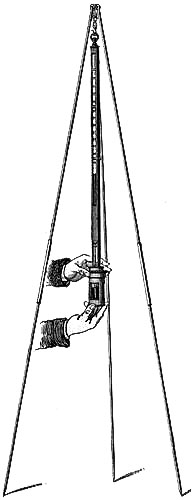
This invention is intended to make mountain and other barometers of standard accuracy stronger, more portable, and less liable to derangement, when being carried about, than heretofore, by dispensing with the ordinary flexible cistern containing the mercury at the bottom of the instrument, and adapting in lieu thereof a rigid cistern constructed of glass and iron. The cistern is composed of a glass cylinder, which is secured in a metallic tube or frame. In order to render the cistern mercury-tight at top and bottom, metal caps are screwed into the tube or frame, and bear against leather washers placed between them and the edges of the glass cylinder. The upper cap of the cistern is tapped with a fine threaded screw to receive the iron plug or socket, into which the barometer tube is securely fixed. The whole length of this plug has a fine screw cut upon it by which the cistern can be screwed up or down. At the side of this plug or socket, extending from the lower end to within half an inch of the top, is cut a groove for admitting the air to the surface of the mercury within the cistern when the barometer is in use. An ivory point is screwed into the under surface of the plug, carrying the barometer tube. This ivory point is very carefully adjusted by measurement to be the zero point of the instrument, from which the barometer scale of inches is divided. The surface of the mercury in the cistern is adjusted to the zero point by screwing the cistern up or down until the ivory point and its reflected image are in contact.
The instrument (fig. 30) is shown in a state of adjustment, ready to take an observation; but when it is desired to render it portable, it must be inclined, until mercury from the cistern fills the tube; the cistern must then be screwed up on the socket, so as to bring the face of the upper cap against the under side of the shoulder of the cover immediately above it; the instrument may then be carried without being liable to derangement.
Precautions necessary in using the Mountain Barometer.—On removing the barometer from its case after a journey, allow it to remain with its scale end downward, whilst the cistern is unscrewed to the extent of one turn of the screw, after which slightly shake the cistern; the mercury in it will then completely fill the end of the barometer tube, should any portion of it have escaped therefrom.
The barometer is then inverted, and if it be desired to make an observation, suspend it vertically from its stand by the ring at top. The cistern must then be unscrewed, until the surface of the mercury is brought just level with the extreme end of the ivory or zero point fixed to the iron plug on which the glass cistern moves up and down.
Should the elevation of the place where the barometer is to be used be considerably above the sea level, it will be well—after suspending it from the stand—to unscrew the cistern several turns, holding the barometer in an oblique position, as at great heights the mercury will fall considerably quicker than the cistern can be unscrewed, thereby filling it to overflowing; but by partly unscrewing the cistern first, room is given for the reception of a fall of mercury to the extent of several inches.
The cistern must not be unscrewed when the Instrument is INVERTED more than two turns of the screw, otherwise the mercury will flow out through the groove.
It is found safer when travelling to carry the barometer in a horizontal position, or with its cistern end uppermost.
To clean the Barometer.—Should at any time the mercury in the cistern become oxidised, and reading from its surface be difficult, it can be readily cleaned by removing the cistern and its contained mercury from the barometer frame by unscrewing it when in a horizontal position; this precaution is necessary that the mercury in the tube may not escape, and thereby allow air to enter. The cistern must then be emptied, and with a dry clean leather, or silk handkerchief, well cleaned.
The operation of cleaning being performed, return the cistern to the frame, and screw it until the face is brought up against the under side of the shoulder, still keeping the instrument horizontal. The cistern is now ready for re-filling, to do which stand the barometer on end head downwards, and remove the small screw at bottom; through the aperture thus opened, pour in mercury, passing it through a paper funnel with a very small aperture. It is well to pass the mercury through a very small funnel two or three times before returning it to the barometer cistern, as by this process all particles of dust or oxide adhere to the paper, and are effectually removed.
Should any small quantity of the mercury be lost during the operation of cleaning, it is of no importance so long as sufficient remains to allow of adjustment to the zero point. This latter constitutes one of the great advantages of this new instrument over the ordinary barometer; for, in the majority of cases, after an instrument has been compared carefully with a standard, should mercury be lost, there is no means of correcting the error unless a standard barometer be at hand; the new barometer is, in this respect, independent, a little mercury more or less being unimportant.
41. Short Tube Barometer.—This is simply a tube shorter, as may be required, than that necessary to show the atmospheric pressure at the sea level. It is convenient for balloon purposes, and for use at mountain stations, being of course a special construction.
42. Method of Calculating Heights by the Barometer.—The pressure of the atmosphere being measured by the barometer, it is evident that as the instrument is carried up a high mountain or elevated in a balloon, the length of the column must decrease as the atmospheric pressure decreases, in consequence of a stratum of air being left below. The pressure of air arises from its weight, or the attraction of gravitation upon it, and therefore the quantity of air below the barometer cistern cannot influence the height of the column. Hence it follows that a certain relation must exist between the difference of the barometric pressure at the foot and at the top of a hill or other elevation, and the difference of the absolute heights above the sea. Theoretical investigation, abundantly confirmed by practical results, has determined that the strata of air decrease in density in a geometrical proportion, while the elevations increase in an arithmetical one. Hence we have a method of determining differences of level, by observations made on the density of the air by means of the barometer. It is beyond our purpose to explain in detail the principles upon which this method is founded, or to give its mathematical investigation. We append Tables, which will be useful to practical persons,—surveyors, engineers, travellers, tourists, &c.,—who may carry a barometer as a travelling companion.
Table I. is calculated from the formula, height in feet = 60,200 (log. 29·922 - log. B) + 925; where 29·922 is the mean atmospheric pressure at 32° F., and the mean sea-level in latitude 45°; and B is any other barometric pressure; the 925 being added to avoid minus signs in the Table.
Table II. contains the correction necessary for the mean temperature of the stratum of air between the stations of observation; and is computed from Regnault’s co-efficient for the expansion of air, which is ·002036 of its volume at 32° for each degree above that temperature.
Table III. is the correction due to the difference of gravitation in any other latitude, and is found from the formula, x = 1 + ·00265 cos. 2 lat.
Table IV. is to correct for the diminution of gravity in ascending from the sea-level.
To use these Tables: The barometer readings at the upper and lower stations having been corrected and reduced to temperature 32° F., take out from Table I. the numbers opposite the corrected readings, and subtract the lower from the upper. Multiply this difference successively by the factors found in Tables II. and III. The factor from Table III. may be neglected unless precision is desired. Finally, add the correction taken from Table IV.
Table I.
Approximate Height due to Barometric Pressure.
Inches. Feet. Inches. Feet. Inches. Feet.
31·0 0 28·2 2475 25·4 5209
30·9 84 ·1 2568 ·3 5312
·8 169 28·0 2661 ·2 5415
·7 254 27·9 2754 ·1 5519
·6 339 ·8 2848 25·0 5623
·5 425 ·7 2942 24·9 5728
·4 511 ·6 3037 ·8 5833
·3 597 ·5 3132 ·7 5939
·2 683 ·4 3227 ·6 6045
·1 770 ·3 3323 ·5 6152
30·0 857 ·2 3419 ·4 6259
29·9 944 ·1 3515 ·3 6366
·8 1032 27·0 3612 ·2 6474
·7 1120 26·9 3709 ·1 6582
·6 1208 ·8 3806 24·0 6691
·5 1296 ·7 3904 23·9 6800
·4 1385 ·6 4002 ·8 6910
·3 1474 ·5 4100 ·7 7020
·2 1563 ·4 4199 ·6 7131
·1 1653 ·3 4298 ·5 7242
29·0 1743 ·2 4398 ·4 7353
28·9 1833 ·1 4498 ·3 7465
·8 1924 26·0 4598 ·2 7577
·7 2015 25·9 4699 ·1 7690
·6 2106 ·8 4800 23·0 7803
·5 2198 ·7 4902 22·9 7917
·4 2290 ·6 5004 ·8 8032
·3 2382 ·5 5106 ·7 8147
Table I.—continued.
Approximate Height due to Barometric Pressure.
Inches. Feet. Inches. Feet. Inches. Feet.
22·6 8262 18·9 12937 15·2 18632
·5 8378 ·8 13076 ·1 18805
·4 8495 ·7 13215 15·0 18979
·3 8612 ·6 13355 14·9 19154
·2 8729 ·5 13496 ·8 19330
·1 8847 ·4 13638 ·7 19507
22·0 8966 ·3 13780 ·6 19685
21·9 9085 ·2 13923 ·5 19865
·8 9205 ·1 14067 ·4 20046
·7 9325 18·0 14212 ·3 20228
·6 9446 17·9 14358 ·2 20412
·5 9567 ·8 14505 ·1 20597
·4 9689 ·7 14652 14·0 20783
·3 9811 ·6 14800 13·9 20970
·2 9934 ·5 14949 ·8 21159
·1 10058 ·4 15099 ·7 21349
21·0 10182 ·3 15250 ·6 21541
20·9 10307 ·2 15402 ·5 21734
·8 10432 ·1 15554 ·4 21928
·7 10558 17·0 15707 ·3 22124
·6 10684 16·9 15861 ·2 22321
·5 10812 ·8 16016 ·1 22520
·4 10940 ·7 16172 13·0 22720
·3 11069 ·6 16329 12·9 22922
·2 11198 ·5 16487 ·8 23126
·1 11328 ·4 16646 ·7 23331
20·0 11458 ·3 16806 ·6 23538
19·9 11589 ·2 16967 ·5 23746
·8 11721 ·1 17129 ·4 23956
·7 11853 16·0 17292 ·3 24168
·6 11986 15·9 17456 ·2 24381
·5 12120 ·8 17621 ·1 24596
·4 12254 ·7 17787 12·0 24813
·3 12389 ·6 17954 11·9 25032
·2 12525 ·5 18122 ·8 25253
·1 12662 ·4 18291 ·7 25476
19·0 12799 ·3 18461 ·6 25700
Table II.
Correction due to Mean Temperature of the Air.
Mean Temp. Factor. Mean Temp. Factor. Mean Temp. Factor.
10° 0·955 35° 1·006 60° 1·057
11 ·957 36 1·008 61 1·059
12 ·959 37 1·010 62 1·061
13 ·961 38 1·012 63 1·063
14 ·963 39 1·014 64 1·065
15 ·965 40 1·016 65 1·067
16 ·967 41 1·018 66 1·069
17 ·969 42 1·020 67 1·071
18 ·971 43 1·022 68 1·073
19 ·974 44 1·024 69 1·075
20 ·976 45 1·026 70 1·077
21 ·978 46 1·029 71 1·079
22 ·980 47 1·031 72 1·081
23 ·982 48 1·033 73 1·083
24 ·984 49 1·035 74 1·086
25 ·986 50 1·037 75 1·088
26 ·988 51 1·039 76 1·090
27 ·990 52 1·041 77 1·092
28 ·992 53 1·043 78 1·094
29 ·994 54 1·045 79 1·096
30 ·996 55 1·047 80 1·098
31 0·998 56 1·049 81 1·100
32 1·000 57 1·051 82 1·102
33 1·002 58 1·053 83 1·104
34 1·004 59 1·055 84 1·106
Table III.
Latitude. Factor. Latitude. Factor. Latitude. Factor.
80° 0·99751 50 0·99954 20 1·00203
75 0·99770 45 1·00000 15 1·00230
70 0·99797 40 1·00046 10 1·00249
65 0·99830 35 1·00090 5 1·00261
60 0·99868 30 1·00132 0 1·00265
55 0·99910 25 1·00170
Table IV.
Height in Thousand Feet. Correction Additive. Height in Thousand Feet. Correction Additive.
1 3 14 44
2 5 15 48
3 8 16 52
4 11 17 56
5 14 18 60
6 17 19 65
7 20 20 69
8 23 21 74
9 26 22 78
10 30 23 83
11 33 24 88
12 37 25 93
13 41 26 98
Example 1. On October 21st, 1852, when Mr. Welsh ascended in a balloon, at 3h. 30m. p.m., the barometer, corrected and reduced, was 18·85, the air temperature 27°, while at Greenwich, 159 feet above the sea, the barometer at the same time was 29·97 inches, air temperature 49°, the balloon not being more than 5 miles S.W. from over Greenwich; required its elevation.
Feet.
Barometer in Balloon 18·85, Table I. = 13007
" at Greenwich 29·97 " 883
12124
Mean Temperature, 38°, Table II. Factor 1·012
12269·
Latitude 51½°, Factor from Table III. ·99941
12262
Correction from Table IV. 38
12300
Elevation of Greenwich 159
"Balloon 12459feet.
The following examples, from the balloon ascents of J. Glashier, Esq., F.R.S., will serve for practice.[4]
2. Ascended from Wolverhampton, 18th August, 1862, at 2h. 38m. p.m.; barometer (in all cases corrected and reduced to 32° F) was 14·868, the temperature of the air 26°; at the same time, at Wrottesley Hall, 531 feet above the sea, in latitude 52½° N, the barometer was 29·46, and the temperature of the air 65°·4; find the elevation of the balloon above the sea.
Height, 18,959 feet.
3. From the same place an ascent was made 5th September, 1862, when at 1h. 48m. p.m. barometer was 11·954, air O°; at Wrottesley Hall 29·38, air 56°.
Height, 23,923 feet.
4. From the Crystal Palace a balloon ascent was made 20th August, 1862. At 6h. 47m. p.m. barometer was 25·55, air 50°·5; and at the same time at Greenwich Observatory, at 159 feet above the sea, the barometer was 29·81, air 63°.
Height, 4,406 feet.
5. From the same place an ascent was made 8th September, 1862. At 5 p.m., the balloon being over Blackheath, barometer was 25·60, and the air 49°·5, while at Greenwich, barometer was 29·92, air 66°·4.
Height, 4,461 feet.