Chapter XVI
Reading edition
INSTRUMENTS NOT DESCRIBED IN THE PRECEDING CHAPTERS.
145. Chemical Weather Glass.—This curious instrument appears to have been invented more than a hundred years ago, but the original maker is not known. It is simply a glass vial about ten inches long and three quarters of an inch in diameter, which is nearly filled, and hermetically sealed, with the following mixture:—Two drachms of camphor, half a drachm of nitrate of potassium, half a drachm of chlorate of ammonium, dissolved in about two fluid ounces of absolute alcohol mixed with two ounces of distilled water. All the ingredients should be as pure as possible, and each vial filled separately. When the instruments are made in numbers and filled from a common mixture, some get more than the due proportion of the solid ingredients, and consequently such glasses do not exhibit that uniformity of appearance and changes, that undoubtedly should accompany similar influencing circumstances. It is in consequence of a want of precision and fixed principle of manufacture, that these interesting instruments are not properly appreciated, and more generally used.
The glass should be kept quite undisturbed, exposed to the north, and shaded from the sun. Camphor is soluble in alcohol, but not in water, while both water and alcohol have different solvent powers, according to the temperature; hence, the solid ingredients being in excess for certain conditions of solution, depending upon temperature chiefly, and perhaps electricity and the action of light also, appear as crystals and disappear with the various changes that occur in the weather.
The various appearances thus presented in the menstruum have been inferred to prognosticate atmospheric changes. The following rules have been deduced from careful study of the glass and weather:—
1. During cold weather, beautiful fern-like or feathery crystallization is developed at the top, and sometimes even throughout the liquid. This is the normal state of the glass during winter. The crystallization increases with the coldness; and if the structure grows downward, the cold will continue.
2. During warm and serene weather, the crystals dissolve, the upper and greater part of the liquid becoming perfectly clear. This is the normal state of the glass during summer. The less amount of crystallization, that is, the greater the clear portion of the liquid (for there is always some of the composition visible at the bottom), the greater the probability of continued fine dry weather.
3. When the upper portion is clear, and flakes of the composition rise to the top and aggregate, it is a sign of increasing wind and stormy weather.
4. In cold weather, if the top of the liquid becomes thick and cloudy, it denotes approaching rain.
5. In warm weather, if small crystals rise in the liquid, which still maintains its clearness, rain may be expected.
6. Sharpness in the points and features of the fern-like structure of the crystals, is a sign of fine weather; but when they begin to break up, and are badly defined, unsettled weather may be expected.
Admiral FitzRoy, in The Weather Book, writes of this instrument as follows:—“Since 1825, we have generally had some of these glasses, as curiosities rather than otherwise; for nothing certain could be made of their variations until lately, when it was fairly demonstrated that if fixed undisturbed in free air, not exposed to radiation, fire, or sun, but in the ordinary light of a well-ventilated room, or, preferably, in the outer air, the chemical mixture in a so-called storm-glass varies in character with the direction of the wind—not its force, specially (though it may so vary in appearance, only from another cause, electrical tension).
“As the atmospheric current veers toward, comes from, or is only approaching from the polar direction, this chemical mixture—if closely, even microscopically watched—is found to grow like fir, yew, fern leaves, or hoar-frost—or like crystallizations.
“As the wind, or great body of air, tends more from the opposite quarter, the lines or spikes—all regular, hard, or crisp features—gradually diminish, till they vanish.
“Before, and in a continued southerly wind, the mixture sinks slowly downward in the vial, till it becomes shapeless, like melting white sugar.
“Before, or during the continuance of a northerly wind (polar current), the crystallizations are beautiful (if the mixture is correct, the glass a fixture, and duly placed); but the least motion of the liquid disturbs them.
“When the main currents meet, and turn toward the west, making easterly winds, stars are more or less numerous, and the liquid dull, or less clear. When, and while they combine by the west, making westerly winds, the liquid is clear, and the crystallization well-defined, without loose stars.
“While any hard or crisp features are visible below, above, or at the top of the liquid (where they form for polar winds), there is plus electricity in the air; a mixture of polar current co-existing in that locality with the opposite, or southerly.
“When nothing but soft, melting, sugary substance is seen, the atmospheric current (feeble or strong as it may be) is southerly with minus electricity, unmixed with, and uninfluenced by, the contrary wind.
“Repeated trials with a delicate galvanometer, applied to measure electric tension in the air, have proved these facts, which are now found useful for aiding, with the barometer and thermometer, in forecasting weather.
“Temperature affects the mixture much, but not solely; as many comparisons of winter with summer changes of temperature have fully proved.
“A confused appearance of the mixture, with flaky spots, or stars, in motion, and less clearness of the liquid, indicates south-easterly wind, probably strong to a gale.
“Clearness of the liquid, with more or less perfect crystallizations, accompanies a combination, or a contest, of the main currents, by the west, and very remarkable these differences are,—the results of these air currents acting on each other from eastward, or from an entirely opposite direction, the west.
“The glass should be wiped clean now and then,—and once or twice a year the mixture should be disturbed, by inverting and gently shaking the glass vial.”
Fig. 93.
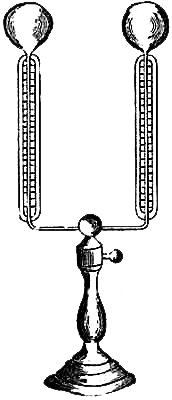
146. Leslie’s Differential Thermometer.—A glass tube having a large bulb at each extremity, and bent twice at right angles, as represented in figure 93, containing strong sulphuric acid tinged with carmine, and supported at the centre by a wooden stand, constitutes the differential thermometer as invented by Professor Leslie. The instrument is designed to exhibit and measure small differences of temperature. Each leg of the instrument is usually from three to six inches long, and the balls are about four inches apart. The calibre of the legs is about 1⁄50 inch, not more; the other part of the tube may be wider. The tube is filled with the liquid, the bulbs contain air. When both bulbs are heated alike, each scale indicates zero. The scale is divided so that the space between the freezing and the boiling-points of water is equal to 1,000 parts. When one bulb is heated more than the other, the difference of temperature is delicately shown by the descent of the coloured fluid from the heated ball. It is uninfluenced by changes in the temperature of the atmosphere; hence it is admirably adapted for experiments of radiant heat. The theory of the instrument is that gases expand equally for uniform increments of heat.
147. Rumford’s Differential Thermometer differs from that just described in simply containing only a small bubble of liquid, which lies in the centre of the tube, when both bulbs are similarly influenced. The bulbs and other parts of the tube contain air. When one bulb is more heated than the other, the bubble moves towards the one less heated; and the scale attached to the horizontal part of the tube affords a measurement of the difference of temperature.
Fig. 94.
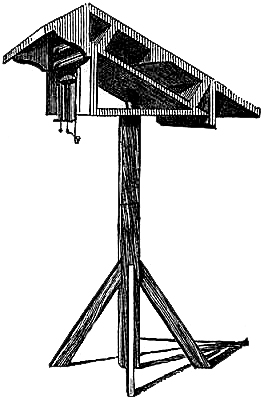
148. Glaisher’s Thermometer Stand.—The thermometer stand consists of a horizontal board as a base, of a vertical board projecting upwards from one edge of the horizontal one, and of two parallel inclined boards, separated from each other by blocks of three inches in thickness, connected at the top with the vertical, and at the bottom with the horizontal board, and the air passes freely about and between them all. To the top of the inclined boards is connected a small projecting roof to prevent the rain falling on the bulbs of the instrument, which are carried on the face of the vertical board, with their bulbs projecting below it, so that the air plays freely on the bulbs from all sides. The whole frame revolves on an upright post firmly fixed to the ground, as shown in the engraving, fig. 94; and in use, the inclined side is always turned towards the sun.
149. Thermometer Screen, for use at Sea.—This screen, or shade, was designed by Admiral FitzRoy, and has been in use for several years on board H.M. vessels and many merchant-ships. It is about twenty-four inches long by twelve wide and eight deep; having lattice-work sides, door, and bottom; with perforation also at top, so contrived that the air has free access to the interior, while the direct rays of the sun, rain, and sea spray are effectually excluded from the thermometers mounted inside. There is ample space for two thermometers placed side by side on brackets, at least three inches from each other or any part of the exterior of the screen. One thermometer should be fitted up as a “wet bulb” (see p. 105). A small vessel of water can easily be fixed inside the screen so as to retain its position and contents under the usual motions of the ship; and by means of a piece of cotton-wick, or muslin rag tied round the bulb of the thermometer and trailing into the cup of water, keep the bulb constantly moist.
Self-registering thermometers should be protected by a similar screen. It has been found that thermometric observations made at sea are not valuable for scientific purposes unless the instruments have been duly protected by such a screen.
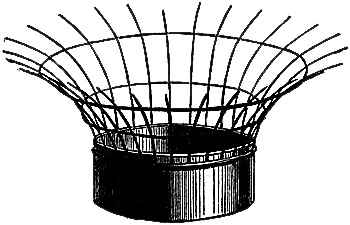
Fig. 95.
150. Anemoscope, or Portable Wind Vane for travellers, with compass, bar needle, &c., shows the direct course of the wind to half a point of the compass.
151. Evaporating Dish, or Gauge (fig. 95), for showing the amount of evaporation from the earth’s surface. This gauge consists of a brass vessel, the area or evaporating surface of which is accurately determined; and also a glass cylindrical measure, graduated into inches, tenths, and hundredths of inches. In use, the evaporating gauge is nearly filled with water, the quantity having been previously measured by means of the glass cylinder; it is then placed out of doors, freely exposed to the action of the atmosphere; after exposure, the water is again measured, and the difference between the first and second measurement shows the amount of evaporation that has taken place. If rain has fallen during the exposure of the gauge, the quantity collected by it must be deducted from the measured quantity; the amount is shown by the quantity of rain collected in the rain gauge. The wire cage round the gauge is to prevent animals, birds, &c., from drinking the water.
152. Dr. Babington’s Atmidometer, or instrument for measuring the evaporation from water, ice or snow, consists of an oblong hollow bulb of glass or copper, beneath which and communicating with it by a contracted neck is a second globular bulb, duly weighted with mercury or shot. The upper bulb is surmounted by a small glass or metal stem, having a scale graduated to grains and half-grains; on the top of which is fixed horizontally a shallow metal pan. The bulbs are immersed in a vessel of water having a circular hole in the cover through which the stem rises. Distilled water is then gradually poured into the pan above, until the zero of the stem sinks to a level with the cover of the vessel. Thus adjusted, as the water in the pan evaporates, the stem ascends, and the amount of evaporation is indicated in grains. This instrument affords a means of measuring evaporation from ice or snow. An adjustment for temperature is necessary.
153. Cloud Reflector.—At the International Exhibition 1862, Mr. J. T. Goddard exhibited a cloud mirror, for ascertaining the direction in which the clouds are moving.
The mirror is laid on a horizontal support near a window, and fastened so that the point marked north may coincide with the south point of the horizon,—the several points will consequently be reversed. The edge of a conspicuous cloud is brought to the centre of the mirror, and the observer keeps perfectly still until it passes off at the margin, where the true point of the horizon from which the clouds are coming can be read off.
154. Sunshine Recorder.—Mr. Goddard also exhibited an instrument which he calls by this name. It works by letting the sun’s rays pass through a narrow slit, and fall on photographic paper wound round a barrel moved by clock-work; the paper being changed daily, and the photographic impression developed and fixed in the usual manner.[19]
155. SET OF PORTABLE INSTRUMENTS.
In a small box, 8 in. by 8 in. by 4 in., a complete set of meteorological instruments have been packed. The lid of the box, by an ingenious arrangement, is made to take off and hang up; on it are permanently fixed for observation, a maximum and minimum, and a pair of dry and wet bulb thermometers. The interior of the box contains a maximum thermometer in vacuo for solar radiation, and a minimum for terrestrial purposes, one of Negretti and Zambra’s small pocket aneroid barometers, pedometer for measuring distances, pocket compass, clinometer, and lastly a rain gauge. This latter instrument consists of an accurately turned brass ring having an india rubber body fastened to it to receive the rain, which is measured off by a small graduated glass, also contained in the box. Gentlemen travelling will find this compact observatory all that can be desired for meteorological observations.
156. IMPLEMENTS.
The practical meteorologist will find the following articles very useful, if not necessary. They scarcely require description; an enumeration will therefore suffice:—Weather Diagrams, or prepared printed and ruled forms, whereon to exhibit graphically the readings of the various instruments to render their indications useful in foretelling weather, &c.;—Meteorological Registers, or Record Books, for recording all observations, and the deductions;—Cloud Pictures, by which the clouds can be readily referred to their particular classification, very necessary to the inexperienced and learners;—Cyclone Glasses, or Horns, outline Maps with Wind-markers, are also useful, especially in forecasting weather.
Fig. 96.

Fig. 97.

157. HYDROMETER.
A simple kind of hydrometer is very much used at sea, as “a sea-water test;” and as the observations are usually recorded in a meteorological register or the ship’s log-book, it may not be altogether out of place to give a description of it here.
It is constructed of glass. If made of brass, the corrosive action of salt-water soon renders the instrument erroneous in its indications. The shapes usually given to the instruments are shown in figs. 96 and 97. A globular bulb is blown, and partly filled with mercury or small shot, to make the instrument float steadily in a vertical position. From the neck of the bulb the glass is expanded into an oval or a cylindrical shape, to give the instrument sufficient volume for flotation; finally, it is tapered off to a narrow upright stem which encloses an ivory scale, and is closed at the top. The divisions on the scale read downward, so as to measure the length of the stem which stands above the surface of any liquid in which the hydrometer is floated. The denser the fluid, the higher will the instrument rise; the rarer, the lower it will sink.
The indications depend upon the hydrostatic principle, that floating bodies displace a quantity of the fluid which sustains them equal to their own weight. According, therefore, as the specific gravities of fluids differ from each other, so will vary the quantities of the fluids displaced by the same body when floated successively in each.
The specific gravity of distilled water, at the temperature of 62° F, being taken as unity, the depth to which the instrument sinks when gently immersed in such water is the zero of the scale. The graduations extend from 0 to 40; the latter being the mark which will be level with the surface when the instrument is placed in water, the specific gravity of which is 1·040. In recording observations, the last two figures only—being the figures on the scale—are written down. Sea-water usually ranges from 1·020 to 1·036.
A small tin, copper, or glass cylinder is useful for containing the water to be tested. It should be wider than the hydrometer, and always filled to the brim. If fitted to a stand, which is supported by gimbals, it will be very convenient. Water in a bucket, basin, or other wide vessel, acquires motion at sea, and the eye cannot be brought low enough (on account of the edges) to read off the scale accurately.
Errors of observation may occur with the hydrometer, if it be put into water without being clean, or without being carefully wiped. The instrument is extremely accurate if correctly used. It should be kept free from contact with the sides of the vessel; and all dust, smears, or greasiness, should be scrupulously avoided, by carefully wiping it with a clean cloth before and after use.
Whenever the temperature of the water tested differs from 62°, a correction to the reading is necessary, for the expansion or contraction of the glass, as well as the water itself, in order to reduce all observations to one generally adopted standard.
Negretti and Zambra’s hydrometer, with thermometer in the stem, shows the density and temperature in one instrument.
For the following Tables we are indebted to the kindness of Admiral FitzRoy:—
Table for reducing observations made with a Brass Hydrometer, assuming the linear expansion of brass to be 0·000009555 for 1° F. The correction is additive for all temperatures above 62°, and subtractive for temperatures below 62°.
t° Correction. t° Correction. t° Correction. t° Correction.
32 -0·0014 48 -0·0010 64 +0·0002 80 +0·0020
33 ·0014 49 ·0009 65 ·0003 81 ·0021
34 ·0014 50 ·0009 66 ·0004 82 ·0023
35 ·0014 51 -0·0008 67 ·0005 83 ·0024
36 ·0014 52 ·0008 68 +0·0006 84 ·0026
37 ·0014 53 ·0007 69 ·0007 85 +0·0027
38 -0·0014 54 ·0006 70 ·0008 86 ·0029
39 ·0013 55 ·0006 71 ·0009 87 ·0030
40 ·0013 56 -0·0005 72 ·0010 88 ·0032
41 ·0013 57 ·0004 73 ·0011 89 ·0033
42 ·0013 58 ·0003 74 +0·0013 90 +0·0035
43 ·0012 59 ·0003 75 ·0014 91 ·0036
44 -0·0012 60 ·0002 76 ·0015 92 ·0038
45 ·0011 61 -0·0001 77 ·0016 93 ·0040
46 ·0011 62 0·0000 78 ·0018 94 ·0041
47 -0·0010 63 +0·0001 79 +0·0019 95 +0·0043
Table for reducing observations made with a Glass Hydrometer, assuming the linear expansion of glass to be 0·00000463 for 1° F. The correction is additive for temperatures above 62°, and subtractive for temperatures below 62°.
t° Correction. t° Correction. t° Correction. t° Correction.
32 -0·0019 48 -0·0012 64 +0·0002 80 +0·0023
33 ·0019 49 ·0011 65 ·0003 81 ·0024
34 ·0018 50 ·0011 66 ·0004 82 ·0026
35 ·0018 51 -0·0010 67 ·0005 83 ·0027
36 ·0018 52 ·0009 68 +0·0007 84 ·0029
37 ·0017 53 ·0008 69 ·0008 85 +0·0031
38 -0·0017 54 ·0008 70 ·0009 86 ·0032
39 ·0017 55 ·0007 71 ·0010 87 ·0034
40 ·0016 56 -0·0006 72 ·0012 88 ·0036
41 ·0016 57 ·0005 73 ·0013 89 ·0037
42 ·0015 58 ·0004 74 +0·0014 90 +0·0039
43 ·0015 59 ·0003 75 ·0016 91 ·0041
44 -0·0014 60 ·0002 76 ·0017 92 ·0042
45 ·0014 61 -0·0001 77 ·0018 93 ·0044
46 ·0013 62 0·0000 78 ·0020 94 ·0046
47 -0·0013 63 +0·0001 79 +0·0021 95 +0·0048
158. NEWMAN’S SELF-REGISTERING TIDE-GAUGE.
At places where the phenomena of the tides are of much maritime importance, a continuous series of observations upon the rise and fall, and times of change, is essentially necessary as a basis for the construction of good tide tables; and as such observations should also be accompanied with the registration of atmospheric phenomena, we have no hesitation in inserting a description of an accurate self-registering tide-gauge.
The tide-gauge, as shown in the illustration, consists of a cylinder, A, which is made to revolve on its axis once in twenty-four hours by the action of the clock, B. A chain, to which is attached the float, D, passes over the wheel, C, and on the axis of this wheel, C (in about the middle of it) is a small toothed wheel, placed so as to be in contact with a larger toothed wheel carrying a cylinder, E, over which passes another smaller chain. This chain, passing along the upper surface of the cylinder, A, and round a second cylinder, F, at its further end, is acted on by a spring so as to be kept in a constant state of tension. In the middle of this chain a small tube is fixed for carrying a pencil, which, being gently pressed down by means of a small weight on the top of it, performs the duty of marking on paper placed round the cylinder the progress of the rise or fall of the tide as the cylinder revolves, and as it is drawn by the chain forward or backward by the rise or fall of the float. The paper is prepared with lines equidistant from each other, to correspond with the hours of the clock, crossed by others showing the number of feet of rise and fall.
Larger Image
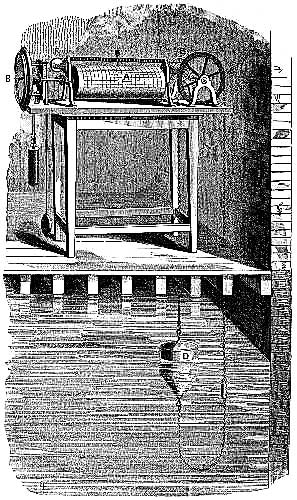
The cylinder while in action revolves from left to right to a spectator facing the clock, and the pencil is carried horizontally along the top of the cylinder; and the large wheel being made to revolve by the rise and fall of the float, turns the wheel with the small cylinder, E, attached to it. If the tide is falling, the small chain is wound round the cylinder, E, and the pencil is drawn towards the large wheel; but if the tide is rising, the small chain is wound on to the cylinder, F, by means of the spring contained in it, which constantly keeps it in a state of tension. Thus, by means of the rise and fall of the tide, a lateral progress is given to the pencil, while the cylinder is made to revolve on its axis by the clock, so that a line is traced on the paper showing the exact state of the tide continuously, without further attention than is necessary to change the paper once every day, and to keep the pencil carefully pointed; or a metallic pencil may be used, which will require little, if any, attention.
A good self-registering tide-gauge is a valuable and important acquisition wherever tidal observations are required, and the only perfectly efficient instrument of this kind is that invented by the late Mr. John Newman, of Regent Street, London. It is now in action in several parts of the world, silently and faithfully performing its duty, requiring no other kind of attention than that of a few minutes daily, and thus admitting the employment of the person on any other service whose duty it would otherwise have been to have registered the tide. It has done much by its faithful records in contributing to the construction of good tide tables for many places; for those unavoidable defects dependent on merely watching the surface on a divided scale are set aside by it, all erroneous conclusions excluded, and a true delineation of Nature’s own making is preserved by it for the theorist.