Front matter (continued 4)
Reading edition
While drinking and wading in the stream, we were fired upon from the opposite shore, although a flag of truce had been raised. The Indians’ bullets fell short of their mark, but the retreat was sounded, and we marched back for the open prairie, and returned to our camp, which was situated on a beautiful plateau a few miles below. The brush was so thick that the Indians were obliged to abandon all of their carts and camp equipage, with thousands of buffalo robes, and tons of dried meat. The rout of the Indians and destruction of property was complete.
Our casualties were very light; but, among the killed was Lieutenant Beaver, an English lord, who came to this country to engage in a buffalo hunt; but, upon his arrival, learning of the Indian outbreak, tendered his services to the Government, and was commissioned a lieutenant on General Sibley’s staff, as aide-de-camp. He had been sent by General Sibley with an order to Colonel Crooks, who was in command of the advance, and, on his return, he and his beautiful black horse were killed.
Colonel Crooks said to Lieutenant Beaver that the regiment would return as soon as the skirmishers could be rallied, and invited him to remain and ride with him back to camp, but the aide, true soldier that he was, felt it his duty to report to General Sibley at once, and paid the penalty.
The Indians, some at least, not being able to cross the river, were in hiding, and others had re-crossed, and were skulking in the thick brush, waiting for a chance to shoot with arrows. Lieutenant Beaver had mistaken the path he came in on, and took one that led him on to some of these skulking Indians, and he thus met his death.
Colonel Crooks returned, and though Lieutenant Beaver messed with him, his tent was at General Sibley’s headquarters, and his absence from mess was not noticed until, upon inquiry at the General’s tent, it was found he had not reported. The sudden disappearance of one who was such a general favorite cast a gloom over the camp.
As soon as it became dark fire rockets were sent up, in hopes that if he was wandering away, through taking a wrong road, he might be guided back to camp. The early morning found us astir, for a detail of my regiment had been made to reconnoiter and to skirmish clear down to the bank of the river, in order to gain tidings of Lieutenant Beaver, and, also, of Private Miller, of the Sixth Regiment, who also was missing.
The reconnoissance proved successful, and both bodies were found, as well as the body of the lieutenant’s horse. Lieutenant Beaver had evidently made a desperate fight for his life, because his two revolvers were empty, and the indications were that he had made more than one of the enemy bite the dust.
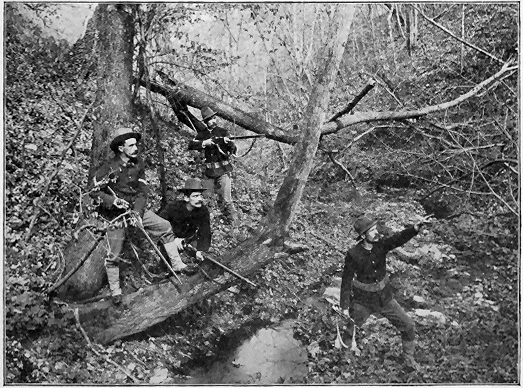
Sighting the Enemy on the Missouri.
The bodies were brought to camp and prepared for burial in the trenches on opposite sides of the camp, and the work was so done as to obliterate all signs and prevent the Indians from locating the spots and desecrating the graves. The service was touchingly solemn, and many tears were shed, as we thought of these lonely graves so far away from the homes of the living relatives.
Lieutenant Beaver had friends in England who were abundantly able to have his remains disinterred and removed to a more suitable place of burial. Money was sent out from England for this purpose, and trusted agents sent up to the Missouri banks for the purpose of bringing back the remains. There is a grave at Graceland, in St. Paul, on the top of which rests a slab of granite, and engraven on this are the words:
“Sacred to the memory of Lieutenant F. J. H. Beaver, who died July 28, 1863. Peace to his ashes.”
On the banks of the Missouri is a lonely grave. The winter’s storms and the summer’s heat have come and gone. The night vigils of the strange birds have been kept, the requiem of gentle breezes has been sung over this lonely grave. Comrade Nicholas Miller, private of Company K, Sixth Minnesota Infantry Volunteers, sleeps in his lonely bed, and “after life’s fitful fever he sleeps well.”
CHAPTER XLI.
HOMEWARD BOUND.
We remained but two days at this Missouri camp, when the reveille sounded early in the morning of August 1st, and the troops were astir. We were a long way from home, and on short rations; and, in addition to this, we felt some anxiety about the boys we left at Camp Atchison, having heard nothing from them. The sun was very hot the day we left; one of the kind the boys called “muggy,”—disagreeable in the extreme. At dress parade the night before, we received the compliments of the General in orders read, announcing that the purpose of the expedition had been accomplished. This was, of course, good news to us, and we speculated as to how early a date would find us taking leave of this far-away camp.
The scouts reported to the General that Indians had been crossing the river below us all day long, and the indications were that they intended to make an attack about midnight, in order to steal our teams. With this information before him, General Sibley ordered one-half the command out on guard, and the balance to lay on their arms. In an hour or so another order came, for the balance of the command to reinforce the guard, because there surely would be an attack, and it did come about twelve o’clock; but the attempt to capture the teams miscarried; for, after a few shots, the Indians retired. Having lost nearly all of their wagons and cured meat, they were in a desperate condition, and a commissary train would have been a rich prize.
On the morning we left it was astonishing how quickly we got ready, and how lonesome the canvas city looked after the bugle sounded “strike tents.” We marched out this fine morning with our banners flying, and the band playing “The Girl I Left Behind Me.”
There were no regrets, for the “beautiful Indian maiden” had not made a favorable impression on us, and we had our own little families at home.
The Sixth Minnesota was in the rear, and we were hardly beyond the limits of the camp before the Indians had taken possession and commenced firing on our rear guard. The Colonel gave the necessary commands to bring us to a “right about,” with orders to “commence firing.” The orders came in quick succession, and were such a surprise to the Indians that they took to their heels with great alacrity. They hovered about us during all the day, but did not in the least retard us in our homeward march. We were instructed to supply ourselves with water before starting, because we must march eighteen miles, to Apple river bend, before we could get a fresh supply.
The day was excessively warm, and the men became thirsty; but, behold! we look away, and a beautiful lake appears before us. “Water! water!” cry the thirsty men, and our canteens were soon empty, in anticipation of refilling them from the bosom of this beautiful lake before us. We march and thirst again, and the beautiful lake seems just as far away.
“It’s two miles to that lake,” says one thirsty soul. We march the two miles, and yet are two miles away, and the thirst and heat are intolerable.
“Surely that’s water,” said another, “but we don’t seem to get any nearer to it.”
We marched and marched; but we must be in a valley, for the lake is out of sight.
“When we get over the ridge we’ll see the beautiful lake,” comes from some one in the ranks.
We got over the ridge, but the beautiful lake, in all its refreshing loveliness, had vanished. Had it evaporated, or had it sunk into the ground? Neither. We had been deceived,—it was a mirage! The air was hot, the earth parched, the throats dry, the canteens empty, and we were yet eight miles from water.
Eight long, weary miles to go before we reach the bend in Apple river, but there was no help for it, and we bear to it with our soldier load. “Five miles farther,” says the scout, and our hearts almost stop beating, we are so parched; three miles, and on we march; only one mile more, and we would run if we could. We reach the bank, and the Colonel commands: “Battalion, halt!” but the refreshing water is too near, and the famishing men make a run for it, and do not stop until they are in waist deep, and then they drink to their fill and replenish their canteens.
On our return march we passed nearly over the same ground as we did going out. We passed the battlefield of the Big Mound, and went into camp by the lake where Lieutenant Freeman was killed; this was on the 4th of August. The next day our scouts reported “Indians ahead,”—a false alarm,—the Indians espied were half-breeds bringing us mail from Camp Atchison, and also the news that George A. Brackett, who was with Lieutenant Freeman when he was killed, had made his way, after weary days and nights of wandering, and in a half-starved condition, to Camp Atchison, where he fell among friends.
When we arrived at Camp Atchison it took but a day to arrange for our final departure. Lieutenant Freeman’s body had been recovered and buried, and the place so marked that it was easily found afterwards, when the body was removed and taken to his home for final interment.
We drew five days’ rations of hard tack and bacon, and the side dishes that go with it; just what they were I cannot now remember. I guess the dear old army bean was one and desiccated vegetable another; anyway, we were not troubled with the gout from too much eating of rich food. The surgeons made proper provision for the transportation of the sick by placing them in ambulances, and at an early hour the headquarters’ bugler sounded “strike tents,” and the canvas city was razed to the ground;—Camp Atchison was a back number.
The command took up the line of march for Fort Snelling, where we expected to receive orders to proceed at once to join the Union Army in the South. We were a jolly crowd, and the march seemed but a pleasant pastime; we had driven the enemy out of the country, and, save the first two or three days of our return march, he was giving us no trouble. We made good time, and the nearer we got home the shorter the miles became.
When we got down to civilization we were accorded an ovation; especially was this the case at Minneapolis, where the whole city turned out to bid us welcome.
We arrived at Fort Snelling on the morning of September 12th, after having made a march of more than twelve hundred miles;—and thus ended the campaign of 1863.
CHAPTER XLII.
THE CAMPAIGN OF 1864.
My active work in the Sioux Indian war ended in the autumn of 1863, and the regiment went South, but history has made me familiar with the campaign of 1864, and I thus devote space to it, so as to follow the troops and Indians to the culmination and final successful closing of the greatest Indian war of modern times.
The return of General Sibley from the Missouri campaign of 1863 did not end the Sioux war, because, while the Indians had been defeated in five pitched battles in 1862 and ’63, yet they were known to be in large numbers, ready to take the field again in 1864, as soon as the weather would permit. Such being the case, it became necessary to organize against them.
To this end another expedition was fitted out from the Minnesota side, which was to co-operate with General Sully from the Missouri side. General Sully, on account of the low stage of water in the Missouri in 1863, was unable to co-operate with General Sibley, as was intended, and on August 1st, 1863, and when General Sibley’s order for the homeward march was promulgated, General Sully was one hundred and sixty miles farther down the river than it was intended he should be. This was the reason why the Indians were not more severely whipped than they were. It would have been suicidal for General Sibley to have crossed the Missouri river at this time, with rations and ammunition as scarce as they were.
The Indians took advantage of the situation and evinced a determination to take the field again. A cavalry regiment had been authorized by the War Department for one year and for frontier service. This regiment was filled to the maximum, and placed in command of Colonel R. N. McLaren.
A battalion had been raised previous to this, known as Hatch’s battalion, and was on duty near Pembina, and by this wise provision confidence was restored in this part of the country.
The Indians still had undisputed possession of the country west of the Missouri, and, although they may have been peaceable, it was necessary to settle the question permanently, and place them on their reservations.
The plan of the campaign of 1864 was very similar to that of the year previous, excepting in the matter of command, the two columns,—the one from the Minnesota side and the other from the Missouri side,—were to combine and become two brigades, under the command of General Sully.
The first brigade was composed of Iowa and Kansas infantry, and they embarked at Sioux City, Iowa, and proceeded up the Missouri. The second brigade embraced the Eighth Minnesota Infantry, mounted on ponies, Colonel M. T. Thomas in command; the Second Minnesota Cavalry, Colonel McLaren; and the Third Minnesota Battery, Captain John Jones. This brigade was in command of Colonel Thomas, and left Fort Snelling on June 1st.
General Sibley and staff accompanied this brigade of 2,100 men as far as Fort Ridgely, where he gave them their final orders.
Colonel Thomas, who considered General Sibley a man of ability, thought him too cautious, and, in response to his final orders, said: “General, I am going to hunt for Indians; if they will hunt for and find me it will save a heap of trouble.”
It was a beautiful morning on June 5th, and as the first rays of the morning sun flashed the full light of day, “boots and saddles” sounded in the clear tones of the bugles, and the column, headed by a magnificent band, mounted on milk white horses, marched out to the tune of “The Girl I Left Behind Me.”
The General reviewed the column as it passed, and after complimenting the appearance of the soldiers and bidding good-bye to Colonel Thomas and his staff, who were starting on a five months’ campaign beyond the bounds of civilization, rode back to the fort.
The column was now under way, and day after day the march went on, in solid square, so organized that all the Indians in North America could not disturb it. At night the square closed up, so as to ensure greater safety and reduce guard duty.
The column moved up the valley of the Minnesota river to its source, and then took a westerly course, making daily from sixteen to twenty miles, resting on Sunday.
The scouts, failing to find even signs of Indians, the march became monotonous until the valley of the Missouri was reached. Here was found General Sully’s trail of the year previous, and soon some of his scouts came into camp and reported General Sully only one day’s march away, where he was waiting for the fleet of boats on which were supplies for the troops.
The monotony of the daily march was enlivened by the report that Indians were hovering around,—they came to reconnoiter, but not to fight yet. This of itself was encouraging, because the boys began to think they would not even see an Indian; but there was fun ahead, as we shall see in the next chapter.
CHAPTER XLIII.
THE BATTLE OF THE BAD LANDS.
General Sully, an unpretentious man, with clear perception, appeared to know where the Indians were, and what they would do. His service in the regular army peculiarly fitted him for this service, and this, with his genial temperament, made him an agreeable commander.
The boats were unloaded, the command supplied with sixty days’ rations and divested of all surplus clothing and equipments, made ready for a vigorous march after Indians.
The troops were reviewed by the commanding officer, General Sully, who, by the way, was at one time Colonel of the First Minnesota, and afterwards promoted to Major-General of Volunteers and Brevet Brigadier-General of the regular army. The review of the troops constituted the celebrating the Fourth of July, 1864.
When the column finally moved, which was on July 19, it marched out into an unknown and unexplored country, from the white man’s standpoint.
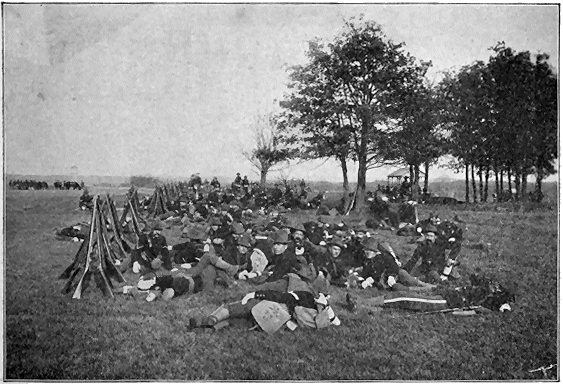
Resting Before an Attack.
What a transformation,—then unknown and unexplored,—no highways, no railroads, no civilization,—to-day the onward march of our race has left its imprint by railroads, beautiful farms, busy cities, busy factories, Christian civilization, education and the “little red school house.” But I am anticipating; turn back the leaves and we are again on the Knife river, and we snuff a battle, for the Indians are ahead in great numbers.
It was on July 28th, among the foothills of the mountains, that a large camp of Indians was found. In this camp were no less than one hundred and ten bands of hostile Sioux, and they meant business, for they had congregated here for the express purpose of cleaning out the white soldiers, and they felt confident they could do it.
The Indians, on their horses, were stripped for the fray, and began leisurely to ride in line of battle toward the white enemy. When within rifle shot, the soldiers opened fire, and instantly the scene was changed. The bands concentrated, and, uttering their war cries, they dashed at full speed on our lines, firing, and, like the wind, whirled to the rear, loading as they went, when they would again face the enemy, and, coming within gunshot, fire again.
They were so confident of success that they did not attempt to save their own camp, which was the objective point of the soldiers; and they did not realize their dangerous position until they found that their terrific onslaught on our lines did not in the least impede the progress of the troops.
Soon the artillery was brought up, and the shells were sent thick and fast among them. By this time they began to realize that retreat were the tactics now.
There were 1,600 tepees filled with women and children, with the usual supply of dogs,—not less than two dogs to a tepee, and such a stampede.
It was a grand sight in one sense and sad in another. To see this great, moving mass of 10,000 or 12,000 souls, with their camp paraphernalia, including dogs and ponies, rushing over the prairie; the fleeing multitude spread out as far as the eye could reach on either side, rushing on in mad haste, as though fleeing from the city of destruction. It was the sight of a lifetime, but sad to contemplate that the sins of some were being showered upon the heads of the innocent women and children.
The loss to the Indians in killed was estimated at 100 to 150; the wounded they carried off the field. The dead were buried in the night in large trenches, the earth leveled off, and the troops marched away.
The Indians were not satisfied with the result of this engagement; they naturally would not be. They claimed that the best of their young men were off hunting for our troops in another direction, and they should at once call them in and give battle again.
The last six days had been very exciting, and was a nervous strain on the soldiers. One hundred and seventy-five miles had been made, a battle of eight hours had been fought, and the camp of Indians destroyed.
The march to the west was resumed over the prairie, with the Knife Mountains to the north and the Black Hills to the south, looming up in the distance like great sentinels, standing to contest the approach of civilization and defying the elements of ages.
In the immediate front, off towards the horizon, was what seemed to be a level plain,—it was level, but for a little distance, and then broke to your view what might have inspired a Dante to write a more recent edition of Inferno; for, as far as the eye could reach, north and south and for forty miles to the west, the body of the earth had been rent and torn asunder, as though giant demons, in their infuriated defeat, had sought to disembowel the earth.
General Sully said of it: “It is hell with the fires put out.”
We are now in the Bad Lands, and it is Sunday,—the Lord’s day, and in such a region,—where devils had fought. White men’s eyes had probably never before seen this region, and the Indians were afraid of it; they looked upon this region as the abode of evil spirits, and that the great gorges and buttes and yawning chasms were but the product of their wrath.
The Sunday passed quietly until after noon, when a reconnoitering party returned and said they had been fired upon by Indians.
About five o’clock on this Sunday General Sully changed the position of the camp and went four miles farther up the river, in order to be in better position to prevent a surprise or repel an attack.
The Indians were interested observers, for while this move was being made 1,000 of them were quietly sitting on their horses on the surrounding hills, observing.
General Sully, being sick in his tent at this time, the command devolved upon Colonel Thomas, of the Eighth Minnesota, and to him he gave orders to “have everything ready to move at six o’clock in the morning, in perfect fighting order; put one of your most active field officers in charge of a strong advance guard, and you will meet them at the head of the ravine, and have the biggest Indian fight that ever will happen on this continent; and let me further say that under no circumstances must any man turn his back on a live Indian.”
On Monday morning, bright and early, on August 8th, 1864, the columns were formed. The General was in an ambulance at the front, and in admiration looking up and down the lines of the soldiers who were so soon to engage the Indians in battle, gave vent to his feelings in words more expressive than elegant: “Those fellows can whip the devil and all his angels.”
General Sully himself was unable to go farther, but when he grasped Colonel Thomas, who was in immediate command, by the hand he said: “You must make some history to-day.”
“Forward!” and the column is marching out, and not a sound is there to indicate that its progress will be impeded, as we enter the narrow gorge, only wide enough for a wagon trail. Almost an hour passes in steadily climbing up the narrow and secluded way, and when near the head of the gulch, from the beautiful stillness of the morning the pandemonium of war broke loose.
The artillery advanced in a gallop, and, in position, soon commenced planting shells among the redskins. This was followed up by the steady advance of the dismounted men, who pressed their lines, and they commenced to fall back. The General, sick though he was, and in the ambulance, could not endure being there when the fight was going on, so he ordered up his horse and, mounting, rode to the front, but nature resisted, and he was obliged to dismount, which he did, and seating himself on a boulder, with his field glass took in the whole situation. Colonel Thomas, who was in command, hearing that the General was on the field, sought him out and said: “I am ready to advance, sir.”
The General, pointing his hand toward a range of hills, said: "Go ahead, you will find the camp beyond those buttes; hold your men well in hand, push the Indians; they will fight for their families; protect your flank, and I will protect the rear.”
The fight went on; the wounded were sent to the rear, and for twelve miles we drove the Indians from point to point, but darkness came on before their camp was reached.
In the bivouac at night the scene was a varied one. At the roll-call there were names not answered, for the unerring arrow and Indian bullet had done its work. At the next muster it would be necessary to mark after some name: “Killed in battle in the Bad Lands August 8th, 1864,” or, “died of wounds received from Indians in battle in the Bad Lands August 8th, 1864,” for there were 109 killed and wounded on this day.
The wounded received proper attention at once, and the other soldiers, well tired out with the day’s fighting and marching, were soundly sleeping and dreaming of home.
There were 8,000 warriors engaged in this battle, and as nearly as could be estimated they lost 350 killed and from 600 to 800 wounded. It was a bloody battle, and the field was named by the Indians Waps-chon-choka.
The Indians, after this decisive battle, broke up into small bands and went in every direction, so that the soldiers, as an army, could not well follow them.
The war had ended so far as the Indians were concerned, but there was another fight on hand. Bad water and lack of rations are not a happy condition of affairs, and the soldiers had to look this square in the face. And hot! The tongues of some of the men were so swelled from thirst and heat that they could not talk. The animals suffered equally with the men, and in numerous instances it became necessary to put them out of their misery by blowing out their brains.
And thus things went on from day to day until August 12th, when glad news came from one of the scouts, who came riding back and frantically waving something in his hands. It was simply a little chip of wood, and why should this create such unbounded joy among a lot of war-begrimed veterans? It was freshly cut and evidently came from the steamboat men, as it was borne down on the bosom of the cool waters of the longed-for Yellowstone.
The weary soldiers, thirsting and starving, viewed this little harbinger of plenty with delight, and their strength began to return as they increased their step in the march toward the river.
O, that beautiful river:—“The Nectar of the Gods.” How life-inspiring its fluid, as discipline was forgotten and joy and happy shouts took the place of misery in the command.
The thirst was slaked, and now for something to eat, for soldiers, poor mortals, get very hungry, and how often they longed for some good home-made bread and sugar and cream for coffee. And pies; well, our mouths used to fairly water for pies. But, on this especial occasion, almost anything would do, for the boys were awfully hungry, and the commissary was like “Old Mother Hubbard’s” cupboard—empty.
There were timber bottoms a little way down the river full of elk and black-tailed deer, so the Indians informed us.
A detail was made, and the hunters went out in search of game, and before night they returned with the evidence of their day’s hunt with them. They were like the spies sent out in Bible times, who came back laden with grapes, and reported that the country which they had explored was rich, and flowed with milk and honey.
So, too, our soldier-hunters said the bottom lands were alive with elk and deer; and, by the next night, the luscious ribs and steaks were sizzling in the blaze, and hunger was being appeased as well as the thirst had been.
The war being practically over, the several commands returned by various routes to the points from whence they came, and were at once ordered South to take their places in some of the other armies. The campaigns of 1862, ’63 and ’64 were successfully carried out, and we will recapitulate our desires, our journeyings, our hopes and our fears and our rejoicings in another chapter, and bid you adieu.
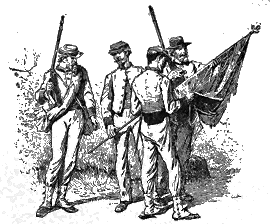
Examining the Colors After the Campaign.
CHAPTER XLIV.
CONCLUSION.
In writing this narrative my mind has been refreshed and incidents and the names of persons almost forgotten come to me—they press on my memory.
I am able to recall many, but to specify them would unduly lengthen this book. There was one important character, however, whom I had quite forgotten at the proper time, and in this concluding chapter must make mention of him.
Pierre Bottineau came originally from the Selkirk settlement, and in 1837 made a claim near St. Anthony Falls.
I was with him upon the plains of Dakota in 1857, and in his way he was a remarkable man. On one occasion the party got lost in a furious storm and we knew that war parties of Chippewas were roaming over the prairie and it was not any way too healthy to be in the region we supposed we were wandering in. We halted to hold a council and Pierre said: “As soon as the stars come out I can locate.” So we waited and waited for the storm to pass over. The night was pitchy dark, but in time the stars came, when Pierre laid flat down on the ground, face up, and for perhaps half an hour surveyed the heavens and located our wandering feet. We were soon on the right trail for our camp, which was forty or fifty miles away.
Pierre was one of General Sibley’s principal scouts during the several campaigns against the Indians in 1862 and 1863. He died some years ago, and speaking of his death reminds me of others prominent in these military operations who have gone beyond the river.
The two generals, Sibley and Sully, are gone, and of the field and staff, I can recall Colonel John T. Averill, of the Sixth Minnesota, who was, after the war, member of Congress. Adjutant Snow and Quartermasters Carver and Gilbert, Colonels Stephen Miller and Wm. R. Marshall, both honored by Minnesota by electing them to chief executive—they, with Lieut. Colonel Bradley and all of the Seventh; Colonel Robert N. McLaren, of the Second Cavalry, and Major Hatch, of the battalion bearing his name, and Captain John Jones, of the famous battery. These are among some of the chiefs who have been called.
Among the line of officers and the rank and file, it would be a mighty host, and it saddens my heart when I think of them, so I will desist and conclude by reminding you of the invitation extended and briefly recapitulate our journeyings.
READER: The invitation extended to you to accompany us on a military expedition into the Indian country has been accepted. It was under exciting circumstances, when the whole country was surcharged with alarm, and for good cause.
The Indians, cruel, relentless, revengeful, and with determination, were murdering innocent men, women and children, and but for the friendly offices of a faithful few, whose hearts were whiter than their skins, the death list and list of horrors would have been far greater; and it is for these few we speak when we say there are good Indians other than dead ones; and Minnesota could not do a more appropriate thing to-day than erect a monument to the memory of Old Betz, Other Day, Chaska and others, who risked their lives to save their white friends from the tomahawk of their more vengeful brethren, and who did so much to alleviate the sufferings and to relieve the anxiety of the captive prisoners.
You went with us to besieged New Ulm and Fort Ridgely; helped bury the dead at Redwood; marched with us and went into camp and endured the thirty-six hours of anxiety and suffering at Birch Coolie; helped bury the dead and care for the wounded there; returned with us to Fort Ridgely; took part in the battle at Wood Lake, where the Indians were defeated; shared our joys when we liberated the women at Camp Release; helped arrest, shackle and guard the Indians; witnessed the execution of thirty-eight at Mankato; marched across with the “Moscow Expedition”; rendezvoused with us at Camp Pope in 1863; marched and fought Indians with us at Big Mound, Dead Buffalo Lake, Stony Lake and the Missouri River. You mingled your tears with ours over Beaver’s and Miller’s graves, as we left them in their loneliness on the bank of the river; participated in and rejoiced with us all the way on our return, took part in the campaign of 1864, and now, before bidding you adieu, one question: Are you satisfied?
THE END.
Transcriber Note
Illustrations moved so as to not split paragraphs. Quotation usage in quoted letters was standardized.