Front matter (continued 2)
Reading edition
John Paul, or Little Paul, was friendly to the whites, and in a speech to the Indians at this pow-wow said:
“I am friendly to the whites, and will deliver these women and children at Fort Ridgely. I am opposed to the war on the whites. You say you are brave men, and can whip the whites. That is a lie—persons who cut women and children’s throats are not brave. You are squaws and cowards. Fight the whites if you want to, but do it like brave men. I am ashamed of the way you have acted towards the captives; and, if any of you have the feelings of men, you will give them up. You may look fierce at me, but I am not afraid of you.”
Red Iron, one of the chiefs of the Upper Indians, was not friendly. He was one of the principal chiefs of the Sissitons, and at one time was so outspoken against the whites that Governor Ramsey, who was then Superintendent of Indian Affairs, and was at the agency, had occasion to rebuke him in a substantial way—he reduced him to the ranks. In other words, he broke him of his chieftianship. This was in December, 1852.
Red Iron was a handsome Indian, an athlete, six feet in his moccasins, with a large, well-developed head, aquiline nose, thin lips, but with intelligence and resolution beaming all over his countenance.
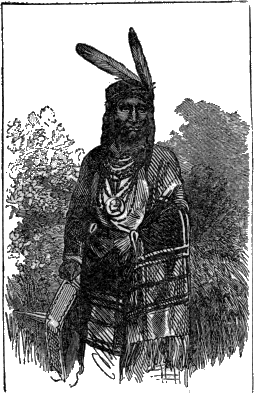
RED IRON.
When brought into the presence of Governor Ramsey he walked with a firm, lordly tread, and was clad in half military and half Indian costume. When he came in he seated himself in silence, which was not broken until through an interpreter the Governor asked him what excuse he had to offer for not coming to the council when sent for.
Red Iron, when he arose to his feet to reply, did so with a Chesterfieldian grace, allowing his blanket to fall from his shoulders, and, intentionally dropping his pipe of peace. He stood before the Governor for a moment in silence, with his arms folded, his bearing betraying perfect self-composure, a defiant smile playing upon his lips. In a firm voice he said:
Red Iron—“I started to come, but your braves drove me back.”
Governor—“What excuse have you for not coming the second time I sent for you?”
Red Iron—“No other excuse than I have already given you.”
When the Governor, as Commissioner of Indian Affairs, informed this proud chief that, by virtue of his office, he would break him of his chieftianship it appealed to his pride, and he said:
“You break me? I was elected chief by my tribe. You can’t break me.”
The chief, while surrendering to the powers that be, never felt friendly to the whites, and during this war of which we write he continued stubborn and sullen to the end.
Standing Buffalo, hereditary chief of the Sissitons, was a different type, and counselled living in peace, but desired fair treatment and honest dealings with his people. He was a handsome Indian, and a man of rare ability. General Sibley was anxious to know how he felt on the important question agitating the Sioux Nation, and desired his co-operation in liberating the captives and compassing the capture of Little Crow and his followers. At this Indian convention this noted chief said:
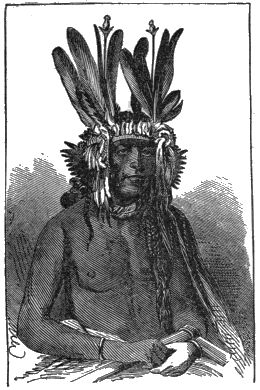
STANDING BUFFALO.
“I am a young man, but I have always felt friendly toward the whites, because they were kind to my father. You have brought me into great danger without my knowledge of it beforehand. By killing the whites, it is just as if you had waited for me in ambush and shot me down. You Lower Indians feel bad because we have all got into this trouble; but I feel worse, because I know that neither I nor my people have killed any of the whites, and that yet we have to suffer with the guilty. I was out buffalo hunting when I heard of the outbreak, and I felt as if I was dead, and I feel so now. You all know that the Indians cannot live without the aid of the white man, and, therefore, I have made up my mind that Paul is right, and my Indians will stand by him. We claim this reservation. What are you doing here? If you want to fight the whites, go back and fight them. Leave my village at Big Stone Lake. You sent word to my young men to come down, and that you had plenty of oxen, horses, goods, powder and lead, and now we see nothing. We are going back to Big Stone Lake and leave you to fight the whites. Those who make peace can say that Standing Buffalo and his people will give themselves up in the spring.”
They kept their word, and would have nothing to do with Little Crow.
Standing Buffalo was killed in 1863 by an accident.
Other Day, a civilized Indian, in addressing the council at this time, said:
“You can, of course, easily kill a few unarmed whites, but it would be a cowardly thing to do, because we have gained their confidence, and the innocent will suffer with the guilty, and the great Father at Washington will send his soldiers to punish you, and we will all suffer. I will not join you in this, but will help defend these white people who have always been our friends.”
Other Day was a true friend of the whites; he looked it. He was a full-blood Indian, it is true, and the Indians respected and feared him, but his desire to forsake the barbarous teachings of his father inclined him towards the unsuspecting settlers.
In 1863 he was General Sibley’s most trusted and confidential scout. In the early outbreak Other Day manifested his loyalty to his white friends by risking his life in their defense, piloting sixty people through the river bottoms during the nights to a place of safety. He traveled with his charge in the night, and hid them in underbrush during the daytime. He was a true-hearted, kind man, with a red skin, who has gone to his reward in a land where there are no reds, no blacks, but where all are white.
Little Crow, who is one of the principal characters in this narrative, was an Indian of no mean ability. He was the commander-in-chief of the hostile tribes, and wielded a powerful influence among all the tribes of this great Sioux Nation. He was a powerful man, and felt his lordly position; was confident of final success, and very defiant at the outset. He had a penchant for notoriety in more ways than one. In dress he was peculiar, and could nearly always be found with some parts of a white man’s clothing. He was particularly conspicuous in the style of collar he wore; happy in the possession of one of the old-style standing collars, such as Daniel Webster and other old-time gentlemen bedecked themselves with. He also possessed a black silk neckerchief and a black frock coat, and on grand occasions wore both.
He had strongly marked features, and in studying the lineaments of his face one would not adjudge him a particularly bad Indian. As we had hundreds of these men in our custody, a good opportunity was offered while guarding them to try one’s gift as a reader of character as stamped in the face, but Little Crow proved an enigma. It was like a novice trying to separate good money from bad, an unprofitable and unsuccessful task. Little Crow said:
“It is impossible to make peace if we so desired. Did we ever do the most trifling thing, the whites would hang us. Now, we have been killing them by the hundreds in Dakota, Minnesota and Iowa, and I know if they get us into their hands they will hang every one of us. As for me, I will kill as many of them as I can, and fight them till I die. Do not think you will escape. There is not a band of Indians from the Redwood Agency to Big Stone Lake that has not had some of its members embroiled in this war. I tell you we must fight and perish together. A man is a fool and coward who thinks otherwise, and who will desert his nation at such a time. Disgrace not yourselves by a surrender to those who will hang you up like dogs; but die, if die you must, with arms in your hands, like warriors and braves of the Dakotas.”
In one of our battles we took some fine-looking bucks prisoners, and the soldiers were for scalping them at once, but we had a little “pow-wow” with them, and found them intelligent and well educated; they were students home on a vacation from Bishop Whipple’s school at Faribault, Minnesota, and said they were forced, much against their will, to go on the warpath; that they had not fired a bullet at the whites; that they fired blank cartridges because they felt friendly to the whites, and had no desire to kill them. There were three of them; we told them they could take their choice—be shot or enlist; they chose the latter, and went South with us, staying until the close of the Rebellion, and they displayed the courage of the born soldier.
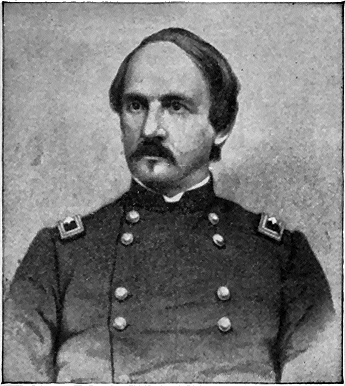
Brevet Major General H. H. Sibley, Commander in the field in 1862 and 1863 against the Sioux Indians.
CHAPTER XV.
GOV. SIBLEY APPOINTED COMMANDER.
While these scenes which I have related were being enacted in the upper country excitement ran high at St. Paul, and for a time the great struggle then going on in the South was forgotten. The news of the outbreak soon reached St. Paul, and couriers, with horses covered with foam, kept coming in one after another, until the officers at Fort Snelling were ordered by Governor Ramsey to be in readiness with their men to move at a moment’s notice, and we did not have long to wait.
The Sixth Minnesota, of which I was a member, had just organized, and was assigned to Hancock corps, Army of the Potomac, but the events transpiring in the Indian country made it necessary for all available troops to go there. When I say that the whole country was seething with excitement it is no exaggeration. The towns, big and little, were filled with frightened refugees; the rumors that came in were of the most frightful nature, and the whole state was clamorous for protection.
Governor Ramsey, in his desire to protect the panic-stricken people and liberate the captives, cast about for a suitable commander for this important work. Of all the men in and about St. Paul who seemed eminently qualified for this position, Governor Henry H. Sibley, who at that time was living in quietude in his home in Mendota, just across the river from the fort, was his choice.
Governor Henry Hastings Sibley, the hero of these Indian campaigns, was born in the city of Detroit February 20, 1811. His sire was Chief Justice Solomon Sibley, of Detroit, and his mother was Sarah Whipple Sproat, whose father, Colonel Ebenezer Sproat, was an accomplished officer of the Continental army, and the granddaughter of Commodore Abraham Whipple, an illustrious commander in the Continental navy. He came from a long line of illustrious ancestry on both sides, of good Puritan stock, and dating his lineage back to the Sibleys of William the Conqueror of England in the fifteenth century.
He was not a fighter; his heart was too tender for that, but he felt the weighty responsibility he had assumed when he consented to lead the soldiers and save the lives of the captives. For delaying he was denounced on all hands. The press denounced him for not falling immediately upon the Indians; but he knew the enemy better than his censors. If he had heeded the behests of the clamorous people not a captive would have been spared; but to-day hundreds live to bless him for his cautious, conservative movements. Until his death, which occurred but a few months since, he lived in his beautiful home in St. Paul; and, although a half century of winters in the far Northwest had whitened his head, and a great deal more than a half century of time had made his limbs tremble, neither time nor frost had sapped the citadel of his mind. He was a member of Aker Post, No. 21, Department of Minnesota, and the comrades, in deference to his declining years, went in a body to his beautiful home where he was mustered in. He lived in peace and plenty, surrounded by his family and friends, who esteemed him for his worth. He passed away respected and regretted by a host of friends throughout the land, who knew him as a citizen and a soldier. I knew him personally and intimately since 1857; and in his death, with others great in our nation’s history, we are reminded that in war the bullet is no respecter of rank; the commander and the soldier fall together.
Governor Sibley was commissioned by Governor Ramsey as Colonel of Volunteers, and assigned to the command of the expedition. He was selected because he had spent many years of his life among the Indians as a trader, he spoke their language, he knew them personally, and knew their characteristics. He was a man of large experience, education and ability, and possessed, withal, a cool head. He knew the Indians, and they knew him and respected him. He consented to lead the forces against the Indians when appealed to by Governor Ramsey, upon conditions that he should not be interfered with by His Excellency, or any one else, and that he should have adequate supplies of men, stores and transportation. Colonel Sibley, afterwards Brigadier and Brevet Major-General of Volunteers, with his staff and Companies A, B, and E, of the Sixth Minnesota Infantry, embarked on a small steamer then at anchor near the fort, and steamed up the Minnesota river to Shakopee, distant about forty miles by water. We started in a furious rain, and after a slow trip up the narrow and winding Minnesota, arrived at Shakopee, where we found the frightened citizens ready to receive us with open arms, although all the firearms we had were worthless and condemned Austrian rifles, without ammunition to fit them. All serviceable material of war had been shipped to the South. Our first guard duty was on picket in the suburbs of Shakopee, and our instructions were to press all teams into the service. We felt the gravity of the situation, and obeyed orders to the letter as nearly as we, raw recruits, could. While here the news was spread that Indians were in the vicinity, and the women and children began to flock to the vicinity of the soldiers; the alarm was without foundation. As we were stationed on the various roads leading to and from the town, the citizens who had been so badly scared seemed to feel comparatively safe. The news from the upper country, however, was discouraging, and appeals for protection very urgent. We could not move at once from lack of transportation, and had no adequate supplies, either of food, arms or ammunition, for we had been so hurriedly dispatched from Fort Snelling that only about half of one company had been supplied with even the worthless muskets spoken of, and the whole command with but two days’ rations. It was necessary, however, to make some quick demonstration to appease the panic-stricken people. After a delay of one day, by various routes by land and water, the regiment concentrated at St. Peter, under command of Colonel William Crooks, where it was inspected and remained four or five days, awaiting the receipt of suitable arms and ammunition and also reinforcements.
Our guns were so absolutely worthless that it was necessary to delay a little, as the Indians, in large numbers, were then besieging Fort Ridgely, and were well armed with Springfield rifles, while our own arms were condemned Austrian muskets.
We embarked on a boat at Shakopee and sailed up to Carver, forty miles above, and there pressed in teams to carry us through what was known as the “Big Woods.” It had been raining for days, and the town of Carver was literally packed with refugees. There was not an empty building in it, even the warehouses were filled, and the muddy streets were a sight to behold. The mud was ankle deep, and you may imagine in what condition everything was. I cannot describe it.
The frightened people, who had flocked in from all the country round, told most woeful tales of Indian atrocities. In some cases they were overdrawn, but later on we saw evidences enough to warrant them fleeing to a place of safety. There was no safety, however, in coming to these small towns, for they were without protection.
After loading up the teams, we started through the “Big Woods,” and the roads were in such a horrible condition that we made but slow progress. However, we had to make Glencoe, twenty-five miles distant, before night or camp down in the woods in the mud. It became pitchy dark, but we kept on the move, and in time got through the woods and could see the lights of Glencoe afar off. This was only a small place, but the twinkling lights from the houses were a pleasant sight, and when we arrived there the people were glad to see us. We remained over night, and the next day started for St. Peter. We could see evidences of Indian devastation in every direction, among which were the burning buildings and grain stacks on the beautiful neighboring farms.
On the route to St. Peter, which we reached early in the evening, we discovered a few dead settlers, and took some families along with us. Upon our arrival we went into camp with the rest of the command, and were soon placed under strict military discipline, and in a brief time our commander, Colonel William Crooks, a West Pointer, brought order out of chaos.
Of the preparation and forward march to relieve Fort Ridgely I will reserve for another chapter.
CHAPTER XVI.
MARCH TO FORT RIDGELY.
In the interval the companies were drilled and the command otherwise prepared to act effectively against the formidable body of hostile warriors, who were well armed and plentifully supplied with powder and ball. Colonel Sibley, having looked the ground over with a critical eye, uninfluenced by the public clamor and fault-finding of the press, remained firm in the determination not to take the field until assured of success in his operations. He knew the Indians well, and knew it was necessary to fight or failure, there would be no adequate barrier to the descent of the savages upon St. Paul and Minneapolis, and the desolation of the state generally. The Chippewas on the north were known to be in secret communication with Little Crow, the head of the Sioux hordes, and ready to them cautiously if he would succeed, for, in case of defeat co-operate with him if victorious, while the Winnebagoes were also in active sympathy with him, for two or three of their warriors were found among the dead after the battle of Wood Lake, which occurred later on. Arms, ammunition and supplies arriving, we took up the line of march for Fort Ridgely, which was then in a state of siege. Our advent at the Fort was hailed with delight, for the little garrison was pretty well tired out with the fighting and watching that they had had on their hands for the eight days previous. Barricades had been erected at all weak points, but the Indians so far outnumbered the soldiers that they approached near enough to fire the wooden buildings of the fort proper in many places.
Our march to Fort Ridgely was the first we had made as an entire organization, and under an able commanding officer we profited by it. On the way we found the dead body of a colored man from St. Paul by the name of Taylor. He was a barber by trade, but also quite a noted gambler, and had been up to the agency to get his share of the money when the Indians got their pay.
He played one game too many, and lost—his life.
Before we reached the Fort the Indians took alarm and sullenly retreated upon our approach, after having done all possible damage to men and property. As we entered, the brave little garrison accompanied by the women and children turned out to greet us, and a right joyous time we had. A detachment of thirty men of the Fifth Minnesota, under Captain Marsh, the commander of the fort, upon receipt of news of the outbreak, had marched in the direction of the Lower Sioux Agency, distant a few miles. The Indians, perceiving the advance of this small detachment, placed themselves in ambush in the long grass at the crossing of the Minnesota River and awaited the oncoming of their unsuspecting victims, and, when in the toils, they opened a terrific fire upon them, which destroyed almost the entire party.
Colonel Sibley hurried forward supplies and ammunition for an extensive campaign, for, from his knowledge of the Indians, he knew it was no boy’s play. The moving spirit among the hostiles was Little Crow, a wily old chief, without principle, but active and influential. He had harangued his people into the belief that the fight going on among the whites in the South had drawn off all the able-bodied men, leaving none but old men, women and children. “Now,” he said, “is the time to strike for Minnesota. These fertile fields, stolen from us, are ours; the buffalo are gone; we have no food, and our women and children are starving. Let the warriors assemble in war paint and drive the pale-faces from the face of the earth!” He told his people they could pitch their wigwams the coming winter in St. Paul and hold high carnival in the legislative halls. So widespread had the alarm became that it reached St. Paul and Minneapolis, and “minute men” were on duty on the bluffs adjacent for several days. In addition to the Sioux, the Chippewas and Winnebagoes were becoming very restless, and this caused additional uneasiness in the two cities.
Colonel Sibley, upon his arrival of the fort, sent out scouts to ascertain the whereabouts of the Indians. The news they brought was that a large camp of hostiles was located above the Yellow Medicine, where they held as captives about four hundred white women and children, and one white man. They also reported that the Indians were preparing to make a raid on the small towns below the fort.
It was also known that a large number of citizens who had been killed near the agency were yet unburied, and the fate of Captain Marsh and his men was in doubt. To this end a small command was organized, as narrated in another chapter, to go out to bury the dead and relieve Captain Marsh and his men if they were found alive.
CHAPTER XVII.
BURIAL OF CAPT. MARSH AND MEN.
Company “A,” of the Sixth Minnesota, together with two men each from the other companies, were detailed to accompany a burial party, with instructions to properly bury all bodies found, and, if possible, ascertain the fate of Captain Marsh and his thirty men, who had gone out to intercept the Indians at the Redwood Crossing. In addition to this detail we had a small detachment of citizen cavalry, under Captain Joe Anderson, to act as scouts.
Our little command numbered, all told, 153—infantry, cavalry and teamsters—and ninety-six horses, including twenty teams taken along to carry camp and garrison equipage, rations and ammunition, and to transport our wounded, either soldiers or citizens. The expedition was under the immediate command of Captain H. P. Grant, of Company A. Major Joseph R. Brown, better known as “Old Joe Brown,” was in charge of the scouts. He had a cool head, but no fighting qualities; had been an Indian trader for many years, raised an Indian family, and knew a great deal about Indian signs and customs. In this particular case, however, the Indians fooled Joe. The first day out we found and buried about fifty citizens, and at night went into camp in the river bottom near Redwood Crossing. The night was dark and dismal, and particularly sad to us who had been gathering up the dead all day long. The instructions to the guard by Captain Anderson were of a very solemn nature, in view of the surroundings and the probable fighting ahead. This, together with the stillness of the night and the impression that a lurking foe was near, made the boys feel rather uncomfortable.
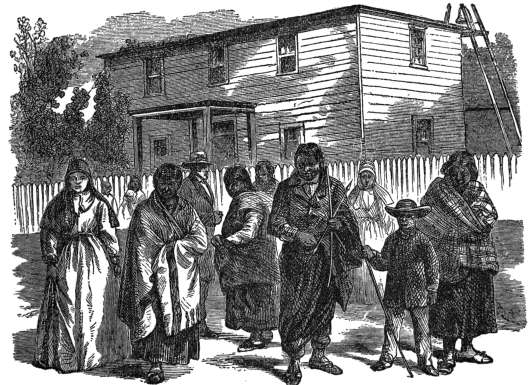
DR. WILLIAMSON’S HOUSE.
Deep sleep settled upon the camp, but the sentinels maintained a vigilant watch, however, and the night slowly passed without incident. After reveille the next morning we found Captain Marsh and his comrades, but not one of them answered to “roll-call.” We found the captain’s body and those of a few of his men in the river, and the rest of the bodies in the thicket on the river bank, where they had evidently been hemmed in and fired upon from all sides. Nearly all had been scalped, and were minus guns and ammunition, for these had been confiscated by the redskins. We buried the soldiers side by side, with their captain at their head, and marked the place by a huge cross, so that the bodies might be easily found and removed, which was subsequently done, when they were finally buried in the Soldiers’ cemetery at Fort Ridgely. After this last service to our dead comrades, we took up the line of march, leaving the bottom lands for the prairie above, and it was when passing over the bluff that a large body of Indians, who were on their way to capture Saint Peter and Mankato, espied us. What was our subsequent loss was the gain of the two towns mentioned. Our scouts had crossed the river, making a detour to the south, and thus missed making the acquaintance of our enemies, who had their eyes on us.
We went into camp the second night near Birch Coolie, and sixteen miles distant from Fort Ridgely, about 5 p. m., well tired out with our day’s march. Birch Coolie is a deep gorge running north and south in Redwood county, Minnesota. What was then a bleak prairie is now a beautiful farming community, and Birch Coolie a thriving village.
From information gathered by the scouts we felt comparatively safe.
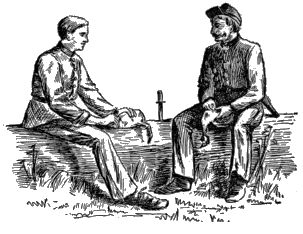
“Chickens for Supper.”
Old Joe said: “Boys, go to sleep now and rest; you are as safe as you would be in your mother’s house; there is not an Indian within fifty miles of you.” At that very moment five hundred Indians were in the immediate vicinity watching us and impatient for the ball to open, as they intended it should at the proper time, which, with the Indian, is about four o’clock in the morning.
After our supper on chicken stew, song-singing and story-telling, we turned in, well tired out and in a condition to enjoy a good night’s sleep and dreams of home.
The night was warm, the sky clear, with the stars shining brightly, and a full moon in all her glory. It was a beautiful night—too beautiful to witness the scene that was so soon to follow. The guard had been stationed and cautioned to be on the alert for strange sounds; “tattoo,” “roll-call,” “taps,” sounded, and the little camp was silent. The low hum of voices became less and less as slumber came to the weary soldiers, and all that could be heard was the occasional challenge of the guard: “Halt! who comes there!” as he was being approached by the officer of the guard.
Soon the soldiers slept, little dreaming that the lurking enemy and death were so near. The awakening to some was in eternity.
CHAPTER XVIII.
BATTLE OF BIRCH COOLIE.
The battle of Birch Coolie was fought September 2 and 3, 1862. It has never taken its proper place in history, but with the exception of the massacre at the Little Big Horn, in 1876, it was the hottest and the most desperate battle fought during the war of the Rebellion or any of our Indian wars. In comparison to the number of men and horses engaged, I know of no conflict, the one above referred to excepted, where the casualties were as great as they were here.
The Indian custom is to make an attack about four o’clock in the morning, so this relief had been especially cautioned, and soon after the guard was placed one of them thought he saw something moving in the grass. It proved to be an Indian, and they were slowly moving in upon us, their intention being to shoot the pickets with arrows, and as noiselessly as possible rush in and destroy us in our confusion. The sentinel fired at the moving object, and instantly our camp was encircled by fire and smoke from the guns of five hundred Indians, who had hemmed us in. The guard who fired escaped the bullet intended for him. He said he thought the moving object in the grass might be a hog or it might be an Indian, and, hog or Indian, he intended to kill it if he could. The fire was returned by the pickets as they retreated to the camp, and although there necessarily was confusion, there was no panic. Quicker than I can write we were out, musket in hand, but the captain’s command to “fall down” was mistaken for “fall in,” which makes a vast difference under such circumstances. We soon broke for the wagons, however, which were formed in a circle about our tents, and this afforded us some little shelter.
As this was our baptismal fire, and a most important engagement, I devote more space to it than I otherwise would. What an experience it was to inexperienced, peaceable, unsuspecting men! Think of being awakened out of a blissful sleep by the fire from five hundred Indian rifles—it is a wonder that we were not all destroyed amid the confusion that naturally would follow; but we had cool heads among us, and none were cooler than Old Joe Brown and Captain H. P. Grant, of Company A, who was in immediate command. I will here refer to two others. First, Mr. William H. Grant, a lawyer of St. Paul, who still lives in Minnesota. He went out to see the fun. Well, he saw it, and the “trial” was a severe one. He “objected” and “took exceptions” to everything the Indians did.
He wore a black plug hat, and this was a good mark for the redskins; they shot it off his head twice, and it was finally lost altogether. “Bill” was cool; he did not lose his temper, but laid down very flat on the ground and gave directions to those about him how to shoot to kill. We afterward voted him in as a brevet private, and were always ready to divide grub and “shake.” Postmaster Ed. Patch, of St. Anthony, was another of our citizen escorts. He was a jolly good fellow and “cool as a cucumber,” with a bay window on him like an overgrown bass drum. He found this excess of stomach very much in the way, in his great desire to hug mother earth and get out of range of the Indian bullets, and looked as if he wished he had never been born, or that he had been a disciple of anti-fat.
One of our little thin fellows was lying down alongside of “Ed,” and I’ll never forget the expression of his face when he said: “God, bub, I wish I was as little as you be.”
The camp was miserably located, being commanded by the deep ravine on one side and by a mound on the other, so that the savages were well sheltered from our fire. Had the instructions given by Colonel Sibley been followed, which were always to encamp in open and level prairie, there would have been no such destruction of valuable lives, but the spot was chosen for our camp because it was near wood and water, and the Indians were supposed to be fifty miles away. It was a mistake, which we discovered after it was too late. A brisk fire was opened by the boys, and soon the cartridge boxes were being depleted. Ammunition was called for, and upon opening a box, to our dismay we found it to be of too large a calibre. Other boxes were opened with a like result. In loading up our ammunition a mistake had been made, and we found ourselves in this unfortunate dilemma; but no time was to be lost, as we had not more than an average of twenty rounds to the man, and a hoard of savages about us who seemed well supplied with powder and ball.
We went to work cutting the large bullets down with our knives, but this was a slow and unsatisfactory process. We used the powder from these large cartridges to load our guns with, putting in an extra amount, so that when we fired these blanks they made a great noise, and thus kept up a successful “bluff,” though doing no damage. A dead silence would ensue, and occasionally some of our best shots picked off a more daring redskin simply to remind them that we were awake. We had but one shovel and one pick; there were others in some of the wagons, or they had been thrown out in the grass and could not be found. The captain offered $5 apiece for them, but the bullets were too thick to admit of a search, so we used jack-knives, spoons and bayonets to dig our intrenchments with. In time we had very good pits dug, and with the assistance of the dead bodies of our horses had ourselves tolerably well protected.
With the wounded horses rearing and plunging, the men groaning and calling for help, the hurried commands, and the unearthly yells of the five hundred red devils about us, this baptismal fire was trying to the souls of raw recruits, as most of us were. We were encircled by fire and smoke, the bullets were doing their deadly work, and it really seemed as though no man could escape death. Our orders were: “Load and fire, but steady, boys, and give them hail Columbia!”
Upon the first fire of the Indians two men fled from the camp, one a citizen, who was with us, and the other a soldier. The citizen we found afterward on the prairie, dead. He was the last of his family, for we had buried his wife and two children just the previous day, before going into camp. The soldier, a Swede, returned, but he was so paralyzed with fear that he was like a dead man during all this memorable thirty-six hours, and the poor fellow afterward succumbed to sickness. Everything was improvised for a barricade—camp kettles, knapsacks, wagon-seats, etc., and it was done in a hurry, for hot work was on our hands. The word soon went the rounds: "College is dead, Irvine is dead, Baxter, Coulter, Benecke, King and a score of others are dead, and nearly all are wounded." It was only a few minutes after the first fire when we realized all this, and it verily looked as though the little command would be wiped out of existence. If a head was shown fifty Indians leveled at it. During all this terrible fire Old Joe Brown walked about seemingly unconcerned, until a bullet went through the back of his neck. He came to the ground as quick as if shot through the heart, for it was a bad wound, but with it all he continued to give instructions. Nearly all the damage was done before ten o’clock, for up to that time we found ourselves with sixty killed and wounded, out of 155, and ninety-five horses dead, out of ninety-six. The horses saved our little encampment. As soon as they fell their bodies formed a good barricade for us, and this and the overturned wagons were our only protection. The Indians, occupying higher ground than we did, had us at a disadvantage. The day wore on, and all we could do was to assist Surgeon J. W. Daniels with the wounded and keep the Indians at bay. Dr. Daniels proved himself a cool-headed, brave man, never flinching for a moment. Where duty called he was found, and he immortalized himself with the boys. The great fear of the wounded seemed to be that we would be obliged to abandon them to their fate, for the sun was extremely hot and the camp had become very offensive from the smell of decomposing bodies of horses; besides, we had no means of transporting the wounded, and their fears were not without foundation, for it looked as though we would be driven by necessity from the camp. We assured and reassured them that if we went they would go, too. If we died it would be in defending them as well as ourselves.
The one thing, aside from cowardice on the part of the Indians, that saved us from assault was the fact of our having several half-breed scouts with us, who talked back and forth.
The Indians said: “Come out from the pale-faces; we do not want to kill you, but we want all their scalps.”
Private James Auge of our company was the spokesman. He was a Canadian Frenchman, but had lived among the Indians, knew them well, and spoke their language, and as he went so would all the other Indians and half-breeds who were with us.
CHAPTER XIX.
BIRCH COOLIE CONTINUED.
On the second day, at about sunrise, we discovered a large body of Indians closing up nearer to us, when one of their number, probably Little Crow’s brother, came within twenty rods of us. He was on a white horse, and carried a flag of truce. He held a conversation with Auge, our interpreter, and tried to persuade him to leave us and bring the other half-breeds with him. When the conversation was interpreted to Captain Grant, he said: “Well, Auge, what do you fellows intend to do, go with the Indians or stay with us?” Auge replied:
“Captain Grant, we want nothing to do with these Indians; we will stand by you and fight as long as there is a man left, and I will now tell them so.” He did call to them, and said:
“We won’t come over to you; we will stay with the soldiers, and if you come we will kill you if we can. You are cowards to kill poor women and children, and if we catch you we will treat you as you treated them.”
We felt relieved to know that our half-breeds were loyal. Auge, after this, was Corporal Auge, and he went all through the South with us, making a splendid soldier. I shall have occasion to refer to him in another place in this chapter.
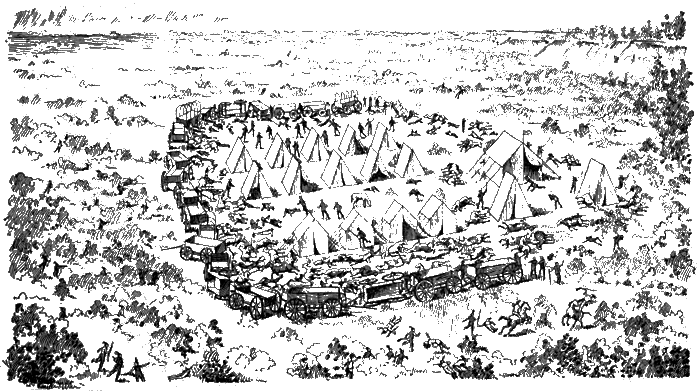
Designed by A. P. Connolly.
Battle of Birch Coolie. Minn.
Fought September 2nd and 3d, 1862. Ninety-five horses lay dead within the camp; 60 men killed and wounded; 500 Indians were under cover in the tall grass, and concentrated their fire on the camp.
Captain Grant told Auge to say to them that we had two hundred fighting men and plenty of ammunition, and that Little Crow and all his dirty Indians could not take us, and for him to get out with his flag of truce.
It was a game of bluff, for at that time we only had about sixty-five effective men, and were nearly out of ammunition.
We did not know whether we could trust the half-breeds or not, and were instructed to fire on them to kill if they made the slightest move to desert us. Our firing had been heard at Fort Ridgely, sixteen miles away, and the Colonel dispatched two hundred and fifty men, with one howitzer, to our relief.
Just at sunset the second day we saw two horsemen come to the edge of the woods across the Coolie, but the Indians also saw them, and chased them back. They returned to their command and reported a large body of Indians, and said they saw a small camp with the stars and stripes flying, but as they had no field glass, could not make it out. Colonel McPhail, who was in command of this relief, ordered the howitzer to be fired to give us courage, if the little camp proved to be ours. A shout went up at this welcome sound just as the sun went down. Old Joe Brown, who had been disabled early in the day, called out from his tent: “Captain Grant, instruct the men to be watchful; we are in a bad fix; the Indians will hate to lose our scalps, now that they are so near their grasp; give them a few shots occasionally, assure the wounded men that we will not leave them, and keep the pick and shovel busy.” We disposed of ourselves for the night as best we could. Every man was on guard, and nearly all had two rifles fully charged and bayonets fixed. We clasped our rifles, looked up into the starry heavens, and, asking God’s protection, swore not to yield an inch. We made this demonstration to encourage the wounded men, who seemed fearful that something more terrible was in store for them. The prayers and groans of the wounded and the awful silence of the dead inspired us to do our whole duty. The watch-word, “wide-awake,” went the rounds every few minutes, and there was “no sleep to the eye nor slumber to the eye-lids,” during all that live-long night.
Out of our ninety-six horses we had but one left. This was a splendid animal, and had thus far escaped without a scratch. He was feeding about the camp, unmindful of the fate of his fellows.
The picture of Birch Coolie is an exact reproduction of the situation. The ninety-five dead horses were all within the enclosure, and the one who escaped for the time is grazing among them.
Just before midnight the clouds began to gather, and we felt cheered to think we would soon have rain. We were sorely in need of water, for we had not tasted a drop since the night before, and the wounded men were nearly famished with thirst and burning with fever. As the sky darkened Captain Grant called for a volunteer to go to Fort Ridgely for relief. Corporal James Auge volunteered to go, and by this act proved himself a truly brave man, and if it had been successfully carried out would have gained for him a commission at no very distant day. The fact of its not being carried out was no fault of his, and, in the abandonment of the trial, he was declared not the less brave by all his comrades, who trembled for him while he was preparing to make the perilous journey. The night was cloudy, and he being conversant with Indian methods and well posted in the topography of the country, could be successful in getting through the Indian’s lines, if anybody could; but the chances were ten to one against the success of the undertaking.
The horse was saddled and the Corporal had his instructions. He had his foot in the stirrup when the clouds rolled back from the full moon like the rolling back of a scroll, and it was almost as light as noon-day. The Indians, ever on the alert, saw the preparations and opened fire anew upon us, and, long before they ceased, our good horse was pierced by six bullets, and the project was abandoned—we could only wait anxiously for results. The enemy did not allow us to wait long, for at four o’clock they opened a terrific fire, which they kept up for an hour. The only response they got from us was blank cartridges, but we made a great noise with them, and it answered the purpose very well. We had ourselves so well protected that in this fusillade they killed but one man and wounded another.
The early morning dawn and heavy, dewy atmosphere found our eyes heavy from loss of sleep, so we divided up and some slept while others watched. We heard nothing of the detachment, and as the day advanced the Indians became bolder. They had driven the relief back and were closing in upon us, and we, having so little ammunition, could do them but little harm. They were puzzled at our silence. Some of the chiefs said it was a trick, others said we were all killed. At any rate, with them “discretion was the better part of valor,” and we didn’t object.
About one o’clock the same day we descried the glimmer of the polished rifle in the distance. We had no glass, but anxious eyes strained to see what it was, and the dark outline of a moving mass told us reinforcements were coming. The chiefs, by waving their blankets and shouts, called off their warriors. “There’s a mile of whites coming,” they said. They waved their tomahawks, shouted, fired, and finally galloped off on the prairie.
A few warriors more daring than the others remained behind for a time to get a scalp, and some of them came so close we could readily discern their war paint. Before the main body of the Indians left, however, they rode very close, and gave us several parting volleys. The wounding of a few of our men was all the damage they did at this time.
Right joyful were we when the reinforcements arrived. Our camp had been formed by driving twenty teams in a circle, and it can readily be seen that it was not large. It was about as large as an ordinary circus tent, and inside of this we had our horses, men and tents. After the battle the sight was a sickening one, for with sixty dead and wounded men and ninety-five horses in such a small space, and all the confusion arising out of such a siege it was enough to appall the stoutest heart. Strong men, when they beheld the sight, wept like children. It was our baptismal fire, and the horror seemed greater to us. Our men, whose nerves had been on a tension so long and bodies exhausted for want of food, water and sleep, when the relief came, fell down and slept. Colonel Sibley was the first to arrive, and when he rode up to our barricade, and saw the terrible loss of life he looked as though he had lost his best friends. His heart bled at the sight, and the tears he shed spoke volumes. A detail was at once made to bury the dead side by side in a temporary grave, dinner was cooked for the remainder of the command and the wounded were put in ambulances, tents were “struck,” and we took up the line of march for Fort Ridgely, which we reached sometime during the night. Our tents had been so completely riddled with bullets that they were condemned as useless, and were finally sent down to Fort Snelling and placed on exhibition for a long time. One of them had 375 bullet holes in it, and when the people looked at them they wondered that any man escaped. The narrow escapes were almost miraculous, and congratulations were frequently in order. It was not every man for himself, but a strong fellow-feeling sprang up among us that forever afterwards cemented our hearts. We shared our shelter and encouraged one another, and no man shrank from duty. We had determined to die together, and if ever soldiers stood shoulder to shoulder we did on this bloody spot, where our nerves and courage were taxed to the utmost. Company A, so nearly wiped out, was ever afterwards considered the “Old Ironsides” of the regiment.
Before we left, Colonel Sibley addressed a note to Little Crow, and placing it on a stick stuck it in the ground so he might find it when he would visit the battle ground, as he surely would do as soon as we were out of the way. The note was as follows:
“If Little Crow has any proposition to make let him send a half-breed to me and he shall be protected in and out of my camp.
“H. H. Sibley, “Colonel Commanding Military Expedition.”
To specify the remarkable escapes would unduly lengthen this chapter, but, as near as my recollection serves me, no man entirely escaped. I’ll specify two—one an escape and the other an incident. Lieutenant Swan, of the Third Minnesota, now a lawyer of Sioux City, Iowa, was with us on this picnic. He was not ordered to go, neither was he detailed, but he simply went, and he had a very narrow escape. During the sharp firing, and after we had some shallow pits dug, this officer was in one as far as his long legs would admit. He had a fine gold watch in his fob pocket, and one of the boys asked him the time of day. He undoubled as well as he could and got out his watch, but in returning it put it in his vest pocket instead of the fob. It was no sooner in his pocket than an Indian bullet struck it squarely in the center. The concussion knocked the lieutenant over, but the watch saved his life. He keeps it as a valued souvenir of the occasion.
The incident relates to Private James Leyde, of Company A, of the Sixth. He was a little fellow who could march longer and eat oftener than any youngster of his size I ever saw. Jimmy was a splendid soldier, always ready for drill or guard, and never forgot his manners when he met a “shoulder-straps.” He was a pious little fellow, too, and carried a Bible his mother gave him.
Well, “after the battle” Jimmy was looking over the wreck with his comrade, Billy Caine, and in taking up his Bible found a bullet embedded in it. “Hello, Billy, my Bible got struck!” The ball had gone through Genesis, Exodus and Leviticus, until it stopped half way through Deuteronomy. Jimmy says: “God, Billy, it didn’t get through Deuteronomy anyway!”
There were many close calls, and it really seemed remarkable that so many could escape. I could specify scores, but it is not necessary.
Among the incidents on the march before we arrived at Birch Coolie I might mention the finding of a wounded woman by the roadside. She had been without food or water for twelve days, and was the only one of a large party supposed to have been murdered. She did not escape uninjured, however, for the surgeon took fourteen buckshot from her back. During our thirty-six hours’ siege this poor woman remained in the wagon where she had been placed the first day, and spent her time in praying for our deliverance. She sustained a broken wrist in addition to her other wounds, but after we got to the fort she was among her own people and soon fully recovered to tell the tale of her twelve days’ wanderings and her marvelous escape.
CHAPTER XX.
BATTLE OF WOOD LAKE.
At this juncture the press and people were clamoring for Colonel Sibley’s removal because of his delay and, as they claimed—lack of energy and judgment. He lacked in neither, for he knew the foe he had to deal with, and if he had heeded the behests of the press and people, so far away, not a woman or child of the captives would have escaped. However, he dispatched Col. William Crooks to St. Paul to explain the situation in detail to Governor Ramsey and satisfy the clamorous press that they knew but little of the situation as it existed at the seat of the Sioux war.
After our return to Fort Ridgely and a few more days of preparation, the command was put in splendid marching condition, and “forward” was the word for the rescuing of the captives and if possible the capture of the renegades. We met the Indians next at Wood Lake and had a sharp battle with them early in the morning. They had come down in force to annihilate us, but we were glad to meet them in broad day light on the open prairie and receive them with “open arms to hospitable graves.” We were just up from a good night’s sleep and had partaken of a generous supply of Old Java and “hard tack,” and felt abundantly able to defend ourselves. Besides we were veterans now, for we had profited by our baptismal fire and had an old score to settle with “Mr. Injun,” and we settled to our entire satisfaction.
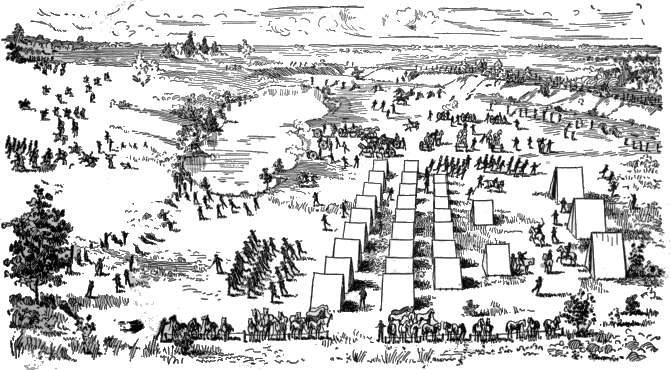
Designed by A. P. Connolly.
Battle of Wood Lake, Minn.
Fought September 23d, in which the Indians were defeated.
Our sappers had gone out to repair a bridge that had been burned, and the temptation was too great for some of the younger warriors. The plan of the Indians was to surprise us as we were crossing the river—to divide our attention by having a small body in the rear and one in front, and then the main body to spring from their ambush, and in our confusion to destroy us; but the young bucks, when they saw a few of our men, wanted their scalps so bad they opened fire. The “long roll” was sounded, and we stood to arms. Little Crow knew that Colonel Sibley was aware of his tactics, and was determined to remove him if he could by detailing about eighty of his best warriors to do the work, and at this battle of Wood Lake they tried hard to reach him, but he was too watchful to be caught napping. A detachment of the Third Minnesota, under Major Welch, and the Renville Rangers charged upon the Indians in one direction, and the Seventh Minnesota, in command of Col. William R. Marshall, in another, while the battery, under command of Captain Mark Hendricks, did effective work also. The Sixth Minnesota, under command of Colonel William Crooks, routed the Indians from a deep ravine on the right flank of our camp and probably saved Colonel Sibley from being captured by the picked men sent out for that purpose by Little Crow.
The conflict lasted more than two hours and was decisive. The Indians offered to surrender if Colonel Sibley would promise them immunity from punishment, but this was sternly refused. They fled in dismay, not being permitted to take their dead and wounded from the field. So confident were they of success that they had brought their women and teams to take back the pillage after the Indians had loaded themselves with glory and scalps—but presto, change; they got no glory and lost their scalps.
The soldiers had not forgotten Birch Coolie quite so soon and took great pleasure in procuring Indian scalps for trophies.
“Other Day,” who guided a large party in escaping the massacre, seemed to have a charmed life, and a little incident here, in which he is the chief figure, will not be amiss. “Other Day,” the same as other scouts, wore United States clothing. The day before the Wood Lake battle he was out scouting, and coming to a house turned his pony out to graze and lay down to take a noon-day nap. An Indian espied the pony and wanted it. He stealthily came up to the sleeping “Other Day,” and putting up some kind of a sign so he might know a brother Indian had his pony, he rode off with the animal. “Other Day,” considerably crestfallen, came back to headquarters and reported his loss and the manner of it. The Colonel and his staff had a hearty laugh at his expense, which rather offended his Indian sensitiveness. “Never mind,” says he, “me get two for one.”
Early next morning “Other Day” put on his Indian toggery, paint, feathers and all, and as the Indians hove in sight the morning of the Wood Lake battle, he started out on his pony hunt. Our men espied him across the ravine, and thinking him a hostile opened fire on him. His blanket was perforated with bullets, even the feathers in his hair were shot off, and yet no harm came to him. After the battle he came in with two ponies, and reporting to the Colonel, laughingly said: “Me got two for one.” His wonderful escape was the talk of the camp, and the Colonel had an order issued prohibiting any one attached to the command, in the future, wearing anything but the United States regulation uniform.
The battle was a very decisive one and very discouraging to the Indians, who suffered a loss of 175 in killed and wounded, while our loss was fifty-seven killed and wounded. The engagement lasted two hours, and after the dead were gathered up and buried and the wounded cared for the column was again ready to move. This battle developed the fact that the Indian forces resisting our advance were composed in part of the Medawakantons and Wahpekutas of the Lower and Wahpetons and Sissetons of the Upper Sioux and Winnebagoes, half-breeds and deserters from the Renville Rangers.
The utmost solicitude was expressed for the safety of the white prisoners, who knew that the Indians had gone down to fight the soldiers. They knew the temper of the squaws especially and feared the results of the battle. They heard the firing of the howitzer away in the distance, and by noon squaws began to arrive and in a most unhappy mood.
It was immediately after the battle of Wood Lake that General Pope wrote to General Halleck as follows;
“You do not seem to be aware of the extent of the Indian outbreak. The Sioux, 2,600 warriors, are assembled at the Upper Agency to give battle to Colonel Sibley, who is advancing with 1,600 men and five pieces of artillery. Three hundred and over of women and children are captives in their hands. Cannot the paroled officers and men of the rifle regiment (dragoons) now in Michigan be sent here?”
The stay-at-homes, who were loudest in their complaints, were raising the cry, “On to Richmond,” on the one hand, and then again, “On to Little Crow” on the other. Colonel Sibley stood like a man of iron against these impatient behests. The “howlers” were not heeded, and in the liberation of the captives he gained the gratitude of the nation and a merited promotion.
The friendly chiefs who had determined at all hazards to protect the defenseless women and children redoubled their vigilance during the night; because they, too, knew the temper of a vanquished Sioux warrior. The position of these poor creatures was truly pitiable.
No less than four different councils were convoked, the Upper Indians arrayed, in a measure, against the Lower, and a quarrel ensued. Little Paul, Red Iron, Standing Buffalo, Chaska and a hundred Sissetons determined to fight Little Crow himself should any attempt be made to massacre the captives or place them in front at the coming battle. The hostiles began to fear that judgment was near, and it compelled Little Crow to assume a spirit of bravado not at all in consonance with his feelings.
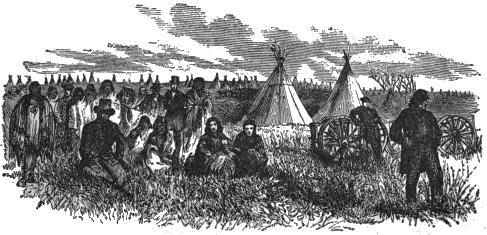
INDIAN CAMP TAKEN BY COLONEL SIBLEY.
Colonel Sibley, when he came in sight of the hostile camp, did not do as the majority of the soldiers thought he ought; viz., march up and at once surround the camp. This is where his coolness and knowledge of the Indians served him so good a purpose. He knew if he attempted such a course that the renegade Indians in the camp would at once take the alarm and run away, and that probably before they did go they would attempt to take the prisoners with them, and failing in this would kill them outright. He was informed of this by one of the scouts and at once concluded to adopt but one course, to go into camp and pay no attention to them and thus disarm them of any fear as to his real intention. While the Colonel did this, and apparently intended to leave them alone, he was informing himself of the condition of affairs in the Indian camp. He learned that several of the worst bands had gone farther up north, and he sent word to them to return and they should not be harmed. Several bands did come back, but there were those who did not, and after the scouts had located them, companies of soldiers were sent out to make their capture. In this way they all came back or were captured and compelled to come, excepting Little Crow and his immediate followers.
At Camp Release we attended to guard mount, company and battalion drill, and all other duties incident to a soldier’s life. It became necessary to make a concerted move against the Indian camp in our immediate vicinity and relieve the white prisoners, and the orders were received one night for all the infantry to turn out at twelve midnight. It was to be done noiselessly, and the instructions were so given. The whole command marched out in single file until the Indian camp was surrounded, and then we were ordered to close in. After this was done we received orders to lie down and to remain until daylight, when, at the sound of reveille, we were to rise up. The Indians, hearing the early bugle call so near them, flocked out to see what it was and found themselves prisoners.
Negotiations at once commenced for the unconditional surrender of the white prisoners, and the object about which General Sibley was so solicitous was accomplished. He knew that he could not attack the hostiles in the friendly camp without endangering the lives of the captives, and that the best policy was to appear indifferent about their presence and thus disarm them of fear. The plan worked admirably, and the game was successfully bagged.
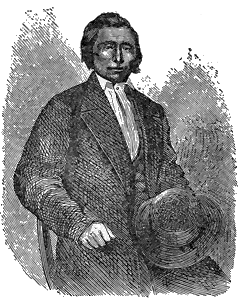
OTHER DAY.
CHAPTER XXI.
CAMP RELEASE.
Among the attractive and cultivated women found among the prisoners was a Miss Mattie Williams, of Painesville, Ohio, who at the time of the outbreak was living with an uncle on the Yellow Medicine River. They had been surprised by the Indians without a moment’s warning, and of course, in their hurry, had no time to plan for an escape; but each sought safety as best they could and became separated. Miss Williams, in her wanderings, was picked up by a Mr. Patwell, who was escaping with a German girl, who also was fleeing. They were overtaken by the Indians, Mr. Patwell was killed, the German girl so wounded that she died, and Miss Williams herself, wounded in the shoulder, was alone with her Indian captors, who imposed upon her all the indignities born of their hellish desires. For forty days she suffered as no human mind can imagine, forty anxious days and sleepless nights in a dirty, smoke-begrimed, leaky tent, clad in Indian costume and obliged to submit to savage passion. But the angels listened and the day of deliverance drew near. The women of this camp were all of one mind—in accord they prayed that deliverance should come, and that the guiding hand should be directed by a clear head. As Moses was preserved in the bulrushes and found by Pharaoh’s daughter and educated for a purpose—to lead the children of Israel from out the land of bondage and through the Red Sea to the wilderness and the promised land—so, too, was Colonel Sibley raised up to frustrate the designs of the Indians and liberate these women and children.
On the night of September 25th our heroine, wrapped in her Indian blanket, laid herself down, not to pleasant dreams, but to blissful waking visions of release. Nor was she alone in her night vigils; other hearts, burdened and borne down with unutterable anguish, petitioned God to so direct the soldiers who were on the way, that their release might be sure. The soldiers are coming, and are these weary, anxious, fearful days and nights to end? At the first dawning of the day, September 26th, the Indian camp was astir and preparations made to receive distinguished guests. And who were these guests? Colonel Sibley, the big white chief, and his staff. Extra paint, paint of every hue, and beads, together with eagle feathers and white flags, were conspicuous throughout this excited Indian tepee village.
The bright gleam of muskets away in the distance, banners fluttering in the breeze and the sound of martial music as it struck the glad expectant ear, was an answer to all their prayers: “Deliverance had come!” Hearts made glad because the terrible nightmare of weeks had been dissipated, the anxious days and sleepless nights were at an end, prayers had been answered, and it was now a time for thanksgiving. Was it ended, this horrible dream? Yes. But with it all, strong attachments sprang up between the captive and the captor. They would have been less than human if it were not so. These sturdy and determined Indian women and men who protected them had jeopardized their lives, and what greater love can we show one for the other than that we lay down our lives?
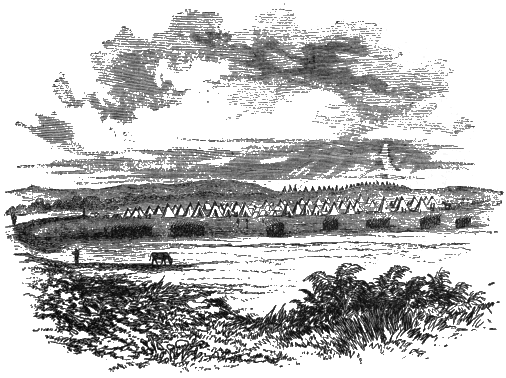
CAMP RELEASE.
The little children, from one year up to four or five, who had become orphaned, were adopted by the Indian mother, and these mothers, who became so under such sorrowful circumstances, and having all the maternal instincts of her more favored white sister, cared for them as tenderly as she did her own. The little things were there with their dirty, chubby faces, just the same as their Indian mates, their faces were painted, their hair braided and garnished with eagle feathers, and they really seemed happy and contented amid their changed and strange environments. When the time came for them to go to our camps they cried and wanted to stay with their newly found Indian mothers, and the mothers in turn hugged them and cried over them and hated to give them up. There is nothing passes a mother’s love, even an Indian mother’s love.
It was a proud day for Colonel Sibley, and as he looked into the happy faces of the captives and received their blessings and reverent homage, his heart was touched and tears coursed down his cheeks. He was yet a colonel, so far as we knew, and one of his staff officers, in addressing him said:
“Colonel Sibley, I would rather have the glory of your achievement to-day than the proudest victory ever won in battle.”
The military camp at this point was designated Camp Release, so named from the nature of our mission in releasing the people from their Indian captivity. The manner in which they were rescued and the Indians captured reflects greatly to the credit and sagacity of Colonel Sibley and his advisers. The impetuous and indignant soldiers, after what their eyes had beheld in the region where the whites had been murdered, were determined to annihilate the camp, and it was almost impossible to restrain them, especially Company A, of the Sixth Minnesota, which had suffered so severely at Birch Coolie; but wiser counsels prevailed.
After the Indians had been secured, and the captives released, we went among them and listened to the recital of experiences that would make the blood of any ordinary mortal boil with indignation, and it was a miracle that the soldiers did not take the matter in hand and then and there forever settle the Indian question. The orders were very strict about guarding the Indians, but on the sly many acts of cruelty were indulged in by the soldiers that would hardly be warranted, for we should not for a moment forget the fact that they were our prisoners and we were not savages and should not indulge in savage propensities.
Colonel Henry Hastings Sibley at Camp Release received a notification of his deserved promotion, and we shall hereafter speak of him as General Sibley.
During our stay at Camp Release we were daily drilling by company and battalion, and perfecting ourselves in all things pertaining to soldier life. We had a splendid camping place on the broad prairie near the river bank, but the cold nights reminded us that winter quarters would soon be more comfortable than the open prairie, and the rations were getting rather scarce. “Fall in for grub” ordinarily is quite as welcome to the hungry soldier as is the gong at a fashionable hotel to the fashionable guest. How we jumped for the haversack containing, not solid silver, but tin cup, tin plate, knife, fork and spoon, and fell in line according to our agility to get there, and not according to size, so as to give the ponies an equal chance with the tall men, whose place is on the right when in parade. Each received his ration of coffee, hard tack, pork and beans, irrespective of size, weight or previous condition.
Commissary stores at Camp Release were getting very low and the supply train was not yet due by several days’ march, so it became necessary to count out the crackers—five crackers to each man for a day, and no pie or strawberries and cream for dessert. From five we were reduced to three, and then there was nothing left but the bottom of the barrels. There was some ear corn, but a guard was placed over that to keep it safe for the horses and mules. Every mule was honored with a guard during his meal hour to prevent the “boys in blue” from appropriating the precious ear for his own use. No coffee, no meal, no hardtack, but there was a load of potatoes remaining, and when the call to grub sounded, again we scrambled into line to receive our ration for the day, which was—one potato. Just after we received this potato ration the commissary train hove in sight under strong guard with three days’ rations, which were issued to the hungry soldiers, and the indications were that the command would soon move.
CHAPTER XXII.
THE INDIAN PRISONERS—THE TRIAL.
After liberating the captives it became necessary to at once proceed against the Indians, and to this end the General appointed a commission consisting of Colonel William Crooks, president; Lieutenant-Colonel William R. Marshall, Captains H. P. Grant, H. S. Bailey and Rollin C. Olin and Lieutenant I. V. D. Heard as recorder. The Indians were properly represented, and through an interpreter understood the nature of the charges brought against them.
The rescued white captives, as soon as possible, were sent under suitable escort to Fort Ridgely and then forwarded to their friends. As before narrated, some of them had formed quite strong attachments for their dusky protectors.
And it is not to be wondered at. Because a man’s skin is red or black it does not follow that his heart is black. The blackest hearts the world’s history ever recorded beat beneath the whitest breasts.
These friendly Indians were in a very small minority, succeeded in saving the lives of the captives. It was a watch by day and by night, and through a bold determination, that the few friendly ones succeeded in saving, as they did, these captives, and they would be less than human if they did not form strong attachments for their dusky friends.
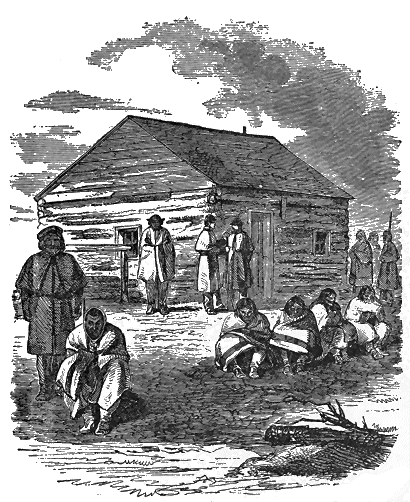
THE COURT-HOUSE OF THE MILITARY COMMISSION.
After the departure of the white captives, the Indian trial proceeded, but for good reasons the General concluded to move the camp down to the Lower Agency on the Red Wood River. The Indian camp, mostly made up of women and children, had been moved from Yellow Medicine to this place, where the trial still progressed.
It was really amusing to sit by and listen to the testimony given in by the Indians through their interpreter. They were nearly all like the white criminals of to-day—innocent. I will only record a few. Cut-Nose, for instance, will be a fair example of others, who were as guilty wretches as ever escaped the immediate vengeance of an outraged people.
The bloody old chief tried to play the innocent by saying he was not in the battles to hurt anyone. He was most always there, but he was engaged in some innocent pastime, such as feasting on roast beef and green corn, while his comrades of the paint and feathers were killing people by the score. If he fired at all it was at random and nobody was hurt. He would steal, but that was for the benefit of his wife; she insisted upon his doing something towards the support of herself and their Indian kids; but as for killing anyone, oh! no, he could not think of that for a minute.
We have his picture here, and his looks are a “dead giveaway;” and, besides, twenty-seven murders were traced directly to him, and his protestation of “me good Injun” all went for nought. He was a notoriously bad Indian; he was so adjudged by the commission, who condemned him to death, and he finally dangled at one end of a hempen cord.
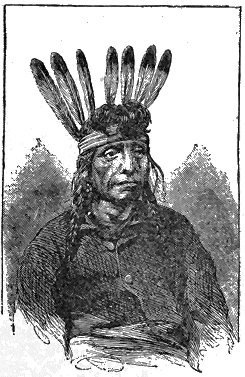
CUT-NOSE. Who killed twenty-seven persons, and was hanged.
Another one, prematurely gray, thought this ought to be evidence in his favor, and others protested that they were too weak to face fire; others, that their lives were threatened and they were compelled to go on the war path; others, that they slept while their more wakeful companions fought; and one old man who said he was fifty years old a great many years ago, thought he might be excused, but a boy swore straight against him and said, “I saw that man kill my mother,” which solemn words settled the prisoner’s fate.
This Indian was “Round Wind,” but it was afterwards shown that he was not there and he was reprieved just before the day set for the execution.
Among the Indian prisoners were some who had been enlisted in the “Renville Rangers,” and had deserted to their friends—our enemies. These rangers were all Indians and half-breeds, and it was largely from this fact that the Indians conceived the idea that all the white men had left the state and that the time was propitious for the Indians to strike to regain their territory.
It was proven conclusively that these men had been in all the battles, and at Wood Lake one of them had taken the first scalp, and this from an old man and a former comrade in his company. For this he received one of the two belts of wampum which had been promised by Little Crow as a reward for killing the first white man. These men all offered excuses, but the evidence was so overwhelmingly against them that they also were condemned to death.
It was necessary to make an indiscriminate capture of the Indians and then investigate their several cases to find out the guilty ones, because, there were many among them who no doubt had been compelled to participate in the fights we had with them at Birch Coolie and Wood Lake, and only kept with the hostiles from policy and to save the lives of the white people. To these and a good old squaw, well known in St. Paul and other parts of the Union as “Old Betz,” over 400 persons owe their lives.
“Old Betz” has gone to her reward in the happy hunting grounds, having lived over seventy-five years. She was a good woman and a good friend to the early settlers of Minnesota. Others who were friendly to the whites and loyal to their great father at Washington were liberated, and the guilty placed under strong guard.
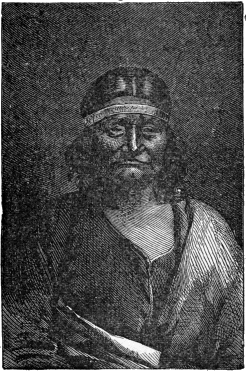
OLD BETZ.
CHAPTER XXIII.
CAPTURE OF RENEGADE BANDS—MIDNIGHT MARCH.
General Sibley was apprised by his scouts that there were several lodges of Indians up around Goose Nest Lake, and also near the mouth of the Lac-qui-Parle River, and he dispatched Lieutenant-Colonel Marshall with two hundred and fifty men (having six days’ rations) to bring them in. The little expedition started at midnight. They did not find Indians at the point designated, but struck across the country, and by a forced march of forty-five miles, found two lodges. They took the young men prisoners, but the women and children were placed in charge of the old men and sent away with instructions to report at Camp Release, which they did in due time. Colonel Marshall heard of twenty-seven lodges at a place described as Two Wood Lake, but upon arriving there, found the place deserted, the enemy leaving behind for the benefit of other Indians, a sign indicating that they had left two days before. In order to catch them, the infantry were instructed to follow, while the cavalry, with a howitzer, pushed on as fast as possible, and about midnight on the 16th the detachment came up to the Indians, who, unsuspecting, were enjoying their sleep. The barking of the dogs awoke them, and they realized that something unusual was about to occur. Peering out through the opening of their tepees, they saw horsemen and at once suspected they were soldiers. The half-breed scouts called upon them to surrender and they would not be harmed. Some of the younger men started to run away, but they were overtaken and all made prisoners. In their conversation with the interpreter they said they would have given themselves up, but were afraid to do so. They said they knew that starvation stared them in the face, because a cold winter was at hand, their provisions were all gone, and that for the sake of their families they were glad to be caught. They said also that Little Crow and some of his immediate followers had gone farther north, near Devil’s Lake.
The game having been successfully bagged, Colonel Marshall hastened with the prisoners back to Camp Release, where everything was in readiness for a move down to Red Wood.
Among the Indians was a negro by the name of Godfrey. He had never known any other people and was totally ignorant concerning his parentage; but he was among them, taking part in all their battles, and a very active part, too, for the charge against him was “murder,” in that with his own hand he had killed seven white men, women and children. He said he was not guilty. It is often thus—guilty men are innocent in their own estimation. Mr. O-ta-kle (Godfrey), was in his own opinion one of this sort. Certain it was, he had been enthusiastic over the prospect of the excitement that would follow a general uprising, for he put on a breech-clout and decorated his black face and legs in all the gorgeous hues of Indian war paint. He could “whoop” as loud and yell as fiercely as the best of them, and when the Indians returned from one of their raids he was accounted one of the bravest of their warriors. He admitted that he had killed seven; this he did, however, to his Indian comrades, when it would, if a fact, add feathers to his coronet and renown to his cruel record; but, when confronted by the men who could pass judgment against him if found guilty, he was the most innocent creature in all the world. In his hesitating, broken way of speaking, he gave a minute account of his whereabouts. There was no direct evidence against him, excepting his own confession to his comrades that he was with the Indians in all their raids and that he had killed seven people. In his earnest denial of the fact, he had such an honest look, and spoke with such a truthful tone, that the court, although prejudiced against him, were inclined to listen to his story with a reasonable degree of favor; yet he was finally found guilty and sentenced to be hanged, the verdict being accompanied with a recommendation that his punishment be commuted to imprisonment for ten years. He did not go to prison, but was sent to a reservation and compelled to stay there. Who he was, or where he came from, no one seemed to know, and he could remember nothing beyond his life among the Indians.
CHAPTER XXIV.
HOMEWARD BOUND.
“We start for home to-morrow morning,” were the gladsome words passed around the camp-fire on the evening of the 22d of October. The nights were getting chilly, and the shortening days indicated that the autumn was fast passing away, and that warmer quarters than our tents would soon be an absolute necessity. The contemplation of the homeward march was a pleasure, for there were ties of friendship there that forbade procrastination. A sad thought came over us as we remembered the poor fellows who had given up their lives—their waiting ones at home would wait in vain.
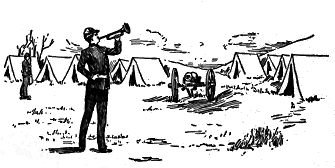
“Reveille.”
Reveille sounded early one morning, and after a hurried breakfast of coffee and hard tack, the headquarters bugle sounded “strike tents,” and the city of canvas was soon razed to the ground. With the captives and prisoners we took up our line of march for Yellow Medicine, where the commission appointed by the General tried and condemned 305 Indians to hang.
The morning we left Camp Release the sun shone brightly, the sky was clear, but there was frost in the air; and, as we were on very short rations and only one blanket each, we were in high glee as we marched out to the music of the band. I think our steps were more than the regulation twenty-eight inches, for we were headed towards God’s country—home. About four p. m. the fierce fall wind veered around in our faces, and coming as it did off the burnt prairie, our faces soon presented the appearance of men from the interior of Africa. We were black in the face. At five o’clock we went into camp. It was pitch dark, with the wind blowing a hurricane, and in the darkness, infantry, cavalry, and artillery were one interminable mass of troops and order was impossible. So the orders were: “By company, left wheel, halt;” “stack arms;” “break ranks,” with orders to pitch tents and get under cover. To make fires and cook supper was impossible, so we supped on raw salt pork, hard tack, and cold water. The Sibley tents blew down as fast as put up, and in this condition we crawled under them to get the best protection possible from the fierce northern blast. Some of the men had found potato cellars that had been dug in the hillside by the Indians, and taking possession of them were thus afforded good, warm quarters and plenty of potatoes to eat. In this respect they were much more fortunate than the rest of us who were on the outside and had all we could do to keep from freezing to death. The storm abated somewhat by morning, so we could make our fires, which we did, and availed ourselves of the Indian potatoes, and with salt pork, hard tack and coffee made a hearty breakfast and were soon on the march again.
The exposure of that night gave many of us the rheumatism, and it took several hours’ march to get ourselves limbered up, but the day was bright and we were homeward bound. We made a good day’s march, and pitched our tents in the valley of the Red Wood.
The Indian camp, consisting principally of women and children, had been previously removed to this place from Yellow Medicine, where the quartermaster had erected a large board prison to hold the captive red men, who had all been condemned by the Commission. The papers had been sent on to President Lincoln for his final decision, and we were here awaiting developments.
The condemned Indians were sent under strong guard to Camp Sibley, on the banks of the Red Wood River. They were chained together and kept in a structure built for the purpose, and their squaws, who were camped on the outside, were allowed to cook for them under the supervision of a guard, to prevent them from smuggling knives or a weapon of any kind on the inside of the enclosure.
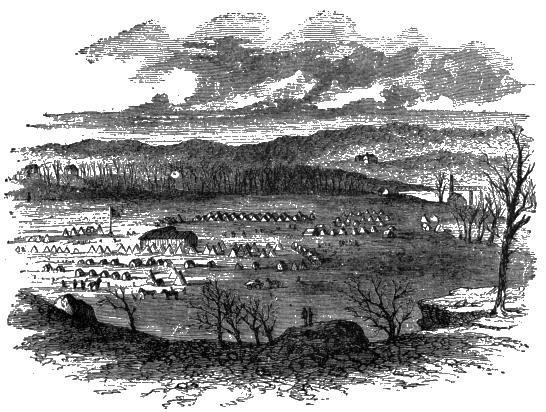
CAMP LINCOLN.
After a week or ten days we again took up the line of march to a destination known only to the General and his Staff, but which proved to be that the Seventh Minnesota, under Colonel William R. Marshall, should proceed with the prisoners to Mankato, and the Sixth Minnesota, under Colonel Crooks, should report at Fort Snelling for further orders. The two regiments marched together until we reached a point some way below New Ulm. Nothing of importance took place until we reached this place. The General having heard that the citizens had determined to kill every redskin regardless of consequences if they could possibly get hold of them, took precaution against it. It was said that every house was supplied with hot water, hot soft soap and anything and everything that ingenuity could invent to inflict sudden and sure punishment, and death if possible, to those that had brought such woe to them. For this reason the General changed his course somewhat, and making a detour to the right, escaped the necessity or perhaps bloodshed, in trying to save his captives from the hands of this justly furious people. Men and women turned out en masse and hurling imprecations, flourishing butcher knives, table knives, and even scissors, axes, pitchforks—in fact, every sort of weapon—seemed determined to get at them, and abused soldiers and Indians alike because they were held at bay. They followed us for two or three miles before they became convinced that the General was determined at all hazards to uphold the supremacy of the government in protecting these blood-stained captives from the furies of a people who had suffered so much at the hands of some of their tribes in the murder of their innocent women and children.
At a point below New Ulm the command was divided, a portion taking all the condemned men to Mankato, and the balance of the command proceeding to Fort Snelling.
At Mankato, as the days wore away and there was some doubt as to what the final decision of President Lincoln would be, great fear was entertained that there would be a general uprising of the people, and an attempt made to override military and civil law by wresting the Indians from the soldiers and instituting a general massacre of them, irrespective of their guilt or innocence, but Colonel Stephen Miller, the post commander, having determined that law and not lawlessness should prevail, used the utmost vigilance to defeat any such undertaking.
CHAPTER XXV.
PROTESTS—PRESIDENT LINCOLN’S ORDER FOR THE EXECUTION.
The Indians did not seem to feel cast down; some in fact appeared rather to enjoy the situation; others, again, were more serious, and were probably speculating as to the probable outcome of the unfortunate condition of affairs. The soldiers did not relish the idea of guarding them, and one night a conspiracy, which I overheard, was formed to create a false alarm in the camp and in the excitement fall on the Indians and murder them. The plot leaked out and the plan miscarried, as it should, for it would have been rank murder to have executed it. Among the prisoners there were many who really were not guilty, but had been caught in bad company. The prisoners were arraigned upon written charges specifying the criminating acts, and these charges were signed by General Sibley, and with but few exceptions were based on information furnished by Rev. S. R. Riggs, who had long been a missionary among them. The majority of the prisoners were condemned to death, and the news reaching the East, far away from the scene of the outrages, petitions went in from many New England cities, imploring the President to exercise clemency toward this unfortunate people. He yielded to the clamor in so far as only to include the very worst characters among them.
Bishop Whipple said: “There are times when the Christian laborer has a right to ask for the sympathy, the prayers and the co-operation of our fellow-citizens, and to make a strong appeal in behalf of this most wretched race of heathen men on the face of the earth. The responsibility,” he says, “is great, the fearful issues are upon us, and as we are to settle them justly or unjustly we shall receive the blessing or curse of Almighty God. Many of these victims of savage ferocity were my friends. They had mingled their voices with mine in prayer; they had given to me such hospitality as can only be found in the log cabin of the frontier; and it fills my heart with grief, and blinds my eyes with tears, when I think of their nameless graves. It is because I love them and would save others from their fate that I ask that the people shall lay the blame of this great crime where it belongs, and rise up with one voice to demand the reform of the atrocious Indian system, which has always garnered for us the same fruit of anguish and blood.”
Thousands of miles away from the scene of the outrages perpetrated against the inoffensive white settlers, protests were sent in to the President from all sorts of humanitarians, imploring him to stay the sentence that condemned to death so many human beings. The provocation to indiscriminately condemn and hang was very great, for thousands of innocents had been ruthlessly murdered; no moments of warning were given them; no former kindnesses seemed to be remembered by the Indians, and their hands were steeped in their friends’ blood, and there seemed no palliating circumstances. The enormity of the outbreak and the fiendish cruelty of the redskins were appalling; the people were paralyzed with astonishment and fear, and the witnesses, no doubt mistaken and prejudiced, gave such positive testimony that the commission felt satisfied in pronouncing them guilty of murder in the first degree; but would this have been the case if these prisoners had been white instead of red?
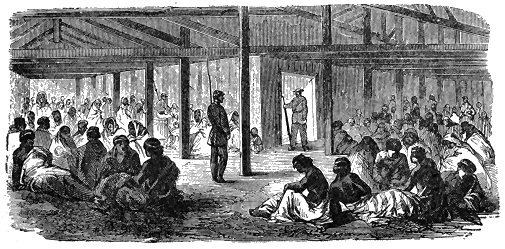
INTERIOR OF INDIAN JAIL.
No doubt General Sibley himself was surprised when he learned of the indiscriminate condemnation of these prisoners, and was glad not to be held responsible for their hanging.
It is a fact that there were Indians found with arms in their hands in nearly all the battles, but their object was to protect the women and children prisoners, and they said they must make a show of fighting whether they did or not in order to accomplish this. It would have been a great stain on the fair name of our country if this wholesale hanging had occurred, and President Lincoln acted wisely in overruling the recommendation of the commission, which he did to such an extent as to sanction the execution of thirty-nine of the condemned men, and the balance to be further held as prisoners until he should designate a reservation to which they should be sent. During the time the preparations were being made to carry out the President’s order the people were clamorous. They were not satisfied with the modification of the President’s order, and grave rumors were abroad that there would be a vigorous effort made to take the Indians from the soldiers and have a wholesale execution, but the military authorities prevented it.
The President acted wisely in this matter. In fact, the state of the public mind was such and the pressure within our lines was exercised to such a degree that the President could do nothing less. If all the condemned Indians had been executed the impression would have gone abroad that the great government of the United States was putting to death its prisoners of war, and this would have done much toward bringing about a recognition of the Southern Confederacy.
The President’s order was as follows:
“Executive Mansion, “Washington, December 6, 1862.
“Brigadier-General H. H. Sibley, St. Paul, Minn.:
“Ordered, that the Indians and half-breeds sentenced to be hanged by the military commission, composed of Colonel Crooks, Lieutenant-Colonel Marshall, Captain Grant, Captain Bailey and Lieutenant Olin, and lately sitting in Minnesota, you cause to be executed on Friday, the 19th day of December, instant.
“The other condemned prisoners you will hold subject to further orders, taking care that they neither escape nor are subjected to any unlawful violence.
“Abraham Lincoln, “President of United States.”
The execution was carried out on the 26th of December, 1862. Thirty-eight were hanged.
CHAPTER XXVI.
THE EXECUTION—THE NIGHT BEFORE.
The date of the execution was fixed for December 26, 1862. On the 22d instant the condemned prisoners were separated from the others, and on the same day Colonel Stephen Miller (afterwards Governor), who was in command, through the interpreter, Rev. Mr. Riggs, called upon the condemned and announced the decision of the Great Father at Washington. He said:
Tell these thirty-nine condemned men that the commanding officer of this place has called to speak to them on a serious subject this afternoon. Their Great Father at Washington, after carefully reading what the witnesses testified to in their several trials, has come to the conclusion that they have been guilty of murdering his white children; and, for this reason, has directed that each be hanged by the neck until dead next Friday at ten a. m.
That good ministers, both Catholic and Protestant, are here, and can commune with them for the remaining four days they have to live.
That I will now cause to be read the letter from their Great Father at Washington, first in English and then in their own language.
Say to them, now, that they have so sinned against their fellow-men, that there is no hope for clemency except in the mercy of God, through the merits of the blessed Redeemer; and that I earnestly exhort them to apply to that, as their only remaining source of comfort and consolation.
Rev. Mr. Riggs, the interpreter, had been a missionary among them for twenty-five years, and he had known them intimately, and it pained him sorely to be obliged to convey to them as an interpreter the words that were to condemn them to death. In so doing he said:
I have known you for many years; I have pointed you to the cross; endeavored to prayerfully convince you that allegiance to God, and the Great Father at Washington, was your duty. I have with a broken heart witnessed your cruelty to inoffensive men, women and children; cruelty to your best friends. You have stained your hands in innocent blood, and now the law holds you to strict accountability. It pains me to inform you that your Great Father in Washington says you must die for your cruelty and murders, and I am directed to inform you that on the 26th day of February you will be hanged by the neck until you are dead, and may God have mercy on your souls.