Front matter (continued 3)
Reading edition
The prisoners received the sentence rather coolly; some smoking their pipes composedly during its reading, one of them knocking the ashes out of his pipe, and another putting in his a fresh supply of kinnikinnick. On Tuesday evening they held a death dance, accompanied by wild Indian songs, and there were some fears that the excitement might cause an attempt to make an escape or create a panic; so, precautionary measures were taken. The Indians’ friends and families were permitted to visit them and take a last farewell. It was a solemn time even to the white soldiers, for it was plainly evident that while there was a lack of such demonstration as would be witnessed among the whites under similar circumstances, yet to the observant eye only, it was plain to be seen that deep, deep grief had taken possession of their hearts. There were few tears; no hysterics, but profound sorrow was depicted on the countenances as the parting word was said, and messages sent to children and friends. Some were completely overcome; others in bravado laughed and joked as if it were an every-day occurrence. One said: “Yes, tell our friends that we are being removed from this world over the same path they must shortly travel. We go first.”
Many spoke in a mournful tone; in fact, the majority of them desired to say something, and with one or two exceptions they seemed to be penitent. Why should they not? Their white brethren under like circumstances are accorded religious privileges. They repent and accept the invitation, “Come unto Me all ye who are weary and heavy laden and I will give you rest.” The thief on the cross repented. Could not an ignorant, misguided Indian under religious instruction receive light and repent?
The night before the execution Colonel Miller received a stay for one of the condemned, as strong doubt existed as to his participation in the murders, and he was finally pardoned.
It has been said that in the excitement of the preparations for the execution that the wrong man was pardoned. He was guilty, but the innocent man suffered in his stead. The last night was spent by the prisoners in quite a jolly camp-fire, chatting merrily and smoking to their hearts’ content.
Father Ravoux, a Catholic priest from St. Paul, remained with them all night administering consolation and communion, and the more serious of them listened attentively to his words of comfort. In the morning, as the hour for the execution approached, and while Father Ravoux was speaking to the Indians, the provost marshal entered and whispered something to the good priest, who in turn spoke in French to one of the half-breeds, and he repeated it in Dakota to the Indians, who were all lying down around the prison. The information he gave was that the hour had arrived when they were to march to the gallows. In a moment every Indian stood erect, and as the provost marshal opened the door they fell in behind him with the greatest alacrity. Indeed, a notice of release, pardon or reprieve could not have induced them to leave their cells with more apparent willingness than this call to death. At the foot of the steps there was no delay. Captain Redfield mounted the drop, at the head, and the Indians crowded after him, as if it were a race to see who would get there first. They actually crowded on each other’s heels, and as they got to the top, each took his position, without any assistance from those who were detailed for that purpose. They still kept up a mournful wail, and occasionally there would be a piercing scream. The ropes were soon arranged around their necks without the least opposition being offered. The white caps, which had been placed on the tops of their heads, were now drawn down over their faces, shutting out forever the light of day from their eyes. Then ensued a scene that can hardly be described and can never be forgotten. All joined in shouting and singing, as it appeared to those who were ignorant of the language. The tones seemed somewhat discordant, and yet there was harmony in it. It was not their voices alone, but their bodies swayed to and fro, and their every limb seemed to be keeping time. The drop trembled and shook as if all were dancing. The most touching scene on the drop was their attempt to grasp each other’s hands, fettered as they were. They were very close to each other, and many succeeded. Three or four in a row were hand in hand, and all hands swaying up and down with the rise and fall of their voices. One old man reached out on each side, but could not grasp a hand; his struggles were piteous and affected many beholders.
Those who understood their manners and language said that their singing and shouting was necessary to sustain each other. Each one shouted his own name and called on the name of his friend, saying in substance: “I am here! I am here!”
The supreme moment arrived, and amid an immense concourse of citizens and soldiers the drop fell, and thirty-eight human beings, whose hands were steeped in innocent blood and who had spread such desolation and sorrow to thousands of happy homes, were ushered into the presence of their Maker.
The arrangements were under the immediate supervision of Captain Burt, of the Seventh Regiment, and they were so complete that there was not the slightest hitch.
“Positions of honor were given to the most interested. For instance, the cutting of the rope was assigned to William J. Daly, of Lake Shetek, who had three children killed and his wife and two children captured, and who were at this time in the hands of Little Crow, on the Missouri, and were afterward ransomed by Major Galpin at Fort Pierre.”
The quotation I make here is from a book in the public library, and I found penciled on the margin by one of those persons who take advantage of the courtesies extended by public libraries, the following:
“So should every remaining Indian be ’elevated'!” Nay! Nay! scribbler. We cannot tell why one man’s face is black and another red, while yours and mine are white. Would you mete out the same measure to the whites? Innocency among the Indians, per capita, is not more rare than among their more favored white brethren, and we are brethren of a different hue. Punish the guilty, be he white or black, but protect the innocent.
After the bodies had hung for about half an hour, the physicians of the several regiments present examined them and reported that life was extinct. The bodies were carried away in United States mule teams and dumped in one common grave, dug in the sand bar in front of the city, the half-breeds in one corner of the hole so they might be found by their friends if they so desired. There may be times and circumstances when a Christian people can afford to act as we expect the benighted to do; but it has not arrived yet. No matter what the crime, the penalty has been paid, and after the spirit has gone to God to be adjudged, it is part of our civilization to be decent in our conduct toward all that remains mortal. It is not necessary to make a great display, but that we perform our duty according to our law. We have taken a life in accordance with a human law, and in justification of it we quote, “An eye for an eye and a tooth for a tooth.” No matter how atrocious the deed, after the penalty has been paid we cannot as a Christian people, apologize for our acts of barbarism to the inanimate clay.
After the mandate of the President had been executed the telegraph flashed to Washington the following:
“St. Paul, Minn., December 27, 1862.
“To the President of the United States:
“I have the honor to inform you that the thirty-eight Indians and half-breeds, ordered by you for execution, were hung on yesterday at Mankato, at ten a. m. Everything went off quietly, and the other prisoners are well secured.
“Henry H. Sibley, “Brigadier-General.”
With this the curtain drops on this bloody drama, and thus ended the great Indian campaign of 1862.
CHAPTER XXVII.
SQUAWS TAKE LEAVE OF THEIR HUSBANDS.
The condemned men, and the others who were to be deported after the execution took place, were called upon to bid good-bye to their wives and children, who were to be taken down to Fort Snelling. The wives were allowed a few at a time to go inside the jail and with the children have words of conversation with the husband and father. After a reasonable time they took leave of them. There were no hysterics, no sobs, no tears, but the heart-beats and the thoughts were there. Love? Yes. How deep, no white on-looker could tell. It was a supreme moment to the poor Indian and his dusky wife. Their roads were very divergent from this time, and in low tones they answered in their own tongue. Some of the soldiers made slighting remarks, but there are those among educated whites who have no serious moments, no serious thoughts; they have not time to be serious, and no inclination; but this was a serious time for those poor creatures; they knew the hour had arrived when they must say good-bye forever on earth to their red-skinned partners in life’s joys and sorrows. No hand shake; no embrace; no crying; but a sorrowful, affectionate look, and they turn their back on them forever.
The women and children are taken down to Fort Snelling, and in a camp prepared for them they are put for the winter, and a strong guard placed about them to prevent any outrages being committed. The night the news was carried to them of the execution the wails of the poor creatures could be heard for a long distance away: “Rachael mourning for her children and would not be comforted, because they were not.”
Much sorrow was expressed for them because we could but feel that they were unfortunate creatures, endowed with all the attributes of human beings.
The mortality among them was very great and hundreds died before the winter of suspense had passed away.
In April, 1863, the camp was broken up and the remaining ones were placed in a steamer for St. Louis, from whence they were to be sent up the Missouri River to the Crow Creek agency. Some died on the way, and as they left their homes and looked for the last time on their native hills, a dark cloud was crushing out their hearts. Soon after landing at Crow Creek every tepee had its sick and anxious hearts—mothers and children far away from their dead.
The deported ones joined their families in time, and as the years glide on they have had time for reflection, and the events, as they undoubtedly come trooping back to them, furnish food for thought.
CHAPTER XXVIII.
CAPTURE AND RELEASE OF JOE BROWN’S INDIAN FAMILY.
We knew Major Brown well. He was known to nearly all early settlers, because he came to Minnesota when the white people were very few. He felt that it was not well for man to live alone, a white man especially, and so he took unto himself a dusky bride. He was in government employ and a big white chief among his new found wife’s people and to whom he was a friend.
As he grew in years his family grew also, and the dusky mother’s household cares increased. Yes, they lived in a fine stone house, elegantly furnished, down on the Yellow Medicine below the agency, but which came in the way of his red brother’s vengeance, and it was destroyed. The Brown family lived happily in their rather modern home. The Major attended to his official duties, and the wife and boys cultivated the land; but in common with all the others during these sad days, their only safety was in flight. Their home, including books and furniture, was totally destroyed. The father was a fugitive and his family prisoners. They did not suffer as some others did, because the wife and mother was a full blood and was related to the Sisseton tribe and had powerful friends among them. Their capture, captivity, and final release, as related by Samuel Brown, the fifteen-year-old boy, is an interesting recital. He says:
On Monday, the 18th day of August, I went to Yellow Medicine with my sister Ellen upon an errand. We met on the way an Indian named Little Dog, who told us that the Indians had killed a family at Beaver Creek, and were going to kill the whites as far as St. Paul, and that we must not tell any one about it, or they would kill us. He said he warned us at the risk of his own life. This was about noon. Soon after our arrival at Yellow Medicine an old squaw told us that we had better be getting away, as there would be trouble. We asked many of the other Indians about it, but they said they had heard of nothing of the kind. Another squaw afterward told us that she thought it must be the Yanktonais who were coming down to take the agency. We left them about half-past three o’clock. George Gleason had just left with Mrs. Wakefield and her children for below. When we reached home we told mother what we heard. She was very much scared and did not sleep any that night. About four o’clock next morning I heard some one outside calling in a loud voice a number of times for my mother, and then I heard Charles Blair, my brother-in-law (a white man), ask what was the matter, and the man, who was a half-breed named Royer, said that four hundred Yanktonais had arrived at the upper agency and were killing everybody. We then became very much alarmed, and had our oxen yoked at once to the wagon, put everything in we could, and started for Fort Ridgely. We had all the neighbors warned, and they went with us. They had three wagons, with ox teams. Four or five white men overtook us on the road, among them Garvey’s cook (Garvey was the trader wounded at the agency, and who afterward died at Hutchinson.)
When we had gone about five miles we saw some men two miles ahead, near the bank of the river, but supposed they were farmers. The Yanktonais, whom we were afraid of, lived above us. We thought nothing about the men until we saw an Indian on a hill ahead of us. He beckoned to others, and before we knew it we were surrounded. De-wa-nea, of Crow’s band, and Cut-Nose and Shakopee, three of the worst among the Lower Indians, came to us first. We were in the head wagon. Mother told them who we were, and they said we must follow them, and that we were all as good as dead. De-wa-nea said that the whites had taken him prisoner a good many times and that it was now his turn. He wanted the rest of the Indians to kill us all. There was an Indian in the party, John Moore’s brother-in-law, who took our part, and he and his friends saved us from the others. This Indian had once come to our house when he was freezing and my mother took him in and warmed him. He told the other Indians that he remembered this, and that we should live. They insisted that my brother Angus should shoot one of the white men, but he refused to do so. Each of the Indians had one of the whites picked out to shoot as they came up. My mother said they were poor men and it would do no good to kill them. John Moore’s brother-in-law said they should live if she wanted them to. The Indians made a great fuss about it, and said she ought to be satisfied with what she had got, but afterwards consented and told the men to start off. The women stayed with us. After the men had got off a little, Leopold Wohler, who had a lime-kiln at the agency, came back to the wagon after his boots, and an Indian told him if he didn’t go away he would kill him. He started off with one boot, and came back again for the other, and the Indian drove him away again with the same threat. He went a short distance and came back again to kiss his wife. The Indians then became very much enraged, and acted so fiercely that he was glad to escape without further difficulty. There were ten Indians close to us, and twenty-five or thirty near, running into the houses. They made Angus and Charles Blair, who were riding horses, give them up. De-wa-nea put on my sister’s bonnet and began singing a war song. He was very merry. He said the Indians were now going to have a good time, and if they got killed it was all right; that the whites wanted to kill them off, and were delaying the payment in order to do it by starvation, and that he preferred to be shot. We saw three men and a woman on the road terribly hacked up. This party had committed the murders. The men had been mowing together; their scythes and pitchforks were lying near by. Cut-nose showed us his thumb, from which a piece had been bitten near the nail, and he said it was done by one of these men while he was working the knife around in his breast; that he was very hard to kill, and he thought he would never die.
Cut-nose afterward went to a wagon and told a Scotch girl who was in it that he wanted her for his wife, and to get out and follow him. She refused, and he then drew his knife and flourished it over her, and she got out and went away with him. That was the last I saw of him until we got to camp. He was called Cut-nose because one of his nostrils had been bitten out. This was done by Other Day in a quarrel.
When we reached the camp of the Red Creek Indians, four miles above the Redwood River, they told us that the Agency Indians had sent word for all to come down there, and that those who did not come would be taken care of by the “Soldiers’ Lodge.” They were then about starting, and an Indian made Augus and myself hitch up a mule team which he said he had taken from Captain Marsh’s men the day before. He said they had just heard a cannon at the fort and they wanted to go down and whip the whites there. This was about noon. We then went down to John Moore’s house (this was where Other Day’s horse was stolen), and they put us upstairs, where they had two or three women captives. We were there about an hour, when three Indians told us to come up to their camp on the hill, where we were to stop with John Moore’s mother, or grandmother. We followed them, and when we got halfway up suddenly missed them. We supposed they hid from us, and we wandered on. We met a German woman who had seven or eight children with her, all under eight years of age,—two on her back, one under each arm and two following behind. They came along with us. We went to Moore’s relative, but she said she knew nothing about us and couldn’t take us, and that we had better go down to Crow’s Village. We started, not knowing where to go, when a squaw, who was crying about the troubles, met us, and took us home with her. The Indians sent our team back to camp. They gave Augus and I blankets and moccasins, and we put them on and went down to see Little Crow. He told us to bring our folks down there, and no one should hurt us. This was Tuesday evening, about seven o’clock. He was in his own house, and the camp was pitched around it. We went back and brought our folks down. Little Crow put us up in the top room of the house, and gave us buffalo robes and everything to make us comfortable. He brought us a candle as soon as it was dark; he was very kind to us; he said he would take as good care of us as he could, but he didn’t believe he could keep Charley Blair alive until morning. He gave him a breech clout and leggings, which he put on.
During the night an Indian or a half-breed came in the room downstairs where Crow was, and told him that we ought to be killed. We overheard what they said. The man was very ugly, and said no prisoners ought to be taken, and that we were related to the Sissetons, and had no claim on the Lower Indians, and there was no reason why we should be spared. He said he wanted Crow to call a council about it immediately. Crow told him that he saved us because we were his friends, and that he would protect us; that it was too late to hold a council that night, and he compelled him to leave.
He gave us plenty to eat, and came up several times during the night to see how we were getting along. We begged him to let Charley Blair go. He said he couldn’t; that the Indians knew he was there, and would kill him (Crow) if he allowed it. We coaxed him for a couple of hours, when he consented, and brought an Indian, who took Charley down to the river and left him in the brush. He made his escape from there to the fort. Crow told us not to say anything about it, for the Indians would kill him, and that he did it because he had known our folks so long. He said the young men started the massacre, and he could not stop them. A week after that Akipu, an Upper Indian, came down from the Yellow Medicine Agency and took us up with him. From that time until our deliverance we remained with our relatives, and were well treated by them.
The foregoing recital is just as the boy gave it, and in subsequent conversations with the father it was substantially verified.
Major Brown, after recovering his family, lived for a few years, and did much toward assisting the Government in adjusting the many claims brought against it by persons who had suffered so much at the hands of the Indians. He died a number of years ago, but the members of his family live and are much respected in the community in which they live.
CHAPTER XXIX.
GOVERNOR RAMSEY AND HOLE-IN-THE-DAY.
Alexander Ramsey, of Minnesota, is the last of the famous coterie of war governors; a band that will be immortal. Curtin, of Pennsylvania; Dix, of New York; Dennison, of Ohio; Morton, of Indiana; Randall, of Wisconsin; Yates, of Illinois; Blair, of Michigan; Andrew, of Massachusetts; and Kirkwood, of Iowa;—a notable group, stalwart, rugged patriots with hearts beating as one. Comprehending the danger that menaced the nation, confronted with no easy task, these grand old stalwarts pledged their states to uphold, with men and money, the general government. They have passed away honored by a grateful country and beloved by the men who responded to their call. Governor Ramsey alone remains, and in the National Grand Army encampment held in St. Paul in 1896 he was a central figure. Passed, as he has, beyond the allotted time of man, measure full and running over, he saw the salvation of his country, proud of the part Minnesota’s sons took in its restoration, and proud to meet them after the smoke of battle had cleared away. Governor Ramsey, being in Washington at the time of the first call for troops, promptly responded in person to the President, and tendered a regiment from Minnesota, and it was accepted; and it was the first to be accepted. He immediately telegraphed to Adjutant General William Henry Acker to at once issue a call for one regiment of three months men.
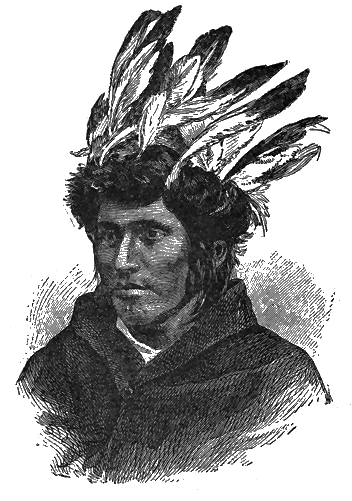
HOLE-IN-THE-DAY.
The companies were soon filled up, and Adjutant-General Acker was commissioned as captain of Company “C.” He was afterwards commissioned as captain in the Sixteenth U. S. Infantry, and was killed at Shiloh.
Governor Ramsey was elected United States Senator from Minnesota, and served his state faithfully and well, and was at one time Secretary of War. At this writing he is hale and hearty, honored by men of all political faith.
Governor Ramsey’s part in the Indian trouble was more than commissioning officers and sending men to the frontier.
The Chippewas were in a turbulent state of mind, and Hole-in-the-Day, their chief, did not seem inclined to soften their feelings to the Government, but rather encouraged them in their desire to break their compact. He said to his people that “we had all we could manage, with our brethren in the South, and if they pleased to combine with the Sioux, their power could not be resisted.”
This surely was cause for alarm,—alarm for the safety of the state, and it required strong measures to curb this uprising among these Indians. Commissioner Dole lost hope of successfully meeting the demands of the Indians, and dispatched a messenger to Governor Ramsey asking him to hasten to his relief. The Governor lost no time, and with two or three others were soon on the way. He did not go with an army carrying banners, but quietly and unostentatiously met the Chippewa chiefs, and soon adjusted all difficulties.
When it became known to Hole-in-the-Day that General Sibley had an overwhelming force, he was then desirous to befriend the state and assist in making a treaty of perpetual friendship with the whites, and assist them in fighting Little Crow. And after the battle of Wood Lake the Winnebagoes, who were inclined to go to war against the “pale faces,” concluded it best to court his favor and proclaim war against the Sioux. Prior to this, all the tribes in Wisconsin had sent their “wampums” to the Winnebago chief, and a council of war had been fixed for the 28th of September. There seemed to be indications that an unfriendly white element was stirring up strife among all our Indian neighbors, and hence the impression that it was emissaries from the South who were doing it. It came from high authority that evidence existed to show that “the Western tribes are going to join the South.” It was a critical moment for this country. Slavery existed yet, and God’s hand was laying heavily upon us. Federal reverses and Confederate successes cast a gloom over the North, and loyal men trembled, while the copper-head came forth and, with an exultant hiss, impeded the progress of the Government in its efforts to bring about an honorable peace. Under these depressing conditions Governor Ramsey, to whom all looked with so much solicitude, nerved himself to bring about an amicable settlement with the Chippewas.
In three days from the time of departure, Governor Ramsey returned, having effected a settlement of all misunderstandings on September 15th, 1862.
The public mind was relieved, for nearly every chief of the Nation being present to sign this treaty of peace, all hostile demonstrations ceased, and they evinced their further friendship by coming to St. Paul to return Governor Ramsey’s visit, and tender their services to General Pope to operate against the Sioux.
The Governor assured them he was pleased to know they had not stained their hands in innocent blood, as the Sioux had done;—that he would communicate their desire to join the white soldiers to the big chief, General Pope, and he would send for them. The talk they had with the Governor so pleased them that they became confidential and talkative. Their responses thus far had been grunts and “ho, hos,” but Chief Berry Hunter said the words they listened to “went right into his ears, and they were good,” and although he was an old man he had not lost his reason. That they had come down to show their white brothers they felt very friendly, and never desired to have any other feeling towards them.
Big Dog, another of their noted chiefs, whose hands were very red, said he had painted them purposely, so that if he should kill an enemy and blood got on his hands it would not stain them.
Governor Ramsey extended them an invitation to ride in the “fire wagon” to St. Anthony (now East Minneapolis).
This meant that he would take them on the train. Railroading in Minnesota at this time was new to the white people, and the beautiful engines were objects of delight and admiration to them, and more so to the Indians, who were much interested in everything they saw in and about the locomotive, and they expressed great wonder at the steam whistle, and invariably ducked their heads as its shrill notes broke upon their ears. They did not wish to appear as cowards, but, like white soldiers dodging bullets after they had passed, so they inadvertently would “duck” when the whistle blew, and afterward have a hearty laugh over it.
CHAPTER XXX.
CHASKA—GEORGE SPENCER—CHASKA’S DEATH—THE “MOSCOW” EXPEDITION.
Chaska and George Spencer were great friends, and there was reason for it, as you will see. It was in George Spencer’s store where the first shot was fired, and he was the victim. He ran upstairs, but the Indians surrounded the place and threatened to burn the store, which they probably would have done but for the fact they wanted the goods. They could not muster courage to go upstairs to kill him, because they naturally thought: “What would he be doing while we are trying to kill him?”
An old squaw got him out the back way and secreted him in her tepee, and the Indians finally burnt the building, and supposed he had perished in the flames. The squaw turned him over to his Indian friend Chaska, and when the other Indians, who supposed he was dead already, saw him quite alive, they were much puzzled, for they had no inkling of his escape.
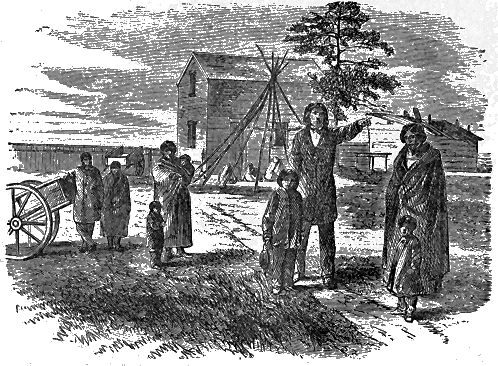
HOUSE OF CHASKA, A CIVILIZED INDIAN.
He was the only white man at the agency who did escape, and can attribute it to the friendly ministration of those two native Americans, Chaska and the squaw. It was no miraculous escape, but a plain case of genuine friendship toward a white man by an Indian. An Indian will avenge a wrong—that is his nature. It is born in him, and it cannot be blotted out; so, too, will he remember a kindness with an equal degree of fidelity, and, under any and all circumstances, will “stick closer than a brother.” Friend Spencer in this case found that the investment he had made in kindness to this red man was a paying one—it came in good time—his life was surely in jeopardy, and no miracle, but a faithful Indian, saved him, and this Indian was Chaska, a chief whom Little Crow had depended upon to help carry on the war. His friendship for Spencer was great, and when his friend’s life was threatened, he with a double shooter in his hands would cry out: “Shoot if you like, kill him if you will, but two of you will come out of your saddles if you do.”
Chaska dressed his friend in Indian garb and painted his face. It became necessary to kite him about, first in one friendly tepee and then in another, so that the spies could not keep track of him. I remember well the day I spoke with him. He had been wounded and was suffering from this, and the long days and nights of anxiety had told on him, but now that he could throw all this off he said he would soon be on the speedy round to complete recovery. Chaska was faithful to his friend of former years. He was desirous of becoming a white man so far as he could, by adopting their manners and customs. He came to see General Sibley one morning in his Indian garb, and the General said to him: “I am not pleased to see you in your blanket.”
“Then I will wear it no more,” was his reply. He washed off the paint from his face, trimmed his hair, and dressed as a citizen. He desired to live in a house rather than a tepee and to have his children attend school. This was the wish of all the friendly Indians. They instituted reforms in the social fabric, and in marrying, the rite was performed by an ordained minister, the same as among their white brethren. Poor Chaska, I remember well the night he died, for at the time a strong suspicion pointed toward a member of my own regiment, who was a clerk in the hospital department, and there never was a doubt but Chaska’s death was by poison administered by this man. George Spencer, his white friend, said of him: “On the second day of our return from the Missouri, we rode along talking pleasantly of the future, he telling me how he would like to be situated on a small farm of land near me, and congratulating himself that his trouble was over, and that he would soon be restored to the bosom of his family. Alas, for my friend! He now sleeps tranquilly near the turbid waters of the Missouri, under the shadow of our intrenchments. Savage though he was, he was a noble man!”
The night he died he had gone around to his white friend’s tent, where he was always welcome, and supped with him and arranged for carrying in the commissary wagon, a pack of furs he had captured. He went to his quarters after taking a dose of medicine and was soon taken ill. He sent for his white comrade, who went immediately to his bedside, to find him senseless, dying. In his delirium he predicted a thunderstorm that would shake the earth and blind the people the day he was put in the ground, and the prediction came true. He did not once recognize his friend, who remained with him, closing his eyes with a sorrowful heart. He died at the age of thirty-two, leaving a wife and two interesting children. He was faithful among the faithless.
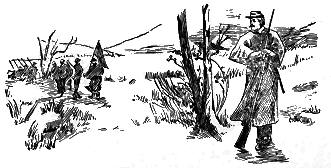
The Sentinel.
CHAPTER XXXI.
THE “MOSCOW” EXPEDITION.
This expedition, well named “Moscow,” will be remembered by the participants so long as they live. The government had decided to remove all the Indians to Fort Thompson, a military post on the Missouri, and after it had been done, it was found a little later that they were in a starving condition. General Pope communicated this fact to the authorities at Washington, and that the Indian agent had applied to him to furnish an escort for a supply train, that would be sent from Minnesota rather than from Sioux City, Iowa. Three companies were designated to undertake this perilous journey, and placed in command of Captain J. C. Whitney, of the Sixth Minnesota. It was impossible to hire teamsters to go, so an offer of twenty-five cents per day was made to the soldiers in addition to their $13 per month; but the undertaking was too hazardous and the offer was refused. The bid was raised until it reached $1.25 per day extra, when a few soldiers agreed to accept. On the 6th day of November a partial start was made, but one delay after another occurred until the case became desperate, and the teamsters finally got two dollars a day extra.
The fact was, the soldiers rebelled, and in order to frustrate the plans of the contractors the wagons were so disabled that it was impossible to move. Colonel Crooks, of the Sixth Minnesota, took matters in hand so vigorously that the soldiers knew that the expedition would have to move at all hazards, and it was foolish and dangerous to object and waste any more time. Several arrests of mutinous soldiers were made, but upon promises of better conduct they were released, and the “Moscow” expedition was finally and fully launched on the 20th day of November, 1863. The undertaking was hazardous, but the men were supplied with the best of Sibley tents and blankets in plenty. Under the most favorable circumstances it was not a picnic, but barring the stinging cold days and colder nights, with a few frozen noses, no serious mishap overtook the brave soldier boys of this celebrated “Moscow” expedition.
The return march was by way of Sioux City, Iowa, and the first post in Minnesota was reached on December 29th, 1863. During the trip the command encountered severe storms and the thermometer at times fell to 40 degrees below zero—but thirteen dollars a month in depreciated currency was a fair compensation.
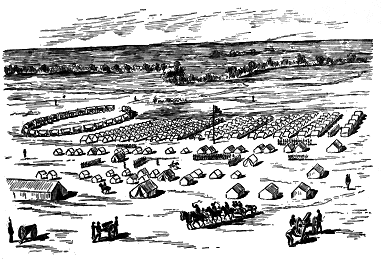
Designed by A. P. Connolly.
Camp Pope
.
Where the troops assembled for the campaign of 1863.
CHAPTER XXXII.
CAMPAIGN OF 1863—CAMP POPE.
In October, 1862, General John Pope had informed General Halleck that five Minnesota regiments could be sent south by November 1, but local influences were at work to prevent the transfer of troops, as it seemed very likely that hostilities would be renewed by the Indians again in the spring, and the demand that the State should be fully protected against these roving bands was acceded to, and orders were forthwith issued to the various companies to proceed at once to points designated on the frontier and go into winter quarters. Rumors were afloat at all times, but there really was no danger, and the soldiers had little to do but attend to a light guard duty and while away the tedious hours as best they could. The campaign of 1863 was planned by General John Pope, and General H. H. Sibley, who was in command of the district of Minnesota, with headquarters at St. Paul, was selected to command the Minnesota column, and General Alfred Sully to command the column that was to proceed up the west bank of the Missouri.
These two columns were to co-operate for the final extinction of the Indians; but the low water of the Missouri prevented the plan from being carried out.
The rendezvous of the Sibley column was at a point near the mouth of the Red Wood River, and twenty-five miles above Fort Ridgely. The forces comprising the expedition organizing at this point were the Sixth, the Seventh and the Tenth Regiments of Minnesota Infantry, under Colonels William Crooks, William R. Marshall and James H. Baker; eight pieces of artillery, under command of Captain John Jones; the Mounted Rangers, under Colonel McPhail; Indian scouts and other small detachments, which brought the force up to 3,052 infantry, 800 cavalry and 146 artillerymen.
The camp, named in honor of General John Pope, then in command of the Department of the Northwest, was situated at the mouth of Red Wood River, in the vicinity of the place where the outbreak was inaugurated. The various regiments, composed of infantry, cavalry and artillery, rendezvoused here. Colonel William Crooks, of the Sixth Minnesota, was in temporary command, and soon after the troops began to assemble, guard mount, company and regimental drills were the order of the day.
The land upon which we were encamped was a perfect level, and in order to attain better discipline, and instruct the men in works of defense, a complete system of sod breastworks and bastions were erected about the camp, of sufficient width to admit of the sentinels being placed on the top of them. It was really a magnificent piece of engineering and reflected credit on the officer in command. The sentinels were instructed to “walk the beat” all in the same direction, turn about at the same time and retrace their steps, so that an enemy could not creep in between them. This was done to instruct the men in guard duty and keep them out of mischief, for there really was no danger.
On the 9th day of June, 1863, the monotony of the camp was relieved by the arrival of General Sibley and his staff. This official family consisted of Captain R. C. Olin, A. A. G.; Captain Forbes, brigade commissary; Captain Atchinson, ordnance officer; Captain Edward L. Corning, brigade commissary; Captain Kimball, A. Q. M.; First Lieutenants Douglas Pope, F. J. H. Beaver, Joseph R. Putnam and Charles H. Flandreau, aides-de-camp, and Rev. S. R. Riggs, brigade chaplain.
The cannon, placed across the river on the high bluff, boomed forth the intelligence that the cavalcade of brilliantly uniformed officers was approaching, and the General doffed his hat in salute as he rode down the long line of soldiers who stood at “present arms.” General Henry H. Sibley, who had gained the confidence and universal respect and love of the soldiers, was again with us.
Soon after his arrival he received the sad intelligence of a beloved daughter’s death. But the responsibilities resting upon him would not admit of days of mourning; there was no time for communion with grief; the needs of the hour reminded him of his duty.
While lying at Camp Pope, General Sibley heard that a party of Indians were on their way down to the settlements, and would cross Red Wood River at a certain point the next night. He at once gave orders that my own company, the one that had sustained such losses at Birch Coolie, should proceed at once to watch for and intercept this band. We received the orders at midnight, and with three days’ rations, and sixty rounds of ammunition, started out on our mission in charge of First Lieutenant Harry J. Gillhams. We had no doctor with us; no team; not even an ambulance. I never thought our General knew of this, for he was a very careful man, and the question with me was: “If we are attacked and meet with losses in killed or wounded what shall we do with them in the absence of any means of transportation?”
We arrived at the point designated the next day about noon and halted. There was no going into camp, for we had no tents. We simply halted and waited for night and Indians. I was in hopes that the Indians would not come, and I got my wish. There were others hoping they would come, and among those most desirous for them to make their appearance were our three full blooded Indian soldiers we had captured, and who were present at the various battles the year before. One of them, Joe Alord, a powerful fellow, claimed to have a grudge against his own people. He said they had always treated him badly, and he wanted to fight them, but I was a little suspicious of him—did not think him sincere. This Alord formed a strong attachment for me, which endured until he was finally mustered out. He went south with us and stood the climate, and proved himself a faithful soldier. I at one time saved him from death by his own hands. He had been punished by the Colonel for an offense of which he said he was not guilty. I think myself he had been imposed upon, like “Old Dog Tray,” by getting into bad company. The Colonel, as a punishment, ordered him to parade up and down the square with a bag of sand on his back. This was galling to the Indian, and calling me to one side, he said: “Sergeant, me kill me mine self; me kill me mine self!”
I tried to persuade him from his purpose, but he seemed determined to carry out his threat, and I watched him closely. I could see he was very much aggrieved, for to him the humiliation was galling.
He grabbed a bayonet, and putting it to his breast, attempted to throw the weight of his body and thus push it through him. I jumped and kicked it from under him just in time and then put him in a cell until he became more reconciled. Soon after the close of the war he enlisted in the regular cavalry, but one morning he was missing. He had deserted, taking his horse and all his equipments with him; and although he was posted as a deserter, he was not heard of for many months.
When heard from it was to the effect that he had gone back to the Indians, taking the horse and all plunder with him. The old grudge against him was rekindled and intensified on account of the course he pursued against his people during the Sioux war, and some of the young bucks, engaging him in a controversy, it resulted in his death.
The Indian soldier Miller was inclined to be pious. He served until the close of the war, and afterwards was caught on the prairie in a severe thunder storm, from which he took refuge in a barn, which was struck by lightning and he was killed. The third was named Walker. At the outbreak he was home on vacation from Bishop Whipple’s school at Faribault, Minn., and was taken prisoner. I have referred to these Indian soldiers once before. Walker was quite well educated and now lives near St. Paul.
These three Indian boys were with us on this midnight expedition, and I felt they would bear watching, because I could not make up my mind to the fact that they should want to so suddenly turn against their own people. About midnight the second night an incident happened that gave us some alarm for a little while. We were all on duty watching and listening for Indians. You have heard about the burnt child dreading the fire. Well, we had been seriously burnt at Birch Coolie, and did not relish another taste of the same sort of fire, and it is not astonishing under such circumstances how many Indian sounds there are to the square foot. Every minute some of us heard an Indian sound, and all at once Joe Alord skipped out in the darkness, and immediately he was followed by Miller. I at once thought it was treachery, and the same opinion prevailed among nearly all the boys. I was but a sergeant then and of course could not assume supreme authority. If I had been in command I should have held the remaining one as a hostage. He wanted to go after the other two and gained the consent of the lieutenant to do so, and away he went out in the darkness. I expected soon to hear the crack of the rifle, for I felt satisfied that they had proved false to us. After they were gone half an hour and returned to our lines with the news that the noise they heard was not Indians we all felt relieved.
But the half hour was an anxious one, and we were rejoiced to have them return. The Indians we were sent out to intercept did not appear, and the next day our little expedition returned to camp.
CHAPTER XXXIII.
“FORWARD MARCH.”
On the 16th day of June, 1863, with the thermometer 100 degrees in the shade, all things being in readiness, the column took up the line of march into the almost unexplored region of Dakota Territory.
This invading army was composed of nearly five thousand men, with a pontoon train, and an adequate ammunition and commissary train composed of 225 four- and six-mule teams; and these, with the troops, really made a formidable army. The big train, five miles long, was necessary, because the expedition was headed for an unknown and hostile country, and expected to traverse a territory totally devoid of vegetables of any sort, and game would probably be very scarce.
The force was well organized, and the appearance of the train alone would awe the whole Sioux nation. It was a season of drouth such as was never before known in the West. The prairies were literally parched up with the heat, the grass was burned up, and the sloughs and little streams were dry. The fierce prairie winds were like the hot siroccos of the desert, and great clouds of dust, raised by the immense column, could be seen for miles and were viewed in wonder. We suffered from the heat, the dust and the weight of our knapsacks, gun and equipments, for the first day. The second day was as hot and dry, but the knapsacks were much lighter. Any one, even at this late date and so far removed from the days of the war, who thinks that a soldier’s life is an easy one, that war is a picnic, is not endowed with common “horse sense.” And yet there are those who thus express themselves.
The trains were soon being relieved of a part of their load by us drawing rations, and we had transportation to carry our individual loads.
I cannot in the few pages allotted me follow the daily march of General Sibley and his hosts; but will, after a hard day’s march of eighteen prairie miles (twenty-five in God’s country), with heavy knapsacks, halt, stack arms, pitch our tents and direct letters from
CAMP SIBLEY,
for such it was named, in honor of our commander.
The General had decided to observe Sunday as a day of rest, deeming it necessary for the welfare of man and beast. There is no doubt but better service was rendered for so doing, and General Sibley was honored for this proper respect shown the Lord’s day.
The several camps were named after the officers in the command, the senior officers taking precedence; first, the colonels, then lieutenant-colonels, etc., etc. Nothing of an unusual nature other than a prairie fire occurred until we reached camp Atchison, where the forces were divided, and this will be the subject of a future chapter.
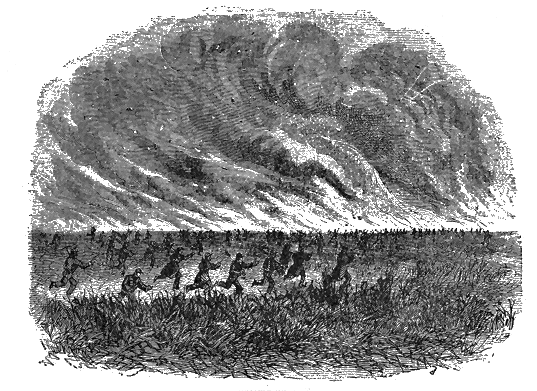
PRAIRIE ON FIRE.
CHAPTER XXXIV.
BURNING PRAIRIE—FIGHTING FIRE.
We started out on an exploring expedition to hunt Indians when we left Camp Pope. On the prairies there are enemies of various sorts—Indians, dust, heat and fire. The latter is a most formidable weapon with the Indian if the grass is plentiful and the weather dry, and they can use it to great advantage if the attacking party is not cool headed.
Our sentinels were always instructed to report fire at once, no matter how far off it might appear to be. This enemy came in good time—it appeared one night when there was a high wind.
The flames spread, becoming one vast sheet, sweeping over the prairies—a very roaring cataract of fire, the billows of which reached to the clouds. Coming on at this rapid, relentless rate, it would envelop and destroy the whole command.
To arms! to arms! we are called, by bugle and by drum, and in face of this enemy, at a “double quick,” we march out to meet it. In case of fire the animals are frenzied, and it was a question at one time whether there would not be a stampede.
The only way to conquer this sort of an enemy is to fight fire with fire, and this is done by burning away from you; so we started our fire, and as it burned away from us, we took possession of the burnt area as the fire demon in the rear came roaring on to consume us in his hot embrace. The red flames roared on high, the dense smoke obscured the moon and the stars, the atmosphere was stifling and thick with coal black dust, and the roar, as the fire fiend rolled on towards us, would have struck terror to the stoutest heart did we not know that his fury would soon be spent.
CHAPTER XXXV.
DEATH OF LITTLE CROW.
We will halt the column for a little and hunt in another direction for Little Crow. He had not been captured and would not surrender after the battle of Wood Lake in 1862. Carried away with the idea that he would receive proper recognition and the confidence of the Indians he started away towards the British dominions. Devil’s Lake was always a favorite “summer resort” for the Indians, and perhaps we can find him there.
In the State of Dakota, nearly five hundred miles west from St. Paul, Minn., is the celebrated Minnewakan, or Devil’s Lake. It is about sixty-five miles in length, and its waters are as salt as are those of the ocean. The immediate shores are part timber and part prairie; but a mile beyond, the country is one vast rolling prairie, destitute of trees, and dotted over with little lakes of salt water. This inland sea is a romantic place, and is well filled with fish, and game quite plentifully can be found there. Among other things are sea gulls and swan. The shore of the lake is covered with petrified wood, and the bones of fishes and animals are in abundance.
To this neighborhood Little Crow and his followers, after the defeat at Wood Lake, Minn., wended their way and encamped, where they were joined by nearly all the Minnesota Sioux who had not surrendered or been captured. There were in all about 4,000 souls, and among them were Yanktonais. During the winter the chief sent out runners with messages and presents to many of the Western tribes, and endeavored to enlist them as allies in a general war.
About the first of June Little Crow went to St. Joseph and Fort Garry to gain recognition from the British, as well as to obtain ammunition, but both were refused him.
When at St. Joseph Little Crow had on a black coat with velvet collar, a lady’s fine shawl adorned his head, and another was knotted around his waist. He had discarded his rifle, and carried a pistol instead, which latter was one of his trophies from the last summer’s raid. He had learned of the deportation of his friends to the Missouri, of which the white residents there had as yet received no information. Crow received the news in advance from an Indian who had outstripped the regular mail. He and sixty of his braves had a war dance, after which he made a speech, in which he said that he considered himself as good as dead, but that he still had plenty of warriors upon whom he could rely, and would not be caught during the summer. He failed to get the recognition he thought he was entitled to as commander-in-chief of the Sioux army then in the field. It is a little strange that he could not be recognized, when cannibal kings from the islands of the sea can get recognition, and the devotees of royalty will tumble over each other to pay their respects to a lecherous, murderous Turk.
Being disappointed in this, he made up his mind to slip through the cordon of posts that had been established for the protection of the people, and while General Sibley with his army was hunting for him away towards the Missouri, he would, single-handed and alone, go horse stealing down in the settlements.
Alas! How are the mighty fallen! From a commander-in-chief, seeking recognition of a foreign nation, he at once becomes a vagabond horse thief.
His son, Crow, Jr., was his only confidant, and to him he said:
“I am getting old and cannot fight the white men, but will go below, steal horses from them for you children, so you may be comfortable, and then I can go away where they cannot catch me.”
The whole party that went with the fallen chief numbered sixteen men and one squaw.
Crow, Jr., whose Indian name was Wa-wi-nap-a (one who appeareth), was with his father near Hutchinson, Minn., picking berries to “stay their stomachs,” when they were discovered by a Mr. Lamson and his son Chauncey. This was Friday evening, July 3, 1863, and the skirmish that followed between Crow, his son, and the Lamsons prevented the Sioux chief from celebrating the Fourth of July in any sort of patriotic manner, for two shots from the trusty rifle of Mr. Lamson sent Crow’s soul on its eternal mission to the happy hunting ground of his fathers. Mr. Lamson and his son were out in the country and they saw two Indians picking berries in an “opening” in the woods. The Indians did not discover the white men, who were taking aim at them. Mr. Lamson had crept cautiously forward among the vines and rested his gun against a tree and fired. His first shot took effect, but not a deadly one, as evinced by the loud yell of his victim, who fell to the ground severely wounded.
With prudence and caution Mr. Lamson retreated a short distance, where he could obtain shelter from behind some bushes.
The wounded Indian, not to be foiled, crept after him, and thus they were brought face to face. Another shot from the white man and the Indian was dead. His companions, his own son and another Indian, mounted a horse and fled.
The Indian’s shot, however, had not gone amiss, for it lodged in Mr. Lamson’s shoulder, and he being some distance from his son, was supposed by him to be killed. The son returned to town to give the alarm. A quick response brought men to the scene of conflict, where they found the dead Indian, but Mr. Lamson was missing. A singular thing about it was that Crow was laid out, his head resting on his rolled-up coat, and he had a new pair of moccasins on. It would appear as though his son returned to make sure of his father’s death, and finding him dead, he performed this last deed.[A]
Mr. Lamson’s wound was a severe one, but he made his way back to his home, which he reached about two o’clock the next morning. Little Crow’s body was brought to town, and the coat he had on was recognized as belonging to a man who had been found murdered some weeks before.
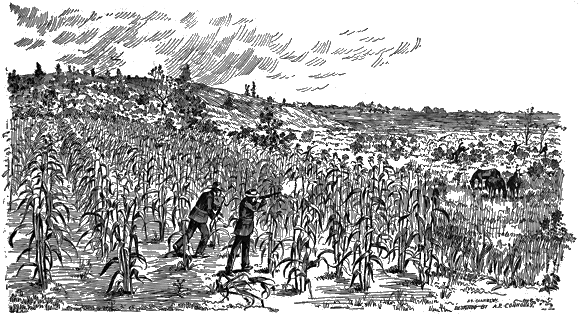
Designed by A. P. Connolly.
Mr. Lamson Shooting Little Crow near Hutchinson, Minn., in August, 1863.
The body of this murderous old chief, after it lay in state on the ground for a day or two, was dumped into an unhonored grave, and no tears of regret were shed for him. While this was being done down in Minnesota, a military train five miles long was in pursuit of him up in Dakota; and the news did not reach General Sibley for two weeks. The description given of this Indian was so accurate that the General said it was no other than Little Crow. This again was corroborated by his son, who was some weeks after captured in a starving condition.
Thus ended the ignominious life of Little Crow, the great Sioux chief who had influenced his people to believe that the time had come for them to reclaim their lost empire.
CHAPTER XXXVI.
LITTLE CROW, JR.—HIS CAPTURE.
After the death of Crow, senior, as narrated in the preceding chapter, his son and heir, Wo-wi-nap-a, becomes an important character in this chapter, and we will follow him and hear what he has to say about his father’s death.
When he was satisfied that his father was dead he started off he knew not where. He was a fugitive, a miserable creature, bereft of home, country and parents—a human being without a country, but with a soul—in a land where every hand was raised against him; a fugitive from an enraged white people because of the sins of his father. He hid by day and travelled by night until beyond the white settlements. He was captured by a company of soldiers who were out hunting Indians in the region of Devil’s Lake, Dakota. When captured he was in a starving condition and glad to get even among Uncle Sam’s soldiers. He was questioned as to his father and where he had been. He said:
“I am the son of Little Crow; my name is Wo-wi-nap-a, and I am sixteen years old. Father said he was getting old and wanted me to go with him to carry his bundles. He left his wives and other children behind. There were sixteen men and one squaw in the party that went below with us. We had no horses, but walked all the way down to the settlements. Father and I were picking red berries near Scattered Lake at the time he was shot. It was near night. He was hit the first time in the side, just above the hip. His gun and mine were lying on the ground. He took up my gun and fired it first, and then fired his own. He was shot the second time while firing his own gun. The ball struck the stock of the gun and then hit him in the side near the shoulder. This was the shot that killed him. He told me that he was killed and asked me for water, which I gave him. He died immediately after. When I heard the first shot fired I laid down and the man did not see me before father was killed.
“A short time before father was killed an Indian named Hi-a-ka, who married the daughter of my father’s second wife, came to him. He had a horse with him, also a gray-colored blanket that he had taken from a man whom he had killed, to the north of where father was killed. He gave the coat to my father, telling him that he would need it when it rained, as he had no coat with him. Hi-a-ka said he had a horse now and was going north. He further said that the Indians who went down with them had separated, and he had not seen them since.”
After the death of his father Young Crow took both guns and started for Devil’s Lake. He had no ammunition, but found a cartridge and cut it into slugs. With this he shot a wolf and ate some of it. His strength gave out, and twenty-six days after his father was killed he was captured.
The old chief was a great wooer of the fair sex, for his son said of him:
“My father had two wives before he took my mother; the first one had one son, the second a son and daughter; the third wife was my mother. After taking my mother he put away the first two; he had seven children by my mother; six are dead; I am the only one living now; the fourth wife had four children born; do not know whether any died or not; two were boys, two were girls; the fifth wife had five children; three of them are dead, two are living; the sixth wife had three children; all of them are dead; the oldest was a boy, the other two were girls; the last four wives were sisters.”
This young savage was cared for and finally sent away to the reservation. Having found the whereabouts of Little Crow and disposed of him, we will return to the command.
CHAPTER XXXVII.
CAMP ATCHISON—GEORGE A. BRACKETT’S ADVENTURE—LIEUTENANT FREEMAN’S DEATH.
Camp Atchison was the most important of all the camps on the whole route. It was here the General was visited by some three hundred Chippewa half-breeds, led by a Catholic priest named Father Andre, who told him that the Indians, hearing that General Sully, who was marching up the west side of the Missouri with a large body of troops, was delayed on account of low water, were deflecting their course in the hope of being reinforced by the Sioux inhabiting the country west of the Missouri.
The General, upon becoming satisfied of this, decided to push on as rapidly as possible after them, and to facilitate the movement he formed a permanent post at Camp Atchison, which is located about fifty miles southeast from Devil’s Lake, where he left all the sick and broken-down men, and a large portion of his ponderous train, with a sufficient guard to protect them if attacked. With these arrangements completed, the column, with twenty-five days’ rations for 1,500 infantry, 500 cavalry, 100 pioneers and artillery, started by forced marches to overtake the Indians before they reached the Missouri River.
On the morning of July 20th the General, with his selected men and reduced train, left Camp Atchison to pursue the Indians and engage them in battle. Attached to the expedition in the capacity of contractor was Mr. George A. Brackett, who met with an experience, the memory of which will remain with him during his life. It is most interesting and exciting, and his own version of it, as narrated at the “camp fire” when he found his old St. Anthony friends and Captain Chase’s company, known as the “Pioneers,” will be read with interest. Mr. Brackett says:
On the fourth day out, in company with Lieutenant Ambrose Freeman, of the Mounted Rangers, we left the main column for the purpose of adventure and game. I had my train started and in good hands, and got permission for the Lieutenant to accompany me. Five miles away, having met nothing worthy of note, we surveyed the country from the summit of a range of hills, when we saw several scouts not very far away. We struck a parallel course, believing we were moving in the same direction as the main column. While watering our horses in the lake, we espied two other scouts on the opposite side doing the same thing. We then moved farther on, over the range of bluffs, covering about three-quarters of a mile. We followed along parallel, or perhaps a little to the left of the main body, a distance of three miles. Lieutenant Freeman saw three antelopes, an old one and two young ones, in the distance. We fired and wounded the old one, who made off around the bluff. I held the Lieutenant’s horse and he chased her on foot, which took us off our course some distance round the bluffs. We traversed a section of country bordering a large lake, near which we succeeded in killing the antelope.
As we were coming down to the lake and while the Lieutenant was creeping up toward the antelope, I again saw scouts on the opposite side of the lake, and the train was in sight on the hillside several miles distant. Instead of taking our course back, we had a curiosity to go around the lake to where we saw the scouts. On our way around we saw cherry bushes newly cut and piled up, and I set about to tear them down. Lieutenant Freeman persisted in saying that they were Indian signs and that Indians were in the vicinity. In preparation for them we cocked our rifles and made around the bushes, so as not to put ourselves in a too exposed position. We took our course, as we supposed, towards the train, or where the train had recently passed.
Between one and two o’clock we discovered three objects a long distance off, but between us and the train’s course, and making for the train. This action, as soon as we came near enough to judge, convinced us that they were Indians, yet we kept on toward them, and they were making preparations to meet us, one leading and the other two riding their horses. We got all ready to give them a trial, they creeping around on one side of the bluff and we creeping around to meet them. I saw one with a straw hat on rise up and recognized him as one of our scouts. He beckoned us to come towards him. From all the description I had of him I supposed him to be Chaska, and the other two were full blood Sioux. Both had government horses, and armed, one with a Springfield and the other a carbine. I asked him where General Sibley was. They pointed to a hill, I should judge, three miles away from where we stood, in the direction where the train passed.
I saw a large number of men on a bluff, judged to be about two hundred in number, whom I supposed to be General Sibley’s men looking for us. We all started directly for them, and as we did so, saw what we supposed to be a guard of cavalry starting towards us. After we had started the scouts turned to a little lake to water their horses, but the Lieutenant and myself having previously watered ours, did not go with them. We still saw the cavalry, as we supposed, about fifteen in number, coming towards us.
I remarked to Lieutenant Freeman that they must have turned back, as they had disappeared and were out of sight. We were soon surprised, however, by seeing fifteen Indians charging upon us as with a flag of truce; but they were not coming evidently in a friendly spirit, as they fired a volley upon us. I yelled to the scouts that they were Indians, and remarked to Lieutenant Freeman that we had better at once join the scouts, which we endeavored to do. When we got within twenty or twenty-five rods of the scouts we were riding about three rods apart. One Indian rode up to Lieutenant Freeman and shot an arrow through his back, on the left side, and at the same time another Indian dismounted and discharged his gun at me, but I laid low on my horse’s neck, as close as I possibly could, and he shot over me, and Chaska stepped up to the top of a knoll and shot this same Indian who had fired at me.
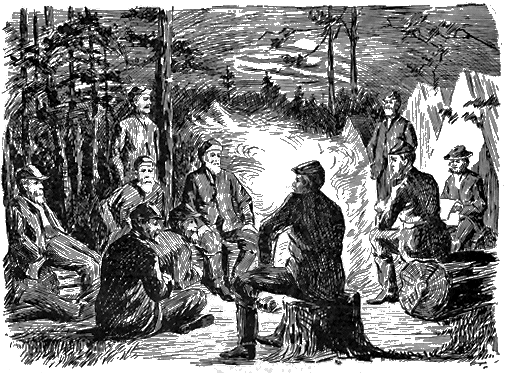
George A. Brackett Telling the Thrilling Story of His Escape to the Members of Capt. Chase’s Company of “Pioneers.”
THE MINNESOTA MASSACRE OF 1862.
Price, to any address, { 60 Cents in Paper. $1.00 and $1.50 in Cloth.
A. P. CONNOLLY, Chicago.
As Lieutenant Freeman dropped from his horse I asked him if he was hurt. He replied, “I am gone.” He wished me to cut a piece of string which was around his neck, and supported a part of the antelope which he was carrying. As I cut the string he changed his position more on his side and more up hill. He asked faintly for water, which I gave him from my canteen, and by this time the scouts had mounted their horses and left us. The Indians were then all around us, and one at the side of the lake; but as the scouts ran toward them they fell back. Lieutenant Freeman, by this time being dead, I took his rifle and revolver and followed the scouts as fast as I could. The Indians mentioned as near the lake, seeing the Lieutenant’s horse, which followed me, left us and started for the horse, thus enabling me to overtake the scouts. The Indians succeeded in catching the horse, and the whole crowd again started after us. We rode for about four miles, when we were overtaken and surrounded by them by the side of a little marsh. We all jumped from our horses. The scouts made motions and ran up to meet them, but Chaska motioned for me to jump into the tall rushes on the marsh. I saw nothing more of the scouts, and the Indians all rushed down to where the horses were. I cocked my rifle, and lay in the rushes within ten feet of where they were, and heard them quarrel about the possession of the horses. They presently settled their dispute and started off, for fear, as I supposed, of being overtaken by some of our forces. They took their course around the marsh in which I lay for an hour; this was about three p. m. A shower came up, and immediately after it cleared I started on my course, with the sun to my back, and traveled for two hours. I followed this direction for two days, stopping in marshes during the night. On the evening of the second day I struck a river of clear water, about a quarter of a mile wide, running in a southerly direction. Next morning I started due south, and traveled until almost night, when I took a westerly course, concluding that the trail was not in that direction; traveled a little to north of west, and struck Gen. Sibley’s trail the afternoon of the third day, about twelve miles from where we camped the night before. I left the main column, and made the deserted camp that night. I started next morning on the back track for Camp Atchison, and made the painful journey in two days, arriving there the second night, between eight and nine o’clock, making the distance of the four camps in two days, bare-headed, barefooted and coatless. I was obliged to leave my rifle on the last day of my travel, but I could not carry it any farther, and made up my mind that this would probably be my last day. It was probably about nine o’clock, and I was about to give up when I came to a few tents and found them to be those of the Pioneers (Captain Chase’s company of the Ninth Minnesota Infantry), and fell to the ground faint and unable to rise again. But, thank God! around that fire were sitting some of my old St. Anthony friends, who kindly picked me up and carried me to my tent.
I lost my coat, hat and knife in the fight the first day, so I took Lieutenant Freeman’s knife, and with it made moccasins of my boot legs, as my boots so chafed my feet in walking that I could not possibly wear them. These improvised moccasins were constantly getting out of repair, and my knife was much needed to keep them in order for use, as well as to make them in the first place. But just before reaching the trail of the expedition on the fifth day I lost the knife, and the loss, I felt at the time, would have decided my fate if I had much farther to go. But a kind Providence was in my favor, for almost the first object that greeted my eyes upon reaching the trail was a knife, old and worn to be sure, but priceless to me. This incident some may deem a mere accident, but let such a one be placed in my situation at that time and he would feel with me that it was given in answer to a prayer made to the great Giver of Good. On the third day, about ten miles from the river spoken of, I left Lieutenant Freeman’s rifle on the prairie because I became too weak to carry it longer; besides, it had already been so damaged by rain that I could not use it. I wrote upon it that Lieutenant Freeman had been killed, and named the course I was then pursuing. The pistol I retained and brought with me to Camp Atchison.
While wandering I lived on cherries, roots, birds’ eggs, young birds and frogs, caught by my hands, all my ammunition but one cartridge having been spoiled by the rain of the first day. That cartridge had a gutta percha case and was preserved. It was my only hope for fire when I should need it, or when I dared venture to make one. I had also some water-proof percussion caps in my portmanteau, which were also put to good use. I took one-half the powder in the cartridge, with a percussion cap, and with the use of my pistol and some dried grass, started a fire at which I cooked a young bird. How did I catch the bird? Well, Providence again favored me, and as I was lying low and making no noise, the bird wandered so near that by firing a stick I had with me in such a manner as to make it whirl horizontally, it struck the bird on the side of the head and broke its neck. This was on the second night. On the fourth I used the remainder of the cartridge in the same way and for a like purpose. The rest of the time I ate my food uncooked. Except some hard bread (found at the fourth camp mentioned above), which had been fried and then thrown in the ashes. I have forgotten one sweet morsel (and all were sweet and very palatable to me), viz., some sinews spared by wolves from a buffalo carcass. As near as I am able to judge I traveled in the seven days at least two hundred miles. I had ample means for a like journey in civilized localities, but for the first time in my life found gold and silver coin not legal tender. My boot-leg moccasins saved me, for a walk of ten miles upon such a prairie, barefooted, would stop all farther progress of any person accustomed to wearing covering upon the feet. The exposure at night, caused more particularly by lying in low and wet places, in order to hide myself, was more prostrating to me than scarcity of food. The loneliness of the prairies would have been terrible in itself, but for the drove of wolves that after the first day hovered, in the day time, at a respectful distance, and at night howled closely around me, seemingly sure that my failing strength would soon render me an easy prey. But a merciful Providence has spared my life by what seems now, even to myself, almost a miracle.
The body of Lieutenant Freeman was afterwards found and buried by members of General Sibley’s main force. An arrow had pierced his breast, and the tomahawk and scalping knife had left bloody traces about his head. He was buried on the desolate plain, five hundred miles away from his beloved, bereaved wife and children. After the war closed his body was exhumed, carried to his late home, and re-interred by loving hands, with all the honors due a brave soldier. The peculiar circumstances of his death, my last moments with him, my subsequent days of weary, dangerous wandering, my suffering, anxiety and happy deliverance have made an impression upon my memory so indelible that time has not, nor cannot efface them.
My friend Brackett and myself came to St. Anthony, Minn., on the same day, May 1st, 1857, and we “put up” at the same hotel, and it is most interesting to hear him relate this wonderful adventure and marvelous escape. He yet lives to tell the story, and poor Freeman! It seemed sad to leave him in his lonely grave on the prairie wild, but such is the fate of war.
CHAPTER XXXVIII.
BATTLE OF BIG MOUND.
A few days after leaving Camp Atchison scouts began to report to General Sibley that Indians in large numbers were between us and the hills beyond. Everything indicated this, and the evidences were that we were soon to have a battle.
We came in sight of the Indians every day, but nothing decisive until July 24th, when we overtook them. Scouts reported a large body of Indians, with Red Plume and Standing Buffalo among them, encamped by the very lake near which the General intended camping. Standing Buffalo was not there as a hostile, and it was a surprise all around. The General, satisfying himself that a determined resistance would be offered us, corralled his train and made such disposition of the troops as he deemed necessary. It was here where Dr. Weiser, of the First Minnesota Rangers, was killed while parleying with a delegation from the hostile camp, and it was treachery, pure and simple. The battle was opened by Whipple’s battery, and while the cannon boomed and sent leaden hail and death among the fleeing Indians, the artillery of Heaven opened amid a furious thunder storm, and a private of Colonel McPhail’s command was killed.
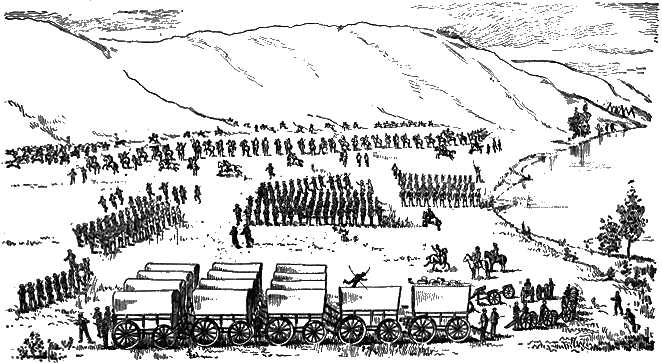
Designed by A. P. Connolly.
Battle of Big Mound, Dakota.
Fought between General Sibley’s forces and the Sioux, on July 24th, 1863. The Indians were defeated.
The Indians in this affair lost eighty-seven killed and wounded and a vast amount of property.
A portion of our command made forty-six miles that day. My own regiment was ordered in pursuit, and we followed them for ten miles, after having already marched eighteen. An order had been sent by an aide for the pursuing troops to bivouac where they were, but being misunderstood, instead of camping, as it was intended, we returned, having been on the march all night. As we came into camp we found that an early reveille had been sounded, and the troops were about ready to march. The part of the command that had joined in the pursuit and returned during the night was so completely exhausted that the whole force was compelled to rest for a day. This battle was a decided victory, counting heavily in the scale of advantage, as it put the savages on the run to a place of safety and materially disabled them from prosecuting further hostilities.
After the battle of the Big Mound, as narrated, the command was compelled to take one day’s rest on account of the over-taxed condition of the troops. The next day we marched over the same ground, and it was a comical yet interesting sight to witness the wholesale abandonment of buffalo robes, camp equipage and “jerked” meat; robes by the thousands and meat by the tons had been thrown away by the Indians in their hurry to get out of harm’s way. We found dogs that had been harnessed up and loaded down with cooking utensils, dead;—they had died from sheer exhaustion. The prairies as far as the eye could penetrate on either side presented this condition of abandonment by the Indians, of their property and winter’s supply of food. As far as the eye could penetrate on either hand were evidences of their hasty flight, as if swept with the besom of God’s wrath. The men would “right about” and fight the soldiers, and then turn, and running towards their fleeing families, urge them to still greater exertion to get away from the avenging army.
In the sand on the bank of the lake, I found a tiny papoose moccasin, and could see the imprint and count each separate toe of the little foot in the sand, as it probably was dragged along by the anxious mother, who was too heavily laden to carry her little baby. I thought,—poor, helpless child, not in the least responsible for its unhappy condition, and yet made to suffer. So with all classes of God’s humanity;—the innocent too often made to suffer, not only with the guilty, but for the guilty, and in our decisions we should be careful lest we injure innocent persons. The fresh made graves we found on this trail told their sorrowful story,—the little Indian spirit had taken its flight,—the body was buried and the heart-broken mother hurried on to keep up with her people, and get away from the army.
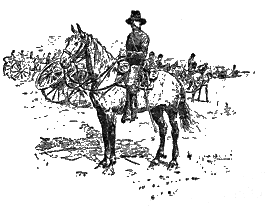
Ready to Go Into Action.
CHAPTER XXXIX.
BATTLE OF DEAD BUFFALO LAKE.
After the decisive battle of the Big Mound the Indians made up their minds evidently that the army and destruction was in their rear, and their Rubicon must be reached and crossed or annihilation was their portion, hence activity was apparent among them. The great impediment to their active work in the field and hasty flight was their families, and it required good generalship to successfully manage this retreating host.
The next decisive engagement with them was fought on July 26th; known as the battle of “Dead Buffalo Lake,” so designated from the fact that the carcass of a big buffalo was found on its shores.
This day strict orders had been given that there should be no shooting within the lines. This was made necessary from the fact of a soldier having been wounded the day before from the careless use of a rifle in the hands of a comrade. We were going along at an easy jog, when all at once a beautiful deer went bounding along. He seemed terribly frightened, and evidently had been surprised by the skirmishers ahead. All orders were forgotten, and a general stampede was made for this beautiful deer. Shots were fired after him, but he made his escape, and it did seem too bad, for we were hungry for deer meat. The general thought we had met the Indians again, and aides were sent to the front, with orders for the proper disposition of the troops. As the Indians were known to be in large numbers not far ahead, the General was pardoned for his surmises.
We passed their abandoned camp early in the morning, but about noon the scouts reported a large body of Indians coming down upon us from various directions. The command was placed in line of battle, and soon the skirmishers, in command of Colonel William Crooks, opened fire, supported by Lieutenant Whipple’s six-pounder.
The savages came swooping down on us, and it seemed as though they sprang up out of the earth, so numerous were they.
There were those among them who knew something of the tactics of war, and they attempted a vigorous flank movement on the left of the column, which was promptly checked by Captain Taylor and his mounted Rangers. Another determined attack was made which was handsomely repulsed by two companies of the Sixth Minnesota, under Colonel Averill.
A running fire was kept up until about three o’clock, when a bold dash was made to stampede the animals which were herded on the bank of a lake.
This attempt was promptly met and defeated by Wilson’s and Davy’s cavalry and six companies of the Sixth Minnesota, under Major McLaren. The Indians, foiled at all points, and having suffered serious losses in killed and wounded, retired from the field, and galloped away after their families, who, a few miles ahead, were hurrying on towards the Missouri river. Our animals were so jaded they could not stand a forced march. The reason was very apparent. We had our regular rations, while the horses and mules were on short rations on account of the hot weather burning up the grass, and, besides, the alkali water was as bad for beast as for man.
We were obliged to dig wells every night for water before we could get our supper, for we could not use the water from the alkali lakes. As many as sixty wells were dug in a night. Think of it,—each company obliged to dig a well in order to get water for supper, but this was one of the daily duties of the soldier. It is astonishing how the “boys in blue” could adapt themselves to every condition and circumstance. I am on a tender spot now,—“the boys in blue.” ’Tis true times are changed; a few of us are alive yet, and perhaps we are just a little bit “stuck on ourselves”; but, “the old soldier,” as we are now dubbed, cannot forget “the boys in blue.” In a few years more a new generation will have control of our government, but the wonderful years from 1861 to 1865 will not be forgotten. If we do not give our government, body and soul, into the hands of foreigners who cannot speak our language it is possible that the memory of the “boys in blue” will remain with us for a time yet. They were a mighty host then, and the tramp, tramp, tramp of their feet as they marched to defeat and victory will go down the centuries;—but, I must come back to my narrative.
CHAPTER XL.
BATTLE OF STONY LAKE—CAPTURE OF A TETON—DEATH OF LIEUTENANT BEAVER.
On the morning of July 28th, just as the command was breaking camp at Stony Lake, we were attacked by Indians, in full force.
General Sibley had the expeditionary forces so well in hand that the enemy could not possibly do us any harm. We halted but a moment, as some of the scouts came riding furiously towards us, followed by Indians intent on their capture. The boys cheered as they came within our lines. The battery was ordered to the front, and soon threw a shell among the Indians, who then galloped around on the flank, while another squad came immediately upon our rear; but, the whole column, in a solid square, moved on. The engagement took place on the prairie, and it was a beautiful sight to see the regularity with which the column moved. First, two companies of cavalry skirmishers, and at a proper interval two companies of infantry; the same order was preserved in the rear, and flankers on the right and left, so as to form a hollow square. In the center were the reserve troops, stores of all sorts, and the artillery.
The teams were so fixed as to make it impossible to get up a stampede. The Indians resort to their peculiar tactics to stampede the teams,—they tried it to its fullest extent on this occasion, but without avail. They did not impede our progress in the least, and as the column moved right along, they soon gave up the attempt, and we pressed them so closely they allowed the killed and wounded to fall into our hands. The casualties were light, because the shells that were thrown among them did but little damage.
The cavalry in this case was effective, and crowded the Indians, as they charged them with drawn sabre.
This was the last stand the Indians made in a body, and they hastened on towards the Missouri river, which they finally crossed at a point near where Bismarck, North Dakota, now stands. They made a determined resistance, and had been repulsed in three successive engagements, and their situation was critical in the extreme,—the victorious army in the rear and the Missouri in front.
After the Indians had given up the fight and had ridden ahead to urge their families on, and we had buried the dead and cared for the wounded, we pushed on after them.
A young Teton chief, who was out on a tour of observation, was captured by some of the cavalry, and the circumstances and manner in which it was done are interesting.
Thousands of us saw the strange object, but the men who captured him were the more interested observers, and the narrator says:
“As the scouts approached it, a dark, motionless object was seen lying upon the ground. Coming nearer, some one cried out: ‘It’s an old buffalo robe’; but, as one stooped to pick it up, it sprang from the earth and bounded off like a deer, arms extended, and flying swiftly, in a zig-zag manner. It was a broad mark for the carbines, but where in it was the motive power? It was impossible to tell. Some thirty shots were fired, all hitting the robe, but still he kept on with the same zig-zag motion, so that it was impossible to hit him.
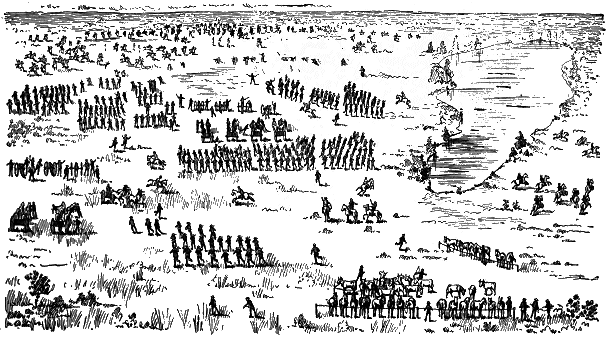
Designed by A. P. Connolly.
Battle of Stony Lake, Dakota, July 28th, 1863.
Indians defeated and slaughtered in great numbers by General Sibley’s troops.
“At last one of the guides reined up near him and, placing a revolver to his head, fired, but he dodged and escaped the ball.
“He now stopped, dropped the robe, and threw up both hands, in token of surrender.”
The robe he wore was literally riddled with bullets, but not a scratch upon the body of the Indian. His gallantry and his lordly bearing won the admiration of his captors, and placing him behind one of the scouts they bore him away in triumph, and presented him to General Sibley, to whom he extended his hand in friendly salute, but which was declined until he had made his statement, and assured the General that his hands were not stained with innocent blood. Being thus convinced, General Sibley shook him by the hand, and they became friends. He belonged to the Teton band, which is one of the largest divisions of the Dakota Nation. They lived west of the Missouri, and his information was that they were interested observers, but had no sympathy with, nor taking no part in, the war.
He and his father, who was one of the head chiefs, were out on a visit to the Yanktonians, and, learning that they were soon to have a fight with the soldiers, his curiosity prompted him to go as an observer. His curiosity was satisfied, and he retired with the balance, but had stopped in a clump of grass to allow his pony to graze. While here he had fallen asleep, and the pony was the object that first attracted the attention of the scouts, which resulted in the Indian’s capture, as above narrated.
He was a prisoner with us for five days, during which time he was treated with some consideration as the heir apparent to the chieftainship of his tribe. He was about twenty years old; a fine looking fellow, tall and athletic. He became strongly attached to the General and the staff.
General Sibley afterwards learned of this Indian’s death. He had given the boy, on his departure, a letter to his father, commending him for refusing to take up the tomahawk against the whites, and in appreciation of this, that he had kept the son for a few days in his camp and then gave him his liberty, so that he might return to his own people. It was good policy, because the letter, being found in his possession, indicated to the Indians that General Sibley was not responsible for his death.
A few days after his departure, a party of miners, who had been up in Idaho, were coming down the Missouri river, and at the very place where our men had reached the river and filled their canteens the Indians were lying in wait for the descending miners.
The young Teton desired peace, and rushed toward them waving General Sibley’s letter over his head. They, not understanding his signal, shot him to death, when they were at once surrounded by the exasperated Indians, and a battle, short and decisive, was fought, and every man of the miners was killed, but not before twice their number of Indians had shared the same fate.
This was another sad chapter of this unholy war.
The Indians now approached the river, but, owing to the thick underbrush, were obliged to abandon all their carts,—their ponies they took with them, but their winter’s supply of meat they abandoned.
Our skirmish line was formed at three paces, but even then it was impossible to observe a line, so thick were the weeds and underbrush. The enemy was sighted, and an advance ordered, when the line moved forward, and after an hour of hard work, we, like De Soto, when he discovered the Mississippi, gazed in admiration on its prototype,—the Missouri.
After having for weeks drank the brackish water of the prairie lakes, we drank from this sweet though turbid stream, and were refreshed, as were the children of Israel, who partook of the cool water from the stricken rock.