Chapter XXVIII
Reading edition
ORIENTAL ARCHITECTURE.
INDIA, CHINA, AND JAPAN.
Books Recommended: Cole, Monographs of Ancient Monuments of India. Conder, Notes on Japanese Architecture (in Transactions of R.I.B.A., for 1886). Cunningham, Archæological Survey of India. Fergusson, Indian and Eastern Architecture; Picturesque Illustrations of Indian Architecture. Le Bon, Les Monuments de l’Inde. Morse, Japanese Houses. Stirling, Asiatic Researches. Consult also the Journal and the Transactions of the Royal Asiatic Society.
INTRODUCTORY NOTE. The architecture of the non-Moslem countries and races of Asia has been reserved for this closing chapter, in order not to interrupt the continuity of the history of European styles, with which it has no affinity and scarcely even a point of contact. Among them all, India alone has produced monuments of great architectural importance. The buildings of China and Japan, although interesting for their style, methods, and detail, and so deserving at least of brief mention, are for the most part of moderate size and of perishable materials. Outside of these three countries there is little to interest the general student of architecture.
INDIA: PERIODS. It is difficult to classify the non-Mohammedan styles of India, owing to their frequently overlapping, both geographically and artistically; while the lack of precise dates in Indian literature makes the chronology of many of the monuments more or less doubtful. The divisions given below are a modification of those first established by Fergusson, and are primarily based on the three great religions, with geographical subdivisions, as follows:
THE BUDDHIST STYLE, from the reign of Asoka, cir. 250 B.C., to the 7th century A.D. Its monuments occupy mainly a broad band running northeast and southwest, between the Indian Desert and the Dekkan. Offshoots of the style are found as far north as Gandhara, and as far south as Ceylon.
THE JAINA STYLE, akin to the preceding if not derived from it, covering the same territory as well as southern India; from 1000 A.D. to the present time.
THE BRAHMAN or HINDU STYLES, extending over the whole peninsula. They are sub-divided geographically into the NORTHERN BRAHMAN, the CHALUKYAN in the Dekkan, and the DRAVIDIAN in the south; this last style being coterminous with the populations speaking the Tamil and cognate languages. The monuments of these styles are mainly subsequent to the 10th century, though a few date as far back as the 7th.
The great majority of Indian monuments are religious—temples, shrines, and monasteries. Secular buildings do not appear until after the Moslem conquests, and most of them are quite modern.
GENERAL CHARACTER. All these styles possess certain traits in common. While stone and brick are both used, sandstone predominating, the details are in large measure derived from wooden prototypes. Structural lines are not followed in the exterior treatment, purely decorative considerations prevailing. Ornament is equally lavished on all parts of the building, and is bewildering in its amount and complexity. Realistic and grotesque sculpture is freely used, forming multiplied horizontal bands of extraordinary richness and minuteness of execution. Spacious and lofty interiors are rarely attempted, but wonderful effects are produced by seemingly endless repetition of columns in halls, and corridors, and by external emphasis of important parts of the plan by lofty tower-like piles of masonry.
The source of the various Indian styles, the origin of the forms used, the history of their development, are all wrapped in obscurity. All the monuments show a fully developed style and great command of technical resources from the outset. When, where, and how these were attained is as yet an unsolved mystery. In all its phases previous to the Moslem conquest Indian architecture appears like an indigenous art, borrowing little from foreign styles, and having no affinities with the arts of Occidental nations.
BUDDHIST STYLE. Although Buddhism originated in the sixth century B.C., the earliest architectural remains of the style date from its wide promulgation in India under Asoka (272–236 B.C.). Buddhist monuments comprise three chief classes of structures: the stupas or topes, which are mounds more or less domical in shape, enclosing relic-shrines of Buddha, or built to mark some sacred spot; chaityas, or temple halls, cut in the rock; and viharas, or monasteries. The style of the detail varies considerably in these three classes, but is in general simpler and more massive than in the other styles of India.
TOPES. These are found in groups, of which the most important are at or near Bhilsa in central India, at Manikyala in the northwest, at Amravati in the south, and in Ceylon at Ruanwalli and Tuparamaya. The best known among them is the Sanchi Tope, near Bhilsa, 120 feet in diameter and 56 feet high. It is surrounded by a richly carved stone rail or fence, with gateways of elaborate workmanship, having three sculptured lintels crossing the carved uprights. The tope at Manikyala is larger, and dates from the 7th century. It is exceeded in size by many in Ceylon, that at Abayagiri measuring 360 feet in diameter. Few of the topes retain the tee, or model of a shrine, which, like a lantern, once crowned each of them.
Besides the topes there are a few stupas of tower-like form, square in plan, of which the most famous is that at Buddh Gaya, near the sacred Bodhi tree, where Buddha attained divine light in 588 B.C.
CHAITYA HALLS. The Buddhist speos-temples—so far as known the only extant halls of worship of that religion, except one at Sanchi—are mostly in the Bombay Presidency, at Ellora, Karli, Ajunta, Nassick, and Bhaja. The earliest, that at Karli, dates from 78 B.C., the latest (at Ellora), cir. 600 A.D. They consist uniformly of a broad nave ending in an apse, and covered by a roof like a barrel vault, and two narrow side aisles. In the apse is the dagoba or relic-shrine, shaped like a miniature tope. The front of the cave was originally adorned with an open-work screen or frame of wood, while the face of the rock about the opening was carved into the semblance of a sumptuous structural façade. Among the finest of these caverns is that at Karli, whose massive columns and impressive scale recall Egyptian models, though the resemblance is superficial and has no historic significance. More suggestive is the affinity of many of the columns which stand before these caves to Persian prototypes (see Fig. 21). It is not improbable that both Persian and classic forms were introduced into India through the Bactrian kingdom 250 years B.C. Otherwise we must seek for the origin of nearly all Buddhist forms in a pre-existing wooden architecture, now wholly perished, though its traditions may survive in the wooden screens in the fronts of the caves. While some of these caverns are extremely simple, as at Bhaja, others, especially at Nassick and Ajunta, are of great splendor and complexity.
VIHARAS. Except at Gandhara in the Punjab, the structural monasteries of the Buddhists were probably all of wood and have long ago perished. The Gandhara monasteries of Jamalgiri and Takht-i-Bahi present in plan three or four courts surrounded by cells. The centre of one court is in both cases occupied by a platform for an altar or shrine. Among the ruins there have been found a number of capitals whose strong resemblance to the Corinthian type is now generally attributed to Byzantine rather than Bactrian influences. These viharas may therefore be assigned to the 6th or 7th century A.D.
The rock-cut viharas are found in the neighborhood of the chaityas already described. Architecturally, they are far more elaborate than the chaityas. Those at Salsette, Ajunta, and Bagh are particularly interesting, with pillared halls or courts, cells, corridors, and shrines. The hall of the Great Vihara at Bagh is 96 feet square, with 36 columns. Adjoining it is the school-room, and the whole is fronted by a sumptuous rock-cut colonnade 200 feet long. These caves were mostly hewn between the 5th and 7th centuries, at which time sculpture was more prevalent in Buddhist works than previously, and some of them are richly adorned with figures.
JAINA STYLE. The religion and the architecture of the Jainas so closely resemble those of the Buddhists, that recent authorities are disposed to treat the Jaina style as a mere variation or continuation of the Buddhist. Chronologically they are separated by an interval of some three centuries, cir. 650–950 A.D., which have left us almost no monuments of either style. The Jaina is moreover easily distinguished from the Buddhist architecture by the great number and elaborateness of its structural monuments. The multiplication of statues of Tirthankhar in the cells about the temple courts, the exuberance of sculpture, the use of domes built in horizontal courses, and the imitation in stone of wooden braces or struts are among its distinguishing features.
FIG. 226.—PORCH OF TEMPLE ON MOUNT ABU.
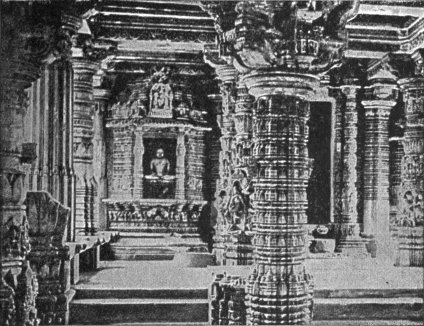
JAINA TEMPLES. The earliest examples are on Mount Abu in the Indian Desert. Built by Vimalah Sah in 1032, the chief of these consists of a court measuring 140 × 90 feet, surrounded by cells and a double colonnade. In the centre rises the shrine of the god, containing his statue, and terminating in a lofty tower or sikhra. An imposing columnar porch, cruciform in plan, precedes this cell (Fig. 226). The intersection of the arms is covered by a dome supported on eight columns with stone brackets or struts. The dome and columns are covered with profuse carving and sculptured figures, and the total effect is one of remarkable dignity and splendor. The temple of Sadri is much more extensive, twenty minor domes and one of larger size forming cruciform porches on all four sides of the central sikhra. The cells about the court are each covered by a small sikhra, and these, with the twenty-one domes (four of which are built in three stories), all grouped about the central tower and adorned with an astonishing variety of detail, constitute a monument of the first importance. It was built by Khumbo Rana, about 1450. At Girnar are several 12th-century temples with enclosed instead of open vestibules. One of these, that of Neminatha, retains intact its court enclosure and cells, which in most other cases have perished. The temple at Somnath resembles it, but is larger; the dome of its porch, 33 feet in diameter, is the largest Jaina dome in India. Other notable temples are at Gwalior, Khajuraho, and Parasnatha.
In all the Jaina temples the salient feature is the sikhra or vimana. This is a tower of approximately square plan, tapering by a graceful curve toward a peculiar terminal ornament shaped like a flattened melon. Its whole surface is variegated by horizontal bands and vertical breaks, covered with sculpture and carving. Next in importance are the domes, built wholly in horizontal courses and resting on stone lintels carried by bracketed columns. These same traits appear in relatively modern examples, as at Delhi.
FIG. 227.—TOWER OF VICTORY, CHITTORE.
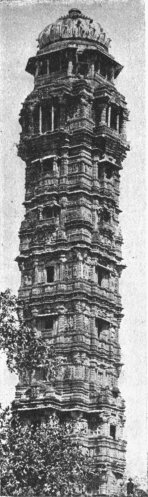
TOWERS. A similar predilection for minutely broken surfaces marks the towers which sometimes adjoin the temples, as at Chittore (tower of Sri Allat, 13th century), or were erected as trophies of victory, like that of Khumbo Rana in the same town (Fig. 227). The combination of horizontal and vertical lines, the distribution of the openings, and the rich ornamentation of these towers are very interesting, though lacking somewhat in structural propriety of design.
HINDU STYLES: NORTHERN BRAHMAN. The origin of this style is as yet an unsolved problem. Its monuments were mainly built between 600 and 1200 A.D., the oldest being in Orissa, at Bhuwanesevar, Kanaruk, and Puri. In northern India the temples are about equally divided between the two forms of Brahmanism—the worship of Vishnu or Vaishnavism, and that of Siva or Shaivism—and do not differ materially in style. As in the Jaina style, the vimana is their most striking feature, and this is in most cases adorned with numerous reduced copies of its own form grouped in successive stages against its sides and angles. This curious system of design appears in nearly all the great temples, both of Vishnu and Siva. The Jaina melon ornament is universal, surmounted generally by an urn-shaped finial.
In plan the vimana shrine is preceded by two or three chambers, square or polygonal, some with and some without columns. The foremost of these is covered by a roof formed like a stepped pyramid set cornerwise. The fine porch of the ruined temple at Bindrabun is cruciform in plan and forms the chief part of the building, the shrine at the further end being relatively small and its tower unfinished or ruined. In some modern examples the antechamber is replaced by an open porch with a Saracenic dome, as at Benares; in others the old type is completely abandoned, as in the temple at Kantonnuggur (1704–22). This is a square hall built of terra-cotta, with four three-arched porches and nine towers, more Saracenic than Brahman in general aspect.
The Kandarya Mahadeo, at Khajuraho, is the most noted example of the northern Brahman style, and one of the most splendid structures extant. A strong and lofty basement supports an extraordinary mass of roofs, covering the six open porches and the antechamber and hypostyle hall, which precede the shrine, and rising in successive pyramidal masses until the vimana is reached which covers the shrine. This is 116 feet high, but seems much loftier, by reason of the small scale of its constituent parts and the marvellously minute decoration which covers the whole structure. The vigor of its masses and the grand stairways which lead up to it give it a dignity unusual for its size, 60 × 109 feet in plan (cir. 1000 A.D.).
At Puri, in Orissa, the Temple of Jugganat, with its double enclosure and numerous subordinate shrines, the Teli-ka-Mandir at Gwalior, and temples at Udaipur near Bhilsa, at Mukteswara in Orissa, at Chittore, Benares, and Barolli, are important examples. The few tombs erected subsequent to the Moslem conquest, combining Jaina bracket columns with Saracenic domes, and picturesquely situated palaces at Chittore (1450), Oudeypore (1580), and Gwalior, should also be mentioned.
CHALUKYAN STYLE. Throughout a central zone crossing the peninsula from sea to sea about the Dekkan, and extending south to Mysore on the west, the Brahmans developed a distinct style during the later centuries of the Chalukyan dynasty. Its monuments are mainly comprised between 1050 and the Mohammedan conquest in 1310. The most notable examples of the style are found along the southwest coast, at Hullabid, Baillur, and Somnathpur.
FIG. 228.—TEMPLE AT HULLABÎD. DETAIL.
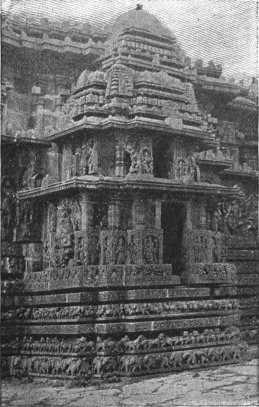
TEMPLES. Chalukyan architecture is exclusively religious and its temples are easily recognized. The plans comprise the same elements as those of the Jainas, but the Chalukyan shrine is always star-shaped externally in plan, and the vimana takes the form of a stepped pyramid instead of a curved outline. The Jaina dome is, moreover, wholly wanting. All the details are of extraordinary richness and beauty, and the breaking up of the surfaces by rectangular projections is skilfully managed so as to produce an effect of great apparent size with very moderate dimensions. All the known examples stand on raised platforms, adding materially to their dignity. Some are double temples, as at Hullabid (Fig. 228); others are triple in plan. A noticeable feature of the style is the deeply cut stratification of the lower part of the temples, each band or stratum bearing a distinct frieze of animals, figures or ornament, carved with masterly skill. Pierced stone slabs filling the window openings are also not uncommon.
The richest exemplars of the style are the temples at Baillur and Somnathpur, and at Hullabîd the Kait Iswara and the incomplete Double Temple. The Kurti Stambha, or gate at Worangul, and the Great Temple at Hamoncondah should also be mentioned.
DRAVIDIAN STYLE. The Brahman monuments of southern India exhibit a style almost as strongly marked as the Chalukyan. This appears less in their details than in their general plan and conception. The Dravidian temples are not single structures, but aggregations of buildings of varied size and form, covering extensive areas enclosed by walls and entered through gates made imposing by lofty pylons called gopuras. As if to emphasize these superficial resemblances to Egyptian models, the sanctuary is often low and insignificant. It is preceded by much more imposing porches (mantapas) and hypostyle halls or choultries, the latter being sometimes of extraordinary extent, though seldom lofty. The choultrie, sometimes called the Hall of 1,000 Columns, is in some cases replaced by pillared corridors of great length and splendor, as at Ramisseram and Madura. The plans are in most cases wholly irregular, and the architecture, so far from resembling the Egyptian in its scale and massiveness, is marked by the utmost minuteness of ornament and tenuity of detail, suggesting wood and stucco rather than stone. The Great Hall at Chillambaram is but 10 to 12 feet high, and the corridors at Ramisseram, 700 feet long, are but 30 feet high. The effect of ensemble of the Dravidian temples is disappointing. They lack the emphasis of dominant masses and the dignity of symmetrical and logical arrangement. The very loftiness of the gopuras makes the buildings of the group within seem low by contrast. In nearly every temple, however, some one feature attracts merited admiration by its splendor, extent, or beauty. Such are the Choultrie, built by Tirumalla Nayak at Madura (1623–45), measuring 333 × 105 feet; the corridors already mentioned at Ramisseram and in the Great Temple at Madura; the gopuras at Tarputry and Vellore, and the Mantapa of Parvati at Chillambaram (1595–1685). Very noticeable are the compound columns of this style, consisting of square piers with slender shafts coupled to them and supporting brackets, as at Chillambaram, Peroor, and Vellore; the richly banded square piers, the grotesques of rampant horses and monsters, and the endless labor bestowed upon minute carving and ornament in superposed bands.
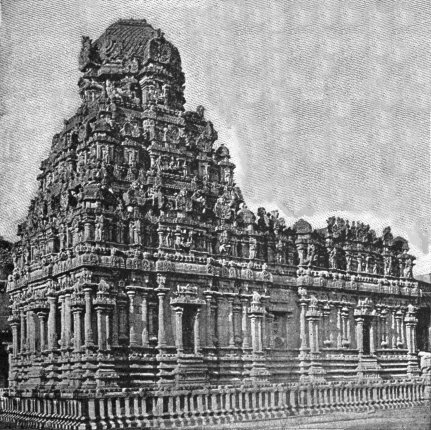
OTHER MONUMENTS. Other important temples are at Tiruvalur, Seringham, Tinevelly, and Conjeveram, all alike in general scheme of design, with enclosures varying from 300 to 1,000 feet in length and width. At Tanjore is a magnificent temple with two courts, in the larger of which stands a pagoda or shrine with a pyramidal vimana, unusual in Dravidian temples, and beside it the smaller Shrine of Soubramanya (Fig. 229), a structure of unusual beauty of detail. In both, the vertical lower story with its pilasters and windows is curiously suggestive of Renaissance design. The pagoda dates from the 14th, the smaller temple from the 15th century.
FIG. 229.—SHRINE OF SOUBRAMANYA, TANJORE.
ROCK-CUT RATHS. All the above temples were built subsequently to the 12th century. The rock-cut shrines date in some cases as far back as the 7th century; they are called kylas and raths, and are not caves, but isolated edifices, imitating structural designs, but hewn bodily from the rock. Those at Mahavellipore are of diminutive size; but at Purudkul there is an extensive temple with shrine, choultrie, and gopura surrounded by a court enclosure measuring 250 × 150 feet (9th century). More famous still is the elaborate Kylas at Ellora, of about the same size as the above, but more complex and complete in its details.
PALACES. At Madura, Tanjore, and Vijayanagar are Dravidian palaces, built after the Mohammedan conquest and in a mixed style. The domical octagonal throne-room and the Great Hall at Madura (17th century), the most famous edifices of the kind, were evidently inspired from Gothic models, but how this came about is not known. The Great Hall with its pointed arched barrel vault of 67 feet span, its cusped arches, round piers, vaulting shafts, and triforium, appears strangely foreign to its surroundings.
CAMBODIA. The subject of Indian architecture cannot be dismissed without at least brief mention of the immense temple of Nakhon Wat in Cambodia. This stupendous creation covers an area of a full square mile, with its concentric courts, its encircling moat or lake, its causeways, porches, and shrines, dominated by a central structure 200 feet square with nine pagoda-like towers. The corridors around the inner court have square piers of almost classic Roman type. The rich carving, the perfect masonry, and the admirable composition of the whole leading up to the central mass, indicate architectural ability of a high order.
CHINESE ARCHITECTURE. No purely Mongolian nation appears ever to have erected buildings of first-rate importance. It cannot be denied, however, that the Chinese are possessed of considerable decorative skill and mechanical ingenuity; and these qualities are the most prominent elements in their buildings. Great size and splendor, massiveness and originality of construction, they do not possess. Built in large measure of wood, cleverly framed and decorated with a certain richness of color and ornament, with a large element of the grotesque in the decoration, the Chinese temples, pagodas, and palaces are interesting rather than impressive. There is not a single architectural monument of imposing size or of great antiquity, so far as we know. The celebrated Porcelain Tower of Nankin is no longer extant, having been destroyed in the Tæping rebellion in 1850. It was a nine-storied polygonal pagoda 236 feet high, revetted with porcelain tiles, and was built in 1412. The largest of Chinese temples, that of the Great Dragon at Pekin, is a circular structure of moderate size, though its enclosure is nearly a mile square. Pagodas with diminishing stories, elaborately carved entrance gates and successive terraces are mainly relied upon for effect. They show little structural art, but much clever ornament. Like the monasteries and the vast lamaseries of Thibet, they belong to the Buddhist religion.
Aside from the ingenious framing and bracketing of the carpentry, the most striking peculiarity of Chinese buildings is their broad-spreading tiled roofs. These invariably slope downward in a curve, and the tiling, with its hip-ridges, crestings, and finials in terra-cotta or metal, adds materially to the picturesqueness of the general effect. Color and gilding are freely used, and in some cases—as in a summer pavilion at Pekin—porcelain tiling covers the walls, with brilliant effect. The chief wonder is that this resource of the architectural decorator has not been further developed in China, where porcelain and earthenware are otherwise treated with such remarkable skill.
JAPANESE ARCHITECTURE. Apparently associated in race with the Chinese and Koreans, the Japanese are far more artistic in temperament than either of their neighbors. The refinement and originality of their decorative art have given it a wide reputation. Unfortunately the prevalence of earthquakes has combined with the influence of the traditional habits of the people to prevent the maturing of a truly monumental architecture. Except for the terraces, gates, and enclosures of their palaces and temples, wood is the predominant building material. It is used substantially as in China, the framing, dovetailing, bracketing, broad eaves and tiled roofs of Japan closely resembling those of China. The chief difference is in the greater refinement and delicacy of the Japanese details and the more monumental disposition of the temple terraces, the beauty of which is greatly enhanced by skillful landscape gardening. The gateways recall somewhat those of the Sanchi Tope in India (p. 403), but are commonly of wood. Owing to the danger from earthquakes, lofty towers and pagodas are rarely seen.
The domestic architecture of Japan, though interesting for its arrangements, and for its sensible and artistic use of the most flimsy materials, is too trivial in scale, detail, and construction to receive more than passing reference. Even the great palace at Tokio,28 covering an immense area, is almost entirely composed of one-storied buildings of wood, with little of splendor or architectural dignity.
MONUMENTS (additional to those in text). BUDDHIST: Topes at Sanchi, Sonari, Satdara, Andher, in Central India; at Sarnath, near Benares; at Jelalabad and Salsette; in Ceylon at Anuradhapura, Tuparamaya, Lankaramaya.—Grotto temples (chaityas), mainly in Bombay and Bengal Presidencies; at Behar, especially the Lomash Rishi, and Cuttack; at Bhaja, Bedsa, Ajunta, and Ellora (Wiswakarma Cave); in Salsette, the Kenheri Cave.—Viharas: Structural at Nalanda and Sarnath, demolished; rock-cut in Bengal, at Cuttack, Udayagiri (the Ganesa); in the west, many at Ajunta, also at Bagh, Bedsa, Bhaja, Nassick (the Nahapana, Vadnya Sri, etc.), Salsette, Ellora (the Dekrivaria, etc.). In Nepâl, stupas of Swayanbunath and Bouddhama.
JAINA: Temples at Aiwulli, Kanaruc (Black Pagoda), and Purudkul; groups of temples at Palitana, Gimar, Mount Abu, Somnath, Parisnath; the Sas Bahu at Gwalior, 1093; Parswanatha and Ganthai (650) at Khajuraho; temple at Gyraspore, 7th century; modern temples at Ahmedabad (Huttising), Delhi, and Sonaghur; in the south at Moodbidri, Sravana Belgula; towers at Chittore.
NORTHERN BRAHMAN: Temples, Parasumareswara (500 A.D.), Mukteswara, and Great Temple (600–650), all at Bhuwaneswar, among many others; of Papanatha at Purudkul; grotto temples at Dhumnar, Ellora, and Poonah; temples at Chandravati, Udaipur, and Amritsur (the last modern); tombs of Singram Sing and others at Oudeypore; of Rajah Baktawar at Ulwar, and others at Goverdhun; ghâts or landings at Benares and elsewhere.
CHALUKYAN: Temples at Buchropully and Hamoncondah, 1163; ruins at Kalyani; grottoes of Hazar Khutri.
DRAVIDIAN: Rock-cut temples (raths) at Mahavellipore; Tiger Cave at Saluvan Kuppan; temples at Pittadkul (Purudkul), Tiruvalur, Combaconum, Vellore, Peroor, Vijayanagar; pavilions at Tanjore and Vijayanagar.
There are also many temples in the Kashmir Valley difficult of assignment to any of the above styles and religions.
APPENDIX.
A. PRIMITIVE GREEK ARCHITECTURE.—The researches of Schliemann commented by Schuchardt, of Dörpfeld, Stamakis, Tsoundas, Perrot, and others, in Troy, Mycenæ, and Tiryns, and the more recent discoveries of Evans at Gnossus, in Crete, have greatly extended our knowledge of the prehistoric art of Greece and the Mediterranean basin, and established many points of contact on the one hand with ancient Egyptian and Phœnician art, and on the other, with the art of historic Greece. They have proved the existence of an active and flourishing commerce between Egypt and the Mediterranean shores and Aegean islands more than 2000 B.C., and of a flourishing material civilization in those islands and on the mainland of Greece, borrowing much, but not everything, from Egypt. While the origin of the Doric order in the structural methods of the pre-Homeric architecture of Tiryns and Mycenæ, as set forth by Dörpfeld and by Perrot and Chipiez, can hardly be regarded as proved in all details, since much of the argument advanced for this derivation rests on more or less conjectural restorations of the existing remains, it seems to be fairly well established that the Doric order, and historic Greek architecture in general, trace their genesis in large measure back in direct line to this prehistoric art. The remarkable feature of this early architecture is the apparently complete absence of temples. Fortifications, houses, palaces, and tombs make up the ruins thus far discovered, and seem to indicate clearly the derivation of the temple-type of later Greek art from the primitive house, consisting of a hall or megaron with four columns about the central hearth (whence no doubt, the atrium and peristyle of Roman houses, through their Greek intermediary prototypes) and a porch or aithousa, with or without columns in antis, opening directly into the megaron, or indirectly through an ante-room called the prodomos. Here we have the prototypes of the Greek temple in antis, with its naos having interior columns, whether roofed over or hypæthral (see pp. 54, 55). It is probable also that the evidently liberal use of timber for many of the structural details led in time to many of the forms later developed in stone in the entablature of the Doric order. But it is hard to discover, as Dörpfeld would have it, in the slender Mycenæan columns with their inverted taper, the prototype of the massive Doric column with its upward taper. The Mycenæan column was evidently derived from wooden models; the sturdy Doric column—the earliest being the most massive—seems plainly derived from stone or rubble piers (see p. 50), and thus to have come from a different source from the Mycenæan forms.
The gynecæum, or women’s apartments, the men’s apartments, and the bath were in these ancient palaces grouped in varying relations about the megaron: their plan, purpose, and arrangement are clearly revealed in the ruins of Tiryns, where they are more complete and perfect than either at Troy or Mycenæ.
B. CAMPANILES IN ITALY.—Reference is made on page 264 to the towers or campaniles of the Italian Gothic style and period, and six of these are specifically mentioned; and on page 305 mention is also made of those of the Renaissance in Italy. The number and importance of the Italian campaniles and the interest attaching to their origin and design, warrant a more extended notice than has been assigned them in the pages cited.
The oldest of these bell-towers appear to be those adjoining the two churches of San Apollinare in and near Ravenna (see p. 114), and date presumably from the sixth century. They are plain circular towers with few and small openings, except in the uppermost story, where larger arched openings permit the issue of the sound of the bells. This type, which might have been developed into a very interesting form of tower, does not seem to have been imitated. It was at Rome, and not till the ninth or tenth century, that the campanile became a recognized feature of church architecture. It was invariably treated as a structure distinct from the church, and was built of brick upon a square plan, rising with little or no architectural adornment to a height usually of a hundred feet or more, and furnished with but a few small openings below the belfry stage, where a pair of coupled arched windows separated by a simple column opened from each face of the tower. Above these windows a pyramidal roof of low pitch terminated the tower. In spite of their simplicity of design these Roman bell-towers often possess a noticeable grace of proportions, and furnish the prototype of many of the more elaborate campaniles erected during the Middle Ages in other central and north Italian cities. The towers of Sta. Maria in Cosmedin, Sta. Maria in Trastevere, and S. Giorgio in Velabro are examples of this type. Most of the Roman examples date from the eleventh and twelfth centuries.
In other cities, the campanile was treated with some variety of form and decoration, as well as of material. In Lombardy and Venetia the square red-brick shaft of the tower is often adorned with long, narrow pilaster strips, as at Piacenza (p. 158, Fig. 91) and Venice, and an arcaded cornice not infrequently crowns the structure. The openings at the top may be three or four in number on each face, and even the plan is sometimes octagonal or circular. The brick octagonal campanile of S. Gottardo at Milan is one of the finest Lombard church towers. At Verona the brick tower on the Piazza dell’ Erbe and that of S. Zeno are conspicuous; but every important town of northern Italy possesses one or more examples of these structures dating from the eleventh, twelfth, or thirteenth century.
Undoubtedly the three most noted bell-towers in Italy are those of Venice, Pisa, and Florence. The great Campanile of St. Mark at Venice, first begun in 874, carried higher in the twelfth and fourteenth centuries, and finally completed in the sixteenth century with the marble belvedere and wooden spire so familiar in pictures of Venice, was formerly the highest of all church campaniles in Italy, measuring approximately 325 feet to the summit. But this superb historic monument, weakened by causes not yet at this writing fully understood, fell in sudden ruin on the 14th of July, 1902, to the great loss not only of Venice, but of the world of art, though fortunately without injuring the neighboring buildings on the Piazza and Piazzetta of St. Mark. Since then the campanile of S. Stefano, in the same city, has been demolished to forestall another like disaster. The Leaning Tower of Pisa (see p. 160, Fig. 92) dates from 1174, and is unique in its plan and its exterior treatment with superposed arcades. Begun apparently as a leaning tower, it seems to have increased this lean to a dangerous point, by the settling of its foundations during construction, as its upper stages were made to deviate slightly towards the vertical from the inclination of the lower portion. It has always served rather as a watch-tower and belvedere than as a bell-tower. The Campanile adjoining the Duomo at Florence is described on p. 263 and illustrated in Fig. 154, and does not require further notice here. The black-and-white banded towers of Sienna, Lucca, and Pistoia, and the octagonal lanterns crowning those of Verona and Mantua, also referred to in the text on p. 264, need here only be mentioned again as illustrating the variety of treatment of these Italian towers.
The Renaissance architects developed new types of campanile, and in such variety that they can only be briefly referred to. Some, like a brick tower at Perugia, are simple square towers with pilasters; more often engaged columns and entablatures mark the several stories, and the upper portion is treated either with an octagonal lantern or with diminishing stages, and sometimes with a spire. Of the latter class the best example is that of S. Biagio, at Montepulciano,—one of the two designed to flank the façade of Ant. da S. Gallo’s beautiful church of that name. One or two good late examples are to be found at Naples. Of the more massive square type there are examples in the towers of S. Michele, Venice; of the cathedral at Ferrara, Sta. Chiara at Naples, and Sta. Maria dell’ Anima—one of the earliest—at Rome. The most complete and perfect of these square belfries of the Renaissance is that of the Campidoglio at Rome, by Martino Lunghi, dating from the end of the sixteenth century, which groups so admirably with the palaces of the Capitol.
C. BRAMANTE’S WORKS.—A more or less animated controversy has arisen regarding the authenticity of many of the works attributed to Bramante, and the tendency has of late been to deny him any part whatever in several of the most important of these works. The first of these to be given a changed assignment was the church of the Consolazione at Todi (p. 293), now believed to be by Cola di Caprarola; and it is now denied by many investigators that either the Cancelleria or the Giraud palace (p. 290) is his work, or any one of two or three smaller houses in Rome showing a somewhat similar architectural treatment. The evidence adduced in support of this denial is rather speculative and critical than documentary, but is not without weight. The date 1495 carved on a doorway of the Cancelleria palace is thought to forbid its attribution to Bramante, who is not known to have come to Rome till 1503; and there is a lack of positive evidence of his authorship of the Giraud palace and the other houses which seem to be by the same hand as the Cancelleria. To the advocates of this view there is not enough resemblance in style between this group of buildings and his acknowledged work either in Milan or in the Vatican to warrant their being attributed to him.
It must, however, be remarked, that this notable group of works, stamped with the marks and even the mannerisms of a strong personality, reveal in their unknown author gifts amounting to genius, and heretofore deemed not unworthy of Bramante. It is almost inconceivable that they should have been designed by a mere beginner previously utterly unknown and forgotten soon after. It is incumbent upon those who deny the attribution to Bramante to find another name, if possible, on which to fasten the credit of these works. Accordingly, they have been variously attributed to Alberti (who died in 1472) or his followers; to Bernardo di Lorenzo, and to other later fifteenth-century artists. The difficulty here is to discover any name that fits the conditions even as well as Bramante’s; for the supposed author must have been in Rome between 1495 and 1505, and his other works must be at least as much like these as were Bramante’s. No name has thus far been found satisfactory to careful critics; and the alternative theory, that there existed in Rome, before Bramante’s coming, a group of architects unknown to later fame, working in a common style and capable of such a masterpiece as the Cancelleria, does not harmonize with the generally accepted facts of Renaissance art history. Moreover, the comparison of these works with Bramante’s Milanese work on the one hand and his great Court of the Belvedere in the Vatican on the other, yields, to some critics, conclusions quite opposed to those of the advocates of another authorship than Bramante’s.
The controversy must be considered for the present as still open. There are manifest difficulties with either of the two opposed views, and these can hardly be eliminated, except by the discovery of documents not now known to exist, whose testimony will be recognized as unimpeachable.
D. L’ART NOUVEAU.—Since 1896, and particularly since the Paris Exposition of 1900, a movement has manifested itself in France and Belgium, and spread to Germany and Austria and even measurably to England, looking towards a more personal and original style of decorative and architectural design, in which the traditions and historic styles of the past shall be ignored. This movement has received from its adherents and the public the name of “L’Art Nouveau,” or, according to some, “L’Art Moderne”; but this name must not be held to connote either a really new style or a fundamentally new principle in art. Indeed, it may be questioned whether any clearly-defined body of principles whatever underlies the movement, or would be acknowledged equally by all its adherents. It appears to be a reaction against a too slavish adherence to traditional forms and methods of design (see pp. 370, 375), a striving to ignore or forget the past rather than a reaching out after any well-understood, positive end; as such, it possesses the negative strength of protest rather than the affirmative strength of a vital principle. Its lack of cohesion is seen in the division of its adherents into groups, some looking to nature for inspiration, while others decry this as a mistaken quest; some seeking to emphasize structural lines, and others to ignore them altogether. All, however, are united in the avoidance of commonplace forms and historic styles, and this preoccupation has developed an amazing amount of originality and individualism of style, frequently reaching the extreme of eccentricity. The results have therefore been, as might be expected, extremely varied in merit, ranging from the most refined and reserved in style to the most harshly bizarre and extravagant. As a rule, they have been most successful in small and semi-decorative objects—jewelry, silverware, vases, and small furniture; and one most desirable feature of the movement has been the stimulus it has given (especially in France and England), to the organization and activity of “arts-and-crafts” societies which occupy themselves with the encouragement of the decorative and industrial arts and the diffusion of an improved taste. In the field of the larger objects of design, in which the dominance of traditional form and of structural considerations is proportionally more imperious, the struggle to evade these restrictions becomes more difficult, and results usually in more obvious and disagreeable eccentricities, which the greater size and permanence of the object tend further to exaggerate. The least successful achievements of the movement have accordingly been in architecture. The buildings designed by its most fervent disciples (e.g. the Pavillon Bleu at the Exposition of 1900, the Castel Béranger, Paris, by H. Guimard, the houses of the artist colony at Darmstadt, and others) are for the most part characterized by extreme stiffness, eccentricity, or ugliness. The requirements of construction and of human habitation cannot easily be met without sometimes using the forms which past experience has developed for the same ends; and the negation of precedent is not the surest path to beauty or even reasonableness of design. It is interesting to notice that in the intermediate field of furniture-design some of the best French productions recall the style of Louis XV., modified by Japanese ideas and spirit. This singular but not unpleasing combination is less surprising when we reflect that the style of Louis XV. was itself a protest against the formalism of the heavy classic architecture of preceding reigns, and achieved its highest successes in the domain of furniture and interior decoration.
It may be fair to credit the new movement with one positive characteristic in its prevalent regard for line, especially for the effect of long and swaying lines, whether in the contours or ornamentation of an object. This is especially noticeable in the Belgian work, and in that of the Viennese “Secessionists,” who have, however, carried eccentricity to a further point of extravagance than any others.
Whether “L’Art Nouveau” will ever produce permanent results time alone can show. Its present vogue is probably evanescent and it cannot claim to have produced a style; but it seems likely to exert on European architecture an influence, direct and indirect, not unlike that of the Néo-Grec movement of 1830 in France (p. 364), but even more lasting and beneficial. It has already begun to break the hold of rigid classical tradition in design; and recent buildings, especially in Germany and Austria, like the works of the brilliant Otto Wagner in Vienna, show a pleasing freedom of personal touch without undue striving after eccentric novelty. Doubtless in French and other European architecture the same result will in time manifest itself.
The search for novelty and the desire to dispense wholly with historic forms of design which are the chief marks of the Art Nouveau, were emphatically displayed in many of the remarkable buildings of the Paris Exhibition of 1900, in which a striking fertility and facility of design in the decorative details made more conspicuous the failure to improve upon the established precedents of architectural style in the matters of proportion, scale, general composition, and contour. As usual the metallic construction of these buildings was almost without exception admirable, and the decorative details, taken by themselves, extremely clever and often beautiful, but the combined result was not satisfactory.
In the United States the movement has not found a firm foothold because there has been no dominant, enslaving tradition to protest against. Not a few of the ideas, not a little of the spirit of the movement may be recognized in the work of individual architects and decorative artists in the United States, executed years before the movement took recognizable form in Europe: and American decorative design has generally been, at least since 1880 or 1885, sufficiently free, individual and personal, to render unnecessary and impossible any concerted movement of artistic revolt against slavery to precedent.
E. RECENT AMERICAN ARCHITECTURE.—Architectural activity in the United States continues to share in the general prosperity which has marked the years since 1898, and this activity has by no means been confined to industrial and commercial architecture. Indeed, while the erection of “sky scrapers” or excessively lofty office-buildings has continued to be a feature of this activity in the great commercial centres, the most notable architectural enterprises of recent years have been in the field of educational buildings, both in the East and West. In 1898 a great international competition resulted in the selection of the design of Mr. E. Bénard of Paris for a magnificent group of buildings for the University of California on a scale of unexampled grandeur, and the erection of this colossal project has been begun. An almost equally ambitious project, by a firm of Philadelphia architects, has been adopted for the Washington University at St. Louis; and many other universities and colleges have either added extensively to their existing buildings or planned an entire rebuilding on new designs. Among these the national military and naval academies at West Point and Annapolis take the first rank in the extent and splendor of the projected improvements. Museums and libraries have also been erected or begun in various cities, and the New York Public Library, now building, will rank in cost and beauty with those already erected in Boston and Washington.
In other departments mention should be made of recent Federal buildings (custom-houses, post-offices, and court-houses) erected under the provisions of the Tarsney act from designs secured by competition among the leading architects of the country; among those the New York Custom House is the most important, but other buildings, at Washington, Indianapolis, and elsewhere, are also conspicuous, and many of them worthy of high praise. The tendency to award the designing of important public buildings, such as State capitols, county court houses, city halls, libraries, and hospitals, by competition instead of by personal and political favor, has resulted in a marked improvement in the quality of American public architecture.
F. THE ERECHTHEUM: RECENT INVESTIGATIONS.—During the past two years, extensive repairs and partial restorations of the Erechtheum at Athens, undertaken by the Greek Archæological Society, have afforded opportunities for a new and thoroughgoing study of the existing portions of the building and of the surrounding ruins. In these investigations a prominent part has been borne by Mr. Gorham P. Stevens, representing the Archæological Institute of America, to whom must be credited, among other things, the demonstration of the existence, in the east wall of the original structure, of two windows previously unknown. Other peculiarities of design and construction were also discovered, which add greatly to the interest of the building. These investigations are reported in the American Journal of Archæology, Second Series; Journal of the Archæological Institute of America, Vol. X., No. 1, et seq. The illustrations, Figures 35 and 36, are, by Mr. Stevens’ courtesy, based upon, though not reproductions of, his original drawings.
GLOSSARY OF TERMS NOT DEFINED IN THE TEXT.
Alcazar (Span., from Arabic Al Kasr), a palace or castle, especially of a governing official.
Archivolt, a band or group of mouldings decorating the wall-face of an arch; or a transverse arch projecting slightly from the surface of a barrel or groined vault.
Astylar, without columns.
Balnea, a Roman bathing establishment, less extensive than the thermæ.
Bel Etage, the principal story of a building, containing the reception rooms and saloons; usually the second story (first above the ground story).
Broken Entablature, an entablature which projects forward over each column or pilaster, returning back to the wall and running along with diminished projection between the columns, as in the Arch of Constantine (Fig. 63).
Cantoned Piers, piers adorned with columns or pilasters at the corners or on the outer faces.
Cartouche (Fr.), an ornament shaped like a shield or oval. In Egyptian hieroglyphics, the oval encircling the name of a king.
Cavetto, a concave, quarter-round moulding.
Chevron, a V-shaped ornament.
Chryselephantine, of ivory and gold; used of statues in which the nude portions are of ivory and the draperies of gold.
Console, a large scroll-shaped bracket or ornament, having its broadest curve at the bottom.
Corinthianesque, resembling the Corinthian; used of capitals having corner-volutes and acanthus leaves, but combined otherwise than in the classic Corinthian type.
Empaistic, made of, or overlaid with, sheet-metal beaten or hammered into decorative patterns.
Exedræ, curved seats of stone; niches or recesses, sometimes of considerable size, provided with seats for the public.
Fenestration, the whole system or arrangement of windows and openings in an architectural composition.
Four-part. A four-part vault is a groined vault formed by the intersection of two barrel vaults. Its diagonal edges or groins divide it into four sections, triangular in plan, each called a compartment.
Gigantomachia, a group or composition representing the mythical combat between the gods and the giants.
Half-timbered, constructed with a timber framework showing externally, and filled in with masonry or brickwork.
Imaum, imâm, a Mohammedan priest.
Kaabah, the sacred shrine at Meccah, a nearly cubical structure hung with black cloth.
Karafah, a region in Cairo containing the so-called tombs of the Khalifs.
Laconicum, the sweat-room in a Roman bath; usually of domical design in the larger thermæ.
Mezzanine, a low, intermediate story.
Mueddin, a Mohammedan mosque-official who calls to prayer.
Narthex, a porch or vestibule running across the front of a basilica or church.
Neo-Gothic, in a style which seeks to revive and adapt or apply to modern uses the forms of the Middle Ages.
Neo‑Mediæval,
Oculus, a circular opening, especially in the crown of a dome.
Ogee Arch, one composed of two juxtaposed S-shaped or wavy curves, meeting in a point at the top.
Palæstra, an establishment among the ancient Greeks for physical training.
Pavilion (Fr. pavillon), ordinarily a light open structure of ornate design. As applied to architectural composition, a projecting section of a façade, usually rectangular in plan, and having its own distinct mass of roof.
Quarry Ornament, any ornament covering a surface with two series of reticulated lines enclosing approximately quadrangular spaces or meshes.
Quatrefoil, with four leaves or foils; composed of four arcs of circles meeting in cusps pointing inward.
Quoins, slightly projecting blocks of stone, alternately long and short, decorating or strengthening a corner or angle of a façade.
Revetment, a veneering or sheathing.
Rustication, treatment of the masonry with blocks having roughly broken faces, or with deeply grooved or bevelled joints.
Soffit, the under-side of an architrave, beam, arch, or corona.
Spandril, the triangular wall-space between two contiguous arches.
Squinch, a bit of conical vaulting filling in the angles of a square so as to provide an octagonal or circular base for a dome or lantern.
Stoa, an open colonnade for public resort.
Tepidarium, the hot-water hall or chamber of a Roman bath.
Tympanum, the flat space comprised between the horizontal and raking cornices of a pediment, or between a lintel and the arch over it.
Voussoir, any one of the radial stones composing an arch.
INDEX OF ARCHITECTS.
A B C D E F G H I J K L M N O P R S T U V W Z Highlighted names link back to the beginning of this Index. Page numbers link to the referenced page.
The surname is in all cases followed by a comma.
Abadie, 373
Adams, Robert 234
Agnolo, Baccio d’ 291
Agnolo, Gabriele d’ 287
Alberti, Leo Battista 277, 280
Alessi, Galeazzo 299, 302
Ammanati, Bartolomeo 300
Anselm, Prior 219
Anthemius of Tralles, 127
Antonio, Master 259
Arnold, Master 243
Arnolfo di Cambio, 162, 265
Baccio D’ Agnolo, 291
Ballu, 371, 373
Baltard, Victor 371
Barry, Sir Charles 380
Bassevi, 356
Battista, Juan 351
Benci di Cione, 266
Benedetto da Majano, 280, 281
Bernardo di Lorenzo, 282
Bernini, Lorenzo 295, 303, 319
Berruguete, Alonzo 348, 350
Bianchi, 305
Bondone, Giotto di 258, 263, 272
Boromini, Francesco 303, 304
Borset, 334
Bramante Lazzari, 289, 290, 294, 295, 321
Brandon, Richard 378
Bregno, Antonio 284
Brongniart, 363
Brunelleschi, Filippo 275, 276, 280, 281, 289
Bullant, Jean 316, 317
Bulfinch, Charles 390
Buon, Bartolomeo 284
Buonarotti, Michael Angelo 289, 292, 294, 295, 296, 299
Burges, William 380
Callicrates, 63
Cambio, Arnolfo di 162, 265
Campbell, Colin 333
Campello, 255
Caprarola, Cola da 293
Caprino, Meo del 286
Chalgrin, 362
Chambers, Sir William 333
Chambiges, Pierre 313
Chrismas, Gerard 327
Christodoulos, 150
Churriguera, 348, 352
Cimabue, 258
Civitale, Matteo 281, 283
Columbe, Michel 310
Cortona, Domenico di 316
Cossutius, 68
Cronaca, 280, 291
Dance, George 334
De Brosse, Salomon 318, 319
De Fabris, 261
De Key, Lieven 336
De Keyser, Hendrik 336
Della Porta, Giacomo 292, 299, 300
Della Robbia, Luca 281
De l’Orme, Philibert 316, 317
Déperthes, 373
Derrand, François 319
Desiderio da Settignano, 281
De Tessin, Nicodemus 337
De Vriendt (or Floris), Cornelius 334, 335
Diego de Siloë, 348
Domenico di Cortona, 316
Donatello, 275
Dosio, Giovanni Antonio 291
Duban, Félix 364
Duc, 364, 365
Du Cerceau, Jean Batiste 318
Edington, 226
Emerson, William 382
Enrique de Egaz, 349
Erwin von Steinbach, 241
Fain, Pierre 310
Federighi, Antonio 282
Ferstel, H. von 375
Fiesole, Mino da 281
Filarete, Antonio 283
Flitcroft, 333
Floris (De Vriendt), Cornelius 334, 335
Fontaine, 362
Fontana, Domenico 295, 299, 300, 304
Fra Giocondo, 286
Fra Ristoro, 256
Fra Sisto, 256
Fuga, Ferdinando 305
Gabriel, Jacques Ange 324, 367
Gabriele d’Agnolo, 287
Gaddi, Taddeo 263
Gadyer, Pierre 315
Galilei, Alessandro 305
Garnier, Charles 372
Gerhardt von Riel, 243
Giacomo di Pietrasanta, 286
Gibbs, James 332, 333, 356, 385
Giocondo, Fra 286
Giotto di Bondone, 258, 263, 272
Giuliano da Majano, 286, 287
Giulio Romano, 289, 292
Goujon, Jean 316, 321
Gumiel, Pedro 349
Hallet, Stephen (Étienne) 389
Hansen, Theophil 360
Have, Theodore 327
Hawksmoor, 332
Hendrik de Keyser, 336
Henri de Narbonne, 249
Henry of Gmünd, 255
Herrera, Francisco 352
Herrera, Juan d’ 348, 350, 351
Hitorff, J. J. 364, 372
Hoban, Thomas 390
Holbein, Hans 327
Hübsch, Heinrich 375, 376
Hunt, Richard M. 393
Ictinus, 62, 63, 65
Isodorus of Miletus, 127
Ivara, Ferdinando 352, 365
Jacobus of Meruan, 255
Jansen, Bernard 327
Jefferson, Thomas 390
John, Master 243
John of Padua, 328
Jones, Inigo 328, 332, 333
Juan Battista, 351
Junckher of Cologne, 241
Kearsley, Dr. 386
Kent, 333
Klenze, Leo von 359, 360, 367
Labrouste, Henri 364
Lassus, J. B. A. 371
Latrobe, Benjamin H. 389
Laurana, Francesco 310
Laurana, Luciano 287
Le Breton, Gilles 313
Lefuel, Hector 372
Lemercier, Jacques 312, 319, 322
Le Nepveu, Pierre 314
Lescot, Pierre 316, 321
Le Vau (or Levau) 320
Lieven de Key, 336
Ligorio, Pirro 293
Lippi, Annibale 293
Lira, Valentino di 343
Lombardi, Antonio 284
Lombardi, Martino 284
Lombardi, Moro 284
Lombardi, Pietro 284
Lombardi, Tullio 284, 293
Longhena, Baldassare 304
Lorenzo, Bernardo di 282
Louis, Victor 362
Luca della Robbia, 281
Lunghi, Martino (the elder) 304, 305
Machuca, 351
Maderna, Carlo 295, 303
Majano, Benedetto da 280, 281
Majano, Giuliano da 286, 287
Mansart, François 322
Mansart, Jules Hardouin 320, 321, 322
Marchionne, 305
Marini, Giovanni 339
Martino, Pietro di 287
Matthew of Arras, 243
Meo del Caprino, 286
Meruan, Jacobus of 255
Métézeau, 318
Michelozzi, Michelozzo 279, 283
Mino da Fiesole, 281
Mnesicles, 65
Mullet, A. B. 392
Narbonne, Henri de 249
Nénot, Henri P. 374
Ohlmüller, 375
Palladio, Andrea 299, 301, 319, 328, 350
Percier, Charles 362
Perrault, Claude 320
Peruzzi, Baldassare 289, 291, 292, 294
Phidias, 62
Philibert de l’Orme, 316, 317
Pietrasanta, Giacomo di 286
Pintelli, Baccio 286
Pisano, Giovanni 260
Pisano, Niccolo 272
Polaert, 382
Poyet, 363
Pugin, A. Welby 378
Pythius, 71
Raphael Sanzio, 289, 290, 291, 292, 293
Renwick, James 391, 392
Revett, Nicholas 355, 358
Richardson, Henry H. 393, 394
Rickman, Thomas 378
Riel, Gerhardt von 243
Ristoro, Fra 256
Rizzio, Antonio 284
Romano, Giulio 289, 292
Rossellini, Bernardo 286
Ruiz, Fernando 352
Salvi, Niccola 305
Sammichele, Michele 293, 299, 300, 329
San Gallo, Antonio da (the Elder) 294
San Gallo, Antonio da (the Younger) 289, 291, 294
San Gallo, Giuliano da 278, 291, 292, 294
Sansovino, Giacopo Tatti 289, 293, 299, 300, 304
Satyrus, 71
Scamozzi, Vincenzo 299, 339
Schinkel, Friedrich 358, 360, 376
Schmidt, F. 378
Scott (General) 382
Scott, Sir Gilbert 380
Semper, Ottfried 376
Sens, William of 219
Servandoni, 323
Settignano, Desiderio da 281
Shaw, Norman 382
Siccardsburg, 376
Smirke, Robert 356
Smithson, Robert 328
Soane, Sir John 356
Soufflot, J. J. 362
Steinbach, Erwin von 241
Stella, Paolo della 339
Stern, Raphael 305, 365
Street, George Edmund 380
Stuart, James 355, 358
Stuhler, 359
Talenti, Francesco Di 259, 263
Talenti, Simone di 266
Taylor, Robert 334
Tessin, Nicodemus de 337
Thomson, Alexander 357
Thornton, 389
Thorpe, John 328
Titz, 376
Torregiano, 327
Trevigi, 327
Upjohn, Richard 392
Val Del Vira, 348
Valentino di Lira, 343
Van Aken, 343
Van Brugh, Sir John 332
Van Noort, William 336
Van Noye, Sebastian 336
Van Vitelli, 304
Vasari, Giorgio 162
Viart, Charles 311
Viel, 372
Vignola, Giacomo Barozzi da 289, 292, 296, 299, 300, 301
Vignon, Pierre 362
Viollet-le-Duc, Eugene Emmanuel 370, 371
Vischer, Kaspar 343
Vischer, Peter 347
Visconti, Louis T. J. 371, 372
Vitoni, Ventura 293
Vitruvius, 56, 71, 77
Von der Null, 376
Wallot, Paul 377
Wallot, Jean 333
Walter, Thomas Ustick 391
Waterhouse, Alfred 381
Webb, Aston 382
Wilkins, 357
William of Sens, 219
William of Wykeham, 222, 226
Wood, 333
Wren, Sir Christopher 329, 331, 332, 356, 385
Ziebland, 375
INDEX.
A B C D E F G H I J K L M N O P R S T U V W X Y Z Highlighted names link back to the beginning of this Index. Page and figure numbers link to the referenced page or figure.
The buildings are arranged according to location. Those which appear only in the lists of monuments at the ends of chapters are omitted. Numerals in parentheses refer to illustrations.
Abayagiri.
Tope, 403
Abbeville.
St. Wulfrand, 209, 213
Abu-Seir.
Stepped pyramid, 9
Abydos.
Columns, 12.
Temple, 19, 21.
Tombs, 11 (5)
Addeh.
Grotto-temple, 22
Æmilia.
Churches in, 157, 262
Agra, 149.
Pearl Mosque, 148.
Taj Mahal, 148 (86)
Agrigentum.
Temple of Zeus, 56, 61 (33)
Ahmedabad, 148
Aix-la-Chapelle.
Minster (palatine Chapel), 172.
Palace of Charlemagne, 176
Aizanoi.
Temple of Zeus, 67.
Theatre, 70
Ajmir, 148
Ajunta.
Brahman Chaityas, 404;
viharas, 405
Albano.
Tomb, 89
Albany.
All Saints’ Cathedral, 394.
Capitol, 391
Alby Cathedral, 185, 205, 206, 212, 249 (123)
Alcala de Heñares, 352.
Archepiscopal Palace, 350.
College, 349
Alcantara.
Bridge, 108
Alençon Cathedral, 209, 213
Alexandria Troas.
Palæstra, 71.
Allahabad.
Akbar’s Palace, 148
Altenburg Cathedral, 242.
Town hall, 344
Amada.
Columns, 12
Amboise Castle, 310
Amiens Cathedral, 189, 197, 201, 203, 205, 206, 219, 232 (122);
west front of, 207, 208, 212, 227
Amravati.
Topes, 403
Amsterdam.
Bourse (Exchange) Hanse House, Town hall, 336
Ancy le Franc.
Château, 317
Anet.
Château, 317
Angers.
Cathedral S. Maurice, 200.
Hospital, 214
Angora (Ancyra), 118
Angoulême Cathedral, 164
Ani, 134
Annapolis.
Harwood and Hammond Houses, 386
Antioch, 115
Antiphellus.
Theatre, 70.
Tombs, 72
Antwerp
Cathedral, 190, 246, 247.
Town Hall, 334, 336
Aquitania.
Churches of, 164, 167, 168, 179, 373
Aranjuez.
Palace, 352
Arezzo Cathedral, 257.
Sta. Maria della Pieve, 159
Argos.
Gates, 45
Arizona.
Spanish churches in, 388
Arles.
St. Trophime, 165
Aschaffenburg.
Church, 243
Asheville.
Biltmore House, 399
Asia Minor, 53, 55, 58, 62, 66, 122
Aspendus.
Theatre, 70
Assisi.
Church of St. Francis (S. Francesco), 255, 256, 258
Assos, 55.
Public cquare, 69.
Temple, 61
Asti.
Church, 256
Astorga.
Rood-screen, 352
Athens.
Academy, 365.
Acropolis, 65, 69.
Agora Gate, 68.
Cathedral, 134.
Choragic Monument of Lysicrates, 66 (30, 38).
Erechtheum, 64 (35, 36).
Museum, 365.
Odeion of Regilla (of Herodes Atticus), 68, 69, 70.
Parthenon, 56, 58, 63, 64, 131, 359 (Frontispiece, 31 d, 34).
Propylæa, 58, 65, 69, 358 (37).
Stoa of Attalus, 67.
Temple of Nike Apteros, 64, 65.
Temple of Olympian Zeus, 68 (39).
Theatre of Dionysus, 69, 70.
Theseum (Temple of Theseus or Heracles), 62.
Tower of Winds (Clepsydra of Cyrrhestes), 53, 67.
University, 365
Attica, 50, 55
Augsburg.
Town hall, 344
Austria, 330
Autun Cathedral, 166, 167
Auvergne.
Churches, 204
Auxerre Cathedral, 197, 201
Avignon.
Notre Dame Des Doms, 165
Avila.
S. Vincente, 180, 247;
Tombs in, 352
Azay-le-rideau.
Château, 316
Baalbec (Heliopolis), 83.
Circular Temple, 94.
Temple of Sun, 92
Bab-el-Molouk, 14
Bagdad.
Tombs, etc., 145, 146
Bagh.
Viharas, Great Vihara, 405
Baillur.
Temples, 409, 410
Bamberg.
Church, 243
Barcelona.
Cathedral, 189, 249.
Sta. Maria del Pi, 249
Barolli.
Hindu Temple, 409
Basle.
Spahlenthor, 246
Bassæ (Phigalæa).
Temple of Apollo Epicurius, 65
Batalha.
Church, mausoleum, 251
Bavaria, 342
Bayeux Cathedral, 197, 205
Bayonne Cathedral, 197
Beaugency.
Town hall, 316
Beaumesnil.
Château, 319
Beaune.
Hospital, 214
Beauvais Cathedral, 189, 197, 211, 219;
chapels, 205;
size, 206, 211, 212, 243
Beit-el-wali.
Rock-cut Temple, 22
Belem.
Church, 251, 352.
Cloister, tower, 352
Belgium, 334.
Benares.
Hindu Temples, 408, 409
Beni Hassan.
Columns, 11, 24, 50.
Speos Artemidos, 22.
Tombs, 11 (6, 7)
Bergamo.
Town Hall, 266
Berlin.
Bauschule, 376.
Brandenburg Gate, 358.
Old Museum, 359 (200).
New Museum, 359.
Alphabetized as shown; body text has “Museum” and “New Museum”.
Parliament House, 377.
Theatres, 360, 376
Bethlehem.
Church of the Nativity, 115
Bhaja.
Chaityas, 404
Bhilsa.
Topes, 403
Bhuwaneswar.
Hindu temples, 408
Bidar, 146
Bijapur.
Tomb of Mahmud, 148, 153 (85).
Jumma Musjid, 148.
Mogul architecture, 149
Biltmore House, 399
Bindrabun.
Ruined temple, 408
Birs Nimroud.
Stepped pyramid, 31
Blenheim House, 332 (188)
Blois.
Château of, 216, 310, 313 (175, 176)
Bohemia, 338
Bologna, 157.
Brick houses, 266.
Campo Santo, 382.
Frati di S. Spirito, 279.
Local style, 283.
Pal. Bevilacqua, Pal. Fava, 283.
Palazzo Communale (town Hall), 266.
Renaissance churches in, 277, 293.
S. Francesco, 256, 263.
S. Petronio, 257, 258, 259, 263.
Sta. Maria dei Servi, 263
Bonn.
Minster, 174.
Baptistery, 175
Bordeaux.
Cathedral, spires, 209.
Grand Théatre, 362
Boston.
Ames Building, 397.
Custom House, 390.
Faneuil Hall, 388.
Fine Arts Museum, 394.
Hancock House, 387.
Old State House, 388.
Old South Church, 386.
Public Library, 399.
State House, 390.
Trinity Church, 394 (222)
Bourges Cathedral, 189, 197, 199, 202, 249;
chapels, 205;
size, 206;
portals, 208.
House of Jacques Cœur, 215 (127)
Bournazel.
Château, 315
Bowden Park, 357
Bozrah Cathedral, 117 (70)
Brandenburg.
St. Catherine, St. Godehard, 244
Bremen.
Town hall, 246, 344
Brescia.
Sta. Maria dei Miracoli, 287
Brieg.
Piastenschloss, 343
Bristol Cathedral, piers, 178
Bruges.
Ancien Greffe, 334.
Cloth hall, 247.
Ste. Anne, 334.
Town hall, 247
Brunswick.
Burg Dankwargerode, 176.
Town hall, 246
Brusa, 150
Brussels.
Bourse, 382.
Cathedral (ste. Gudule), 246.
Pal. de Justice, 382.
Renaissance Houses, 335 (190).
Town Hall, 247
Bubastis.
Temple, 13
Buda-Pesth.
Synagogue, 378
Buddh Gaya.
Tope or stupa, 404
Buffalo.
Guaranty Building, 397
Bulach.
Basilica, 375
Burgundy.
Cathedrals in, 197
Burghley House, 328 (184)
Bury.
Château, 315
Burgos Cathedral, 248, 249, 251 (145)
Byzantium, 92;
See Constantinople
Caen.
Churches, 167, 178;
St. Étienne (Abbaye aux Hommes) and Ste. Trinité (Abbaye aux Dames), 168;
St. Pierre, 312.
Hôtel D’Écoville, 316
Cahors Cathedral, 164
Cairo.
Karafah (Tombs of Khalîfs), 137, 138, 139.
Mohammedan monuments (list), 136, 153.
Mosque of Amrou, 136;
of Ibn Touloun, 136;
of Barkouk, 137;
of Kalaoun, 137;
of Sultan Hassan, 137, 138 (80);
of El Muayyad, 137;
of Kaîd Bey, 137 (81)
California.
Spanish missions and churches, 388
Cambodia.
Temple of Nakhon Wat, 413
Cambray Cathedral, 197
Cambridge.
Caius College, Gate of Honor, 328.
Fitzwilliam Museum, 356.
King’s College Chapel, 223, 227, 234.
Trinity College Library, 332
Cambridge (Mass.).
Craigie (Longfellow) House, 387 (219)
Canterbury Cathedral, 219;
central tower of, 228;
chapels, 231;
transepts, 232;
minor works in, 234
Caprarola.
Palace of, 300
Capua.
Amphitheatre, 103
Caria, 71;
see Halicamassus
Carinthia, 338, 339
Carlton House, 357
Carter’s Grove, 386
Caserta.
Royal Palace, 304
Castle Howard, 332
Cérisy-la-Forêt.
Church, 178
Ceylon.
Topes, 403
Chaise-Dieu.
Cloister, 213
Châlons (Châlons-sur-Marne) Cathedral, 205
Chalvau.
Château, 314
Chambord.
Château, 314 (177, 178)
Chantilly.
“Petit Château,” 317
Charleston.
St. Michael’s, 385
Charlotteville.
University of Virginia, 390
Charlton Hall, 328
Charlton-on-Oxmore.
Plate tracery (110)
Chartres
Cathedral, 197, 201, 203;
chapels of, 205;
size of, 206;
W. front, 207;
transept porches, 208;
spires, 209;
capital from (126 C).
hospital, 214
Chemnitz Cathedral, 245
Chenonceaux.
Château, 316, 317
Chiaravalle.
Certosa, 255
Chicago.
Auditorium Theatre, 399.
Columbian Exposition, 393, 399.
Masonic Building, 396.
Fisher Building, Schiller Building, 397
Chichester Cathedral, spire, 229
Chihuahua.
Church, 352
Chillambaram.
Dravidian Temple, Mantapa of Parvati, 411
Chiswick.
Villa, 328, 329
Chittore.
Hindu temples, 409.
Palace, 409.
Towers, 407, 408 (227)
Clermont (Clermont-Ferrand)
Cathedral, 197;
chapels of, 205, 212.
Notre-Dame-du-Port, 165, 204 (96, 97)
Cluny.
Abbey Church, 166.
Houses at, 214.
Hôtel de (at Paris), 216
Coblentz.
Church of St. Castor, 237
Coimbra.
Sta. Cruz, 352
Coleshill.
House, 329
Cologne.
Apostles’ Church, 174, 243 (101).
Cathedral, 189, 192, 205, 243, 249;
vaulting of, 239;
spires, 240, 241;
plan, 189, 205, 242 (141).
Church of St. Mary-in-the-Capitol, 174.
Great St. Martin’s, 174, 243.
Romanesque Houses, Etc., 176
Como.
Town hall (broletto), 266
Compostella.
St. Iago, 180
Conjeveram.
Dravidian temple, 411
Constantine.
Amphitheatre, 92
Constantinople, 120.
Byzantine monuments (list), 134.
Church of Hagia Sophia (Santa Sophia, Divine Wisdom), 111, 123, 124, 127–131, 132, 133, 150, 151 (72, 75, 76, 77).
Church of the Apostles, 132.
Early Christian monuments (list), 119.
Fountains, Fountain of Ahmet III., 152, 153.
Mosque of Ahmet II. (Ahmediyeh), 151 (88);
of Mehmet II., 150, 151 (87);
of Osman III. (Nouri Osman), 151;
of Soliman (Suleimaniyeh), 151 (89);
of Yeni Djami, 151.
Palaces, 153.
St. Bacchus, 127.
St. John Studius (Emir Akhor mosque), 118.
St. Sergius, 117, 127 (74).
Tchinli Kiosque (Imperial Museum), 153;
sarcophagi in, 66.
Tombs, 152.
Turkish mosques, 150
Copenhagen.
Exchange, Fredericksborg, 336
Cordova, 141;
Great Mosque, 142, 143 (83)
Corinth.
Temple of Zeus, 60
Coutances Cathedral, 197;
chapels of, 205;
spires, 209
Cracow Castle, 338.
Chapel of Jagellons, 338
Cremona.
Town hall, 266
Ctesiphon.
Tâk-kesra, 145
Damascus, Mosque of El-walîd, 136
Dantzic.
Town hall, 344
Dashour.
Pyramid, 9
Deir-el-bahari.
Tomb-temple of Hatasu, 15, 21
Deir-el-medineh.
Temple of Hathor, 19
Delhi.
Jaina Temples, 407.
Jumma Musjid, 148.
Mogul Architecture of, 149.
Palace of Shah Jehan, 148.
Pathan arches, Etc., 148
Delos.
Gates, 45;
Portico of Philip, 67
Denderah.
Temple of Hathor, 17.
Group of Temples, 22, 24.
Hathoric columns, 24
Detroit.
Majestic Building, 397
Dieppe.
Church of St. Jacques, 213
Dijon.
St. Michel, 312
Dol Cathedral, east end, 205
Dresden.
Castle, Georgenflügel, 342.
Church of St. Mary (Marienkirche) 346 (194).
Theatre, 376 (213).
Zwinger Palace, 346 (193)
Drügelte.
Circular church, 175
Durham Cathedral, 177, 178, 220, 221 (102);
central tower of, 228;
Chapel of Nine Altars, 232
Earl’s Barton.
Tower, 176
Ecouen.
Château, 316
Edfou.
Great Temple, 16, 17, 22 (9, 10, 14).
Peripteral Temple, 22
Edinburgh.
High School, Royal Institution, 357
Egypt.
Early Christian buildings in, 118
Elephantine.
Temple of Amenophis III., 22
El Kab.
Temple of Amenophis III.; 18
Eleusis.
Propylæa, 69
Ellora.
Chaityas, 404.
Dravidian Kylas, 413
Elne.
Cloister, 170, 213
Ely Cathedral, 220;
choir vault, 222;
octagon, 224, 330;
clearstory, 225;
towers, 228;
interior, 229;
size, 232;
Lady Chapel, 234
Ephesus.
Temple of Artemis (Artemisium), 66;
Ionic Order, 53.
Palæstra, 71
Erech, 31
Escurial.
Monastery, 351
Esneh.
Hathoric columns, 25.
Temple, 23.
Essen.
Nun’s choir, 172
Esslingen.
Church spire, 240
Etchmiadzin.
Byzantine monuments, 134
Evreux Cathedral, 197
Exeter Cathedral, 221 (129)
Ezra.
Church of St. George, 117
Feraig.
Rock-cut Temple, 22
Ferrara Cathedral, 261, 304.
Churches, 277, 293.
Palaces Scrofa, Roverella, 283
Firouzabad.
Sassanian Buildings, 144
Florence.
Baptistery, 162.
Bartolini, Guadagni, Larderel, Pandolfini, Serristori palaces, 291.
Campanile, 263, 264 (147 a).
Cathedral (Duomo, Santa Maria del Fiore), 257, 258, 263;
façade, 261;
marble incrustation, 263;
dome, 273–275 (147, 148, 159, 160).
Church
of San Miniato, 115, 161, 162;
of Or San Michele, 264.
Gondi Palace, 291.
Loggia dei Lanzi, 266.
Loggia di San Paolo, 281.
Minor works, 287.
Ospedale degli Innocenti, 281.
Palazzo Vecchio, 265.
Pitti Palace, 280, 300, 319.
Riccardi Palace, 279, 280, 281, 290 (162).
Rucellai Palace, 280, 282.
Santa Croce, 258;
Pazzi Chapel of, 276;
pulpit in, 281;
Marsupini tomb, 281.
San Lorenzo, 276.
San Spirito, 276 (161),
Santa Maria Novella, 256, 258;
façade, 277;
fountain in sacristy of, 281.
Strozzi Palace, 280, 290 (163)
Flushing.
Town hall (Hôtel de Ville), 335
Fontainebleau.
Palace, 313, 318
Fontevrault.
Abbey, 164
Fontfroide.
Cloister, 213
France.
Romanesque monuments (list), 170, 171;
Gothic monuments (list), 216, 217;
Renaissance monuments (list), 324, 325
Frankfort.
Salt House, 346
Freiburg Cathedral, 239, 242, 243;
Spire, 240
Freiberg im Erzgebirge.
Golden portal, 242
Fritzlar.
Church, 243
Fulda.
Monastery, 172, 173, 175
Furness.
Abbey, pointed arches, 219
Futtehpore Sikhri.
Mosque of Akbar, 148
Gandhara.
Monasteries, 404
Gaillon.
Château, 310
Gelnhausen.
Abbey Church, 243. Castle ruins, 176
Genoa.
Campo Santo, 382.
Cathedral, west front, 261.
Palaces:— Balbi, Brignole, Cambiasi, Doria-tursi (municipio), Durazzo (reale), Pallavicini, University, 302.
Sta. Maria Di Carignano, 299
Germany.
Mediæval, 172.
Romanesque monuments (list), 180.
Gothic monuments (list), 252.
Renaissance monuments (list), 353
Gernrode.
Romanesque church, 173
Gerona Cathedral, 185, 249, 250
Ghent (Gand).
Cloth hall, 247
Gherf Hossein.
Rock-cut temple, 22
Ghertashi (Kardassy).
Temple, 23
Ghizeh.
Pyramids, 4;
Pyramid of Cheops, 7 (1, 2);
of Chephren, 8;
of Mycerinus, 8.
Sphinx, Sphinx temple, 10 (3, 4)
Girnar.
Jaina temples, 407.
Temple of Neminatha, 407
Glasgow.
Churches in Greek style, 357
Gloucester Cathedral, 178, 220, 222;
cloisters, 222;
east window, 227;
central tower, 228;
Lady Chapel, 234
Goslar.
Palace of Henry III., 176
Gournah.
Columns, 24.
Temple, 21
Gran.
Cruciform Chapel, 338
Granada, 141.
Alhambra, 142, 143, 144, 351 (84).
Cathedral, 348, 350;
minor works in, 352.
Palace of Charles V., 352 (197)
Grange House, 357
Great Britain.
Gothic monuments (list), 235, 236.
Norman monuments (list), 181.
Renaissance monuments (list), 337
Guadalajara.
Infantado, 350
Gujerat, 146
Gwalior.
Jaina Temples, 407.
Palace, 409.
Teli-ka-mandir, 409
Haddon Hall, 326
Hague, The.
Town hall, 336
Hämelschenburg Castle, 343 (191)
Halberstadt Cathedral, 244.
Town hall, 245
Halicarnassus.
Mausoleum, 4, 53, 71, 72 (41)
Hamoncondah.
Temple, 410
Hampton Court, 326, 332
Hartford.
State Capitol, 393
Hauran.
Roman works in, 92;
domestic buildings, 118
Hardwicke Hall, 328
Hatfield House, 328
Hecklingen.
Romanesque church, 173
Heidelberg Castle, 343 (192).
Ritter House, 346
Heilsberg Castle, 245
Heldburg Castle, 342
Hengreave Hall, 326
Herculanum, 86.
Amphitheatre, 92.
Houses, 107.
Theatre, (61)
Hereford Cathedral, 220
Hierapolis.
Early Christian buildings in, 118
Hildesheim.
Kaiserhaus, 346.
Renaissance houses, 345.
St. Godehard, 173.
Town hall, 245.
Wedekindsches Haus, 346
Holland House, 328
Howard Castle, 332
Hullabîd.
Temples, 409;
double temple, 410 (228);
Kaît Iswara, 410
Iffley.
Church, 179(104)
India, 146–149.
Moslem monuments (list), 154.
Non-moslem monuments (list), 415
Innsbrück, Schloss Ambras, 339
Ipsamboul.
(Abou Simbel). Grotto temples, 21, 22 (13)
Ireland.
Celtic Towers, 176
Ispahan.
Meidan (Meidan-Shah), Mesjid-Shah, Bazaar, Medress, 146
Issoire.
Church of St. Paul, 165, 204
Italy.
Early Christian monuments (list), 119;
Romanesque monuments (list), 170;
Gothic monuments (list), 268–269;
Renaissance monuments (list), 306–307
Jaen Cathedral, 348, 350
Jamalgiri.
Monastery, 405
Jerusalem.
Church of the Ascension, 115.
Early Christian churches, 111.
Herod’s temple, 41, 83.
Mosque of Omar (Dome of the Rock, Kubbet-es-sakhrah), 116, 136.
Octagonal church on temple site, 115, 116.
Tombs of the Kings, Etc., 39.
Tomb of Absalom, of Hezekiah, Golden Gate, Solomon’s temple, 40.
Wall of Lamentations, 41.
Zerubbabel’s temple, 41
Jaunpore, 146
Kalabshé.
Columns, 12.
Temple, 23
Kalb Louzeh.
Church, 117(69)
Kalburgah, 146
Kanaruk.
Hindu temples, 408
Kantonnuggur.
Hindu temple, 408
Kardassy (Ghertashi).
Temple, 23
Karli.
Chaityas, 404
Karlstein Castle, 245
Karnak, 50.
Great Temple (of Amen Ra) and Hypostyle Hall, xxiii., 17, 18, 19, 24, 36 (11, 12).
Ancient temple, 13.
Temple of Khonsu, 16, 20
Kaschau Cathedral, 245
Kasr.
Mound, 31
Keddlestone Hall, 334
Kelat Seman.
Church of St. Simeon
Stylites, 117
Khajuraho.
Jaina temples, 407.
Kandarya Mahadeo, 408
Khorsabad.
Palace of Sargon, 31, 32 (18).
City Gate, 32, 33, (19)
Kirkstall Abbey, pointed arches, 219
Königsberg.
Church At, 244
Koyunjik.
Palaces of Sennacherib and Assur-bani-pal, 31
Kuttenberg.
Church of St. Barbara, 239, 240
Laach.
Abbey of, 174
Labyrinth (of Moeris or Fayoum in Egypt), 26
La Muette.
Château, 314
Landshut.
Residenz, 342.
St. Martin’s, 240, 244
Langres Cathedral, 167
Laon Cathedral, 197, 205, 206, 210;
porches, 208
La Rochefoucauld.
Château, 315
Laval Cathedral (La Trinité), 201
Le Mans Cathedral, 197, 200, 205, 206 (118);
tomb in, 310
Leon.
Cathedral, 189, 249.
Panteon of S. Isidore, 179, 180
Le Puy (Puy-en-Vélay).
Church, 204;
cloister of same, 213
Leipzig.
Fürstenhaus346
Lemgo.
Town hall, 344
Leyden.
Town hall, 336
Lichfield Cathedral, 225, 229 (135);
west front, 228 (134);
spire, 229
Liège.
Archbishop’s Palace, 334.
Church of St. Jacques, 247
Limburg-on-the-Hardt.
Church, 193
Limburg-on-Lahn.
Abbey Church, 174.
Cathedral of St. George, 239 (139)
Limoges Cathedral, 197, 205, 212
Lincoln Cathedral, 219, 225, 229, 232;
west front, 227;
central tower, 228;
chapter-house, 223
Lisbon, 352
Lisieux Cathedral, 197
Liverpool.
St. George’s Hall, 358(199)
Loire Valley.
Churches of, 165
Lombardy.
Romanesque Monuments In, 157
London.
Albert Memorial, 380.
Albert Memorial Hall, 382.
Bank of England, 334, 356.
British Museum, 356 (198);
Elgin marbles in, 57;
mausoleum fragments in, 71.
Cathedral (St. Paul’s), 329–331 (186, 187).
Chapel Royal (Banqueting Hall, Whitehall), 329 (185).
Churches:—
Bow Church, 332;
St. George’s, Bloomsbury, 333;
St. Martin’s-in-the-Fields, 333 (189);
St. Mary’s, Woolnoth, 332;
St. Pancras’s, 357;
St. Paul’s Cathedral, 329–331 (186, 187);
St. Paul’s, Covent Garden, 329;
St. Stephen’s, Walbrook, 331;
St. Stephen’s Chapel, Westminster, 234;
Temple Church, pointed arches in, 219;
Westminster Abbey, 220 (137);
Henry VII.’s chapel in same, 192, 223, 227, 229, 234 (136).
Greenwich Hospital, 332.
Mansion House, 334.
Natural History Museum, South Kensington, 381 (216).
New Law Courts, 380.
Newgate Prison, 334.
Parliament Houses, 234, 380 (215).
Somerset House, 329, 333.
South Kensington Museum, new building, 382.
University, 357.
Westminster Abbey, see above.
Westminster Hall, 233.
Whitehall Palace, 329;
Banqueting Hall (Chapel Royal) in same, 329 (185)
Longleat House, 328
Louvain
Cathedral, 246, 247.
Cloth hall, 247.
Town hall, 248 (144)
Lübeck.
City Gates, 246.
St. Mary’s, 242, 244.
St. Catharine’s, 244.
Town hall, 246
Lucca.
Campanile, 264.
Cathedral (S. Martino), 161, 257, 258, 260 (149);
tempietto in same, 281;
tomb of P. di Noceto in same, 281 (164).
S. Frediano, S. Michele, 161.
Minor works, 282, 283.
Palazzo Pretorio, Pal. Bernardini, 283
Lupiana Monastery, 350
Luxor, 50.
Temple, 19, 20.
Osirid Piers, 24
Luz.
Church at, 352
Lycia.
Tombs, 37, 39, 52
Madrid.
First Palace, 350.
New Palace, 352
Madrid, Château de (at Boulogne), 314
Madura.
Choultrie of Tirumalla Nayak, 411.
Great Temple, corridors, 411.
Palace, 413
Mafra.
Palace, 353
Magdeburg Cathedral, 189, 242, 243
Mahrisch Trübau.
Castle portal, 338
Maisons.
Château, 322
Malaga.
Alcazar, 142, 143.
Cathedral, 348
Malines (Mechlin).
Cathedral of St. Rombaut, 246, 247.
Cloth hall, 247.
Hôtel du Saumon, 324
Manchester.
Assize Courts, 380(216)
Manikyala.
Tope, 403
Manresa.
Collegiate Church, 249
Mantinæa.
Theatre, 69
Mantua.
Campanile, 264.
Church of S. Andrea, 279.
Early Renaissance palaces, 283.
Palazzo del Té, 289
Marburg.
St. Elizabeth, 240, 242 (140)
Marienburg Castle, Great Hall, 245
Marienwerder.
Castle, 245
Marseilles.
Chapel of St. Lazare, 310.
Fountain of Longchamps, 372 (211)
Mashita.
Palace of Chosroes, 145
Massachusetts.
Country house in (225)
Maulbronn.
Monastery, 176
Mayence Cathedral, 174
Meaux Cathedral, 212
Mecca.
Kaabah, 136
Medina de Rio Seco.
Rood-screen, 352
Medinet Abou.
Osirid piers, 24(15).
Pavilion of Rameses III., 26.
Peripteral temple, 22.
Tomb-temple of Rameses III., 15, 21
Meissen.
Albrechtsburg, 245
Meroë.
Pyramids, 9
Metz Cathedral, 244
Meydoum.
Stepped Pyramid, 9
Milan, 157.
Arcade, 382.
Cathedral, 243, 255, 257, 260, 261, 262, 263, 264.
Domical churches, 278.
Ospedale Maggiore, 283.
S. Ambrogio, 158, 159 (90).
S. Eustorgio, Portinari Chapel in, 283.
S. Satiro, sacristy of, 289.
Sta. Maria delle Grazie, 278, 289
Miletus.
Temple of Apollo Didymæus, 53, 66 (28, 29)
Minden Cathedral, 244
Mœris.
Labyrinth of, 26
Moissac.
Cloister, 170, 213
Monreale.
Churches, cathedral, 162
Mons.
Cathedral, St. Wandru, 246, 247
Montepulciano.
Church of S. Biagio, 294
Montmajour.
Cloister, 170, 213
Mont St. Michel.
Abbey, 167, 168, 213, 214;
cloister of same, 213
Moret.
House of Francis I., 316
Moscow.
The Kremlin, 366
Mosul, 33
Mount Abu.
Jaina temples, Temple of Vimalah Sah, 405, 406 (226)
Mount Athos.
Monastery, 134
Mugheir.
Temple of Sin Or Hurki, 30
Mujelibeh.
Mound, 31
Mukteswara.
Hindu temples, 409
Mülhausen.
Town Hall, 344
Munich, 366.
Auekirche, 375.
Basilica, 375.
Cathedral, 240, 242.
Glyptothek, 359.
Ludwigskirche, 375.
Propylæa, 360 (201).
Ruhmeshalle, 359.
St. Michael’s, 344.
Münster.
Church at, 243.
Town hall, 245
Münzenberg.
Castle ruins, 176
Mycenæ.
Fortifications, 44(23).
Lion Gate, 44 (22).
Tholos of Atreus, 45, 46, 148 (24, 25).
Tombs, 4
Mylassa.
Tomb, 72
Myra.
Theatre, 69.
Tombs, 72
Nakhon Wat, Temple of, 413
Naksh-i-roustam (persepolis), 36.
Tomb of Darius, 37
Nancy.
Ducal Palace, 216, 311
Nankin.
Porcelain Tower, 414
Naples.
Arcade, 382.
Arch of Alphonso, 287.
Church
of Gesù Nuovo, 304;
of S. Francesco di Paola, 305, 365;
of S. Lorenzo, 263;
of S. Severo (173).
Minor works, 281, 282.
Pal. Gravina, Porta Capuana, 287.
Royal Museum, 304.
Royal Palace, 304, 305.
Theatre of S. Carlo, 305, 365
Narbonne Cathedral, 197, 205, 211
Nassick.
Chaityas, 404
Naukratis, 44
Naumburg.
Church At, 243
Netherlands, 146.
Gothic monuments (list), 252–253
Neuweiler.
Church of St. Peter And St. Paul, 243
Nevers.
St. Étienne, 165
New Mexico.
Spanish churches, 388
Newport.
Town hall, 388.
Trinity Church, 386
New York.
American Surety Building, Broadway Chambers, 397.
Casino, 399.
Cathedral
of St. John the Divine, 399;
of St. Patrick, 375, 391.
Century Club, 399.
City Hall, 389.
Custom House, 390 (221).
Grace Church, 392.
Huntington house, 399.
Madison Square Garden, Metropolitan Club, 399.
St. Paul’s, 386.
Sub-Treasury, 390.
Times Building, (224).
Trinity Church, 392.
Vanderbilt and Villard houses, 399
Nîmes.
Amphitheatre, 92.
Maison Carrée, 93, 94
Nimroud.
Palaces of Assur-nazir-pal and Shalmaneser, 31, 32
Nineveh, 31
Nippur (Niffer).
Ruins of, 29, 31
Normandy.
Romanesque churches in, 167, 177;
cathedrals in, 197, 213
North Germany.
Brick churches in, 244
North Woburn.
Rumford House, 387
Norwich Cathedral, 177, 178, 220
Noyon Cathedral, 197, 200, 203, 205, 246
Nubia.
Early Christian buildings, 118
Nuremberg, 238.
Churches of St. Sebald, St. Lorenz, 245.
Funk, Hirschvogel, and Keller houses, 346.
Renaissance houses, 345.
Town hall, 344.
Shrine of St. Sebald, 347
Olympia.
Altis, Echo Hall, 69.
Heraion, 50, 62.
Temples, 55;
sculptures from, 57.
Temple of Zeus, 62
Oppenheim.
St. Catharine’s, 239, 242, 244
Oudeypore.
Hindu temples, palace, 409
Orange.
Theatre, 101
Orchomenos.
Ceiling, 47
Orléans.
Houses, 316.
Town hall (hôtel de ville), 311
Orvieto Cathedral, 257, 259, 261;
façade of same, 260
Osnabrück.
Church at, 243
Ottmarsheim.
Church at, 172
Oudenärde.
Town hall, 247
Ourscamp.
Hospital, 214
Oxford.
All Souls’ College, 333.
Cathedral (Christ Church), 220, 222.
Christ Church Hall, 233, 234.
Merton College Chapel, 234.
Radcliffe Library, 333.
Sheldonian Theatre, 332
Paderborn.
Town hall, 344
Padua.
Arena chapel, 258.
Palazzo del Consiglio, 287
Pæstum.
Basilica, 69.
Temples, 61
Pailly.
Château, 317
Palermo.
Churches of Eremitani, La Martorana, 162
Palmyra, 83.
Temple of the Sun, 92.
Ceiling panels (50 a)
Parasnatha.
Jaina temples, 407
Paris.
Arch of Triumph of the Carrousel, 362, 363;
of l’Étoile, 362, 363 (204).
Bourse (Exchange), 363.
Cathedral (Notre Dame), 189, 197–202, 249 (116, 117, 124);
rose windows, 203, 212;
chapels, 205;
size, 206, 232;
west front, 207, 227 (124);
capital from (126 b);
early carving (114).
Churches:—
Chapel and Dome of the Invalides, 321 (182);
Madeleine, 362, 363 (205);
Panthéon, 361, 362 (202, 203);
Sacré-Cœur at Montmartre, 373;
Sainte Chapelle, 185, 203, 224 (106, 121);
capital from same (126 a);
Sorbonne, 319;
St. Augustin, 371;
Ste. Clothilde, 371, 375;
St. Étienne-du-Mont, St. Eustache, 312;
St. Jean de Belleville, 371;
St. Merri, St. Sévérin, 213;
St. Paul-St. Louis, 319;
St. Sulpice, 323, 361 (183);
St. Vincent-de-Paul, 364;
Val-de-Grâce, 322.
Collège Chaptal, 371.
Colonnades of the Garde-Meuble, 361, 367.
Column of July (Colonne Juillet), 365.
Corps Législatif (Palais Bourbon), 363.
École des Beaux-Arts, 355, 370, 392, 393;
library of same, 364;
door (206).
École de Médecine, new buildings, 374.
Exhibition buildings, 374.
Fountains:— of Cuvier, Molière, St. Michel, 372.
Halles Centrales, 371.
Hôtel-de-Ville (town hall), 316;
new building, 373.
Hôtels:—
Carnavalet (de Ligeris), 316;
de Cluny, 216;
des Invalides, 321.
House of Francis I. (Maison François I.), 316.
Library of the Beaux-Arts, 364;
of Ste. Genéviève, 365.
Louvre (see palaces). Museum (Musée) Galliéra (212).
Opera House (Nouvel Opéra), 372 (210).
Palaces:—
Palais Bourbon (Corps Législatif), 363;
Palais de l’Industrie, 364;
Pal. de Justice, 364;
Louvre and Tuileries, 215, 315–319, 321, 362, 371, 372 (179, 208, 209);
Luxemburg Palace, 318 (180).
Places (Squares):—
de la Concorde, 324;
Royale, 319;
Vendôme, 322.
Railway stations (du Nord, de l’Est, d’Orléans), 372.
Sorbonne, new academic buildings, 374.
Paulinzelle.
Romanesque church, 173
Pavia, 157.
Certosa, 255, 262, 263, 278, 283, 284 (152, 153).
Church of S. Michele, 159.
Domical churches, 278
Pekin.
Summer pavilion, Temple of Great Dragon, 414
Pergamon (Pergamus).
Altar of Eumenes II., 67.
Christian buildings, 118
Perigueux.
St. Front, 164(94, 95)
Peroor.
Temple, 411
Persepolis, 145.
Columns, 37, 38 (21).
Hall of Xerxes, 36, 37.
Palaces, 35, 69
Persia.
Moslem architecture, 145, 146 (list 154).
Sassanian buildings, 144, 145
Perugia.
Oratory of San Bernardino, 279.
Town hall (Pal. Communale), 266.
Roman Gates, 88
Peterborough Cathedral, 178, 220;
retro-choir, 222;
west front, 227
Phigalæa (Bassæ).
Gate, 45.
Sculptures from, 57.
Temple of Apollo Epicurius, 65
Philadelphia.
Christ Church, 386(218).
Girard College, 390, 391.
Independence Hall, 388.
Marine Exchange, Mint, 390.
Municipal Building, 391
Philæ.
Great Temple, 22.
Peripteral temple, 22
Piacenza, 157. Campanile, 159 (91).
Cathedral (91).
Town hall, 266
Piastenschloss at Brieg, 343
Pienza.
Palazzo Piccolomini, etc., 282
Pierrefonds.
Château, 371
Pisa.
Churches in, 115, 261;
minor works in, 282;
early Renaissance in, 282–283.
Baptistery, 160 (92).
Cathedral (Duomo), 159, 160, 276 (92, 93).
Leaning Tower, 160 (92).
Sta. Maria della Spina, 264
Pistoia.
Campanile, 264.
Churches, 161, 261.
Podestà, Palazzo Communale, 266.
Sta. Maria dell’ Umiltà, 293
Pittsburgh.
Carnegie Building, 397.
Carnegie Library, 399.
County Buildings, 394
Plagnitz.
Castle, 343
Plassenburg.
Castle, 343
Poitiers Cathedral, 197, 201, 205
Pola.
Amphitheatre, 92, 102
Pompeii.
Amphitheatre, 92.
Baths, 86.
Houses, 72, 107, 108;
House of Pansa (65).
Theatre, 101.
Tombs, 105
Pont Du Gard.
Bridge, 108
Portsmouth.
Sherburne House, 387
Portugal, 352.
Gothic monuments (list), 253
Potsdam.
St. Nicholas Church, 359
Prague.
Belvedere, 339.
Cathedral, 239, 242, 244.
Palace on Hradschin, Schloss Stern, Waldstein palace, 339
Prato.
Churches in, 161, 293.
Madonna delle Carceri, 278
Prentzlau.
Church, 244
Priene.
Ionic order, 53;
Propylæa, 69
Provence, 164.
Provins.
Houses at, 214
Puri.
Temples, 408.
Temple of Jugganât, 409
Purudkul.
Rock-cut raths, 413
Ramesseum (Thebes). Tomb-temple of Rameses II., 15, 21, 24 (8)
Ramisseram.
Temple, corridors, 411
Ratisbon (Regensburg) Cathedral, 239, 241, 244.
Town hall, 245.
Walhalla, 359
Ravenna, 114.
Baptistery of St. John, 119.
Byzantine monuments (list), 134.
Cathedral, 304.
Early Christian monuments (list), 119.
S. Apollinare Nuovo, S. Apollinare in Classe, 114.
S. Vitale, 117, 122, 127, 172 (73)
Reggio.
Amphitheatre, 92
Reims Cathedral, 189, 197, 201, 202, 203, 205;
size, 206;
west front, 207, 213, 227;
towers, 209;
portals, 208, 210
Rimini.
S. Francesco, 277
Rochester Cathedral, 220
Rodez Cathedral, 197, 212
Rome.
Ancient monuments, (list) 108, 109.
Amphitheatre of Statilius Taurus, 102.
Arches:—
in general, 77, 103;
of Constantine, 80, 103 (63);
of Septimius Severus, 103;
of Titus, 92, 103;
of Trajan, 97, 103.
Basilicas:—
in general, 97, 98;
Basilica Æmilia, 98;
of Constantine, xxiii, 80, 82, 98, 99 (50 b, 58, 59);
Julian Basilica, 98;
Sempronian, 98;
Ulpian, 97, 98 (57).
(For Early Christian Basilicas, see Churches.)
Baths (Thermæ):—
in general, 71, 92, 99;
of Agrippa, 91, 100;
of Caracalla, 87, 92 (60);
of Diocletian, 92, 100, 101;
of Titus, 86, 91, 100, 105.
Campanile of Campidoglio (Capitol), 305.
Capitol, 91;
palaces on, 299.
Churches:—
in general, 293;
Church of Gesù, 299;
Sistine Chapel of Vatican, 286, 289;
Sta. Agnese
(basilica), 112
(modern church), 303;
S. Agostino, 286;
S. Clemente, 114;
Sta. Costanza, 111 (66);
St. John Lateran, 113, 251, 304, 305;
cloister of same, 281;
S. Lorenzo, 112;
S. Lorenzo in Miranda, 93;
Sta. Maria degli Angeli, 101;
Sta. Maria Maggiore, 113, 305;
Chapel of Sixtus V. in same, 299;
Sta. Maria del Popolo, 286, 287;
Chigi Chapel in same, 293;
Sta. Maria della Vittoria, 303;
Sta. Maria sopra Minerva, 256;
St. Paul-beyond-the-Walls, 113, 281 (67, 68);
St. Peter’s, original basilica, 113;
existing church of, 274, 286, 289, 290, 294–296, 299, 321 (169, 170, 171);
colonnade of same, 295, 303, 367;
sacristy of same, 305;
S. Pietro in Montorio, Tempietto in court of, 209.
Circuses:—
Maximus, 103;
of Caligula and Nero, 103, 113.
Cloaca Maxima, 81, 90.
Colosseum (Flavian amphitheatre) 91, 92, 102 (45, 62).
Columns:— 103;
of Marcus Aurelius, 104;
of Trajan, 97, 104.
Early Christian monuments, 111; (list), 118, 119.
Fora:—
in general, 97;
of Augustus, 91, 97;
of Julius, Nerva, Vespasian, 97;
Forum Romanum (Magnum), 97, 98;
Forum of Trajan, 97, 98 (57).
Fountain of Trevi, 305.
Houses:—
in general, 105, 106, 108;
of Vestals (Atrium Vestæ), 94, 106;
of Livia, 107.
Lateran, carved ornament from Museum of (49);
palace of, 300.
Mausoleum of Augustus, of Hadrian, 104.
Minor Works in Rome, 287.
Monument to Victor Emmanuel, 382.
National Museum, 382.
Palaces (Ancient):—
of Cæsars on Palatine Hill, 86, 91, 105;
of Nero (Golden House), 91, 92, 100, 105;
Septizonium, 105.
Palaces (Renaissance):—
Altemps, 292;
Barberini, 304, 305;
Borghese, 304;
Braschi, 305;
of Capitol, 299;
Cancelleria, 290, 291;
Corsini, 305;
Farnese, 292 (167, 168);
Farnesina, 291;
Giraud, 290, 291 (166);
Lante, 292;
Massimi, Palma, 291;
Quirinal, 300;
Sacchetti, 291;
Vatican, Belvedere, greater and lesser court, Court of S. Damaso, Loggie, 209, 291;
Braccio Nuovo, 305, 365;
Casino del Papa in gardens, 293;
papal residence, 300;
Scala Reggia, 305;
palazzo di Venezia, 286.
Pantheon of Agrippa, 82, 91, 94–96, 100, 118, 122, 127, 365 (54, 55, 56).
Pons Ælius (Ponte S. Angelo), 108.
Porta Maggiore, 108.
Portico of Octavia, 91.
Temples:—
Of Castor and Pollux (Dioscuri), 84, 91, 94 (44);
of Concord, 94;
of Faustina, 93;
of Fortuna Virilis, 89, 90, 93;
of Hercules or Vesta, 90;
of Julius, 94;
of Jupiter Capitolinus, 68, 89, 91;
of Jupiter Stator, so called (see Temple of Castor and Pollux);
of Jupiter Tonans, 91;
of Mars Ultor, 91;
of Minerva Medica, 127;
of Peace, 98;
of Trajan, 97;
of Venus and Rome, 94 (53);
of Vesta, in Forum, 94;
of Vesta, so called, or Hercules, 90.
Theatres:—
Of Marcellus, 91, 101 (42);
of Mummius, of Pompey, 101.
Tombs:— 86, 104;
of Caius Cestius, of Cecilia Metella, 104;
of Helena, 118
Rosenborg Castle, 336
Rosheim.
Church façade, 175
Rothenburg.
Town hall, 344
Rouen, 310.
Cathedral, 192, 197, 201, 202, 205;
size of, 206;
west front, 207;
rose windows, 212.
Hôtel Bourgtheroude, 316.
Palais de Justice, 214.
St. Maclou, 209.
St. Ouen, 212, 213, 375;
rose window from (112)
Rouheiha.
Early Christian church, 117
Royal Domain, 166, 167, 197
Ruanwalli.
Topes, 403
Russia, 367.
Byzantine monuments (list), 134
Sadri.
Temple, 406
Sakkarah.
Pyramid, 9
Salamanca.
Casa de las Conchas, 349.
Cathedral (old), 180, 248;
(new), 250, 348.
Monastery of S. Girolamo, 348.
S. Domingo, 348.
University, 349;
portal of (195)
Salisbury
Cathedral, 219, 223, 225, 229, 232 (128);
west front, 228;
spire, 228, 229.
Market cross, 234
Salonica.
Church of St. George, 118.
Other monuments (list), 134
Salsette.
Viharas, 405
Salzburg.
Church of St. Francis, 242
Samos.
Gate, 45
Sanchi.
Brahman temple, 404.
Tope, 403
San Ildefonso.
Royal Palace, 352
Sabagossa.
Casa de Zaporta, 350(196)
Saxony, 173
Schalaburg.
Castle, 339
Schlettstadt Cathedral, 239
Schloss Hämelschenburg, 343 (191)
Schloss Porzia at Spital, 338
Schloss Stern at Prague, 339
Schwarz-Rheindorf.
Church, 174
Schweinfürth.
Town hall, 344
Scinde, 146
Secundra.
Tomb of Akbar, 148
Sedinga.
Hathoric columns, 24
Séez Cathedral, 197
Segovia Cathedral, 190, 249, 348.
Church of S. Millan, of Templars, 180
Selinus.
Temples, 49;
northern temple, 60;
Temple of Zeus, 61
Semneh.
Pavilion, 26
Senlis Cathedral, 197, 200, 209
Sens.
Archbishop’s palace, 317.
Cathedral, 203, 219
Serbistan.
Sassanian buildings, 144
Seville.
Alcazar, 142, 143.
Casa de Pilato (House of Pilate), 142, 350.
Cathedral, 244, 250, 257, 351.
Giralda, 142, 143, 352
Sheepree.
Pathan arches, 148
Sienna.
Brick houses, 266.
Campanile, 264.
Cathedral (Duomo), 257, 259, 263 (150);
west front, 260 (151).
Loggia del Papa, 282.
Minor works, 282.
Palaces:—
Del Governo, Piccolomini, Spannocchi, 282;
Palazzo Pubblico, 266.
Renaissance churches, 293.
S. Giovanni in Fonte, 260
Silsileh.
Grotto temple, 22
Soissons Cathedral, 197, 200, 203, 205, 243
Somnath.
Jaina temple, 407
Somnathpur.
Chalukyan temples, 409, 410
Southwell Minster, carving from, (115)
Spain, 347.
Gothic monuments (list), 253.
Romanesque churches, 179–180
Spalato.
Palace of Diocletian, 92, 106, 113 (64)
Spital.
Schloss Porzia, 338
Spires (Speyer) Cathedral, 174 (100)
St. Alban’s Abbey, tombs, etc., in, 234
St. Augustine.
Fort Marion (S. Marco), 388.
Ponce de Leon Hotel, 399.
Roman Catholic cathedral, 388.
St. Benoît-sur-Loire.
Antechurch, 177
St. Denis.
Abbey, 197, 198, 200, 202, 203 (120);
tomb of Louis XII. in, 316;
of Francis I., 317
St. Germain-en-Laye.
Château, 313;
Royal chapel in, 204
St. Gilles.
Church, 165
St. Louis.
Union Trust Bdg., 397
St. Paul.
State Capitol, 400
St. Petersburg, 366, 367.
Admiralty, 367.
Cathedral of St. Isaac, 367 (207).
Churches:—
of the Citadel, of the Greek Rite, 366;
of Our Lady of Kazan, 367.
New Museum, Palace of Grand Duke Michael, 367.
Smolnoy Monastery, 366.
St. Rémy.
Tombs, 105
Stabiæ, 92
Stockholm.
Palace, 337
Strasburg
Cathedral, 243;
spire of, 238, 240, 241, 243.
University Buildings, 376
Stuttgart.
Old Castle, 343.
Technical School, 376
Styria, 339
Sully.
Château, 317
Sultaniyeh.
Tomb, 145
Sunium.
Propylæa, 69
Susa, 145.
Palaces, 35
Syracuse.
Theatre, 70
Syria, 122;
early Christian churches in, 115, 116, 117; (list), 119
Tabriz.
Ruined Mosque, 145
Tafkhah.
Early Christian Church, 117
Takht-i-Bahi.
Monastery, 405
Tängermünde.
Church, 244
Tanjore.
Great temple, 412.
Palace, 413.
Shrine of Soubramanya, 412 (229)
Tarputry.
Gopura, 411
Teheran, 146
Tel-el-Amarna, 27
Tewkesbury Abbey, 222 (130)
Thebes.
Amenopheum, 15.
Ramesseum, 15 (8)
Thoricus.
Gate, 45;
Stoa Diple, 69
Tinnevelly.
Dravidian temples, 411
Tiruvalur.
Dravidian temples, 411
Tiryns, 44
Tivoli.
Circular temple, 90, 356 (52).
Villas:—
D’Este, 293;
of Hadrian, 87, 106
Tokio.
Great Palace, 415
Toledo.
Archbishop’s Palace, 360.
Cathedral, 189, 248, 348.
Gate of S. Martino, 350.
Hospital of Sta. Cruz, 349.
S. Juan de los Reyes, 251
Tonnerre.
Hospital, 214
Torgau.
Hartenfels Castle, 342
Toro.
Collegiate church, 180
Toulouse Cathedral, 212.
Church of St. Sernin, 204.
Houses, 317
Tournay Cathedral, 190, 197, 205, 209;
rood-screen in, 335
Tours, 310.
Cathedral, 197, 205, 209;
towers of, 312;
tomb of children of Charles VIII. in, 310, 342
Trausnitz Castle, 342
Treves (Trier).
Cathedral, 174.
Frauenkirche (Liebfrauenkirche, Church of Our Lady), 189, 242, 243 (142)
Troyes
Cathedral, 197, 201, 205;
size, 206;
west portals, 209.
St. Urbain, 212
Tucson.
Church, 352
Tuparamaya.
Topes, 403
Turin.
Church of La Superga, 365
Turkey, 149.
Monuments (list), 154
Tusculum.
Amphitheatre, 92
Tyrol, 338, 339
Udaipur (near Bhilsa). Hindu temples, 409
Ulm Cathedral, 238, 239, 241, 243;
spire, 241
Ur, 30
Urbino.
Ducal palace, 287
Utrecht Cathedral, 244
Valencia Cathedral, 249
Valladolid.
Cathedral, 350.
S. Gregorio, portal (146)
Vellore.
Gopura, 411
Vendôme Cathedral, portal, 209
Venetia, 157, 262, 305
Venice, 300.
Campaniles of St. Mark, of S. Giorgio Maggiore, 305.
Churches:—
Frari (S. M. Gloriosa dei Frari), 256;
Redentore, 299;
S. Giobbe, 284;
S. Giorgio dei Grechi, 293;
S. Giorgio Maggiore, 299, 305;
SS. Giovanni e Paolo, 256;
Sta. Maria Formosa, 293;
S. M. dei Miracoli, 283;
S. M. della Salute, 304, (174);
St. Mark’s, 132, 164 (78, 79);
Library of same (Royal Palace), 301 (172);
S. Salvatore, 293;
S. Zaccaria, 284.
Doge’s Palace, 267, 284 (157).
Minor works, 287.
Palaces:— 267, 283, 284;
Cà d’Oro, Cavalli, Contarini-Fasan, 268;
Cornaro (Corner de Cà Grande) 301;
Dario, 285;
Ducale (Doge’s Palace), 267, 284 (157);
Foscari, 268;
Grimani, 300;
Pesaro, 304;
Pisani, 268;
Rezzonico, 304;
Vendramini (Vendramin-Calergi), 284, 285 (165);
Zorzi, capital, 275 (158)
Vercelli.
S. Andrea, 256, 263
Verneuil.
Château, 317
Verona, 157.
Amphitheatre, 92, 102.
Campanile, 264.
Church
of Sta. Anastasia, 256, 258;
of S. Zeno, 159, 175.
Palaces:— 283;
Bevilacqua, Canossa, 300;
del Consiglio, 286;
Pompeii, Verzi, 300.
Tombs of Scaligers, 264
Versailles Palace, 320
Vézélay.
Abbey, 166, 198, 203
Vicenza, 300, 301.
Basilica, 301.
Palaces:— 283;
Barbarano, Chieregati, Tiene, Valmarano, 301;
Villa Capra, 301, 328
Vienna, 347.
Arsenal at Wiener Neustadt, 338.
Burgtheater, 376.
Cathedral (St. Stephen), 239, 240, 241;
spire of, 240, 241.
Church of St. Charles Borromeo, 358.
Imperial Palace, portal, 339.
Museums, 378.
Opera House, 376.
Parliament House, or Reichsrathsgebäude, 360, 378.
Residence-block (Maria-Theresienhof), 378 (214).
Sta. Maria in Gestade, 245.
Town hall, University, 378.
Votiv Kirche, 375
Vijayanagar.
Palace, 413
Vincennes.
Royal chapel, 204
Viterbo.
Houses, 267.
Town hall (Palazzo Communale), 266.
Villa Lante, 293
Volterra (Volaterræ).
Gate, 88
Waltham.
Abbey, 178.
Eleanor’s Cross, 234
Warfield.
St. Michael’s, window (111)
Warkah (Erech).
Palace terraces, 31
Wartburg Castle, 176
Washington.
Capitol, 389, 391 (220).
Congressional Library, 399.
Patent Office, 390.
State, Army, and Navy Building, 392.
White House, 390
Wells Cathedral, 222, 225, 232;
west front, 228;
chapter house of, 223 (131)
Westminster.
See London
Westonzoyland.
Ceiling of St. Mary’s (138)
Westover House, 386
Wiener-neustadt.
See Vienna
Williamsburg.
Town hall, 385
Wilton House, 329
Winchester Cathedral, 178, 220, 222, 226, 229 (103);
tombs, etc., in, 234
Windsor.
St. George’s Chapel, 223, 227, 234
Wismar.
Castle (Fürstenhof), 343.
City Gates, 246
Woburn.
Public Library (223)
Wollaton Hall, 328
Wolfenbüttel.
Marienkirche, 345
Wolterton Castle, 326
Worangul.
Kurti Stambha, 410
Worcester Cathedral, 232
Worms.
Minster (cathedral), 174 (99)
Würzburg.
University Church, 345
Xanten.
Church, 242
Xanthus.
Nereid monument, 71
York Cathedral, 192, 225, 226;
west front, 227;
tower, 228;
minor works in, 234
Ypres.
Cloth hall, 247
Zurich.
Polytechnic School, 376
Zwettl Cathedral, 242