POTTERY AFFECTED BY ENVIRONMENT.
Reading edition
There is no other section of the United States where the potter's art was so extensively practiced, or where it reached such a degree of perfection, as within the limits of these ancient Pueblo regions. To this statement not even the prolific valleys of the Mississippi and its tributaries form an exception.
On examining a large and varied collection of this pottery, one would naturally regard it either as the product of four distinct peoples or as belonging to four different eras, with an inclination to the chronologic division.
When we see the reasonable probability that the architecture, the primeval arts and industries, and the culture of the Pueblos are mainly indigenous to the desert and semi-desert regions of North America, we are in the way towards an understanding of the origin and remarkable degree of development in the ceramic art.
In these regions water not only occurs in small quantities, but is obtainable only at points separated by great distances, hence to the Pueblos the first necessity of life is the transportation and preservation of water. The skins and paunches of animals could be used in the effort to meet this want with but small success, as the heat and aridity of the atmosphere would in a short time render water thus kept unfit for use, and the membranes once empty would be liable to destruction by drying. So far as language indicates the character of the earliest water vessels which to any extent met the requirements of the Zuñi ancestry, they were tubes of wood or sections of canes. The latter, in ritualistic recitation, are said to have been the receptacles that the creation-priests filled with the sacred water from the ocean of the cave-wombs of earth, whence men and creatures were born, and the name for one of these cane water vessels is shó tom me, from shó e, cane or canes, and tóm me, a wooden tube. Yet, although in the extreme western borders of the deserts, which were probably the first penetrated by the Pueblos, the cane grows to great size and in abundance along the two rivers of that country, its use, if ever extensive, must have speedily given way to the use of gourds, which grew luxuriantly at these places and were of better shapes and of larger capacity. The name of the gourd as a vessel is shoṕ tom me, from shó e, canes, pó pon nai e, bladder-shaped, and tóm me, a wooden tube; a seeming derivation (with the exception of the interpolated sound significant of form) from shó tom me. The gourd itself is called mó thlâ â, "hard fruit." The inference is that when used as a vessel, and called shoṕ tom me, it must have been named after an older form of vessel, instead of after the plant or fruit which produced it.
Fig. 500.—Gourd vessel enclosed in wicker.
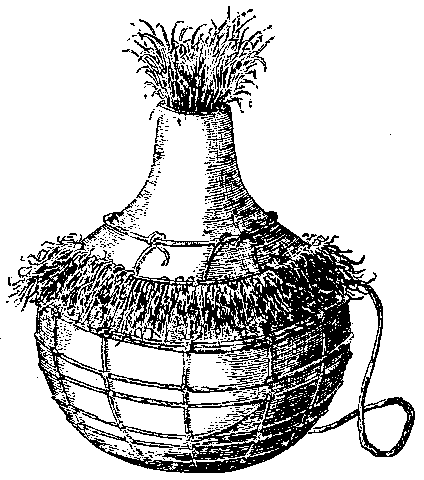
While the gourd was large and convenient in form, it was difficult of transportation owing to its fragility. To overcome this it was encased in a coarse sort of wicker-work, composed of fibrous yucca leaves or of flexible splints. Of this we have evidence in a series of gourd-vessels among the Zuñis, into which the sacred water is said to have been transferred from the tubes, and a pair of which one of the priests, who came east with me two years ago, brought from New Mexico to Boston in his hands—so precious were they considered as relics—for the purpose of replenishing them with water from the Atlantic. These vessels are encased rudely but strongly in a meshing of splints (see Fig. 500), and while I do not positively claim that they have been piously preserved since the time of the universal use of gourds as water-vessels by the ancestry of this people, they are nevertheless of considerable antiquity. Their origin is attributed to the priest-gods, and they show that it must have once been a common practice to encase gourds, as above described, in osiery.
POTTERY ANTICIPATED BY BASKETRY.
This crude beginning of the wicker-art in connection with water-vessels points toward the development of the wonderful water-tight basketry of the southwest, explaining, too, the resemblance of many of its typical forms to the shapes of gourd-vessels. Were we uncertain of this, we might again turn to language, which designates the impervious wicker water-receptacle of whatever outline as tóm ma, an evident derivation from the restricted use of the word tóm me in connection with gourd or cane vessels, since a basket of any other kind is called tsí ì le.
It is readily conceivable that water-tight osiery, once known, however difficult of manufacture, would displace the general use of gourd-vessels. While the growth of the gourd was restricted to limited areas, the materials for basketry were everywhere at hand. Not only so, but basket-vessels were far stronger and more durable, hence more readily transported full of water, to any distance. By virtue of their rough surfaces, any leakage in such vessels was instantly stopped by a daubing of pitch or mineral asphaltum, coated externally with sand or coarse clay to harden it and overcome its adhesiveness.
Fig. 501.—Havasupai clay-lined roasting-tray.
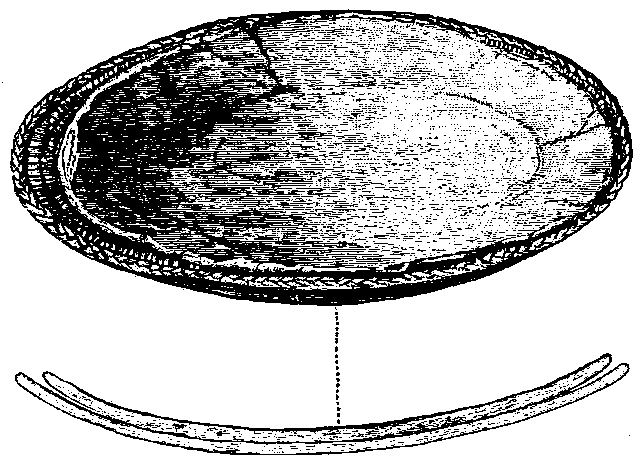
We may conclude, then, that so long as the Pueblo ancestry were semi-nomadic, basketry supplied the place of pottery, as it still does for the less advanced tribes of the Southwest, except in cookery. Possibly for a time basketry of this kind served in place of pottery even for cookery, as with one of the above-mentioned tribes, the Ha va su paí or Coçoninos, of Cataract Cañon, Arizona. These people, until recently, were cut off from the rest of the world by their almost impenetrable cañon, nearly half a mile in depth at the point where they inhabit it. For example, when I visited them in 1881, they still hafted sharpened bits of iron, like celts, in wood. They had not yet forgotten how to boil food in water-tight basketry, by means of hot stones, and continued to roast seeds, crickets, and bits of meat in wicker-trays, coated inside with gritty clay. (See Fig. 501.) The method of preparing and using these roasting-trays has an important bearing on several questions to which reference will be made further on. A round basket-tray, either loosely or closely woven, is evenly coated inside with clay, into which has been kneaded a very large proportion of sand, to prevent contraction and consequent cracking from drying. This lining of clay is pressed, while still soft, into the basket as closely as possible with the hands and then allowed to dry. The tray is thus made ready for use. The seeds or other substances to be parched are placed inside of it, together with a quantity of glowing wood-coals. The operator, quickly squatting, grasps the tray at opposite edges, and, by a rapid spiral motion up and down, succeeds in keeping the coals and seeds constantly shifting places and turning over as they dance after one another around and around the tray, meanwhile blowing or puffing, the embers with every breath to keep them free from ashes and glowing at their hottest.
That this clay lining should grow hard from continual heating, and in some instances separate from its matrix of osiers, is apparent. The clay form thus detached would itself be a perfect roasting-vessel.
POTTERY SUGGESTED BY CLAY-LINED BASKETRY.
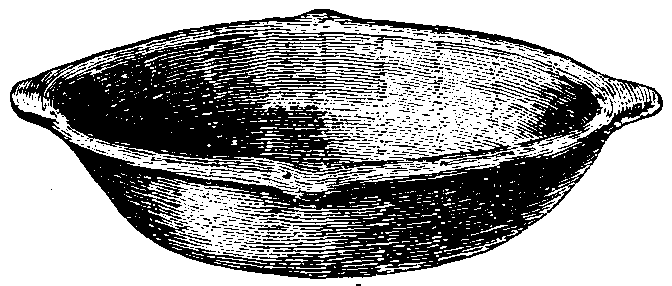
This would suggest the agency of gradual heat in rendering clay fit for use in cookery and preferable to any previous makeshift. The modern Zuñi name for a parching-pan, which is a shallow bowl of black-ware, is thlé mon ne, the name for a basket-tray being thlä' lin ne. The latter name signifies a shallow vessel of twigs, or thlá we; the former etymologically interpreted, although of earthenware, is a hemispherical vessel of the same kind and material. All this would indicate that the thlä' lin ne, coated with clay for roasting, had given birth to the thlé mon ne, or parching-pan of earthenware. (See Fig. 502.)
Fig. 502.—Zuñi earthenware roasting tray.
Among the Havasupaí, still surviving as a sort of bucket, is the basket-pot or boiling-basket, for use with hot stones, which form I have also found in some of the cave deposits throughout the ancient Zuñi country. These vessels (see Fig. 503) were bottle-shaped and provided near the rims of their rather narrow mouths with a sort of cord or strap-handle, attached to two loops or eyes (Fig. 503 a) woven into the basket, to facilitate handling when the vessel was filled with hot water. In the manufacture of one of these vessels, which are good examples of the helix or spirally-coiled type of basket, the beginning was made at the center of the bottom. A small wisp of fine, flexible grass stems or osiers softened in water was first spirally wrapped a little at one end with a flat, limber splint of tough wood, usually willow (see Fig. 504). This wrapped portion was then wound upon itself; the outer coil thus formed (see Fig. 505) being firmly fastened as it progressed to the one already made by passing the splint wrapping of the wisp each time it was wound around the latter through some strands of the contiguous inner coil, with the aid of a bodkin. (See Fig. 506.) The bottom was rounded upward and the sides were made by coiling the wisp higher and higher, first outward, to produce the bulge of the vessel, then inward, to form the tapering upper part and neck, into which, the two little twigs or splint loop-eyes were firmly woven. (See again Fig. 503 a.)
Fig. 503.—Havasupaí boiling-basket.
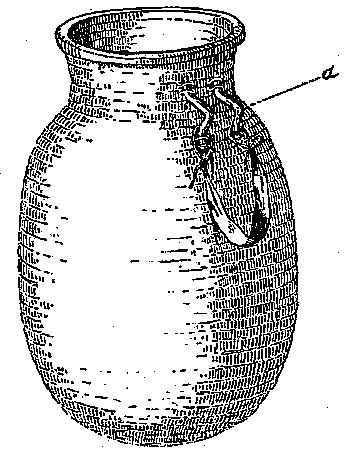
Fig. 504. Fig. 505.
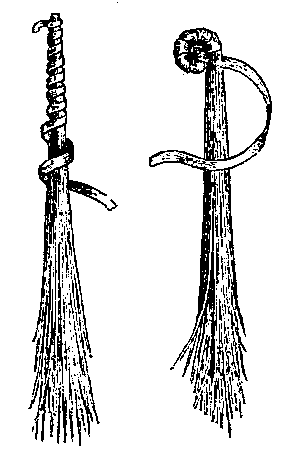
Fig. 506.
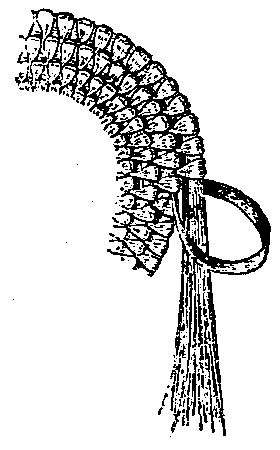
Sketches illustrating manufacture of spirally-coiled basketry.
Fig. 507.—Typical basket decoration.
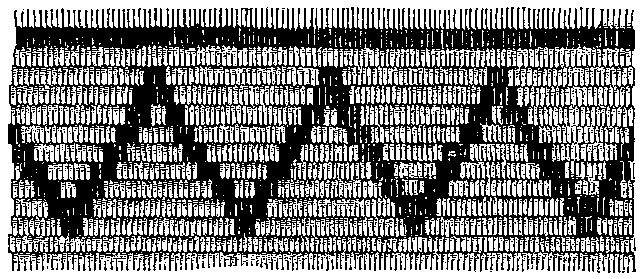
Fig. 508.—Typical basket decoration.

Fig. 509.—Typical basket decoration.

These and especially kindred forms of basket-vessels were often quite elaborately ornamented, either by the insertion at proper points of dyed wrapping-splints, singly, in pairs, or in sets, or by the alternate painting of pairs, sets, or series of stitches. Thus were produced angular devices, like serrated bands, diagonal or zigzag lines, chevrons, even terraces and frets. (See Figs. 507, 508, 509.) There can be no doubt that these styles and ways of decoration were developed, along with the weaving of baskets, simply by elaborating on suggestions of the lines and figures unavoidably produced in wicker-work of any kind when strands of different colors happened to be employed together. Even slight discolorations in occasional splints would result in such suggestions, for the stitches would here show, there disappear. The probability of this view of the accidental origin of basket-ornamentation may be enhanced by a consideration of the etymology of a few Zuñi decorative terms, more of which might be given did space admit. A terraced lozenge (see Figs. 510,511), instead of being named after the abstract word a wi thlui ap í pä tchi na, which signifies a double terrace or two terraces joined together at the base, is designated shu k`u tu li a tsi' nan, from shu e, splints or fibers; k`u tsu, a double fold, space, or stitch (see Figs. 512, 513); li a, an interpolation referring to form; and tsi' nan, mark; in other words, the "double splint-stitch-form mark." Likewise, a pattern, composed principally of a series of diagonal or oblique parallel lines en masse (see Fig. 514), is called shu' k`ish pa tsí nan, from shú e, splints; k`i'sh pai e, tapering (k`ish pon ne, neck or smaller part of anything); and tsí nan, mark; that is, "tapering" or "neck-splint mark." Curiously enough, in a bottle-shaped basket as it approaches completion the splints of the tapering part or neck all lean spirally side by side of one another (see Fig. 515), and a term descriptive of this has come to be used as that applied to lines resembling it, instead of a derivative from ä's sël lai e, signifying an oblique or leaning line. Where splints variously arranged, or stitches, have given names to decorations—applied even to painted and embroidered designs—it is not difficult for us to see that these same combinations, at first unintentional, must have suggested the forms to which they gave names as decorations.
Fig. 510.
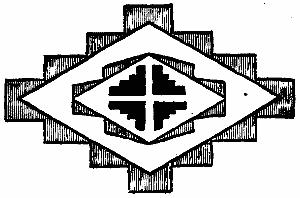
Fig. 511.

Terraced lozenge decoration, or "double-splint-stitch-forms."
Fig. 512.
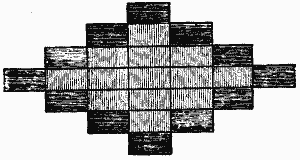
Fig. 513.
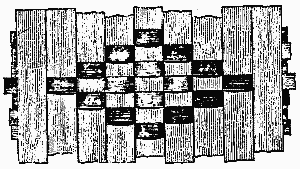
Double-splint-stitch.
Fig. 514.—Diagonal parallel-line decoration.
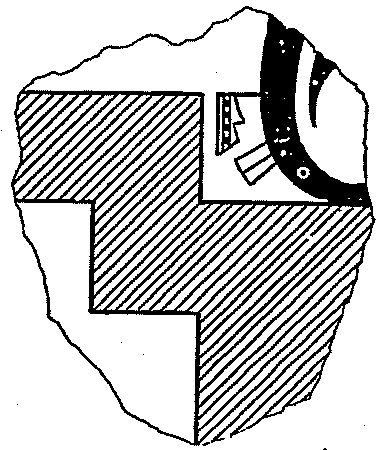
Fig. 515.—Splints at neck of unfinished basket.
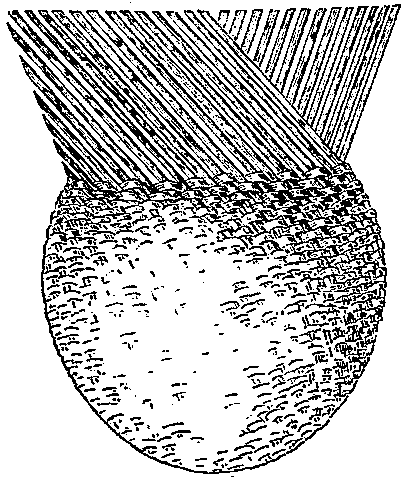
Fig. 516.
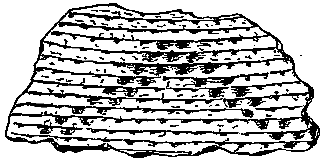
Fig. 517.
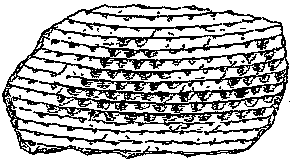
Examples of indented decoration on corrugated ware.
Pueblo coiled pottery developed from basketry.—Seizing the suggestion afforded by the rude tray-molded parching-bowls, particularly after it was discovered that if well burned they resisted the effects of water as well as of heat, the ancient potter would naturally attempt in time to reproduce the boiling-basket in clay. She would find that to accomplish this she could not use as a mold the inside of the boiling-basket, as she had the inside of the tray, because its neck was smaller than its body. Nor could she form the vase by plastering the clay outside of the vessel, not only for the same reason, but also because the clay in drying would contract so much that it would crack or scale off. Naturally, then, she pursued the process she was accustomed to in the manufacture of the basket-bottle. That is, she formed a thin rope of soft clay, which, like the wisp of the basket, she coiled around and around a center to form the bottom, then spirally upon itself, now widening the diameter of each coil more and more, then contracting as she progressed upward until the desired height and form were attained. As the clay was adhesive, each coil was attached to the one already formed by pinching or pressing together the connecting edges at short intervals as the winding went on. This produced corrugations or indentations marvelously resembling the stitches of basket-work. Hence accidentally the vessel thus built up appeared so similar to the basket which had served as its model that evidently it did not seem complete until this feature had been heightened by art. At any rate, the majority of specimens belonging to this type of pottery—especially those of the older periods during which it was predominant—are distinguished by an indented or incised decoration exactly reproducing the zigzags, serrations, chevrons, terraces, and other characteristic devices of water-tight basketry. (Compare Figs. 516, 517 with Figs. 507, 508.) Evidently with a like intention two little cone-like projections were attached to the neck near the rim of the vessel (see Fig. 518) which may hence be regarded as survivals of the loops whereby it has been seen the ends of the strap-handle were attached to the boiling-basket. (See again Fig. 503, a.) Although varied in later times to form scrolls, rosettes, and other ornate figures (see Fig. 519), they continued ever after quite faithful features of the spiral type of pot, and may even sometimes be seen on the cooking-vessels of modern Zuñi. To add yet another link to this chain of connection between the coiled boiling-basket and the spirally-built cooking-pot, the names of the two kinds of vessels may be given. The boiling-basket was known as wó li a k`ia ni tu li a tom me, the corrugated cooking pot as wo li a k`ia te' ni tu li a ton ne, the former signifying "coiled cooking-basket," the latter "coiled earthenware cooking-basket."
Fig. 518.—Cooking-pot of corrugated ware, showing conical projections near rim.
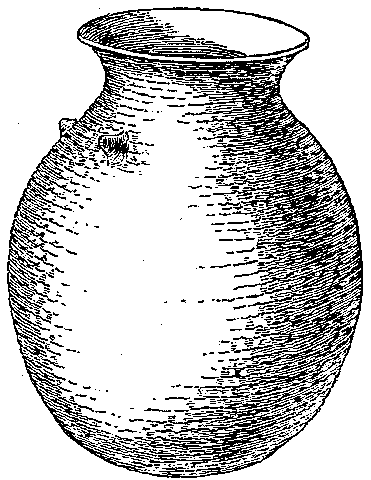
Fig. 519.—Cooking-pot of corrugated ware, showing modified projections near rim.
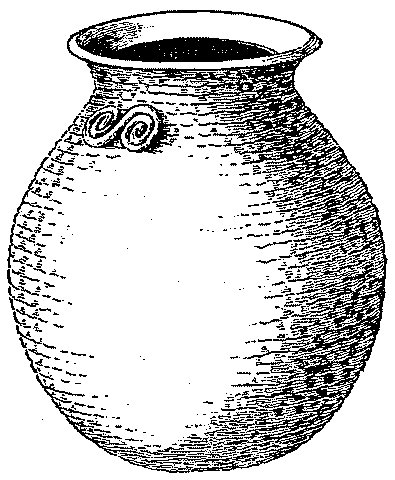
Fig. 520.—Wicker water-bottle, showing double loops for suspension.
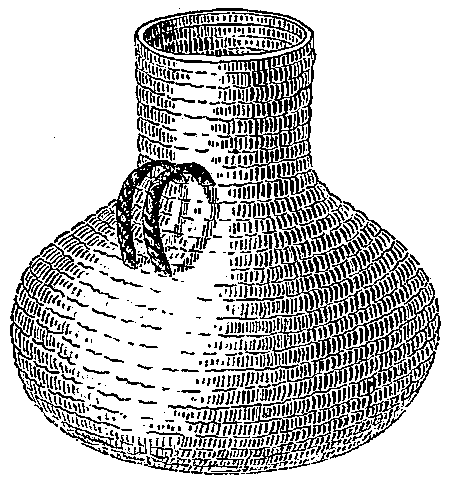
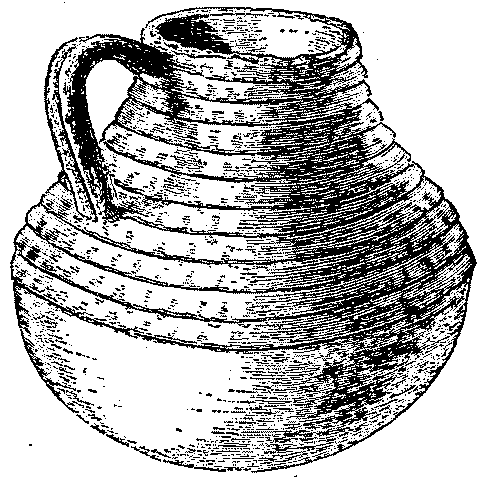
Other very important types of vessels were made in a similar way. I refer especially to canteens and water-bottles. The water-bottle of wicker differed little from the boiling-basket. It was generally rounder-bodied, longer and narrower necked, and provided at one side near the shoulders or rim with two loops of hair or strong fiber, usually braided. (See Fig. 520.) The ends of the burden-strap passed through these loops made suspension of the vessel easy, or when the latter was used simply as a receptacle, the pair of loops served as a handle. Sometimes these basket-bottles were strengthened at the bottom with rawhide or buckskin, stuck on with gum. When, in the evolution of the pitcher, this type of basket was reproduced in clay, not only was the general form preserved, but also the details above described. That is, without reference to usefulness—in fact at no small expense of trouble—the handles were almost always made double (see Fig. 521); indeed, often braided, although of clay. Frequently, especially as time went on, the bottoms were left plain, as if to simulate the smooth skin-bottoming of the basket-bottles. (See Fig. 522.) At first it seems odd that with all these points of similarity the two kinds of water-vessel should have totally dissimilar names; the basket-bottle being known as the k`iá pu k`ia tom me, from k`iá pu kĭa, "for carrying or placing water in," and tóm me; the handled earthen receptacle, as the í mush ton ne. Yet when we consider that the latter was designed not for transporting water, for which it was less suited than the former, but for holding it, for which it was even preferable, the discrepancy is explained, since the name í mush ton ne is from i' mu, to sit, and tóm me, a tube. This indicates, too, why the basket-bottle was not displaced by the earthen bottle. While the former continued in use for bringing water from a distance, the latter was employed for storing it. As the fragile earthen vessels were much more readily made and less liable to become tainted, they were exclusively used as receptacles, removing the necessity of the tedious manufacture of a large number of the basket-bottles. Again, as the pitcher was thus used exclusively as a receptacle, to be set aside in household or camp, the name í' mush ton ne sufficed without the interpolation te—"earthenware"—to distinguish it as of terra cotta, instead of osiery.
Fig. 521.—Water-bottle of corrugated ware, showing double handle.
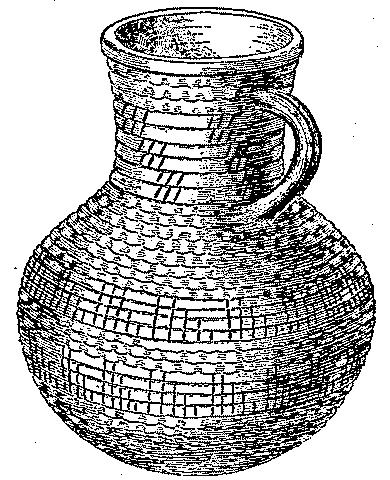
Fig. 522.—Water-bottle of corrugated ware, showing plain bottom.
POTTERY INFLUENCED BY LOCAL MINERALS.
Before discussing the origin of other forms, it may be well to consider briefly some influences, more or less local, which, in addition to the general effect of gourd-forms in suggesting basket-types and of the latter in shaping earthenware, had considerable bearing on the development of ceramic art in the Southwest, pushing it to higher degrees of perfection and diversity in some parts than in others.
Perhaps first in importance among these influences was the mineral character of a locality. Where clay occurred of a fine tough texture, easily mined and manipulated, the work in terra cotta became proportionately more elaborate in variety and finer in quality. There are to be found about the sites of some ancient pueblos, potsherds incredibly abundant and indicating great advancement in decorative art, while near others, architecturally similar, even where evidence of ethnic connection is not wanting, only coarse, crudely-molded, and painted fragments are discoverable, and these in limited quantity.
An example in point is the ruined pueblo of A' wat u i or Aguatóbi, as it was known to the Spaniards at the time of the conquest, when it was the leading "city of the Province of Tusayan," now Moki. Over the entire extent of this ruin, and to a considerable distance around it, fragments of the greatest variety in color, shape, size, and finish of ware occur in abundance. In the immediate neighborhood, however, are extensive, readily accessible formations producing several kinds of clay and nearly all the color minerals used in the Pueblo potter's art. Yet at the greatest ruin on the upper Colorado Chiquito (in an arm of the valley of which river A' wat ú i itself occurs), where the fallen walls betoken equal advancement in the status of the ancient builders and indicate by their vast extent many times the population of A' wat u i, the potsherds are coarse, irregular in curvature, badly decayed, and exceptionally scarce. In the immediate neighborhood of this ruin, I need not add, clay is of rare occurrence and poor in quality.
A more reliable example is furnished by the farming pueblos of Zuñi. At Hé sho ta tsí nan or Ojo del Pescado, fifteen miles east of Zuñi, clays of several varieties and color minerals are abundant. The finest pottery of the tribe is made there in great quantity, while, notwithstanding the facilities for transportation which the Zuñis now possess, at the opposite farming town of K`iáp kwai na kwin, or Los Ojos Calientes, where clay is scarce and of poor texture, the pottery, although somewhat abundant, is of miserable quality and of bad shape.
In quality of art quite as much as in that of material this local influence was great. In the neighborhood of ruined pueblos which occur near mineral deposits furnishing a great variety of pigment-material, the decoration of the ceramic remains is so surprisingly and universally elaborate, beautiful, and varied as to lead the observer to regard the people who dwelt there as different from the people who had inhabited towns about the sites of which the sherds show not only meager skill and less profuse decorative variety, but almost typical dissimilarity. Yet tradition and analogy, even history in rare instances, may declare that the inhabitants of both sections were of common derivation, if not closely related and contemporaneous. Probably, at no one point in the Southwest was ceramic decoration carried to a higher degree of development than at A' wat u i, yet the Oraibes, by descent the modern representatives of the A' wat u i ans are the poorest potters and painters among the Mokis. Near their pueblo the clay and other mineral deposits mentioned as abundant at A' wat u i are meager and inaccessible. Still, it may be urged that time may have introduced other than natural causes for change; this could not be said of another example pertaining to one period and a single tribe. I refer again to the Zuñis. The manufactures of Pescado probably surpass in decorative excellence all other modern Pueblo pottery, while both in their lack of variety and in delicacy of execution of their painted patterns the fictiles of Ojo Caliente are so inferior and diverse from the other Zuñi work that the future archæologist will have need to beware, or (judging alone from the ceramic remains which he finds at the two pueblos) he will attribute them at least to distinct periods, perhaps to diverse peoples.
POTTERY INFLUENCED BY MATERIALS AND METHODS USED IN BURNING.
Other influences, to a less extent local, had no inconsiderable effect on primitive Pueblo pottery: materials employed and methods resorted to in burning.
Only one kind of fuel, except for a single class of vessels, is now used in pottery-firing; namely, dried cakes or slabs of sheep-dung. Anciently, several varieties, such as extremely dry sage-brush or grease-wood, piñon and other resinous woods, dung of herbivora when obtainable, charcoal, and also bituminous or cannel-coal were employed. The principal agent seems, however, to have been dead-wood or spunk, pulverized and moistened with some adhesive mixture so that flat cakes could be formed of it. I infer this not alone from Zuñi tradition, which is not ample, but from the fact that the sheep-dung now used is called, in the condition of fuel, kú ne a, while its name in the abstract or as sheep-dung simply is má he. Dry-rot wood or spunk is known as kú me. In the shape of flat cakes it would be termed kú mo we or kú me a, whence I doubt not the modern word kú ne a is derived.
Of methods, four were in vogue. The simplest and worst consisted in burying the vessel to be burned under hot ashes and building a fire around it, or inverting it over a bed of embers and encircling it with a blazing fire of brush-wood, as is still the practice of the Maricopas and other sedentary tribes of the Gila. The most common was building a little cone or dome of fuel over the articles to be baked and firing; the most perfect was to dig or construct under ground a little cist or kiln, line it evenly with fuel, leaving a central space for the green ware, and slowly fire the whole mass.
Irrespective of the kind of fuel used, the baking by ash-burial made the ware gray, cloudy, or dingy, and not very durable. Pottery burned with sage or grease-wood was firm, light gray unless of ocherous clay, less cloudy than if ash-baked, yet mottled. Turf and dung, although easily managed, did not thoroughly harden the pottery, but burned it very evenly; dead wood or spunk-cakes baked as evenly as any of the materials thus far mentioned, and more thoroughly than the others. Resinous or pitchy woods, while they produced a much higher degree of heat, could be used only when color was unimportant, as they still are used to some extent in the firing of black-ware or cooking pots. The latter, while still hot from a preliminary burning, if coated externally with the mucilaginous juice of green cactus, internally with piñon gum or pitch, and fired a second or even a third time with resinous wood-fuel, are rendered absolutely fire-proof, semi-glazed with a black gloss inside, and wonderfully durable. Tradition represents that by far the most perfect fuel was found to be cannel coal, and that, where abundant, accessible, and of an extremely bituminous quality, it was much used. The traces of little pit-kilns filled with, cinders of mineral coal about many of the ruins in the northwestern portion of the Pueblo region, coupled with the semi-fusion and well-preserved condition of most of the ancient jars found associated with them, certainly give support to this tradition. Happily I have additional confirmation. When, two years ago, I was engaged in making ethnologic collections at Moki for the United States National Museum, some Indians of the Te wa pueblo brought me a quantity of pottery. It had been made with the purpose of deceiving me, in careful imitation of ancient types, and was certainly equal to the latter in lightness and the condition of the burning. I paid these enterprising Indians as good a price as they had been accustomed to getting for genuine ancient specimens, but told them that, being a Zuñi, I was almost one of themselves, hence they could not deceive me, and asked them how they had so cleverly succeeded in burning the ware. They laughingly replied that they had simply dug some bituminous coal (u á ko) and used it in little pits. When I further asked them why they did not burn their household utensils thus, they said it was too uncertain; representing that the pots did not like to be burned in the u á ko, probably because it was so hot, hence they broke more frequently than if fired in the common way with dried sheep-dung; furthermore the latter was less troublesome, requiring only to be dug from the corrals near at hand and dried to make it ready for use.
This partially explains why the art of water-tight basket-making has here gradually declined since the Spanish conquest, as the ceramic industry has increased with the introduction of the sheep, which furnishes fuel for the burning, and the horse, before unknown, has facilitated transportation, whereby trade for this class of basketry with the distant nomadic tribes who still make it is rendered easy. Withal, however, the quality of pottery has not improved, but has deteriorated; as sheep-dung is but an inferior fuel for firing.