EVOLUTION OF FORMS.
Reading edition
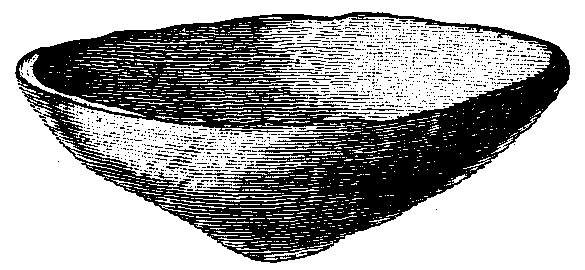
Fig. 523.—Food trencher of wicker-work.
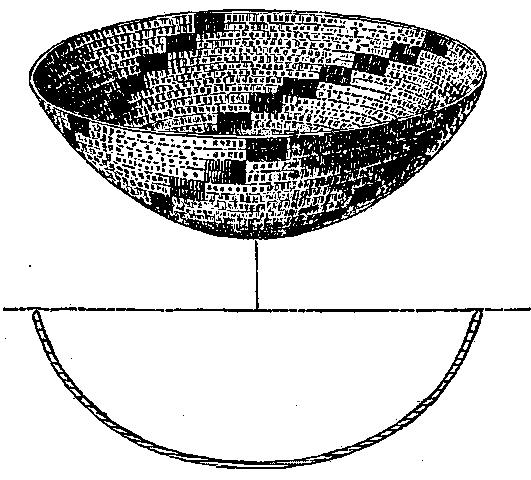
Fig. 524.—Latter inverted, as used in forming bowls
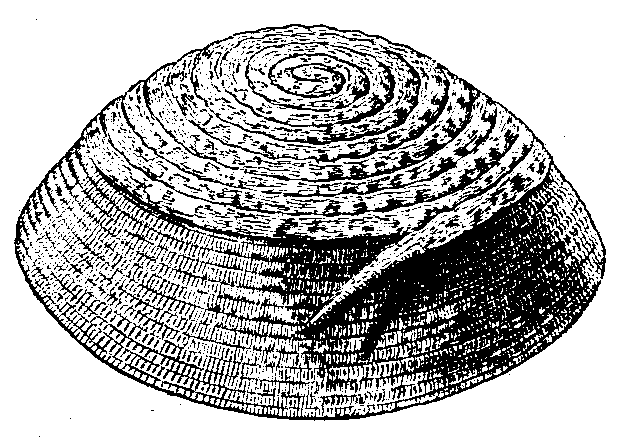
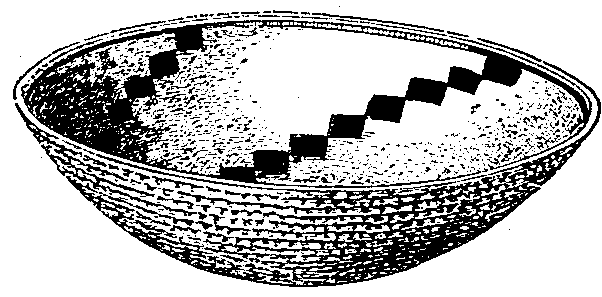
Bearing these statements in mind, the discussion of the evolution as well as of the distribution of form, and later of the evolution of decoration, in pottery will become easier. By lingering steps there was early developed a method of building up vessels by a process differing in part from the spiral. As the parching-bowl had been evolved from the roasting-tray, so, we may infer, the food-bowl was suggested by the hemispherical food-trencher of wicker-work. (See Fig. 523.) Yet, curiously enough, the inside of the latter seems not at first to have been used in molding the food-bowl, as, it will be remembered, the tray had been in forming the parching-pan. On the contrary, the clay was coiled around and around the outside of the bottom of an inverted basket bowl (see Fig. 524), instead of being pressed evenly into it. As with the cooking pot, so with this; as the coiling progressed it was corrugated, not so much, however from necessity, as from habit. In consequence of the difficulty experienced in removing these bowl-forms from the bottoms of the baskets—which had to be done while they were still plastic, to keep them from cracking—they were made very shallow. Hence the specimens found among the older ruins and graves are not only corrugated outside, but are also very wide in proportion to their height. (See Fig. 525.) As time went on it was found that bowls might be made deeper, and yet readily be taken off from the basket bottoms, if slightly moistened outside and pressed evenly all around, or, better still, scraped; for, being plastic, this proceeding caused them to grow thinner, consequently larger, thereby to loosen from the basket over which they had been molded. As a result of this scraping, however, the corrugated surface was destroyed, nor could it easily be restored. Therefore bowls when made deep were, as a rule, smooth on the outside as well as on the interior surface. When by a perfectly natural sequence of events—as will be shown further on—ornamentation by painting came to be applied first to the plain interiors of the bowls, the smooth outer surface was found preferable to the corrugated surface, not only because it took paint more readily, but also because the bowl, when painted outside as well as inside, formed a far handsomer utensil for household use than if simply decorated by the older methods. As a consequence, we find that, while the larger vessels continued to be corrugated and indented, the smoothed and painted bowl came into general use. Associated later on with this secondary type of bowls occurred the larger vessels plain at the bottoms, still corrugated at the sides. Nor is this surprising, as the bowl, molded on the basket bottom and there smoothed, could be afterward built up by the spiral process. When in time the huge hemispherical canteens or water carriers of earthen-ware replaced the basket bottles, so also the water jar or olla replaced the handled sitter or pitcher, since it could be made larger to receive more copious supplies of water than the strength of the frail handles on the pitchers would warrant.
Fig. 525.—Ancient bowl of corrugated ware.
The water jar, like the food-bowl, is a conspicuous household article; for which reason the Zuñi woman expends all her ability to render them handsome. Judging by this, the desire to decorate the water-vessel with paint, like its constant companion the food-bowl, would early lead to the attempt to make its surface smooth. This would need to be effected while the article was still soft; which necessity probably led to the discovery that ajar of the corrugated or simply coiled type may be smoothed while still plastic without danger of distortion, no matter what its size, if supported at the bottom in a basket or other mold so that it may be shifted or turned about without direct handling. (See Fig. 526.)
Fig. 526.—Basket-bowl as base-mold for large vessels.
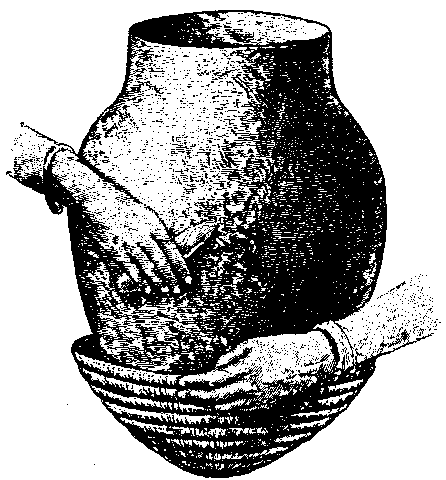
Fig. 527.—Clay nucleus for a vessel.
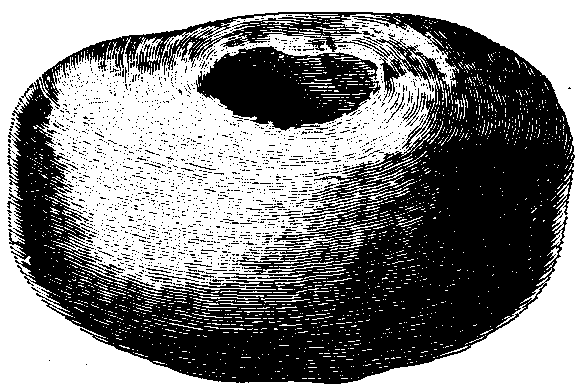
Fig. 528.—Clay nucleus shaped to form the base of a vessel.
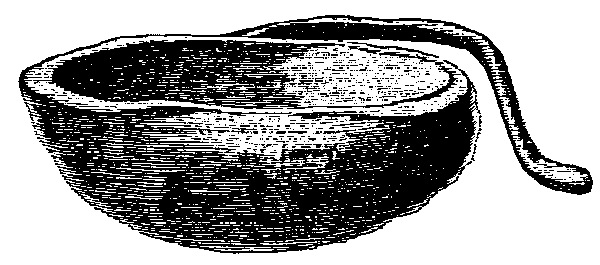
After this discovery was made, the molding of large vessels was no longer accomplished by the spiral method exclusively. A lump of clay, hollowed out (see Fig. 527), was shaped how rudely so ever on the bottom of the basket or in the hand (see Fig. 528), then placed inside of a hemispherical basket-bowl and stroked until pressed outward to conform with the shape, and to project a little above the edges of its temporary mold, whence it was built up spirally (see Fig. 529) until the desired form had been attained, after which it was smoothed by scraping (see Fig. 530).
Fig. 529.—Clay nucleus in base-mold, with beginning of spiral building.
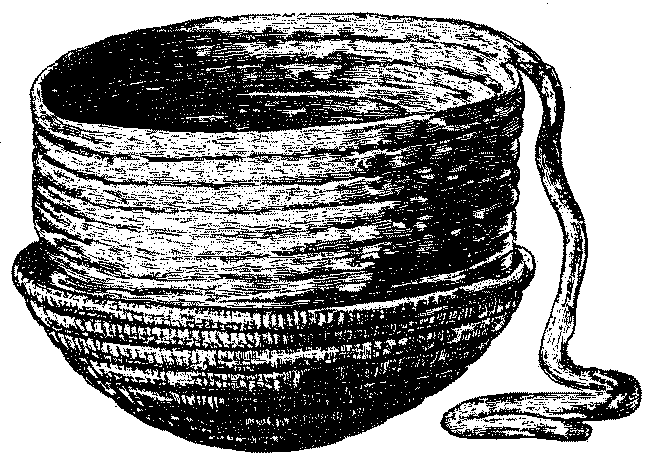
Fig. 530.—First form of vessel.
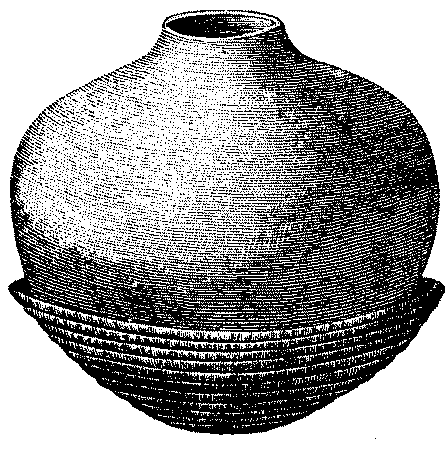
The necks and apertures of these earliest forms of the water jar were made very small in proportion to their other dimensions, presumably on account of the necessity of often carrying them full of water over steep and rough mesa paths, coupled perhaps with the imitation of other forms. To render them as light as possible they were also made very thin. One of the consequences of all this was that when large they could not be stroked inside, as the shoulders or uttermost upper peripheries of the vessel could not be reached with the hand or scraper through the small openings. The effect of the pressure exerted in smoothing them on the outside, therefore, naturally caused the upper parts to sink down, generating the spheroidal shape of the jar. (see Fig. 531), one of the most beautiful types of the olla ever known to the Pueblos. At Zuñi, wishing to have an ancient jar of this form which I had seen, reproduced, I showed a drawing of it to a woman expert in the manufacture of pottery. Without any instructions from me beyond a mere statement of my wishes, she proceeded at once to sprinkle the inside of a basket-bowl with sand, managing the clay in a way above described and continuing the vessel-shaping upward by spiral building. She did not at first make the shoulders low or sloping, but rounded or arched them upward and outward (see again Fig. 529). At this I remonstrated, but she gave no heed other than to ejaculate "wá na ni, àná!" which meant "just wait, will you!" When she had finished the rim, she easily caused the shoulders to sink, simply by stroking them—more where uneven than elsewhere—with a wet scraper of gourd (see Fig. 532, a) until she had exactly reproduced the form of the drawing. She then set the vessel aside in the basket. Within two days it shrank by drying at the rate of about one inch in twelve, leaving the basket far too large. (See Fig. 533.) It could hence be removed without the slightest difficulty.
Fig. 531.—Secondary form, in the mold.
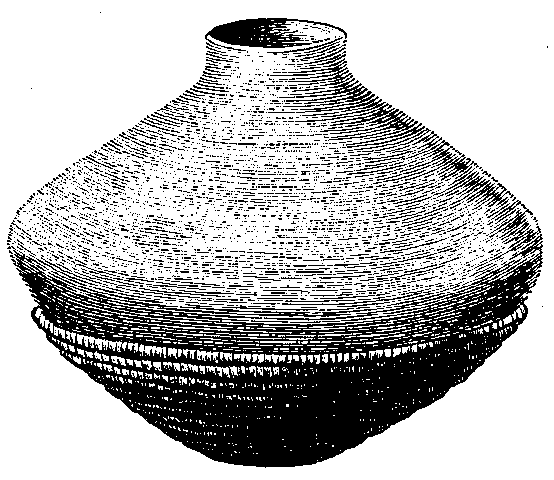
Fig. 532.—Scrapers of gourd and earthenware for smoothing pottery.

Fig. 533.—Finished form of vessel in mold, showing amount of contraction in drying.
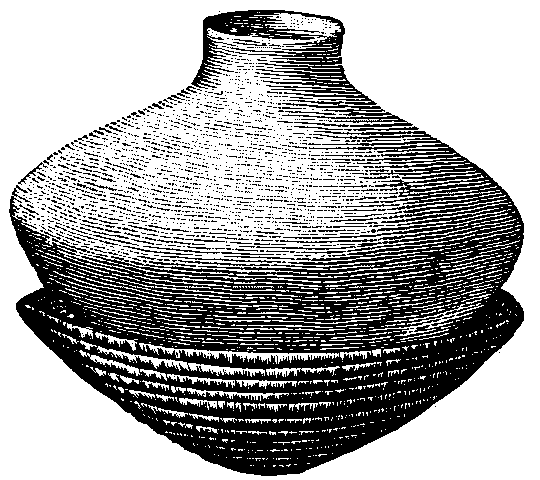
The sand had prevented contact with the basket which would have caused the clay vessel to crack as the latter was very thin. This process exists in full force to-day with the Oraibes in the modeling of convex-bottomed vessels, and the Zuñis thus make their large bowls and huge drum-jars.
Upon the bottoms of many jars of these forms, I have observed the impressions of the wicker bowls in which they had been molded—not entirely to be removed, it seems, by the most assiduous smoothing before burning; for, however smooth any exceptional specimen may appear, a squeeze in plaster will still reveal traces of these impressions.
Fig. 534.—Profile of olla, or modern water-jug.
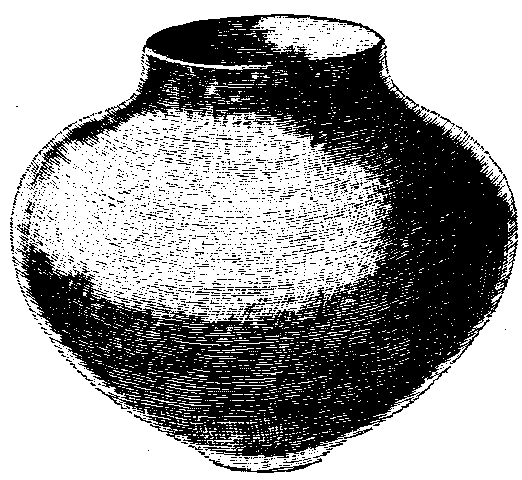
A characteristic of these older forms of the water-jar is that they are invariably flat or round-bottomed, while more recent and all modern types of the olla (see Fig. 534) are concave or hollowed at the base (see Fig. 535) to facilitate balancing on the head. Outside of this concavity and entirely surrounding it (Fig. 536, a) is often to be observed an indentation (see Fig. 536, b) usually slight although sometimes pronounced.
Fig. 535.—Base of olla.
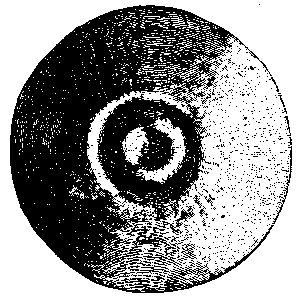
Fig. 536.—Section of olla.
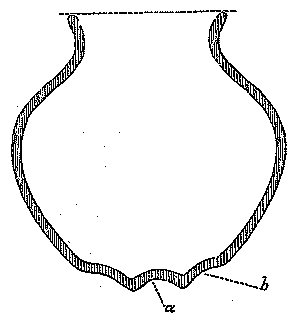
Fig. 537.—Annular mat of wicker, or "milkmaid's boss."
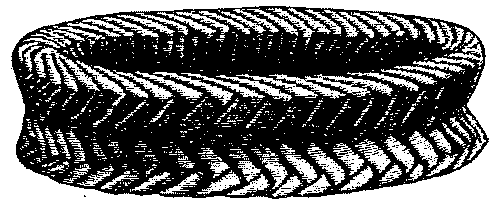
Fig. 538.—Use of annular mat illustrated.
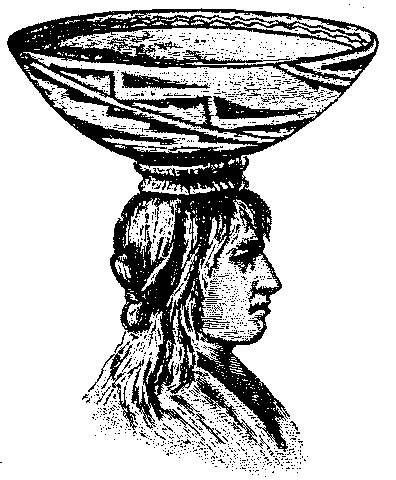
This has no use, but there is of course a reason for its occurrence which, if investigated, may throw light on the origin of the modern type of the olla itself. The older or round-bottomed jars were balanced on the head in carrying, by means of a wicker-work ring, a kind of "milk-maid's boss." (See Fig. 537.) These annular mats are still found among the ruins and cave-deposits, and continue in use with the modern Pueblos for supporting convex-bottom cooking pots on the floor as well as for facilitating the balancing of large food-bowls on the head. (See Fig. 538.) Obviously the latter dishes have never been hollowed as the ollas have been, because, since they were used as eating-bowls, the food could be removed from a plain bottom more easily than from a convex surface, which would result from the hollowing underneath. Supposing that a water-jar chanced to be modeled in one of the convex-bottom bread-baskets (see Fig. 539), it would become necessary, on account of the thickness of these wicker bowls, to remove the form from the mold before it dried. By absorption it would dry so rapidly that it would crack, especially in contracting against the convexity in the center of the basket-bottom. (See Fig. 539, a.) In order that this form might be supported in an upright position until dry, it would naturally be placed on one of the wicker-rings. Moreover, that the bottom might not sink down or fall out, a wad of some soft substance would be placed within the ring. (See Fig. 540, a.) As a consequence the weight of the plastic vessel would press the still soft bottom against the central wad, (Fig. 540, a) and the wicker ring (Fig. 540, c) sufficiently to cause the rounding upward of the cavity (Fig. 540, b) first made by the convex-bottom of the basket-mold, as well as form the encircling indentation (Fig. 540, c). Thus by accident, probably, only possibly by intention, was evolved the most useful and distinctive feature of the modern water-jar or olla, the concave bottom. This, once produced, would be held to be peculiarly convenient, dispensing with the use of a troublesome auxiliary. Its reproduction would present grave difficulties unless the bottom of the first vessel, thickly coated with sand to prevent cracking, was employed as a mold, instead of the absorbent convex-centered basket-bowl.
Fig. 539.—Section of incipient vessel in basket-mold.
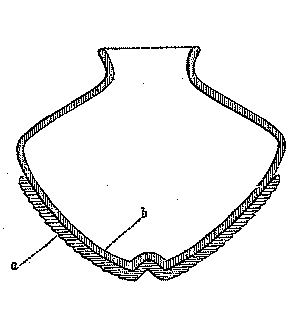
Fig. 540.—Section of vessel supported for drying.
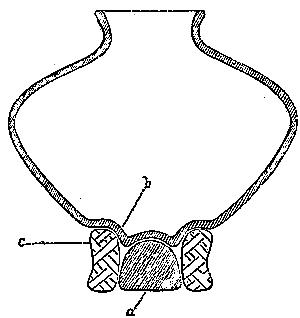
I infer this because, to-day, a Zuñi woman is quite at a loss how to hollow the bottom of a water-jar if she does not possess a form or mold made from the base of some previously broken jar of the same type. She therefore, carefully preserves these precious bottoms of her broken ollas, even cementing together fractured ones, when not too badly shivered, with a mixture of pitch or mineral asphaltum and sand. I have seen as many as a dozen or more of these molds (see Fig. 541) in a single store room.
Fig. 541.—Base-mold (bottom of water-jar).
As the practice of molding all new vessels of this class in the bottoms of older ones was general—I might say invariable—any peculiarities of form in the originals must have been communicated to those ensuing; from the latter to others, and so on, though in less and less degree, to the present time. This theory is but tentative, yet it would also explain, on the score of association, why the Pueblo women slightly prefer the jars showing the indentation in question to more regular ones. With the change from elevated cliff or mesa habitations to more accessible ones, the Pueblo Indians were enabled to enlarge the apertures of their water-jars, since not only did the concave bases of the latter make the balancing of them more secure, but the trails over which they had to be carried from watering place to habitation were less rugged. A natural result of this enlargement of the openings, which admitted access with the scraper to the interior peripheries of the thin-walled jars, was the rounding upward of their shoulders, making them taller in proportion to their diameters. This modification of form in the water-jar, taken in connection with the fact that thus changed, it displaced the daily use of the canteen, explains the totally dissimilar names which were applied to the two types. The older, or spheroidal olla, was known as the k`iáp ton ne, from k`ia pu, to place or carry water in, and tóm me; while the newer olla is called k`iá wih na k`ia té èle, from k`iá wih na ki`a na ki`a, for bringing of water: té, earthen-ware, and ë' le or ë'l lai e, to stand or standing. The latter term, té è le, is generic, being applied to nearly all terra cotta vessels which are taller than they are broad. Té, earthen ware, is derived from t´eh', the root also of té ne a, to resound, to sound hollow; while é le, from ë'l le or ël' lai ê, to stand, is obviously applied in significance of comparative height as well as of function.
Thus I have thrown together a few conjectures and suggestions relative to the origin of the Southwestern pottery and the evolution of its principal forms.