SOME ACCOUNT OF THE ASSAMESE TRIBES.
Reading edition
Observations on the Khamtees—Surprise and Conflagration of the Station of Suddeah by the Khamtees, in January 1839—Singphoos—Muttucks—State of Assam Tea Company—Bor Abors—Abors and Merees—Mishmees—Dooaneahs—Assamese—Nagas—American Baptist Missionaries in Assam—Garrows—Their present and eventual condition—Cosseahs—Traits of the people of Bootan—Attachment of the Bootan Dooars in Assam by the British Government—Defeat of the Booteahs, in 1836—Sath Booteah Rajahs of Kooreahparah Dooar, in Durrung—Thebingeah Booteah Rajahs—Sath Rajahs of Char Dooar—Hazaree Khawa Akhas—Kuppah Choor Akhas—Meechees, and Dufflahs of Now Dooar.
KHAMTEES.
In the reign of Rajeswur Sing, Rajah of Assam, about 1751 A.D., on the north-eastern frontier of Assam, the Khamtees, it is traditionally reported, emigrated from a range of mountains bordering on the sources of the Irawaddy river to the valley of Assam, and settled a small colony of fifteen houses in the vicinity of the Tengapanee river. But between the years 1780 and 1794 A.D., Goureenath Sing, the reigning Rajah of Assam, was compelled to abandon Upper Assam after repeated battles with the rebellious Moamareahs of Muttuck, and in the anarchy that prevailed throughout the country, the Khamtees were emboldened to take up a more advanced position. For that purpose, being joined by another band of 400 Khamtees with some few muskets, they fearlessly located themselves at Suddeah; and, though nominally subordinate to the Assam Government, they arrogantly exercised considerable power over the people of the Suddeah and Saikwah districts: which were exceedingly populous at that period, and had been placed under the direct authority of an Assamese nobleman, styled Suddeah Khawa, an Ahoom by birth. Not content with this usurpation, they proceeded to reduce the whole of the Assamese population to the utmost verge of degradation; considering them as slaves, only worthy to be spared so long as they continued obedient to the will, and were useful to their masters in cultivating the land, and contributing to their comforts. In the height of their success, promoted by the weakness of the Assam Government, the Khamtees commenced kidnapping the Merees, and other inhabitants settled in the neighbourhood of the Dehong and Debong rivers, whom the Abors looked on as their dependants and slaves, entitled to their special protection. This treatment being less endurable than that of the Abors, towards whom a friendly feeling had been created by long intercourse, the Merees were induced to implore the protection of the latter to save them from being cruelly taken away from their homes to serve as slaves amongst a strange tribe. The Abors, on their side, perceiving that they were about to lose the greater portion of their slaves by the aggressions of a formidable foe, lost no time in preparing for war; and descending from their mountain fastnesses to the plains bordering on the Dehong river, a furious battle was fought between them, and, it is said, two or three hundred Khamtees. The contest terminated in the Khamtees being defeated and dispersed with great slaughter, upwards of one hundred men being left on the field of battle. This trial of strength and courage with their warlike neighbours, rendered the Khamtees ever afterwards more circumspect in their demeanour towards the Abors, and the people subject to them.
During the reign of Kumleswur Sing Rajah, from 1794 to 1809, frequent battles were fought between the royal troops and Khamtees, and generally to the discomfiture of the latter. In fact so disastrous to the Khamtees were the results, that the whole tribe was dispersed; many were detained prisoners, and the remainder were compelled to quit Suddeah and return to the country whence they had issued. In 1810, Chunderkant Rajah ascended the throne, and in the commencement of his reign the Khamtees endeavoured to regain their lost position. Joining the Singphoos at Suddeah, they attacked one of the forts situated at the foot of the northern hills above Suddeah, commanded by Bihitea Burrah and Kooch Burrah, and were successful in a night assault, having destroyed the fortress by fire and massacred 150 soldiers. They were, however, speedily repulsed by the Assam troops, and the whole clan was thenceforth expelled the province.
In 1816–17, Chunderkant Rajah was treacherously invited by the Borax Gohain to visit Jorehath, where he was formally deposed, and ignominiously treated: having one of his ears slit, which disqualified him for regal dignities; and Poorunder Sing, the great grandson of Rajeswur Sing Rajah, was duly installed in his seat. This arrangement, however, was of short duration, for in 1818 a Burmese army of 30,000 men invaded Assam and replaced Chunderkant on his throne. The ex-Rajah, Poorunder Sing, on this sudden and unlooked for change of affairs, prudently retired to Chilmary, in Bengal,
Under the Burmese Government, the Assamese at Suddeah were placed under a Khamtee Gohain, or chief; and when the province was conquered in 1824–25, Captain Neufville sanctioned the innovation, bestowing on a Khamtee chief the title of Suddeah Khawa. But the rights of the Assam régime had devolved on the British Government, with whom it rested to revert to the former rule wherever it might be deemed expedient: and that without any injustice to the Khamtees, as they had no claim whatever to the title in question. The assumption of the title of Suddeah Khawah, by the Khamtees is variously described. It is currently believed that Chunderkant Rajah—feeling himself insecure on the throne whilst he had to contend with the Boora Gohain and the ex-Rajah Poorunder Sing—invited the Khamtees to return to Suddeah, and bestowed on one of the Khamtee chiefs the title of Suddeah Khawa; in order, by this arrangement, to secure, through their means, a retreat for himself, if unfortunate at a future day. But in 1820 A.D., the Burphokun having been murdered, with the connivance, it was supposed, of Rajah Chunderkant, the Burmese became his enemies, and returned and dethroned him, shortly afterwards, placing on the throne Jugesur Sing, who was the last prince of the Assam dynasty. In this interval of anarchy, the Khamtees had re-established their influence and power to such an extent as to overawe almost the whole of the tribes of the frontier; and their authority at Suddeah was paramount. The Assamese, though greatly reduced in numbers by oppression and deaths, and from being carried off and sold into slavery by the Singphoos and Burmese, were all now permanently under the control of the Khamtees; but on the submission of the latter to the British Government, a settlement was made with them, leaving the internal management of the tribes to their own chiefs, who were exempt from taxation, but under the obligation of performing military service to the state when required. Revenue, however, was to be paid for the Assamese subjects under their management, and cases of murder, wounding, arson, and petty thefts above fifty rupees were disposed of by British officers.
The military population of the Suddeah district, on the north bank of the Burrampooter, was estimated at this period to be—Assamese, 691, Khamtees, 428, men capable of bearing arms: multiply these numbers by three, for old men, women, and children, we shall reach a census of 4476 souls. On the south bank, in the district of Saikwah, according to the same calculation, there were,—Assamese, 616, Khamtees, 248, which, with old men, women, and children, amounted in all to 3456 persons; thus making the united population on the north and south banks of the Burrampooter, in the districts of Suddeah and Saikwah, 7,932 persons.
In the year 1829, notwithstanding the Khamtees were bound by treaty to pay allegiance to the British Government, such was the intriguing character of the Khamtee Suddeah Khawa Gohain, that the strongest ground existed for believing him to be engaged in a traitorous combination against us. He was the first person who invited the Burmese into the country, and having a relative residing at Ava, he maintained not only with that court, but throughout the frontier, a general correspondence. In the absence of a European military officer, or Political Agent at Suddeah, a native manager or Suznatee, was generally the channel of all communications between the chiefs and the British Government. But in the years 1834–35, Captain Charlton was placed in charge of the Khamtee chiefs, and the Suddeah and Saikwah districts; and by the measures he adopted to check the traffic in slaves, and protect the Assam population from the oppressive exactions of the Khamtees, he created the utmost dissatisfaction among the latter, and caused them to be highly incensed. Moreover, in December 1834, instructions were issued requiring a census of the population to be taken; with the view of levying a capitation tax, to be renewed every five years, in lieu of military service to the state. When this innovation was proposed, it was urged that the state of society among these tribes was such, that the materials for direct taxation were not available; that the introduction of our rule would cause too violent a shock to the habits and usages of the rude people; and that the result, in all probability, would be a harassing rebellion, which would retard the progress of improvement. Concurring in these views, the Government deemed it unsafe fully to enforce the plan of assessment. The Assamese residing within the Suddeah territory were taxed at the rate of one rupee per head; but the Khamtee tribes were exempted from this imposition, on condition of their performing military service as they had hitherto done under the Assamese and British Governments.
Notwithstanding this concession, however, an insubordinate spirit was immediately manifested by the tribes, and it thus became necessary to deprive them of the muskets given them by Captain Neufville, and to depose the Khamtee Suddeah Khawa Gohain. The loss of this title and usurped sovereignty over the Assamese was grievously felt by the Khamtees, and from that period their estrangement from the British Government may fairly be dated. About this time, also, the Khamtee Suddeah Khawa Gohain was arraigned on a charge of slave-dealing,—an unfortunate occurrence, which rendered the Khamtee chiefs still more indisposed to our rule. Serious apprehensions were thenceforth entertained of an open revolt, and combination with our enemies. Nevertheless, not to appear distrustful of their intentions, they were invited to accompany Lieut. Charlton, in the rainy season of 1835, in the expedition against the Duffa Gaum’s force at the stockade of Gackwah; in storming which place the Runowa, the Tow Gohain of Derack (who was wounded in the neck), and the Captain Gohain accompanied him, and were said to have behaved bravely, and been present when Lieut. Charlton was wounded. It was confidently asserted, however, that though these chiefs did accompany Lieut. Charlton when he took the advanced stockade or guard-house, there were not more than five or six men in it, who ran away immediately; and it is probable that the Khamtee chiefs were aware of there being so few men, as they afterwards completely abandoned Lieut. Charlton when he so gallantly attacked the large stockade. Indeed, from the whole of their conduct subsequently, there is every reason to conclude that they were in league with the enemy, for they made no attempt to obstruct his retreat, and said openly that they could not be expected to fight now that a census was taking of their subjects for the purpose of assessing them; and that they got no presents as was formerly the custom. In the cold season of 1835, the Political Agent led another expedition against the Duffa Gaum, and accepted the voluntary offer of the Khamtee chiefs to accompany him: not in a well-grounded belief in the sincerity of the proposal, but as a matter of policy, with the view of rendering the Duffa Gaum doubtful of their intentions; and thinking it safer to keep an eye upon them, whilst close at hand, rather than to leave them in the rear. In these operations, all previous suspicions of their disaffection were completely confirmed, for in no one instance did the principal chiefs afford any support, and they even took care not to place their contingents within fire on the first day. Subsequently, when placed on the line of the Duffa Gaum’s retreat, they made no effort to obstruct it, otherwise the chief would have been captured; and there is every reason to believe that the negotiation was entirely defeated through their efforts, in concert with others.
The difficulty, however, of substantiating matters of this kind in this frontier, amongst these wild tribes, is exceedingly great, for a great deal of correspondence on such subjects is carried on by symbols and tokens: such as pieces of buffalo flesh, short swords, muskets, ball, powder, &c.; but at the very time the Khamtees were posted to cut off the Duffa Gaum’s retreat, one of their chiefs deserted to him, and doubtless gave the intelligence the enemy stood in need of; and it is currently reported that they fired on the British troops, with whom they were co-operating, more than on the enemy. It is even believed that the Khamtees were aware of the Duffa Gaum’s irruption from the first, and promoted it, with the view of finding us occupation on the frontier, and thereby preventing the realization of our plans for assessing them, as they were firmly impressed with the belief that it was our intention to reduce them to a level with the Assamese. It is true that they offered to pay taxes at one rupee per head, on condition of being exempted from military service, but that they were sincere in this offer was not credited: had the measure been enforced, they would probably have resisted it, or moved out of our territory.
In the beginning of 1837, a marked spirit of disaffection existed amongst the Khamtee chiefs, and it was generally understood that they had combined with the Abors and Mishmees to subvert our power; and they had probably encouraged the Abors to attack us, in the hope of making themselves of consequence and thereby recovering their former power over the Assamese. Or it might have been with a view of preventing the extension of taxation to themselves, which, notwithstanding our promises to the contrary, they expected would be enforced when necessary or convenient. In the latter end of 1837, the Khamtees made an inroad on the Mishmees, averring that the Mishmees had taken away their slaves some years ago; but there is no record of the existence of any real pretext for violence. On the contrary, it appears that the Khamtees sold the subjects of the British Government to the Mishmees. The real motive for the incursion is supposed to have been that the Runoah and Tawah Gohains intended proceeding to a particular spot in the Mishmee hills, with the view of expelling a portion of that tribe and of ultimately withdrawing themselves from the authority of the British Government, to which they had evinced no cordial feeling of attachment. In fact, both in 1835 and 1837 it was recommended to the Government that the Khamtees should be located elsewhere than at Suddeah, in order that unpleasant collisions might be avoided, and our peaceable Assamese subjects be induced more cheerfully to submit to taxation.
The only incident that transpired worthy of notice in 1838 was that, without any permission, the Khamtees commenced preparing some lands for cultivation about a day’s journey from Suddeah; alleging as their reason the scarcity of good land at Suddeah. This plea was, however, untenable: the real cause was that the paucity of the population at Suddeah had rendered it necessary for the Government officers to make requisitions for coolies to work on the roads, although considerably higher wages had been paid than in other parts of the country, and the dread of these requisitions had induced the Khamtees to think of removing.
Thus passed the years 1836, 37 and 38: rumours of an insurrection being about to break out were occasionally prevalent, but it was supposed that the Khamtees had too much good sense to league with other lawless and disaffected tribes and hazard a rebellion, unless supported by a large Burmese army. In the following year, however, the deceitful calm was suddenly disturbed. About half past 2 o’clock on the morning of the 28th January, 1839, the clouds that had long been gathering, burst on the doomed post of Suddeah. The Khamtees, including a few Moolooks and Singphoos and others, in number about six hundred fighting men, divided into four parties—impressed with their own importance and strength, and perhaps stimulated to greater daring by opium—insidiously set fire to the houses of the officers and huts of the soldiers and camp followers, at different points; at the same time furiously attacking with short swords, spears, &c., the stockade and Assam Light Infantry in their lines, and the quarters of the artillery. Notwithstanding that the attack was totally unlooked for, and the greatest confusion prevailed from the extensive conflagration and uproar throughout the station—the Sipahees being surrounded by their wives and families, and knowing that the enemy cut up men, women, and children, indiscriminately—the panic was of short duration. Discipline soon came into play; a few men got together, headed by their officers, and retook the stockade in fifteen minutes. The enemy then confined their remaining exertions to cutting up a few helpless individuals in the bazaar; but after a few rounds of grape and round shot from a carronade and a six-pounder which had been fired, at the commencement of the attack, they fled from the cantonment of Suddeah in three bodies, leaving behind them twenty-one men killed on the spot. The loss of killed and wounded on our side, including men, women, and children, amounted to eighty persons. The political agent, Lieutenant-Colonel White, who had only arrived at Suddeah a few days before the attack, placing too much confidence in the illusive permanence of Khamtee allegiance, did not deem it necessary to have for his protection a guard of Sipahees at his house; and on this eventful night he had left his bungalow on the first alarm, and was proceeding by the nearest route to the lines, when he was met by a party of the enemy, who instantly attacked him. He fell, pierced with nine spear wounds. It is a matter of great regret that this officer should have lost his life from the want of proper precaution, for, had a guard been placed at his house, there is little doubt but that he would have fought his way in safety to the troops in the lines, as other officers did. Being a benevolent, brave, talented officer, his death was deeply lamented by the corps; more particularly as he was the only European who met an untimely end on this memorable morning.
The Khamtees, it is reported, had long endeavoured to persuade the Singphoos to join them in their intended outbreak and massacre of our troops, and some had assented to share in the promised plunder of the district; but whether they hesitated from fear of the consequences, or that the Khamtees anticipated the day of attack from a sanguine expectation of accomplishing their design through their own prowess, unassisted by other tribes, we had no means of ascertaining: further than that the Singphoos, excepting a few in the neighbourhood of Suddeah, on this occasion showed their foresight and prudence in not being implicated in the reckless rebellion. But as the Singphoos, immediately after the Suddeah catastrophe, attacked and burnt several villages in the Saikwah district, it is evident they were prepared to take advantage of the surprise of the post had our troops been defeated or annihilated.
The Moolooks engaged in this conspiracy were well affected to the British Government, and at first refused to join the Khamtees in attacking our troops; but the Moolook Gaum, or chief, having been instantly barbarously murdered by the Khamtees for declining to act against us, his little band was intimidated and compelled reluctantly to follow the dreaded Khamtee leaders. A few Mishmees, who were also at this time on a visit to Suddeah for trading purposes, were unfortunately induced to join in the treacherous affray, and many that were fighting for their lives were slain by the troops. Some of the Suddeah Assamese population were likewise implicated, and punished by the law with the severity their temerity and ingratitude deserved: for they had received no provocation, neither had they any grievances to resent or redress.
In a few months the Khamtee tribe (excepting the Khamtees of Palangpan, who were not implicated) were driven by the Assam Light Infantry beyond the frontier; and the Assam valley was, for the third time within a century, freed from the presence of this inimical tribe. Shortly after the return of the troops from this expedition, however, the Khamtees again located themselves at the foot of the Mishmee hills, close to a pass leading into the Burkhamtee country. In 1843, the Runoah Gohain and Tow Gohain, chief actors in the dire disaster of 1839, being dead, their sons and many Khamtees, sent in a petition for pardon, and for permission to return and place themselves under the protection of the British Government. Their prayer was generously acceded to, and a treaty was at once drawn up offering them free pardon for the past rebellion: on condition of their coming down with their wives and families and locating themselves at Choonpoorah, a short distance above Suddeah, where they should be permitted to cultivate the land rent free for five years. They were further bound to abstain from the trafficking in slaves, and to arrange all petty disputes amongst themselves; but all heinous offences, murder, gang robbery, serious wounding and thefts, were to be settled by the political agent. Finally, after ten years they were to abide by any other arrangement the British Government might deem expedient. Previous to this settlement, and shortly after the insurrection of 1839, a small body of Khamtees were sent down to the district of Luckimpore, and by their own industry cleared and brought into a beautiful state of cultivation a fine tract of country. They, however, live most secludedly from their neighbours, retaining their own habits and customs; and it is to be feared that a long period of time will elapse before they amalgamate or assimilate themselves with the Assamese population. Eventually, should the whole body of this discontented, restless, intriguing tribe return to their allegiance under the British Government, their past history would not warrant the most sanguine mind to expect from them, permanently, either a cheerful submission to our rule or a readiness to pay revenue, without an exhibition of force. Neither can we confidently anticipate that they will adopt peaceable, agricultural, industrious habits in the present generation; being addicted to opium and habitual indolence, and preferring the precarious gain derivable from bartering ivory, gold, and impure silver, to the drudgery of regular industry. But it is impossible to calculate on the benefits and changes that might be effected in their feelings and character, could they be prevailed on to have their children educated in our schools; and this scheme for their amelioration has long been contemplated.
In stature the Khamtees are middle sized, in countenance resembling the Chinese more than any other tribe on the frontier, and possessing the same kind of complexion: perhaps a shade darker. They are an active, intelligent, shrewd, warlike looking race of men, but there is a sinister expression, mixed with a peculiar severity, pervading their countenances, that leaves anything but a favourable impression of the benevolence of their dispositions. Vindictive and cruel natures would infallibly be imputed to them by the physiognomist, and experience has shown that this would prove a just estimate of their general character. The chiefs of this tribe are fond of mechanical employments, and with rude instruments most ingeniously work up iron and silver into a variety of forms for arms, ornaments, and pipes. With a little European instruction they would probably become skilful workmen in this art. Their wearing apparel consists of a simple dhotee or sheet folded round the waist and falling below the knee; this, with a dyed blue cotton jacket extending below the waist and well fitted to the body, gives them a smart, tidy appearance. Their long hair is bound up in a high knot on the crown of the head, and sometimes a white cotton cloth is used as a turban. The principal food of the Khamtees consists of rice and vegetables; but meat, when procurable, is never refused. They also enjoy spirituous liquors; and their creed, Boodhism, seems to have imbued them with few prejudices debarring them from the unrestrained indulgence of their natural inclinations.
SINGPHOOS.
“’Tis ours by craft and by surprise to gain:—
’Tis theirs to meet in arms and battle on the plain.”
Prior.
The Singphoo tribes occupy the country between the twenty-eighth and twenty-ninth degrees of north latitude, bounded on the north by the Burrampooter, on the east by the Mishmee mountains, on the south by the Patkoe range, and on the west by the space from the mouth of the Now Dehing river, debouching into the Burrampooter in a direct line to Ningroo, terminating at the foot of the hills south of the Boree Dehing river. Half of this tract, of about 1,400 square miles, may be considered hilly, and the remainder undulating. The soil is rich and fertile, and abundant crops of rice are easily raised both on the high and low lands. Sugar-cane grows luxuriantly; tea is likewise found, and every part of the country is intersected by fine clear streams. The most productive corn tracts are the valleys of the Teerap, Namroop, Boree Dehing, Now Dehing, Mudhoopanee, Tengapanee, and Kurempanee. Almost the whole of this country, at the present time, may be said to be one immense forest, but about sixty years ago, or previous to the arrival and settlement of the Singphoos within the Assam frontier, it was considered, from the great extent of cultivation, a fertile, salubrious region. The Singphoo population was estimated in 1838 at about 6000 persons; but in the absence of a regular census, we can form no accurate estimate of their real numbers. At the present day their communities are very small: probably 6000 persons would not be found scattered over the whole frontier north of the Patkoe range. In the vicinity of the Tengapanee, the following Singphoo chiefs reside:—Niphoonnong, Tangsangtau, Jowbongsang, Nidong, Koonkie, Phoop, Oompheedor, Luttora, Ong, Keemingdoo, Niyang, Lajee, Mannong, Nakinchong, Nisah, Koomiyunglah, Ninayong, Jooloo, Nisah Doboon, Jowna, Wakhut. On the Now Dehing; Komonjong, Wakhut, Soanjang, Kamchowjow. On the Mudhoo and Jengloo-Panee; Luthaon-Jowbong, Simaen, Moolan, Jowken, Nisam, Phoinchee, Seerolasein, Mokhoh, Nidhen Lekhala, Nizen Chowkhen. On the Boree Dhing; Kinglong, Chamsong, Ningroola, Beesa, Lakhoom, Noobrong, Lajong, Seong, Bathamgam, Moongong, Jowkeem.
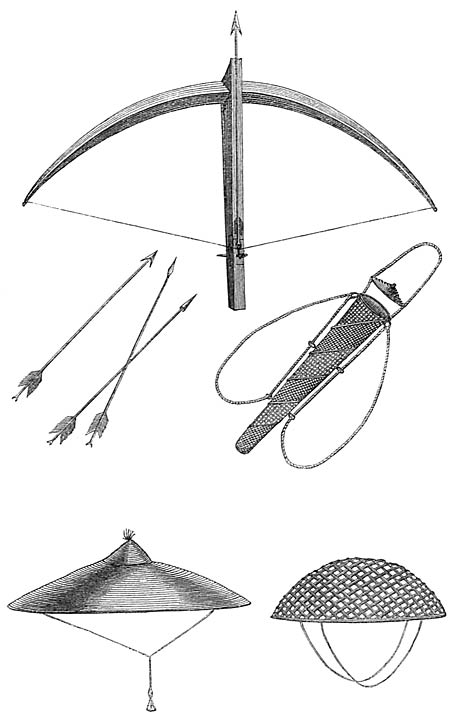
SINGPHOO HAT, HELMET, CROSS-BOW, QUIVER, AND ARROWS.
To face page 59.
Each of the different Singphoo tribes is governed by a chief, designated a Gaum, whose authority over his clan is nearly despotic, and entirely independent of the other chiefs. The general body of clans seldom combine, except for purposes of plunder. Occasionally, however, some chiefs, endowed with superior energy, acquire influence over the rest; and this would appear to have been the case with the Beesa Gaum, when the late Mr. Scott, agent to the Governor-General, entered into a treaty with the Singphoo chiefs. At that time the Beesa Gaum was the most intelligent and influential of the chieftains, and was publicly recognised as the agent through whom the sentiments of the British Government should be made known to the different tribes. In other respects he had no controlling authority, and was regarded by his brother chieftains as merely their equal. On the invasion of Assam by the Burmese, the Singphoos joined the force, and partook of their plunder; in fact, they had no alternative: their only option was to plunder others or to be plundered.
Prior to the conquest of Assam by the British power, the Singphoo tribes had been accustomed to make annual incursions into the province, for the purpose of obtaining slaves and plunder; but on the establishment of a British force at Suddeah, this practice was effectually restrained. From this circumstance arose their dislike to our power, which readily disposes them to listen to any adventurer who holds out to them the prospect of driving us out of the country; for with the reckless and short-sighted policy of barbarians, they never calculate the consequences of a revolt, but think that if the British troops were defeated, and our influence annihilated, all their desires would be accomplished.
The Burmese having been driven from the province, in 1824–25, by our troops, and the Singphoos completely subdued, it became necessary to adopt measures for the establishment of our future intercourse with the latter; and for this purpose, on the 3rd of May, 1826, a treaty was entered into with them, granting them terms they had no reason to expect. The following is a copy of the compact:
“Whereas we, the Singphoo chiefs named Bam, Komjoy, Meejong, Jow, Chowkhen, Jowrah, Chow, Chumun, Neenjun, Tangrang, Chowbal, Chumta, Chowrah, Chowdoo, Chowkam, Koomring, &c., are under the subjection of the British Government. We execute this agreement to Mr. David Scott, the agent to the Governor General, and hereby engage to adhere to the following terms, viz: 1st. Assam being under the sway of the British Government, we and our dependent Singphoos, who were subjects of the Assam state, acknowledge subjection to that Government. We agree not to side with the Burmese, or any other king, nor to commit any aggressions whatever; but we will obey the orders of the British Government.
“2dly. Whenever a British force may march to Assam, to protect it from foreign aggression, we will supply that force with grain, &c.; make and repair roads for it, and execute any order that may be issued to us; and we shall, on our doing so, be protected by that force.
“3rd. If we abide by the terms of this agreement, no tribute shall be paid by us; but if any Assam Paicks, of their own accord, reside in our villages, the tax on such Paicks shall be paid to the British Government.
“4th. We will set at large, or cause to be liberated any Assam people whom we may have seized, and they shall have the option to reside wherever they please.
“5th. If any of the Singphoos rob any of the Assam people residing in our country, we will apprehend the former, and surrender him to the British Government; but if we fail to do so, we will make good the loss thus sustained by the latter.
“6th. We will govern and protect the Singphoos under us, as heretofore, and adjust their differences; and if any boundary dispute occur amongst us, we will not take up arms without the knowledge of the British Government.
“7th. We will adhere to the terms of this agreement, and never depart from them. This agreement shall be binding upon our brothers, sons, nephews and relatives in such way as the Agent to the Governor-General may deem proper. We have executed this agreement in the presence of many. Written at Suddeah, 5th May, 1826, A.D.”
The Singphoo country remained undisturbed until the year 1830, when the invasion of Wakim Koomjoon, from the province of Hookong, on the Burmese side, took place, and was promptly repelled by Captain Neufville. On this occasion, the Luttora and Tengapanee Singphoos took part with the invader, and the Beesa Gaum with the British authorities. The assistance of the Beesa Gaum does not appear to have been of a very active nature, but his conduct was nevertheless approved by the Political Agent, and rewarded by Government. He was, however, shortly afterwards dismissed from the situation of Sunzatee, and Zalim Sing, a Soobadar of the Assam Light Infantry, who had greatly distinguished himself under Captain Neufville, was appointed to the office. Bijee Nath Sing, a Soobadar of the Assam Light Infantry, succeeded him in 1839.
In 1835, the attack of the Duffa Gaum upon the Beesa took place. This compelled the British Government to interfere for his protection, and to avenge the massacre of its subjects; but although the attacking party came from Hookong, the contest was in reality between the Khakoo Singphoos, under the Luttoora chief (who espoused the Duffa’s cause), and the Now Dehing and Booree Dehing Singphoos, on the side of the Beesa; for the Duffa only brought fifty muskets with him and one hundred followers, the remainder of his force being collected within the British boundary.
The feud between the two rival chieftains, the Duffa and the Beesa, arose in 1823 A.D., two years before the assumption of the sovereignty of Assam by the British Government. A Singphoo chief of rank, named Likhee Khandoo, who had lately come over from Hookong, had proposed to the Beesa Gaum that the Singphoos, in conjunction, should attack the Bursenaputty, or chief of the Muttucks. The Beesa chief replied that he would willingly join provided the Duffa Gaum was of the party; the latter was applied to, but refused to engage in the enterprise; nevertheless the attack was made by the Singphoos, but was repulsed with severe loss to them, the Muttucks having received secret information which enabled them to prepare to receive the assailants. The prior intelligence of the attack which the Bursenaputty had received, was ascribed, whether justly or unjustly, to the Duffa chief’s agency. Accordingly, in a spirit of revenge, the remaining Singphoos attacked his house, wounded his wife (who died from the effects of her wounds), and killed some of his people. It is not certain that the Beesa chief was present at this outrage, but as the party went from his house, there can be little doubt of his connivance at the transaction. After this the Duffa chief withdrew into the district of Hookong, under Burmese control; and although repeatedly invited by the British authorities to return and resume his territory, he never could be prevailed on to do so. Nor did he ever make application to obtain redress for the injuries he had sustained from the Beesa chief prior to the conquest of Assam by the British Government, and it was evidently never his intention to apply. Indeed, it would have been incompatible with Singphoo notions of honour that a chieftain should have obtained redress in this manner without retaliating upon his enemy. With this latter view, ever since his retreat from Assam, he had been gradually labouring to extend his influence amongst the Singphoos, across both the Burmese and Assam sides of the boundary line; and possessing the advantage of birth, superior connections, and a reputation for liberality, he at length succeeded in establishing an ascendancy paramount to that of the Beesa chief: which had latterly declined, owing to his connection with the British Government. The Beesa chief, and those dependent upon him, had been compelled to give up the Assamese who returned from slavery in Burmah—a measure extremely repugnant to the Singphoos, dependant as they were upon the Assamese for the means of subsistence.
Matters stood in this position up to July 1835, when the Duffa Gaum, having obtained decided influence, planned an expedition into the Beesa’s territory, and appearing there unexpectedly, surprised and plundered his village, murdered his wife, his son’s wife, and ninety of his people: thus retaliating in a far greater degree the injury he had sustained. On hearing of this outrage, Lieutenant Charlton ordered out a company, and instructed the Soobadar to inform the Duffa Gaum that he must forthwith quit the Assam boundary, and that, on reaching the frontier, any complaint he had to prefer against the Beesa chief would be promptly attended to. The Duffa chief refusing to comply with the mandate, Lieutenant Charlton was obliged to employ force against him; but the troops under Lieutenant Charlton’s command being insufficient for the purpose, three months afterwards (in November 1835) the political agent in person moved to his assistance with two hundred and fifty men of the Assam Light Infantry.
The Duffa Gaum, anticipating an attack, had taken up a strong position in the stockades on the Menaboom hills. Prior to resorting to hostilities, every exertion was made to induce the chief to come to terms, and a three days’ truce was granted for this purpose. The Khamtee chiefs and the Bursenaputtee of Muttuck, who accompanied the political agent as auxiliaries on this occasion, were required to escort the Duffa Gaum to the camp of the Political Agent as a security that his person would be respected, and that he would be permitted to return unmolested should no satisfactory result follow the meeting. The Duffa Gaum, however, being still apprehensive of treachery, could not be prevailed upon to attend the conference, until the Political Agent consented to meet him at a spot one hundred and fifty yards distant from his fort, with an escort of only a havildar and twelve soldiers. The escort having been scrupulously counted, the chief at last came out with a similar number of armed followers. His demeanour was most abject: he and his whole escort sunk down upon their knees, and taking a handful of the earth, he kissed it and said that the Company was Lord and Master thereof. He then proceeded to speak of the injuries he had sustained from the Beesa Gaum. In reply, he was told that he had no reason to complain of the British Government, as he had never represented the conduct of the Beesa chief to any of the functionaries, and that it could not be expected that the Government should take cognizance of acts which had occurred in 1823, prior to its assumption of the sovereignty of Assam. The injuries which the British Government had sustained from him were then recapitulated: the murder of its subjects, the plunder of their property, and the Duffa Gaum’s stubborn persistence in retaining his position in the face of repeated injunctions that he should withdraw from the territory within the Assam boundary. It was further brought to his recollection that the British Government had repeatedly offered him repossession of his territory, provided he came in a peaceable manner, but that it was incompatible with its dignity to allow him to attempt to extort by force that which had been given spontaneously. He was then required, First, to make good, by an annual instalment in money, elephants’ teeth, or gold dust, the loss of 8000 rupees that our merchants had sustained by his treacherous attack on Beesa: furnishing security, or a hostage, for the fulfilment of his engagement; and, Secondly, to dismiss the auxiliary Singphoos whom he had brought from the Burmese territory: and as a security for their not returning he was to give up their arms. The Duffa Gaum agreed to both these propositions, apparently in the most joyful manner, and promised faithfully to come in the following morning; but the next day he sent a letter into camp referring entirely to his ancient dispute with the Beesa chief, and making no allusion whatever to the terms proposed to him. Upon this, the British force took up a position within five hundred yards of his stockade; but the Duffa Gaum’s agent immediately came out and said, that if the Political Agent would advance alone to a place within one hundred and fifty yards of the fort, the chief would come out and accompany him to camp. The Political Agent complied with the request, remained at the appointed spot half an hour at considerable personal risk, and called upon the Duffa Gaum to fulfil to his promise. The answer given was, that the Duffa Gaum had no confidence in the sincerity of the Political Agent, as Wakutchangnang had sent him a flint, powder and ball, the evening before: which was equivalent to an intimation that his intentions were warlike whilst proposing peace. The Agent urged in the strongest manner that no such message had been sent; but finding the Duffa Gaum immovable, hostilities were reluctantly resorted to. A signal was given to the battery, and the fire commenced; the stockade was carried, and the Duffa chief fled beyond the frontier.
Not the slightest doubt was entertained of the individual desire of the Duffa chief for peace; but the Khamtee chiefs, being irritated by certain proposed innovations in 1834—such as taking a census and taxing them—were the first, it is believed, to call in the Duffa chief, with a view of exciting troubles and obstructing the maturity of our plans; and thus was the negotiation marred.
In the year 1838 public tranquillity was again disturbed by a feud between the Peshee and Let chiefs, which compelled the British Government to interfere and punish the former: who, contrary to his agreement, persisted in attacking the latter. The Luttora chief likewise violated his compact, by giving aid to the Peshee chief, and was driven from the Company’s territory.
Though the Tengapanee Singphoos did not arrive in time to join in a body with the Khamtee chiefs, in the attack made on the post of Suddeah in January 1839, their disaffection was apparent in their unprovoked attack upon, and plunder of, the villages in the Saikwah district, when they carried off many Dooaneahs. In consequence of this outrage, a detachment of troops visited in November 1839, the principal villages of Inshaw, Dobom, Inban, Luttora, Koomkie, and Tang Sang Tang; situated at the foot of the Mishmee hills, between the Kerempanee north, and Mena Boom hills south, in the vicinity of the Tengapanee, which takes its rise in the Mena Boom hills south. On this occasion the whole of the chiefs were assembled, and the heinousness of their late conduct explained: fines were imposed in proportion to their means, and their submission and pledges required to an extent never before obtained, besides the restitution of most of the Dooaneahs carried away from Saikwah. The confederacy between the Singphoos and Kamtees was broken up, and the expulsion of the Deerack Tawah Gohain effected, with the loss of his village and a quantity of grain.
In November 1841, considerable alarm pervaded the north-east frontier, owing to a report that the Tippum Rajah, aided by the Burmese and Singphoos from both sides of the border, meditated an incursion into Assam. To remove this impression, a tour was made by the Political Agent with a company of the Assam Light Infantry, a body of Golundaz, and two three pounders carried on elephants, through the greater portion of the Singphoo territory. The route pursued was from Saikwah up the Burrampooter river to the Tengapanee; and on passing the villages of Kinglong, Dohing Koomkee, the principal chiefs, Neesaka of Jusha, Ong of Luttora, Labing of Dobom, Tang Sang Tang, Koomong of Koomkee, and Samnong, son of the Wakhet chief, paid their respects. From thence the party proceeded up the bed of the Tengapanee, by the site of the former village of Luttora, on to Naing and Meerappanee, and commenced the ascent over the Mena Boom hills: a most trying undertaking for elephants, as they had to travel along a narrow ridge in some places only a few paces wide, and entirely composed of loose stones; the sides frequently presenting dangerous precipices. It was in descending this ridge that the laden elephants encountered the greatest difficulty; yet they managed to get down without the necessity of dismounting the guns, and reached Beesa and Ningroo in perfect safety. The Singphoos thus learned the folly of trusting to their stockades in their fastnesses, when guns could be brought against them by moderate exertion and ingenuity. It was hoped that this tour would also tend to repress the feuds so constantly arising amongst themselves; seeing that justice could be administered even in retreats the most secluded and difficult of access. But this expectation was not realized; for in the year 1842 the Tippum Rajah (brother of Jegessur Sing, the last rajah of Assam, said to be now governor of Hookong and Mogong) sent the Beesa chief six pounds of needles, half of which were broken, to be distributed by him amongst the Singphoos: a token or signal of alliance and preparation for war. This intimation was followed up in January 1843 by an attack on a party consisting of one Jemadar, one Havildar, one Naick, and twenty Sipahees located in a small stockade at Beesa. Some previous altercation had occurred between the Jemadar and the Beesa chief regarding the repair of the stockade, which not having been effected, the Jemadar had contemptuously called the Beesa chief an old cow, and in return vengeance was vowed in intelligible terms. After holding out for some days, three Sipahees being killed and three wounded in the defence, the Jemadar was unfortunately induced to surrender himself and party prisoners of war; the treacherous Singphoos having assured him that the posts of Ningroo and Koojoo had fallen into their hands, and our troops been totally defeated. Trusting to their mercy and honour, he caused his men to cease firing; and oaths were freely taken in support of promises of good and honourable treatment; but the instant the Singphoos gained admittance into the stockade, the Jemadar and the whole party were disarmed and bound. The next morning the Jemadar and Havildar were led out by the Singphoos and tied up to a tree, and fired at; after this they were hewn to pieces with a short sword, on the same spot where one of the Singphoos had been shot by the Jemadar when in possession of the stockade. Nine of the Sipahees were sold into slavery, some to Hookong and Burkhamtee. Thus signally did the Singphoos gratify their revenge, at the commencement of the irruption or attempt to break through the line of outposts and lay waste the whole country.
Their second and third attacks on the Koojoo and Ningroo stockades, defended by European officers, were completely frustrated. The Koojoo stockade was besieged for some days, but a sally being made on the enemy whilst the Singphoos were at dinner, they were defeated and fled in the utmost consternation. The Ningroo stockade was likewise at night suddenly attacked and taken by surprise, but after a short, sharp struggle, in which several lives were lost, the Singphoos left the stockade in greater haste than they entered it.
The Tippum Rajah’s sister was married to the late king of Ava, and she is supposed to be in favour with the present king. It may be owing to her influence that the Tippum Rajah is reported to be now Governor of Hookong, to take advantage of any opportunity to invade Assam. Scarcely a year passes without some such reports being spread throughout the province, and there is great reason to believe that the Singphoo insurrection of 1843 was raised at the suggestion, or at least through the connivance of the Rajah; as many Burmese or Shans under his jurisdiction crossed the frontier and joined the insurgents in the hope of plundering the province. Had success attended their first attempts, it cannot be doubted but that many more would have soon followed their example, in the speedy removal of slaves and property from Assam. But the real origin of the insurrection was the occupation of the Koojoo tea garden and other tea tracts. The constant desertion of the Dooaneah slaves and dependants, who are the people chiefly employed in cultivation under the Singphoos, besides the advance of civilization consequent on the establishment of a considerable village at Jeypore with European residents, was the source of much heart-burning. The occupation of Muttuck, formerly under native management, must also have proved distasteful to a savage people possessing a wild country and delighting in extensive hunting-grounds. These circumstances, aggravated by frequent quarrels with the Sipahees at Ningroo, the unauthorized apprehension of two Let Singphoos by the Jemadar, and a desire of revenge for the execution, many years ago, of Ningroola Gaum’s kinsman, certainly contributed to produce the insurrection of 1843.
Viewing the nature of our connection with the Singphoos generally, it must be acknowledged that the balance of advantage had been decidedly in their favour; for while we have been called upon to fight their battles, little or no assistance has, comparatively, been afforded us by them. Being a rude, treacherous people, little faith can be placed in them; neither can we expect they will be influenced or bound by any treaties not in accordance with their own views: in fact they have in no respect fulfilled their obligations to the British Government.
The Singphoo country is eminently unfavourable to the operations of regular troops, owing to its mountainous character, unrelieved by plains or table lands, the want of roads, the extreme scarcity of provisions, the absence of local means of transport, and above all the unhealthiness of the climate. The Government is likewise put to a great expense without commensurate benefit, for in such a rude and barbarous state of society revenue cannot be collected without the employment of military force; and this is not always adequate to the success of hostile operations, because of its paucity and the advantage afforded to the natives by the natural defences of the country: of which they are not slow to avail themselves.
In reviewing the different tribes of Assam, it may not be out of place to offer a brief sketch of one or two of the chieftains.
Wakut-chang-nang is the son of a Singphoo chief who submitted to Captain Neufville in 1825, and received a present of a gun and other articles from him, which he requited by firing upon the captain a day or two afterwards. The ball missed Captain Neufville and went through Lieutenant Kerr’s hat without doing him any injury. Subsequent to this, Wakut-chang-nang absconded to Hookong within the Burmese boundary, and only returned in 1835 to the Assam territory. During his sojourn within the Hookong territory he is stated to have committed several murders; and with the money accumulated by crime and robbery, he has been enabled to marry the Beesa Gaum’s daughter. From his having been the principal agent in breaking off the negotiation with the Duffa chief, and consequently the cause of the subsequent bloodshed, he was imprisoned during 1836–37 at Bishnath. He is now residing at Beesa, and is considered, as heretofore, an intriguing, dangerous character. The Beesa Gaum, having been implicated in the rebellion of 1843, is now a state prisoner for life; he is nearly blind, and his career may be said to have closed, as it is not probable he will survive many years. He was supposed to be a man of good sense and to possess considerable information regarding border politics, but of no enlarged capacity or superior energy of character, and totally incapable of forming those comprehensive designs which have been attributed to him. He is not of a warlike character. Most of his battles have been fought by others: for a Singphoo chief is not expected to head his troops in action. Nevertheless his disposition is sanguinary, and it is said his career has been marked by blood and treachery in a greater degree than usual, even amongst the Singphoos.
The Shan is the written character used by the Singphoos, and their language is distinct from any of the neighbouring tribes: they write on leaves and a peculiar kind of paper. As yet no European has sufficiently studied the language to appreciate justly the Singphoo literature, or to prepare elementary works for the guidance of others. Nor are we aware of there being any written works in the language either historical or theological. As civil members of society they are anything but good subjects, from their excessive laziness, immoderate addiction to opium, and general uncertainty of character. They are so indolent and improvident, that notwithstanding they have the most fertile soil in Assam, which yields fruit with little labour, and might be made to produce an abundant crop—notwithstanding, too, their freedom from taxation, grain is always so extravagantly dear, that during several months in the year the people are reduced to subsist on yams and other roots found in the jungles. Almost the whole of the field work is performed by the women and slaves, while the men delight in lounging about the villages, and basking in the sun, when not engaged in hunting or war.
The religion of the Singphoos appears to be a mixture of all the various idolatries and superstitions of the natives with whom they have intercourse. They seem to have no fixed principles common to the whole tribe. Their ostensible worship is that of Guduma, whose temples and priests are to be found in all their principal villages. They are also in the habit of deifying any Singphoos who may chance to be killed in action during a foray upon some other tribe or village, and of sacrificing to them as to their penates. On emergencies, such as famine, pestilence, or danger, they make offerings to the “Ning Deota,” God of the Elements, called also “Ningschees;” sacrificing buffaloes, hogs, and cocks. The skulls of the buffaloes so offered are afterwards hung up in their houses as mementos of their own piety.
Their funeral ceremonies are simple. The poorer classes burn or bury the body, according to the previously expressed wish of the deceased, and invariably make to the deity an offering of a pig, fowl, or fish, through their Deodhies or priests. On the death of a chief, numerous ceremonies are performed: the body is detained until all the friends of the deceased can be assembled, when buffaloes, pigs, and deer are sacrificed, a grand feast is given, and spirituous liquor distributed to the company. The corpse is then committed to the earth, the priest chants a prayer for the deceased, a clay tomb is raised over the remains, and the grave is encircled with a bamboo fence. Sacrifices are always offered up on the death of every Singphoo, according to the means of the surviving relatives; no matter whether death be caused by accident or war, or in the course of nature.
Polygamy, without restriction, prevails among the Singphoos, and they make no distinction between the children born of Singphoo women and those born of foreign or Assamese women. They reject with horror the idea of infanticide, under any shape or pretext. Marriage is only forbidden with a mother or sister: they may marry stepmothers, brothers’ widows, or any other relative. In the marriage ceremony the bridegroom has to present the parents of the bride with a Khamtee Dhao, or short sword, a velvet jacket, a silk Dhota, and a slave; the rich give gold and silver, buffaloes, and as many slaves as the wealth of the bridegroom will permit. The bridegroom has also to furnish a marriage feast to the friends and relations of the bride; and after the Deodhies or priests have performed a certain religious ceremony, the bride is delivered over to the bridegroom, and the jewels, &c., which are on her person, are returned to her parents.
If a man commits adultery, he is obliged to pay damages according to the demand of the injured husband, in slaves, buffaloes, dhoties, swords, money, or beads; and if he cannot pay the damages, he pays the penalty of his crime in confinement. No damages are demanded for the violation of an unmarried woman or virgin; but in the event of her being found pregnant, the ravisher has to give the parents three slaves and one buffalo, and the issue is claimed by the man. It is optional with himself to marry his victim, or not. Theft is punished by exacting from the thief double the value of the property stolen.
The Singphoos entertain strange ideas of honour and revenge. Compatibly with their customs and rude notions of religion, a Singphoo chief could not ever abandon, without dishonour, the application of the lex talionis to one who had murdered his relative; although, from circumstances of policy, or deficiency of means, he might postpone the gratification of his vengeance to an indefinite period. A mistaken feeling of religion, combined with private affection for the deceased, fully accounts for this perverted state of mind. The Singphoos imagine that the soul of the murdered individual will torment them until his manes are appeased by the death of one of his enemies; and further, that the anger of their deity would be roused should an opportunity of retaliation be neglected. Nor is the retribution to be limited to the actual perpetrator of the homicide. If death be occasioned by violence committed, or supposed to be committed by any one, the relations are never appeased until they have murdered one of the family to which the murderer belonged. An innocent person is thus often murdered, who is quite ignorant of the injury committed by his tribe or family.
The houses of the Singphoos are generally nothing but long sheds, roofed in with grass or bamboo leaves, and the walls composed of split bamboo. The floor of the dwelling part is raised about four feet from the ground; and the entrance forms an extensive porch, in which are congregated pigs, fowls, household and agricultural implements, and where women may generally be seen pounding rice. These buildings are sometimes one hundred feet long, and divided into compartments allotted to several families. Occasionally immense houses may be seen, which are occupied by powerful chiefs; the timbers of these buildings being of such enormous size and length as to render it a matter of surprise that they could have been erected by mere manual labour. At the burning of the Ningrang chief’s house, when the village was surprised by our troops in 1843, the officers remarked that the posts were of prodigious diameter and length; and it was regretted that war rendered it necessary to destroy such a magnificent residence. The mansion was entered by a flight of several steps leading up to the floor, and was divided into numerous rooms by partitions of split bamboo.
The Singphoos have nothing approaching to what we call government: each chief is independent, collecting no revenue, nor directing in person any force, although he may influence the movements of others. The Singphoos are of a tawny complexion, and a cunning expression, with long bodies and short legs. They are implacable, cruel, and treacherous; stealing upon and murdering with the short sword at night those who have offended or injured them; and are ever ready to coalesce for a foray, if there is a prospect of success. Casualties that occur from the contentions of one tribe with another, murders resulting from private jealousy, the difficulty of procuring food, and exposure to the inclemency of the weather, help to keep the population scanty all over the north-east frontier. In fact, the great cause of the thinness of the population is the want of food, arising from the absence of productive industry. The unsettled and lawless state of society among the Burmese and Singphoos appears likewise to operate in retarding the extension of trade; and this evil cannot be rectified until these tribes are brought more completely under subjection to the British Government. That once effected, a mart might be formed at our extreme boundary; though the scantiness of the population in these regions would probably for some time prevent the establishment of a very brisk trade.
Hookoom is distant from Suddeah about 200 miles; a miserable, desolate, backward country intervening: in fact, almost an entire jungle throughout. At Moonkoom there would be a larger field for commerce, as water communication by the Irawaddy is facile. Broad cloths, &c., could probably be conveyed thither cheaper, viâ Rangoon, than from the Burrampooter. The same obstacles exist to opening a trade between Assam and the provinces of Yunan, owing to the greater proximity of Yunan to the Burmese empire. By all accounts a considerable trade is carried on between the two countries, viâ Bamow: a Burmese town within twenty miles of the confines of Yunan; and from the facility of transport which the Irawaddy affords, we may infer that British goods could be supplied at a cheaper rate, and with greater safety, from Rangoon or from Moulmein through the Sangha, than could be effected from Assam. The poverty of the people on this part of our frontier is such that scarcely any one can afford to buy woollens, excepting the chiefs, and even those persons generally receive them as presents from the officers of Government. It would therefore be desirable to send up articles of less value. The articles chiefly in demand are salt, cloths, tobacco, opium, knives, needles, cups and saucers, basons and plates.
In 1828, by way of experiment, and to test the possibility of reviving trade, a Government investment of woollen goods to the amount of 4000 rupees, was sent up to Suddeah; but it actually took eight years before the whole stock was sold off, and it would not then, probably, have been disposed of, had not the price been reduced thirty per cent. below prime cost. It was sold during the first and second years of its appearance in the market, at prime cost; afterwards at a reduction of ten, twenty, and thirty per cent. Since then, a trade, such as it is, has been established at Suddeah by native merchants, at considerable risk; for the Government will not undertake to give compensation for any losses the traders may sustain, either from sudden attacks, or in their transactions with these wild tribes. Notwithstanding the apparently hopeless prospect of any immediate commercial intercourse taking place between Assam and any portion of western China, there can be no doubt that as civilization advances, the intervening tracts will be traversed, and a lucrative trade may then connect districts now separated by dense forests.
It remains only to mention that, some difference of opinion existing as to the boundary line between Assam and the Burmese territory, it was deemed expedient to define the limits of both countries by a special mission to the disputed point; and for this purpose, in 1837, Dr. Bayfield was deputed to proceed from Ava and join the Burmese Governor of Mogaum, and in the presence of Major White, Political Agent of Upper Assam, to settle the question. Major White, accompanied by Dr. Griffiths, Captain Hannay, and Lieut. Bigge, and the neighbouring native chiefs, with ninety followers, accordingly set out from Namroop Pathar, on the 19th February; and on the 25th of the same month they reached Yaoung Sang Nullah, on the north face of the Patkoe boundary, or range, where the Burmese governor had agreed that the conference should take place.
In this dreary wilderness of hills and jungle, the impossibility of obtaining an adequate supply of provisions for ninety persons (the commissariat being carried from the plains of Assam) presented an insuperable obstacle to the prolonged stay of the party with Major White. Having therefore waited till the 5th March, daily expecting the arrival of the Burmese Governor and Dr. Bayfield; and the whole of their provisions being consumed, with the exception of a bare sufficiency for the wants of the party on their return, the Major was constrained to retrace his steps to Suddeah. Captain Hannay, however, pushed on unencumbered, in company with Dr. Griffiths (deputed for scientific purposes to Ava), hoping to meet the Burmese Governor and accomplish the object of the mission: which he did.
On the 9th March, Captain Hannay and Dr. Bayfield pointed out to the Burmese Governor of Mogaum the boundary line on the summit of the Patkoe Mountains, and read to him an extract of the treaty between the Rajahs of Mogaum and Assam, establishing the boundary in 1323, A.S., or 1402, A.D. The purport of this extract was that, in the year 1145, A.S., equivalent to 1224 of the Christian era, Sookhapah, the founder of the Ahoom Dynasty, having taken his departure from Moonkhoom, invaded Assam; and, taking possession of the country on the other side of the Patkoe range, he established Khanjang, or Nunyangpanee, as the boundary: appointing the Bor Gohain to the government of the district, and directing that the customary tribute should be remitted to him in Assam. This settlement continued until the year 1323, equivalent to 1402, A.D., during the reign of Soodangpha, the eighth Rajah of the Ahoon dynasty; when a brother of his, named Towsoolie, having quarrelled with him, went to Moonkhoom and instigated the Rajah to invade Assam. The attack being, however, repulsed, an accommodation afterwards took place between the two Rajahs, and the Patkoe range of hills was established as the boundary. On this occasion a stone image was put up to indicate the limits; and both the Rajahs, dipping their hands in the water, vowed personal friendship, and swore reciprocally to respect each other’s territory. This compact remained unviolated for a period of 400 years up to the period when the Burmese invaded Assam.
MUTTUCKS.
The Muttucks were originally a rude tribe settled in a district called Mooran or Muttuck, who prior to the Ahoom invasion of 1224, A.D., had learned the doctrines of the Hindoo religion from two Gosains named respectively Madho Deo, and Sunkur Deo. The Gosains were followers of Krishen, and their doctrine particularly differed from that of the other Hindoos of Assam, in their refusing to worship the images of Doorga. The appellation of Moa Mureyas arose from its being the name of the place where a Shuster was founded, and from which the doctrines of the Muttucks emanated. They were allowed to exercise their religion unmolested, until the reign of Seba Sing, between 1714 and 1744, A.D.; when, animated by a spirit of sectarian zeal, the Queen, Phoolsuree, inflicted a sore wound upon their religious feelings by compelling them to worship the images of Doorga, and to put the distinguishing marks of the followers of that deity on their foreheads. But persecution, as usual, failed in checking this sectarian spirit; and the numbers of the Muttucks having greatly increased in the reign of Luckmi Sing, 1769, A.D., they revolted from his authority. The immediate cause of the first insurrection is attributable to two circumstances,—a bigoted religious persecution, and a haughty, inconsiderate, oppressive demeanour towards the Muttuck chiefs, and their adherents.
Soon after the succession of Luckmi Sing to the throne of his brother, Rajeswur Sing, Rajhan Mooran, a Muttuck chief, was commissioned to procure a thousand elephants for Luckmi Sing, who was a great admirer of these animals. The chief obeyed, and from time to time he presented many elephants to the king. On one occasion, having been unusually fortunate in capturing two hundred and fifty elephants, he took them to the capital to show them to his Majesty; but as it was customary to apprize the Bor Borowa of his intended visit, that the circumstance might be previously announced to the King, he was proceeding to the residence of that functionary, when he met the Bor Borowa’s son going on business to the King. Unfortunately he was persuaded to accompany the young man, unmindful of the indiscretion of deviating from the established rules of respect and courtesy to the Bor Borowa.
On Rajhan’s arrival at the palace, the King ordered his servants to prepare to attend him during the inspection of the elephants. The Bor Borowa being obliged to be present on all such occasions, and hearing that Rajhan Mooran had ventured to approach the Rajah without the usual formality of an introduction, determined to wreak his vengeance on the insolent Muttuck. Luckmi Sing inspected the elephants, and was highly pleased with Rajhan Mooran’s promptitude and assiduity in the execution of his orders. He warmly expressed his royal approbation of the conduct of the chief, and, handsomely rewarding him, retired to the palace.
The Bor Borowa now took the opportunity of sending for Rajhan Mooran to learn his reasons for not having apprized him of his arrival before he had sought an interview with the king. The excuse pleaded by Rajhan Mooran was unheeded; the Bor Borowa was implacable, and directed the infliction of a severe corporal punishment with the cane. So strictly was this order executed, that Rajhan Mooran was cast into the road in a lifeless state. Here he was recognised by his countrymen, and conveyed away; and with good treatment, but not without difficulty, he recovered.
The Moa Mureya Gosain Ushtobhoj, commiserating the ill-treatment Rajhan Mooran had met with, resolved, a short time afterwards, on visiting the Rajah to obtain reparation. He accordingly set out with his Bhukuts, or religious disciples, and meeting the Rajah’s fleet on the river, he paid his respects to the Rajah, contrary to the wishes of the Bor Borowa Keerteerchund, Prime Minister. This conduct greatly incensed the Bor Borowa, who immediately sent for the Gosain and treated him with great harshness and abuse, for the temerity he had evinced in presuming to visit the Rajah without being announced by himself. The Bhukuts who had accompanied him to the interview were likewise ill-treated. This indignity highly offended the Gosain, and he determined to take an early opportunity of retaliating the outrage. With this view, he took measures for ascertaining the number of disciples and adherents he might rely on, and found, to his satisfaction, that the census returned one hundred thousand persons.
The feelings of the Muttucks being now exasperated to the highest degree by the degradations and insults to which they were subjected by the Assam nobles; the present appeared to them a fitting opportunity to rise and avenge their wrongs. The Bor Deka, son of the Muttuck Gosain, having long entertained ambitious views, encouraged Rajhan Mooran to assemble all the Muttuck chiefs and followers willing to co-operate with them; expressing his belief that with their united forces, success would attend their efforts. In the mean time he remained quiet, the better to conceal his designs, and commenced building a large mound near Jorehath, on which he intimated his intention to found a Shuster, to be denominated the Bor Bhatee. Each man who was willing to join in the insurrection was enjoined to bring in one hand a lump of earth and in the other a reed. By this device the Bor Deka’s designs passed unobserved, and a multitude of followers were ascertained to be ripe for the approaching contest.
Mohun Bor Jona Gohain, eldest brother of Luckmi Sing, being marked with the smallpox, and a slit in the ear, was, by the Assamese customs, disqualified from ascending the throne. Notwithstanding this, however, with a view of concealing their real designs, the Muttucks proposed to the prince to join the insurrectionary force; promising to place him on the throne in the event of the success of the insurrection. Tempted by the promise, the prince joined the rebels, who immediately marched towards the capital at Rungpore, on the banks of the Dikho river. Luckme Sing having been informed of the movement, ordered the Assam chiefs to proceed and punish the insolent Muttucks, and bring him the ringleaders of the insurrection. The rival forces met near the Thowra Dole Temple, on the banks of the Dehing river, and after a slight skirmish, in which their commander, the Doabyah Phokun, was killed, the Assamese were defeated, and fled. Bhectorial Phokun then succeeded to the command, and perceiving that Mohun Bor Jona Gohain, the elder brother of the reigning king was at the head of the rebel force, not only refused to oppose the prince and the invaders, but went and paid homage to the Gosain. The Muttucks, thus meeting with no opposition, marched in and took possession of the capital; and with such promptitude that Rajah Luckme Sing and all his court were taken prisoners. Luckme Sing was then incarcerated and harshly treated: food scarcely sufficient for his subsistence being allowed him. The Bor Borowa Keerteerchund was seized and put to death, with all his family, relations, and friends; and many nobles also shared the same fate.
Ramakant Bor Deka now took possession of the throne, and Rajhan Mooran became Bor Borowa; while the prince, Bor Jona Gohain, who thus traitorously acted against his family and country, was put off with the plea that he was incapacitated to reign as king by reason of the personal mutilation already adverted to.
The conspirators, having successfully carried through their plot against Rajhan Mooran and the principal Muttuck chief, proceeded to the residence of the Bor Deka Ramakant, the usurper; his father, brothers, women, and children, were, with all the principal parties, captured; but Ramakant, on hearing of the death of Rajhan Mooran, had made his escape from the capital. He was, however, seized near Bet-barree and brought back to pay the forfeit of his ambition and rebellion. Luckme Sing was immediately released from imprisonment and again placed on his throne. The first order issued by the king after his restoration, was for the extermination of the Muttucks. The usurper Ramakant Bor Deka, and his brother Chunder Deka, as well as the Muttuck Gosain their father, were tied to the legs of fierce, newly caught elephants, and ignominiously dragged round the city, assailed with mud and filth and every kind of indignity that an infuriated, relentless mob, intoxicated with triumph, could inflict; and to close the scene they suffered the cruel and disgraceful death of impalement. The Muttuck chiefs and their followers were everywhere hunted down like wild beasts, and put to death: neither men, women, nor children were spared. In fact, such was the animosity of the Assamese against the Muttucks, for the time, that they seemed bereft of all feelings of mercy or compassion. Vast numbers of the Muttucks died of hunger in the jungles, and an incalculable number perished by the sword of the insatiate populace.
Luckme Sing, being now under no farther apprehensions for the safety of himself or throne, richly rewarded the actors in the late tragedy with rank and wealth: and thus terminated the first rebellion of the Muttucks.
In 1784 the Moa Mareyas again rebelled, and having expelled the Rajah Goureenath they proceeded to place two others upon the Guddee, or throne, one named Bhurt Sing as Rajah of Rungpore or Upper Assam, the other Surbamend (the father of Malebar Bursenaputtee, who died in 1839) as Rajah of Mooran or Muttuck. Both these chiefs marked their rule by establishing a mint, and some of their coins are to be met with at the present day. Being driven from Upper Assam, the Rajah Goureenath solicited the aid of the British Government; and his request being acceded to, Captain Welsh was sent with one or two battalions, in 1794, A.D. Having taken Rungpore, Goureenath was replaced on the Guddee; but Captain Welsh did not penetrate into the Muttuck country. The next Rajah, Kumalepur, raised two corps of Hindoostanees, armed and disciplined in the English fashion, and ordered them to undertake the conquest of Muttuck; but although successful in some degree, they were unable to obtain permanent possession, owing to the harassing mode of warfare pursued by the Bursenaputtee, who retired to his fastnesses. However, the struggle was at length terminated by his agreeing to pay an annual tribute in the shape of elephants, Moongah silk, &c. It is asserted by the Assamese at Rungpore and Jorehath that, at this period, the Bursenaputtee agreed to pay a tribute of 10,000 rupees; but that chief positively denied this to the Political Agent, and it is believed there is no record in existence of such a sum, or even part of it, being paid: though the acknowledgment of the Rajah of Assam is undeniable. As regards the Muttucks, the statements of the people connected with the late Court of Assam, and the followers of Doorga throughout the province, ought to be received with a great deal of caution; for both classes are animated by a bitter spirit of hatred, occasioned by the twofold conquest and plunder of their capital; and the temporary triumph of a rival sectarian party still rankles in their minds.
It is difficult to ascertain what was the precise status of the Bursenaputtee in the distracted reigns of Chunderkant and Poorunder Sing. It is said that the usual tribute was paid, but this is denied by the other party; we presume, therefore, that in these weak and divided times the Muttucks were nearly independent. When the Burmese invaded the country, the Bursenaputtee, at their requisition, afforded them supplies in labour and provisions, but no aid in troops or money; and they, therefore, made no attempt to seize his possessions. On the conquest of Assam by the British Government, the Bursenaputtee acknowledged its supremacy, and bound himself to obey its orders; he further engaged to supply three hundred soldiers in time of war, no tribute having been demanded of him. The interior management of his territory was left in his own hands, excepting as regarded cases of murder and other capital offences, which were to be made over for trial to the Agent of the Governor-General or Political Agent in Upper Assam. This arrangement had evidently in view the impressing a rude people with a greater regard for human life, which the more rigid investigation and sanctity of British forms of justice might be expected to create. This state of things subsisted until January 1835, when, under the instructions of the Agent to the Governor-General, the obligation to supply troops was commuted into an annual payment of 1800 rupees. No census has been taken of the population, but from the best information it is estimated at sixty thousand or seventy thousand persons. It yields a revenue of 20,000 rupees per annum.
In his personal manners the late Bursenaputtee Malebur was plain and straightforward, and accustomed to think and act for himself. In his political character, his fidelity was much doubted a few years back, but he was always found ready to answer every call; as evinced in the expedition against the Duffa Guam in 1835, and the Singphoo Luttora chief in 1838, which proved that he was faithful to his engagement. But his communications with British officers were not always carried on in the smoothest manner. Accustomed to act as an independent chief for forty or fifty years, and his territory being unoccupied by troops, either Burmese or British, he was naturally independent and blunt in his manners; which bearing, combining with the testiness of age and dislike of innovation natural to that period of life, occasionally gave rise to improprieties of expression and seeming acts of disobedience. He departed this life in January 1839, leaving ten sons, five daughters, and three widows; and, pending the final orders of Government, Muttuck was placed under Bhageerut Majoo Gohain, the second son of the late chief: the Bor Gohain, or eldest son, having waved his claim of birth in compliance with the wishes of his father.
On the 4th of August 1839, the Political Agent was directed to confer on the Majoo Gohain the title of Bursenaputtee, and the management of Lower Muttuck, on his agreeing to the conditions offered for his acceptance. These were based on the settlement entered into with his late father, but a new census was required to determine the amount of tribute to be paid. These terms also withheld Upper Muttuck, until an amicable understanding could be come to between the chiefs of that part of the country; who, with their spiritual head, the Tiphook Muhunt, were averse to the rule of the family of the late chief. This party being only 1000, or 1500, out of a population of 60,000, it seemed hard to sever them from the jurisdiction of the Bursenaputtee, without any specific acts of oppression having been committed by the late chief or his family. The real objection rested on religious grounds: they are the disciples of a Gosain or priest professing different religious tenets from those of the Bursenaputtee’s family; consequently they preferred a ruler of their own persuasion, although they had not experienced any persecution from the late Bursenaputtee.
In November 1839, the Political Agent arrived at Rungagora, the capital of Muttuck, and having assembled the principal members of the late chief’s family, and head men of the district, made known to them the resolution of Government. The Majoo Gohain Bhagerut and his brothers, finding that Upper Muttuck was not at once to be included in the settlement, peremptorily refused to accept of the management of the country; the whole of Muttuck was therefore annexed to the district of Luckimpoor, and pensions in money and land, to the amount of 7637 rupees per annum, were granted for the support of the members of the late chief’s family.
Thus terminated the independence of the Muttucks, a rude, fanatical, stiff-necked people. Accustomed to a very slight assessment, tendered to their chief in the shape of presents for settling their disputes, and exercising a considerable share in their own government, it was feared they would not readily submit to the heavier rate of taxation for the purposes of good government under British rule; but these apprehensions, it seems, were unfounded, since, for the last four years, no resort to force has been found necessary to compel taxation, or to further any other measures for their general welfare.
Husbandry is the chief occupation of the Muttucks; and their district possessing a fine fertile soil and abounding in extensive rice plains, intersected by large tracts of tree and grass jungle, expectations are entertained that, in the course of time, this country will prove a prosperous and valuable acquisition; if improvements are not impeded by the inroads of border tribes. Two corps of local Assam Light Infantry, and a company of local Artillery are ever vigilantly occupied in promptly suppressing combinations or insurrections raised with a view to the acquisition of plunder and slaves from our subjects; and there is, therefore, little fear of any organized obstruction to improvement.
The tea plant is indigenous in Muttuck, and the Assam Tea Company have cultivated many gardens, greatly to the benefit of Upper Assam; and if the company steadily prosecute the speculation, thousands of labourers will, in the course of time, resort thither for employment, and become permanent settlers. Tea, it is believed, may be grown in sufficient quantity to supply the English market, and afford a handsome remuneration to the speculators. An inconsiderate expenditure of capital placed the Assam Tea Company in great jeopardy, and at one time it was feared the scheme would be abandoned. The number of managers and assistants appointed by the Assam Company to carry on their affairs, and superintend their tea gardens on large salaries, was quite unnecessary: one or two experienced European superintendents to direct the native establishment would have answered every purpose. A vast number of Coolies (or labourers) were induced to proceed to Upper Assam, on high wages, to cultivate the gardens; but bad arrangements having been made to supply them with proper wholesome food, many were seized with sickness. On their arrival at the tea-plantations, in the midst of high and dense tree jungle, numbers absconded, and others met an untimely end. The rice served out to the Coolies from the Assam Tea Company’s store rooms, was so bad as not to be fit to be given to elephants, much less to human beings. The loss of these labourers, who had been conveyed to Upper Assam at a great expense, deprived the company of the means of cultivating so great an extent of country as would otherwise have been ensured; for the scanty population of Upper Assam offered no means of replacing the deficiency of hands. Another importation of labourers seems desirable, to facilitate and accomplish an undertaking formed under most auspicious circumstances. Nor was the improvidence of the Company in respect to labourers the only instance of their mismanagement. Although the Company must have known that they had no real use or necessity for a steamer, a huge vessel was nevertheless purchased, and frequently sent up and down the Burrampooter river from Calcutta; carrying little else than a few thousand rupees for the payment of their establishment in Upper Assam, which might have been transmitted through native bankers, and have saved the Company a most lavish and unprofitable expenditure of capital.
It is generally understood that too little attention had been paid to the advice of Major Jenkins, the Governor-General’s Agent; or more vigilant supervision, better economy, and greater success might not unreasonably have been expected. The cultivation of tea in Assam, with a view of supplying the English market, was, it must be admitted, first contemplated by Major Jenkins; and for his exertions in having been the main cause of the Assam plant being proved to be the genuine tea of China, the Agricultural Society of Calcutta presented him with a gold medal; but the Assam tea was first discovered by Mr. Bruce in 1826, A.D.
The tea of Assam is now becoming better known in the English market, and its quality more generally appreciated; and as the chief difficulties have been surmounted, every well-wisher of England and India must hope the directors will, in future, pursue a more scrutinizing and economical course: extending the cultivation of tea, and thereby, while enhancing the profits derivable from the concern, contribute to render England independent of China as far as tea is concerned. If Assam tea can be grown equal to the produce of China, there is little doubt but that, at the rate of one and sixpence the pound, a remunerating profit will accrue to the Company: a handsome, but not a too ample compensation for an enterprise involving such highly important considerations.
The first of these three classes reside on the loftiest and most remote mountains north of the valley of Assam. The second class on a lower range, and the third at the foot of, or on the plains immediately leading up to, the hills. Several parties of Abors visited me frequently at Saikwah to barter a few fowls, eggs, ginger, chillies, yams, &c., for salt, and other necessaries of life. They appear to be descendants of the Tartar race; and are large, uncouth, athletic, fierce-looking, dirty fellows. The hair of the women is cut short, like that of the men: in a circle round the crown of the head it is two inches long, but the hair in front and behind, below the upper circle, is only about half an inch long. The ears of the men and women are perforated, the aperture, one inch in diameter, being distended by a piece of wood, worn as an ornament; and the necks of the Abor women are loaded with innumerable glass bead necklaces of all colours. Their arms are likewise adorned, from the wrist to the elbow with brass rings; the legs are exposed from the knee downwards, the calf of the leg being bandaged with cane rings to the ankle. The Abors are feared and respected by all the neighbouring tribes for their martial spirit; nevertheless they are in great dread of the highland or Bor Abors, who are said to be as brave as they are savage. Like all the hill tribes of Assam, the Abors are void of beards: invariably plucking them, and leaving only scanty moustaches. They can neither read nor write, and their language sounds extremely harsh. The dress of the Abor chiefs consists of Thibetian woollen cloaks, and a simple piece of cotton cloth, about a foot square, which is passed between the legs and suspended by a string round the waist: but not so effectually as to screen their persons from exposure every time they sit down. Of delicacy, however, the Abors are as void as they are of cleanliness. They wear three kinds of helmets, one of plain cane, and others trimmed with an edging of bear’s skin, or covered with a thick yellow skin of a species of deer. A more formidable looking covering for the head could scarcely be worn.
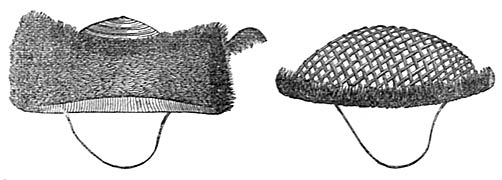
Abor Cane Helmets.
In December, 1835, an Abor chief, with two hundred followers, descended from the hills, and begged permission to locate on the Dehing, within a day’s journey of Suddeah. The Political Agent asked the chief whether he was aware that the land in that quarter was within the Company’s jurisdiction, and that settlers necessarily became subject to our police administration? He replied he was aware of that, and would readily give up any of his people guilty of criminal offences, but demurred to the introduction of our police officers for the apprehension of offenders. He was then asked whether he and his people would agree to pay taxes? His answer was that they had never been accustomed to do so, and could not submit to it.
From various reports, the Abors are deemed a very rude, barbarous people, but of open manners and warlike habits; their bluntness of expression is more manly and pleasing than the base servility and sycophancy of the Assamese. As they have been accustomed to levy contributions from the inhabitants of Seesee, and other districts in Assam, they would be dangerous neighbours, if located in the immediate vicinity of the Suddeah people.
Not acceding to the terms on which we were disposed to acquiesce in their application, the Abors returned to their hills. Scarcity of the means of subsistence was, it is supposed, the cause of their visit; and they evidently meditated replacing the Merees, who formerly laboured for the Abors on the Dehong quarter, but have since emigrated to Upper and Lower Assam, to escape the exactions of that tribe.
It appears that the Abors are not allowed to emigrate to Assam; for in 1844 two young men having eloped with two damsels to Saikwah, and the latter claiming protection from the British authorities, an inquiry was made as to the cause of their deserting their own country; when one freely confessed that her father had given her in marriage to an old man, but preferring a young Abor, she had determined on living with him in the Company’s territory and disobeying her father’s commands. The other stated that she had been given in marriage to a young man, who died, and she was retained for his younger brother, a mere boy; but not being disposed to wait until he had reached the age of puberty, she had fallen in love with an Abor youth, and trusted they might be permitted to pass their days in peace in the forests adjoining Saikwah. If their prayer was not granted, the girls affirmed, in the most earnest manner, that they should be tortured and sold to another tribe; while their young husbands would be cast into the Dehong river with their hands bound, to suffer death by drowning.
To the present day, little is known of the Abor country, Europeans never having been permitted to penetrate any very great distance into the interior. The eminent astronomer and adventurous traveller, Lieutenant Wilcox, in 1827, endeavoured to ascend the Dehong river, with the view of proving that this stream was the celebrated Sampoo river; but after a few days’ journey he met with insuperable difficulties, from the rapidity of the current, the closeness of the country, and the absolute prohibition of the Abors against his proceeding farther. Since that period, no strenuous endeavours have been made to acquire further information regarding these rude barbarians. The Merees speak the Abor language, and a friendly intercourse exists between the tribes; though the Merees have ceased to bear the yoke of slavery or be subordinate to the Abors. Their chief occupation is husbandry, and they are generally considered a quiet and tolerably industrious race.
MISHMEES.
The Mishmee tribe reside in the hills on the north-east extremity of the valley of Assam. They are divided into several distinct clans. The Dibong Mishmees are called Chool Kutta or Crop-haired, and the others are known by the appellation of Tains and Mezhoos. They are a very wild, roaming race of people, constantly engaged in petty wars amongst themselves and their neighbours, the Abors and Singphoos, when the most remorseless reprisals and massacres are committed. They have no written language, and appear to belong to the Tartar race. They are of diminutive stature, but stout, active, and hardy; very dirty in their persons, and little encumbered with clothing. The chiefs wear the coarse red coloured woollens of Thibet, and the dress of the lower orders is extremely scanty. The women, however, are more decently attired; wearing a striped or coloured petticoat, or cloth folded round the waist, extending to the knees, and a kind of jacket or bodice, with a profusion of necklaces of several pounds weight, composed of porcelain, glass, and pieces of cornelian. The hair is bound up in a knot on the crown of the head, with a thin band of silver passing round the forehead. The lobe of the ears is hideously distended to an inch in diameter, to admit of the silver ear-ring being inserted: this mutilation of the ear evidently having been gradually effected from early youth. The Mishmees are not restricted in their number of wives; each man taking as many as he can afford to support. A curious custom is said to prevail as a preventive to the constant bickerings and jealousies natural to this system; each wife either has a separate house or store room, or she lives with her relations.
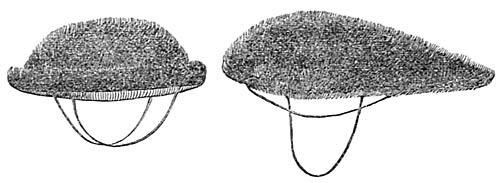
Mishmee Dog-skin Caps.
The Mishmees, women and children, as well as men, are inordinately fond of smoking; and use a roughly-made Singphoo bamboo pipe, or a brass China-made bowl, with a bamboo tube. A bag made of monkey’s skin is suspended from a belt for the express purpose of carrying the tobacco pipe, flint and steel, with a leather case containing tinder. The men wear a long, straight sword, of China manufacture, ornamented with a tuft of coloured hair; and a lance, manufactured by themselves, is constantly carried. They also use the cross-bow and poisoned arrows. Their head dresses are composed of dog skin, fastened under the chin by strings. Like all savages, they are superstitious; invoking an unknown spirit supposed to reside in the inaccessible mountains or dense forests; and on being afflicted by famine, sickness, or other misfortunes, they invariably sacrifice fowls and pigs, that the evil may be removed, and the wrath of the invisible spirit appeased by their offerings and submission. We are led to believe that the authority of the chiefs, though respected, is not absolute: they are obliged to abide by the decisions of the people, duly assembled for the purpose of settling disputes and arranging the amount of amercements to be imposed for offences committed. For all heinous crimes remission is said to be procurable by the liquidation of a fine; but adultery, if the husband be not privy to the offence, is punished by death, which is inflicted by the people purposely assembled for the trial.
The Mishmees, like the Abors, are most skilful in the construction of cane bridges; which they throw across rivers of eighty yards breadth. Three large cane ropes are sufficient to pass a person over in safety; but the transit, to any but a Mishmee, would be impracticable: for few would hazard the risk of falling into a rapid river below, or of being suspended midway on these ropes, unable to retire or advance. Accidents, however, rarely occur, and the Mishmees cross over their rivers in this manner without difficulty or apprehension.
In the year 1836, it was said that the Mezhoo and Tain, or Digaroo Mishmees had a serious quarrel about a marriage: for though at enmity often times with each other, and speaking a different dialect, they have not been debarred from intermarrying. Blows having been exchanged, the Mezhoo chief Rooling determined on speedily overcoming his enemies by an overwhelming force, and for this purpose he invited the Lamas to come to his assistance; which they did, and entered the Mishmee country with a force of seventy men, armed with matchlocks. The Tain Mishmees were totally defeated by the Lamas and Mezhoo Mishmees, and lost about twenty men. After this success, the Lamas returned to their own country about September 1836, and from that day we have had no similar invasion of this portion of Assam in favour of the Mezhoo Mishmees. No precise information is obtainable as to where these hostile operations occurred; but the conflict evidently took place several days’ journey in advance of the villages visited by Lieutenant Wilcox in 1826–27, and by Dr. Griffiths in 1836–37. However, such was the heart-burning or feud between the Tains and the Mezhoos in 1836–37, that the late Dr. Griffiths, in his visit to the Mishmee country, could not by promises or bribes induce the Tains to furnish him with guides, even to the nearest village of the Mezhoos, or there can be little doubt that he would have succeeded in making good his way into the Lama country. In justification of their conduct, the Tains remarked, “If we give you guides, who is to protect us from the vengeance of the Mezhoos when you are gone? and who is to insure us from a second invasion of the Lamas?”