SOME ACCOUNT OF THE ASSAMESE TRIBES. (continued 3)
Reading edition
THEBINGEAH BOOTEAHS.
Of all the tribes of Booteahs inhabiting the interior or most northern mountains, the Thebingeahs appear to be the most easterly. About forty years ago a quarrel arose between them and the Rooprae Booteahs of Char Dooar, regarding the right to collect contributions or black mail from certain Bohoteahs, or slaves. Being defeated, the Thebingeahs were for eleven years denied all access to the plains by their unrelenting foes. Previous to this feud, the former had the right to collect the whole of the Booteah dues from Majbat; but after this, their black mail was appropriated by their opponents.
Having, about twenty-nine years ago, partially made up matters with their enemies, the Rooprae Booteahs, the Thebingeahs again visited Assam, and have since that time made collections in Majbat in conjunction with them. Formerly, as they aver, they were the channel through which the Char Dooar Booteahs sent tribute to Towung. Before the quarrel, their route to Assam lay through the Char Dooar Booteahs’ country; but since then it has been abandoned, and they now enter by that of Kooreahparah Dooar. At the present day their numbers are very small, and they appear to be a peaceable, inoffensive race.
The town of Tibbung is stated to be sixteen days’ journey from the plains of Assam. For the first twelve days the route lies through the country belonging to the Kooreahparah Booteahs. The next march brings the Thebingeah Booteahs to their own frontier village of Sangtie. The Thebingeahs are tributary to the Towung Rajah, who is subordinate to the Deba and Dhurma Rajahs of Lassah. In speaking of Lassah, they make the distance from their country much greater than there is reason to believe it to be. They aver that in going to Lassah they cross a great river (probably the Sampoo) which is the Lohit or Burrampooter, that traverses the whole valley of Assam. Towung is said to be twenty days’ journey from Tibbung, in a westerly direction. From the little information we have hitherto been able to gather, it is evident the Thebingeah Booteahs were once a powerful tribe; but feuds and exterminating wars with other neighbouring tribes have reduced them to an insignificant state. The British Government generously bestows on this clan 141 rs. 13 ans. 6 pice per annum, in lieu of the black mail they formerly extorted from the Ryots of the village of Majbat in Char Dooar.
HUZAREE KHAWA AKHAS.
These tribes reside eastward of the Rooprae and Sheergawn Booteahs, in the mountains north of Burgong, called the Jumara Guyah hills, distant from Burgong, viâ the Dymarahhat or market, about six difficult marches. The whole of the Akha tribe is reported to consist of two hundred families; the Kuppah Choor Akhas, of sixty or seventy families; and the Meeches (who are also, like the Kuppah Choor Akhas, a tribe of Akhas residing far in the interior, north of the whole) are estimated at three or four hundred families. The whole are armed with bows and arrows, and long swords, but they have no fire-arms of any kind. The Huzaree Khawa Akhas were formerly the most formidable of the two clans, but through the energy and daring of Kuppah Choor Akha chief, Taggee, they have been obliged to acknowledge him supreme. His will at the present day may be said to be paramount; for though his contemporary chiefs profess to look on him as their friend and equal they fear to incur his resentment, and submit to his dictation with concealed feelings of dissatisfaction.
Previous to the massacre of a detachment of the 1st Assam Light Infantry at Baleeparah, the Huzaree Khawa Akhas had always collected Pocha or black mail to the yearly amount of 175 rupees; but after the above catastrophe they were looked on as outlaws, and were denied all intercourse with the people of the plains. In February, 1844, however, the following chiefs of this tribe were summoned to Tezpore, and an annual sum of 148 rupees was settled upon them; on the condition of their abstaining from committing further depredations on our subjects or joining with other disaffected tribes:—
Rs.
Nizam Rajah 60
Changja 32
Changtoang 32
Kebelon 24
Rs. 148
KUPPAH CHOOR AKHAS.
From all the information obtainable regarding this tribe, they appear to have been always looked upon by their neighbours, the Booteahs and Dufflahs, as a ferocious band of Dacoits or banditti, living entirely upon plunder, and never scrupling to shed blood for the successful prosecution of any unprovoked aggressions, whether on the Booteahs, Dufflahs, or British subjects. In this light the late Mr. David Scott, Agent to the Governor-General, on his first visit to the Char Dooar, regarded this clan. Considering that they had no right or title to collect pocha, or black mail, he verbally directed that they should be treated as enemies, and not allowed to enter the British territory: if they attempted it, the guards were to fire upon them. This was absolutely necessary; as the Taggee Rajah, just prior to our conquest of Assam, and during the Burmese government, had frequently committed serious depredations on the people; and on one occasion he ransacked several villages, and attacked the estate of Pond Borowa of Char Dooar, who was barbarously murdered with twenty-five of his followers. In 1829, the Taggee Rajah and his Kuppah Choor Akhas had a quarrel with the Akhas of Somgsong Rajah. Many lives were lost in the prosecution of this feud, and the Taggee Rajah was at last obliged to take refuge at Burgong, in Char Dooar. Brijnath Hazaree had the courage instantly to apprehend him at Gorahgong; and, putting him in irons, sent him down to Mr. D. Scott, then at Gowahatty. Here he was incarcerated in the common gaol for four years; at the expiration of which period (in 1832–33) Mr. Robertson, the then Agent to the Governor-General, directed his release and allowed him to return to his native hills, in the hope that this act of clemency would secure his future fidelity and attachment to the British Government. But Mr. Robertson was deceived. No sooner did this child of the forest and the mountain find himself again at liberty, than, regardless of his engagements, he immediately collected together a few of his old followers, and, by the mere influence of his savage character, he soon rendered himself independent of the Towung Rajah, and took tribute from the Rooprae and Sheergawn Booteahs. He then resorted to his former lawless practices of rapine and destruction; declaring that, now he was released from the Gowahatty gaol, he would not rest until he had sacrificed every man who had aided in apprehending him. Such was the terror his name inspired, that the slightest report of his approach alarmed the inhabitants of the plains, and they deserted their villages in the utmost consternation. It was well known that no quarter was given or mercy shown by the freebooter: men, women, and children were indiscriminately butchered; neither life nor property was respected; and safety was only attainable by timely flight.
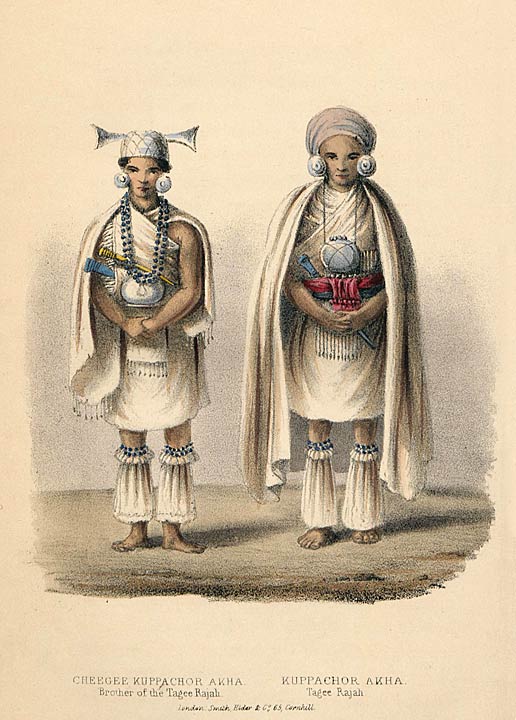
CHEEGEE KUPPACHOR AKHA. KUPPACHOR AKHA.
Brother of the Tagee Rajah. Tagee Rajah.
London: Smith, Elder & Co. 65, Cornhill.
At one time it was the practice in Assam to locate small bodies of troops in stockades along the frontier, north and south of the valley at the foot of the hills; or in the immediate vicinity of hostile tribes, so as to overawe them and prevent predatory incursions into our plains for the capture of slaves and plunder. These posts, being far distant from the support of the head quarters of the respective regiments, and away from the immediate control of European officers, discipline and vigilance were perhaps too little regarded; and the consequence was, that detachments were not unfrequently surprised and massacred in the most savage manner. In 1835, there was a stockade at Baleeparah in Char Dooar, garrisoned by one havildar, one naick, and six sipahees of the 1st Assam Light Infantry. About 10 o’clock A.M. of the 3rd of February of the same year, the Kuppah Choor and Akha chiefs, Taggee, Nizam, and Somgsong, accompanied by a few daring followers, proceeded to the stockade: the havildar, unsuspicious of any treachery, went outside to converse with the Taggee Rajah, and told him that he must not enter the stockade. After a short conversation the Taggee Rajah—as a signal understood by the Akhas, drew his sword and inflicted a wound on the havildar’s left leg. Nazim Rajah then cut down the Naick with his own hand, and the whole of the Akhas instantly rushed on the havildar, entered the stockade, and murdered every person they could seize; slaughtering in all sixteen persons: the havildar, naick and four sipahees, and the wives and families of the Goorkha sipahees. Two sipahees of the guard happened to be bathing in a tank close by at the time of the attack, and saved their lives by running into the jungles. After the massacre, the Taggee Rajah set fire to all the houses inside the stockade, and retired with his followers to the fastnesses in the neighbouring hills.
Intelligence of this disaster reaching the civil authorities, a proclamation was immediately issued, offering a reward of five hundred rupees to any person who would bring the Taggee Rajah, dead or alive, and two hundred rupees for any information that would lead to his apprehension. This proclamation, however, was in 1837–38 modified by the express order of the Honourable Court of Directors, who intimated that the proceeding was most exceptionable, and that rewards should only be given for the apprehension of offenders, and not for slaying them. From that day until 1842, the whole tribe of Akhas and Kuppah Choor Akhas were treated as outlaws. Our outposts were strengthened, and all British subjects prohibited from furnishing them with grain or any other necessaries of life.
In 1842, the Taggee Rajah, of his own free will, came down from the hills and surrendered himself to the British Government. The excuse pleaded by him for the massacre of the guard was the tyranny and insolence of the sipahees towards his tribe; but it does not appear that the sipahees had any quarrel with the Akhas or Kuppah Choor Akhas, and it is therefore reasonable to conclude that the latter destroyed the guard because they were posted there to prevent depredations on the plains. Notwithstanding the crimes committed by the Taggee Rajah, Government directed his release, on his swearing future allegiance on his own behalf and that of his tribe. This was a matter of necessity: there were no means at hand of summarily punishing the outrage that had been committed, and the influence of the Rajah was requisite to curb the future irregularities of his people. As an inducement to him to restrain a rapacious banditti from future aggressions, a pension of twenty rupees per mensem was bestowed upon him for life. The Taggee Rajah, it might have been supposed, returned to his native hills somewhat appeased and gratified; but here again the British authorities were erroneous in their calculations. Incapable of comprehending our motives, and distrustful of our purposes, the Rajah, for two years, never resorted to the station of Tezpore to receive his pension. In 1844, however, an interview with himself and other chiefs took place, and an amicable and satisfactory arrangement was made. The Taggee Rajah received his pension of 240 rupees per annum granted in 1842; Nechoo received 24 rupees; Sankhandoo, 32 rupees; Seerkoolee, 32 rupees; Sorsoo, 32 rupees: in all five chiefs, their pensions amounting to 360 rupees per annum.
Thus terminated a desultory, harassing war of twenty years with one of the most restless tribes on the frontier. The manner in which the forbearance of these savages has been purchased will, we are persuaded, not be misconstrued into fear or weakness, but be productive of future peace and security and a freer intercourse with the people of the plains.
DUFFLAHS.
The Dufflah tribes are divided into innumerable petty clans, and reside in Char Dooar, Now Dooar, and Chuh Dooar. They are a very uncivilized race of beings, and formerly were extremely troublesome: committing atrocities, attacking and kidnapping the people of the plains, and extorting a large amount of black mail in kind annually. To enumerate the several petty robberies, disturbances, and murders committed at different times by these wild mountaineers, would, at the present day, be neither interesting nor profitable: it will suffice to remark that the people are all disunited, living under independent chiefs with separate interests, and have never leagued together in large bodies to ravage the plains for plunder or the capture of slaves. No union seems to prevail amongst them as with the Singphoos, Abors, and Khamtees; their irruptions and depredations, therefore, are always on a small scale. Almost every clan seems suspicious of its neighbour, and the sanguinary feuds amongst themselves are frequent. Of their religion, manners, customs, and habits, we regret to say little is known, and that little of a character not to be relied on: the same may be said of our information respecting the Akha tribes.
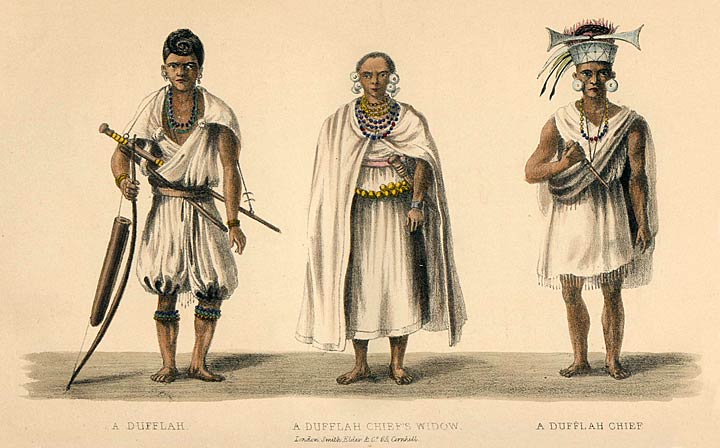
A DUFFLAH. A DUFFLAH CHIEF’S WIDOW. A DUFFLAH CHIEF.
London: Smith, Elder & Co. 65, Cornhill.
In 1836–37, an agreement was entered into with the Dufflahs to forego their extortions on receiving from the British Government a fixed sum in lieu of all demands. Unlike the Booteahs, who cannot live in the plains, the Dufflahs seem disposed to adopt agricultural habits; and considerable numbers have deserted their hills and located themselves in the plains, paying revenue for the land they cultivate at the same rate as our Ryots. From these symptoms of industry, we are led to hope that in the course of time others will follow their example, and descend from their hills to enjoy the protection of the British Government; when their condition will be greatly ameliorated.
In Char Dooar there are no less than one hundred and eighty Dufflah chiefs, belonging to twelve distinct clans, who receive 1,020 rupees per annum in lieu of the black mail formerly extorted from the Ryots. In the Now Dooar, there are nine dooars (passes or tracts of country leading into the northern hills) occupied by fifty-eight Dufflah chiefs, who receive compensation or a pension from Government of 1,523 rupees 9 ans. annually in lieu of black mail; making a grand total for both Dooars of 2,543 rupees 9 ans. 8 pice. It remains only to notice the amount supposed to have been collected as black mail by the Dufflahs from the people in Now Dooar previous to the year 1836–37, when a pecuniary compensation was given to the Dufflahs in lieu of this objectionable exaction. The contributions levied as black mail were nearly all given in kind. On the arrival of the Dufflahs once a year, from their mountains in the Now Dooar, it was their custom to take from the Sahoorea Ryots Government free pykes (or men), from each house:—
Rs. Ans. Pice.
1 seer of salt, valued at 0 4 0
5 seers of rice 0 1 0
Ready cash 0 1 0
0 6 0
and if the ready money of one anna was not paid, a Moonga, or Erea Gumcha, or handkerchief valued at three annas was taken instead. On their return to the hills, another cess or contribution, amounting to 7 rs. 10 ans. was levied from each village or community, fixed originally at twenty houses; and whether they had decreased or increased in numbers the Dufflahs neither reduced nor augmented their demand. The articles taken from each village consisted on this occasion generally of—
Rs. Ans. Pice.
1 Erea cloth, valued at 3 0 0
1 Moonga Gumcha handkerchief 0 4 0
1 cow 2 8 0
Cash, as a present 1 0 0
Rice, 1 bhar 0 4 0
1 duck 0 2 0
1 seer of salt 0 4 0
1 seer of oil 0 4 0
7 10 0
Besides the Sahoorea, or free population, there were four villages (Baghmarra, Bihalle, Sakomata, Bakola) wholly inhabited by Cacharees, who were denominated Bohoteahs, or slaves; being free men bestowed originally by the Assam kings for a particular purpose or service. This caste or tribe the Dufflahs especially considered as their slaves, from whom they claimed the right to collect two-thirds of the produce of their labours. Each Bohoteah received from the British Government two poorahs of land, and one rupee only was taken from him as revenue, or capitation tax; being two rupees less than that paid by the Government Pykes. The remission of two rupees granted in his favour, was to enable him to meet the demands of the Dufflahs against him, in addition to the following amount of black mail, viz:—
Rs. Ans. Pice.
1 Erea small cloth 1 0 0
1 Moonga gumcha 0 4 0
1 chunam (or lime box) 0 8 0
1 kuttaree, or knife 0 2 0
1 jappee hat or umbrella 0 4 0
1 bhar of rice 0 4 0
1 duck 0 2 0
1 seer of salt 0 4 0
1 seer of oil 0 4 0
3 0 0
From this it would appear that the Bohoteahs paid to the Dufflahs five rupees each in produce; while the free population was assessed at the rate of about eight rupees per village of twenty houses, which would average about six annas four pice per house. From the free and slave population united, as far as we have means for determining, the sum realized in kind from the inhabitants of the whole Dooar, amounted to 2,503 rs. 10 ans. 6 pice; so that in reality the Dufflahs have gained by the money substituted for black mail.
In the palmy days of the Ahoom Government it is not certain that this system existed; but on the Ahoom Rajahs becoming proselytes to the Hindoo creed, they and their followers degenerated; and being unable to check by force of arms, the inroads of the numerous hill tribes both on the north and south frontiers of the valley—a space of 400 miles, accessible by innumerable passes—they readily permitted the tribes to levy black mail once a year on certain portions of land called Dooars. Thus were continual hostilities averted, and the Ahoom Rajahs had leisure to pay attention to their own affairs. Intestine commotion, however, worked the destruction which foreign aggression was restrained from accomplishing.
CHAR DOOAR DUFFLAHS.
No. of Chiefs in each Khel or Clan. No. of Khels or Clans. Name of Khel or Clan. Amount of Pension.
Rs. Ans. Pice.
23 1 Phering Ooela 97 8 5
20 2 Oopur Takoolea 108 5 2
21 3 Nam Takoolea 196 14 1
21 4 Rapo Oolea 76 11 4
46 5 Paee Olea 234 12 2
7 6 Oopur Taolea 17 1 11
2 7 Nam Taolea 3 10 7
3 8 Chana Oolea 23 6 7
37 9 Oopur Tabungolea 106 2 9
10 Purbutea village, Mekla Gaum, Deka and Bur Gaum extinct 4 8 4
11 Jeynath Hya Babang Gaum, of Kuchla Barru, extinct 0 8 3
12 Names of chiefs unknown, extinct 150 0 0
180 Total 1020 0 0
DUFFLAHS OF NOW DOOAR.
No. of Dooars. Name of Dooars. No. of Chiefs Name of Chiefs Amount of Pension
Rs. Ans. Pice.
1 Bihalee Dooar. 1 Tamoo Gaum
2 Tetae
3 Ruma
4 Nerbow
5 Tumes
6 Emakolee Gaumnee
7 Hollee Gaum
8 Hathemorea Huraporah 58 9 7
2 Gong Dooar. 1 Bhoot Gaum
2 Ruma and Gamoo
3 Akho Chalee Gaumnee
4 Changdur Gaum
5 Rao
6 Nizboo and Burkmal
7 Rungoa and his son Byragee 82 2 8
3 Bagmara Dooar. 1 Gopee Gaum
2 Papoong and Kadoo
3 Sedae Gaum
4 Teeta Gaum
5 Lalloo
6 Kowa
7 Baboo
8 Madoo and Paree 29 5 11
4 Sakhoo Mata Dooar. 1 Deka Gaum, Bogle, and Rumgka
2 Chale Gaema, Gotoa Gaum
3 Kena Gaum 262 8 5
5 Chooteah Dooar. 1 Babung Gaum
2 Bengala Gaum
3 Bengakoe Gaum
4 Chengolee Gaum
5 Hanoo Gaum
6 Tadung Gaum
7 Hanoo Gaum
8 Peroo Gaum
9 Durpur Gaum
10 Taggee for Talee
11 Teloa Gaum
12 Tamar
13 Durrung 234 0 3
6 Kuchlahbaree Dooar. 1 Phedula, Bhedo Jey, Nizae Bulae Jey Gaums
2 Ladoom
3 Onee
4 Rungoma
5 Tajur 66 1 3
7 Chandhur Dooar. 1 Jeyram Gaum
2 Ketula Haree
3 Bogee Gaum
4 Hetoo Gaumnee 137 12 8
8 Gurea Dooar. 1 Beroo Gaum, Seram Nirboo Keah Gaum
2 Dhunae Darkeh 46 11 10
9 Bakula Dooar. 1 Neema Gaum
2 Gobind Gaum
3 Peroo Gaum
4 Tama, Jagura, Nerum Lekejoo Luchoo, Begora, Oozeer, and others
5 Chengalee and others
6 Khakung Gaum
7 Halee
8 Chedar 606 5 1
Total paid to Now Dooar, Dufflah Chiefs 1523 9 8
Total paid to Char Dooar Dufflah Chiefs 1020 0 0
58 Total 2543 9 8
London: Printed by Stewart and Murray, Old Bailey.
A
CATALOGUE
OF
Books,
IN
VARIOUS BRANCHES OF LITERATURE;
IN THE PRESS, OR RECENTLY PUBLISHED BY
SMITH, ELDER AND CO.,
65, CORNHILL, LONDON.
AGENTS: CUMMING & FERGUSON, Dublin; BELL & BRADFUTE, Edinburgh; D. ROBERTSON, Glasgow; W. GRAPEL, Liverpool.