SOME ACCOUNT OF THE ASSAMESE TRIBES. (continued 2)
Reading edition
The Mishmee tribes were formerly obedient to the Assam Governors, the Suddeah Khawa Gohains: if they were not totally dependent, they at least gave small presents as tokens of submission, and attended to the orders of the Khamtees and Singphoos. In 1835, for example, the Duffa Gaum received considerable assistance from gangs of Mishmees sent down to erect his stockades. If under any pretence, therefore, the Thibetians, being a branch of the Chinese empire, should be permitted to establish their supremacy over the hill tribes in allegiance to the British Government in this quarter of the valley, our interests would be affected; but in the present rude state of society in this region there is little to be apprehended on this score. An immense, desolate, almost impassable tract, intervenes, so as to render ingress or egress from Assam to Thibet impracticable, excepting at certain seasons of the year. Traversing such a country, when the route follows the course of rivers, must naturally be difficult in the extreme. The hills are invariably characterized by excessive steepness, and as the greater portion of the route winds round them at some height above their bases, marching is excessively fatiguing, difficult, and dangerous. In many places a false step would be attended with fatal consequences: precipices must be crossed at a height of a hundred feet above the foaming bed of a river, the only support of the traveller being derived from the roots and stumps of trees and shrubs, and the angular character of the face of the rock. The paths are of the very worst description; always excessively narrow and overgrown by jungle in all directions. In very steep places the descent is often assisted by hanging canes, which afford good support, but no attempt is ever made to clear the paths of any obstruction: in fact, the natives seem to think the more difficult they are, the greater is their security against foreign invasions.
Notwithstanding these impediments to a free intercourse, some little trade, it is supposed, is carried on between the Mishmees and Lamas; the Mishmees exchanging their Bih (poison), Gathewan (an odoriferous root), Manjeet (madder), and Teetah (a bitter root, greatly esteemed for its medicinal qualities) for Lama cattle, brass pipes, gongs, and copper vessels; and if a friendly feeling of confidence could be established between the people of the plains of Assam and the Lamas, it is impossible to calculate to what extent the commerce between the two nations might attain. Once every year in the cold weather, that is between November and March, the Mishmees visit Suddeah for the purpose of bartering the only export produce of their country: namely, bih, teetah, manjeet, gathewan, gongs, brass pipes, and copper vessels; in exchange for which they invariably take, in preference to English merchandize, cows, buffaloes, and a quantity of small, coloured beads. Their cultivation is scanty: apparently not sufficient to supply their wants, and is, moreover, carried on in a very rude way. The ground selected as most favourable for cultivation lies on the slopes of hills, or on the more level patches occasionally bordering rivers. Some villages produce a good sort of hill rice, but their chief cultivation is ghoom dhan (or Indian corn), konee dhan, and two or three other inferior grains. The villages situated at low elevations produce excellent yams and aloos of several kinds. They are not acquainted with wheat, barley, &c., nor have they taken the trouble to grow potatoes, but that esculent is obtainable at Suddeah in great abundance. Of opium, a small quantity is cultivated, chiefly for sale to the Singphoos; though many of the natives are great opium-eaters. A small quantity of inferior cotton is also cultivated for the manufacture of their own clothing, and tobacco is in great request among them; they are likewise very fond of spirituous liquors.
We have no authentic data whereby to judge of the amount of the population, but from the following rough census of the followers of a few chiefs, it would not appear to be extensive.
No. of Chiefs. Names of the different Chiefs. No. of followers.
1 Jengsha 50
2 Japan 80
3 Deeling and Yeu 80
4 Galooms 80
5 Khoshas 100
6 Primsong 70
The number of villages among which the above population is distributed, is seven; but there are two other villages, Muresas and Roolings, close to Khoshas. By far the greater number of villages appear to be located near the banks of the Lohit; one only has been observed on the Lung. The villages of Jengsha, Japan, Deeling, and Yeu, consist of several houses each; neither, however, exceeding ten in number. Ghalooms, Khoshas, and Primsong, consist each of a single house, capable of containing from eighty to one hundred and sixty persons. These comprehensive residences are divided by bamboo partitions into twenty or more rooms, all opening into a passage, in which the skulls of animals killed during the possessors’ lifetime are duly arranged. The houses are all built on raised platforms, and the roofs are formed of the leaf of the arrow-root plant, or the leaves of cane, which are found in great abundance in all the forests. Khosha’s house is one hundred and sixty feet in length; each room possessing a fire hearth; but as there are no chimneys, or any outlet for the smoke, excepting the door, a Mishmee dwelling is scarcely endurable.
Of Mishmee habits and customs little is known; feuds and misunderstandings having hitherto obstructed a freedom of intercourse indispensable to the acquirement of correct information. Several European officers have visited the Mishmee country for a few days, and have been desirous of proceeding by this route over the mountains north into the Lama country, or Thibet; to ascertain whether the celebrated Sampoo river flows into the Burrampooter from this quarter, or debouches into the Dehong, below Suddeah, or takes its course, as has been surmised, through China. This interesting inquiry, however, has not yet been solved; though little or no doubt appears to exist that the Sampoo joins the Burrampooter at one of these points. The British Government have hitherto, from prudential motives, abstained from giving offence to or exciting the jealousy of the Chinese, by permitting any of our officers to attempt to enter Thibet from the extreme north-eastern quarter of the valley of Assam. This is a sacrifice of geographical knowledge to policy; for there can be no question that a scientific traveller would obtain much information respecting the character of the country, and bring us acquainted with a people at present unknown to the civilized world.
DOOANEAHS.
The Dooaneahs are descendants of Burmese or Singphoo fathers, from Assamese women, captured in predatory irruptions and kept as slaves. Assamese males, also carried off into slavery, are, from the loss of caste by their connection with the Singphoos, and the adoption of Singphoo habits, denominated Dooaneahs. They are a very hardy race, and inhabit the densest jungles; cultivating scarcely sufficient rice and opium for their maintenance, and subsisting, when their stock of grain is expended, on yams, kutchoos, and other roots of the forests. Without the aid of the Dooaneahs, no military detachment could move to many parts of the frontier, for none are so expert as pioneers. With the Dhao, or Singphoo short sword, they will cut a footpath through the densest jungles in the most expeditious manner, thus enabling our troops to move almost in any direction. They are not endowed with a martial spirit, and it is said they will not stand the fire of musketry; but if properly trained and disciplined, their fears might be surmounted. Their addiction, however, to opium is so great, that no permanent reliance could ever be placed in them as soldiers, in any emergency; and being utterly despised by their former masters, the Singphoos (from whose thraldom they have only lately escaped) it would seem inexpedient to place them in situations of trust, where the possibility of betrayal or defeat could be anticipated. The loss of their services as slaves, in cultivating the land, is deeply felt by the Singphoos; but these latter have not yet known the full extent of their inconvenience. In course of time few Dooaneah slaves will remain attached to the Singphoos; who must consequently either resort to manual labour themselves, or starve, or leave the province: which, by the way, would be the greatest boon we could desire, for the safety and improvement of our peaceable subjects.
ASSAMESE.
The province of Assam was invaded about 1224 A.D., by a band of Ahoom or Shan adventurers; who conquered the country, parcelled out its territory, and subjected the population to a vassalage approximating to that in force under the feudal system of Europe. By this arrangement the whole body of cultivators were divided into different portions, called Khels, varying from one thousand to five thousand cultivators each. They were governed by officers of various grades: those called Borahs, possessing authority over twenty ghoots or sixty paicks; Sykeahs, over one hundred ghoots or three hundred paicks; and Huzarees, over one thousand; with one superior officer denominated a Kheldar, who was generally a nobleman, or person connected with the royal family. But in recent times this arrangement has been modified, and Borahs, Sykeahs, and Hazarees have exercised authority over a much smaller number of persons. The Kheldars collected the revenue and exercised jurisdiction in petty criminal offences. Owing to the backward state of society in Assam, and its almost utter destitution of commerce and manufactures, the revenue was seldom paid in money, but mostly in personal labour: all public buildings, roads, bridges, &c., were constructed out of the funds of labour at the command of the Government; and the services of all public functionaries, clerical, medical, military, and judicial, were paid in the same manner. To facilitate this arrangement, the community were divided into threes, (or in some parts of Assam fours) each division being called a ghote; and if one of the three served the state throughout the year, the other two were excused the payment of money, revenue, or produce. From artisans and manufacturers, who were subjected to a higher taxation than other classes, money was taken occasionally; but more frequently the tax was levied in produce.
Under the Ahoom Government the monopoly of office was at first confined to the Ahooms, or original conquerors of the soil; but in the reign of Rodroo Sing, 1695, A.D., when the Assamese natives of the soil had become proselytes to the Hindoo religion, they were admitted to a share in the public employ. When the British Government conquered the country in 1825, this system of revenue, founded upon personal labour, was still in existence; but a money rate of taxation under the form of a poll-tax was introduced as far as circumstances would allow, the rates being fixed with reference to the customs of the ancient government. The two poorahs of land allowed to each cultivator were deemed equivalent to two English acres: the land could not be taken from him as long as he paid his revenue, but it was nevertheless considered the property of the state and could not be disposed of by the tenant. Almost the whole of the land in Assam is now taxed according to its quality, at so much per poorah or acre, but in some places any quantity of land may be cultivated by paying a certain sum per plough. The poll tax is likewise collected where the population is unsettled and scanty.
The religious wants of the people were provided for by the Assam rulers apportioning a certain number of paicks or cultivators to each Shuster or temple, for the support of which one-half of their revenue was assigned: the other half was appropriated by Government. Independently of this, grants of land were made to various religious persons, under the title of Debootur (service of the Gods), Dhurmooter (religious purposes), and Bramooter, for the support of the Brahmins (or priests); and a remission of half the usual rate of taxation was allowed when the claims of the parties were fairly established.
Assam is noted for the abundance of gold found in many of its rivers; and as the manner of acquiring it by washing the sands may not be generally known, and is a subject of considerable importance, a description may not be uninteresting to the reader. In the first place, the gold washer, taught by experience, chooses a favourable site; a wooden trough, six feet long by one and a half broad and two inches and a half deep, is then placed on pegs driven into the sand: one end of the trough being raised to throw it into an inclined or sloping position. This effected, a shifting bamboo sieve, made to fit the trough, is placed upon it; two men with baskets then strew a plentiful coat of sand and gravel from the river on the sieve, through which the gold washer quickly washes the sand by pouring water on it, and shaking the sieve to hasten the descent of the water into the trough. By this means the heavier particles sink and the lighter are carried off by the stream, that continues to flow from the square or upper end of the trough to the circular end, from which it escapes by an aperture purposely bored. The coarse gravel on the sieve is frequently removed, and a fresh supply is continually heaped up, until the sand in the bottom of the trough containing the gold is about an inch thick. The sieve is then removed, and placed at one end of the trough, and a quantity of water being poured through the sieve, it falls on the sand like a shower of rain, till all the light particles are carried off by the stream flowing down the trough. By this process the heavier particles only remain, and these are gold dust and iron. The gold dust being now distinctly visible, is subjected to a further washing, and then dexterously floated on to leaves; after which it is transferred to a glazed earthen vessel, and again washed with the hand. The gold washer now daubs his hands with lime, and having applied some quicksilver and water, again washes the sand with his hands, which causes a scum to rise on the surface; this being cleared off, after repeated washings, the gold is found adhering to the quicksilver, when it is taken from shell to shell till every particle of sand is removed. The quicksilver and gold dust are then placed in a shell on a charcoal fire, and with the aid of a bamboo blow-pipe the ore is speedily melted; a little water being then applied, the gold is separated and forms a ball at the bottom of the shell. It is considered a good return if three persons at one trough can obtain four annas weight of gold (worth three rupees) in twelve days: giving the labourer one anna four pice per diem. At one time there was a numerous body of gold washers employed in collecting gold from many of the rivers in Upper and Central Assam; and the rivers were, in some instances, let by Government to persons wishing to enjoy the sole monopoly of bringing gold into the market. The profit on the gold dust must have been very considerable, seeing that it realized from twelve to fifteen rupees per tolah, and was produced in large quantities. But, like many other monopolies, this was found open to abuse: the people were oppressed for the benefit of the manufacturers, and the Government deemed it expedient to discontinue it as a source of revenue; thus leaving one of the most valuable products of the province neglected. Gold, in consequence, is becoming scarce; and we hope, therefore, that the evil will work its own cure, by stimulating the gold washers to resume their ancient lucrative vocation.
In many parts of the province, coal of a good quality, is found; and indeed the soil of Assam generally may be considered extremely rich: it abounds in valuable products, such as rice, sugar-cane, moongah silk, pepper, mustard-seed, and cotton. But the bounty of nature is marred by the indolence and apathy of man: the cultivator seldom looks beyond his immediate wants, and makes no attempt to improve his condition. In fact, in agricultural, commercial, and manufacturing industry, this country may be considered at least a century behind Bengal; and there seems little prospect of improvement, excepting by the introduction of a more active and industrious people, who might stimulate the natives to increased exertions. An inveterate indulgence in the use of opium by the population at large, is the curse of the country: depressing the industry and withering the physical energies of the people, by limiting their desires to the gratification of the wants of the day.
The greater portion of the Assamese are Hindoos; but they are very lax in their observance of the rites of the Hindoo religion, and in the few ceremonies which they do perform, deviate considerably from the strict tenets enjoined by that creed. In their domestic habits they are simple in the extreme; their poverty and ignorance limiting their desires within the narrowest compass. A slight cotton covering thrown over the shoulders, and a dhoti or sheet tied round the waist, reaching to the knees, forms the chief clothing of the poor: shoes are never worn. A little oil, rice, vegetables (such as greens and chillies), seasoned with the smallest quantity of salt, and sometimes a few small fish, compose the humble fare of the poor peasant. These necessaries are procurable for about three shillings per mensem, and as the wages of a day labourer or coolie are from one and a half to two annas per diem, or about two rupees per mensem, he has still one shilling to spare.
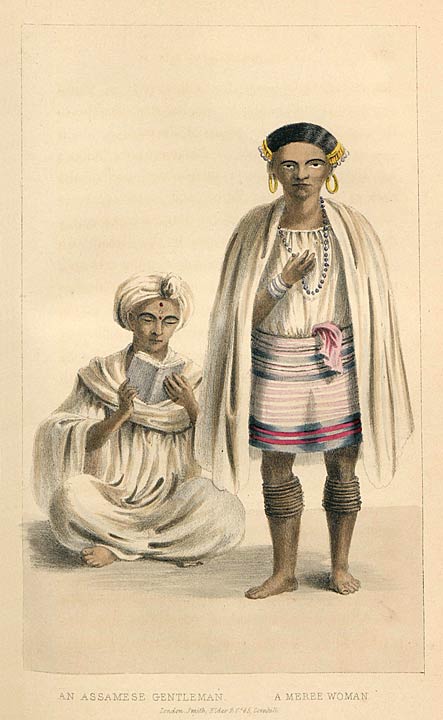
AN ASSAMESE GENTLEMAN. A MEREE WOMAN.
London, Smith Elder & Co. 65, Cornhill
This spare diet has, of course, its influence upon the stature and bulk of the Assamese; who are, consequently, slender, effeminate, and indolent. Their complexion is not uniform; numbers being very fair, and as many excessively dark. Their morals are exceedingly depraved, and their manners servile and contemptible. Nor are the women one whit superior to the men; and although they are far from possessing attractive persons, they are utter slaves to the worst licentiousness.
These frail buildings require yearly repairs, but the peasants are put to no expense for them, except in bringing posts, reeds, and grass from the jungle. Assamese families of respectability and wealth live in larger houses of the same character of architecture; but instead of one hut, they erect several close together, in the form of a square, each hut opening into the quadrangular court-yard, which is entered by a portico or receiving room for visitors.
In the estimation of the Assamese, marriage is one of the most important duties of life; not only for the additional comfort, assistance, and respectability it confers on the man, but because he considers he has not fulfilled the divine will if he has failed to take unto himself a wife—and sometimes a plurality of wives. Polygamy is prevalent throughout the province, and is only limited in extent by the means of each man to provide for the support of his wives. If a man marries only one or two wives, he probably has on his establishment three or four concubines; and his life is therefore embittered and harassed by perpetual family quarrels. It is the custom in Assam for parents to make early arrangements for the marriage of their sons; and having selected the daughter of any particular family of the same caste, a regular agreement is entered into for the amount of the dower to be paid to the parents of the girl, even when she is but a mere child. The first ceremony of betrothing the girl is called Tamul pankatta, or partaking of the betel nut and leaf of the betel vine; which takes place when the damsel may be about four years of age. The parents of the youth proceed to the house of the family with whom they wish to form a matrimonial alliance, make their proposal, and produce a present of the following articles:—
Rs. Ans. Pice.
Betel nut and betel leaf 1 0 0
Two bhars (or baskets) of milk 0 8 0
Fish 0 4 0
Treacle 0 4 0
Plantains 0 4 0
Chura (parched rice) 0 4 0
Total rupees 2 8 0
If the above present be accepted, then, to all intents and purposes, the agreement is ratified between the parties, and is considered as solemnly and legally binding as are the parchment instruments which regulate these contracts in England. The next ceremony performed in furtherance of the union of the young people is called Nowae toolun (or attaining the period of puberty), when the girl being about ten or eleven years of age, the youth’s parents proceed to her house again with another present composed of the following articles:—
R. Ans. Pice.
Oil 1 0 0
Red vermilion, for the distinguishing mark of the tutelary deity on the forehead 0 2 0
Betel nut and betel leaf 0 4 0
Pitter goorie (rice flour) 0 4 0
Akho rice parched in the husk, (dhan) 0 4 0
Total rupees 1 14 0
About six months or a year after this offering, the third ceremony takes place, and is called “Kharoo munee puredheen” (or putting the bracelets and necklaces on the bride). The expense incurred on these occasions corresponds with the means of the bridegroom and his parents. To show the nature of the presents made, we subjoin the following list:—
Rs. Ans. Pice.
Bracelets 20 0 0
Ear-rings 12 0 0
Necklaces of several strings, of various sizes and colours 5 0 0
Madulee, a silver charm ornament suspended from the neck 1 8 0
Four silver finger-rings, 4 annas each 1 0 0
One piece of Mongah silk cloth, five cubits long 1 8 0
Betel nut and betel leaf 2 0 0
Twelve bhars (or baskets) of treacle, rice, curds, pittagoorie kutcha (ground rice) chandagoorie puckah (baked rice flour): each basket valued at four annas each 3 0 0
Total rupees 46 0 0
The fourth and last ceremony is Shadee (or marriage), when a great feast is given at the damsel’s house by her parents to the friends of both families. The presents consist of:—
Rs. Ans. Pice.
Fish, rice, diel, oil, salt, greens, and chillies 3 0 0
Betel nut and betel leaf 1 0 0
One piece of Moongah silk 1 8 0
One Burkopper cotton cloth, for the girl’s father or brother 1 0 0
Gao dhun, dower or price of the girl, paid to her parents in ready cash 9 0 0
Total rupees 15 8 0
The bridegroom is kept awake all night by feasting, dancing, and singing; and in the morning, all having broken their fast, the bridegroom accompanies his bride to his own dwelling in a regular procession. Drums, cymbals, and gongs take the lead; the bride follows either in a palkee, or mounted on a pony; or, if very poor, she walks in the midst of her female acquaintances, covered from head to foot with a white cotton cloth or veil thrown loosely over her; and the bridegroom and his friends bring up the rear. On arrival at the bridegroom’s house, his friends partake of a repast, and return to their homes in the course of the afternoon. The young couple then take up their abode, generally in a newly erected house adjoining their parents’ dwelling. The whole expense of the marriage conducted on this scale amounts to sixty-five rupees fourteen annas; but only the better orders disburse such a sum. If the parties are in very affluent circumstances, however, many hundreds of rupees are expended. The poorer class, from inability to incur further outlay, are not unfrequently married at the second ceremony of Nowae toolun for four or five rupees, including every expense.
Should the parents of the girl, contrary to the marriage contract or betrothment, give their daughter to another person, it is incumbent on them to refund the value of the presents they may have received on different occasions for a number of years previously. Yet in few countries, probably, will the number of violated contracts or promises of marriages be found to exceed those of Assam. The litigation and ill-will consequent on these ill-advised agreements is incalculable, and the complaints under this head in the civil courts are innumerable.
There is a remarkable similarity between one of the customs in Assam and that practised by the Patriarchs of old. Jacob served Laban as a servant or bondsman many years to obtain in marriage Leah and Rachel, who were sisters; and he was not allowed to marry the younger before the elder. So in Assam a man may marry two sisters, but he must marry the elder before the younger. It is not uncommon, when a man is poverty stricken, to engage to live and work for several years for the father of the girl he wishes to marry. He is then called a Chapunea, a kind of bondsman, and is entitled to receive bhat kupper, food and clothing, but no wages; and at the expiration of the period of servitude, if the girl does not dislike him, the marriage takes place. The man is looked on in the family as a khanu damad (or son-in-law), and is treated kindly. If the girl’s father be very wealthy, and he has no sons, he will sometimes select, from some equally respectable family, a husband for his daughter, and bring him up in his own house. The youth so selected is likewise called a Chapunea, and inherits the whole of his father-in-law’s property. If a woman’s husband dies, though she may be only eighteen or twenty years of age, she can never marry again. She is considered a Baree, or widow for life; but very few women—if any—so circumstanced lead a life of celibacy: they prefer submitting to be selected as companions, and are then contemptuously designated batuloo (refuse or offal). And this condition of existence among the lower orders is almost as common as marriage; for the becoming a man’s Dhemuna stree (alias mistress or companion) involves no expense for bhar bhete (marriage present) or gaodhun (dower), and is therefore more convenient. The offspring of this connection inherit all the rights of legitimate issue, and are not the less respected in society; there is, therefore, no bar to the loose and immoral habits so prevalent among the poorer classes in Assam. The indulgence of these is further facilitated by the ease with which the marriage-tie may be dissevered. No reference is necessary to either the temporal or ecclesiastical courts: dissolution is simply effected by the husband, if displeased with his wife or doubtful of her fidelity. On these occasions he merely assembles his friends, and in their presence addresses his wife in these words:—“Henceforth I look on you as my mother and sister;” and tearing a betel leaf into two pieces the marriage is dissolved, and the man and woman are free to select fresh partners. The divorce is equally complete if the husband distributes a little salt to each member of the assembly of friends, making the same speech to the wife. The Cacharies, a simple-minded, honest, and industrious tribe of Assamese, cut off a branch of the kuddum tree before a select body of friends, when the husband declares he has divorced his wife, and the ceremony is completed.
The funeral obsequies of the Assamese are performed agreeably to Hindoo usages. The body is burnt as soon as possible after death. Jogees, Weavers, and Cacharies bury their dead in the same manner as Moossulmans. A curious practice prevails amongst the Assamese of giving salt to their friends assembled to bear witness to many of the common occurrences of life. If a man adopts a son, he distributes salt to his friends in token of a person having been appointed to succeed to his property. If he buys a piece of land or purchases a slave, or if a dispute is settled by arbitrators, salt is in like manner distributed amongst a few friends who testify to the fairness of the transaction; and amongst themselves these agreements or settlements are as binding as laws could make them.
When an Assamese has been excommunicated by the priests for any civil offence, the expiation of his crime and his restoration to society are effected by the payment of a fine, called chundrayen, amounting to four rupees: dhurmdund (twelve annas), feeding the Punchayet or jury, (one rupee) at most about six rupees. If the offender be very poor, one rupee ten annas will suffice to pay for “purachit” (absolution); which is granted by the priest.
By the ancient Assam laws, slavery existed in a variety of forms. All born of a free slave by a free father, as well as those of pure slave parentage, were considered slaves. Free women married to slaves became, with their offspring, slaves. The king had the power to grant to his nobles and spiritual advisers portions of the free population as slaves, which the owner could dispose of in any manner he thought proper: they were designated Bohoteahs. Prisoners of war were often granted to individuals as slaves; and criminals who had a sentence of death passed upon them had it commuted to slavery, and were assigned to certain masters. The free people were at liberty to mortgage themselves for debts; remaining in bondage for a number of years or until the sum borrowed was paid off; and as the debtor was seldom in a situation to liquidate his obligation, he continued a slave to his creditor for the remainder of his life. In each district the value of slaves varied considerably.
Name of District. Value of Men. Value of Boys. Value of Women. Value of Girls.
Rs. Rs. Rs. Rs. Rs. Rs.
Kamroop 40 15 to 20 20 12 to 20
Durrung 20 10 to 15 15 8 to 12
Nowgong 20 10 to 15 15 8 to 12
The above is the estimated value of good castes, such as Kuletahs, Kewuts, Kooches. The price of the lower castes, denominated Joges, Doomes, Cachares, Boreahs, and Burahees, was one-third less.
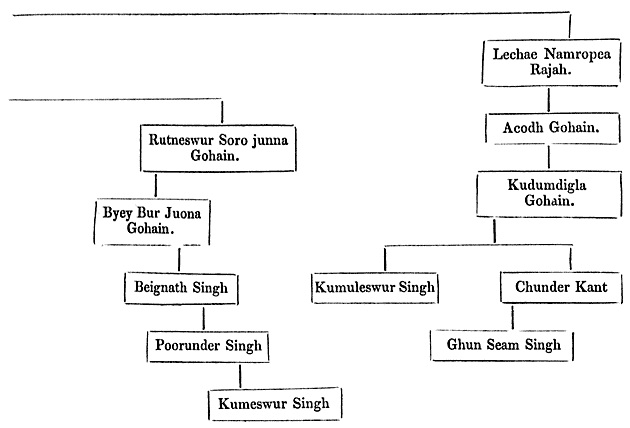
In the present brief review of Assam it would be foreign to our object to attempt to describe the events of each reign; we confine ourselves, therefore, to a short list of the last kings of Assam. (See opposite page.)
The downfall of the Ahoom kings of Assam may be attributed to their becoming proselytes to the Hindoo religion in the reign of Jeydhoj Singh, A.D. 1654; to the religious persecutions of the Muttucks in the reign of Seeb Singh; to family dissensions and disputes, and the cruel treatment of Mohun Burjona Gohain. Rodur Singh left five sons, Seb Singh, Prumutta Singh, Mohun Burjona Gohain,
LIST OF THE LAST KINGS OF ASSAM.
1681, A.D., Gudhadhur Singh.
1695, A.D. ,, , Bodur Singh.
1714, A.D. ,, , Seeb Singh.
1744, A.D. ,, , Prumutta Singh.
1751, A.D. ,, , Rajeswur Singh.
1769, A.D. ,, , Luckme Singh.
1780, A.D. ,, , Gowree Nath Singh.
1795, A.D. ,, , Kumuleswur Singh.
1810, A.D. ,, , Chunderkant Singh.
1817, A.D. ,, , Poorunder Singh.
1818, A.D. ,, , Chunderkant Singh reinstated on the throne by the Burmese.
1821, A.D. ,, , Jogessur Singh placed on the throne by the Burmese.
1824–25 A.D. ,, , Assam conquered by the British troops, and the Burmese army expelled the province.
1833 A.D. ,, , Poorunder Singh made Rajah of Upper Assam, April 12th, 1833, and deposed by the British Government, Aug. 1835, A.D.
Rajeswur Singh, and Luckme Singh. The third son, Mohun Burjona Gohain, being marked with the small-pox, was incapacitated to reign; and his younger brother, Rajeswur Singh, superseded him. By the evil machinations of the Bor Borowa, Rajeswur Singh was led to believe his brother, Mohun Burjona Gohain, was plotting against his government; and for the effectual suppression of this conspiracy, his brother was expelled the capital in the most ignominious manner, his ears having been slit and one of his eyes plucked out. It was, doubtless, as we have already remarked, from this severity that the prince Mohun Burjona Gohain, in the succeeding reign of his younger brother, Luckme Singh, was induced to rebel against his sovereign, and to join the Muttucks, hoping thereby to avenge his wrongs and gain the throne; but though temporary success attended the Muttuck insurrection, the Prince failed in realizing his ambitious projects, and hastened the extinction of the power of the Ahoom dynasty.
In no part of the world, perhaps, have such sanguinary customs and laws prevailed as in Assam, under the Ahoom kings. Many of their punishments were revolting to humanity. Criminals were whipped, put in the pillory, impaled; their limbs amputated, the nose, ears, and lips mutilated; the hair was torn out by the roots, eyes were plucked out of the sockets, and sometimes offenders were ground between wooden rollers, sawn asunder, or tortured with red-hot irons. A variety of other cruelties were practised with a relentlessness that but too vividly marked the barbarity of the rulers of those days, and rendered it a matter of sincere congratulation that a merciful providence shortened the period of their sovereignty, and placed the country in the hands of the British Government, in 1824–25.
NAGAS.
The south-eastern hills of Assam are the abode of many tribes of Nagas. They are a very uncivilized race, with dark complexions, athletic sinewy frames, hideously wild and ugly visages: their faces and bodies being tattooed in a most frightful manner by pricking the juice of the bela nut into the skin in a variety of fantastic figures. They are reckless of human life; treacherously murdering their neighbours often without provocation, or at best for a trivial cause of offence. The greater number of the Nagas are supposed to be in a very destitute state, living almost without clothing of any kind. Their poverty renders them remarkably free from any prejudices in respect of diet: they will eat cows, dogs, cats, vermin, and even reptiles, and are very fond of intoxicating liquors.
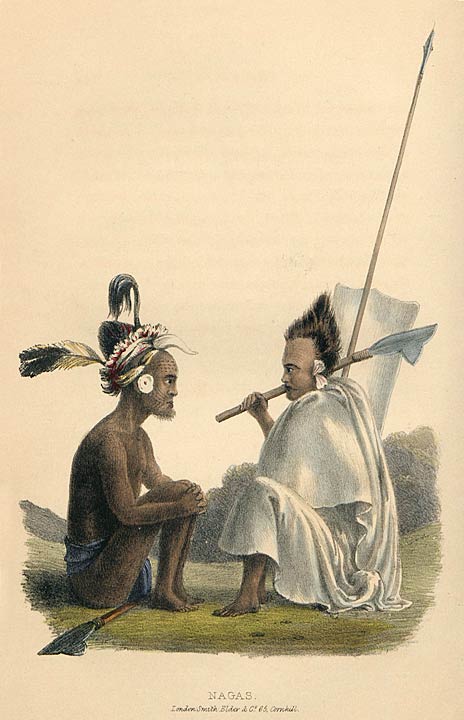
NAGAS.
London, Smith Elder & Co. 65, Cornhill
Amongst a people so thoroughly primitive, and so independent of religious prepossessions, we might reasonably expect missionary zeal would be most successful; for the last eight years, however, two or three American Baptist missionaries have in vain endeavoured to awake in them a sense of the saving virtues of Christianity. For a considerable period the residence of the missionaries was at Suddeah; where their labours, I believe, were unattended by any conversions either of Assamese or Singphoos. On the station being deserted by the troops for Saikwah, in 1839, the missionaries turned their attention more particularly towards the Nagas; they took up their residence on the Boree Dehing river, at Jeypore, established a school, and were indefatigable in endeavouring to gain some correct knowledge of the savage tribes in their vicinity. A few years’ experience here proved the futility of their plans. Instead of wandering amongst the savage tribes scattered over an immense extent of country, in unhealthy, dense jungles, it would have been prudent and politic to have afforded instruction in the first instance to the populous villages in the plains. One or more natives have been baptized at Jeypore, agreeably to the rites of the Baptist persuasion, by immersion in the Boree Dehing river, and this is the sum total of the missionary success. This has, it is understood, induced them to change their abode to Seebsauger and Nowgong, where they seem to think there is a greater chance of their succeeding. The missionaries have a printing press, and many elementary books of instruction in Assamese and English have been printed by them for the use of the natives. Their exemplary conduct and exertions merit the utmost commendation, and it is to be deplored that their well-intentioned labours should not be crowned by felicitous results.
To this day little is known either of the country inhabited by the Nagas, or of their habits and customs. Several officers have penetrated a considerable distance into the hills occupied by the Nagas; but always with marked and necessary caution, attended by a military guard. Greater intercourse between the highland Nagas and the people of the plains were much to be wished; but it is doubtful if any advantage would accrue to the British Government from extending its sway southward, over immense tracts of unprofitable wastes or dense jungles thinly inhabited.
Naga Government.
Under the ancient Assam Government some of the tribes may have been more dependent upon the Government than they are now, but the Naga territory was never considered an integral portion of the sovereignty of Assam. It is customary with the Naga tribe to offer trifling presents to the British authorities, as a mark of submission, and something is given in return, in token of amicable feeling; but the Nagas have never been considered subject to our regular jurisdiction, and nothing in the shape of an assessment has ever been imposed upon them.
It is very difficult to arrive at anything like a correct understanding of the nature of the feuds between neighbouring tribes; for the Nagas have no written language, and their dialects vary considerably in different parts of the country. No general government exists over the whole tribe: they are divided into innumerable clans, independent of each other, and possessing no power beyond the limits of their respective territories. Each tribe seems ever jealous of its neighbour; and cruel hostilities, ending in the most tragical manner—even to the extermination of a tribe and the total destruction of its cattle, stores, and property—are often the result of their mutual animosity. The form of the Naga government is democratical; each clan seems to be ruled by a president and two subordinates or deputies, who form the executive. The president is called Khonbao, and the deputies Sundekae and Khonsae: the one prime minister, and the latter a chief over twenty houses. The chief magistrate or arbitrator, the Khonbao, decides all disputes of a civil or criminal nature, and it is optional with him either to direct or enforce his orders with his own sword; but in all this he is merely the organ or agent of the people, for the decisions are the results of the consultations of the whole Raj, or populace, who discuss all matters of importance in the open Moorung, or hall of justice, to be found in every Naga village. The Khonbao, Sundekae, and Khonsae, on these occasions, summon all the community to attend and assist with their counsel in disposing of any affairs of moment: such as a war to be undertaken against a foe, or in furtherance of revenge; or the punishment of crimes committed by any of the members of the tribe in opposition to their established polity.
The dignity of Khonbao is hereditary: the eldest son of the incumbent invariably succeeding to the title and authority. No junior brother can assume the rank, under any pretensions founded on greater ability, personal appearance, or reputation of valour. In the event of the Khonbao leaving no progeny, his wife succeeds to his title and authority; and the deputy Khonbao, Sundekae and Khonsae in council enforce her commands, and report everything to her connected with the welfare of the community.
No hospitality is shown to a stranger visiting the Naga country, unless he visits the Khonbao in the first instance: he is unable, even under the greatest distress, to obtain shelter or provision elsewhere. On the arrival of an embassy it is conducted to the residence of the Khonbao, who gives audience immediately, and returns a reply by the messengers on his own responsibility, if the object of the visit is of no great importance. But, on the other hand, should the embassy be for the purpose of obtaining redress of wrongs committed by the clan of the Khonbao, the embassy is retained and entertained hospitably till the Sundekae, Khonsae, and principal elders of the people can be assembled in the moorung; when the grievance is stated and inquiries made, each member stating openly and candidly his opinion on the matter at issue. The Khonbao propounds what is, in his opinion, expedient and best for the public good; but if there appears any irregularity, the people express their disapprobation to the Khonbao, and he is constrained to abide by the will of the community, to give orders to the embassy, and allow its departure to the place whence it came. In this manner all affairs and discussions are regulated amongst the Nagas. Any attempt to travel through their country, unaccompanied by a person acquainted with the roads, villages, and Naga language, would be the height of folly; as the traveller would not be supplied with water, food, or fire, neither would any shelter be afforded him, and his life would be in imminent danger.
Omens.
The superstition of the Nagas is strikingly exhibited in the great attention paid by them to all signs of good and evil, before they attempt the execution of any project: whether it be to prepare the land to receive the seed, to proceed on hunting or fishing excursions, or to enter upon any war expedition. On these occasions the Khonbao, Sundekae, and Khonsae, assemble the people, and a grand consultation is held between the chief ruler and the elders of the village, in order to divine the most auspicious moment, and to ascertain whether the affair under consideration will turn out favourably or otherwise. To aid the deliberation, new-laid eggs are procured, which they address in these terms:—“Oh eggs, you are enjoined to speak the truth and not to mislead us by false representations.” The eggs are then perforated and roasted on a fire, and the yolk is minutely examined: if it appears entire, the omen is considered good; if broken, the reverse, and auspicious for their enemies. In this conclusion the senate are likewise confirmed by a peculiar appearance of the white of the egg. Another simple mode of divining the propriety or expediency of carrying out certain plans is by burning the Bujjal bamboo. Should it crackle and fall out of the fire on the left side, it is a good omen; should it fly out on the right, the event is accepted as a warning of failure and disaster. By these simple and strange proceedings are the acts of these people guided.
Husbandry.
In their agricultural operations, the implements of the Nagas are simple and rude in the extreme; but bullocks and buffaloes are used as in Assam. At the commencement of the season, the Khonbao having assembled the people after the usual ceremonies of consulting the omens, the land is apportioned out to each clan, the jungle is cleared, and sowing commences. Konee dhan, a small grain, and Indian corn, or goom dhan, is sown in January and gathered in about June, when the Behoo is celebrated with great festivities; resembling the old English custom of harvest-home. After the goom dhan and konee dhan is cut, ahoo dhan is sown; and after this crop, kuchoos, a kind of root resembling the arrow root, are planted; so that in the course of the year three crops are raised from the same land. This is done for three successive years; when, the land being impoverished, new land is broken up for the same period, until the usual time of fallow admits of the old land being again resumed. Yet, with all the means of avoiding famine, blessed with a fertile soil and a wonderful rapidity of vegetation, so improvident are these savages, that in a few months the whole produce of the land is consumed, and they are compelled to subsist on roots and leaves of the forests till the return of harvest.
Salt Wells.
In different parts of the Naga territory many salt wells exist, and being worked by some of the tribes an immense quantity of salt is produced. This is sold or bartered to the people of Assam for rice, and by this means, doubtless, the miseries attendant on a scanty supply of food are greatly lessened. We have no means of judging of the extent of the salt trade between the Assamese and Nagas, but the commerce might doubtless be increased by greater vigilance, to the mutual advantage of both parties.
Preparations for War.
When the Nagas purpose taking vengeance on a neighbouring tribe, the Khonbao assembles the elders of the village; and, in accordance with established customs, the omens being consulted and proving propitious, a plan to cut up their enemies by surprise is decided on. Each man provides himself with a spear, sword, bamboo choong, a hollow joint of the bamboo filled with water, and a small basket of rice; and, the party being formed, set out in the day towards the frontier of the enemy who is to be attacked. At night they cross over and occupy a favourable position in ambush, surrounding the enemy’s village. There they take their repast, and when the cock first crows on the following morning, they rush, with great shouting, into the village, and cut up every body they meet with; sparing neither old infirm men, nor helpless women, nor children: even the cows, pigs, and poultry of the foe are slaughtered. Sometimes the victors remain on the spot two or three days, but generally return to their own village on the same day; taking with them the heads, hands, and feet of those they have massacred: these they parade about from house to house, accompanied with drums and gongs, throwing liquor and rice on the heads, and uttering all manner of incantations: saying, “Call your father, mother, and relations to come here and join you in eating rice and drinking spirits, when we will kill them with the same sword.” They then sing, dance, and perform all manner of anticks; pierce and mangle the heads of their enemies, and again with curses enjoin them to summon their whole race to suffer the same ignominious treatment. In the massacre, one of the Nagas may have, perhaps, particularly distinguished himself by evincing great ferocity in cutting off more heads than any of his party; which circumstance he fails not to bring to the notice of his assembled friends. Stalking out before them he challenges them to mark his deeds, and with many songs of boisterous mirth and audacious boasting, he drags the heads of his enemies about in the most contemptuous manner, proclaiming his own triumph somewhat after this fashion:—
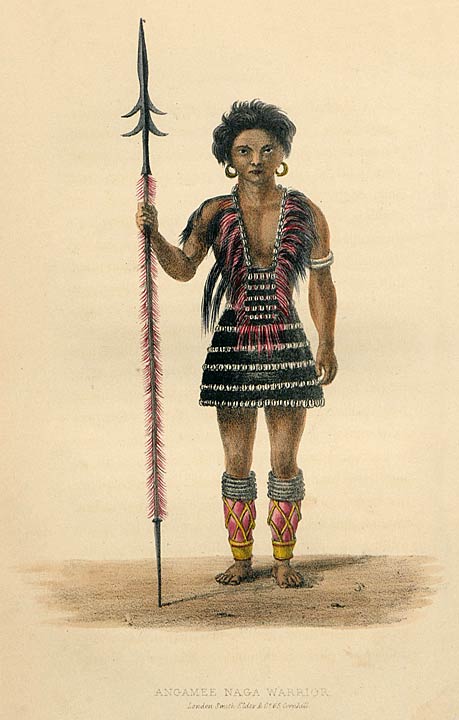
ANGAMEE NAGA WARRIOR.
London Smith Elder & Co 65, Cornhill.
“In the world I am the most powerful and courageous; there is none equal to me. I am the greatest of all men. No one” (pointing to the skulls of his enemies) “can perform such deeds. Like to the clouds that thunder and hurl down fire-balls into the water to the destruction of the fish,—like to the tiger who leaps out to seize the deer,—like to the hawk who pounces down on the chickens and carries them off, do I cut up every one, and carry off their heads; and with these weapons” (dashing them together, to produce a clashing noise) “I have killed such and such persons: yes, I have killed them. You know my name. The greatest beast of the forest, the elephant, I first destroy, and after that all other animals too insignificant to mention. Such a hero am I, there is no one equal to me,” &c. &c.
The same scene is enacted for three or four successive days; when the heads being hacked and sufficiently danced about to satiate Naga revenge, they are suspended from the branches of Nahor trees. After this, the ceremony of tattooing the body is performed, and a most severe operation it is. The burnt ashes of a pot are pricked into the skin with the thorns of the cane: a great quantity of blood exudes, and the body swells to a great size. Being previously thrown into a state of stupid intoxication, the patient is left to welter in the dirt and blood for three days, unconscious of his condition. After this operation, the young sprouts of the Bhat-teeta tree being well pounded, are smeared over the wounds, and in the course of twenty-five days the patient is able to resume his avocations; upon which a number of pigs and fowls are killed, and a great feast is given; the heads of the enemies being brought down from the trees and strewed out upon a platform before the populace in the court, or Raj Moorung. For a whole month from the day of the massacre, the Nagas daily sing the war song quoted above, and dance and manifest the greatest excitement and delight.
All villages are not entitled to the honour of retaining the heads of their enemies; they must be kept in the village of the Khonbao.
In some Naga villages it is the custom, for a man who has committed murder in cutting off the head of a foreigner, to be joined by ten or a dozen Nagas in submitting to the operation of tattooing; which in such cases is an indispensable ceremony. The tattooing is pricked round the calves of the legs in ten or twelve rings or circles interspersed with dots; the thighs, the breast, the neck, the fingers, the back of the hand, the arms, the forehead, and nose, the vicinity of the eyes and the ears being similarly decorated. The poorest Naga peasant deems it an honour to have his body thus embellished with stripes, figures, and dots; and the omission of the ceremony would entail on him eternal disgrace and censure. Indeed, the tattooing determines the character and consequence of the individual; for by certain marks on one arm it is apparent that he has killed a man; when both arms and body are scarred he is known to have murdered two individuals; and when the face and eye-sockets are indelibly impressed with the tattoo, he stands proclaimed the assassin of three of his fellow-creatures, and is thenceforth esteemed a valiant warrior.
On the question being once put to the Nagas whether they would like to become the subjects of the Company, they promptly replied,—“No: we could not then cut off the heads of men and attain renown as warriors, bearing the honourable marks of our valour on our bodies and faces.”
If a Naga happens to be suddenly surprised, and cut off by the inhabitants of a neighbouring village, his corpse is quickly taken up by his friends and placed on a platform in the jungles near the road. At the expiration of three or four days they perform some ceremonies, and wait till a favourable opportunity occurs for avenging his death. The purpose is never relinquished, though its execution may unavoidably be tardy: by day and night they lie in ambush in the jungle, or on the plains near the roads, till they can pounce upon some unwary individual of the enemy. His murder is then communicated to his friends in a singular way. Forty or fifty Nagas, armed with wooden clubs, strike a large hollow piece of wood called a tomkhong, from which a loud, terrific sound proceeds, which gives token to the enemy that one of their tribe has died in acquittance of the debt of revenge. To such an extent does this vindictive spirit prevail, that the Nagas will wait for two or three generations devising plans for decapitating a member of a tribe who has murdered one of their clan; and when the opportunity of vengeance offers, they are sure to take advantage of it, regardless of the personal innocence of the man whom they select as the victim of their fury. The death of the victim is hailed with dance and song, and the liveliest demonstrations of joy: even the old men, women, and children seem in raptures at the announcement of the joyful tidings that their tribe has succeeded in taking revenge.
Naga Customs from Childhood until Marriage.
Ten days after the birth of a child the hair of the infant is shorn off, and the parents perform several ceremonies, inviting all their friends to a grand feast, on which occasion the child is named. On proceeding to field work the mother ties the child to her back, and whilst at work the infant is placed on the ground. When the child is about a year old it is left at home in the village, and the parents pursue their avocations unattended by their little charge. At the age of five or six years, some of the Nagas wear a lungtee (a small piece of cloth) round the waist. On attaining the age of nine or ten years the boy is called a Moorungea, and from that time no longer resides with his parents, but, with all the youths of the village, takes up his abode at the Moorung, a large building set apart for this especial purpose. The parents, however, still continue to provide him with food, and he is obedient to their will, assisting them in cultivating their fields. He carries a sword and spear, and wears the Naga habiliments. At fifteen or sixteen years of age he begins to be dissatisfied with his existence in the Moorung, and makes arrangements for taking a wife; generally selecting a cousin, the daughter of his mother’s brother. On these occasions the parents collect as much rice and liquor, and as many cows and buffaloes, as their means will admit. The girls all live together, like the boys, in a separate Moorung or house allotted for them; sometimes they reside in a house in which a corpse is kept, probably from the greater sanctity such an inmate would confer on their habitation. The youth is not restricted from visiting the damsel of his choice, and he adopts a well understood stratagem to ascertain her sentiments regarding himself. Whilst he is talking to her companion, he carelessly puts down his pipe, and narrowly watches her actions. If the damsel entertains any regard for him she instantly takes up his pipe and smokes it; from that moment the youth is satisfied of his conquest, and hastens to communicate the result to his parents, who arrange matters with the girl’s relatives. Presents of ornaments are sent for the girl, which she immediately wears; and an offering of liquor and tumbool pan (or betel nut leaf) to chew, being accepted by her parents, the marriage is decided on. After this, cows, buffaloes, rice, and liquor are forwarded to the house of the intended bride, and all her relations and friends are invited to a grand feast. An old Deodhunee (or priestess) accompanies the youth to the party with a basket of ginger, and the youth then addresses the chosen damsel, thus:—“This day I take you to be my wife. I will not desert you, neither will I take another; eat this ginger in pledge thereof—henceforth we are husband and wife.” The woman on this eats a bit of the ginger, and then the youth sits down; whereupon the girl, in the same strain, taking up a piece of ginger, says—“I am your wife, and you are my husband, and I will obey you as such. I will not take another husband, for we are husband and wife; in token of which you will eat this ginger.” The marriage ceremony being thus concluded, the youth, after partaking of the feast, returns home to his parents, and in the evening his wife joins him with baskets of food for her husband’s parents and his brothers’ wives. She thenceforth resides with her husband. From that day the husband ceases to abide at the Moorung, and after the lapse of two or three days, according to the village roll, takes his tour of guard duty at the Moorung. From the day of his marriage he commences the preparation of a separate house, upon the completion of which, in a few months, he quits the parental roof. Some Nagas will, however, continue to cultivate the land, and share the produce of their labour with those of their parents; but on the birth of a child the families separate.
Amongst the Nagas, marriage is contracted with near relatives, such as cousins, in preference to other women. A widow, having no children, cannot marry a stranger, but must marry her late husband’s brother; and if he happens to be a mere boy, she will still live with him as his wife; nor can the boy take another damsel: he must marry his brother’s widow. The custom is one of great antiquity, and apparently cannot be infringed. If the widow has one or two children she cannot marry again, but must remain in her own house. No Naga marries more than one wife, and if she dies he is at liberty to marry again.
The crimes of adultery and seduction are treated with the utmost severity: the offenders are brought before the Khonbao and the people assembled to investigate the offence; on proof of which, the Khonbao, or his Ticklah, decapitates the man in a conspicuous part of the road, between two or three villages; or he is tied with cane cords to a tree and there crucified. In some clans it is the practice to deprive both the seducer and seduced of their lives; in others, the former is placed in a basket, his hands and feet tied together, and he is rolled many times from the summit of a hill until life be extinct.
Funeral Ceremonies.
The Nagas consider sudden death as particularly unfortunate: even if a person dies after one or two months’ sickness, the period is still deemed too short to be lucky; and his corpse is instantly removed and placed in the jungles on a platform four or five feet high, where it is left to decay. For three or four days after a death, the relatives do not leave the village; neither do other villagers resort to the village in which death has occurred during the same period. If a person dies who has been afflicted with a long illness, a platform is raised within his house, and the corpse being folded in clothes is placed thereon. By night and day the corpse is watched with great care, and as soon as it begins to decompose, large quantities of spirituous liquor are thrown over it; and whatever the deceased was in the habit of eating and drinking in his lifetime (such as rice, vegetables, and liquor) is placed once a month on the ground before the body. The virtues of the deceased are frequently rehearsed; the heirs and relatives throw themselves on the earth, and make great lamentations for many months after the death has occurred. At the expiration of the period of mourning, a great feast of liquor, rice, buffaloes’ and cows’ flesh is prepared by the survivors; and an immense number of people, armed with their swords and spears, and dressed in the most fantastical garb, as if preparing for a war expedition, are assembled to partake of it. They commence the festival by repeating the name of the deceased, singing many kinds of songs, dancing and cursing the deity or spirit in these words: “If to-day we could see you, we would with these swords and spears kill you. Yes, we would eat your flesh! yes, we would drink your blood! yes, we would burn your bones in the fire! You have slain our relative. Where have you fled to? Why did you kill our friend? Show yourself now, and we shall see what your strength is. Come quickly,—to-day, and we shall see you with our eyes, and with our swords cut you in pieces, and eat you raw. Let us see how sharp your sword is, and with it we will kill you. Look at our spears, see how sharp they are: with them we will spear you. Whither now art thou fled? Than thou, spirit, who destroyest our friends in our absence, we have no greater enemy. Where are you now?—whither hast thou fled?”
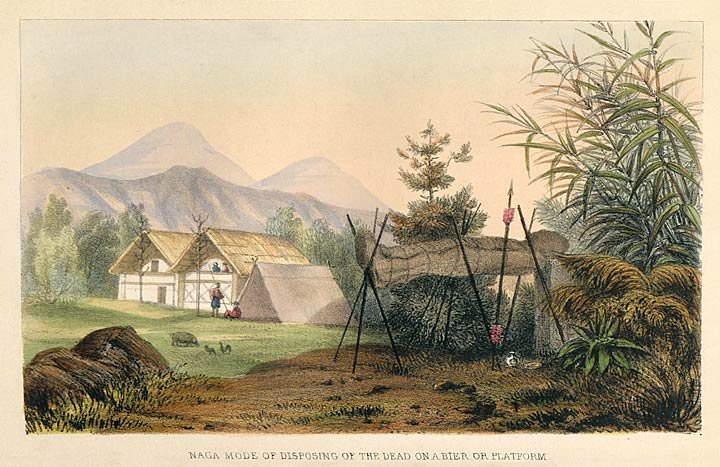
NAGA MODE OF DISPOSING OF THE DEAD ON A BIER OR PLATFORM.
With these and similar speeches and songs, they clash their swords and weapons together, dance, and eat and drink throughout the night. On the following day the corpse is folded up in a cloth and placed on a new platform four or five feet high; and the whole of his weapons, swords, spears, panjees choonga (hollow bamboo joint, for holding water), rice-dish,—in fact everything used by the deceased in his lifetime, is now arranged round his bier, which is held sacred: no one would dare to touch a single thing thus consecrated. After this ceremony is concluded, the whole of the party disperse to their respective homes.
On the death of the Namsungea Khonbao, who, it is said, was one hundred and twenty years of age, his corpse was removed in December 1843, and according to an ancient custom, a tusk elephant was purchased from the Muttuck Bur Gohain, and killed, with three hundred buffaloes and pigs; when the Nagas enjoyed a magnificent feast. The usual practice of reviling the deity, while singing and dancing, was kept up with uncommon fervor, and the bacchanalian scene has perhaps seldom been exceeded. The heads of the slaughtered animals were suspended round the platform within a large enclosure, and the corpse was strewed over with an abundant supply of all kinds of forest flowers.
Theft is held in great abhorrence amongst the Nagas, and is consequently so rare that they leave everything exposed in the open fields. If any person is detected in committing the offence no mercy is shown: the Khonbao pronounces sentence of decapitation without a moment’s hesitation. The Nagas are remarkable for simplicity, candour, and integrity; even the comparatively small vice of lying, to which the natives of British India are so seriously and universally addicted, is unknown among them, and will probably continue so until they have been corrupted by their more enlightened neighbours, the Assamese, or by the advance of civilization, refined arts, and manners. The Nagas have no names for the days of the week, and know not their own ages. Summer and winter are the only divisions of the year they recognise, distinguishing them as dry and wet seasons of six months’ each. Time is counted by the moon, or by the number of crops they can recollect reaping. They believe in a God or Spirit called Rungkuttuck Rung, who created the earth and all things, but they have no hope of future rewards, nor any fear of punishment hereafter; neither do they believe in a future state of existence.
For the above information we are indebted to Bhog Chund, who is the son of a West Countryman of the Khetree caste, by an Assamese mother, and having lived many years amongst the Nagas, is thoroughly acquainted with them. He is now a resident and industrious cultivator in the plains. He reads and writes Assamese, and is a most straightforward character. He would be an invaluable companion and guide in travelling through the Naga territory.
I do not vouch for the correctness of the list of the Naga tribe inserted in a later page, but in the absence of more authentic details, it may be deemed worthy of consideration. The present account of the tribes is confined to the Nagas of Upper Assam; but it is supposed that very similar customs and habits prevail amongst those of central Assam. The Nagas bordering immediately on the plains are, for the most part, amicably disposed towards the British Government; and those on the Patkoe range have shown a desire for our protection against the marauding Singphoos. The Nagas residing on the hills most remote from the valley are said to be fine, stout, athletic men, of fair complexions; and unencumbered with the smallest strip of covering in the shape of clothing for any part of the body.
In 1842–43, the Namsangea, Bordoareah, and Borkhoormah Nagas invited a party of the Khetree to visit them as friends, but when they got them into their power they treacherously massacred twenty-four persons. Thageng, one of the Khetree party, being only wounded, fled and communicated the catastrophe to his tribe, who at the sight of his wounds prepared for revenge; and in a short time they were successful against the Nagas. The Khetrees, being ignorant of the Assamese language, were unable to pass through the territory of their enemies to report their grievances to the British authorities at Jeypoor. They accordingly went to Tomkhoomana, and lying in ambush, surprised and cut off the heads of twelve men of the Borkhoormah tribe, in revenge for the murdered of their own tribe. Upon this the civil authorities proceeded to the village of the Khetrees to endeavour to put a stop to these atrocious assassinations, but unfortunately the Namsangea and Bordoareah Nagas, contrary to strict injunctions, persisted in following in the wake of the British embassy of peace. The Khetrees perceiving the advance of their enemies, placed in the road a small basket of ginger kuchoos and a spear, as a token of submission to the British Government, but loudly protested from the summit of their hills against a visit being made to their village; dreading, as they did, the vengeance of the Namsangea and Bordoareah Nagas. The interpreter, Bhog Chund, who accompanied the party, entreated the Khetrees to remain quiet in their village, and to listen to terms of peace; but they indignantly rejected the offer, and threw down stones, and discharged a volley of spears, upon the advancing embassy. This being returned by a few rounds of musketry in self-defence, the Khetrees fled from their village to the neighbouring inaccessible hill fastnesses. The Namsangea and Bordoareah Nagas perceiving this, instantly rushed into the deserted village, slaughtered all the cows, pigs, and fowls, and burnt every house to the ground. After this untoward event a retreat was necessary, for the Khetrees came upon the party, throwing down stones and spears from their hills. A Sepahee having loitered in the rear, was speared to death, and his head and hands cut off and triumphantly stuck up on bamboos: the head in the village of Najoo, and the hands in Khoekting. After some difficulty the little detachment was extricated from its perilous position, and retreated in safety. Shortly after this lamentable affair, a larger military detachment was sent out; but to the present time an amicable settlement has been impracticable. Almost immediately after the last expedition, the Khetrees cut off the heads of eight men of the village of Bulatin; from which we may infer that their animosity continues unappeased, and that there is little hope of these savages being speedily brought to a sense of the advantages attending a reconciliation. Our intercession might be effectual for a time; but it is more than probable that it would be incompatible with a Naga’s sense of honour to forego his greatest delight—revenge.
From the figured statement obtained from native authority, it would appear that there are one hundred and four Naga villages in Upper Assam, containing eleven thousand and ninety-five houses, with a population of forty-eight thousand five hundred and eighty-eight persons; but this estimate is probably erroneous. We shall perhaps be nearer the truth, if, assuming the number of houses to be correctly stated, we allow three persons for every dwelling: this gives a census of thirty-three thousand two hundred and eighty-five souls—a closer approximation to the apparent population.
LIST OF THE NAGA TRIBE.
No. of Villages. Names of Villages. No. of Houses. No. of Persons. Remarks.
1 Bur Dovar 250 1000
2 Namsang 160 520
3 Kea Mae 140 500
4 Poolung 120 420 Three villages of
5 Panee Dooar 160 520 this name
6 Choongpon 140 500
7 Khamgin 120 420
8 Kokil 100 400
9 Gophcha 70 280
10 Topee 50 200
11 Hungkal 80 320
12 Dadum 250 1000
13 Nerung 200 800
14 Bako 300 1200
15 Kekhyah 200 800
16 Nahoah 180 720
17 Nahoo 220 880
18 Khoncha 50 200
19 Lootong 50 200
20 Kotong 70 280
21 Nokphan 80 167
22 Choupcha 120 480
23 Choupnon 180 567
24 Runow 200 800
25 Rucha 60 140
26 Changnee 220 880
27 Changeha 160 567
28 Pokum 80 167
29 Loknean 80 167
30 Changnoege 360 1340
31 Changcha 120 480
32 Mangnoe 120 480
33 Mangcha 60 167
34 Picktoo 80 320
35 Pickta 55 220
36 Nakma 70 200
37 Moolong 90 263
38 Bhetur Namsang 120 480 Entirely naked
39 Now Gawn 160 540
40 Kangchang 100 415
41 Dekahnoe Moong 140 520
42 Borachaemoong 150 540
43 Chamcha 60 180
44 Achuringea 70 220
45 Toormoong 120 480
46 Jamee 100 400
47 Moloo Thopea 500 4000
48 Akhoea 270 2020
49 Pocho 120 480
50 Bor Langee 150 550
51 Soro Langee 100 400
52 Bhuga Langee 120 480
53 Chenajow 150 560
54 Boora Gaea 150 550
55 Bur Dorea 150 540
56 Kula Barea 200 800
57 Soroo Durea1 20 470
Nagas east of the Namsang River subject to the Political Agent, Upper Assam.
No. of Villages. Names of Villages. No. of Houses. No. of Persons. Remarks.
1 Khetree Gawn 110 440
2 Khena 80 180
3 Bottin 60 120
4 Namcha 70 140
5 Mooktong 90 240
6 Hakhoom 80 280
7 Konagaun 150 550
8 Khatung 40 190
9 Jankung 60 420
10 Ken Noean 50 200
11 Naktung 60 240
12 Lalrung 60 240
13 Koonum 80 330
14 Kootung 70 340
15 Mooaloo 120 480
16 Moacha 80 320
17 Tejhon 80 280
18 Chomjoo 90 320
19 Somcha 60 240
20 Kambao 100 400
21 Langchang 100 400
22 Sooroomungchang 60 240
23 Noanangchang 50 200
24 Tikhak 50 200
25 Gudie 60 240
26 Manbao 110 440
27 Eahung 110 400
28 Mookkhoop 110 400
29 Mookpe 120 480
30 Mookcha 90 360
31 Loongke 100 400
32 Namnie 220 880 On or near the
33 Namcha 130 520 Patkoe range.
34 Keme, No. 1 120 440 ditto.
35 Keme, No. 2 120 480 ditto.
36 Kintoonie 100 400 ditto.
37 Mookrung 120 480
38 Joopee 50 200
39 Doedam 70 280
40 Noakhoorma 50 200
41 Chobang 50 200
42 Chilim 40 160
43 Bachowuk 50 200
44 Moung 60 240
45 Hadoot 80 260
46 Kaeah 90 300
47 Kaejou 110 440
Total 3,000 15,398
Total of Statement No. 1 8,095 33,190
Grand Total 11,095 48,588
GARROWS.
Of all the hill tribes bordering on the Assam valley, north or south, the Garrows near Goalparah, though not lofty in stature, are endowed with the most powerful herculean frames. The expression of their countenances is savage, and their complexion exceedingly black. In conversation they are loud, and remarkable for asperity. Passing through Lookee Dooar to the Jeypore stockade, at the foot of the Garrow hills, I met with many Garrows who reside on the low hills bordering Assam, and learned that they were frequently in great danger from the highland Garrows; who, feeling secure in their mountain fastnesses, made occasional incursions into the territory of the former, and committed acts of violence upon the British subjects located in the plains.
A savage custom exists amongst the Garrows, of commemorating the death of their relatives by massacring our inoffensive subjects whenever they can do so with impunity; whether in open day, in ambush, or by a sudden night attack in overwhelming numbers. In this respect they resemble other tribes of which we have already treated. At their festive meetings it is said the Garrows are guilty of great excesses in imbibing spirituous liquors. A dried excavated gourd, which does duty for a bottle, and holds about one quart and a half, is filled with an intoxicating liquor distilled from rice: this, at their jovial parties, is presented to each person, whose nose being seized, the gourd is applied to the mouth till the individual is perfectly satiated, or falls prostrate in a fit of intoxication. After this, the toper is immersed in a pool of water, or the river, that the temperature of the body may be cooled. In the choice of food few things come amiss to a Garrow palate. For example, a dog fed with rice and then roasted alive, is esteemed one of the most exquisite dainties. Every description of meat is consumed, even when perfectly putrid. Singularly enough, however, milk is considered unwholesome, and is never drank.
The Garrow women are remarkably coarse and ugly, with very dark complexions. They wear scarcely any articles of cloth covering, but, in common with most savages, they are particularly fond of showy ornaments. Their necks are adorned with a profusion of coloured glass beads; and if the lobe of the ear can only be distended to the shoulders by the weight of ear-rings, they consider that they have succeeded in rendering themselves peculiarly attractive. The Garrows to this day are independent of our rule, and are, therefore, free from any tax on their cultivation.
An immense quantity of cotton is grown on their hills. This, until 1843, was subject to a tax paid by the purchaser to Government, at the market, where the Garrows bring down their cotton for sale; but, owing to the mal-practices of the native collectors appointed to receive the customs, little profit accrued to Government after the expenses of the establishment had been paid. For the encouragement of trade and a freer intercourse with our people, the customs have lately been entirely abolished; but it is supposed that a plan for the assessment of the whole of the Garrow cultivation will, if possible, shortly be adopted. The climate of the Garrow hills, however, offers a serious obstacle to this measure; for, according to our present information, no European constitution could endure a lengthened residence amongst them; and without the constant presence of a British officer, armed with authority to arrange their affairs, neither the advancement of civilization, nor the realization of a revenue sufficient to defray the expense of retaining and settling the country, could be accomplished. It is supposed that a lac of rupees, or ten thousand pounds sterling, might annually be raised from the land; but our knowledge of the country and the resources of the people is so limited, that this estimate cannot be relied on. Moreover, from the known aversion of the Garrows to any sort of taxation, the undertaking can only be rendered successful by the presence of a large body of British troops; to whom the sword, spear, and poisoned arrows of the savages could offer but little effectual resistance.
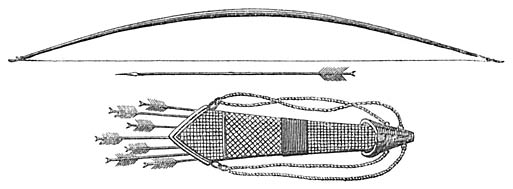
Garrow Bow and Arrows.
COSSEAHS.
This tribe, although near neighbours of the Garrows, are unlike them in personal appearance. They are an athletic race, but by no means fond of more occupation than will suffice to give them a bare subsistence. This gained, their lives are passed in fishing, bird catching, and hunting, merely by way of pastime. Like all savages, they are untrustworthy.
In the year 1829 at Nuncklow, Lieutenants Beddingfield and Burlton were, by the Cosseah Rajah’s order, barbarously massacred. A regular war ensued; consequent on which Rajah Teeruth Singh was deprived of the district of Bur Dooar, and the Rajah of Pantam having joined the Cosseahs, his district was also sequestrated. At this period, no protecting force being at hand, the Garrows joined the Cosseahs and invaded the districts of Bur Dooar and Pantam, accompanied by the people, who were compelled to join the insurrection. The movement, however, was quickly suppressed by military detachments. Since then the Cosseahs have been vigilantly watched by the Sylhet Light Infantry, stationed at Chirrapoonjie.
In the Cosseah hills a large supply of potatoes is annually raised and sold in the Gowahatty market, realizing to the Cosseahs no inconsiderable profit. The effect of this traffic being to promote a more frequent intercourse with the people of the plains, it is hoped that in course of time the Cosseahs may learn the value of peaceable commercial pursuits, and become a prosperous and civilized race.
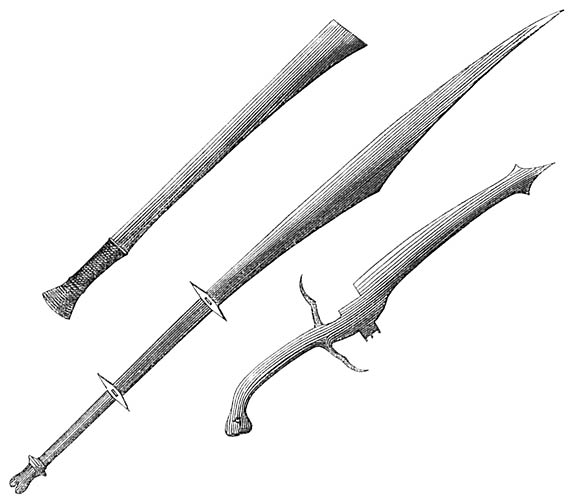
Singphoo, Cosseah, and Garrow swords.
BOOTEAHS.
The hills of Bootan, about two hundred and twenty miles long by ninety broad, form the northern boundary of Assam. The population of the country, including the Dooars, is assumed at 145,200 souls, the Bootan hills 79,200, and the Dooars or low lands at 66,000; but this calculation, made by the late Captain Pemberton, has been proved to be greatly in excess of the truth, as regards the population of the Dooars. In 1842 a census was taken of five Dooars: namely, Ghurkola, Banska, Chapagorie, Chapakhamar, and Bijnee, in the Kamroop district; when it appeared there were about 10,000 inhabitants, and the net revenue of the tracts amounted to 17,544 rupees 7 ans. 4 pice, or 1,754l. 8s. 11d. It may, therefore, justly be inferred that the population of the whole of the Dooars would not exceed 40,000 souls. Captain Pemberton, the British Envoy deputed to Bootan in 1838, describes the Booteah to be “in disposition naturally excellent; he possesses an equanimity of temper almost bordering on apathy, and he is seldom sufficiently roused to give vent to his feelings in any exclamations of pleasure or surprise; on the other hand, they are indolent to an extreme degree, totally wanting in energy, illiterate, immoral, and victims of the most unqualified superstition. The punishment of the most heinous offences may be evaded by the payment of a fine, which for murder varies from eighty to two hundred Deba rupees, or 40 to 100 Company’s rupees, or from 4l. to 10l.”
Polyandry, or plurality of husbands, prevails throughout Thibet and the northern parts of Bootan; and on the death of the head of a family his property becomes escheated to the Deba or Dhurma Rajahs, without the slightest reference to the distress entailed on the afflicted survivors. “The highest officers of state in Bootan are shameless beggars, liars of the first magnitude, whose most solemnly pledged words are violated without the slightest hesitation; who enter into engagements which they have not the most distant intention of fulfilling; who play the bully and sycophant with equal readiness, and are apparently totally void of gratitude, exhibiting in their conduct a rare compound of official pride and presumption with the low cunning of needy mediocrity; and yet preserving, at the same time, a mild deportment, and speaking generally in a remarkably low tone of voice.”
Amongst the officers of the Deba or Dhurma Rajahs of Bootan, not one appears to have been entitled to the confidence of the Envoy. The habits of all classes are most disgustingly filthy, and in the mode of preparing their food little attention is paid to cleanliness, and still less to the quality of the meat they consume. On festive occasions they imbibe large draughts of the liquor called chong, which is procured by fermentation from rice. “The diet of the great body of the people is restricted to the refuse of wretched crops of unripe wheat and barley, and their food consists generally of cakes made from these grains very imperfectly ground; but the food of the Government officers and priests consists of the flesh of goats, swine, cattle, and rice, imported from the Dooars.” The Dooars are large tracts of country leading up to the passes into the Bootan mountains. In January, 1842, they were all appropriated by our Government as a permanent measure; in consequence of the non-payment of tribute by the Booteahs, their “repeated acts of aggression in the murder and seizure of British subjects, and likewise for assisting to organize bands of robbers and sharing in the profits of their plunder.” Whether the Bootan hills will furnish a sufficient support for their scanty population seems problematical; and if pressed by hunger it is not improbable the Booteahs will rush down and ravage the fertile plains of Assam. The measure was, however, indispensably necessary to prevent the frequent recurrence of oppression and systematic plunder of the people located at the foot of the Bootan mountains. The extensive territory denominated Dooars has always belonged to the Assam kings, and the Booteahs invariably paid tribute for the same. Their exactions and malpractices having imposed on the Government the necessity of depriving the Booteahs of a charge they were unworthy of retaining, this cannot be viewed as a harsh proceeding: it was most reluctantly adopted, and only when it became evident that the finest land in Assam had been converted into a desolate waste, overgrown with jungle and nearly depopulated, owing to the arbitrary severity of the Bootan rulers.
In December, 1842, a friendly meeting took place at Banska Dooar between the highest officers of the Bootan Government and the Governor-General’s Agent. The Booteahs were attended by about two hundred followers; and during their few days’ stay their complaints were fully entertained, and will probably be satisfied by the grant of a small annual sum as compensation for the loss they have sustained in the annexation of the Dooars to Assam.
During the interview the Booteahs were plentifully supplied with swine, the most acceptable gifts that can be offered to a Booteah; and an officer who was present on the occasion assured me that the incessant squeaking of the pigs, when roasting alive by these heartless barbarians, was most distressing, and the sight of the culinary process excessively disgusting. As soon as the animals had been partially roasted they were cut up, and, without any further preparation, re-toasted and speedily consumed.
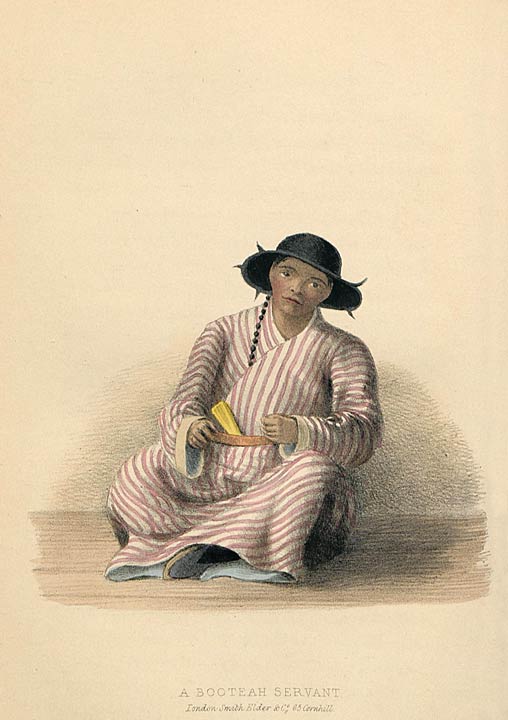
A BOOTEAH SERVANT.
London Smith Elder & Co 65, Cornhill.
The Booteah is a large, athletic man, of a dark complexion, with an unpleasant, heavy, but cunning countenance. Compared with other hill tribes in their neighbourhood, they are deficient in spirit and bravery. For example, in March 1836, A.D., a party of seventy-five Assam Sebundy Sipahees proceeded against six hundred Booteahs, who were posted in five masses, with a few men extended between each, at Soobunkatta, in Banska Dooar. When the Dewangerie Rajah was requested to retire with his troops; they answered the requisition with shouts of defiance and a simultaneous advance. Lieut. Matthews, perceiving the critical situation in which his little band was placed, instantly advanced to the contest, and, firing a volley and then gallantly charging with the bayonet, caused the immediate dispersion of the whole force, leaving on the field twenty-five killed and fifty wounded. The Dewangerie Rajah himself was closely pursued, and only escaped through the swiftness of the elephant on which he was mounted; his tent, baggage, robes of state, and standards, fell into the hands of the victorious Sebundies.
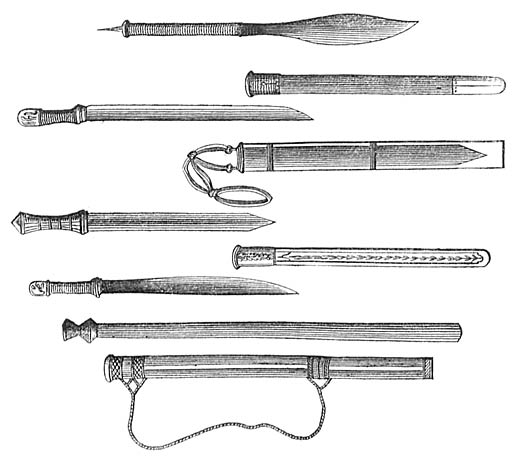
Booteah Weapons.
This trial of strength with our disciplined troops has taught the Booteahs to pay more respect to our power; and they are not likely to have recourse to arms again, unless greatly distressed for provisions, or urged by vain arrogance to imagine that a show of resistance may conduce to our resigning the Dooars to their rule.
SATH BOOTEAH RAJAHS OF KOOREAHPARAH DOOAH, IN DURRUNG.
Having given a brief outline of the Booteahs of Banska Dooar in Kamroop, we propose now to detail a few authenticated facts and incidents connected with the remaining tribes noted above; who are located in the northern mountains between the Bur Nuddee west and the Kochoojan east, bordering on the Luckimpore district, north of the Burrampooter river.
And first commencing from the Bur Nuddee west, we find the Kalling and Booree Goorma Dooars belonged, for eight months in the year, to the Booteahs subject to the Tongso Pilo, under the Deba and Dhurma Rajahs of Bootan; during which time they levied upon the people contributions, or black mail, in the shape of rice, Erea cloths, and cattle. During the remaining portion of the year, from the 15th of June to the 15th of October, the people of the Dooars reverted to the jurisdiction of the British Government; and for the protection granted to them they paid an annual revenue, at a certain rate per plough. A hearth tax was likewise realized. But this double rule was attended with the most disastrous results. No man under the tyrannical Booteah Government dared evince signs of affluence, or even of comfort: the people were compelled, for their self-preservation, to dress in the miserable garb of the lowest Hindoo peasantry; for the mere suspicion of a person being possessed of any wealth, entailed on him the strictest espionage, and not unfrequently the seizure of the whole of his property. Not satisfied with this, if the slightest idea were entertained that there was money or other valuable property concealed (for it is the custom of the Assamese to bury their wealth underground), torture was resorted to without the slightest compunction, until the unfortunate sufferer confessed to having a hoard, and surrendered the little savings of a whole life to his merciless persecutors.
Such was the condition of the inhabitants of the Dooars till 1838: hundreds annually retreated to the Pergunnahs (districts) of Assam under British rule, to enjoy the fruit of their labours in peace and safety. The beautiful, fertile Dooars were then rapidly reverting to a barren wilderness: fearful exactions and cruel oppressions rendering the existence of the few remaining communities precarious and unendurable; until an unlooked for incident occurred to deliver the people from the thraldom of their demi-savage rulers. Gumbhur Wuzeer having long been suspected by the Booteahs of disaffection towards them, and of possessing great wealth, the Tongso Pilo of Bootan, through the Soobah Rajah, gave orders for his destruction; and in December, 1838, he was barbarously murdered. The whole of his property, amounting to 50,000 rupees, was confiscated, and his wives, children, and adherents, in all twelve persons, were carried away into the hills.
This outrage justly aroused the British Government to redress the grievances of a long oppressed people. The Dooar was immediately attached to Assam; and the Booteahs have never, to this day, sought pecuniary compensation for the loss of their territory. The son of the late Gumbheer Wuzeer was permitted to return to Assam in 1844, and resume the fiscal charge of his father’s villages; and ere long, probably, the Booteahs of this tract will see the folly of their past conduct, and be glad to accept such compensation as the Government may be disposed to make them for the privation of their power to levy black mail from the people. The annual tribute realized from Kalling Dooar previous to its annexation, amounted to 390 rupees, and was collected in the following articles:—
Rupees.
5 ponies valued at 60 rupees each 300
5 tolas weight of gold, at 12 rupees per tola 60
4 pods of musk, at 3 rupees each 12
4 cows’ tails, at 1 rupee 4
4 blankets at 3 rupees each 12
4 daggers, at 8 annas each 2
Total rs. 390
From Booree Gooma Dooar the tribute of 232 rs. 10 ans. 8 pice was also paid in kind, viz:—
Rupees.
3 ponies, at 6 rupees each 180
3 tolas of gold 36
2 pods of musk 6
2 cows’ tails 2
2 blankets 6
2 daggers 1
Bags 1
At the present day the net revenue of Kalling Dooar amounts to 2080 rs. 0 ans. 4 pice, with a population of 1634 persons. Booree Gooma Dooar is estimated to contain 7785 souls, with a net revenue of 5348 rs. 5 ans. 3 pice.
Proceeding eastwards from Booree Gooma Dooar, the next Dooar, called Kooreahparah, is under the Sath Booteah Rajahs of Naregooma, subject to the Towung Rajah, who is a tributary of the Deba and Dhurma Rajahs of Lassah.
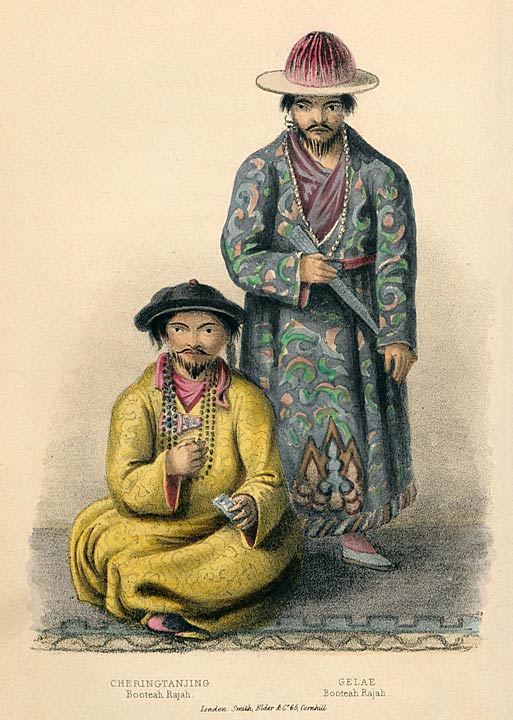
CHERINGTANJING. GELAE.
Booteah Rajah. Booteah Rajah.
London: Smith, Elder & Co. 65, Cornhill.
The country of Towung being in Kumpa or Thibet, quite distinct from Bootan, south of the Sampoo river, it appears that a portion of the Thibet territory, or more properly the Chinese and British frontiers, are actually in immediate contact in the Kooreahparah Dooar, about twenty miles from the Burrampooter river. This Dooar, as we have said, was governed by these chiefs eight months in every year. During this period, the seven Rajahs paid periodical visits to the Dooar, and let loose many hundreds of their followers to range throughout the Dooars, and quarter themselves gratuitously upon the people: changing from house to house until they had consumed all the food the poor Ryots had to give them. The Sath Rajahs had usually a caravan of large herds of ponies, mules, &c., as far as Umerathal, one march from Oodalgorie. On their arrival there, the inhabitants of the Dooar were compelled to take care of the cattle, and be in constant attendance on the Rajahs, furnishing them with supplies of rice, cloths, spirits, pigs, &c.; and at the approach of the hot months, the ponies, mules, and donkeys were laden with the whole of the collections levied from the people of the Dooar, and the chiefs retreated to the mountains at Nareegooma.
Such was the annual visitation to which the people were subjected the moment the four months of British rule expired. A gradual decrease of the population of the Dooar was the natural result of this tyranny; but the grasping oppression of the Booteahs underwent no diminution. They made no remission on account of the decay of the population: the same amount of collections was still drawn from the remaining Ryots. The country became overgrown with jungle, and the malaria of these plains was so injurious to the constitutions of Bengalees or Europeans, that the tract could not be visited with impunity for above a few weeks in the year. The fevers were most fatal, and life was frequently extinguished in four or five days. Thieves, highway robbers, and murderers here sought and found a safe asylum under the shadow of Booteah rule, by administering to the rapacity of the chiefs. They surrendered a portion of their ill-gotten wealth in the shape of fines for the protection given them, in opposition to treaties and the laws of civilized nations.
Such was the state of affairs, when, to the unspeakable delight of the inhabitants, the Dooar was attached by the British Government in 1839. A police thannah was established at Oodalgorie, British law was enforced, marauders and disturbers of society were quickly suppressed, and at the present day a prosperous population has again sprung up; only too thankful that they can enjoy the produce of the land in peace and safety, under a powerful Government capable of protecting them from the aggressions and exactions of the wild mountaineers. The contributions taken in kind from each house by the Booteahs consisted of five pieces of Moonjah silk, sar cloth, one piece of Erea cloth, one gumcha or handkerchief, Moonjah thread, and metal bracelets, worth altogether about one rupee and a half. Such, at least, was the estimate made by the late Mr. David Scott, the Agent to the Governor-General. But there can be no doubt that the Booteahs were in the habit of exacting as much as possible from the most wealthy in the Dooar, though from the poorest peasant they might have collected their black mail upon some settled principle. In this manner the sum annually collected would vary; but we have reason to believe that 5,499 rs. 15 ans. was the average sum levied on the Ryots in the shape of contributions in kind, and 411 rs. 13 ans. in black mail or ready cash.
The Booteahs, it is affirmed, yearly brought down presents of various articles, such as salt, blankets, &c., which they gave to the Ryots. These presents were valued at 966 rs. 15 ans., which being deducted from the supposed amount of the value of the contributions above noticed, the Sath Rajahs, it would appear, received 4944 rs. 13 ans. Upon this data, in 1844, a permanent settlement was made with these chiefs. They agreed to resign all claim or title to collect black mail in the said Dooar for the future, on condition of receiving 5000 rs. from the British Government as compensation for the sacrifice they made. The tribute paid in kind from this Dooar, previous to its attachment in 1839, amounted to 397 rs. 8 ans., namely:—
Rs. Ans.
4 ponies at 60 rs. each 240 0
5 pucka tolahs of gold 60 0
4 kucha tolahs 40 0
3 pods of musk 9 0
Cows’ tails 3 0
9 blankets 27 0
Bags 2 8
3 red striped Erea cloths 3 0
Honey 3 12
Contingencies for the care of the ponies 7 8
The principal persons who subscribed to the treaty of February, 1844, at Tezpore, were Sanjiee, chief of the Sath Rajahs, Sering, Tangjing, Changdundoo, and two Bramee agents from the Towung Rajah. The latter had no credentials empowering them to execute any deed or to agree to any particular terms; but, as the Towung Rajah had never deigned to reply to the communications hitherto made to him, the apparent informality was deemed of no consequence; and, from the very liberal terms proposed, no difficulty was experienced in effecting so desirable a settlement.
The population of the Dooar is estimated to be 22,577 persons, and the net revenue 12,455 rs. 7 ans.
CHAR DOOAR, OR SHEERGAWN AND ROOPRAE BOOTEAH SATH RAJAHS.
The appellation of Sath Rajahs, or Seven Chiefs, appears to be commonly in vogue amongst the Booteahs; but we have yet to learn the origin of its adoption, as the number of chiefs, both in the Kooreahparah and Char Dooars, is by no means confined to seven. The Sath Rajahs of the Char Dooar levied black mail from the people precisely in the same manner as their brethren in the Kooreahparah Dooar. The principal chiefs are the Durjee Rajah Tangpoor, Jyphoo, Dakpah, Sankandoo Sangjaa of Roopre, Chang Wangdundoo, son of the late Rajah Tangjung of Sheergawn. They reside at Sheergawn and Rooprae, about three days’ journey from Dymara pass, by which they descend into Char Dooar. They are quite distinct from the Booteahs of Kooreahparah Dooar, and do not admit that they are subordinate to the Towung Rajah.
These chiefs, until 1839, yearly realised 2526 rs. 7 ans. black mail, exclusive of 416 rs. 8 ans. which was deducted for collecting the contributions from the Ryots in the shape of food, clothing, &c.; but in April, 1839, Moodhoo Sykeah, the Patyhery of Ooorung, having been barbarously murdered by some Booteahs of the above-named clan, they were from that date a proscribed tribe, and prevented from deriving any benefit from the Dooar in collecting black mail. Refusing to give up the murderers, all access to the Dooars was strictly denied them, and they were justly regarded as unworthy of any consideration. They frequently denied having any authority over the murderers, pleaded the hardship of the whole body being made to suffer for the faults of a few individuals, and expressed their extreme regret at having incurred the displeasure of the British Government.
Moodhoo Sykeah’s fate is supposed to have arisen from his attachment to the British Government, and the energy displayed by him in causing the land to be measured, to effect a regular assessment thereof, in lieu of a plough and capitation tax. Such an arrangement was particularly repugnant to the Booteahs, as they imagined it would interfere with the Ryots paying them their black mail; they therefore took vengeance on the promoters of this measure, and Moodhoo Sykeah was cruelly cut to pieces in his own house by Booteahs partaking of his hospitality. Gumbheer Wuzeer had been similarly treated the year before, under suspicion of too great an attachment to the British Government, and a desire to carry out their views. In 1844 the chiefs were permitted to visit Tezpore, and in consideration of the contrition evinced by them, and the uncertainty as to whether the murderers were still in existence, and really belonged to that tribe, Government was pleased to overlook the past, and again to receive them into favour. In lieu of all right or title to collect black mail, compensation to the amount of 1740 rupees per annum was settled upon them.