Front matter (continued 4)
Reading edition
“We’re going to try and hunt up a creamy pup-seal, Harold, and bring it back to camp,” said Nixon; and in the excitement of this quest the still shy boy forgot his nervous qualms.
Fortune favored the expedition. It was now between one and two o’clock in the afternoon. The tide, which had been high at six in the morning and again at twelve, was once more on the ebb, as the two elder scouts rowing in leisurely fashion, turned the Pill’s snub nose into a pearly creek whose shallow water was clear and pellucid, over its sandy bed.
Hardly half a dozen strokes had they taken between bold marshy banks when, from some half-submerged rocks near the head of the creek, they heard a prolonged and dulcet “Oo-oo-oo-ooo” that might have been the call of a dove, save that it was louder.
“Hear him?” cried Leon, shipping his oar in blinking excitement. “That’s our pup-seal, Nix! We’ve got him cornered in this little creek; if he dives, the water is so shallow that we can pick him up from the bottom; and he can’t swim fast enough to get away from us—though as likely as not he won’t want to!”
The last conjecture proved true. The young seal, little more than two months old, which lay sprawled out, a creamy splotch, upon the low reef which the tide was forsaking, with his baby flippers clinging to the wet rock and his little eyes staring unwinkingly into the sunlight, had not the least objection to human company. He welcomed it.
When the scouts rowed up alongside the ledge he suffered Nixon to lift his moist fat body into the boat, where he stretched himself upon the bottom planks in perfect contentment, and took all the caresses which the three boys lavished upon him like any other lazy puppy.
“Isn’t he ‘cunning’, though?” gasped Harold, trying to lift the youthful mammal into his arms, an attempt which failed because he, the weak one of the Owls, was not strong enough to do so without capsizing the Pill—not because the pup-seal objected. “I thought he’d be a kind of whitish color, eh?” appealing diffidently to Leon.
“So he was, when born; his hair is turning darker now, to a dull yellow; by and by it will be a brownish drab. See, Greerie! his spots are beginning to appear!” Leon ran his finger down the seal’s dog-like head and back, already faintly dotted with those round markings which gain for his family the name of the “marbled seal.”
“Isn’t he a ‘sprawly’ pup, and so friendly? The other scouts will be ‘tickled to death’ with him—” Nixon was beginning, when a shadow suddenly fell across the boat and its three occupants, whose attention was entirely upon the young seal.
“Hi, there! You’ll get pocketed in this little creek, you fellows—hung up aground here—if you don’t look out! Can’t you see that the water is leaving you?” cried a harsh voice from the bold marsh-bank which overhung the creek to the right of them, so suddenly that the three jumped.
Looking up, they saw the unkempt figure of a young man, short of stature and showing a hungry leanness about the neck and face. This sudden apparition which had approached noiselessly over the soft marshes, was plainly outlined against the surrounding wildness of salt-marsh and tideway.
Had the little dog-fox which prowled among the moonlit dunes been near, he might have recognized in the shabby figure his brother-prowler of the night before.
Recognition was springing from another source. Starrie Chase caught his breath with such a wild gasp that he rocked the Pill as if a gust had struck it. Something about that stocky figure and in the expression of the face, half wistful, half savage, reminded him overwhelmingly of an old woman whom he had seen issuing, lantern in hand, from her paintless home, and who had raised her trembling arm to her breast at sight of him, Leon.
“Forevermore! it’s Dave Baldwin,” he ejaculated in a whisper audible only to Nixon. “That’s who it is—Nix! ”
“Don’t you see that the tide is leaving you?” snapped the stranger again. “There won’t be a teaspoonful of water in this creek presently.”
He was looking down at the Pill and its occupants, with a gleam in his eyes fugitive and phosphorescent as a marsh-light, which revealed a new expression upon his mud-smeared face, one of passionate envy—envy of the boy scouts healthily rejoicing over their captive pup-seal.
“Tide leaving us! S-so it is!” Nixon seized an oar as if awakening from a dream. “Thank you for warning us! We don’t want to be hung up in the pocket of this little creek—until it rises again!”
“Then pull for all you’re worth! Your boat—she’s a funny one,” broke off the stranger with the ghost of a boyish twinkle in his eye; “she looks as if she was made from a flat-bottomed dory that had been cut in two!”
“So she was, I guess!” Leon too found his voice suddenly.
“Well! luckily for you, she doesn’t draw much water; you may scrape by an’ get out into the open channel while there’s tide enough left to float her!” And with an inarticulate grunt that might have been construed into some sort of farewell, the stranger disappeared over the marshes abruptly as he had come.
Their own plight now engrossed the boys. It was clear that if they did not want to be pocketed in this out-of-the-way creek with their amphibious prize, grounded in the sand for the next five or six hours, without a hope of getting back to their camp on the dunes until the tide should rise again, they certainly must row for all they were worth!
Even as it was, the two older scouts, divesting themselves of shoes and stockings, rolling up their khaki trousers, had to “get out and shove” ere they could propel the flat-bottomed Pill through the mouth of the creek.
“If that fellow hadn’t warned us just in time, we’d have been in a bad scrape,” said Scout Chase. “We’re not out of the misery yet, Nix! See the old mud-shadow poking its nose up on either side of the main channel!”
“Yes, the water on those shallows looks like the inside of an oyster-shell,—thick and iridescent. ‘Shove’ is the word again, Starrie!” returned his toiling companion, arduously putting that watchword in practice, pushing the little boat containing Harold and the pup-seal (the latter being the only member of the party placidly unmoved by the situation) through the iridescent opaqueness of the ebbing ripples that now barely covered vast silvery stretches of tidal mud.
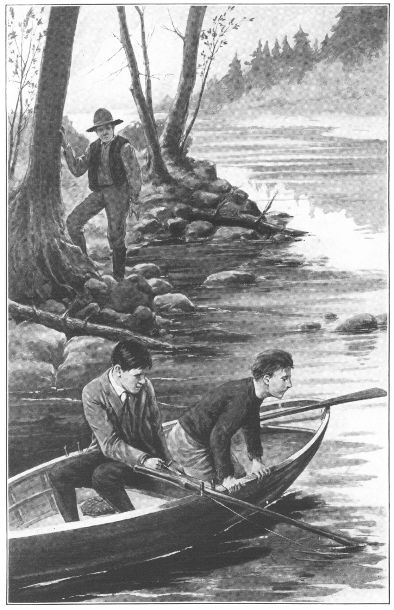
“CAN’T YOU SEE THE TIDE IS LEAVING YOU?”
“Look at that old clam-digger, who has his shack on the white beach, about quarter of a mile from our camp! He’s left his boat behind and is wading out to the clam-flats.” Nixon paused, with his breast to the boat’s stern, in the act of propelling it. “Goody! I’d like to stop and dig clams with him. But we’d never get back to camp! What ho! she sticks again. There! that brings her.”
By dint of alternately propelling and rowing the three scouts, with their prize, finally reached the white beach of the dunes before the tide completely deserted them. They brought a full cargo of excitement into camp in their tale of the stranger who had warned them; who, with worthless vagrancy stamped all over him, they felt must be the vaurien, Dave Baldwin; and in their engaging prize, the flippered pup-seal.
The latter quite eclipsed the interest felt in the former. Never was there a more docile, fatter, or more amiable puppy. He enjoyed being fondled in a scout’s arms, under difficulties, as, for a pup, he was quite a heavy-weight and slippery too, on account of the amount of blubber secreted under his creamy skin. His oily brown eyes were softly trustful.
But the tug-of-war came with feeding-time. Vainly did the boy scouts offer him of their best, vainly did Marcoo and Colin tramp a mile over the dunes to bring back a quart of new milk for him from the nearest farm, and try to pour it gently down his infant throat!
He set up a dove-like moaning that was plainly a call for his mother as he lay sprawled out on the white sands. And, at nightfall, by order of the scoutmaster, Scouts Warren and Chase rowed out into the channel and returned him to the water in which he was quite at home.
But he was possessed of a contradictory spirit, for he swam after the Pill, crying to be taken aboard again. They could hear his dulcet “Oo-oo-ooo!” as they gathered round their camp-fire in the white hollow among the sand-hills.
At the powwow to-night the encounter with Dave Baldwin, if the vagrant of the marshes was really he, came in for its share of discussion. Guesses were rife as to the probability of the scouts running across him again, and as to how he might occupy his time in the lazy vagabond life which he was leading.
It was here that Harold broke through the semi-shy reserve which still encrusted him and contributed a remark, the first as a result of his observations, to the powwow.
“Well! he had an awful sorry face on him,” he said impulsively, alluding to the vagrant. “It just made me feel badly for a while!”
“You’re right, Greerie, he had!” corroborated Leon. “Whatever he’s doing, it isn’t agreeing with him. We’ll probably come on him again some time on the marshes or among the dunes.”
But eleven days went by, eleven full days for the scout campers, golden with congenial activity, wherein each hour brought its own interesting “stunt,” as they called it; and they saw no more of the vaurien, the worthless one, who had caused his mother’s heart to “break in pieces.”
And they gave little thought to him. For those breezy days, the last of August and the first of September, were spent in observation tours over marsh and dune or on the heaving river, in playing their exciting scout games among the sandhills, in clam-bakes, in practising signaling with the little red-and-white flags according to the semaphore or wig-wag code—one scout transmitting a message to another posted on a distant hill—and in the various duties assigned to them in pairs, of cooking, and keeping the camp generally in order.
The more fully one lives, the more joyously one adventures, the more quickly flutters the present into the past, like a sunny landscape flitting by a train! It had come to be the last night but one in camp. Within another two days the Sugarloaf Dunes would be deserted so far as campers were concerned.
School would presently reopen. And at the end of the month the Owls would lose their brother and patrol leader: during the first days of October Scout Nixon Warren’s parents were expected home from Europe, and he would rejoin his former troop in Philadelphia.
To-night, every one was bent upon making the end of the camping trip a season of befitting jollity. They sang their scout songs as they gathered round the camp-fire. They retailed the last good joke from their magazine. They challenged the darkness with their hearty motto,—both in the strong sweet mother tongue wherein it had been given to the world, and in the pretty Estu preta! form, which two of their number thought might serve as a universal link.
But the night refused to rejoice with them. It was chilly, colder than on the same date one year ago when four lost boys camped out in the Bear’s Den. The inflowing tide broke on the beach with sobbing clamor. There was no moon, few stars. The white sand-hills were wild-looking sable mounds waving blood-red plumes of beach-grass or beach-pea wherever the light of camp-fire or camp-lantern struck them.
The clusters of gray birches and ash-trees scattered here and there among the dunes cowered like ebony shadows fearful of the rising wind.
“Bah! De night she’s as black as one black crow,” declared Toiney with a shrug as he threw another birch log on the camp-fire and set one of the two bright oil-lanterns on a sand-hill where it spied upon the gusty, secretive darkness like a watchful eye.
With the exception of a few small carbide lamps attached to tent-posts, those lanterns were the only luminaries in camp.
“An’ de win’ she commence for mak’ noise lak’ mad cat! Saint Ba’tiste! I’ll t’ink dis iss night for de come-backs—me.” And Toiney glanced half-fearfully behind him at the sable mounds so milky in daylight.
“He means it’s a night for spooks—ghosts! He doesn’t believe much in ‘come-backs,’ though: look at his face!” Leon pointed at the assistant scoutmaster’s black eyes dancing in the firelight, at the tassel of his red cap capering in the breeze. “By the way, Nix and I saw one ‘come-back,’ about an hour ago—a human one!” went on Corporal Chase suddenly, after a minute’s pause: “that rough customer, Dave Baldwin, as we suppose him to be, turned up again this evening near the summer bungalows away over on the beach. He was acting rather queerly, too!”
“He certainly was!” chimed in Nixon, looking thoughtfully at a little topknot of flame that sprouted upon the blazing log nearest to him as he lay, with his brother Owls, prone upon his face and hands, gazing into the fire.
“What was he doing?” asked Jesse Taber, a member of the Seal Patrol.
“Why, he was up on the high piazza of the largest bungalow—that house built just on the edge of the dunes which looks as if it was standing on stilts, and getting ready to walk off! He seemed to be trying one of the windows when we came along as if attempting to get in.”
“The summer people who own that house left there this morning; we saw them going,” broke in Godey Peck of the Fox Patrol. “I guess all the three houses are empty now; those dandified ‘summer birds’ don’t like staying round here when the wind ‘makes noise like mad cat’!” Godey hugged himself and beamed over the wild noises of the night, and at the voice of the tidal river calling lustily.
“Well! did he get into the house?” asked Jemmie Ahern of the Seals.
“No, as we came along over the dunes he saw us and scooted off!” Thus Corporal Leon Chase again took up the thread of the story. “But Nix an’ I looked back as we walked along the beach; it was getting dusk then, but we made out his figure disappearing into a large shed belonging to that bungalow.”
“I hope he wasn’t up to any mischief,” said the scoutmaster gravely. “Now! let’s forget about him. Haven’t any of you other scouts some contribution to make to to-night’s powwow about things you’ve observed during the day?”
“Mr. Scoutmaster, I have!” Marcoo lifted his head upon the opposite side of the camp-fire where he lay, breast downward, on the sand. “Colin and I and two members of the Seal Patrol, Howsie and Jemmie Ahern, saw an awfully big heap of clam-shells between two sand-hills on the shore-edge of the beach. They were partly covered with sand; but we dug them out; and—somehow—they looked as if they had been there for ages.”
“Likely enough, they had! The Indians used to hold clam-bakes here.” The firelight danced upon the scoutmaster’s white teeth; he greatly enjoyed the camp-fire powwow. “You see, fellows, this fine, white sand is something like snow—but snow which doesn’t harden—the wind blows it into a drift; then, perhaps, another big gale comes along, picks up the drift and deposits it somewhere else. That’s what uncovered your clam-shells.”
“Then how is it these white dunes aren’t traveling round the country?” Colin waved his arm toward the neighboring sand-hills with a laugh.
“Because they are held in place by the vegetation that quickly sprang up on and between them. That beach-grass has very coarse strong roots which interlace under the surface. Now! let’s listen to Toiney singing; we must be merry, seeing it’s our second last night in camp.” Scoutmaster Estey waved his hand toward his assistant in the blue shirt and tasseled cap.
Toiney, tiring of the conversation which it was an effort for him to follow, was crooning softly an old French ditty wherewith he had been sung to sleep by his grandfather when he was a black-eyed babe in a saffron-hued night-cap and gown:—
“À la clair-e fontain-e M’en allant promener, J’ai trouvé l’eau si belle, Que je m’y suis baigné!”
“Oh! you took a walk near the fountain and found the water so fine that you went in bathing!” cried one and another of the scouts who were in their first year in high school. “Must have been a pretty big fountain! Go ahead: what did you do next, Toiney?”
But the singer had suddenly sprung to his feet and stood, an alert, tense figure, in the flickering twilight.
“Gard’ donc!” he cried gutturally, while the cat-like breeze capered round him, flicking his short red tassel, catching at his legs in their queer high boots. “Gard’ donc! de littal light in de sky—engh? Sapré tonnerre! I’ll t’ink shee’s fire, me. No camp-fire, non! Beeg fire—engh? V’là! V’là!”
He glanced round sharply at his scout comrades, and pointed, with excited gesticulations, across the sable dunes in the direction of those recently erected summer residences.
CHAPTER XVII
THE SIGNALMAN
“Patrol leaders and corporals, muster your men!” The voice of the young scoutmaster rang sharply out upon the night.
The three boy patrols, Owls, Seals, and Foxes, who fell quickly into line at his order, were no longer surrounding their camp-fire amid the dusky sand-hills. That had been deserted even while Toiney was speaking, while he was pointing out the claims of a larger fire on their attention.
From the glare in the sky this was evidently a threatening blaze; its fierce reflection overhung like an intangible flaming sword the trio of recently erected summer residences about quarter of a mile from the scouts’ camp—those handsome bungalows from which the summer birds had flown.
“That’s no brush fire,” Scoutmaster Estey had exclaimed directly he sighted the glare. “It’s a building of some kind. Come on, fellows; there’s work for us here!” And snatching one of the two camp-lanterns from its sandy pedestal he led the way across the dark wilderness of the dunes.
Nixon caught up the second luminary and followed his chief. In their wake raced the three patrols, down in a sandy hollow one moment, climbing wildly the next, tearing their way through the plumed tangle of beach-grass and other vegetation that capped each pale mound now swathed in blackness, Toiney keeping Harold by his side.
“It isn’t one of the houses, thank goodness! Only a big shed!” cried the scoutmaster as they neared the scene of the fire, where golden flames tore in two the darkness that cowered on either side of them, having gained complete mastery of an outbuilding which had been used as a modest garage during the summer.
“Whee-ew! Gracious!” Nixon vented a prolonged whistle of consternation. “Why! ’twas into that very shed that we saw Dave Baldwin—or the man whom we took for him—disappear a couple of hours ago.”
But the demands of the moment were such, if the three houses were to be saved, that the remark, tossed at random into the darkness, was lost there amid the reign of fiery motes and rampant sparks that strove to carry the destruction farther.
“Luckily, the wind isn’t setting toward the house—it’s mostly in another direction!” The scoutmaster by a breathless wave of his blinking lantern indicated the largest of the three bungalows to which the blazing outbuilding belonged. “No hope of saving that shed! But if the little wood-shed near-by catches, the house will go too. We may head the fire off!”
It was then that he issued the ringing order to patrol leaders and those second in command to muster their men.
And as the boy scouts fell into line, while Toiney was muttering, aghast: “Ah, quel gros feu! She’s beeg fire! How we put shes out—engh?” the alert brain of the American scoutmaster had outlined his plan of campaign; and the air cracked with his orders:—
“Toiney, take the Owls and break into that clam-digger’s shack on the beach: get his pails! Foxes and Seals form a line to the beach; fill the pails as you get them an’ pass ’em along to me! Tide’s high; you need only wade in a little way! Hey! Leon,”—to Corporal Chase, who was obeying the first order with the rest of his patrol,—”you’re good at signaling: take these lanterns, get up on the tallest sand-hill an’ signal Annisquam Lighthouse; tell them to get help! Men there can probably read semaphore!”
“We may not be able to prevent the fire’s spreading. And if it attacks that bungalow, the others will go too—the whole colony! Lighthouse men may take the glare in the sky to mean only a brush-fire,” added the scoutmaster, sotto voce, as he stationed himself upon the crest of the sandy slope that led from the burning shed to the dim lapping water.
That doomed shed was now blazing like a mammoth bonfire. The flames flung their gleeful arms out, seizing a solemn gray birch-tree for a partner in their wild dance, scattering their rosy fire-petals broadcast until they lodged in the roof of the wood-shed adjacent to the house, and upon the piazza of the bungalow itself.
But they had a trained force to reckon with in the boy scouts. In the clam-digger’s shack were found more than a dozen pails which their owner had cleaned and set in order before he went home that evening. And among the excited raiders who seized upon them with wild eagerness was Harold Greer—Harold who a year ago was called “poltron” and “scaree” even by the friend who protected him—Harold, with the last wisp of bugbear fear that trammeled him burned off by the contagious excitement of the moment—acquitting himself sturdily as a Scout of the U.S.A!
Under his patrol leader’s direction he took his place in the chain of boys that formed from the conflagration to the wave-edge of the beach, where half a dozen of his comrades rushed bare-legged into the howling tide, filled the pails and passed them along, up the line, to their scoutmaster on the hill.
And he held to his place and to his duty stanchly, did the one-time “poltron,” even when Toiney, his mainstay, was summoned to the hill-top, to aid the commander-in-chief in his direct onslaughts upon the fire. Seeing which, Scout Warren touched his shoulder once proudly, in passing, and said in a voice huskily triumphant: “Well done, Harold! I always knew you were a boy!”
The dragon which had held sway upon that woodland clearing was slain at last, and the scars which he had left upon his victim were being cauterized by the fire.
“Go to it, boys! Good work! That’s fine!” rang out the commanding shout of the scoutmaster above the sullen roar of semi-defeated flames and the hiss of contending elements.
“Houp-là! Ça c’est bien! Dat’s ver’ good!” screamed Toiney airily from his perch atop of a ladder which he had found in the wood-shed.
From this vantage-point he was deluging with salt water the roof of the smaller shed and also the walls of the bungalow wherever a fire-seed lodged, ready to take root. Like a huge monkey he looked, swarming up there, with the flame-light dancing deliriously upon his dingy red cap! But his voice would put merriment into any exigency.
“Houp-e-là! We arre de boy! We arre de bes’ scout ev’ry tam’!” he carolled gayly, as he launched his hissing pailfuls at each threatened spot. “Continue cette affaire d’eau—go on wit’ dis watere bizness. We done good work—engh?”
So they were, doing very good work! But the issue was still exceedingly doubtful as to whether, without any proper fire-fighting apparatus, they could hold the flames in check, restricting their destruction to the large shed whose roof toppled in with a resounding crash, and a volcano-like eruption of sparks.
And what of Leon? What of Corporal Chase, alone upon the tallest sand-hill he could pick out, a solitary scout figure remote from his comrades with the dune breeze shrieking round him?
What were his feelings as he shook his two bright signaling lanterns aloft at arm’s length, to attract the attention of the men who kept the distant lighthouse beyond the dunes at the mouth of another tidal river, and then spelled out his message with those flashing luminaries, instead of the ordinary signal-flags: “Fire! Get help! House afire! Get help!” calling assistance out of the black night?
Well! Starrie Chase was conscious of a monster thrill shooting through him to his feet which firmly pressed the sandy soil: breaking up into a hundred little thrills, it made most of the sensations which he had misnamed excitement a year ago seem tame, thin, and unboyish.
He stood there, an isolated, sixteen-year-old boy. But he knew himself a trained force stronger than the “mad-cat” wind that clawed at him, than the tide which moaned behind him, even than the fire he combated; stronger always in the long run than these, for he was growing into a man who could get the better of them ninety-nine times out of a hundred.
He was a scout, in line with the world’s progress, allied with rescue, not ruin, with healing, not harm, with a chivalry that crowned all.
“Fire! Get help!” Thus he kept on signaling at intervals, his left arm extending one flashing lantern at arm’s length, while the companion light was lowered to his knees for the formation of the first letter of the message. And so on, the twin lights held at various angles illumining the youthful signalman until he stood out like a black statue on a pedestal among the lonely dunes.
To Starrie Chase that sand-peak pedestal seemed to grow into a mountain and his uniformed figure to tower with it—become colossal—in the excitement of the moment!
While, not twenty yards distant, behind a smaller sand-hillock, crouched another figure whose half-liberated groan the wind caught and tossed away like a feather as he gazed between clumps of beach-grass at the gesturing form of the scout.
It was the same figure which had haunted the dunes, listening to the camp-fire revelry upon the boy scouts’ first night in camp, the same which had so suddenly appeared upon the marshes near the pup-seal’s creek.
But distress seemed now to lie heavier upon that vagrant figure, instead of diminishing. For, as he still studied the light-girdled form of the signalman, Dave Baldwin vented a groan full and unmistakable, and blew upon a pair of burned hands.
CHAPTER XVIII
THE LOG SHANTY AGAIN
“This fire has been the work of some incendiary—that’s what I think!” was the opinion delivered later that night by the captain of the nearest fire-brigade, who, with his company, had been summoned by Leon’s signaled message, passed on via telephone wires by the lighthouse men.
“Of course, it may have been a case of accident or spontaneous combustion, but the former seems out of the question, seeing that the houses were empty, and the latter not probable,” went on the grizzled chief. “Anyhow, I congratulate you on your boys, Mr. Scoutmaster! Under your leadership they certainly did good work in saving this whole summer colony.”
“So they did; I’m proud of them!” returned the scoutmaster impulsively, which made the three patrol leaders within hearing, Scout Warren of the Owls, Godey Peck of the Foxes, and Jesse Taber of the Seals, straighten their tired bodies, feeling repaid.
“Well! I expect you’ll see one or two officers landing upon these Sugarloaf Dunes to-morrow, to try and get at the cause of the fire,” said the chief again. “It started in that shed where, so far as we know, there was nothing inflammable.”
“I ought to tell you,” Scoutmaster Estey looked very grave, “that two of my scouts saw a man entering the shed,” pointing to what was now a mere smouldering heap of ashes, “just about an hour, or a little over, before the fire broke out. When they first caught sight of him he was on the piazza of the bungalow itself, and seemed trying to get into the house.”
“Ho! Ho! I thought so. This is a case for the district police, I guess!” muttered the grizzled fire-chief.
That was the opinion also of the police representatives who landed upon the white dunes from a motor-boat early the next morning. And when the sharp questioning of one of the officers brought out the fact that the individual who had lurked about the scene of the fire was believed to be a youthful ne’er-do-weel, Dave Baldwin, with a prison record behind him, whose name was known to the two policemen, though his person was not, suspicion fastened upon that vagrant as possibly the malicious author of the fire.
“That fellow first got into trouble through a morbid craving for excitement,” said one of the officers. “The same craving may have led him on from one thing to another until he hasn’t stopped at arson—especially if he had a spiteful motive for it, which is likely with a tramp. That may have been his purpose in trying to enter the house.”
“I can scarcely imagine Dave’s having become such an utter degenerate,” answered the scoutmaster sadly. “I went to school with him long ago. And Captain Andy Davis knew his father well; they were shipmates on more than one trawling trip to the Grand Banks. Captain Andy speaks of the elder David Baldwin as a brave man and a big fisherman. Even if the son did start this fire, it may have been accidental in some way.”
“Well! we must get our hands on him, anyhow,” decided the officer. “I wonder if he’s skulking round among the dunes still; that’s not probable? I’d like to know whether any one of these observant boy scouts of yours saw a boat leave this shore since daybreak?”
It transpired that Coombsie had: after a night of unprecedented excitement—like his tossing brother scouts who sought the shelter of their tents about one o’clock in the morning—he had been unable to sleep, had crept out of his tent at daybreak and climbed a white sand-hill, to watch the sun rise over the river.
“I saw a rowboat shoot out of a little creek farther up the river, I should say about half a mile from the dunes,” said Marcoo. “There was only one person in it; seemed to me he was acting rather queerly; he’d row for a while, then stand up in the stern and scull a bit, then row again.”
“Could you see for what point he was heading?”
“For the salt-marshes high up on the other side of the river, I guess! I think he landed there.”
“Then, he’s probably hiding in the woods beyond the marshes. We must search them. That French-Canadian, Toiney Leduc, who’s camping with you, has worked as a lumberman in those woods; he knows them well, and is a good trailer. I’d like to have him for a guide this morning.” Here the officer turned to the scoutmaster. “And if you have no objection I think it would be well that those two boys should come with us,” he nodded toward Scouts Warren and Chase. “They can identify the man whom they saw trying to enter that bungalow last night.”
There is nothing at all inspiriting about a man-hunt; so Nixon and Leon decided when, within an hour, they landed from the police boat on the familiar salt-marshes high up the river, and silently took their way across them, in company with Toiney and the policemen, over the uplands into the woods.
They had come upon the fugitive’s boat, hidden among a clump of bushes near the river. Using that as a starting-point, Toiney followed Dave Baldwin’s trail into the maze of woodland; though how he did so was to the boy scouts a problem, for to them it seemed blind work.
But the guide in the tasseled cap, blue shirt, and heelless high boots, would stop now and again at a soft spot on the marshes or uplands, or when they came to a swampy patch in the woods; at such times he would generally drop on all fours with a muttered: “Ha! V’là ses pis!” in his queer patois. “Dere’s heem step!” And anon: “Dere me fin his feets again!”
When there was no footprint to guide him Toiney would stoop down and read the story of the dry pine-needles, just faintly disturbed by the toe of a rough boot which had kicked them aside a little in passing.
Or he would carefully examine a broken twig, the wood of which, being whitish and not discolored, showed that it had been recently snapped by a tread heavier than that of a fox; and again they would hear him mutter in his quaint dialect: “Tiens! le tzit ramille cassé: de littal stick broke! I’ll t’ink hees step jus’ here—engh?”
It was a lesson in trailing which the two boy scouts never forgot as they took their way through the thick woods, fairly well known to them now, past Varney’s Paintpot, Rattlesnake Brook, and other points of interest.
Ere they reached the Bear’s Den, however, the trail which Toiney had been following seemed to turn off at an angle and then double backward through the woods, in an opposite direction to that in which they had been pursuing it.
“Mebbe she’s no’ de same trail?” pondered the guide aloud. “Mebbe dere’s oder man’s feets, engh?”
It was now that a sudden idea, a swift memory, struck Scout Warren.
“Say! Starrie,” he exclaimed in a low tone to his brother scout. “Do you remember our looking all over that loggers’ camp last year, the shanty back there in the woods, with the rusty grindstone trough and mountain of sawdust beside it? We found some fresh tobacco ash on the table and in one of the bunks which showed that, though the shanty was deserted in summer, somebody was using it for a shelter at night. That somebody may have been Dave Baldwin.”
“Yes, they say he has spent his time—or most of it—loafing among the dunes or in the woods,” returned Leon, well recalling the incident and how, too, he had scoffed at the boy scout for taking the trouble to read the sign story told by every article in and about the rough shanty, including the overturned trough.
“Eh! what’s that, boys?” asked one of the two policemen, catching part of the conversation.
As in duty bound they told him; and the search party turned in the direction of the log shanty.
As they surmised it was not empty. On the discolored mattress in the lower bunk left there by the lumbermen who once occupied it, was stretched the figure of a man, fast asleep. One foot emerging from a charred, torn trouser-leg which looked as if it had come into contact with fire, hung over the edge of the deal crib.
When the party filed into the shanty the sleeper started up and rubbed his eyes. At sight of the two policemen his smudged face took on a pinched pallor.
“I didn’t do it on purpose!” he cried in the bewilderment of this sudden awakening, without time to collect his senses. “So help me! I never meant to set that shed on fire!”
“You were seen hanging round there an hour before the blaze broke out, and trying to get into the house too,” challenged the elder of the policemen.
Dave Baldwin slipped from the bunk to the ground; he saw that his best course lay in making a clean breast of last night’s proceedings.
“So I was!” he said. “And these two fellows,” he pointed to the boy scouts, “saw me up on the piazza of the house, trying a window. I was hungry; I’d had nothing to eat all day but the last leg of a woodchuck that I knocked on the head day before yesterday. I thought the summer people who had just gone away might have left some canned stuff or remnants o’ food behind ’em. I didn’t want to steal anything else, or to do mischief!” he went on with that same passionate frankness of a man abruptly startled out of sleep, while the policemen listened patiently. “I didn’t, I tell ye! I’d been hangin’ round those Sugarloaf Dunes for nigh on two weeks, watching the boys who were camping there, having a ripping good time—doing a lot o’ stunts that I knew nothing about—wishing I’d had the chanst they have now!”
“How came you to go into the shed that was burned down?” asked one of the officers.
“I was hungry, as I tell you, an’ I couldn’t get into the house, so I thought I’d lie down under the nearest cover, that shed, go to sleep an’ forget it. I guess I knocked the ashes out o’ my pipe an’ dozed. Smoke an’ the smell o’ wood burning woke me. I found one side o’ the shed was on fire. Maybe, some one had left an oily rag, or one with turpentine on it, around, and the spark from my pipe caught it. I don’t know! I tried to stamp out the fire—to beat it out with my hands!” He extended blistered palms and knuckles. “I’ve made a mess o’ my life I know! But I ain’t a crazy fire-bug!”
“Why didn’t you try and get help to fight it?”
“I was too scared. I thought, likely as not, nobody would believe me, seeing I had a ‘reformatory record,’” the youthful vagrant’s face twitched. “I was afraid o’ being ‘sent up ’ again, so I hid among the dunes and crossed to the woods this morning.”
“Well, you can tell all that to the judge; you must come with me now,” said the older policeman inflexibly, not unkindly; he knew that men when suddenly aroused from sleep usually speak the truth; he was impressed by the argument of those blistered palms; on the other hand, the youthful vagrant’s past record was very much against him.
But those charred palms were evidence enough for Toiney; though they might leave the officers of the law unconvinced.
“Ha! courage, Dave,” he cried, feeling an emotion of pity mingle with the contempt which he, honest Antoine, had felt for the vaurien who had caused his old mother’s heart to burst. “Bon courage, Dave! I’ll no t’ink you do dat, for sure, me. Mebbe littal fire fly f’om you’ pipe. I’ll no t’ink you do dat for de fun!”
“We don’t think you did it on purpose, Dave,” struck in the two boy scouts, seconding their guide.
Nevertheless, Dave Baldwin passed that night in a prison cell and appeared before the judge next morning with the certainty confronting him that he would be remanded to appear before the higher court on the grave charge of being an incendiary.
And it seemed improbable that bail would be offered for the prisoner, so that he would be allowed out of jail in the mean time.
Yet bail was forthcoming. A massive, weatherbeaten figure, well known in this part of Essex County, stood up in court declaring that he was ready and willing to sign the prisoner’s bail bonds. It was Captain Andy Davis.
And when all formalities had been gone through, when the prisoner was liberated until such time as his case should come up for trial, Captain Andy took him in tow.
“You come along home with me, Dave!” he commanded. “I’m going to put it up to you straight whether you want to live a man’s life, or not.”
And so he did that evening.
“I’ve been wanting to get hold of you for some time, Dave Baldwin,” said the sea-captain. “Your father an’ I were shipmates together on more’n one trip. He was a white man, brave an’ hard-working; it’s hard for me to believe that there isn’t some o’ the same stuff in his son.”
The youthful ne’er-do-weel was silent. Captain Andy slowly went on: —
“As for the matter of this fire, I don’t believe you started it on purpose. I doubt if the policemen who arrested you do! It’s your past record that’s against you. Now! if I see the district attorney, Dave Baldwin,” Captain Andy’s eyes narrowed meditatively under the heavy lids, “and succeed in getting this case against you nol prossed—I guess that’s the term the lawyer used—it means squashed, anyhow, do you want to start over again an’ head for some port worth while?”
“Nobody would give me the chance,” muttered the younger man huskily.
“I will. I’ve bought a piece of land over there on the edge of the woods, lad; it ain’t more’n half cleared yet. I’m intending to start a farm. But I don’t know much about farming; that’s the truth!” The grand old Viking looked almost pathetically helpless. “But you’ve worked on a farm, Dave, when you were a boy and since: if you want to take hold an’ help me—if you want to stick to work an’ make good—this is your chance!”
An inarticulate sound from the vaurien; it sounded like a sob bitten in two by clenched teeth!
“The two boys who were with the officers who arrested you told me that you declared you’d been hangin’ round the Sugarloaf Dunes lately, watching those scouts at their signaling stunts an’ the like, an’ wishing that you’d had the chance they have now, when you were a boy. Well! theirs is a splendid chance—better than boys ever had before, it seems to me—of joining the learning o’ useful things with fun.” Captain Andy planted an elbow emphatically upon a little table near him. “Now! Dave, you don’t want to let those boy scouts be the ones to do the good turns for your old mother that you should do? If you ain’t set on breaking her heart altogether—if you want to be a decent citizen of the country that raises boys like these scouts—if you want to see your own sons scouts some day—well, give us your fin, lad!”
The captain’s voice dropped upon the last words, the semi-comical wind-up of a peroration broken and blustering in its earnestness.
There was a repetition of the hysterical sound in Dave Baldwin’s throat which failed to pass his gritting teeth. He did not extend his hand at Captain Andy’s invitation. But his shoulders heaved as he turned his head away; and the would-be benefactor was satisfied.
“And so Captain Andy is going to stand back of Dave Baldwin and give him another chance to make good in life!” said the Exmouth doctor, member of the Local Council of Boy Scouts, when he heard what had come of the vagrant’s arrest. “That’s like Andy! And I don’t think he’ll have much difficulty with the district attorney; nobody really believes that Baldwin started that fire maliciously, and the district attorney will be very ready to listen to anything Captain Andy has to say!”
Here the doctor’s eye watered. He was recalling an incident which had occurred some years before at sea, when the son of that district attorney, who did not then occupy his present distinguished position, and the doctor’s own son, with one or two other young men of Dave Baldwin’s age, had been wrecked while yachting upon certain ragged rocks of Newfoundland, owing to their foolhardiness in putting to sea when a storm was brewing.
At daybreak upon an October morning their buffeted figures were sighted, clinging to the rocks, by the lookout on the able fishing vessel, Constellation, of which Captain Andrew Davis was then in command.
The furious gale had subsided. But as Captain Andy knew, the greatest danger to his own vessel lay in the sullen and terrible swell of the “old sea” which it had stirred up.
Nevertheless, the Constellation bore down upon the shipwrecked men, getting as near to them as possible, without being swept on to the rocks herself.
Then Captain Andy gave the order to put over a dory, stepped into it, and called for a volunteer. Twice, to and fro through the towering swell of the old sea, went that gallant little dory. She was smashed to kindling wood on her second trip, but not before the men in her could be hauled aboard the Constellation with ropes—not before every member of the yachting party was saved!
“And I guess if Captain Andy wants a chance to haul Dave Baldwin off the rocks where the old sea stirred up by the gusts of his own waywardness and wrongdoing have stranded him, the district attorney won’t stand in the way!” said the doctor to himself.
His surmise proved correct.
It was just one month after the fire upon the dunes that the three patrols of boy scouts, Owls, Foxes, and Seals, assembled at a point of rendezvous upon the outskirts of the town, bound off upon a long Saturday hike through the October woods.
But some hearts in the troop were at bottom heavy to-day, though on the surface they rose above the feeling.
For it was the last woodland hike, for the present, that Scout Warren of the Owls would take with his patrol. The return of his parents from Europe was expected during the coming week; and he—now with two white stripes upon his arm, signifying his two years of service in the Boy Scouts of America, wearing also the patrol leader’s bars and first-class scout badge—would rejoin his Peewit Patrol in Philadelphia.
However, his comrades’ regrets were softened by Nixon’s promise that he would frequently visit the Massachusetts troop with which he had spent an exciting year, and which, unintentionally, he had been instrumental in forming.
And on this brilliant October Saturday Assistant Scoutmaster Toiney Leduc, perceiving that the coming parting was casting a faint shadow before, exerted himself to banish that cloudlet as the troop started on its hike.
“Houp-e-là! We arre de boy! We arre de stuff! We arre de bes’ scout ev’ry tam’!” he shouted with an esprit de corps which found its echo in one breast at least—that of the terrier, Blink, who to-day capered with the troop as its mascot. “We arre de bes’ scout; n’est-ce pas, mo’ smarty?” And Toiney embraced Harold, marching at his side—Harold, whose lips turned up to-day and every day now in the scout’s smile, for since the night of the dune fire had not each of his comrades and the scoutmasters too, kept impressing on him that he had “behaved like a little man and a good scout” at duty’s call!
There were individuals among the onlookers, too, watching the three patrols march out of the town that morning, who shared Toiney’s primitive conceit that they were the “best scouts”; or at least fairly on the way to being a model troop.
Little Jack Baldwin, gazing at his rescuers, Scouts Warren and Chase, Marcoo and Colin Estey, marching two and two at the head of the leading patrol, clapped his hands and almost burst his heart in wishing that he could be twelve years old to-morrow so that he might enlist as a tenderfoot scout.
Whereupon his old grandmother smilingly bade him “take patience,” for the two years which now separated him from his heart’s desire would not be long in passing.
And the boy scouts, as they raised their broad-brimmed hats to old Ma’am Baldwin, saw a happier look upon her face than it had ever worn before, to their knowledge.
Farther on they came upon the explanation of this! They were taking a different route to-day from that which they usually followed in entering the woods. About a mile from the town they struck a partial clearing, where the land, not yet entirely relieved of timber, was evidently being gradually converted into a farm.
As the scouts approached they heard the ringing strokes of a woodsman’s axe, and presently came upon a perspiring young man, putting all his strength into felling a stubborn oak-tree.
“Hullo, Dave; how goes it?” cried the scoutmaster, halting with his troop.
“Fine!” came back the panting answer from the individual engaged in this scouting or pioneering work, who was the former vaurien, Dave Baldwin.
“Find this better than loafing about the dunes, eh?”
“Well! I should say so,” came the answer with an honest smile.
But the boy scouts were hardly noticing Dave Baldwin: Owls, Foxes, and Seals, they were gazing in transfixed amusement at their hero-in-chief, Captain Andy, owner of this half-cleared land.
He, who in his seagoing days had been known by such flattering titles as the Grand Bank Horse, the Ocean Patrol, and the like, was seated in the midst of a half-acre of pasture land, holding on like grim death to one end of a twenty-foot rope coiled round his hand, the hemp’s other extremity being hitched to the leg of a very lively red cow which presently dragged him the entire length of the pasture and then across and across it, in obedience to her feminine whims.
“She’ll be the death o’ me, boys!” he shouted comically to the convulsed scouts. “Great Neptune! I’d rather take a vessel through the breakers on Sable Island Bar than to be tied to her heels for one day.”
“For pity’s sake! Hold on to her, Cap!” Dave Baldwin paused in his energetic tree-felling. “Yesterday, she got into that little plowed field that I’d just seeded down with winter rye, and thrashed about there!”
“Ha! I’ll t’ink you go for be good habitant—farmer—Dave,” broke in Toiney suddenly and genially. “I’ll t’ink you get dere after de w’ile, engh?”
It was plain to each member of the troop that so far as Dave himself was concerned he was already “getting there,”—reaching the goal of an honest, industrious manhood.
The triple responsibility of starting a farm, directing the energies of his benefactor, and combating the cow, was rapidly making a man of him.
They heard the virile blows of his axe against the tree-trunk as they marched on their woodland way. And their song floated back to him:—
“At duty’s call, with a smile for all, The Scout will do his part!”
Dave Baldwin paused for a minute to listen; then, as he swung his axe in a tremendous, final blow against the tottering oak, he too broke triumphantly into the refrain:—
“And we’ll shout, shout, shout, For the Scout, Scout, Scout, For the Scouts of the U.S.A!”
THE END
Transcriber's note: Both ‘Ne’er-do-weel’ and ‘Ne’er-do-well’ are used, so both spellings have been preserved.