Front matter (continued 3)
Reading edition
“Hullo! there’s the old baldfaced house,” he cried suddenly to the dog. “Here we are on our old stamping-ground, Blink! Wonder if ‘Mom Baldwin’ is doing her witch stunts still? We haven’t said ‘Howdy!’ to her for a long time; have we, pup?”
Slackening pace, for that fickle breeze was blowing away many things that he ought to have remembered, among them the lateness of the hour, he turned aside a few steps to where a lonely old house stood at the foot of the slope as the uplands melted into the salt-marshes.
It was a shallow shell of a dwelling—all face and no rear apparently—and that face was bald, almost stripped of paint by the elements. Just as storm-stripped was the heart of the one old woman who lived in it, and whom Leon had been wont to call a “solitary crank!”
To the neighborhood generally she was known as Ma’am Baldwin, mother of the young scape-grace, Dave Baldwin, who had so troubled the peaceful town by his pranks that he had finally been shut up in a reformatory, and who was now, a year after his release, a useless vagrant, spending, according to report, most of his time loafing between the white sand-dunes on one side of the river and the woods on the other—incidentally breaking his mother’s heart at the same time.
She had lived here in the old baldfaced house, with him, her youngest boy, the child of her middle age, until his wild doings brought the law’s hand upon him. After his imprisonment shame prevented her leaving the isolated dwelling and going to live with her married daughter near the town, though that daughter’s one child, her little grandson Jack, possessed all the love-spots still green in her withered heart.
In her humiliation and loneliness “Mom Baldwin,” as the boys called her, had become rather eccentric.
She had more than once been seen by those town boys—Leon and his gang—stationed behind the smeared glass of her paintless window, doing strange signaling “stunts” with a lighted lantern, whose pale rays described a circle, dipped and then shot up as, held aloft in her bony old hand, it sent an amber gleam over the salt-marshes.
“She’s a witch—a witch like Dark Tammy, who lived on the edge of the woods over a hundred years ago and who washed her clothes at the Witch Rock,” whispered Starrie Chase and his companions one to another as they lay low among the rank grass of the dark marshes, spying upon her. “She’s a witch, working spells with that lantern!”
Older people surmised that she was signaling to her vagabond son, who might be haunting the distant marshes, trying to lure him home; shame and grief on his account had half-unbalanced her, they said.
But the boys pretended to stick to their own superstitious belief, because, to them, it offered some shabby excuse for tormenting her.
Leon Chase in particular made her rank little garden his nightly stamping-ground, and was the most ingenious in his persecuting attentions.
He it was who devised the plan of anchoring a shingle or other light piece of wood by a short string to the longest branch of the apple-tree that grew near her door.
When the wind blew directly across the marshes, as it did this evening, and drove against that paintless door, it operated the impromptu knocker; the wooden shingle would keep up an intermittent tapping, playing ticktack upon the painted panels all night.
Sometimes Ma’am Baldwin had come to the door a dozen times and peered forth over the dark salt-marshes, believing that it was her vagrant son who demanded entrance, while the perpetrators of the trick, Leon Chase, Godey Peck and others of their gang—tickled in the meanest part of them by the fact that they “kept her guessing”—hid among the marsh-grass and watched.
Hardly any prank could have been more senseless, childish, and unfeeling. Yet Starrie Chase had actually believed that he got some sham excitement out of it.
And to-night as his feet pressed his old stamping-ground beneath that apple-tree beside the house, while the wind raked the marshes and whipped his thoughts into dusty confusion, the old waste impulses which prompted the trick were mysteriously whirled uppermost again.
The mischievous tide rip boiled in him once more.
Just as he became conscious of its yeasty bubbling, his foot touched something on the ground—a hard winter apple. He picked it up and threw it against the house, imposing silence on his dog by dictatorial gesture and word.
There was a stir within the paintless dwelling. Through the blurred window-panes he caught sight of a shrunken form moving.
“Ha! there’s the old ‘witch’ herself. She looks like a withered corn-stalk with all those odds and ends of shawls dangling about her. Ssh-ssh! Blinkie. Down, doggie! Quiet, sir!”
Leon’s fingers groped upon the ground, where twilight shadows were merging into darkness, for another apple. Since he enlisted as a boy scout mischief had been sentenced and shut up in a dark little cell inside him. But Malign Habit, though a captive, dies hard.
Those seeking fingers touched something else, a worm-eaten shingle blown from the old roof. He picked it up and considered it in the darkness, while his left hand felt in his pocket for some twine.
“Gee! it would be a great night for that trick to work,” he muttered with a low chuckle that had less depth to it than a parrot’s. “The wind is just in the right direction—driving straight through the house. Eh, Blink! Shall we ‘get her on a string’ again?”
The dog whined softly with impatience. Of late, in his short excursions with his master, he had not been used to such stealthy doings. With the exception of the trailing expeditions through the woods from which canines were debarred, movements had been open, manly, and aboveboard since the master became a boy scout.
But Leon had forgotten that he was a scout, had momentarily forgotten even the outdoor test in Sparrow Hollow, and the necessary preparations therefor.
His fingers trifled with the shingle and string. His brain going ahead of those fingers was already attaching the one to the other when—the paintless door opened and Ma’am Baldwin stepped out.
She did look like a wind-torn corn-stalk, short and withered, with the breeze catching at the many-colored strips of shawls that hung around her, uniting to protect her somewhat against that marsh-wind driving straight from the river through her home.
From her left hand drooped a pale lantern, the one with which boyish imagination had accused her of working spells.
It made an island of yellow light about her as she stepped slowly forth into the dusk. And Leon saw her raise her right arm to her breast with that timid, pathetic movement characteristic of old people—especially of those whom life has treated harshly—as if she was afraid of what might spring upon her out of the gusty darkness.
Not for nothing had Starrie Chase been for two months a boy scout! Prior to those eight weeks of training that feebly defensive arm would have meant naught to him; hardly would he have noticed it. But just as his eyes had been opened to consider at length, with a dazzled thrill, that distant Sugarloaf Sand-Pillar and other of Nature’s beauties as he had seldom or never contemplated them before; so those scout’s eyes were being trained to remark each significant gesture of another person and to read its meaning.
Somehow, that right arm laid across an old woman’s breast told a tale of loneliness and lack of defenders which made the boy wince. The distance widened between his two hands holding respectively the shingle and string.
There was a wood-pile within a few yards of him. Ma’am Baldwin stepped toward it, breathing heavily and ejaculating: “My sen-ses! How it do blow!” While Leon restrained the terrier with a “Quiet, Blink! Don’t go for her!”
Ma’am Baldwin, intent on holding fast to her shawls and procuring some chunks from the wood-pile—nearsighted as she was, to boot—did not notice the boy and dog standing in the blackness beneath the bare apple-tree.
She set the lantern atop of the pile. As she bent forward, groping for a hatchet, its yellow rays kindled two other lanterns in her eyes by whose light the lurking boy gazed through into her heart and saw for a brief moment how tired, lonely, and baffled it was.
At the glimpse he straightened up very stiffly. There was a gurgle in his throat, a stirring as of panic at the roots of his hair.
But not scare produced the rigidity! It was caused by a sudden great throe within which scraped his throat and sent a dimness to his eyes. The captive, Malign Habit, imprisoned before, was dying now in the grasp of the Scout.
To put it otherwise,—at sight of an old woman’s arm pathetically shielding her breast, at a startled peep into her heart, the tight little bud of chivalry in Leon, watered of late by his scout training, fostered by the good turn to somebody every day, burst suddenly, impetuously into flower!
With a low snarl at himself, he thrust the coil of string deep into his pocket, and flung the shingle as far as he could into the night.
“Ughr-r-r! Guess I was meaner’n you’d be, Blink!” he muttered, swallowing the discovery that sometimes of yore, in his dealings with his own kind, he had been less of a gentleman than his dog.
To which Blink, freed from restraint, returned a sharp, glad “Wouf!” that said: “I’m glad you’ve come to your senses, old man!”
“Hullo! ‘Mom Baldwin,’” Leon stepped forward as the bowed woman started at the monosyllabic bark, and peered fearfully into the darkness. “Don’t you want me to split those chunks for you? You can’t manage the hatchet.”
Ma’am Baldwin’s experience had taught her to distrust boys—Leon especially! As her peering eyes recognized him, she backed away, raising her right arm to her breast again with that helpless gesture of defense.
Starrie Chase blenched in turn. That pathetic old arm warding him off hurt him more at the core than a knockdown blow from a stronger limb.
But remembering all at once that he was a scout, trained to prompt action, he picked up the hatchet where she had dropped it, and set to work vigorously, chopping wood.
“Now! I’ll carry these chunks into the house for you,” he said presently. “Aw! let me. I’d just as soon do it!”
Ma’am Baldwin had no alternative. Leon pushed the paintless door open and carried the wood inside, while she hobbled after him, well-nigh as much astonished as if Gabriel’s trump had suddenly awoke the echoes of the gusty marshland.
The scout went to and fro for another ten minutes, splitting more chunks, piling them ready to her hand within.
Meanwhile his beneficiary, the old woman, seemed to have got a little light on the surprising situation. Grunting inarticulately, chewing her bewilderment between her teeth, she disappeared into a room off the kitchen and returned holding forth a ten-cent piece to her knight.
“No, thanks! I’m a boy scout. We don’t take money for doing a good turn.” Leon shook his head. “Say! this old house is so draughty; you burn all the wood you want to-night; I’ll run over to-morrow or next day an’ split some more. Is there anything else I can do for you before I go? You’ve got enough water in from the well,” he peered into the water-pail, which winked satisfactorily.
Ma’am Baldwin had sunk upon a chair, alternately looking in perplexity at the energetic boy, and listening to the frisky gusts: “My sen-ses! Whatever’s come over you, Leon?” she gasped; and then wailingly: “Deary me! if it should blow up a gale to-night, some things in this house’ll ride out.”
“No, it isn’t going to blow up a storm,” Leon reassured her. “The wind’s not really high, only it gets such a rake over the marshes. Here, I’ll tie these old shutters together for you, the fastening is broken,” and the coil of string was produced from his pocket for a new purpose. “But it must be awful lonely for you, living here by yourself, Ma’am Baldwin. You’ll be snowed in later on; we’ll have to come and dig you out.”
Still chewing the cud of her bewilderment, she stared at him, mumbling, nodding, and stroking the gray hair from her forehead with nervous fingers. But there was a humid light in the old eyes that spilled over on the boy as he worked.
“Why don’t you go to live with your daughter an’ your grandson in the town?” went on Leon as he tied together the last pair of flapping shutters. “And you’re so fond of little Jack too; he’s a nice kid!”
“So he is!” nodded the grandmother; a change overspread her entire face now, she looked tender, grandmotherly, half-hopeful, as if for the moment trouble on behalf of her ne’er-do-well son was forgotten. “Well! perhaps I will move there before the winter sets in hard, Leon. I’m not so smart as I was. I’m sure I don’t know how to thank you! Good-night!”
“Good-night!” returned the scout. “You can untie those shutters easily enough in the morning.”
And he found himself outside again upon the dark marshland, with the obedient terrier who had trotted at his heels during the late proceedings, waltzing excitedly at his side.
“Ah, la! la! as Toiney says, it’s too late now, Blink, for us to put back to the town to buy our supper—half a pound of beefsteak and two potatoes, to be cooked over each one’s special fire,” muttered the boy, momentarily irresolute. “Well! we’ll have to let the grub go, and race back across the uplands, over to the Hollow. Stir your trotters, Mr. Dog!”
As the two regained the crest of the hilly uplands, Leon paused for breath. On his left hand stretched the dark, solemn woods, where the breeze hooted weirdly among leafless boughs. On his right, beyond upland and broad salt-marsh, wound the silver-spot river in whose now shallow ripples bathed a rising moon.
Quarter of a mile ahead of him a rosy flush upon the cheek of darkness told that in the sheltered hollow, between a clump of pines that served as a windbreak and the woods, the Owls’ camp-fires were already blazing.
“Tooraloo! I feel as if I could start my fire to-night without using a match at all—just by snapping my fingers at it, or with a piece of damp bark and a snowball, as the woodsmen say,” he confided half-audibly to the dog.
Whence this feeling of prowess, of being a firebrand—a genial one—capable of kindling other and better lights in the world than a camp-fire?
Starrie Chase did not analyze his sensations of magnificence, which bloomed from a discovery back there on the marshes of the secret which is at the root of the Boy Scout Movement, at the base of all Christian Chivalry, at the foundation of golden labor for mankind in every age: namely, that the excitement of helping people is vastly, vitally, and blissfully greater than the spurious excitement of hurting them!
CHAPTER XI
ESTU PRETA!
“Hullo! here’s Starrie. Well! it’s about time you turned up. We waited quarter of an hour for you before leaving town.—Hey! Starrie, we’ve got our six cook-fires all going. I only used two matches in lighting mine; I’ve passed one half of to-night’s test.—So’ve I! Whoopee! I ‘went the jolly test one better’: I lit my fire with a single, solitary match.”
Starrie Chase, bounding down the grassy side of Sparrow Hollow, with these lusty cries of his brother Owls greeting him, stood for a moment in the brilliant glare of a belt of fires, as if dazed by the ruddy carnival, while his dog, making a wild circuit of the ring, bayed each bouquet of flames in turn.
“Yaas; we’ll get heem littal fire light lak’ wink—sure! We ar-re de boy! We ar-re de scout, you’ll bet!” supplemented the merry voice of Toiney, the assistant scoutmaster, who, with the tassel of his red cap bobbing, and the flame-light flickering on his blue homespun shirt, was on his knees before Harold’s cook-fire, using his lungs as a pair of bellows.
“Hurrah! I’m in this: I’ll light my fire with one match, too. Kenjo Red shan’t get ahead of me: no, sir!” Corporal Leon Chase was now working like lightning, piling dry leaves, pine splinters, dead twigs into a carefully arranged heap in a gap which had been left for him in the ring of half a dozen fires kindled by six tenderfoot scouts, ambitious of being admitted to a second-class degree.
But he, the behind-time tenderfoot, was abruptly held up in his tardy labors by the voice of the tall scoutmaster, who with Scout Warren, the patrol leader of the Owls, was superintending the tests.
“I want to speak to you for a minute, Leon,” said Scoutmaster Estey, with a gravity that dropped like a weighty pebble into the midst of the fun.
And Corporal Chase, otherwise Scout 2, of the Owls, obediently suspended fire-building, approached his superior officer and saluted.
“I’d like to know where you have been for the last hour,” began the scoutmaster with the dignity of a brigadier-general holding an investigation, while his keen eyes from under the drab broad-brimmed hat searched Leon’s face in the sixfold firelight. “Jimmy Sweet,” nodding toward a squatting Owl, “said he caught a distant glimpse of you nearly an hour ago over on the edge of the salt-marshes near Ma’am Baldwin’s old house. I hope you haven’t been plaguing her again?”
The voice of the superior officer was all ready to be stern, as if he had visions of a corporal being requested to hand over his scout-badge of chivalry until such time as he should prove himself worthy of wearing it.
“Have you?”
“No!” Leon cleared his throat hesitatingly. “No,”—he suddenly lifted steady eyes to the scoutmaster’s face,—”I have been chopping wood and doing a few other little things for her; that made me late!”
A moment’s breathless silence enveloped the six cook-fires. The face of the scoutmaster himself was set in lines of amazement: genially it relaxed.
“Good for you, Corporal!” He clapped the late-comer approvingly on the shoulder, and in his voice was a moved ring.
For, as he scanned the boy’s face in the sixfold glow, he read from it that, to-night, Leon had really become a scout: that, back there on the salt-marshes, the inner and chivalrous grace of knighthood, of which his oath was the outward and heralding sign, had been consciously born within him.
The scoutmaster was feeling round in his broad approval for other words of commendation, when Toiney’s sprightly tones broke the momentary tension.
“Ha! dis poor ole oomans,” he grunted, vivaciously pitying Ma’am Baldwin. “She’s lif’ all alone en she’s burst she’s heart for she haf such a bad boy, engh? She’s boy, Dave, heem canaille, vaurien—w’at-you-call, good-for-nodings—engh?”
“I’m afraid he is,” agreed the scoutmaster regretfully. “Yet I pity Dave too. His elder brother went West when he was a little fellow; his father, who was a deep-sea fisherman, like Harold’s father, was away nearly all the year round. Dave grew up without any strong man’s hand over him; out of school-hours he had to work hard on a farm, and I suppose in his craving for fun of some kind he played all sorts of foolish pranks. After he left school and was old enough to know better, he kept them up—ran a locomotive out of the little railway station one night, came near killing a man and was sent to a reformatory!”
“Bah! heem jus’ vagabond—errant—how-you-say-eet—tramp-sonne-of-a-gun—vaurien, engh?” declared Toiney, gutturally contemptuous, while he poked Harold’s fire with a dry stick.
“Yes, he’s a mere vagrant now, loafing about the Sugarloaf Sand-Dunes and the woods; and likely to get into trouble again through petty thefts, so people say. When he had served his sentence he seemed to think there wasn’t much of a future before him, and didn’t stick to the job he got. I pity his old mother! I think that every boy scout should make it a point to do a good turn for her when he can.”
“Ah! oui; shes break in pieces, engh?” murmured Toiney, the irrepressible, still punching up the fire, to prepare it for the cooking tests.
Somehow, his eloquent sympathy sent a stab through Leon—whom everybody was at the moment regarding with admiration—for it brought a sharp recollection of an old woman backing away from him in fear, with her right arm laid across her breast in piteous self-defense.
“Gee! I wish I could do something more for her than chopping wood—something that would make up for being mean to her,” thought Corporal Chase, as he returned to his fire-building, arranging the fuel methodically so as to allow plenty of draught, and then triumphantly rivaling Kenjo’s feat by lighting his cook-fire with one match.
The tiny, snappy laughter of that matchhead, seeming to rejoice that another baby light was born into the world, as he drew it along a dry stick, restored his towering good spirits.
“And now for the cooking test!” cried the scoutmaster. “Each scout to put his two potatoes to roast in the embers of his fire, and make a contrivance for broiling his beefsteak! And look out that you don’t ‘cook the black ox,’ boys, as Captain Andy would say!”
“What do you mean by ‘cooking the black ox’?” from two or three excited and perspiring scouts.
“Why! that’s what the sailors say when their beef is burnt to the color of a black-haired ox,” laughed the superior officer. “Scout Chase, haven’t you brought any beefsteak and potatoes?”
“No, I meant to go back to the town for them an’ meet you there. Blink an’ I don’t want any supper; we’ll get it when we go home,” returned Leon nonchalantly, swallowing his mortification at not being able to complete the outdoor test, this evening.
“Oh! I’ll share my rations with you, Starrie,” volunteered Colin Estey. “I shan’t ‘cook the black ox’: I’m too nifty a cook for that; trust me!” Colin was concocting a handsome gridiron of peeled twigs as he spoke.
“Don’t mind him, Starrie: I could cook better when I was born than Col can now! I’ll divide my beefsteak and ‘taters’ with you,” came from another primitive chef, the offer being repeated more or less alluringly by every boy scout.
“Well! you’re a generous-hearted bunch,” put in Nixon, the patrol leader, from his over-seer’s post. “But the scout-master and I have more than a pound of raw beefsteak here which we brought along for our supper. As I’m not in these tests” (Nixon was now a full-fledged first-class scout) “I’ll cut off a piece for Leon so that he can cook it himself; I guess we can spare him a couple of potatoes too; then he can pass the test, with the others.”
During the supper which followed while each scout, sitting cross-legged by his own cook-fire, partook of the meal in primitive fashion and Toiney made coffee for the “crowd,” more than one Owl shared in the opinion once enunciated by Leon that eating in the woods—or in a woodsy hollow such as sheltered them now from the breeze that drove keenly across the marshes—was the “best part of the business.”
They modified that opinion later when the seven small fires, which had sputtered merrily under the cooking, were reinforced by logs and branches, and stimulated into a belt of vivacious camp-fires, each rearing high its topknot of crested flame, and throwing wonderful reflections through the stony hollow.
“I always wanted to be a savage. To-night, I feel nearer to it than ever before,” said Colin, listening with an ecstatic shiver to the wind as it chanted among the pines that formed their windbreak, capered round the hollow, flinging them a gust or two that made the camp-fires roar with laughter, and then, as if unwilling to disturb such a jolly party, rushed wildly on to take it out of the trees in the woods. “And now for the powwow, Mr. Scoutmaster!” he suggested, looking across the ring of fires at his tall brother and superior officer.
“Hark! that’s an owl hooting somewhere,” broke in Coombsie. “It’s the Grand Duke, I think—the big old horned owl! One doesn’t hear him often at this time of year. He wants to be present at the Owl Powwow.”
“Ah, la! la! I’ll t’ink he soun’ lak’ hongree ole wolf, me,” murmured Toiney dreamily.
But the distant hoot, the deep “Whoo-hoo-hoodoo hoo,” or “Whoo-hoo-whoo-whah-hoo!” as some of the boys interpreted it, from the far recesses of the woods, added a final touch of mystic wildness to the sevenfold radiance of the firelit scene which was reflected in the sevenfold rapture of boyish hearts.
And now the heads of human Owls were bent nearer to the golden flames as notebooks were drawn out containing rough pencil jottings, and scouts compared their observations of man, beast, bird, fish, or inanimate object, encountered in the woods, on the uplands or marshes, or upon the river during the past few days!
Kenjo Red offered the most important contribution.
“I went to Ipswich yesterday to spend the day with my uncle,” he began, as he lay, breast downward, gazing reflectively into his fire. “In the afternoon we walked over to the Sugarloaf Sand-Dunes and lounged about there on the white beach, watching the tide go out. We didn’t see many birds, only a few herring gulls. But I’ll tell you what we did see: two big harbor seals and a young one, lying out on a sand-spit which the tide had just left bare. They were sunning themselves an’ having a dandy time! One was a monster, a male, or big old dog-seal, my uncle said; he must have been nearly six feet long, and weighed about half a ton.”
“More or less?” threw in the scoutmaster, laughing at Kenjo’s jesting imagination. “Generally a big male weighs almost two hundred pounds, occasionally something over. Hereabouts, he is indifferently called the ‘dog-seal’ or ‘bull-seal,’ according to the speaker’s taste; his head is shaped rather like a setter dog’s, with the ears laid flat back,—for the seal has no ears to speak of,—but the eyes are bovine,” he explained to Nixon, who knew less about this sea mammal than did his brother scouts, and who had never seen him at close quarters.
“Isn’t it unusual to find seals high and dry at this time of year?” asked Coombsie. “In the spring and summer one sees plenty of them down near the mouth of the river, sprawling in the sun on a reef or sandbar. But in the late fall and winter they mostly stay in the water.”
“Not when the river is frozen over—or partially frozen,” threw in Leon. “They love to take a ride on a drifting ice-cake, so Captain Andy says! Is there any bounty on their heads now, Mr. Scoutmaster?” he addressed the troop commander.
“No, that has been removed. The marbled harbor seal, so called because of his spots, was being wiped out, as he was wiping out the fish many years ago, before the Government put a price on his head. Now that he is no longer severely persecuted the mottled dotard, as he is sometimes called,—I’m sure I don’t know why, for I see no signs of senility about him,—is becoming tamer and more prevalent again. Still, he’s wilder and shyer than he used to be.”
“Yes, there’s an old fisherman’s shack on one corner of the Sugarloaf Dunes, where a clam-digger keeps his pails and a boat,” said Kenjo. “He let my uncle take the boat and we rowed across to the sand-spit. The seals let us come within thirty yards of them: then they stirred themselves lazily, with that funny wabble they have—just like a person whose hands are tied together, and his feet tied more tightly still—lifting the head and short fore-flippers first and swinging them to one side, then the back part of the body and long hind-flippers, giving them a swing to the other side. Say! but it was funny. So they flopped off into the water.”
“Goodness! I wish that I’d been with you, Kenjo,” exclaimed Scout Warren. “I haven’t seen a harbor seal yet, except just his head as he swam round in the water, when Captain Andy took me down the river in his power-boat, the Aviator. We rowed ashore in the Aviator’s Pill,” laughingly, “in that funny little tub of a rowboat which dances attendance on the gasolene launch, but though we landed on the white sand-dunes and stayed round there for quite a while, not a seal did we see sprawling out on any reef.”
“I’ll see heem gros seal on reever,” broke in Toiney gutturally. “I’ll see heem six mont’ past on reever au printemps—in spring—w’en, he go for kill todder gros seal; he’ll hit heem en mak’ heem go deaded—engh?”
“Yes, the males have bad duels between themselves occasionally. But they’re mild enough toward human beings. However, my father had a strange experience with them once,” said the scoutmaster, pushing back his broad hat, so that the sevenfold glow from the fires danced upon his strong face. “He’s told me about it ever since I was a little boy, and Colin too. When he was a very young man he rowed down to the mouth of the river one day with some sportsmen who went off to shoot ducks, leaving him to dig clams and get a clambake ready for them on the white dunes. Well, sir! left alone, he pulled off to the clam-flats, drew up his boat, stepped out, and the tide being at a low ebb, set to work to dig up the clams which were here and there thrusting their long necks up from the wet sand, to feed on the infusoria—their favorite feeding-time being when it is nearly, but not quite, low water.
“The tide had receded altogether from the other side of the sand-flats, so that they joined the marshy mainland, and as my father landed he saw that there was a big herd of twenty or thirty seals lying out on those flats. It was before a bounty was set upon their heads, when they were very plentiful and tame. My father was not in the least afraid of them and was proceeding to dig his clams peacefully, when he suddenly saw that the whole herd was thrown into a wild panic by the discovery that he was between them and the water. They broke into a floundering stampede and came straight for him—or rather for the water behind him—at a fast clip, half sliding, half throwing themselves along. A funny sight they must have been! Father says one big fellow came at him with his mouth wide open: the four sharp white teeth in front, two upper and two lower, shining. So Dad just turned tail and ran for the water as he had never run before; not waiting to jump into his boat, he plunged into the channel up to his waist!”
“But the seals wouldn’t have attacked him, would they?” incredulously from Nixon.
“No; I think not. But he might not have been able to keep his feet. They would, perhaps, have struck him with their heavy bodies and knocked him down. And to feel a dozen or so of damp seals sliding over a fellow, their weights ranging anywhere from a hundred to two hundred and fifty pounds, wouldn’t be a pleasant sensation, to say the least!”
“I guess not!” chuckled the Owls.
“I’d like to catch a creamy pup-seal—isn’t that what you call the only child, the young one? ’Twould be fun to tame it,” said Nixon. “Perhaps I’ll get a chance to do so when we camp out on the Sugarloaf Dunes next summer. Aren’t we going to have a camp there for two weeks during the end of August and beginning of September, Mr. Scoutmaster? ”
“I hope so, if I can get permission from the landlord who owns the dunes.”
“Maybe we’ll run across Dave Baldwin too—the vaurien, as Toiney calls him—if he stays round there a part of the time?” This from Leon.
“That wouldn’t be a desirable encounter, I’m afraid. Now! has any scout a suggestion to make that would be useful in planning our work for this winter?” Scoutmaster Estey looked round at the ring of boyish faces, reflecting the sevenfold glow, at Harold, lying on his face and hands, blinking dreamily under Toiney’s wing, while the firelight burnished the latter’s swarthy features beneath the tasseled cap.
“Mr. Scoutmaster!” Nixon Warren sprang to his feet impulsively, “Marcoo and I have a suggestion to offer,”—Nixon glanced at his cousin Coombsie,—”it hasn’t any direct relation to our work, but we humbly submit it as an idea that might be useful, not only to our boy scout organization here, but to the movement everywhere all over the world.”
“Ho! Ho! What do you know about that? Out with it, Nix, if it’s worth anything,” came the dubious encouragement of his brother Owls.
“I must tell a little yarn first. The day before yesterday Marcoo and I were in Boston. We lunched at a fine restaurant. At a table near us was a gentleman—he looked like a Mexican or Spaniard—who couldn’t speak any English and addressed the waiter by signs. There was a boy with him, a classy-looking fellow of about fourteen, his son, I guess. ‘I’ll wager that boy is a scout!’ I whispered to Marcoo. ‘His eyes take in everything, without seeming to stare about him much—and see the way he carries himself—straight as a string!’”
“So I suggested that we should try the scout salute on him as we passed out,” struck in Marcoo. “We did! And fellows, he was on his feet like a flash, holding up his right hand, thumb resting on the little finger-nail, and the other three fingers upright, saluting back! We guessed then that he was a Mexican boy scout, traveling with his father.”
“He seemed jolly glad to see us,” Nixon again took up the anecdote; “just beamed! But he didn’t apparently understand a word of English except ‘Good-day!’ not even when we passed the scout motto to him as a watchword: ‘Be Prepared!’ We might all three have been mutes saluting each other.
“We talked it over, coming home, Marcoo and I,” went on the patrol leader. “And we arrived at the conclusion that it would be a great thing if our hearty motto, as Captain Andy calls it, could be taught to boy scouts all over the world, in some common form understood by all, as well as in their mother tongue. So that when scout meets scout of another country he could pass it on as a kind of bond and inspiration—together with the Scout Sign which is understood in almost every land to-day.”
“So we looked it up in Esperanto—the only attempt at a world-language of which we know, and in which my father is interested.” Marcoo leaped to his feet, too, as he excitedly spoke. “And it sounded fine! Give it to them, Nix!”
“Estu preta!”
“Estu preta! Estu preta! Be Prepared!” One and all these present-day scouts took it up, shouting it to the seven fires, and to the wind which caught it from their lips like a silver feather to bear it away beyond the hollow, as if it would girdle the world with that hearty motto, in some universal form, as Nixon had suggested.
“Estu preta!” it was still on their tongues when, camp-fires extinguished, they marched home. They flung it at each other in joyous challenge as they said good-night.
It entwined itself with the drowsy thoughts of the patrol leader from whom it emanated when he lay down to sleep, eclipsing his interest in the future summer camp, in marbled seals and cooing pup-seals—though such might not have been the case could he have foreseen how exciting would be his first glimpse of the “gros seal” at close quarters.
It mingled with Leon’s dreamy reminiscences too, as the first ripple of slumber, like the inflowing tide, invaded his consciousness.
“Whew! this certainly has been a great day,” he murmured, after repeating the Lord’s Prayer with an elated fervor which he had never put into it before.
Yet there was one smirch upon the day’s golden face in the sudden memory of an old woman shrinking away from him with uplifted arm.
“Gee! I wish I could do something for her beyond a few good turns.” His drowsy tongue half-formed the words.
And like a silver echo, stealing through his confused consciousness came the automatic answer: “Estu preta! Live up to your able motto! Be Prepared!”
CHAPTER XII
THE CHRISTMAS BRIGADE
“Estu preta!” During the days that followed, while the fall season was merged in winter, the Owls who had passed their outdoor tests in Sparrow Hollow, six of whom were tenderfeet no longer, but second-class scouts, did try to live up to their hearty motto. And this not only in the development of their strong young bodies by exercise and drill, so that every expanding muscle was under control, not only in the training of their mental faculties toward keen observation and alert action, but also in the chivalrous practice of the little every-day kindness to man or beast—almost too trivial to be noticed, perhaps, yet preparing the heart for the rendering of a supreme good turn!
Thus the Owl Patrol presently began to be recognized as a patriotic and progressive force. The Improvement Society of the little town sought its coöperation, and it soon became “lots more fun” to the boy scouts to lend a hand in making that too staid town a more beautiful and lively place to live in than to pile—as had often been the case formerly—destruction on its dullness.
Under the direction of their energetic young scoutmaster they engaged in other crusades too, besides that against things ugly and retarding, in crusades for the rescue of many a needless and undue sufferer of the animal kingdom, their most noted enterprise along these lines being an attack upon the use of the steel trap among boys, especially those of the woodland farms, whereby many a little fur-bearing animal met its slow end in suffering unspeakable.
The use of this steel-jawed atrocity was bad enough in the hands of the one or two adult professional trappers of the neighborhood who visited their traps regularly. (And it is to be hoped that the Boy Scouts of America, who champion the cause of their timid little brothers of the woods, will some day sweep this barbarous contrivance altogether from the earth!) But its use by irresponsible boys who set the traps in copse or thicket, and, in the multitudinous interests of boydom, frequently forgot all about them for days—leaving the little animal luckless enough to be caught to suffer indefinitely—is a cruelty too heinous to flourish upon the same free soil that yields such a fair growth of chivalry as that embodied in the Scouts of the U.S.A.
One or two of the Owls, who shall remain incognito, had possessed such traps in the past: now, they took them out into a back yard, shattered them with a hammer, relegated the fragments to a refuse heap, and instituted a zealous crusade against the use of the steel trap by non-scouts of the neighboring farms, such as Godey Peck and his gang.
There was a hand-to-hand skirmish over this matter before the Owl Patrol had its way; and the result thereof gave Godey cause for reflection.
“It hasn’t made ‘softies’ of ’em anyhow, this scout movement,” he soliloquized. “They got the better of us. And they seem to have such ripping good times, hiking an’ trailing! But—”
The demurring “but” in this boy’s mind sprang from the proviso that if he enlisted in the Boy Scouts of America, he would be obliged, like Leon, to part with his gun. Also, from a feeling that he would be debarred in future from the planning of such lawless escapades as playing stowaway aboard an unlaunched vessel; a scheme, it may be said, which was never carried through, being nipped in the bud by watchful shipwrights!
Godey Peck was on the fence with regard to the new movement. And he did not yet know on which side he would drop down. Meanwhile from his wavering point of indecision, beset with discomfort, he soothed his feelings by renewed and vehement shouts of “Tin Scouts! Tin Soldiers!” whenever a khaki uniform and broad drab hat hove in view.
He had ample opportunity to air his feeble-shafted malice during the week preceding Christmas, for scouts, in uniform and out of it, were constantly to be seen engaged in “hifalutin stunts,” according to Godey, which meant that they had been organized into a brigade by the scoutmaster for the doing of sundry and many good turns befitting the season.
It might be only the carrying of parcels, for a heavy-laden woman, who had visited a distant city on a shopping expedition, from the little railway station on the edge of the yellow wintry salt-marshes to her home! Or the bearing of gifts from a benevolent individual or society to some poor or solitary human brother or sister who otherwise might forget the meaning of Christmas.
It was on behalf of one such person that Corporal Leon Chase—detailed for duty on this brigade—took counsel with his mother on the afternoon of Christmas Eve.
“You don’t suppose that she’ll stay alone in that old baldfaced house to-day and to-morrow, do you, mother?” he said, rather ambiguously. “The town authorities ought to forbid her living on there all by herself; she’ll be snowed in pretty soon if this cold snap continues. Why! the river is all frozen over—ice fairly firm too. I’m going skating by an’ by.”
“I’d wait until it is a little more solid, if I were you,” returned the mother anxiously. “You know our brackish ice is apt to be treacherous; the salt in the water softens it, so your father says, renders it more porous and unsafe. I suppose you were speaking of old Ma’am Baldwin. I don’t see what the authorities can do. They can’t force her into an institution; she owns that old house. And I don’t know that her daughter’s husband—little Jack’s father—wants her in his home. It’s too bad that her son Dave should have turned out such a good-for-nothing! Trouble about him has aged her, I guess; she’s not as old as she seems.”
Then Starrie Chase inveigled his dimpling mother into a pantry and, while she made passes at him with a rolling-pin, proceeded to whisper in her ear—with a measure of embarrassment, for he was not accustomed to himself in the rôle of alms-bearer. But in a shadowy corner within him, once tenanted by Malign Habit, there still lurked a vision which sprang out on him at times, of an old woman raising her feeble arm to ward him off: it caused him to grit his teeth and mutter: “I wish I could do something more than to chop her wood occasionally!” And vaguely the mental answer would come: “Estu preta! At a time when you least expect it, you may find yourself up against the Big Minute!”
And in the mean time Starrie cornered his mother in the pantry—floury shrine of Christmas culinary rites!—and presently listened, well-pleased, to her answer:—
“Yes! I’m glad that you put it into my head, son. I’ll pack some things into a basket for her, and you can take it across the marshes now. It must be bitterly lonely for her, poor old woman! And oh! Leon, as you’ll be in that direction, could you go on into the woods and get me some red berries for Christmas decorations?”
“Sure, mum!” And Leon stepped forth to speak to Colin Estey, who was awaiting him at the rear of the Chase homestead, exercising in a preliminary canter a new pedalomotor which Santa Claus, masquerading as the expressman, had dropped at his home a little too soon.
“Take care you don’t run into a tree, smash it up, and drive a splinter through your nose, as Marcoo did when he got his, last year!” admonished Starrie. “Say! Col, I can’t go skating for a little while: I’m bound for the woods first to get some alder-berries for decorations. Want to come?”
“Guess so!”
“You can leave that ‘pedalmobile’ here. Wait a minute! Mother’s just putting some Christmas ‘grub,’ mince-pies an’ things, into a basket for old Ma’am Baldwin; we’ll deposit it at her door as we go along!”
“How’d it be to write on it, ‘Merry Christmas from the Owls’?” suggested young Colin whimsically: “that would keep her guessing; she’d maybe think birds had come out o’ the woods to feed her as they did Elijah or Elisha of old.”
So a card was tacked to the basket, on which was traced with a stub-end of colored chalk the outline of a perching owl, highly rufous as to plumage, with the proposed salutation beneath it.
But the two Owls who placed the gift did not find the recipient at home. That baldfaced house beyond the frost-spiked marshes was empty, its paintless door, half screened by the icy boughs of the wind-beaten apple-tree, fast locked.
“I guess she’s gone over to the town to spend Christmas Eve with her daughter,” suggested Colin. “She dotes on her gran’son, little Jack Barry; he’s quite a boy for nine years old! What shall we do with the basket?”
“Raise that kitchen window an’ slip it inside—the fastening’s broken!”
“Say! but you’re as barefaced as the house.” Colin hugged himself with a sense of having got off a good joke as he watched Leon boldly raise the loose window and deposit the present within. “Let’s put for the woods now!” he added, the deed accomplished.
And the two scouts climbed the uplands toward those midwinter woods that crowned the heights in dismantled majesty.
But they were not robbed of beauty, the December woods: the frosty sunshine knew that as it picked out the berry-laden black alders displaying their coral branches against the velvet background of a pine, and embraced the regiment of hemlock bushes, green dwarfs which, together with their full-sized brothers, held the fort for spring against all the hosts of winter.
“Whee-ew! I think the woods are just dandy at this time o’ year!” Leon led a whistling onslaught upon the vividly laden black alder bushes, while the white gusts of the boys’ breath floated like incense through the coral and evergreen sanctuary of beauty, guarded by the silvery pillars of white birch-trees, where, in the bare forest, Nature had not left herself without a witness to joy and color.
“These berries are as red as Varney’s Paintpot,” laughed Colin by and by, as the two scouts retraced their steps across the salt-marshes, crunching underfoot the frozen spikes of yellow marsh-grass. “Well, we had a great time on that day when we found the old Paintpot—though we succeeded in getting lost!”
“We surely did! I wonder if the frost will hold, so that we’ll have some good skating after Christmas? It’s freezing now.” Leon’s gaze strayed ahead to the solid white surface of the tidal river, stained with amber by the setting sun.
They were within a hundred yards of it by this time, and caught the shrill cries and yells of boyish laughter from youthful skaters who careered and pirouetted at a short, safe distance from the bank. But a clear view of what was going on was shut off from the two berry-laden scouts, crossing the saffron marshes at a leisurely pace, by some tumble-down sheds that intervened between them and the river.
“Well, the kids seem to be having a good time on the ice anyhow—though I don’t think it can be very firm yet. Whew! what’s that?” exclaimed Colin suddenly, as a piercing cry came ringing from the river-bank whereon each blade of the coarse beach-grass glittered like a jeweled spike under the waning sunlight.
“Oh! somebody is blowing off the smoke of his troubles,” laughed Leon unconcernedly.
The afternoon was so sharply delectable, with the sky all pale gold in the west, flinging them a remote, lukewarm smile like a Christmas greeting from some half-reminiscent friend, the hearts of the two scouts reflecting the beauty of the Christmas woods were so elated that they could not all in a moment slide down from Mount Happiness into the valley where danger and pain become realities.
But now a volley of cries, frenzied and appealing, rang out over the salt-marshes. Mingling with them—outshrilling them—came a call which made each scout jump as if an arrow had struck him.
It was the weird hoot of an owl uttered by a human throat, shrill with desperation, the signal call of the Owl Patrol—but with a violent note of distress in it such as to their ears had never sharpened it before.
“Gee whiz! Something’s wrong—something’s up! I’ll wager ’twas Nix Warren who hooted that time!”
Starrie Chase dropped his coral-laden branches upon the frozen ground.
“The Owls to the rescue!” he cried, and dashed toward the frozen river-bank.
CHAPTER XIII
THE BIG MINUTE
When Scouts Chase and Estey reached that frosty bank a confused scene met their eyes.
Before the tumble-down sheds some wildly terrified small boys were stumbling to and fro on the pale brink of the ice, floundering like river seals in their attempts to walk upon the skates which they were too distracted to remove, and shrieking at intervals:—
“He’s drown-dr-rowning! Oh! he’s drowning. Jack Barry’s drowning in the river!”
“Who’s drowning? What’s the matter, Marcoo? Has anybody gone through the ice?” questioned Leon sharply of the one older boy upon the bank, who turned upon him over a heaving shoulder the pleasant, ruddy face, empurpled by shock, of Coombsie.
“Yes, the ice gave way out there.” Marcoo pointed to a wide hole thirty yards from the bank, where the dark, imprisoned water bubbled like a whirlpool. “Little Jack Barry has fallen through. Ice rotten there! Couldn’t reach him without a rope! Nix gone for it!” Coombsie flung the words from him like broken twigs. “Here he comes now!”
Bareheaded, breathless, the patrol leader of the Owls tore toward the bank, in his hand a coil of rope. Behind him ran two distracted women from a near-by house; the drowning boy’s mother and his grandmother—whose one unshattered idol he was—old Ma’am Baldwin.
She looked more like a ragged cornstalk than ever, that little old woman, thought Leon—in the way that trivial reflections have of being whirled to the surface upon the tempest of a moment like this—with all her odds and ends of shawls streaming on the icy breeze that skated mockingly to meet her. With her long wisps of gray hair outstreaming too!
And as she came she raised her right arm to her breast with that pathetic gesture familiar to Starrie Chase, as though to shield her half-broken old heart from the last blow that Fate might deal to it: as if she would defend the image it held of the drowning child, and therewith little Jack himself, from the robber Death.
Starrie’s brown eyes took one rapid snapshot of the old woman in her quaking anguish, and his mind passed two resolutions: that the Big Minute had come: and that there wasn’t water or ice enough in the tidal river to keep him from saving Ma’am Baldwin’s grandson.
“Tie this rope round me! Quick! Bowline knot! I’ll try an’ crawl out to him!” Nixon was shrieking in his ear.
“You can’t alone! The ice is too rotten. You’d break through—and we mightn’t be able to pull you out that way. Must make a chain! I’ll go first. Crawl after me, Nix, and hang on tight to my feet!”
Corporal Chase was already lying flat on his stomach, working himself out over the infirm ice where, here and there, within the white map of lines and circles traced by the skates of the small boys, were small holes through which the captive water heaved like Ma’am Baldwin’s breast, under a thin, glassy fretwork.
After him crawled Nixon, grasping his ankles in a strong grip. And, performing a like service for the patrol leader, came Coombsie, and after Coombsie Colin; the four forming a human chain, trusting their lives to the unstable, saline ice, and to the grip of each other.
“Hold on tight, Nix! I see his head. We’ll land him—yet!” Leon flung the last challenge between his set teeth at the white, porous ice and the little dark wells of bubbling water.
Worming his body in and out between those fretting holes, he reached the glassy skirts of the larger fissure which imprisoned little Jack. There the nine-year-old victim’s hands clutched frantically at the jagged edges of the encircling ice, while his screams for help grew weaker. To Jack himself they seemed not to rise above the cold, pale ring that hemmed him in.
“Hold—tight!” The clenched word was passed along the chain as Leon at its head, hearing the tidal current beneath him sobbing, straining to be free, flung his hands out and grasped the victim’s collar and shoulder, trying to lift him out of the hole.
But with a groan the brittle ice surrounding it gave way: the foremost rescuer’s body was plunged too into the freezing, brackish water.
“We’ll both go now—Jack an’ I—unless Nix hangs on to me like a bulldog!” was the thought that stabbed him as an ice-spear while the dark tidal current, shot with glints of light like cruel eyes, engulfed his shoulders.
But Nixon held on to his ankles, like grim death fighting grim Death himself. Not a link in that human chain parted, though the ice cracked ominously beneath it!
And Leon, half submerged, battling for breath, clung steadfastly to Jack, as if indeed there was not water enough in the seven miles of tidal river to sunder them.
Presently, while his comrades backed cautiously, dragging upon the lower part of his body, his head and arms reappeared, the latter clasping Ma’am Baldwin’s grandson.
A sob, half hysterical, burst from the gathering spectators on the bank.
“If—if the Lord hadn’t been with him, he couldn’t have hung on to him that time!” muttered Captain Andy, the old life-saver, who had limped to the scene.
And, indeed, it did seem as if the Lord was with Leon Chase and made his strength in this desperate minute—like that of one of the famous knights of the Round Table—as the strength of ten because his heart was pure!—Purified of all but the desire to help and save!
“Starrie’s got him! Starrie’s holding on to him!” came in an exultant cry from a group of boys rigid upon the river-brink; in their midst gleamed the face, pale and fixed as the ice itself, of Godey Peck; and from Godey’s eyes streamed the first ray of ardent hero-worship those rather dull eyes had ever known—leveled at the Tin Scouts.
“Keep cool, boys! Take it easy an’ you’ll land him now!” shouted Captain Andy.
Afraid, for their sakes, to burden farther the ice with his massive body, he, too, stretched himself, breast downward, on the more solid crust near the bank, and seizing Colin’s ankles directly they came within reach added another link to that human chain by means of which Jack’s half-conscious body was finally drawn ashore and placed in his mother’s arms.
“You saved him, Leon. I’ll thank you as well—as well as I can—Leon!” quavered the grandmother’s broken voice.
“Aw! that’s all right,” came in an embarrassed shiver from between the chattering teeth of the foremost rescuer, from whom the water ran in rivulets that would freeze in another minute.
“I’ll forward the names of you four boys to National Headquarters, to receive the scout medal for life-saving!” proudly cried Scoutmaster Estey, who at this minute appeared upon the river-bank, while he plucked Jack’s numbed body from his mother’s shaking arms and set off at a run with it toward the nearest house.
Leon was hustled in the same direction by an admiring crowd.
But whence came that shrill challenge waking the echoes of the Christmas Eve? Did Godey’s lips utter the cry: “What’s the matter with the Boy Scouts? They’re all right!”
And a score of throats gave back the answer:—
“Three cheers for the Boy Scouts of America! Three cheers—an’ a tiger—for the Owl Patrol.”
“Say, Mister!” Half an hour later, as Scoutmaster Estey issued from the cottage where, with the help of Kenjo Red and another scout, he had been turning his first-aid knowledge to account in the resuscitation of little Jack, he heard himself thus addressed and felt a hand pluck at his sleeve. Looking down, in the twilight, he saw Godey Peck.
“Say! it hasn’t made ‘softies’ of ’em, this scout business,” declared Godey oracularly. “I want to be a scout too. Us boys all want to come in!” He glanced behind him at his gang who had constituted him their spokesman.
“Really? Do you all want to enlist in the Boy Scouts of America?”
“Sure! We want to come in now at the rate of sixty miles an hour, you bet!” Godey chuckled.
“Oh! well, if you’re in such a hurry as that, come round to my house to-night; we’re going to have a Christmas celebration there.” And the tall scoutmaster walked off, laughing.
Thus on Christmas Eve did Godey drop off the fence on the side of the boy scouts, whose code of chivalry is only an elaboration of the first Christmas message: “Peace on earth, good will to men!”
CHAPTER XIV
A RIVER DUEL
With the enlisting of Godey and his gang, who mainly represented whatever tendency there might be to youthful rowdyism in the demure little town, the whole vicinity of the tidal river was won over to the Boy Scout Movement.
The new recruits, those who gave in their names on Christmas Eve as would-be scouts, together with one or two later additions, were formed into a second patrol, of which Godey became patrol leader, called the Foxes in honor of the commonest animal of moderate size to be found in their woods; the red fox being prevalent, too, among the white sand-hills, the Sugarloaf Dunes, that formed part of the wild coast near the mouth of the Exmouth River.
Those milky dunes, formed of pale sand which was popularly supposed to have drifted down from New Hampshire to the sea and to have been swept in here by the winds and tides of ages, were a sort of El Dorado to the boys of the little town far up the tidal river.
Pirates’ treasure was confidently believed to be buried there; each lad who made the trip by steam launch, motor-boat, or plodding rowboat downstream for several miles to the dunes, was certain that if he could only hit upon the right sand-hill and dig deep enough, he would find its whiteness richly inlaid with gold.
Other wild tales centred about the romantic dunes, of smugglers and their lawless doings in earlier and less law-enforcing times than the beginning of the twentieth century.
It was even hinted that within recent years there had been unlawful importations at rare intervals of certain dutiable commodities, such as intoxicating liquors and cigars, by means of a rowboat that would lie up during the day in the sandy pocket of some little creek that intersected the marshes near the white dunes, stealing forth at night into the bay to meet a mysterious vessel.
The latest report connected the name of Dave Baldwin, the vaurien, as Toiney contemptuously called him, with this species of petty smuggling.
Wiseacres, such as Captain Andy and the doctor, were of opinion that no such lawless work could be carried on to-day under the Argus eyes of revenue officers. But it was known that Dave spent most of his vagrant days hanging round the milky dunes and their neighborhood, sleeping on winter nights in some empty camp or deserted summer cottage, and occasionally varying the pale monotony of the dunes by sojourning in the woods at the opposite side of the river.
The possibility of running across him during a visit to the Sugarloaf Sand-Hills, or of seeing his “pocketed” boat reposing in some little creek where the mottled mother-seal secreted her solitary young one, had little interest for the boy scouts.
Toiney’s contempt for the skulking vagrant who had caused his mother’s heart to “break in pieces,” had communicated itself to them. They were much more interested in the prospect of pursuing acquaintance with the spotted harbor seal, once the floundering despot of the tidal river, now scarcer and more shy.
As winter merged into spring a third patrol of boy scouts was formed, composed of boys from farms down the river, who had recourse to this harbor mammal for a name and called themselves the Seals.
Thus when April swelled the buds upon the trees, and the salt-marshes were all feathery with new green, there were three patrols of boy scouts who met in the little town hall of Exmouth, forming a complete scout troop, to plan for hikes and summer camps; and to go on their cheery way out of meeting, ofttimes creating spring in the heart of winter by doing the regulation good turn for somebody.
In especial, good turns toward the sorrow-bowed old woman, Ma’am Baldwin, were in vogue that season, because a first-rate recipe for sympathy is to perform a service for its object. The greater and more risky the service, the broader the stream of good will that flows from it!
So it was with the four members of the Owl Patrol who had received the boy scout medal for life-saving—the silver cross suspended from a blue ribbon, awarded to the scout who saves life with considerable risk to himself—for their gallant work in rescuing the old woman’s grandson from the frozen waters of the tidal river. Their own moved feelings at that the finest moment of their young lives were thereafter as a shining mantle veiling the peculiarities of her who, solitary and defenseless, had once been regarded as fair game for their most merciless teasing.
She was not so solitary now. Much shaken by the accident to her grandchild, she was in no fit state to return to her baldfaced house on Christmas Eve or for many days after; so Public Opinion at length took the matter into its own hands and decreed that henceforth she must find a home with her daughter.
There, in a little dwelling on the outskirts of the town, she often watched the khaki-clad scouts march by. Invariably they saluted her. And Jack, the rescued nine-year-old, would strut and stretch and stamp in a vain attempt to hasten the advent of his twelfth birthday when he might enlist as a tenderfoot.
The Saturday spring hikes were varied by trips down the river when each patrol in turn was taken on an excursion in Captain Andy’s motor-boat. It was on such an occasion that Nixon Warren, who had begun his scout service as a member of the Peewit Patrol of Philadelphia, obtained his coveted chance of seeing Spotty Seal at close quarters.
“You stay round Exmouth during the spring an’ summer, Nix, and I’ll take you where you’ll see a seal close enough for you to shake his flipper,” promised the sea-captain; and he kept his word, though the pledge was fulfilled after a fashion not in accordance with his intentions.
It was a glorious day, when the power-boat Aviator, owned by Captain Andy, left the town wharf with six of the Owls aboard in charge of the assistant scoutmaster, Toiney Leduc, and with the absurd little rowboat that danced attendance upon the Aviator, and which was jocosely named the Pill, bobbing behind them on the tidal ripples at the end of a six-foot towrope.
Spring was on the river to-day. Spring was in the clear call of the greater yellow-legs as it skimmed over the marshes, in the lightning dart of the kingfisher, in the wave of the tall black grass fringing each marshy bank, showered with diamonds by the advance and retreat of a very high tide tickled into laughter by the April breeze.
And spring was in the scouts’ hearts, focusing all Nature’s joy-thrills, as they glided down the river.
“Houp-e-là! I’ll t’ink heem prett’ good day for go on reever, me,” announced Assistant Scoutmaster Toiney, his black eyes dancing.
And he presently woke the echoes, while they wound in and out between the feathery marshes, with a gay “Tra-la!” or “Rond’! Rond’! Rond’!” that seemed the very voice of Spring herself bursting into song.
“Goodness! I can hardly wait for the end of August when our scoutmaster will get his vacation and we’re to camp out on the Sugarloaf Dunes,” said Leon Chase. “You can see the white dunes from here, Nix. It’s a great old Sugarloaf, isn’t it?” pointing across broad, pearly plains of water which at high tide spread out on either side of the central tidal channel, at the crystalline sand-pillar, guarding the mouth of the tidal river.
“The other sand-hills look like a row of tall, snowy breakers at this distance. Whew! aren’t they splendid—with that bright blue sky-line behind them? I expect we’ll just have the ‘time of our lives’ when we camp out there!” came in blissful accents from the patrol leader.
“Well! we’re not going to land on the dunes to-day,” said Captain Andy, who was standing up forward, steering the gasolene launch, his keen eyes scanning the plains of water from under his visored cap, in search of Spotty Seal’s sleek dog-like head cleaving the ripples as he swam, with his strong hind-flippers propelling him along.
“Whoo’! Whoo’! she threw the water a bit that time; didn’t she, lads?” alluding to his motor-boat, as the April breeze plucked a crisp sheet of spray from the breast of the high tide, like a white leaf from a book, and laughingly threw it at the occupants of the launch. “But that’s nothing!” went on the old skipper. “Bless ye, boys, I’ve been down this river in a rowboat when the seas would come tumbling in on me from the bay, each looking big as a house as it shoved its white comb along! ’Twould rear itself like a glassy roof over the boat and I’d think it meant ‘day, day!’ to me, but I’d crawl out somehow. An’ I’ve lived to tell the tale.
“But I’m gettin’ too old for such scrapes now,” went on the old sea-fighter. “I’m going to turn ‘Hayseed!’ You mayn’t believe it, but I am!” glowering at the laughing, incredulous scouts. “I’m about buying a piece o’ land that’s only half cleared o’ timber yet, up Exmouth way; going to start a farm. But, great sailor! how’ll I ever get along with a cow. That’s what stumps me.”
“We’ll come out an’ milk her for you, Captain Andy,” volunteered with one breath the boy scouts, their merry voices ringing out over the mother-of-pearl plains of water, bounded on one side by the headlands of a bold shore, on the other by green peninsulas of salt-marsh, insulated at high water by the winding creeks that burrowed among them, and farther on by the radiant dunes.
“I’ll t’ink he no lak’ for be tie to cow, me!” Toiney nodded mischievously at the sea-captain. Then, all of a sudden, his voice exploded gutturally like a bomb: “Gard’ donc! Gard’ donc, de gros seal! Sapré tonnere! deux gros seal. Two beeg seal! V’là V’là! shes jomp right out o’ reever—engh!”
The excited Canadian’s gesticulating hands drew every eye in the direction he indicated, which was a little to the left of the central tidal channel, between them and the straying creeks.
And the scouts’ excitement fairly fizzed like a burning fuse as, mingled with Toiney’s cry, sounded a hoarse bark, wafted across the plains of water, the harsh “Beow!” or “Weow!” according as the semi-distant ear might translate it, of an angry bull-seal.
Each boy’s heart leaped into his distended throat at the sound, but not so high as leaped the bull-seal, to whom the other term significant of his male gender—that of dog-seal—hardly applied, for he outweighed half a dozen good-sized dogs.
Breathlessly gazing, the scouts saw him jump clear out of the water not quarter of a mile from them, his sleek, dark bulk sheathed in crystal armor, wrought of brine and sunbeams—his flippers dripping rainbows! Down he came again with a wrathful splash that sent the foam flying, and struck his companion, an apparently smaller animal whose head alone was visible, a furious blow on that sleek head with one of his clawed flippers.
“Gard’ donc! Gard’ donc, les gros seal qui se battent! De beeg seal dat fights—dat strike heem oder, engh?” exploded Toiney again.
“So they are—fighting! Goodness! that big fellow is pitching into the one in the water. Going for him like fury, for some reason!” broke from the excited boys, as they stared, open-mouthed, while this belligerent performance was repeated, accompanied once or twice by the grunting bark of the larger seal.
“Great guns! he’s a snorter, isn’t he? You could hear that battle-cry of his nearly a mile off, at night, when the weather is decently calm as to-day,” came from Captain Andy while he slowed down the panting motor-boat in order that the scouts might have a good view of the angry sea-calf—another name for the harbor seal—which Nixon yearned to see, and which was so absorbed in wreaking vengeance on a flippered rival that it paid no attention at all to the approaching launch.
“Gee whiz! isn’t he a monster?”—”Must be five or six feet long!”—”Can’t he make the foam fly, though?”—”You’d think he owned the river!” came at intervals from the gasping spectators.
“Nom-de-tonnerre! she’s gros seal: shes mak de watere go lak’ scramble de egg—engh?” gurgled Toiney, mixing up his pronouns in guttural excitement over this river duel, such as he had witnessed once before, when two male seals contested for the favor of some marbled sweetheart.
In this case the duelists were evidently unevenly matched, for presently a wild cry came from Scout Nixon:—
“See! See! he has him by the throat now. That big fellow has his fangs in the other seal’s throat! Must have! For he’s dragging him along to that little creek! He’s going to kill him.”
“Mille tonnerres! I’ll t’ink shes go for choke heem, me: dat’s de tam he’ll go deaded sure—engh?” Thus Toiney came gutturally in on the excited duet, as seven strained faces peered over the motor-boat’s side at the one-sided battle.
“Mille tonnerres”—”a thousand thunders”—were being launched, indeed, upon the spotted head of the weaker animal, half stunned by the furious blows rained on him by the clawed hind-flippers of his adversary, and now finding himself dragged, willy-nilly, through the water into the secluded creek, like a prisoner to the block.
He tried diving, to loosen those cruel fangs, but was mercilessly forced to the surface again by his big rival.
“Well! I think this fight has gone on long enough; I’m going to separate them,” cried Captain Andy. “I guess the tide is high enough for us to overhaul them in that little creek, without danger of being pocketed, or hung up aground, there!”
And with a warning chug! chug! the power-boat Aviator made straight for the bubbling mouth of the creek, across the foamy wake left by the fighting seals, and dashed in after them.
Not until it was almost upon them did the triumphant male tear his four fangs from his rival’s throat. Then, startled at last, he swam off a few strokes in a wild flurry, and dove, while Captain Andy drove his throbbing boat in between the combatants.
For a thrilling minute the scouts found themselves at the centre of a grand old mix-up that churned the waters of the creek; the weaker seal, now half dead, was right beneath the boat. Presently his head appeared upon the surface a few yards ahead of it. Swimming feebly a short distance, he crawled out of the water a little higher up the creek and lay upon the marshy bank entirely played out.
His merciless rival reappeared too, to the rear of the boat, strong as ever, swimming rapidly for the creek’s mouth and the open water beyond it.
“That seal is ‘all in’;” Nixon pointed to the victim. “If we could go on to the head of the creek, we might step out on the bank and have a good look at him.”
“I can’t land you from the power-boat, but you can get into the little Pill if you like, an’ row up ’longside him.” Captain Andy pointed to the tubby rowboat bobbing astern. “No! only three of you may go, more might capsize her; she ain’t much of a boat, though she’s a slick bit o’ wood for her size! Easy there now! Steady!”
The sturdy Pill was drawn alongside. Scouts Warren and Chase, with one brother Owl, stepped into her, and rowed to the head of the creek, whence they had a near view of the half-throttled creature as he lay, mouth open, stretched out upon the marshy bank, his strong hind-flippers extended behind him, their brown claws glistening with brine.
“Whew! he’s spotted like a sandpiper’s egg,” said Nixon, looking at the head and back of the marbled seal. “Seems to me he’s of a lighter color than the big fellow who nearly did for him; he looked almost black out of water—but then he was all wet. And what a funny little tail this one has, not bigger than a pair of spectacles!”
“See his black nose an’ short fore-flippers!” whispered Leon. “Don’t his eyes stick out? They’re a kind o’ blue-black an’ glazy. There! he’s noticing us now. He’s trying to flounder off—with that funny, teetering kind o’ wabble they have! Say! hadn’t we better row back to Captain Andy, and leave him to recover? He’s all used up; that big one gave him an awful licking.”
And this merciful consideration from Starrie Chase, who, prior to his scout days, would have had no thought save how to finish the cruel work of the big bully and put an end to the beaten rival!
“Well! you did see a harbor seal, Nix, ’most near enough to shake his flipper, eh?” challenged Captain Andy as the three scrambled back aboard the motor-boat, and made the little Pill fast astern by its short towrope, while the Aviator bore out of the blue creek, to head upstream toward the town again.
“Yes! I’d have tried to do it too, if he hadn’t been so completely ‘all in,’” laughed the scout. “I suppose we’ll have plenty of opportunities to see seals and listen to their barking when we camp out on the white dunes during the last days of August and the beginning of September. They say the young ones make a kind of cooing noise, much like a turtle-dove, only stronger; I’m bent on capturing a pup-seal, to tame him!”
“Oh! you’d have no trouble about the taming, only you couldn’t feed him! But you’ll see seals a-plenty an’ hear ’em, too, next summer. They just love to lie out on a reef o’ rocks in the sun, when the tide’s low, especially if the wind’s a little from the no’thwest,” said the ex-skipper. “A lonely reef, a warm sun, and light no’thwesterly breeze make up the harbor-seal’s heaven, I guess!”
CHAPTER XV
THE CAMP ON THE DUNES
And when those fervently anticipated last days of August did in due time dawn, they brought with them many opportunities to Nixon and his brother scouts of watching Spotty Seal and his kindred in the enjoyment of their mundane paradise, whose pavement of gold was a wave-washed reef and its harpings the mild bluster of a northwesterly breeze.
During the final week of August and the first of September their scoutmaster, a rising young naval architect, had a respite from designing wooden vessels, from considering how he could best combine speed and seaworthiness in an up-to-date model; and he arranged to devote the whole of that holiday to camping out with his boy scout troop upon the milky Sugarloaf Dunes.
A more ideal camping-ground could scarcely have been found than among the white sand-hills, capped with plumy vegetation which formed the background for an equally dazzling line of beach, where the gray-and-white gulls strutted in feathered rendezvous, and were hardly to be scared away by the landing in their midst of the first patrol of scouts, put ashore from Captain Andy’s motor-boat in a light skiff, a more capacious rowboat than the Pill.
But they had brought the tubby Pill down the river too, in tow of the launch; and Captain Andy, who was partial to scouts, had arranged to leave that rotund little rowboat with them, so that, two or three at a time, they might explore the tidal river with the creeks that intersected the marshes in the neighborhood of the white dunes.
“Just look at that gray gull, will you?” laughed Patrol Leader Nixon, as he landed from the skiff. “He’s made up his mind that we Owls have no rights here: that this white beach is his stamping-ground, and he won’t be frightened away!”
Other gulls had reluctantly taken wing and wheeled off during the prolonged process of landing the eight members of the Owl Patrol, with their scoutmasters and camp outfit, in various detachments from the launch, which was too large to run right in to the beach.
But this one youthful sea-gull, a mere boy in plumage gray, held his ground, parading the lonely beach with head turning alertly from side to side, as if he were admonishing his wheeling brothers with: “These are boy scouts! Look at me: I tell you, you have nothing to fear!”
So bold was his mien, so peaceful the attitude of the human invaders, that presently the regiment of sea-gulls fluttered back to a point of rendezvous only a little removed from their former one.
“We won’t have much company beyond ourselves and the birds, I guess!” remarked Nixon presently. “There are no houses in sight except those three fine bungalows about quarter of a mile off on the edge of the dunes. And the fisherman’s shack on the beach below them!”
“Yes, that belongs to an old clam-digger,” said Kenjo Red. “He keeps his pails there. Don’t you remember my telling you about his letting us—my uncle an’ me—have his boat one day last November, so’s we could row over to the sand-spit opposite, and take a look at some seals that were sunning themselves there?”
“Oh! yes, we remember, Kenjo; you’ve told about that at half a dozen camp-fire powwows, at least.” Starrie Chase plucked off Kenjo’s cap and combed his ruddy locks with a teasing forefinger. “They say Dave Baldwin, the vaurien,” with guttural mimicry of Toiney’s accents, “hangs out among the dunes here, when he isn’t loafing in the woods up the river,” added Corporal Chase, peering off among the white sand-hills, capped with biscuit-colored plumes of dry beach-grass, and the more verdant beach-pea, as if he expected to see young Baldwin’s head pop up among them.
“I wonder if we’ll run across him?” said Nixon. “He can’t ‘make camp’ among the dunes. Nobody is allowed to camp out here, without special permission. Boy scouts are privileged persons; they know we won’t set fire to the brush.”
“Oh! when he needs a fire—when he knocks a woodchuck on the head and wants to cook it—I suppose he rows over to one of those little islands there; they say he has an old rowboat here.” Leon pointed to two small islets rising from the plains of water a little higher up the river.
“Well, I don’t envy him!” Marcoo shrugged his shoulders. “He must have a bitter time of it in winter, when the river is frozen over down to the bay, an’ you don’t hear a sound here beyond the occasional pop of a sportsman’s gun, or the barking of the seals—and even they’re pretty quiet in midwinter. Hey! Look at that spotted sandpiper. ‘Teeter-tail’ we call him: see his tail bob up and down!” exclaimed Coombsie, who was an enthusiast about birds.
In watching the sandpiper rise from the white beach and dart across the water, in listening to his sweet, whistling “peet-weet!” note, speculations about the habits of the vaurien, the good-for-nothing young vagrant, were forgotten.
He, Dave Baldwin, faded completely from the campers’ thoughts as the narrow skiff grounded its sharp nose for the fourth time on the beach, landing the remainder of their camp dunnage and commissariat; and the work began of selecting a site for the camp amid the milky sand-hills, interspersed with a few trees, slender and short of stature.
Those gray birches and ash-trees formed pleasant spots of shade amid the dazzling whiteness of the dunes. But there was other and more unique vegetable growth to be considered.
“Say! but will you just look at the cranberry patch, growing out of the white beach?” shrieked young Colin after an ecstatic interval, addressing no one scout in particular.
“Cranberries there near the tide!”—”Growing out of the sand!”—”Tooraloo!”—”Nonsense!” came from his brother Owls who were already getting busy, erecting tents.
But cranberries there were, in ripening beauty—as the workers presently saw for themselves—cranberries whose roots underran the dazzling beach, whose crimson creepers trailed delicately over its whiteness, whose berries nestled their rosy cheeks daintily, each upon its snowy pillow.
“Gee!” The one united ejaculation—the little nondescript, uncouth monosyllable which expresses so many emotions of the boyish heart, from panic to panegyric—was all that the scouts could find voice for in presence of this red-and-white loveliness secreted by Nature upon a lonely shore.
“Hey! fellows, Captain Andy is going,” the voice of the busy scoutmaster broke in upon their bliss. “He’s to bring the Foxes down to-morrow in his motor-boat,” alluding to the Fox Patrol, of which Godey was leader. “The Seals will row over, to-morrow forenoon, from the other side of the river; so our scout troop will be complete. We owe a lot to Captain Andy. Don’t you want to show him that you can make a noise: don’t you want to give your yell, with his name at the end? Now, all in line, and together!”
And each scout with his arm around a comrade upon either side—Leon’s clasping the back of Harold Greer who, a year ago, had cowered at sight of him—all in a welded line, swaying together where the ripples broke upon the milky beach, they proved their prowess as chief noise-makers and made the welkin ring with:—
AMERICA Boy Scouts! Boy Scouts! Rah! Rah! Rah! Exmouth! Exmouth! Exmouth! Captain Andy! Captain Andy! Cap-tain An-dy!
The weatherbeaten ex-skipper, standing “up for’ard” in his launch, which was just beginning its panting trip up the river, waved his hand in acknowledgment, while the Aviator’s whistle returned a triple salute to that linked line upon the water’s edge.
“They’re fine lads!” A little moisture gathered in the captain’s narrowed blue eye as he gazed back at the beach—moisture which did not come in over the Aviator’s rail. “Some one has spoken of this Boy Scout Movement as the ‘Salvation of England’—as I’ve heard! So here’s to it again as the Future of America!” And he sounded three more whistles—and yet another three—giving the scouts three times three, until it seemed as if his power-boat would burst its steel throat.
Then comparative silence reigned again upon the sands and certain startled birds resumed their feeding avocations, notably that white-breasted busybody, the sanderling or surf-snipe, called by river-men the “whitey.”
“See! the ‘whitey’ doesn’t believe that ‘two is company, three none’: they’re chasing after their dinner in triplets! They run out into the ripples and back again, pecking in the sand, so quickly that the larger waves can’t catch them: don’t they, Greerie?” said Leon Chase, pointing them out to Harold in the overflowing brotherliness established by that yell.
Harold was no longer the “Hare.” That nickname had been forbidden by the patrol leader of the Owls under pain of dire penalties. The “poltron,” or coward, as Toiney had once in pity called him, was “Greerie” now; and was gradually learning what mere bugaboos were the fears which had separated him from his kind and from boyhood’s activities—something which might never have come home to him thoroughly, save in the stimulating society of other boys who aimed earnestly at helping him.
“We’re going to have a splendid time here for the next two weeks, Greerie, camping among the dunes,” Leon assured him. “To-morrow Nix an’ you and I will go out in the little rowboat, the Pill, and hunt up a creamy pup-seal and bring him back to camp for a pet. Now! you must come and do your share of the work—help to set up the other tents among the sand-hills.”
One was already erected, a large canvas shelter, to contain four boys, another went up like unto it for the other four members of the patrol, then a smaller tent for the scoutmaster, and the cook-tent which sheltered the “commissariat,” stocked with cans of preserved meats, vegetables, and all that went to make up the scouts’ daily rations.
“Where are you going to sleep, Toiney?” asked Patrol Leader Nixon.
“Me—I’ll lak’ for sleep out in de air, me—wit’ de littal star on top o’ me!” Toiney shrugged his shoulders complacently at the summer sky, now taking on the hues of evening, as if the firmament were a blanket woven for his comfort.
“Oh! I’ll sleep out with you.—And I!—Me, too!” Each and every member of the patrol, from the leader downward, longed to feel the white sand beneath him as a mattress, to have the stars for canopy, to hear the night-tide as it broke upon the near-by beach crooning his lullaby.
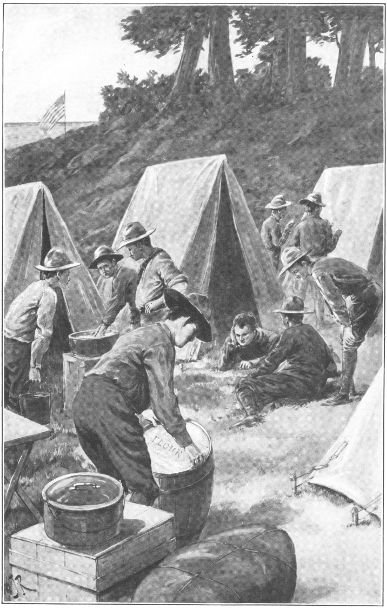
IN CAMP
“You may take it in turns, fellows—each sleep out with him one night, when the weather is fine,” decided the scoutmaster. “Now! I’m going to appoint Scouts Warren and Chase cooks for to-night.”
A first-rate supper did those cooks turn out, of flapjacks and scrambled eggs, the latter stirred with a peeled stick, while the great coffee-pot, brooding upon its rosy nest of birch-logs, grinned facetiously when a stray flame wreathed its spout, then broke into bubbling laughter.
Night fell upon the pale dunes that turned to silver monuments under the smile of a moon in its third quarter. A gentle, lowing sound came to the scouts’ ears from the tide at far ebb upon the silvery beach, as, the cook-fire abandoned, they gathered round a blazing camp-fire that cast weird reflections upon the surrounding white hillocks.
The holding of a calm powwow on this first night in camp, when each heart was thrilling tumultuously to the novelty of the surroundings, was impossible. Toiney sang wild fragments of songs that found a suitable accompaniment in the distant, hoarse barking of the harbor seal, and in the plaintive “Oo-oo-ooo!”—the dove-like call of the creamy pup-seal to its marbled mother in some lonely tidal creek.
Once and again from the shore side of the scouts’ camp-fire, from among the shimmering sand-hills, came the weaker, more snappy bark of the little dog-fox, as he prowled the dunes.
The dazzling Sugarloaf Pillar near the mouth of the river was wrapped in night’s mantle. But lights flickered out in two of the handsome summer bungalows which the boys had noticed, standing at some distance from their camping-ground, looming high above the beach, erected upon stilt-like props driven into the sandy soil.
“Those houses were only built last spring; they’re occupied for the first time this summer,” said Kenjo Red, who was more familiar with this region than the others. “Say! let’s chant our African war-song, fellows. This is just the night for it.” And the barbaric chant rang weirdly among the sand-hills, the leader shouting the first line, his companions answering with the other three, to the accompaniment of the flames’ crackle and the night calls of bird and beast:—
“Een gonyâma—gonyâma. Invoboo! Yah bô! Yah bô Invoboo!”
Presently the bark of the dog-fox was heard farther off. He knew, the stealthy slyboots, that he was not the only lone prowler among the pale dunes that night who listened intently to the boisterous revelry round the scouts’ camp-fire.
His keen sense of smell informed him that behind one plumed sand-hill, between his own trotting form and the noisy company in the firelight, there lurked a solitary man-figure.
But he, the sandy-coated little trotter from burrow to burrow, could neither hear nor interpret the sound, half groan, half oath, savagely envious, that escaped from the other night-prowler’s lips as he listened to the boys’ voices.
Silence, broken only by ringing snatches of laughter, reigned temporarily over the dunes. Then once again it blossomed into song:—
“Hurrah for the brave, hurrah for the good, Hurrah for the pure in heart! At duty’s call, with a smile for all, The Scout will do his part!”
And the soft purr of the low tide, with the breeze skipping among pallid dunes that looked like capped haystacks in the darkness, flung back the cheer for the “Scouts of the U.S.A.”
“Aghrr-r!” snarled the testy dog-fox, his distant petulant growl much resembling that of Leon’s terrier, who, unfortunately, was not present upon the dunes to-night. Blink had already added the word “Scout” to his limited human vocabulary, but the wild fox had no such linguistic powers. The foreign music upon the lonely dunes was irritating, alarming to him.
It seemed to have something of the same effect upon his brother-prowler, upon the man who skulked among the sand-hills within hearing of the song: at any rate, the semi-articulate sound which from time to time he uttered, deepened into an unmixed groan that escaped from his lips again later when the clear notes of a bugle rang over the Sugarloaf Dunes, warning the scouts by the “first call” that fun was at an end for to-night, and sleep would be next upon the programme.
Then when lights were out, came the sweet sound of “Taps,” the wind-up of the first day in camp, the expert bugler being Corporal Chase.
For the Exmouth doctor had kept his word: Leon had been given the “bugle” literally and figuratively since he enlisted as a scout, symbol of the challenge to all the energy in him to advance along new lines, instead of the “foghorn” reproofs and warnings that had been showered on him prior to his scouting days.
Then, at last, stillness reigned, indeed, upon the moonlit dunes.
The bark of the dog-fox melted into distance, becoming indistinguishable from the voice of the returning tide.
The man-prowler among the sand-hills slipped away to some lair as lonely as the fox’s.
And Toiney, with Scout Nixon Warren wrapped in his camper’s blanket beside him, slept out upon the white sands “wit’ de littal star on top o’ them!”
CHAPTER XVI
THE PUP-SEAL’S CREEK
The music of “Taps” was eclipsed by the blither music of “Reveille,” the morning blast blown by Leon standing in front of the white tents, the sands beneath his feet jeweled by the early sunshine, the blue ribbon attached to his bugle flirting with the breeze that capered among the plumy hillocks.
The tide which had ebbed and flowed again since midnight—when the last excited scout had fallen asleep lulled by its full purr—broke high upon the beach, where the white sands gleamed through its translucent flood like milk in a crystal vase.
Far away in dim distance, higher up the tidal river upon its other side, beyond the plains of water, the woods which enclosed Varney’s Paintpot and the cave called the Bear’s Den smiled remotely through a pearly veil of haze.
And all the waking glee of tide, dunes, and woods was personified in the boy bugler’s face.
The sight of him as he stood there, face to the tents where his comrades scrambled up from cot or ground, his brown eyes snapping and flashing under the scout’s broad hat, with the delight of having found an absorbing interest which stimulated and turned to good account every budding activity within him—that sight would have made the veriest old Seek-sorrow among men take heart and feel that a new era of chivalry was in flower among the Scouts of the U.S.A.
And the old religious reverence, that fortifying kernel of knighthood, was not neglected by this boy scout patrol.
Bareheaded, and in line with their scoutmasters presently, while their eyes gazed off over the sparkling dunes and crystal tide-stretches, they repeated in unison the Lord’s Prayer, offering morning homage to the Power, dimly discerned, of whom and through whom and to whom are all things. Of his, the Father’s, presence chamber, gladness and beauty stand at the threshold!
“Now, for our early swim! The tide’s just right. Come along, Harold; I’m going to give you your first swimming-lesson; and I expect you’ll be a star pupil!” cried Nixon, the patrol leader, when the brief adoration was over. “What! you don’t want to learn to swim? Nonsense! You are going into that dandy water. Oh! that’s not a scout’s mouth, Harold.”
And the corners of Harold’s mouth, which had drooped with fear of this new experience, curled up in a yielding grin.
Once he was in the invigorating salt water, feeling the boisterous tidal ripples, fresh and not too cold, rise about his body, the timid lad underwent another lightning change, just as at the moment of his tying the bowline knot, the spirit of his fisherman father became uppermost in him, and he learned to swim almost as easily and naturally as a pup-seal.
The improvement in his condition was such that his brother Owls had won his promise to enter school when it should reopen after this jolly camping period was over. “And if any boy picks on you or teases you, Harold, mind you’re to let us know at once, because we’re your brother scouts—and he won’t try it a second time!” So they admonished him.
Thus Harold, under the Owls’ sheltering wing, was gradually losing his inherited and imbibed dread of a crowd, of any gathering of his own kind.
Although this bugbear fear returned upon him a little when, later on that morning, the Fox Patrol, with Godey Peck as its leader, was landed upon the Sugarloaf Dunes from Captain Andy’s motor-launch, and still later in the day the Seals rowed across in two large rowboats from certain farms or fishermen’s houses upon the opposite side of the river, to join the other two patrols. So that the boy scout troop was complete, and Harold found himself one of twenty-four boisterous, though good-natured, boys upon this strange white beach.
A little homesickness beset him for the farm-clearing in the woods and his grandfather’s staid presence, to cure which Scouts Warren and Chase took him off with them in the little rowboat, the Pill, lent by Captain Andy, to explore the tidal river and the little truant creeks that escaped from it to burrow among the salt-marshes.