Front matter (continued 2)
Reading edition
“Well! we’re up against it now,” gasped the scout. “We can’t get out of the woods to-night; that’s sure! We could sleep in the cave and be jolly comfortable too”—he stooped down and examined its wide interior—”if we only had a fire. But, without a camp-fire or a single blanket, we’ll be uncomfortable enough when it comes on dark; these September nights are chilly.”
He threw his hat on the ground, drew his coat-sleeve across his ruddy forehead, rendering his bedaubed countenance slightly more grotesque than before. He had forgotten that it was smeared, forgotten paint and frolic. An old look descended upon his face.
He was desperately tired. Every muscle of his body ached. His head was confused too from long wandering among the trees; his thoughts seemed to skip back into the woods away from him; he felt himself stalking them as Blink would stalk a rabbit. But there was one thing more alive in him at that moment than ever before, a sense of protective responsibility.
With Leon disabled and the two younger boys completely worn out, it rested with him alone to turn a night in the Bear’s Den into a mere “corking” adventure, or to let it drag by as a dark age of discomfort with certainly bad results for two of the party. Nixon had felt Leon’s hand as it slipped from his neck at the edge of the clearing, it was clammy as ice; his first-aid training as a scout told him that the injured lad would feel the cold bitterly during the night.
Starrie Chase would probably “stick it out without squealing,” as in such circumstances he would try to do himself. But it would be a hard experience. And young Colin’s clothing was still sodden from his partial immersion in Big Swamp. It was one of those moments for the Scout of the U.S.A. when the potential father in the boy is awake.
“I’ve got to fix things up for the night, somehow,” he wearily told himself aloud. “I wonder—I wonder if I could manage to start a fire without matches—with ‘rubbing-sticks’? I did it once when we were camping out with our scoutmaster. But he helped me. If I could only get the fire, now, ’twould be a—great—stunt!”
“’Start a fire without matches!’ You’re crazy!” Colin and Coombsie looked sideways at him; they had heard of people being “turned round” in their heads by much woodland wandering.
“Shut up, you two!” commanded Leon, suddenly imperious. “He knows what he’s about. He did a good stunt in helping me along here.”
“If I could only find the right kinds of wood to start a friction fire—balsam fir for the fireboard and drill, and a little chunk of cedarwood to be shredded into tinder!” The boy scout was eagerly scanning the trees on either side of the grass-grown logging-road, trees which at this moment seemed to have their roots in the forest soil and their heads in Heaven’s own glory.
“There’s a fir-tree! Among those pines—a little way along the road!” Leon spoke in that slow, stiff voice, sprained by pain. “Perhaps I can help you—Nix?”
“No, you lie still, but chuck me your knife, it’s stronger than mine! I ought to have two tools for preparing the ‘rubbing-sticks,’ so the Chief Scout tells us in our book, but I’ll have to get along somehow with our pocketknives.”
Nix Warren was off up the road as he spoke; hope, responsibility, and ambition toward the performance of a “great stunt,” forming a fighting trio to get the better of weariness.
The glory was waning from the tree-tops when he returned, bearing with him one sizeable chunk of balsamic fir-wood and a long stick from the same tree.
“Any sort of stick will do for the bent bow which is attached to the drill and works it; that’s what our book says,” he murmured, as if conning over a lesson. “Who’s got a leather shoe-lace? You have—cowhide laces—in those high boots of yours, Colin! Mind letting me have one?”
The speaker was excitedly setting to work, now, fashioning the flat fireboard from the chunk of fir-wood, carving a deep notch in its side, and scooping out a shallow hole at the inner end of the notch into which the point of the upright drill would fit.
In feeling, he was the primitive man again, this modern boy scout: he was that grand old savage ancestor of prehistoric times into whose ear God whispered the secret, unknown to beast or bird, of creating light and warmth for himself and those dependent on him, when the sun forsook them.
“Say! can’t you fellows get busy and collect some materials for a fire, dry chips and pine-splinters—fat pine-splinters—and dead branches? There’s plenty of good fuel around! You wood-finders’ll have a cinch! ”
It certainly was a signal act of faith in Colin and Coombsie when they bestirred their weary limbs to obey this command from the wizard who was to try and evoke the mysterious fire-element latent in the combustible wood he handled, but hard to get at without the aids which civilization places at man’s disposal.
They each kept a corner of their inquisitive eyes upon him while they collected the fuel, watching the shaping of the notched fireboard, of the upright pointed drill, over a dozen inches in length, and the construction of a rude bow out of a supple stick found on the clearing, with Colin’s cowhide shoe-lace made fast to each end as the cord or strap that bent the bow.
This cord was twisted once round the upper part of the drill whose lower point fitted into the shallow hole in the fireboard.
“Whew! I must find a piece of pine-wood with a knot in it and scoop that knot out, so that it will form a disc for the top of the drill in which it will turn easily,” said the perspiring scout. “Oh, sugarloons! I’ve forgotten all about the tinder; we may have to trot a long way into the woods to find a cedar-tree.”
“I’ll go with you, Nix,” proffered Marcoo, while Leon, lying on the ground near the cave, with his dog pressing close to him, undertook the task of scooping that soft knot out of the pine-disk.
“All right; bring along the tin mug out of your basket; perhaps we may find water!”
And they did! Oh, blessed find! Wearily they trudged back about sixty yards into the woods, in an opposite direction from that in which they had traveled before—Nixon taking the precaution of breaking off a twig from every second or third tree so as to mark the trail—before they lit on a grove of young cedars through which ran a sound, now a purling sob, now a tinkling laugh; softer, more angel-like, than the wind’s mirth!
“Water! A spring! Oh—tooraloo!” And they drank their fill, bringing back, along with the cedar-wood for tinder—water, as much as their tin vessel would hold, for the two boys and dog keeping watch over the fire-sticks on the old bear’s camping-ground.
The soft cedar was shredded into tinder between two stones. The drill was set up with its lower point resting in the notched hole of the fire-board, its upper point fitting into the pine-disk which Nixon steadied with his hand.
Then the boy scout began to work the bent bow which passed through a hole in the upper part of the drill, steadily to and fro, slowly turning that drill, grinding its lower point into the punky wood of the fireboard.
In the eye of each of the four boys the coveted spark already glowed, drilled by excitement out of the dead wood of his fatigue.
Even the dog, his jaws gaping, his tongue lolling out, lay stretched at attention, his gaze intent upon the central figure of the boy scout working the strapped bow backward and forward, turning the pointed drill that bored into the fireboard.
Ground-up wood began to fall through the notch in the fireboard adjacent to the hole upon another slab of wood which Nixon had placed as a tray beneath it.
This powdered wood was brown. Slowly it turned black. Was that smoke?
It was a strange tableau, the four disheveled boys with their red-smeared faces, the painted clown’s dog, all holding their breath intent upon the primitive miracle of the fire-birth.
Smoke it was! Increasing smoke! And in its tiny cloud suddenly appeared the miracle—a dull red spark at the heart of the black wood dust.
“What do you know about that?” Marcoo’s voice was thick.
“Gee! that’s a—wonderful—stunt. I guess you could light a fire with a piece of damp bark and a snowball!” Leon looked up at the panting scout.
Colin’s mind was telegraphing back to the moment when he lay on the salt-marshes that morning, hungry for the woods. If any one had told him that, before night, he would assist at a forest drama like this!
“Hush! Don’t speak for fear you’d hoodoo it! We haven’t got it yet—the fire! Perhaps—perhaps—I can’t make it burn.” It was the most wonderful moment of his life for the boy scout as he now took a pinch of the cedar-wood tinder, half-enclosed in a piece of paper-like birch-bark and held it down upon the red fire-germ—in all following the teaching of the great Chief Scout.
Then he lifted the slab of wood that served as tray, bearing the ruddy fire-embryo and tinder, and blew upon it evenly, gently. It blazed. The miracle was complete.
“Wonderful stunt!” murmured Starrie Chase again. His hand in its restless uneasiness had been plucking large flakes of moss from the gray rock behind him and turning them over, revealing the medicinal gold thread that embroidered the earthy underside of the sod; he was sucking that bitter fibre—supposed to be good for a sore mouth, but no panacea for a sprained ankle—while a like gold thread of fascinated speculation embroidered the ruddy mask of his face.
“Hurrah! we’ll have a fire right away now, that will talk to us all night long.” The triumphant scout lowered the flame-bud to the ground, piled over it some of the resinous pine-splinters and strips of inflammatory bark, fanning it steadily with his hat. In a few minutes a rollicking camp-fire was roaring in front of the old Bear’s Den.
“Now! we must gather some big chunks, dry roots and stumps, to keep the fire going through the night, cut sods to put round it and prevent its spreading into the woods, and break up some pine-tips to strew in the cave for a bed. There’s lots of work ahead still, fellows, before we can be snug for the night!”
The scout, having got his second breath with his great achievement, was working hard as he spoke; Marcoo and Colin followed his example in renewed spirits. Leon, chafing at his own inactivity, tried to stand and sank down with a groan.
“How’s the thunderstorm sprain?” they asked him.
“Worse—ugh-h! And I’m parched with thirst—still!”
“Well, we’ll lope off into the woods and bring you back some more water. If you’ll leave a little in the bottom of the mug I’ll soak our handkerchiefs in it and wrap them round your ankle; cold applications may relieve the pain;” the scout was recalling what he had learned about first aid to the injured.
Darkness descended upon the old bear’s stamping-ground. But the camp-fire burned gloriously, throwing off now and again a foam of flame whose rosy clots lit in the crevices of the tall rock and bloomed there for an instant like scarlet flowers.
The work necessary in making camp for the night done, the four boys gathered round it, dividing their scanty rations, the scraps of food left in Coombsie’s basket, and speculating as to how early in the morning a search-party would come out and find them.
“Toiney Leduc will certainly be one of the party. Toiney is a regular scout; he’s only been here a year, but he knows the woods well,” remarked Leon, then was silent a minute, gazing wistfully into the heart of the flames which filled the pause with snappy conversational fire-works.
“Tell us something about this boy scout business, bo’!” he spoke again in the slow, sprained voice, his feverish eyes burning into the fire, his tone making the slangy little abbreviation stand for brother, as he addressed Nixon. “It seems as if it might be The Thing—starting that fire was a great stunt—and if it’s The Thing—every fellow wants to be in it!”
“Oh! you don’t know what good times we have,” began the scout.
And briefly skimming from one point to another, he told of the origin of the Boy Scout Movement far away in Africa during the defense of a besieged city, and of the great English general, the friend of boys, who had fathered that movement.
Leon’s eyes narrowed as he still gazed into the camp-fire: it was a long descent from the defense of a beleaguered city to the championship of a besieged chipmunk, but his quick mind grasped the principle of fiery chivalry underlying both—one and the same.
“Can you sing some more of that U.S.A. song which you were shouting in the woods near the log camp?” Marcoo broke in, as the narrator dwelt on those good times spent in hiking, trailing, camping with the scoutmaster.
“Perhaps I can—a verse or two! That’s the latest for the Boy Scouts of America—the Scouts of the old U.S. Don’t know whether I have a pinch of breath left, though!”
And the flagging voice began, gathering gusto from the camp-fire, glee from the stars now winking through the pine-tops:—
“Mile after mile in rank or file, We tramp through field and wood: Or off we hike down path or pike, One glorious brotherhood. Hurrah for the woods, hurrah for the fields, Hurrah for the life that’s free! With a body and mind both clean and kind, The Scout’s is the life for me!”
“Chorus, fellows!” he cried:—
We will fight, fight, fight, for the right, right, right, “Be prepared” both night and day; and we’ll shout, shout, shout, for the Scout, Scout, Scout, for the Scouts of the U.S.A.
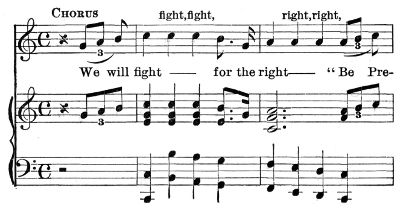
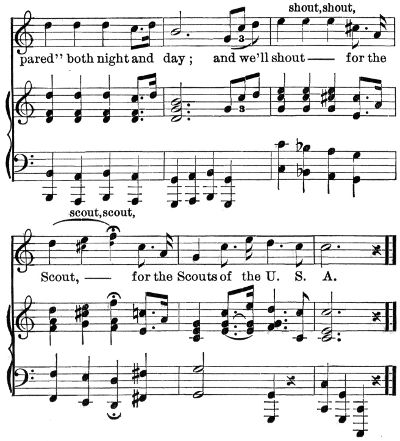
Audio content is not currently supported on your device.
The rolling music in the pine-trees, the reedy whistle of the breeze among beeches and birches, soft cluck of rocking branches, the bagpipe skirling of the flames leaping high, fluted and green-edged, all came in on that chorus; together with the four boyish voices and the bark of the dog as he bayed the blaze: the night woods rang for the Scouts of the U.S.A.
“If when night comes down we are far from town, Both tired and happy too, Camp-fires we light and by embers bright We sleep the whole night through. Hurrah for the sun, hurrah for the storm, Hurrah for the stars above! We feel secure, safe, sane and sure, For we know that God is Love.”
“Why have you that knot in your tie?” asked Leon after the last note had died away in forest-echo, while the scout was wetting the bandages round his inflamed ankle before they crept into the cave to sleep.
“To remind me to do one good turn to somebody every day.”
“Well, you can untie it now; I guess you’ve done good turns by the bunch to-day!”
Lying presently upon the fragrant pine-tips with which they had strewn the interior of the cave, the scout’s tired fingers fumbled for that knot and drowsily undid it. He had lost both way and temper in the woods. But he had tried, at least, to obey the scout law of kindness.
As he lay on guard, nearest to the cave’s entrance, winking back at the stars, this brought him a happy sense of that wide brotherhood whose cradle is God’s Everlasting Arms.
From the well of his sleepy excitement two words bubbled up: “Our Father!” Rolling over until his nose burrowed among the fragrant evergreens, he repeated the Lord’s Prayer, adding—because this had been an eventful day—a brief petition which had been put into his lips by his scoutmaster and was uttered under unusual stress of feeling, or when he remembered it: That in helpfulness to others and loyalty to good he might be a follower of the Lord of Chivalry, Jesus Christ, and continue his faithful soldier and servant “until the scout’s last trail is done!”
It was almost morning when he awoke for the second time, having stirred his tired limbs once already to replenish the camp-fire.
Now that hard-won fire had waned to a dull red shading on the undersides of velvety logs, the remainder of whose surface was of a chilly gray from which each passing breeze flicked the white flakes of ash like half-shriveled moths.
“Whew! I must punch up the fire again—but it’s hard to get the kinks out o’ my backbone;” he straightened his curled-up spine with difficulty and stumbled out on the camping-ground.
It was that darkest hour before dawn. The stars were waning as well as the fire. The trees which had been friends in the daytime were spectators now. Each wrapped in its dark mantle, they seemed to stand curiously aloof, watching him.
He attacked the logs with a stick, poking them together and thrusting a dry branch into the ruddy nest where the fire still hatched.
Snip! Snap! Crackle! the flames awoke. Mingling with their reviving laughter, came a low, strange cluck that was not the voice of the fire, immediately followed by a long shrill cry with a wavering trill in it, not unlike human mirth.
It hailed from some point in the scout’s rear.
“For heaven’s sake!” The stick shook in his fingers. “Can it be a wildcat—or another coon?”
Stiffly he wheeled round. His eyes traveled up the great rock—in whose cave his companions lay sleeping; as they gained the top of that old grayback, they were confronted by two other eyes—mere twinkling points of flame!
The scout’s scalp seemed to lift like a blown-off roof. His throat grew very dry.
At the same moment there was a noiseless flitting as of a shadow from the rock’s crest to a near-by tree whence came the weird cry again.
“An owl! Well, forevermore! And my hair is standing straight still! ”
“What is it? What is it, Nix?” came in muffled cries from the cave.
“Only a screech owl; it’s unusual to find one so far in the woods as this!”
As it happened two ruddy screech owls, faithful lovers and monogamists, which had dwelt together as Darby and Joan in the hollow of an old apple-tree in a distant orchard, being persecuted both by boys and blue jays, had eschewed civilization, isolating themselves, at least from the former, in the woods.
As dawn broke between the tall pines and a pale river of daylight flowed along the logging-road, they were seen, both together, upon a low bough, with the dawn breeze fluffing their thick, rufous plumage, making them look larger than they really were, and their heads slowly turning from side to side, trying to discover the meaning of a camp-fire and other strange doings in this their retreat.
“Oo-oo! look at them,” hooted Colin softly, creeping out of the cave and stealthily approaching their birch-tree. “They have yellow eyes and faces like kittens. Huh! they’re more comical than a basket of monkeys. Oh, there they go.”
For even as his hand was put forth to touch them, they vanished silently as the ebbing shadows in the train of night.
“This must be a great place for owls,” said Leon, blinking like one—not until far on in the night had he slept owing to the wrenching pain in his ankle. “Listen! there goes the big old hooter—the great horned owl—the Grand Duke we call him. Hear him ’way off: ‘Whoo-whoo-hoo-doo-whoo!’ Sounds almost like a wolf howling! Ou-ouch!”
“Is your ankle hurting badly, Starrie?”
“It’s—fierce.”
“Daylight is coming fast now; I’ll be able to find the spring and wet those bandages again—and bring you a drink too”; this from the scout.
“Thanks. You’re the boy, Nix!”
The brotherly act accomplished, there was silence in the cave where the four boys had again stretched themselves while young Day crept up over the woods.
Suddenly Leon’s voice was heard ambiguously muttering in the cave’s recess: “If it’s The Thing, every fellow wants to be in it!”
“Say! fellows, I’ve got an idea,” he put forth aloud.
“Out with it, if it’s worth anything!” from Colin.
“Oh, for heaven’s sake, Leon! get it out quick, and let us go to sleep again!” pleaded Coombsie, who knew that if Starrie Chase was oppressed by an idea, other boys would hear it in his time, not in theirs.
“I propose that after we get home—when my ankle is better—we start a boy scout patrol in our town and call it the Owl Patrol! I guess we’ve heard the owls—different kinds—often enough to-night, to be able to imitate one or other of them.”
“Good enough! The Scout’s is the life for me!” sang out Colin.
“The motion is seconded and carried—now let’s go to sleep!” from Marcoo.
“As I expect to stay in these parts for six months, or longer, I’ll get transferred from the Philadelphia Peewits to the new patrol!” decided Nixon.
“Bully for you! We’ll ask Kenjo Red and Sweetsie to come in; they’re dandy fellows—and who else?” Leon hesitated.
“Why don’t you get hold of that frightened boy who was with Toiney on the edge of the woods? We had a boy like him in our Philadelphia troop,” went on Nixon hurriedly, ignoring a surge of protest. “Scared of his own shadow he was! Abnormal timidity—with a long Latin name—due to pre-natal influences, according to the doctors! Well, our scoutmaster managed somehow to enlist him as a tenderfoot. When he got out into the woods with us and found that every other scout was trying to help him to become a ‘fellow,’ why! he began to crawl out of his shell. He’s getting to be quite a boy now!”
“But the ‘Hare’! he’d spoil—Ouch!” A sudden wrench of agony as Leon moved restlessly put the pointed question as to whether the mental pain which Harold Greer suffered might not be as hard to drag round as a thunderstorm ankle.
“All right, Nix! Enlist him if you can! I guess you’ll have to pass on who comes into the new patrol.”
Colin dug his nose into the pine-tips with a skeptical chuckle: that new patrol would have a big contract on hand, he thought, if it was to gather up the wild, waste energy of Leon,—that element in him which parents and teachers sought to eradicate,—turn it to good account, and take the fright out of the Hare.
But from the woods came a deep bass whoop that sounded encouraging: the Whoo-whoo-hoo-doo-whoo! of the Grand Duke bidding the world good-morning ere he went into retreat for the day.
It was answered by the Whoo-whoo-whooah-whoo! of a brother owl, also lifting up his voice before sunrise.
“Listen, fellows!” cried Leon excitedly. “Listen! The feathered owls themselves are cheering the Owl Patrol.”
CHAPTER VII
MEMBERS OF THE LOCAL COUNCIL
And thus the new patrol was started.
Three weeks after the September morning when an anxious search-party led by Asa Chase, Leon’s father, and by that clever woodsman Toiney Leduc, had started out at dawn to search the dense woods for four missing boys, and found a grotesque-looking quartette with faces piebald from the half-effaced smears of Varney’s Paintpot, breakfasting on blueberries and water by a still ruddy camp-fire,—three weeks after those morning woods had rung with Toiney’s shrill “Hôlà!” the first meeting for the formation of the Owl Patrol was held.
In virtue of his being already a boy scout with a year’s training behind him, Nixon Warren was elected patrol leader; and Leon Starr Chase who still limped as a result of his reckless descent of that freak pine-tree, was made second in rank with the title of corporal—or assistant patrol leader.
Among the half-dozen spectators, leading men of the small town, who had assembled to witness the inaugural doings at this first meeting and to lend their approval to the new movement for the boys, there appeared one who was lamer than Leon, his halting step being due to a year-old injury which condemned him to limp somewhat for the remainder of his life.
This was Captain Andrew Davis, popularly known as Captain Andy, who had been for thirty years a Gloucester fishing-skipper, one of the present-day Vikings who sail forth from the Queen Fishing City at the head of its blue harbor.
He had commanded one fine fishing-vessel after another, was known along the water-front and among the fishing-fleet as a “crackerjack” and “driver,” with other more complimentary titles. He had got the better of the sea in a hundred raging battles on behalf of himself and others. But it partially worsted him at last by wrecking his vessel in what he mildly termed a “November breeze”—in reality a howling hurricane—and by laming him for life when at the height of the storm the schooner’s main-boom fell on him.
He was dragged forth from under it, half-dead, but, “game to the last,” refused to be carried below. Lashed to the weather main-bitt—one of the sawed-off posts rising from the vessel’s deck to which the main-sheet was made fast—in order to prevent his being swept overboard by the great seas washing over that deck, he had kept barking out orders and fighting for the lives of his crew so long as he could command a breath.
“And I didn’t lose a man, Doc!” he said long afterwards to his friend and admirer, the Exmouth doctor, the hard-working physician with whose long-suffering bell Leon had mischievously tampered. “I didn’t lose a man—only the vessel. When the gale blew down we had to take to the dories, for she was just washing to pieces under us. Too bad: she was an able vessel too! But I guess I’ll have to ‘take my medicine’ for the rest of my life—an’ take it limping!”—with a rueful smile.
But the many waters through which he had passed had not quenched in Captain Andy the chivalrous love for his human brothers. Rather did they baptize and freshen it until it sprouted anew, after he took up his residence ashore, in a paternal love for boys which kept his great heart youthful in his massive, sixty-year-old body; and which kept him hopefully dreaming, too, of deeds that shall be done by the sons now being reared for Uncle Sam, that shall rival or outshine the knightly feats of their fathers both on land and sea.
So he smiled happily, this grand old sea-scout, as, on the occasion of the first meeting for the inauguration of the Boy Scout Movement, he heaved his powerful frame into a seat beside his friend the doctor who was equally interested in the new doings.
“Hi there, Doc!” said Captain Andy joyously, laying his hand, big and warm as a tea-kettle, on the doctor’s arm, “we’re launching a new boat for the boys to-night, eh? Seems to me that it’s an able craft too—this new movement—intended to keep the lads goin’ ahead under all the sail they can carry, and on a course where they’ll get the benefit of the best breezes, too.”
“That’s how it strikes me,” returned the doctor. “If it will only keep Starrie Chase, as they call him, sailing in an opposite direction to my doorbell, I’m sure I shall bless it! D’you know, Andy,” the gray-bearded physician addressed the weatherbeaten sea-fighter beside him as he had done when they were schoolboys together, “when I heard how that boy Leon had sprained his ankle badly in the woods and that the family had sent for me, I said: ‘Serve him right! Let him be tied by the leg for a while and meditate on the mischief of his ways; I’m not going to see him!’ Of course, before the words were well out, I had picked up my bag and was on my way to the Chase homestead!”
“Of course you were!” Captain Andy beamed upon his friend until his large face with its coating of ruddy tan flamed like an aurora borealis under the electric lights of the little town hall in which the first boy scout meeting was held. “Trust you, Doc!”
The ex-skipper knew that no man of his acquaintance lived up to the twelve points of the scout law in more thorough fashion than did this country doctor, who never by day or night closed his ears against the call of distress.
“I’ll say this much for the young rascal, he was ashamed to see me bring out my bandages”; the doctor now nodded humorously in the direction of Leon Chase, who made one of a semicircle composed of Nixon, himself and six other boys, at present seated round the young scoutmaster whom they had chosen to be leader of the new movement in their town.
“But by and by his tongue loosened somewhat,” went on the grizzled medical man, “and he began to take me into his confidence about the formation of this boy scout patrol; he seemed more taken up with that than with what he called ‘the thunderstorm in his ankle.’ Leon isn’t one to knuckle under much to pain, anyhow! Somehow, as he talked, I began to feel as if we hadn’t been properly facing the problem of our boys in and about this town, Andy.”
“I see what you mean!” Captain Andrew nodded. “Leon is as full of tricks as a tide rip in a gale o’ wind. An’ that’s the most mischievous thing I know!” with a reminiscent chuckle. “But what can you do? If a boy is chockfull o’ bubbling energy that’s going round an’ round in a whirl inside him, like the rip, it’s bound to boil over in mischief, if there ain’t a deep channel to draw it off.”
“That’s just it! Ours is a slow little town—not much doing for the boys! Not even a male teacher in our graded schools to organize hikes and athletics for them! I am afraid that more than one lad with no natural criminal tendency, has got into trouble, been ultimately sent to a reformatory, owing to a lack in the beginning of some outlet safe and exciting for that surplus energy of which you speak. Take the case of Dave Baldwin, for instance, son of that old Ma’am Baldwin who lives over on the salt-marshes! ” The doctor’s face took on a sorry expression. “There was nothing really bad in him, I think! Just too much tide rip! He was the counterpart of this boy Leon, with a craving for excitement, a wild energy in him that boiled over at times in irregular pranks—like the rip—as you say.”
“And you know what makes that so dangerous?” Captain Andy’s sigh was heaved from the depths of past experience. “Well! with certain shoals an’ ledges in the ocean there’s too much water crowded onto ’em at low tide, so it just boils chock up from the bottom like a pot, goes round and round in a whirl, strings out, foamy an’ irregular, for miles. It’s ‘day, day!’ to the vessel that once gets well into it, for you never know where ’twill strike you.
“And it’s pretty much the same with a lively boy, Doc: at low tide, when there’s nothing doing, too much o’ something is crowded onto the ledges in him, an’ when it froths over, it gets himself and others into trouble. Keep him interested—swinging ahead on a high tide of activity under all the sail he can carry, and there’s no danger of the rip forming. That’s what this Boy Scout Movement aims at, I guess! It looks to me—my word! it does look to me—as if Leon was already ‘deepening the water some,’ to-night,” wound up Captain Andy with a gratified smile, scrutinizing the face of Starrie Chase, which was at this moment marked by a new and purposeful eagerness as he discussed the various requirements of the tenderfoot test, the elementary knowledge to be mastered before the next meeting, ere he could take the scout oath, be invested with the tenderfoot scout badge and be enrolled among the Boy Scouts of America.
“A movement such as this might have been the saving of Dave Baldwin,” sighed the Doctor. “He was always playing such wild tricks. People kept warning him to ‘cut it out’ or he would surely get into trouble. But the ‘tide rip’ within seemed too much for him. No foghorn warnings made any impression. I’ve been thinking lately of the saying of one wise man: ‘Hitherto there has been too much foghorn and too little bugle in our treatment of the boys!’ Too much croaking at them: too little challenge to advance! So I said to the new scoutmaster, Harry Estey, Colin’s brother,” nodding toward a tall young man who was the centre of the eager ring of boys, “I said, ‘give Leon the bugle: give it to him literally and figuratively: you’ll need a bugler in your boy scout camp and I’ll pay for the lessons; it will be a better pastime for him than fixing my doorbell.’”
“I hope ’twill keep him from tormenting that lonely old woman over on the marshes; the boys of this town have made her life a burden to her,” said Captain Andy, thinking of that female recluse “Ma’am Baldwin,” to whom allusion had been made by Colin and Coombsie on the memorable day which witnessed their headstrong expedition into the woods. “She has been regarded as fair game by them because she’s a grain cranky an’ peculiar, owing to the trouble she’s had about her son. He was the youngest, born when she was middle-aged—perhaps she spoiled him a little. Come to think of it, Doc, I saw the young scape-grace a few days ago when I was down the river in my power-boat! He was skulking like a fox round those Sugar-loaf Sand-Dunes near the bay.”
“How did he look?”
“Oh, shrunken an’ dirty, like a winter’s day!” Captain Andy was accustomed to the rough murkiness of a winter day on mid-ocean fishing-grounds. “He made off when he saw me heading for him. He’s nothing but an idle vagrant now, who spends his time loafing between those white dunes and the woods on t’ other side o ’ the river. He got work on a farm after he was discharged from the reformatory, but didn’t stick to it. Other fellows shunned him, I guess! Folks say that he’s been mixed up in some petty thefts of lumber from the shipyards lately, others that he keeps a row-boat stowed away in the pocket of a little creek near the dunes, and occasionally does smuggling in a small way from a vessel lying out in the bay. But that’s only a yarn! He couldn’t dodge the revenue officers. Anyhow, it’s too bad that Dave should have gone the way he has! He’s only ‘a boy of a man’ yet, not more’n twenty-three. When I was about that age I shipped on the same vessel with Dave’s father—she was a trawler bound for Gran’ Banks—we made more than one trip together on her. He was a white man; and—”
“Captain Andy!” A voice ringing and eager, the voice of the scoutmaster of the new patrol who had just received his certificate from headquarters, interrupted the captain’s recollections of Dave Baldwin’s father. “Captain Andy, will you undertake to instruct these boys in knot-tying, before our next meeting, so that they may be able to tie the four knots which form part of the tenderfoot test, and be enrolled as scouts two weeks from now? ”
“Sakes! yes; I’ll teach ’em. And if any one of ’em is such a lubber that he won’t set himself to learn, why, I’ll spank him with a dried codfish as if I had him aboard a fishing-vessel. Belay that!”
And the ex-skipper’s eye roved challengingly toward the scout recruits from under the heavy lid and short bristling eyelashes which overhung its blue like a fringed cloud-bank.
The threat was welcomed with an outburst of laughter.
“And, Doctor, will you give us some talks on first-aid to the injured, after we get the new patrol fairly started?” Scoutmaster Estey, Colin’s elder brother, looked now at the busy physician, who, with Captain Andy and other prominent townsmen, including the clergymen of diverse creeds, was a member of the local council of the Boy Scouts of America which had been recently formed in the little town.
“Yes; you may rely on me for that. But”—here the doctor turned questioningly toward the weather beaten sea-captain, his neighbor—”I thought the new patrol, the Owl Patrol as they have named it, was to consist of eight boys, and I see only seven present to-night. There’s that tall boy, Nixon Warren, who’s visiting here, and Mark Coombs, his cousin; then there’s Leon Chase, Colin Estey, Kenjo Red, otherwise Kenneth Jordan,” the doctor smiled at the red head of a sturdy-looking lad of fourteen, “Joe Sweet, commonly called Sweetsie, and Evan Macduff. But where’s the eighth Owl, Andy? Isn’t he fledged yet?”
“I guess not! I think they’ll have to tackle him in private before they can enlist him.” The narrow rift of blue which represented Captain Andy’s eye under the cloud-bank glistened. “You’ll never guess who they have fixed upon for the eighth Owl, Doc. Why! that frightened boy, Ben Greer’s son, who lives on the little farm-clearing in the woods with his gran’father and a Canadian farmhand whom Old Man Greer hires for the summer an’ fall.”
“Not Harold Greer? You don’t mean that abnormally shy an’ timid boy whom the children nickname the ‘Hare’? Why! I had to supply a certificate for him so that he could be kept out of school. It made him worse to go, because the other boys teased him so cruelly.”
“Jus’ so! But that brand o’ teasing is ruled out under the scout law. A scout is a brother to every other scout. I guess the idea of trying to get Harold enlisted in the Boy Scouts and thereby waking him up a little an’ gradually showing him what ‘bugaboos’ his fears are, originated with that lad from Philadelphia, Nix Warren, who, as I understand, showed himself to be quite a fellow in the woods, starting a friction fire with rubbing-sticks an’ doing other stunts which caused his companions to become head over heels interested in this new movement.”
“But how did he get interested in Harold Greer?” inquired the doctor.
“Well, as they trudged through the woods on that day when they made circus guys of themselves at Varney’s Paintpot, and subsequently got lost, they passed the Greer farm and saw Harold who hid behind that French-Canadian, Toiney, when he saw them coming. Apparently it struck Nix, seeing him for the first time, what a miserable thing it must be for the boy himself to be afraid of everything an’ nothing. So he set his heart on enlisting Harold in the new patrol. He, Nix, wants to pass the test for becoming a first-class scout: to do this he must enlist a recruit trained by himself in the requirements of a tenderfoot; and he is going to try an’ get near to Harold an’ train him—Nixon’s cousin, Mark Coombs, Marcoo, as they call him, told me all about it.”
“Well, I like that!” The doctor’s face glowed. “Though I’m afraid they’ll have difficulty in getting the eighth Owl sufficiently fledged to show any plumage but the white feather!” with a sorry smile. “I pity that boy Harold,” went on the medical man, “because he has been hampered by heredity and in a way by environment too. His mother was a very delicate, nervous creature, Andy. She was a prey to certain fears, the worst of which was one which we doctors call ‘cloister fobia,’ which means that she had a strange dread of a crowd, or even of mingling with a small group of individuals. As you know, her husband, like Dave Baldwin’s father, was a Gloucester fisherman, whose home was in these parts. During his long absences at sea, she lived alone with her father-in-law, her little boy Harold and one old woman in that little farmhouse on the clearing. And I suppose every time that the wind howled through the woods she had a fresh fit of the quakes, thinking of her husband away on the foggy fishing-grounds.”
“Yes! I guess at such times the women suffer more than we do,” muttered Captain Andy, thinking of his dead wife.
“Well!” the doctor cleared his throat, “after Harold’s mother received the news that her husband’s vessel was lost with all hands, on Quero Bank, when her little boy was about five years old, she became more unbalanced; she wouldn’t see any of her relatives even, if she could avoid it, save those who lived in the house with her. I attended her when she was ill and begged her to try and get the better of her foolishness for her boy’s sake—or to let me send him away to a school of some kind. Both Harold’s grandfather and she opposed the latter idea. She lived until her son was nine years old; by that time she had communicated all her queer dread of people—and a hundred other scares as well—to him. But in my opinion there’s nothing to prevent his becoming in time a normal boy under favorable conditions where his companions would help him to fight his fears, instead of fastening them on him—conditions under which what we call his ‘inhibitory power of self-control’ would be strengthened, so that he could command his terrified impulses. And if the Boy Scout Movement can, under God, do this, Andy, why then I’ll say—I’ll say that knighthood has surely in our day come again—that Scout Nixon Warren has sallied forth into the woods and slain a dragon more truly, perhaps, than ever did Knight of the Round Table by whose rules the boy scouts of to-day are governed! ”
The doctor’s last words were more to himself than to his companion, and full of the ardor of one who was a dragon-fighter “from way back”: day by day, for years, he had grappled with the many-clawed dragons of pain and disease, often taking no reward for his labors.
As his glance studied one and another of the seven boyish faces now forming an eager ring round the tall scoutmaster, while the date of the next meeting—the great meeting at which eight new recruits were to take the scout oath—was being discussed, he was beset by the same feeling which had possessed Colin Estey on that September morning in the Bear’s Den. Namely, that the Owl Patrol would have a big contract on hand if it was to get the better of that mischievous “tide rip” in Leon and prove to the handicapped “Hare” what imaginary bugaboos were his fears!
But Leon’s face in its purposeful interest plainly showed that, according to Captain Andy’s breezy metaphor, to-night he was really deepening the water in which his boyish bark floated, drawing out from the shoals among which he had drifted after a manner too trifling for his age and endowment.
And so the doctor felt that there might be hope for the eighth Owl chosen, and not present, being still a scared fledgling on that little farm-clearing in the woods, having never yet shaken a free wing, but only the craven white feather.
CHAPTER VIII
THE BOWLINE KNOT
Scout Nixon Warren, henceforth to be known as the patrol leader of the Owls, was himself possessed by the excited feeling that he was faring forth, into the October woods to tackle a dragon—the obstinate Hobgoblin of confirmed Fear—when on the day following that first boy scout meeting in Exmouth he took his way, accompanied by Coombsie, over the heaving uplands that lay between the salt-marshes and the woodland.
Thence, through thick grove and undergrowth, they tramped to the little farm-clearing, where they had come upon Toiney and the dead raccoon.
Nixon had arrayed himself in the full bravery of his scout uniform to-day, hoping that it might attract the attention of the frightened boy whose interest he wished to capture.
The October sun burnished his metal buttons, with the oxidized silver badge upon his left arm beneath the white bars of the patrol leader, and the white stripe at his wrist recording his one year’s service as a scout.
Because of the impression they hoped to produce, Marcoo too had donned the uniform, minus stripes and badge—the latter he would not be entitled to wear until after the all-important next meeting when, on his passing the tenderfoot test, the scoutmaster would pin it on his shirt, but reversed until he should have proved his right to wear that badge of chivalry by the doing of some initial good turn.
But Marcoo, like his companion, carried the long scout staff and was loud in his appreciation of its usefulness on a woodland hike.
And thus, a knightly-looking pair of pilgrims, they issued forth into the forest clearing, bathed in the early afternoon sun.
As before, their ears were tickled afar off by the sound of a tuneful voice alternately whistling and singing, though to-day it was unaccompanied by the woodchopper’s axe.
“That’s Toiney!” said Marcoo. “Listen to him! He’s just ‘full of it’; isn’t he?”
Toiney was indeed full to the brim and bubbling over with the primitive, zestful joy of life as he toiled upon the little woodland farm, cutting off withered cornstalks from a patch which earlier in the season had been golden with fine yellow maize of his planting. His lithe, energetic figure focused the sun rays which loved to play over his knitted cap of dingy red, with a bobbing tassel, over the rough blue shirt of homespun flannel, and upon the queer heelless high boots of rough unfinished leather, with puckered moccasin-like feet, in which he could steal through the woods well-nigh as noiselessly as the dog-fox himself.
As the two scouts emerged into the open he was singing to the sunbeams and to the timid human “Hare” who basked in his brightness, a funny little fragment of song which he illustrated as though he had a sling in his hand and were letting fly a missile:—
“Gaston Guè, si j’avais ma fron-de, Gaston Guè, je te l’aurais fron-dé!”
This he translated for Harold’s benefit:—
“Gaston Guè, if I haf ma sling, Gaston Guè, at you I vould fling!”
“Well! you needn’t ‘fling’ at us, Toiney,” laughed Nixon, stepping forward with a bold front. “Hullo! Harold!” he added in what he meant to be a most winning tone.
“Hullo, Harold! How are you?” supplemented Marcoo in accents equally sugared.
But the abnormally timid boy, with the pointed chin and slightly rodent-like face, only made an indistinguishable sound in his throat and slunk behind some bushes on the edge of the corn-patch.
Toiney, on the other hand, was never backward in responding vivaciously to a friendly greeting.
“Houp-e-là!” he explained in bantering astonishment as he surveyed the two scouts in the uniform which was strange to him. “Houp-e-là! We arre de boy! We arre de stuff, I guess, engh?” He pointed an earthy forefinger at the figures in khaki, his black eyes sparkling with whimsical flattery. “But, comment, you’ll no come for go in gran’ forêt agen, dat’s de tam’ you’ll get los’ agen—hein?”
“No, we’re not going any farther into the woods to-day. We came to see him.” Nixon nodded in the direction of Harold skulking timidly behind the berry bushes. “We want to speak to him about something.”
“Ah—miséricorde—he’ll no speak on you; he’s a poltron, a scaree: some tam’ I’ll be so shame for heem I’ll feel lak’ cry!” returned Toiney, moved to voluble frankness, his eye glistening like a moist bead, now, with mortified pity. “Son gran’père—hees gran’fader—he’s go on town dis day: he’s try ver’ hard for get heem to go also—for to see! Mais, non! He’s too scaree!” And the speaker, glancing toward the screen of bushes, shrugged his shoulders despairingly, as if asking what could possibly be done for such a craven.
Scout Nixon was not baffled. Persistent by nature, he had worked well into the fibre of his being the tenth point of the scout law: that defeat, or the semblance thereof, must not down the true scout.
“Then I’ll talk to you first, Toiney,” he said, “and tell you about something that we think might help him.”
And in the simplest English that he could choose, eked out at intervals with freshman French, he made clear to Toiney’s quick understanding the aim and methods of the Boy Scout Movement.
The Canadian, a born son of the woods, was quick to grasp and commend the return to Nature.
“Ça c’est b’en!” he murmured with an approving nod. “I’ll t’ink dat iss good for boy to go in gran’ forêt—w’en he know how fin’ de way—for see heem beeg tree en de littal wil’ an-ni-mal, engh? Mais, miséri-corde,”—his shrugging shoulders pumped up a huge sigh as he turned toward Harold,—”mis-éri-corde! he’ll no marche as éclaireur—w’at-you-call-eet—scoutee—hein? He’ll no go on meetin’ or on school, engh?”
And Toiney set to work cutting down cornstalks again as if the subject were unhappily disposed of.
Such was not the case, however. At one word which he, the blue-shirted woodsman, had used in his harangue, Nixon started, and a strange look shot across his face. He knew enough of French to translate literally that word éclaireur, the French military term for scout. He knew that it meant figuratively a light-spreader: one who marches ahead of his comrades to enlighten the others.
Could any term be more applicable to the peace scout of to-day who is striving to bring in an advanced era of progress and good will?
Somehow, it stimulated in Scout Warren the desire to be an éclaireur in earnest to the darkened boy overshadowed by his bugbear fears, now skulking behind the berry-bushes.
“I guess it’s no use our trying to get hold of him,” Coombsie was saying meanwhile in his cousin’s ear. “See that old dame over there, Nix?” he pointed to a portly, elderly woman with an immense straw hat tied down, sunbonnet fashion, over her head. “Well! she took care of Harold’s mother before she died; now she keeps house for his grandfather, and she, that old woman, told my mother that up to the time Harold was seven years old he would often run and hide his head in her lap of an evening as it was coming on dark. And when she asked what frightened him he said that he was ‘afraid of the stars’! Just fancy! Afraid of the stars as they came out above the clearing here!”
“Gee whiz! What do you know about that?” exclaimed Nixon with a rueful whistle: that dark hobgoblin, Fear, was more absurdly entrenched than he had thought possible.
Yet Harold’s seemed more than ever a case in which the scout who could once break down the wall of shyness round him might prove a true éclaireur: so he advanced upon the timid boy and addressed him with a honeyed mildness which made Coombsie chuckle and gasp, “Oh, sugar!” under his breath; though Marcoo set himself to second his patrol leader’s efforts to the best of his ability.
Together they sought to decoy Harold into a conversation, asking him questions about his life, whether he ever went into the woods with Toiney or played solitary games on the clearing. They intimated that they knew he was “quite a boy” if he’d only make friends with them and not be so stand-offish; and they tried to inveigle him into a simple game of tag or hide-and-seek among the bushes as a prelude to some more exciting sport such as duck-on-a-rock or prisoner’s base.
But the hapless “poltron” only answered them in jerky monosyllables, cowering against the bushes, and finally slunk back to the side of the blue-shirted farmhand with whom he had become familiar—whose merry songs could charm away the dark spirit of fear—and there remained, hovering under Toiney’s wing.
“I knew that it would be hard to get round him,” said Marcoo thoughtfully. “Until now all the boys whom he has met have picked on an’ teased him. Suppose you turn your attention to me for a while, Nix! Suppose you were to make a bluff of teaching me some of the things that a fellow must learn before he can enlist as a tenderfoot scout! Perhaps, then, he’d begin to listen an’ take notice. I’ve got a toy flag in my pocket; let’s start off with that!”
“Good idea! You do use your head for something more than a hat-rack, Marcoo!” The patrol leader relapsed with a relieved sigh into his natural manner. “I brought an end of rope with me; I thought we might have got along to teaching him how to tie one or other of the four knots which form part of the tenderfoot test. You take charge of the rope-end. And don’t lose it if you want to live!”
He passed the little brown coil to his cousin and receiving in return the miniature Stars and Stripes, went through a formal flag-raising ceremony there on the sunny clearing. Tying the toy flag-staff to the top of his tall scout’s staff, he planted the latter in some soft earth; then both scouts stood at attention and saluted Old Glory, after which they passed and repassed it at marching pace, each time removing their broad-brimmed hats with much respect and an eye on Harold to see if he was taking notice.
Subsequently the patrol leader stationed himself by the impromptu flagstaff, and delivered a simple lecture to Coombsie upon the history and composition of the National Flag; a knowledge of which, together with the proper forms of respect due to that starry banner, would enter into his examination for tenderfoot scout.
Both were hoping that some crumbs of information—some ray of patriotic enthusiasm—might be absorbed by Harold, the boy who had never been to school, and who had scantily profited by some elementary and intermittent lessons in reading and writing from his grandfather. His brown eyes, shy as any rodent’s, watched this parade curiously. But though Toiney tried to encourage him by precept and gesticulation to follow the boy scouts’ example and salute the Flag, plucking off his own tasseled cap and going through a dumb pantomime of respect to it, the “scaree” could not be moved from his shuffling stolidity.
The starry flaglet waving from the scout’s planted staff, might have been a gorgeous, drifting leaf from the surrounding woods for all the attention he paid to it!
“Say! but it’s hard to land him, isn’t it?” Nixon suspended the parade with a sigh almost of despair. “Well, here goes, for one more attempt to get him interested! Chuck me that rope-end, Marcoo! I’ll show you how to tie a bowline knot; perhaps, as his father was a sailor—a deep-sea fisherman—knot-tying may be more in his line than flag-raising.”
The next minute Coombsie’s fingers were fumbling with the rope rather blunderingly, for Marcoo was by nature a bookworm and more efficient along lines of abstract study than at anything requiring manual skill.
“Pass the end up through the bight,” directed Scout Warren when the bight or loop had been formed upon the standing part of the rope. “I said up, not down, jackass! Now, pass it round the ‘standing part’; don’t you know what that means? Why! the long end of the rope on which you’re working. Oh! you’re a dear donkey,” nodding with good-humored scorn.
Now both the donkey recruit and the instructing scout had become for the moment genuinely absorbed in the intricacies of that bowline knot, and forgot that this was not intended as a bona-fide lesson, but as mere “show off” to awaken the interest of a third person.
Their tail-end glances were no longer directed furtively at Harold to see whether or not he was beginning to “take notice.”
So they missed the first quiver of a peculiar change in him; they did not see that his sagging chin was suddenly reared a little as if by the application of an invisible bearing-rein.
They missed the twitching face-muscles, the slowly dilating eye, the breath beginning to come in quick puffs through his spreading nostrils, like the smoke issuing from the punky wood, heralding the advent of the ruddy spark, when in the woods they started a fire with rubbing-sticks. And just as suddenly and mysteriously as that triumphant spark appeared—evolved by Nixon’s fire-drill, from the dormant possibilities in the dull wood—did the first glitter of fascinated light appear and grow in the eye of Harold Greer, the prisoner of Fear, disparagingly nicknamed the “Hare”!
“I—I can do that! I c-can do it—b-better than he can!” Stuttering and trembling in a strange paroxysm of eagerness, the poltron addressed, in a nervous squawk, not the absorbed scouts, but Toiney, his friend and protector.
“I can t-tie it better ’n he does! I know—I know I can!” The shrill boyish voice which seemed suddenly to dominate every other sound on the clearing was hoarse with derision as the abnormally shy and timid boy pointed a trembling finger at Marcoo still, like a “dear donkey,” blundering with the rope-end.
Had the gray rabbit, which suddenly at that moment whisked out of the woods and across a distant corner, opened its mouth and addressed them, the surprise to the two scouts could scarcely have been greater.
“Oh! you can, can you?” said Nixon thickly. “Let’s see you try!” He placed the rope-end in Harold’s hand, which received it with a fondling touch.
“Here you make a small loop on this part of the rope, leaving a good long end,” he began coolly, while his heart bounded, for the spark in the furtive eye of the twelve-year-old “scaree” was rapidly becoming a scintillation: the scouts had struck fire from him at last.
A triumph beside which the signal achievement of their friction fire in the woods paled!
The intangible dragon which held their brother boy a captive on this lonely clearing, not permitting him to mingle freely with his fellows for study or play, was weakening before them.
“That’s right, Harold! Go ahead: now pass the end up through the loop! Bravo, you’re the boy! Now, around the standing part—the rope itself—and down again! Good: you have it. You can beat him every time at tying a knot: he’s just a blockhead, isn’t he?”
And Scout Warren pointed with much show of scorn at Marcoo, the normal recruit, who looked on delightedly. Never before did boy rejoice so unselfishly over being beaten at a test as Coombsie then! For right here on the little farm-clearing a strange thing had happened.
In the gloom of every beclouded mind there is one chink by which light, more or less, may enter; and a skillful teacher can work an improvement by enlarging that chink.
Harold’s brain was not darkened in the sense of being defective. And the gray tent of fear in which he dwelt had its chink too; the scouts had found it in the frayed rope-end and knot.
For while the timid boy watched Coombsie’s bungling fingers, that drab knot, upon which they blundered, suddenly beckoned to him like a star.
And, all in a moment, it was no longer his fear-stricken mother who lived in him, but his daring fisherman-father whose horny fingers could tie every sailor’s knot that was ever heard of, and who had used that bowline noose in many an emergency at sea to save a ship-wrecked fellow-creature.
The bowline was the means of saving the fisherman’s son now from mental shipwreck, or something nearly as bad. Harold’s eager thoughts became entangled in it, while his fingers worked under Nixon’s directions; he forgot, for once, to be afraid.
Presently the noose was complete, and Nixon was showing him how to tighten it by pulling on the standing part of the rope.
This achieved, the timid human “Hare” raised his brown eyes from the rope in his hand and looked from one to another of his three companions as in a dream, a bright one.
For half a minute a rainbowed—almost awed—silence held the three upon the clearing. Toiney was the first to break it. He flung his arms rapturously round the hitherto fear-bound boy.
“Bravo! mo’ fin,” he cried, embracing Harold as his “cute one.” “Bravo! mo’ smarty. Grace à bon Dieu, you ain’ so scare anny longere! You go for be de boy—de brave boy—you go for be de scout—engh?” His eyes were wet and winking as if, now indeed, he felt “lak’ cry”!
“Certainly, you’re going to be a scout, Harold,” corroborated Nixon, equally if not so eloquently moved. “Now! don’t you want to learn how to tie another knot, the fisherman’s bend? You ought to be able to tie that, you know, because your father was a great fisherman.”
Harold was nothing loath. More and more his father’s spirit flashed awake in him. Through the rest of that afternoon, which marked a new era in his life, he seemed to work with his father’s fingers, while the October sky glowed in radiant tints of saffron and blue, and a light breeze skipped through the pine-trees and the brilliant maples that flamed at intervals like lamps around the clearing.
“We’ll come again to-morrow or the day after, Harold, and teach you more ‘stunts’; I mean some other things, besides knot-tying, that a boy ought to know how to do,” said Nixon as a filmy haze hovering over the edges of the woods warned them that it bore evening on its dull blue wings.
“Aw right!” docilely agreed Harold; and though he shuffled his feet timidly, like the “poltron” or craven, which Toiney had in sorrow called him, there was a shy longing in his face which said that he was sorry the afternoon was over, that he would look for the return of his new friends, the only boys who had ever racked their brains to help and not to hurt him.
Before their departure he had learned how to tie three knots, square or reef, bowline and the fisherman’s bend. He had likewise admitted two more persons within the narrow enclosure of his confidence—the two who were to liberate him, the éclaireurs, the peace scouts of to-day.
And, for the first time in his life, he had awkwardly lifted his cap and saluted the flag of his country as it waved in miniature from the planted staff.
That afternoon was the first of several spent by Scout Warren and his aide-de-camp, Coombsie, on the little farm-clearing in the woods, trying to foster a boyish spirit in Harold, to overcome his dread of mingling with other boys, to awaken in him the desire to become a boy scout and share the latter’s good times at indoor meeting, on hike, or in camp.
When the date of the second meeting drew near at which seven new recruits were to take the scout oath and be formally organized into the Owl Patrol, they had obtained the promise of this timid fledgling to be present under Toiney’s wing, and enlist, too.
“I wonder whether he’ll keep his word or if he’ll fight shy of coming at the last minute?” whispered Nixon to Coombsie on the all-important evening when the other recruits led by their scoutmaster marched into the modest town hall, a neutral ground where all of diverse creeds might meet, and where the members of the local council, including the doctor and Captain Andy, had already assembled.
“If he doesn’t show up, Nix, you won’t be able to pass the twelfth point of test for becoming a first-class scout by producing a recruit trained by yourself in the requirements of a tenderfoot,” suggested Marcoo. “You’ve passed all the active tests, haven’t you?”
Scout Warren nodded, keeping an anxious eye on the door. Having been duly transferred from his Philadelphia troop to the new patrol which had just been organized in this tide-lapped corner of Massachusetts—where it seemed probable now that he would spend a year at least, as his parents contemplated a longer stay in Europe—he had already passed the major part of his examination for first-class scout before the Scout Commissioner of the district.
He was an expert in first-aid and primitive cooking. He had prepared a fair map of a certain section of the marshy country near the tidal river. He could state upon his honor that he had accurately judged with his eye a certain distance in the woods—namely, from the top of that towering red-oak-tree which, when lost, he had chosen as a lookout point, to the cave called the Bear’s Den—on the never-to-be-forgotten day when four painted boys and a dog finally took refuge in that rocky cavern; the boy scout’s judgment of the distance being subsequently confirmed by lumbermen who knew every important tree in that section of the woods.
He had passed tests in swimming, tree-felling, map-reading, and so forth! But he would not be entitled to wear, instead of the second-class scout badge, the badge of the first-class rank, beneath the two white bars of the patrol leader upon his left arm, until he produced the tenderfoot whom he had trained.
But would that timid recruit from the little woodland clearing—that half-fledged Owlet—appear?
“Suppose he should ‘funk it’ at the last minute?” whispered Marcoo tragically to the patrol leader. “No! No! As I’m alive! here they come—Toiney, with Harold in tow. Blessings on that Canuck!” he added fervently.
It was a strange-looking pair who now entered the little town hall: Toiney, in a rough gray sweater and those heelless high boots, removing his tasseled cap and depositing in a corner the lantern which had guided him with his charge through the woods, as facile to him by night as by day; and Harold, timidly clinging to his arm.
The brown eyes of the latter rolled up in panic as he beheld the big lighted room wherein the boy scouts and those interested in them were assembled. All his mother’s unbalanced fear of a crowd returning upon him in full force, he would have fled, but for Toiney’s firm imprisonment of his trembling arm, and for Toiney’s voice encouraging him gutturally with:—
“Tiens! mo’ beau. Courage! Gard’ donc de scout wit’ de flag on she’s hand! V’là! V’là!” pointing to Nixon, the patrol leader, supporting the Stars and Stripes. “Bon courage! you go for be de scout too—engh?”
His country’s flag, blooming into magnificence under the electric light, had, to-night, a smile for Harold, as he saw it the centre of saluting boys.
Something of his brave father’s love for that National Ensign, the “Color” as the fisherman called it, which had presided over so many crises of that father’s life, as when on a gala day in harbor he ran it to the masthead, or twined it in the rigging, at sea, to speak another vessel, or sorrowfully hoisted it at half-mast for a shipmate drowned,—something of that loving reverence now began to blossom in Harold’s heart like a many-tinted flower!
“Well! here you are, Harold.” Coombsie was promptly taking charge of the new arrival, piloting him, with Toiney, to a seat. “I knew you’d come; you’ve got the right stuff in you; eh?”
It was feeble “stuff” at the moment, and in danger of melting into an open attempt at flight; for Harold’s eyes had turned from the benignant flag to the figure of Leon Chase.
But Leon had little opportunity, and less desire, to harass him to-night.
For, as the kernel of the initiatory proceedings was reached, the first of the seven new recruits to hold up the three fingers of his right hand and take the scout oath was Starrie Chase:—
“On my honor I will do my best, to do my duty to God and my country, and to obey the scout law: To help other people at all times, to keep myself physically strong, mentally awake and morally straight.”
Captain Andy cleared his throat as he listened, and the doctor wiped his glasses.
Then, as corporal or second in command of the new patrol, Leon stood holding aloft the brand-new flag of that patrol—a great, horned hoot-owl, the Grand Duke of the neighboring woods, embroidered on a blue ground by Colin’s mother—while his brother recruits, having each passed the tenderfoot test, took the oath and were enrolled as duly fledged Owls.
Harold, the timid fledgling, came last. Supported on either side by his sponsors, Nixon and Coombsie, he distinguished himself by tying the four knots which formed part of the test with swiftness and skill, and by “muddling” through the rest of the examination, consent having been obtained from headquarters that some leniency in the matter of answers might be shown to this handicapped boy who had never been to school and for whom—as for Leon—the Boy Scout Movement might prove The Thing.
Captain Andy declared it to be “The Thing” when later that night he was called upon for a speech.
“Boys!” he said, heaving his massive figure erect, the sky-blue rift of his eye twinkling under the cloudy lid. “Boys! it’s an able craft, this new movement, if you’ll only buckle to an’ work it well. And it’s a hearty motto you have: Be Prepared. Prepared to help yourselves, so that you can stand by to help others! Lads,”—the voice of the old sea-fighter boomed blustrously,—”there comes a time to ’most every one who isn’t a poor-hearted lubber, when he wants to help somebody else more than he ever wanted to help himself; and if he hasn’t made the most o’ what powers he has, why! when that Big Minute comes he won’t be ‘in it.’ Belay that! Make it fast here!” tapping his forehead. “Live up to your able motto an’ pretty soon you’ll find yourselves going ahead under all the sail you can carry; an’ you won’t be trying to get a corner on the breeze either, or to blanket any other fellow’s sails! Rather, you’ll show him the road an’ give him a tow when he needs it. God bless you! So long!”
And when the wisdom of the grand old sea-scout had been cheered to the echo, the eight members of the new patrol, rallying round their Owl flag, broke into the first verse of their song, a part of which Nixon had sung to them by the camp-fire in the woods:—
“No loyal Scout gives place to doubt, But action quick he shows! Like a knight of old he is brave and bold, And chivalry he knows. Then hurrah for the brave, hurrah for the good! Hurrah for the pure in heart! At duty’s call, with a smile for all, The Scout will do his part!”
“Sing! Harold. Do your part, and sing!” urged Nixon, the patrol leader. “Oh, go on: that isn’t a scout’s mouth, Harold!” looking at the weak brother’s fear-tightened lips. “A scout’s mouth turns up at the corners. Smile, Harold! Smile and sing.”
A minute later Scout Warren’s own features were wreathed by a smile, humorous, moved, glad—more glad than any which had illumined his face hitherto—for by his side the boy who had once feared the stars as they stole out above the clearing, was singing after him:—
“Hurrah for the sun, hurrah for the storm! Hurrah for the stars above!”
“He’s going to make a good scout, some time; don’t you think so, Cap?” Nixon, glancing down at the timid “poltron,” nudged Captain Andy’s arm.
“Aye, aye! lad, I guess he will, when you’ve put some more backbone into him,” came the optimistic answer.
But Captain Andy’s gaze did not linger on Harold. The keen search-light of his glance was trained upon Leon—upon Corporal Chase, who, judging by the new and lively purpose in his face, had to-night, indeed, through the channel of his scout oath, “deepened the water in which he floated,” as he stood holding high the royal-blue banner of the Owl Patrol.
CHAPTER IX
GODEY PECK
That stirring initiation meeting was the forerunner of others thereafter held weekly in the small town hall, when the members of the new patrol had their bodies developed, stiffened into manly erectness by a good drill and various rousing indoor games, while their minds were expanded by the practice of various new and exciting “stunts” as Leon called them.
To Starrie Chase the most interesting of these in which he soon became surprisingly proficient was the flag-signaling, transmitting or receiving a message to or from a brother scout stationed at the other end of the long hall. Spelling out such a message swiftly, letter by letter, with the two little red and white flags, according to either the semaphore or American Morse code, had a splendid fascination for him.
More exciting still was it when on some dark fall evening, at the end of the Saturday afternoon hike, he gathered with his brother scouts around a blazing camp-fire on the uplands, with the pale gray ribbon of the tidal river dimly unrolling itself beyond the low-lying marshes, and the scoutmaster would suggest that he should try some outdoor signaling to another scout stationed on a distant hillock, using torches, two red brands from the fire, one in each hand, instead of the regulation flags.
“Oh! but this is in-ter-est-ing; makes a fellow feel as if he were ‘going some’!” Starrie would declare to himself in an ecstatic drawl, as, first his right arm, then his left, manipulated the rosy firebrands, while his keen eyes could barely discern the black silhouette of his brother Owl’s figure on its distant mound, as he spelled out a brief message.
It certainly was “going.” There was progress here: exciting progress. Growth which made the excitement squeezed out of his former pranks seem tame and childish!
And more than one resident of the neighborhood—including Dave Baldwin’s old mother, who lived alone in her shallow, baldfaced house, almost denuded of paint by the elements, at a bleak point where upland and salt-marsh met—drew a free breath and thanked God for a respite.
In addition to the indoor signaling there were talks on first-aid to the injured by the busy doctor and on seamanship by Captain Andy whose big voice had a storm-burr clinging to it in which, at exciting moments, an intent ear could almost catch the echo of the gale’s roar, of raging seas, shrieking rigging and slatting sails—all the wild orchestra of the storm-king.
Then there were the Saturday hikes, and once in a while the week-end camping-out in the woods from Friday evening to Saturday night, whenever Scoutmaster Estey, Colin’s much-admired brother, could obtain a forenoon holiday, in addition to the customary Saturday afternoon, from the office where he worked as naval architect, or expert designer of fishing-vessels, in connection with a shipbuilding yard on the river.
A notable figure in relation to the scouts’ outdoor life was Toiney Leduc, the French-Canadian farmhand. As time progressed he became an inseparable part of it.
For Harold, the abnormally timid boy, for whom it was hoped that the new movement would do much, was inseparable from him: Harold would not come to scout meeting or march on hike without Toiney, although with his brother Owls and their scoutmaster he was already beginning to emerge from his shadowy fears like a beetle from the grub.
In time he would no doubt fully realize what impotent bugaboos were his vague terrors, and would be reconciled to the world at large through the medium of the Owl Patrol.
Already there was such an improvement in his health and spirits that his grandfather raised Toiney’s wages on condition that he would consent to work all the year round on the little farm-clearing, and no longer spend his winters at some loggers’ camp, tree-felling, in the woods.
Moreover Old Man Greer, to whom the abnormal condition of his only grandson had been a sore trial, was willing and glad to spare Toiney’s services as woodland guide to the boy scouts, including Harold, whenever they were required for a week-end excursion.
And so much did those eight scouts learn from this primitive woodsman, who could not command enough English to say “Boo!” straight, according to Leon, but who understood the language and track-prints of bird and animal as if they the shy ones had taught him, that by general petition of all members of the new patrol, Toiney was elected assistant scoutmaster, and duly received his emblazoned certificate from headquarters.
His presence and songs lent a primitive charm to many a camp-fire gathering; no normal boy could feel temporarily dull in his company, for Toiney, besides being an expert in woodlore and a good trailer, was essentially a bon enfant, or jolly child, at heart, meeting every experience with the blithe faith that, somehow—somewhere—he would come out on top.
In the woods his songs were generally inaudible, locked up in his heart or throat, though occasionally they escaped to his lips which would move silently in a preliminary canter, then part to emit a gay bar or two, a joyous “Tra la la ... la!” or:—
“Rond’, Rond’, Rond’, peti’ pie pon’ ton’!”
But on these occasions the strain rarely soared above a whisper and was promptly suspended lest it should startle any wild thing within hearing, while he led his boy scouts through the denser woods with the skill and stealth of the Indian whose wary blood mingled very slightly with the current in his veins.
Those were mighty moments for the young scoutmaster and members of the Owl Patrol when they “lay low,” crouching breathlessly in some thicket, with Toiney, prostrate on his face and hands, a little in advance of them, his black eyes intent upon a fox-path, a mere shadow-track such as four of their number had seen on that first memorable day in the woods, where only the lightly trampled weeds or an occasional depression in some little bush told their assistant scoutmaster, whom nothing escaped, that some airy-footed animal was in the habit of passing there from burrow to hunting-ground.
The waiting was sometimes long and the enforced silence irksome to youthful scouts; there were times when it oppressed one or other of the boys like a steel cage against the bars of which his voice, like a rebellious bird, dashed itself in some irrepressible sound, a pinched-off cry or smothered whistle.
But that always drew a backward hiss of “Mak’ you s-silent! W’at for you spik lak dat?” from the advance scout, Toiney, or a clipped, sarcastic “T’as pas besoin to shoutee—engh?”
And the needless semi-shout was repressed next time by the reprimanded one, many a lesson in self-control being learned thereby.
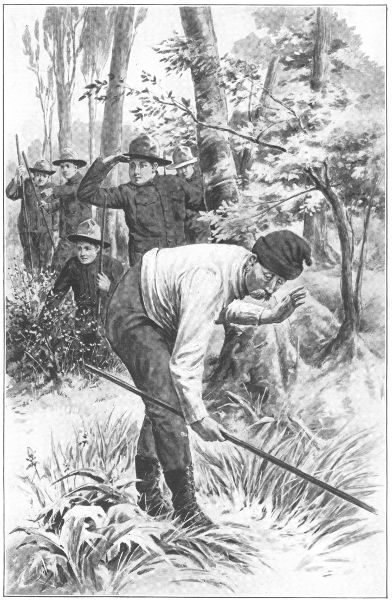
“MAK’ YOU S-SILENT! W’AT FOR YOU SPIK LAK DAT?”
More than once patience was at last rewarded by a glimpse of the trotting traveler, the sly red fox, maker of that shadow-path: of its sandy coat, white throat, large black ears, and the bushy, reddish tail, with milk-white tip, the “flag” as woodsmen call it.
Instinctively on such occasions Leon at first yearned for his gun, his old “fuzzee,” with which he had worked havoc—often purposeless and excessive—among shore birds, and from which he had to part when he enlisted in the Boy Scouts of America, and adopted principles tending toward the conservation of all wild life rather than to destruction.
Gradually, however, Starrie Chase, like his brother scouts, came under the glamour of this peaceful trailing. He began to discover a subtler excitement, more spicy fun—the spicier for Toiney’s presence—in the brief contemplation of that dog-fox at home, trotting along, unmolested, to his hunting-ground, than in past fevered glimpses of him when all interest in his wiles and habits was merged into greed for his skin and tail.
Many were the opportunities, too, for a glimpse at the white flag of the shy deer as it bounded off into some deeper woodland glade, and for being thrilled by the swift drumming of the partridge’s wings when it rose from its dusting-place on the ground or on some old log whose brown, flaky wood could be reduced to powder; or from feasting on the brilliant and lowly partridge-berries which, nestling amid their evergreen leaves, challenged November’s sereness.
Each woodland hike brought its own revelation—its special discovery—insignificant, perhaps—but which thereafter stood out as a beauty spot upon the face of the day.
The hikes were generally conducted after this manner: seven of the Owls with their tall scoutmaster would leave the town bright and early on a Saturday morning, a goodly spectacle in their khaki uniforms, and, staff in hand, take their way through the woods to the little farm-clearing where they were reinforced by the assistant scoutmaster in his rough garb—Toiney would not don the scout uniform—and by Harold, the still weak brother.
Their coming was generally heralded by modified shouting. And the impulsive Toiney would suspend some farm task and stand erect with an explosive “Houp-là!” tickling his throat, to witness that most exhilarating of present-day sights, a party of boy scouts emerging from the woods into a clearing, with Mother Nature in the guise of the early sunshine rushing, open-armed, to meet them, as if welcoming her stray children back to her heart.
Then Toiney, as forest guide, would assume the leadership of the party, and not only was his thorough acquaintance with “de bird en de littal wil’ an-ni-mal” valuable; but his fund of knowledge about “heem beeg tree,” and the uses to which the different kinds of wood could be put, seemed broad and unfailing, too.
The most exciting discovery of that season to the boys was when he pointed out to them one day the small hole or den amid some rocky ledges near Big Swamp where the Mother Coon—as sometimes happens, though she generally prefers a hollow tree—had brought forth her intrepid offspring; both the one which had raided Toiney’s hencoop, and Raccoon Junior who had come to a warlike issue with the crows.
Toiney, as he explained, had investigated that deep hole amid the ledges when the woods were green with spring, and had discovered some wild animal which by its size and general outline he knew to be a coon, crouching at the inner end of it, with her young “littal as small cat.” He had beaten a hasty retreat, not willing to provoke a possible attack from the mother rendered bold by maternity, or to disturb the infant family.
He was radiant at finding the coon’s rocky home again, though tenantless, now.
“Ha! I’ll know we fin’ heem den”; he beamed upon his comrades with primitive conceit. “We arre de boy—engh? We arre de bes’ scout ev’ry tam!”
And that was the aim of each member of the Owl Patrol, with the exception, perhaps, of Harold, not indeed to be the “best scout,” but to figure as the equal in scoutcraft of any lad of his age and a corresponding period of service, in the United States. To this end he drilled, explored and studied, somewhat to the mystification of boys who still held aloof from the scout movement!
“Where are ye off to, Starrie?” inquired Godey Peck, a youth of this type, one fair November afternoon, intercepting Leon about an hour after school had closed. “Don’t you want to come along with me? I’m going down to Stanway’s shipyard to have a look at the new vessel that they’re going to launch at daybreak to-morrow. She’s all wedged up on the ways, ready to go. Say!” Godey edged slyly nearer to Leon, “us boys—Choc Latour, Benjie Lane an’ me—have hit on a plan for being launched in her. You know they won’t allow boys to be aboard, if they know it, when she shoots off the launching ways. But those ship carpenters’ll have to rise bright and early if they want to get ahead of us! See?”
Godey laid a forefinger against the left side of his nose, to emphasize a high opinion of his own subtlety.
“How are you going to work it?” Leon asked briefly.
“Why! there’s a vessel ’most built on the stocks right ’longside the finished hull. Us boys are going to wake very early, trot down to the shipyard before any of the workmen are around; then we’ll shin up the staging an’ over the half-built vessel right onto the white deck o’ the new one that’s waiting to be launched. ’Twill be easy to drop below into the cabin an’ hide under the bunks until the time comes for launching her. When we hear ’em knocking out the last block from under her keel—when she’s just beginning to crawl—then we’ll pop up an’ be on deck when she’s launched; see?”
“Ho! So you’re going to do the stowaway act, eh?” Starrie Chase, with that characteristic snap of his brown eyes, seemed to be taking a mental photograph of the plan.
“Only for an hour or two. You want to be in this too; don’t you, Starrie?”
Leon was silent, considering. The underhand scheme ran counter to the aboveboard principles of the scout law which he had sworn to obey; of that he felt sure. “On my honor I will do my best ... to keep myself morally straight!” Voluntarily and enthusiastically he had taken the chivalrous oath, and he was “too much of a fellow” to go back on it deliberately.
“No! I don’t want to play stowaway,” he answered after a minute. “It’s a crazy plan anyhow! Give it up, Gode! Likely enough you’ll scratch up the paint of the new cabin with your boots, skulking there all three of you—then there’ll be a big row; and ’twould seem a pity, too, after all the months it has taken to build an’ paint that dandy new hull.”
Such a view would scarcely have presented itself to Leon two months ago; he certainly was “deepening the water” in which he floated.
“Well, let’s pop down to the shipyard anyhow, an’ see her!” urged Godey, hoping that a contemplation of the new vessel, airily wedged high on the launching ways, with her bridal deck white as a hound’s tooth, would weaken the other’s resolution.
“No, I’ll be down there to-morrow morning, on the river-slip, to see her go. But I want to do something else this afternoon. I’m going home to study.”
“What?”
“Flag-signaling in the Boy Scout Handbook. I can send a message by semaphore now, twenty letters per minute; I must get it down to sixteen before I can pass the examination for first-class scout!” Starrie threw this out impetuously, his face glowing. “We’re going to have an outdoor test in some other things this evening—if I pass it I’ll be a second-class scout. I don’t want to be a tenderfoot for ever! Say! but the signaling gets me; it’s so interesting: I’m beginning to study the Morse code now.”
“Pshaw! You boy scouts jus’ make me tired.” Godey leaned against the parapet of the broad bridge above the tidal river whereon the boys stood, as if the contemplation of so much energy ambitiously directed was too much for him. “Here comes another of your kind now!”
He pointed to Colin Estey who came swinging along out of the distance, his quick springy step and upright carriage doing credit to the scouts’ drill.
Colin halted ere crossing the bridge to hail a street-car for an old gentleman who was making futile attempts to stop it, and then courteously helped him to the platform.
Godey shook his head over the action. “Cock-a-doodle-doo!” he crowed scornfully. “Ain’t we acting hifalutin?”
Yet there was nothing at all bombastic about the simple good turn or in Colin’s bright face as he joined the other scout upon the bridge and marched off homeward with him, their rhythmic step and erect carriage attracting the attention of more than one adult pedestrian.
Godey lolled on the parapet, looking after them, racking his brain for some derisive epithet to hurl at their backs; he longed to shout, “Sissies!” and “Spongecakes!” But such belittling terms clearly didn’t apply.
The only mocking shaft in his quiver that would come anywhere near hitting the mark of those well-drilled backs—straight as a rod—was one which even he felt to be feeble:—
“Oh! you Tin Scouts,” he shouted maliciously. “Tin Soldiers! Tin Scouts!” sustaining the cry until the two figures disappeared from view in the direction of the Chase homestead.
CHAPTER X
THE BALDFACED HOUSE
But Leon did not study signaling and the Morse alphabet that afternoon. He was presently dispatched by his father, who owned a pleasant home on the outskirts of the town, on an errand to a farm some two miles distant on the uplands that skirted the woods.
The afternoon had all the spicy beauty of early November, with a slight frost in the air. The fresh breeze laughed like a tomboy as it romped over the salt-marshes. Each eddying dimple in the tidal river shone like a star sapphire, while the broad, brackish channel wound in and out between the marshes with as many wriggles as a lively trout.
“Those little creeks look like runaways,” thought Leon as he paused upon the uplands and beamed down upon the wide panorama of golden marsh-land and winding water. “They’re for all the world like schoolboys that have cut school, giggling an’ running to hide!” His eye dreamily followed the course of many a truant creek that half-turned its head, looking under the tickling sunbeams as if it were glancing back over its shoulder, while it burrowed into the marshes vainly trying to hide where the relentless schoolmaster, called, for want of a better name, Solar Attraction, might not find it and compel its return to the ocean.
“And the Sugarloaf Sand-Dunes; don’t they look fine?” reflected the boy scout further, his eye traveling off downstream to where the curving tidal channel broadened into pearly plains of water, bounded at one distant point, near the juncture of river and sea, by a dazzlingly white beach.
There the fine colorless sand, which when viewed closely had very much the hue of skim milk, the white being shot with a faint gray-blue tinge, had been piled by the winds of ages into tall sand-hills, into pyramids and columns: one dazzling pillar, in especial, being named the Sugarloaf from its crystalline whiteness, had given its name to the whole expanse of dune and beach.
The tall Sugarloaf gleamed in the distance now like a snowy lighthouse whose lamps are sleeping, presiding over the mouth of the tidal river; its brother sand-hills capped by vegetation might have been the pure bright cliffs of some fairy shore.
The boy scout stood for many minutes upon the uplands, gazing afar, his mouth open as if he were physically drinking in that distant beauty.
“Gee whiz! this is gr-reat; isn’t it, Blinkie?” he murmured to the squatting dog by his side. “I never before saw that old Sugarloaf look as it does to-day; did you, Mr. Dog?”
It had appeared just as radiantly beautiful, off and on, during all the seasons of Leon’s life. But his powers of observation had not been trained as was the case of late. In the years prior to his becoming a scout, when his inseparable companion on uplands and marsh had been a shotgun—from the time he was permitted free use of one—and the all-absorbing idea in his mind how to contrive a successful shot at shore bird or animal, he had gone about “lak wit’ eye shut,” so far as many things just now beginning to fill him with a wonderful, speechless gladness were concerned.
“Well, we’re not heading for that farmhouse, are we, pup?” he said at length, turning from the contemplation of runaway creeks and radiant dunes to the completion of his father’s errand.
But the sunlit beauty at which he had been gazing coursed through his every vein, finding vent in a curly, ecstatic whistle that ascended in spirals until it touched the high keynote of exultation and there hung suspended; while the rest of the trip to that upland farmhouse was accomplished in a series of broad jumps, the terrier being as wild with delight as his master.
The errand performed and the boy scout having put in half an hour condescendingly amusing the farmer’s two small children, while Blink exchanged compliments with his kind, master and dog started upon the return walk.
“Oh! it’s early yet; don’t you want to come a little way into the woods, doggie?” said Leon, doubling backward after they had taken a few steps. “We haven’t had many runs together lately. Your nose has been out of joint; poor pup!” stooping to caress the terrier. “Toiney says we can’t take you on our scout hikes, because you’d scare every ‘littal wil’ an-ni-mal’ within a mile. You would, too; wouldn’t you? But there’s an outdoor scout meeting to-night to be held over in Sparrow Hollow, each fellow lighting his own camp-fire—using not more than two matches—and cooking his own supper. And you may come. Yes, I said you might come!” as the dog, gyrating like a feather, seized his coat-sleeve between strong white teeth in his eagerness not to be excluded from any more fun that might be afoot.
They were soon on the sere skirts of the woodland, prancing through leafy drifts.
“We can’t go far,” said Leon. “We must get back to the town and buy our half-pound of beefsteak that we’re to cook without the use of any ordinary cooking-utensil, and so pass one of the tests for becoming a second-class scout. I’ll divvy up with you, pup! But whew! isn’t this just fine?... The woods in November can put it all over the September woods to my mind.”
He added the last words to himself. There was something about the rugged strength of the stripped trees, with the stealing blue haze of evening softening their bareness, about the evergreen grandeur of pine and hemlock lording it over their robbed brethren, about the drab, parchment-like leaves clinging with eerie murmur to the oak-tree, and the ruddy twigs of bare berry-bushes, that appealed to the element of rugged daring in the boy himself.
He could not so soon break away from the woods as he had intended, though he only explored their outskirts.
Dusk was already falling when he found himself on the open uplands again, bound back toward the distant town.
“The scouts are to start for Sparrow Hollow at six o’clock: we must hustle, if we want to start with them,” he said to the dog. “The only way we can make it is by taking a short cut across the marshes and wading through the river; that would be a quick way of reaching the town and the butcher’s shop, to buy our beefsteak,” muttering rapidly, partly to himself, partly to his impatient companion. “The tide is full out now, the water will be shallow; I can take off my shoes and stockings and carry you, pup. Who cares if it’s cold?”
The boy scout, with an anticipatory glow all over him, felt impervious to any extreme of temperature as he bounded down the uplands, with the breeze—the freshening, freakish breeze—driving across the salt-marshes directly in his face, racing through every vein in him, stirring up a whirligig within, presently bringing waste things to the top even as it stirred up dust and refuse in the roadway.