IV. The Graphic Elements.
Reading edition
Having made this satisfactory progress in explaining the numeral and the pictorial portions of the Codices, we are well prepared to approach the more difficult part of our task, the interpretations of the hieroglyphs themselves.
Fortunately, an even superficial inspection of the manuscripts shows us that we are not without material aids to this end. It is clear that many of the hieroglyphs are those of the twenty days and the eighteen months of the Maya year, which are preserved to us in the work of Bishop Landa; others, again, by their arrangement, must be connected with the cardinal points; and others suggest, by their appearance and disposition, that they portray the celestial bodies, the sun, moon, and stars; others are in the columns of numerals, and must have numerical values; and others are so related to the pictures that they are plainly a repetition of them in a partial and conventional manner, as the written characters for divinities, which are usually merely the head of the divinity more or less cursively expressed.
1. The Direction in which the Glyphs are to be read.
The first step in the decipherment of any inscription is to ascertain the direction in which it is to be read.
In my earliest essay on this subject,[101] I stated that whatever the prevailing rule in this respect might have been, the native artists had no hesitation in disregarding it, when artistic or other reasons presented themselves. This is the conclusion which has since been arrived at by conservative later students. I shall have numerous illustrations of it to offer in the following pages. Most of the diversity in this respect was not capricious, 79however, but in accordance with rules, some of which have been ascertained.
Three points in this connection will immediately attract the attention of the student. The movement of the principal figures in the records, both manuscript and mural, is generally from right to left; the main portion of the composite characters are drawn on the right, and the minor portions or affixes are added on the left;[102] and in placing numerals on a line, the upright strokes which mean the fives are placed to the right, and the dots which mean units less than five are placed to the left. These facts look as if the lines were written from right to left. The general opinion, however, is that expressed by Pousse and by Thomas, that the characters when arranged in lines are to be read from left to right, and when in columns from top to bottom.[103] That this rule does not hold good in a number of instances, as I shall show, need not surprise us, as precisely the same uncertainty in the arrangement is found in the Mexican picture-writing, as Chavero has pointed out,[104] and exists to-day in the manuscripts of the Tuaregs of the Sahara.[105] Dr. Förstemann has shown conclusively that the numerical elements in the long computations to which I have referred (above p. 30) are to be read from below upward and from right to left.[106]
Great aid in settling this question in any given instance can be obtained by a close examination of the rubrication of the 80manuscript. The native scribe, before he filled in the glyphs or letters, divided his sheet into small compartments by faint red lines, bounding as it were the different sentences or paragraphs he intended to set down. Each such sentence consists usually of four or six characters, arranged either in a column or in a square, the whole of which may be called a “cartouche.” The following diagram illustrates the manner in which the separate glyphs are to be read in ordinary cases:—
a a b a b a
b c d c d b
c c
d picture picture d
Without the aid of the rubrics, from an independent study of the characters themselves, M. Pousse demonstrated that this is a necessary arrangement of the majority of the written passages.[107]
The signs for the days are usually placed in columns on the left of the groups of hieroglyphic characters, the numeral belonging to each being inscribed above it; while immediately below the groups are numerals in black and red, generally indicating certain days. This disposition of the elements of the writing shows that it was intended for a “time-count,” as I have before stated. For the somewhat voluminous analysis of the Codices in this direction, the reader is referred to the works of Förstemann and Thomas, who have paid fruitful attention to this department.
81
2. Composition of the Glyphs.
I have already stated, p. 10, that the main elements of the Mayan hieroglyphic writing are not numerous. The apparent complexity of many of the glyphs arises from the combination of a number of frequently recurring elements which are placed in different positions and relations, and each of which has many variant forms, dependent on the degree of skill or care of the scribe or sculptor, and the material which he used for the record.
Usually each glyph or katun consists of one main element with a number of others drawn in or around it, which are generally known as “affixes.” An element within another is called an “infix;” placed in front of it, a “prefix;” behind it, a “suffix” or “postfix;” above it, a “superfix;” and below it, a “subfix.” The same element will often be found first in one and then in another of these positions; and a certain class of elements are employed as affixes only. I shall refer to the single elements as “simple characters,” and to the complex glyphs as “composite characters.”
3. The Proper Method of Studying the Glyphs.
The proper method to adopt in studying composite characters is first carefully to separate them into the simple characters of which they are composed, noting the relative positions of these.
The next step is vitally important and often most difficult. It is to determine what visible objects these simple characters were intended to represent. They are often so conventionalized or so negligently sketched that the most careful students have reached absurdly different opinions as to what they were designed to portray.[108]
This identification accomplished, the student should proceed to 82ascertain the name of the object in the Maya language; because, though it may be employed as pure ideogram in one connection, in another it may be used for its phonetic value according to the “ikonomatic,” or rebus method, as I have above explained, and instances of which I give in these pages. I do not believe that a further phonetic analysis—that to the isolation of distinct alphabetic elements—as has been pursued by a number of writers already referred to, is justified by the nature of the Maya script, or will yield useful results.
4. An Analysis of Various Graphic Elements.
I shall now proceed, in the manner above described, to examine a number of simple and composite characters, not by any means exhausting the stock, but rather merely offering suggestions and examples for future students. In their application it must always be remembered that any Maya character may be employed in either of three values: 1, As an ideogram; 2, as a rebus; 3, as an astronomical or numerical sign.
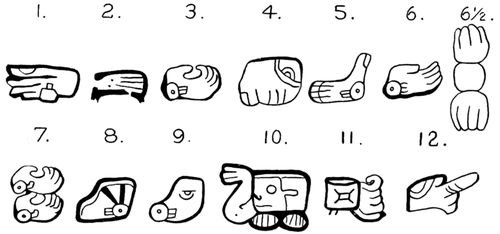
Fig. 31.—The Hand.
The hand contributes to some of the most numerous hieroglyphs in the Mayan writing; and the significant poses assigned it in the pictures and statues prove how expressive it was to this people.
83The forms presented in Fig. 30 by no means exhaust its delineations. They are drawn from gesture-speech and each is significant. No. 1, from the Cod. Cort., is the usual sign “to give;” No. 2, from the Cod. Tro., shows it in hasty writing; No. 3 is the hand closing (“la main qui se ferme,” Brasseur). It is the sign for the day manik, and is explained by Dr. Seler, “to eat;” but I take it to be the rebus for mach, “to grasp” (“asir, tomar con las manos,” Dic. Motul). No. 4, the hand closed, thumb downward (pollice verso), has probably an inauspicious significance (very common, e. g., Cod. Per., pp. 2, 3, 6, 7); No. 5 is the “supporting hand” (very frequent, usually in composition); No. 6 is intended to show the hand, palm upward, forming a cup (Cod. Dres., p. 40, Cod. Tro., p. 21),—it would signify “offering;” No. 6½, from the stelæ of Copan, must mean union or friendship. The two hands held as No. 7 occur repeatedly in Cod. Dres., pp. 6, 7, in the Tro. and Cort. often thus, , to which Thomas, by means of his “key,” assigns the wonderful meaning, “a meat pie”! Nos. 8 and 9 are explained by Seler as the supporting hand; No. 10 shows the hand and arm pointing; No. 12, Cod. Tro., 30, 31, is the index finger extended; No. 11, Cort., p. 28, shows the closed hand as a suffix to the sign ik.[109]
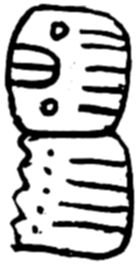
Phonetically the hand is kab, which also means “arm, finger, juice, sap, tears;” and as a rebus it could stand for kaba, name.
By some writers all the signs, Fig. 32 are supposed to represent the eye. Nos. 1 and 2 may also stand for a tooth, and for the small bells worn as ornaments. No. 3 has been called the “weeping eye,” and by Brasseur “une hache;” but I take it 84to be the space within the closing hand (Figs. 31, No. 3). No. 4 shows the eyelashes of the closed eye, and signifies sleep or death. No. 5 is the “ornamented” or “serpent” eye, and, according to Thomas, is the characteristic of a deity. Nos. 6 and 8 are supposed by Seler to be the eye torn out. They are extremely common affixes. Schellhas explains No. 6 as “the head and creeping foot of a snail.” I am persuaded that it is a bird’s wing, or the chief feather of a wing, and means “superior,” “supremacy,” or something of that kind.[110] For that reason it always appears in the sign of Kin ich ahau. No. 8 I regard also as copied from a feather ornament.[111] No. 7, called by Seler the “bleeding eye,” I take to be a sign for stars.
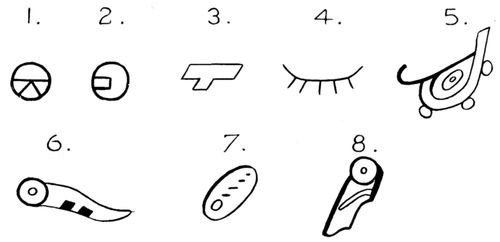
Fig. 32.—The Eye and Similar Figures.
In Maya, ich, the eye, also means “face” and “twins.”
The design, Fig. 33, No. 1, abundant in the Codices and on the stone and ceramic remains, shows eyes, but is believed by Förstemann 85to represent the planet Venus, and to be a variant of Fig. 37, No. 4. Seler thinks it an ornamental kin (see Fig. 36). It is carved on the great tortoise of Copan, and Nos. 2, 3, and 4 are from the pottery of that city, on which it is the most common glyph I have noted. In No. 5, from Cod. Dres., p. 57, it is postfixed to a human figure reversed. Brasseur explains it as “the spectacles of Tezcatlipoca,” and for a name, we may call it “the spectacles glyph.”
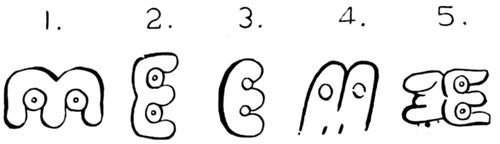
Fig. 33.—The “Spectacles.”
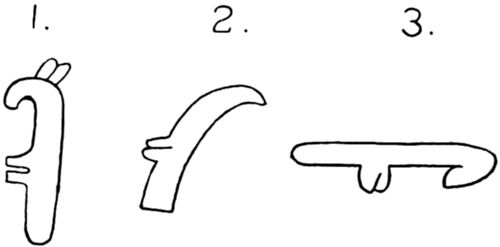
Fig. 34.—The Ear.
The human ear has been represented by No. 2, Fig. 34, as has been proved by de Rosny and Thomas. No. 1 (Cod. Cort., p. 16) is either an ear or an ear ornament. It is not the ordinary ear-ring, which is clearly shown in Figs. 12, 17, etc. This latter is often used as an affix, and has been confused with the serpent rattle, and with No. 3, which is the lower jaw bone, cham or camach. (See Cod. Cort., pp. 35, 36, etc.)
The ear is xicin, which also means “shell.” Ear-rings are tup, a word which as a verb signifies “to stop up, to cover over, to extinguish.”[112]
86The group of signs, Fig. 35, beginning with a person seated, are, in the opinion of Seler, all derivatives from “man.” Nos. 2, 3, and 4 he calls “eyes,” and Nos. 5–11 outlines of the mouth, jaws, and face, with a general value, “person.” Other suggestions are, that the crescentic outlines, Nos. 6, 7, 11, refer to a crescent moon, or an ear (Schellhas), or to a serpent’s mouth (Allen); while No. 10 may be an eye and eyelashes (Allen), a comb (Valentini), a claw, a feather, part of a plant, etc. It may be called the “comb sign.”[113]
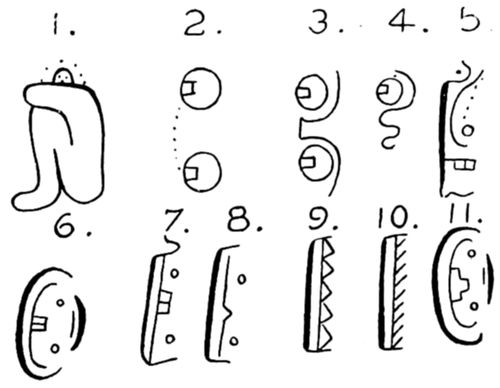
Fig. 35.—Crescentic Signs.
My belief is that some of these affixes show the necklace on which beads and precious stones were strung. This was called u, which is also the word for moon, and in sound is akin to uil, food.[114]
By the latter fact I would explain the frequent appearance of this sign on the neck of vases and on haunches of venison (Cod. Tro. 22, etc.). The picture of a necklace shown 87in the Lienzo de Tlascala, p. 7, will demonstrate how close is the resemblance. That in Landa’s alphabet (see above, p. 15) this sign is given for u, confirms my supposition.
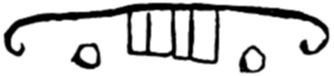
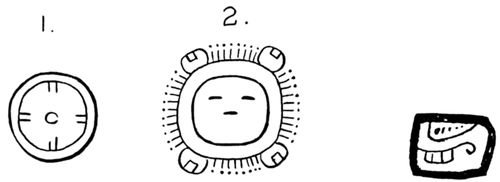
Fig. 36.—Sun and Moon Signs.
The hieroglyphs of the sun, Fig. 36, Nos. 1 and 2, cannot be mistaken. In the latter, the four teeth indicate the biting heat. This design often occurs on war shields. No. 1 is that usually employed in composition. The word for sun is kin, which has the further meanings, “day, light, festival, time, news, to rule;” from it are derived kinal, “heat, hot;” kinam, “strength, bravery, power, poison, fear, veneration;” ah-kin, “a priest,” etc. The kin sign usually indicates a beneficent divinity.
The third sign in Fig. 36 is that for moon (Schellhas). Dr. Seler, however, claims that it is the symbol of “night,” and that where it means 20 (see above, p. 21), it is not derived from u, moon, but from uinic, man. He explains the figure as a human head with a “bleeding eye,” and bare teeth.
In all these points I think he is in error. Maya grammar does not authorize the derivation of uinal from uinic (in which Seler follows Brasseur); but it may come from u, month, uin or uen, “relating to a month.” His statement that the 20–day period was not spoken of as an uinal, is disproved by Landa, who calls it uinal hun ekeh, “a dark month,” to distinguish it from one lighted by the moon. A close examination of most of the drawings will show that the line on which the supposed bare teeth are shown is not that of the mouth, but that of the necklace above mentioned, which has the value u. Cf. Fig. 3, No. 3.
88No. 1, Fig. 37, I introduce from Mexican pictography; it is the sacred green jade jewel, the xihuitl, meaning “precious, divine.” By it I explain the very common No. 2, a modification either of it or of the kin sign, constantly associated with deities (on the hand, Cod. Dres., p. 21; on the leg, id., 12; on the back, id., 39; and always on the head-dress of the God of Growth).
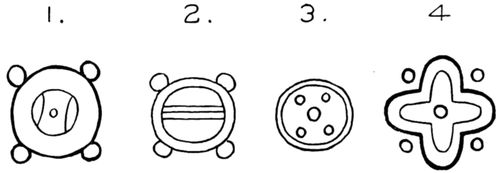
Fig. 37.—Supposed Derivatives of the Sun Sign.
No. 3 may be a modification of the kin. It is given in Landa’s alphabet, where it stands for be, footprints. It may also be the stones of the hearth, and signify “house.” As a “directive sign,” it stands for the point south, and the color yellow; and it appears as an occasional variant of the day-signs lamat, muluc, and chuen.
No. 4 is thought by Seler to be merely an ornamental form of the kin sign; but by Förstemann is taken for the monogram of the planet Venus, at least in the Cod. Dres., where it is very frequent on pp. 46–50. It is repeated with slight variations on the Copan pottery.
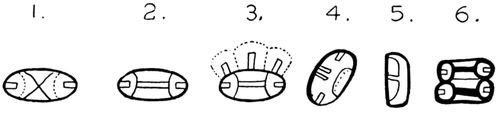
Fig. 38.—The Knife Signs.
The flint knife was an important implement. Landa speaks of the numerous large ones kept by the priests for slaughtering 89their victims.[115] They were called ta, and licil dzicil; in Tzental, chinax, from chi, to bite. Fig. 38, Nos. 1, 2, and 4, show the usual forms in which they are drawn, the small squares at the end being the biting edges. No. 3, surmounted by the “trinal” sign, refers probably to lightning. No. 6 is a rare sign for a dog, showing his biting teeth (Cod. Tro., p. 25). The flint knife typifies sacrifice, death, war, the East, and fire. As a rebus, it could stand for ta, excrement; tah, a dramatic representation, etc.
No. 5 is a very common affix. It has been regarded as a variant of the knife (Seler, etc). But it is too constantly distinguished from it to have this meaning. I consider it the sacred bean, with which divination was practiced and lots cast. This was called bul, a word which, as an affix, means “all,” the whole of anything, as bulkin, “the whole day.” This may suggest its signification.
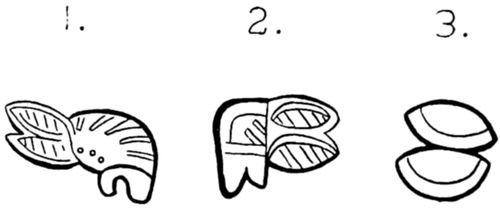
Fig. 39.—The “Fish and Oyster” Sign.
The curious objects in Fig. 39 were long a puzzle to me, and have not been explained by previous writers. I believe them to be representations of the food products of the sea, showing a fish and two shellfish. My reasons for this are that in Cod. Dres., p. 34, they are seen along with other food-offerings (see Fig. 30); in some places the fish tail is unmistakeable (Cod. Dres., pp. 6, 7, 36); in Cod. Cort., pp. 20, 21, they are associated with a fishing bird,—a pelican or cormorant; in Cod. Dres., p. 50, the two shells are replaced by one conch shell; and in Cod. Dres., p. 67, a fish and two shells are painted separately, to represent food from the sea. The two shells are often seen in other relations, as sprinkled with blood (Cod. Tro., p. 18*), and as an affix (see Fig. 31, No. 10). I shall refer to this as the “fish and oyster” sign.
90Shells had a peculiar sacredness in Maya symbolism. The robes of some of the priests were bordered with them.[116]
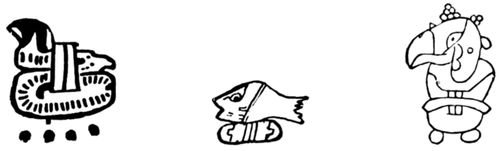
Fig. 40.—The Sacred Food-Offerings.
Some other sacred food-offerings are shown in Fig. 40. The first is the haunch of venison tied up (identified as such by Brasseur); the second is the fish, here shown with a subfix; the third is the wild turkey, represented by his head in a dish. Another is the iguana (see p. 122, No. 14); and a fifth is the object shown on p. 122, No. 12. It has been explained as a grain of corn sprouting from the ground, or a mole emerging from its hole (Schellhas). The true explanation is that of Brasseur, that it portrays the forequarter and head of a food-animal, tied up. He does not specify what animal, but in some of the drawings I distinctly recognize the dog, with his sharp teeth, the species raised by the Mayas to be eaten on festival occasions, as stated by Landa.[117]

Fig. 41.—The ben-ik and other Signs.
Nos. 1 and 2, Fig. 41, are variants of an element often occurring with a ben-ik superfix. Dr. Seler, who is apt to see gory 91human heads everywhere, thinks it is one carried in a sling and means “conquered in war.”
Dr. Förstemann, with greater probability, considers that it symbolizes an astronomical event connected with the motions of the sun. (See the significant designs, Cod. Tro., 28* b.)
The ben-ik sign referred to is rendered by Seler to mean conquest and destruction; by Förstemann, astronomically, as the lunar month of 29 days; in a general sense, I would say, “strength and deific power.” It is a very constant association of the two day-signs so named, ben giving the idea of motion, and ik of life and power.
In No. 3 is a long worm-like figure under the ben-ik sign. Brasseur pointed out that it is a variant of the day-sign men, and explained it as a caterpillar (chenille). Seler speaks of it as an eagle, and as a symbol of “mother earth;” Schellhas, as perhaps the serpent goddess. It sometimes is drawn to have a fish-like appearance (Cod. Per., p. 7), and may symbolize the waters; the more so as it has occasionally as a superfix the “cloud-balls.”
No. 4 is explained by Brasseur as the girdle, xoc, around the body; and I prefer this to later suggestions. A similar design was the tress of hair, kax pol or kaaxi, worn by women (see Cod. Tro., p. 27; Cod. Dres., p. 45). Its signification would seem to be “to tie together, to join,” or, as a rebus, “rain, to rain,” for kaxala (llover, y la lluvia).
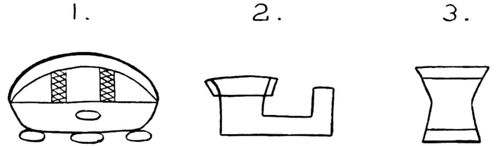
Fig. 42.—The Drum Signs.
No more prominent hieroglyph than No. 1, Fig. 42, can be found in the Mayan inscriptions, and none which has proved such a stumbling block to interpreters. Valentini has called 92it the picture of a censer or brazier; de Rosny thought it a variant of the ahau sign; Dr. Seler explained it as a precious stone; and Thomas as “a stone heap!” It is the upper figure in the “Initial Series” of glyphs at Palenque, Copan, Quirigua, etc. (see above, p. 24), and recurs with but slight variations in all the Codices.
I first announced what it represents and its signification at the meeting of the American Association for the Advancement of Science, August, 1894.[118] It is the picture of a drum, the large variety, made of the hollow trunk of a tree resting upon short feet, the trunk being sawed across partly through so as to give two vibrating surfaces, which were often decorated with cross-hatching. Such drums are described by the early Spanish writers, and one is shown in the Atlas to Duran’s History.[119] Their sound could be heard for two leagues, and they were important adjuvants in the services in the temples.
In the hieroglyphics the significance of this design is primarily phonetic. The name of this particular kind of drum was pax che, from pax, musical instrument, and che, wooden; a large one was bolon pax che, the word bolon, nine, being a superlative prefix in Maya. Employed according to the ikonomatic method, this expressed the word paxan, a very common term in Maya, meaning “it is finished,” and applied to anything completed, ended, or destroyed, in a good or bad sense.[120] This is 93why in the numeral signs it marks the end of a series (see above, p. 22), and in the so-called “Initial Series” (which I believe to be terminal), it surmounts and thus closes (reading from below upward) the rows of computation signs. For the same reason it is the support of the figure representing the dying year in the ceremonies at its termination (Cod. Tro., pp. 20–24), and is often associated with the deities of old age, destruction, and death.
Several other varieties of drums were in use among the Mayas. That shown Fig. 42 No. 2, is noteworthy. It is the dzacatan (Berendt), or medicine-drum (from dzacah, to cure, to practice medicine). It was used in the sacred ceremonies (see Fig. 30), and Itzamna is portrayed playing upon one (Cod. Dres., p. 34). Its representations in the Codices are peculiar, and have been entirely misunderstood by previous writers. I show them in Fig. 43, Nos. 1, 2, 3. In a more highly conventionalized form we find them in the Cod. Troano, thus: which has been explained by Pousse, Thomas, and others, as making fire or as grinding paint. It is obviously the dzacatan, what I have called the “pottery decoration” (see p. 58) around the figures, showing that the body of the drum was of earthenware.
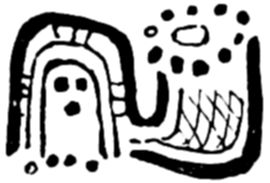
Fig. 42, No. 3 shows the ordinary hand drum, the huehuetl of the Mexicans. Its name in Maya is tunkul, properly tankul, which means either “before the gods,” or “now one worships” (ahora se adora, Baeza.) It was either of wood and was struck with a stick; or of pottery with a skin stretched over its mouth, when the sound was produced by the fingers. Some were large and stood upright, as shown in Fig. 43.[121] Representations of these are 94common in the Codices, and have generally been mistaken for vases. (See Cod. Cort., p. 27.) Even Nos. 4 and 5, Fig. 44, are probably some such musical instruments. (See Cod. Cort., pp. 12, 30, 31.)
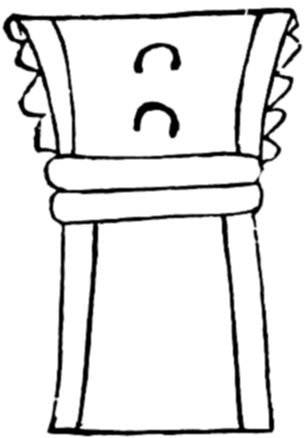
Fig. 43.—A Standing Drum. (From the Cortesian Codex.)
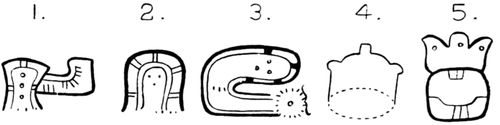
Fig. 44.—Graphic Delineations of Drums.
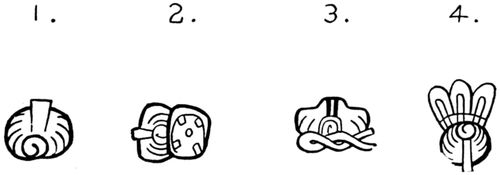
Fig. 45.—The yax and other Feather Signs.
Few glyphs are more frequent than No. 1, Fig. 45, either alone or in such combinations as Nos. 2 and 3. The guesses as to what it represents have been singularly divergent. Brasseur said, a kind of gourd; Seler, a tree; Schellhas, the zapote; Rosny and Förstemann, the phallus, etc.
None of these suggestions seems to me tenable. I believe it represents a common feather decoration made of short green or blue feathers, attached to a style or staff. It is frequent on Mexican and Maya figures, and in No. 4, Fig. 45, I copy one from a Maya war dress. The lower portion represents the ornament to which I allude. It was called yax kukul, and this 95gives the phonetic rebus value of the sign, which is yax, green, and (metaphorically) new, young, fresh, strong, virile, etc.
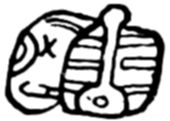
Care must be taken not to confound this with the character seen in the sign of the dog (see p. 70), which really represents the ribs and breast-bone, although called a “phallus” by Rosny, an “article of food” by Thomas, a “breastplate” by Allen, and a “vertebral column” by Seler.[122]
The three feathers which surmounted the yax kukul, as shown in No. 4, Fig. 45, also developed in the hieroglyphs to an important sign. It is shown in Fig. 46, No. 1, and is the uppermost sign in the “Initial glyph” of Palenque (see p. 137) and was a mark of eminent distinction. (See Fig. 47, No. 2.)
These three feathers indicated in Maya symbolism the highest place and power. They appear on the head of the important statue unearthed by Dr. Le Plongeon at Chichen Itza, which he calls “Chac Mool,” in the form given Fig. 46, No. 2. Three was a sacred number with the Mayas, and with this in mind I shall refer to it as the “trinal” sign.
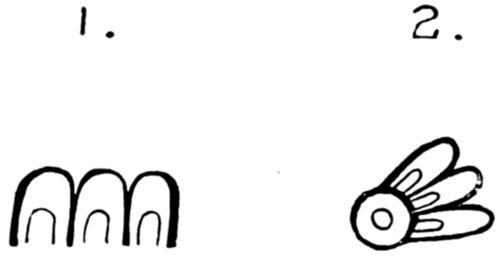
Fig. 46.—The “Trinal” Feather Emblem.
In Mexican writing the three feathers appear in the ikonomatic sign for tecpan, royal, in the Lienzo de Tlascala, pp. 56, 57, 78. As feather in Maya is kukum, which is allied in sound to ku, god, kul, divine, etc., we see what an appropriate rebus the “trinal” makes.
Rounded figures, identified by Seler as “feather balls,” are sometimes portrayed above the men, or “Mother Earth” sign, and in other relations. See Cod. Peres., p. 7, for a good example.
96
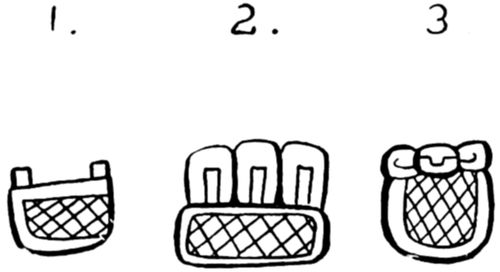
Fig. 47.—The “Cross-hatched” Signs.
A number of drawings in the Codices represent textile materials—mats, cotton cloth, wicker-work, etc. That Fig. 47, No. 1 is frequent, both as an affix and as part of costume. Thomas calls it a trellis or lattice work; Seler, an imitation of a snake skin; Förstemann, of the shell of a tortoise. In some places it is clearly a part of a helmet made of interlaced and twisted cords attached to a frame. (See Cod. Tro., pp. 2, 3, 6, 19, 22*, 23*.)[123] In Nos. 2 and 3 it appears as a written character with superfixes. It forms part of the sign of the day chicchan, and is attached to the sign of the sun and of the world.
This cross-hatching I regard as showing woven stuff, or that twisted, knotted, and plaited; and I consider its value when used phonetically to be “strong, mighty,” because the word for “strong” in Maya is chich, and that for twisting and interlacing cords is chich-kuch,—again a simple rebus.[124]
The designs, on p. 129, are supposed by Seler and Thomas to represent a house, the roof of which is indicated by the cross-hatched or plaited objects, and . I regard them as meaning a canopy, the practical and symbolic uses of which article are often referred to by the early visitors to these tribes.[125]
97In Fig. 48, No. 1, I give a frequent postfix. In the pictures it portrays the wing of a bird, the foot of an animal, the claw of a reptile or insect, or the tail of a dog (Cod. Tro., p. 27).
No. 2 is the conventional sign for smoke, as may be seen in Cod. Tro., pp. 5*, 6*, etc.
No. 3 is called by Seler an ideogram for “man” or “person.”
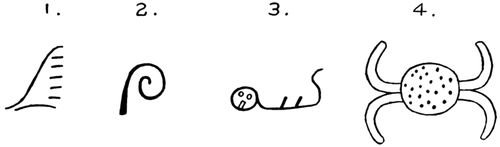
Fig. 48.—Some Linear Signs and Dots.
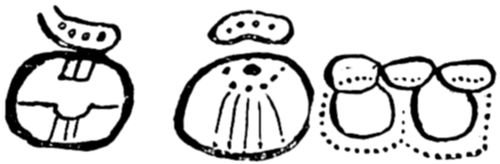
Fig. 49.—The Use of Dots.
No. 4 I introduce from the Mexican pictography to illustrate the use of black dots. They have many significations which I have not traced in Mayan Codices, such as seed, salt, ashes, stars, sand, earth, and from the latter, place, region, world.[126] In the sign for the day, ix, I believe we see the dots with the signification xiix, “grain-husks.” A line or lines of dots mean “speech” or vocal sound, as attached to the drum, Fig. 44, No. 3; coming from the mouth of a dog, Cod. Tro., p. 20, singing, etc. Some have mistaken this for the sign of death. Dots in Maya are ua or ual, akin in sound to u, month, uil, food, and may be allusive for these ideas.
98The kan and imix signs are often associated under two superfixes enclosing dots, as in Fig. 49, No. 1. These have been interpreted by Seler to indicate copal gum, or the burning of incense. The sign is associated with various deities, especially those of a beneficent character.
The same objects, however, occur elsewhere as superfixes over various glyphs, as Fig. 49, No. 2, where it is not easy to assign them any such meaning.
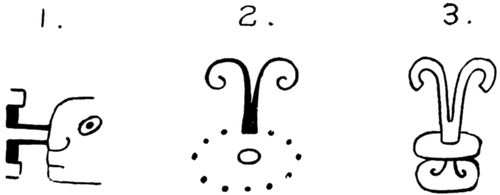
Fig. 50.—Linear Prefixes.
Modifications of Fig. 50, No. 1 are quite frequent. This sign has had various explanations, as typifying fire, lightning, or wind (Seler, Schellhas); but I believe it represents divine or magical power exerted by blowing. As I have explained in my Nagualism, “the act of blowing was the essential feature in the practice of the ‘medicine men.’ It symbolized the exercise and transfer of spiritual power.”[127] Where the deity is portrayed with this addition, he is in the act of exerting his divine influence. For examples, see the “bee god,” in Cod. Tro., pp. 5* and 10*, where the head is as in No. 2; and the scorpion, in Cod. Tro., p. 2, precisely like one in the Cod. Porfirio Diaz, lam. I. At times it also conveys the idea of speech, or vocal sound, or that from a drum, etc., e. g., Fig. 44, No. 3.
No. 3 represents the usual mode of portraying the antennæ of scorpions, insects, etc., of interest because the word for these in Maya, matzab, also means the rays of the sun and of light, and the figure might so be interpreted.
99Dr. Förstemann believes that the circle of dots, as in the lower portion of No. 2, means “movement or precession;” as in Cod. Dres., p. 68. The sign is so surrounded, indicating the junction of two time-periods; or, as others would say, the crooked lightning darting from the sky.

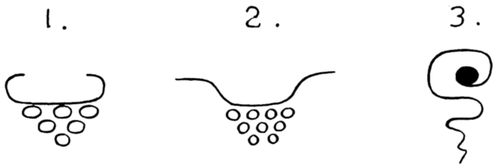
Fig. 51.—The “Cloud-Balls” and the “Cork-screw Curl.”
In Fig. 51, Nos. 1 and 2, copied from the great tortoise of Copan, show the rain-clouds as conceived by the native artist. In the Codices they are seen in the day-sign cauac; and elsewhere. An almost identical conception appears in the pictography of the northern tribes.[128] Seler speaks of them as Wolkenballen, “cloud-balls,” an appropriate name for the element.

Fig. 52.—Symbols for the Earth.
No. 3 has been explained by Thomas and Seler as the portrayal of trickling fluid; or, again, by the latter, as a “nose ornament.” Dr. Schellhas first saw its real intention. It is a picture of a twisted lock of hair, or “cork-screw curl,” worn by the Maya women. It appears in the monograms of various goddesses. Ideographically it has two meanings, one, woman or 100female; the other, down or downward; either from its name (which we do not know), or because it hangs downward. In the latter sense, it is in the hieroglyph of the Earth, as that which is down or below us, Fig. 52; although, as the Earth is the feminine principle in nature,—Mother Earth,—I would suggest that this is the intimation conveyed by the sign.
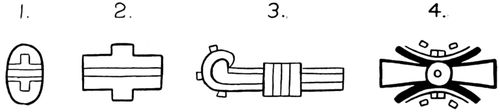
Fig. 53.—Signs for Union.
No. 1, Fig. 53, occurs with great frequency. Allen explains it as “the radical of the mouth,” others as “falling water,” etc., but I accept without hesitation Brasseur’s identification of it as the side view of the joint of a reed or maize stalk, with the meaning “union.” In the writing it is probably among other things the conjunctive conjunction, yetal, “and,” which explains its frequency. It is common in the form No. 2, in the Vienna Codex, signifying the union of day series (pp. 58, 61, 64, etc.); it may imply sexual union, as in the “Tableau des Bacabs” (see above, p. 50.)
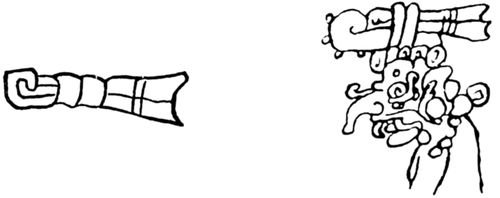
Fig. 54.—The Knotted Head Dress.
Other signs for union are No. 3, which is a knotted head-dress common on males, and No. 4, from the Cod. Troano, p. 5, which 101perhaps indicates the union of two month periods, or the new and old moons, in relation. The middle design between the two crescents is frequent as an affix (e. g., Cod. Tro., p. 7, etc.).
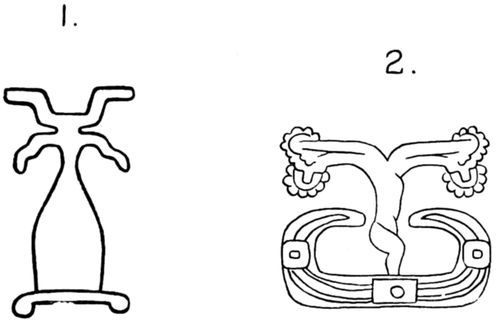
Fig. 55.—The “Tree of Life.”
I have already hinted at the significance of the “tree of life” in Mayan mythology. It is shown in the Codices under two forms, Fig. 55, Nos. 1 and 2. In the former it seems to be growing from a bottle-shaped vase. The leaves (omitted in this instance) are well shown in Cod. Tro., p. 17*. They are cordate and pendent.
No. 2 is taken from the Cod. Peres., p. 3; it beautifully shows the sacred tree, here distinctly anthropomorphic,[129] in the vase of the heavenly waters, lifting its fourfold branches. In the original, the god of the north star is resting upon them. Usually the tree is associated with Itzamna. Both forms are frequent in the Mexican manuscripts, and the myths relating to them have been subjects of study by various writers.[130]
102
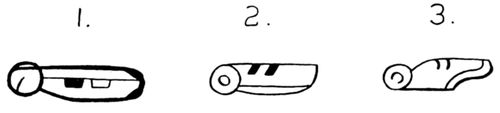
Fig. 56.—The “Machete” and Similar Signs.
Forms like Nos. 1 and 2, Fig. 56, and perhaps No. 3, are usually taken to represent a chopper or machete. The representation of this weapon or implement is seen in Cod. Tro., p. 17, where a man is killing a snake with one. In the conventional and negligent manner in which these characters are often written, it is not easy to distinguish them from others of different origin and meaning. Nos. 2 and 3 may be feather signs. Seler explains the machete as the symbol of striking or wounding (“Ausdruck des Schlagens”).
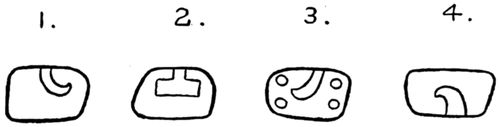
Fig. 57.—Supposed Bird Signs.
Characters like the above recur in all the forms of writing. No. 1 has been called by Seler the representation of “man,” but this is doubtful. It may be a variant of No. 2, which is a “closing hand” from Fig. 31, No. 3. Nos. 3 and 4, from Copan and Guatemalan pottery, follow closely the Codices. With a “comb affix,” Förstemann calls No. 4 “a well-known form of moan,” meaning the Pleiades (Entziff. IV); while Dr. Seler explains it as an owl symbol. The design enclosed is held to depict the bill of a bird.
The “Crotalean curve,” the outline of the jaws of the rattlesnake, Crotalus horridus, has been dwelt upon with emphasis by Allen and Maudslay as one of the most notable emblems in 103Maya art.[131] Fig. 58, Nos. 1, 2, 3, 4, show some of its forms in the Codices, and No. 5, from Stephens, illustrates its radical. As a graphic element, it is less prominent than in architecture.
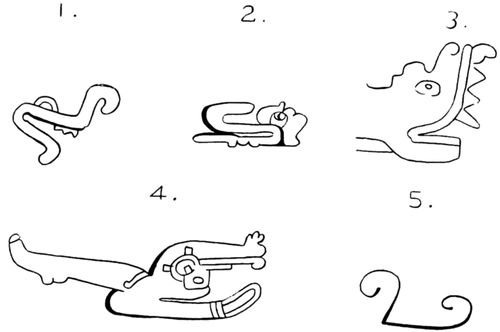
Fig. 58.—The “Crotalean Curve.”
Fig. 59, Nos. 1–4, are outlines of objects often seen in the Codices. No. 1, which looks like a carriage-wrench, is in fact a serpent wand, as can readily be seen by comparing Cod. Tro., pp. 6, 7, 31*, with Cod. Dres., pp. 40, 42, 43.
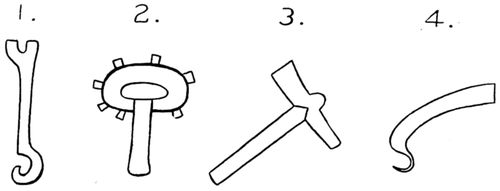
Fig. 59.—Objects Held in the Hand.
104No. 2 is the “medicine rattle.” Sometimes it was a gourd, at others of earthenware, as we see by the “pottery decoration” in Cod. Tro., 34, 35, etc. Sometimes it looks like a fan or a mirror.[132]
No. 3 is the hatchet, and No. 4 the chisel. The peculiar shape and mode of use of the latter are seen Cod. Tro., 34, etc. Both of these implements were made of metal obtained from Tabasco, and Landa especially says that the latter was that with which they carved their idols, exactly as we see in the MSS.[133]
The word for the tomahawk in Maya was bat; and from the same root come batul, “to fight;” batab, “a chief;” batan, “first or in front of;” bat, “hail;” for any of which ideas the weapon might be a symbol or a rebus. It is of frequent occurrence in the texts. One of its uses, I am persuaded, was to indicate a thunderbolt or stroke of lightning. The name for this in Maya was “the blow of the cloud,”[134] and in the group of the moan sign and the tomahawk we have this well expressed.
The first design in Fig. 60 shows the aspersorium, lilābal, with which the high priest sprinkled the holy water (which was the dew collected in the early morning) during the ceremonies. To it were attached the rattles of the rattlesnake and tails of 105poisonous serpents.[135] It is often portrayed in the Codices and inscriptions.
The second design is the throwing-stick, in Nahuatl, atlatl. The admirable monograph of Mrs. Zelia Nuttall explains its important symbolic uses.[136] Examples where it is well portrayed are: Cod. Dres., p. 60, 65; Cod. Tro., pp. 21* and 22*.
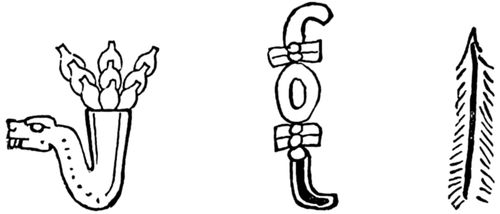
Fig. 60.—The Aspersorium, the Atlatl, and the Mimosa.
The third design in Fig. 60 is what Seler calls a broom (Spanish, escobilla, Nahuatl, mallinalli,) and Schellhas, a feather. But that it is, as Brasseur said, a mimosa, seems clear from Cod. Tro., p. 29, where it is shown growing. In id., p. 32*c, where it is above the turtle, it has an astronomic significance.
Other objects sometimes depicted are fans, ual or picit; mirrors, nen; shields, chimal; and planting sticks, xul.
The designs shown in Fig. 61 recur in all the Codices, and I agree with Dr. Förstemann that they must refer to the celestial bodies and their relative motions (contrary to the view of Dr. Seler). That they have not all been identified is perhaps because none of the students of the subject has been astronomer enough to understand the lessons they convey.
A few we are certain about. No. 1 is the sun, No. 2 the moon; No. 13 must be “the rope of the moon” (see above p. 36) 106indicating its conjunction;[137] No. 12, from the Cod. Peres., might reasonably indicate its opposition; No. 14 is the pole star, occurring in Cod. Tro., pp. 20, 22, 23. Dr. Förstemann has offered certain reasons, reaching a moderate probability, that Nos. 3 and 4 symbolize the planet Mercury; Nos. 5 and 6 the planet Venus; No. 7, Jupiter; No. 8, Mars; and No. 11, Saturn; No. 15 I have seen only on the casts from Sastanquiqui, Peten, at the World’s Columbian Exposition.
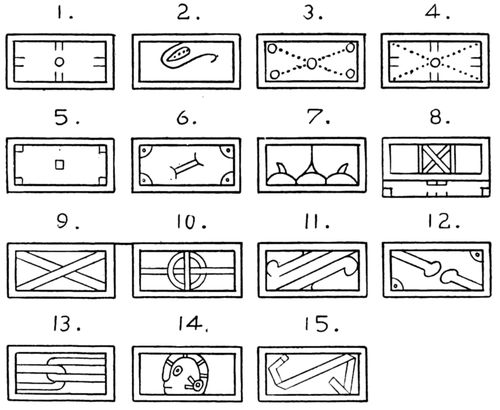
Fig. 61.—The “Constellation Band.”
These designs are arranged in rows of three or more, forming ribbons or bands, and therefore I shall refer to the series as “the constellation band.” Some members of it usually are placed above the representation of the sun and moon (day and night), frequent in the Codices and represented in Fig. 62.
107
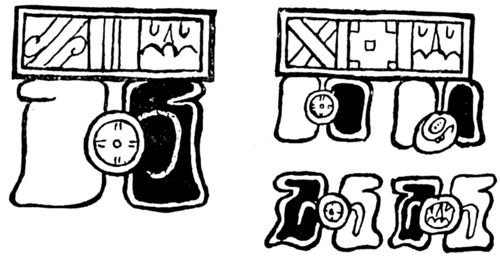
Fig. 62.—The “Heavenly Shield.”
This has been called “the heavenly shield,” a designation I shall retain. Its signification was first explained by Schellhas. The orbs are suspended from the “constellation band” by curious bearings, which seem to be developments from a form very common in the Mexican MSS., and which is shown in Fig. 63, No. 1, which, however, I have copied from a potsherd brought from Copan. Figs. Nos. 2 and 3, from the same source, also seem of astronomical intent, though No. 3 may be a variant of the ik (comp. Cod. Dres., pp. 56, 57).
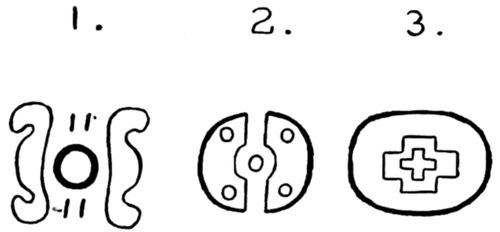
Fig. 63.—Designs from Copan Potsherds.
After considerable discussion the signs for the cardinal points have been definitely determined to be as in Fig. 64, reading from left to right, East, North, West, South. The East sign is composed of the kin (sun) sign with the ahau as a superfix and the “claw” postfix; the North has the north star god’s monogram with the lunar prefix; the West the kin sign with the mach as a superfix 108(see p. 83) and the “claw” postfix; the South has the yax with the mac superfix and sometimes an augment. Space will not permit a further analysis of these important composites, but each is highly significant. These signs never occur isolated, but always together; where one is found, the others may confidently be looked for.
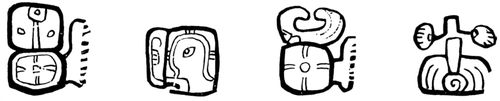
Fig. 64.—The Signs for the Cardinal Points.
Another series of signs are intimately associated with these. They are shown Fig. 65, and read from left to right, South, East, North, West.
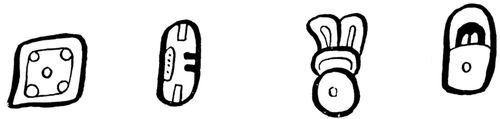
Fig. 65.—The “Directive Signs.”
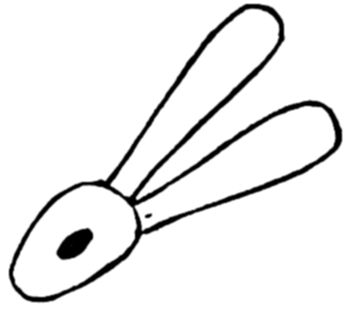
Fig. 66.—The “Cuceb.”
The precise purpose of these has remained obscure. Dr. Seler has suggested that they indicate the colors which were assigned to the four directions. This is true as far as it goes, but does not explain many of their uses. My own studies have led me to believe they are primarily “directive signs,” intended to guide the learner in the use of the calendar wheel. This was somewhat intricate, made by the superposition of two surfaces, the lower marked with the cardinal points, etc., the upper, I take it, with these directive signs. That any quarter in the native astrology could be transferred into any other, explains why they are all 109found with all the signs of the cardinal points.[138] My view is borne out by the Books of Chilan Balam. In this work the rotation of the time-periods is called cuceb, “the squirrel,” and their beginning is marked with the Fig. 66. This is identical with several variants of the North “directive sign” above; and the reason it was called cuceb was that the verb cucul means “to move round and round” as they did their calendar wheels.
These four directive signs occur repeatedly as affixes. They may be read, (1) ideographically: either as directions, south, east, north, west; or for colors, yellow, red, white, black; or, (2) ikonomatically: for the homonyms of the names of these colors, that is, for the other meanings of the color names. These are numerous. Thus, kan, yellow, also means “jewels, money, food, abundance, a rope, a hamac;” chac, red, may also signify “strong, water, rain, the rain god, a tempest;” zac, white, is also an intensive particle, “much, very,” and is close to zacal, to weave, a web, and zacan, bread; while ek, black, may also be translated “dark, darkness, a star, dyewood, the fat of meat.” The sign for the East, the flint knife, may as such have the values assigned above to that object (see p. 89). This, however, does not make the method so complicated as one may think, for in all rebus-writing we find the ordinary signs employed are limited to a few recognized meanings.
5. The Hieroglyphs of the Days.
In my work on “The Native Calendar of Central America” I pointed out that the hieroglyphs of the names of the days are to be looked upon as rebuses, and therefore do not tell us the 110real meaning of the name given the day. They are merely the pictures of some familiar visible object or objects, the name of which has more or less similarity to the name of the day, and would serve by an ocular representation to recall it to mind. To repeat what I there said on this essential point: “It is quite misleading to seek the real meaning or derivation of a day-name or other word from the figure which represents it in the hieroglyphic writing. The latter usually stands for a word of an entirely different meaning, the only connection being a more or less similarity of sound.”[139]
It should be remembered, therefore, that some of these hieroglyphics of the day-names recur as independent characters with other than calendar significations.
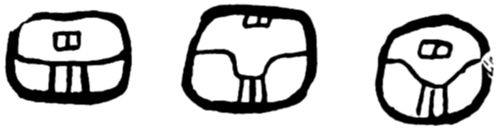
1. Kan. The object represented is a polished stone, shell pendant, or bead, in Maya, kan. It was their circulating medium, and it stands for money, and all which that magic word conveys,—food, prosperity, abundance.[140] The dot or eye in the upper portion is the perforation by which it was strung on a cord. Others explain it as an eye (Seler); a tooth (Brasseur); a grain of maize (Schellhas).
111

2. Chicchan. The allusive design to suggest the name is supplied by the twisted threads chich kuch. See above, p. 96. Brasseur sees in it a petticoat, Seler a serpent’s skin, etc.
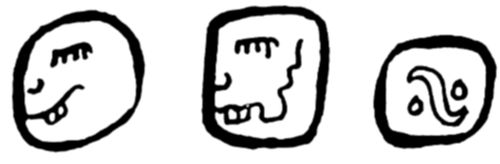
3. Cimi. Represented either by an eye closed as in death, cimil; or by the maggot (see above p. 65).
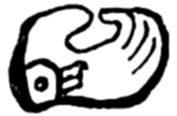
4. Manik. Correctly explained by Brasseur as a hand in the act of grasping, “une main qui se ferme.” Its phonetic value is not kab, hand, but mach, “to grasp” (see above p. 83).
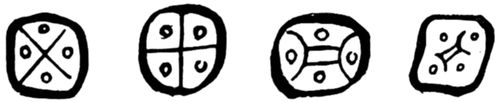
5. Lamat. The figures bear a close resemblance to some of the sun signs. See Fig. 37. They seem to show the orb partly below a line—the horizon—which would give as a rebus lamal kin, the sunsetting; enough to recall the day name.
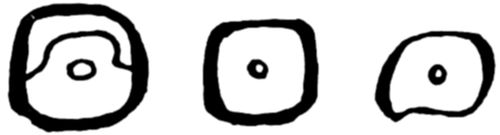
6. Muluc. The day sign muluc and the month sign mol have a resemblance, as do the words. The root mol or mul means a 112coming together, or piling up. The hurricane is called molay ik, “the winds united;” the word for religion is umolay, literally, “a congregation or meeting.” Both signs seem to portray one thing inside of another of the same kind, with a probable reference to the sense of the root.

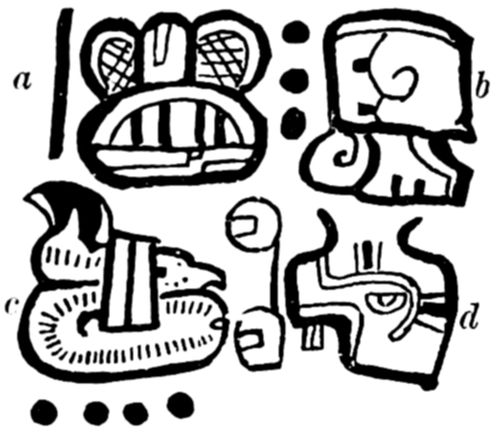
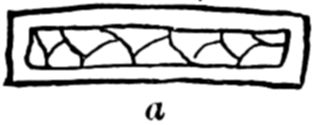
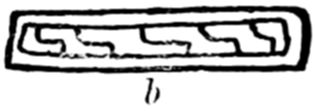
Fig. 67.—A Cartouche.
7. Oc. Among its various meanings this word signifies “a trail” and “footprints.” Such seems the design in the first variant. Brasseur, and, following him, Seler, think that the others portray the ears of a dog, as in some Mayan dialects the dog is called oc. The full glyph is thus: It is of frequent occurrence in such a cartouche as shown in Fig. 67, where a is the strengthened pax; (See p. 92), b, the dog sign; c, the haunch of venison; and d, the monogram of Xmucane with a vigesimal or personal prefix.
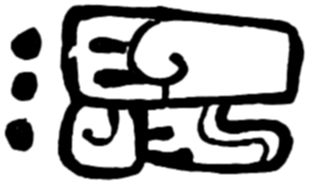
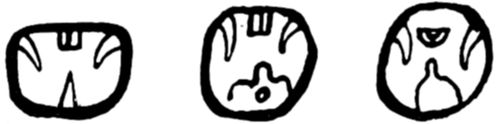
8. Chuen. The figure is that of a mouth, chi, with fangs; but as that was not very near in sound, a calabash, chu, is sometimes portrayed at the bottom of the circle, within. The mouth of no particular animal is intended, as is evident from allied designs; though Brasseur and Seler claim that it is of a monkey, Schellhas, of a snake, etc. The day name is close in sound to chun, the first, the beginning, and appears occasionally as a numeral (see above, p. 23). Piles of chuen are shown as offerings, e. g., 113Cod. Dres., pp. 26, 42; Cod. Cort., p. 3. Do they mean “first fruits?”[141]
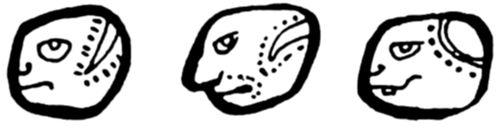
9. Eb. The face of an old man with a peculiar pointed ear mark. The word eb means “ladder;” ebtun, a stone stairway; ebzah, to sharpen or point a flint; this last may explain the sharpened ear and dots.
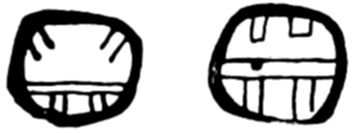
10. Ben, or Been. Explained by Brasseur as showing a path, be; by Seler, as a mat and a straw roof. To me, it looks like a be che, a wooden bridge, the two supports of which are shown and which was sometimes covered with a straw mat. This rebus gives the first syllable of the name. In Tzental tradition Been was the ancient hero who erected the inscribed stelæ (piedras paradas) at Quixté, near Comitan,[142] which the natives still decorate at certain times with garlands of flowers, etc.[143]
11. Ix. The usual figure contains a number of black dots. 114These suggest the word xiix, scattered grain husks. Seler thinks it shows “the round hairy ear and spotted skin of the jaguar.” Brasseur proposed that it conventionally portrays the feminine parts, as ix is the feminine prefix in Maya.
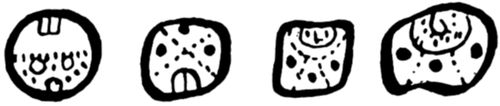
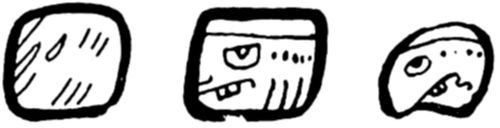
12. Men. The head of an aged person, supposed by Brasseur and Seler to be Mother Earth. Sometimes it is extended worm-like, as in Fig. 43, No. 3.

13. Cib. Brasseur and Seler believe the enclosed spiral represents the fermented liquor, ci, trickling down. The “pottery decoration” (see p. 58) certainly indicates a jar or vase.
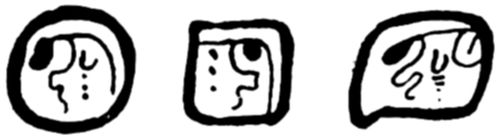
14. Caban. The design is that of the “cork-screw curl” of a woman, and stands for cab (see p. 99).
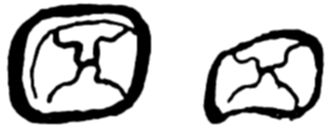
15. Ezanab. The picture is of the sacrificial knife of flint, which closely corresponds with the name.
115
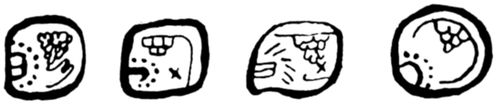
16. Cauac. The design shows a side face, with pendent clouds for the eye, the “windcross” for the ear, and, perhaps, as Seler thinks, the hairy mouth of the moan bird. On the other hand, Rosny explains it as “the plan of a building,” and Thomas as “the sign for wood.”

17. Ahau. Usually considered to be the conventional drawing of a full face.
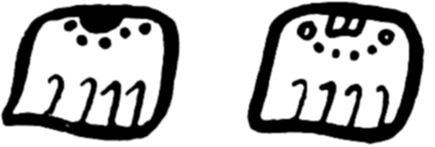
18. Imix. Generally regarded as representing a mammary gland, though it is not quite like those shown in the Codices. It is typical of prosperity and is often attached to the kan sign. In the calendar it indicated the beginning of a time-period.[144]
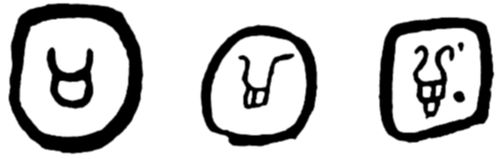
19. Ik. The word means air, wind, breath, spirit, soul, and life. The design is a katun enclosing the sign of the four directions or four winds, the “wind-cross.” Brasseur calls it a flower, because it is sometimes shown with what looks like leaves emerging from it (Cod Tro., pp. 5*, 6*, etc.). This indicates, however, the spirit of life coming forth (or, as Seler thinks, is a sign of 116sacrifice; the same superfix occurs on the kan, Cod. Cort., p. 37, etc.).
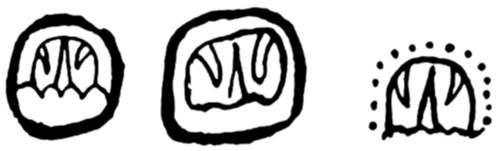
20. Akbal. The word resembles akab, night, and is probably derived from it. The design may be that of a mouth with teeth (Brasseur, Seler), or the rays of the sun after sinking below the horizon. As a general glyph it is frequent with the signification of night and darkness, not necessarily in a bad sense.
6. The Hieroglyphs for the Months.
These are more intricate than those of the days, and show wider variation. In the designs given below, the first on the line is from Landa’s work, the second and third are from the Dresden Codex.
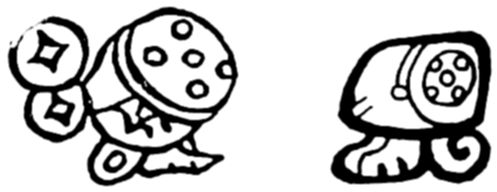
1. Pop. The word means “a mat.” The principal element in the glyph is the south or yellow sign, referring perhaps to the color of a mat, with the alar subfix. The prefix to the first variant shows the “windcross.”
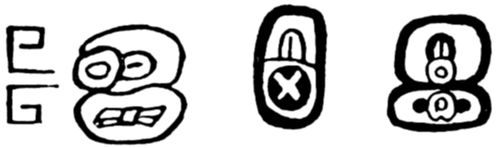
2. Uo. The usual meaning of this term is a prickly pear; also, a species of frog; uooh, a written character or letter. The prefix indicating speech (see p. 98) seems to indicate the latter. The chief element is the mol sign with the night sun as a subfix.
117
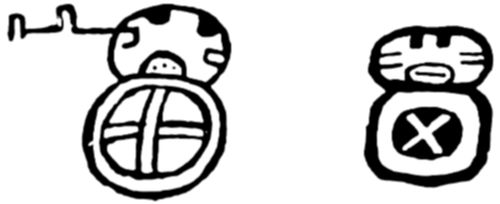
3. Zip. The design shows the sun below the flint knife, that is, the slain or departed sun, a play on the phrase, zipik kin, the sun set (ponerse el sol, Dicc. Motul). The idea is strengthened by the mac as a prefix, signifying “to extinguish.”
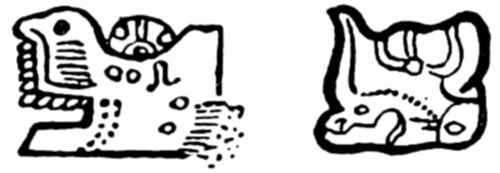
4. Zodz. The word means “bat,” and the design shows the head of one with the kin as a superfix.
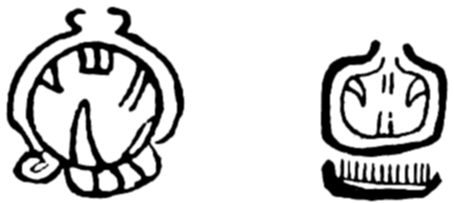
5. Zec, or Tzec. The design is explained by Brasseur as a death’s head, Maya, tzekel; by others, as an open mouth with teeth (compare chuen, p. 112). The projecting curved lines above the head are supposed by Schellhas to represent a peculiar mode of wearing the hair. But as tzec means “scorpion,” they may depict conventionally the claws of that animal.[145]
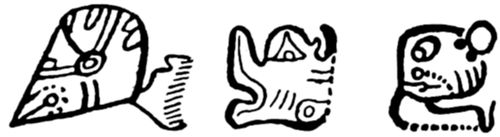
6. Xul. The three signs are quite unlike. The first presents 118the conical bill of a bird of the finch or sparrow family; the second, the horned owl or the falcon (?); the third, a conventionalized bird’s head. The second may be ikonomatic for xulub, horns. The word xul means to end or to finish; and, the end, limit, or extremity.
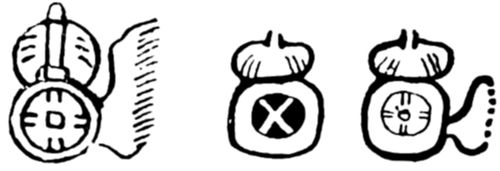
7. Yaxkin. This means “new sun” or “strong sun.” The glyph expresses this by the yax sign, “new” or “strong;” the kin (sun) sign and the dotted postfix, ual, month. According to the Dicc. Motul, the phrase dze yax kin was applied by the Mayas to the hottest part of the summer.
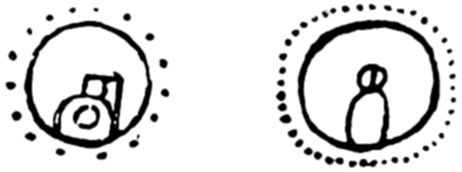
8. Mol. See remarks on the day sign muluc, p. 111. Dr. Förstemann suggests that the above designs represent either (1) a snail in its shell, or (2) an egg with its yolk, or (3) the sun after setting. Seler holds that it shows the heart, Maya, ol, within the body, making a rebus for mol.
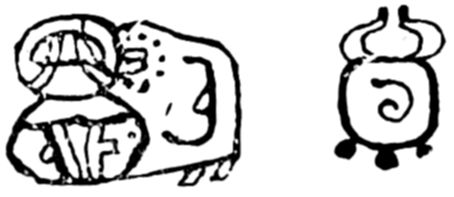
9. Ch’en. This means a spring or well of water. The second sign shows a water jar bearing the sign of fluid, with reference to the sense of the word. The first is more complex. The main element is a face with a moan mouth, referring to water; for an eye the infix u, for month; and two prefixes, the sign of 119union (see p. 100), and above it what may be a variant of ben (see. 113).
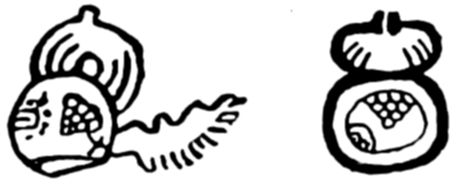
10. Yax. The feather sign yax (see p. 94) is the superfix to the cauac sign, which carries the postfix ual, month.
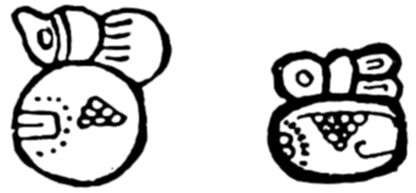
11. Zac. This word means “white,” and this is here expressed by the cauac sign carrying as a superfix the north directive sign (see p. 109), as white was the color sacred to the North.
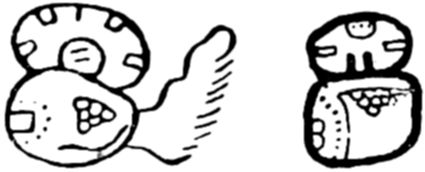
12. Ceh. The meaning of ceh is “deer,” and the design shows the flint knife used in slaughtering that animal, placed as a superfix to the cauac sign.
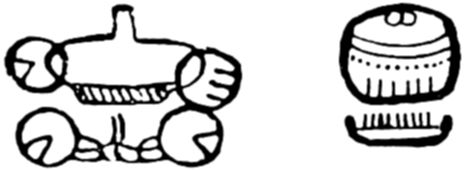
13. Mac. The first glyph represents the cover of a jar, the name of which in Maya is mac, thus making a perfect rebus.[146] The second, not plain, is a variant of the kan or imix, with the 120“comb” subfix. In this month was celebrated the important rite of tupp kak, “the extinguishing of the fire,” the aim of which was to secure rain for the growing crops. The figure may refer to this.
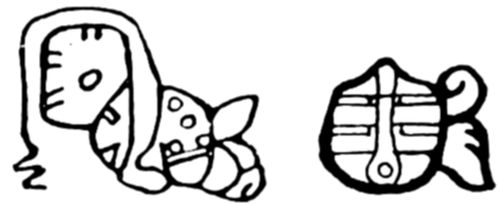
14. Kan kin. This expression means “the yellow sun.” The first glyph is a perfect rebus, showing the sun sign, kin, and the south directive sign (see Fig. 65), which means “yellow.” The second glyph is the sign for a breast-bone, a shield, or dog (see p. 125).
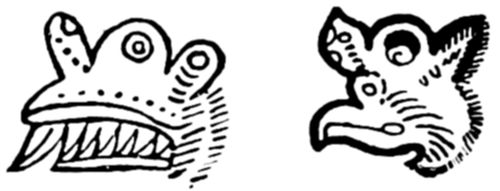
15. Muan. The head of the muan bird, the crested falcon, with his ears or horns, see p. 74.
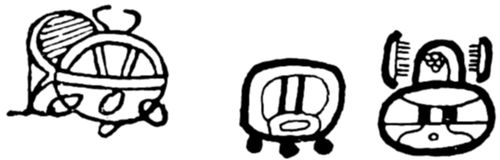
16. Pax. The only or main element is the drum, pax che, above explained (see p. 91).
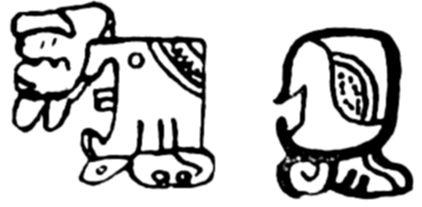
17. Kayab. The main element was recognized by Schellhas as the head of a turtle. In Landa’s alphabet this has the value 121a or ak. It is applied as a rebus to recall the first syllable of the name.
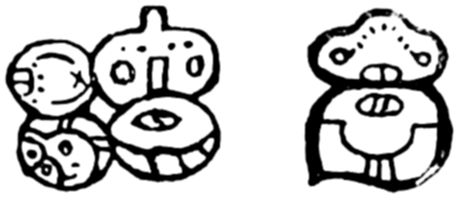
18. Cum ku. The glyph in one case combines kan and cum, with prefixes of cauac and cib. Dr. Förstemann fancifully explains it as portraying “from one point two flashes of lightning or sun’s rays striking the maize field.” Rather, we have here the rebus cum kan, recalling the name, and the cauac sign, which is repeated in a number of the month signs.
7. The Hieroglyphs of the Deities.
I have already mentioned that in the texts the gods are severally represented by their signs or monograms. The credit of defining these in a clear and satisfactory manner is due almost entirely to Dr. Schellhas, and I shall here present the results of his careful studies, retaining his alphabetic nomenclature, which has in some degree been accepted by Dr. Förstemann and others.
A. The god of Death.
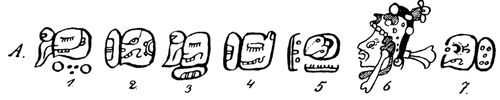
His signs are clearly established and vary but little, Nos. 1–4. Two of them are usually written. The prefix to 1 and 3 has been already referred to (see p. 84). The bean (or flint) appears as a prefix in No. 2, as a subfix in No. 3. Frequently associated with his monogram is No. 5, which Seler explains as the sign of the owl. No. 6, from Cod. Dres., p. 50, with a skull 122for a head-dress, may be a priest of this divinity; No. 7, from Dres., p. 22, may also be a priest or a companion.
B. Itzamna, or “the god with the snake-like tongue.”

His hieroglyphs are, beyond mistake, Nos. 8 and 9. The directive sign, No. 10, is occasionally associated with his monogram. In Cod. Dres., p. 33, one of his attributes is shown in No. 11, the hand closing on the rattles of the crotalus. The food symbols, Nos. 12, 13, 14, 15, are often connected with him. Some regard them as the four elements, etc.
C. The North Star, or “the god with the ornamental face.”

It is easy to recognize his monogram, Nos. 16, 17, 18, 19, 21. I have already explained the “pottery decoration” (above, p. 58). As prefixes, we find the bean, No. 20; the crescent, as in 21; the number 13, indicating completeness or perfection; and the vase, as in 16 and 17.
D. Cuculcan, “the moon god, or night god.”
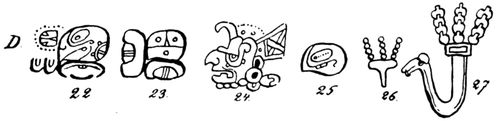
The complete hieroglyph is No. 22, generally followed by No. 23. He is “the old man god,” with one tooth, as in No. 24; 123sometimes connected with the moon symbol as in No. 25; and often holds in his hand the aspersorium, shown in Nos. 26 and 27. See p. 105.
E. Ghanan, “a male maize god.”

His usual monogram is No. 28. No. 29 is a picture of the maize plant from Cod. Tro., p. 29, from which Dr. Schellhas argues that the head-dresses of this divinity, as shown in Nos. 30–34, are conventional designs for growing maize. My own collations persuade me that the maize should here be understood as a general symbol for vegetable growth, fertility, and the harvests.
F. The god of War, or, “a companion of the god of death.”
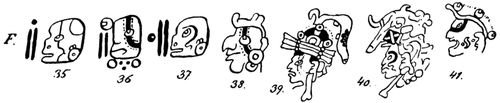
His hieroglyphs, shown in Nos. 35–41, often contain the number 11. The black line is characteristic. His signs appear in connection with all four cardinal points.
G. Kin ich, “the sun god.”

His monogram is uniform No. 42. It is the sun with the ben ik superfix and alar postfix. (See p. 90). His nose ornament, 124No. 43, and the “flower,” No. 44, are usually distinctive of his portraits.[147]
I. “The serpent goddess.”
Her signs are not distinct. Dr. Schellhas believes them to be Nos. 49–51; but I cannot accept that they are intended for the same individual.
H. “The serpent god.”

The hieroglyph and the personage, No. 45, are doubtful. He is supposed to be shown in Cod. Dres., pp. 11, 12, 20, etc. Nos. 46 and 47, from Cod. Tro., p. 17, are also assigned him. The rattle, No. 48, appears as a hieroglyph in Cod. Dres., p. 61, and elsewhere. I doubt this deity.
K. “The god with the ornamented nose.”
The hieroglyph is No. 52, often accompanied by the “dog” sign, No. 53. I have already expressed the belief that this is merely one of the manifestations of Itzamna. (See p. 54.)
L. Ical Ahau, “a black god.”
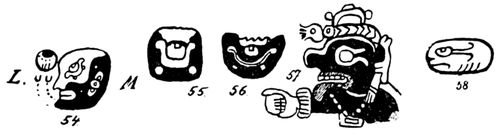
Dr. Schellhas distinguishes between a divinity whose sign is No. 54, and “M,” “a second black god,” whose hieroglyph is 125No. 55, 56, and whose face is shown No. 57. He appears in Cod. Dres., pp. 13, 16, 43, and is common in the Cod. Tro. The sign No. 58 is occasionally associated, as in Cod. Tro., p. 5, and Cod. Cort., p. 28.
N. “A god with the features of an old man.”
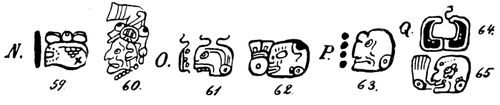
His sign is No. 59, which may be translated “5 Zac,” and may refer to his festival on that date (Seler). His face and peculiar head-dress, with the pax sign, are shown No. 60. These do not strike me as representing divinity, but simply “old age.”
O. “A goddess with features of an old woman” (Xmucane?). Her hieroglyphs are shown Nos. 61, 62; the latter is more frequent.
P. “A figure with features of an old man.”
It is seen Cod. Dres., p. 21, with the sign No. 63. It is doubtful if a deity is intended.
Q. “An isolated deity.”
Shown Cod. Dres., p. 20, with the signs Nos. 64 and 65; probably a mere personage.

R. The moan bird.
He is often associated with the god of death, and bears the hieroglyphs Nos. 66–69, sometimes with the 13.
S. No. 70 is the usual hieroglyph of the dog, and T, No. 71, is that of the vulture.
126U. No. 72 is the sign of the jaguar, as seen in Cod. Tro., p. 17, and in Cod. Dres., pp. 8, 26.

V. The turtle or tortoise. Its monogram is seen Nos. 73, 74, 75. It is the a of Landa’s alphabet. There is no doubt but that the turtle’s head and not that of the parrot is intended, though some have thought otherwise.
127