Front matter
Reading edition
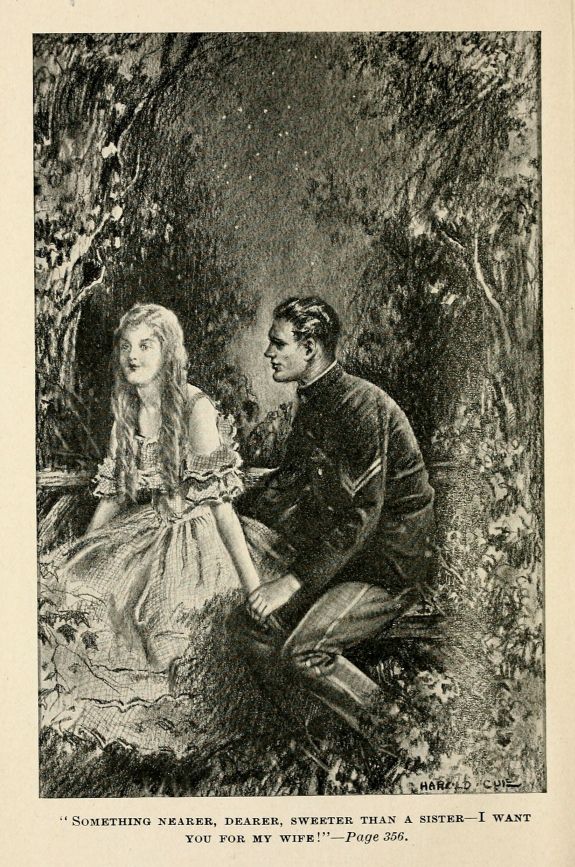
"SOMETHING NEARER, DEARER, SWEETER THAN A SISTER—I WANT YOU FOR MY WIFE!"—Page 356.
A Prairie-Schooner Princess
By MARY KATHERINE MAULE
Illustrated by HAROLD CUE
BOSTON LOTHROP, LEE & SHEPARD CO.
Published, August, 1920
COPYRIGHT, 1920, BY LOTHROP, LEE & SHEPARD Co.
All Rights Reserved
A Prairie-Schooner Princess
Norwood Press BERWICK & SMITH CO. NORWOOD, MASS. U.S.A.
Dedicated to the memory of those gentle pioneers who have gone on to their reward, but whose influence will long be felt in that State to which they came in a Prairie Schooner
Thanks are due to Mr. Addison Erwin Sheldon, Director of the Nebraska Legislative Reference Bureau and The Nebraska State Historical Society, for aid in research work.
CONTENTS
The Strangers
The Grave in the Desert
Princess
Leaving the Old Home
Westward Ho!
In Which the Pioneers Hear Alarming News
A Night of Horror
Joe Meets a Friend and Makes an Enemy
Red Snake
Nebraska
The Prairie Fire
A Nebraska Dugout
The Minne-to-wauk-pala
The New Home
Building the Sod House
In the Hands of the Enemy
Eagle Eye
A Life for a Life
How Joe Came Home
Eagle Eye Remembers
The Blizzard
To the Rescue
Christmas on the Prairies
Ruth Makes a Discovery
The Dispatch-Box
Trouble Brewing
War
In Camp and Field
Home Again
Ruth Receives a Surprise
Joe Hears a Strange Story
ILLUSTRATIONS
"Something nearer, dearer, sweeter than a sister—I want you for my wife!" (Page 356) . . . . . . Frontispiece
The little Princess settled down beside him, her chin in her hand
"Keep it; you were good and saved us"
Sunrise found her plodding on, a forlorn little figure on a big bay mare
A Prairie-Schooner Princess
CHAPTER I
THE STRANGERS
From under the curving top of a canvas-covered "prairie schooner" a boy of about fifteen leaned out, his eyes straining intently across the brown, level expanse of the prairies.
"Father," he called, with a note of anxiety in his voice, "look back there to the northeast! What is that against the horizon? It looks like a cloud of dust or smoke."
In a second prairie schooner, just ahead of the one the boy was driving, a man with a brown, bearded face looked out hastily, then continued to scan the horizon with anxious gaze.
Beside him in the wagon sat a blue-eyed, comely woman with traces of care in her face. As the boy's voice reached her she started, then leaned out of the wagon, her startled gaze sweeping the lonely untrodden plains over which they were traveling.
Inside the wagon under the canvas cover a boy of nine, two little girls of seven and twelve, a curly-headed little girl of five, and a baby boy of two years, lay on the rolled-up bedding sleeping heavily.
The time was midsummer, 1856, and the family of Joshua Peniman, crossing the plains to the Territory of Nebraska, which had recently been organized, were traveling over the uninhabited prairies of western Iowa.
"Does thee think it could be Indians, Joshua?" asked Hannah Peniman, her face growing white as she viewed the cloud of dust which appeared momentarily to be coming nearer.
"I can't tell—-I can't see yet," answered her husband, turning anxious eyes from the musket he was hastily loading toward the cloud of dust. "But whatever it is, it is coming this way. It might be a herd of elk or buffalo, but anyway, we must be prepared. Get inside, Hannah, and thee and the little ones keep well under cover."
In the other wagon two younger boys had joined the lad who was driving. On the seat beside him now sat a merry-faced, brown-eyed lad of fourteen, and leaning on their shoulders peering out between them was a boy of twelve, the twin of the twelve-year-old girl in the other wagon, with red hair, laughing blue eyes, and a round, freckled face.
Sam was the mischief of the family, and was generally larking and laughing, but now his face looked rather pale beneath its coat of tan and freckles, and the eyes which he fastened on the horizon had in them an expression of terror.
"Do you suppose it's Indians, Joe?" he whispered huskily. "Did you hear what that man told Father at Fort Dodge the other day? He said that Indians had set on an emigrant train near Fontanelle and murdered the whole party."
The boy on the driver's seat did not answer. With his wide grey eyes focused intently on the cloud of dust in the distance, his tanned face strained and set, he craned forward, every muscle of his body at rigid attention.
Presently he handed the lines to the brother who sat beside him and reaching up into the curving top of the wagon took down a heavy old muzzle-loading musket.
"Do you think it is Indians?" the boy asked, his hands a bit tremulous on the lines.
"I dunno. Can't tell yet. But we've got to be ready anyhow. Better load up your rifle, Lige."
The brown-eyed boy wound the lines around the whip-stock and took from a rack under the cover a long-barreled rifle.
They had seen many roving bands of Indians on their journey, but had never been molested by them, but at the last settlement they had passed through they had heard horrifying accounts of the scalping and massacre of settlers and emigrants by the red men. On the old Overland Trail between Fort Laramie and the South Fork of the Platte there had occurred an Indian uprising a few days before, the terrifying news of which had reached them at their last stopping place.
As Joe leaned forward with eyes fastened on the horizon he suddenly uttered a cry.
"It's a wagon," he shouted,—"an emigrant wagon—like ours!"
From out of the cloud of dust that drifted across the prairie an object could now be discerned, a large object, with a white canvas cover.
Joshua Peniman, who had never removed his intent gaze from the approaching cloud, echoed the cry.
"It is a wagon—an emigrant wagon!" Then as the dust drifted aside and he could see more clearly,—"and they are driving at a fearful pace!"
For many weeks now the family had been traveling over the desolation of the prairies, for days at a time seeing no human creature but one another. For miles all about them lay the prairies, brown, dry, scorched by the hot summer sun, level as a floor, with never a tree, a shrub, a bush, a hill, or a mound to break the dreary monotony of the plains that stretched endlessly away all about them to the very horizon in every direction.
It was therefore with the greater excitement and astonishment that the family saw a wagon drawn by two furiously plunging horses emerge from the cloud of dust that had concealed it, and come swaying and lurching across the plains.
They had stopped their teams now, and the whole family were standing up looking backward.
"Jerusalem! the folks in that wagon must be in a terrible hurry, whoever they are!" ejaculated Elijah, more commonly called "Lige" by his family.
"They'll tip their old schooner over if they don't look out!" cried Sam. "Look at her tilt!"
"Pretty risky driving, I should say," said Mrs. Peniman, shading her eyes with her hand.
"Something must be the matter," cried Ruth, who, wakened by the talking, had come to the rear of the wagon. "I don't believe anybody'd drive like that if they didn't have to! Oh, Mother, do you suppose the Indians are after them?"
"I think not, Ruthie, there does not appear to be any sign of any one after them. What does thee make of it, Joshua?"
"I don't know what to make of it," replied Joshua Peniman, leaping out of the wagon and keeping his gaze fixed on the approaching vehicle. "I never saw such driving. What can they be thinking of to drive their horses like that on such a day! The man must be drunk—or crazy! He'll kill his team!"
The white-topped prairie schooner was now clearly visible, the horses galloping madly, the wagon swaying and lurching from side to side, the white curtain at the back streaming out on the wind.
"Something must be wrong there," cried Joe; "nobody in his senses would drive like that! Do you suppose the team could be running away? No, they're leaving the road! Look, they're turning in here! They must have seen us! I wonder——"
With strained gaze the travelers stood motionless, every faculty absorbed in watching the oncoming vehicle.
Suddenly Mrs. Peniman uttered a startled cry:
"Why, that isn't a man driving—it's a woman!"
Joshua Peniman, with hands bowed across his eyes, exclaimed breathlessly, "My God, so it is!"
As the prairie schooner drew nearer the wonder and excitement of the family increased.
On the high driver's seat in the front of the wagon they could now make out a woman; a woman young, beautiful, white and livid as death; a mass of hair that gleamed like molten gold in the sunshine blowing wildly about her shoulders, her eyes distended, her arms bare to the elbows extended far in front of her, one hand clutching the reins, the other lashing the panting, staggering horses, that, lathered with foam and sweat, were heaving and stumbling, ready to drop with exhaustion.
"Help, help, help!" her wild, piercing shriek came to them above the clattering of the wagon.
Joshua Peniman, Joe and Lige leaped from their wagons and ran forward to meet her. As they reached her she threw down the reins and reeled and tottered on the seat.
"My husband—my husband!" she gasped, and pointed to the inside of the wagon.
Joshua Peniman took the poor exhausted beasts by their bits and led them up to his own encampment.
"What is it? What has happened?" Hannah Peniman cried, running to the woman and with strong, tender arms lifting her down from the seat.
The woman staggered, and would have fallen if it were not for her strong support.
"My husband—Lee—my husband!" she cried again, and breaking from the supporting arms ran to the rear of the wagon.
Joshua Peniman was there before her.
On the roll of bedding under the canvas cover he saw the figure of a man lying. Springing into the wagon he bent over it, then lifting it in his arms bore it to the opening at the rear, where Joe waited. Between them they carried it to the shade of the wagons, where they laid it on the grass.
As they did so Hannah Peniman stooped over it, then uttered a sharp cry.
"Oh, look, look what has happened to him!" she gasped.
Joshua Peniman bent over the prostrate figure. Protruding from the breast, with a great pool of blood staining the shirt about it, was an arrow, buried well up on its feathered shaft.
"An arrow!" whispered Hannah Peniman in accents of horror.
"Indians!" cried Joe, a creepy chill running down his back.
The strange woman had run to the body and precipitated herself upon it with agonized cries.
"Oh, Lee, Lee!" she shrieked. "Oh, surely he isn't dead! Surely he would not leave us all alone!"
Joshua Peniman motioned to his wife, and with gentle hands she raised the frail, delicate figure of the young wife and bore it away to the other side of the wagon. Mr. Peniman stripped off the coat and laid his hand, then his ear, over the heart of the prostrate figure.
"He is not dead," he whispered, "his heart is beating faintly. Get me a pan of water, Joe, and the spirits of ammonia. Hurry, lad, a life may depend on our efficiency now!"
When he had sponged the blood away he tried to draw the arrow from the wound, but it was too deeply imbedded. His efforts only succeeded in starting a terrific flow of blood, in the midst of which the wounded man moaned and opened his eyes.
"Marian!" his lips shaped rather than spoke the word. Surmising that it must be the name of his wife, Joshua Peniman sent Lige running to call her. Then he bent over the wounded man, saying distinctly, "Thee is with friends, friend. Thy wife is safe, and with my wife back of the wagons."
The wounded man rolled his eyes about, then whispered tensely, "Nina! Nina!"
Not knowing what he meant, the Quaker nodded reassuringly.
"Indians?" he asked, pointing to the arrow.
The man slowly raised his hand and groped toward the wound. To the intense astonishment of both father and sons he shook his head. "Tell—Marian—watch out—watch out for—for——" his head dropped back, the blood gushed from his mouth, and with a gurgling cry he sank back on the grass.
Joshua Peniman knelt beside him.
"Gone!" he said solemnly, reverently removing his hat.
CHAPTER II
THE GRAVE IN THE DESERT
As Joshua Peniman and his two older sons stood looking down upon the dead man, the delicate-featured, high-browed, thoughtful face of a scholar, upon the hands, smooth, white, tapering, with well-kept nails and soft palms, the body worn and thin almost to emaciation, the waxen cheeks hollow and sunken under the blue-rimmed eyes, a strange sense of awe and wonder passed over them.
What was this man—this delicate, scholarly-appearing individual with his soft hands and emaciated body—doing in an emigrant wagon crossing the trackless plains?
Who was the woman who was with him—that young, beautiful, delicately-clad and delicately nurtured woman, whose sobs and moans they could hear from the other side of the wagon?
As these questions forced themselves through the mind of Joshua Peniman the woman came rushing around the end of the wagon and cast herself down beside the body.
"Lee, Lee, Lee!" she shrieked. "Oh, he is not dead, he is not dead! Surely God could not be so cruel as to take him from me! Oh, Lee, my husband, my own, my only love!"
Her voice had risen into a high, wailing cry. Suddenly from the rear end of the wagon from which they had taken the dead man a head appeared.
To the startled eyes of the boys who first saw it it seemed the most beautiful head and face they had ever seen.
It was a small head, fine and delicate, set like a flower on a little swan-like throat, and covered with short curls of sunny gold. Beneath the shining halo of curls a face looked out, pitifully small and frightened, with great terrified violet eyes, a quivering rose-bud mouth, and a skin as fair and delicate as the petals of a flower.
"Father—Mother!" cried a quivering, childish voice, "oh, what is the matter? what has happened? what are you crying so for, Mother?" Then, as the terrified violet eyes caught sight of the body, she leaped to the ground and threw herself upon it with a cry that Joe could never forget.
The children who had gathered about stood transfixed, but Hannah Peniman moved swiftly to the child and took her in her arms.
"Thy father has gone away, dear child," she whispered in her soft, motherly voice. "But thee must be very brave for thy poor young mother's sake. Thou must help her to bear it."
The child uttered a wild sob, then fled to her mother and clasped her arms about her neck.
They clung to each other sobbing bitterly for a time. The boys turned away, and Joe found a lump too big to swallow choking his throat.
After a time Joshua Peniman bent to the woman tenderly.
"Was thy husband ill, my child?" he asked gently.
"Oh yes, yes, very ill," she answered between her sobs. "They told me he had tuberculosis. He was a writer. You must have heard of him. The doctors sent us out West. They told him to get a wagon and spend the whole summer traveling across the plains. We were on our way to Colorado for his health. We have been out three weeks, and he was better, oh, very, very much better. And then yesterday we were driving along near a creek and some Indians set upon us——"
"Indians?" cried Joshua Peniman, remembering that the dying man had answered his question with a shake of the head.
"Yes, Indians—a whole band of them. They began shooting at us. Nina and I happened to be inside the wagon, but Lee—my poor Lee—was on the driver's seat. I don't know when he was hit. I don't know that he knew himself. He shouted out to me to hide, and to hide Nina, and I did, I hid her under the blankets beneath the seat——"
"And you are sure it was Indians that attacked you?" asked Joshua Peniman, while a cold hand of terror clutched his wife's heart.
"Yes, I'm sure. I saw them. I heard them. Oh, they were horrible! Lee never made a sound when he was struck. All at once I saw him reel and totter on the seat, then he came tumbling backward, and I saw the arrow in his breast. I tried to pull it out, but I couldn't, and it bled fearfully, so I stopped. He was conscious then, and said, 'Drive—hurry—wagon ahead!' I got up on the seat and whipped up the horses and drove and drove as fast as I could make them go. The heat was terrible. I thought I should die. But I saw your tracks, and at last I saw the smoke of your fire and knew there was help at hand. I thought I should kill the horses, but I didn't care, all I could think of was help—help for my poor Lee!"
As she said the last words she uttered a long wail, threw her arms above her head and plunged forward over the dead body.
Joshua Peniman lifted her tenderly and bore her in his arms to their own wagon.
All night they worked over her, with every remedy at their command, but before the grey dawn of morning they knew that she would join her husband before many hours.
Heat, exhaustion, terror, the strain of agony and fear, the shock to an already weakened and overstrained heart, were more than nature could bear.
Shortly before daylight she opened her eyes and looked up into the face of Hannah Peniman, who bent above her.
"Who are you?" she asked faintly. "Where do you come from?"
"Our name is Peniman, Hannah and Joshua Peniman. And these are our children. We come from the Muskingum Valley in Ohio."
"You are Quakers?"
"Yes. My husband was a leader in the Society of Friends."
"Then you are good—good and kind, I know," she whispered brokenly. Then clutching Hannah Peniman's hand and fixing her beautiful, burning eyes upon her face she hurried on: "My child—my little Nina—what will become of her? I am going—going to Lee—I could not live without him. Our name is Carroll. My husband was Lee Carroll—a writer—and I am Marian Carroll. The little girl's name is Nina. Will you take her—will you take her with you to the nearest Mission? I know it is asking a good deal with your big family—but you will do it—I know you will do it—for my poor little orphaned child. I will explain to her—give her papers and addresses and all—and they can send her home from there. Our people are all—all——"
She stopped, gasping and struggling for breath. Joshua Peniman lifted her and held a heart stimulant to her lips. After an interval, when they feared all was over, she again opened her eyes. Mother love was stronger than death. "Send—her—to me," she gasped—"I have not long—to—be—with—her."
They laid her back upon the bed, then sent the child to her.
For some moments they heard the low murmur of voices, the sobbing of the child. Then when there had been silence for some time Hannah Peniman quietly parted the curtains of the wagon and looked in.
The young mother lay white and still, her beautiful delicately carved face looking like sculptured marble in the dim grey light of morning, the child with her arms tight clasped about her neck, her cheek on the fast-chilling cheek of her dead mother, sobbing by her side.
Hannah Peniman took her in her arms and carried her out of the wagon. Apart from her own brood of little ones she sat down, the little girl still in her arms, and rocked and crooned to her, talking to her in gentle, soothing tones, telling her of the great happiness her young parents would feel in their reunion, in that place where there is no more parting, no more sickness or suffering or death.
When the sun had risen they buried the man and woman side by side in a grave dug in the virgin soil of the prairie. Over it the sun rose, shining down upon the two pitiful mounds of earth in the loneliness of the desert land, and bringing out upon the two wooden crosses at their head the inscription Joshua Peniman had painted upon them, "Lee and Marian Carroll. Died July 20th, 1856. Buried by Joshua Peniman, emigrant, on way to Nebraska."
Below in smaller letters he had printed the cause of the death. That was all that he knew about them.
He had drawn the arrow from the breast of the dead man before wrapping the still form in the blanket that was its only coffin and shroud, and without asking himself the reason why he preserved the arrow carefully, putting it away in a chest under the seat of his wagon.
The whole family gathered about the graves, while the gentle Quaker said over them the simple, earnest prayer of the Friends, then turned sadly toward the wagons, which were ready to start again on their westward journey.
As they turned away from the lonely graves the child broke from them and with a wild cry ran back and threw herself face downward upon them.
Ruth and Sara broke into loud sobbing, and even the boys were obliged to turn aside.
Hannah Peniman went to the child and raised her.
"Come, little one," she said with tear-wet eyes, "thee must come away. Thy dear parents are not there. That is only the old garments they have laid down to go to the new home that awaits them. They are together now, and will always be happy and well. They are not far away. They will watch over thee. Their spirits will always be near thee. Thou art young, life will bring many joys to thee, of which thy parents will be glad. Come now, little girl, the sun grows high, the day will be hot, and we must be on our way."
As the child, sobbing bitterly and clinging to her, turned toward the wagon that had belonged to her parents, which was hitched on behind the one driven by Joshua Peniman, Mrs. Peniman drew her away.
"Will thee ride in the big wagon with my little girls?" she asked gently; "they would be very glad to have thee."
The child raised her pretty head, looked at the Peniman children with her beautiful, tear-filled eyes, then slowly shook her head.
"I will ride with that boy," she said, pointing to Joe, who, seated on the driver's seat of his own wagon, was valiantly striving to appear manly and keep back his tears. He blushed up to the roots of his fair hair, then leaped down from the seat and very tenderly lifted the little stranger up on the seat of the wagon.
As the cavalcade started forward, now quite a procession with the three teams and wagons, the cow following behind, the collie dog leaping and barking beside the wagons, the faces of all were turned backward and their eyes rested on the lonely mounds on the prairie as long as they were in sight.
The little girl, sitting beside Joe on the high seat with her trimly-dressed little feet swinging far above the wagon-bed, kept her head buried in her arms, and sobbed as if her heart would break. Gentle-hearted Ruth cried with her, Lige beat a hasty retreat to the back of the wagon, while tender-hearted Sam slipped a sympathetic freckled hand into hers and wept openly as he smoothed and patted it.
Joe could do nothing but sit soddenly, with a lump in his throat so big that he could neither speak nor swallow. But his eyes had in them all the sympathy that his lips could not speak, and when the little girl at last looked up it was straight into those bright, wistful, moist grey eyes, after which she snuggled up against him and laid her head against his arm.
CHAPTER III
PRINCESS
As the wagons creaked slowly along over the burning, dusty prairies the little stranger cried more quietly, while the children stared at her with growing interest and wonder.
They had never seen any one quite like her before.
Living as they had in the quiet Friends settlement on their farm in Ohio, they had seen but little of the outside world, and that little had contained nobody in the least like this fairy-like creature, with her dainty clothing, her delicate features and coloring and her sunny golden hair.
"Say," whispered Sam, who was a great devourer of juvenile literature; "she looks just exactly like the fairy princesses you read about in story-books, don't she? Look at her little feet, and her little teenty white hands, and how her hair curls, and how little and white her neck is!"
Lige looked and nodded. "An' look at her clothes, too! City folks' clothes. Wonder why her mother let her wear clothes like that in the wagon? Our mother wouldn't let Sara and Ruth."
"You bet she wouldn't. She makes 'em wear calico aprons."
They glanced again at the little figure on the seat in front of them; at the dainty white dress, the little lace-trimmed petticoat that showed below its edge, the white stockings, the dainty little kid slippers, and then at each other and their own rough clothes and rough red hands.
"Makes you feel kind of like a tramp, don't it?" muttered Lige, and privately resolved to get out his second-best suit and put it on in the morning.
Joe meanwhile was casting sympathetic glances at the little figure beside him, and trying hard to think of something to say or do to comfort her. The sight of a meadow-lark flying up from a little bunch of grass near by gave him an opening.
"Bet there's a nest and some eggs in that bunch of grass," he remarked nonchalantly, and was rewarded by seeing the big violet eyes come up from the little monogramed handkerchief, and the golden head raised to see.
"Where?" she asked, with a child's readily aroused interest.
Joe was enchanted.
"Right over there," he explained, pointing with the whip. "Want to see if there ain't?" He stopped the horses and all the children sprang out and ran to the patch of grass.
Sam reached it first, and made emphatic signs to the others to come quietly. When they had all crept up they found a nest indeed, but better than eggs in it, for there were four big-headed, wide-mouthed speckled little birds, that, when they felt the stir in the grass near them, stretched up their skinny necks and peeped industriously.
The boys laughed, and even Nina managed a little smile. When they went back to the wagon she was not crying, and her three anxious escorts exerted themselves to their utmost to keep her busy and interested for the remainder of the day.
After a time Sara and Paul joined them, and Mr. and Mrs. Peniman, riding in the other wagon with the younger children, were pleased and glad to hear as the day progressed that the voice of the little stranger joined in their talk and laughter.
"What shall we do with her, Hannah?" asked Joshua Peniman anxiously. "Somehow it weighs heavily upon my heart to think of leaving this little orphaned child among strangers at a Mission. I presume they would be kind to her, and perhaps would exert themselves to get her home to her own people, but——"
The sigh with which the sentence ended found an echo in Hannah Peniman's heart. She had been thinking of the matter all day, wondering in what direction lay their duty.
"I agree with thee, Joshua," she answered. "A Mission is no place for a little girl like her. She bears every evidence of delicate and tender rearing, and gives promise of great beauty. She is thirteen years old now, her mother told me, and in a very few years will grow into a beautiful young maiden."
For many miles the couple drove along in silence, the voices from the other wagon coming frequently to their ears. After long and earnest thought Hannah Peniman spoke:
"Joshua," she said, "my heart cannot forget that the hand of the Lord was laid upon us, too, in crossing these prairies. There is always before me the picture of that tiny mound we left behind us in this great trackless desert when our own little girl was taken from us. Perhaps God has intended to comfort us by sending to us this other child, whose sorrow has linked her to us. Somehow I cannot find it in my heart to abandon her to such care as she would find at a Mission."
Joshua Peniman turned to her, love and approval beaming in his eyes.
"Spoken like the true woman thee is, Hannah," he said, clasping her hand. "But I would not that an added burden should be laid upon thee. Thou hast many little ones to attend to, and this stranger child——"
"—Would not make me any more care, dear. She can run wild with Ruth and Sara out there on the plains, and I believe that our boys are kind and chivalrous enough to take care of her."
"But her clothes, Hannah? With eight children of our own to keep covered——"
"One more would not matter. Beside, the child is thirteen years old, and should learn to sew. Soon she will be able to attend to her own clothes. And"—with a little smile that had in it a tinge of pain,—"I imagine few clothes will suffice in the country to which we are going."
"But the cooking——"
"She would be a help to Ruth and Sara in their share of the work. And as for the food she will eat——"
"We must not think of that," cried Joshua Peniman hastily. "The Providence which threw her into our hands will see to it that we are able to feed her. When we reach another town of size I will write to the relatives of which her mother spoke. Until that time——"
"—Until that time," interrupted Mrs. Peniman, with her motherly smile, "she shall be even as our own, and we will care for her as her poor young parents would have wished her to be cared for."
"God bless thee for a good and noble woman, Hannah," said her husband; and so the fate of the little stranger was decided.
Meanwhile as the wagons jogged on through the long, hot, silent afternoon the children grew better acquainted, and presently began to talk of themselves and one another.
"How long have you been on the way, Princess?" asked the irrepressible Sam. "We been out eight weeks now."
The little stranger looked up at him quickly.
"My name isn't 'Princess,' it's Nina," she said.
"But you look just like a princess—like the princess in the fairy stories, don't you know?"
Nina, who had been an indefatigable reader of fairy tales herself, recognized the compliment.
"Aw, no I don't, either!" she ejaculated scornfully. "The princesses in fairy stories are always beautiful."
"So're you," urged the gallant Sam. "You do, too, look like a princess, don't she, Joe?"
Joe glanced up shyly. "I've never seen a princess," he admitted, "but I think you do. I think you are beautiful. You are the most beautiful person I have ever seen."
Long years after, when time and fate had wrought many changes in their lives, Joe remembered the speech and thought no differently.
The little girl blushed and hung her head.
"You're a silly boy," she told him. "I don't look a bit like a princess. What makes you boys say such foolish things?"
Joe seldom said anything that he had not thought out pretty thoroughly, and he now puckered his forehead and searched for the reason in his mind that made this little girl seem different from any other he had ever seen.
"I guess," he began thoughtfully, "it's 'cause you're kind of different. You see we've always lived on the farm, and the folks we knew were just plain Friends, who didn't think much about dress or looks, just work and service, you know. But you—well—I dunno, I don't know how to say it—but you look like—like something out of the sky, or the air, or a book or something. Not like us—like you were meant for work and service, but kind o' like the birds and flowers an' the pretty things of life. I guess that's what Sam means when he says you look like a princess."
"W-ell, partly," admitted Sam. "Anyhow I'm going to call you 'Princess.'"
"I don't care what you call me," cried the little girl, with a smile that brought little sparkles into her eyes and made a dimple play hide-and-seek in either rose-hued cheek. Then turning again to Joe, "You're Quakers, aren't you?"
"Yes," he replied, "all our people have been Friends for generations back. Father was the founder of a sect where we lived."
"But you boys don't talk like Quakers!"
"No, we don't use the plain language any more. You see we have been at school with other boys who didn't use it, so we got out of the way. Father doesn't use it to people of the world, either; we only use it at home. We've always lived in Ohio. Where did you used to live?"
The sadness which the conversation of the last few minutes had driven from the face of the little "Princess" returned.
"We really lived in New York," she said. "But we traveled about so much I don't know just where our home really was. You see Papa was a writer—wrote books, you know, and he had to travel about a lot, and Mama and I always went with him. She could never bear to be away from him, and they always took me. We lived in France and Italy and Germany and Russia, and it was awful cold there in Russia, and Papa took sick. He was awfully sick, we thought he was going to die. The doctors sent us back to America, and we came out West for his health. We got a wagon and team in Chicago and were on our way to Colorado. He was better—lots and lots better, and he might have got well, but then—then——" Her voice broke and the tears welled up into her eyes.
"Oh," broke in Lige, who could not bear to see the clouds obscure the sunshine of the past few minutes, "you ought to see what we've been through! I tell you we've had adventures! We came all the way from Ohio in these wagons, and I tell you what we've had some lively times!"
"What kind of adventures?" queried the Princess, the natural curiosity of a child aroused by these allusions to incidents of a thrilling nature.
"O Jerusalem, all kinds of 'em!" cried the delighted Lige, fairly swelling with importance. "We got into a flood an' nearly lost our wagon, and coyotes got after the horses, and little David got lost an' fell into the river, an'—an'—oh, all kinds of things!"
"Tell me about them," demanded the Princess, who dearly loved a story.
Lige looked at Joe. He was a handsome boy, who was fond of occupying the centre of the stage, but he knew that his brother could do greater justice to the thrilling adventures they had been through than he could.
"You tell her, Joe," he said. And as Joe pulled the horses into a smoother place in the road and threw one leg over the other, the little Princess settled down beside him, her chin in her hand, her great violet eyes fastened upon his face, as he proceeded to tell their story.
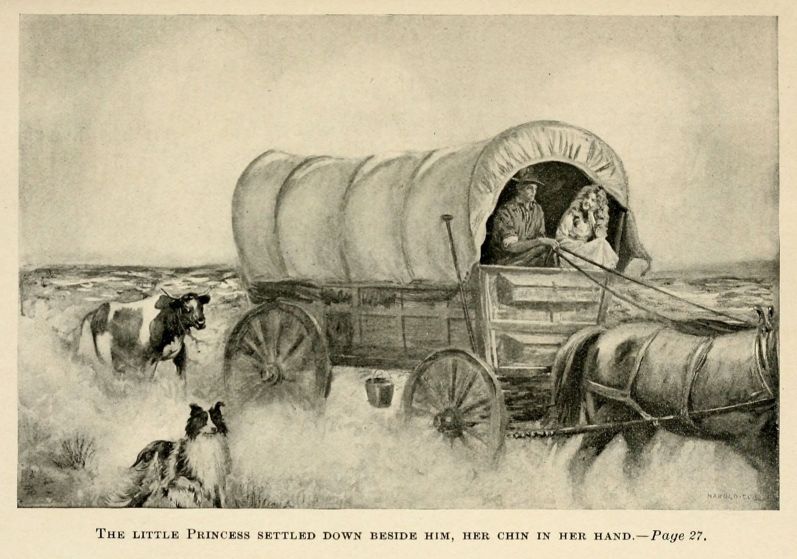
The little Princess settled down beside him, her chin in her hand.
That the reader may know as much about the Peniman family and their great adventure of crossing the plains as did the little Princess, we will leave the wagons lumbering slowly along over the baking plains and return to the Muskingum Valley in Ohio from whence they made their start.
CHAPTER IV
LEAVING THE OLD HOME
It was on the morning of May 15, 1856, that Joe Peniman awoke as the first grey streaks of morning were coming in the sky. In the yard beneath his window he could hear the sound of voices, footsteps going to and fro. Inside there was the sound of bumping and thumping of furniture, of much talking, the hurried noises of preparation for some great event.
He started up and glanced at the window. Day was coming! The Day! The day he had been dreaming of and hoping for and longing for for months!
He leaped out of bed with a shrill yip of joy and pulled the bedclothes off his slumbering brother.
"Hi, Lige," he shouted, "wake up! It's to-morrow—I mean it's to-day—it's The Day at last!"
Lige raised a sleepy face from the pillows, blinked once or twice, rubbed his nose, then sat up with a jerk.
"Jerusalem, is it morning?" he ejaculated. "Why, I never slept a wink all night. Couldn't, I was too excited. Oh, golly, this is to-morrow, isn't it? No, it's to-day now—and we're going to start right after breakfast! Ki-yi, ain't I glad!"
He did an extemporaneous war-dance around the room, then brought up beside the bed where Joe was hastily getting into the new gingham shirt, the dark suit, and strong copper-toed shoes that had been laid out upon it.
Outside in the yard they could hear the sound of talking, of men going to and fro. There was the sound of rumbling wheels, the regular strokes of a hammer, and many directions given in the mild but decisive voice of their father.
It was very early still. In the shadows it was still dark, and over the whole earth there lay that hush, that sense of mystery and silence that comes with the early dawn. The sky above the east pasture showed faint streaks of pink and mauve, and the fragrance of the apple and peach and plum and cherry blossoms in the old orchard came up to them, mingled with the scent of wet grass and clover, the lowing of the cows in the pasture, the crowing of the roosters in the barnyard. It was with something like a pang that Joe recognized the shrill and strident voice of little Dicky, his favorite bantam rooster.
Under the old elm-trees two heavy new wagons were drawn up, and their father, mounted on the dash-board of one of them was fastening in place the white canvas cover, stretching it taut over strong ash bows that were bent from side to side of the wagon.
A thrill passed through the hearts of the boys as they leaned half-dressed out of the window.
The Prairie Schooners!
The romantic craft in which they were to embark that day on the most wonderful adventures of their lives!
They had talked of and dreamed about and anticipated the coming of this day for many months. Now it seemed almost too good to be true that it was really here at last.
It seemed to the boys as they hung out of the window that the yard was full of men, and that they all seemed in a great hurry and bustle of preparation, going to and fro between the barn and the house and the wagons carrying boxes and bundles and bedding and furniture and stowing it away in the wagons beneath the canvas covers.
They recognized their Uncle Jonathan among them, and sent forth a loud and triumphant hail to their Cousin Fred, who was standing about wistfully watching the loading of the wagons. Bill Hale, the "hired man," was there, and Uncle Charles, and Friend Robinson, and neighbor Hines, and many more. A queer sort of a sinking sensation seized the pit of Joe's stomach as he saw Friend Robinson carry out his mother's old rocking-chair and the baby's cradle and put them into the wagon.
Through the trees across the creek he could see the red roof of his grandmother's house, the old Quaker homestead where his mother was born and had grown to womanhood, and nearer the woods and stream and lanes where his brothers and sisters and himself had played all their lives.
In the tree outside the window he caught a glimpse of the robin that had nested in that same crotch of a branch for five summers. She was sitting now. The young birds would be out in a few days. Joe turned his eyes hastily away from the bright glance of the little mother as she peered up at him.
"Come, boys—come, Joseph, will thee stand staring out of that window all day?" a voice cried behind him, and he withdrew his head quickly and turned around to see his mother standing in the doorway. She was all dressed and ready for the journey, in a dark grey worsted dress with a white collar, her brown hair neat and shining, her face a little pale, and her sweet blue eyes reddened by recent tears.
"Come, come, boys, thee must hurry," she cried. "Thy father has been afoot for an hour or more, and breakfast is nearly ready. Elijah, did thee put on the new stockings I laid out for thee? Tie thy necktie neatly, Joseph. And hurry, now, the day that thee has been looking forward to so long has come at last, and thee must begin right now to be brave young pioneers."
Her voice quivered a little but she smiled at them bravely, then hurried away.
Out under the elm-trees the boys found preparations for the journey rapidly approaching completion. The great white canvas covers of the wagons were now in place, making a domed shelter for the interior of the wagons, and most of the household goods that the family were going to take with them to their far western home had already been stowed away inside.
As Joe stood watching these preparations something of the finality of the change was borne in upon him. Up to this moment he had thought of nothing but the wonderful journey across the plains, the romance, the adventure, the strange, novel, and interesting things he would see and do along the way. Now it suddenly came over him that he was leaving his childhood home forever.
He thought of the boys, the playmates of his whole life, whom he was leaving behind; of the swimming-hole down under the willows; the nest of young kittens under the barn; the sunfish and croppies in the stream. He thought of his playmates at old-fashioned "round ball," and wondered, with just the suggestion of a pang, who would play in his place this summer.
Just below the house the creek murmured musically over its pebbly bottom, and near it was the old willow-tree in which he could see the platform of their playhouse—all that was left of it—most of it having been torn down and the lumber used for crating furniture and covering boxes.
His thoughts were beginning to grow a bit sombre when a call to breakfast interrupted them. He hurried into the big sunny kitchen, in which he had eaten his breakfast every morning of his life.
It did not look natural this morning. An extemporaneous table had been arranged of planks set on sawhorses, and upon it was spread the breakfast, with odds and ends of dishes and crockery that were to be left behind. About this board the family was gathered, while the kitchen was filled with relatives, neighbors, and friends.
Mrs. Peniman's mother, Mrs. Jennings, sat at the head of the table, with little David in her lap, and her noble placid face looked withered, wan and pale, as if she had not slept for many nights. Mrs. Peniman sat beside her with baby Abigail on her knee, and Joe noticed with a queer constriction in his breast that her face was very pale and her white lips pressed together as if to keep them from trembling. Aunt Sue stood behind her, her handkerchief pressed to her eyes, and Aunt Jenny, his mother's youngest sister, sat on the floor at her feet, her face hidden in baby Abigail's dress, crying as if her heart would break.
Back of them against the wall Uncle Charles and Uncle Henry were biting their lips and surreptitiously blowing their noses, and Uncle Jonathan and Uncle Benjamin, while pretending to be very busy passing around trays of coffee, occasionally found time in a corner to mop their eyes with their handkerchiefs. Old friends and neighbors whom he had known all his life stood about the room looking grave and sober, while there were tears in all the women's eyes.
Joe and Elijah stood in the doorway, loath to go in, but their father beckoned them to him. He was a tall, thin man, with a broad brow upon which waved thick dark hair just tinged with grey. His eyes were dark, with a keen yet very gentle expression, and the almost womanish beauty of his mouth and the square masculinity of his chin were lost in a heavy dark-brown beard which grew high on his cheeks and was trimmed square below the points of his collar.
The boys noticed as they came to him that his eyes were red, and the hand that he laid on Joe's shoulder trembled slightly.
When the breakfast was over and the last preparations being made on the wagons Friend Robinson turned to Mr. Peniman with a heavy sigh. "I tell thee it is a pretty serious business, friend Joshua, to break up a home like this and go away into the wilderness with a family like thine. I don't blame Hannah for feeling sad about it."
"Blame her?" cried Joshua Peniman. "Who could blame her? She is the bravest woman in the world. Many women would be prostrated at leaving the home in which they were born and had lived all their lives, their mother, sisters, brothers and all the friends of a lifetime to go away into a wild and unknown country to encounter the dangers and hardships of the life of a pioneer. But she has been our inspiration, she has given courage to us all." After a moment he cleared his throat and went on huskily, "I don't know that any of us particularly enjoy the prospect before us."
"Why does thee persist in going then, Joshua?" broke in his brother Henry. "There is time even yet to reconsider thy decision. It is a great undertaking, a great responsibility thou art laying on thyself. Think of Hannah—think of the children—think of the dangers and the hardships and privations that thee and thine will have to undergo in that desert country——"
"I have thought of nothing else for months, Henry," replied Joshua Peniman solemnly. "I cannot tell thee the struggle I have been through. I fully realize what this breaking up of her lifelong home must mean to Hannah. I know what it will mean to the children—and," with a sudden twitching of his gentle face, "what it will mean to myself. But I feel that it must be done. It is a duty we owe our little family. It is a duty I owe to my religion and my God. Thee knows the condition of the country, Henry. Thee knows that war is inevitable between the North and South. It will be a terrible war, a war of brother against brother, father against son, neighbor against neighbor; one kindred pitted against another. Thee knows our faith, our principles. Could I stay here with my five sons and have them brought up to human slaughter? Could I stay here and have them sent forth to shoot down their fellow-men?"
"But that is all nonsense, Joshua, thy boys are but children yet."
"Joe is almost sixteen. In five years he will be twenty-one. Tell me, brothers, at the rate things are going in this country now how will things stand between the North and South in five years?"
"Well," put in Bill Hale, "there ain't no signs of war yit; the trouble between the North and South hain't got no further than shootin' off their mouths, an' so long's they confine themselves to that kind of warfare I reckon you an' th' boys would be middlin' safe here."
"It isn't a question of safety," retorted Joshua Peniman with as near to a flash of anger in his eyes as Joe had ever seen. "It is a question of principle. Suppose this country does get into war and there should be a draft. My boys are Quakers. How could they go? And how could they avoid going if they were drafted? Even should there be no real fighting for years to come still those boys would be brought up in an atmosphere of rancor, hostility, and controversy. Hannah and I do not want our children to grow up with hatred in their hearts. We want them to grow up in love and brotherly kindness to all men."
"But thee could keep the children out of it all, Joshua," put in Uncle Charles. "Here on the farm they would not come in touch with the political controversy to any great extent, and both thee and thy boys could keep thyselves entirely aloof from the trouble."
Joshua Peniman shook his head. "No, brother Charles, thee knows that that would not be possible. Thy affectionate heart is speaking now, not thy reason. Thee knows how I stand on this matter of slavery. Thee knows that already I have embroiled myself, have made many and bitter enemies for myself by my connection with the underground railway. I have run off runaway slaves, and I will run them off again every chance I get; for I believe it to be a wicked and iniquitous business. No man has a right to own and control another human being. I am a man of peace, who loves my fellow-man, and yet"—he paused and turned his eyes upon Joe, who crimsoned under the scrutiny,—"no longer ago than yesterday I found my oldest son, an offshoot of good old Quaker stock, drilling a company of boys in the manoeuvres of war."
"I didn't mean any harm, Father," burst forth Joe, "thee knows that I would not hurt any one! It is only that it is fun to drill. I love to march and counter-march my men about."
His father nodded. "I know, my son. And therein lies the danger. Thou art breathing in the spirit of warfare with the very air. I do not blame thee, lad; how could it be otherwise? The minds of men are full of it. The papers are full of it, and people talk of little else. I tell thee, friends, war is inevitable, and I will not have my young lads filled with the spirit of it. Hannah thinks as I do, and long before the red carnival of blood-lust is let loose in the land we will be far away, out on the clean, wholesome prairies, where our boys and girls can grow up to noble man and womanhood untouched and untainted by the unholy slaughter."
"But thee should think of the material prosperity of thy children as well as their spiritual good, brother Joshua," argued Charles. "Thee knows that out there in that untrodden wilderness they will have little or no opportunity for education——"
"We are thinking of their material prosperity. What chance in life would our nine children have here? I would be a poor man all my life, and could do nothing to establish a future for them. With a big family like ours we need room, more opportunity for development, and that we will find in the new country. If we go west now, while the children and the country are both young they will have great opportunities. I will take up a homestead and make them a good home, and as the boys grow old enough they can take up timber-claims and homesteads so that by the time they reach manhood they will each have a valuable property, a good start in life, and a chance to make of themselves whatever they see fit."
"Yes, but their education——" urged Charles, whose heart was sore at the thought of seeing his brother and his young family set forth for that strange, far land, and hoped even now at the last moment to turn him from the purpose.
"That does not trouble us, Charles. Thee knows that I was once a teacher in a college, and that Hannah has also had a good education. There is nothing to prevent us from conducting a little school of our own for our children until such time as there will be good schools in that growing country for them to attend."
"But what good'll schoolin' do 'em if they was all to get skulped by them bloody Injuns out there?" put in Bill Hale. "My wife's sister-in-law's cousin went out west onct, an' he never come back. The Injuns got him. Like's not they made soup of him. But I'm bound to say that if he was anything like the rest of that family he'd 'a' made dern poor soup, even fer a cannibal."
Joshua Peniman did not join in the general laugh that followed Bill's remark. He glanced uneasily at his watch, then at the house.
"Call thy mother, Joe," he said; "it is growing late, the sun is up, and we should be on our way. Ah, here they come now!"
As he spoke Mrs. Peniman came down the steps, the baby in her arms, leading little David by the hand. Her sister Jenny followed with Mary, and Ruth and Sara walked on either side of their grandmother, their hands in hers, while Sam and Paul, with red noses and watery eyes, followed.
The powerful bay team, Jim and Charley, hitched to the big wagon, were prancing and fidgeting, and the sorrel team, Kit and Billy, hitched to the lighter wagon, which it had been decided that Joe should drive, were harnessed and ready, when Bill Hale came racing from the house waving a bundle in his hand.
"What's the matter?" cried Joe, checking them up. "We must have left something behind!"
"Couldn't have forgotten the baby, could we?" queried Sam.
By this time Bill Hale had reached them, carrying a large bundle tied up in a napkin in one hand, and in the other swinging a pair of squawking chickens by the legs.
"Ye 'most missed it, I tell ye," he grinned. "Ol' Mis' Perkins brought ye over some things t' take on your journey, an' she never got here until jist now. I've et Ma Perkins' pies an' things an' I couldn't abear fer ye to miss 'em."
He handed the package tied up in the napkin to Mr. Peniman.
"Mis' Perkins 'lowed she wanted to send some chicken along fer yer lunch," he went on, looking down at the squawking fowls in his hand, "but hearin' that the Friends had cooked up s' much fer ye she figgered she hadn't better cook hern, but send 'em along on th' hoof like, so's ye could have 'em any time ye liked."
The children all laughed, and even Mr. Peniman smiled.
"That was very kind of Friend Perkins," he said. "Thank her for us, won't you, Bill? But I declare I don't see how we are going to take those live chickens! We've got about all the live stock we can handle now."
"Oh, we must take them, Joshua," said Mrs. Peniman. "It would never do to send them back when she was so kind. We can manage to take care of them somehow."
"I've got a box in my wagon that hasn't much in it, Father," said Joe; "we could turn the things out and put them in that."
"You can kill and eat them any time they get to be a bother, you know," said Uncle Charles, who stood by.
Ruth, who loved every living creature, and who would have fed and mothered any number of pets, protested loudly.
"Oh, we will not kill them, Uncle Charles!" she cried. "Look at them, Father, aren't they perfect darlings? Let's take them along for pets, Father, I'll take care of them!"
By this time Joe and Lige had cleared the box of its contents, and with Bill Hale's help soon had the struggling fowls shut up in it, with slats nailed up in front to keep them in.
"Oh, aren't they lovely chickies?" cooed Ruth, who had jumped out of the wagon to watch the operation. "We'll call this one Dicky, and this one Mother Feathertop, to always remind us of our old Mother Feathertop at home."
"All right; ready there?" called Mr. Peniman.
Cherry, the red cow, that was tied behind the big wagon, looked back and gave a mournful bellow, as if she knew that she was leaving her old home forever; Spotty, the collie dog, leaped forward with a bark, and the children scrambled to their places in the wagons.
Joe never liked to remember the few moments that followed, as relatives, friends, neighbors, chums, and playmates of a lifetime crowded close about the wagons to bid them good-bye. There were sobs and tears, close embraces, choked words of love and farewell; hands were shaken, tears shed, husky good-byes spoken. But it was soon over.
The boys sprang to their places, the reins were gathered up, the word of command spoken, and the prairie schooners drove slowly out of the farmyard, en route for the Golden West.
CHAPTER V
WESTWARD HO!
The road over which the Peniman family set forth led through southern and eastern Ohio, where the roads were good, shade and water abundant, and where pretty towns and villages lined the way, so that their larder was always plentifully supplied with fresh meat, fruits, and vegetables.
The wagons in which they were to make their long overland journey to the new territory of Nebraska had been carefully prepared for the comfort of the travelers, and the first part of the trip was like nothing so much as a prolonged family picnic. Their night camp was made in beautiful woods beside murmuring streams, and if bad weather came a town or village was always within easy reach, where the wagons could be put in a stable and the family repair to a hotel until the storm was over.
On their seventh day out they reached Columbus, and during the week that followed traveled across the western part of Ohio and crossed into Indiana, where they made a stop of a few days with old Quaker friends.
Their progress was necessarily slow, averaging not more than fifteen to twenty miles a day. On June seventh they arrived in Indianapolis, then but a small and inconsequential town, where they made a stop of a few hours to lay in a fresh suppy of meat, fresh fruits, bread, butter, and vegetables, then struck into the main road leading north and west to Crawfordsville, where they stopped long enough to buy a doll for little Mary, a tin trumpet for David, and ice-cream for the rest of the family.
This part of the journey, while pleasant and interesting, was uneventful, and though the boys enjoyed it, much as they would have enjoyed a prolonged picnic, they were looking eagerly forward to the adventures which lay in the wild and untrodden land beyond the Missouri River.
On June fourteenth they arrived at the beautiful Wabash River, and made their camp upon its banks for the night, where the whole family had a refreshing bath in its sparkling waters.
Up to this time the weather had been fine, the roads excellent, and the traveling pleasant. But the day they began their journey across the State of Illinois the weather changed and a heavy rain set in which materially interfered with both their comfort and their progress.
At first the children found it rather fun sitting snug and dry under their canvas roof while the rain pattered down upon it. But when day followed day and the rain continued to fall, when they had to make camp at night in wet groves with a fire that would not burn and clothes and shoes that were never dry, it was not quite so pleasant.
Betrayed into neglecting his canvas covers by the long dry spell Mr. Peniman now found that they had shrunken from the sun and were beginning to leak, and the family woke morning after morning to find the rain spraying down into their faces, and to crawl out of damp beds to find the ground a mush of wet grass and mud, and no dry wood obtainable with which to start their fire.
There was no running before or behind the wagons these days, no playing in the fields, picking wild-flowers or frolicking on the road as the white-topped wagons crawled along; all day long while the horses plodded monotonously along through puddles of water or mud that went over their fetlocks and ruts that let the wagons down almost to the hubs of the wheels, they sat tired, bored, and hoping for fair weather and sunshine.
On the fourth day of the rain, when the wagons had become so damp that they were decidedly uncomfortable, they came to a house toward evening, and Mr. Peniman alighted to ask if the people who lived in it would give them shelter for the night. They found both husband and wife down with the ague, and little cheer or comfort in the neglected house, but were glad to accept the shelter of its roof and the chance to dry their clothes by the fire. When they were starting on in the morning Mr. Peniman tried to buy some hay and grain from the owner of the place, whose name was Grigsby, but he refused to sell.
"Nope," he said, drooping listlessly against the door-post with a shawl over his shoulders, "I cain't sell you no grain nor hay. Had th' shakes so bad this spring I hain't got to do much farmin', and I hain't got hardly enough to feed my stock." Then, as a shrill squeal pierced the air his eyes brightened and an idea seemed to strike him. "But I tell you what I will do," he drawled, "I'll sell you two of the nicest little suckin' pigs you ever see. Their mother up an' died of the cholery a few nights ago, and they ain't old enough to eat yit. Me an' the old woman, havin' th' shakes so, cain't bother to feed 'em, so I'll let you have the pair of 'em for two dollars. Goin' off in th' wilderness like you be they might come in handy."
He shuffled off to the barn, and soon returned carrying a basket in which were two tiny pigs only a few days old. With a grin he drew from his pocket a nursing-bottle filled with warm milk and held it to the little white pig's mouth. It took hold like an old hand at the business, and the children shouted with glee while the little spotted brother squealed shrilly with envy.
When the nursing-bottle had been refilled Ruth demanded the privilege of feeding the protesting young porker, and sitting down in the straw took the little pig in her lap and fed it so dexterously that her brothers yelled with delight.
Of course that settled it.
With one accord the children demanded the possession of the two little pigs, and with a long-headed thought for the possible needs of the future Mr. Peniman agreed, and the listless Grigsby filled a box with straw and packed the little fellows cosily into it.
"What shall we name them, Father?" cried Ruth, hanging lovingly over them. "They are such darlings they ought to have real lovely names."
"Call them Romeo and Juliet," said Mr. Peniman, with a twinkle in his eyes.
In talking with the Grigsbys Mr. Peniman had learned that they had chosen a bad road, and were traveling through a poor and swampy part of Illinois, where the roads were all bad and chills and fever prevalent, and by their advice had left the road over which they came and striking north and west came out upon a much better road, that in the course of a few days' traveling brought them to the Sangamon River, and a few days later to Decatur. Here they remained a few days to dry out their clothes and wagons and renew their supply of provisions, being regaled at supper that night with sweet corn and watermelons.
It was now July first, and very hot weather. The travelers were burned and tanned as brown as Indians, and were beginning to feel like real pioneers. They drove into Springfield, the capital of the State, on the evening of the third of July, and Joshua Peniman suggested to his wife that the wagons be put up in a livery stable and the whole family go to a hotel, where they could all have a good tub bath, a night's rest in a real bed, and a few meals at a real table.
"We are going far away into the wilderness," he said, "and it may be years before our children will have a chance to see a Fourth of July celebration again. I believe that all young Americans should love and honor that day. I think we had better stay over to-morrow in Springfield, let the little ones have a good time, and take the boys to see the celebration we see advertised, while thee has a good rest at a hotel."
When told of this plan the young Penimans were delighted. The novelty of traveling in the wagons had begun to pall a trifle, and the thought of a day in a city, a night at a hotel, and the exciting events promised by the great posters that lined the roads, gave them great pleasure.
It turned out to be a great day for them. They started out immediately after breakfast, and firecrackers, torpedoes, flags, and rockets were purchased at the first store they came to, and in the intervals of other excitement the boys revelled in pops and bangs and explosions, while the girls exploded their torpedoes on the sidewalks, and they all marched gaily to the music of many bands.
There was a great parade in the forenoon, in which the Whigs and Democrats vied with each other in the exhibition of floats, bands, and flower-decked carriages. Long columns of men of both parties marched and shouted, bearing transparencies extolling the virtues of their particular candidates. The Buchanan men wore white coats and caps, and carried huge portraits of their candidate.
There was to be a great political rally at the park in the afternoon, and after dinner the boys and their father followed the crowd to the pretty shaded inclosure, where a great pavilion had been erected, gorgeously decorated with flags and bunting.
The place was already crowded when they arrived, but they pushed their way through the throng and succeeded in getting seats on a long bench before the speakers' stand.
It seemed a little thing that they should be so placed that Joe should be able to look directly into the speaker's face and hear his every word, but upon such trifling things the whole course of a life sometimes depends.
Bands played, a great chorus upon the platform stood up and sang "America," and then a stir and flutter passed through the crowd as a party of gentlemen in frock coats with tall "chimney-pot" hats, made their way to the platform, where they were greeted with great bursts of applause.
The Peniman boys had never heard a public speech in their lives. Partly owing to the fact that their father was a Quaker and avoided discussion of the question that was beginning to seethe and burn through the length and breadth of the land, partly because of the remote and quiet farm from which they had come, they had heard little of the agitation of the times.
Politics were at a white heat throughout the country. The pro-slavery and anti-slavery parties were each using every artifice in their power to elect their candidates. Arguments, discussions, public speeches and inflammatory meetings were taking place in every part of the United States, and the fire that later burst into so fierce a conflagration was beginning to smoulder hotly beneath the surface.
There was something in the very air of that meeting that breathed tension, excitement. And Joshua Peniman felt a cold chill smite his heart, as sitting with his young sons he listened to the conversation that went on about him. Joe, too, felt the electric atmosphere. His eyes brightened and his color rose. When a dapper little gentleman with a massive head and a keen, ruddy face mounted the platform and began to speak he leaned forward eagerly.
He liked the speech. The cultured voice, the smooth periods, the forceful gestures of the man fascinated him. Yet he found his mind continually protesting against the statements he made. The boy knew nothing of the Kansas-Nebraska Bill, the Wilmot Proviso, or the Missouri Compromise, but as the speaker proceeded he found himself arguing passionately against him in his own mind. When the speaker sat down, amid terrific applause, Joe turned to his father.
"Who is he, Father?" he asked in a whisper.
"His name is Douglas—Stephen A. Douglas. He is a United States Senator from Illinois," replied Mr. Peniman.
"He's a great speaker," whispered Joe thoughtfully; then half-hesitatingly, as if trying to put into words a thing that was not clear in his own mind, "but somehow—I suppose it's pretty presumptuous of me to say so—but somehow I don't agree with what he says."
Joshua Peniman turned a quick, pleased look upon his son's face.
"Nor do I, Joe. His reasoning is false, spurious. Such a policy as he is advocating could only plunge our country into endless trouble. He is a Democrat, and though he claims that he does not care whether 'the cause of slavery be voted up or voted down' he is doing more, perhaps, than any other one man in the Senate to uphold it and increase its power and territory."
"But, Father——" began Joe, but his whispering voice was lost in a terrific storm of cheers and hoots and yells as a tall, gaunt man in a long-tailed coat of shabby black, mounted the platform.
As he began to speak, in a deep, earnest voice, that had in it now and then a whimsical quality of humor, now and then a deep note of pathos, there was a general craning forward in the crowd, a stillness, a breathless attention, that had not been accorded the previous speaker.
From his first words Joe sat entranced. In every statement that he made the boy found an echo in his own heart. His blood tingled, his color rose, he clenched and unclenched his hands, a great surge of exultation, excitement, a stir that he had never before known passed through all his being.
The crowd about him seemed equally roused and swayed by the words of the speaker. At times as the impassioned sentences rose and swelled through the air they were stopped by the wild cheers that burst from the throats of the thousands of listeners. And when he leaned forward, pointing his long, gaunt finger at them, his deep, sad eyes fixed as if in prophetic vision, a stillness so great passed over the audience that the breathing of the man next him was perfectly audible.
"And I contend," thundered the orator, "that no man is good enough to own and govern another man without that other's consent. Slavery is founded on the selfishness of man's nature; opposition to it is founded on the love of justice. These principles are in eternal antagonism, and when brought into collision so fiercely as slavery extension brings them, shocks and throes and convulsions must ceaselessly follow. These two principles cannot stand together. They are as opposite as God and Mammon; and whoever holds to one must despise the other. 'A house divided against itself cannot stand.' I believe that this government cannot endure permanently half slave and half free. I do not expect the Union to be dissolved—I do not expect the house to fall—but I do expect that it will cease to be divided."
The last words rang out in such an earnest, impressive, almost prophetic tone as to make a cold shiver run through the audience. For a moment the speaker stood silent, his black hair fallen forward over his forehead, his sad grey eyes, deep-set and hollow, gazing out over the assembled people. Then as a great storm of applause broke out and the people made a rush for the platform he bowed and retired.
Joe woke as from a trance when the audience began to file out.
"Who was he, Father?" he asked breathlessly. "Who was that man?"
As he looked up into his father's face he saw that his cheeks were flushed and his usually gentle, kindly eyes were blazing.
"His name is Lincoln, I believe," he answered, rousing himself with an effort from the thoughts the address had set running in his mind. "He is a lawyer, a member of the legislature from Sangamon County, some one told me."
For a long time Joe was silent. Lige spoke to him about something else, but he did not hear him. When he spoke again they were out on the street and on their way back to the hotel.
"Do you believe I could ever be a lawyer, Father?" he asked.
His father smiled, then answered gravely, "I have no doubt you could, Joe, if you set your mind on it."
"And a member of the legislature—like that man?"
Joshua Peniman laughed outright. "Well, I don't know about that, my son. That man appears to me to be a rather unusual sort of a person. But you might become a member of the legislature, perhaps."
"Then that's what I'm going to do when I'm a man," said Joe decisively.
After a long pause he lifted his eyes to his father's face.
"Do you believe in the abolition of slavery, Father?"
"I do indeed, my son," replied Mr. Peniman earnestly. "As Mr. Lincoln said 'No man has a right to own and govern another without that other's consent.'"
"Do you believe in the abolition of slavery enough to fight for it, Father,—if our country should have to go to war?"
"Quakers cannot fight, Joe. We are bound to peace."
"But if war should come," urged the boy, "if we should have to fight—if the South should secede——"
"God forbid!" cried Joshua Peniman, in a voice whose deep, quavering earnestness was a slight indication of the storm that was raging in his heart. "May God forbid such a catastrophe! Let us not talk of it. Let us not think of it. Let us pray the Almighty Ruler of the Universe to avert so frightful a calamity to our nation!"
Joe glanced up quickly and opened his lips to speak, but the expression that he surprised upon his father's face caused him to close them promptly, avert his eyes, and walk silently beside him.
In the evening there was a great torchlight procession, followed by more speaking at the Opera House. But this function the Peniman family did not attend. Mr. Peniman, stirred, anxious, feeling a prescience of the storm that was brewing in the country, was eager to get away; to get his young lads out of the spirit of rancor and bitterness that was abroad in the land, and out onto the clean, quiet prairies where the inhumanity of man to man would not throw its baleful shadow over them.
In the morning long before the celebrators of the night before had opened their eyes the two prairie schooners were on their way, and the young pioneers, with faces turned westward, were starting upon the most exciting part of their journey.
CHAPTER VI
IN WHICH THE PIONEERS HEAR ALARMING NEWS
Their Fourth of July spent in Springfield was a day long to be remembered by the Peniman family. The children talked of it many days as the canvas-covered wagons rumbled slowly along the dusty, rutted Illinois roads, and years later, when the events then being so darkly foreshadowed on the horizon had come to be matters of fact, it helped to shape the destiny of Joshua Peniman's sons.
Joe had something new to think about now as he sat in the wagon holding the reins in his hands while the horses plodded on through the long, hot, silent days, and his mind was often busy with the future that lay before him, while plans, dreams, ambitions began to unfold themselves in his mind.
They passed through Beardstown and camped on the Illinois River, then struck off again to the west, and twelve days later sighted the Mississippi River.
It was Lige who first caught sight of the great brown swiftly-flowing waters.
"Look," he cried, breaking into Joe's day-dream by poking him in the ribs, "look what a big river we're coming to! Wonder what river it is?"
"Mighty big one—and a mighty dirty one, too," commented Sam, hanging away out of the wagon to get a better look at it. "Look at the whopping big bridge across it!" he whooped, pointing at the great bridge that spanned the muddy waters. "Hey, Father, what river is that? It's a mighty big one!"
Mr. Peniman turned and looked back with a smile.
"What river is that? That's a great question for a boy your age to ask! Don't you know where we are? What have you studied geography for if you don't know what river that is?"
"Oh, I know!" shouted Ruth, "I know, Father! It's the Mississippi! This is Illinois, that State over there is Iowa, and that is the Mississippi that flows between!"
"Ah, good girl!" applauded her father. "Of course! The Mississippi—the great Father of Waters. And the boundary line "—he continued thoughtfully, speaking more to himself than the children,—"between the old East and the new West."
"The Mississippi at last—hurray!" shouted Joe.
"Huh, I knew it all the time," grunted Sam. "Ruth needn't think she's so smart. Golly, when I got kept in last winter 'cause I couldn't tell what States were bounded by the Mississippi I didn't think I'd be crossing it so soon!"
They spent the night at Rock Island, then the terminus of the Chicago and Rock Island Railroad, and the next day crossed the Mississippi at Davenport, on the first bridge built across the river, which had been completed but a few weeks before. They stayed there that night, then started on, and two days later drove into Iowa City, then the capital of the State.
As the two wagons progressed slowly through the bare, wide clayey streets, which were flanked on either side by one-story unpainted buildings, as if dumped unceremoniously into their present location with no view to permanency, they observed groups of men gathered together talking excitedly. Presently a troop of cavalry dashed through the streets, followed by a company of infantry.
"Soldiers!" ejaculated Lige. "Wonder what soldiers are doing out here?"
As they drew up before the bare, unpainted general store Mr. Peniman turned to the boys and told them to stay in the wagons.
This was most unusual, as the boys were always glad to get out at these stops, stretch their legs, buy candy and gum, and exchange greetings with the boys and dogs they generally found congregated about the door.
"Aw, why not, Father?" protested Sam. But his protestations were cut short by his father's uplifted hand and the expression on his face.
"Because I wish you to," he said with unusual curtness, and disappeared within the store.
"Don't see why he wouldn't let us get out," grumbled Sam, "I wanted to buy some candy."
It seemed a long time before their father returned to the wagons, and when he did Joe noticed that he looked pale and grim and that his lips were compressed into a close, white line.
He went from store to store swiftly, with absorbed attention, and greatly astonished the occupants of the wagons by coming back with a new Enfield rifle in his hand, followed by a man carrying a keg of powder and a big box of cartridges.
"Who's the new gun for, Father—me?" cried Joe with delight.
"Yes, you can shoot well enough now to be trusted with a gun. Lige can use the old rifle. I bought one of those new Colt's revolvers for you, Mother."
"For me, Joshua?" Hannah Peniman opened her blue eyes very wide. "Why, dear man, thee knows that I could never use a gun. I am deathly afraid of them."
"We are going away into the wilderness, Hannah," he said very gravely, "thee must learn." And the words were spoken in a tone and with an expression that made her start and look at him closely.
When they were once more upon their way she turned to him and asked in a low voice, "What is it, Joshua?"
They had never had any reservations from one another, and though he wished now with all his heart that he might spare her he knew that he stood in need of her courage, her help, her calm, cool judgment.
"There has been a massacre of whites by the Indians not far from here," he told her. "The white settlers along the Little Sioux have been obliged to flee, and many of them have been murdered. I cannot tell thee the horrible details. They are sending out State troops. It was all brought about by the treachery of a white man, they tell me, but——" He broke off abruptly and sat gazing into her horrified face.
"They say," he continued, "that most of the Indians around here are friendly, but a white trader deceived and murdered the brother of Chief Inkpaducah, and he has roused his whole tribe to vengeance."
"And they have killed the settlers—and women—and children?" she gasped, every vestige of color leaving her face.
"They killed the children. They have carried the women away into captivity."
"Oh, God, have mercy on us!"
"In God's care and mercy alone can we trust, Hannah," he answered. "We will never give these red brothers cause for anger against us, and perhaps we may escape harm at their hands. But I must confess it has given me a great shock. I wish——"
"The children—the children——" she whispered in anguish. "Oh, Joshua, I wish we had never come to this terrible country. I wish we had stayed at home——"
"I have been wishing the same thing. But it is too late now. We have come too far on our way. Thee—thee would not advise that we turn back now, would thee, Hannah? When we are so near the goal?"
For a moment she sat silent, her sweet blue eyes, wide and filled with horror, fixed upon the western horizon, her arms clasped tightly about the baby, which she pressed almost fiercely to her breast. After a time she turned to her husband and laid her hand on his arm, saying bravely:
"No, Joshua. My heart is filled with fears, but thee has sacrificed too much to turn back now. We can only go on, and pray that Almighty God will protect us."
"My brave, noble wife," he whispered, and kissed her.
That night when they made their camp the two wagons were drawn close together and the cow and horses instead of being picketed out were placed beside them. No camp-fire was built that night, and the supper was prepared over as small a fire as possible, a piece of sacking placed over the top of the stove-pipe to absorb and keep down the smoke. Before they retired their father gave each of the three older boys a gun and ammunition.
"We have reached the real West now, lads," he told them, "and must be prepared for some of the adventures you have been looking forward to for so long. I have no idea that you will have occasion to use those guns to-night, but like good pioneers you must keep them ready and in order for whatever might happen."
A thrill passed through the hearts of Joe and Lige as they listened to his words. Not even then did they appreciate the menace they portended.
That night Joshua Peniman did not sleep in the wagon as he had been accustomed to do, but with Spotty beside him and a loaded musket at hand lay down beside the wagons wrapped in his blanket.
There was little sleep for the elders of the party. The children, who had been allowed to hear nothing of the horrors of the massacre, slept tranquilly, but Joshua Peniman patrolled his camp all night, while his wife lay among her little ones in the wagon with her heart like an ice-cold stone within her breast.
They were now traveling through an almost uninhabited part of western Iowa, where settlers were far apart and shade and water grew scarcer and farther apart every day.
The weather had grown intensely hot, and the poor animals, forced to travel all day through the heat of the sun without sufficient water, suffered greatly.
The cow especially seemed to feel the strain, and after one intensely hot day, during which the pioneers had all suffered, she gave but a small portion of milk, and lay down when they made camp refusing to graze.
That night the baby was taken ill. Both father and mother did all that they knew for her, but she grew steadily worse, and two days later, while they were traveling over a barren, desolate expanse of country with no living creature in sight but themselves, she passed away.
They stopped and made a little grave in the desolate prairies, over which they placed a tiny cross marked with her name and age. Then the bereaved parents went on their way, with what agony of spirit only those who have lost a precious little one may know.
CHAPTER VII
A NIGHT OF HORROR
"And so," Joe concluded his long story, during which the afternoon had waned and the long shadows over the prairies told of the coming night, "we left little Abby behind us and started on again. Father and Mother were terribly sad. Sometimes I was afraid that Mother could not live through it. They seemed awfully nervous and afraid all the time, too. Father never went to bed at night, but sat or lay beside the wagons with Spotty beside him and his gun in his hand, and Mother would not let any of us get away from the wagons.
"It was fearful hot all that time—hotter even than it is to-day—and we had to travel slow on account of the cow. We just plugged along, and then toward night we hauled up beside the road and camped. Nobody had any heart to eat, so it didn't matter. Once in a while we came to a little town, or some houses, but we seldom stopped. Father seemed in a hurry to get where we were going, and Mother didn't seem to care about anything. Two or three times we had a scare about Indians, but they never came very near to us. Then one day when it had been so hot and dusty that we were all almost suffocated we saw a kind of a draw ahead and made for it, thinking we would camp there that night. It wasn't much of a place to camp, but we didn't see any sign of water anywhere, and Mother was just about beat out.
"Golly, I bet I'll never forget that evening! We were all feeling mighty miserable. I happened to look off toward the wagon road, and I saw a big cloud of dust. First I thought it was just a whirlwind, and then we were afraid it was Indians. But after a while we made out that it was an emigrant wagon, being driven by a woman. That surprised us a lot. She was driving like the old Harry, and Father ran out toward the road to meet her when we heard her yelling for help. When the wagon came nearer we saw——"
"Stop, stop, oh don't!" cried the little Princess, covering her eyes with her hands while shudders shook her frame. "Don't," she cried again, "I can't bear it—I can't bear it! I know—I know the rest!"
"Yes," Joe took her hand very gently, "you know the rest. It was your wagon—and—and—it brought us—you."
For a little while all the children were silent. Ruth crept up and put her arm about the little stranger's waist.
"I guess God sent you to us to be a little sister to us in baby's place," she said chokily.
Nina turned and put her arm about her neck.
"Perhaps He did. I never had any sisters or brothers. I'd like to be your sister. I like you."
"I'm glad," said honest Ruth, and kissed her.
"So'm I," cried Lige; but Joe said nothing.
That night when camp was struck the three wagons were drawn into a circle with the horses and cow inside.
Joshua Peniman did not remove his clothing, but having seen his family comfortably disposed, with the strange child in the wagon with his wife and the younger children, he stretched himself out beside the wagons, with Spotty near him and his musket by his side. Joe refused to go to his place in his own wagon, but lay down beside his father.
The prairies looked vast and still under the glimmering starlight with no sound but the sough of the wind through the grass and the occasional howling of a coyote. For a long time he lay awake, some vague, haunting uneasiness upon him. Twice he sprang up, his musket leveled, every nerve and muscle strained to attention.
They had agreed that Mr. Peniman was to take the first watch of the night and Joe the second. At two o'clock Joe woke, and seeing his father patrolling up and down beside the wagons insisted that he should go to bed. This the weary man refused to do, but wrapping himself in his blankets lay down upon the ground.
Joe sat beside him, his gun leaning against his knees, and looked up at the silent stars, feeling them companions in his loneliness.
It was between two and three o'clock, and he was beginning to doze, when a low, ominous growl from Spotty caused him to start wide awake, his gun clenched in his hand.
Spotty was standing, stiff-legged, the hair on his neck raised, his lips drawn back showing his teeth, growling deeply and staring into the shadows back of the wagons.
Joe did not move, but remained motionless listening.
Presently he heard a soft rustling in the grass.
A moment later by the light of the stars he made out a dim silhouette creeping toward the wagons.
"Stop," he cried, "or I'll shoot!"
Instantly Joshua Peniman was on his feet.
"What is it?" he whispered huskily.
"Man—Indian—over there by the wagons!"
The whispered words had scarcely left his lips when an arrow whizzed by his ear.
Instantly Joshua Peniman's gun, leveled at the point from which the arrow came, barked through the darkness. The shot was answered by a wild, shrill whoop, and suddenly the night seemed to be filled with flitting figures.
Joe's gun was at his shoulder, and as one huge naked savage leaped at his father he fired. The Indian fell with a groan, but almost before he had touched the ground another had taken his place, rushing toward the white man with uplifted tomahawk and blood-curdling yell. He was almost upon him when a sharp "crack" spoke from the back of one of the wagons, and the Indian dropped and lay motionless, while Lige, half-dressed, leaped out and ran to his father's side.
Sam on the seat of Joe's wagon held the rifle firmly at his shoulder. His freckled face was very pale, but the blue eyes were shining in a way that boded ill to the Indian who should come within range of the old rifle.
In the opening of the big wagon, between its curtains stood Hannah Peniman, her revolver in her hand. Her face was white and set, but the hand that held the weapon did not tremble.
The night was now hideous with yells. With the blood-curdling war-whoop that had carried terror to the hearts of so many early settlers on the plains the Indians were now circling about the camp, watching their opportunity to break through.
Suddenly from somewhere in the distance rose another cry. The heart of Joshua Peniman almost died in his breast.
"Another band!" he muttered, as he crowded down the charge in the old musket. Their case had seemed hopeless before, but they had firearms while the savages seemed to be armed only with bows and arrows, and might have had a chance. But if another band of savages joined those already upon them——
"Ki-ki-ee-ee-ee!" rang the cry through the night.
The Indians who were creeping up toward the wagons suddenly paused and stood still. Some sudden instinct made Joe raise his musket and fire into the air. Then at the top of his lungs shout, "Ki-ki-ee-ee-ee!"
He had no idea from whom the cry had come, whether from white man or Indian, friend or foe; but some sure instinct told him that whoever they might be their presence was unwelcome to the marauders.
While the sound of his shot and cry were still reverberating in the air there came a swift rush from the darkness outside the circle of wagons, and in the starlight they could make out the naked outlines of a band of Indians who made a rush for the wagons.
In the terror and excitement of the moment they did not notice that one of the band separated himself from the rest, and slipping into the shadows made his way noiselessly as a serpent to the rear of the Carroll wagon, where he climbed under the curtain and was lost to view.
Joshua Peniman uttering a warning shout sprang to the front of the wagon in which were his wife and younger children, with the child of the deceased Carrolls. Hannah Peniman was guarding the rear of the wagon, her revolver cocked and ready in her hand, while Joe and Lige at the front and back of the other wagon were making good use of their firearms, and Sam, standing up in the front was banging away with the rifle as fast as he could load and fire.