Front matter (continued 2)
Reading edition
As the Indians rushed toward them it looked for a moment to the travelers as if all hope was lost. At the moment when the savages burst through their guard the shrill "Ki-ki-ee-ee-ee!" again smote upon their ears, and an instant later the sound of wild yelps and thundering hoofs was all about them, and another band of Indians, mounted and in full war panoply, burst into the encampment.
The travelers thought their last hour had come.
"To the wagons, to the wagons!" shouted Joshua Peniman. "Inside, Sam! Lige, help thy mother guard the rear! To me, to me, Joe! We must try to keep them away from this wagon at least! Now, is thee ready? Fire!"
As his words rang out above the tumult a tawny chief with eagle feathers in his hair, who was riding by, checked his horse so abruptly that he threw it back upon its haunches. He cast a swift, searching look at the man and boys who stood so resolutely before their wagons, and suddenly threw up his hand. Riding toward them he waved a piece of white cloth above his head, then halted his horse before them.
"Is thee a Quaker?" he surprised them by asking in fairly good English.
"Yes, I am," replied Joshua Peniman, looking not at all like a Quaker with his wild, disordered hair, his set white face and his gun at his shoulder. In the excitement of the moment he had no time to think of the strangeness, the incongruity of the question. All he could think of was that for some unknown reason the other Indians seemed to have drawn off, and for a moment at least there appeared to be a pause in the savage onslaught.
The Indian who had spoken to him whirled his pony about and shouted a few words in a language they could not understand. Instantly there came a wild yelp in answer, and a moment later there was the clamor of a battle cry, the wild thundering of hoofs, the crash of blows, the uproar of battle. Before the horrified pioneers knew what was happening the sound of battle began to recede from them, had grown faint and fainter, had died away across the plain, and the night was still about them.
Even then they could not realize that they had been saved; that death—horrible death—and worse than death—had in some miraculous way been averted from them.
They expected momentarily that the savages would return. Joshua Peniman and the boys reloaded their muskets. Mr. Peniman snatching the axe from the wagon laid it beside him. Joe slipped a long sharp knife inside his belt.
Strangely enough none of them spoke. The moment was too tense, the struggle for life too imminent for words.
Moments passed. The shrill yelps and cries grew fainter and fainter and finally died away.
An intense, silent half hour went by. Then Joshua Peniman lowered his gun to the ground and looked about him.
"I believe they have gone!" he whispered.
"I believe so too!" replied Joe in the same tone.
"Keep on guard. I'll look around."
Cautiously and with musket ready he made a tour around the wagons.
Two Indians, both dead, lay in the grass not far away, but there was no sign of any living creature about the place but themselves.
He returned to the wagons relieved but perplexed.
What did it mean? He could not account for it.
"They appear to be gone," he said. "For the life of me I cannot understand what happened, but somehow, by God's merciful providence, we have been spared."
"But how—why—why did they go away like that?" Joe demanded. "Does thee think they will return, Father?"
"It is a most mysterious proceeding. I do not know what to think of it. But I scarcely think they will return—at least not immediately."
The children, who had been hidden under the wagon seats covered with blankets, now crept out, still too terrified to speak.
"I don't believe they'll come back," said Joe, who had been thinking hard. "Do you know, Father, I believe that there must have been two tribes. I believe they are at war with one another, and that the last ones that came—those that came on horseback—drove the others away. They didn't come together. There weren't many of those Indians that attacked us first, and they came on foot. We would have heard horses, but they crept up on us like shadows. If Spotty hadn't warned us we might all have been murdered in our sleep. I didn't hear a sound until he began to growl."
"Nor I either," answered his father. "Thee may be right." Then suddenly for the first time the peculiarity of the question that the big chief had asked him flashed into his mind. "Why, I guess thee is right, Joe," he cried. "That big fellow with the eagle feathers in his hair held up a flag of truce. He asked me if I was a Quaker! I never thought about it until this moment. How strange—how passing strange! How did he guess—how could he know—it must have been he who saved us!" Then suddenly catching sight of his wife's deathly face he turned to her. "Go lie down, Hannah, thee is all used up. The danger is past for the time. What ever miraculous interposition of God's mercy saved us it seems clear that we are saved. Our enemies have gone and we can sleep in peace. Go to thy rest, too, Joe. Thee has done well. I feel that I have a real man to depend on in these trying times."
The look in his eyes, the pressure of the hand on his shoulder, sent Joe away to bed with a warm glow in his heart.
Presently the camp was still again, and Joshua Peniman patrolled up and down and all about it, with his musket over his shoulder and Spotty at his heels until the rosy glow of morning was tinting the eastern sky.
Just before sunrise he received a severe shock, when looking across the pathless prairies toward the north he saw an Indian riding toward him.
For many moments he watched the advancing figure. When it came within musket range he raised his gun to his shoulder and shouted:
"Stop, or I'll fire!"
The Indian did not check his pony, but held up a bit of white rag. As he came nearer, riding his pony as erect and motionless as a bronze statue, the pioneer saw with a start that it was the Indian who had spoken to him the night before.
"How!" he said, bringing his pony to a halt before the white man and sliding down from its back.
"How!" answered Joshua Peniman, answering the western salutation.
The Indian came closer.
"You Quaker, eh?"
Wondering, the white man answered as he had answered the night before, "Yes, I am."
"Me Quaker too."
"You? You a Quaker?"
A grave smile broke over the impassive, copper-colored face.
"Me Neowage, Chief Winnebagoes. Live Omaha Reservation. Friends' Mission."
"Oh-h!" A great light began to dawn on Joshua Peniman. "Oh, you are one of the tribe who were put in charge of the Friends' Mission?[#] Then it was you who saved us last night?"
[#] During the year 1856-1857 the Winnebago tribe, being much depleted by continual wars with the Sioux and Arapahoes, sought protection at the Reservation in Omaha. There the remnants of the tribe were put under the protection of the Friends' Mission, and many of them became converts to the faith.—SHELDON'S History of Nebraska.
The big chief nodded.
"Me hear you say 'thee' to you boy. Me know you Friend."
"And because I was a Friend you saved me—me and my family! Oh, Friend, I thank thee!"
He stepped forward and grasped the Indian's hand.
With a dignity equal to his own the chief shook it warmly.
"Friends good people. Good heart. Good friend to Winnebagoes."
"Then you are a Winnebago? Who were the others—those Indians that attacked us?"
"Dirty Sioux." He turned and spurned the dead body in the grass with his foot.
"Ah, they were Sioux, eh? Are the Sioux hostile to white men?"
"Sioux bad Indian. Heap bad heart. Winnebago good Indian. Heap white man's friend."
"I am glad, glad indeed to hear it. You don't know how you relieve my anxious heart. But how did it happen that you came to our aid so opportunely last night?"
The Indian folded his arms across his brawny chest.
"My tribe war with Sioux," he said. "Heap much trouble now. Inkpaducah on war-path. Kill heap white men. Me hear gun, know trouble. My young men on war-path. Fight Sioux all time. Me come, drive Sioux away."
"God be thanked you did come. You saved our lives. How can I thank you?"
The Indian waved his hand with a royal gesture. As his keen eyes roved about the encampment they fell upon a scrap of paper which lay under the Carroll wagon. He strode over to it and picked it up, then remained gazing at the ground for some minutes.
The wagons stood backed up to the edge of the ravine, and back of them the ground was soft, in some places muddy.
Neowage pointed silently. Joshua Peniman hurried to his side.
"White man print," he grunted, indicating a well-defined footmark in the muddy earth at the back of the Carroll wagon.
Joshua Peniman stooped and examined it carefully.
The sharp edges of a hard leather sole and the imprint of a boot heel were plainly discernible.
A white man!
With perplexed face he stood staring at the imprint.
That Indians might attack them was perfectly understandable, but that a white man should be among them—that a white man was one of those howling demons who had set upon his camp the night before—was a thing that he could not understand.
Neowage glanced sharply at his feet.
"Not you mark?"
"No, I was not near the back of that wagon. It was unoccupied. And you see that is a much larger foot than mine."
"You boy?"
"No, my boys are all going barefooted."
"Who?"
"I wish I knew."
The Indian was turning the scrap of paper he had picked up under the wagon over and over in his hands.
"Tore," he said, pointing to the ragged edges.
Mr. Peniman took the paper and scrutinized it carefully. It was but a small scrap, and its edges showed that it had been torn recently and hastily. As he turned it over the words: "and the said Lee C. Carroll——" caught his eye.
With a strange leap of his pulses he turned and ran to the Carroll wagon.
As he threw aside the rear curtain and looked in he uttered a loud exclamation.
The inside of the neatly-arranged wagon was in chaos, trunks torn open, boxes and bundles rifled of their contents, clothes, books, papers scattered about; and the dispatch-box, placed in the hands of Nina Carroll by her dying mother, which contained all her money, deeds, papers, and all the information that had been left her regarding herself and her parents and the relatives to whom she was to be sent—was gone!
CHAPTER VIII
JOE MEETS A FRIEND AND MAKES AN ENEMY
The sound of the voices outside had wakened the boys, who, worn out from the excitement of the night, had fallen into a fitful slumber.
As the fact of the looting of the Carroll wagon, with its disastrous consequences to the young survivor of the tragedy, forced itself upon him Joshua Peniman uttered a loud exclamation.
Instantly Joe and Lige leaped from the wagon, their guns in their hands, and Mrs. Peniman, still grasping her revolver, parted the rear curtains of the wagon and looked out.
When their eyes fell upon the Indian both boys started violently, and Joe raised his gun.
"No, no, son, put down thy gun," cried his father. "This is a friend. It was he who so mysteriously saved us last night. He is a Friend, and has learned to speak a little English at a Friends' Mission."
"Oh," cried Hannah Peniman, and in the little exclamation was wonder, relief and surprise.
"But see, Hannah," went on Mr. Peniman, "see what those miscreants have done! They have rifled the Carroll wagon and carried off everything of value in it, including the dispatch-box."
"The dispatch-box?" Hannah Peniman's face whitened and her eyes grew dark with horror. "They have taken the dispatch-box? Oh, Joshua, that box had in it everything relating to the property and identity of that little girl!"
Her husband nodded.
"I know," he said. "It is a terrible catastrophe. I should have put that box in my own wagon."
"But who would have thought—who would have supposed that Indians——"
Neowage who had been looking and listening impassively, interrupted her.
"Indian no want papers."
Mr. and Mrs. Peniman started and looked at one another.
"True," said Joshua Peniman, pulling at his beard, "that is true, Neowage."
Presently he looked up at his wife with a troubled face. "There is more in this than we see now," he said in a low tone, and told her of the scrap of paper, the print of a white man's boot at the rear of the wagon, of the broken locks and opened trunks and scattered books and papers in the wagon.
"There is something very strange about it," he concluded. "Our own wagons were not disturbed, our horses were not taken; it almost looks to me as if the assault was made upon us to cover the rifling of the Carroll wagon."
He stopped abruptly and stood for some moments with head bent thinking intently. Then going to his own wagon he returned with the arrow he had taken from the body of Lee Carroll.
Silently he handed it to Neowage. Silently the Indian inspected it.
"Santee Sioux," he said after a moment, handing it back.
"Are you sure?"
"Sure. See plenty. My young men fight Santee Sioux. Kill my people, two, t'ree, five hunnerd. Drive my people way from hunting grounds. My people starve. Go Omaha Reservation. They put us in Friends' care."
"And this is a Sioux arrow?"
The Indian nodded.
"I took that arrow out of the dead body of a white man. When he was dying he told me that it was not an Indian that had killed him."
Then by a sudden impulse he told the chief the whole story.
When it was finished the Indian remained standing with his arms folded across his bare brown chest, his head bent, his face impassive. After an interval he spoke.
"You got papoose now?"
"Yes."
"She sleep in wagon?"
"No, she has never slept there since her father and mother died. She sleeps with my little girls in that wagon," pointing to the canvas-covered prairie schooner where his own children lay asleep.
"Indian no want papoose. Indian no want paper. White man want papoose and paper."
Joshua Peniman nodded. "Yes, I see your point. But I don't know. It's beyond me. I don't know what to think."
The children, awakened by the talking, had now crowded to the back of the wagon, and Ruth, Nina, Sam, and Paul were staring out with bulging eyes.
For the first time they were gazing upon a real Red Man of the Plains, and strange to say their father was not shooting at him nor scalping him, nor even being scalped by him, but was standing quietly talking to him, evidently asking his advice.
The younger children were also awake now, and Mrs. Peniman got down from the wagon and began preparing the breakfast.
"Thee must stay and break bread with us, friend Neowage," said Joshua Peniman; and presently the whole family were gathered about the oilcloth on the grass, with Neowage cross-legged and silent among them.
It seemed very strange to be thus eating breakfast with one of the savages of whom they had stood in such deadly terror the night before; the little girls shrank closer to their mother and peered at him with fearful eyes, but the boys watched his every movement with fascinated gaze, and Lige began mentally composing a letter to Simeon Fisher, in which he meant to tell him all about his friend Neowage, the great and mighty chief of the Winnebago tribe.
The chief, however, after one keen glance from his black eyes seemed to pay little attention to them. His eyes were fastened upon Nina, and whether it was her tragic story or her winning beauty that held his attention they could not tell.
When he had finished eating he rose abruptly and said, "Me go now." Then turning to Mr. Peniman he extended his hand.
"No be 'fraid," he said in his deep guttural voice. "Neowage you friend. He watch over you. No let Quaker family get harm." Then as he turned to where his pony was standing, its bridle trailing on the ground, he included them all in one quick glance and muttered a guttural "goo-bye."
Mrs. Peniman rose and gave him her hand, thanking him for his protection. The boys also hastened to shake hands with him. But Nina sprang up from her place and ran to him, taking from her neck a pretty little blue chain, and laid it in his hand.
"Keep it," she said, smiling up at him; "you were good and saved us. Keep that to remember us by."
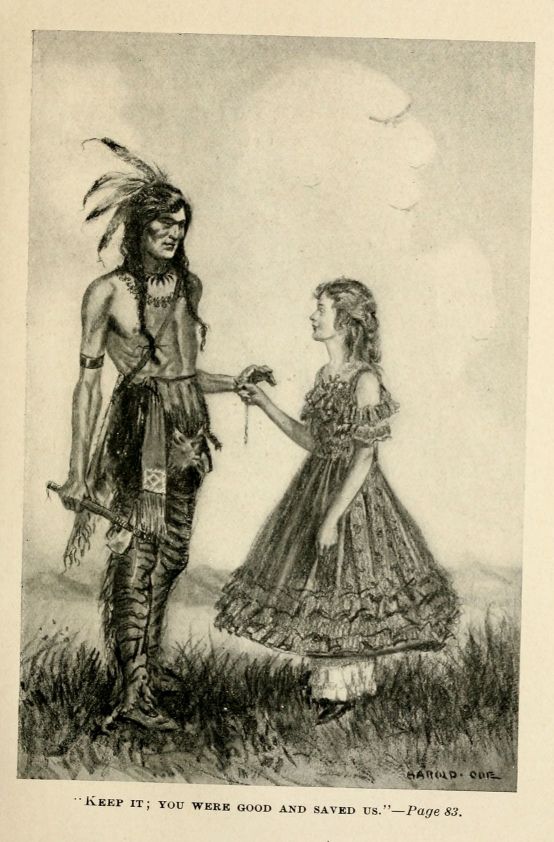
"KEEP IT; YOU WERE GOOD AND SAVED US."
The Indian looked down from his great height upon the golden-haired little girl, then to the chain in his hand.
"Umph!" he grunted, but they knew from the smile on his face that he was pleased.
"What you name?" he asked.
"Nina—Nina Carroll." Then with a shy little smile, "The boys call me 'Princess.'"
"Umph!" again grunted the Indian, and mounting his pony rode swiftly away.
As the pioneers traveled on through the heat and dust of that day the hearts of Joshua Peniman and his wife were deeply troubled. It was not alone that their worst fears of the perils of the plains had been realized in the attack of the night before, but the menace and mystery of the theft of the dispatch-box left a deep sense of fear and depression upon them.
"I cannot but fear for the child," Joshua Peniman said, after long study. "We know nothing about her, who she is, what her life may represent, or what enemies her family may have had. The thought is forcing itself upon me that we should not keep her with us, that we must leave her at the first Mission we come to, as her mother requested. They may be able to get her back to her own people."
"But who are her people? How can we ever tell that now? Every bit of information, every letter, address, paper, everything relating to her or her relatives, was in that box."
"But surely the girl herself knows——"
"Very little. I have talked with her. It appears that she and her parents have been traveling abroad a great deal of the time since she was born. She knows that they lived in New York, also for a time in St. Louis, but she does not remember the address in either place. Her mother's parents are dead, I believe, and I judge from things she has told me that there must have been some trouble with her father's family, and that the young couple lived rather an independent existence." Then after a long pause, "Somehow I cannot bear to leave the child at a Mission. Think of leaving our Ruth——"
"I know, Hannah, but her safety——"
"Yes, I realize that. We have the right, perhaps, to jeopardize the lives of our own family in this trip across the plains, but have we the right to expose the life and safety of this child, that has been left in our care?"
They sat in deep thought for some minutes. From the other wagon they could hear the chatter of the children's voices, as Ruth, Lige, Sam, Joe, and Nina excitedly discussed the events of the night before. She still grieved for her parents, but little by little the society of the wholesome, healthy-minded young Penimans was winning the little Princess back to cheerfulness.
"She seems very happy with us," sighed Mrs. Peniman.
"Yes, I believe she is. I wish we might keep her with us," answered her husband gravely.
The next day they reached the Des Moines River, and after making their night camp by the beautiful stream made their way the next morning to Fort Dodge, which had been built on the east side of the Des Moines two years before. Here they found other travelers and heard the horrible details of the Spring Lake massacre, and also of the depredations of the Sioux on the South Fork of the Platte. Sam and Lige, who were standing near, overheard a mover relating to their father the circumstances of a hideous murder of a party of emigrants which had occurred near Fontanelle but a few days before. These accounts, while they thrilled the boys with a sense of adventure, made their parents more anxious than ever, and many times the temptation assailed them to give up the hazardous journey and return to safety and civilization.
But there was something in the make-up of the early pioneers that forbade them to turn back, and after a few hours of rest they replenished their supplies and went on their way.
While at Fort Dodge Joshua Peniman made inquiries in regard to Missions, and learned that a Presbyterian Mission had been founded at Bellevue, the first permanent white settlement in Nebraska, on the west side of the Missouri River. To this he determined to make his way, and leave in safety the child of the strangers who had been entrusted to his care.
The travelers had now left civilization far behind them. The boys, who had so eagerly anticipated the adventures of the journey, now had more than sufficient of it to satisfy them. What white settlers there were in the country at that time were settled along the streams and rivers, leaving the space between unorganized and wild. As they traveled on trees and water grew farther and farther apart. There were some trees, mostly willows and cottonwoods, along the borders of the streams, all the rest was grass and sky.
They often saw large bands of Indians sweeping across the plains, hunting the wild game that was everywhere in great abundance. They saw great herds of elk and antelope, and wild turkeys were plentiful, with great flocks of prairie-chickens and quail.
They had no difficulty in providing their table with fresh meat now, for the boys and their father had but to go out with their guns for an hour or two in the evening and come back with their game-bags full.
But while they had meat in plenty they could no longer get fruit or vegetables. They could not supply their daily needs at towns or villages, for there were no towns, and the settlements were so far apart that many times they traveled for days without ever seeing a house or human. When they did find a "settler" or squatter, his home was on the bank of some river or stream, and his food consisted mostly of "sow-belly" and coffee, with little enough of either for himself, and none whatever for guest or traveler.
The lack of green food troubled Mrs. Peniman greatly, for with the voracious appetites of her young brood she realized that they should have vegetables to offset their constant consumption of the heavier diet.
One morning while they were traveling through western Iowa she suddenly leaned out of the wagon peering down into the grass.
"Stop a minute, Joshua," she cried, "I see something over there I want to investigate. It looks to me as if the Lord might be sending us the vegetables we have been wanting."
Mr. Peniman stopped the team and she scrambled nimbly down. Seeing her leave the wagon, Ruth, Nina, Sam and Paul eagerly followed her.
"What is it, Mother? What do you see?" cried Ruth.
Just then Sam stooped down and held up a small green object between his fingers. "Look, Mother," he cried, "look at the funny little green balls!"
"Ah," cried Mrs. Peniman, seizing it eagerly, "that's what I thought! That's what I was looking for! Look here, see?"
She stooped down, pointing to a delicate green vine with small leaves and delicate tendrils that grew in the grass at her feet.
"Pea-vines!" exclaimed Ruth.
"Yes, pea-vines! and these are some kind of a wild pea. I am almost sure they would be good to eat."
By this time Mr. Peniman, Lige and Joe had joined them.
"Oh," said Mr. Peniman, "buffalo peas! I have often read of them growing on the plains."
"Are they good to eat, Father?" asked Sam, who was in a chronic state of being hungry.
"I think so; we might try them. Run about and gather all you can, children; we'll cook them when we camp to-night."
With pails and baskets the young people ran about gathering the peas from the low trailing vines.
"They're the queerest peas I ever saw," said Joe; "they haven't any pods, and they're so big, look!" and he held up a round green ball about as large as a marble, pale green on one side and on the other a dull, purplish red.
When camp was struck that evening there was great interest shown in the preparation of the buffalo peas. After soaking them in water Mrs. Peniman put them on to boil with a pinch of soda, then drained off that water, put fresh water upon them, let them boil again, and when they were tender served them with a dressing of milk.
The family ate them, but it was the general opinion that the peas had grown too old to be prepared in that way, and on the next evening Mrs. Peniman made them into a pea soup, which was pronounced delicious by the entire family, and became a distinct addition to their diet as long as the buffalo-pea season lasted.
The boys had often remarked as they traveled farther and farther westward into the uninhabited wilderness that the road over which their prairie schooners rumbled was a broad, hard highway, with scarcely a blade of grass upon its surface. Joe wondered at this, and asked his father why it should be so.
"We are traveling over the old Oregon Trail, my boy," Mr. Peniman told him. "It is an old, old trail, the first highway made into the wilderness of the west by the feet of white men."
"Who made it?" demanded Lige, who resented any one having been ahead of them in pioneer life.
"The trail was first made in 1813 by what was known as the Astorian Expedition, which set out from St. Louis with about a hundred men, intending to cross the mountains and build a fort for the American Fur Trading Company in Oregon. You boys should read the history of that expedition; you would find it most interesting."
"Did they get there?" asked Sam, who was always interested in the result of any adventure.
His father smiled. "Yes, Sam, they got there. When I knew that a part of our journey would lead us along the old Oregon Trail I read up its history. They had a terrible journey, but after great losses and hardships seven men reached the Columbia River, where they built a fort which they called Astoria, after John Jacob Astor of New York, the president of the fur company. The Indians set upon them and stole their goods and their stock, and they returned to St. Louis with only one old horse, which they had succeeded in trading for with a friendly Indian."
"But that was so long ago, Father," put in Joe, "I should think the trail would have been lost since."
"It probably would have been," answered his father, "but that it was kept open by the Oregon emigration of 1832. But it was beaten into its present good condition and has been kept so by the gold-seekers and emigrant trains that began the rush to California in 1849. This is also sometimes called the 'Mormon Trail,' because it was over this very road that we are traveling now that the Mormons passed on their pilgrimage to Salt Lake in 1847. They, too, had great hardships and losses, and had to winter at Florence, a little trading-station on the Missouri River, which we should reach very soon now."
"Jiminy, that's interesting," cried Joe, who had been listening intently; "it makes it so much more interesting when you think of who's been over this old road before. How much easier and pleasanter it is to learn history and geography when you're right on the spot than when you are sitting on a hard bench at school!"
Toward evening the country became more rolling, and shortly before sunset they saw in the distance a blue haze and high steep bluffs.
Joe, whose eyes were always on the alert, cried, "River ahead!"
Mr. Peniman, who was studying a map spread out on his knees, looked up.
"Yes," he said, "that is the Missouri River."
"The Missouri—at last!" whooped Lige, "hurray, now the fun will begin!"
Mr. and Mrs. Peniman looked at one another. To them the experiences that lay beyond the Missouri did not appeal in the light of fun.
The day had been hot and clear, and as the sun sank in the west it left a sky of intense brilliancy, shot with crimson and gold, fading away toward the horizon in tender pink and mauve and lavender. They drove into the straggling little trading-post of Florence, where the unhappy Mormons had passed such a tragic winter many years before, and as they left it and drove over a small hill their eyes fell upon a sight grander and more beautiful than Moses saw from the top of Nebo's Mountain. The valley of the Missouri lay before them, and with the great river sweeping by long lines of bluffs covered with waving trees it presented to them a panorama both magnificent and inspiring.
"See that great bluff over there, Joe?" called his father. "That's where the Lewis and Clark Expedition held their first great council with the Indians. It was called Council Bluffs in memory of that event, which was the beginning of the opening up of this great western country. I am told it has come to be a great Indian trading-station."
Twilight was beginning to fall as they drove into the trading-post, which is now the city of Council Bluffs.
It was a great sight to the young easterners. On every hand were Indians, Indians and more Indians. Some wearing the cotton shirt and trousers of civilization, others blankets, others rejoicing in the garb of nature, augmented by a breech-clout and a few feathers in their hair. The squaws with their papooses strapped on their backs stood stolidly about, some in blankets, some in ugly calico "Mother Hubbard" wrappers. These Indians were mostly Omahas, with some Pawnees, Arapahoes and Potawatamis, all friendly to the white man. The Omaha Reservation was but a short distance away, and the Indians were bringing in skins, furs, and buffalo hides and exchanging them for blankets, flour, coffee, and the white man's "fire-water."
There were many emigrant wagons gathered in the wide straggling street, between two rows of one-story shanties, and white men were trading with red men, home-seekers anxiously seeking information, dogs were barking, children crying, men arguing and swearing, while the patient oxen hitched to the wagons breathed gusty sighs of rest, and the few women who were on their way to a home in the new country west of the Missouri looked on with troubled eyes or hurried in and out of the few straggling shops making their purchases.
The Peniman family had all alighted from their wagons before the general store, and while Mr. and Mrs. Peniman went in to make some purchases, followed by David and the little girls, Joe and Lige stood outside, looking with interested attention at the strange, novel spectacle of an Indian trading-station.
They were watching some white men who were talking with a group of Indians. Suddenly Joe pricked up his ears and walked nearer.
A tall, slenderly-built man, with a red, dissipated face, watery red-lidded eyes, and longish red hair was holding out a string of beads and jabbering in his own language to a tall, handsome young Indian who had an otter pelt over his arm.
"Aw, don't you do it," Joe burst out suddenly. "He's stringin' you! That string of beads ain't worth twenty-five cents."
The young Indian turned and looked at him, and the man, turning several shades redder than before, wheeled upon him with an oath.
"Mind your own business, you little pup," he roared, "who's askin' your advice!"
Whether he understood what had been said or not, Joe did not know, but the Indian turned and walked away, carrying the pelt with him. The man strode up to Joe with a menacing attitude.
"I'll teach you to interfere in my business again, you meddlesome young fool," he shouted, and raised his clenched fist. At this moment Mr. and Mrs. Peniman came out of the store, followed by Ruth, Sara, and Nina Carroll. Joshua Peniman, seeing his son threatened, hurried to his side, and the man, with another great oath, turned and faced him.
As he did so the oath died on his lips, his eyes flew wide and his mouth fell open, and the fiery color receded from his face, leaving it grey and ashen.
Joe, staring at him, saw that his eyes were fixed upon Nina, with the look of a man who sees an apparition from another world.
"What's the matter here?" cried Joshua Peniman. "Joe, what has this man been doing to you?"
"Nothing," answered Joe with a laugh, "he's just mad because I busted up his trade with an Indian. Say, what do you think, the old cheat was tryin' to trade that young buck out of a splendid otter skin for a string of nasty little cheap yellow beads!"
Joshua Peniman turned to the man, but he was paying no attention to them. With eyes fixed on the face of the little Princess he stood motionless, his thin, dissipated face almost white through its coat of tan.
Mrs. Peniman, who saw the look, seized Nina by the hand and hurried her away.
The man whirled upon Joshua Peniman.
"Who is that?" he demanded. "What's her name?"
"Who?" asked Mr. Peniman coolly. He too had seen the expression, and was on his guard immediately.
"That—that girl! Where did she come from? What's her name?"
Ruth and Nina had come out of the store together. Joshua Peniman, whose conscience would not let him lie, purposely misunderstood which little girl he meant.
"That little girl is my daughter. Her name is Ruth Peniman. She comes from the Muskingum Valley in Ohio," he answered.
The man stared at him with fiery eyes.
"Are you lying to me? If you are you'd better make your will right now."
"I am not lying to you. I never lie. My name is Joshua Peniman. I and my family are crossing the plains to Nebraska. The little girl you just saw come out of that store with my wife is my daughter Ruth. This is my son Joe."
The stranger turned and cast a snarling glance at the boy.
"He'd better not interfere in my business again, or his name'll be on a coffin-plate," he growled, and moved away.
Joshua Peniman motioned to the wagons. "In with you, boys," he said in a low voice, "we'll have to get away from here."
When they were in the wagons again and on the road he turned to his wife.
"What does it mean?" he said in a voice so low that the little girls who were in the back of the wagon dressing the china dolls they had bought at the trading-station could not hear him. "What is this mystery that is following us? It is evident that Nina is in danger from some one—for some reason that we know nothing about. I shall be thankful when we can put her into the hands of those who are in a better position to protect her than we are."
"That man back there," breathed Mrs. Peniman, scarcely above a whisper, "that horrible creature—thought—acted—as if he knew her!"
"He did know her—or he thought he did! He had some sort of a shock when his eyes fell upon her. He was not sure, and I think I threw him off the trail."
"It is strange—strange—in this vast new country—what can it mean?" cried Mrs. Peniman, and gazed out over the prairies with brooding eyes.
CHAPTER IX
RED SNAKE
It had been Joshua Peniman's intention to pass the night at Council Bluffs and cross the Missouri in the morning. But the events that had transpired at the general store so alarmed him that he decided to leave the trading-station at once, anxious to get the child who appeared to be so surrounded by mystery away from the proximity of the stranger with the degenerate, fox-like face.
They drove until dark along the banks of the river, then made their camp in the woods in a place that looked sheltered and secure. They had finished their supper and were preparing for bed when the young Indian, whom Joe had advised not to trade his otter skin for the stranger's worthless string of beads, came striding into their camp.
He walked straight up to Joe and held out his hand.
"Good boy," he said, greatly to the lad's astonishment. Then without another word laid the otter skin in his hands.
"Hello," cried Joe, "where'd you come from?"
"Me Pashepaho. Son Pawnee chief. Spik li'le." Then looking down at the otter skin—"Heap bad man."
"Who? Oh, the feller that was tryin' to do you out of this skin for a string of beads? I should sa-ay so. He's a crook, he is. But say, P—p——"
"Pashepaho. Son chief."
"Uh-huh," nodded Joe, to whom the son of a chief was no different from any other Indian, "but look here, Pashepaho, you fellers ought to learn the value of your goods and not let those thieving white men skin you like that. I happen to know that this is a good otter skin, because my uncle used to deal in furs and I've seen lots of 'em. Those beads he was tryin' to trade you weren't worth a quarter."
"No?" the young Indian looked at him and a slow fire smouldered in his eyes.
"White brother liar. Take 'way red man's land, take 'way red man's furs, take 'way red man's wife, give red man fire-water."
Mr. Peniman had come up to hear what the Indian was saying. "That's true," he said gravely, "the white men are setting a bad example to their red brothers, I fear." Then after a moment's pause, "Do you know who that man was, Pashepaho?"
"Red Snake. Heap bad man. Got bad heart. Trade with Indian. Live Santee Sioux."
Joshua Peniman started. "He lives with the Santee Sioux?"
The Indian nodded.
"But he is not an Indian, he's a white man, isn't he?"
"Squaw-man."
For a moment Joshua Peniman stood staring at him, his brain whirling.
A white man—lived with the Santee Sioux! Had evidently recognized—or partly recognized—Nina Carroll! Who could he be? What the relation between him and the departed Carrolls? What could be the meaning of this tangle in which he had involved himself by taking into his custody the friendless child of the white man who had been slain by a Sioux arrow!
The young Indian pointed to the pelt, which still hung carelessly over Joe's arm.
"Me give," he said. "Pawnee heap white man's friend."
"You mean you want to give me this skin?" cried Joe.
The young Indian grinned and nodded.
"Oh, no, Pashepaho! That pelt's worth good money. I have no use for it, and you ought to get a good price for it. I'm awfully much obliged all the same; it was fine of you to want to make me a present. I like you. You're square. Shake. You and I will be friends, shan't we?"
Pashepaho shook the hand that Joe extended to him. Joe dashed into the wagon and scrambled out again a moment later carrying a bright red necktie in his hand.
"Here, you take this. I'd like to make you a present. I know you like red. It'll look good on you."
Pashepaho took it eagerly, scrutinizing the brilliant bit of silk with the pleased smile of a child. Then he proceeded to wind it about his head, tying it in a knot in the back and letting the ends hang down over his shoulders.
"There! That looks fine! I knew it would be becoming to you," cried Joe, without an intimation that that was not the accustomed manner of wearing neckties.
The Indian looked from the boy to his father with a pleased grin. "You sleep?" he asked.
"Yes, we're going to camp here to-night," answered Joe.
"Me sleep, too."
Joe brought him out a substantial supper, which he ate squatted on the grass beside the wagons, and when the family settled down to their night's rest he lay down beside them with his blanket over his head.
It was long past midnight when Joe was awakened by a slight movement at his feet. He had heard no sound. Spotty was standing, his ears cocked forward, and the young Indian, motionless as a statue, stood with bow bent, an arrow in rest.
"What's the matter? What do you see?" cried Joe, springing up.
"Sh-sh!" whispered the Indian.
For a moment longer he stood, then discharged the arrow and at the same moment let loose a blood-curdling yell that roused the family and set the children to screaming.
Mr. Peniman leaped wildly to his feet.
"What is it? Where are they?" he shouted, but the young Indian laughed and snapped his fingers.
"Gone!" he said with a gesture of wide flight, "Red Snake coward. Think Big Chief come."
"Red Snake! Was Red Snake here? How do you know? What was he doing? Were there other Indians with him?"
Pashepaho shrugged his shoulders.
"Me know he come. Me come. He scare. He run 'way. He no come more. Think heap much Pawnee here."
He chuckled to himself, but Joshua Peniman did not join in his merriment. He knew now that a deadly enemy was following them, and that while Nina Carroll was in their hands there could be neither rest nor security for the family.
They rose early, and taking a grateful farewell of Pashepaho started on their way.
In the fresh light of early morning, they caught their first glimpse of Nebraska.
The land all about them lay smiling, with tall prairie grass waving to and fro and flickering with constantly changing shades and colors, the river glinted like a sheet of silver, and over all arched the sky, blue as an amethyst, with the delicate shades of early sunrise coloring the east.
They crossed the Missouri on the ferry-boat General Marion, which had been running only since the spring of the year before, and found themselves in Omaha, taking their first view of the bare, straggling settlement which is now the chief city of the great agricultural State of Nebraska.
At that time Omaha was the centre of the reservation of the Maha, or Omaha, tribe, and a trading post for the trappers and traders who had come to profit by the credulity and ignorance of the Indians. Missionaries were here who had come to carry Christianity into the wilderness, and a few white settlers who at that date had found their way across the river into the newly organized territory. The great motionless prairies lay spread out in striking contrast to the uplands and valleys along the river, with the sombre brown of the vegetation lighted up by the sunrise through a soft haze that cast a glamour over the picture.
The Omahas were camped in their teepees on the lowlands, bucks, squaws, papooses, dogs, wigwams and ponies huddled together, just as they had come from their great annual hunt in the Elkhorn valley, where elk, bison, antelope and other game abounded. There were a few shanties and log huts scattered about, but at this date, August of 1856, there were not more than fifty white families in the whole of Douglas County.
Joshua Peniman inquired the way to Bellevue, and after a brief stop in Omaha set forth for the Mission at that point.
Before leaving Omaha, Hannah Peniman had sent the children into the other wagon, and drew the little Princess to her, reminding her of her dead mother's wishes, and telling her that they were now near Bellevue, where they would leave her at the Mission, from which she hoped that she might be sent home to her own people.
Somewhat to her surprise, the little girl received the announcement with grief and terror.
"Oh, no, no, no," she cried, "I don't want to be left there! I'd die of homesickness there! Oh, Mother Peniman, don't leave me, don't leave me, please don't go away and leave me!"
"But you would only be there a short time, Nina," said Mrs. Peniman gently; "they would soon send you home."
"I have no home," she cried, bursting into a wild storm of weeping; "I don't know any of my people. My papa and mama are dead, and there is no one who wants me or cares for me! Oh, don't leave me, Mother Peniman, please, please take me with you!"
"Can you tell me the names of any of your relatives, Nina? Don't you remember your grandfather or grandmother? Haven't you any aunts or uncles or cousins? Who is there back there where you used to live that you could go to?"
"I don't know, I don't know!" sobbed the child. "I never knew any of them. My grandma and grandpa on Mama's side are both dead, and I think Papa must have quarreled with his parents, for he never talked about them. We lived abroad 'most all the time, and when we were in this country we lived all by ourselves in New York."
"But can't you tell us the names of any people who would know who your relatives are? Your mother said——"
"No, no, I can't, I can't!" sobbed the child. "Everything was in the box Mama gave me. She told me that full particulars were in there. I don't know who they can send me to—I have no friends—no one who loves me——"
Hannah Peniman looked at her husband over the head that was buried on her breast. The past few months had drawn lines in the comely face, had silvered the shining brown hair with threads of grey, and left deep shadows in the sweet blue eyes.
"She doesn't know—she doesn't understand, the poor lamb," she said tremulously.
"Oh, yes, I do know, yes I do understand," sobbed the child. "I know that my papa and mama are dead and that I am left all alone in the world—I have no one who loves or cares for me—and now you are going to send me away—leave me all alone at a Mission—and I'll die—I'll just die——"
Her voice had risen into a loud sobbing wail, and the children in the other wagon heard it. In a twinkling Joe, Lige and Ruth were running back to them.
"Mother—what's the matter with Princess—I heard her crying," panted Ruth, scrambling into the wagon.
"They're going to leave me—leave me—at the M-M-Mission," sobbed Princess. "They're tired of me—they don't love me—and they're going to send me back h-h-home!"
Joe sprang into the wagon, his face looking strangely pale and set.
"Leave her at a Mission? Father—what does she mean?"
His father explained, as gently as he could, omitting, for the sake of the little girl, the danger that threatened them on her account, and which seemed to be so relentlessly following her.
The child had thrown herself into Joe's arms, and he listened with his arms clasped about her.
"It was the dying wish of her mother, Joe," Mr. Peniman concluded.
"But she is dead—and Nina is alive. If she doesn't know her own people—if she doesn't want to go to them—isn't it better that she should be allowed to do what she wants to with her own life?"
"But the danger, Joe——"
Joe clasped his arms more tightly about her. "I'll take care of her, Father," he said, with an expression that made the words like a vow.
A few hours later they reached Bellevue, the oldest town in Nebraska, and once designed to be its capital, and Mr. Peniman drove directly to the Mission.
They left Nina in the wagon with the other children while they went inside. What was said or done, what discoveries they made, or what caused them to so quickly reach a decision the children never knew; but only a few minutes had passed before they saw them returning, and Hannah Peniman's head was held high and an angry spot was burning on either cheek as she climbed into the wagon.
Nina, with tear-stained face and eyes swollen and red with weeping, was clasped in Ruth's arms, and both of them were crying together. When they heard the approach of Mr. and Mrs. Peniman Nina raised her head with a gasping sob, but Mrs. Peniman bent over her, took her in her arms and pressed her to her breast.
"Don't cry, poor lamb," she comforted, "thee shall not be taken from us. I believe your chances are better with us than they would ever have been there. God took our baby daughter from us, and I believe that He has given us thee to comfort us. Cry no more, dear child, thee shall stay with us, and our fortunes shall be thy fortunes, to the end of the chapter."
There was great joy in the wagons when the news went forth that Princess was not to be taken from them. The children had all become devotedly attached to their little comrade, and her happiness was no greater than theirs when they learned that they were not to be parted. Mr. and Mrs. Peniman, too, felt a great weight lifted from their hearts.
"He who never faileth us will guard her, Joshua," said Hannah Peniman, a mist in her brave blue eyes. "I could never have found it in my conscience to abandon the poor lamb. She will be to us as one of our own children, and I know that her mother will rest more tranquilly there in her grave on the lonely prairies knowing that her little one is with us. Her spirit will watch over her, her love will guide her safely through all dangers and alarms."
"God grant that it may be so," answered Joshua Peniman solemnly.
CHAPTER X
NEBRASKA
The Peniman family found the little town of Bellevue the most pleasant and attractive place they had struck in many days' travel, and it comforted the hearts of the elders of the party to find that after all Nebraska was not the treeless and verdureless wilderness they had been led to expect.
Located on the banks of the great Missouri, overlooking the green wood-crowned bluffs, with the soft verdant valley winding its way below, they were not surprised as they gazed upon it that the old fur-trader, Manuel Lisa, had named it "belle vue," or "beautiful view," so many years before.
This was the stopping-place of all the adventurers to the far western land. Trappers, traders, travelers and prospective settlers all stopped here for rest and refreshment before making the plunge into the wilderness that lay beyond on the trackless plains. Missionaries here made their first attempt to civilize and Christianize the Territory, and Mr. and Mrs. Peniman found great comfort and solace in sitting again in a church, even though not of their own particular faith, and listening to the word of God.
They made their preparations to leave this last anchor to civilization with much reluctance and regret. They wished many times that they might consider their journey ended here. But the object of that journey had been to so locate that each of their growing lads might be enabled to homestead his 160 acres as soon as he was old enough, and the bottom lands of the Missouri were already pretty well squatted by trappers and settlers. So after a pleasant and restful day at Bellevue they purchased the last essentials for their home in the wilderness, loaded them into the Carroll wagon, and started westward on the most trying and perilous part of their journey.
They crossed the Platte River, a winding, shallow stream twisting along over its flat sandy bottom, which gave the Territory the Indian name of "Ne-bras-kah," or "Flat Water," and started across the prairies.
After leaving the Oregon Trail there was not even a track to be seen on the prairies. There was no road, nor any sign of a road. All to the westward seemed an unbroken wilderness. Meadow-larks sang in the grass, deer or antelope now and then flitted across their vision far away in the knee-high sage-brush, and their eyes strained westward over an ocean of immensity that looked as if it stretched away unbroken to the very edge of the world.
They watched the sun go down that night as the voyager sees it go down at sea, sinking inch by inch with no obstructing obstacle between, until its red rim sank below the horizon, leaving them alone on the vast solitude of the prairies.
It was well for the family that they had carried wood and water from their last camp at Bellevue, for there was neither wood nor water in sight.
The wagons were drawn up in a semicircle, the cow and horses placed inside, and the family gathered close together about their supper table, as if feeling the need of human contact in the vast loneliness that brooded about them.
They woke the next morning with the blaze of sunshine in their faces. It was a marvelous thing, this awakening on the silent unbroken surface of the plains, with the sun coming up like a great crimson hogshead over the flat rim of the earth, changing it from black to grey, from grey to pink, from pink to rose and blue and green and purple; and in all that great expanse, over which the eye could travel in every direction to the very limits of the horizon, to see no living creature but each other.
The day was hot and cloudless, and as the wagons bumped and crawled along through the grass something of the dread silence and loneliness of the prairies crept into their hearts, and a sort of awe came over them. The children found themselves dropping their voices and speaking low, as if they were in church; and Mr. and Mrs. Peniman avoided each other's eyes and spoke but seldom, as their gaze stared out over the interminable plains.
There were no trees in this land through which they were now traveling, and the only bird that gladdened their ears or eyes for many a long day to come were the little meadow-larks, which perched upon a swaying stalk or weed uttered its clear, gurgling melody.
One morning as they were jogging along, Lige, who sat beside Joe in the wagon, suddenly jogged his arm.
"Look, Joe," he cried, "what are all those little humps in the ground? See, there are thousands of them! Aren't they queer? Let's ask Father what they are."
His father heard and smiled. "Just watch," he said. "And Ruthie, thee and Sam and Paul should watch, too. Those are little houses, and some queer little fellows live in them."
"What lives in them?" asked Joe. At the same moment Sam, who was lying on the beds in the back of the wagon, stuck his head out of the rear curtains and gave a squeal of delight.
"Oh, I see!" he shouted. "Look at that queer little feller sittin' right up on the roof of his house! Come on out, Ruth, greatest sight you ever saw! Queerest little things, bigger'n gophers and not striped, just kind o' plain brown, with their arms folded across their chests. What in the world are they, Father?"
"They are prairie dogs," answered Mr. Peniman. "We are passing through what is called a 'prairie dog town.' I have read of them many times, but have never seen them before."
They had stopped the teams, and the family all scrambled out of the wagons to see this strange and novel sight of a "town" in which nothing lived but prairie dogs.
"Why, just see," cried Joe, "there are millions of them! Just look at that fellow over there, Ruth, sitting up on the roof of his house scolding at us!"
And truly there did appear to be millions of them. The whole surface of the ground as far as they could see was dotted over with the queer little dome-like houses, made of the clayey soil of the prairies thrown up into small heaps or mounds; and on each sat a small reddish-grey animal, a little larger than a squirrel, with tail cocked up saucily over their backs, and paws folded demurely across their fat little stomachs, gazing with bright, bead-like eyes at the intruders, of whom they did not seem to be in the least afraid. On each side of the face were pouches, in which they carry out the dirt when burrowing the holes in which they live, and in which they pouch nuts, roots, and other dainties. They seemed filled with curiosity, and as they came swarming up out of their holes to sit on the tops of their houses, they made a peculiar barking noise, something like the bark of a young puppy.
This amused the children immensely. "How deep are their holes, Father?" asked Sam.
"I have read that they are tunneled back long distances, and that many of the underground passages connect the mounds with one another. I have also read," he continued with a twinkle in his eyes, "that a prairie dog, an owl, and a rattlesnake lives in every hole."
"A rattlesnake?" cried Ruth. "Wouldn't it bite the prairie dogs?"
Joshua Peniman laughed. "Well, I don't know, Ruth, that is what I read; but my own opinion is that as the main business of little Mrs. Prairie Dog is to keep snakes and other varmints from eating her little ones I hardly think she would tolerate a rattler in her house. But come now, jump in, we must not spend any more time here. No doubt there are many just as interesting and curious things to see farther on."
They stopped early that night on account of the heat, wanting to save the horses all they could. A strong wind came up about sundown, which soon grew to be a gale, and which almost blew them off their feet as they scampered about on the prairie trying to find something of which to make their fire.
It was their first taste of the "Nebraska zephyrs," of which they were to see so much later on, and it kept the whole family busy chasing about after hats and bonnets, brooms, dish-pans, and all sorts of things that blew out of the wagons.
"I can't find anything to build a fire of, Mother," cried Joe after a vain search, "there's nothing out here, only wind and grass. Don't you think we'd better use some of our stored-up wood?"
Lige, who was just returning from a prolonged chase after Ruth's sunbonnet, suddenly stopped short and pointed away across the prairies. Joe turned and looked, then remained staring.
"What in the name of goodness——" he ejaculated.
"Look, Mother, what are those things over there?" called Lige. "Do you think they are some kind of animals?"
"Sheep!" ventured Sam, staring away intently toward where a number of dark objects were moving rapidly toward them from the south.
"No, they're too small for sheep," said Mrs. Peniman, puckering her forehead and narrowing her eyes; "what in the world are they?"
"They've got a queer gait," cried Joe, "and they're coming a-whizzing. Could they be wild turkeys?"
"Oh, no, they're not fowl of any kind."
"Will they bite, Mother?" queried little Mary.
"Maybe they're coyotes," suggested Paul.
Just then Mr. Peniman, who had been out looking after the horses, appeared.
"Look, Father, what are those things over yonder?" cried Lige.
Mr. Peniman shaded his eyes with his hand and gazed intently out over the prairies. Then he began to laugh.
"Hurry up, boys," he cried, "here's the stuff for your fire coming to you! Catch as much of it as you can as it goes by, for I warn you that with this wind it won't wait long on anybody."
"But what is it, Father?" asked Joe curiously.
"It is called 'tumble-weed.' It is a sort of bush, with a small, slender stalk. During the summer this bush grows almost round, and when the fibre of the plant dries the stalk becomes brittle and the first hard wind breaks it off; then the bush rolls over and over across the plains, sometimes traveling for miles before a high wind."
"Oh-h," cried Lige, with a falling inflection of disappointment in his voice, "I thought it might be something interesting."
"So it is something interesting," said Mrs. Peniman. "Did you ever see a more interesting sight than that? It looks like a Lilliputian army marching toward us! Hurry up everybody, get in line, let's stop all we can. I know they will make a splendid fire."
Always ready for anything new the children hastened to form in a line, even down to small David, who was continually being blown off his short legs. As the tumble-weeds came toward them, rolling over and over before the strong south wind, they had a great game, stopping them, chasing after them and running them down, while Mr. Peniman piled them up and threw a horse-blanket over them to keep them from blowing away.
It was a great romp, and the children shrieked with laughter as they all chased after the strange, grotesque bundles, with the wind beating in their faces and almost carrying them away.
"Whew! that's more fun than pom-pom-pull-away!" puffed Lige, throwing himself flat on a great tumble-weed which was trying hard to elude him. And Mrs. Peniman, with her hair blown down and her cheeks as red as Ruth's, declared it was the liveliest game she had taken part in for many a long day.
When broken up and crowded under the pot and into the little sheet-iron camp-stove they found it excellent fuel. It burned out quickly, but made a hot fire, little smoke, and saved the precious store of firewood so laboriously gathered up and so carefully hoarded for emergencies.
That night the moon was full, and the boys begged to sleep in their blankets outside. As the night was very hot and it was close and stifling under the canvas their mother gave her consent. The dry prairie grass made a good mattress, and rolled up in their blankets like old campaigners they lay looking up into the wonderful night sky for a long time before they could fall asleep.
At last the fatigues of the day and the deep quiet of the prairies lulled them to rest. Sam and Lige were fast asleep and Joe was beginning to doze, when there came to his ears a sound so weird, so blood-curdling that he sprang up, his heart beating heavily.
His first instinct was to grab for his musket. Spotty was standing up, with hair bristling and lips drawn back, growling fiercely.
The wagons were, as was their custom these days, drawn up into a semicircle, and the boys were lying within it close to the big wagon. Just back of the wagon the three teams of horses were picketed, and just beyond them the cow.
As Joe stood listening intently, his musket in his hand, he heard the horses begin to plunge and snort.
He glanced at his father, but the sight of the thin, tired face of the sleeping man stopped him.
For a moment all was silent as the grave. Then again came the long, hoarse, raucous cry.
He stooped and shook Lige.
"Wake up," he whispered in his ear, "there's something after the horses!"
Lige woke with a start, and grabbed his rifle as he sprang to his feet.
"Where?" he whispered. At the same moment the howling was repeated, and the horses back of the wagons began to rear and snort with fear. Suddenly the cow sent forth a terrified bellow.
With musket over his shoulder Joe dashed between the wagons, followed by Lige.
The moon was at its full, and the flat surface of the prairies was dimly visible all about them. Outlined against the horizon they saw a number of gaunt, shadowy forms flitting silently. At no great distance from them a creature, larger than a big dog, sat up on its haunches and with head raised to the moon uttered a long, wailing howl.
From far away across the prairie it was answered, and while they stood listening the night grew hideous by the calling and answering of the deep-chested howl of grey wolves.
"Wolves—grey wolves!" whispered Joe, "they are after the horses!"
Presently as they stood with suspended breath dim grey shapes came gliding across the prairies toward them.
Almost as he spoke they heard the cow give a terrified bellow, and heard her tugging wildly at her rope.
"The cow, the cow!" shouted Lige, and together the boys leaped forward.
They saw the poor animal crouched and cringing with terror, and as they sprang forward, gun at shoulder, they saw a huge, gaunt grey figure leap at her throat.
Scarcely waiting to aim, Joe shot. The reverberation had scarcely ceased when his father was at his side.
"What is it?" he cried.
"Wolves—wolves! They are after the horses—they almost got the cow!" shouted Lige, and fired again into the shadows, where he could make out the slinking grey figures.
Joe too was loading and firing. The horses, half mad with terror, were rearing and snorting, and the cow plunged in wide circles, blowing and bellowing with fear.
Mr. Peniman, musket in hand, ran to them, but the wolves had been frightened away. He found two great, gaunt, grey marauders dead, but the others, frightened by the shots, had disappeared as swiftly and silently as shadows.
The boys were greatly disappointed to find that they had not killed more of the midnight thieves. "There were such a lot of them," cried Joe; "what became of the rest? I thought I would kill half a dozen at least."
"Wolves are great cowards. When they heard the shots they probably made off with all speed. I think you did exceedingly well to get two in this uncertain light. Too bad we can't skin these fellows and keep the pelts as souvenirs of your first wolves. But you will no doubt have the chance to get plenty more, so we will let these fellows go. We'll have to watch for them after this. It would have been a bad lookout for us if they had got the horses or the cow."
This incident served to show the pioneers that other dangers than those of Indian raids menaced their night camp on the plains, and served to make them more watchful than ever.
CHAPTER XI
THE PRAIRIE FIRE
A few days later the travelers drove into a dreary, straggling little settlement of a few log and sod shanties on a little stream called Salt Creek. Here they spent the night, glad of the company of other white settlers. There was a general store in the little settlement, at which Joshua Peniman bought a barrel of salt pork, a barrel of flour, sugar, coffee, rice, tea, beans, dried peas, and a bucket of lard and a firkin of butter.
"I am doubtful," he said as he loaded them into his wagon, "whether we will come to another place where we could get supplies."
Early the next morning they loaded up their wagons, bade farewell to the other movers, and struck off across the trackless prairies.
It was still early, and the drum of the prairie-chickens came to their ears across the silence of the plains. Joe and Lige took their guns and went in search of them, and soon returned with a couple of fine young hens, which Mrs. Peniman cooked for their dinner.
A strong, hot south wind was blowing, which toward evening increased to a gale. Even the shadows of night did not bring relief from the heat, which seemed to increase rather than diminish. Mrs. Peniman could not sleep. With a feeling of suffocation and uneasiness upon her she tossed from side to side. The air was hot and close, and in her nostrils there was a pungent smell. With the instinct of danger strong upon her she sprang up, and jumping out of the wagon looked about her.
Off to the south the sky was red, and straining her eyes through the darkness she saw, low against the horizon, a leaping tongue of flame.
She ran to where her husband lay sleeping. "Joshua," she whispered, laying her hand on his arm, "Joshua, wake up! I smell smoke, and away over yonder I think I see a fire——"
"Fire!" the sleeping man was wide awake and on his feet in a moment. "Fire? Where?"
Mrs. Peniman pointed.
For an instant he stood staring at the little tongues of flame that licked up over the horizon, then sprang to the pickets and began untying the horses.
"Prairie fire!" he cried. "And there's no telling where it will stop in this wind! Call the boys!"
When the boys were roused he gave them no time to ask questions. In quick, nervous tones he issued his orders.
"Hitch up as quick as you can, Joe," he shouted, "there's a prairie fire over yonder! Lige, get up the black team. Sam, run and bring in the cow. Pack those things in the wagons, Hannah, never mind order now. Ruth, get a couple of pails of water out of the kegs. Paul, pull up those stake-pins, wind up the ropes and throw them in the wagons! Hurry, hurry, all of you, we haven't a moment to lose!"
Working with feverish haste he turned often and glanced at the line of red on the horizon.
"It's miles away yet," he said in a low voice to his wife; "we may be able to get out of its path, but with this wind——"
He stopped abruptly, then leaping into the wagon shouted, "Come on, in with you, never mind those things, Hannah, never mind anything now! The wind has changed, and that fire will be down upon us in less than half an hour. Whip up your horses, boys, don't spare them now! With that fire behind us——"
He leaned forward as he spoke and lashed his team; the horses plunged forward with a leap that made the wagon careen.
Over the coarse prairie grass they fled, the horses straining and plunging, while they looked continually behind them to where the red line had left the horizon now and was creeping toward them, the red tongues of flame leaping higher and higher as they caught the dry grass and rosin weeds.
The air grew suffocatingly hot, and before long particles of burned grass and weeds, carried by the gale, began to fall about them.
"Watch that nothing catches fire in the wagon, Hannah," shouted Joshua Peniman, bending forward and laying the whip across the backs of the petted team that had scarcely ever felt a blow in their lives before. "Watch the children's clothing. Have wet cloths handy!"
The wind, a gale before, now seemed to have increased in fury, and before it the fire leaped and roared like a furnace.
"Faster, Joe, faster!" yelled his father; "it's gaining on us, we've got to reach a stream or draw of some kind——"
Leaning far forward on his seat with the whip in his hand and the reins clutched hard, Joe did not wait for the finish of the sentence. With voice and whip and lines he urged the horses forward, shouting at them, shaking the lines over their straining backs, whirling the whip about their heads, as in a blinding reek of smoke and dust they thundered on, while closer and closer behind them came the roaring flames.
The horses were soon panting and lathered with sweat, staggering and stumbling under the strain of the heavy wagons, and poor Cherry, fastened on behind, was almost pulled off her feet, and slid and stumbled bawling wildly.
The whole sky was illuminated now, and the air so filled with smoke that they could hardly breathe. Behind them the ominous crackling and snapping of dry grass grew louder and louder, as the fire, fanned by the high wind, rushed through the tall, dry prairie grass with the velocity of a cyclone.
All at once without decreasing the pace of his horses, Mr. Peniman stood up in the wagon and looked back.
They heard him utter a sharp, inarticulate sound, and the horses were stopped with a jerk that almost threw them upon their haunches.
"No use," he shouted, leaping out, "we can never make it! Got to fight it out here! Out everybody, and fight for your lives!"
Joe and Lige stopped their teams, and drawing the wagons up together they leaped out and tied their teams to the rings in the side of the other wagon.
"The kegs!" shouted Joshua Peniman, "roll out the kegs, and those gunny-sacks! We've got to back-fire, it's our only chance now!"
With frantic haste the boys rolled out the precious kegs of water, while Mrs. Peniman, with an instinctive knowledge of what to do, threw out a couple of brooms, some old coats, and a bundle of gunny-sacks.
The children, aroused at the first call of danger, had all gotten into their clothes by this time. With their heads enveloped in wet towels, wet brooms and gunny-sacks in their hands, they stood ready to do as their father commanded.
Having secured the horses firmly to the wagons Joshua Peniman rushed back over the way they had come for some two hundred feet, and called the family to him.
"We've got to set a back-fire here," he shouted; "watch it closely, don't let it get away from you, and beat out every tongue of fire that tries to get beyond you. Have your brooms and sacks ready. Now!"
The whole family, with the exception of Mary and David, who had been left asleep in the wagons with Spotty to guard them, were now lined up at a distance of some two hundred yards nearer to the oncoming fire than the wagons. It required courage for young people who had never, until they had begun this journey, encountered real danger, to face the roaring wall of flame that rushed toward them, but they were well disciplined and obeyed their father's orders implicitly.
Seeing that they were all in readiness Joshua Peniman stooped and put a match to the grass at his feet. Instantly it leaped into a flame. He let it burn a little way, then whipped out the edges, making a straight track of fire of about a hundred and fifty feet wide. This Joe instantly recognized as a "fire-guard." Then backing up a few steps at a time, and keeping the flames under control, they let this second or "back-fire" burn toward the wagon, leaving between them and the oncoming wall of flame a large area of burned-over ground. This they continued to do until they had described a complete circle about the wagons.
"Watch out there, Joe, keep your eye to the right there," yelled Mr. Peniman, black and smoke-begrimed and beating with all his might at a vicious tongue of flame that threatened to get beyond him. "Look out there, Lige! Nina, be careful to keep your skirts out of the fire! Watch behind you, Sam; better wet your broom again! Beat out that fire on your left there, Hannah!"
With her skirts pinned up about her, her hair blown down, and her sleeves rolled to her elbows, Mrs. Peniman wielded broom and sack, beating and firing as she went backwards, step at a time.
"Oh, Mother, will it get us?" cried Ruth, as a great gust of wind enveloped them in smoke and increased the roar and crackle of the flames that rushed toward them.
"Don't be frightened, Ruthie," she shouted above the wind. "Keep your broom going! Don't stop to look. God will take care of us. Watch your side there, Nina; beat it out—beat it out! Here, Sam, come here and work by Nina; she needs help!"
As Sam left his station she ran to where he had been and with furious strokes of broom and sack beat out the fire that was creeping away from them.
Back-firing and beating out the flames as they went, they gradually worked back toward the wagons, leaving behind them a smoking black ring nearly two hundred feet in circumference.
Their faces and hands were black and blistered, their feet scorched, their eyes burning and smarting, and their lungs wheezed with the effort to breathe through the suffocating smoke and ashes that filled the air.
The horses, half-wild with terror, were rearing and plunging, and poor Cherry running madly in circles as far as her rope permitted.
"Run to the horses, Joe," shouted his father, after a swift backward glance at the wagons. "Put wet sacks over their heads and throw wet blankets over them! Lige, here, you take Joe's place! Watch out there, Mother, beat out that fire on thy right!"
Joe threw down his sack and ran with all speed to the horses. With soothing words and pats he did his best to quiet them, throwing their blankets over their backs to protect them from flying sparks, and enveloping their heads in wet sacks, wrung from the precious and fast-disappearing kegs of water.
He had difficulty in getting near enough to the distracted Cherry to do anything for her, but after a wild struggle, during which he was dragged in a wide circle by her rope, he succeeded in getting a wet sack over her head and a blanket on her back. The chickens were squawking and the little pigs squealing in their boxes, and he stopped long enough to throw a bucketful of water over them, and pitch a tarpaulin over their boxes. Then he rushed back to the wildly beating family.
As they backed and fired they began to see outside the ring of fire grey spectral shapes dashing by in the shadows, running madly, frantically, with the terror of the crackling flames behind.
All at once the ground under their feet seemed to tremble, and the horses, crouching and shivering with terror, began again to rear and plunge.
Dropping his sack Joe ran to the heads of one, Lige to the other, while Mr. Peniman dashed to the heads of the third team.
"To the wagons, to the wagons!" he shouted, and saw his wife and the other children drop their sacks and dash for the wagons as the quaking of the ground and a great roar like that of an approaching cyclone rose above the crackling of the flames.
"What is it? What is it?" shouted Joe, terror-stricken.
"Buffaloes!" yelled his father. "Stampeded by the fire! Get your guns—fire into them as they come—please God our back-fire may keep us from being trampled by them!"
There was a moment of awful suspense, while the ground beneath their feet seemed to rock and tremble with the impact of the wildly charging herd. Through the smoke and dust they could make out a great mass of enormous reddish-brown bodies being hurled madly forward before the pursuing flames. Then the terrified creatures made a wide circle to avoid the black ring of burned ground, which they seemed to fear, and the herd of buffaloes, grim, monstrous shapes in the dusk of early morning, thundered by and passed out of sight.
When the circle of back-fire was completed the nearly exhausted family leaned for a moment on their wet brooms to breathe. The last of the water in the kegs went to wet blankets and tarpaulins to spread over the canvas covers of the wagons, and as the flames swept toward them they took their stand about the wagons, still armed with their wet brooms and sacks, to make a last struggle against the fire that came crackling and rushing toward them.
CHAPTER XII
A NEBRASKA DUGOUT
With the roar of a tornado the prairie fire swept down upon them.
The high grass, dry as tinder after the long hot spell, burned as if covered with turpentine.
The tall rosin-weeds and sunflowers, blazing like torches, sent up showers of sparks that the wind carried through the air, setting fresh fires and raining down upon the travelers, burning their clothes and singeing their faces and hair.
Once Mrs. Peniman's calico apron caught fire, but she tore it off and trampled it under her feet.
At times it looked as if the wall of flame must leap the narrow boundary of burned-over ground and sweep down upon them, destroying them all in the roaring furnace that raced toward them.
The heat grew fiercer; the horses screamed and tugged at their halters, the cow bellowed pitifully, and the little pigs at the back of the wagon squealed as if the knife of the executioner were at their throats.
For a moment the flames seemed to fairly tower over them, hissing and crackling in its wrath.
Would it leap the back-fire?
The hearts of the pioneers almost stopped breathing. An agonized prayer went up from the hearts of the parents that they and their little ones might be spared.
Then the wall of flame flickered, fell—and swept on around them.
Their back-fire had saved them.
With cracked and parching lips they uttered prayers of thanksgiving, and worn out with the struggle let sacks and brooms drop from their nerveless hands and stood still.
They realized now for the first time the extent of their exhaustion. They felt the pain of their burned hands, their scorched faces, their parched and burning throats.
Daylight came before they were able to realize the fact that they were saved.
The broadening light revealed a sad and dismal prospect. If the prairie had seemed monotonous to them before in its sombre dress of grey, and brown, and green, it seemed desolate beyond all description now, covered as far as the eye could see with a pall of funereal blackness.
Suffering as they were with burns and thirst it was noon before the ground was cool enough so that they could drive over the still smoking prairies.
All the afternoon they drove, straining their eyes in every direction for the sight of a town, a house, a sign of shade and water.
As fast as possible they veered away from the burned district, and about sundown got out of the track of the fire and onto the brown dry prairies.
Back of them and far away to the south and east they could still see the devastating trail of the fire, but away to the north and west the wind had turned the direction of the flames and the prairie remained untouched by its fury.
It was a tremendous relief to escape from the scorched and blackened ground, the stifling smell of burned grass, the acrid smoke that made their eyes smart and water and their throats sting, and to drive out on the unscorched prairies, which, hot as they were, seemed cool in comparison.
It was nearing nightfall when they saw, not far away, a small column of smoke rising in the air. Joshua Peniman scanned it with eager eyes.
"It might be an Indian camp," said his wife anxiously.
"White men or red we must have water to-night," he said, and drove on.
As they drew nearer they saw a low, squat outline against a small rise in the ground, and from it rose a stove-pipe, from which the smoke they had seen was coming.
"What is it?" called Joe. "Is it an Indian's hut?"
"No, thank God," cried Joshua Peniman fervently; "no Indians live there. It must be a dugout, and if it is white people are living in it."
He clucked to the horses and drove eagerly forward.
As they approached the low, dark object they saw that it had a roof, and that the sides were dug back in the rise of ground behind it. They could also see that it had two windows in front, and a door, which was thrown open as they drew nearer, and a tall, raw-boned red-haired woman with a good-natured freckled face stood framed in the opening.
"Wal of all things!" she ejaculated, "if it ain't a bunch o' emigrants! Hello, mister, where'd you come from?"
"From Ohio," called out Joshua Peniman, and made all possible haste toward the dugout.
As the wagon drew up before the door she looked at its occupants, then laughed aloud.
"Fer th' land sakes," she cried; "what be ye? Air ye niggers or Mexicans or Portuguese, or what?"
"We're Americans—and white," said Mr. Peniman laughing, as he leaped from the wagon. "At least we were white once, and we hope to be again. We've just escaped with our lives from a terrible prairie fire, and are covered with its smoke and grime."
"Lord save us!" ejaculated the woman. "Was you in the track o' that fire? We been watchin' it all day. We was skeered it might ketch us, but the wind wa'n't in th' right direction. Them prairie fires is terrible things. We mighty nigh got burned out last fall."
"We used all the water we had fighting fire," Mr. Peniman continued, "and are all suffering from thirst. I wonder if you could let us have a little drinking water?"
"Kin I? Wal I should say I could! Me an' Jim never turned a thirsty man or woman or horse or dog away from our place yit! Git out, git out, all of ye! We've got a good well and you can have all the water ye want to drink and wash up, too, and I will say you sure do need it."
The travelers came scrambling out of the wagon, and there were tears of relief and gratitude in Hannah Peniman's eyes.
"Jim," a husky-looking pioneer over six feet tall, with a good-humored sunburned face and a shock of tow-colored hair sticking up through a hole in his hat, came hurrying up at this moment, drawn from his work in his cornfield near by by the unwonted sight of a caravan of moving wagons before his door. As he came he cast a sharp, inquiring look at the company of sooty, grimy individuals gathered before his dugout.
"We aren't quite such desperate characters as we appear," saluted Joshua Peniman with his pleasant smile. "We have barely escaped with our lives from a prairie fire, had to use all the water we had, and have had no chance to wash. My name is Peniman—Joshua Peniman, a Quaker, from the Muskingum Valley in Ohio, and these are my wife and children."
"Glad t' meet ye, Mr. Peniman," said the pioneer, extending a hairy, work-worn hand. "So you was in the track o' that fire, was ye? Sa-ay, I wonder ye ever got out alive. It was sure a fire, all right. Me an' the old woman been watchin' it. Thought fer a spell it might come this way, but th' wind favored us. Glad ye got through all right. Ye sure have got a likely-lookin' family. My name's Ward—Jim Ward. B'en out here goin' on three years. Homesteaded a piece o' land back here that ye can't beat in the hull nation. Travelin' across country? Be'n pretty hot, ain't it? But that's what makes good corn. We're going to have a hummer of a crop this season. But come in, come in! Ye shore do look all tuckered out. Wife'll git ye chairs, an' I'll go out an' draw up some fresh water. I reckon ye must be dry."
When the thirst of the family had been satisfied they felt greatly refreshed, and for the first time began to look about them. Mrs. Ward saw the curious glances the young people were casting about the queer-looking underground house and burst into a good-natured laugh.
"I'll bet you folks ain't never seen a dugout before," she exclaimed jovially. "Well it's sure a queer way to live, but me an' Jim think it's a good way—to begin with. We ain't always goin' to live this way, but a dugout's safe from cyclones and blizzards and Indians, an' it's warm in winter an' cool in summer—an' what more does a pioneer want?"
"I see that it has great advantages," said Joshua Peniman gazing with interest about the dwelling. "Do you see how it is done, Hannah? You see they have chosen a place where there is a rise in the ground, and have dug back into the earth so that the house is protected on every side but the front. You have had to build up side walls, of course, where the earth slopes away, and a front wall, but that was all. I see how safe and sheltered it must be, both from weather and possible enemies."
"Yes, an' a feller has to think a heap about both o' them out here," said Jim Ward, standing with his hands in his pockets and his legs wide apart as the travelers admired his dwelling.
The excavation, which was about twenty by thirty feet square, was dug back into the bank of a piece of rolling ground on the prairie, and made into a chamber about nine feet high. The entire rear part of the dwelling was protected by the embankment, and a part of the sides, while a stout, thick wall of sods was built up on the sides and in front, in which was let a door and two windows. An ivy-vine was trained up over the window casements, clean white curtains shaded the spotless panes, which had broad sills, upon which were placed pots of geraniums in full bloom.
The floor was made of matched flooring, and was as white as hands could make it, with braided rag rugs spread before the shining stove and the red-covered table, upon which were a Bible, a vase of wild-flowers, and a shining lamp. In a corner of the room was a large double bed, made up with a spotless blue-and-white patchwork counterpane, and "shams," elaborately worked in red cotton, with "Good Night" on one pillow and "Good Morning" on the other. At the other end of the room was a shining cook-stove, with a tea-kettle steaming cozily upon it, and a row of packing cases, which had been placed one on top of another and cleverly converted into a kitchen cupboard.
"It's wonderfully clean and cozy and comfortable-looking," exclaimed Mrs. Peniman. "I wonder how you keep it so. I would not dream that a house just dug into the ground could be so attractive."
"Lots of 'em ain't," vouchsafed Jim Ward. "Some of the folks that come out here is content to live like pigs. But me an' Mary ain't. She always was a good housekeeper, an' she keeps this place so nice I sometimes almost forgit we live in a dugout."
"Now you quit talkin', Jim," put in "Mary," "and go an' draw up a tubful o' fresh water. I reckon these folks don't want nothin' so much in this world as a bath. I'll set a wash-tub out in th' back yard, an' when it comes dark ye can all take a bath. I sh'd think ye could begin now with th' little fellers."
One after another the Peniman family slipped out and took their turn in the tub in the back yard, and it was indeed a cleansed and changed family that gathered at last on the "front stoop," as Jim Ward facetiously called the hard, beaten place before the door.
When supper was over they sat on the "stoop" until the moon rose, listening eagerly to the many curious and interesting tales the pioneer homesteader and his wife had to tell.
"Has thee ever been troubled with Indians, friend Ward?" asked Joshua Peniman, a bit anxiously.
"No," answered the pioneer, "we ain't never had any trouble with 'em. A lot of the settlers has, but I've always figgered it was their own fault. We've been livin' out here three years now, an' we've never had a thing stolen or molested or a bit o' trouble ourselves."
"But why haven't you?" demanded Joe, "when the others have?"
"Because I've always figgered on treatin' the Indians like they was human. Some folks treats 'em worse'n dogs. Good land, this is their country, ain't it? They was here first! Us folks that comes in now is just takin' what they've owned for God knows how many years. Ain't it so?"
"Yes," said Joshua Peniman, "it is. I have always felt so. But we have so often been warned of danger——"
"An' there is danger; don't ye ever forgit that. Some o' these here Indians is bad medicine. They're mad about havin' white settlers come in, an' they'll plug ye the fust chance they get. But I figger that Indians is jest like other folks. Some is bad an' some good—they're all just human. Me an' Mary has always thought if we treated them all right they'd treat us right. So fur it's worked all right."
During the long talk that Mr. Peniman had with Jim Ward after the women and children had retired to get ready for bed, he discussed land and locations, and when the family set forth the next morning it was with the firm intention of going to the northwestern part of Nebraska, where the land along the Niobrara was particularly recommended, and where there were still thousands of acres of government land to be homesteaded upon for the choice.
They bade their kind host and hostess a reluctant good-bye, and having promised that they would write them when they had arrived at their destination they started on, turning to wave their hands again and again to the last white people they were to see for many a long day.
CHAPTER XIII
THE MINNE-TO-WAUK-PALA
It was with the greatest reluctance that the travelers parted with Jim Ward and his good-natured wife. For many days they had seen no other human beings, and the relief of being with and talking with them was so great that it took a determined effort to leave the cheerful dugout and its occupants and turn their faces once more toward the uninhabited plains.
They had traveled but a few miles in the calm clear light of morning when they saw not a quarter of a mile ahead of them thirty or forty beautiful antelope. They were cantering across the prairie, their little white cotton tails shining in the sunshine, the light gleaming on their pretty dappled sides. They were playing and leaping, and their curious antics made the boys shout with laughter.