Front matter (continued 4)
Reading edition
When he came to himself it was morning. There was no sound to be heard, and he was bitterly cold, shivering as if with an ague. He drew himself slowly and painfully out of the water and sat down on the bank. His left arm hung limp and useless at his side, and his shirt was stained and draggled with blood.
How long he sat there he could not tell. He was weak and dizzy, and his head was going around so fast that he could make no note of time. He stooped presently and drank a little from the stream, bathed his aching head, and shook the water from his clothes. Then he got to his feet, and weakly, warily, began making his way through the brush.
He wondered, with a sinking heart, what had become of Nina. Whether she had got away or whether she had been captured again by Red Snake. He could not go far at a time but, stopping every little way to rest and ease the agony in his chest, crept on. The sun was up and shining hot in the heavens when he reached the edge of the thicket. He called and whistled, but there was no answer. Kit was not there.
Suddenly he shrank back into the shelter of the undergrowth with a sickening heart. Across the flat surface of the plain he saw a troop of horsemen riding, and from the way they rode he knew they were Indians.
A groan burst from his lips. He supposed they were hunting him, and cowering back in the shelter of the scrubby undergrowth he gave himself up for lost. He thought that of course they had captured Nina, and the horror and agony of the thought, combined with the pain in his arm and chest, rendered him almost unconscious. Dropping down upon the ground he gradually drifted away into a blank, then into a wild, fevered dream, where all was confusion.
There was a great noise in the dream, a rushing and thundering of hoofs, a shaking of the ground, as if with an earthquake, whoops, yells, the crashing and smashing of timber, and a great crowd about him.
He cried out, and started up in terror. Outside on the plains a party of horsemen were thundering by, and not far away a great red animal lay struggling in its death-agonies, with a group of Indians about it.
Joe raised himself painfully, and creeping to an opening in the thicket looked out. Then suddenly he cried aloud.
These were not Sioux!
With all the blood in his body roaring in his ears he listened to the guttural tones of the Indians bent over the buffalo on the grass, quickly ending its struggles.
He had picked up a few words of the Indian language, and by the dress of these men, by the words that he could catch here and there he knew that they were Omahas and Pawnees.
With no further hesitation he crawled from his hiding-place and raising his hand above his head gave a weak call. The Indians whirled about swiftly and looked at him. One of them detached himself from the rest and came toward him.
He had but strength enough to point to his wound, to say "Heap sick," then stumbled forward and fell at the Indian's feet.
When he came to himself he was in an Indian wig-wam.
At first terror took possession of him, thinking that he had again fallen into the hands of the Sioux. But his first stir brought an Indian woman to his side, who, seeing his eyes open, uttered a guttural exclamation and ran from the wigwam. Immediately the opening was thrown back and a young buck entered.
Joe, half-expecting to see Red Snake, cowered down on the bed of boughs and skins. But the Indian who hurried to his side came with outstretched hand and a smile on his face. There was something strangely familiar about him, and as the boy gazed up at him he was struggling in his sick mind to place the face.
The Indian bent over him, smiled, then thrust his hand inside his shirt and brought out a bright red necktie. Joe's heart gave a great jump of joy.
"Pashepaho!" he cried, and grabbed the slim brown hand. Then gazing about him, "Where am I—how did I happen to get here?"
Pashepaho grinned at him and patted his hand.
"You with my people. Pawnee village on Platte River. Heap sick boy. Been here many sleeps."
"I have?" Joe rubbed his head confusedly. "How did I get here? I don't remember—oh!"—as memory began to come back to him—"oh, I was shot—and some Indian came——"
"My young men hunt buffalo. Fin' you heap sick. Bring you back Big Chief. Big Chief my favver."
"Oh, and I am in your wigwam? This is your camp?"
Pashepaho nodded.
"And you have been taking care of me, Pashepaho? I was hurt pretty bad, I guess. I believe I would have died there if your young men had not found me."
"Sure. Heap sick. Medicine man make you well."
Joe grinned weakly. He had not much faith in medicine men, but he cared little who saved him as long as he was getting well.
"I'm all right now, ain't I?" he asked anxiously, beginning to realize his great weakness and languor.
"Yep. Get li'l stronger. Eat heap meat."
Joe suddenly remembered his arm and lifted it gingerly.
Pashepaho saw the movement and grinned. "All ri' now." Then laying his hand on the boy's chest, "Here worse. Heap much hole. Bleed. Cough. Heap sick."
Joe put his hand to his chest. A rough poultice of leaves and herbs covered it. He could feel that it was still sore, but the burning, stabbing pain that he remembered the last thing before he became unconscious was gone.
He turned and grasped the hand of the young Indian tightly, and his gratitude shone in his sunken grey eyes.
"You're a true friend, Pashepaho, I guess you saved my life," he said fervently. Then, stopping now and then to rest when his breath gave out or a coughing spell came on, he told the story of the assault of the Sioux, Nina's capture, his own pursuit, his discovery of Nina in the teepee, and his shooting and escape.
"I don't know whether they got Nina again or not," he concluded sorrowfully. "I did the best I could, but when I got plugged in the chest I didn't know much afterward. I told her to get through the thicket if she could and find Kit, but I don't know whether she made it, and even if she did they might have got her afterward. To think of that poor little girl in the hands of that brute——"
His voice shook, and he stopped abruptly.
Pashepaho patted his shoulder. "No worry," he said. "She get home all ri'." Then, "Who get? Indian carry off girl?"
Joe's face flushed and his eyes blazed. "No, I don't believe there's any Indian mean enough. It was a white man. He lives with the Sioux——"
"Squaw-man?"
"I guess that's what they call him. He's got some kind of a grudge against Nina or her folks. This is the third time he has attacked her. He killed her father. Sometimes I have wondered if——"
"What kind man?"
"Oh, he's a big brute, tall and terribly strong, but thin, and he's got red hair and a"—then as a sudden flash of memory came over him—"why, say, you know him! That's the man that was trying to trade you out of that otter skin the first time I saw you!"
"Ai-ee, ai-ee! Big white man, red hair, live with Santee Sioux! Drink heap fire-water! Name Red Snake."
"Yes—yes—that's the man—Red Snake. Who is he, Pashepaho? What is he doing living with red men? What is his real name?"
Pashepaho shook his head. "Red Snake all name I know. Heap bad man. Make heap trouble."
Joe lay back on his blanket depressed and troubled. While he knew that he was now safe his heart was rent with anxiety for Nina and his parents. He had been gone "many sleeps"! He knew that by this time they must think him dead. And Nina—poor little Princess—what of her? Where was she, and what had she suffered while he lay unconscious in Pashepaho's wigwam!
He would have risen and tried to start forth at once, but Pashepaho and Petale-sharu, his father, the Great Chief, would not allow it.
"Me take you when you can ride," assured Pashepaho, and with that assurance Joe was forced to be content.
He found that he was in an Indian settlement on Buffalo Creek, where he was left alone day after day with the old men and squaws and papooses while the men of the tribe were away on the big fall hunt.
It was tedious business waiting for his wound to heal with so anxious a heart in his breast, and it took all the patience and fortitude he possessed. He played with the dogs and children, and talked with the squaws, whom he found to be kind and gentle, and who seemed glad to teach him their own language, learning, meanwhile, amid great laughter, a little of the English tongue. They had funny times making themselves understood by one another, and while his wound healed and his strength came back day by day Joe acquired a knowledge of the language and customs of the Pawnees which stood him in good stead at a later day.
The Pawnees lived in large circular houses called "earth lodges," with walls of dirt and a roof supported by trunks of trees set upright inside of the walls, the whole covered with poles, grass and sod. On the east side was a covered entrance, and on the west were the sacred bundle and buffalo skull. There was a hole in the centre of the roof to let the smoke out, and the people slept around the edge of the circle made by the walls, and gathered about the lodge-fire in the centre of the enclosure to eat and talk.
The women raised crops of corn, beans, pumpkins, squashes, and melons, and gathered the wild fruits and roots from the prairie and dried them for winter. As they were now busy with the drying process Joe often helped them, telling them in his boyish way how they could better their farming, and even taking a hand, when he grew strong enough, in showing them how to harvest their crops in an easier and more scientific manner.
He found them to be a very religious people, and as they came to know him better and to grow fond of him, he was sometimes allowed to attend their sacred rites. They believed in a Great Spirit, whom they called "Tirawa," the Father, who made the people, and who sent the corn, the rain, the buffalo, the sunshine, and all good things, and he was permitted to witness some of the dances and ceremonials held by the tribe for the purpose of gaining the favor of Tirawa.
In spite of his terrible anxiety about Nina and the burning desire he had to get back to his parents and relieve their worry about him the days went by not unhappily. He found the Pawnees to be a quiet, gentle people, friendly to the whites, and with high ideas of honor and honesty which surprised as well as delighted him. The women were very kind to him, gave him the best the lodges afforded to eat, and nursed and tended him until he was able to wait upon himself.
He had no means of knowing how time had gone by. To the best of his knowledge he must have been gone nearly a month, when Pashepaho, seeing his continual anxiety, told him one morning that they would set out upon his journey homeward the next day.
Joe could not sleep that night, and was awake and ready before even the first prowling dog of the encampment was astir.
After a good breakfast he bade them all good-bye, thanked the kind people over and over again for their care and hospitality, and mounting the shaggy Indian pony that Pashepaho had provided for him, and well equipped with food and water, they set forth toward home.
Joe could never have found his way alone. They wound along creek bottoms and by devious paths and trails which a white man would never have discovered, and as they rode they talked. Joe found that his friend Pashepaho was not only an exceedingly intelligent young Indian, but a man of courage and principle as well.
He told the boy that his people had lived in what was then called the Territory of Nebraska for more than two hundred years. That they had always been friendly to the white man, but that the white brothers who had come among them had robbed and deceived them and were taking from them all that they had possessed as their own for so many centuries. He talked sorrowfully of the condition of his people, and said in a tragic voice that he knew that their day was past. Standing upon a little rise and sweeping his arm in a slow circle all about him he said, "All once belong to my people. But white man come, and now my people are as the leaves on the trees in the winter, yours as the grass in the fields. If we rebel we get kill. If twenty your people fall, hundreds of mine must pay. No hope. The Indian must go. His day is ended."
The second day out they saw a great herd of buffalo feeding on the plains. Joe could see that it was hard for Pashepaho to pass them by unmolested.
"Can't we try to get a shot at them?" cried Joe, willing, boy-like, to risk anything for the sake of a stirring chase.
Pashepaho shook his head.
"No shoot," he grunted. "Bring trouble. We no want Sioux come now." Then glancing at the boy, who was still pale from his recent illness, "You no hunt now. Bime-by when you strong me take you big hunt some day."
"Oh, will you, Pashepaho?" cried Joe eagerly. "Hurray! And may Lige come, too? Jeminy, that'd be great. Don't forget, will you?"
"Me no forget," remarked Pashepaho, with a smile that showed how fond he had grown of his young white friend.
On the third day, or as Pashepaho expressed it, "three sleeps from the Pawnee settlement," Joe began to recognize the landscape.
"Oh, I know this road," he cried out excitedly, "we traveled over it when we were coming out! We made our noon camp right over there! Yes, sir, there's the signs of our fire yet! We go straight west from here, don't we?"
Pashepaho looked into the flushed, excited face of his young friend. "We no far from Blue Water now," he said with a smile.
Joe's heart beat hard and high as they came nearer and nearer to the homestead. What should he find when he got there? What might have happened while he had been away?
CHAPTER XIX
HOW JOE CAME HOME
When Nina saw Joe fall and heard him slide down the bank and into the water she thought he was dead.
When she could see nothing of him, and heard the Indians rushing through the trees and grass above her she fled like a startled rabbit through the undergrowth.
She saw an Indian dash down the bank and look up and down the creek, then she heard his footsteps recede and words called out in a language she did not understand. Twice while she hid and cowered in the undergrowth she saw Indians come down to the creek and look along its banks, then she heard them ride away.
Many times in her flight she stopped and listened. It was pitch-dark in the thicket, and the little girl, creeping forward through the underbrush, was half-crazed with fear. But she knew that her best protection from capture by the savages was in the tangled brush, and she fought her way gallantly through it, and just at dawn found herself at the edge of the thicket, with the broad, open prairies before her.
Remembering Joe's directions she gave the whistle he had always used in calling Kit, and to her unbounded joy heard a low, smothered whinny in answer.
In her terror and loneliness it sounded to the little Princess like the voice of an old friend. Guiding her direction by the sound she stole along in the shadow of the thicket and not long after came to where Kit, still tied as Joe had left her, turned her slender head and intelligent eyes toward her, pawing the ground with an impatient hoof.
Nina had never ridden horseback, but she was too terrified, too weary now to remember that. Clasping her arms about Kit's neck she managed to scramble on her back and started off, not knowing which way to go, but eager to put distance in any direction between herself and the horrors with which she had been surrounded.
She had to cling tight to Kit's mane to keep from falling off, and was afraid to let her go much faster than a walk, so that her progress was slow and difficult. Sunrise found her plodding on, a forlorn little figure on a big bay mare, tears running down her face, and muffled sobs shaking her.
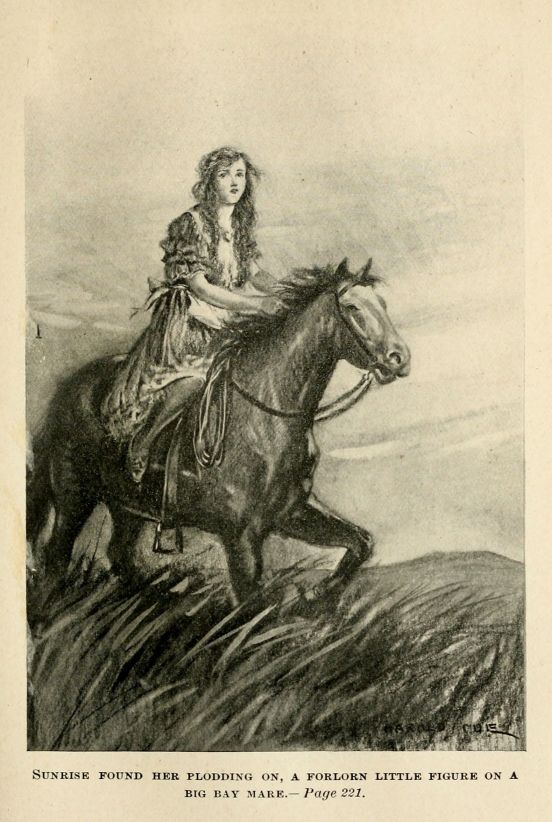
SUNRISE FOUND HER PLODDING ON, A FORLORN LITTLE FIGURE ON A BIG BAY MARE.
Shortly after sunrise she was overtaken by a band of Winnebago Indians laden with elk hides and buffalo skins, returning to their camp from a week's hunt in the Blackbird Hills.
The surprise of the Indians may be imagined when seeing a solitary rider ambling slowly and apparently aimlessly over the prairies, they overtook it and saw that the rider was a beautiful little white girl, who cried bitterly when they spoke to her and would not tell who she was, where she had come from or where she was going.
None of the band could speak English, and as Nina knew no Indian there was little chance of her being able to inform them. It was quite evident, however, that the child was wild with terror when they approached her, and when they took her and her horse in tow she shrieked and fought, utterly unaware that they were doing their utmost to assure her that they were "good Indians," that they never hurt children and would take her back to her home and family if she could make them understand where she lived.
After much perplexed discussion among themselves the Winnebagoes decided to take her back with them to their encampment, where they would find some of their tribe who spoke English, and find out who the young stranger might be.
They tried to be kind and gentle to her, and the squaws did their best to comfort her, but the child was in a perfect panic of terror, and at the approach of every new person shrank and shuddered, looking with great agonized violet eyes into the faces of the Indians, and shaking and trembling with fear. To her all Indians were alike, and momentarily she expected the hated Red Snake to come and claim her.
As days passed, however, and Red Snake did not appear, when day followed day and no dreadful thing happened to her, and she saw the boys and men ride away leaving her behind with the squaws, old men and children, she began to be less afraid. Little by little the haunted look of terror left her eyes, and after a time she began to scrape acquaintance with the children that hung fascinated about her. The bright-eyed little papooses strapped to their rigid back-boards appealed to her wonderfully, and when she sat down before them and played with them, chucking them under their fat little chins and playing "peek-a-boo" with her apron, they squealed with laughter, and she too could begin to smile. After a while she began to play with the little Indian girls and boys, and little by little to learn their language and teach them hers.
Twice the camp was moved, and Nina was moved with it, helping the squaws with the babies, and feeling tremendous interest in the bustle of preparation, when the teepees were taken down, folded and tied with cords made of deer and buffalo hide, and fastened to the ponies, strong shaggy little beasts which dragged them after them in long traces, while the women carried the bundles, and the braves walked along smoking their pipes ahead of the procession, or nonchalantly rode their ponies, leaving the squaws and children to bear all the burdens and shoulder all the responsibilities of moving.
At first Nina could not understand these moves, but gradually came to know that the Indians were engaged in their fall hunt, and that while the men scoured the plains for the animals that provided them with food, clothing, and shelter for the winter, the women and children moved slowly along behind them with the equipment, so that the camp to which the hunters belonged was never far away.
The Indians were all kind to her, the women gentle and even motherly to the little paleface that had been thrust so unceremoniously among them, the men quiet and grave, but never cross nor severe.
Gradually as the days passed by she became fond of her little playfellows, and though she was desperately unhappy, and longed with a sick, yearning heartache for her adopted home, she did not suffer as she might have suffered if she had fallen among less quiet and gentle people.
One day when she had been romping over the prairie with the children and dogs they came back to find a great band of hunters just riding in, laden with the fruits of the chase. Some of them bore long poles on their shoulders from which were suspended the carcases of elk and deer, others carried great willow baskets, which the Indian women made, containing the meat of deer, antelope, and buffaloes which had been stripped from the bones to save carrying the huge bodies; others carried great baskets of grouse, prairie-chicken, and quail, and the whole camp was full of rejoicing.
Among the hunters was one tall, powerful Indian, who stopped short as the group of children came running toward them, and stared at Nina with an expression of utter astonishment on his face.
Pointing his finger at her he asked in the Winnebago dialect how she came to be there. A babel of tongues broke out among the children and squaws, each trying to tell her version of the story.
Nina, seeing him staring at her, was filled with fear. Her face paled, her great violet eyes widened with terror, and her bosom began to heave. But the red man walked straight up to her and put out a big brown hand.
"How, Nee-ah-nah," he said, and smiled down upon her.
Nina, with a trembling hand at her bosom, drew back.
The big Indian smiled, and putting his hand in his bosom, brought forth a little chain of blue beads which he held up before her.
The child looked, gasped, then looked again, then with a joyful cry ran to him.
"Neowage, Neowage!" she cried.
The big Indian grinned down at her and held her hand.
"How come here?" he asked gently.
Nina burst into tears. "I was captured by the Sioux," she cried. "They made an assault on the house—they got me—and Joe—Joe came after me to rescue me—and he was killed, Neowage, he was killed! Red Snake shot him."
Neowage threw up his hands. "Ai-ee, ai-ee! Keel? Sho keel? Ai-ee, that too bad. Tell."
Between her heartbroken sobs Nina told of the assault upon the sod house, of her capture, and of Joe's attempted rescue and what followed. When she had finished she clung to Neowage's hand sobbing bitterly.
"Take me home, Neowage," she begged, "oh, take me home! They've been good and kind to me here, but oh, I want to go back to Mother Peniman, and Ruth and Sara and Lige and Sam and little Da-da! I want to go back to them and try to comfort them, for if it were not for me dear Joe would not now be gone."
The big Indian stroked the golden hair with his great brown hands and patted and comforted her.
"Me take you home, Nee-ah-nah," he said, "me take you home."
The next morning Nina bade farewell to the squaws and papooses, the boys and girls that had been so kind to her, and mounted upon Kit's back, rode away by the side of Neowage in the direction of the homestead on the Blue River.
It was a soft golden day in early October, and the prairies were yellow with goldenrod and spangled gayly with sunflowers and St. Michaelmas daisies. As they rode the sun cast long shadows on the grass that looked like brown velvet in the distance, and the sky arched over them with a blue that is all Nebraska's own.
They talked little on the way. Neowage seemed to have fallen into a fit of deep musing, and Nina's heart was too sore with grief to feel like attempting conversation.
They rested that night at an Indian camp on the prairies, and started at daylight the next morning. It was almost evening when familiar landmarks began to come in sight, and quite dark when they rode up to the sod house.
The lamps were lighted inside, and creeping up to the windows Nina looked in, with a heart that was like to burst with mingled grief and joy.
The children had gone to bed, and on either side of the table sat Joshua and Hannah Peniman. The Bible was open on the table between them, and Joshua Peniman's head was bent forward on his hands while Hannah sat with hands folded in her lap, her eyes on the fire, with an expression of heartbreak in their depths that made Nina sob aloud.
Somewhere in that land of broken dreams in which her thoughts were wandering Hannah Peniman heard the sound. She started, looked up, saw the face at the window, and with a sharp, gasping breath sprang to her feet, her hand pressed against her breast.
Nina dashed to the door, threw it open, and sprang into her arms.
"Mother Peniman, Mother Peniman!" she sobbed over and over, unable to speak any other word.
"Nina! Nina! My lamb! My child! Where did you come from?"
Joshua Peniman had sprung to his feet and stood staring like a man in a dream.
Before he could speak Mrs. Peniman had loosed Nina's arms from her neck and peered into her face.
"Nina"—she gasped, "Joe—where is he?"
Nina buried her head in Mrs. Peniman's bosom. "Oh, Mother Peniman, Mother Peniman," she wailed over and over as if she could not speak the words that must be spoken.
Joshua Peniman came to her, raised her head, and with his haggard eyes gazed into her face.
"What is it, Nina?" he said, with the gentle tone of authority she knew so well in his shaking voice. "Tell us. Anything is better than suspense."
It was some minutes before she could control herself enough to speak. Then, as gently as she could, she told her story. When it was finished there was no sound in the room. Joshua Peniman stood as if turned to stone, while Hannah Peniman's face turned from white to livid grey and looked as if stricken with death.
The sound of the talking had wakened the children, and they now came rushing out into the room; there was a wild shout of joy, which was changed to bitter tears as they heard the news she had brought them.
Suddenly Joshua Peniman raised his head.
"I have not thought to ask how you got here, Nina?" he said, in a voice she would scarcely have recognized. "Surely you did not come alone?"
"No, Neowage brought me."
"Neowage? Where is he?"
They found him squatted in the grass outside, with too much delicacy of feeling to obtrude himself upon the family in their grief.
Joshua Peniman grasped his hand in silence, unable to speak. In silence the Indian returned the pressure.
When he had greeted the family with his impassive "How," and had eaten the meal which the weeping Ruth provided for him, he lay down before the fire and gazed thoughtfully into its depths. Hannah Peniman had gone away into the night alone, Ruth had taken Nina away to bed, and Joshua Peniman sat with his arms on the table and his head bowed upon them, a prey to the agony and despair of losing an eldest and best-beloved son.
Suddenly Neowage looked up.
"Nee-ah-nah no see him die!"
Mr. Peniman raised his head, and his gentle face was seamed and seared as if a dozen years had gone over it.
"No, but I fear it is as she said. Joe would have been home before this if he was alive."
"Sho no dead!"
Again Neowage relapsed into silence, smoking his pipe and gazing steadily into the fire. Presently he rose, gathered his blanket about him, and shaking his host's hand solemnly strode forth into the night.
For three days the Peniman family mourned Joe as dead.
Mr. Peniman said little, but his hair turned white, almost in a night, and into Hannah Peniman's eyes had come a look of silent, patient suffering that none of the family could look upon without tears.
To Lige and Sam the blow had come with a shock that left them stunned for a while, then overcome with uncontrollable grief. Ruth and Nina clung to one another in a sorrow too sharp and keen for words, and the little ones wept without ceasing for the brother who did not come home.
On the morning of the fourth day the Chapter had been read, the silent prayer was over, and the family set mournfully about the work that had to be done, no matter how heavy the heart.
Going down to the spring for water Lige passed the dugout, and hearing the step outside Kit put her head out and whinnied.
The sound fairly unmanned him.
Kit had always known Joe's step, and had greeted him with that glad little whinny every morning.
"He can't come to you this morning, Kit," he whispered huskily, going to her and putting his arms about her neck, "he can't come to you—or to us—ever again." And leaning against the smooth brown neck he burst into a passion of tears.
To none of the family perhaps, except his mother, had Joe's absence brought more poignant grief. Always together, from their very babyhood, and dependent largely upon one another for companionship, there had grown up between the lads a comradeship so close, an affection so sweet and strong, that life seemed scarcely to be endured apart from one another.
Lige had striven nobly to fill Joe's place, hoping daily, almost hourly, to see him come riding home. But as the days and weeks passed that hope had grown gradually fainter and fainter, until the news that he had just heard was merely a confirmation of the fear that was in his heart.
So deeply was he plunged in grief that when he chanced to glance out and see two riders dashing across the prairies he took no interest in them. He glanced at them idly, then turned away as the blur of hot, bitter tears dimmed his eyes.
Brushing them hastily aside he took up his pail and went on to the spring.
Thus it was that Sam was the first to herald the approach of the strangers.
"Father," he said, in a sad, subdued voice, utterly unlike Sam's usual cheerful bellow, "here come two men on horseback. One of 'em looks like an Indian."
Mr. Peniman rose quickly and went to the door. He had no hope, yet something in the words of Neowage the night before had clung in his memory and said themselves over and over in his brain all night.
"Nee-ah-nah no see him die."
No one had seen him die! Perhaps—perhaps God in His infinite mercy——
As he stood in the doorway with his hand shading his eyes, his silvery hair glistening in the morning light, there was a strange tumult in his breast.
He shaded his eyes and gazed intently. Presently when the riders had come nearer he saw one of them lean forward and wave his hat about his head.
"Hannah!" he called in a queer, choked voice, "Hannah!"
Something in his tone brought her hurrying to the door.
The riders were now galloping madly. One of them, far in advance of the other, leaned forward on his horse's neck, and waved and waved, riding as if the horse could not carry him fast enough.
With a gasping breath Hannah Peniman clutched her husband's hand. Neither spoke. Both ashen pale, silent, tense, they strained forward, their eyes set on the riders galloping toward them.
Suddenly from Hannah Peniman's lips came a hoarse, "Merciful God!"
At the same moment Sam leaped through the door and began racing toward the riders with Paul at his heels, shouting frantically, "Joe, Joe, Joe!"
The riders were close now, and the foremost, with tears streaming down his pale cheeks, was lashing the little Indian pony with one hand, while with the other he waved and waved his hat about his head, shouting, "Home, home, home!"
None of them ever knew who reached him first, how or when or where he got off his horse, or how they all got back to the sod house, laughing and crying and clinging to one another, and saying over and over again as if they would never tire, "Joe's home, Joe's alive, Joe's home again!"
Down at the spring Lige had heard nothing of the excitement. He had splashed water over his face and eyes to remove the traces of tears, and close by the running water had sat down to get control of himself before he should go back to his mother and the house. As he came slowly up the incline carrying the pail he saw a crowd about the door. For an instant he stood motionless, then dropped his pail and ran swiftly toward the house.
Was it—-could it be—news of—of Joe?
When he was nearly to the house one of the children leaping and capering about stepped aside, and he saw a tall, slender boyish figure clasped in his mother's arms. Lige, tall young pioneer that he was, almost fainted. When the world righted itself he gave a hoarse, hysterical shout and dashing forward precipitated himself into Joe's arms.
Perhaps it was his shout of "Joe, Joe, Joe!" perhaps the general hubbub, that awoke Nina, who, exhausted by the trials through which she had passed, had been charged to remain in bed.
Startled by the noise she woke in a panic, leaped out of bed and ran to the window. What she saw outside held her there paralyzed, believing that she had lost her senses.
Joe glancing up saw here there, her eyes wide and fixed, her face white as a snowdrop, her head framed in a nimbus of golden hair.
Never while life lasted did he forget the picture.
"Nina!" he shouted, joy, amazement, incredulity in his voice.
The girl meanwhile was staring at him as if he were a ghost.
"J—J—Jo-oe!" her lips framed the word rather than spoke it. Then again, as if she could not believe the evidence of her senses—"Joe!"
Ruth ran to her and caught her in her arms. "Yes, Nina, yes, darling, don't look so scared. It isn't his ghost, it's just himself, our own darling, blessed, precious Joesy home again, alive and well, and not dead at all!"
Joe broke from his mother's arms.
"Nina, Nina," he cried stretching his arms toward the window, "oh, Nina, how did you get here? How did you escape? Oh, I've worried and worried and worried about you! Oh, thank God, you got home! I thought that the Sioux or Red Snake had got you again!"
Nina leaned from the window gasping and panting.
"But you, Joe—you—I thought you were dead! I saw you fall—I saw you slide into the water—and when I went to look for you you were gone. Oh, Joe, where did you go? I thought you were dead——"
She burst into a fit of hysterical weeping, and Ruth drew her back into the bedroom. A few minutes later, dressed, and a bit more calm, she burst from the door and ran into Joe's waiting arms.
It took a vast amount of talking, of telling and explaining and exclaiming, and tears and chills and thrills, before the whole story was complete, its two parts pieced together and all the events that had caused so much suffering and anxiety made plain.
It was a long time before Joe, with his hand clasped in his father's, his mother's arm about his neck, Ruth and Sara on either knee, Nina at his feet, and Lige and Sam and Paul and David crowded close up to him, had time to remember Pashepaho.
When he did remember him he ran to the door and called him. The handsome young chief was standing outside, his face wreathed in smiles.
Joe called to him joyously.
"Come on in here, Pashepaho," he shouted, "I want you to come in and join in the jamboree, and see all these blessed people I've been talking to you so much about." Then clasping Pashepaho's hand, "Listen, folks, I wouldn't be here now having you all make such a fuss over me if it wasn't for this fellow. If Pashepaho hadn't nursed me and tended me and doctored me like a brother I'd have been a dead one long ago."
You may be sure that Pashepaho received a warm and cordial welcome from the family. When Mr. and Mrs. Peniman shook his hand and thanked him with deep emotion for all he had done for their son tears sprang to his eyes. But when the children gathered about him and pulled the feathers on his dress and tugged at the beads and laid timid fingers upon his tomahawk he smiled, gave Sam his war-bonnet to look at, took little David upon his knee, and was soon happy and at home amongst them.
CHAPTER XX
EAGLE EYE REMEMBERS
When Eagle Eye left the Peniman family, striding away across the plains without a word of gratitude or farewell, Mrs. Peniman and the girls felt grieved and disappointed.
It would have comforted them perhaps if they could have seen his face; if they could have detected the surreptitious glances he threw backward, or if they could have beheld the moisture that blurred his eyes, which he hurriedly wiped away as if ashamed of his weakness.
He was not yet strong, and could not make rapid progress, and as he sat down in the grass now and then to rest his eyes turned ever backward to the homestead, while he turned over and over in his mind the story Joshua Peniman had told him.
Of that story he knew more than the white man suspected.
He was a Sioux, and had seen Red Snake among his people.
When, after many days' travel, he at last reached the Sioux village on the Missouri River, near the mouth of the Niobrara, he went at once to the head chief of the tribe.
"Where Red Snake?" he asked in his own language.
"I know not," answered the chief in the same language, "I have not seen him for many sleeps."
"Red Snake bad man," continued Eagle Eye, and proceeded to tell the chief the story that Joshua Peniman had told him, adding to it much that he had learned about the family while being nursed back to health among them.
When he had finished the tale the old chief looked thoughtful.
"Red Snake has a bad heart to the white brother," he said after a long pause. "He has done much harm to my people. He leads my young men into much trouble. He has brought fire-water among us, he has taught our young men to drink. And when my young men are drunk he takes them on raids on the white people. He make me much trouble with the white man's government. I wish he would come to my teepees no more."
Eagle Eye fervently echoed the wish.
"Where is the boy—the young maiden—he captured?" he continued.
Eagle Eye shook his head. "Gone!" he said laconically.
Both Indians puffed their pipes solemnly for a while. Then Eagle Eye asked the question he had been making ready to ask from the beginning.
"Does the Great Chief know what is Red Snake's name?"
The old chief shook his head slowly.
"I know nothing. One time when the big fire burn the grass of the prairies Black Bear brought a white man to our camps. He was drunk and had been caught in the great fire. He was heap sick, sleep two, three, many days. He gave Black Bear much presents, gun, knife, beads, many things. He gave other young men of my camp presents. At last he gave them firewater, and my young men were pleased. They gave the paleface a place in the lodge of my people. They called him 'Red Snake' because he moved so still and the Great Spirit had given him red hair. After a while he married Wahahnesha. He has been with my people ever since."
"And you never heard the true name of the white man?"
"No. He never told his name."
For some minutes they smoked in silence. Then rising slowly the old chief went to the back of the lodge and returned with a pouch made of deerskin in his hand. From it he drew a small red morocco-covered book, which he held out to Eagle Eye.
"He lose. Me find. Me keep."
Eagle Eye took the book and turned it over and over in his hands. As he turned its pages he could make out a lot of queer-looking marks and signs, which meant nothing to him. After scrutinizing it carefully but uselessly for a while he handed it back to the chief. The chief waved his hand.
"You keep," he said laconically, "give white man some day."
After another silence he burst forth: "He no red snake, he black snake. Heap bad man. Some day he make heap trouble for Sioux. Bring white soldier—shoot my young men. Wish he killed—wish he come back to my people no more."
Eagle Eye sat smoking silently for a time, then rose and left the lodge.
He heard the sound of voices, and following it came to a great camp-fire, about which a number of young men of the tribe were sitting cross-legged on the ground. He greeted, then joined them, listening idly to the talk that went on among them.
He learned after a time that they were talking about a great hunt that was to take place the next day, and that Red Snake, who had been suffering from a wound in the knee and had gone to Bellevue to see a white man's doctor, had returned the day before and was to accompany them. There was much joking about the presents he had brought them and the fire-water that was to be taken with them on the hunt, and which was to enliven their night camps.
"And where is the hunt to be?" asked Eagle Eye, a quick alarming thought running through his head.
"To the Minne-to-wauk-pala. He say heap much antelope, elk, buffalo out that way."
The eyes which had given the young Indian his name blazed hotly. In an instant he saw the plan. He knew as well as if he had heard the details that the drunken degenerate white man was planning to take these young men on a hunting expedition, and when they were crazed with fire-water lead them on a raid on the Peniman homestead, for which, if trouble arose, they would be blamed, and he would escape free, and yet would be enabled to work out his fiendish designs upon the family.
Without a moment's hesitation he resolved to join the hunt.
Long before the sun rose the next morning the young Indians were on their way. Red Snake, attired in his usual fashion, with his face stained red and great warlike emblems of red and blue and yellow painted on his face and breast, led the way.
He was not intoxicated this day, Eagle Eye observed with some interest, and the fire-water was kept carefully secreted until they made their night camp, when a demijohn was passed around and around among them until the Indians were all wild or stupid. He drank nothing. Eagle Eye, while making a great pretense of roisterous drinking, took little, but pretending to be stupefied lay down beside the fire with his blanket over his head and watched and listened until all was still.
The camp had sunk to silence, the whoops and yelps of the drunken Indians had gradually sunk to grunts and snores, when Eagle Eye saw Red Snake creep from his blanket and signal to Black Bear, a wild young buck who had already been in considerable trouble, and draw him away from the camp.
Eagle Eye lay still for a few moments, then rolling over and grunting, as if in a bad dream, edged himself away from the firelight until he reached the shadows beyond, then on hands and knees crept noiselessly through the grass until he was within earshot of Red Snake and Black Bear. They were talking in low, guttural tones, fortunately in the Sioux dialect.
After a jumble of talk, of which he could make nothing, he heard at last the thing for which he had been waiting; Red Snake and Black Bear were planning a raid upon the Peniman homestead, and to Black Bear was confided the details of leading the raid, while Red Snake himself would be free to carry out whatever nefarious designs on the persons or property of the settlers he might have in mind without danger of detection.
Eagle Eye's blood boiled hotly. Not only was his indignation aroused against the renegade by the feeling of gratitude for the white family who had nursed and tended him, but because of his loyalty and devotion to his own people.
He had been one of those who had been betrayed into making the assault upon the Peniman place before, and his life had nearly paid the penalty of his folly. Then, as now, the young Indians had known nothing of his plans, but maddened with fire-water, incited by wild tales of loot and treasure, they had followed him, ignorant of the fact that they were being made the cat's-paw to cover his crimes, and that should detection and punishment follow it was the Sioux who would be blamed and punished by the white man's law, while the white man who was responsible for it would escape, his villainy covered by the blanket and war-paint of an Indian.
All the next day the party hunted, bringing down many elk, deer, and antelope, cheered and enlivened by the prospect of the evening's carousal and the tales of the great herds of buffalo they would overtake the next day.
There was little sleep for any one in the camp that night. When darkness fell the camp-fire was lighted, and the supply of fire-water with which Red Snake had liberally provided himself while he was in Bellevue was sent around. No limit was put upon it, and after a time the prairies rung and the night was made hideous by the yelps and howls and wild orgies of the Indians, who, unaccustomed to the poisonous stuff, were made fairly mad and frantic by it.
When the start was made in the morning they were still drunk. Many of them were like mad men, while others were stupefied and logy, scarcely able to sit their ponies and utterly unfitted for the chase. Whether the tales of Red Snake in regard to the great herds of buffalo between them and the Minne-to-wauk-pala were intended as fiction or not they turned out to be true, and shortly after daylight they spied a vast herd feeding to the north of them, for which the Indians started with wild whoops of delight.
Red Snake followed, cursing. His plan was not working out exactly as he intended.
Riding like maniacs the crazed young warriors soon came close enough to the herd to fire, and a volley of arrows whizzed through the air, stinging and maddening the animals, and while not wounding severely making them ready to fight.
Instead of fleeing in terror, as they did from gunfire, they turned about and made a dash into the ranks of the drunken Indians, who, utterly unprepared for such action, became panic-stricken and many of those who sat their ponies unsteadily were thrown and trampled in the wild stampede that followed, while others fired wildly and recklessly, their arrows stinging and maddening the beasts, which gored and trampled the hunters that fell at their feet.
With wild shouts Eagle Eye urged his pony in among them, trying with all the might that was in him to rescue his friends, who, maddened and stupefied by the deadly effects of the liquor they had drunk the night before, were unable to help themselves.
As he stood with his bow curved, his arrow poised for flight, his eye chanced to fall upon Red Snake, the baleful and malign influence that had brought this and other troubles upon his people. Eagle Eye was a hereditary chief, and loved his people with the love of a father. Suddenly as he gazed upon the renegade white man a fierce anger burned in his breast. He saw red. His blood surged madly through his veins. And changing the aim of his arrow with the quickness of lightning he bent his bow strongly and let it fly, carrying his vengeance with it.
He saw Red Snake throw up his hands, heard above the uproar his yell of rage and pain, and saw him fall and the buffaloes charge on and over him, galloping away over the plains.
When they had gone the survivors of the disaster, sobered by their peril, drew close together and looked about them. On the ground were strewn the carcasses of a number of buffaloes, and among them, mangled and crushed out of all human semblance, were many of the young Indians who had set out that morning so recklessly.
Black Bear, who remained unhurt, went among them turning over those that lay face downward, lifting those that were alive, passing by those that were dead with a grunt. Suddenly he uttered an exclamation and stooped over a prostrate figure. Eagle Eye moved nearer. As Black Bear lifted the trampled and mangled form he saw that it was Red Snake.
"Is he dead?" he asked in his own language.
Black Bear put his ear to the chest of the wounded man.
"No, he is breathing," he answered in the same language.
"Then put him on your horse and take him home," thundered Eagle Eye. "He is your friend. You brought him among us to bring death and trouble and disgrace to your own people. Now look out for him. And you"—he pointed his finger in the face of Black Bear with a look that made him cringe, "go to the chief when you get there. I know what you were going to do. I heard your plan. The chief will settle with you for it."
Without a word the Indian stooped and picking up the body of Red Snake threw it across his horse, mounted behind it, and rode away. Eagle Eye stayed behind to bury the dead, look after the wounded, and see that the Indians who were too drunken to take care of themselves were mounted and started back toward their village.
When he arrived Black Bear was there.
"Does Red Snake still live?" he asked.
"He still lives," replied Black Bear.
"So much the worse for you," Eagle Eye told him, and driving Black Bear before him went straight to the lodge of the chief, where he told him the whole story.
When it was finished the old man turned to Black Bear.
"Have you no love for your people," he asked, "that you are willing to lead them to death and destruction? Well are you named 'Black Bear,' who sees not the danger when his nose is tickled by the honey-pots of strangers. You would have betrayed your people. You would have led your own kindred into the snare laid for you by the white man who has a bad heart toward Indians. You have caused the death of our young men. You are not worthy to live in the lodge of your people. Go; from this day forth you are no longer one of us. We cast you out. Now go!"
He slunk away, and at the same moment a young squaw entered the lodge of the chief in search of Eagle Eye.
"You speak the tongue of the white man," she said. "Come!"
Leading him to a teepee not far away she pushed aside the skin that hung over the door. He entered and saw Red Snake lying on a pile of skins and blankets in a corner, crushed and bleeding, the seal of approaching death upon his face.
As Eagle Eye approached him he opened his eyes.
"You die," said the Indian, looking down upon him sternly, his arms folded across his breast.
Red Snake looked up, the dew of death upon his forehead.
"Yes," he sneered. "It's all over. The game's up—and I'm glad of it."
"Who are you? What you name?" asked Eagle Eye.
"No matter who I am. I've sacrificed all claim to the name I was born with. I'll die as I have lived, as 'Red Snake,' a squaw-man, a renegade, a drunkard, an all-around bad egg."
As the words left his lips a shudder ran through his body, his eyes flew wide, and he clutched wildly at his breast; then with a gasping breath fell backward, the blood gushing from his lips.
Eagle Eye bent over him. The Indian head-dress had been lost or cast aside and his thick mane of red hair fell loose about his face. Beneath the buckskin shirt which he had thrust aside in his agony his skin was smooth and white, and, as if in immutable justice for the deed that he had done, a feathered arrow protruded from his breast.
The Indian stood looking down at the dead body for a moment, then spurned it with his foot.
He turned presently and cast his keen eyes about the wigwam. With a step as soft as that of a panther he skirted its walls, and from under a heap of hides, blankets and rubbish in a corner drew forth a battered tin box.
For a moment he stood holding it in his hands and gazing at it curiously. Then he tucked it under his arm under his blanket, and with a backward glance at the body and a muttered "Ugh!" lifted the flap and passed out into the night.
CHAPTER XXI
THE BLIZZARD
With the coming of November, bitter winds and cold rains began to beat across the prairies, and the thoughts of the pioneers were turned with deep concern toward providing for the winter.
On an expedition up the river one day Joe and Lige came upon a quantity of wild grapes and plums, and directly after the first frost the whole family made a day's excursion to the place and returned laden with bushels of fruit, a most precious commodity on the prairies, where other fruits were not to be had. Mrs. Peniman set to work the next day and made it up into jelly, jam, and preserves, which constituted a most welcome addition to their meals throughout the winter.
The pressing work at hand kept the whole family busy from daylight until dark, and December was upon them before they were aware.
Early in the month there came a break in the bad weather, followed by a series of mild, warm days.
Joshua Peniman, who had been carefully going through his stores and feeling some uneasiness in regard to the condition of their winter supplies, hailed this weather with joy, and determined to take advantage of it to make a trip to Omaha, then the nearest point at which they could obtain the needed commodities.
When Mrs. Peniman was told of the project she looked much troubled. "It has to be done, Hannah," he said, answering her look. "When the winter storms set in we are liable to be blockaded here for months, and we must be provided with sufficient supplies for our needs. Besides," he added with a smile, "you know Christmas is coming. Santa Claus must not fail to visit us this year—even if we are away out on the prairies."
"Dear man," she replied, patting his arm, "thee never fails to think of everything, does thee? Of course Santa Claus must come this year. But it chills my heart to think of thee crossing those dreadful prairies. Of course Joe must go with thee——"
"No, Joe and Lige must stay here to guard you and the little ones. But I will take Sam. He is a bright boy, and will be great help and company for me. Come now, let us make out our lists, for I would like to start this morning while the weather is bright and clear."
Before ten o'clock he was on his way, a long list of necessities in his pocket and Sam by his side, driving Jim and Charley, now sleek and fat and in fine condition from grazing on the rich grass of the prairies.
Joe and Lige were somewhat disappointed when they learned that they were to be left behind, but when their father told them that he was leaving them to take his place and act as the head of the house during his absence the pride they felt in the trust he reposed in them almost made up for the disappointment.
Sam, however, was jubilant. The prospect of the trip across the prairies with his father, of again seeing a town, thrilled him, and he chattered away gleefully as tucked cozily under the buffalo robes (made from the hides of the animals Joe and Lige had killed in a great buffalo hunt they had gone upon with Pashepaho), as they clattered away over the prairies.
The first night they put up at Lancaster, the little settlement on Salt Creek at which they had stopped on their way out, and the third day reached Omaha, after a rather wearisome and uneventful journey.
They put up at the American House, and his father gave him three dollars, and suggested that he might like to buy some things to bring to the folks at home, and also to purchase some Christmas presents for the family.
This was the first time that the thought of Christmas had come to him, and it brought with it something of a shock.
Christmas!
This would be a queer Christmas, away out there on the plains all by themselves!
He thought of the Christmases at home, of the comfortable old house wreathed with greens and holly, of the great Christmas tree in the parlor, the Christmas dinner, the stacks of presents, and the jolly crowd of aunts and uncles and grandmother and cousins and other relatives gathered about the board.
A wave of homesickness went over him, then the exciting thought of three whole dollars to spend took possession of him and he forgot his homesick feelings in planning what he should buy.
When his father set forth in the morning to make his purchases Sam, with his three dollars locked firmly in his hand, ran from store to store.
He bought candy and peanuts and apples and popcorn, a lace scarf for his mother, ties for Joe and Lige, ribbons for Nina, Ruth and Sara, a top for Paul, a doll for Mary, and a hobby-horse and a large candy cane for little David.
The candy cane took his last penny, and, in fact, he was obliged, greatly to his embarrassment, to change his order from a larger to a smaller candy cane, because the one he had selected cost three cents more than he possessed.
Well satisfied with his purchases he returned to the American House, where he found his father with the wagon loaded waiting for him, a fine new heating-stove for the living-room standing up grandly behind the seat.
"Jump in, son," he said quickly, "I have been waiting for thee. I want to get on the way. I'm afraid from the looks of the sky we are going to have a change in the weather."
They drove fast, and reached Lancaster by about six o'clock in the evening, by which time it had grown much colder. They awoke the next morning to find a grey sky and a high northwest wind blowing.
His father had bought an ear-cap and a pair of warm mittens for him in Omaha, and these he was glad to put on, and he noticed when he took his place in the wagon that hot bricks had been tucked away in the bottom under the buffalo robes.
As they drove he noticed that his father was unusually quiet and kept casting glances at the sky. He urged the team forward as fast as they could go, even using the whip, a thing he would never do except in extremities.
By ten o'clock the wind had risen and scattering snowflakes had begun to fall. By noon the sky had changed to a deeper grey and the wind had increased to a biting gale.
It was shortly after one o'clock, and they were clattering fast across the prairies, when a sudden blackness, almost as of night, seemed to fall upon them. For a moment the wind died down and a hush fell over all the earth that was like the hush of death. All about them over the vast, lonesome prairies came a tense, ominous silence, as if all nature were holding its breath. Then, with a whoop and a shriek that was like all the demons of the Inferno let loose, the blizzard was down upon them.
Its onslaught was so fierce and sudden that it staggered the horses and almost upset the wagon. The snow that came on the breath of the terrific gale did not fall in flakes, but in solid whirling sheets, which blinded, smothered, and utterly bewildered them. It stopped their breath, it stung their eyes, it slashed and beat in their faces like the beating of nettles.
All about them was a blackness almost like that of midnight, and the eddying wall of swirling, blinding snow, driven by a ninety-mile gale, caught them in its embrace, drove the breath from their lungs, froze on their mouths and nostrils, and buffeted them with a fury that almost left them senseless.
The horses, covered with snow almost as solidly as if it had been spread over them with a trowel, stood with drooped tails and heads, dazed and shivering, not knowing which way to go.
Through the demoniac shrieking of the wind Sam heard his father's voice.
"Get down in the bottom of the wagon under the robes," Joshua Peniman shouted, and tried to urge the terrified horses forward against the blast.
He knew that he dared not let them stop now. He knew that come what would he must keep them going as long as they could stand. He could not see a step before him. All about them was a maze, a stinging, dazzling, whirling wall of white, that blown on the breath of the fierce northwest wind pelted and buffeted the very breath from his body.
In a shorter time than would have been believed possible the prairies were covered with snow, all traces of the wagon-trail blotted out, and no indication anywhere which way to go.
The horses seemed utterly bewildered. Finding it impossible to keep them headed against the blast, and fearing that if they once swerved from the direction in which they had been traveling that he would lose his sense of direction and become lost on the prairies, he leaped out of the wagon, and grasping the terrified team by the bits led them forward, resolutely keeping his face toward the west. He knew that the wind was blowing from the northwest. If he kept it on his right cheek he knew that he was keeping in the right direction.
The breath of the horses froze on their mouths and noses, and walking beside them he had to continually wipe it away so that they could breathe. Stumbling along, now protecting his own face and ears, now the faces of the horses, he prayed continually for guidance and help.
Down in the bottom of the wagon against the hot bricks and under the buffalo robes Sam gradually recovered his breath and began getting warm. But fear and anxiety for his father made it impossible for him to keep still.
He wiggled out of the robes and suddenly appeared at his father's elbow.
"You get in and get warm now, Father," he shouted above the shrieking of the blizzard. "I'm warm now; let me walk by the team."
The temperature had fallen to thirty degrees below zero by this time, and warning prickings of his face, ears and feet told Joshua Peniman that he must take every precaution against freezing.
"Can you stand it for a few minutes?" he yelled, with his mouth close to Sam's ear. "I'm afraid my feet are freezing. I'll get on some more clothes and warm up a little, then I'll take them again. Keep the wind on your right cheek all the time. The horses don't seem to know which way to go."
Sam took the bits and his father climbed into the wagon. He rubbed his face and ears with snow, took off his boots and rubbed his feet, then warmed them against the hot bricks, put on his boots and wrapped his feet in pieces torn from the blanket. With another strip of the blanket he wrapped his head about, leaving only his eyes exposed. He knew that the one hope of their getting through this storm alive was for him to keep from freezing and able to direct their movements. When he had protected himself as well as he was able he again sprang to the heads of the floundering horses and sent Sam back into the wagon to rest and get warm.
In this way they kept their blood circulating, and relieved one another. He thanked his precaution of bringing the hot bricks many times. Under the buffalo robes in the straw in the bottom of the wagon they could escape the fury of the freezing gale, and by taking refuge there at short intervals they were able to keep from freezing.
Every moment the blizzard seemed to increase. They could scarcely see the struggling horses from the wagon now, and the snow, drifting on the biting wind, was growing deeper and deeper all about them.
Sam, protected like his father with strips of the blanket tied around his feet and wound about his head up to his eyes, was struggling at the horses' heads when suddenly the wagon gave a lurch, tilted perilously, then stopped.
The horses, up to their middles in snow, plunged and struggled, and Joshua Peniman leaped out, looked, and uttered a deep groan. One of the front wheels was broken at the hub.
For a single terrible moment the father and son stood gazing at the damage, and hope almost vanished from their breasts. Then Joshua Peniman set to work to liberate the plunging horses.
"We'll have to leave it," he shouted, struggling with his half-frozen fingers at the traces. "We'll have to trust to the horses."
"But our wagon—the supplies—our Christmas presents——" Sam shouted back, trying to raise his voice above the howling and shrieking of the storm.
"Can't think of them now," gasped Joshua Peniman; "we'll be lucky if we save ourselves!" And having got poor Charley loose from the disabled wagon he lifted Sam up on his back, and wrapped him about with blankets and one of the buffalo robes. Then taking the other robe from the wagon he mounted Jim, and wrapping himself up as best he could led the way straight into the teeth of the roaring, stinging vortex, that hissed and shrieked like ten thousand demons about their heads.
"Keep close!" he shouted to the boy, "keep Charley's head right up against Jim's tail! Don't lag, don't get out of my tracks or we're lost!"
The drifts were now up to the bellies of the horses, and growing deeper every moment. The wind had increased to a degree against which they could scarcely stand, and the snow came down in such solid sheets of blinding, dazzling white that they could not see a foot before them, could not keep their eyes open against its pelting fury, might almost as well have been stone blind, as they beat their way, struggling, stumbling, floundering, against the storm.
After a few moments of frantic struggling the horses stood still, shaking and trembling, instinct urging them to turn tail to the storm, yet kept facing its cruel onslaught by the firm hand upon the reins. Again and again one or the other of them stumbled and fell, and each time they got to their feet with greater difficulty.
Joshua Peniman had given up trying to ride, and was again walking at their heads, urging them on, patting, encouraging, helping them all he could. He knew that none of them could last long. He knew that the horses must soon fall and perish, and that no human creature could hold out long against the cold that seemed to grow more intense with every passing hour.
With all the strength, all the faith that was in him he prayed for help.
CHAPTER XXII
TO THE RESCUE
In the sod house on the prairies meanwhile there was fearful suspense and anxiety.
From the moment of the departure of her husband and son Hannah Peniman had watched the weather with an anxious eye. When the wind rose and the snow began to fall fear took hold upon her. With eyes scanning the horizon she went from door to window and window to door, hoping every moment to see the wagon approaching over the prairie.
But the hours passed on and they did not come. As the temperature fell and the wind rose her fears increased; and when the pall of darkness fell, and with a whoop and shriek and roar that she could never forget the blizzard swept down upon them, her heart almost died in her breast.
"A blizzard, a blizzard!" she moaned. "Oh, God, help them; God have mercy on them out there on those plains in this storm!"
The children, terrified at the blackness, almost like that of night, that had fallen over the prairies, and at the shrieking and howling of the wind, gathered close about her. She concealed her own fears to comfort them.
At the first approach of the storm the boys had put the cow and horses in the dugout and closed the doors. At five o'clock when they started out to feed them the door of the dugout was drifted half-way up to its top with snow, and the wind was so terrific and the whirl of the wall of snow so blinding and bewildering that they were unable to make their way from the house to the dugout.
Lige, who had started out ahead of Joe, became lost almost before he had left the shelter of the house, and were Joe not close behind him he might have wandered away and perished on the plains.
Battling their way back to the house, holding to one another, they sought the shelter of the kitchen, beaten, breathless, even in those few moments almost frozen. When they made another attempt to get to the dugout they were obliged to tie a rope to the handle of the door and clinging to it grope their way to the dugout, where they made the line fast, and when they had fed and attended to the stock were able to guide themselves by it back to the house.
As the hours passed on and the travelers did not return the anxiety of the family became almost unbearable. At last Joe drew his mother aside. "I can't stay still any longer, Mother," he said. "It is getting dark. Father and Sam ought to have been here long ago; they must have lost their way in this blizzard. Let Lige and me go out to meet them."
Hannah Peniman turned her white face upon him.
"What good would that do?" she asked. "You could not find them—perhaps you too would get lost—perhaps none of you would ever come home. Oh, God, have I not given enough, enough!"
Joe took her hands. "But, Mother," he said firmly, "we can't stay here and let Father and Sam perish in this storm without trying to save them! Lige and I are strong—we can take ropes—we'll tie ourselves to the house so we can always get back. We must go, Mother! They must have got nearly home before the blizzard struck them. They may be out there—not far away—lost and fighting their way through this storm——"
Hannah Peniman cried out and covered her face with her hands. A moment later she turned to the boy and said quickly, "Yes, you must go. It is thy duty—I would not keep thee from it. Go—go quickly! Thy father may be needing thee!"
It was bitterly hard for Hannah Peniman to send her two oldest boys—all that she and the little ones had to depend upon now—out into the howling blizzard. As she gazed out into the whirling, blinding, shrieking tempest it seemed to her almost like giving them up to inevitable destruction. But her husband, another child, were out there somewhere on those prairies in the blizzard. It was the duty of these boys to go to their rescue. All her life Duty had been her guide. So with prayers upon her lips and in her heart she wrapped them up and let them go, fighting their way into the storm inch by inch, unwinding as they went a great coil of rope that had been provided for a well-rope, but which, fortunately, had not been put in use.
As the two lads emerged from the shelter of the sod house the storm caught them in its icy embrace and almost drove the breath from their bodies. They had the wind to their backs, so fortunately were not obliged to head their way into it, but the cold was so intense that it froze the breath in their nostrils, the lashes of their eyes, and the wind so fierce that it fairly lifted them off their feet, causing them to stagger and stumble in the great drifts of snow.
They were warmly clad and well protected, but they had not gone many yards from the house when they began to realize how slight were the chances that their father and brother, caught out upon the prairies in this storm, could ever reach home. In twenty minutes their feet were like chunks of lead, their hands numb and aching, their faces, in the small space left exposed, tingling and freezing. Their breath was gone, their limbs numb and lifeless, and an exhaustion so great upon them that they were scarcely able to forge ahead and keep firm hold upon the rope.
As they stumbled and staggered forward, Joe, far in advance of his brother, stopped abruptly, while a muffled cry came from his numb lips. Spotty, whom they had taken with them, gave vent to a sharp, yelping bark and leaped forward in the snow. Under a drift, with something black protruding from its edges, lay a humped-up form.
Joe sprang to it with an agonized cry.
He bent and with his hands began to scrape away the snow, while Spotty, whimpering loudly, aided him by digging at the drift with his sharp claws. A body, lying face downward, was soon uncovered. Joe turned it over quickly, then gave a choked, quivering sob of relief. The body was that of an Indian.
Lige, fighting his way through the drifts with head bent almost to his knees, heard Spotty's whining bark and stopped.
"What's the matter?" he called out. Then seeing the body, "My Lord, what is that?"
"It's an Indian." Joe rose from his inspection shaking and trembling in every limb. "It scared me almost to death. I—I thought at first it might be—be—Father—or Sam."
"Who is it? Anybody we know?" Lige shouted above the howling of the blizzard.
"No, never saw him before. Poor fellow, I suppose he lost his way in the storm."
"I don't wonder," panted Lige; "I never saw such a storm. Lord, I wish we knew where Father and Sam were! They can't live long in a storm like this."
As they started forward there was a new fear, a new horror in their hearts. The sight of the Indian, young, strong, inured to the hardships of the plains, yet stark and dead in the drift, brought to them a hideous picture of what at that very moment might be happening to their father, older and not so agile and strong—and to Sam—their chum, playmate and brother—little more than a child!
Lige had not approached the Indian, but with a shuddering glance had pushed on. As Joe started forward his foot struck something imbedded in the snow. At another time he would have stopped to see what it was, but all his thoughts, all his fears were with his father out there in that whirling, blinding, shrieking blizzard, and his one thought to reach him if that was possible.
At the metallic click Lige turned and looked back.
"What was that?" he asked.
"I dunno, a tin can, I guess," answered Joe, and could not guess as he plunged forward through the blizzard that the solution of the mystery about which he had puzzled so much lay close at his feet.
When the two boys reached the utmost length of their rope they stood still, not knowing what to do next. They knew to abandon it and go forward would probably mean death, that they would soon become lost in the tempest, in which they could tell neither location nor direction, and probably perish in the storm.
They stood side by side, holding on to the rope and one another, their backs to the wind, gasping, panting, exhausted, half-frozen from the stinging blast that beat about them, half blinded by the snow that was almost waist-deep where they stood, and which covered them from head to foot while they stood still.
Spotty, crouched up close against them, whined and looked up in their faces as if trying to ask why they should be out in that storm.
"Do you suppose we'd have any chance of finding them out there, Joe?" Lige asked between chattering teeth.
"Not much," Joe answered huskily. "I don't believe anybody could live long in this."
"I wonder if we shouted——"
"They'd never hear us through this blizzard."
"Let's try it anyhow. The wind is blowing that way. They might hear—and if they were lost——"
Presently the two young voices were joined in a shout as loud as they could force from their aching chests. Spotty hearing it seemed to get some inkling that there was trouble and set up a loud barking. He ran round and round them in circles, nosing in the snow, and when Joe pointed off ahead into the reeling wall of the blizzard and cried "Go get Sam, Spotty, go get Father!" he looked up in his face, whined, barked, ran forward into the snow, then back to leap and bark about them.
Again and again they shouted, calling upon their father's name, upon Sam's, with all the strength that was in them.
After each shout they listened, straining their ears for a reply. But all that came to them was the wild roaring of the blizzard, the shrieking of the wind as it whipped up the snow and tossed it in blinding clouds over the plains.
For long they stood, the cold eating into their very vitals.
At last Lige spoke. "I can't stand it any longer, Joe, I'm freezing to death. Let's go on. They can't be very far——"
"If we ever get away from the rope we'll never get back home," answered Joe. "And you know we've got to think of Mother and the girls. If Father never comes back——"
His voice faltered and stopped.
"We'll have to go back then," gasped Lige; "we can't stand here any longer. We'll both freeze to death."
They stood, the two young, strained faces turned toward the cruel storm, their eyes trying to penetrate the reeling, swirling wall of white that eddied and whirled about them.
At this moment, when all hope was dead in their hearts, when they had both abandoned the last expectation of ever seeing their father and brother alive again, there came to their ears a far, faint cry.
They clutched each other.
"What was that?" whispered Lige, trembling like an aspen leaf.
Joe's only answer was to draw in his breath and send forth a shout so strong, so thrilling with the hope that awoke in his breast that even the tempest seemed to heed it. For a second the wind seemed to ease, and in that second they both called and shouted at the top of their lungs again and again.
Spotty too had heard the call. He seemed to know now what the trouble was, and what was expected of him. Barking loudly he plunged forward through the drifts, constantly looking back and stopping to bark and whine, as if begging the boys to follow him.
Only for a moment was he visible, then the storm closed about him and he passed out of their sight.
Presently the call came again.
"It's them—it's Father—it's Sam!" the boys shouted in chorus.
"It's them, it's them! They're alive! They're out there somewhere. Oh, Joe, let's go after them!" panted Lige.
For a moment Joe hesitated. All his heart was urging him to rush on into the blinding tempest toward the point from whence the faint calls came. But the judgment with which nature had gifted him, that judgment that was to mean so much to so many people in his after life, restrained him.
"No, we'd better stay here," he answered. "If we get away from the rope we might get lost ourselves, and make things worse. We'll do them more good by staying right here and shouting to them so we will guide them to us. I believe by the sound they're coming nearer. Listen!"
Again they sent forth a great shout.
For a moment there was no sound other than the roaring of the blizzard, then more distinctly than before came the answer.
"There!" shouted Joe, "it is nearer! They are coming this way. Listen! That's Spotty barking! I believe he sees them! All we've got to do now is to keep shouting."
With hope renewed they redoubled their shouts and yells. Nearer, and yet nearer came the answer, and at last, staggering out of the wall of white they could make out two huge shapeless bulks, which as they came nearer gradually developed into two floundering, staggering horses, with heads down and nostrils clogged and caked with ice and snow, and on their backs two shapeless creatures, which they at last saw, with a joy too great for expression, were their father and Sam, wrapped up in the buffalo robes and blankets.
Behind them, before them, around and about them leaped Spotty, barking and leaping upon them as if he could not express his joy. He it was who had reached them in their bewilderment and guided them back to the rope. They were hopelessly lost, had neither sense of location nor direction left, and had been wandering about for hours in circles when they heard, faint and far away, the sound of shouts. They answered, with all the strength that was left in them, but even then so paralyzed and bewildered had they become by cold and exhaustion that they should never have been able to follow it, but that Spotty came bursting through the storm like a guiding angel and barking and leaping about them had guided them on.
With the blizzard at its height the worn and weakened party would never have reached home but for the rope that anchored them to safety. Holding tight to it and leading the way Joe and Lige beat their way forward leading the almost dying horses, whose knees were fairly giving way beneath them from exhaustion, while the man and boy upon their backs were almost insensible from numbness and cold.
It seemed an endless fight against the tempest, but the rope held, and step by step they fought their way back by its aid, until suddenly out of the impalpable shroud that wrapped them in its icy embrace they fairly bunted into the walls of the dugout.
"The dugout!" gasped Joe, "thank God, oh, thank God! I began to fear we would none of us live to get home!"
Seizing Jim's bridle he led him up to the wall and lifted his father down in his strong young arms. Lige was already lifting Sam from Charley's back, so weak, so numb and exhausted that he could neither move nor speak.
As Joe was staggering toward the house with his father in his arms the door was burst open and Mrs. Peniman rushed out into the storm.
"Thank God, thank God!" she sobbed over and over, as together they lifted the wayfarers into the house, rubbed snow on their frozen faces and ears, got them into hot blankets, poured hot drinks and nourishment into them, and worked over them until life began to revive. Then they got them into bed with hot irons about them, and with a gratitude and thankfulness too great for words saw them gradually fall into a natural and healthy sleep.
Sam had a badly frozen ear, two frost-bitten toes, and a frosted finger, and Mr. Peniman's left foot was so badly frozen that it was many weeks before he could walk again. But these injuries were as nothing compared to the fact that they had come out of the most terrible blizzard ever known in the territory alive, and the thought that the lost was found, the dear ones given up as dead restored to life again, was joy enough to overbalance any amount of pain.
CHAPTER XXIII
CHRISTMAS ON THE PRAIRIES
The blizzard which so nearly cost Joshua Peniman and Sam their lives raged unabated for three days. When it was over the prairies lay a vast wilderness of unbroken white from horizon to horizon, the snow lying five feet deep on the level.
For several days Mr. Peniman was compelled to remain in bed, completely prostrated by the experience he had been through. But Sam, though somewhat frost-bitten in places, awoke the next morning as well as ever, and greatly exalted by the sense of being a hero.
The blizzard was followed by a spell of bitterly cold weather, the thermometer going down to thirty-six below. While the family all felt great anxiety about the abandoned wagon and its precious contents it was impossible to go after it until the weather moderated. In the meantime they employed the hours of the long cold days by making runners, one pair of which they affixed to Joe's wagon, carrying the other pair with them when a day at last came when the weather had so far moderated that they dared face it without danger of freezing.
They set out with all six horses, Jim and Charley drawing the wagon on runners, in which Mr. Peniman, Joe, Sam, and Lige rode, Joe leading his own team and Lige the Carroll horses, which had been rechristened Major and Nellie.
There was a hard, solid crust over the deep drifts, that carried them safely, and the sun sparkled like diamonds over the vast unbroken expanse of spotless white. On their way they saw three grey wolves and ten elk, which came within two hundred yards of them, driven to forget fear by hunger.
As the improvised sledge glided smoothly over the snow the thoughts of the whole party were busy with the dangers and terrors of the blizzard.
"It was just about here that we found that poor old Indian, Lige," said Joe, scanning the snow-covered prairies about them.
"Yes; I don't see any sign of him now though," replied Lige.
"What Indian?" asked Mr. Peniman.
"When we were coming out to meet you we came upon the body of an Indian, dead and half-covered by snow," answered Joe. "I thought after we'd got you safe home we'd come back and bury him; but I guess the snow has done that better than we could, poor fellow!"
"Did you know him?"
"No, I never saw him before."
"Did you see any signs of any other Indians about?"
"No, he seemed to be all alone. And the funny thing to me was that we didn't see any signs of his pony. It seemed queer that an Indian should be way off here alone, on foot."
"If you'd looked far enough you would probably have found his pony in some draw or ravine. The poor fellow probably got lost in the blizzard, and feeling himself freezing to death deserted his horse in a drift somewhere, perhaps, and was making for some place of shelter when cold and exhaustion overcame him."
"Golly, it sure gave us a shock when we found him," broke in Lige; "I didn't see him, but Joe thought at first it was you or Sam."
"Thank God it was not," said Joshua Peniman fervently. "I know what the poor fellow must have suffered. I thought at one time his fate would surely be ours."
They found the wagon exactly where they had left it, completely covered over by a drift, its contents undisturbed, and practically uninjured by the storm.
When it was unloaded they removed the wheels and affixed to the bottom the extra pair of runners. They then replaced the contents, harnessed Kit, Billy, and black Major to it, while Jim, Charley, and Nellie were put to the other wagon. It was well for them that they had six powerful horses to pull the load, for weighted as the wagons now were they continually broke through the crust, and the journey back to the homestead required constant use of picks and shovels, and all the strength, initiative, and energy of both drivers and horses.
They reached home at last, and as soon as they had warmed, eaten, and rested a little immediately set to work to install the new heating-stove.
That night the family did not shiver about the stove in the kitchen, but clustered about in the warm glow of the new heater, cozy and comfortable, and thankful from the bottoms of their hearts, they enjoyed with the relish of appetites long denied the candy and popcorn and peanuts that Sam had brought to them.
That winter—the winter of 1856-7—will long be remembered on the prairies. From December until March storm followed storm, blizzard followed blizzard, the time between filled in with the coldest weather ever known in the west.
The young Penimans, who had run as free as wild antelopes over the plains ever since their arrival, were now compelled to stay in the house, which, small and circumscribed as it was, was sometimes almost too small to hold them.
One morning when the snow drove against the windows and a bitter wind howled across the prairies Mrs. Peniman looked across the breakfast table at her husband with a smile.
"Father," she said, "does thee not think that the time has come for us to begin our school?"
"I certainly do, my dear," replied Joshua Peniman. "I was thinking of suggesting it this morning. The children have been out of school too long now, but with all the work we had to do to make living conditions possible for the winter we have not had time to get our school started before. But now is the time to do it. They cannot be outdoors, there is little work about the place that can be done in this weather, and it will occupy their time and attention."
"But we haven't any school to go to, Father," cried Ruth, "nor any books or teachers!"
Mrs. Peniman laughed. "Just wait and see," she said. "Your school is going to be right here, and Father and I will be the teachers. Didn't you know that Father used to be a teacher in the Friends' School at home? And the books are right in the trunk over there."
"I don't want to go to school," grumbled Sam, "I want to play outdoors."
"I do," cried Joe. "I want to study. Can you teach us history and language and algebra, Father?"
Mr. Peniman smiled. "I have taught older and wiser boys than you, Joe, and I think I can teach you any branches that you will need to take up now."
"All right then, I'm all for it," declared Lige; "let's get our school started this morning."
It was quite a game after all, and they all entered gaily into the spirit of it, everybody helping to push the furniture about and arrange boxes and tables and chairs for the "school."
Mrs. Peniman took Sara, Paul, Mary, and David into the rear part of the sod house and drew the curtains between, and Mr. Peniman got out the school-books they had brought with them from Ohio and set Joe, Lige, Sam, Nina, and Ruth at work.
The program was so arranged that while some of the more advanced pupils, as Joe and Lige, were studying, the less advanced, as Sam and Ruth, were reciting. As Sam and Ruth had always kept pretty well together in their classes they were a great help to one another, but Nina was a problem. While far in advance of Sam and Ruth in English, geography, reading, and spelling, she was hopelessly behind them in grammar and mathematics. Indeed her whole curriculum of studies had been so superficially and sketchily acquired that Mr. Peniman scarcely knew what to do with her.
"I think I'll have to put you up a grade, Nina," he told her jokingly. "You are far and away beyond Ruth and Sam, yet I hardly think that on account of your arithmetic you could keep up with Lige and Joe."
"Oh, please do put me up with Lige and Joe, Father Peniman," begged Nina; "I have never really studied in my life, but I believe that I could keep up if I studied with Joe."