Chapter X · CRYPTOGAMS (continued 2)
Reading edition
Look with your lens for a cluster of small, bottle-shaped bodies just below the deep cleft in the heart. If you cannot make out what they are, put a thin section through a part of the prothallium containing one under the microscope, and you will see that they are the archegonia. Lower down among the rhizoids, near the pointed base, will be found the antheridia. In some species the prothalli are diœcious, one kind bearing antheridia, the other archegonia, but this is rare among the true ferns.
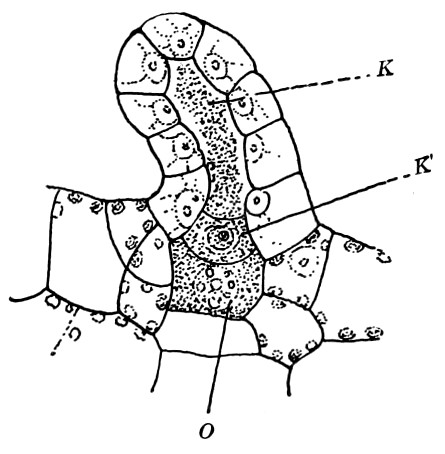
Fig. 503.—Young archegonium of a fern, magnified: K, neck canal cell; K′, ventral canal cell: O, egg cell.
408. Fertilization.—This process is the same in all essentials as in the bryophytes. As in other cryptogams, it can take place only under water,—a circumstance which points to an aquatic origin for this sub-kingdom, and through them to the entire flora of the globe. The archegonia differ somewhat in shape from those of the liverworts and mosses, but a section under the microscope will show that they consist of essentially the same parts. On account of the similarity of these organs, the pteridophytes and bryophytes are often classed together as Archegoniates.
409. Alternation of generations.—Among the section of ferns that we have been considering, the order of alternation corresponds in all essentials to that prevailing among the bryophytes, and may be represented by the same formula. The chief difference is in the relatively much greater importance of the sporophyte, which may be expressed by putting it first:—
fg fg
╱ ╲ ╱ ╲
S ⟶ o ⟶ G oös ⟶ S ⟶ o ⟶ G oös ⟶ S ⟶ o ⟶ G etc.
╲ ╱ ╲ ╱
mg mg
But some of the pteridophytes—of which the Selaginella offers a conspicuous example—have differentiated their asexual spores (o of the formula) into two kinds, large and small, known respectively as megaspores and microspores. The prothallia developed by the former bear archegonia containing female gametes only; those by the latter, antheridia containing male gametes—while in the diœcious bryophytes, the archegonial and antheridial thalli are produced by spores of the same kind.
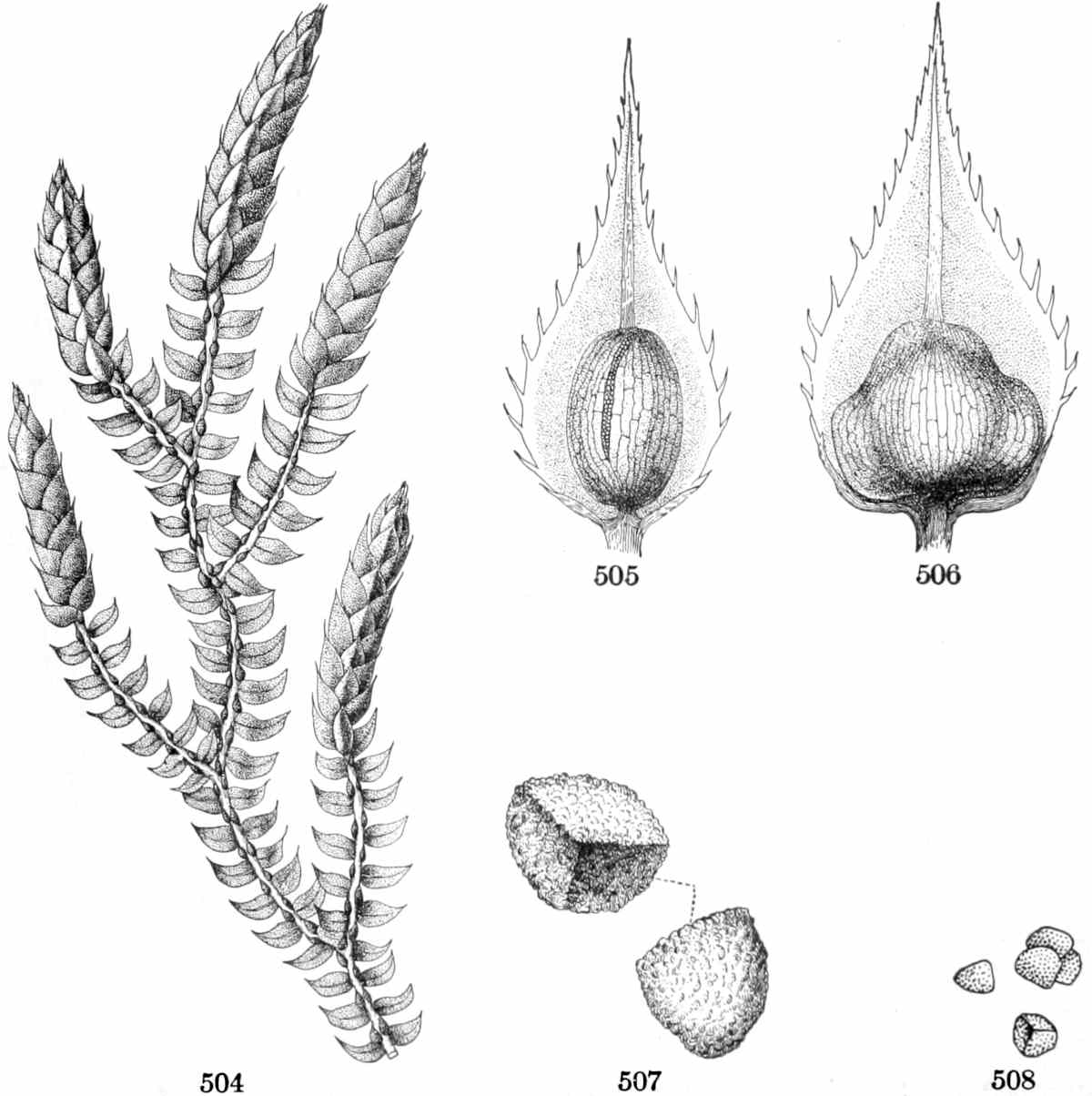
Figs. 504.-508.—A kind of pteridophyte (Selaginella martensii) with its organs of fructification: 504, a fruiting branch; 505, a microsporophyll with a microsporangium, showing microspores through a rupture in the wall; 506, a megasporophyll with a megasporangium; 507, megaspores; 508, microspores. (From Coulter’s “Plant Structures.”)
The differentiation of the asexual spores in the higher pteridophytes gives rise to corresponding changes in the sporangia that bear them, and even in the sporophylls themselves, one kind bearing microsporangia only, the other megasporangia. In this way the differentiation of sex is pushed back, step by step, until it virtually begins with the sporophyte, or asexual generation.
Using the same terms as before, and representing the microspores by the abbreviation mo, the megaspores by Mo, the archegonial gametophyte by arG, the antheridial by anG, the formula may be modified to express this more complicated process of alternation, as follows:—
Mo ⟶ arG ⟶ fg Mo ⟶ arG ⟶ fg
╱ ╲ ╱ ╲
S oös ⟶ S oös ⟶ S etc.
╲ ╱ ╲ ╱
mo ⟶ anG ⟶ mg mo ⟶ anG ⟶ mg
Comparing this formula with the preceding, it will be seen that the increased complexity affects the sporophyte at the expense of the gametophyte, which has now become a mere dependent on the former.
410. Advantages of alternation.—This roundabout mode of reproduction would hardly have been developed unless it had been of some benefit to the plants in which it occurs. The chief advantage seems to be in more rapid multiplication and consequently better chance to propagate the species, as compared with the slow process of sexual reproduction were the plant confined to that method alone. Only one plant is produced by each oöspore, and if this were a gametophyte with its limited number of archegonia, multiplication would be slow; but the sporophyte with its millions of spores, each capable of producing a new individual, enables the species to multiply indefinitely. At the same time the interposition of a gametophyte, or sexual generation, secures the introduction of a new strain with effects analogous to those of cross fertilization.
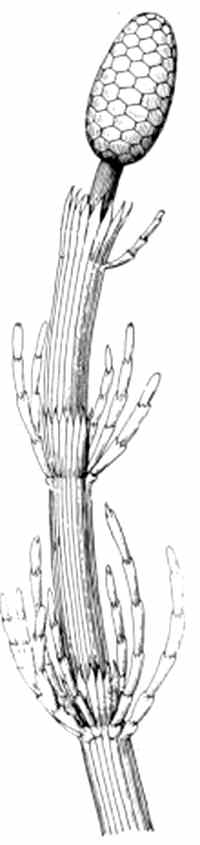
Fig. 509.—Part of the fruiting stem of a scouring rush, Equisetum limosum, showing the cone-like spore cluster. (After Gray.)
411. Classification of pteridophytes.—In our study of this group, the ferns have been taken as the type because they are the most familiar and most widely distributed of all the vascular cryptogams. But while they exceed in numbers, both of individuals and species, all the other orders combined, they form only one division of three great groups that make up the class Pteridophyta. These groups are: (1) ferns, under which are included, besides the true ferns, two widely differing orders, with the grape ferns and adder’s-tongue in one, and the water ferns in the other; (2) the club mosses, embracing the two subdivisions of Lycopodium and Selaginella; (3) the horsetail family, including horsetails and scouring rushes. Orders (2) and (3) are grouped together as cone-bearing (strobilaceous) pteridophytes, because their sporangia are clustered in oblong heads, or strobiles (Fig. 509), somewhat like the cones of the pine. The orders of pteridophytes differ greatly among themselves, but agree in possessing certain characteristics that point to their derivation from a common ancestry.
412. Distinction between pteridophytes and bryophytes.—In passing from the Thallophytes and Bryophytes to the vascular cryptogams, we cross the widest chasm in the vegetable kingdom—a gap relatively as great as that between vertebrates and invertebrates among animals. The most important modifications that discriminate the two groups are: (1) the presence in Pteridophytes of a highly organized vascular system accompanied by a well-marked differentiation of the plant body into root and stem; (2) increased importance and complexity of the sporophyte with proportionate diminution of the gametophyte.
While vessels for conducting water occur in some of the bryophytes (403), a well-defined vascular system and true roots are met with first in the Pteridophytes. The change in the relative importance of sporophyte and gametophyte is so marked that in Selaginella, the genus which approaches nearest in structure to the seed-bearing plants, the suppression of the gametophyte has proceeded so far that it never leads an independent existence at all and is difficult even to recognize as a distinct individual.
Practical Questions
1. Have ferns any economic use—that is, are they good for food, medicines, etc.?
2. What is their chief value?
3. Under what ecological conditions do they grow?
4. Are they often attacked by insects, or by blights and disease of any kind?
5. Of what advantage is it to ferns to have their stems underground, in the form of rootstocks? (321.)
6. What causes the young frond of ferns to unroll? (54, 98.)
7. Name the ferns indigenous to your neighborhood.
8. Which of these are most ornamental, and to what peculiarities of structure do they owe that quality?
9. Are cultivated ferns usually raised from the spores or in some other way? Why?
10. After the great eruption of Krakatoa in 1883, by which the vegetation of the island was completely destroyed, ferns were the first plants to reappear. Explain why. (19; Exp. 17.)
VIII. THE RELATION BETWEEN CRYPTOGAMS AND SEED PLANTS
413. No break in the chain of life.—The great gap that was once supposed to exist between the cryptogams and phanerogams has been bridged over by the discovery of analogies in the reproductive processes of the two groups that connect them together as successive links in one continuous chain of vegetable life. It is therefore very important to have a clear understanding of the nature and meaning of these processes, for the chief turning points in the life history of the different groups of plants are connected with them, their natural relationships to each other, and their distribution according to their respective places in the evolutionary scale, being determined largely by a comparison of their modes of continuing the life of the group.
414. Alternation of generations in seed plants.—This process, so conspicuous among Bryophytes and Pteridophytes, and not unknown among Thallophytes, is universal among seed plants (Spermatophytes) also, though in so masked a form that it is not easy to recognize without a more detailed study than would be practicable within the limits of a book like this. Briefly, we may say that the stamens of spermatophytes, and the pistils, or rather the carpels, which we have seen to be transformed leaves (298), represent the sporophylls (406) of the higher pteridophytes. The pollen sacs and ovules are sporangia, bearing microspores and megaspores (409), represented respectively by the pollen grains in the anther and the embryo sac in the ovule. These go through a series of microscopic changes in the body of the ovule analogous to the production of the oöspore in the archegonia of ferns and liverworts, but the process is so obscure that to an ordinary observer the pollen grains and the ovule appear to be the real gametes, and were long supposed to be such. The fertilized germ cell in the embryo sac (251) corresponds to an oöspore; the embryo sac with the endosperm found in all seeds (previous to its absorption by the cotyledons) is a rudimentary gametophyte; and the embryo in the matured seed is the undeveloped sporophyte, destined, after germination and further growth, to produce a new generation with its recurrent cycle of alternating phases.
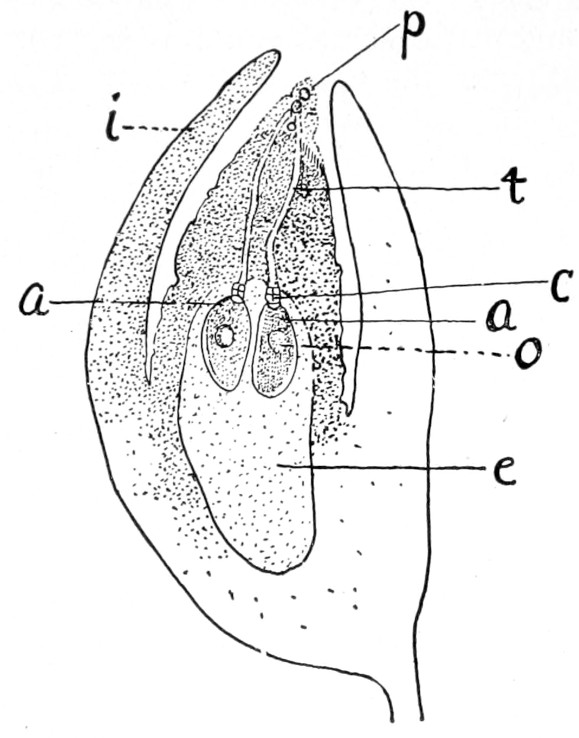
Fig. 510.—Diagrammatic section through the ovule of a gymnosperm belonging to the spruce family: i, integument covering the ovule; e, endosperm (corresponding to female gametophyte), which fills the embryo sac, containing two archegonia, a; o, egg cell; p, pollen grains; t, pollen tubes entering the neck, c, of the archegonia.
In the gymnosperms,—pines, yews, cycads, etc.,—which represent the most ancient and primitive type of existing seed-bearing plants, the similarity of these processes to those of certain of the pteridophytes is very striking, and it was through the study of these that the sequences of the process were traced in the much more obscure form in which they occur among the angiosperms. From the endosperm in the seeds of gymnosperms archegonia were found to be developed (Fig. 510) in much the same way as in Selaginella, from the prothallium, thus showing the endosperm to be a modified and greatly reduced gametophyte. In some cases, it has even been found to protrude a little way out of the embryo sac and to take on a slightly greenish tinge—another reminiscence of its origin. Fertilization, too, takes place in precisely the same manner as in the pteridophytes, except that in all but the ginkgo and the cycads, the fertilizing cells in the pollen grains are non-motile, and find their way to the ovule by growing down into the embryo sac with the pollen tube, instead of swimming to it—an adaptation probably brought about in response to changed condition during the course of evolution from aquatic to terrestrial life.
The analogies between the sequence of alternations in the two classes will be made clearer by a comparison of the accompanying diagrams. The corresponding terms applied to the various organs stand in the same vertical row. Diagram (1) shows the process as it takes place in the more highly developed Pteridophytes; diagram (2) the corresponding phases in angiosperms.
PTERIDOPHYTES
mospl ⟶ mic ⟶ mo ⟶ anG ⟶ ant ⟶ mg
╱ ╲
(1) S öos ⟶ S
╲ ╱
Mospl ⟶ Mgc ⟶ Mo ⟶ arG ⟶ arc ⟶ fg
mospl, microsporophyll; mic, microsporangium; mo, microspores; anG, male gametophyte; ant, antheridia; mg, antherozoids. The letters in the lower line stand for the corresponding female organs.
SPERMATOPHYTES
st ⟶ an ⟶ pol ⟶ fc ⟶ not developed ⟶ gc
╱ ╲
(2) S öos ⟶ S
╲ ╱
p ⟶ ov ⟶ em ⟶ end ⟶ developed only in gymnosperms ⟶ ec
st, stamen; an, anther; pol, pollen; fc, food cells in pollen grain; gc, generative cell; p, pistil; ov, ovules; em, embryo sac; end, endosperm; ec, egg cell.
415. Disappearance of the gametophyte.—The seed is a comparatively recent development in plant evolution. It has no counterpart anywhere among the cryptogams, but is strictly characteristic of the three great orders of Spermophytes: Monocotyl, Dicotyl, and Gymnosperms, which compose the greater part of the vegetation of the globe. Structurally, it is a matured sporangium containing a rudimentary sporophyte (the embryo), and a reduced gametophyte (the embryo sac), which, under the form of endosperm, has dwindled to an insignificance that makes it difficult to recognize it as a phase in an alternation of generations.
416. Significance of the sporophyte.—The gametophyte is obviously a more ancient and primitive structure than the sporophyte, which first becomes prominent in the ferns and their allies. The sudden and violent break in the succession of vegetable life that accompanies the appearance of the pteridophytes (412) is probably to be explained by the development of a land flora and the necessity of adaptation to life in a new medium. The fact that no living cell, whether vegetable or animal, can absorb nourishment except in a liquid form, seems to point to an aquatic origin more or less remote for all life. This inference is further strengthened, in the case of plants, by the fact that even in so highly organized a group as the pteridophytes, fertilization cannot take place except in water. Such a requirement would manifestly be a great disadvantage to land plants, and one of the first steps in response to the demands of a new habitat would be to get rid, as far as possible, of the primitive gametophyte with its outgrown adaptations to a liquid medium, and to transfer the greater part of the work of reproduction to the asexual generation, in which the problem of fertilization did not have to be directly met, the asexual spores germinating without it. The greater the number of these produced, the better the chance that at least some of the gametes developed from them would meet the difficult conditions of fertilization, and the survival of the species be assured. At the same time, in order to meet the requirements of terrestrial life successfully, and to provide for continuing the sexual generation, correlative changes would have to take place in the gametophyte by which the increasing uncertainty of fertilization due to structural changes in the sporophyte, and the absence of a liquid medium for the conveyance of free swimming antherozoids would be avoided. This necessity has been met by the development of the pollen tube, which bores its way to the egg cell, carrying with it the generative cells, which in seed plants have taken the place of the more primitive antherozoids. With the concomitant reduction of the gametophyte and development of the seed habit, the adaptation to land conditions has been made complete.
Roughly speaking, it may be said: (1) that Thallophytes are predominantly aquatic; (2) Archegoniates (Bryophytes and Pteridophytes), amphibious; (3) Spermophytes, terrestrial; (4) that the seed habit is a response to terrestrial conditions; and (5) that the increased development of the sporophyte was a necessary adaptation to meet those conditions.
IX. THE COURSE OF PLANT EVOLUTION
417. Plant genealogy.—It has been shown by a study of existing forms of plant life that there is no hard and fast line of division anywhere between the different groups, but that they are all connected by ties of kinship more or less defined, according to their distance from a common ancestral stock. The geological record points to the same conclusion, and our classification of them into families, orders, and species is merely a very imperfect genealogical table of their supposed pedigrees. This does not mean, however, that we can assert positively that such and such a species is derived from such or such another, but that both are descended from some common intermediate form more or less remote. While we have reason to believe that the flowering plants are derived through pteridophyte and bryophyte types from some of the green algæ, no direct connection has ever been traced between any particular kind of flowering plant and any particular kind of alga,—or between a liverwort and an alga, for that matter,—and probably never will be, because the intermediate forms die out, or pass on by variation into other lines of development. But while this is true, all the evidence we possess does go to show that, since the beginning of life on the globe, there has been a general progressive evolution from lower and simpler to higher and more complex forms.
418. Retrogressive evolution.—While the general course of evolution has been upward and onward, the movement has not always followed a straight line, but, like a mountain road, shows many windings and deviations from the direct route. The monocotyls furnish a conspicuous example of this departure from the general law of progression. It was formerly supposed, on account of their greater simplicity of structure, that they were a more ancient type than dicotyls, but recent investigations point to the conclusion that they are a later offshoot, derived from some primitive form of aquatic dicotyl, and represent, not an ancient and primitive stock, but a case of retrogressive evolution from a higher type. Strong presumptions in favor of this view are: (1) that various species of dicotyls show an unequal development of the seed leaves, amounting, in the bryony, to complete abortion of one of them, while some monocotyl seeds show morphological characters that can best be explained as survivals, or inheritances, from a dicotyl ancestor; (2) the structural resemblances between gymnosperms and dicotyls are closer than between gymnosperms and monocotyls, which could hardly be the case if the latter were the more ancient; (3) the geological record does not show them to have appeared before dicotyls; (4) the number of cotyledons furnishes no criterion as to the relative age of any plant group, since all three types are represented among the pteridophytes, where plants are found bearing one, two, or more cotyledons.
The theory of their comparatively recent origin from an aquatic ancestor is further borne out by the many points of similarity between their internal structure and that of hydrophytes (318), and also by the great proportion of aquatic plants among them, amounting to thirty-three per cent, while in dicotyls the proportion is only four per cent. Can you give any reasons, from your examination of their internal structure (113, 114), for believing that the line of development which they have followed is a less effective one for meeting conditions now existing on the globe than that attained by dicotyls?
We should remember, too, that while progressive evolution implies successful adjustment to surroundings, it is possible to conceive of a state, as our planet approaches the period of cosmic debility and decay, when the conditions of existence may become progressively more and more unfavorable. In this case the course of evolution would be reversed, the higher types gradually dying out as the struggle for life became more severe, and the tendency would be constantly toward lower and simpler forms, until finally all life would become extinct on our planet. We have no right, however, to assume that during such a course of retrogressive evolution the same forms would be repeated in reverse order as have already appeared, because there is no reason to believe that the conditions brought about by planetary decline and “old age” would be the same as those attending planetary birth and adolescence.
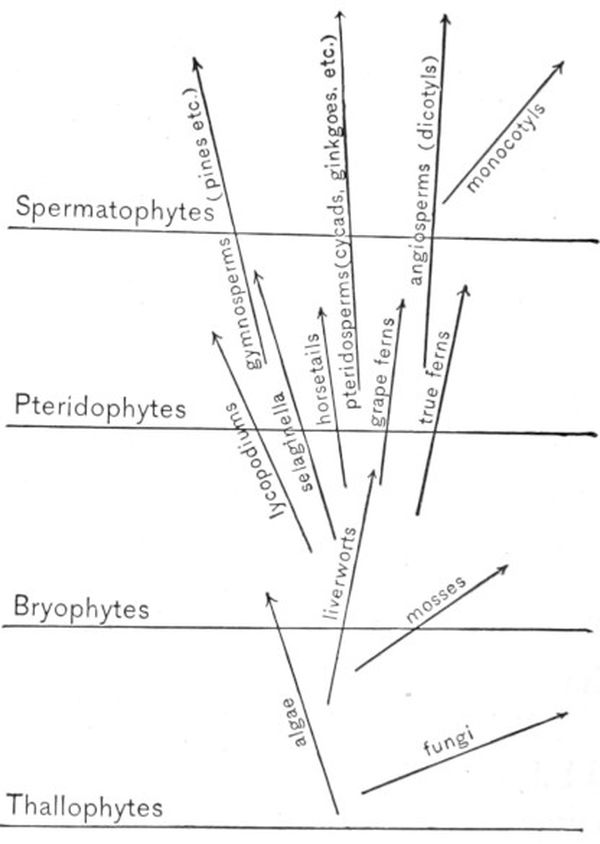
Fig. 511.—Diagram showing the supposed course of plant evolution.
419. Explanation of the diagram.—An attempt to show the general course of plant evolution up to the present time is made in the accompanying diagram. The four great divisions, Thallophytes, Bryophytes, Pteridophytes, and Spermatophytes, are represented by spaces between four horizontal lines arranged one above the other in the order of their succession in time and complexity of organization. It should be borne in mind that these dividing lines are not sharply defined in nature, but overlap or indent the territory between them with varying degrees of irregularity, like the coast line on a map. The relative positions of the different orders we have been considering are represented by upright and diagonal lines, the general course of which, as indicated by the arrows, is intended to give an idea of the trend of evolutionary progress in the particular group represented by each line. No one of these lines is made to originate directly in any other, because, with the possible exception of the monocotyls, we have no authority for asserting that any such direct connection exists between plants as we know them, but only that certain types give evidence of descent from a common ancestry. This lack of certainty is expressed by placing the point of origin for any given line in more or less close proximity to the one which is supposed to be the nearest living representative of the common ancestor. The line of ferns, for instance, is depicted as originating in the region of the bryophytes, somewhere in the neighborhood of the liverworts, but the two lines nowhere come in contact, because there is no evidence that any fern, living or fossil, is directly descended from any particular kind of liverwort known to us. With these explanations, the diagram shows, in a rough way, the generally accepted view of plant relationships as based on the evidence at present before us. But in questions of this sort it is wise to keep in mind the blunt remark of a famous old American statesman, that “only fools and dead people never change their opinions.”
Field Work
1. If you live in the country, study the appearance of plants affected with blights, smuts, rusts, and mildews, and learn to recognize the different kinds of disease by their signs. Notice which kinds are most prevalent in your neighborhood, and what plants are most affected by them.
2. Notice the different kinds of mushrooms you find growing wild. Observe the difference between those that grow on the ground and those that grow on logs, stumps, and trees; between those found in the woods and those in open ground. Find out how those on the ground get their nourishment. Uncover the mycelium, and notice the extent of its surface. Examine the soil and find out if it contains anything upon which they could feed. Note the prevalence of shelf fungi on trees. Examine the condition of the wood where they grow, and decide in what ways they injure their hosts. Notice whether they abound most on healthy or on decaying trunks and boughs, and decide whether this is because the fungus prefers that kind of host, or whether the injury it does causes the decay, or whether both causes operate together. Notice what fungi grow on different trees, and study their preferences in this respect.
3. Observe the different kinds of lichens found in your walks and try to distinguish the three classes. Which kind are most abundant in your neighborhood? Which least so? Note the situations in which you find each kind growing, whether on stumps, trees, rocks, or the ground. Consider how the algæ and fungi aid each other in the different positions; could either, for instance, exist independently on bald rocks? Notice on what kind of trees the different lichens seem to thrive best and on which poorly or not at all, and whether the character of the bark—rough, smooth, scaly—has anything to do with their choice of a habitat.