APPENDIX
Reading edition
SYSTEMATIC BOTANY
Taxonomy, or systematic botany, deals with the family relationships of plants in the order of their nearness or remoteness with regard to a common line of descent. Its chief value is the insight it gives into the course of plant evolution and into the nature of the modifications that differentiate each group from the ancestral type. While it is not advisable to spend too much time in the mere identification of species, a sufficient number should be examined and described to familiarize the student with the distinctive characteristics of the principal botanical orders.
Principles of classification.—All the known plants in the world, numbering not less than one hundred and twenty thousand species of the seed-bearing kind alone, are ranged according to certain resemblances of structure, into a number of great groups known as families or orders. The names of these families are distinguished by the ending aceæ; the rose family, for instance, are the Rosaceæ; the pink family, Caryophyllaceæ; the walnut family, Juglandaceæ, etc. Each of these families is divided into lesser groups called genera (singular, genus), characterized by similarities showing a still greater degree of affinity than that which marks the larger groups or orders; and finally, when the differences between the individual plants of a kind are so small as to be disregarded, they are considered to form one species; all the common morning-glories, for instance, of whatever shade or color, belong to the species Ipomea purpurea. The small differences that arise within a species as to the color and size of flowers, and other minor points, constitute mere varieties, and have no special names applied to them. The line between varieties and species is not clearly defined, and in the nature of things can never be, since progressive development, through unceasing change, is the law of all life.
In botanical descriptions, the name both of the species and the genus is given, just as in designating a person, like Mary Jones or John Robinson, we give both the surname and the Christian name. The genus, or generic name, answers to the surname, and that of the species to the Christian name—except that in botanical nomenclature the order is reversed, the generic, or surname, coming first, and the specific or individual name last; for example, Ipomea is the generic, or surname, of the morning-glories, and purpurea the specific one.
How to use the key.—Any good manual will answer the purpose. Gray’s “School and Field Book” is, perhaps, the best available at present for the states east of the Mississippi. Reference to the floral analyses in sections I-IV of Chapter VII will make its use clear. Suppose, for instance, we want to find out to what botanical species the morning-glory or the sweet potato belongs. Turning to the key, we find the sub-kingdom of Phænerogams—flowering or seed-bearing plants—divided into two great classes, Angiosperms and Gymnosperms, as explained in 18. A glance will show that our specimen belongs to the former class. Angiosperms, again, are divided into the two subclasses of Dicotyledons and Monocotyledons (18, 171). We at once recognize our plant, by its net-veined leaves and pentamerous flowers, as a dicotyledon (171, 229), and turning again to the key, we find this subclass divided into three great groups: Sympetalous (211), called also Monopetalous and Gamopetalous; Apopetalous, or Polypetalous (211), and Apetalous—having no petals or corolla. A glance will refer our blossom to the sympetalous or monopetalous group, which we find divided into two sections, characterized by the superior or inferior ovary (218, 225). Further examination will show that the morning-glory belongs to the former class, which is in turn divided into two sections, according as the corolla is regular, or more or less irregular. We see at once that we must look for our specimen in the group having regular corollas. This we find again subdivided into four sections, according to the number and position of the stamens, and we find that the morning-glory falls under the last of these,—“Stamens as many as the lobes or parts of the corolla and alternate with them.” A very little further search brings us to the family Convolvulaceæ, and turning to that title in the descriptive analysis, we find under the genus, Ipomea, a full description of the common morning-glory, in the species Ipomea purpurea, and of the sweet potato in the species Ipomea batatas.
Making collections.—Mere labeled aggregations of species are not recommended, but the collection of examples illustrating special points in morphology and plant variation may be made with profit; such, for instance, as the adaptations observed in tendrils and stipular appendages, the various modifications of leaves and stems to serve other than their normal purposes, or the different forms of leaves and flowers on the same stem, or on different plants of the same species. A collection made with some specific object in view would also be instructive, and might prove of great value; for instance, to get together examples of all the troublesome weeds of a locality for the purpose of studying their habits and devising means for their eradication; or of all the native useful plants, with detailed analyses of their economic properties, and observations on their habits and the practicability of further developing them. In short, wherever collecting is carried on, it should be done with some object other than the mere identification of species, which often results in greater detriment to the wild plants of a neighborhood than profit to the collector.
WEIGHTS, MEASURES, AND TEMPERATURES
As the metric system of weights and measures and the Centigrade appraisement of temperatures are universally employed in scientific works, the following tables showing the equivalents in our common English standards of those in most frequent use, are given for the convenience of students who have not already familiarized themselves with the subject. The values given are approximate only, but will answer for all practical purposes, except in cases where very great exactitude is required. The micron, or micrometer, is used principally by scientific investigators for measuring extremely minute objects seen under the microscope.
Measures of Length
Metric English Equivalents
Kilometer km. ⅔ of a mile.
Meter m. 39 inches.
Decimeter dm. 4 inches.
Centimeter cm. ⅖ of an inch.
Millimeter mm. ¹⁄₂₅ of an inch.
Micron µ ¹⁄₂₅₀₀₀ of an inch.
Capacity
Liter l. 61 cubic inches, or 1 quart, U.S. measure
Cubic centimeter cc. ¹⁄₁₆ of a cubic inch.
Weight
Kilogram kg., or kilo. 2⅕ pounds.
Gram gm. 15½ grains avoirdupois.
¹⁄₂₈ of an ounce avoirdupois.
Metric and English Scales
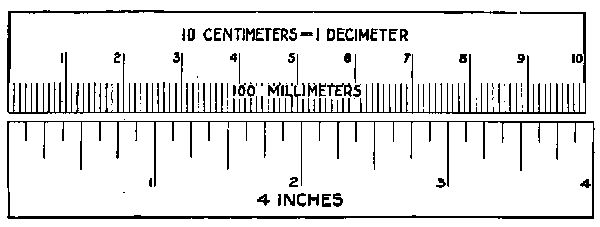
10 CENTIMETERS = 1 DECIMETER 100 MILLIMETERS 4 INCHES
Temperature Equivalents
The next table gives the Fahrenheit equivalent, in round numbers, for every tenth degree Centigrade from absolute zero to the boiling point of water. To find the corresponding F. for any degree C., multiply the given C. temperature by nine, divide by five, and add thirty-two. Conversely, to change F. to C. equivalent, subtract thirty-two, multiply by five, and divide by nine.
Cent. Fahr.
100 212
90 194
80 176
70 158
60 140
50 122
40 104
30 86
20 68
10 50
0 32
−10 14
−20 −4
−30 −22
−40 −40
−50 −58
−100 −148
Absolute zero.
-273 -459