Part 2 — CHAPTER XII
Reading edition
STARS AND NEBULÆ
That a science of stellar chemistry should not only have become possible, but should already have made material advances, is assuredly one of the most amazing features in the swift progress of knowledge our age has witnessed. Custom can never blunt the wonder with which we must regard the achievement of compelling rays emanating from a source devoid of sensible magnitude through immeasurable distance, to reveal, by its distinctive qualities, the composition of that source. The discovery of revolving double stars assured us that the great governing force of the planetary movements, and of our own material existence, sways equally the courses of the farthest suns in space; the application of prismatic analysis certified to the presence in the stars of the familiar materials, no less of the earth we tread, than of the human bodies built up out of its dust and circumambient vapours.
We have seen that, as early as 1823, Fraunhofer ascertained the generic participation of stellar light in the peculiarity by which sunlight, spread out by transmission through a prism, shows numerous transverse rulings of interrupting darkness. No sooner had Kirchhoff supplied the key to the hidden meaning of those ciphered characters than it was eagerly turned to the interpretation of the dim scrolls unfolded in the spectra of the stars. Donati made at Florence in 1860 the first efforts in this direction; but with little result, owing to the imperfections of the instrumental means at his command. His comparative failure, however, was a prelude to others' success. Almost simultaneously, in 1862, the novel line of investigation was entered upon by Huggins near London, by Father Secchi at Rome, and by Lewis M. Rutherfurd in New York. Fraunhofer's device of using a cylindrical lens for the purpose of giving a second dimension to stellar spectra was adopted by all, and was, indeed, indispensable. For a luminous point, such as a star appears, becomes, when viewed through a prism, a variegated line, which, until broadened into a band by the intervention of a cylindrical lens, is all but useless for purposes of research. This process of rolling out involves, it is true, much loss of light—a scanty and precious commodity, as coming from the stars; but the loss is an inevitable one. And so fully is it compensated by the great light-grasping power of modern telescopes that important information can now be gained from the spectroscopic examination of stars far below the range of the unarmed eye.
The effective founders of stellar spectroscopy, then (since Rutherfurd shortly turned his efforts elsewhither), were Father Secchi, the eminent Jesuit astronomer of the Collegio Romano, where he died, February 26, 1878, and Sir William Huggins, with whom the late Professor W. A. Miller was associated. The work of each was happily directed so as to supplement that of the other. With less perfect appliances, the Roman astronomer sought to render his extensive rather than precise; at Tulse Hill searching accuracy over a narrow range was aimed at and attained. To Father Secchi is due the merit of having executed the first spectroscopic survey of the heavens. Above 4,000 stars were passed in review by him, and classified according to the varying qualities of their light. His provisional establishment (1863-67) of four types of stellar spectra[1369] has proved a genuine aid to knowledge through the facilities afforded by it for the arrangement and comparison of rapidly accumulating facts. Moreover, it is scarcely doubtful that these spectral distinctions correspond to differences in physical condition of a marked kind.
The first order comprises more than half the visible and probably an overwhelming proportion of the faintest stars. Sirius, Vega, Regulus, Altair, are amongst its leading members. Their spectra are distinguished by the breadth and intensity of the four dark bars due to the absorption of hydrogen, and by the extreme faintness of the metallic lines, of which, nevertheless, hundreds are disclosed by careful examination. The light of these "Sirian" orbs is white or bluish; and it is found to be rich in ultra-violet rays.
Capella and Arcturus belong to the second, or solar type of stars, which is about one-sixth less numerously represented than the first. Their spectra are quite closely similar to that of sunlight, in being ruled throughout by innumerable fine dark lines; and they share its yellowish tinge.
The third class includes most red and variable stars (commonly synonymous), of which Betelgeux in the shoulder of Orion, and "Mira" in the Whale, are noted examples. Their characteristic spectrum is of the "fluted" description. It shows like a strongly illuminated range of seven or eight variously tinted columns seen in perspective, the light falling from the red end towards the violet. This kind of absorption is produced by the vapours of metalloids or of compound substances.
To the fourth order of stars belongs also a colonnaded spectrum, but reversed; the light is thrown the other way. The three broad zones of absorption which interrupt it are sharp towards the red, insensibly gradated towards the violet end. The individuals composing Class IV. are few and apparently insignificant, the brightest of them not exceeding the fifth magnitude. They are commonly distinguished by a deep red tint, and gleam like rubies in the field of the telescope. Father Secchi, who in 1867 detected the peculiarity of their analyzed light, ascribed it to the presence of carbon in some form in their atmospheres; and this was confirmed by the researches of H. C. Vogel,[1370] director of the Astro-physical Observatory at Potsdam. The hydro-carbon bands, in fact, seen bright in comets, are dark in these singular objects—the only ones in the heavens (save one bright-line star and a rare meteor)[1371] which display a cometary analogy of the fundamental sort revealed by the spectroscope.
The members of all four orders are, however, emphatically suns. They possess, it would appear, photospheres radiating all kinds of light, and differ from each other mainly in the varying qualities of their absorptive atmospheres. The principle that the colours of stars depend, not on the intrinsic nature of their light, but on the kinds of vapours surrounding them, and stopping out certain portions of that light, was laid down by Huggins in 1864.[1372] The phenomena of double stars seem to indicate a connection between the state of the investing atmospheres, by the action of which their often brilliantly contrasted tints are produced, and their mutual physical relations. A tabular statement put forward by Professor Holden in June, 1880,[1373] made it, at any rate, clear that inequality of magnitude between the components of binary systems accompanies unlikeness in colour, and that stars more equally matched in one respect are pretty sure to be so in the other. Besides, blue and green stars of a decided tinge are never solitary; they invariably form part of systems. So that association has undoubtedly a predominant influence upon colour.
Nevertheless, the crude notion thrown out by Zöllner in 1865,[1374] that yellow and red stars are simply white stars in various stages of cooling, obtained for a time undeserved currency. D'Arrest, indeed, protested against it, and Ångström, in 1868,[1375] substituted atmospheric quality for mere colour[1376] as a criterion of age and temperature. His lead was followed by Lockyer in 1873,[1377] and by Vogel in 1874.[1378] The scheme of classification due to the Potsdam astro-physicist differed from Father Secchi's only in presenting his third and fourth types as subdivisions of the same order, and in inserting three subordinate categories; but their variety was "rationalised" by the addition of the seductive idea of progressive development. Thus, the white Sirian stars were represented as the youngest because the hottest of the sidereal family; those of the solar pattern as having already wasted much of their store by radiation, and being well advanced in middle life; while the red stars with banded spectra figured as effete suns, hastening rapidly down the road to final extinction.
Vogel's scheme is, however, incomplete. It traces the downward curve of decay, but gives no account of the slow ascent to maturity. The present splendour of Vega, for instance, was prepared, according to all creative analogy, by almost endless processes of gradual change. What was its antecedent condition? The question has been variously answered. Dr. Johnstone Stoney advocated, in 1867, the comparative youth of red stars;[1379] A. Ritter, of Aix-la-Chapelle, divided them, in 1883,[1380] into two squadrons, posted, the one on the ascending, the other on the descending branch of the temperature-curve, and corresponding, presumably, with Secchi's third and fourth orders of stars with banded spectra. Whether, in the interim, they should display spectra of the Sirian or of the solar type was made to depend on their greater or less massiveness.[1381] But the relation actually existing perhaps inverts that contemplated by Ritter. Certainly, the evidence collected by Mr. Maunder in 1891 strongly supports the opinion that the average solar star is a weightier body than the average Sirian star.[1382]
On November 17, 1887, Sir Norman Lockyer communicated to the Royal Society the first of a series of papers embodying his "Meteoritic Hypothesis" of cosmical constitution, stated and supported more at large in a separate work bearing that name, published in 1890. The fundamental proposition wrought out in it was that "all self-luminous bodies in the celestial space are composed either of swarms of meteorites or of masses of meteoric vapour produced by heat."[1383] On the basis of this supposed community of origin, sidereal objects were distributed in seven groups along a temperature-curve ascending from nebulæ and gaseous, or bright-line stars, through red stars of the third type, and a younger division of solar stars, to the high Sirian level; then descending through the more strictly solar stars to red stars of the fourth type ("carbon-stars"), below which lay only the caput mortuum entitled Group vii. The ground-work of this classification was, however, insecure, and has given way. Certain spectroscopic coincidences, avowedly only approximate, suggesting that stars and nebulæ of every species might be formed out of variously aggregated meteorites, failed of verification by exact inquiry. And spectroscopic coincidences admit of no compromise. Those that are merely approximate are, as a rule, unmeaning.
In his Presidential Address at the Cardiff Meeting of the British Association in 1891, Dr. Huggins adhered in the main to the line of advance traced by Vogel. The inconspicuousness of metallic lines in the spectra of the white stars he attributed, not to the paucity, but to the high temperature of the vapours producing them, and the consequent deficiency of contrast between their absorption-rays and the continuous light of the photospheric background. "Such a state of things would more probably," in his opinion, "be found in conditions anterior to the solar stage," while "a considerable cooling of the sun would probably give rise to banded spectra due to compounds." He adverted also to the influential effects upon stellar types of varying surface gravity, which being a function of both mass and bulk necessarily gains strength with wasting heat and consequent shrinkage. The same leading ideas were more fully worked out in "An Atlas of Representative Stellar Spectra," published by Sir William and Lady Huggins in 1899. They were, moreover, splendidly illustrated by a set of original spectrographic plates, while precision was added to the adopted classification by the separation of helium from hydrogen stars. The spectrum of the exotic substance terrestrially captured in 1895 is conspicuous by absorption, as Vogel, Lockyer, and Deslandres promptly recognised in a considerable number of white stars, among them the Pleiades and most of the brilliants in Orion. Mr. McClean, whose valuable spectrographic survey of the heavens was completed at the Cape in 1897, found reason to conclude that they are in the first stage of development from gaseous nebulæ;[1384] and in this the Tulse Hill investigators unhesitatingly concur.
The strongest evidence for the primitive state of white stars is found in their nebular relations. The components of groups, still involved and entangled with "silver braids" of cosmic mist, show, perhaps invariably, spectra of the helium type, occasionally crossed by bright rays. Possibly all such stars have passed through a bright-line stage; but further evidence on the point is needed. Relative density furnishes another important test of comparative age, and Sirian stars are, on the whole, undoubtedly more bulky proportionately to their mass than solar stars. The rule, however, seems to admit of exceptions; hence the change from one kind of spectrum to the other is not inevitably connected with the attainment of a particular degree of condensation. There is reason to believe that it is anticipated in the more massive globes, despite their comparatively slow cooling, as a consequence of the greater power of gravity over their investing vaporous envelopes. This conclusion is enforced by the relations of double-star spectra. The fact that, in unequal pairs, the chief star most frequently shows a solar, its companion a Sirian, spectrum can scarcely be otherwise explained than by admitting that, while the sequence of types is pursued in an invariable order, it is pursued much more rapidly in larger than in small orbs. It need not, indeed, be supposed that all stars are identical in constitution, and present identical life-histories.[1385] Individualities in the one, and divergencies in the other, must be allowed for. Yet the main track is plainly continuous, and leads by insensible gradations from nebulæ through helium stars to the Sirian, and onward to the solar type, whence, by an inevitable transition, fluted, or "Antarian,"[1386] spectra develop.
The first-known examples of the class of gaseous stars—β Lyræ and γ Cassiopeiæ—were noticed by Father Secchi at the outset of his spectroscopic inquiries. Both show bright lines of hydrogen and helium, so that the peculiarity of their condition probably consists in the intense ignition of their chromospheric surroundings. Their entire radiating surfaces might be described as faculous. That is to say, brilliant formations, such as have been photographed by Professor Hale on the sun's disc,[1387] cover, perhaps, the whole, instead of being limited to a small portion of the photospheric area. But this state of things is more or less inconstant. Some at least of the bright rays indicative of it are subject to temporary extinctions. Already in 1871-72, Dr. Vogel[1388] suspected the prevalence of such vicissitudes; and their reality was ascertained by M. Eugen von Gothard. After the completion of his new astrophysical observatory at Herény in the autumn of 1881, he repeatedly observed the spectra of both stars without perceiving a trace of bright lines; and was thus taken quite by surprise when he caught a twinkling of the crimson C in γ Cassiopeiæ, August 13, 1883.[1389] A few days later, the whole range including D_3 was lustrous. Duly apprised of the recurrence of a phenomenon he had himself vainly looked for during some years, M. von Konkoly took the opportunity of the great Vienna refractor being placed at his disposal to examine with it the relighted spectrum on August 27.[1390] In its wealth of light C was dazzling; D_3 and the green and blue hydrogen rays shone somewhat less vividly; D and the group b showed faintly dark; while three broad absorption-bands, sharply terminated towards the red, diffuse towards the violet, shaded the spectrum near its opposite extremities.
The previous absence of bright lines from the spectrum of this star was, however, by no means so protracted or complete as M. von Gothard supposed. At Dunecht, C was "superbly visible" December 20, 1879[1391]; F was seen bright on October 28 of the same year, and frequently at Greenwich in 1880-81. The curious fact has, moreover, been adverted to by Dr. Copeland, that C is much more variable than F. To Vogel, June 18, 1872, the first was invisible, while the second was bright; at Dunecht, January 11, 1887, the conditions were so far inverted that C was resplendent, F comparatively dim.
No spectral fluctuations were detected in γ Cassiopeiæ by Keeler in 1889; but even with the giant telescope of Mount Hamilton, the helium-ray was completely invisible.[1392] It made, nevertheless, capricious appearances at South Kensington during that autumn, and again October 21, 1894,[1393] while in September, 1892, Bélopolsky could obtain no trace of it on orthochromatic plates exposed with the 30-inch Pulkowa refractor.[1394] Still more noteworthy is the circumstance that the well-known green triplet of magnesium (b), recorded as dark by Keeler in 1889, came out bright on fifty-two spectrographs of the star taken by Father Sidgreaves during the years 1891-99.[1395] No fluctuations in the hydrogen-spectrum were betrayed by them; but subordinate lines of unknown origin showed alternate fading and vivification.
The spectrum of β Lyræ undergoes transitions to some extent analogous, yet involving a different set of considerations. First noticed by Von Gothard in 1882,[1396] they were imperfectly made out, two years later, to be of a cyclical character.[1397] This, however, could only be effectively determined by photographic means. Beta Lyræ is a "short-period variable." Its light changes with great regularity from 3·4 to 4·4 magnitude every twelve days and twenty-two hours, during which time it attains a twofold maximum, with an intervening secondary minimum. The question, then, is of singular interest, whether the changes of spectral quality visible in this object correspond to its changes in visual brightness. A distinct answer in the affirmative was supplied through Mrs. Fleming's examination of the Harvard plates of the star's spectrum, upon which, in 1891, she found recorded diverse complex changes of bright and dark lines obviously connected with the phases of luminous variation, and obeying, in the long-run, precisely the same period.[1398] Something more will be said presently as to the import of this discovery.
Bright hydrogen lines have so far been detected—for the most part photographically at Harvard College—in about sixty stars, including Pleione, the surmised lost Pleiad, P Cygni, noted for instability of light in the seventeenth century, and the extraordinary southern variable, η Carinæ. In most of these objects other vivid rays are associated with those due to hydrogen. A blaze of hydrogen, moreover, accompanies the recurring outbursts of about one hundred and fifty "long-period variables," giving banded spectra of the third type. Professor Pickering discovered the first example of this class, towards the close of 1886, in Mira Ceti; further detections were made visually by Mr. Espin; and the conjunction of bright hydrogen-lines with dusky bands has been proved by Mrs. Fleming's long experience in studying the Harvard photographs, to indicate unerringly the subjection of the stars thus characterised to variations of lustre accomplished in some months.
A third variety of gaseous star is named after MM. Wolf and Rayet, who discovered, at Paris in 1867,[1399] its three typical representatives, close together in the constellation Cygnus. Six further specimens were discovered by Dr. Copeland, five of them in the course of a trip for the exploration of visual facilities in the Andes in 1883;[1400] and a large number have been made known through spectral photographs taken in both hemispheres under Professor Pickering's direction. At the close of the nineteenth century, over a hundred such objects had been registered, none brighter than the sixth magnitude, with the single exception of γ Argûs, the resplendent continuous spectrum of which, first examined by Respighi and Lockyer in 1871, is embellished with the yellow and blue rays distinctive of the type.[1401] Here, then, we have a stellar globe apparently at the highest point of sunlike incandescence, sharing the peculiarities of bodies verging towards the nebulous state. Examined with instruments of adequate power, their spectra are seen to be highly complex. They include a fairly strong continuous element, a numerous set of absorption-lines, and a range of emission-lines, more or less completely represented in different stars. Especially conspicuous is a broad effluence of azure light, found by Dr. Vogel in 1883,[1402] and by Sir William and Lady Huggins in 1890,[1403] to be of multiple structure, and hence to vary in its mode of display. Its suggested identification with the blue carbon-fluting was disproved at Tulse Hill. Metallic vapours give no certain sign of their presence in the atmospheres of these remarkable bodies; but nebulum is stated to shine in some.[1404] Hydrogen and helium account for a large proportion of their spectral rays. Thirty-two Wolf-Rayet stars were investigated, spectroscopically and spectrographically, by Professor Campbell with the great Lick refractor in 1892-94;[1405] and several disclosed the singularity, already noticed by him in γ Argûs, of giving out mixed series, the members of which change from vivid to obscure with increase of refrangibility. It is difficult to imagine by what chromospheric machinery this curious result can be produced. Alcyone in the Pleiades presents the same characteristic. Alone among the hydrogen lines, crimson C glows in its spectrum, while all the others are dark. Luminosity of the Wolf-Rayet kind is particularly constant, both in quantity and quality. It seems to be incapable of developing save under galactic conditions. All the stars marked by it lie near the central line of the Milky Way, or in the Magellanic Clouds. They tend also to gather into groups. Circles of four degrees radius include respectively seven in Argo, eight in Cygnus.
The first spectroscopic star catalogue was published by Dr. Vogel at Potsdam in 1883.[1406] It included 4,051 stars, distributed over a zone of the heavens extending from 20° north to 20° south of the celestial equator.[1407] More than half of these were white stars, while red stars with banded spectra occurred in the proportion of about one-thirteenth of the whole. To the latter genus, M. Dunér, then of Lund, now Director of the Upsala Observatory, devoted a work of standard authority, issued at Stockholm in 1884. This was a catalogue with descriptive particulars of 352 stars showing banded spectra, 297 of which belong to Secchi's third, 55 to his fourth class (Vogel's iii. a and iii. b). Since then discovery has progressed so rapidly, at first through the telescopic reviews of Mr. Espin, then in the course of the photographic survey carried on at Harvard College, that considerably over one thousand stars are at present recognised as of the family of Betelgeux and Mira, while about 250 have so far exhibited the spectral pattern of 19 Piscium. One fact well ascertained as regards both species is the invariability of the type. The prismatic flutings of the one, and the broader zones of the other, are as if stereotyped—they undergo, in their fundamental outlines, no modification, though varying in relative intensity from star to star. They are always accompanied by, or superposed upon, a spectrum of dark lines, in producing which sodium and iron have an obvious share; and certain bright rays, noticed by Secchi with imperfect appliances as enhancing the chiaroscuro effects in carbon-stars, came out upon plates exposed by Hale and Ellerman in 1898 with the stellar spectrograph of the Yerkes Observatory.[1408] Their genuineness was shortly afterwards visually attested by Keeler, Campbell, and Dunér;[1409] but no chemical interpretation has been found for them.
A fairly complete preliminary answer to the question, What are the stars made of? was given by Sir William Huggins in 1864.[1410] By laborious processes of comparison between stellar dark lines and the bright rays emitted by terrestrial substances, he sought to assure his conclusions, regardless of cost in time and pains. He averred, indeed, that—taking into account restrictions by weather and position—the thorough investigation of a single star-spectrum would be the work of some years. Of two, however—those of Betelgeux and Aldebaran—he was able to furnish detailed and accurate drawings. The dusky flutings in the prismatic light of the first of these stars have not been identified with the absorption of any particular substance; but associated with them are metallic lines, of which 78 were measured, and a good many identified by Huggins, while the wave-lengths of 97 were determined by Vogel in 1871.[1411] A photographic research, made by Keeler at the Alleghany Observatory in 1897, convinced him that the linear spectrum of third-type stars of the Betelgeux pattern essentially repeats that of the sun, but with marked differences in the comparative strength of its components.[1412] Hydrogen rays are inconspicuously present. That an exalted temperature reigns, at least in the lower strata of the atmosphere, is certified by the vaporisation there of matter so refractory to heat as iron.[1413]
Nine elements—among them iron, sodium, calcium, and magnesium—were recognised by Huggins as having stamped their signature on the spectrum of Aldebaran; while the existence in Sirius, and nearly all the other stars inspected, of hydrogen, together with sundry metals, was rendered certain or highly probable. This was admitted to be a bare gleaning of results; nor is there reason to suppose any of his congeners inferior to our sun in complexity of constitution. Definite knowledge on the subject, however, made little advance beyond the point to which it was brought by Huggins's early experiments until spectroscopic photography became thoroughly effective as a means of research.
In this, as in so many other directions, Sir William Huggins acted as pioneer. In March, 1863, he obtained microscopic prints of the spectra of Sirius and Capella.[1414] But they told nothing. No lines were visible in them. They were mere characterless streaks of light. Nine years later Dr. Henry Draper of New York got an impression of four lines in the spectrum of Vega. Then Huggins attacked the subject again in 1876, when the 18-inch speculum of the Royal Society had come into his possession, using prisms of Iceland spar and lenses of rock crystal; and this time with better success. A photograph of the spectrum of Vega showed seven strong lines.[1415] Still he was not satisfied. He waited and worked for three years longer. At length, on December 18, 1879, he was able to communicate to the Royal Society[1416] results answering to his expectations. The delicacy of eye and hand needed to obtain them may be estimated from the single fact that the image of a star had to be kept, by continual minute adjustments, exactly projected upon a slit 1/350 of an inch in width during nearly an hour, in order to give it time to imprint the characters of its analyzed light upon a gelatine plate raised to the highest pitch of sensitiveness. But by this time he had secured in his wife a rarely qualified assistant.
The ultra-violet spectrum of the white stars—of which Vega was taken as the type—was thus shown to be a very remarkable one. A group of broad dark lines intersected it, arranged at intervals diminishing regularly upward, and falling into a rhythmical succession with the visible hydrogen lines. All belonged presumably to the same substance; and the presumption was rendered a certainty by direct photographs of the hydrogen spectrum taken by H. W. Vogel at Berlin a few months earlier.[1417] In them seven of the white-star series of grouped lines were visible; and the full complement of twelve appeared on Cornu's plates in 1886.[1418]
In yellow stars, such as Capella and Arcturus, the same rhythmical series was partially represented, but associated with a great number of other lines; their state, as regards ultra-violet absorption, approximating to that of the sun; while the redder stars betrayed so marked a deficiency in actinic rays that from Betelgeux, with an exposure forty times that required for Sirius, only a faint spectral impression could be obtained, and from Aldebaran, in the strictly invisible region, almost none at all.
Thus, by the means of stellar light-analysis, acquaintance was first made with the ultra-violet spectrum of hydrogen;[1419] and its harmonic character, as expressed by "Balmer's Law," supplies a sure test for discriminating, among newly discovered lines, those that appertain from those that are unrelated to it. Deslandres' five additional prominence-rays, for instance, were at once seen to make part of the series, because conforming to its law;[1420] while a group of six dusky bands, photographed by Sir William and Lady Huggins, April 4, 1890,[1421] near the extreme upper end of the spectrum of Sirius, were pronounced without hesitation, for the opposite reason, to have nothing to do with hydrogen. Their true affinities are still a matter for inquiry.
As regards the hydrogen spectrum, however, the stars had further information in reserve. Until recently, it was supposed to consist of a single harmonic series, although, by analogy, three should co-exist. In 1896, accordingly, a second, bound to the first by unmistakable numerical relationships, was recognised by Professor Pickering in spectrographs of the 2·5 magnitude star ζ Puppis,[1422] and the identification was shortly afterwards extended to prominent Wolf-Rayet emission lines. The discovery was capped by Dr. Rydberg's indication of the Wolf-Rayet blue band at λ 4,688 as the fundamental member of the third, and principal, hydrogen series.[1423] None of the "Pickering lines" (as they may be called to distinguish them from the "Huggins series") can be induced to glimmer in vacuum-tubes. They seem to characterise bodies in a primitive state,[1424] and are in many cases associated with absorption rays of oxygen, the identification of which by Mr. McClean in 1897[1425] was fully confirmed by Sir David Gill.[1426] The typical "oxygen star" is β Crucis, one of the brilliants of the Southern Cross; but the distinctive notes of its spectrum occur in not a few specimens of the helium class. Thus, Sir William and Lady Huggins photographed several ultra-violet oxygen lines in β Lyræ,[1427] and found in Rigel signs of the presence of nitrogen,[1428] which, as well as silicium, proves to be a tolerably frequent constituent of such orbs.[1429] For some unknown reason, metalloids tend to become effaced, as metals, in the normal course of stellar development, exert a more and more conspicuous action.
Dr. Scheiner's spectrographic researches at Potsdam in 1890 and subsequently, exemplify the immense advantages of self-registration. In a restricted section of the spectrum of Capella, he was enabled to determine nearly three hundred lines with more precision than had then been attained in the measurement of terrestrial spectra. This star appeared to be virtually identical with the sun in physical constitution, although it emits, according to the best available data, about 140 times as much light, and is hence presumably 1,600 times more voluminous. An equally close examination of the spectrum of Betelgeux showed the predominance in it of the linear absorption of iron;[1430] but its characteristic flutings do not extend to the photographic region. Spectra of the second and third orders are for this reason not easily distinguished on the sensitive plate.
A spectrographic investigation of all the brighter northern stars was set on foot in 1886 at the observatory of Harvard College, under the form of a memorial to Dr. H. Draper, whose promising work in that line was brought to a close by his premature death in 1882. No individual exertions could, however, have realized a tithe of what has been and is being accomplished under Professor Pickering's able direction, with the aid of the Draper and other instruments, supplemented by Mrs. Draper's liberal provision of funds. A novel system was adopted, or, rather, an old one—originally used by Fraunhofer—was revived.[1431] The use of a slit was discarded as unnecessary for objects like the stars, devoid of sensible dimensions, and giving hence a naturally pure spectrum; and a large prism, placed in front of the object-glass, analysed at once, with slight loss of light, the rays of all the stars in the field. Their spectra were taken, as it were, wholesale. As many as two hundred stars down to the eighth magnitude were occasionally printed on a single plate with a single exposure. No cylindrical lens was employed. The movement of the stars themselves was turned to account for giving the desirable width to their spectra. The star was allowed—by disconnecting or suitably regulating the clock—to travel slowly across the line of its own dispersed light, so broadening it gradually into a band. Excellent results were secured in this way. About fifty lines appear in the photographed spectrum of Aldebaran, and eight in that of Vega. On January 26, 1886, with an exposure of thirty-four minutes, a simultaneous impression was obtained of the spectra (among many others) of close upon forty Pleiades. With few and doubtful exceptions, they all proved to belong to the same type. An additional argument for the common origin of the stars forming this beautiful group was thus provided.[1432]
The "Draper Catalogue" of stellar spectra was published in 1890.[1433] It gives the results of a rapid analytical survey of the heavens north of 25° of southern declination, and includes 10,351 stars, down to about the eighth magnitude. The telescope used was of eight inches aperture and forty-five focus, its field of view—owing to the "portrait-lens" or "doublet" form given to it—embracing with fair definition no less than one hundred square degrees. An objective prism eight inches square was attached, and exposures of a few minutes were given to the most sensitive plates that could be procured. In this way the sky was twice covered in duplicate, each star appearing, as a rule, on four plates. The registration of their spectra was sought to be made more distinctive than had previously been attempted, Secchi's first type being divided into four, his second into five subdivisions; but the differences regarded in them could be confidently established only for stars above the sixth magnitude. The work supplies none the less valuable materials for general inferences as to the distribution and relations of the spectral types. The labour of its actual preparation was borne by a staff of ladies under the direction of Mrs. Fleming. Materials for its completion to the southern pole have been accumulated with the identical instrument used at Cambridge, transferred for the purpose in 1889 to Peru, and the forthcoming "Second Draper Catalogue" will comprise 30,000 stars in both hemispheres. As supplements to this great enterprise, two important detailed discussions of stellar spectra were issued in 1897 and 1901 respectively.[1434] The first, by Miss A. C. Maury, dealt with 681 bright stars visible in the northern hemisphere; the second, by Miss A. J. Cannon, with 1,122 southern stars. Both authors traced, with care and ability, the minute gradations by which the long process of stellar evolution appears to be accomplished.
The progress of the Draper Memorial researches was marked by discoveries of an unexampled kind.
The principle upon which "motion in the line of sight" can be detected and measured with the spectroscope has already been explained.[1435] It depends, as our readers will remember, upon the removal of certain lines, dark or bright (it matters not which), from their normal places by almost infinitesimal amounts. The whole spectrum of the moving object, in fact, is very slightly shoved hither or thither, according as it is travelling towards or from the eye; but, for convenience of measurement, one line is usually picked out from the rest, and attention concentrated upon it. The application of this method to the stars, however, is encompassed with difficulties. It needs a powerfully dispersive spectroscope to show line-displacements of the minute order in question; and powerful dispersion involves a strictly proportionate enfeeblement of light. This, where the supply is already to a deplorable extent niggardly, can ill be afforded; for which reason the operation of determining a star's approach or recession is, even apart from atmospheric obstacles, an excessively delicate one.
It was first executed by Sir William Huggins early in 1868.[1436] Selecting the brightest star in the heavens as the most promising subject of experiment, he considered the F line in the spectrum of Sirius to be just so much displaced towards the red as to indicate (the orbital motion of the earth being deducted) recession at the rate of twenty-nine miles a second; and the reality and direction of the movement were ratified by Vogel and Lohse's observation, March 22, 1871, of a similar, but even more considerable displacement.[1437] The inquiry was resumed by Huggins with improved apparatus in the following year, when the velocities of thirty stars were approximately determined.[1438] The retreat of Sirius, which proved slower than had at first been supposed, was now announced to be shared, at rates varying from twelve to twenty-nine miles, by Betelgeux, Rigel, Castor, Regulus, and five of the principal stars in the Plough. Arcturus, on the contrary, gave signs of rapid approach, as well as Pollux, Vega, Deneb in the Swan, and the brightness of the Pointers.
Numerically, indeed, these results were encompassed with uncertainty. Thus, Arcturus is now fully ascertained to be travelling towards the sun at the comparatively slow pace of less than five miles a second; and Sirius moves twice as fast in the same direction. The great difficulty of measuring so distended a line as the Sirian F might, indeed, well account for some apparent anomalies. The scope of Sir William Huggins's achievement was not, however, to provide definitive data, but to establish as practicable the method of procuring them. In this he was thoroughly successful, and his success was of incalculable value. Spectroscopic investigations of stellar movements may confidently be expected to play a leading part in the unravelment of the vast and complex relations which we can dimly detect as prevailing among the innumerable orbs of the sidereal world; for it supplements the means which we possess of measuring by direct observation movements transverse to the line of sight, and thus completes our knowledge of the courses and velocities of stars at ascertained distances, while supplying for all a valuable index to the amount of perspective foreshortening of apparent movement. Thus some, even if an imperfect, knowledge may at length be gained of the revolutions of the stars—of the systems they unite to form, of the paths they respectively pursue, and of the forces under the compulsion of which they travel.
The applicability of the method to determining the orbital motions of double stars was pointed out by Fox Talbot in 1871;[1439] but its use for their discovery revealed itself spontaneously through the Harvard College photographs. In "spectrograms" of ζ Ursæ Majoris (Mizar), taken in 1887, and again in 1889, the K line was seen to be double; while on other plates it appeared single. A careful study of Miss A. C. Maury of a series of seventy impressions indicated for the doubling a period of fifty-two days, and showed it to affect all the lines in the spectrum.[1440] The only available, and no doubt the true, explanation of the phenomenon was that two similar and nearly equal stars are here merged into one telescopically indivisible; their combined light giving a single or double spectrum, according as their orbital velocities are directed across or along our line of sight. The movements of a revolving pair of stars must always be opposite in sense, and proportionately equal in amount. That is, they at all times travel with speeds in the inverse ratio of their masses. Hence, unless the plane of their orbits be perpendicular to a plane passing through the eye, there must be two opposite points where their velocities in the line of sight reach a maximum, and two diametrically opposite points where they touch zero. The lines in their common spectrum would thus appear alternately double and single twice in the course of each revolution. To that of Mizar, at first supposed to need 104 days for its completion, a period of only twenty days fourteen hours was finally assigned by Vogel.[1441] Anomalous spectral effects, probably due to the very considerable eccentricity of the orbit, long impeded its satisfactory determination. The mean distance apart of the component stars, as now ascertained, is just twenty-two million miles, and their joint mass quadruples that of the sun. But these are minimum estimates. For if the orbital plane be inclined, much or little, to the line of sight, the dimensions and mass of the system should be proportionately increased.
An analogous discovery was made by Miss Maury in 1889. But in the spectrum of β Aurigæ, the lines open out and close up on alternate days, indicating a relative orbit[1442] with a radius of less than eight million miles, traversed in about four days. This implies a rate of travel for each star of sixty-five miles a second, and a combined mass 4·7 times that of the sun. The components are approximately equal, both in mass and light,[1443] and the system formed by them is transported towards us with a speed of some sixteen miles a second. The line-shiftings so singularly communicative proceed, in this star, with perfect regularity.
This new class of "spectroscopic binaries" could never have been visually disclosed. The distance of β Aurigæ from the earth, as determined, somewhat doubtfully, by Professor Pritchard, is nearly three and a third million times that of the earth from the sun (parallax = 0·06′); whence it has been calculated that the greatest angular separation of the revolving stars is only five-thousandths of a second of arc.[1444] To make this evanescent interval perceptible, a telescope eighty feet in aperture would be required.
The zodiacal star, Spica (α Virginis), was announced by Dr. Vogel, April 24, 1890,[1445] to belong to the novel category, with the difference, however, of possessing a nearly dark, instead of a brilliantly lustrous companion. In this case, accordingly, the tell-tale spectroscopic variations consist merely in a slight swinging to and fro of single lines. No second spectrum leaves a legible trace on the plate. Spica revolves in four days at the rate of fifty-seven miles a second,[1446] or quicker, in proportion as its orbit is more inclined to the line of sight, round a centre at a minimum distance of three millions of miles. But the position of the second star being unknown, the mass of the system remains indeterminate. The lesser component of the splendid, slowly revolving binary, Castor, is also closely double. Its spectral lines were found by Bélopolsky in 1896[1447] to oscillate once in nearly three days, the secondary globe being apparently quite obscure. Further study of the movements thus betrayed elicited the fact that the major axis of the eclipse traversed revolves in a period of 2,100 days, as a consequence, most likely, of the flattened shape of the stars.[1448] Still more unexpected was the simultaneous assignment, by Campbell and Newall, of a duplex character to Capella.[1449] Here both components shine, though with a different quality of light, one giving a pure solar spectrum, the other claiming prismatic affinity with Procyon. Their mutual circulation is performed in 104 days, and the radius of their orbit cannot be less, and may be a great deal more, than 51,000,000 miles. Hence the possibility is not excluded that the star—which has an authentic parallax of 0·08′—may be visually resolved. Indeed, signs of "elongation" were thought to be perceptible with the Greenwich 28-inch refractor,[1450] while only round images could be seen at Lick.[1451] Another noteworthy case is that of Polaris, found by Campbell to have certainly one, and probably two obscure attendants.[1452] Through his systematic investigations of stellar radial velocities with the Mills spectrograph, knowledge in this department has, since 1897, progressed so rapidly that the spectroscopic binaries of our acquaintance already number half a hundred, and ten times as many more doubtless lie within easy range of detection.
Now it is evident that a spectroscopic binary, if the plane of its motion made a very small angle with the line of sight, would be a variable star. For, during a few hours of each revolution, some at least of its light should be cut off by a transit of its dusky companion. Such "eclipse-stars" are actually found in the heavens.
The best and longest-known member of the group is Algol in the Head of Medusa, the "Demon-star" of the Arabs.[1453] This remarkable object, normally above the third magnitude, loses and regains three-fifths of its light once in 68·8 hours, the change being completed in about twelve hours. Its definite and limited nature, and punctual recurrence, suggested to Goodricke of York, by whom the periodicity of the star was discovered in 1783,[1454] the interposition of a large dark satellite. But the conditions involved by the explanation were first seriously investigated by Pickering in 1880.[1455] He found that the phenomena could be satisfactorily accounted for by supposing an obscure body 0·764 the bright star's diameter to revolve round it in a period identical with that of its observed variation. This theoretical forecast was verified with singular exactitude at Potsdam in 1889.[1456] A series of spectral photographs taken there showed each of Algol's minima to be preceded by a rapid recession from the earth, and succeeded by a rapid movement of approach towards it. They take place, accordingly, when the star is at the furthest point from ourselves of an orbit described round an invisible companion, the transits of which across its disc betray themselves to notice by the luminous vicissitudes they occasion. The diameter of this orbit, traversed at the rate of twenty-six miles a second, is just 2,000,000 miles; and it is an easy further inference from the duration and extent of the phases exhibited that Algol itself must be (in round numbers) one million, its attendant 830,000 miles in diameter. Assuming both to be of the same density, Vogel found their respective masses to be four-ninths and two-ninths that of the sun, and their distance asunder to be 3,230,000 miles.
This singularly assorted pair of stars possibly form part of a larger system. Their period of revolution is shorter now by six seconds than it was in Goodricke's time; and Dr. Chandler has shown, by an exhaustive discussion, that its inequalities are comprised in a cycle of about 130 years.[1457] They arise, in his view, from a common revolution, in that period, of the close couple about a third distant body, emitting little or no light, in an orbit inclined 20° to our line of vision, and of approximately the size of that described by Uranus round the sun. The time spent by light in crossing this orbit causes an apparent delay in the phases of the variable, when Algol and its eclipsing satellite are on its further side from ourselves, balanced by acceleration while they traverse its hither side. Dr. Chandler derives confirmation for his plausible and ingenious theory from a supposed undulation in the line traced out by Algol's small proper motion; but the reality of this disturbance has yet to be established.[1458] Meanwhile, M. Tisserand,[1459] late Director of the Paris Observatory, preferred to account for Algol's inequalities on the principle later applied by Bélopolsky to those of Castor. That is to say, he assumed a revolving line of apsides in an elliptical orbit traversed by a pretty strongly compressed pair of globes. The truth of this hypothesis can be tested by close observation of the phases of the star during the next few years.
The variable in the Head of Medusa is the exemplar of a class including 26 recognised members, all of which doubtless represent occulting combinations of stars. But their occultations result merely from the accident of their orbital planes passing through our line of sight; hence the heavens must contain numerous systems similarly constituted, though otherwise situated as regards ourselves, some of which, like Spica Virginis, will become known through their spectroscopic changes, while others, because revolving in planes nearly tangent to the sphere, or at right angles to the visual line, may never disclose to us their true nature. Among eclipsing stars should probably be reckoned the peculiar variables, β Lyræ and V Puppis, each believed to consist of a pair of bright stars revolving almost in contact.[1460] Three stars, on the other hand, distinguished by rapid and regular fluctuations, have been proved by Bélopolsky to be attended by non-occulting satellites, which circulate, nevertheless, in the identical periods of light-change.
Gore's "Catalogue of Known Variables"[1461] included, in 1884, 190 entries, and the number was augmented to 243 on its revision in 1888.[1462] Chandler's first list of 225 such objects,[1463] published about the same time, received successive expansions in 1893 and 1896,[1464] and finally included 400 entries. A new "Catalogue of Variable Stars," still wider in scope, will shortly be issued by the German Astronomische Gesellschaft. Mr. A. W. Roberts's researches on southern variables[1465] have greatly helped to give precision, while adding to the extent of knowledge in this branch. Dr. Gould held the opinion that most stars fluctuate slightly in brightness through surface-alterations similar to, but on a larger scale than those of the sun; and the solar analogy might be pushed somewhat further. It perhaps affords a clue to much that is perplexing in stellar behaviour. Wolf pointed out in 1852 the striking resemblance in character between curves representing sun-spot frequency and curves representing the changing luminous intensity of many variable stars. There were the same steep ascent to maximum and more gradual decline to minimum, the same irregularities in heights and hollows, and, it may be added, the same tendency to a double maximum, and complexity of superposed periods.[1466] It is impossible to compare the two sets of phenomena thus graphically portrayed without reaching the conclusion that they are of closely related origin. But the correspondence indicated is not, as has often been hastily assumed, between maxima of sun-spots and minima of stellar brightness, but just the reverse. The luminous outbursts, not the obscurations of variable stars, obey a law analogous to that governing the development of spots on the sun. Objects of the kind do not, then, gain light through the closing-up of dusky chasms in their photospheres, but by an actual increase of surface-brilliancy, together with an immense growth of these brilliant formations—prominences and faculæ—which, in the sun, accompany, or are appended to spots. A comparison of light-curves with curves of spot-frequency leaves no doubt on this point, and the strongest corroborative evidence is derived from the emergence of bright lines in the spectra of long-period variables rising to their recurring maxima.
Every kind and degree of variability is exemplified in the heavens. At the bottom of the scales are stars like the sun, of which the lustre is—tried by our instrumental means—sensibly steady. At the other extreme are ranged the astounding apparitions of "new," or "temporary" stars. Within the last thirty-six years eleven of these stellar guests (as the Chinese call them) have presented themselves, and we meet with a twelfth no farther back than April 27, 1848. But of the "new star" in Ophiuchus found by Mr. Hind on that night, little more could be learnt than of the brilliant objects of the same kind observed by Tycho and Kepler. The spectroscope had not then been invented. Let us hear what it had to tell of later arrivals.
About thirty minutes before midnight of May 12, 1866, Mr. John Birmingham of Millbrook, near Tuam, in Ireland, saw with astonishment a bright star of the second magnitude unfamiliarly situated in the constellation of the Northern Crown. Four hours earlier, Schmidt of Athens had been surveying the same part of the heavens, and was able to testify that it was not visible there. That is to say, a few hours, or possibly a few minutes, sufficed to bring about a conflagration, the news of which may have occupied hundreds of years in travelling to us across space. The rays which were its messengers, admitted within the slit of Sir William Huggins's spectroscope, May 16, proved to be of a composition highly significant as to the nature of the catastrophe. The star—which had already declined below the third magnitude—showed what was described as a double spectrum. To the dusky flutings of Secchi's third type four brilliant rays were added.[1467] The chief of these agreed in position with lines of hydrogen; so that the immediate cause of the outburst was inferred to have been the eruption, or ignition, of vast masses of that subtle kind of matter, the universal importance of which throughout the cosmos is one of the most curious facts revealed by the spectroscope.
T Coronæ (as the new star was called) quickly lost its adventitious splendour. Nine days after its discovery it was again invisible to the naked eye. It is now a pale yellow, slightly variable star near the tenth magnitude, and finds a place as such in Argelander's charts.[1468] It was thus obscurely known before it made its sudden leap into notoriety.
The next "temporary," discovered by Dr. Schmidt at Athens, November 24, 1876, could lay no claim to previous recognition even in that modest rank. It was strictly a parvenu. There was no record of its existence until it made its appearance as a star of nearly the third magnitude, in the constellation of the Swan. Its spectrum was examined, December 2, by Cornu at Paris,[1469] and a few days later by Vogel and O. Lohse at Potsdam.[1470] It proved of a closely similar character to that of T Coronæ. A range of bright lines, including those of hydrogen, and probably of helium, stood out from a continuous background impressed with strong absorption. It may be presumed that in reality the gaseous substances, which, by their sudden incandescence, had produced the apparent conflagration, lay comparatively near the surface of the star, while the screen of cooler materials intercepting large portions of its light was situated at a considerable elevation in its atmosphere.
The object, meanwhile, steadily faded. By the end of the year it was of no more than seventh magnitude. After the second week of March, 1877, strengthening twilight combined with the decline of its radiance to arrest further observation. It was resumed, September 2, at Dunecht, with a strange result. Practically the whole of its scanty light (it had then sunk below the tenth magnitude) was perceived to be gathered into a single bright line in the green, and that the most characteristic line of gaseous nebulæ.[1471] The star had, in fact, so far as outward appearance was concerned, become transformed into a planetary nebula, many of which are so minute as to be distinguishable from small stars only by the quality of their radiations. It is now, having sunk to about the fourteenth magnitude,[1472] entirely beyond the reach of spectroscopic scrutiny.
Perhaps none of the marvellous changes witnessed in the heavens has given a more significant hint as to their construction than the stellar blaze kindled in the heart of the great Andromeda nebula some undetermined number of years or centuries before its rays reached the earth in the month of August, 1885. The first published discovery was by Dr. Hartwig at Dorpat on August 31; but it was found to have been already seen, on the 19th, by Mr. Isaac W. Ward of Belfast, and on the 17th by M. Ludovic Gully of Rouen. The negative observations, on the 16th, of Tempel[1473] and Max Wolf, limited very narrowly the epoch of the apparition. Nevertheless, it did not, like most temporaries, attain its maximum brightness all at once. When first detected, it was of the ninth, by September 1 it had risen to the seventh magnitude, from which it so rapidly fell off that in March it touched the limit of visibility (sixteenth magnitude) with the Washington 26-inch. Its light bleached very perceptibly as it faded.[1474] During the earlier stages of its decline, the contrast was striking between the sharply defined, ruddy disc of the star, and the hazy, greenish-white background upon which it was projected,[1475] and with which it was inevitably suggested to be in some sort of physical connection.
Let us consider what evidence was really available on this point. To begin with, the position of the star was not exactly central. It lay sixteen seconds of arc to the south-west of the true nebular nucleus. Its appearance did not then signify a sudden advance of the nebula towards condensation, nor was it attended by any visible change in it save the transient effect of partial effacement through superior brightness.
Equally indecisive information was derived from the spectroscope. To Vogel, Hasselberg, and Young, the light of the "Nova" seemed perfectly continuous; but Huggins caught traces of bright lines on September 2, confirmed on the 9th;[1476] and Copeland succeeded, on September 30, in measuring three bright bands with an acute-angled prism specially constructed for the purpose.[1477] A shimmer of F was suspected, and had also been perceived by Mr. O. T. Sherman of Yale College. Still, the effect was widely different from that of the characteristic blazing spectrum of a temporary star, and prompted the surmise that here, too, a variable might be under scrutiny. The star, however, was certainly so far "new" that its rays, until their sudden accession of strength, were too feeble to affect even our reinforced senses. Not one of the 1,283 small stars recorded in charts of the nebula could be identified with it; and a photograph taken by Dr. Common, August 16, 1884, on which a multitude of stars down to the fifteenth magnitude had imprinted themselves, showed the uniform, soft gradation of nebulous light to be absolutely unbroken by a stellar indication in the spot reserved for the future occupation of the "Nova."[1478]
So far, then, the view that its relation to the nebula was a merely optical one might be justified; but it became altogether untenable when it was found that what was taken to be a chance coincidence had repeated itself within living memory. On the 21st of May, 1860, M. Auwers perceived at Königsberg a seventh magnitude star shining close to the centre of a nebula in Scorpio, numbered 80 in Messier's Catalogue.[1479] Three days earlier it certainly was not there, and three weeks later it had vanished. The effect to Mr. Pogson (who independently discovered the change, May 28)[1480] was as if the nebula had been replaced by a star, so entirely were its dim rays overpowered by the concentrated blaze in their midst. Now, it is simply incredible that two outbursts of so uncommon a character should have accidentally occurred just on the line of sight between us and the central portions of two nebulæ; we must, then, conclude that they showed on these objects because they took place in them. The most favoured explanation is that they were what might be called effects of overcrowding—that some of the numerous small bodies, presumably composing the nebulæ, jostled together, in their intricate circlings, and obtained compensation in heat for their sacrifice of motion. But this is scarcely more than a plausible makeshift of perplexed thought. Mr. W. H. S. Monck, on the other hand, has suggested that new stars appear when dark bodies are rendered luminous by rushing through the gaseous fields of space,[1481] just as meteors kindle in our atmosphere. The idea, which has been revived and elaborated by Dr. Seeliger of Munich,[1482] is ingenious, but was not designed to apply to our present case. Neither of the objects distinguished by the striking variations just described is of gaseous constitution. That in Scorpio appears under high magnifying powers as a "compressed cluster"; that in Andromeda is perhaps, as Sir J. Herschel suggested, "optically nebulous through the smallness of its constituent stars"[1483]—if stars they deserve to be called.
On the 8th of December, 1891, Dr. Max Wolf took a photograph of the region about χ Aurigæ. No stranger so bright as the eighth magnitude was among the stars depicted upon it. On the 10th, nevertheless, a stellar object of the fifth magnitude, situated a couple of degrees to the north-east of β Tauri and previously unrecorded, where eleventh magnitude stars appeared, imprinted itself upon a Harvard negative. Subsequent photographs taken at the same place showed it to have gained about half a magnitude by the 20th; but the plates were not then examined, and the discovery was left to be modestly appropriated by an amateur, the Rev. Dr. Anderson of Edinburgh, by whom it was announced, February 1, 1892, through the medium of an anonymous postcard, to Dr. Copeland, the Astronomer Royal for Scotland.[1484] By him and others, the engines of modern research were promptly set to work. And to good purpose. Nova Aurigæ was the first star of its kind studied by the universal chemical method. It is the first, accordingly, of which authentic records can be handed down to posterity. They are of a most remarkable character. The spectrum of the new object was photographed at Stonyhurst and South Kensington on February 3; a few days later, at Harvard and Lick in America, at Potsdam and Hérény on the Continent of Europe. But by far the most complete impression was secured, February 22, with an exposure of an hour and three-quarters, by Sir William and Lady Huggins, through whose kindness it is reproduced in Plate V., Fig. 1. The range of bright lines displayed in it is of astonishing vividness and extent. It includes all the hydrogen rays dark in the spectrum of Sirius (separately printed for comparison), besides many others still more refrangible, as yet unidentified. Very significant, too, is the marked character of the great prominence lines H and K. The visual spectrum of the Nova was splendidly effective. A
PLATE V.
Photographic and Visual Spectrum of Nova Aurigæ." Fig. 1.—From a Photograph taken by Sir William and Lady Huggins, Feb. 22, 1892. Fig. 2.—From a Drawing made by Lady Huggins, Feb. 2 to 6, 1892.
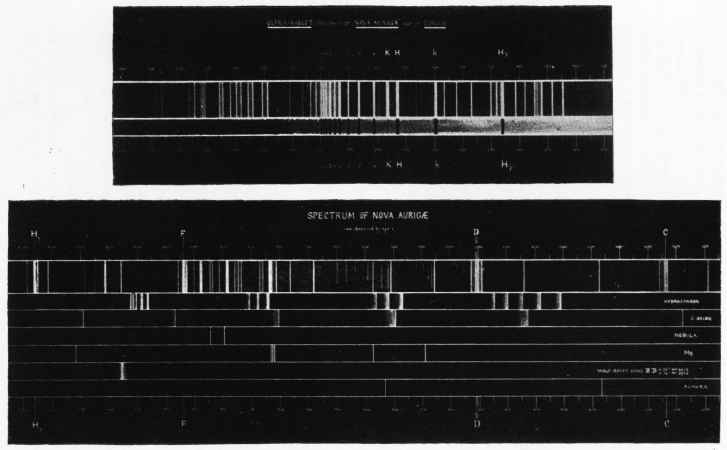
quartette of brilliant green rays, two of them due to helium, caught the eye; and they had companions too numerous to be easily counted. The hydrogen lines were broad and bright; C blazed, as Mr. Espin said, "like a danger-signal on a dark night"; the sodium pair were identified at Tulse Hill, and the yellow helium ray was suspected to lurk close beside them. Fig. 2 in the same plate shows the spectrum as it was seen and mapped by Lady Huggins, February 2 to 6, together with the spectra employed to test the nature of the emissions dispersed in it. One striking feature will be at once remarked. It is that of the pairing of bright with dark lines. Both in the visible and the photographic regions this singular peculiarity was unmistakable; and since the two series plainly owned the same chemical origin, their separate visibility implied large displacement. Otherwise they would have been superposed, not juxtaposed. Measurements of the bright rays, accordingly, showed them to be considerably pushed down towards the red, while their dark companions were still more pushed up towards the blue end. Thus the spectrum of Nova Aurigæ, like that of β Lyræ, with which it had many points in common, appeared to be really double. It was supposed to combine the light of two distinct bodies, one, of a gaseous nature, moving rapidly away from the earth, the other, giving a more sunlike spectrum, approaching it with even higher speed. The relative velocity determined at Potsdam for these oppositely flying masses amounted to 550 miles a second.[1485] And this prodigious rate of separation was fully maintained during six weeks! It did not then represent a mere periastral rush-past.[1486] To the bodies exhibiting its effects, and parting company for ever under its stress, it must have belonged, with slight diminution, in perpetuity. The luminous outburst by which they became visible was explained by Sir William Huggins, in a lecture delivered at the Royal Institution, May 13, 1892, on the tidal theory of Klinkerfues and Wilsing. Disturbances and deformations due to the mutual attraction of two bulky globes at a close approach would, he considered, "give rise to enormous eruptions of the hotter matters from within, immensely greater, but similar in kind, to solar eruptions; and accompanied, probably, by large electrical disturbances." The multiple aspect and somewhat variable character of both bright and dark lines were plausibly referred to processes of "reversal," such as are nearly always in progress above sun-spots; but the long duration of the star's suddenly acquired lustre did not easily fit in with the adopted rationale. A direct collision, on the other hand, was out of the question, since there had obviously been little, if any, sacrifice of motion; and the substitution of a nebula for one of the "stars"[1487] compelled recourse to scarcely conceivable modes of action for an explanation of the perplexing peculiarities of the compound spectrum.
An unexpected dénouement, however, threw all speculations off the track. The Nova contained most of its brightness, fluctuations notwithstanding, until March 9; after which date it ran swiftly and uniformly down towards what was apprehended to be total extinction. No marked change of spectrum attended its decline. When last examined at Tulse Hill, March 24, all the more essential features of its prismatic light were still faintly recognisable.[1488] The object was steadily sinking on April 26, when a (supposed) final glimpse of it was caught with the Lick 36-inch.[1489] It was then of about the sixteenth magnitude. But on August 17 it had sprung up to the tenth, as Professors Holden, Schaeberle, and Campbell perceived with amazement on turning the same instrument upon its place. And to Professor Barnard it appeared, two nights later, not only revived, but transformed into the nucleus of a planetary nebula, 3′ across.[1490] The reality of this seeming distension, however, at once disputed, was eventually disproved. It unquestionably arose from the imperfect focussing power of the telescope for rays of unusual quality.[1491]
The rekindled Nova was detected in this country by Mr. H. Corder, on whose notification Mr. Espin, on August 21, examined its nearly monochromatic spectrum.[1492] The metamorphosis of Nova Cygni seemed repeated.[1493] The light of the new object, like that of its predecessor, was mainly concentrated in a vivid green band, identified with the chief nebular line by Copeland,[1494] Von Gothard,[1495] and Campbell.[1496] The second nebular line was also represented. Indeed, the last-named observer recognised nearly all the eighteen lines measured by him in the Nova as characteristic of planetary nebulæ.[1497] Of particular interest is the emergence in the star-spectrum photographed by Von Gothard of an ultra-violet line originally discovered at Tulse Hill in the Orion nebula, which is also very strong in the Lyra annular nebula, Obviously, then, the physical constitution of Nova Aurigæ became profoundly modified during the four months of its invisibility. The spectrum of February was or appeared compound; that of August was simple; it could be reasonably associated only with a single light-source. Many of the former brilliant lines, too, had vanished, and been replaced by others, at first inconspicuous or absent. As a result, the solar-prominence type, to which the earlier spectrum had seemed to conform, was completely effaced in the later. The cause of these alterations remains mysterious, yet its effects continue. The chromatic behaviour of the semi-extinct Nova, when scrutinised with great refractors, shows its waning light to be distinctly nebular.[1498] Like nearly all its congeners, the star is situated in the full stream of the Milky Way, and we learn without surprise that micrometrical measures by Burnham and Barnard[1499] failed to elicit from it any sign of parallactic shifting. It is hence certain that the development of light, of which the news reached the earth in December, 1891, must have been on a vast scale, and of ancient date. Nova Aurigæ at its maximum assuredly exceeded the sun many times in brightness; and its conflagration can scarcely have occurred less, and may have occurred much more, than a hundred years ago.
By means of the photographic surveys of the skies, carried on in both hemispheres under Professor Pickering's superintendence, such amazing events have been proved to be of not infrequent occurrence. Within six years five new stars were detected from Draper Memorial, or chart-plates by Mrs Fleming, besides the retrospective discovery of a sixth which had rapidly burnt itself out, eight years previously, in Perseus.[1500] Nova Normæ was the immediate successor of Nova Aurigæ; Nova Carinæ and Nova Centauri lit up in 1895, the latter in a pre-existent nebula; Nova Sagittarii and Nova Aquilæ attained brief maxima in 1898 and 1899 respectively. Now, three out of these five stars reproduced with singular fidelity the spectrum of Nova Aurigæ; they displayed the same brilliant rays shadowed, invariably on their blue sides, by dark ones. Palpably, then, the arrangement was systematic and significant; it could not result merely from the casually directed, opposite velocities of bodies meeting in space. The hypothesis of stellar encounters accordingly fell to the ground, and has been provided with no entire satisfactory substitute. Most speculators now fully recognise that motion-displacements cannot be made to account for the doubled spectra of Novæ, and seek recourse instead to some kind of physical agency for producing the observed effect.[1501] And since this is also visible in certain permanent, though peculiar objects—notably in P Cygni, β Lyræ, and η Carinæ—the acting cause must also evidently be permanent and inherent.
The "new star of the new century"[1502] was a visual discovery. Dr. Anderson duplicated, with added éclat, his performance of nine years back. In the early morning of February 22, 1901, he perceived that Algol had a neighbour of nearly its own brightness, which a photograph taken by Mr. Stanley Williams, at Brighton, proved to have risen from below the twelfth magnitude within the preceding 28 hours. And it was still swiftly ascending. On the 23rd, it outshone Capella; for a brief space it took rank as the premier star of the northern hemisphere. A decline set in promptly, but was pursued hesitatingly. The light fluctuated continually over a range of a couple of magnitudes, and with a close approach, during some weeks, to a three-day periodicity. A year after the original outburst, the star was still conspicuous with an opera-glass. The spectrum underwent amazing changes. At first continuous, save for fine dark lines of hydrogen and helium, it unfolded within forty-eight hours a composite range of brilliant and dusky bands disposed in the usual fashion of Novæ. These lasted until far on in March, when hydrogen certainly, and probably other substances as well, ceased to exert any appreciable absorptive action. Blue emissions of the Wolf-Rayet type then became occasionally prominent, in remarkable correspondence with the varying lustre of the star;[1503] finally, a band at λ 3969, found by Wright at Lick to characterise nebular spectra,[1504] assumed abnormal importance; and in July the nebular transformation might be said to be complete. Striking alterations of colour attended these spectral vicissitudes. White to begin with, the star soon turned deep red, and its redness was visibly intensified at each of its recurring minima of light. Blanching, however, ensued upon the development of its nebulous proclivities; and its surviving rays are of a steely hue.
All the more important investigations of Nova Persei were conducted by photographic means. Libraries of spectral plates were collected at the Yerkes and Lick Observatories, at South Kensington, Stonyhurst, and Potsdam, and await the more exhaustive interpretation of the future. Meanwhile, extraordinary revelations have been supplied by immediate photographic delineation. On August 22 and 23, 1901, Professor Max Wolf, by long exposures with the 16-inch Bruce twin objectives of the Königstuhl Observatory (Heidelberg), obtained indications of a large nebula finely ramified, extending south-east of the Nova;[1505] and the entire formation came out in four hours with the Yerkes 2-foot reflector, directed to it by Mr. Ritchey on September 20.[1506] It proved to be a great spiral encircling, and apparently emanating from, the star. But if so, tumultuously, and under stress of catastrophic impulsions. A picture obtained by Mr. Perrine with the Crossley refractor, in 7h. 19m., on November 7 and 8, disclosed the progress of a startling change.[1507] Comparison with the Yerkes photograph showed that during the intervening 48 days four clearly identifiable condensations had become displaced, all to the same extent of about 90 seconds of arc, and in fairly concordant directions, suggesting motion round the Nova as well as away from it. The velocity implied, however, is so prodigious as virtually to exclude the supposition of a bodily transport of matter. It should be at the rate of no less than twenty thousand miles a second, admitting the object to be at a distance from us corresponding to an annual parallax of one-tenth of a second, and actual measurements show it to be indefinitely more remote. The fact of rapid variations in the nebula was reaffirmed, though with less precision, from Yerkes photographs of November 9 and 13, Mr. Ritchey inferring a general expansion of its southern portions.[1508] Much further evidence must be at hand before a sane judgment can be formed as to the nature of the strange events taking place in that secluded corner of the Galaxy.[1509] And it is highly probable that the illumination of the nebulous wreaths round the star will prove no less evanescent than the blazing of the star itself.
We have been compelled somewhat to anticipate our narrative as regards inquiries into the nature of nebulæ. The excursions of opinion on the point were abruptly restricted and defined by the application to them of the spectroscope. On August 29, 1864, Sir William Huggins sifted through his prisms the rays of a bright planetary nebula in Draco.[1510] To his infinite surprise, they proved to be mainly of one colour. In other words, they avowed their origin from a mass of glowing vapour. As to what kind of vapour it might be by which Herschel's conjecture of a "shining fluid" diffused at large throughout the cosmos was thus unexpectedly verified, an answer only partially satisfactory could be afforded. The conspicuous bright line of the Draco nebula seemed to agree in position with one emitted by nitrogen, but has since proved to be distinct from it; of its two fainter companions, one was unmistakably the F line of hydrogen, while the other, in position intermediate between the two, still remains unidentified.
By 1868 Huggins had satisfactorily examined the spectra of about seventy nebulæ, of which one-third displayed a gaseous character.[1511] All of these gave the green ray fundamental to the nebular spectrum, and emanating from an unknown form of matter named by Sir William Huggins "nebulum." It is associated with seven or eight hydrogen lines, with three of "yellow" helium, and with a good many of undetermined origin. The absence of the crimson radiation of hydrogen—perceived with difficulty only in some highly condensed objects—is an anomaly very imperfectly explained as a physiological effect connected with the extreme faintness of nebular light.[1512] An approximate coincidence between the chief nebular line and a "fluting" of magnesium having been alleged by Lockyer in support of his meteoritic hypothesis of nebular constitution, it became of interest to ascertain its reality. The task was accomplished by Sir William and Lady Huggins in 1889 and 1890,[1513] and by Professor Keeler, with the advantages of the Mount Hamilton apparatus and atmosphere, in 1890-91.[1514] The upshot was to show a slight but sure discrepancy as to place, and a marked diversity as to character, between the two qualities of light. The nebular ray (wave-length 5,007 millionths of a millimetre) is slightly more refrangible than the magnesium fluting-edge, and it is sharp and fine, with no trace of the unilateral haze necessarily clinging even to the last "remnant" of a banded formation.
Planetary and annular nebulæ are, without exception, gaseous, as well as those termed "irregular," which frequent the region of the Milky Way. Their constitution usually betrays itself to the eye by their blue or greenish colour; while those yielding a continuous spectrum are of a dull white. Among the more remarkable of these are the well-known nebula in Andromeda, and the great spiral in Canes Venatici; and, as a general rule, the emissions of all such nebulæ as present the appearance of star-clusters grown misty through excessive distance are of the same kind. It would, however, be eminently rash to conclude thence that they are really aggregations of sun-like bodies. The improbability of such an inference has been greatly enhanced by the occurrence, at an interval of a quarter of a century, of stellar outbursts in the midst of two of them. For it is practically certain that the temporary stars were equally remote with the hazy formations they illuminated; hence, if the constituent particles of the latter be suns, the incomparably vaster orbs by which their feeble light was well-nigh obliterated must, as was argued by Mr. Proctor, have been on a scale of magnitude such as the imagination recoils from contemplating. Nevertheless, Dr. Scheiner, not without much difficulty, obtained, in January, 1899, spectrographic prints of the Andromeda nebula, indicative, he thought, of its being a cluster of solar stars.[1515] Sir William and Lady Huggins, on the other hand, saw, in 1897, bright intermixed with dark bands in the spectrum of the same object.[1516] And Mr. Maunder conjectures all "white" nebulæ to be made up of sunlets in which the coronal element predominates, while chromospheric materials assert their presence in nebulæ of the "green" variety.[1517]
Among the ascertained analogies between the stellar and nebular systems is that of variability of light. On October 11, 1852, Mr. Hind discovered a small nebula in Taurus. Chacornac observed it at Marseilles in 1854, but was confounded four years later to find it vanished. D'Arrest missed it October 3, and redetected it December 29, 1861. It was easily seen in 1865-66, but invisible in the most powerful instruments from 1877 to 1880.[1518] Barnard, however, made out an almost evanescent trace of it, October 15, 1890, with the great Lick telescope,[1519] and saw it easily in the spring of 1895, while six months later it evaded his most diligent search.[1520] Then again, on September 28, 1897, the Yerkes 40-inch disclosed it to him as a mere shimmer at the last limit of visibility; and it came out in three diffuse patches on plates to which, on December 6 and 27, 1899, Keeler gave prolonged exposures with the Crossley reflector.[1521] Moreover, a fairly bright adjacent nebula, perceived by O. Struve in 1868, and observed shortly afterwards by d'Arrest, has totally vanished, and was most likely only a temporary apparition. These are the most authentic instances of nebular variability. Many others have been more or less plausibly alleged;[1522] but Professor Holden's persuasion, acquired from an exhaustive study of the records since 1758,[1523] that the various parts of the Orion nebula fluctuate continually in relative lustre, has not been ratified by photographic evidence.
The case of the "trifid" nebula in Sagittarius, investigated by Holden in 1877,[1524] is less easily disposed of. What is certain is that a remarkable triple star, centrally situated, according to the observations of both the Herschels, 1784-1833, in a dark space between the three great lobes of the nebula, is now, and has been since 1839, densely involved in one of them; and since the hypothesis of relative motion is on many grounds inadmissible, the change that has apparently taken place must be in the distribution of light. One no less conspicuous was adduced by Mr. H. C. Russell, director of the Sydney Observatory.[1525] A particularly bright part of the great Argo nebula, as drawn by Sir John Herschel, has, it would seem, almost totally disappeared. He noticed its absence in 1871, using a 7-inch telescope, failed equally later on to find it with an 11-1/2-inch, and his long-exposure photographs show no vestige of it. The same structure is missing from, or scarcely traceable in, a splendid picture of the nebula taken by Sir David Gill in twelve hours distributed over four nights in March, 1892.[1526] An immense gaseous expanse has, it would seem, sunk out of sight. Materially it is no doubt there; but the radiance has left it.
Nebulæ have no ascertained proper motions. No genuine change of place in the heavens has yet been recorded for any one of them. All equally hold aloof, so far as telescopic observation shows, from the busy journeyings of the stars. This seeming immobility is partly an effect of vast distance. Nebular parallax has, up to the present, proved evanescent, and nebular parallactic drift, in response to the sun's advance through space, remains likewise imperceptible.[1527] It may hence be presumed that no nebulæ occur within the sphere occupied by the nearer stars. But the difficulty of accurately measuring such objects must also be taken into account. Displacements which would be conspicuous in stars might easily escape detection in ill-defined, hazy masses. Thus the measures executed by d'Arrest in 1857[1528] have not yet proved effective for their designed purpose of contributing to the future detection of proper motions. Some determinations made by Mr. Burnham with the Lick refractor in 1891,[1529] will ultimately afford a more critical test. He found that nearly all planetary nebulæ include a sharp stellar nucleus, the position of which with reference to neighbouring stars could be fixed no less precisely than if it were devoid of nebulous surroundings. Hence, the objects located by him cannot henceforward shift, were it only to the extent of a small fraction of a second, without the fact coming to the knowledge of astronomers.
The spectroscope, however, here as elsewhere, can supplement the telescope; and what it has to tell, it tells at once, without the necessity of waiting on time to ripen results. Sir William Huggins made, in 1874,[1530] the earliest experiments on the radial movements of nebulæ. But with only a negative upshot. None of the six objects examined gave signs of spectral alteration, and it was estimated that they must have done so had they been in course of recession from or approach towards the earth by as much as twenty-five miles a second. With far more powerful appliances, Professor Keeler renewed the attempt at Lick in 1890-91. His success was unequivocal. Ten planetary nebulæ yielded perfectly satisfactory evidence of line-of-sight motion,[1531] the swiftest traveller being the well-known greenish globe in Draco,[1532] found to be hurrying towards the earth at the rate of forty miles a second. For the Orion nebula, a recession of about eleven miles was determined,[1533] the whole of which may, however, very well belong to the solar system itself, which, by its translation towards the constellation Lyra, is certainly leaving the great nebula pretty rapidly behind. The anomaly of seeming nebular fixity has nevertheless been removed; and the problem of nebular motion has begun to be solved through the demonstrated possibility of its spectroscopic investigation.
Keeler's were the first trustworthy determinations of radial motion obtained visually. That the similar work on the stars begun at Greenwich in 1874, and carried on for thirteen years, remained comparatively unfruitful, was only what might have been expected, the instruments available there being altogether inadequate for the attainment of a high degree of accuracy.
The various obstacles in the way of securing it were overcome by the substitution of the sensitive plate for the eye. Air-tremors are thus rendered comparatively innocuous; and measurements of stellar lines displaced by motion with reference to fiducial lines from terrestrial sources, photographed on the same plates, can be depended upon within vastly reduced limits of error. Studies for the realisation of the "spectrographic" method were begun by Dr. Vogel and his able assistant, Dr. Scheiner, at Potsdam in 1887. Their preliminary results, communicated to the Berlin Academy of Sciences, March 15, 1888, already showed that the requirements for effective research in this important branch were at last about to be complied with. An improved instrument was erected in the autumn of the same year, and the fifty-one stars, bright enough for determination with a refractor of 11 inches aperture, were promptly taken in hand. A list of their motions in the line of sight, published in 1892,[1534] was of high value, both in itself and for what it promised. One noteworthy inference from the data it collected was that the eye tends, under unfavourable circumstances, to exaggerate the line-displacements it attempts to estimate. The velocities photographically arrived at were of much smaller amounts than those visually assigned. The average speed of the Potsdam stars came out only 10·4 miles a second, the quickest among them being Aldebaran, with a recession of thirty miles a second. More lately, however, Deslandres and Campbell have determined for ζ Herculis and η Cephei respectively approaching rates of forty-four and fifty-four miles a second.
The installation, in 1900, of a photographic refractor 31-1/2 inches in aperture, coupled with a 20-inch guiding telescope, will enable Dr. Vogel to investigate spectrographically some hundreds of stars fainter than the second magnitude; and the materials thus accumulated should largely help to provide means for a definite and complete solution of the more than secular problem of the sun's advance through space. The solution should be complete, because including a genuine determination of the sun's velocity, apart from assumptions of any kind. M. Homann's attempt, in 1885,[1535] to extract some provisional information on the subject from the radial movements of visually determined stars gave a fair earnest of what might be done with materials of a better quality. He arrived at a goal for the sun's way shifted eastward to the constellation Cygnus—a result congruous with the marked tendency of recently determined apexes to collect in or near Lyra; and the most probable corresponding velocity seemed to be about nineteen miles a second, or just that of the earth in its orbit. A more elaborate investigation of the same kind, based by Professor Campbell in 1900[1536] upon the motions of 280 stars, determined with extreme precision, suffered in completeness through lack of available data from the southern hemisphere. The outcome, accordingly, was an apex most likely correctly placed as regards right ascension, but displaced southward by some fifteen degrees. The speed of twelve miles a second, assigned to the solar translation, approximates doubtless very closely to the truth.
A successful beginning was made in nebular spectrography by Sir William Huggins, March 7, 1882.[1537] Five lines in all stamped themselves upon the plate during forty-five minutes of exposure to the rays of the strange object in Orion. Of these, four were the known visible lines, and a fifth, high up in the ultra-violet, at wave-length 3,727, has evidently peculiar relationships, as yet imperfectly apprehended. It is strong in the spectra of many planetaries; it helped to characterise the nebular metamorphosis of Nova Aurigæ, yet failed to appear in Nova Persei. Two additional hydrogen lines, making six in all, were photographed at Tulse Hill, from the Orion nebula, in 1890;[1538] and Dr. Copeland's detection in 1886[1539] of the yellow ray D3 gave the first hint of the presence of helium in this prodigious formation. Nor are there wanting spectroscopic indications of its physical connection with the stars visually involved in it. Sir William and Lady Huggins found a plate exposed February 5, 1888, impressed with four groups of fine bright lines, originating in the continuous light of two of the trapezium-stars, but extending some way into the surrounding nebula.[1540] And Dr. Scheiner[1541] argued a wider relationship from the common possession, by the nebula and the chief stars in the constellation Orion, of a blue line, bright in the one case, dark in the others, since identified as a member of one of the helium series.
The structural unity of the stellar and nebular orders in this extensive region of the sky has also, by direct photographic means, been unmistakably affirmed.
The first promising autographic picture of the Orion nebula was obtained by Draper, September 30, 1880.[1542] The marked approach towards a still more perfectly satisfactory result shown by his plates of March, 1881 and 1882, was unhappily cut short by his death. Meanwhile, M. Janssen was at work in the same field from 1881, with his accustomed success.[1543] But Dr. A. Ainslie Common left all competitors far behind with a splendid picture, taken January 30, 1883, by means of an exposure of thirty-seven minutes in the focus of his 3-foot silver-on-glass mirror.[1544] Photography may thereby be said to have definitely assumed the office of historiographer to the nebulæ, since this one impression embodies a mass of facts hardly to be compassed by months of labour with the pencil, and affords a record of shape and relative brightness in the various parts of the stupendous object it delineates which must prove invaluable to the students of its future condition. Its beauty and merit were officially recognised by the award of the Astronomical Society's Gold Medal in 1884.
A second picture of equal merit, obtained by the same means, February 28, 1883, with an exposure of one hour, is reproduced in the frontispiece. The vignette includes two specimens of planetary photography. The Jupiter, with the great red spot conspicuous in the southern hemisphere, is by Dr. Common. It dates from September 3, 1879, and was accordingly one of the earliest results with his 36-inch, the direct image in which imprinted itself in a fraction of a second, and was subsequently enlarged on paper about twelve times. The exquisite little picture of Saturn was taken at Paris by MM. Paul and Prosper Henry, December 21, 1885, with their 13-inch photographic refractor. The telescopic image was in this case magnified eleven times previous to being photographed, an exposure of about five seconds being allowed; and the total enlargement, as it now appears, is nineteen times. A trace of the dusky ring perceptible on the original negative is lost in the print.
A photograph of the Orion nebula taken by Dr. Roberts in 67 minutes, November 30, 1886, made a striking disclosure of the extent of that prodigious object. More than six times the nebulous area depicted on Dr. Common's plates is covered by it, and it plainly shows an adjacent nebula, separately catalogued by Messier, to belong to the same vast formation.
This disposition to annex and appropriate has come out more strongly with every increase of photographic power. Plates exposed at Harvard College in March, 1888, with an 8-inch portrait-lens (the same used in the preparation of the Draper Catalogue) showed the old-established "Fish-mouth" nebula not only to involve the stars of the sword-handle, but to be in tolerably evident connection with the most easterly of the three belt-stars, from which a remarkable nebulous appendage was found to proceed.[1545] A still more curious discovery was made by W. H. Pickering in 1889.[1546] Photographs taken in three hours from the summit of Wilson's Peak in California revealed the existence of an enormous, though faint spiral structure, enclosing in its span of nearly seventeen degrees the entire stellar and nebulous group of the Belt and Sword, from which it most likely, although not quite traceably, issues as if from a nucleus. A startling glimpse is thus afforded of the cosmical importance of that strange "hiatus" in the heavens which excited the wonder of Huygens in 1656. The inconceivable attenuation of the gaseous stuff composing it was virtually demonstrated by Mr. Ranyard.[1547]
In March, 1885, Sir Howard Grubb mounted for Dr. Isaac Roberts, at Maghull, near Liverpool (his observatory has since been transferred to Crowborough in Sussex), a silver-on-glass reflector of twenty inches aperture, constructed expressly for use in celestial photography. A series of nebula-pictures, obtained with this fine instrument, have proved highly instructive both as to the structure and extent of these wonderful objects; above all, one of the great Andromeda nebula, to which an exposure of three hours was given on October 1, 1888.[1548] In it a convoluted structure replaced and rendered intelligible the anomalously rifted mass seen by Bond in 1847.[1549] The effects of annular condensation appeared to have stamped themselves upon the plate, and two attendant nebulæ presented the aspect of satellites already separated from the parent body, and presumably revolving round it. The ring-nebula in Lyra was photographed at Paris in 1886, and shortly afterwards by Von Gothard with a 10-inch reflector,[1550] and he similarly depicted in 1888 the two chief spiral and other nebulæ.[1551] Photographs of the Lyra nebula taken at Algiers in 1890,[1552] and at the Vatican observatory in 1892,[1553] were remarkable for the strong development of a central star, difficult of telescopic discernment, but evidently of primary importance to the annular structure around.
The uses of photography in celestial investigations become every year more manifold and more apparent. The earliest chemical star-pictures were those of Castor and Vega, obtained with the Cambridge refractor in 1850 by Whipple of Boston under the direction of W. C. Bond. Double-star photography was inaugurated under the auspices of G. P. Bond, April 27, 1857, with an impression, obtained in eight seconds, of Mizar, the middle star in the handle of the Plough. A series of measures from sixty-two similar images gave the distance and position-angle of its companion with about the same accuracy attainable by ordinary micrometrical operations; and the method and upshot of these novel experiments were described in three papers remarkably forecasting the purposes to be served by stellar photography.[1554] The matter next fell into the able hands of Rutherfurd, who completed in 1864 a fine object glass (of 11-1/2 inches) corrected for the ultra-violet rays, consequently useless for visual purposes. The sacrifice was recompensed by conspicuous success. A set of measurements from his photographs of nearly fifty stars in the Pleiades, and their comparison with Bessel's places, enabled Dr. Gould to announce, in 1866, that during the intervening third of a century no changes of importance had occurred in their relative positions.[1555] And Mr. Harold Jacoby[1556] similarly ascertained the fixity of seventy-five of Rutherfurd's Atlantids, between the epoch 1873 and that of Dr. Elkin's heliometric triangulation of the cluster in 1886,[1557] extending the interval to twenty-seven years by subsequent comparisons with plates taken at Lick, September 27, 1900.[1558] Positive, however, as well as negative results have ensued from the application of modern methods to that antique group.
On October 19, 1859, Wilhelm Tempel, a Saxon peasant by origin, later a skilled engraver, discovered with a small telescope, bought out of his scanty savings, an elliptical nebulosity, stretching far to the southward from the star Merope. It attracted the attention of many observers, but was so often missed, owing to its extreme susceptibility to adverse atmospheric influences, as to rouse unfounded suspicions of its variability. The detection of this evasive object gave a hint, barely intelligible at the time, of further revelations of the same kind by more cogent means.
A splendid photograph of 1,421 stars in the Pleiades, taken by the MM. Henry with three hours' exposure, November 16, 1885, showed one of the brightest of them to have a small spiral nebula, somewhat resembling a strongly-curved comet's tail, attached to it. The reappearance of this strange appurtenance on three subsequent plates left no doubt of its real existence, visually attested at Pulkowa, February 5, 1886, by one of the first observations made with the 30-inch equatoreal.[1559] Much smaller apertures, however, sufficed to disclose the "Maia nebula," once it was known to be there. Not only did it appear greatly extended in the Vienna 27-inch,[1560] but MM. Perrotin and Thollon saw it with the Nice 15-inch, and M. Kammermann of Geneva, employing special precautions, with a refractor of only ten inches aperture.[1561] The advantage derived by him for bringing it into view, from the insertion into the eye-piece of a uranium film, gives, with its photographic intensity, valid proof that a large proportion of the light of this remarkable object is of the ultra-violet kind.
The beginning thus made was quickly followed up. A picture of the Pleiades procured at Maghull in eighty-nine minutes, October 23, 1886, revealed nebulous surroundings to no less than four leading stars of the group, namely, Alcyone, Electra, Merope, and Maia; and a second impression, taken in three hours on the following night, showed further "that the nebulosity extends in streamers and fleecy masses till it seems almost to fill the spaces between the stars, and to extend far beyond them."[1562] The coherence of the entire mixed structure was, moreover, placed beyond doubt by the visibly close relationship of the stars to the nebulous formations surrounding them in Dr. Roberts's striking pictures. Thus Goldschmidt's notion that all the clustered Pleiades constitute, as it were, a second Orion trapezium in the midst of a huge formation of which Tempel's nebula is but a fragment,[1563] has been to some extent verified. Yet it seemed fantastic enough in 1863.