Part 2 — CHAPTER XII (continued 2)
Reading edition
Then in 1888 the MM. Henry gave exposures of four hours each to several plates, which exhibited on development some new features of the entangled nebulæ. The most curious of these was the linking together of stars by nebulous chains. In one case seven aligned stars appeared strung on a silvery filament, "like beads on a rosary."[1564] The "rows of stars," so often noticed in the sky, may, then, be concluded to have more than an imaginary existence. Of the 2,326 stars recorded in these pictures, a couple of hundred among the brightest can, at the outside, be reckoned as genuine Pleiades. The great majority were relegated, by Pickering's[1565] and Stratonoff's[1566] counts of the stellar populace in and near the cluster, to the position of outsiders from it. They are undistinguished denizens of the abysmal background upon which it is projected.
Investigations of its condition were carried a stage further by Barnard. On November 14, 1890,[1567] he discovered visually with the Lick refractor a close nebulous satellite to Merope, photographs of which were obtained by Keeler in 1898.[1568] It appears in them of a rudely pentagonal shape, a prominent angle being directed towards the adjacent star. Finally, an exposure of ten hours made by Barnard with the Willard lens indicated the singular fact that the entire group is embedded in a nebulous matrix, streaky outliers of which blur a wide surface of the celestial vault.[1569] The artist's conviction of the reality of what his picture showed was confirmed by negatives obtained by Bailey at Arequipa in 1897, and by H. C. Wilson at Northfield (Minnesota) in 1898.[1570]
With the Ealing 3-foot reflector, sold by Dr. Common to Mr. Crossley, and by him presented to the Lick Observatory, Professor Keeler took in 1899 a series of beautiful and instructive nebula[1571] photographs; One of the Trifid may be singled out as of particular excellence. An astonishing multitude of new nebulæ were revealed by trial-exposures with this instrument. A "conservative estimate" gave 120,000 as the number coming within its scope. Moreover, the majority of those actually recorded were of an unmistakable spiral character, and they included most of Sir John Herschel's "double nebulæ," previously supposed to exemplify the primitive history of binary stellar systems.[1572] Dr. Max Wolf's explorations with a 6-inch Voigtländer lens in 1901 emphatically reaffirmed the inexhaustible wealth of the nebular heavens. In one restricted region, midway between Præsepe and the Milky Way, he located 135 nebulæ, where only three had until then been catalogued; and he counted 108 such objects clustering round the star 31 Comæ Berenices,[1573] and so closely that all might be occulted together by the moon. The general photographic Catalogue of Nebulæ which Dr. Wolf has begun to prepare[1574] will thus be a most voluminous work.
The history of celestial photography at the Cape of Good Hope began with the appearance of the great comet of 1882. No special apparatus was at hand; so Sir David Gill called in the services of a local artist, Mr. Allis of Mowbray, with whose camera, strapped to the Observatory equatoreal, pictures of conspicuous merit were obtained. But their particular distinction lay in the multitude of stars begemming the background. (See Plate III.) The sight of them at once opened to the Royal Astronomer a new prospect. He had already formed the project of extending Argelander's "Durchmusterung" from the point where it was left by Schönfeld to the southern pole; and his ideas regarding the means of carrying it into execution crystallised at the needle touch of the cometary experiments. He resolved to employ photography for the purpose. The exposure of plates was accordingly begun, under the care of Mr. Ray Woods, in 1885; and in less than six years, the sky, from 19° of south latitude to the pole, had been covered in duplicate. Their measurement, and the preparation of a catalogue of the stars imprinted upon them, were generously undertaken by Professor Kapteyn, and his laborious task has at length been successfully completed. The publication, in 1900, of the third and concluding volume of the "Cape Photographic Durchmusterung"[1575] placed at the disposal of astronomers a photographic census of the heavens fuller and surer than the corresponding visual enumeration executed at Bonn. It includes 454,875 stars, nearly to the tenth magnitude, and their positions are reliable to about one second of arc.
The production of this important work was thus a result of the Cape comet-pictures; yet not the most momentous one. They turned the scale in favour of recourse to the camera when the MM. Henry encountered, in their continuation of Chacornac's half-finished enterprise of ecliptical charting, sections of the Milky Way defying the enumerating efforts of eye and hand. The perfect success of some preliminary experiments made with an instrument constructed by them expressly for the purpose was announced to the Academy of Sciences at Paris, May 2, 1885. By its means stars estimated as of the sixteenth magnitude clearly recorded their presence and their places; and the enormous increase of knowledge involved may be judged of from the fact that, in a space of the Milky Way in Cygnus 2° 15′ by 3°, where 170 stars had been mapped by the old laborious method, about five thousand stamped their images on a single Henry plate.
These results suggested the grand undertaking of a general photographic survey of the heavens, and Gill's proposal, June 4, 1886, of an International Congress for the purpose of setting it on foot was received with acclamation, and promptly acted upon. Fifty-six delegates of seventeen different nationalities met in Paris, April 16, 1887, under the presidentship of Admiral Mouchez, to discuss measures and organise action. They resolved upon the construction of a Photographic Chart of the whole heavens, comprising stars of a fourteenth magnitude, to the surmised number of twenty millions; to be supplemented by a Catalogue, framed from plates of comparatively short exposure, giving start to the eleventh magnitude. These will probably amount to about one million and a quarter. For procuring both sets of plates, instruments were constructed precisely similar to that of the MM. Henry, which is a photographic refractor, thirteen inches in aperture, and eleven feet focus, attached to a guiding telescope of eleven inches aperture, corrected, of course, for the visual rays. Each place covers an area of four square degrees, and since the series must be duplicated to prevent mistakes, about 22,000 plates will be needed for the Chart alone. The task of preparing them was apportioned among eighteen observatories scattered over the globe, from Mexico to Melbourne; but three in South America having become disabled or inert, were replaced in 1900 by those at Cordoba, Montevideo, and Perth, Western Australia. Meanwhile, the publication of results has begun, and is likely to continue for at least a quarter of a century. The first volume of measures from the Potsdam Catalogue-plates was issued in 1899, and its successors, if on the same scale, must number nearly 400. Moreover, ninety-six heliogravure enlargements from the Paris Chart-plates, distributed in the same year, supplied a basis for the calculation that the entire Atlas of the sky, composed of similar sheets, will form a pile thirty feet high and two tons in weight![1576] It will, however, possess an incalculable scientific value. For millions of stars can be determined by its means, from their imprinted images, with an accuracy comparable to that attainable by direct meridian observations.
One of the most ardent promoters of the scheme it may be expected to realise was Admiral Mouchez, the successor of Leverrier in the direction of the Paris Observatory. But it was not granted to him to see the fruition of his efforts. He died suddenly June 25, 1892.[1577] Although not an astronomer by profession, he had been singularly successful in pushing forward the cause of the science he loved, while his genial and open nature won for him wide personal regard. He was replaced by M. Tisserand, whose mathematical eminence fitted him to continue the traditions of Delaunay and Leverrier. But his career, too, was unhappily cut short by an unforeseen death on October 20, 1896; and the more eminent among the many qualifications of his successor, M. Maurice Loewy, are of the practical kind.
The sublime problem of the construction of the heavens has not been neglected amid the multiplicity of tasks imposed upon the cultivators of astronomy by its rapid development. But data of a far higher order of precision, and indefinitely greater in amount, than those at the disposal of Herschel or Struve must be accumulated before any definite conclusions on the subject are possible. The first organised effort towards realising this desideratum was made by the German Astronomical Society in 1865, two years after its foundation at Heidelberg. The original programme consisted in the exact determination of the places of all Argelander's stars to the ninth magnitude (exclusive of the polar zone), from the reobservation of which, say, in the year 1950, astronomers of two generations hence may gather a vast store of knowledge—directly of the apparent motions, indirectly of the mutual relations binding together the suns and systems of space. Thirteen observatories in Europe and America joined in the work, now virtually terminated. Its scope was, after its inception, widened to include southern zones as far as the Tropic of Capricorn; this having been rendered feasible by Schönfeld's extension (1875-1885) of Argelander's survey. Thirty thousand additional stars thus taken in were allotted in zones to five observatories. Another important undertaking of the same class is the reobservation of the 47,300 stars in Lalande's Histoire Céleste. Begun under Arago in 1855, its upshot has been the publication of the great Paris Catalogue, issued in eight volumes, between 1887 and 1902. From a careful study of their secular changes in position, M. Bossert has already derived the proper motions of a couple of thousand out of nearly fifty thousand stars enumerated in it.
Through Dr. Gould's unceasing labours during his fifteen years' residence at Cordoba, a detailed acquaintance with southern stars was brought about. His Uranometria Argentina (1879) enumerates the magnitudes of 8,198 out of 10,649 stars visible to the naked eye under those transparent skies; 33,160 down to 9-1/2 magnitude are embraced in his "zones"; and the Argentine General Catalogue of 32,468 southern stars was published in 1886. Valuable work of the same kind has been done at the Leander McCormick Observatory, Virginia, by Professor O. Stone; while the late Redcliffe observer's "Cape Catalogue for 1880′ affords inestimable aid to the practical astronomer south of the line, which has been reinforced with several publications issued by the present Astronomer Royal at the Cape. Moreover, the gigantic task entered upon in 1860 by Dr. C. H. F. Peters, director of the Litchfield Observatory, Clinton (N.Y.), and of which a large instalment was finished in 1882, deserves honourable mention. It was nothing less than to map all stars down to, and even below, the fourteenth magnitude, situated within 30° on either side of the ecliptic, and so to afford "a sure basis for drawing conclusions with respect to the changes going on in the starry heavens."[1578]
It is tolerably safe to predict that no work of its kind and for its purpose will ever again be undertaken. In a small part of one night stars can now be got to register themselves more numerously and more accurately than by the eye and hand of the most skilled observer in the course of a year. Fundamental catalogues, constructed by the old, time-honoured method, will continue to furnish indispensable starting-points for measurement; and one of especial excellence was published by Professor Newcomb in 1899;[1579] but the relative places of the small crowded stars—the sidereal οι‘ πο′λλοι—will henceforth be derived from their autographic statements on the sensitive plate. Even the secondary purpose—that of asteroidal discovery—served by detailed stellar enumeration, is more surely attained by photography than by laborious visual comparison. For planetary movement betrays itself in a comparatively short time by turning the imprinted image of the object affected by it from a dot into a trail.
In the arduous matter of determining star distances progress has been steady, and bids fair to become rapidly accelerated. Together, yet independently, Gill and Elkin carried out, at the Cape Observatory in 1882-83, an investigation of remarkable accuracy into the parallaxes of nine southern stars. One of these was the famous α Centauri, the distance of which from the earth was ascertained to be just one-third greater than Henderson had made it. The parallax of Sirius, on the other hand, was doubled, or its distance halved; while Canopus proved to be quite immeasurably remote—a circumstance which, considering that, among all the stellar multitude, it is outshone only by the radiant Dog-star, gives a stupendous idea of its real splendour and dimensions.
Inquiries of this kind were, for some years, successfully pursued at the observatory of Dunsink, near Dublin. Annual perspective displacements were by Dr. Brünnow detected in several stars, and in others remeasured with a care which inspired just confidence. His parallax for α Lyræ (0·13′) was authentic, though slightly too large (Elkin's final results gave π = 0·082′); and the received value for the parallax of the swiftly travelling star "Groombridge 1,830′ scarcely differs from that arrived at by him in 1871 (π = 0·09′). His successor as Astronomer-Royal for Ireland, Sir Robert Stawell Ball (now Lowndean Professor of Astronomy in the University of Cambridge), has done good service in the same department. For besides verifying approximately Struve's parallax of half a second of arc for 61 Cygni, he refuted, in 1811, by a sweeping search for (so-called) "large" parallaxes, certain baseless conjectures of comparative nearness to the earth, in the case of red and temporary stars.[1580] Of 450 objects thus cursorily examined, only one star of the seventh magnitude, numbered 1,618 in Groombridge's Circumpolar Catalogue, gave signs of measurable vicinity. Similarly, a reconnaissance among rapidly moving stars lately made by Dr. Chase with the Yale heliometer[1581] yielded no really large, and only eight appreciable parallaxes among the 92 subjects of his experiments.
A second campaign in stellar parallax was undertaken by Gill and Elkin in 1887. But this time the two observers were in opposite hemispheres. Both used heliometers. Dr. Elkin had charge of the fine instrument then recently erected in Yale College Observatory; Sir David Gill employed one of seven inches, just constructed under his directions, in first-rate style, by the Repsolds of Hamburg. Dr. Elkin completed in 1888 his share of the more immediate joint programme, which consisted in the determination, by direct measurement, of the average parallax of stars of the first magnitude. It came out, for the ten northern luminaries, after several revisions, 0·098′, equivalent to a light-journey of thirty-three years. The deviations from this average were, indeed, exceedingly wide. Two of the stars, Betelgeux and α Cygni, gave no certain sign of any perspective shifting; of the rest, Procyon, with a parallax of 0·334′, proved the nearest to our system. At the mean distance concluded for these ten brilliant stars, the sun would show as of only fifth magnitude; hence it claims a very subordinate rank among the suns of space. Sir David Gill's definitive results were published in 1900.[1582] As the average parallax of the eleven brightest stars in the southern hemisphere, they gave 0·13′, a value enhanced by the exceptional proximity of α Centauri. Yet four of these conspicuous objects—Canopus, Rigel, Spica, and β Crucis—gave no sign of perspective response to the annual change in our point of view. The list included eleven fainter stars with notable proper motions, and most of these proved to have fairly large parallaxes. Among other valuable contributions to this difficult branch may be instanced Bruno Peter's measurements of eleven stars with the Leipzig heliometer, 1887-92;[1583] Kapteyn's application of the method by differences in right ascension to fifteen stars observed on the meridian 1885-89;[1584] and Flint's more recent similar determinations at Madison, Wisconsin.[1585]
The great merit of having rendered photography available for the sounding of the celestial depths belongs to Professor Pritchard. The subject of his initial experiment was 61 Cygni. From measurements of 200 negatives taken in 1886, he derived for that classic star a parallax of 0·438′, in satisfactory agreement with Ball's of 0·468′. A detailed examination convinced the Astronomer-Royal of its superior accuracy to Bessel's result with the heliometer. The Savilian Professor carried out his project of determining all second magnitude stars to the number of about thirty,[1586] conveniently observable at Oxford, obtaining as the general outcome of the research an average parallax of 0·056′, for objects of that rank. But this value, though in itself probable, cannot be accepted as authoritative, in view of certain inaccuracies in the work adverted to by Jacoby,[1587] Hermann Davis, and Gill. The method has, nevertheless, very large capabilities. Professor Kapteyn showed, in 1889,[1588] the practicability of deriving parallaxes wholesale from plates exposed at due intervals, and applied his system, in 1900, with encouraging success, to a group of 248 stars.[1589] The apparent absence of spurious shiftings justified the proposal to follow up the completion of the Astrographic Chart with the initiation of a photographic "Parallax Durchmusterung."
Observers of double stars are among the most meritorious, and need to be among the most patient and painstaking workers in sidereal astronomy. They are scarcely as numerous as could be wished. Dr. Doberck, distinguished as a computer of stellar orbits, complained in 1882[1590] that data sufficient for the purpose had not been collected for above 30 or 40 binaries out of between five and six hundred certainly or probably within reach. The progress since made is illustrated by Mr. Gore's useful Catalogue of Computed Binaries, including fifty-nine entries, presented to the Royal Irish Academy, June 9, 1890.[1591] Few have done more towards supplying the deficiency of materials than the late Baron Ercole Dembowski of Milan. He devoted the last thirty years of his life, which came to an end January 19, 1881, to the revision of the Dorpat Catalogue, and left behind him a store of micrometrical measures as numerous as they are precise.
Of living observers in this branch, Mr. S. W. Burnham is beyond question the foremost. While pursuing legal avocations at Chicago, he diverted his scanty leisure by exploring the skies with a 6-inch telescope mounted in his back-yard; and had discovered, in May, 1882, one thousand close and mostly very difficult double stars.[1592] Summoned as chief assistant to the new Lick Observatory in 1888, he resumed the work of his predilection with the 36-inch and 12-inch refractors of that establishment. But although devoting most of his attention to much-needed remeasurements of known pairs, he incidentally divided no less than 274 stars, the majority of which lay beyond the resolving power of less keen and effectually aided eyesight. One of his many interesting discoveries was that of a minute companion to α Ursæ Majoris (the first Pointer), which already gives unmistakable signs of orbital movement round the shining orb it is attached to. Another pair, κ Pegasi, detected in 1880, was found in 1892 to have more than completed a circuit in the interim.[1593] Its period of a little over eleven years is the shortest attributable to a visible binary system, except that of δ Equulei, provisionally determined by Professor Hussey in 1900 at 5·7 years,[1594] and indicated by spectroscopic evidence to be of uncommon brevity.[1595] Burnham's Catalogue of 1,290 Double Stars, discovered by him from 1871 to 1899,[1596] is a record of unprecedented interest. Nearly all the 690 pairs included in it, 2′ or less than 2′ apart, must be physically connected; and they offer a practically unlimited field for investigation; while the notes, diagrams, and orbits appended profusely to the various entries, are eminently helpful to students and computers. The author is continuing his researches at the Yerkes Observatory, having quitted the Lick establishment in 1892. The first complete enrolment of southern double stars was made by Mr. R. T. A. Innes in 1899.[1597] The couples enumerated, twenty-one per cent. of which are separated by less than one second of arc, are 2,140 in number. They include 305 discovered by himself. Dr. See gathered a rich harvest of nearly 500 new southern pairs with the Lowell 24-inch refractor in 1897.[1598] Professor Hough's discoveries in more northerly zones amount to 623;[1599] Hussey's at Lick to 350; and Aitken's already to over 300.
There is as yet no certainty that the stars of 61 Cygni form a true binary combination. Mr. Burnham, indeed, holds them to be in course of definitive separation; and Professor Hall's observations at Washington, 1879 to 1891, although favouring their physical connection, are far from decisive on the point.[1600] Dr. Wilsing, from certain anomalous displacements of their photographed images, concluded in 1893[1601] the presence of an invisible third member of the system, revolving in a period of twenty-two months; but the effects noticed by him were probably illusory.
Important series of double-star observations were made by Perrotin at Nice in 1883-4;[1602] by Hall, with the 26-inch Washington equatoreal, 1874 to 1891;[1603] by Schiaparelli from 1875 onward; by Glasenapp, O. Stone, Leavenworth, Seabroke, and many besides. Finally, Professor Hussey's revision of the Pulkowa Catalogue[1604] is a work of the teres atque rotundus kind, which leaves little or nothing to be desired. The methods employed in double-star determinations remain, at the beginning of the twentieth century, essentially unchanged. The camera has scarcely encroached upon this part of the micrometer's domain.[1605]
A research of striking merit into the origin of binary stars was published in 1892 by Dr. T. J. J. See, in the form of an Inaugural Dissertation for his doctor's degree in the University of Berlin. The main result was to show the powerful effects of tidal friction in prescribing the course of their development from double nebulæ, revolving almost in contact, to double suns, far apart, yet inseparable. The high eccentricities of their eventual orbits were shown to result necessarily from this mode of action, which must operate with enormous strength on closely conjoined, nearly equal masses, such as the rapidly revolving pairs disclosed by the spectroscope. That these are still in an early stage of their life-history is probable in itself, and is re-affirmed by the exceedingly small density indicated for eclipsing stars by the ratio of phase-duration to period.
Stellar photometry, initiated by the elder Herschel, and provided with exact methods by his son at the Cape, by Steinheil and Seidel at Munich, has of late years assumed the importance of a separate department of astronomical research. Two monumental works on the subject, compiled on opposite sides of the Atlantic, were thus appropriately coupled in the bestowal of the Royal Astronomical Society's Gold Medal in 1886. Harvard College Observatory led the way under the able direction of Professor E. C. Pickering. His photometric catalogue of 4,260 stars,[1606] constructed from nearly 95,000 observations of light-intensity during the years 1879-82, constitutes a record of incalculable value for the detection and estimation of stellar variability. It was succeeded in 1885 by Professor Pritchard's "Uranometria Nova Oxoniensis," including photometric determinations of the magnitude of all naked-eye stars, from the pole to ten degrees south of the equator to the number of 2,784. The instrument employed was the "wedge photometer," which measures brightness by resistance to extinction. A wedge of neutral-tint glass, accurately divided to scale, is placed in the path of the stellar rays, when the thickness of it they have power to traverse furnishes a criterion of their intensity. Professor Pickering's "meridian photometer," on the other hand, is based upon Zöllner's principle of equalization effected by a polarising apparatus. After all, however, as Professor Pritchard observed, "the eye is the real photometer," and its judgment can only be valid over a limited range.[1607] Absolute uniformity, then, in estimates made by various means, under varying conditions, and by different observers, is not to be looked for; and it is satisfactory to find substantial agreement attainable and attained. Only in an insignificant fraction of the stars common to the Harvard and Oxford catalogues discordances are found exceeding one-third of a magnitude; a large proportion (71 per cent.) agree within one-fourth, a considerable minority (31 per cent.) within one-tenth of a magnitude.[1608] The Harvard photometry was extended, on the same scale, to the opposite pole in a catalogue of the magnitudes of 7,922 southern stars,[1609] founded on Professor Bailey's observations in Peru, 1889-91. Measurements still more comprehensive were subsequently executed at the primary establishment. With a meridian photometer of augmented power, the surprising number of 473,216 settings were made during the years 1891-98, nearly all by the indefatigable director himself, and they afforded materials for a "Photometric Durchmusterung," published in 1901, including all stars to 7·5 magnitude north of declination -40°.[1610] A photometric zone, 20° wide, has for some time been in course of observation at Potsdam by MM. Müller and Kempf. The instrument employed by them is constructed on the polarising principle as adapted by Zöllner.
Photographic photometry has meanwhile risen to an importance if anything exceeding that of visual photometry. For the usefulness of the great international star-chart now being prepared would be gravely compromised by systematic mistakes regarding the magnitudes of the stars registered upon it. No entirely trustworthy means of determining them have, however, yet been found. There is no certainty as to the relative times of exposure needed to get images of stars representative of successive photometric ranks. All that can be done is to measure the proportionate diameters of such images, and to infer, by the application of a law learned from experience, the varied intensities of light to which they correspond. The law is, indeed, neither simple nor constant. Different investigators have arrived at different formulæ, which, being purely empirical, vary their nature with the conditions of experiment. Probably the best expedient for overcoming the difficulty is that devised by Pickering, of simultaneously photographing a star and its secondary image, reduced in brightness by a known amount.[1611] The results of its use will be exhibited in a catalogue of 40,000 stars to the tenth magnitude, one for each square degree of the heavens. A photographic photometry of all the lucid stars, modelled on the visual photometry of 1884, is promised from the same copious source of novelties. The magnitudes of the stars in the Draper Catalogue were determined, so to speak, spectrographically. The quantity measured in all cases was the intensity of the hydrogen line near G. By the employment of this definite and uniform test, results were obtained, of special value indeed, but in strong disaccord with those given by less exclusive determinations.
Thought, meantime, cannot be held aloof from the great subject upon the future illustration of which so much patient industry is being expended. Nor are partial glimpses denied to us of relations fully discoverable, perhaps, only through centuries of toil. Some important points in cosmical economy have, indeed, become quite clear within the last fifty years, and scarcely any longer admit of a difference of opinion. One of these is that of the true status of nebulæ.
This was virtually settled by Sir J. Herschel's description in 1847 of the structure of the Magellanic clouds; but it was not until Whewell, in 1853, and Herbert Spencer, in 1858,[1612] enforced the conclusions necessarily to be derived therefrom that the conception of the nebulæ as remote galaxies, which Lord Rosse's resolution of many into stellar points had appeared to support, began to withdraw into the region of discarded and half-forgotten speculations. In the Nubeculæ, as Whewell insisted,[1613] "there coexist, in a limited compass and in indiscriminate position, stars, clusters of stars, nebulæ, regular and irregular, and nebulous streaks and patches. These, then, are different kinds of things in themselves, not merely different to us. There are such things as nebulæ side by side with stars and with clusters of stars. Nebulous matter resolvable occurs close to nebulous matter irresolvable."
This argument from coexistence in nearly the same region of space, reiterated and reinforced with others by Mr. Spencer, was urged with his accustomed force and freshness by Mr. Proctor. It is unanswerable. There is no maintaining nebulæ to be simply remote worlds of stars in the face of an agglomeration like the Nubecula Major, containing in its (certainly capacious) bosom both stars and nebulæ. Add the facts that a considerable proportion of these perplexing objects are gaseous, and that an intimate relation obviously subsists between the mode of their scattering and the lie of the Milky Way, and it becomes impossible to resist the conclusion that both nebular and stellar systems are parts of a single scheme.[1614]
As to the stars themselves, the presumption of their approximate uniformity in size and brightness has been effectually dissipated. Differences of distance can no longer be invoked to account for dissimilarity in lustre. Minute orbs, altogether invisible without optical aid, are found to be indefinitely nearer to us than such radiant objects as Canopus, Betelgeux, or Rigel. Moreover, intensity of light is perceived to be a very imperfect index to real magnitude. Brilliant suns are swayed from their course by the attractive power of massive yet faintly luminous companions, and suffer eclipse from obscure interpositions. Besides, effective lustre is now known to depend no less upon the qualities of the investing atmosphere than upon the extent and radiative power of the stellar surface. Red stars must be far larger in proportion to the light diffused by them than white or yellow stars.[1615] There can be no doubt that our sun would at least double its brightness were the absorption suffered by its rays to be reduced to the Sirian standard; and, on the other hand, that it would lose half its present efficiency as a light-source if the atmosphere partially veiling its splendours were rendered as dense as that of Aldebaran.
Thus, variety of all kinds is seen to abound in the heavens; and it must be admitted that the consequent insecurity of all hypotheses as to the relative distances of individual stars singularly complicates the question of their allocation in space. Nevertheless, something has been learnt even on that point; and the tendency of modern research is, on the whole, strongly confirmatory of the views expressed by Herschel in 1802. He then no longer regarded the Milky Way as the mere visual effect of an enormously extended stratum of stars, but as an actual aggregation, highly irregular in structure, made up of stellar clouds and groups and nodosities. All the facts since ascertained fit in with this conception, to which Proctor added arguments favouring the view, since adopted by Barnard[1616] and Easton,[1617] that the stars forming the galactic stream are not only situated more closely together, but are also really, as well as apparently, of smaller dimensions than the lucid orbs studding our skies. By the laborious process of isographically charting the whole of Argelander's 324,000 stars, he brought out in 1871[1618] signs of relationship between the distribution of the brighter stars and the complex branchings of the Milky Way, which has been stamped as authentic by Newcomb's recent statistical inquiries.[1619] There is, besides, a marked condensation of stars, especially in the southern hemisphere, towards a great circle inclined some twenty degrees to the galactic plane; and these were supposed by Gould to form with the sun a subordinate cluster, of which the components are seen projected upon the sky as a zone of stellar brilliants.[1620] The zone has, however, galactic rather than solar affinities, and represents, perhaps, not a group, but a stream.
The idea is gaining ground that the Milky Way is designed, in its main outlines, on a spiral pattern, and that its various branches and sections are consequently situated at very different distances from ourselves. Proctor gave a preliminarily interpretation of their complexities on this principle, and Easton of Rotterdam[1621] has renewed the attempt with better success.
A most suggestive delineation of the Milky Way, completed in 1889, after five years of labour, by Dr. Otto Boedicker, Lord Rosse's astronomer at Parsonstown, was published by lithography in 1892. It showed a curiously intricate structure, composed of dimly luminous streams, and shreds, and patches, intermixed with dark gaps and channels. Ramifications from the main trunk ran out towards the Andromeda nebula and the "Bee-hive" cluster in Cancer, involved the Pleiades and Hyades, and, winding round the constellation of Orion, just attained the Sword-handle nebula. The last delicate touches had scarcely been put to the picture, when the laborious eye-and-hand method was, in this quarter, as already in so many others, superseded by a more expeditious process. Professor Barnard took the first photographs ever secured of the true Milky Way, July 28, August 1 and 2, 1889, at the Lick Observatory. Special conditions were required for success; above all, a wide field and a strong light-grasp, both complied with through the use of a 6-inch portrait-lens. Even thus, the sensitive plate needed some hours to pick out the exceedingly faint stars collected in the galactic clouds. These cannot be photographed under the nebulous aspect they wear to the eye; the camera takes note of their real nature, and registers their constituent stars rank by rank. Hence the difficulty of disclosing them. "In the photographs made with the 6-inch portrait-lens," Professor Barnard wrote, "besides myriads of stars, there are shown, for the first time, the vast and wonderful cloud-forms, with all their remarkable structure of lanes, holes, and black gaps, and sprays of stars. They present to us these forms in all their delicacy and beauty, as no eye or telescope can ever hope to see them."[1622] In Plate VI. one of these strange galactic landscapes is reproduced. It occurs in the Bow of Sagittarius, not far from the Trifid nebula, where the aggregations of the Milky Way are more than usually varied and characteristic. One of their distinctive features comes out with particular prominence.
PLATE VI.
Region of the Milky Way in Sagittarius—showing a double black aperture. Photographed by Professor E. E. Barnard.
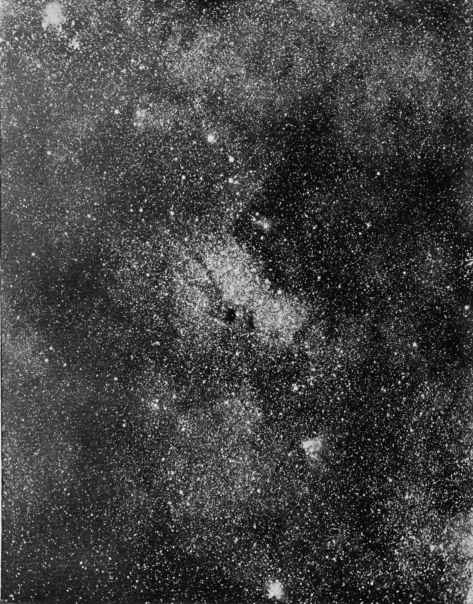
It will be noticed that the bright mass near the centre of the plate is tunnelled with dark holes and furrowed by dusky lanes. Such interruptions recur perpetually in the Milky Way. They are exemplified on the largest scale in the great rift dividing it into two branches all the way from Cygnus to Crux; and they are reproduced in miniature in many clusters.
Mr. H. C. Russell, at Sydney in 1890, successfully imitated Professor Barnard's example.[1623] His photographs of the southern Milky Way have many points of interest. They show the great rift, black to the eye, yet densely star-strewn to the perception of the chemical retina; while the "Coal-sack" appears absolutely dark only in its northern portion. His most remarkable discovery, however, was that of the spiral character of the two Nubeculæ. With an effective exposure of four and a half hours, the Greater Cloud came out as "a complex spiral, with two centres"; while the similar conformation of its minor companion developed only after eight hours of persistent actinic action. The revelation is full of significance.
Scarcely less so, although after a different fashion, is the disclosure on plates exposed by Dr. Max Wolf, with a 5-inch lens, in June, 1891, of a vastly extended nebula, bringing some of the leading stars in Cygnus into apparently organic connection with the piles of galactic star-dust likewise involved by it.[1624] Barnard has similarly found great tracts of the Milky Way to be photographically nebulous, and the conclusion seems inevitable that we see in it a prodigious mixed system, resembling that of the Pleiades in point of composition, though differing widely from it in plan of structure. Of corroborative testimony, moreover, is the discovery independently resulting from Gill's and Pickering's photographic reviews, that stars of the first type of spectrum largely prevail in the galactic zone of the heavens.[1625] With approach to that zone, Kapteyn noticed a steady growth of actinic intensity relative to visual brightness in the stars depicted on the Cape Durchmusterung plates.[1626] In other words, stellar light is, in the Milky Way, bluer than elsewhere. And the reality of the primitive character hence to be inferred for the entire structure was, in a manner, certified by Mr. McClean's observation that Helium stars—the supposed immediate products of nebulous matter—crowd towards its medial plane.
The first step towards the unravelment of the tangled web of stellar movements was taken when Herschel established the reality, and indicated the direction of the sun's journey. But the gradual shifting backward of the whole of the celestial scenery amid which we advance accounts for only a part of the observed displacements. The stars have motions of their own besides those reflected upon them from ours. All attempts, however, to grasp the general scheme of these motions have hitherto failed. Yet they have not remained wholly fruitless. The community of slow movement in Taurus, upon which Mädler based his famous theory, has proved to be a fact, and one of very extended significance.
In 1870 Mr. Proctor undertook to chart down the directions and proportionate amounts of about 1,600 proper motions, as determined by Messrs. Stone and Main, with the result of bringing to light the remarkable phenomenon termed by him "star-drift."[1627] Quite unmistakably, large groups of stars, otherwise apparently disconnected, were seen to be in progress together, in the same direction and at the same rate, across the sky. An example of this kind of unanimity was alleged by him in the five intermediate stars of the Plough; and that the agreement in thwartwise motion is no casual one is practically demonstrated by the concordant radial velocities determined at Potsdam for four out of the five objects in question. All of these approach the earth at the rate of about eighteen miles a second; and the fifth and faintest, δ Ursæ, though not yet measured, may be held to share their advance. One of them, moreover, ζ Ursæ, alias Mizar, carries with it three other stars—Alcor, the Arab "Rider" of the horse, visible to the naked eye, besides a telescopic and a spectroscopic attendant. So that the group may be regarded as octuple. It is of vast compass. Dr. Höffler assigned to it in 1897[1628]—although on grounds more or less hypothetical—a mean parallax corresponding to a light-journey of 192 years, which would give to the marching squadron a total extent of at least fourteen times the distance from the sun to α Centauri, while implying for its brightest member—ε Ursæ Majoris—the lustre of six hundred suns. The organising principle of this grand scheme must long remain mysterious.
It is no solitary example. Particular association, indeed—as was surmised by Michell far back in the eighteenth century—appears to be the rule rather than an exception in the sidereal system. Stars are bound together by twos, by threes, by dozens, by hundreds. Our own sun is, perhaps, not exempt from this gregarious tendency. Yet the search for its companions has, up to the present, been unavailing. Gould's cluster[1629] seems remote and intangible; Kapteyn's collection of solar stars proved to have been a creation of erroneous data, and was abolished by his unrelenting industry. Rather, we appear to have secured a compartment to ourselves for our long journey through space. A practical certainty has, at any rate, been gained that whatever aggregation holds the sun as a constituent is of a far looser build than the Pleiades or Præsepe. Of all such majestic communities the laws and revolutions remain, as yet, inaccessible to inquiry; centuries may elapse before even a rudimentary acquaintance with them begins to develop; while the economy of the higher order of association, which we must reasonably believe that they unite to compose, will possibly continue to stimulate and baffle human curiosity to the end of time.