SUPPLEMENTARY NOTES. (continued 2)
Reading edition
XX. Stigmaria, Sigillaria, &c.—The most remarkable peculiarity of the flora of the carboniferous period is the immense numerical preponderance of the vascular or higher tribes of cryptogamic plants, which amount to two-thirds of the species described. With these are associated a few Palms, Coniferæ, Cycadeæ, and dicotyledonous plants, allied to the Cacteæ and Euphorbiaceæ. The number and magnitude of the vegetables bearing an analogy to the Ductulosæ, but differing from existing species and genera, constitute therefore the most important botanical feature of the carboniferous flora. Thus we have plants allied to the Equisetum, or mare's-tail (Calamites), eighteen inches in circumference, and from thirty to forty feet high; Zamia-like coniferæ (Sigillariæ) fifty feet high; and arborescent club-mosses (Lepidodendra) attaining an altitude of sixty or seventy feet. Of this ancient flora, the fossil plants whose stems have been named Sigillaria (see Plate XXI.), and their roots Stigmaria, are especially remarkable in consequence of the peculiar circumstances under which upright examples of these trees are occasionally met with. Referring for details to "Wonders of Geology," Lecture VII., I purpose describing in this place the facts recently brought to light, which prove that certain species of Stigmaria are the roots of Sigillariæ; while others in all probability belong to Lepidodendra:—an opinion maintained more than thirty years ago by the Rev. H. Steinhauer.[145] To the late Mr. Binney we are indebted for the first confirmation of the inference of my friend, M. Adolphe Brongniart, (derived from an examination of the structure of those bodies,) that the Stigmariæ are the veritable roots of Sigillariæ. At St. Helen's, near Liverpool, Mr. Binney discovered, in 1844, an upright trunk of a Sigillaria, nine feet high, to which were attached ten roots, several feet long, that extended into the under clay in their natural position;[146] and these roots were unquestionable Stigmariæ, the tubercles with their attached rootlets being clearly displayed. In the floor of the Victoria Mine at Dunkinfold, near Manchester, at the depth of 1,100 feet from the surface, Mr. Binney also discovered a magnificent specimen of Sigillaria, which exhibited on its stem the respective characters of three supposed species, and had stigmaria-roots extending twenty feet.
In the Sydney coal-field at Cape Breton, Mr. Richard Brown has observed several upright stems of Sigillariæ and Lepidodendra, with stigmaria-roots attached; and the same fact has been noticed in the Picton coal, in Nova Scotia. The following figures and notes from Mr. Brown's description of these interesting phenomena, will place the subject before the reader in a clear point of view.[147]
The main bed of coal is six feet in thickness, and is overlaid, as usual, by a roof of shale abounding in foliage and fragments of branches. As the coal is dug out, large masses of the shale fall in, and occasionally hollow spaces, called by the workmen pot-holes, are left in the roof; the fallen masses being the roots and truncated stems of Sigillariæ and other trees, which separate at the parting formed by the coaly bark covering the roots, when the supporting coal is removed.
The following sketch represents one of the specimens of the base of a stem of a Lepidodendron, with the roots (stigmariæ) attached. This figure (1) shows the position of the tree above the bed of main coal, with the inclination and length of two of the principal roots, so far as they could be distinctly traced; and the following sketch (2) represents the trunk, with its branching roots, constructed from careful measurements of the dimensions and position of each root, drawn on the spot. The stem at the part marked A, was encrusted with a coaly bark, covered by the usual cicatrices of the Lepidodendra, and the roots at B, C, D, with a similar carbonaceous investment, impressed with the characteristic pits or areolæ of Stigmariæ.
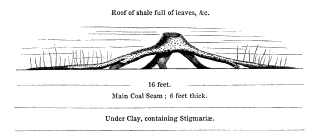
Fig. 1. STEM OF LEPIDODENDRON WITH ROOTS.
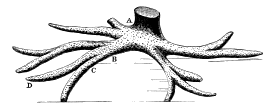
Fig. 2.
In the Instance of the upright stems of Sigillariæ in the same coal-field, the roots were also unequivocally Stigmariæ. Fig. 3, represents one of these erect stems, sixteen Inches high and twelve inches in diameter at the top, which dropped from the roof of the bed after the coal had been removed. Part of the coaly bark remains at c. The decorticated part of the trunk is covered with minute scales as far as the point h, a few inches below the first ramification of the roots. The carbonaceous crust investing the roots was thick at the upper part, but gradually became thin, and at a, and b, was a mere friable pellicle, that fell off upon the slightest touch.
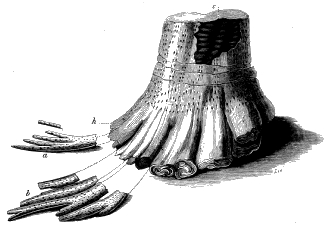
Fig. 3. STEM OF SIGILLARIA ALTERNANS, 1/12 natural size.
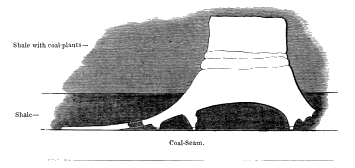
Fig. 4.
The exact position of the tree in relation to the underlying coal is shown in the above section. Fig. 4. Immediately over the coal there is a bed of hard shale, six inches in depth, in which no fossils are found; this is overlaid by a softer shale abounding in coal-plants; all the upright stems were rooted in the six-inch shale. Upon clearing the base of this tree, a complete set of conical tap-roots was discovered, arranged as in the annexed sketch. Fig. 5. There are four large tap-roots in each quarter of the stump, and five inches below these another set of smaller tap-roots; the total number amounting to eighteen. The horizontal roots are seen to branch off in a regular manner, the base being divided into four nearly equal parts by deep channels, extending from the centre to the points i, k, l, m.
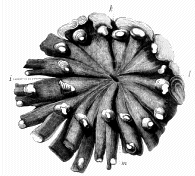
Fig. 5. The under surface of Fig. 3, showing the conical tap-roots of the tree, 1/12 natural size.
Mr. Brown remarks, that these short thick tap-roots were evidently adapted only to a soft wet soil, such as we may conceive was the nature of the first layer of mud deposited upon a bed of peat which had settled down slightly below the level of the water. He supposes, from the presence of a layer of shale without fossil plants immediately over the coal, that the prostrate stems and leaves which occur in such large quantities in the next superincumbent bed, fell from trees growing on the spot, and were entombed in layers of mud held in suspension in the water, which at short intervals inundated the low marshy ground on which they grew; for had the plants been drifted from a distance, he conceives they would also occur in the first layer of shale, as well as in those higher up.
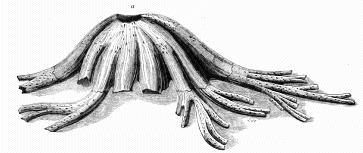
Fig. 6. STEM OF A SIGILLARIA BROKEN OFF CLOSE TO THE ROOTS, 1/12 natural size.
Having thus shown that the Sigillaria alternans was provided with roots adapted for a soft muddy soil, Mr. Brown next describes the specimen represented in Fig. 6, which is the stem of the same species of tree broken off near the roots; the hollow cylinder of bark (a) having been bent down and doubled over by the pressure of the surrounding mud, so as effectually to close up the aperture, leaving only a few irregular cicatrices, of three or four inches in length, converging at the apex; the structure, arrangement, and number of the tap-roots, as well as the horizontal ramifications, are similar to those in Fig. 5. This fossil clearly explains the nature of the "dome-shaped" plant figured in the "Fossil Flora of Great Britain."[148]
"The roots of the preceding fossils repeatedly ramify as their distance from the stem increases, and ultimately terminate in broad flattened points. The whole of the spreading roots of these trees (the Sigillariæ) cover only an area of thirty square feet each; whilst those of the Lepidodendron (Fig. 1), whose stem is only two or three inches larger in diameter, covered a space of two hundred square feet. Since it is well known, from numerous examples, that the Lepidodendra were lofty trees, with spreading branches, which therefore required wide bases for support, may we not conclude that Sigillariæ of the species described were, on the contrary, trees of low stature, without heavy branches?"
I cannot quit this subject without again adverting to the remarkable phenomenon mentioned In a previous note, namely, that in the bed of pulverulent earth—the under-clay—on which the coal invariably reposes, the roots (or Stigmariæ) of large trees are generally the only organic remains met with. The constant occurrence of these fossils in the under-clay, and their rarity in the coal and shale, was long ago pointed out by Mr. Martin, Dr. Macculloch, and other geologists; but the importance of the fact was not appreciated till Mr. Logan drew attention to it. In the Welsh coal-field, through a depth of 1,200 feet, there are sixty beds of coal, each of which lies on a stratum of clay abounding in Stigmariæ. In the Appalachian coal formation of the United States, the same phenomena occur.
Thus it appears that the under-clay is the natural soil in which the roots (Stigmariæ) of the Sigillariæ and Lepidodendra grew; the coal above it is composed of the carbonized stems and foliage of those trees; and the roof or coal-shale is formed by the leaves and branches of a forest overwhelmed and buried beneath the transported detritus of distant rocks. These phenomena may be explained by supposing that a plain, densely clothed with a luxuriant intertropical vegetation, was either inundated by an irruption of the sea, or overwhelmed by a flood, from the sudden breaking up of the barrier of an inland lake; or by the subsidence of the country on which the forests grew. But when we find an uninterrupted series, in which triple deposits of this character are repeated through many thousand feet, the solution of the problem is beset with difficulties, which the hypothesis of repeated periodical subsidences, however ingenious, does not, in my opinion, remove.[149]
∵ Jaw of the Iguanodon.—Additional note to p. 194.—Since the preceding pages were struck off, I have, through the kindness and liberality of Samuel H. Beckles, Esq., of Hastings, obtained two portions of jaws from the Wealden of the Sussex Coast. One of these is a fragment of the left side of the lower jaw, with six well-defined dental sockets; the other specimen exhibits the position of the mature molars and the successional teeth in the upper jaw; and confirms the accuracy of the views of Dr. Melville and myself as to the ruminant character of the arrangement of the dental organs in the upper and lower jaws of the Iguanodon, as described in my memoir on the structure of the jaws and teeth; Philos. Trans. 1848, p. 183. When this specimen is completely developed, it will probably exhibit distinctly the relative position of the germs and mature teeth, and the form of the inner alveolar parapet.