FOSSIL FAUNA. (continued 2)
Reading edition
Fig. 18. A fine specimen of a fossil tooth of a fish of an extinct genus, of which many species occur in the chalk (Ptychodus polygurus, of Agassiz). The teeth of various species of this genus of Sharks abound in the chalk of almost every part of England.[71]
Plate LXXI.
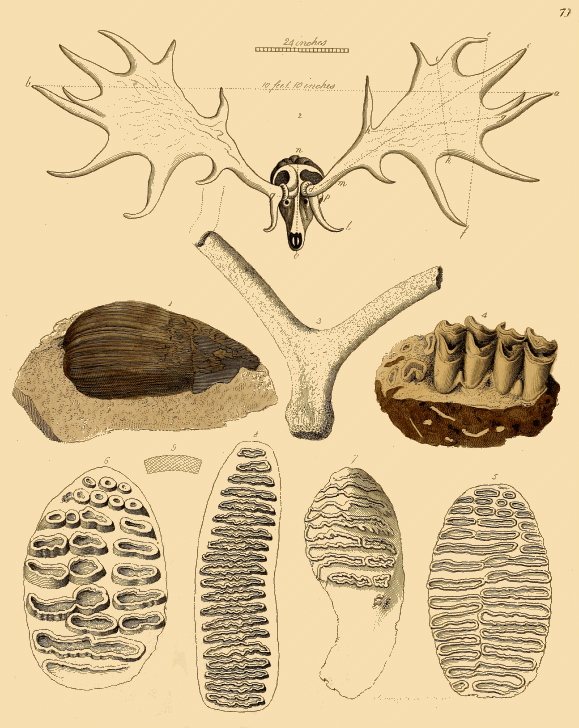
PLATE LXXI.
Fossil Remains of Mammalia.
Fig. 1. "a fossil tooth, probably of some animal of the whale kind."—Mr. Parkinson. I am not able to determine the nature of this specimen.
Fig. 2. The antlers and skull of the Fossil Elk, of Ireland, (Megaceros Hibernicus.) The original was nearly eleven feet across, from the point of one antler to another. A perfect skeleton of this extinct gigantic deer is exhibited in the Gallery of Organic Remains in the British Museum. For an account of this animal see Wonders of Geology, vol. i. p. 132; and Supplementary Notes, p. 189. The following measurements of the specimen figured are given by Mr. Parkinson;
Feet. Inches.
a to b 10 10
c to d 5 2
e to f 3 7 ½
g to h 2 6
i to k 1 10 ½
d to l 1 2
Diameter of the horn at m 0 2 ¼
Circumference, " 0 8
"at the root 2 11
Length of the cranium from n to o 2 0
Width""p to q 1 0
"A similar pair, found ten feet under ground in the county of Clare, was presented to Charles the Second, and placed in the guard-room of Hampton Court Palace."
Fig. 3. Fragment of the fossil horn of some species of Cervus or Deer, from Etampes, in France.
Fig. 4. Two teeth of a ruminant, (a species of Bos or Ox,) in breccia, from Gibraltar.[72]
The remaining figures. Figs. 5, 6, 7, 8, represent the worn surfaces of molars or grinding teeth of the extinct species of Elephants termed Mammoths, (Elephas primigenius, of M. Bojanus.)
Fig. 9, shows the structure of part of the tooth.
These were regarded by Mr. Parkinson as referable to two or more species of Mammoth; but Professor Owen, after an examination of the vast number of specimens that modern researches have brought to light, and which are deposited in the public and private collections of Great Britain, concludes that the specimens here figured belong to but one species. The differences observable in the surface of the crowns, are due to abrasion, and to the latitude of variety to which the highly complex molars of this extinct Elephant were subject.[73]
For an account of the Mastodon and Mammoth, see Wonders of Geology, vol. i. pp. 151-161.
Plate LXXII.
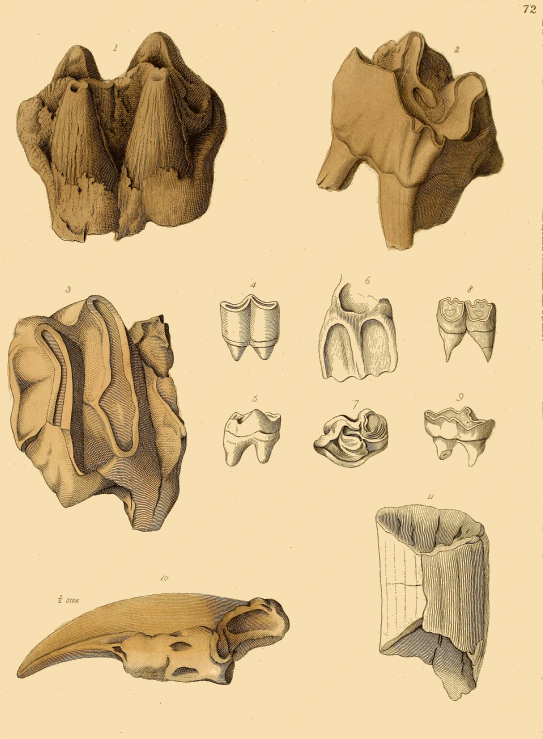
PLATE LXXII.
Fossil Teeth of Mammalia.
Fig. 1. A right lower molar tooth of an extinct species of Hippopotamus (H. major, of Cuvier), from France.
Fig. 2. Upper molar of an extinct species of Rhinoceros (R. leptorhinus, of Cuvier), from the bone-cave near Torquay, Devonshire.
Fig. 3. The crown of a molar tooth of the "gigantic Tapir" of Baron Cuvier; the Dinotherium of M. Kaup.[74]
Fig. 4, "the outer, and fig. 5, the inner, surface of the fourth molar of Palæotherium medium, of M. Cuvier."—Mr. Parkinson. From the eocene tertiary deposits of Paris.
Fig. 6, the outer, and fig. 7, the inner, aspect of an upper molar of the same animal.
Figs. 8, & 9. Lower molars of Amplotherium commune, of M. Cuvier.[75]
Fig. 10. An ungueal or bone of the claw, of a gigantic animal of the Sloth tribe (Megalonyx Jeffersoni); the figure is half the linear diameter of the original.[76]
Fig. 11. Vertical section of a tooth of the same. These remains of a colossal animal of that remarkable group of mammalia—the Edentata—are from Big-bone Cave, in Kentucky. The Megalonyx resembled the Megatherium in its general characters but was one-third smaller. See Supplementary Notes, p. 184.
Plate LXXIII.
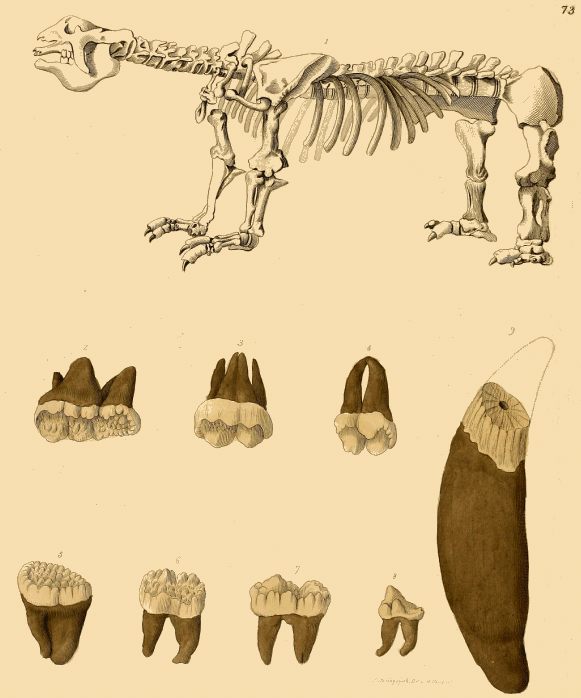
PLATE LXXIII.
Megatherium and Fossil Bears.
Fig. 1, is a sketch, on a very small scale, of the skeleton of a colossal extinct animal of the Sloth tribe, discovered in the alluvial deposits of the Pampas, and preserved in the museum at Madrid. A plaster model of a skeleton, restored from the remains of various individuals, dispersed in different collections, is just completed, and exhibited to the public in the Gallery of Organic Remains of the British Museum.[77] This extinct animal is named the Megatherium (gigantic wild animal) Cuvieri. It was seven feet high, and nine long, and therefore larger than the largest rhinoceros. It possessed no incisor teeth; and the grinders, which are seven inches long, are of a prismatic form, and like those of the sloths, are composed of dentine and cement. They are so formed that the crown always presents two cutting, wedge-shaped, salient angles; they are therefore admirably adapted for cutting and bruising vegetable substances. The entire fore-foot is about a yard in length, and armed with strong claws. The Megatherium held an intermediate place between the sloths, armadillos, and ant-eaters. The celebrated specimens of different parts of the skeleton of this colossal creature, preserved in the Hunterian Museum of the College of Surgeons of England, were collected and presented by Sir Woodbine Parish.
Fig. 2. The hindmost grinder of the upper jaw of the Fossil Bear (Ursus spelæus) of the Caverns, from Gaylenreuth.[78]
Fig. 3. The middle upper grinder.
Fig. 4. The foremost upper grinder.
Fig. 5. The hindmost grinder of the lower jaw.
Fig. 6. The penultimate grinder of the lower jaw.
Fig. 7. The antepenultimate lower grinder.
Fig. 8. The foremost lower grinder.
Fig. 9. The canine tooth of the Fossil Bear.
Plate LXXIV.
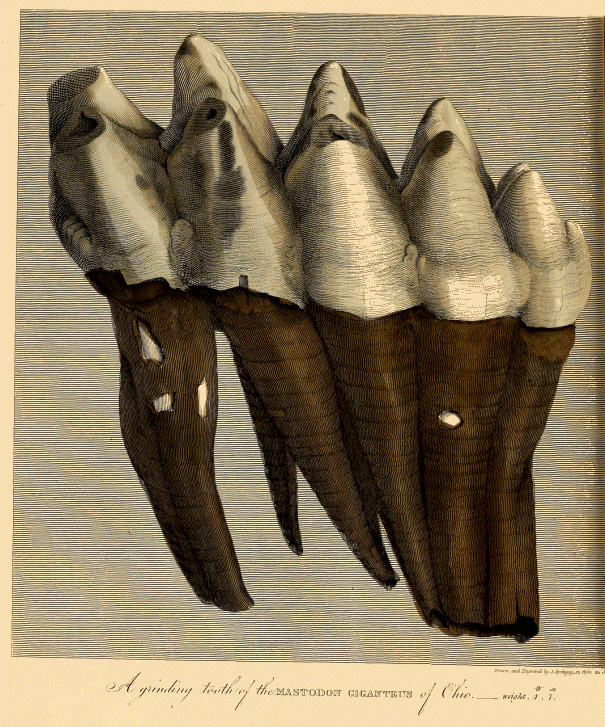
PLATE LXXIV.
Tooth of the Mastodon.
A molar tooth of the Mastodon giganteus, from Big-bone Lick, Kentucky; of the natural size.
From the great number of bones and teeth of animals of the extinct elephantine genus, to which the name of Mastodon was given by Cuvier (from the structure of the crowns of the teeth), that have of late years been brought to England, and are dispersed in our public and private collections, the intelligent reader must be familiar with the forms, characters, and gigantic proportions, of that stupendous tribe of animals which once ranged through the primeval forests not only of America, but also of some parts of Europe. From a perfect skeleton lately set up in the British Museum (in the same room with that of the Megatherium), a correct idea may be obtained of this peculiar type of mammalian structure. From this specimen it appears that the great Mastodon of the Ohio was not unlike the elephant In its general outline, though somewhat longer and thicker. It had a trunk or proboscis, tusks which curved upward, and four molar teeth in each jaw, but no incisors. But another remarkable peculiarity, and which entirely separates the Mastodon from the Elephant, is that the young animal had a pair of tusks, placed horizontally in the lower jaw, and of these tusks one only became developed, and that in the adult male: both were early shed in the female. In the midst of a collection of Mastodon bones imbedded in mud, a mass of small branches, grass, and leaves, in a half bruised state, and a species of reed common in Virginia, were discovered; the whole appeared to have been enveloped in a sac, probably the stomach of the animal. In another instance traces of the proboscis were observed. The tusks are composed of ivory, and vary somewhat in the direction and degree of their curvature. The bones of this colossal quadruped are found remarkably fresh and well preserved, and are generally impregnated with iron. No living instance of this creature is on record, and there can be no doubt that its race has long since been extinct.
"Big-bone Lick, where so many remains of the Mastodon and other extinct quadrupeds have been dug up, is distant from Cincinnati about twenty-three miles in a south-west direction. This celebrated bog is situated in a nearly level plain, in a valley bounded by gentle slopes, which lead up to flat table-lands composed of blue argillaceous (Silurian) limestone, and marl. The general course of the meandering stream which flows through the plain, is from east to west. There are two springs on the southern or left bank, rising from marshes, and two on the opposite bank; the most western of which, called the Gum Lick, is at the point where a small tributary joins the principal stream. The quaking bogs on this side are now more than fifteen acres in extent; but all the marshes were formerly larger, before the surrounding forest was partially cleared away. Within the memory of persons now living, the wild bisons or buffaloes crowded to these springs; but they have retreated many years, and are now as unknown to the inhabitants as the Mastodon itself. The bog in the spots where the salt springs rise is so soft, that a pole may be forced down into it many yards perpendicularly.
"The greater numbers both of the entire skeletons and the separate bones have been taken up from black mud, about twelve feet below the level of the Creek. It is supposed that the bones of the mastodons found here could not have belonged to less than one hundred individuals: those of the fossil Elephant (Elephas primigenius) to twenty; besides which a few bones of the Megalonyx, and of a species of stag, horse, and bison, are stated to have been collected. The greatest depth of the black mud has not been ascertained; it is composed chiefly of clay, with a mixture of calcareous matter and sand, and contains 5 parts in 100 of sulphate of lime, with some animal matter. Layers of gravel occur in the midst of it at various depths. It contains remains of seeds, and of several species and genera of fresh-water and terrestrial shells. It is impossible to view this plain without at once concluding that it has remained unchanged in all its principal features, from the period when the extinct quadrupeds inhabited the banks of the Ohio and its tributaries.
"There are two buffalo paths or trails still extant in the woods, and both lead directly to springs: the one which strikes off in a northerly direction from the Gum Lick, may be traced eastward through the forest for several miles. It is three or four yards wide, and only partially overgrown with grass, and sixty years ago was as bare, hard, and well trodden, as a high road. It is well known that during great droughts in the Pampas of South America, the horses, deer, and cattle, throng to the rivers in such numbers, that the foremost of the crowd are pushed into the stream by the pressure of others behind, and are sometimes carried away by thousands, and drowned. In their eagerness to drink the saline waters and lick the salt, the heavy mastodons and elephants seem in like manner to have pressed upon each other, and sunk in the soft quagmires of Kentucky."[79]