VOLUME V (continued 4)
William F. Fleming translation
I pique myself on thinking, in matters of religion, better than Ostrogoth, Theodoric, the assassin of Symmachus, and Boëtius, because I am a good Catholic, and he was an Arian. But I declare this king worthy of being confined as a madman if he were so atrociously besotted. What! he immediately cut off his minister's head because that minister had at last come over to his own way of thinking. How was a worshipper of God, who passed from the opinion of Athanasius to that of Arius and Eusebius, unfaithful to God? He was at most unfaithful only to Athanasius and his party, at a time when the world was divided between the Athanasians and the Eusebians; but Theodoric could not regard him as a man unfaithful to God, because he had rejected the term consubstantial, after admitting it at first. To cut off his favorite's head for such a reason could certainly be the act of none but the wickedest fool and most barbarous blockhead that ever existed. What would you say of Louis XIV. if he had beheaded the duke de la Force because the duke de la Force had quitted Calvinism for the religion of Louis XIV.?
I have just opened a history of Holland, in which I find that, in 1672, Marshal de Luxembourg harangued his troops in the following manner: "Go, my children, plunder, rob, kill, ravish; and if there be anything more abominable fail not to do it, that I may find I have not been mistaken in selecting you as the bravest of men." This is certainly a very pretty harangue. It is as true as those given us by Livy, but it is not in his style. To complete the dishonor of typography, this fine piece is inserted in several new dictionaries, which are no other than impostures in alphabetical order.
It is a trifling error in the "Abrégé Chronologique de l'Histoire de France" ("Chronological Abridgment of the History of France") to suppose that Louis XIV., after the Peace of Utrecht, for which he was indebted to the English, after nine years of misfortune, and after the many great victories which the English had gained, said to the English ambassador: "I have always been master at home, and sometimes abroad; do not remind me of it." This speech would have been very ill-timed, very false as it regarded the English, and would have exposed the king to a most galling reply.
The author himself confessed to me that the Marquis de Torcy, who was present at all the earl of Stair's audiences, had always given the lie to this anecdote. It is assuredly neither true nor likely, and has remained in the later editions of this book only because it was put in the first. This error, however, does not at all disparage this very useful work, in which all the great events, arranged in the most convenient order, are perfectly authenticated.
All these little tales, designed to embellish history, do but dishonor it, and unfortunately almost all ancient histories are little else than tales. Malebranche was right when, speaking on this subject, he said: "I think no more of history than I do of the news of my parish."
In 1723, Father Fouquet, a Jesuit, returned to France from China, where he had passed twenty-five years. Religious disputes had embroiled him with his brethren. He had carried with him to China a gospel different from theirs, and now brought back to France memorials against them. Two Chinese literati made the voyage with him; one of them died on the way, the other came with Father Fouquet to Paris. The Jesuit was to take the Chinese to Rome secretly, as a witness of the conduct of the good fathers in China, and in the meantime Fouquet and his companion lodged at the house of the Professed, Rue St. Antoine.
The reverend fathers received advice of their reverend brother's intentions. Fouquet was no less quickly informed of the designs of the reverend fathers. He lost not a moment, but set off the same night for Rome. The reverend fathers had interest enough to get him pursued, but the Chinese only was taken. This poor fellow did not understand a word of French. The good fathers went to Cardinal Dubois, who at that time needed their support, and told him that they had among them a young man who had gone mad, and whom it was necessary to confine. The cardinal immediately granted a lettre de cachet, than which there is sometimes nothing which a minister is more ready to grant. The lieutenant of police went to take this madman, who was pointed out to him. He found a man making reverences in a way different from the French, speaking in a singing tone, and looking quite astonished. He expressed great pity for his derangement, ordered his hands to be tied behind him, and sent him to Charenton, where, like the Abbé Desfontaines, he was flogged twice a week. The Chinese did not at all understand this method of receiving strangers. He had passed only two or three days in Paris, and had found the manners of the French very odd. He had lived two years on bread and water, amongst madmen and keepers, and believed that the French nation consisted of these two species, the one part dancing while the other flogged them.
At length, when two years had elapsed, the ministry changed and a new lieutenant of police was appointed. This magistrate commenced his administration by visiting the prisons. He also saw the lunatics at Charenton. After conversing with them he asked if there were no other persons for him to see. He was told that there was one more unfortunate man, but that he spoke a language which nobody understood. A Jesuit, who accompanied the magistrate, said it was the peculiarity of this man's madness that he never gave an answer in French; nothing would be gotten from him, and he thought it would be better not to take the trouble of calling him. The minister insisted. The unfortunate man was brought, and threw himself at his feet. The lieutenant sent for the king's interpreters, who spoke to him in Spanish, Latin, Greek, and English, but he constantly said Kanton, Kanton, and nothing else. The Jesuit assured them he was possessed. The magistrate, having at some time heard it said that there was a province in China called Kanton, thought this man might perhaps have come from thence. An interpreter to the foreign missions was sent for, who could murder Chinese. All was discovered. The magistrate knew not what to do, nor the Jesuit what to say. The Duke de Bourbon was then prime minister. The circumstance having been related to him, he ordered money and clothes to be given to the Chinese, and sent him back to his own country, whence it is not thought that many literati will come and see us in the future. It would have been more politic to have kept this man and treated him well, than to have sent him to give his countrymen the very worst opinion of the French.
About thirty years ago the French Jesuits sent secret missionaries to China, who enticed a child from his parents in Canton, and brought him to Paris, where they educated him in their convent of La Rue St. Antoine. This boy became a Jesuit at the age of fifteen, after which he remained ten years in France. He knows both French and Chinese perfectly, and is very learned. M. Bertin, comptroller-general, and afterwards secretary of state, sent him back to China in 1763, after the abolition of the Jesuits. He calls himself Ko, and signs himself Ko, Jesuit.
In 1772 there were fourteen Jesuits in Pekin, amongst whom was Brother Ko, who still lives in their house. The Emperor Kien-Long has kept these monks of Europe about him in the positions of painters, engravers, watch-makers, and mechanics, with an express prohibition from ever disputing on religion, or causing the least trouble in the empire.
The Jesuit Ko has sent manuscripts of his own composition from Pekin to Paris entitled: "Memoirs Relative to the History, Arts and Sciences of the Chinese by the Missionaries at Pekin." This book is printed, and is now selling at Paris by Nyon, the bookseller. The author attacks all the philosophers of Europe. He calls a prince of the Tartar race, whom the Jesuits had seduced, and the late emperor, Yong-Chin, had banished, an illustrious martyr to Jesus Christ. This Ko boasts of making many neophytes, who are ardent spirits, capable of troubling China even more than the Jesuits formerly troubled Japan. It is said that a Russian nobleman, indignant at this Jesuitical insolence, which reaches the farthest corners of the earth even after the extinction of the order—has resolved to find some means of sending to the president of the tribunal of rites at Pekin an extract in Chinese from these memoirs, which may serve to make the aforesaid Ko, and the Jesuits who labor with him, better known.
ANGELS.
SECTION I.
Angels of the Indians, Persians, etc.
The author of the article "Angel" in the Encyclopædia says that all religions have admitted the existence of angels, although it is not demonstrated by natural reason.
We understand by this word, ministers of God, supernatural is beyond reason. If I mistake not it should have been several religions (and not all) have acknowledged the existence of angels. That of Numa, that of Sabaism, that of the Druids, that of the Scythians, and that of the Phœnicians and ancient Egyptians did not admit their existence.
We understand by this word, ministers of God, deputies, beings of a middle order between God and man, sent to make known to us His orders.
At the present time—in 1772—the Brahmins boast of having possessed in writing, for just four thousand eight hundred and seventy-eight years, their first sacred law, entitled the Shastah, fifteen hundred years before their second law, called Veidam, signifying the word of God. The Shastah contains five chapters; the first, of God and His attributes; the second, of the creation of the angels; the third, of the fall of the angels; the fourth, of their punishment; the fifth, of their pardon, and the creation of man.
It is good, in the first place, to observe the manner in which this book speaks of God.
First Chapter of the Shastah.
God is one; He has created all; it is a perfect sphere, without beginning or end. God conducts the whole creation by a general providence, resulting from a determined principle. Thou shalt not seek to discover the nature and essence of the Eternal, nor by what laws He governs; such an undertaking would be vain and criminal. It is enough for thee to contemplate day and night in His works, His wisdom, His power, and His goodness.
After paying to this opening of the Shastah the tribute of admiration which is due to it, let us pass to the creation of the angels.
Second Chapter of the Shastah.
The Eternal, absorbed in the contemplation of His own existence, resolved, in the fulness of time, to communicate His glory and His essence to beings capable of feeling and partaking His beatitude as well as of contributing to His glory. The Eternal willed it, and they were. He formed them partly of His own essence, capable of perfection or imperfection, according to their will.
The Eternal first created Brahma, Vishnu, and Siva, then Mozazor, and all the multitude of the angels. The Eternal gave the pre-eminence to Brahma, Vishnu, and Siva. Brahma was the prince of the angelic army; Vishnu and Siva were His coadjutors. The Eternal divided the angelic army into several bands, and gave to each a chief. They adored the Eternal, ranged around His throne, each in the degree assigned him. There was harmony in heaven. Mozazor, chief of the first band, led the canticle of praise and adoration to the Creator, and the song of obedience to Brahma, his first creature; and the Eternal rejoiced in His new creation.
Chapter III.—The Fall of a Part of the Angels.
From the creation of the celestial army, joy and harmony surrounded the throne of the Eternal for a thousand years multiplied by a thousand, and would have lasted until the end of time had not envy seized Mozazor and other princes of the angelic bands, among whom was Raabon, the next in dignity to Mozazor. Forgetful of the blessing of their creation, and of their duty, they rejected the power of perfection, and exercised the power of imperfection. They did evil in the sight of the Eternal; they disobeyed Him; they refused to submit to God's lieutenant and his coadjutors Vishnu and Siva, saying: "We will govern," and, without fearing the power and the anger of their Creator, disseminated their seditious principles in the celestial army. They seduced the angels, and persuaded a great multitude of them to rebel; and they forsook the throne of the Eternal; and sorrow came upon the faithful angelic spirits; and for the first time grief was known in heaven.
Chapter IV.—Punishment of the Guilty Angels.
The Eternal, whose omniscience, prescience, and influence extend over all things except the action of the beings whom He has created free, beheld with grief and anger the defection of Mozazor, Raabon, and the other chiefs of the angels.
Merciful in his wrath, he sent Brahma, Vishnu, and Siva to reproach them with their crime, and bring them back to their duty; but, confirmed in their spirit of independence, they persisted in their revolt. The Eternal then commanded Siva to march against them, armed with almighty power, and hurl them down from the high place to the place of darkness, into the Ondera, there to be punished for a thousand years multiplied by a thousand.
Abstract of the Fifth Chapter.
At the end of a thousand years Brahma, Vishnu, and Siva implored the clemency of the Eternal in favor of the delinquents. The Eternal vouchsafed to deliver them from the prison of the Ondera, and place them in a state of probation during a great number of solar revolutions. There were other rebellions against God during this time of penitence.
It was at one of these periods that God created the earth, where the penitent angels underwent several metempsychoses, one of the last of which was their transformation into cows. Hence it was that cows became sacred in India. Lastly, they were metamorphosed into men.
So that the Indian system of angels is precisely that of the Jesuit Bougeant, who asserts that the bodies of beasts are inhabited by sinful angels. What the Brahmins had invented seriously, Bougeant, more than four thousand years after, imagined in jest—if, indeed, this pleasantry of his was not a remnant of superstition, combined with the spirit of system-making, as is often the case.
Such is the history of the angels among the ancient Brahmins, which, after the lapse of about fifty centuries, they still continue to teach. Neither our merchants who have traded in India, nor our missionaries, have ever been informed of it; for the Brahmins, having never been edified by their science or their manners, have not communicated to them their secrets. It was left for an Englishman, named Holwell, to reside for thirty years at Benares, on the Ganges, an ancient school of the Brahmins, to learn the ancient Sanscrit tongue, in order at length to enrich our Europe with this singular knowledge; just as Mr. Sale lived a long time in Arabia to give us a faithful translation of the Koran and information relative to ancient Sabaism, which has been succeeded by the Mussulman religion; and as Dr. Hyde continued for twenty years his researches into everything concerning the religion of the Magi.
Angels of the Persians.
The Persians had thirty-one angels. The first of all, who is served by four other angels, is named Bahaman. He has the inspection of all animals except man, over whom God has reserved to himself an immediate jurisdiction.
God presides over the day on which the sun enters the Ram, and this day is a Sabbath, which proves that the feast of the Sabbath was observed among the Persians in the ancient times. The second angel presides over the seventh day, and is called Debadur. The third is Kur, which probably was afterwards converted into Cyrus. He is the angel of the sun. The fourth is called Mah, and presides over the moon. Thus each angel has his province. It was among the Persians that the doctrine of the guardian angel and the evil angel was first adopted. It is believed that Raphael was the guardian angel of the Persian Empire.
Angels of the Hebrews.
The Hebrews knew nothing of the fall of the angels until the commencement of the Christian era. This secret doctrine of the ancient Brahmins must have reached them at that time, for it was then that the book attributed to Enoch, relative to the sinful angels driven from heaven, was fabricated.
Enoch must have been a very ancient writer, since, according to the Jews, he lived in the seventh generation before the deluge. But as Seth, still more ancient than he, had left books to the Hebrews, they might boast of having some from Enoch also. According to them Enoch wrote as follows:
"It happened, after the sons of men had multiplied in those days, that daughters were born to them, elegant and beautiful. And when the angels, the sons of heaven, beheld them they became enamored of them, saying to each other: 'Come, let us select for ourselves wives from the progeny of men, and let us beget children.' Then their leader, Samyaza, said to them: 'I fear that you may perhaps be indisposed to the performance of this enterprise, and that I alone shall suffer for so grievous a crime.' But they answered him and said: 'We all swear, and bind ourselves by mutual execrations, that we will not change our intention, but execute our projected undertaking.'
"Then they swore all together, and all bound themselves by mutual execrations. Their whole number was two hundred, who descended upon Ardis, which is the top of Mount Armon. That mountain, therefore, was called Armon, because they had sworn upon it, and bound themselves by mutual execrations. These are the names of their chiefs: Samyaza, who was their leader; Urakabarameel, Akabeel, Tamiel, Ramuel, Danel, Azkeel, Sarakuyal, Asael, Armers, Batraal, Anane, Zavebe, Samsaveel, Ertael, Turel, Yomyael, Arazyal. These were the prefects of the two hundred angels, and the remainder were all with them.
"Then they took wives, each choosing for himself, whom they began to approach, and with whom they cohabited, teaching them sorcery, incantations, and the dividing of roots and trees. And the women, conceiving, brought forth giants, whose stature was each three hundred cubits," etc.
The author of this fragment writes in the style which seems to belong to the primitive ages. He has the same simplicity. He does not fail to name the persons, nor does he forget the dates; here are no reflections, no maxims. It is the ancient Oriental manner.
It is evident that this story is founded on the sixth chapter of Genesis: "There were giants in the earth in those days, and also after that, when the sons of God came in unto the daughters of men, and they bear children to them, the same became mighty men which were of old, men of renown." Genesis and the Book of Enoch perfectly agree respecting the coupling of the angels with the daughters of men, and the race of giants which sprung from this union; but neither this Enoch, nor any book of the Old Testament, speaks of the war of the angels against God, or of their defeat, or of their fall into hell, or of their hatred to mankind.
Nearly all the commentators on the Old Testament unanimously say that before the Babylonian captivity, the Jews knew not the name of any angel. The one that appeared to Manoah, father of Samson, would not tell his name.
When the three angels appeared to Abraham, and he had a whole calf dressed to regale them, they did not tell him their names. One of them said: "I will come to see thee next year, if God grant me life; and Sarah thy wife shall have a son."
Calmet discovers a great affinity between this story and the fable which Ovid relates in his "Fasti", of Jupiter, Neptune, and Mercury, who, having supped with old Hyreus, and finding that he was afflicted with impotence, urinated upon the skin of a calf which he had served up to them, and ordered him to bury this hide watered with celestial urine in the ground, and leave it there for nine months. At the end of the nine months, Hyreus uncovered his hide, and found in it a child, which was named Orion, and is now in the heavens. Calmet moreover says that the words which the angels used to Abraham may be rendered thus: A child shall be born of your calf.
Be this as it may, the angels did not tell Abraham their names; they did not even tell them to Moses; and we find the name of Raphael only in Tobit, at the time of the captivity. The other names of angels are evidently taken from the Chaldæans and the Persians. Raphael, Gabriel, and Uriel, are Persian or Babylonian. The name of Israel itself is Chaldæan, as the learned Jew Philo expressly says, in the account of his deputation to Caligula.
We shall not here repeat what has been elsewhere said of angels.
Whether the Greeks and the Romans admitted the Existence of Angels.
They had gods and demi-gods enough to dispense with all other subaltern beings. Mercury executed the commissions of Jupiter, and Iris those of Juno; nevertheless, they admitted genii and demons. The doctrine of guardian angels was versified by Hesiod, who was contemporary with Homer. In his poem of "The Works and Days" he thus explains it:
When gods alike and mortals rose to birth, A golden race the immortals formed on earth Of many-languaged men; they lived of old, When Saturn reigned in heaven—an age of gold. Like gods they lived, with calm, untroubled mind, Free from the toil and anguish of our kind. Nor sad, decrepit age approaching nigh, Their limbs misshaped with swoln deformity. Strangers to ill, they Nature's banquet proved, Rich in earth's fruits, and of the blest beloved: They sank to death, as opiate slumber stole Soft o'er the sense, and whelmed the willing soul. Theirs was each good: the grain-exuberant soil Poured the full harvest, uncompelled by toil; The virtuous many dwelt in common, blest, And all unenvying shared what all in peace possessed. When on this race the verdant earth had lain, By Jove's high will they rose a Genii train: Earth-wandering dæmons, they their charge began, The ministers or good and guards of man: Veiled with a mantle of aerial night, O'er earth's wide space they wing their hovering flight; Dispense the fertile treasures of the ground, And bend their all-observant glance around; To mark the deed unjust, the just approve, Their kingly office, delegate from Jove. ELTON'S Translation.
The farther we search into antiquity, the more we see how modern nations have by turns explored these now almost abandoned mines. The Greeks, who so long passed for inventors, imitated Egypt, which had copied from the Chaldæans, who owed almost everything to the Indians. The doctrine of the guardian angels, so well sung by Hesiod, was afterwards sophisticated in the schools: it was all that they were capable of doing. Every man had his good and his evil genius, as each one had his particular star—
Est genius natale comes qui temper at astrum.
Socrates, we know, had his good angel; but his bad angel must have governed him. No angel but an evil one could prompt a philosopher to run from house to house, to tell people, by question and answer, that father and mother, preceptor and pupil, were all ignorant and imbecile. A guardian angel in that event will find it very difficult to save his protege from the hemlock.
We are acquainted only with the evil angel of Marcus Brutus, which appeared to him before the battle of Philippi.
SECTION II.
The doctrine of angels is one of the oldest in the world. It preceded that of the immortality of the soul. This is not surprising; philosophy is necessary to the belief that the soul of mortal man is immortal; but imagination and weakness are sufficient for the invention of beings superior to ourselves, protecting or persecuting us. Yet it does not appear that the ancient Egyptians had any notion of these celestial beings, clothed with an ethereal body and administering to the orders of a God. The ancient Babylonians were the first who admitted this theology. The Hebrew books employ the angels from the first book of Genesis downwards: but the Book of Genesis was not written before the Chaldæans had become a powerful nation: nor was it until the captivity of Babylon that the Jews learned the names of Gabriel, Raphael, Michael, Uriel, etc., which were given to the angels. The Jewish and Christian religions being founded on the fall of Adam, and this fall being founded on the temptation by the evil angel, the devil, it is very singular that not a word is said in the Pentateuch of the existence of the bad angels, still less of their punishment and abode in hell.
The reason of this omission is evident: the evil angels were unknown to the Jews until the Babylonian captivity; then it is that Asmodeus begins to be talked of, whom Raphael went to bind in Upper Egypt; there it is that the Jews first hear of Satan. This word Satan was Chaldæan; and the Book of Job, an inhabitant of Chaldæa, is the first that makes mention of him.
The ancient Persians said Satan was an angel or genius who had made war upon the Dives and the Peris, that is, the fairest of the East.
Thus, according to the ordinary rules of probability, those who are guided by reason alone might be permitted to think that, from this theology, the Jews and Christians at length took the idea that the evil angels had been driven out of heaven, and that their prince had tempted Eve, in the form of a serpent.
It has been pretended that Isaiah, in his fourteenth chapter, had this allegory in view when he said: "Quornodo occidisti de cœlo, Lucifer, qui mane oriebaris?" "How hast thou fallen from heaven, O Lucifer, son of the morning?"
It was this same Latin verse, translated from Isaiah, which procured for the devil the name of Lucifer. It was forgotten that Lucifer signifies "that which sheds light." The words of Isaiah, too, have received a little attention; he is speaking of the dethroned king of Babylon; and by a common figure of speech, he says to him: "How hast thou fallen from heaven, thou brilliant star?"
It does not at all appear that Isaiah sought, by this stroke of rhetoric, to establish the doctrine of the angels precipitated into hell. It was scarcely before the time of the primitive Christian church that the fathers and the rabbis exerted themselves to encourage this doctrine, in order to save the incredibility of the story of a serpent which seduced the mother of men, and which, condemned for this bad action to crawl on its belly, has ever since been an enemy to man, who is always striving to crush it, while it is always endeavoring to bite him. There seemed to be somewhat more of sublimity in celestial substances precipitated into the abyss, and issuing from it to persecute mankind.
It cannot be proved by any reasoning that these celestial and infernal powers exist; neither can it be proved that they do not exist. There is certainly no contradiction in acknowledging the existence of beneficent and malignant substances which are neither of the nature of God nor of the nature of man: but a thing, to be believed, must be more than possible.
The angels who, according to the Babylonians and the Jews, presided over nations, were precisely what the gods of Homer were—celestial beings, subordinate to a supreme being. The imagination which produced the one probably produced the other. The number of the inferior gods increased with the religion of Homer. Among the Christians, the number of the angels was augmented in the course of time.
The writers known by the names of Dionysius the Areopagite and Gregory I. fixed the number of angels in nine choirs, forming three hierarchies; the first consisting of the seraphim, cherubim, and thrones; the second of the dominations, virtues and powers; and the third of the principalities, archangels, and, lastly, the angels, who give their domination to all the rest. It is hardly permissible for any one but a pope thus to settle the different ranks in heaven.
SECTION III.
Angel, in Greek, is envoy. The reader will hardly be the wiser for being told that the Persians had their peris, the Hebrews their malakim, and the Greeks their demonoi.
But it is perhaps better worth knowing that, one of the first of man's ideas has always been to place intermediate beings between the Divinity and himself; such were those demons, those genii, invented in the ages of antiquity. Man always made the gods after his own image; princes were seen to communicate their orders by messengers; therefore, the Divinity had also his couriers. Mercury, Iris, were couriers or messengers.
The Jews, the only people under the conduct of the Divinity Himself, did not at first give names to the angels whom God vouchsafed to send them; they borrowed the names given them by the Chaldæans when the Jewish nation was captive in Babylon; Michael and Gabriel are named for the first time by Daniel, a slave among those people. The Jew Tobit, who lived at Ninevah, knew the angel Raphael, who travelled with his son to assist him in recovering the money due to him from the Jew Gabaël.
In the laws of the Jews, that is, in Leviticus and Deuteronomy, not the least mention is made of the existence of the angels—much less of the worship of them. Neither did the Sadducees believe in the angels.
But in the histories of the Jews, they are much spoken of. The angels were corporeal; they had wings at their backs, as the Gentiles feigned that Mercury had at his heels; sometimes they concealed their wings under their clothing. How could they be without bodies, since they all ate and drank, and the inhabitants of Sodom wanted to commit the sin of pederasty with the angels who went to Lot's house?
The ancient Jewish tradition, according to Ben Maimon, admits ten degrees, ten orders of angels:
1. The chaios ecodesh, pure, holy. 2. The ofamin, swift. 3. The oralim, strong. 4. The chasmalim, flames. 5. The seraphim, sparks. 6. The malakim, angels, messengers, deputies. 7. The elohim, gods or judges. 8. The ben elohim, sons of the gods. 9. The cherubim, images. 10. The ychim, animated.
The story of the fall of the angels is not to be found in the books of Moses. The first testimony respecting it is that of Isaiah, who, apostrophizing the king of Babylon, exclaims, "Where is now the exacter of tributes? The pines and the cedars rejoice in his fall. How hast thou fallen from heaven, O Hellel, star of the morning?" It has been already observed that the word Hellel has been rendered by the Latin word Lucifer; that afterwards, in an allegorical sense, the name of Lucifer was given to the prince of the angels, who made war in heaven; and that, at last, this word, signifying Phosphorus and Aurora, has become the name of the devil.
The Christian religion is founded on the fall of the angels. Those who revolted were precipitated from the spheres which they inhabited into hell, in the centre of the earth, and became devils. A devil, in the form of a serpent, tempted Eve, and damned mankind. Jesus came to redeem mankind, and to triumph over the devil, who tempts us still. Yet this fundamental tradition is to be found nowhere but in the apocryphal book of Enoch; and there it is in a form quite different from that of the received tradition.
St. Augustine, in his 109th letter, does not hesitate to give slender and agile bodies to the good and bad angels. Pope Gregory I. has reduced to nine choirs—to nine hierarchies or orders—the ten choirs of angels acknowledged by the Jews.
The Jews had in their temple two cherubs, each with two heads—the one that of an ox, the other that of an eagle, with six wings. We paint them now in the form of a flying head, with two small wings below the ears. We paint the angels and archangels in the form of young men, with two wings at the back. As for the thrones and dominations, no one has yet thought of painting them.
St. Thomas, at question cviii. article 2, says that the thrones are as near to God as the cherubim and the seraphim, because it is upon them that God sits. Scot has counted a thousand million of angels. The ancient mythology of the good and bad genii, having passed from the East to Greece and Rome, we consecrated this opinion, for admitting for each individual a good and an evil angel, of whom one assists him and the other torments him, from his birth to his death; but it is not yet known whether these good and bad angels are continually passing from one to another, or are relieved by others. On this point, consult "St. Thomas's Dream."
It is not known precisely where the angels dwell—whether in the air, in the void, or in the planets. It has not been God's pleasure that we should be informed of their abode.
ANNALS.
How many nations have long existed, and still exist, without annals. There were none in all America, that is, in one-half of our globe, excepting those of Mexico and Peru, which are not very ancient. Besides, knotted cords are a sort of books which cannot enter into very minute details. Three-fourths of Africa never had annals; and, at the present day, in the most learned nations, in those which have even used and abused the art of writing the most, ninety-nine out of a hundred persons may be regarded as not knowing anything that happened there farther back than four generations, and as ignorant almost of the names of their great-grandfathers. Such is the case with nearly all the inhabitants of towns and villages, very few families holding titles of their possessions. When a litigation arises respecting the limits of a field or a meadow, the judges decide according to the testimony of the old men; and possession constitutes the title. Some great events are transmitted from father to son, and are entirely altered in passing from mouth to mouth. They have no other annals.
Look at all the villages of our Europe, so polished, so enlightened, so full of immense libraries, and which now seem to groan under the enormous mass of books. In each village two men at most, on an average, can read and write. Society loses nothing in consequence. All works are performed—building, planting, sowing, reaping, as they were in the remotest times. The laborer has not even leisure to regret that he has not been taught to consume some hours of the day in reading. This proves that mankind had no need of historical monuments to cultivate the arts really necessary to life.
It is astonishing, not that so many tribes of people are without annals, but that three or four nations have preserved them for five thousand years or thereabouts, through so many violent revolutions which the earth has undergone. Not a line remains of the ancient Egyptian, Chaldæan, or Persian annals, nor of those of the Latins and Etruscans. The only annals that can boast of a little antiquity are the Indian, the Chinese, and the Hebrew.
We cannot give the name of annals to vague and rude fragments of history without date, order, or connection. They are riddles proposed by antiquity to posterity, who understand nothing at all of them. We venture to affirm that Sanchoniathon, who is said to have lived before the time of Moses, composed annals. He probably limited his researches to cosmogony, as Hesiod afterwards did in Greece. We advance this latter opinion only as a doubt; for we write only to be informed, and not to teach.
But what deserves the greatest attention is that Sanchoniathon quotes the books of the Egyptian Thoth, who, he tells us, lived eight hundred years before him. Now Sanchoniathon probably wrote in the age in which we place Joseph's adventure in Egypt. We commonly place the epoch of the promotion of the Jew Joseph to the prime-ministry of Egypt at the year of the creation 2300.
If, then, the books of Thoth were written eight hundred years before, they were written in the year 1500 of the creation. Therefore, their date was a hundred and fifty-six years before the deluge. They must, then, have been engraved on stone, and preserved in the universal inundation. Another difficulty is that Sanchoniathon does not speak of the deluge, and that no Egyptian writer has ever been quoted who does speak of it. But these difficulties vanish before the Book of Genesis, inspired by the Holy Ghost.
We have no intention here to plunge into the chaos which eighty writers have sought to clear up, by inventing different chronologies; we always keep to the Old Testament. We only ask whether in the time of Thoth they wrote in hieroglyphics, or in alphabetical characters? whether stone and brick had yet been laid aside for vellum, or any other material? whether Thoth wrote annals, or only a cosmogony? whether there were some pyramids already built in the time of Thoth? whether Lower Egypt was already inhabited? whether canals had been constructed to receive the waters of the Nile? whether the Chaldæans had already taught the arts of the Egyptians, and whether the Chaldæans had received them from the Brahmins? There are persons who have resolved all these questions; which once occasioned a man of sense and wit to say of a grave doctor, "That man must be very ignorant, for he answers every question that is asked him."
ANNATS.
The epoch of the establishment of annats is uncertain, which is a proof that the exaction of them is a usurpation—an extortionary custom. Whatever is not founded on an authentic law is an abuse. Every abuse ought to be reformed, unless the reform is more dangerous than the abuse itself. Usurpation begins by small and successive encroachments; equity and the public interest at length exclaim and protest; then comes policy, which does its best to reconcile usurpation with equity, and the abuse remains.
In several dioceses the bishops, chapters, and arch-deacons, after the example of the popes, imposed annats upon the curés. In Normandy this exaction is called droit de déport. Policy having no interest in maintaining this pillage, it was abolished in several places; it still exists in others; so true is it that money is the first object of worship!
In 1409, at the Council of Pisa, Pope Alexander V. expressly renounced annats; Charles VII. condemned them by an edict of April, 1418; the Council of Basel declared that they came under the domination of simony, and the Pragmatic Sanction abolished them again.
Francis I., by a private treaty which he made with Leo X., and which was not inserted in the concordat, allowed the pope to raise this tribute, which produced him annually, during that prince's reign, a hundred thousand crowns of that day, according to the calculation then made by Jacques Capelle, advocate-general to the Parliament of Paris.
The parliament, the universities, the clergy, the whole nation, protested against this exaction, and Henry II., yielding at length to the cries of his people, renewed the law of Charles VII., by an edict of the 3d of September, 1551.
The paying of annats was again forbidden by Charles IX., at the States of Orleans, in 1560: "By the advice of our council, and in pursuance of the decrees of the Holy Councils, the ancient ordinances of the kings, our predecessors, and the decisions of our courts of parliament, we order that all conveying of gold and silver out of our kingdom, and paying of money under the name of annats, vacant or otherwise, shall cease, on pain of a four-fold penalty on the offenders."
This law, promulgated in the general assembly of the nation, must have seemed irrevocable, but two years afterwards the same prince, subdued by the court of Rome, at that time powerful, re-established what the whole nation and himself had abrogated.
Henry IV., who feared no danger, but feared Rome, confirmed the annats by an edict of the 22d of January, 1596.
Three celebrated jurisconsults, Dumoulin, Lannoy, and Duaren, have written strongly against annats, which they call a real simony. If, in default of their payment the pope refuses his bulls, Duaren advises the Gallican Church to imitate that of Spain, which, in the twelfth Council of Toledo, charged the archbishop of that city, on the pope's refusal, to provide for the prelates appointed by the king.
It is one of the most certain maxims of French law, consecrated by article fourteen of our liberties, that the bishop of Rome has no power over the temporalities of benefices, but enjoys the revenues of annats only by the king's permission. But ought there not to be a term to this permission? What avails our enlightenment if we are always to retain, our abuses?
The amount of the sums which have been and still are paid to the pope is truly frightful. The attorney-general, Jean de St. Romain, has remarked that in the time of Pius II. twenty-two bishoprics having become vacant in France in the space of three years, it was necessary to carry to Rome a hundred and twenty thousand crowns; that sixty-one abbeys having also become vacant, the like sum had been paid to the court of Rome; that about the same time there had been paid to this court for provisions for the priorships, deaneries, and other inferior dignities, a thousand crowns; that for each curate there was at least a grâce expectative, which was sold for twenty-five crowns, besides an infinite number of dispensations, amounting to two millions of crowns. St. Romain lived in the time of Louis XI. Judge then, what these sums would now amount to. Judge how much other states have given. Judge whether the Roman commonwealth in the time of Lucullus drew more gold and silver from the nations conquered by its sword than the popes, the fathers of those same nations, have drawn from them by their pens.
Supposing that St. Romain's calculation is too high by half, which is very unlikely, does there not still remain a sum sufficiently considerable to entitle us to call the apostolical chamber to an account and demand restitution, seeing that there is nothing at all apostolical in such an amount of money?
ANTHROPOMORPHITES.
They are said to have been a small sect of the fourth century, but they were rather the sect of every people that had painters and sculptors. As soon as they could draw a little, or shape a figure, they made an image of the Divinity. If the Egyptians consecrated cats and gnats they also sculptured Isis and Osiris. Bel was carved at Babylon, Hercules at Tyre, Brahma in India.
The Mussulmans did not paint God as a man. The Guebres had no image of the Great Being. The Sabean Arabs, did not give the human figure to the stars. The Jews did not give it to God in their temple. None of these nations cultivated the art of design, and if Solomon placed figures of animals in his temple it is likely that he had them carved at Tyre; but all the Jews have spoken of God as of a man.
Although they had no images they seem to have made God a man on all occasions. He comes down into the garden; He walks there every day at noon; He talks to His creatures; He talks to the serpent; He makes Himself heard by Moses in the bush; He shows him only His back parts on the mountain; He nevertheless talks to him, face to face, like one friend to another.
In the Koran, too, God is always looked up to as a king. In the twelfth chapter, a throne is given Him above the waters. He had this Koran written by a secretary, as kings have their orders. He sent this same Koran to Mahomet by the angel Gabriel, as kings communicate their orders through the great officers of the crown. In short, although God is declared in the Koran to be neither begetting nor begotten, there is, nevertheless a morsel of anthropomorphism. In the Greek and Latin Churches, God has always been painted with a great beard.
ANTI-LUCRETIUS.
The reading of the whole poem of the late Cardinal Polignac has confirmed me in the idea which I formed of it when he read to me the first book. I am moreover astonished, that amidst the dissipations of the world and the troubles in public life, he should have been able to write a long work in verse, in a foreign language; he, who could hardly have made four good lines in his own tongue. It seems to me that he often united the strength of Lucretius and the elegance of Virgil. I admire him, above all, for that facility with which he expresses such difficult things.
Perhaps, indeed, his "Anti-Lucretius" is too diffuse, and too little diversified, but he is here to be examined as a philosopher, not as a poet. It appears to me that so fine a mind as his should have done more justice to the morals of Epicurus, who, though he was a very bad natural philosopher, was, nevertheless, a very worthy man and always taught mildness, temperance, moderation, and justice, virtues which his example inculcated still more forcibly.
In the "Anti-Lucretius," this great man is thus apostrophized:
Si virtutis eras avidus, rectique bonique Tam sitiens, quid relligio tibi sancta nocebat? Aspera quippe nimis visa est. Asperrima certe Gaudenti vitiis, sed non virtutis amanti. Ergo perfugium culpa, solisque benignus Periuris ac fœdifragis, Epicure, parabas. So lam hominum faecem poteras, devotaque fureis Corpora, etc. If virtue, justice, goodness, were thy care, Why didst thou tremble at Religion's call?— Whose laws are harsh to vicious minds alone— Not to the spirit that delights in virtue. No, no—the worst of men, the worst of crimes Has thy solicitude—thy dearest aim To find a refuge for the guilty soul, etc.
But Epicurus might reply to the cardinal: "If I had had the happiness of knowing, like you, the true God, of being born, like you, in a pure and holy religion, I should certainly not have rejected that revealed God, whose tenets were necessarily unknown to my mind, but whose morality was in my heart. I could not admit the existence of such gods as were announced to me by paganism. I was too rational to adore divinities, made to spring from a father and a mother, like mortals, and like them, to make war upon one another. I was too great a friend to virtue not to hate a religion which now invited to crime by the example of those gods themselves, and now sold for money the remission of the most horrible enormities. I beheld, on one hand, infatuated men, stained with vices, and seeking to purify themselves before impure gods; and on the other, knaves who boasted that they could justify the most perverse by initiating them in mysteries, by dropping bullock's blood on their heads, or by dipping them in the waters of the Ganges. I beheld the most unjust wars undertaken with perfect sanctity, so soon as a ram's liver was found unspotted, or a woman, with hair dishevelled and rolling eyes, uttered words of which neither she nor any one else knew the meaning. In short, I beheld all the countries of the earth stained with the blood of human victims, sacrificed by barbarous pontiffs to barbarous gods. I consider that I did well to detest such religions. Mine is virtue. I exhorted my disciples not to meddle with the affairs of this world, because they were horribly governed. A true Epicurean was mild, moderate, just, amiable—a man of whom no society had to complain—one who did not pay executioners to assassinate in public those who thought differently from himself. From hence to the holy religion in which you have been bred there is but one step. I destroyed the false gods, and, had I lived in your day, I would have recognized the true ones."
Thus might Epicurus justify himself concerning his error. He might even entitle himself to pardon respecting the dogma of the immortality of the soul, by saying: "Pity me for having combated a truth which God revealed five hundred years after my birth. I thought like all the first Pagan legislators of the world; and they were all ignorant of this truth."
I wish, then, that Cardinal Polignac had pitied while he condemned Epicurus; it would have been no detriment to fine poetry. With regard to physics it appears to me that the author has lost much time and many verses in refuting the declination of atoms and the other absurdities which swarm in the poem of Lucretius. This is employing artillery to destroy a cottage. Besides, why remove Lucretius' reveries to substitute those of Descartes?
Cardinal Polignac has inserted in his poem some very fine lines on the discoveries of Newton; but in these, unfortunately for himself, he combats demonstrated truths. The philosophy of Newton is not to be discussed in verse; it is scarcely to be approached in prose. Founded altogether on geometry, the genius of poetry is not fit to assail it. The surface of these truths may be decorated with fine verses but to fathom them, calculation is requisite, and not verse.
ANTIQUITY.
SECTION I.
Have you not sometimes seen, in a village, Pierre Aoudri and his wife Peronelle striving to go before their neighbors in a procession? "Our grandfathers," say they, "rung the bells before those who elbow us now had so much as a stable of their own."
The vanity of Pierre Aoudri, his wife, and his neighbors knows no better. They grow warm. The quarrel is an important one, for honor is in question. Proofs must now be found. Some learned churchsinger discovers an old rusty iron pot, marked with an A, the initial of the brazier's name who made the pot. Pierre Aoudri persuades himself that it was the helmet of one of his ancestors. So Cæsar descended from a hero and from the goddess Venus. Such is the history of nations; such is, very nearly, the knowledge of early antiquity.
The learned of Armenia demonstrate that the terrestrial paradise was in their country. Some profound Swedes demonstrate that it was somewhere about Lake Wenner, which exhibits visible remains of it. Some Spaniards, too, demonstrate that it was in Castile. While the Japanese, the Chinese, the Tartars, the Indians, the Africans, and the Americans, are so unfortunate as not even to know that a terrestrial paradise once existed at the sources of the Pison, the Gihon, the Tigris, and the Euphrates, or, which is the same thing, at the sources of the Guadalquivir, the Guadiana, the Douro, and the Ebro. For of Pison we easily make Phæris, and of Phæris we easily make the Bætis, which is the Guadalquivir. The Gihon, it is plain, is the Guadiana, for they both begin with a G. And the Ebro, which is in Catalonia, is unquestionably the Euphrates, both beginning with an E.
But a Scotchman comes, and in his turn demonstrates that the garden of Eden was at Edinburgh, which has retained its name; and it is not unlikely that, in a few centuries, this opinion will prevail.
The whole globe was once burned, says a man conversant with ancient and modern history; for I have read in a journal that charcoal quite black has been found a hundred feet deep, among mountains covered with wood. And it is also suspected that there were charcoal-burners in this place.
Phaeton's adventure sufficiently shows that everything has been boiled, even to the bottom of the sea. The sulphur of Mount Vesuvius incontrovertibly proves that the banks of the Rhine, the Danube, the Ganges, the Nile, and the Great Yellow River, are nothing but sulphur, nitre, and oil of guiacum, which only wait for the moment of explosion to reduce the earth to ashes, as it has already once been. The sand on which we walk is an evident proof that the universe has vitrified, and that our globe is nothing but a ball of glass—like our ideas.
But if fire has changed our globe, water has produced still more wonderful revolutions. For it is plain that the sea, the tides of which in our latitudes rise eight feet, has produced the mountains, which are sixteen to seventeen thousand feet high. This is so true that some learned men, who never were in Switzerland, found a large vessel there, with all its rigging, petrified, either on Mount St. Gothard or at the bottom of a precipice—it is not positively known which; but it is quite certain that it was there. Therefore, men were originally fishes—Q.E.D.
Coming down to antiquity less ancient let us speak of the times when most barbarous nations quitted their own countries to seek others which were not much better. It is true, if there be anything true in ancient history, that there were Gaulish robbers who went to plunder Rome in the time of Camillus. Other robbers from Gaul had, it is said, passed through Illyria to sell their services as murderers to other murderers in the neighborhood of Thrace: they bartered their blood for bread, and at length settled in Galatia. But who were these Gauls? Were they natives of Berry and Anjou? They were, doubtless, some of those Gauls whom the Romans called Cisalpine, and whom we call Transalpine—famishing mountaineers, inhabiting the Alps and the Apennines. The Gauls of the Seine and the Marne did not then know that Rome existed, and could not resolve to cross Mont Cenis, as was afterwards done by Hannibal, to steal the wardrobes of the Roman senators, whose only movables were a gown of bad grey cloth, decorated with a band, the color of bull's blood, two small knobs of ivory, or rather dog's bone, fixed to the arms of a wooden chair, and a piece of rancid bacon in their kitchens.
The Gauls, who were dying of hunger, finding nothing to eat at home, went to try their fortune farther off; as the Romans afterwards did when they ravaged so many countries, and as the people of the North did at a later period when they destroyed the Roman Empire.
And whence have we received our vague information respecting these emigrations? From some lines written at a venture by the Romans; for, as for the Celts, Welsh, or Gauls, whom some would have us believe to have been eloquent, neither they nor their bards could at that time read or write.
But, to infer from these that the Gauls or Celts, afterwards conquered by a few of Cæsar's legions, then by a horde of Goths, then by a horde of Burgundians, and lastly by a horde of Sicambri, under one Clodovic, had before subjugated the whole earth, and given their names and their laws to Asia, seems to me to be inferring a great deal. The thing, however, is not mathematically impossible; and if it be demonstrated, I assent: it would be very uncivil to refuse to the Welsh what is granted to the Tartars.
SECTION II.
On the Antiquity of Usages.
Who have been the greatest fools, and who the most ancient fools? Ourselves or the Egyptians, or the Syrians or some other people? What was signified by our mistletoe? Who first consecrated a cat? It must have been he who was the most troubled with mice. In what nation did they first dance under the boughs of trees in honor of the gods? Who first made processions, and placed fools, with caps and bells, at the head of them? Who first carried a priapus through the streets, and fixed one like a knocker at the door? What Arab first took it into his head to hang his wife's drawers out at the window, the day after his marriage?
All nations have formerly danced at the time of the new moon. Did they then give one another the word? No; no more than they did to rejoice at the birth of a son, or to mourn, or seem to mourn, at the death of a father. Every one is very glad to see the moon again, after having lost her for several nights. There are a hundred usages so natural to all men, that it cannot be said the Biscayans taught them to the Phrygians, or the Phrygians to the Biscayans.
Fire and water have been used in temples. This custom needed no introduction. A priest did not choose always to have his hands dirty. Fire was necessary to cook the immolated carcasses, and to burn slips of resinous wood and spices, in order to combat the odor of the sacerdotal shambles.
But the mysterious ceremonies which it is so difficult to understand, the usages which nature does not teach—in what place, when, where, how, why, were they invented? Who communicated them to other nations? It is not likely that it should, at the same time, have entered the head of an Arab and of an Egyptian to cut off one end of his son's prepuce; nor that a Chinese and a Persian should, both at once, have resolved to castrate little boys.
It can never have been that two fathers, in different countries, have, at the same moment, formed the idea of cutting their sons' throats to please God. Some nations must have communicated to others their follies, serious, ridiculous, or barbarous. In this antiquity men love to search, to discover, if possible, the first madman and the first scoundrel who perverted human nature.
But how are we to know whether Jehu, in Phœnicia, by immolating his son, was the inventor of sacrifices of human blood? How can we be assured that Lycaon was the first who ate human flesh, when we do not know who first began to eat fowls?
We seek to know the origin of ancient feasts. The most ancient and the finest is that of the emperors of China tilling and sowing the ground, together with their first mandarins. The second is that of the Thesmophoria at Athens. To celebrate at once agriculture and justice, to show men how necessary they both are, to unite the curb of law with the art which is the source of all wealth—nothing is more wise, more pious, or more useful.
There are old allegorical feasts to be found everywhere, as those of the return of the seasons. It was not necessary that one nation should come from afar off to teach another that marks of joy and friendship for one's neighbors may be given on the first day of the year. This custom has been that of every people. The Saturnalia of the Romans are better known than those of the Allobroges and the Picts; because there are many Roman writings and monuments remaining, but there are none of the other nations of western Europe.
The feast of Saturn was the feast of Time. He had four wings; time flies quickly—his two faces evidently signifying the concluded and the commencing year. The Greeks said that he had devoured his father and that he devoured his children. No allegory is more reasonable. Time devours the past and the present, and will devour the future.
Why seek for vain and gloomy explanations of a feast so universal, so gay, and so well known? When I look well into antiquity, I do not find a single annual festival of a melancholy character; or, at least, if they begin with lamentations, they end in dancing and revelry. If tears are shed for Adoni or Adonai, whom we call Adonis, he is soon resuscitated, and rejoicing takes place. It is the same with the feasts of Isis, Osiris, and Horus. The Greeks, too, did as much for Ceres as for Prosperine. The death of the serpent Python was celebrated with gayety. A feast day and a day of joy were one and the same thing. At the feasts of Bacchus this joy was only carried too far.
I do not find one general commemoration of an unfortunate event. The institutors of the feasts would have shown themselves to be devoid of common sense if they had established at Athens a celebration of the battle lost at Chæronea, and at Rome another of the battle of Cannae.
They perpetuated the remembrance of what might encourage men, and not of that which might fill them with cowardice or despair. This is so true that fables were invented for the purpose of instituting feasts. Castor and Pollux did not fight for the Romans near Lake Regillus; but, at the end of three or four hundred years, some priests said so, and all the people danced. Hercules did not deliver Greece from a hydra with seven heads; but Hercules and his hydra were sung.
SECTION III.
Festivals Founded on Chimeras.
I do not know that there was, in all antiquity, a single festival founded on an established fact. It has been elsewhere remarked how extremely ridiculous those schoolmen appear who say to you, with a magisterial air: "Here is an ancient hymn in honor of Apollo, who visited Claros; therefore Apollo went to Claros; a chapel was erected to Perseus; therefore he delivered Andromeda." Poor men! You should rather say, therefore there was no Andromeda.
But what, then, will become of that learned antiquity which preceded the olympiads? It will become what it is—an unknown time, a time lost, a time of allegories and lies, a time regarded with contempt by the wise, and profoundly discussed by blockheads, who like to float in a void, like Epicurus' atoms.
There were everywhere days of penance, days of expiation in the temples; but these days were never called by a name answering to that of feasts. Every feast-day was sacred to diversion; so true is this that the Egyptian priests fasted on the eve in order to eat the more on the morrow—a custom which our monks have preserved. There were, no doubt, mournful ceremonies. It was not customary to dance the Greek brawl while interring or carrying to the funeral pile a son or a daughter; this was a public ceremony, but certainly not a feast.
SECTION IV.
On the Antiquity of Feasts, Which, It has been Asserted, were Always Mournful.
Men of ingenuity, profound searchers into antiquity, who would know how the earth was made a hundred thousand years ago, if genius could discover it, have asserted that mankind, reduced to a very small number in both continents, and still terrified at the innumerable revolutions which this sad globe had undergone, perpetuated the remembrance of their calamities by dismal and mournful commemorations.
"Every feast," say they, "was a day of horror, instituted to remind men that their fathers had been destroyed by the fires of the volcanoes, by rocks falling from the mountains, by eruptions of the sea, by the teeth and claws of wild beasts, by war, pestilence and famine."
Then we are not made as men were then. There was never so much rejoicing in London as after the plague and the burning of the whole city in the reign of Charles II. We made songs while the massacres of Bartholomew were still going on. Some pasquinades have been preserved which were made the day after the assassination of Coligni; there was printed in Paris, Passio Domini nostri Gaspardi Colignii secundum Bartholomæum.
It has a thousand times happened that the sultan who reigns in Constantinople has made his eunuchs and odalisks dance in apartments stained with the blood of his brothers and his viziers. What do the people of Paris do on the very day that they are apprised of the loss of a battle and the death of a hundred brave officers? They run to the play and the opera.
What did they when the wife of Marshal d'Ancre was given up in the Grève to the barbarity of her persecutors? When Marshal de Marillac was dragged to execution in a wagon, by virtue of a paper signed by robed lackeys in Cardinal de Richelieu's ante-chamber? When a lieutenant-general of the army, a foreigner, who had shed his blood for the state, condemned by the cries of his infuriated enemies, was led to the scaffold in a dung-cart, with a gag in his mouth? When a young man of nineteen, full of candor, courage and modesty, but very imprudent, was carried to the most dreadful of punishments? They sang vaudevilles. Such is man, at least man on the banks of the Seine. Such has he been at all times, for the same reason that rabbits have always had hair, and larks feathers.
SECTION V.
On the Origin of the Arts.
What! we would know the precise theology—of Thoth, Zerdusht, or Sanchoniathon, although we know not who invented the shuttle. The first weaver, the first mason, the first smith were undoubtedly great geniuses; yet no account has been made of them. And why? Because not one of them invented a perfect art. He who first hollowed the trunk of an oak for the purpose of crossing a river did not build galleys; nor did they who piled up unhewn stones, and laid pieces of wood across them, dream of the pyramids. Everything is done by degrees, and the glory belongs to no one.
All was done in the dark, until philosophers, aided by geometry, taught men to proceed with accuracy and safety.
It was left for Pythagoras, on his return from his travels, to show workmen the way to make an exact square. He took three rules: one three, one four, and one five feet long, and with these he made a right-angled triangle. Moreover, it was found that the side 5 furnished a square just equal to the two squares produced by the sides 4 and 3; a method of importance in all regular works.
This is the famous theorem which he had brought from India, and which we have elsewhere said was known in China long before, according to the relation of the Emperor Cam-hi. Long before Plato, the Greeks made use of a single geometrical figure to double the square.
Archytas and Erastothenes invented a method of doubling the cube, which was impracticable by ordinary geometry, and which would have done honor to Archimedes.
This Archimedes found the method of calculating exactly the quantity of alloy mixed with gold; for gold had been worked for ages before the fraud of the workers could be discovered. Knavery existed long before mathematics. The pyramids, built with the square, and corresponding exactly with the four cardinal points, sufficiently show that geometry was known in Egypt from time immemorial; and yet it is proved that Egypt is quite a new country.
Without philosophy we should be little above the animals that dig or erect their habitations, prepare their food in them, take care of their little ones in their dwellings, and have besides the good fortune, which we have not, of being born ready clothed. Vitruvius, who had travelled in Gaul and Spain, tells us that in his time the houses were built of a sort of mortar, covered with thatch or oak shingles, and that the people did not make use of tiles. What was the time of Vitruvius? It was that of Augustus. The arts had scarcely yet reached the Spaniards, who had mines of gold and silver; or the Gauls, who had fought for ten years against Cæsar.
The same Vitruvius informs us that in the opulent and ingenious town of Marseilles, which traded with so many nations, the roofs were only of a kind of clay mixed with straw.
He says that the Phrygians dug themselves habitations in the ground; they stuck poles round the hollow, brought them together at the top, and laid earth over them. The Hurons and the Algonquins are better lodged. This gives us no very lofty idea of Troy, built by the gods, and the palace of Priam:
Apparet domus intus, et atria longa patescunt; Apparent Priami et veterum penetralia regum. A mighty breach is made; the rooms concealed Appear, and all the palace is revealed— The halls of audience, and of public state.—DRYDEN.
To be sure, the people are not lodged like kings; huts are to be seen near the Vatican and near Versailles. Besides, industry rises and falls among nations by a thousand revolutions:
Et campus ubi Troja fuit. ....the plain where Troy once stood.
We have our arts, the ancients had theirs. We could not make a galley with three benches of oars, but we can build ships with a hundred pieces of cannon. We cannot raise obelisks a hundred feet high in a single piece, but our meridians are more exact. The byssus is unknown to us, but the stuffs of Lyons are more valuable. The Capitol was worthy of admiration, the church of St. Peter is larger and more beautiful. The Louvre is a masterpiece when compared with the palace of Persepolis, the situation and ruins of which do but tell of a vast monument to barbaric wealth. Rameau's music is probably better than that of Timotheus; and there is not a picture presented at Paris in the Hall of Apollo (salon d'Apollon) which does not excel the paintings dug out of Herculaneum.
APIS.
Was the ox Apis worshipped at Memphis as a god, as a symbol, or as an ox? It is likely that the fanatics regarded him as a god, the wise as merely a symbol, and that the more stupid part of the people worshipped the ox. Did Cambyses do right in killing this ox with his own hand? Why not? He showed to the imbecile that their god might be put on the spit without nature's arming herself to avenge the sacrilege. The Egyptians have been much extolled. I have not heard of a more miserable people. There must always have been in their character, and in their government, some radical vice which has constantly made vile slaves of them. Let it be granted that in times almost unknown they conquered the earth; but in historical times they have been subjugated by all who have chosen to take the trouble—by the Assyrians, by the Greeks, by the Romans, by the Arabs, by the Mamelukes, by the Turks, by all, in short, but our crusaders, who were even more ill-advised than the Egyptians were cowardly. It was the Mameluke militia that beat the French under St. Louis. There are, perhaps, but two things tolerable in this nation; the first is, that those who worshipped an ox never sought to compel those who adored an ape to change their religion; the second, that they have always hatched chickens in ovens.
A vast monument to barbaric wealth.
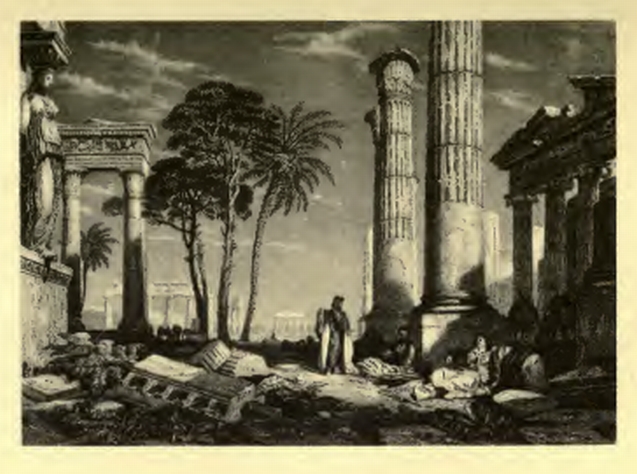
We are told of their pyramids; but they are monuments of an enslaved people. The whole nation must have been set to work on them, or those unsightly masses could never have been raised. And for what use were they? To preserve in a small chamber the mummy of some prince, or governor, or intendant, which his soul was to reanimate at the end of a thousand years. But if they looked forward to this resurrection of the body, why did they take out the brains before embalming them? Were the Egyptians to be resuscitated without brains?
APOCALYPSE.
SECTION I.
Justin the Martyr, who wrote about the year 270 of the Christian era, was the first who spoke of the Apocalypse; he attributes it to the apostle John the Evangelist. In his dialogue with Tryphon, that Jew asks him if he does not believe that Jerusalem is one day to be re-established? Justin answers that he believes it, as all Christians do who think aright. "There was among us," says he, "a certain person named John, one of the twelve apostles of Jesus; he foretold that the faithful shall pass a thousand years in Jerusalem."
The belief in this reign of a thousand years was long prevalent among the Christians. This period was also in great credit among the Gentiles. The souls of the Egyptians returned to their bodies at the end of a thousand years; and, according to Virgil, the souls in purgatory were exorcised for the same space of time—et mille per annos. The New Jerusalem of a thousand years was to have twelve gates, in memory of the twelve apostles; its form was to be square; its length, breadth, and height were each to be a thousand stadii—i.e., five hundred leagues; so that the houses were to be five hundred leagues high. It would be rather disagreeable to live in the upper story; but we find all this in the twenty-first chapter of the Apocalypse.
If Justin was the first who attributed the Apocalypse to St. John, some persons have rejected his testimony; because in the same dialogue with the Jew Tryphon he says that, according to the relation of the apostles, Jesus Christ, when he went into the Jordan, made the water boil, which, however, is not to be found in any writing of the apostles.
The same St. Justin confidently cites the oracles of Sibyls; he moreover pretends to have seen the remains of the places in which the seventy-two interpreters were confined in the Egyptian pharos, in Herod's time. The testimony of a man who had had the misfortune to see these places seems to indicate that he might possibly have been confined there himself.
St. Irenæus, who comes afterwards, and who also believed in the reign of a thousand years, tells us that he learned from an old man that St. John wrote the Apocalypse. But St. Irenæus is reproached with having written that there should be but four gospels, because there are but four quarters of the world, and four cardinal points, and Ezekiel saw but four animals. He calls this reasoning a demonstration. It must be confessed that Irenæus's method of demonstrating is quite worthy of Justin's power of sight.
Clement of Alexandria, in his "Electa" mentions only an Apocalypse of St. Peter, to which great importance was attached. Tertullian, a great partisan of the thousand years' reign, not only assures us that St. John foretold this resurrection and reign of a thousand years in the city of Jerusalem, but also asserts that this Jerusalem was already beginning to form itself in the air, where it had been seen by all the Christians of Palestine, and even by the Pagans, at the latter end of the night, for forty nights successively; but, unfortunately, the city always disappeared as soon as it was daylight.
Origen, in his preface to St. John's Gospel, and in his homilies, quotes the oracles of the Apocalypse, but he likewise quotes the oracles of Sibyls. And St. Dionysius of Alexandria, who wrote about the middle of the third century, says, in one of his fragments preserved by Eusebius, that nearly all the doctors rejected the Apocalypse as a book devoid of reason, and that this book was composed, not by St. John, but by one Cerinthus, who made use of a great name to give more weight to his reveries.
The Council of Laodicea, held in 360, did not reckon the Apocalypse among the canonical books. It is very singular that Laodicea, one of the churches to which the Apocalypse was addressed, should have rejected a treasure designed for itself, and that the bishop of Ephesus, who attended the council, should also have rejected this book of St. John, who was buried at Ephesus.
It was visible to all eyes that St. John was continually turning about in his grave, causing a constant rising and falling of the earth. Yet the same persons who were sure that St. John was not quite dead were also sure that he had not written the Apocalypse. But those who were for the thousand years' reign were unshaken in their opinion. Sulpicius Severus, in his "Sacred History," book xi., treats as mad and impious those who did not receive the Apocalypse. At length, after numerous oppositions of council to council, the opinion of Sulpicius Severus prevailed. The matter having been thus cleared up, the Church came to the decision, from which there is no appeal, that the Apocalypse is incontestably St. John's.
Every Christian communion has applied to itself the prophecies contained in this book. The English have found in it the revolutions of Great Britain; the Lutherans, the troubles of Germany; the French reformers, the reign of Charles IX., and the regency of Catherine de Medici, and they are all equally right. Bossuet and Newton have both commented on the Apocalypse, yet, after all, the eloquent declamations of the one, and the sublime discoveries of the other, have done them greater honor than their commentaries.
SECTION II.
Two great men, but very different in their greatness, have commented on the Apocalypse in the seventeenth century: Newton, to whom such a study was very ill suited, and Bossuet, who was better fitted for the undertaking. Both gave additional weapons to their enemies, by their commentaries, and, as has elsewhere been said, the former consoled mankind for his superiority over them, while the latter made his enemies rejoice.
The Catholics and the Protestants have both explained the Apocalypse in their favor, and have each found in it exactly what has accorded with their interests. They have made wonderful commentaries on the great beast with seven heads and ten horns, with the hair of a leopard, the feet of a bear, the throat of a lion, the strength of a dragon, and to buy and sell it was necessary to have the character and number of the beast, which number was 666.
Bossuet finds that this beast was evidently the Emperor Diocletian, by making an acrostic of his name. Grotius believed that it was Trajan. A curate of St. Sulpice, named La Chétardie, known from some strange adventures, proves that the beast was Julian. Jurieu proves that the beast is the pope. One preacher has demonstrated that it was Louis XIV. A good Catholic has demonstrated that it was William, king of England. It is not easy to make them all agree.
There have been warm disputes concerning the stars which fell from heaven to earth, and the sun and moon, which were struck with darkness in their third parts.
There are several opinions respecting the book that the angel made the author of the Apocalypse eat, which book was sweet to the mouth and bitter to the stomach. Jurieu asserted that the books of his adversary were designated thereby, and his argument was retorted upon himself.
There have been disputes about this verse: "And I heard a voice from heaven, as the voice of many waters, and as the voice of a great thunder; and I heard the voice of harpers harping on their harps."
It is quite clear that it would have been better to have respected the Apocalypse than to have commented upon it.
Camus, bishop of Bellay, printed in the last century a large book against the monks, which an unfrocked monk abridged. It was entitled "Apocalypse," because in it he exposed the dangers and defects of the monastic life; and "Melito's Apocalypse" ("Apocalypse de Méliton?"), because Melito, bishop of Sardis, in the second century, had passed for a prophet. This bishop's work has none of the obscurities of St. John's Apocalypse. Nothing was ever clearer. The bishop is like a magistrate saying to an attorney, "You are a forger and a cheat—do you comprehend me?"
The bishop of Bellay computes, in his Apocalypse or Revelations, that there were in his time ninety-eight orders of monks endowed or mendicant, living at the expense of the people, without employing themselves in the smallest labor. He reckoned six hundred thousand monks in Europe. The calculation was a little strained; but it is certain that the real number of the monks was rather too large.
He assures us that the monks are enemies to the bishops, curates, and magistrates; that, among the privileges granted to the Cordeliers, the sixth privilege is the certainty of being saved, whatever horrible crime you may have committed, provided you belong to the Order of St. Francis; that the monks are like apes; the higher they climb, the plainer you see their posteriors; that the name of monk has become so infamous and execrable that it is regarded by the monks themselves as a foul reproach and the most violent insult that can be offered them.
My dear reader, whoever you are, minister or magistrate, consider attentively the following short extract from our bishop's book:
"Figure to yourself the convent of the Escorial or of Monte Cassino, where the cœnobites have everything necessary, useful, delightful, superfluous and superabundant—since they have their yearly revenue of a hundred and fifty thousand, four hundred thousand, or five hundred thousand crowns; and judge whether Monsieur l'Abbé has wherewithal to allow himself and those under him to sleep after dinner.
"Then imagine an artisan or laborer, with no dependence except on the work of his hands, and burdened with a large family, toiling like a slave every day and at all seasons, to feed them with the bread of sorrow and the water of tears; and say, which of the two conditions is pre-eminent in poverty."
This is a passage from the "Episcopal Apocalypse" which needs no commentary. All that is wanted is an angel to come and fill his cup with the wine of the monks, to slake the thirst of the laborers who plow, sow, and reap, for the monasteries.
But this prelate, instead of writing a useful book, only composed a satire. Consistently with his dignity, he should have stated the good as well as evil. He should have acknowledged that the Benedictines have produced many good works, and that the Jesuits have rendered great services to literature. He might have blessed the brethren of La Charité, and those of the Redemption of the Captives. Our first duty is to be just. Camus gave too much scope to his imagination. St. François de Sales advised him to write moral romances; but he abused the advice.
ANTI-TRINITARIANS.
These are heretics who might pass for other than Christians. However, they acknowledge Jesus as Saviour and Mediator; but they dare to maintain that nothing is more contrary to right reason than what is taught among Christians concerning the Trinity of persons in one only divine essence, of whom the second is begotten by the first, and the third proceeds from the other two; that this unintelligible doctrine is not to be found in any part of Scripture; that no passage can be produced which authorizes it; or to which, without in any wise departing from the spirit of the text, a sense cannot be given more clear, more natural, or more conformable to common notions, and to primitive and immutable truths; that to maintain, as the orthodox do, that in the divine essence there are several distinct persons, and that the Eternal is not the only true God, but that the Son and the Holy Ghost must be joined with Him, is to introduce into the Church of Christ an error the most gross and dangerous, since it is openly to favor polytheism; that it implies a contradiction, to say that there is but one God, and that, nevertheless, there are three persons, each of which is truly God; that this distinction, of one in essence, and three in person, was never in Scripture; that it is manifestly false, since it is certain that there are no fewer essences than persons, nor persons than essences; that the three persons of the Trinity are either three different substances, or accidents of the divine essence, or that essence itself without distinction; that, in the first place, you make three Gods; that, in the second, God is composed of accidents; you adore accidents, and metamorphose accidents into persons; that, in the third, you unfoundedly and to no purpose divide an indivisible subject, and distinguish into three that which within itself has no distinction; that if it be said that the three personalities are neither different substances in the divine essence, nor accidents of that essence, it will be difficult to persuade ourselves that they are anything at all; that it must not be believed that the most rigid and decided Trinitarians have themselves any clear idea of the way in which the three hypostases subsist in God, without dividing His substance, and consequently without multiplying it; that St. Augustine himself, after advancing on this subject a thousand reasonings alike dark and false, was forced to confess that nothing intelligible could be said about the matter; they then repeat the passage by this father, which is, indeed, a very singular one: "When," says he, "it is asked what are the three, the language of man fails and terms are wanting to express them." "Three persons, has, however, been said—not for the purpose of expressing anything, but in order to say something and not remain mute." "Dictum est tres personæ, non ut aliquid diceretur, sed ne taceretur".—De Trinit. lib. v. cap. 9; that modern theologians have cleared up this matter no better; that, when they are asked what they understand by the word person, they explain themselves only by saying that it is a certain incomprehensible distinction by which are distinguished in one nature only, a Father, a Son, and a Holy Ghost; that the explanation which they give of the terms begetting and proceeding, is no more satisfactory, since it reduces itself to saying that these terms indicate certain incomprehensible relations existing among the three persons of the Trinity; that it may be hence gathered that the state of the question between them and the orthodox is to know whether there are in God three distinctions, of which no one has any definite idea, and among which there are certain relations of which no one has any more idea.
From all this they conclude that it would be wiser to abide by the testimony of the apostles, who never spoke of the Trinity, and to banish from religion forever all terms which are not in the scriptures—as trinity, person, essence, hypostasis, hypostatic and personal union, incarnation, generation, proceeding, and many others of the same kind; which being absolutely devoid of meaning, since they are represented by no real existence in nature, can excite in the understanding none but false, vague, obscure, and undefinable notions.
To this article let us add what Calmet says in his dissertation on the following passage of the Epistle of John the Evangelist: "For there are three that bear record in heaven, the Father, the Word, and the Holy Ghost; and these three are one; and there are three that bear witness in earth, the spirit, the water and the blood; and these three are one." Calmet acknowledges that these two verses are not in any ancient bible; indeed, it would be very strange if St. John had spoken of the Trinity in a letter, and said not a word about it in his Gospel. We find no trace of this dogma, either in the canonical or in the apocryphal gospels. All these reasons and many others might excuse the anti-trinitarians, if the councils had not decided. But as the heretics pay no regard to councils, we know not what measures to take to confound them. Let us content ourselves with believing and wishing them to believe.
APOCRYPHA—APOCRYPHAL.
(FROM THE GREEK WORD SIGNIFYING HIDDEN.)
It has been very well remarked that the divine writings might, at one and the same time, be sacred and apocryphal; sacred, because they had undoubtedly been dictated by God Himself; apocryphal, because they were hidden from the nations, and even from the Jewish people.
That they were hidden from the nations before the translation executed at Alexandria, under the Ptolemies, is an acknowledged truth. Josephus declares it in the answer to Appian, which he wrote after Appian's death; and his declaration has not less strength because he seeks to strengthen it by a fable. He says in his history that the Jewish books being all-divine, no foreign historian or poet had ever dared to speak of them. And, immediately after assuring us that no one had ever dared to mention the Jewish laws, he adds that the historian Theopompus, having only intended to insert something concerning them in his history, God struck him with madness for thirty days; but that, having been informed in a dream that he was mad only because he had wished to know divine things and make them known to the profane, he asked pardon of God, who restored him to his senses.
Josephus in the same passage also relates that a poet named Theodectes, having said a few words about the Jews in his tragedies, became blind, and that God did not restore his sight until he had done penance.
As for the Jewish people, it is certain that there was a time when they could not read the divine writings; for it is said in the Second Book of Kings (chap, xxii., ver. 8), and in the Second Book of Chronicles (chap, xxxiv., ver. 14), that in the reign of Josias they were unknown, and that a single copy was accidentally found in the house of the high priest Hilkiah.
The twelve tribes which were dispersed by Shalmaneser have never re-appeared; and their books, if they had any, have been lost with them. The two tribes which were in slavery at Babylon and allowed to return at the end of seventy years, returned without their books, or at least they were very scarce and very defective, since Esdras was obliged to restore them. But although during the Babylonian captivity these books were apocryphal, that is, hidden or unknown to the people, they were constantly sacred—they bore the stamp of divinity—they were, as all the world agrees, the only monument of truth upon earth.
We now give the name of apocrypha to those books which are not worthy of belief; so subject are languages to change! Catholics and Protestants agree in regarding as apocryphal in this sense, and in rejecting, the prayer of Manasseh, king of Judah, contained in the Second Book of Kings; the Third and Fourth Books of Maccabees; the Fourth Book of Esdras; although these books were incontestably written by Jews. But it is denied that the authors were inspired by God, like the Jews.
The other books, rejected by the Protestants only, and consequently considered by them as not inspired by God Himself, are the Book of Wisdom, though it is written in the same style as the Proverbs; Ecclesiasticus, though the style is still the same; the first two books of Maccabees, though written by a Jew, But they do not believe this Jew to have been inspired by God—Tobit—although the story is edifying. The judicious and profound Calmet affirms that a part of this book was written by Tobit the father, and a part by Tobit the son; and that a third author added the conclusion of the last chapter, which says that Tobit the younger expired at the age of one hundred and twenty-seven years, and that he died rejoicing over the destruction of Nineveh.
The same Calmet, at the end of his preface, has these words: "Neither the story itself, nor the manner in which it is told, bears any fabulous or fictitious character. If all Scripture histories, containing anything of the marvellous or extraordinary, were to be rejected, where is the sacred book which is to be preserved?"
Judith is another book rejected by the Protestants, although Luther himself declares that "this book is beautiful, good, holy, useful, the language of a holy poet and a prophet animated by the Holy Spirit, that had been his instructor," etc.
It is indeed hard to discover at what time Judith's adventure happened, or where the town of Bethulia was. The degree of sanctity in Judith's action has also been disputed; but the book having been declared canonical by the Council of Trent, all disputes are at an end.
Other books are Baruch, although it is written in the style of all the other prophets; Esther, of which the Protestants reject only some additions after the tenth chapter. They admit all the rest of the book; yet no one knows who King Ahasuerus was, although he is the principal person in the story; Daniel, in which the Protestants retrench Susannah's adventure and that of the children in the furnace; but they retain Nebuchadnezzar's dream and his grazing with the beasts.
On the Life of Moses, an Apocryphal Book of the Highest Antiquity.
The ancient book which contains the life and death of Moses seems to have been written at the time of the Babylonian captivity. It was then that the Jews began to know the names given to the angels by the Chaldæans and Persians.
Here we see the names of Zinguiel, Samael, Tsakon, Lakah, and many others of which the Jews had made no mention.
The book of the death of Moses seems to have been written later. It is known that the Jews had several very ancient lives of Moses and other books, independently of the Pentateuch. In them he was called Moni, not Moses; and it is asserted that mo signified water, and ni the particle of. He was called by the general name of Melk. He received those of Joakim, Adamosi, Thetmosi; and it has been thought that he was the same person whom Mane then calls Ozarziph.
Some of these old Hebrew manuscripts were withdrawn from their covering of dust in the cabinets of the Jews about the year 1517. The learned Gilbert Gaumin, who was a perfect master of their language, translated them into Latin about the year 1535. They were afterwards printed and dedicated to Cardinal Bérule. The copies have become extremely scarce.
Never were rabbinism, the taste for the marvellous and the imagination of the orientals displayed to greater excess.
Fragment of the Life of Moses.
A hundred and thirty years after the settling of the Jews in Egypt, and sixty years after the death of the patriarch Joseph, Pharaoh, while sleeping, had a dream. He saw an old man holding a balance; in one scale were all the inhabitants of Egypt; in the other was an infant, and this infant weighed more than all the Egyptians together. Pharaoh forthwith called together his shotim, or sages. One of the wise men said: "O king, this infant is a Jew who will one day do great evil to your kingdom. Cause all the children of the Jews to be slain; thus shalt thou save thy empire, if, indeed, the decrees of fate can be opposed."