VOLUME V (continued 3)
William F. Fleming translation
ALTARS, TEMPLES, RITES, SACRIFICES, ETC.
It is universally acknowledged that the first Christians had neither temples, nor altars, nor tapers, nor incense, nor holy water, nor any of those rites which the prudence of pastors afterwards instituted, in conformity with times and places, but more especially with the various wants of the faithful.
We have ample testimony in Origen, Athenagoras, Theophilus, Justin, and Tertullian, that the primitive Christians held temples and altars in abomination; and that not merely because they could not in the beginning obtain permission from the government to build temples, but because they had a real aversion for everything that seemed to apply any affinity with other religions. This abhorrence existed among them for two hundred and fifty years, as is proved by the following passage of Minutius Felix, who lived in the third century. Addressing the Romans, he says:
"Putatis autem nos occultare quod colimus, si delubra et aras non habemus. Quod enim simulacrum Deo fingam, quum, si recte existimes, sit Dei homo ipse simulacrum? quod templum ei exstruam, quum totus hic mundus, ejus opere fabricatus, eum capere non possit? et quum homo latius maneam, intra unam ædiculum vim tantæ majestatis includam? nonne melius in nostra dedicandus est mente, in nostro imo consecrandus est pectore?"
"You think that we conceal what we adore, because we have neither temples nor altars. But what shall we erect like to God, since man himself is God's image? What temple shall we build for Him, when the whole world, which is the work of His hands, cannot contain Him? How shall we enclose the power of such majesty in one dwelling-place? Is it not better to consecrate a temple to Him in our minds and in our hearts?"
The Christians, then, had no temples until about the beginning of the reign of Diocletian. The Church had then become very numerous; and it was found necessary to introduce those decorations and rites which, at an earlier period, would have been useless and even dangerous to a slender flock, long despised, and considered as nothing more than a small sect of dissenting Jews.
It is manifest that, while they were confounded with the Jews, they could not obtain permission to erect temples. The Jews, who paid very dear for their synagogues, would themselves have opposed it; for they were mortal enemies to the Christians, and they were rich. We must not say, with Toland, that the Christians, who at that time made a show of despising temples and altars, were like the fox that said the grapes were sour. This comparison appears as unjust as it is impious, since all the primitive Christians in so many different countries, agreed in maintaining that there was no need of raising temples or altars to the true God.
Providence, acting by second causes, willed that they should erect a splendid temple at Nicomedia, the residence of the Emperor Diocletian, as soon as they had obtained that sovereign's protection. They built others in other cities; but still they had a horror of tapers, lustral water, pontifical habits, etc. All this pomp and circumstance was in their eyes no other than a distinctive mark of paganism. These customs were adopted under Constantine and his successors, and have frequently changed.
Our good women of the present day, who every Sunday hear a Latin mass, at which a little boy attends, imagine that this rite has been observed from the earliest ages, that there never was any other, and that the custom in other countries of assembling to offer up prayers to God in common is diabolical and quite of recent origin. There is, undeniably, something very respectable in a mass, since it has been authorized by the Church; it is not at all an ancient usage, but is not the less entitled to our veneration.
There is not, perhaps, a single ceremony of this day which was in use in the time of the apostles. The Holy Spirit has always conformed himself to the times. He inspired the first disciples in a mean apartment; He now communicates His inspirations in St. Peter's at Rome, which cost several millions—equally divine, however, in the wretched room, and in the superb edifice of Julius II., Leo X., Paul III., and Sixtus V.
AMAZONS.
Bold and vigorous women have been often seen to fight like men. History makes mention of such; for, without reckoning Semiramis, Tomyris, or Penthesilea—who, perhaps, existed only in fable—it is certain that there were many women in the armies of the first caliphs. In the tribe of the Homerites, especially, it was a sort of law, dictated by love and courage, that in battle wives should succor and avenge their husbands, and mothers their children.
When the famous chief Derar was fighting in Syria against the generals of the Emperor Heraclius, in the time of the caliph Abubeker, successor to Mahomet, Peter, who commanded at Damascus, took thither several women, whom he had captured, together with some booty, in one of his excursions; among the prisoners was the sister of Derar. Alvakedi's "Arabian History," translated by Ockley, says that she was a perfect beauty, and that Peter became enamored of her, paid great attention to her on the way, and indulged her and her fellow-prisoners with short marches. They encamped in an extensive plain, under tents, guarded by troops posted at a short distance. Caulah (so this sister of Derar's was named) proposed to one of her companions, called Oserra, that they should endeavor to escape from captivity, and persuaded her rather to die than be a victim to the lewd desires of the Christians. The same Mahometan enthusiasm seized all the women; they armed themselves with the iron-pointed staves that supported their tents, and with a sort of dagger which they wore in their girdles; they then formed a circle, as the cows do when they present their horns to attacking wolves. Peter only laughed at first; he advanced toward the women, who gave him hard blows with the staves; after hesitating for some time, he at length resolved to use force; the sabres of his men were already drawn, when Derar arrived, put the Greeks to flight, and delivered his sister and the other captives.
Nothing can more strongly resemble those times called heroic, sung by Homer. Here are the same single combats at the head of armies, the combatants frequently holding a long conversation before they commence fighting; and this, no doubt, justifies Homer.
Thomas, governor of Syria, Heraclius's son-in-law, made a sally from Damascus, and attacked Sergiabil, having first prayed to Jesus Christ. "Unjust aggressor," said he to Sergiabil, "thou canst not resist Jesus, my God, who will fight for the champions of His religion." "Thou tellest an impious lie," answered Sergiabil; "Jesus is not greater before God than Adam. God raised Him from the dust; He gave life to Him as to another man, and, after leaving Him for some time on earth, took Him up into heaven." After some more verbal skirmishing the fight began. Thomas discharged an arrow, which wounded young Aban, the son of Saib, by the side of the valiant Sergiabil; Aban fell and expired; the news of his death reached his young wife, to whom he had been united but a few days before; she neither wept nor complained, but ran to the field of battle, with a quiver at her back, and a couple of arrows in her hand; with the first of these she killed the Christian standard-bearer, and the Arabs seized the trophy, crying, Allah achar! With the other she shot Thomas in the eye, and he retired, bleeding, into the town.
Arabian history is full of similar examples, but they do not tell us that these warlike women burned their right breast, that they might draw the bow better, nor that they lived without men; on the contrary, they exposed themselves in battle for their husbands or their lovers; from which very circumstance we must conclude that, so far from reproaching Ariosto and Tasso for having introduced so many enamored warriors into their poems, we should praise them for having delineated real and interesting manners.
When the crusading mania was at its height there were some Christian women who shared the fatigues and dangers of their husbands. To such a pitch, indeed, was this enthusiasm carried that the Genoese women undertook a crusade of their own, and were on the point of setting out for Palestine to form petticoat battalions; they had made a vow so to do, but were absolved from it by a pope, who was a little wiser than themselves.
Margaret of Anjou, wife of the unfortunate Henry VI. of England, evinced, in a juster war, a valor truly heroic; she fought in ten battles to deliver her husband. History affords no authenticated example of greater or more persevering courage in a woman. She had been preceded by the celebrated Countess de Montfort, in Brittany. "This princess," says d'Argentré, "was virtuous beyond the nature of her sex, and valiant beyond all men; she mounted her horse, and managed him better than any esquire; she fought hand to hand, or charged a troop of armed men like the most valiant captain; she fought on sea and land with equal bravery," etc. She went, sword in hand, through her states, which were invaded by her competitor, Charles de Blois. She not only sustained two assaults, armed cap-à-pie, in the breach of Hennebon, but she made a sortie with five hundred men, attacked the enemy's camp, set fire to it, and reduced it to ashes.
The exploits of Joan of Arc, better known as the Maid of Orleans, are less astonishing than those of Margaret of Anjou and the Countess de Montfort. These two princesses having been brought up in the luxury of courts, and Joan of Arc in the rude exercises of country life, it was more singular, as well as more noble, to quit a palace for the field than a cottage.
The heroine who defended Beauvais was, perhaps, superior to her who raised the siege of Orleans, for she fought quite as well, and neither boasted of being a maid, nor of being inspired. It was in 1472, when the Burgundian army was besieging Beauvais, that Jeanne Hachette, at the head of a number of women, sustained an assault for a considerable time, wrested the standard from one of the enemy who was about to plant it on the breach, threw the bearer into the trench, and gave time for the king's troops to arrive and relieve the town. Her descendants have been exempted from the taille (poll tax)—a mean and shameful recompense! The women and girls of Beauvais are more flattered by their walking before the men in the procession on the anniversary day. Every public mark of honor is an encouragement of merit; but the exemption from the taille is but a proof that the persons so exempted were subjected to this servitude by the misfortune of their birth.
There is hardly any nation which does not boast of having produced such heroines; the number of these, however, is not great; nature seems to have designed women for other purposes. Women have been known but rarely to exhibit themselves as soldiers. In short, every people have had their female warriors; but the kingdom of the Amazons, on the banks of the Thermodon, is, like most other ancient stories, nothing more than a poetic fiction.
AMBIGUITY—EQUIVOCATION.
For want of defining terms, and especially for want of a clear understanding, almost all laws, that should be as plain as arithmetic and geometry, are as obscure as logogriphs. The melancholy proof of this is that nearly all processes are founded on the sense of the laws, always differently understood by the pleaders, the advocates, and the judges.
The whole public law of Europe had its origin in equivocal expressions, beginning with the Salique law. She shall not inherit Salique land. But what is Salique land? And shall not a girl inherit money, or a necklace, left to her, which may be worth more than the land?
The citizens of Rome saluted Karl, son of the Austrasian Pepin le Bref, by the name of imperator. Did they understand thereby: We confer on you all the prerogatives of Octavius, Tiberius, Caligula, and Claudius? We give you all the country which they possessed? However, they could not give it; for so far were they from being masters of it that they were scarcely masters of their own city. There never was a more equivocal expression; and such as it was then it still is.
Did Leo III., the bishop of Rome who is said to have saluted Charlemagne emperor, comprehend the meaning of the words which he pronounced? The Germans assert that he understood by them that Charles should be his master. The Datary has asserted that he meant he should be master over Charlemagne.
Have not things the most venerable, the most sacred, the most divine, been obscured by the ambiguities of language? Ask two Christians of what religion they are. Each will answer, I am a Catholic. You think they are both of the same communion; yet one is of the Greek, the other of the Latin church; and they are irreconcilable. If you seek to be further informed, you will find that by the word Catholic each of them understands universal, in which case universal signifies a part.
The soul of St. Francis is in heaven—is in paradise. One of these words signifies the air; the other means a garden. The word spirit is used alike to express extract, thought, distilled liquor, apparition. Ambiguity has been so necessary a vice in all languages, formed by what is called chance and by custom, that the author of all clearness and truth Himself condescended to speak after the manner of His people; whence is it that Elohim signifies in some places judges, at other times gods, and at others angels. "Tu es Petrus, et super hunc petrum ædificabo ecclesiam meam," would be equivocal in a profane tongue, and on profane subject; but these words receive a divine sense from the mouth which utters them, and the subject to which they are applied.
"I am the God of Abraham, the God of Isaac, the God of Jacob; now God is not the God of the dead, but of the living." In the ordinary sense these words might signify: "I am the same God that was worshipped by Abraham, Isaac and Jacob; as the earth, which bore Abraham, Isaac, and Jacob, likewise bears their descendants; the sun which shines to-day is the sun that shone on Abraham, Isaac, and Jacob; the law of their children was their law." This does not, however, signify that Abraham, Isaac, and Jacob are still living. But when the Messiah speaks, there is no longer any ambiguity; the sense is as clear as it is divine. It is evident that Abraham, Isaac, and Jacob are not among the dead, but live in glory, since this oracle is pronounced by the Messiah; but it was necessary that He and no one else should utter it.
The discourses of the Jewish prophets might seem equivocal to men of gross intellects, who could not perceive their meaning; but they were not so to minds illumined by the light of faith.
All the oracles of antiquity were equivocal. It was foretold to Crœsus that a powerful empire was to fall; but was it to be his own? or that of Cyrus? It was also foretold to Pyrrhus that the Romans might conquer him, and that he might conquer the Romans. It was impossible that this oracle should lie.
When Septimius Severus, Pescennius Niger, and Clodius Albinus were contending for the empire, the oracle of Delphos, being consulted (notwithstanding the assertion of the Jesuit Baltus that oracles had ceased), answered that the brown was very good, the white good for nothing, and the African tolerable. It is plain that there are more ways than one of explaining such an oracle.
When Aurelian consulted the god of Palmyra (still in spite of Baltus), the god said that the doves fear the falcon. Whatever might happen, the god would not be embarrassed; the falcon would be the conqueror, and the doves the conquered.
Sovereigns, as well as gods, have sometimes made use of equivocation. Some tyrant, whose name I forget, having sworn to one of his captives that he would not kill him, ordered that he should have nothing to eat, saying that he had promised not to put him to death, but he had not promised to keep him alive.
AMERICA.
Since framers of systems are continually conjecturing on the manner in which America can have been peopled, we will be equally consistent in saying that He who caused flies to exist in those regions caused men to exist there also. However pleasant it may be to dispute, it cannot be denied that the Supreme Being, who lives in all nature, has created, about the forty-eighth degree, two-legged animals without feathers, the color of whose skin is a mixture of white and carnation, with long beards approaching to red; about the line, in Africa and its islands, negroes without beards; and in the same latitude, other negroes with beards, some of them having wool, and some hair, on their heads; and among them other animals quite white, having neither hair nor wool, but a kind of white silk. It does not very clearly appear what should have prevented God from placing on another continent animals of the same species, of a copper color, in the same latitude in which, in Africa and Asia, they are found black; or even from making them without beards in the very same latitude in which others possess them.
To what lengths are we carried by the rage for systems joined with the tyranny of prejudice! We see these animals; it is agreed that God has had the power to place them where they are; yet it is not agreed that he has so placed them. The same persons who readily admit that the beavers of Canada are of Canadian origin, assert that the men must have come there in boats, and that Mexico must have been peopled by some of the descendants of Magog. As well might be said that if there be men in the moon they must have been taken thither by Astolpho on his hippogriff, when he went to fetch Roland's senses, which were corked up in a bottle. If America had been discovered in his time, and there had then been men in Europe systematic enough to have advanced, with the Jesuit Lafitau, that the Caribbees descended from the inhabitants of Caria, and the Hurons from the Jews, he would have done well to have brought back the bottle containing the wits of these reasoners, which he would doubtless have found in the moon, along with those of Angelica's lover.
The first thing done when an inhabited island is discovered in the Indian Ocean, or in the South Seas, is to inquire whence came these people? But as for the trees and the tortoises, they are, without any hesitation, pronounced to be indigenous; as if it was more difficult for Nature to make men than to make tortoises. One thing, however, which tends to countenance this system is that there is scarcely an island in the Eastern or in the Western Ocean which does not contain jugglers, quacks, knaves and fools. This, it is probable, gave rise to the opinion that these animals are of the same race with ourselves.
AMPLIFICATION.
It is pretended that amplification is a fine figure of rhetoric; perhaps, however, it would be more reasonable to call it a defect. In saying all that we should say, we do not amplify; and if after saying this we amplify, we say too much. To place a good or bad action in every light is not to amplify; but to go farther than this is to exaggerate and become wearisome.
Prizes were formerly given in colleges for amplification. This was indeed teaching the art of being diffuse. It would, perhaps, have been better to have given the fewest words, and thus teach the art of speaking with greater force and energy. But while we avoid amplification, let us beware of dryness.
I have heard professors teach that certain passages in "Virgil" are amplifications, as, for instance, the following:
Nox erat, et placidum carpebant fessa soporem Corpora per terras, silvæque et saeva quierunt Æquora; quum medio volvuntur sidera lapsu; Quum tacet omnis ager, pecudes, pietaeque volucres; Quaeque lacus late liquidos, quaeque aspera dumis Rura tenant, somno positae sub node silenti Lenibant curas, et corda oblita laborum: At non infelix animi Phœnissa. 'Twas dead of night, when weary bodies close Their eyes in balmy sleep and soft repose: The winds no longer whisper through the woods, Nor murmuring tides disturb the gentle floods; The stars in silent order moved around, And peace, with downy wings, was brooding on the ground. The flocks and herds, and parti-colored fowl, Which haunt the woods and swim the weedy pool. Stretched on the quiet earth securely lay, Forgetting the past labors of the day. All else of Nature's common gift partake; Unhappy Dido was alone awake.—DRYDEN.
If the long description of the reign of sleep throughout all nature did not form an admirable contrast with the cruel inquietude of Dido, these lines would be no other than a puerile amplification; it is the words At non infelix animi Phœnissa—"Unhappy Dido," etc., which give them their charm.
That beautiful ode of Sappho's which paints all the symptoms of love, and which has been happily translated into every cultivated language, would doubtless have been less touching had Sappho been speaking of any other than herself; it might then have been considered as an amplification.
The description of the tempest in the first book of the "Æneid" is not an amplification; it is a true picture of all that happens in a tempest; there is no idea repeated, and repetition is the vice of all which is merely amplification.
The finest part on the stage in any language is that of Phèdre (Phædra). Nearly all that she says would be tiresome amplification if any other was speaking of Phædra's passion.
Athenes me montra mon superbe ennemie; Je le vis, je rougis, je plaîs, à sa vue; Un trouble s'éleva dans mon âme éperdue; Mes yeux ne voyaient plus, je ne pouvais parler, Je sentis tout mon corps et transir et brûler; Je reconnus Venus et ses traits redoubtables, D'un sang qu'elle poursuit tormens inévitables. Yes;—Athens showed me my proud enemy; I saw him—blushed—turned pale;— A sudden trouble came upon my soul,— My eyes grew dim—my tongue refused its office,— I burned—and shivered;—through my trembling frame Venus in all her dreadful power I felt, Shooting through every vein a separate pang.
It is quite clear that since Athens showed her her proud enemy Hippolytus, she saw Hippolytus; if she blushed and turned pale, she was doubtless troubled. It would have been a pleonasm, a redundancy, if a stranger had been made to relate the loves of Phædra; but it is Phædra, enamored and ashamed of her passion—her heart is full—everything escapes her:
Ut vidi, lit perii, ut me malus abstulit error. Je le vis, je rougis, je pâlis, à sa vue. I saw him—blushed—turned pale.—
What can be a better imitation of Virgil?
Mes yeux ne voyaient plus, je ne pouvais parler; Je sentis tout mon corps et transir et brûler; My eyes grew dim—my tongue refused its office; I burned—and shivered;
What can be a finer imitation of Sappho?
These lines, though imitated, flow as from their first source; each word moves and penetrates the feeling heart; this is not amplification; it is the perfection of nature and of art.
The following is, in my opinion, an instance of amplification, in a modern tragedy, which nevertheless has great beauties. Tydeus is at the court of Argos; he is in love with a sister of Electra; he laments the fall of his friend Orestes and of his father; he is divided betwixt his passion for Electra and his desire of vengeance; while in this state of care and perplexity he gives one of his followers a long description of a tempest, in which he had been shipwrecked some time before.
Tu sais ce qu'en ces lieux nous venions entreprendre; Tu sais que Palamède, avant que de s'y rendre, Ne voulut point tenter son retour dans Argos, Qu'il n'eût interroge l'oracle de Délos. A de si justes soins on souscrivit sans peine; Nous partîmes, comblés des bienfaits de Thyrrène; Tout nous favorisait; nous voyageâmes longtems Au gré de nos désirs, bien plus qu'au gré des vents; Mais, signalant bientôt toute son inconstance, Le mer en un moment se mutine et s'élance; L'air mugit, le jour fuit, une épaisse vapeur Couvre d'un voile affreux les vagues en fureur; La foudre, éclairante seule une nuit si profonde, À sillons redoublés ouvre le ciel et l'onde, Et comme un tourbillon, embrassant nos vaisseaux, Semble en sources de feu bouillonner sur les eaux; Les vagues quelquefois, nous portant sur leurs cimes, Nous font router après sous de vastes abîmes, Où les éclairs pressés, pénétrans avec nous, Dans des gouffres de feu semblaient nous plonger tous; Le pilote effrayé, que la flamme environne, Aux rochers qu'il fuyait lui-même s'abandonne; À travers les écueils notre vaisseau pousse, Se brise, et nage enfin sur les eaux dispersées. Thou knowest what purpose brought us to these shores; Thou knowest that Palamed would not attempt Again to set his foot within these walls Until he'd questioned Delos' oracle. To his just care we readily subscribed; We sailed, and favoring gales at first appeared To announce a prosperous voyage; Long time we held our course, and held it rather As our desires than as the winds impelled; But the inconstant ocean heaved at last Its treacherous bosom; howling blasts arose; The heavens were darkened; vapors black and dense Spread o'er the furious waves a frightful veil, Pierced only by the thunderbolts, which clove The waters and the firmament at once, And whirling round our ship, in horrid sport Chased one another o'er the boiling surge; Now rose we on some watery mountain's summit. Now with the lightning plunged into a gulf That seemed to swallow all. Our pilot, struck Powerless by terror, ceased to steer, and left us Abandoned to those rocks we dreaded most; Soon did our vessel dash upon their points, And swim in scattered fragments on the billows.
In this description we see the poet wishing to surprise his readers with the relation of a shipwreck, rather than the man who seeks to avenge his father and his friend—to kill the tyrant of Argos, but who is at the same time divided between love and vengeance.
Several men of taste, and among others the author of "Telemachus," have considered the relation of the death of Hippolytus, in Racine, as an amplification; long recitals were the fashion at that time. The vanity of actors make them wish to be listened to, and it was then the custom to indulge them in this way. The archbishop of Cambray says that Theramenes should not, after Hippolytus' catastrophe, have strength to speak so long; that he gives too ample a description of the monster's threatening horns, his saffron scales, etc.; that he should say in broken accents, Hippolytus is dead—a monster has destroyed him—I beheld it.
I shall not enter on a defence of the threatening horns, etc.; yet this piece of criticism, which has been so often repeated, appears to me to be unjust. You would have Theramenes say nothing more than Hippolytus is killed—I saw him die—all is over. This is precisely what he does say; Hippolyte n'est plus! (Hippolytus is no more!) His father exclaims aloud; and Theramenes, on recovering his senses, says;
J'ai vu des mortels périr le plus amiable, I have seen the most amiable of mortals perish,
and adds this line, so necessary and so affecting yet so agonizing for Theseus:
Et j'ose dire encore. Seigneur, le moins coupable. And, Sire, I may truly add, the most innocent.
The gradations are fully observed; each shade is accurately distinguished. The wretched father asks what God—what sudden thunder-stroke has deprived him of his son. He has not courage to proceed; he is mute with grief; he awaits the dreadful recital, and the audience awaits it also. Theramenes must answer; he is asked for particulars; he must give them.
Was it for him who had made Mentor and all the rest of his personages discourse at such length, sometimes even tediously; was it for him to shut the mouth of Theramenes? Who among the spectators would not listen to him? Who would not enjoy the melancholy pleasure of hearing the circumstance of Hippolytus' death? Who would have so much as three lines struck out? This is no vain description of a storm unconnected with the piece; no ill-written amplification; it is the purest diction, the most affecting language; in short, it is Racine. Amplification, declamation, and exaggeration were at all times the faults of the Greeks, excepting Demosthenes and Aristotle.
There have been absurd pieces of poetry on which time has set the stamp of almost universal approbation, because they were mixed with brilliant flashes which threw a glare over their imperfections, or because the poets who came afterward did nothing better. The rude beginnings of every art acquire a greater celebrity than the art in perfection; he who first played the fiddle was looked upon as a demi-god, while Rameau had only enemies. In fine, men, generally going with the stream, seldom judge for themselves, and purity of taste is almost as rare as talent.
At the present day, most of our sermons, funeral orations, set discourses, and harangues in certain ceremonies, are tedious amplifications—strings of commonplace expressions repeated again and again a thousand times. These discourses are only supportable when rarely heard. Why speak when you have nothing new to say? It is high time to put a stop to this excessive waste of words, and therefore we conclude our article.
ANCIENTS AND MODERNS.
The great cause of the ancients versus the moderns is not yet disposed of; it has been at issue ever since the silver age, which succeeded the golden one. Men have always pretended that the good old times were much better than the present. Nestor, in the "Iliad," wishing to insinuate himself, like a wise mediator, into the good opinion of Achilles and Agamemnon, begins with saying: "I have lived with better men than you; never have I seen, nor shall I ever see again, such great personages as Dryas, Cæneus, Exadius, Polyphemus equal to the gods," etc. Posterity has made ample amends to Achilles for Nestor's bad compliment, so vainly admired by those who admire nothing but what is ancient. Who knows anything about Dryas? We have scarcely heard of Exadius or of Cæneus; and as for Polyphemus equal to the gods, he has no very high reputation, unless, indeed, there was something divine in his having a great eye in the middle of his forehead, and eating the raw carcasses of mankind.
Lucretius does not hesitate to say that nature has degenerated:
Ipsa dedit dulces fœtus et pabula lœta, Quæ nunc vix nostro grandescunt aucta labore; Conterimusque boves, et vires agricolarum, etc.
Antiquity is full of the praises of another antiquity still more remote:
Les hommes, en tout tems, ont pensé qu'autrefois, De longs ruisseaux de lait serpentaient dans nos bois; La lune était plus grande, et la nuit moins obscure; L'hiver se couronnait de fleurs et de verdure; Se contemplait à l'aise, admirait son néant, Et, formé pour agir, se plaisait à rien faire, etc. Men have, in every age, believed that once Long streams of milk ran winding through the woods; The moon was larger and the night less dark; Winter was crowned with flowers and trod on verdure; Man, the world's king, had nothing else to do Than contemplate his utter worthlessness, And, formed for action, took delight in sloth, etc.
Horace combats this prejudice with equal force and address in his fine epistle to Augustus. "Must our poems, then," says he, "be like our wines, of which the oldest are always preferred?" He afterward says:
Indignor quidquam reprehendi, non quia crasse Compositum illepideve putetur, sed quia nuper; Nec veniam antiquis, sed honorem et præmia posci. * * * * * * * * * * * * * * * * * * * * * * * * * * * Ingeniis non ille favet plauditque sepultis, Nostra sed impugnat, nos nostraque lividus odit. I feel my honest indignation rise, When, with affected air, a coxcomb cries: "The work, I own, has elegance and ease, But sure no modern should presume to please"; Thus for his favorite ancients dares to claim, Not pardon only, but rewards and fame. * * * * * * * * * * * * * * * * * * * * Not to the illustrious dead his homage pays, But envious robs the living of their praise.—FRANCIS.
On this subject the learned and ingenious Fontenelle expresses himself thus:
"The whole of the question of pre-eminence between the ancients and moderns, being once well understood, reduces itself to this: Were the trees which formerly grew in the country larger than those of the present day? If they were, Homer, Plato, and Demosthenes cannot be equalled in these latter ages; but if our trees are as large as those of former times, then can we equal Homer, Plato, and Demosthenes.
"But to clear up the paradox: If the ancients had stronger minds than ourselves, it must have been that the brains of those times were better disposed, were formed of firmer or more delicate fibres, or contained a larger portion of animal spirits. But how should the brains of those times have been better disposed? Had such been the case, the leaves would likewise have been larger and more beautiful; for if nature was then more youthful and vigorous, the trees, as well as the brains of men, would have borne testimony to that youth and vigor."
With our illustrious academician's leave, this is by no means the state of the question. It is not asked whether nature can at the present day produce as great geniuses, and as good works, as those of Greek and Latin antiquity, but whether we really have such. It is doubtless possible that there are oaks in the forest of Chantilly as large as those of Dodona; but supposing that the oaks of Dodona could talk, it is quite clear that they had a great advantage over ours, which, it is probable, will never talk.
La Motte, a man of wit and talent, who has merited applause in more than one kind of writing, has, in an ode full of happy lines, taken the part of the moderns. We give one of his stanzas:
Et pourquoi veut-on que j'encense Ces prétendus Dieux dont je sors? En moi la même intelligence Fait mouvoir les mêmes ressorts. Croit-on la nature bizarre, Pour nous aujourd'hui plus avare Que pour les Grecs et les Romains? De nos aînés mere idolâtre, N'est-elle plus que la marâtre Dure et grossière des humains?
And pray, why must I bend the knee To these pretended Gods of ours? The same intelligence in me Gives vigor to the self-same powers. Think ye that nature is capricious, Or towards us more avaricious Than to our Greek and Roman sires— To them an idolizing mother, While in their children she would smother The sparks of intellectual fires?
He might be answered thus: Esteem your ancestors, without adoring them. You have intelligence and powers of invention, as Virgil and Horace had; but perhaps it is not absolutely the same intelligence. Perhaps their talents were superior to—yours; they exercised them, too, in a language richer and more harmonious than our modern tongues, which are a mixture of corrupted Latin, with the horrible jargon of the Celts.
Nature is not capricious; but it is possible that she had given the Athenians a soil and sky better adapted than Westphalia and the Limousin to the formation of geniuses of a certain order. It is also likely that, the government of Athens, seconding the favorable climate, put ideas into the head of Demosthenes which the air of Clamar and La Grenouillere combined with the government of Cardinal de Richelieu, did not put into the heads of Omer Talon and Jerome Bignon.
Some one answered La Motte's lines by the following:
Cher la Motte, imite et revère Ces Dieux dont tu ne descends pas; Si tu crois qu'Horace est ton père, Il a fait des enfans ingrats. La nature n'est point bizarre; Pour Danchet elle est fort avare, Mais Racine en fut bien traité; Tibulle était guide par elle, Mais pour notre ami La Chapelle, Hélas! qu'elle a peu de bonté! Revere and imitate, La Motte, Those Gods from whom thou'rt not descended; If thou by Horace wert begot, His children's manners might be mended. Nature is not at all capricious; To Danchet she is avaricious, But she was liberal to Racine; She used Tibullus very well, Though to our good friend La Chapelle, Alas! she is extremely mean!
This dispute, then, resolves itself into a question of fact. Was antiquity more fertile in great monuments of genius of every kind, down to the time of Plutarch, than modern ages have been, from that of the house of Medicis to that of Louis XIV., inclusively?
The Chinese, more than two hundred years before our Christian era, built their great wall, which could not save them from invasion by the Tartars. The Egyptians had, four thousand years before, burdened the earth with their astonishing pyramids, the bases of which covered ninety thousand square feet. No one doubts that, if it were thought advisable to undertake such useless works at the present day, they might be accomplished by lavishing plenty of money. The great wall of China is a monument of fear; the pyramids of Egypt are monuments of vanity and superstition; both testify the great patience of the two people, but no superior genius. Neither the Chinese nor the Egyptians could have made a single statue like those formed by our living sculptors.
Sir William Temple, who made a point of degrading the moderns, asserts that they have nothing in architecture that can be compared to the temples of Greece and Rome; but, Englishman as he was, he should have admitted that St. Peter's at Rome is incomparably more beautiful than the capitol.
There is something curious in the assurance with which he asserts that there is nothing new in our astronomy, nor in our knowledge of the human body, except, says he, it be the circulation of the blood. The love of his opinion, founded on his extreme self-love, makes him forget the discovery of Jupiter's satellites, of Saturn's five moons and ring, of the sun's rotation on his axis, the calculation of the positions of three thousand stars, the development by Kepler and Newton of the law by which the heavenly bodies are governed, and the knowledge of a thousand other things of which the ancients did not even suspect the possibility. The discoveries in anatomy have been no less numerous. A new universe in miniature, discovered by the microscope, went as nothing with Sir William Temple; he closed his eyes to the wonders of his contemporaries, and opened them only to admire ancient ignorance.
He even goes so far as to regret that we have nothing left of the magic of the Indians, Chaldæans, and Egyptians. By this magic, he understands a profound knowledge of nature, which enabled them to work miracles—of which, however, he does not mention one, because the truth is that they never worked any. "What," says he, "has become of the charms of that music which so often enchanted men and beasts, fishes, birds, and serpents, and even changed their nature?" This enemy to his own times believed implicitly in the fable of "Orpheus," and, it should seem, had never heard of the fine music of Italy, nor even of that of France, which do not charm serpents, it is true, but which do charm the ears of the connoisseur.
It is still more strange that, having all his life cultivated the belles-lettres, he reasons no better on our good authors than on our philosophers. He considers Rabelais a great man, and speaks of "les Amours des Gaules" ("The Loves of the Gauls"), as one of his best works. He was, nevertheless, a learned man, a courtier, a man of considerable wit, and an ambassador, who had made profound reflections on all that he had seen; he possessed great knowledge; one prejudice sufficed to render all this merit unavailing.
Boileau and Racine, when writing in favor of the ancients against Perrault, showed more address than Sir William Temple. They knew better than to touch on astronomy and physical science. Boikau seeks only to vindicate Homer against Perrault, at the same time gliding adroitly over the faults of the Greek poet, and the slumber with which Horace reproaches him. He strove to turn Perrault, the enemy of Homer, into ridicule. Wherever Perrault misunderstands a passage, or renders inaccurately a passage which he understands, Boileau, seizing this little advantage, falls upon him like a redoubtable enemy, and beats him as an ignoramus—a dull writer. But it is not at all improbable that Perrault, though often mistaken, was frequently right in his remarks on the contradictions, the repetitions, the uniformity of the combats, the long harangues in the midst of them, the indecent and inconsistent conduct of the gods in the poem—in short, on all the errors into which this great poet is asserted to have fallen. In a word, Boileau ridicules Perrault much more than he justifies Homer.
Racine used the same artifice, for he was at least as malignant as Boileau. Although he did not, like the latter, make his fortune by satire, he enjoyed the pleasure of confounding his enemies on the occasion of a small and very pardonable mistake into which they had fallen respecting Euripides, and, at the same time, of feeling much superior to Euripides himself. He rallies the same Perrault and his partisans upon their critique on the Alceste of Euripides, because these gentlemen had unfortunately been deceived by a faulty edition of Euripides, and had taken some replies of Admetus for those of Alceste; but Euripides does not the less appear in all countries to have done very wrong in making Admetus use such extraordinary language to his father, whom he violently reproaches for not having died for him:
"How!" replies the king, his father; "whom, pray, are you addressing so haughtily? Some Lydian or Phrygian slave? Know you not that I am free, and a Thessalian? (Fine language, truly, for a king and a father!) You insult me as if I were the meanest of men. Where is the law which says fathers must die for their children? Each for himself here below. I have fulfilled all my obligations toward you. In what, then, do I wrong you? Do I ask you to die for me? The light is dear to you; is it less so to me? You accuse me of cowardice! Coward that you yourself are! You were not ashamed to urge your wife to save you, by dying for you. After this, does it become you to treat as cowards those who refuse to do for you what you have not the courage to do yourself? Believe me, you ought rather to be silent. You love life; others love it no less. Be assured that if you continue to abuse me, you shall have reproaches, and not false ones, in return."
He is here interrupted by the chorus, with: "Enough! Too much on both sides! Old man, cease this ill language toward your son."
One would think that the chorus should rather give the son a severe reprimand for speaking in so brutal a manner to his father.
All the rest of the scene is in the same style:
Pheres (to his son).—Thou speakest against thy father, without his having injured thee.
Admetus.—Oh! I am well aware that you wish to live as long as possible.
Pheres.—And art thou not carrying to the tomb her who died for thee?
Admetus.—Ah! most infamous of men! 'Tis the proof of thy cowardice!
Pheres.—At least, thou canst not say she died for me.
Admetus.—Would to heaven that thou wert in a situation to need my assistance!
Pheres.—Thou wouldst do better to think of marrying several wives, who may die that thy life may be lengthened.
After this scene a domestic comes and talks to himself about the arrival of Hercules.
"A stranger," says he, "opens the door of his own accord; places himself without more ado at table; is angry because he is not served quick enough; fills his cup every moment with wine, and drinks long draughts of red and of white; constantly singing, or rather howling, bad songs, without giving himself any concern about the king and his wife, for whom we are mourning. He is, doubtless, some cunning rogue, some vagabond, or assassin."
It seems somewhat strange that Hercules should be taken for a cunning rogue, and no less so that Hercules, the friend of Admetus, should be unknown to the household. It is still more extraordinary that Hercules should be ignorant of Alceste's death, at the very time when they were carrying her to her tomb.
Tastes must not be disputed, but such scenes as these would, assuredly, not be tolerated at one of our country fairs.
Brumoy, who has given us the Théâtre des Grecs (Greek Theatre), but has not translated Euripides with scrupulous fidelity, does all he can to justify the scene of Admetus and his father: the argument he makes use of is rather singular.
First, he says, that "there was nothing offensive to the Greeks in these things which we regard as horrible and indecent, therefore it must be admitted that they were not exactly what we take them to have been, in short, ideas have changed." To this it may be answered that the ideas of polished nations on the respect due from children to their fathers have never changed. He adds, "Who can doubt that in different ages ideas have changed relative to points of morality of still greater importance?" We answer, that there are scarcely any points of greater importance.
"A Frenchman," continues he, "is insulted; the pretended good sense of the French obliges him to run the risk of a duel, and to kill or be killed, in order to recover his honor." We answer, that it is not the pretended good sense of the French alone, but of all the nations of Europe without exception. He proceeds:
"The world in general cannot be fully sensible how ridiculous this maxim will appear two thousand years hence, nor how it would have been scoffed at in the time of Euripides." This maxim is cruel and fatal, but it is not ridiculous; nor would it have been in any way scoffed at in the time of Euripides. There were many instances of duels among the Asiatics. In the very commencement of the first book of the "Iliad," we see Achilles half unsheathing his sword, and ready to fight Agamemnon, had not Minerva taken him by the hair and made him desist.
Plutarch relates that Hephæstion and Craterus were fighting a duel, but were separated by Alexander. Quintus Curtius tells us that two other of Alexander's officers fought a duel in the presence of Alexander, one of them armed at all points, the other, who was a wrestler, supplied only with a staff, and that the latter overcame his adversary. Besides, what has duelling to do with Admetus and his father Pheres, reproaching each other by turns, with having too great a love for life, and with being cowards?
I shall give only this one instance of the blindness of translators and commentators; for if Brumoy, the most impartial of all, has fallen into such errors, what are we to expect from others? I would, however, ask the Brumoys and the Daciers, if they find much saltin the language which Euripides puts into the mouth of Polyphemus: "I fear not the thunder of Jupiter; I know not that Jupiter is a prouder or a stronger god than myself; I care very little about him. If he sends down rain, I shut myself up in my cavern; there I eat a roasted calf or some wild animal, after which I lie down all my length, drink off a great potful of milk, and send forth a certain noise, which is as good as his thunder."
The schoolmen cannot have very fine noses if they are not disgusted with the noise which Polyphemus makes when he has eaten heartily.
They say that the Athenian pit laughed at this pleasantry, and that the Athenians never laughed at anything stupid. So the whole populace of Athens had more wit than the court of Louis XIV., and the populace are not the same everywhere!
Nevertheless, Euripides has beauties, and Sophocles still more; but they have much greater defects. We may venture to say that the fine scenes of Corneille and the affecting tragedies of Racine are as much superior to the tragedies of Sophocles and Euripides, as these two Greeks were to Thespis. Racine was quite sensible of his great superiority over Euripides, but he praised the Greek poet for the sake of humbling Perrault.
Molière, in his best pieces, is as superior to the pure but cold Terence, and to the buffoon Aristophanes, as to the merry-andrew Dancourt.
Thus there are things in which the moderns are superior to the ancients; and others, though very few, in which we are their inferiors. The whole of the dispute reduces itself to this fact.
Certain Comparisons between Celebrated Works.
Both taste and reason seem to require that we should, in an ancient as well as in a modern, discriminate between the good and the bad that are often to be found in contact with each other.
The warmest admiration must be excited by that line of Corneille's, unequalled by any in Homer, in Sophocles, or in Euripides:
Que vouliez-vous qu'il fût contre trois?—Qu'il mourût. What could he do against three weapons?—Die.
And, with equal justice, the line that follows will be condemned.
The man of taste, while he admires the sublime picture, the striking contrasts of character and strong coloring in the last scene of Rodogyne, will perceive how many faults, how many improbabilities, have prepared the way for this terrible situation—how much Rodogyne has belied her character, and by what crooked ways it is necessary to pass to this great and tragical catastrophe.
The same equitable judge will not fail to do justice to the fine and artful contexture of Racine's tragedies, the only ones, perhaps, that have been well wrought from the time of Æschylus down to the age of Louis XIV. He will be touched by that continued elegance, that purity of language, that truth of character, to be found in him only; by that grandeur without bombast, that fidelity to nature which never wanders in vain declamations, sophistical disputes, false and far-fetched images, often expressed in solecisms or rhetorical pleadings, fitter for provincial schools than for a tragedy. The same person will discover weakness and uniformity in some of Racine's characters; and in others, gallantry and sometimes even coquetry; he will find declarations of love breathing more of the idyl and the elegy, than of a great dramatic passion; and will complain that more than one well-written piece has elegance to please, but not eloquence to move him. Just so will he judge of the ancients; not by their names—not by the age in which they lived—but by their works themselves.
Suppose Timanthes the painter were at this day to come and present to us, by the side of the paintings in the Palais Royal, his picture in four colors of the "Sacrifice of Iphigenia," telling us that men of judgment in Greece had assured him that it was an admirable artifice to veil the face of Agamemnon, lest his grief should appear to equal that of Clytemnestra, and the tears of the father dishonor the majesty of the monarch. He would find connoisseurs who would reply—it is a stroke of ingenuity, but not of painting; a veil on the head of your principal personage has a frightful effect; your art has failed you. Behold the masterpiece of Rubens, who has succeeded in expressing in the countenance of Mary of Medicis the pain attendant on childbirth—the joy, the smile, the tenderness—not with four colors, but with every tint of nature. If you wished that Agamemnon should partly conceal his face, you should have made him hide a portion of it by placing his hands over his eyes and forehead; and not with a veil, which is as disagreeable to the eye, and as unpicturesque, as it is contrary to all costume. You should then have shown some falling tears that the hero would conceal, and have expressed in his muscles the convulsions of a grief which he struggles to suppress; you should have painted in this attitude majesty and despair. You are a Greek, and Rubens is a Belgian; but the Belgian bears away the palm.
On a Passage in Homer.
A Florentine, a man of letters, of clear understanding and cultivated taste, was one day in Lord Chesterfield's library, together with an Oxford professor and a Scotchman, who was boasting of the poem of Fingal, composed, said he, in the Gaelic tongue, which is still partly that of Lower Brittany. "Ah!" exclaimed he, "how fine is antiquity; the poem of Fingal has passed from mouth to mouth for nearly two thousand years, down to us, without any alteration. Such power has real beauty over the minds of men!" He then read to the company the commencement of Fingal:
"Cuthullin sat by Tara's wall; by the tree of the rustling sound. His spear leaned against a rock. His shield lay on the grass by his side. Amid his thoughts of mighty Carbar, a hero slain by the chief in war, the scout of ocean comes, Moran, the son of Fithil!
"'Arise,' says the youth, 'Cuthullin, arise! I see the ships of the north! many, chief of men, are the foe; many the heroes of the sea-born Swaran!' 'Moran,' replied the blue-eyed chief, 'thou ever tremblest, son of Fithil! thy fears have increased the foe. It is Fingal, king of deserts, with aid to green Erin of streams.' 'I beheld their chief,' says Moran, 'tall as a glittering rock. His spear is a blasted pine. His shield the rising moon! He sat on the shore, like a cloud of mist on the silent hill!'" etc.
"That," said the Oxford professor, "is the true style of Homer; but what pleases me still more is that I find in it the sublime eloquence of the Hebrews. I could fancy myself to be reading passages such as these from those fine canticles:
"'Thou shalt break them with a rod of iron; thou shalt dash them in pieces like a potter's vessel. Thou hast broken the teeth of the ungodly. Then the earth shook and trembled; the foundation also of the hills moved and were shaken because he was wroth. The Lord also thundered in the heavens; and the Highest gave His voice hailstones and coals of fire. In them hath He set a tabernacle for the sun. Which is as a bridegroom coming out of his chamber.
"'Break their teeth in their mouth, O God; break the great teeth of the young lions, O Lord. Let them pass away as waters that run continually; when he bendeth his bow to shoot his arrows, let them be as cut in pieces. As a snail which melteth, let every one of them pass away, like the untimely birth of a woman, that they may not see the sun. Before your pots can feel the thorns, he shall take them away as in a whirlwind, both living, and in his wrath.
"'They return at evening; they make a noise like a dog. But Thou, O Lord, shalt laugh at them; Thou shalt have all the heathen in derision. Consume them in wrath; consume them that they may not be.
"'The hill of God is as the hill of Bashan, a high hill as the hill of Bashan. Why leap ye, ye high hills? The Lord said I will bring again from Bashan, I will bring up my people again from the depths of the sea; that thy feet may be dipped in the blood of thine enemies, and the tongue of thy dogs in the same.
"'Open thy mouth wide and I will fill it. O my God, make them like a wheel; as the stubble before the wind. As the fire burneth the wood, and as the flame setteth the mountains on fire; so persecute them with Thy tempest and make them afraid with Thy storm.
"'He shall judge among the heathen; he shall fill the places with dead bodies; He shall wound the heads over many countries. Happy shall he be that taketh and dasheth thy little ones against the stones,'" etc.
The Florentine, having listened with great attention to the verses of the canticles recited by the doctor, as well as to the first lines of Fingal bellowed forth by the Scotchman, confessed that he was not greatly moved by all these Eastern figures, and that he liked the noble simplicity of Virgil's style much better.
At these words the Scotchman turned pale with wrath, the Oxonian shrugged his shoulders with pity, but Lord Chesterfield encouraged the Florentine by a smile of approbation.
The Florentine, becoming warm and finding himself supported, said to them: "Gentlemen, nothing is more easy than to do violence to nature; nothing more difficult than to imitate her. I know something of those whom we in Italy call improvisatori; and I could speak in this oriental style for eight hours together without the least effort, for it requires none to be bombastic in negligent verse, overloaded with epithets almost continually repeated, to heap combat upon combat, and to describe chimeras."
"What!" said the professor, "you make an epic poem impromptu!" "Not a rational epic poem in correct verse, like Virgil," replied the Italian, "but a poem in which I would abandon myself to the current of my ideas, and not take the trouble to arrange them."
"I defy you to do it," said the Scotchman and the Oxford graduate at once. "Well," returned the Florentine, "give me a subject." Lord Chesterfield gave him as a subject the Black Prince, the conqueror of Poictiers, granting peace after the victory.
The Italian collected himself and thus began:
"Muse of Albion, genius that presidest over heroes, come sing with me—not the idle rage of men implacable alike to friends and foes—not the deeds of heroes whom the gods have favored in turn, without any reason for so favoring them—not the siege of a town which is not taken—not the extravagant exploits of the fabulous Fingal, but the real victories of a hero modest as brave, who led kings captive and respected his vanquished enemies.
"George, the Mars of England, had descended from on high on that immortal charger before which the proudest coursers of Limousin flee as the bleating sheep and the tender lambs crowd into the fold at the sight of a terrible wolf issuing from the forest with fiery eyes, with hair erect and foaming mouth, threatening the flock and the shepherd with the fury of his murderous jaws.
"Martin, the famed protector of them who dwell in fruitful Touraine, Genevieve, the mild divinity of them who drink the waters of the Seine and the Marne, Denis, who bore his head under his arm in the sight of man and of immortals, trembled as they saw George proudly traversing the vast fields of air. On his head was a golden helmet, glittering with diamonds that once paved the squares of the heavenly Jerusalem, when it appeared to mortals during forty diurnal revolutions of the great luminary and his inconstant sister, who with her mild radiance enlightens the darkness of night.
"In his hand is the terrible and sacred lance with which, in the first days of the world, the demi-god Michael, who executes the vengeance of the Most High, overthrew the eternal enemy of the world and the Creator. The most beautiful of the plumage of the angels that stand about the throne, plucked from their immortal backs, waved over his casque; and around it hovered Terror, destroying War, unpitying Revenge, and Death, the terminator of man's calamities. He came like a comet in its rapid course, darting through the orbits of the wondering planets, and leaving far behind its rays, pale and terrible, announcing to weak mortals the fall of kings and nations.
"He alighted on the banks of the Charente, and the sound of his immortal arms was echoed from the spheres of Jupiter and Saturn. Two strides brought him to the spot where the son of the magnanimous Edward waited for the son of the intrepid de Valois," etc.
The Florentine continued in this strain for more than a quarter of an hour. The words fell from his lips, as Homer says, more thickly and abundantly than the snows descend in winter; but his words were not cold; they were rather like the rapid sparks escaping from the furnace when the Cyclops forge the bolts of Jove on resounding anvil.
His two antagonists were at last obliged to silence him, by acknowledging that it was easier than they had thought it was, to string together gigantic images, and call in the aid of heaven, earth and hell; but they maintained that to unite the tender and moving with the sublime was the perfection of the art.
"For example," said the Oxonian, "can anything be more moral, and at the same time more voluptuous, than to see Jupiter reposing with his wife on Mount Ida?"
His lordship then spoke: "Gentlemen," said he, "I ask your pardon for meddling in the dispute. Perhaps to the Greeks there was something very interesting in a god's lying with his wife upon a mountain; for my own part, I see nothing in it refined or attractive. I will agree with you that the handkerchief, which commentators and imitators have been pleased to call the girdle of Venus, is a charming figure; but I never understood that it was a soporific, nor how Juno could receive the caresses of the master of the gods for the purpose of putting him to sleep. A queer god, truly, to fall asleep so soon! I can swear that, when I was young, I was not so drowsy. It may, for aught I know, be noble, pleasing, interesting, witty, and decorous to make Juno say to Jupiter, 'If you are determined to embrace me, let us go to your apartment in heaven, which is the work of Vulcan, and the door of which closes so well that none of the gods can enter."
"I am equally at a loss to understand how the god of sleep, whom Juno prays to close the eyes of Jupiter, can be so brisk a divinity. He arrives in a moment from the isles of Lemnos and Imbros; there is something fine in coming from two islands at once. He then mounts a pine and, is instantly among the Greek ships; he seeks Neptune, finds him, conjures him to give the victory to the Greeks, and returns with a rapid flight to Lemnos. I know of nothing so nimble as this god of sleep.
"In short, if in an epic poem there must be amorous matters, I own that I incomparably prefer the assignations of Alcina with Rogero, and of Armida with Rinaldo. Come, my dear Florentine, read me those two admirable cantos of Ariosto and Tasso."
The Florentine readily obeyed, and his lordship was enchanted; during which time the Scotchman reperused Fingal, the Oxford professor reperused Homer; and every one was content. It was at last agreed that happy is he who is sensible to the merits of the ancients and the moderns, appreciates their beauties, knows their faults and pardons them.
ANECDOTES.
If Suetonius could be confronted with the valets-de-chambre of the twelve Cæsars, think you that they would in every instance corroborate his testimony? And in case of dispute, who would not back the valets-de-chambre against the historian?
In our own times, how many books are founded on nothing more than the talk of the town?—just as the science of physics was founded on chimeras which have been repeated from age to age to the present time. Those who take the trouble of noting down at night what they have heard in the day, should, like St. Augustine, write a book of retractions at the end of the year.
Some one related to the grand-audiencier l'Étoile that Henry IV., hunting near Créteil, went alone into an inn where some Parisian lawyers were dining in an upper room. The king, without making himself known, sent the hostess to ask them if they would admit him at their table or sell him a part of their dinner. They sent him for answer that they had private business to talk of and had but a short dinner; they therefore begged that the stranger would excuse them.
Henry called his guards and had the guests outrageously beaten, to teach them, says de l'Étoile, to show more courtesy to gentlemen. Some authors of the present day, who have taken upon them to write the life of Henry IV., copy this anecdote from de l'Étoile without examination, and, which is worse, fail not to praise it as a fine action in Henry. The thing is, however, neither true nor likely; and were it true, Henry would have been guilty of an act at once the most ridiculous, the most cowardly, the most tyrannical, and the most imprudent.
First, it is not likely that, in 1502, Henry IV., whose physiognomy was so remarkable, and who showed himself to everybody with so much affability, was unknown at Créteil near Paris. Secondly, de l'Étoile, far from verifying his impertinent story, says he had it from a man who had it from M. de Vitri; so that it is nothing more than an idle rumor. Thirdly, it would have been cowardly and hateful to inflict a shameful punishment on citizens assembled together on business, who certainly committed no crime in refusing to share their dinner with a stranger (and, it must be admitted, with an indiscreet one) who could easily find something to eat in the same house. Fourthly, this action, so tyrannical, so unworthy not only of a king but of a man, so liable to punishment by the laws of every country, would have been as imprudent as ridiculous and criminal; it would have drawn upon Henry IV. the execrations of the whole commonalty of Paris, whose good opinion was then of so much importance to him.
History, then, should not have been disfigured by so stupid a story, nor should the character of Henry IV. have been dishonored by so impertinent an anecdote.
In a book entitled "Anecdotes Littéraires", printed by Durand in 1752, avec privilége, there appears the following passage (vol. iii, page 183): "The Amours of Louis XIV., having been dramatized in England, that prince wished to have those of King William performed in France. The Abbé Brueys was directed by M. de Torcy to compose the piece; but though applauded, it was never played, for the subject of it died in the meantime."
There are almost as many absurd lies as there are words in these few lines. The Amours of Louis XIV. were never played on the London stage. Louis XIV. never lowered himself so far as to order a farce to be written on the amours of King William. King William never had a mistress; no one accused him of weakness of that sort. The Marquis de Torcy never spoke to the Abbé Brueys; he was incapable of making to the abbé, or any one else, so indiscreet and childish a proposal. The Abbé Brueys never wrote the piece in question. So much for the faith to be placed in anecdotes.
The same book says that "Louis XIV. was so much pleased with the opera of Isis that he ordered a decree to be passed in council by which men of rank were permitted to sing at the opera, and receive a salary for so doing, without demeaning themselves. This decree was registered in the Parliament of Paris."
No such declaration was ever registered in the Parliament of Paris. It is true that Lulli obtained in 1672, long before the opera of Isis was performed, letters permitting him to establish his opera, in which letters he got it inserted that "ladies and gentlemen might sing in this theatre without degradation." But no declaration was ever registered.
Of all the anas, that which deserves to stand foremost in the ranks of printed falsehood is the Segraisiana: It was compiled by the amanuensis of Segrais, one of his domestics, and was printed long after the master's death. The Menagiana, revised by La Monnoye, is the only one that contains anything instructive. Nothing is more common than to find in our new miscellanies old bons mots attributed to our contemporaries, or inscriptions and epigrams written on certain princes, applied to others.
We are told in the "Histoire Philosophique et Politique du Commerce dans les deux Indes" (the Philosophical and Political History of the Commerce of the two Indies), that the Dutch, having driven the Portuguese from Malacca, the Dutch captain asked the Portuguese commander when he should return; to which he replied: "When your sins are greater than ours." This answer had before been attributed to an Englishman in the time of Charles VII. of France, and before them to a Saracen emir in Sicily; after all, it is the answer rather of a Capuchin than of a politician; it was not because the French were greater sinners than the English that the latter deprived them of Canada.
The author of this same history relates, in a serious manner, a little story invented by Steele, and inserted in the Spectator; and would make it pass for one of the real causes of war between the English and the savages. The tale which Steele opposes to the much pleasanter story of the widow of Ephesus, is as follows and is designed to prove that men are not more constant than women; but in Petronius the Ephesian matron exhibits only an amusing and pardonable weakness; while the merchant Inkle, in the Spectator, is guilty of the most frightful ingratitude: "This young traveller Inkle is on the point of being taken by the Caribbees on the continent of America, without it being said at what place or on what occasion. Yarico, a pretty Caribbee, saves his life, and at length flies with him to Barbadoes. As soon as they arrive, Inkle goes and sells his benefactress in the slave market. 'Ungrateful and barbarous man!' says Yarico, 'wilt thou sell me, when I am with child by thee?' 'With child!' replied the English merchant, 'so much the better; I shall get more for thee!'" And this is given us as a true story and as the origin of a long war.
The speech of a woman of Boston to her judges, who condemned her to the house of correction for the fifth time for having brought to bed a fifth child, was a pleasantry of the illustrious Franklin; yet it is related in the same work as an authentic occurrence. How many tales have embellished and disfigured every history?
An author, who has thought more correctly than he has quoted, asserts that the following epitaph was made for Cromwell:
Ci-gît le destructeur d'un pouvoir légitime, Jusqu' à son dernier jour favorisé des cieux, Dont les vertus méritaient mieux Que le sceptre acquis par un crime. Par quel destin faut-il, par quel étrange loi Qu' à tous ceux qui sont nés pour porter la couronne Ce soil l'Usurpateur qui donne L'exemple des vertus que doit avoir un Roi? Here lies the man who trod on rightful power, Favored by heaven to his latest hour; Whose virtues merited a nobler fate Than that of ruling criminally great. What wondrous destiny can so ordain, That among all whose fortune is to reign, The usurper only to his sceptre brings The virtues vainly sought in lawful kings.
These verses were never made for Cromwell, but for King William. They are not an epitaph, but were written under a portrait of that monarch. Instead of Ci-gît (Here lies) it was:
Tel fut le destructeur d'un pouvoir légitime. Such was the man who trod on rightful power.
No one in France was ever so stupid as to say that Cromwell had ever set an example of virtue. It is granted that he had valor and genius; but the title of virtuous was not his due. A thousand stories—a thousand faceticæ—have been travelling about the world for the last thirty centuries. Our books are stuffed with maxims which come forth as new, but are to be found in Plutarch, in Athenæus, in Seneca, in Plautus, in all the ancients.
These are only mistakes, as innocent as they are common; but wilful falsehoods—historical lies which attack the glory of princes and the reputation of private individuals—are serious offences. Of all the books that are swelled with false anecdotes, that in which the most absurd and impudent lies are crowded together, is the pretended "Mémoires de Madame de Maintenon". The foundation of it was true: the author had several of that lady's letters, which had been communicated to him by a person of consequence at St. Cyr; but this small quantity of truth is lost in a romance of seven volumes.
In this work the author shows us Louis XIV. supplanted by one of his valets-de-chambre. It supposes letters from Mdlle. Mancini (afterwards Madame Colonne) to Louis XIV., in one of which he makes this niece of Cardinal Mazarin say to the king: "You obey a priest—you are unworthy of me if you submit to serve another. I love you as I love the light of heaven, but I love your glory still better." Most certainly the author had not the original of this letter.
Louis at Mdlle de la Vallière's feet.
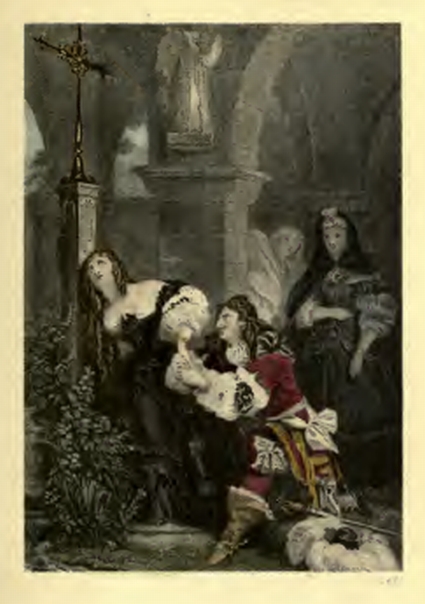
"Mdlle. de la Vallière," he says, in another place, "had thrown herself on a sofa in a light dishabille, her thoughts employed on her lover. Often did the dawn of day find her still seated in a chair, her arm resting on a table, her eye fixed, her soul constantly attached to the same object, in the ecstasy of love. The king alone occupied her mind; perhaps at that moment she was inwardly complaining of the vigilance of the spies of Henriette, or the severity of the queen-mother. A slight noise aroused her from her reverie—she shrunk back with surprise and dread; Louis was at her feet—she would have fled—he stopped her; she threatened—he pacified; she wept—he wiped away her tears." Such a description would not now be tolerated in one of our most insipid novels.
Du Haillan asserts, in one of his small works, that Charles VIII. was not the son of Louis XI. This would account for Louis having neglected his education and always keeping him at a distance. Charles VIII. did not resemble Louis XI. either in body or in mind; but dissimilarity between fathers and their children is still less a proof of illegitimacy than resemblance is a proof of the contrary. That Louis XI. hated Charles VIII. brings us to no conclusion; so bad a son might well be a bad father. Though ten Du Haillans should tell me that Charles VIII. sprung from some other than Louis XI., I should not believe him implicitly. I think a prudent reader should pronounce as the judges do—Pater est is quern nuptiæ demonstrant.
Did Charles V. intrigue with his sister Margaret, who governed the Low Countries? Was it by her that he had Don John of Austria, the intrepid brother of the prudent Philip II.? We have no more proof of this than we have of the secrets of Charlemagne's bed, who is said to have made free with all his daughters. If the Holy Scriptures did not assure me that Lot's daughters had children by their own father, and Tamar by her father-in-law, I should hesitate to accuse them of it; one cannot be too discreet.
It has been written that the Duchess de Montpensier bestowed her favors on the monk Jacques Clement, in order to encourage him to assassinate his sovereign. It would have been more politic to have promised them than to have given them. But a fanatical or parricide priest is not incited in this way; heaven is held out to him, and not a woman. His Prior Bourgoing had much greater power in determining him to any act than the greatest beauty upon earth. When he killed the king he had in his pocket no love-letters, but the stories of Judith and Ehud, quite dog-eared and worn out with thumbing.
Jean Châtel and Ravaillac had no accomplices; their crime was that of the age; their only accomplice was the cry of religion. It has been repeatedly asserted that Ravaillac had taken a journey to Naples and that the Jesuit Alagona had, in Naples, predicted the death of the king. The Jesuits never were prophets; had they been so, they would have foretold their own destination; but, on the contrary, they, poor men, always positively declared that they should endure to the end of time. We should never be too sure of anything.
It is in vain that the Jesuit Daniel tells me, in his very dry and very defective "History of France," that Henry IV. was a Catholic long before his abjuration. I will rather believe Henry IV. himself than the Jesuit Daniel. His letter to La Belle Gabrielle: "C'est demain que je fais le saut périlleux" (To-morrow I take the fatal leap) proves, at least, that something different from Catholicism was still in his heart. Had his great soul been long penetrated by the efficacy of grace, he would perhaps have said to his mistress: "These bishops edify me;" but he says: "Ces gens-là m'ennuient." (These people weary me.) Are these the words of a great catechumen?
This great man's letters to Corisande d'Andouin, Countess of Grammont, are not a matter of doubt; they still exist in the originals. The author of the "Essai sur les Mœurs et l'Esprit des Nations" (Essay on the Manners and Spirit of Nations) gives several of these interesting letters, in which there are the following curious passages: "Tous ces empoisonneurs sont tous Papistes. J'ai découvert un tueur pour moi. Les prêcheurs Romains prêchent tout-haut qu'il n'y a plus qu'une mort à voir; ils admonestent tout bon Catholique de prendre exemple.—Et vous êtes de cette religion! Si je n'étais Huguenot, je me ferais Turc." [These poisoners are all Papists. I have discovered an executioner for myself. The Roman preachers exclaim aloud that there is only one more death to be looked for; they admonish all good Catholics to profit by the example (of the poisoning of the prince of Condé).—And you are of this religion! If I were not a Huguenot, I would turn Turk.] It is difficult, after seeing these testimonials in Henry IV.'s own hand, to become firmly persuaded that he was a Catholic in his heart.
Another modern historian accuses the duke of Lerma of the murder of Henry IV. "This," says he, "is the best established opinion." This opinion is evidently the worst established. It has never been heard of in Spain; and in France, the continuator of de Thou is the only one who has given any credit to these vague and ridiculous suspicions. If the duke of Lerma, prime minister, employed Ravaillac, he paid him very ill; for when the unfortunate man was seized, he was almost without money. If the duke of Lerma either prompted him or caused him to be prompted to the commission of the act, by the promise of a reward proportioned to the attempt, Ravaillac would assuredly have named both him and his emissaries, if only to revenge himself. He named the Jesuit d'Aubigny, to whom he had only shown a knife—why, then, should he spare the duke of Lerma? It is very strange obstinacy not to believe what Ravaillac himself declared when put to the torture. Is a great Spanish family to be insulted without the least shadow of proof?
Et voilà justement comme on écrit l'histoire. (Yet this is how history is written.) The Spanish nation is not accustomed to resort to shameful crimes; and the Spanish grandees have always possessed a generous pride which has prevented them from acting so basely. If Philip II. set a price on the head of the prince of Orange, he had, at least, the pretext of punishing a rebellious subject, as the Parliament of Paris had when they set fifty thousand crowns on the head of Admiral Coligni, and afterwards on that of Cardinal Mazarin. These political proscriptions partook of the horror of the civil wars; but how can it be supposed that the duke of Lerma had secret communications with a poor wretch like Ravaillac?
The same author says that Marshal D'Ancre and his wife were struck, as it were, by a thunderbolt. The truth is, that the one was struck by pistol-balls, and the other burned as a witch. An assassination and a sentence of death passed on the wife of a marshal of France, an attendant on the queen, as a reputed sorceress, do very little honor either to the chivalry or to the jurisprudence of that day. But I know not why the historian makes use of these words; "If these two wretches were not accomplices in the king's death, they at least deserved the most rigorous chastisement; it is certain that, even during the king's life, Concini and his wife had connections with Spain in opposition to the king's designs."
This is not at all certain, nor is it even likely. They were Florentines. The grand duke of Florence was the first to acknowledge Henry IV., and feared nothing so much as the power of Spain in Italy. Concini and his wife had no influence in the time of Henry IV. If they intrigued with the court of Madrid it could only be through the queen, who must, therefore, have betrayed her husband. Besides, let it once more be observed that we are not at liberty to bring forward such accusations without proofs. What! shall a writer pronounce a defamation from his garret, which the most enlightened judges in the kingdom would tremble to hear in a court of justice? Why are a marshal of France and his wife, one of the queen's attendants, to be called two wretches? Does Marshal d'Ancre, who raised an army against the rebels at his own expense, merit an epithet suitable only to Ravaillac or Cartouche—to public robbers, or public calumniators?
It is but too true that one fanatic is sufficient for the commission of a parricide, without any accomplice. Damiens had none; he repeated four times, in the course of his interrogatory, that he committed his crime solely through a principle of religion. Having been in the way of knowing the convulsionaries, I may say that I have seen twenty of them capable of any act equally horrid, so excessive has been their infatuation. Religion, ill-understood, is a fever which the smallest occurrence raises to frenzy. It is the property of fanaticism to heat the imagination. When a few sparks from the lire that keeps their superstitious heads a-boiling, fall on some violent and wicked spirit—when some ignorant and furious man thinks he is imitating Phineas, Ehud, Judith, and other such personages, he has more accomplices than he is aware of. Many incite to murder without knowing it. Some persons drop a few indiscreet and violent words; a servant repeats them, with additions and embellishments; a Châtel, a Ravaillac, or a Damiens listens to them, while they who pronounced them little think what mischief they have done; they are involuntary accomplices, without there having been either plot or instigation. In short, he knows little of the human mind who does not know that fanaticism renders the populace capable of anything.
The author of the "Siècle de Louis XIV" ("Age of Louis the Fourteenth") is the first who has spoken of the Man in the Iron Mask in any authentic history. He was well acquainted with this circumstance, which is the astonishment of the present age, and will be that of posterity, but which is only too true. He had been deceived respecting the time of the death of this unknown and singularly unfortunate person, who was interred at the church of St. Paul March 3, 1703, and not in 1704.
He was first confined at Pignerol, before he was sent to the Isles of Ste. Marguerite, and afterwards to the Bastille, always under the care of the same man, that St. Marc, who saw him die. Father Griffet, a Jesuit, has communicated to the public the journal of the Bastille, which certifies the dates. He had no difficulty in obtaining this journal, since he exercised the delicate office of confessor to the prisoners confined in the Bastille.
The Man in the Iron Mask is an enigma which each one attempts to solve. Some have said that he was the duke of Beaufort, but the duke of Beaufort was killed by the Turks in the defence of Candia, in 1669, and the Man in the Iron Mask was at Pignerol in 1672. Besides, how should the duke of Beaufort have been arrested in the midst of his army? How could he have been transferred to France without some one's knowing something about it? and why should he have been imprisoned? and why masked?
Others have imagined that he was Count Vermandois, natural son to Louis XIV., who, it is well known, died of smallpox when with the army, in 1683, and was buried in the town of Arras.
It has since been supposed that the duke of Monmouth, who was publicly beheaded by order of King James, in 1685, was the Man in the Iron Mask. But either the duke must have come to life again, and afterwards changed the order of time, putting the year 1662 for the year 1685, or King James, who never pardoned any one, and therefore merited all his misfortunes, must have pardoned the duke of Monmouth, and put to death in his stead some one who perfectly resembled him. In the latter case, a person must have been found kind enough to have his head publicly cut off to save the duke of Monmouth. All England must have been deceived in the person; then King James must have begged of Louis XIV. that he would be so good as to become his jailer. Louis XIV., having granted King James this small favor, could not have refused to show the same regard for King William and Queen Anne, with whom he was at war; but would have been careful to maintain the dignity of jailer—with which King James had honored him—to the end of the chapter.
All these illusions being dissipated, it remains to be known who this constantly-masked prisoner was, at what age he died, and under what name he was buried. It is clear that, if he was not permitted to walk in the court of the Bastille, nor to see his physician—except in a mask—it was for fear that some very striking resemblance would be discovered in his features. He was permitted to show his tongue, but never his face. As for his age, he himself told the apothecary of the Bastille, a little before his death, that he believed he was about sixty. The apothecary's son-in-law, Marsolam, surgeon to Marshal de Richelieu, and afterwards to the duke of Orleans the regent, has repeated this to me several times. To conclude: Why was an Italian name given to him? He was always called Marchiali The writer of this article, perhaps, knows more on the subject than Father Griffet, though he will not say more.
It is true that Nicholas Fouquet, superintendent of the finances, had many friends in his disgrace, and that they persevered even until judgment was passed on him. It is true that the chancellor, who presided at that judgment, treated the illustrious captive with too much rigor. But it was not Michel Letellier, as stated in some editions of the "Siècle de Louis XIV.", it was Pierre Seguier. This inadvertency of having placed one for the other is a fault which must be corrected.
It is very remarkable that no one knows where this celebrated minister died. Not that it is of any importance to know it, for his death not having led to any event whatever, is like all other indifferent occurrences; but this serves to prove how completely he was forgotten towards the close of life, how worthless that worldly consideration is which is so anxiously sought for, and how happy they are who have no higher ambition than to live and die unknown. This knowledge is far more useful than that of dates.
Father Griffet does his utmost to persuade us that Cardinal Richelieu wrote a bad book. Well, many statesmen have done the same. But it is very fine to see him strive so hard to prove that, according to Cardinal Richelieu, "our allies, the Spaniards," so happily governed by a Bourbon, "are tributary to hell, and make the Indies tributary to hell!" Cardinal Richelieu's "Political Testament" is not that of a polite man. He alleges:
That France had more good ports on the Mediterranean than the whole Spanish monarchy (this is an exaggeration); that to keep up an army of fifty thousand men it is best to raise a hundred thousand (this throws money away); that when a new tax is imposed the pay of the soldiers is increased (which has never been done either in France or elsewhere); that the parliaments and other superior courts should be made to pay the taille (an infallible means of gaining their hearts and making the magistracy respectable); that the noblesse should be forced to serve and to enroll themselves in the cavalry (the better to preserve their privileges); that Genoa was the richest city in Italy (which I wish it were); that we must be very chaste (the testator might add—like certain preachers—"Do what I say, not what I do"); that an abbey should be given to the holy chapel at Paris (a thing of great importance at the crisis in which your friend stood); that Pope Benedict XI. gave a great deal of trouble to the cordeliers, who were piqued on the subject of poverty (that is to say, the revenues of the order of St Francis); that they were exasperated against him to such a degree that they made war upon him by their writings (more important still and more learned!—especially when John XXII. is taken for Benedict XI. and when in a "Political Testament" nothing is said of the manner in which the war against Spain and the empire was to be conducted, nor of the means of making peace, nor of present dangers, nor of resources, nor of alliances, nor of the generals and ministers who were to be employed, nor even of the dauphin, whose education was of so much importance to the State, nor, in short, of any one object of the ministry).
I consent with all my heart, since it must be so, that Cardinal Richelieu's memory shall be reproached with this unfortunate work, full of anachronisms, ignorance, ridiculous calculations, and acknowledged falsities. Let people strive as hard as they please to persuade themselves that the greatest minister was the most ignorant and tedious, as well as the most extravagant of writers; it may afford some gratification to those who detest his tyranny. It is also a fact worth preserving in the history of the human mind that this despicable work was praised for more than thirty years, while it was believed to be that great minister's, and quite as true that the pretended "Testament" made no noise in the world until thirty years after the Cardinal's death; that it was not printed until forty-two years after that event; that the original, signed by him, has never been seen; that the book is very bad; and that it scarcely deserves to be mentioned.
Did Count de Moret, son of Henry IV., who was wounded in the little skirmish at Castelnaudari, live until the year 1693 under the name of the hermit Jean Baptiste? What proof have we that this hermit was the son of Henry IV.? None.
Did Jeanne d'Albret de Navarre, mother of Henry IV., after the death of Antoine, marry a gentleman named Guyon, who was killed in the massacre of St. Bartholomew? Had she a son by him, who preached at Bordeaux? These facts are detailed at great length in the "Remarks on Bayle's Answers to the Questions of a Provincial," folio, page 689. Was Margaret of Valois, wife to Henry IV., brought to bed of two children secretly after her marriage?
We might fill volumes with inquiries like these. But how much pains should we be taking to discover things of no use to mankind! Let us rather seek cures for the scrofula, the gout, the stone, the gravel, and a thousand other chronic or acute diseases. Let us seek remedies for the distempers of the mind, no less terrible and no less mortal. Let us labor to bring the arts to perfection, and to lessen the miseries of the human race; and let us not waste our time over the anas, the anecdotes, and curious stories of our day, the collections of pretended bons mots, etc.
I read in a book lately published that Louis XIV. exempted all new-married men from the taille for five years. I have not found this fact in any collection of edicts, nor in any memoir of that time. I read in the same book that the king of Prussia has fifty livres given to every girl with child. There is, in truth, no better way of laying out money, nor of encouraging propagation, but I do not believe that this royal munificence is true; at least I have never witnessed it.
An anecdote of greater antiquity has just fallen under my eye, and appears to me to be a very strange one. It is said in a chronological history of Italy that the great Arian, Theodoric—he who is represented to have been so wise—had amongst his ministers a Catholic, for whom he had a great liking, and who proved worthy of all his confidence. This minister thought he should rise still higher in his master's favor by embracing Arianism; but Theodoric had him immediately beheaded, saying: "If a man is not faithful to God, how can he be faithful to me, who am but a man?" The compiler remarks that "this trait does great honor to Theodoric's manner of thinking with respect to religion."