VOLUME V (continued 2)
William F. Fleming translation
It is, however, very strange that the Jewish people were permitted to read the books of Exodus, where there are so many miracles that shock reason, yet were not permitted to read before the age of twenty-five the first chapter of Genesis, in which all is necessarily a miracle, since the creation is the subject Perhaps it was because God, after creating the man and woman in the first chapter, makes them again in another, and it was thought expedient to keep this appearance of contradiction from the eyes of youth. Perhaps it is because it is said that God made man in his own image, and this expression gave the Jews too corporeal an idea of God. Perhaps it was because it is said that God took a rib from Adam's side to form the woman, and the young and inconsiderate, feeling their sides, and finding the right number of ribs, might have suspected the author of some infidelity. Perhaps it was because God, who always took a walk at noon in the garden of Eden, laughed at Adam after his fall, and this tone of ridicule might tend to give youth too great a taste for pleasantry. In short, every line of this chapter furnishes very plausible reasons for interdicting the reading of it; but such being the case, one cannot clearly see how it was that the other chapters were permitted. It is, besides, surprising that the Jews were not to read this chapter until they were twenty-five. One would think that it should first have been proposed to childhood, which receives everything without examination, rather than to youth, whose pride is to judge and to laugh. On the other hand, the Jews of twenty-five years of age, having their judgments prepared and strengthened, might be more fitted to receive this chapter than inexperienced minds. We shall say nothing here of Adam's second wife, named Lillah, whom the ancient rabbis have given him. It must be confessed that we know very few anecdotes of our family.
ADORATION.
Is it not a great fault in some modern languages that the same word that is used in addressing the Supreme Being is also used in addressing a mistress? We not infrequently go from hearing a sermon, in which the preacher has talked of nothing but adoring God in spirit and in truth, to the opera, where nothing is to be heard but the charming object of my adoration, etc.
The Greeks and Romans, at least, did not fall into this extravagant profanation. Horace does not say that he adores Lalage; Tibullus does not adore Delia; nor is even the term adorationto be found in Petronius. If anything can excuse this indecency, it is the frequent mention which is made in our operas and songs of the gods of ancient fable. Poets have said that their mistresses were more adorable than these false divinities; for which no one could blame them. We have insensibly become familiarized with this mode of expression, until at last, without any perception of the folly, the God of the universe is addressed in the same terms as an opera singer.
But to return to the important part of our subject: There is no civilized nation which does not render public adoration to God. It is true that neither in Asia nor in Africa is any person forced to the mosque or temple of the place; each one goes of his own accord. This custom of assembling should tend to unite the minds of men and render them more gentle in society; yet have they been seen raging against each other, even in the consecrated abode of peace. The temple of Jerusalem was deluged with blood by zealots who murdered their brethren, and our churches have more than once been defiled by carnage.
In the article on "China" it will be seen that the emperor is the chief pontiff, and that the worship is august and simple. There are other countries in which it is simple without any magnificence, as among the reformers of Europe and in British America. In others wax tapers must be lighted at noon, although in the primitive ages they were held in abomination. A convent of nuns, if deprived of their tapers, would cry out that the light of the faith was extinguished and the world would shortly be at an end. The Church of England holds a middle course between the pompous ceremonies of the Church of Rome and the plainness of the Calvinists.
Throughout the East, songs, dances and torches formed part of the ceremonies essential in all sacred feasts. No sacerdotal institution existed among the Greeks without songs and dances. The Hebrews borrowed this custom from their neighbors; for David sang and danced before the ark.
St. Matthew speaks of a canticle sung by Jesus Christ Himself and by His apostles after their Passover. This canticle, which is not admitted into the authorized books, is to be found in fragments in the 237th letter of St. Augustine to Bishop Chretius; and, whatever disputes there may have been about its authenticity, it is certain that singing was employed in all religious ceremonies. Mahomet found this a settled mode of worship among the Arabs; it is also established in India, but does not appear to be in use among the lettered men of China. The ceremonies of all places have some resemblance and some difference; but God is worshipped throughout the earth. Woe, assuredly, unto those who do not adore Him as we do! whether erring in their tenets or in their rites. They sit in the shadow of death; but the greater their misfortune the more are they to be pitied and supported.
It is indeed a great consolation for us that the Mahometans, the Indians, the Chinese, the Tartars, all adore one only God; for so far they are our kindred. Their fatal ignorance of our sacred mysteries can only inspire us with tender compassion for our wandering brethren. Far from us be all spirit of persecution which would only serve to render them irreconcilable.
One only God being adored throughout the known world, shall those who acknowledge Him as their Father never cease to present to Him the revolting spectacle of His children detesting, anathematizing, persecuting and massacring one another by way of argument?
It is hard to determine precisely what the Greeks and Romans understood by adoring, or whether they adored fauns, sylvans, dryads and naiads as they adored the twelve superior gods. It is not likely that Adrian's minion, Antinous, was adored by the Egyptians of later times with the same worship which they paid to Serapis; and it is sufficiently proved that the ancient Egyptians did not adore onions and crocodiles as they did Isis and Osiris. Ambiguity abounds everywhere and confounds everything; we are obliged at every word to exclaim, What do you mean? we must constantly repeat—Define your terms.
Is it quite true that Simon, called the Magician, was adored among the Romans? It is not more true that he was utterly unknown to them. St. Justin in his "Apology," which was as little known at Rome as Simon, tells us that this God had a statue erected on the Tiber, or rather near the Tiber, between the two bridges, with this inscription: Simoni deo sancto. St. Irenæus and Tertullian attest the same thing; but to whom do they attest it? To people who had never seen Rome—to Africans, to Allobroges, to Syrians, and to some of the inhabitants of Sichem. They had certainly not seen this statue, the real inscription on which was Semo sanco deo fidio, and not Simoni deo sancto. They should at least have consulted Dionysius of Halicarnassus, who gives this inscription in his fourth book. Semo sanco was an old Sabine word, signifying half god and half man; we find in Livy, Bona Semoni sanco censuerunt consecranda. This god was one of the most ancient in Roman worship, having been consecrated by Tarquin the Proud, and was considered as the god of alliances and good faith. It was the custom to sacrifice an ox to him, and to write any treaty made with a neighboring people upon the skin. He had a temple near that of Quirinus; offerings were sometimes presented to him under the name of Semo the father, and sometimes under that of Sancus fidius, whence Ovid says in his "Fasti":
Quærebam nonas Sanco, Fidove referrem, An tibi, Semo pater.
Such was the Roman divinity which for so many ages was taken for Simon the Magician. St. Cyril of Jerusalem had no doubts on the subject, and St. Augustine in his first book of "Heresies" tells us that Simon the Magician himself procured the erection of this statue, together with that of his Helena, by order of the emperor and senate.
This strange fable, the falsehood of which might so easily have been discovered, was constantly connected with another fable, which relates that Simon and St. Peter both appeared before Nero and challenged each other which of them should soonest bring to life the corpse of a near relative of Nero's, and also raise himself highest in the air; that Simon caused himself to be carried up by devils in a fiery chariot; that St. Peter and St. Paul brought him down by their prayers; that he broke his legs and in consequence died, and that Nero, being enraged, put both St. Peter and St. Paul to death.
Abdias, Marcellinus and Hegisippus have each related this story, with a little difference in the details. Arnobius, St. Cyril of Jerusalem, Sulpicius Severus, Philaster, St. Epiphanius, Isidorus of Damietta, Maximus of Turin, and several other authors successively gave currency to this error, and it was generally adopted, until at length there was found at Rome a statue of Semo sancus deus fidius, and the learned Father Mabillon dug up an ancient monument with the inscription Semoni sanco deo fidio.
It is nevertheless certain that there was a Simon, whom the Jews believed to be a magician, as it is certain that there was an Apollonius of Tyana. It is also true that this Simon, who was born in the little country of Samaria, gathered together some vagabonds, whom he persuaded that he was one sent by God; he baptized, indeed, as well as the apostles, and raised altar against altar.
The Jews of Samaria, always hostile to those of Jerusalem, ventured to oppose this Simon to Jesus Christ, acknowledged by the apostles and disciples, all of whom were of the tribe of Benjamin or that of Judah. He baptized like them, but to the baptism of water he added fire, saying that he had been foretold by John the Baptist in these words: "He that cometh after me is mightier than I; he shall baptize you with the Holy Ghost and with fire."
Simon lighted a lambent flame over the baptismal font with naphtha from the Asphaltic Lake. His party was very strong, but it is very doubtful whether his disciples adored him; St. Justin is the only one who believes it.
Menander, like Simon, said he was sent by God to be the savior of men. All the false Messiahs, Barcochebas especially, called themselves sent by God; but not even Barcochebas demanded to be adored. Men are not often erected into divinities while they live, unless, indeed, they be Alexanders or Roman emperors, who expressly order their slaves so to do. But this is not, strictly speaking, adoration; it is an extraordinary homage, an anticipated apotheosis, a flattery as ridiculous as those which are lavished on Octavius by Virgil and Horace.
ADULTERY.
We are not indebted for this expression to the Greeks; they called adultery moicheia, from which came the Latin mœchus, which we have not adopted. We owe it neither to the Syriac tongue nor to the Hebrew, a jargon of the Syriac, in which adultery is called niuph. In Latin adulteratio signified alteration—adulteration, one thing put for another—a counterfeit, as false keys, false bargains, false signatures; thus he who took possession of another's bed was called adulter.
In a similar way, by antiphrasis, the name of coccyx, a cuckoo, was given to the poor husband into whose nest a stranger intruded. Pliny, the naturalist, says: "Coccyx ova subdit in nidis alienis; ita plerique alienas uxores faciunt matres"—"the cuckoo deposits its eggs in the nest of other birds; so the Romans not unfrequently made mothers of the wives of their friends." The comparison is not over just. Coccyx signifying a cuckoo, we have made it cuckold. What a number of things do we owe to the Romans! But as the sense of all words is subject to change, the term applied to cuckold, which, according to good grammar, should be the gallant, is appropriated to the husband. Some of the learned assert that it is to the Greeks we owe the emblem of the horns, and that they bestowed the appellation of goat upon a husband the disposition of whose wife resembled that of a female of the same species. Indeed, they used the epithet son of a goat in the same way as the modern vulgar do an appellation which is much more literal.
These vile terms are no longer made use of in good company. Even the word adultery is never pronounced. We do not now say, "Madame la Duchesse lives in adultery with Monsieur le Chevalier—Madame la Marquise has a criminal intimacy with Monsieur l'Abbé;" but we say, "Monsieur l'Abbé is this week the lover of Madame la Marquise." When ladies talk of their adulteries to their female friends, they say, "I confess I have some inclination for him." They used formerly to confess that they felt some esteem, but since the time when a certain citizen's wife accused herself to her confessor of having esteem for a counsellor, and the confessor inquired as to the number of proofs of esteem afforded, ladies of quality have esteemed no one and gone but little to confession.
The women of Lacedæmon, we are told, knew neither confession nor adultery. It is true that Menelaus had experienced the intractability of Helen, but Lycurgus set all right by making the women common, when the husbands were willing to lend them and the wives consented. Every one might dispose of his own. In this case a husband had not to apprehend that he should foster in his house the offspring of a stranger; all children belonged to the republic, and not to any particular family, so that no one was injured. Adultery is an evil only inasmuch as it is a theft; but we do not steal that which is given to us. The Lacedæmonians, therefore, had good reason for saying that adultery was impossible among them. It is otherwise in our modern nations, where every law is founded on the principle of meum and tuum.
It is the greatest wrong, the greatest injury, to give a poor fellow children which do not belong to him and lay upon him a burden which he ought not to bear. Races of heroes have thus been utterly bastardized. The wives of the Astolphos and the Jocondas, through a depraved appetite, a momentary weakness, have become pregnant by some deformed dwarf—some little page, devoid alike of heart and mind, and both the bodies and souls of the offspring have borne testimony to the fact. In some countries of Europe the heirs to the greatest names are little insignificant apes, who have in their halls the portraits of their pretended fathers, six feet high, handsome, well-made, and carrying a broadsword which their successors of the present day would scarcely be able to lift. Important offices are thus held by men who have no right to them, and whose hearts, heads, and arms are unequal to the burden.
In some provinces of Europe the girls make love, without their afterwards becoming less prudent wives. In France it is quite the contrary; the girls are shut up in convents, where, hitherto, they have received a most ridiculous education. Their mothers, in order to console them, teach them to look for liberty in marriage. Scarcely have they lived a year with their husbands when they become impatient to ascertain the force of their attractions. A young wife neither sits, nor eats, nor walks, nor goes to the play, but in company with women who have each their regular intrigue. If she has not her lover like the rest, she is to be unpaired; and ashamed of being so, she is afraid to show herself.
The Orientals proceed quite in another way. Girls are brought to them and warranted virgins on the words of a Circassian. They marry them and shut them up as a measure of precaution, as we shut up our maids. No jokes there upon ladies and their husbands! no songs!—nothing resembling our quodlibets about horns and cuckoldom! We pity the great ladies of Turkey, Persia and India; but they are a thousand times happier in their seraglios than our young women in their convents.
It sometimes happens among us that a dissatisfied husband, not choosing to institute a criminal process against his wife for adultery, which would subject him to the imputation of barbarity, contents himself with obtaining a separation of person and property. And here we must insert an abstract of a memorial, drawn up by a good man who finds himself in this situation. These are his complaints; are they just or not?—
A memorial, written by a magistrate, about the year 1764.
A principal magistrate of a town in France is so unfortunate as to have a wife who was debauched by a priest before her marriage, and has since brought herself to public shame; he has, however, contented himself with a private separation. This man, who is forty years old, healthy, and of a pleasing figure, has need of woman's society. He is too scrupulous to seek to seduce the wife of another; he even fears to contract an illicit intimacy with a maid or a widow. In this state of sorrow and perplexity he addresses the following complaints to the Church, of which he is a member:
"My wife is criminal, and I suffer the punishment. A woman is necessary to the comfort of my life—nay, even to the preservation of my virtue; yet she is refused me by the Church, which forbids me to marry an honest woman. The civil law of the present day, which is, unhappily, founded on the canon law, deprives me of the rights of humanity. The Church compels me to seek either pleasures which it reprobates, or shameful consolations which it condemns; it forces me to be criminal.
"If I look round among the nations of the earth, I see no religion except the Roman Catholic which does not recognize divorce and second marriage as a natural right. What inversion of order, then, has made it a virtue in Catholics to suffer adultery and a duty to live without wives when their wives have thus shamefully injured them? Why is a cankered tie indissoluble, notwithstanding the great maxim adopted by the code, Quicquid ligatur dissolubile est? A separation of person and property is granted me, but not a divorce. The law takes from me my wife, and leaves me the word sacrament! I no longer enjoy matrimony, but still I am married! What contradiction! What slavery!
"Nor is it less strange that this law of the Church is directly contrary to the words which it believes to have been pronounced by Jesus Christ: Whosoever shall put away his wife, except it be for fornication, and shall marry another, committeth adultery."
"I have no wish here to inquire whether the pontiffs of Rome have a right to violate at pleasure the law of Him whom they regard as their Master; whether when a kingdom wants an heir, it is allowable to repudiate the woman who is incapable of giving one; nor whether a turbulent wife, one attacked by lunacy, or one guilty of murder, should not be divorced as well as an adulteress; I confine myself to what concerns my own sad situation. God permits me to marry again, but the bishop of Rome forbids me.
"Divorce was customary among Catholics under all the emperors, as well as in all the disjointed members of the Roman Empire. Almost all those kings of France who are called of the first race, repudiated their wives and took fresh ones. At length came one Gregory IX., an enemy to emperors and kings, who, by a decree, made the bonds of marriage indissoluble; and his decretal became the law of Europe. Hence, when a king wished to repudiate an adulterous wife, according to the law of Jesus Christ, he could not do so without seeking some ridiculous pretext. St. Louis was obliged, in order to effect his unfortunate divorce from Eleanora of Guienne, to allege a relationship which did not exist; and Henry IV., to repudiate Margaret of Valois, brought forward a still more unfounded pretence—a want of consent. Thus a lawful divorce was to be obtained by falsehood.
"What! may a sovereign abdicate his crown, and shall he not without the pope's permission abdicate his faithless wife? And is it possible that men, enlightened in other things, have so long submitted to this absurd and abject slavery?
"Let our priests and our monks abstain from women, if it must be so; they have my consent. It is detrimental to the progress of population and a misfortune for them; but they deserve that misfortune which they have contrived for themselves. They are the victims of the popes, who in them wish to possess slaves—soldiers without family or country, living for the Church; but I, a magistrate, who serve the state the whole day long, have occasion for a woman at night; and the Church has no right to deprive me of a possession allowed me by the Deity. The apostles were married, Joseph was married, and I wish to be married. If I, an Alsatian, am dependent on a priest who lives at Rome and has the barbarous power to deprive me of a wife, he may as well make me a eunuch to sing Miserere in his chapel."
A Plea for Wives.
Equity requires that, after giving this memorial in favor of husbands, we should also lay before the public the plea on behalf of wives, presented to the junta of Portugal, by one Countess D'Arcira. It is in substance as follows:
"The gospel has forbidden adultery to my husband as well as to me; we shall be damned alike; nothing is more certain. Although he has been guilty of fifty infidelities—though he has given my necklace to one of my rivals, and my earrings to another, I have not called upon the judges to order his head to be shaved, himself to be shut up with monks, and his property to be given to me; yet I, for having but once imitated him—for having done that with the handsomest young man in Lisbon, which he is allowed to do every day with the homeliest and most stupid creatures of the court and the city, must be placed on a stool to answer the questions of a set of licentiates, every one of whom would be at my feet were he alone with me in my closet; must have the finest hair in the world cut from my head; be confined with nuns who have not common sense; be deprived of my portion and marriage settlement, and see my property given to my fool of a husband to assist him in seducing other women and committing fresh adulteries. I ask if the thing is just? if it is not evident that the cuckolds are the lawmakers?
"The answer to my complaint is that I am but too fortunate in not being stoned at the city gate by the canons and the people, as was the custom with the first nation of the earth—the cherished nation—the chosen people—the only one which was right when all others were wrong.
"To these barbarians I reply that when the poor woman, taken in adultery, was presented to her accusers by the Master of the Old and of the New Law, he did not order her to be stoned; on the contrary, he reproached their injustice, tracing on the sand with his finger the old Hebrew proverb: 'Let him who is without sin cast the first stone.' All then retired, the oldest being the first to depart, since the greater their age the more adulteries they had committed.
"The doctors of the canon law tell me that this story of the woman taken in adultery is related only in the Gospel of St. John, and that there it is nothing more than an interpolation; that Leontius and Maldonat affirm that it is to be found in but one ancient Greek copy; that not one of the first twenty-three commentators has spoken of it; that neither Origen nor St. Jerome, nor St. John Chrysostom, nor Theophylact, nor Nonnus, knew anything of it; and that it is not in the Syriac Bible, nor in the version of Ulphilas.
"Such are the arguments advanced by my husband's advocates, who would not only shave my head, but stone me also. However, those who plead for me say that Ammonius, a writer of the third century, acknowledges the truth of this story, and that St. Jerome, while he rejects it in some passages, adopts it in others; in short, that it is now authenticated. Here I hold, and say to my husband: If you are without sin shave my head, confine me, take my property; but if you have committed more sins than I have, it is I who must shave you, have you confined and seize your possessions. In both cases the justice is the same.'
"My husband replies that he is my superior and my head; that he is taller than I by more than an inch; that he is as rough as a bear; and that, consequently, I owe him everything and he owes me nothing. But I ask if Queen Anne, of England, is not the head of her husband? if the Prince of Denmark, who is her high admiral, does not owe her an entire obedience? and if she would not have him condemned by the House of Peers should the little man prove unfaithful? It is clear that, if women have not their husbands punished, it is when they are not the strongest."
Conclusion of the Chapter on Adultery.
In order to obtain an equitable verdict in an action for adultery, the jury should be composed of twelve men and twelve women, with an hermaphrodite to give the casting vote in the event of necessity. But singular cases may exist wherein raillery is inapplicable, and of which it is not for us to judge. Such is the adventure related by St. Augustine in his sermon on Christ's preaching on the Mount.
Septimius Acyndicus, proconsul of Syria, caused a Christian of Antioch who was unable to pay the treasury a pound of gold (the amount to which he was taxed), to be thrown into prison and threatened with death. A wealthy man promised the unfortunate prisoner's wife to furnish her with the pound if she would consent to his desires. The wife hastened to inform her husband, who begged that she would save his life at the expense of his rights, which he was willing to give up. She obeyed, but the man who owed her the gold deceived her by giving her a sackful of earth. The husband, being still unable to pay the tax, was about to be led to the scaffold, but this infamous transaction having come to the ears of the proconsul he paid the pound of gold from his own coffers and gave to the Christian couple the estate from which the sackful of earth had been taken.
It is certain that far from injuring her husband the wife, in this instance, acted conformably to his will, not only obeying him, but also saving his life. St. Augustine does not venture to decide on the guilt or virtue of this action; he is afraid to condemn it.
It is, in my opinion, very singular that Bayle should pretend to be more severe than St. Augustine. He boldly condemns the poor woman. This would be inconceivable did we not know how much almost every writer has suffered his pen to belie his heart—with what facility his own feelings have been sacrificed to the fear of enraging some evil-disposed pedant—in a word, how inconsistent he has been with himself.
A Father's Reflection.
A word on the contradictory education which we bestow upon our daughters. We inculcate an immoderate desire of pleasing; we dictate when nature does enough without us, and add to her lessons every refinement of art. When they are perfectly trained we punish them if they put in practice the very arts which we have been so anxious to teach! What should we think of a dancing master who, having taught a pupil for ten years, would break his leg because he had found him dancing with other people?
Might not this paragraph be added to the chapter of contradictions?
AFFIRMATION OR OATH.
We shall not say anything of the affirmations so frequently made use of by the learned. To affirm, to decide, is permissible only in geometry. In everything else let us imitate the Doctor Metaphrastes of Molière—it may be so; the thing is feasible; it is not impossible; we shall see. Let us adopt Rabelais' perhaps, Montaigne's what know I? the Roman non liquet, or the doubt of the Athenian academy: but only in profane matters, be it understood, for in sacred things, we are well aware that doubting is not permitted.
The primitives, in England called Quakers, are allowed to give testimony in a court of justice on their simple affirmation, without taking an oath. The peers of the realm have the same privilege—the lay peers affirming on their honor, and the bishops laying their hands on their hearts. The Quakers obtained it in the reign of Charles II., and are the only sect in Europe so honored.
The Lord Chancellor Cowper wished to compel the Quakers to swear like other citizens. He who was then at their head said to him gravely: "Friend Chancellor, thou oughtest to know that our Lord and Saviour Jesus Christ hath forbidden us to affirm otherwise than by yea or nay, he hath expressly said: I forbid thee to swear by heaven, because it is the throne of God; by the earth, because it is his footstool; by Jerusalem, because it is the city of the King of kings; or by thy head, because thou canst not change the color of a single hair. This, friend, is positive, and we will not disobey God to please thee and thy parliament." "It is impossible to argue better," replied the Chancellor; "but be it known to thee that Jupiter one day ordered all beasts of burden to get shod: horses, mules, and even camels, instantly obeyed, the asses alone resisted; they made so many representations, and brayed so long that Jupiter, who was good-natured, at last said to them, 'Asses, I grant your prayer; you shall not be shod; but the first slip you make you shall have a most sound cudgelling.'"
It must be granted that, hitherto, the Quakers have made no slips.
AGAR, OR HAGAR.
When a man puts away his mistress—his friend—the partner of his bed, he must either make her condition tolerably comfortable or be regarded among us as a man of bad heart.
We are told that Abraham was very rich in the desert of Gerar, although he did not possess an inch of land. However, we know with the greatest certainty that he defeated the armies of four great kings with three hundred and eighteen shepherds.
He should, then, at least have given a small flock to his mistress Agar, when he sent her away in the desert. I speak always according to worldly notions, always reverencing those incomprehensible ways which are not our ways.
I would have given my old companion Agar a few sheep, a few goats, a few suits of clothes for herself and our son Ishmael, a good she-ass for the mother and a pretty foal for the child, a camel to carry their baggage, and at least two men to attend them and prevent them from being devoured by wolves.
But when the Father of the Faithful exposed his poor mistress and her child in the desert he gave them only a loaf and a pitcher of water. Some impious persons have asserted that Abraham was not a very tender father—that he wished to make his bastard son die of hunger, and to cut his legitimate son's throat! But again let it be remembered that these ways were not our ways.
It is said that poor Agar went away into the desert of Beer-sheba. There was no desert of Beer-sheba; this name was not known until long after; but this is a mere trifle; the foundation of the story is not the less authentic. It is true that the posterity of Agar's son Ishmael took ample revenge on the posterity of Sarah's son Isaac, in favor of whom he had been cast out. The Saracens, descending in a right line from Ishmael, made themselves masters of Jerusalem, which belonged by right of conquest to the posterity of Isaac. I would have made the Saracens descend from Sarah; the etymology would then have been neater.
It has been asserted that the word Saracen comes from sarac, a robber. I do not believe any people have ever called themselves robbers; nearly all have been robbers, but it is not usual for them to take the title. Saracen descending from Sarah, appears to me to sound better.
ALCHEMY.
The emphatic al places the alchemist as much above the ordinary chemist as the gold which he obtains is superior to other metals. Germany still swarms with people who seek the philosopher's stone, as the water of immortality has been sought in China, and the fountain of youth in Europe. In France some have been known to ruin themselves in this pursuit.
The number of those who have believed in transmutations is prodigious, and the number of cheats has been in proportion to that of the credulous. At Paris we have seen Signor Dammi, Marquis of Conventiglio, obtain some hundred louis from several of the nobility that he might make them gold to the amount of two or three crowns. The best trick that has ever been performed in alchemy was that of a Rosicrucian, who, in 1620, went to Henry, Duke of Bouillon, of the house of Turenne, Sovereign Prince of Sedan, and addressed him as follows:
"You have not a sovereignty proportioned to your great courage, but I will make you richer than the emperor. I cannot remain for more than two days in your states, having to go to Venice to hold the grand assembly of the brethren; I only charge you to keep the secret. Send to the first apothecary of your town for some litharge; throw into it one grain of the red powder which I will give you, put the whole into a crucible and in a quarter of an hour you will have gold."
The prince performed the operation, and repeated it three times, in presence of the virtuoso. This man had previously bought up all the litharge from the apothecaries of Sedan and got it resold after mixing it with a few ounces of gold. The adept, on taking leave, made the Duke of Bouillon a present of all his transmuting powder.
The prince, having made three ounces of gold with three grains, doubted not that with three hundred thousand grains he should make three hundred thousand ounces, and that he should in a week possess eighteen thousand, seven hundred and fifty pounds of gold, besides what he should afterwards make. It took at least three months to make this powder. The philosopher was in haste to depart; he was without anything, having given all to the prince, and wanted some ready money in order to hold the states-general of hermetic philosophy. He was a man very moderate in his desires, and asked only twenty thousand crowns for the expenses of his journey. The duke, ashamed to give so small a sum, presented him with forty thousand. When he had consumed all the litharge in Sedan he made no more gold, nor ever more saw his philosopher or his forty thousand crowns.
All pretended alchemic transmutations have been performed nearly in the same manner. To change one natural production into another, for example, iron into silver, is a rather difficult operation, since it requires two things a little above our power—the annihilation of the iron and creation of the silver.
We must not, however, reject all discoveries of secrets and all new inventions. It is with them as with theatrical pieces, there may be one good out of a thousand.
ALKORAN;
OR, MORE PROPERLY, THE KORAN.
SECTION I.
This book governs with despotic sway the whole of northern Africa, from Mount Atlas to the desert of Barca, the whole of Egypt, the coasts of the Ethiopian Sea to the extent of six hundred leagues, Syria, Asia Minor, all the countries round the Black and the Caspian seas (excepting the kingdom of Astrakhan), the whole empire of Hindostan, all Persia, a great part of Tartary; and in Europe, Thrace, Macedonia, Bulgaria, Servia, Bosnia, Greece, Epirus, and nearly all the islands as far as the little strait of Otranto, which terminates these possessions.
In this prodigious extent of country there is not a single Mahometan who has the happiness of reading our sacred books; and very few of our literati are acquainted with the Koran, of which we always form a ridiculous idea, notwithstanding the researches of our really learned men.
The first lines of this book are as follows: "Praise to God, the sovereign of all worlds, to the God of mercy, the sovereign of the day of justice? Thee we adore! to Thee only do we look for protection. Lead us in the right way—in the way of those whom Thou hast loaded with Thy graces, and not in the way of the objects of Thy wrath—of them who have gone astray."
Such is the introduction. Then come three letters, A, L, M, which, according to the learned Sale, are not understood, for each commentator explains them in his own way; but the most common opinion is that they signify Ali, Latif, Magid—God, Grace, Glory.
God himself then speaks to Mahomet in these words: "This book admitteth not of doubt. It is for the direction of the just, who believe in the depths of the faith, who observe the times of prayer, who distribute in alms what it has pleased Me to give them, who believe in the revelation which hath descended to thee, and was delivered to the prophets before thee. Let the faithful have a firm assurance in the life to come; let them be directed by their Lord; and they shall be happy.
Mahomet.
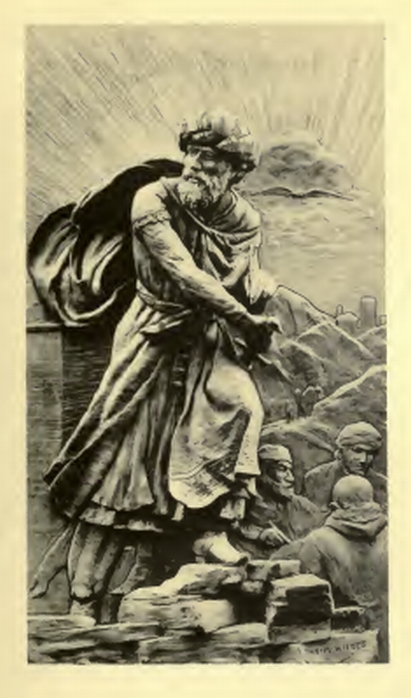
"As for unbelievers, it mattereth not whether thou callest them or no: they do not believe; the seal of unbelief is on their hearts and on their ears; a terrible punishment awaiteth them. There are some who say, 'We believe in God and in the Last Day,' but in their hearts they are unbelievers. They think to deceive the Eternal; they deceive themselves without knowing it. Infirmity is in their hearts, and God himself increaseth this infirmity," etc.
These words are said to have incomparably more energy in Arabic. Indeed, the Koran still passes for the most elegant and most sublime book that has been written in that language. We have imputed to the Koran a great number of foolish things which it never contained. It was chiefly against the Turks, who had become Mahometans, that our monks wrote so many books, at a time when no other opposition was of much service against the conquerors of Constantinople. Our authors, much more numerous than the janissaries, had no great difficulty in ranging our women on their side; they persuaded them that Mahomet looked upon them merely as intelligent animals; that, by the laws of the Koran, they were all slaves, having no property in this world, nor any share in the paradise of the next. The falsehood of all this is evident; yet it has all been firmly believed.
It was, however, only necessary in order to discover the deception to have read the fourth sura or chapter of the Koran, in which would have been found the following laws, translated in the same manner by Du Ryer, who resided for a long time at Constantinople; by Maracci, who never went there; and by Sale, who lived twenty-five years among the Arabs:
Mahomet's Regulations with Respect to Wives.
1.
Never marry idolatrous women, unless they will become believers. A Mussulman servant is better than an idolatrous woman, though of the highest rank.
2.
They who, having wives, wish to make a vow of chastity, shall wait four months before they decide.
Wives shall conduct themselves towards their husbands as their husbands conduct themselves towards them.
3.
You may separate yourself from your wife twice; but if you divorce her a third time, it must be forever; you must either keep her humanely or put her away kindly. You are not permitted to keep anything from her that you have given to her.
4.
Good wives are obedient and attentive, even in the absence of their husbands. If your wife is prudent be careful not to have any quarrel with her; but if one should happen, let an arbiter be chosen from your own family, and one from hers.
5.
Take one wife, or two, or three, or four, but never more. But if you doubt your ability to act equitably towards several, take only one. Give them a suitable dowry, take care of them, and speak to them always like a friend.
6.
You are not permitted to inherit from your wife against her will; nor to prevent her from marrying another after her divorce, in order to possess yourself of her dower, unless she has been declared guilty of some crime.
When you choose to separate yourself from your wife and take another, you must not, though you have even given her a talent at your marriage, take anything from her.
7.
You are permitted to marry a slave, but it is better that you should not do so.
8.
A repudiated wife is obliged to suckle her child until it is two years old, during which time the father is obliged to maintain them according to his condition. If the infant is weaned at an earlier period, it must be with the consent of both father and mother. If you are obliged to entrust it to a strange nurse, you shall make her a reasonable allowance.
Here, then, is sufficient to reconcile the women to Mahomet, who has not used them so hardly as he is said to have done. We do not pretend to justify either his ignorance or his imposture; but we cannot condemn his doctrine of one only God. These words of his 122d sura, "God is one, eternal, neither begetting nor begotten; no one is like to Him;" these words had more effect than even his sword in subjugating the East.
Still his Koran is a collection of ridiculous revelations and vague and incoherent predictions, combined with laws that were very good for the country in which he lived, and all which continue to be followed, without having been changed or weakened, either by Mahometan interpreters or by new decrees. The poets of Mecca were hostile to Mahomet, but above all the doctors. These raised the magistracy against him, and a warrant was issued for his apprehension as only duly accused and convicted of having said that God must be adored, and not the stars. This, it is known, was the source of his greatness. When it was seen that he could not be put down, and that his writings were becoming popular, it was given out in the city that he was not the author of them, or that at least he was assisted in their composition by a learned Jew, and sometimes by a learned Christian—supposing that there were at that time learned Jews and learned Christians.
So, in our days, more than one prelate has been reproached with having set monks to compose his sermons and funeral orations. There was one Father Hercules (Père Hercule) who made sermons for a certain bishop, and when people went to hear him preach, they used to say, "Let us go and hear the labors of Hercules."
To this charge Mahomet gives an answer in his 16th chapter, occasioned by a gross blunder he had made in the pulpit, about which a great deal had been said. He gets out of the scrape thus: "When thou readest the Koran, address thyself to God, that He may preserve thee from the machinations of Satan. He has power only over those who have chosen Him for their Master, and who give associates unto God.
"When I substitute one verse for another in the Koran (the reason for which changes is known to God) some unbelievers cry out, 'Thou hast forged those verses'; but they know not how to distinguish truth from falsehood. Say rather that the Holy Spirit brought those verses of truth to me from God. Others say, still more malignantly, There is a certain man who labors with him in composing the Koran. But how can this man, to whom they attribute my works, have taught me, speaking as he does, a foreign language, while the Koran is written in the purest Arabic?"
He who, it was pretended, assisted Mahomet, was a Jew named Bensalen or Bensalon. It is not very likely that a Jew should have lent his assistance to Mahomet in writing against the Jews; yet the thing is not impossible. The monk who was said to have contributed to the Koran was by some called Bohaira, by others Sergius. There is something pleasant in this monk's having had both a Latin and an Arabic name. As for the fine theological disputes which have arisen among the Mussulmans, I have no concern with them; I leave them to the decision of the mufti.
In "The Triumph of the Cross" ("le Triomphe de la Croix") the Koran is said to be Arian, Sabellian, Carpocratian, Cardonician, Manichæan, Donatistic, Origenian, Macedonian, and Ebionitish. Mahomet, however, was nothing of all this; he was rather a Jansenist, for the foundation of his doctrine is the absolute degree of gratuitous predestination.
SECTION II.
This Mahomet, son of Abdallah, was a bold and sublime charlatan. He says in his tenth chapter, "Who but God can have composed the Koran? Mahomet, you say, has forged this book. Well; try then to write one chapter resembling it and call to your aid whomsoever you please." In the seventeenth he exclaims, "Praise be to Him who in one night transported His servant from the sacred temple of Mecca to that of Jerusalem!"
This was a very fine journey, but nothing like that which he took the very same night from planet to planet. He pretended that it was five hundred years' journey from one to another, and that he cleft the moon in twain. His disciples who, after his death, collected, in a solemn manner, the verses of this Koran, suppressed this celestial journey, for they dreaded raillery and philosophy. After all, they had too much delicacy; they might have trusted to the commentators, who would have found no difficulty whatever in explaining the itinerary. Mahomet's friends should have known by experience that the marvellous is the reason of the multitude; the wise contradict in silence, which the multitude prevent them from breaking. But while the itinerary of the planets was suppressed, a few words were retained about the adventure of the moon. One cannot be always on one's guard.
The Koran is a rhapsody, without connection, without order, and without art. This tedious book is, nevertheless, said to be a very fine production, at least by the Arabs, who assert that it is written with an elegance and purity that no later work has equalled. It is a poem, or sort of rhymed prose, consisting of three thousand verses. No poem ever advanced the fortune of its author so much as the Koran. It was disputed among the Mussulmans whether it was eternal or God had created it in order to dictate it to Mahomet. The doctors decided that it was eternal, and they were right; this eternity is a much finer opinion than the other, for with the vulgar we must always adopt that which is the most incredible.
The monks who have attacked Mahomet, and said so many silly things about him, have asserted that he could not write. But how can we imagine that a man who had been a merchant, a poet, a legislator, and a sovereign, did not know how to sign his name? If his book is bad for our times and for us, it was very good for his contemporaries, and his religion was still better. It must be acknowledged that he reclaimed nearly the whole of Asia from idolatry. He taught the unity of God, and forcibly declaimed against all those who gave him associates. He forbade usury with foreigners, and commanded the giving of alms. With him prayer was a thing of absolute necessity, and resignation to the eternal decrees the primum mobile of all. A religion so simple and so wise, taught by one who was constantly victorious, could hardly fail to subjugate a portion of the earth. Indeed the Mussulmans have made as many proselytes by their creed as by their swords; they have converted the Indians and the negroes to their religion; even the Turks, who conquered them, submitted to Islamism.
Mahomet allowed many things to remain in his law which he had found established among the Arabs—as circumcision, fasting, the pilgrimage to Mecca, which was instituted four thousand years before his time; ablutions, so necessary to health and cleanliness in a burning country, where linen was unknown; and the idea of a last judgment, which the magi had always inculcated, and which had reached the inhabitants of Arabia. It is said that on his announcing that we should rise again quite naked, his wife. Aishca, expressed her opinion that the thing would be immodest and dangerous. "Do not be alarmed, my dear," said he, "no one will then feel any inclination to laugh." According to the Koran, an angel will weigh both men and women in a great balance; this idea, too, is taken from the magi. He also stole from them their narrow bridge which must be passed over after death; and their elysium, where the Mussulmans elect will find baths, well-furnished apartments, good beds, and houris with great black eyes. He does, it is true, say that all these pleasures of the senses, so necessary to those that are to rise again with senses, will be nothing in comparison with the pleasure of contemplating the Supreme Being. He has the humility to confess that he himself will not enter paradise through his own merits, but purely by the will of God. Through this same pure Divine will he orders that a fifth part of the spoil shall always be reserved for the prophet.
It is not true that he excludes women from paradise. It is hardly likely that so able a man should have chosen to embroil himself with that half of the human race by which the other half is led. Abulfeda relates that an old lady one day importuned him to tell her what she must do to get into paradise. "My good lady," said he, "paradise is not for old women." The good woman began to weep, but the prophet consoled her by saying, "There will be no old women because they will become young again." This consolatory doctrine is confirmed in the fifty-fourth chapter of the Koran.
He forbade wine because some of his followers once went intoxicated to prayers. He permitted a plurality of wives, conforming in this point to the immemorial usage of the orientals.
In short, his civil laws are good; his doctrine is admirable in all which it has in common with ours; but his means are shocking—villainy and murder!
He is excused by some, on the first of these charges, because, say they, the Arabs had a hundred and twenty-four thousand prophets before him, and there could be no great harm in the appearance of one more; men, it is added, require to be deceived. But how are we to justify a man who says, "Believe that I have conversed with the angel Gabriel, or pay me tribute!"
How superior is Confucius—the first of mortals who have not been favored with revelations! He employs neither falsehood nor the sword, but only reason. The viceroy of a great province, he causes the laws to be observed and morality to flourish; disgraced and poor, he teaches them. He practises them alike in greatness and in humiliation; he renders virtue amiable; and has for his disciples the most ancient and wisest people on the earth.
In vain does Count de Boulainvilliers, who had some respect for Mahomet, extol the Arabs. Notwithstanding all his boastings, they were a nation of banditti. They robbed before Mahomet, when they adored the stars; they robbed under Mahomet in the name of God. They had, say you, the simplicity of the heroic ages; but what were these heroic ages?—times when men cut one another's throats for a well or a cistern, as they now do for a province?
The first Mussulmans were animated by Mahomet with the rage of enthusiasm. Nothing is more terrible than a people who, having nothing to lose, fight in the united spirit of rapine and of religion.
It is true there was not much art in their proceedings. The contract of marriage between Mahomet and his first wife expresses that, while Cadisha loves him, and he in like manner loves Cadisha, it is thought meet to join them. But is there the same simplicity in having composed a genealogy which makes him descend in a right line from Adam, as several Spanish and Scotch families have been made to descend?
The great prophet experienced the disgrace common to so many husbands, after which no one should complain. The name of him who received the favors of his second wife was Assam. The behavior of Mahomet, on this occasion, was even more lofty than that of Cæsar, who put away his wife, saying, "The wife of Cæsar ought not to be suspected." The prophet would not suspect his. He sent to heaven for a chapter of the Koran, affirming that his wife was faithful. This chapter, like all the others, had been written from all eternity.
He is admired for having raised himself from being a camel-driver to be a pontiff, a legislator, and a monarch; for having subdued Arabia, which had never before been subjugated; for having given the first shock to the Roman Empire in the East, and to that of the Persians; and I admire him still more for having kept peace in his house among his wives. He changed the face of part of Europe, one half of Asia, and nearly all Africa; nor was his religion unlikely, at one time, to subjugate the whole earth. On how trivial a circumstance will revolutions sometimes depend! A blow from a stone, a little harder than that which he received in his first battle, might have changed the destiny of the world!
His son-in-law Ali asserted that when the prophet was about to be inhumed, he was found in a situation not very common to the dead. The words of the Roman sovereign might be well applied in this case: "Decet imperatorem stantem mori."
Never was the life of a man written more in detail than his; the most minute particulars were regarded as sacred. We have the name and the numbers of all that belonged to him—nine swords, three lances, three bows, seven cuirasses, three bucklers, twelve wives, one white cock, seven horses, two mules, and four camels, besides the mare Borac, on which he went to heaven. But this last he had only borrowed; it was the property of the angel Gabriel.
All his sayings have been preserved. One was that the enjoyment of women made him more fervent in prayer. Besides all his other knowledge he is said to have been a great physician; so that he wanted none of the qualifications for deceiving mankind.
ALEXANDER.
It is no longer allowable to speak of Alexander, except in order to say something new of him, or to destroy the fables, historical, physical, and moral, which have disfigured the history of the only great man to be found among the conquerors of Asia.
After reflecting a little on the life of Alexander, who, amid the intoxications of pleasure and conquest, built more towns than all the other conquerors of Asia destroyed—after calling to mind that, young as he was, he turned the commerce of the world into a new channel, it appears very strange that Boileau should have spoken of him as a robber and a madman. Alexander, having been elected at Corinth captain-general of Greece, and commissioned as such to avenge the invasions of the Persians, did no more than his duty in destroying their empire; and, having always united the greatest magnanimity with the greatest courage—having respected the wife and daughters of Darius when in his power, he did not in any way deserve either to be confined as a madman or hanged as a robber.
Rollin asserts that Alexander took the famous city of Tyre only to oblige the Jews, who hated the Tyrians; it is, however, quite as likely that Alexander had other reasons; for a naval commander would not leave Tyre mistress of the sea, when he was going to attack Egypt. Alexander's friendship and respect for Jerusalem were undoubtedly great; but it should hardly be said that the Jews set a rare example of fidelity—an example worthy of the only people who, at that time, had the knowledge of the true God, in refusing to furnish Alexander with provisions because they had sworn fidelity to Darius. It is well known that the Jews took every opportunity of revolting against their sovereigns; for a Jew was not to serve a profane king. If they imprudently refused contributions to the conqueror, it was not with a view to prove themselves the faithful slaves of Darius, since their law expressly ordered them to hold all idolatrous nations in abhorrence; their books are full of execrations pronounced against them, and of reiterated attempts to throw off their yoke. If, therefore, they at first refused the contributions, it was because their rivals, the Samaritans, had paid them without hesitation, and they believed that Darius, though vanquished, was still powerful enough to support Jerusalem against Samaria.
It is wholly false that the Jews were then the only people who had the knowledge of the true God, as Rollin tells us. The Samaritans worshipped the same God, though in another temple; they had the same Pentateuch as the Jews, and they had it in Tyrian characters, which the Jews had lost. The schism between Samaria and Jerusalem was, on a small scale, what the schism between the Greek and Latin churches is on a large one. The hatred was equal on both sides, having the same foundation—religion.
Alexander, having possessed himself of Tyre by means of that famous causeway which is still the admiration of all generals, went to punish Jerusalem, which lay not far out of his way. The Jews, headed by their high priest, came and humbled themselves before him, offering him money—for angry conquerors are not to be appeased without money. Alexander was appeased, and they remained subject to Alexander and to his successors. Such is the true, as well as the only probable, history of the affair.
Rollin repeats a story told about four hundred years after Alexander's expedition, by that romancing, exaggerating historian, Flavius Josephus, who may be pardoned for having taken every opportunity of setting off his wretched country to the best advantage. Rollin repeats, after Josephus, that Jaddus, the high-priest, having prostrated himself before Alexander, the prince, seeing the name of Jehovah engraved on a plate of gold attached to Jaddus' cap, and understanding Hebrew perfectly, fell prostrate in his turn, and paid homage to Jaddus. This excess of civility having astonished Parmenio, Alexander told him that he had known Jaddus a long time; that he had appeared to him, in the same habit and the same cap, ten years before, when he was meditating the conquest of Asia (a conquest which he had not then even thought of); that this same Jaddus had exhorted him to cross the Hellespont, assuring him that God would march at the head of the Greeks, and that the God of the Jews would give him the victory over the Persians. This old woman's tale makes but a sorry figure in the history of such a man as Alexander.
An ancient history well digested was an undertaking calculated to be of great service to youth; it is to be wished that it had not been in some degree marred by the adoption of some absurdities. The story of Jaddus would be entitled to our respect—it would be beyond the reach of animadversion—were even any shadow of it to be found in the sacred writings; but as they do not make the slightest mention of it, we are quite at liberty to see that it is ridiculous.
There can be no doubt that Alexander subdued that part of India which lies on this side the Ganges and was tributary to the Persians. Mr. Holwell, who lived for thirty years among the Brahmins of Benares and the neighboring countries, and who learned not only their modern language but also their ancient sacred tongue, assures us that their annals attest the invasion by Alexander, whom they call Mahadukoit Kounha—great robber, great murderer. These peaceful people could not call him otherwise; indeed, it is hardly to be supposed that they gave any other name to the kings of Persia. The same annals say that Alexander entered by the province now called Candahar, and it is probable that there were always some fortresses on that frontier.
Alexander afterwards descended the river Zombodipo, which the Greeks called Sind. In the history of Alexander there is not a single Indian name to be found. The Greeks never called an Asiatic town or province by their own name. They dealt in the same manner with the Egyptians. They would have thought it a dishonor to the Greek tongue had they introduced into it a pronunciation which they thought barbarous; if, for instance, they had not called the city of Moph Memphis.
Mr. Holwell says that the Indians never knew either Porus or Taxiles; indeed these are not Indian words. Nevertheless, if we may believe our missionaries, there are still some Indian lords who pretend to have descended from Porus. Perhaps the missionaries have flattered them with this origin until they have adopted it. There is, at least, no country in Europe in which servility has not invented and vanity received genealogies yet more chimerical.
If Flavius Josephus has related a ridiculous fable about Alexander and a Jewish pontiff, Plutarch, who wrote long after Josephus, in his turn seems not to have been sparing in fables concerning this hero. He has even outdone Quintus Curtius. Both assert that Alexander, when marching towards India, wished to have himself adored, not only by the Persians but also by the Greeks. The question is, what did Alexander, the Persians, the Greeks, Quintus Curtius, and Plutarch understand by adoring? We must never lose sight of the great rule—Define your terms.
If by adoring he meant invoking a man as a divinity—offering to him incense and sacrifices—raising to him altars and temples, it is clear that Alexander required nothing of all this. If, being the conqueror and master of the Persians, he chose that they should salute him after the Persian manner, prostrating themselves on certain occasions, treating him, in short, like what he was, a sovereign of Persia, there is nothing in this but what is very reasonable and very common. The members of the French parliament, in their beds of justice, address the king kneeling; the third estate addresses the states-general kneeling, a cup of wine is presented kneeling, to the king of England; several European sovereigns are served kneeling at their consecration. The great mogul, the emperor of China, and the emperor of Japan are always addressed kneeling. The Chinese colaos of an inferior order bend the knee before the colaos of a superior order. We adore the pope, and kiss the toe of his right foot. None of these ceremonies have ever been regarded as adoration in the strict sense of the word, or as a worship like that due to the Divinity.
Thus, all that has been said of the pretended adoration exacted by Alexander is founded on ambiguity.
Octavius, surnamed Augustus, really caused himself to be adored in the strictest sense of the word. Temples and altars were raised to him. There were priests of Augustus. Horace positively tells him:
"Jurandisque tuum par nomen ponimus aras."
Here was truly a sacrilegious adoration; yet we are not told that it excited discontent.
The contradictions in the character of Alexander would be more difficult to reconcile did we not know that men, especially men called heroes, are often very inconsistent with themselves, and that the life or death of the best citizens, or the fate of a province, has more than once depended on the good or bad digestion of a well or ill advised sovereign.
But how are we to reconcile improbable facts related in a contradictory manner? Some say that Callisthenes was crucified by order of Alexander for not having acknowledged him to be the son of Jupiter. But the cross was not a mode of execution among the Greeks. Others say that he died long afterwards, of too great corpulency. Athenæus assures us that he was carried, like a bird, in an iron cage until he was devoured by vermin. Among all these different stories distinguish the true one if you can. Some adventures are supposed by Quintus Curtius to have happened in one town, and by Plutarch in another, the two places being five hundred leagues apart. Alexander, armed and alone, leaped from the top of a wall into a town he was besieging; according to Plutarch near the mouth of the Indus. When he arrived on the Malabar coast, or near the Ganges—no matter which, it is only nine hundred miles from the one to the other—he gave orders to seize ten of the Indian philosophers, called by the Greeks gymnosophists, who went about as naked as apes; to those he proposed ridiculous questions, promising them very seriously that he who gave the worst answers should be hanged the first, and the rest in due order. This reminds us of Nebuchadonosor, who would absolutely put his magi to death if they did not divine one of his dreams which he had forgotten; and of the Caliph of the "Thousand and One Nights," who was to strangle his wife as soon as she had finished her story. But it is Plutarch who relates this nonsense; therefore it must be respected, for he was a Greek.
This latter story is entitled to the same credit as that of the poisoning of Alexander by Aristotle; for Plutarch tells us that somebody had heard one Agnotemis say, that he had heard Antigonus say, that Aristotle sent a bottle of water from Nonacris, a town in Arcadia, which water was so extremely cold that they who drank it instantly died; that Antipater sent this water in a horn; that it arrived at Babylon quite fresh; that Alexander drank of it; and that, at the end of six days, he died of a continued fever.
Plutarch has, it is true, some doubts respecting this anecdote. All that we can be quite certain of is that Alexander, at the age of twenty-four, had conquered Persia by three battles; that his genius was as great as his valor; that he changed the face of Asia, Greece, and Egypt, and gave a new direction to the commerce of the world; and that Boileau should have been more sparing of his ridicule, since it is not very likely that Boileau would have done more in as short a time.
ALEXANDRIA.
More than twenty towns have borne the name of Alexandria, all built by Alexander and his captains, who became so many kings. These towns are so many monuments of glory, far superior to the statues which servility afterwards erected to power; but the only one of them which attracted the attention of the world by its greatness and its wealth was that which became the capital of Egypt. This is now but a heap of ruins; for it is well known that one half of the city has been rebuilt on another site, near the sea. The lighthouse, formerly one of the wonders of the world, has also ceased to exist.
The city was always flourishing under the Ptolemies and the Romans. It did not decline under the Arabs, nor did the Mamelukes or the Turks, who successively conquered it, together with the rest of Egypt, suffer it to go to decay. It preserved some portion of its greatness until the passage of the Cape of Good Hope opened a new route to the Indies, and once more gave a new direction to the commerce of the world, which Alexander had previously changed, and which had been changed several times before Alexander.
The Alexandrians were remarkable, under all their successive dominations, for industry united with levity; for love of novelty, accompanied by a close application to commerce, and to all the arts that make commerce flourish; and for a contentious and quarrelsome spirit, joined to cowardice, superstition, and debauchery—all which never changed. The city was peopled with Egyptians, Jews, and Turks, all of whom, though poor at first, enriched themselves by traffic. Opulence introduced the cultivation of the fine arts, with a taste for literature, and consequently for disputation.
The Jews built a magnificent temple, and translated their books into Greek, which had become the language of the country. So great were the animosities among the native Egyptians, the Greeks, the Jews, and the Christians, that they were continually accusing one another to the governor, to the no small advantage of his revenue. There were even frequent and bloody seditions, in one of which, in the reign of Caligula, the Jews, who exaggerate everything, assert that religious and commercial jealousy, united, cost them fifty thousand men, whom the Alexandrians murdered.
Christianity, which the Origens, Clements, and others had established and rendered admirable by their lives, degenerated into a mere spirit of party. The Christians adopted the manners of the Egyptians; religion yielded to the desire of gain; and all the inhabitants, divided in everything else, were unanimous only in the love of money. This it was which produced that famous letter from the Emperor Adrian to the Consul Servianus, which Vopiscus gives us as follows:
ADRIANI EPISTOLA, EX LIBRIS PHLEGONTIS EJUS PRODITA.
Adrianus Augustus Serviano Cos. Vo.
Ægyptum, quam mihi laudabas, Serviane carissime, totam didici, levem, pendulam, et ad omnia famæ monumenta volitantem. Illi qui Serapin colunt Christiani sunt, et devoti sunt Serapi qui se CHRISTI episcopus dicunt. Nemo illic Archisynagogus Judæorum, nemo Semarites, nemo Christianorum presbyter, non mathematicus, non aruspex, non aliptes. Ipse ille Patriarcha, quum Ægyptum venerit, ab aliis Serapidem adorare, ab aliis cogitur CHRISTUM. Genus hominis seditiosissimum, injuriosissimum. Civitas opulenta, dives, fecunda, in qua nemo vivat otiosus. Alli vitrum constant, ab aliis charta conficitur; omnes certe lymphiones cujuscunque artis et videntur et habentur, Podagrosi quod agant habent, cœci quod faciant; ne chiragri quidem apud cos otiosi vivunt. Unus illis deus est; hunc Christiani, hunc Judæi, hunc homnes venerantur et gentes.
Which may be rendered thus:
"My dear Servian: I have seen that Egypt of which you have spoken so highly; I know it thoroughly. It is a light, uncertain, fickle nation. The worshippers of Serapis turn Christians, and they who are at the head of the religion of Christ devote themselves to Serapis. There is no chief of the rabbis, no Samaritan, no Christian priest who is not an astrologer, a diviner, a pander. When the Greek patriarch comes into Egypt, some press him to worship Serapis, others to adore Christ. They are very seditious, very vain, and very quarrelsome. The city is commercial, opulent, and populous. No one is idle. Some make glass; others manufacture paper; they seem to be, and indeed are, of all trades; not even the gout in their feet and hands can reduce them to entire inactivity; even the blind work. Money is a god which the Christians, Jews, and all men adore alike."
This letter of an emperor, whose discernment was as great as his valor, sufficiently proves that the Christians, as well as others, had become corrupted in this abode of luxury and controversy; but the manners of the primitive Christians had not degenerated everywhere; and although they had the misfortune to be for a long time divided into different sects, which detested and accused one another, the most violent enemies of Christianity were obliged to acknowledge that the purest and the greatest souls were to be found among its proselytes. Such is the case even at the present day in cities wherein the degree of folly and frenzy exceeds that of ancient Alexandria.
ALGIERS.
The principal object of this dictionary is philosophy. It is not, therefore, as geographers that we speak of Algiers, but for the purpose of remarking that the first design of Louis XIV., when he took the reigns of government, was to deliver Christian Europe from the continual depredations of the Barbary corsairs. This project was an indication of a great mind. He wished to pursue every road to glory. It is somewhat astonishing that, with the spirit of order which he showed in his court, in his finances, and in the conduct of state affairs, he had a sort of relish for ancient chivalry, which led him to the performance of generous and brilliant actions, even approaching the romantic. It is certain that Louis inherited from his mother a deal of that Spanish gallantry, at once noble and delicate, with much of that greatness of soul—that passion for glory—that lofty pride, so conspicuous in old romances. He talked of fighting the emperor Leopold, like a knight seeking adventures. The erection of the pyramid at Rome, the assertion of his right of precedence, and the idea of having a port near Algiers to curb the pirates, were likewise of this class. To this latter attempt he was moreover excited by Pope Alexander VII., and by Cardinal Mazarin before his death. He had for some time debated with himself whether he should go on this expedition in person, like Charles the Fifth; but he had not vessels to execute so great an enterprise, whether in person or by his generals. The attempt was therefore fruitless, and it could not be otherwise.
It was, however, of service in exercising the French marine, and prepared the world to expect some of those noble and heroic actions which are out of the ordinary line of policy, such as the disinterested aid lent to the Venetians besieged in Candia, and to the Germans pressed by the Ottoman arms at St. Gothard.
The details of the African expedition are lost in the number of successful or unsuccessful wars, waged justly or unjustly, with good or bad policy. We shall merely give the following letter, which was written some years ago on the subject of the Algerine piracies:
"It is to be lamented, sire, that the proposals of the order of Malta were not acceded to, when they offered, on consideration of a moderate subsidy from each Christian power, to free the seas from the pirates of Algiers, Morocco, and Tunis. The knights of Malta would then have been truly the defenders of Christianity. The actual force of the Algerines is but two fifty-gun ships, five of about forty, and four of thirty guns; the rest are not worth mentioning.
"It is shameful to see their little barks seizing our merchant vessels every day throughout the Mediterranean. They even cruise as far as the Canaries and the Azores.
"Their soldiery, composed of a variety of nations—ancient Mauritanians, ancient Numidians, Arabs, Turks, and even negroes, set sail, almost without provisions, in tight vessels carrying from eighteen to twenty guns, and infest all our seas like vultures seeking their prey. When they see a man of war, they fly; when they see a merchant vessel they seize it. Our friends and our relatives, men and women, are made slaves; and we must humbly supplicate the barbarians to deign to receive our money for restoring to us their captives.
"Some Christian states have had the shameful prudence to treat with them, and send them arms wherewith to attack others, bargaining with them as merchants, while they negotiate as warriors.
"Nothing would be more easy than to put down these marauders; yet it is not done. But how many other useful and easy things are entirely neglected! The necessity of reducing these pirates is acknowledged in every prince's cabinet; yet no one undertakes their reduction. When the ministers of different courts accidently talk the matter over, they do but illustrate the fable of tying the bell round the cat's neck.
"The order of the Redemption of Captives is the finest of all monastic institutions, but it is a sad reproach to us. The kingdoms of Fez, Algiers, and Tunis have no marabous of the Redemption of Captives; because, though they take many Christians from us, we take scarcely any Mussulmans from them.
"Nevertheless, they are more attached to their religion than we are to ours; for no Turk or Arab ever turns Christian, while they have hundreds of renegadoes among them, who even serve in their expeditions. An Italian named Pelegini, was, in 1712, captain-general of the Algerine galleys. The miramolin, the bey, the dey, all have Christian females in their seraglios, but there are only two Turkish girls who have found lovers in Paris.
"The Algerine land force consists of twelve thousand regular soldiers only; but all the rest of the men are trained to arms; and it is this that renders the conquest of the country so difficult. The Vandals, however, easily subdued it; yet we dare not attack it."
ALLEGORIES.
Jupiter, Neptune, and Mercury, travelling one day in Thrace, called on a certain king named Hyreus, who entertained them very handsomely. After eating a good dinner, they asked him if they could render him any service. The good man, who was past the age at which it is usual for men to have children, told them he should be very much obliged to them if they would make him a boy. The three gods then urinated on the skin of a new flayed ox; and from these sprang Orion, who became one of the constellations known to the most remote antiquity. This constellation was named Orion by the ancient Chaldæans; it is spoken of in the Book of Job. It would be hard to discover a rational allegory in this pretty story, unless we are to infer from it that nothing was impossible to the gods.
There were in Greece two young rakes, who were told by the oracle to beware of the melampygos or sable posteriors. One day Hercules took them and tied them by the feet to the end of his club, so that they hung down his back with their heads downward, like a couple of rabbits, having a full view of his person. "Ah!" said they; "the oracle is accomplished; this is the melampygos." Hercules fell alaughing, and let them go. Here again it would be rather difficult to divine the moral sense.
Among the fathers of mythology there were some who had only imagination; but the greater part of them possessed understandings of no mean order. Not all our academies, not all our makers of devices, not even they who compose the legends for the counters of the royal treasury, will ever invent allegories more true, more pleasing, or more ingenious, than those of the Nine Muses, of Venus, the Graces, the God of Love, and so many others, which will be the delight and instruction of all ages.
The ancients, it must be confessed, almost always spoke in allegories. The earlier fathers of the church, the greater part of whom were Platonists, imitated this method of Plato's. They have, indeed, been reproached with having carried this taste for allegories and allusions a little too far.
St. Justin, in his "Apology," says that the sign of the cross is marked in the limbs and features of man; that when he extends his arms there is a perfect cross; and that his nose and eyes form a cross upon his face.
According to Origen's explanation of Leviticus, the fat of the victims signifies the Church, and the tail is a symbol of perseverance.
St. Augustine, in his sermon on the difference and agreement of the two genealogies of Christ, explains to his auditors why St. Matthew, although he reckons forty-two generations, enumerates only forty-one. It is, says he, because Jechonias must be reckoned twice, Jechonias having gone from Jerusalem to Babylon. This journey is to be considered as the corner-stone; and if the corner-stone is the first of one side of a building, it is also the first of the other side; consequently this stone must be reckoned twice; and therefore Jechonias must be reckoned twice. He adds that, in the forty-two generations, we must dwell on the number forty, because that number signifies life. The number ten denotes blessedness, and ten multiplied by four, which represents the four elements and the four seasons, produces forty.
In his fifty-third sermon, the dimensions of matter have astonishing properties. Breadth is the dilation of the heart, length is long-suffering, height is hope, and depth is faith. So that, besides the allegory, we have four dimensions of matter instead of three.
It is clear and indubitable (says he in his sermon on the 6th psalm) that the number four denotes the human body, because of the four elements, and the four qualities of hot, cold, moist, and dry; and as four relates to the body, so three relates to the soul; for we must love God with a triple love—with all our hearts with all our souls, and with all our minds. Four also relates to the Old Testament, and three to the New. Four and three make up the number of seven days, and the eight is the day of judgment.
One cannot but feel that there is in these allegories an affectation but little compatible with true eloquence. The fathers, who sometimes made use of these figures, wrote in times and countries in which nearly all the arts were degenerating. Their learning and fine genius were warped by the imperfections of the age in which they lived. St. Augustine is not to be respected the less for having paid this tribute to the bad taste of Africa and the fourth century.
The discourses of our modern preachers are not disfigured by similar faults. Not that we dare prefer them to the fathers; but the present age is to be preferred to the ages in which they wrote. Eloquence, which became more and more corrupted, and was not revived until later times, fell, after them, into still greater extravagances; and the languages of all barbarous nations were alike ridiculous until the age of Louis XIV. Look at all the old collections of sermons; they are far below the dramatic pieces of the Passion, which used to be played at the Hôtel de Bourgogne. But the spirit of allegory, which has never been lost, may be traced throughout these barbarous discourses. The celebrated Ménot, who lived in the reign of Francis I., did more honor, perhaps, than any other to the allegorical style. "The worthy administrators of justice," said he, "are like a cat set to take care of a cheese, lest it should be gnawed by the mice. One bite of the cat does more damage to the cheese than twenty mice can do."
Here is another very curious passage: "The woodmen, in a forest, cut large and small branches, and bind them in faggots; just so do our ecclesiastics, with dispensations from Rome, heap together great and small benefices. The cardinal's hat is garnished with bishoprics, the bishoprics are garnished with abbeys and priories, and the whole is garnished with devils. All these church possessions must pass through the three links of the Ave Maria; for benedicta tu stands for fat abbeys of Benedictines, in mulieribus for monsieur and madame, and fructus ventris for banquets and gormandizers."
The sermons of Barlet and Maillard are all framed after this model, and were delivered half in bad Latin, and half in bad French. The Italian sermons were in the same taste; and the German were still worse. This monstrous medley gave birth to the macaroni style, the very climax of barbarism. The species of oratory, worthy only of the Indians on the banks of the Missouri, prevailed even so lately as the reign of Louis XIII. The Jesuit Garasse, one of the most distinguished enemies of common sense, never preached in any other style. He likened the celebrated Theophile to a calf, because Theophile's family name was Viaud, something resembling veau (a calf). "But," said he, "the flesh of a calf is good to roast and to boil, whereas thine is good for nothing but to burn."
All these allegories, used by our barbarians, fall infinitely short of those employed by Homer, Virgil, and Ovid, which proves that if there be still some Goths and Vandals who despise ancient fable they are not altogether in the right.
ALMANAC.
It is of little moment to know whether we have the word almanac from the ancient Saxons, who could not write, or from the Arabs, who are known to have been astronomers, and to have had some acquaintance with the courses of the planets, while the western nations were still wrapped in an ignorance as great as their barbarism. I shall here confine myself to one short observation.
Let an Indian philosopher, who has embarked at Meliapour, come to Bayonne. I shall suppose this philosopher to be a man of sense, which, you will say, is rare among the learned of India; to be divested of all scholastic prejudices—a thing that was rare everywhere not long ago—and I shall suppose him to meet with a blockhead in our part of the world—which is not quite so great a rarity.
Our blockhead, in order to make him conversant with our arts and sciences, presents him with a Liège almanac, composed by Matthew Lansberg, and the Lame Messenger (Messager boiteux) by Anthony Souci, astrologer and historian, printed every year at Basle, and sold to the number of 20,000 copies in eight days. There you behold the fine figure of a man, surrounded by the signs of the Zodiac, with certain indications most clearly demonstrating that the scales preside over the posteriors, the ram over the head, the fishes over the feet, etc.
Each day of the moon informs you when you must take Le Lièvre's balm of life, or Keiser's pills; when you must be bled, have your nails cut, wean your children, plant, sow, go a journey, or put on a pair of new shoes. The Indian, when he hears these lessons, will do well to say to his guide that he will have none of his almanac.
So soon as our simpleton shall have shown the philosopher a few of our ceremonies, which every wise man disapproves, but which are tolerated in order to amuse the populace, through pure contempt for that populace, the traveller, seeing these mummeries, followed by a tambourine dance, will not fail to pity and take us for madmen, who are, nevertheless, very amusing and not absolutely cruel. He will write home to the president of the Grand College of Benares that we have not common sense; but that if His Paternity will send enlightened and discreet persons among us, something may, with the blessing of God, be made of us.
It was precisely in this way that our first missionaries, especially St. Francis Xavier, spoke of the people inhabiting the peninsula of India. They even fell into still grosser mistakes respecting the customs of the Indians, their sciences, their opinions, their manners, and their worship. The accounts which they sent to Europe were extremely curious. Every statue was a devil; every assembly a sabbath; every symbolical figure a talisman; every Brahmin a sorcerer; and these are made the subject of never-ending lamentations. They hope that the harvest will be abundant; and add, by a rather incongruous metaphor, that they will labor effectually in the vineyard of the Lord, in a country where wine has always been unknown. Thus, or nearly thus, have every people judged, not only of distant nations, but of their neighbors.
The Chinese are said to be the most ancient almanac-makers. The finest of their emperor's privileges is that of sending his calendar to his vassals and neighbors; their refusal of which would be considered as a bravado, and war would forthwith be made upon them, as it used to be in Europe on feudal lords who refused their homage.
If we have only twelve constellations, the Chinese have twenty-eight, the names of which have not the least affinity with ours—a sufficient proof that they have taken nothing from the Chaldæan Zodiac, that we have adopted. But though they have had a complete system of astrology for more than four thousand years, they resemble Matthew Lansberg and Anthony Souci in the fine predictions and secrets of health with which they stuff their Imperial Almanac. They divide the day into ten thousand minutes, and know, with the greatest precision, what minute is favorable or otherwise. When the Emperor Kamhi wished to employ the Jesuit missionaries in making the almanac, they are said to have excused themselves, at first, on account of the extravagant superstitions with which it must be filled. "I have much less faith than you in the superstitions," replied the emperor; "only make me a good calendar, and leave it for my learned men to fill up the book with their foolery."
The ingenious author of the "Plurality of Worlds" ridicules the Chinese, because, says he, they see a thousand stars fall at once into the sea. It is very likely that the Emperor Kamhi ridiculed this notion as well as Fontenelle. Some Chinese almanac-maker had, it would seem, been good-natured enough to speak of these meteors after the manner of the people, and to take them for stars. Every country has its foolish notions. All the nations of antiquity made the sun lie down in the sea, where for a long time we sent the stars. We have believed that the clouds touched the firmament, that the firmament was a hard substance, and that it supported a reservoir of water. It has not long been known in our towns that the Virgin-thread (fil de la vierge) so often found in the country, is nothing more than the thread spun by a spider. Let us not laugh at any people. Let us reflect that the Chinese had astrolabes and spheres before we could read, and that if they have made no great progress in astronomy, it is through that same respect for the ancients which we have had for Aristotle.
It is consoling to know that the Roman people, populus late rex, were, in this particular, far behind Matthew Lansberg, and the Lame Messenger, and the astrologers of China, until the period when Julius Cæsar reformed the Roman year, which we have received from him and still call by his name—the Julian Calendar, although we have no calends, and he was obliged to reform it himself.
The primitive Romans had, at first, a year of ten months, making three hundred and four days; this was neither solar nor lunar, nor anything except barbarous. The Roman year was afterwards composed of three hundred and fifty-five days—another mistake, which was corrected so imperfectly that, in Cæsar's time, the summer festivals were held in winter. The Roman generals always triumphed, but never knew on what day they triumphed.
Cæsar reformed everything; he seemed to rule both heaven and earth. I know not through what complaisance for the Roman customs it was that he began the year at a time when it does not begin—that is, eight days after the winter solstice. All the nations composing the Roman Empire submitted to this innovation; even the Egyptians, who had until then given the law in all that related to almanacs, received it; but none of these different nations altered anything in the distribution of their feasts. The Jews, like the rest, celebrated their new moons; their phase or pascha, the fourteenth day of the moon of March, called the red-haired moon, which day often fell in April; their Pentecost, fifty days after the pascha; the feast of horns or trumpets, the first day of July; that of tabernacles on the fifteenth of the same month, and that of the great sabbath, seven days afterwards.
The first Christians followed the computations of the empire, and reckoned by calends, nones, and ides, like their masters; they likewise received the Bissextile, which we have still, although it was found necessary to correct it in the fifteenth century, and it must some day be corrected again; but they conformed to the Jewish methods in the celebration of their great feasts. They fixed their Easter for the fourteenth day of the red moon, until the Council of Nice determined that it should be the Sunday following. Those who celebrated it on the fourteenth were declared heretics; and both were mistaken in their calculation.
The feasts of the Blessed Virgin were, as far as possible, substituted for the new moons. The author of the "Roman Calendar" (Le Calendrier Romain) says the reason of this is drawn from the verse of the Canticle, pulchra ut luna, "fair as the moon"; but, by the same rule, these feasts should be held on a Sunday, for in the same verse we find electa ut sol, "chosen like the sun." The Christians also kept the feast of Pentecost; it was fixed, like that of the Jews, precisely fifty days after Easter. The same author asserts that saint-days took the place of the feasts of tabernacles. He adds that St. John's day was fixed for the 24th of June, only because the days then begin to shorten, and St. John had said, when speaking of Jesus Christ, "He must grow, and I must become less"—Oportet ilium crescere, me autem minui. There is something very singular in the ancient ceremony of lighting a great fire on St. John's day, in the hottest period of the year. It has been said to be a very old custom, originally designed to commemorate the ancient burning of the world, which awaited a second conflagration. The same writer assures us that the feast of the Assumption is kept on the 15th of August because the sun is then in the sign of the Virgin. He also certifies that St. Mathias' day is in the month of February, because he was, as it were, intercalated among the twelve apostles, as a day is added to February every leap-year. There would, perhaps, be something in these astronomical imaginings to make our Indian philosopher smile; nevertheless, the author of them was mathematical master to the Dauphin, son of Louis XIV., and moreover, an engineer and a very worthy officer.