Part 2 — OMPHI,
Reading edition
AND OF
THE WORSHIP UPON HIGH PLACES.
Fundatur Veneri Idaliæ: tumuloque Sacerdos,
Et lucus, late sacer, additur Anchiseo.
Φοιβου κατεχει δομος.
O, sancte Apollo, Qui umbilicum certum terrarum obtines.
Upon which he makes this remark: Umbilicum dictum aiunt ab umbilico nostro, quod is medius locus sit terrarum, ut umbilicus in nobis: quod utrumque est falsum. Neque hic locus terrarum est medius; neque noster umbilicus est hominis medius. Epimenides long before had said the same:
Ζευ πατερ, ἡ Νυμφη σε (Θεναι δ' εσαν εγγυθι Κνωσσου)
Τουτακι τοι πεσε, Δαιμον, απ' ομφαλος, ενθεν εκεινο
Ομφαλιον μετεπειτα πεδον καλεουσι Κυδωνες.
Who would imagine, that one of the wisest nations that ever existed could rest satisfied with such idle figments: and how can we account for these illusions, which overspread the brightest minds? We see knowing and experienced people inventing the most childish tales; lovers of science adopting them; and they are finally recorded by the grave historian: all which would not appear credible, had we not these evidences so immediately transmitted from them. And it is to be observed that this blindness is only in regard to their religion; and to their mythology, which was grounded thereupon. In all other respects they were the wisest of the sons of men.
Πυκινῳ μαντευμα θυμῳ
Παρα μεσον ομφαλον
Ευδενδροιο ῥηθεν ματερος.—
In other words, it proceeded from the stately grove of Hestia, where stood an oracular temple.
Νοσφι πυρος θειοιο ΠΑΝΟΜΦΕΑΣ ηυτ' ΟΝΕΙΡΟΥΣ.
Θειοτατου νυκτωρ ομφην επι Μεμνονος ηλθον.
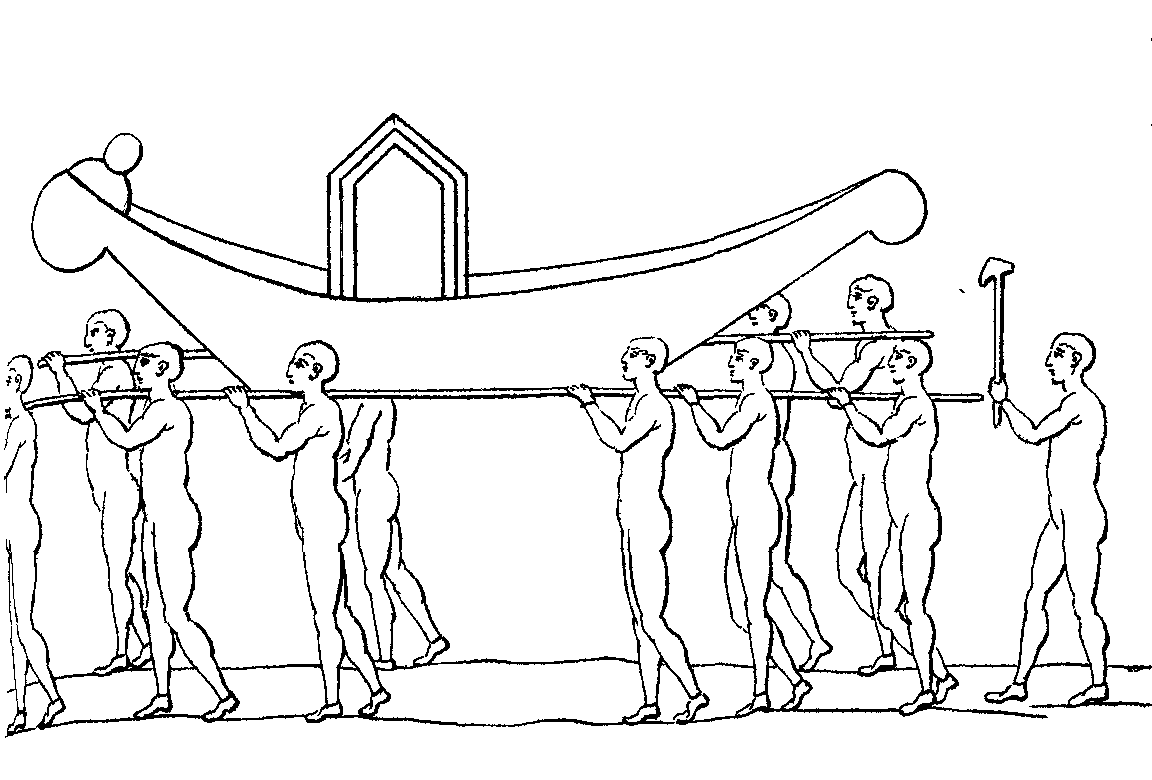
Pl. IV. The Ship of Isis Biprora with an Ark.
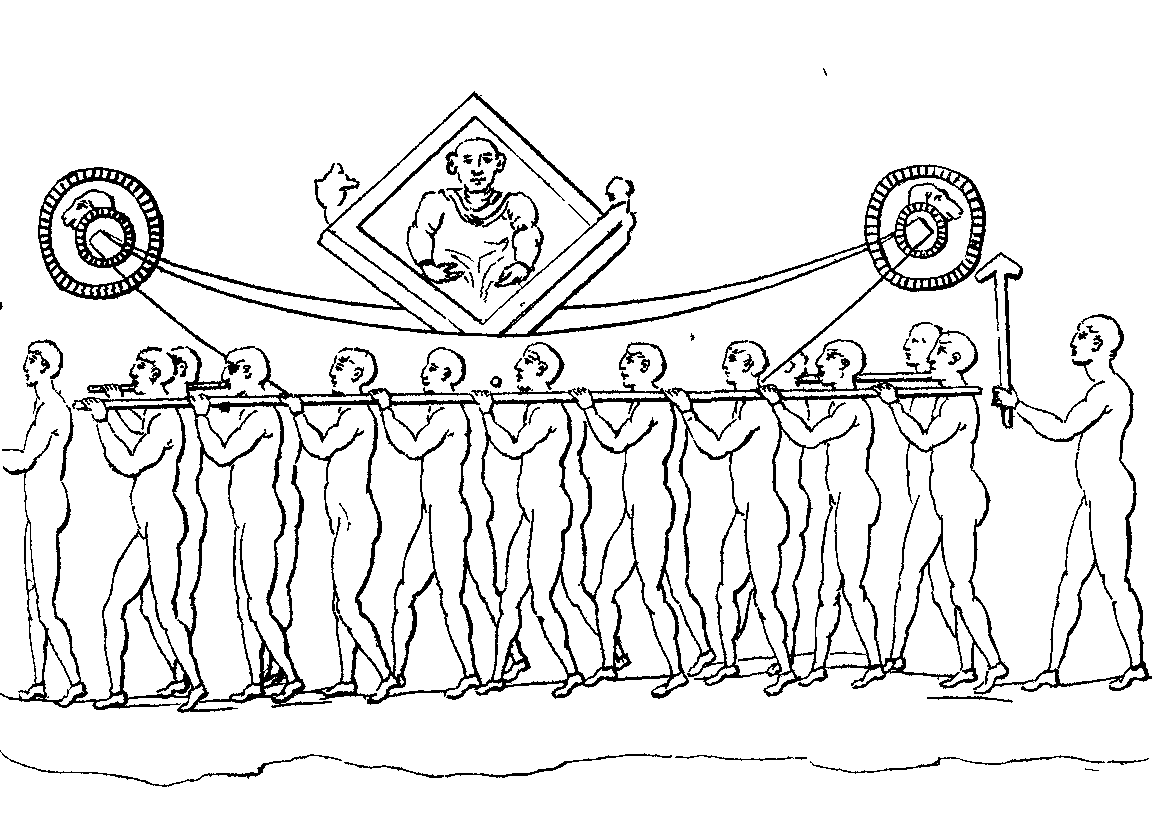
Ship of Isis and Image. From Pocock's Account of Egypt. Pl. XLII.
From the shrines of Amon abovementioned we may derive the history of all oracles; which, from the Deity by whom they were supposed to be uttered, were called Omphi and Amphi, as I have shewn: also, Alphi, Elphi, Orphi, Urphi, from El, and Orus. The Greeks adhered religiously to antient terms, however obsolete and unintelligible. They retained the name of Amphi, though they knew not the meaning: for it was antiquated before they had letters. That it originally related to oracular revelation is plain from its being always found annexed to the names of places famous on that account; and from its occurring in the names of men, renowned as priests and augurs, and supposed to have been gifted with a degree of foreknowledge. We read of Amphiaraus, Amphilocus, Amphimachus, persons represented as under particular divine influence, and interpreters of the will of the Gods. Amphion, though degraded to a harper, was Amphi-On, the oracle of Apollo, the Sun: and there was a temple, one of the antient ὑπαιθρα, dedicated to him and Zethus, as we may read in Pausanias. Mopsus, the diviner, is styled Αμπυκιδης, Ampucides; which is not a patronymic, but a title of the oracular Deity.
Νηλειης ἑλε ποτμος· αδευκεα δ' ου φυγεν αισαν
Μαντοσυναις· ου γαρ τις αποτροπιη θανατοιο.
Idmon, the reputed son of Abas, was a prophet, as well as Mopsus: he was favoured with the divine Omphe, and, like the former, styled Ampucides.
Αμπυκιδην Ιδμωνα, κυβερνητηρα τε Τιφυν.
What his attainments were, the Poet mentions in another place.
Τον ῥ' υποκυσσαμενη τεκεν Απολλωνι ανακτι
Αμβροσιον παρα κυμα φερετριος Αντιανειρα,
Τῳ και ΜΑΝΤΟΣYΝΗΝ επορε, και θεσφατον ΟΜΦΗΝ.
I imagine that this sacred influence, under the name of Amphi, is often alluded to in the exordia of Poets, especially by the writers in Dithyrambic measure, when they address Apollo. Taken in its usual sense (αμφι circum) the word has no meaning: and there is otherwise no accounting for its being chosen above all others in the language to begin hymns of praise to this Deity, who was the principal God of prophecy. We have one instance of it in the Nubes of Aristophanes:
Δηλιε, Κυνθιαν εχων
Ὑψικερατα πετραν.
Αμφι μοι Ερμειαο φιλον γονον εννεπε, Μουσα.
Αμφι Διοσκουρων ἑλικωπιδες εσπετε, Μουσαι.
Αμφι Διωνυσου Σεμελης ερικυδεος ὑιον
These hymns were of late date, long after Homer; and were introduced in Ionia, and also in Cyprus and Phenicia, when the Grecians were in possession of those parts. They were used in the room of the antient hymns, which were not understood by the new inhabitants. One of them is confessedly addressed to the Goddess called Venus Ourania, in Cyprus; and was designed to be sung by the priest of that Goddess upon the stated festivals at Salamis.
Και πασης Κυπρου· δος δ' ἱμεροεσσαν αοιδην,
Αυταρ εγω κεν σειο και αλλης μνησομ' αοιδης.
Χρονῳ συμπαντι ματηρ
Αθανατον.
From hence we may be assured, that he was of old the real Deity of the place.
Ωπασε μαντοσυνησι προηγητειραν ὁδοιο.
Many places were from the oracle styled P'ompean: and supposed by the Romans to have been so named from Pompeius Magnus; but they were too numerous, and too remote to have been denominated from him, or any other Roman. There was indeed Pompeiæ in Campania: but even that was of too high antiquity to have received its name from Rome. We read of Pompeiæ among the Pyrenees, Pompion in Athens, Pompelon in Spain, Pompeditha in Babylonia, Pomponiana in Gaul. There were some cities in Cilicia and Cappadocia, to which that Roman gave the name of Pompeipolis: but upon, inquiry they will be found to have been Zeleian cities, which were oracular: go that the Romans only gave a turn to the name in honour of their own countryman, by whom these cities were taken.
ΣΩΣΤΡΑΤΟΣ ΚΝΙΔΙΟΣ ΔΕΞΙΦΑΝΟΥΣ ΘΕΟΙΣ ΣΩΤΗΡΣΙΝ YΠΕΡ ΤΩΝ ΠΛΩΙΖΟΜΕΝΩΝ.
Quamvis increpitent socij, et vi cursus in altum
Vela vocet, possisque sinus implere secundos,
Quin adeas vatem, precibusque oracula poscas.
The island Delos was particularly frequented upon this account; and the sailors seem to have undergone some severe discipline at the altar of the God, in order to obtain his favour.
Εμπορος Αιγαιοιο παρηλυθε νηι θεουσῃ·
Ουχ' ὁυτω μεγαλοι μιν επιπνειουσιν αηται,
Χρειω δ' ὁττι ταχιστον αγει πλοον, αλλα τα λαιφη
Ωκεες εστειλαντο, και ου παλιν αυθις εβησαν,
Πριν μεγαν η σεο βωμον ὑπο πληγησιν ἑλιξαι
Ρησσομενοι——
O! ever crown'd with altars, ever blest, Lovely Asteria, in how high repute Stands thy fair temple 'mid the various tribes Who ply the Ægean. Though their business claims Dispatch immediate; though the inviting gales Ill brook the lingering mariners' delay: Soon as they reach thy soundings, down at once Drop the slack sails, and all the naval gear. The ship is moor'd: nor do the crew presume To quit thy sacred limits, 'till they have pass'd A painful penance; with the galling whip Lash'd thrice around thine altar.
This island was greatly esteemed for its sanctity, and there used to be a wonderful concourse of people from all nations continually resorting to its temple. The priests, in consequence of it, had hymns composed in almost all languages. It is moreover said of the female attendants, that they could imitate the speech of various people; and were well versed in the histories of foreign parts, and of antient times. Homer speaks of these extraordinary qualifications as if he had been an eye-witness:
Κουραι Δηλιαδες, Ἑκατηβελετεω θεραπαιναι,
Ἁιτ' επει αν πρωτον μεν Απολλων' ὑμνησωσιν,
Αυτις δ' αυ Λητω τε, και Αρτεμιν ιοχεαιρην,
Μνησαμεναι ανδρων τε παλαιων, ηδε γυναικων,
Ὑμνον αειδουσιν, θελγουσι δε φυλ' ανθρωπων.
Παντων δ' ανθρωπων φωνας, και Κρομβαλιαστυν
Μιμεισθαι ισασι· φαιης δε κεν αυτος ἑκαστον
Φθεγγεσθαι, ὁυτω σφι καλη συναρηρεν αοιδη.
The Delian nymphs, who tend Apollo's shrine, When they begin their tuneful hymns, first praise The mighty God of day: to his they join Latona's name, and Artemis, far fam'd For her fleet arrows and unerring bow. Of heroes next, and heroines, they sing, And deeds of antient prowess. Crowds around, Of every region, every language, stand In mute applause, sooth'd with the pleasing lay. Vers'd in each art and every power of speech, The Delians mimick all who come: to them All language is familiar: you would think The natives spoke of every different clime. Such are their winning ways: so sweet their song.
Ζηνα, κατα προτανων ἱστιον εκπετασας.
Ειτ' επι Κυανεας δινας δρομος, ενθα Ποσειδων
Καμπυλον ἑιλισσει κυμα παρα ψαμαθοις,
Ειτε κατ Αιγαιου ποντου πλακα, νοστον ερευνων
Νεισθω, τῳ δε Βαλων ψαιστα παρα ξοανῳ.
Τον δε γαρ ευαντητον αει θεον Αντιπατρου παις
Στησε φιλων αγαθης συμβολον ευπλοϊης.
Great Urian Jove invoke to be your guide: Then spread the sail, and boldly stem the tide. Whether the stormy inlet you explore, Where the surge laves the bleak Cyanean shore, Or down the Egean homeward bend your way, Still as you pass the wonted tribute pay, An humble cake of meal: for Philo here, Antipater's good son, this shrine did rear, A pleasing omen, as you ply the sail, And sure prognostic of a prosperous gale.
The Iapygian promontory had a temple to the same God, whose name by Dionysius is rendered Ὑριος.
Παῤῥαλιας, Ὑριου, τοθι συρεται Ἁδριας ἁλμη.
The more difficult the navigation was, the more places of sanctity were erected upon the coast. The Bosporus was esteemed a dangerous pass; and, upon that account, abounded with Cippi, and altars. These were originally mounds of earth, and sacred to the Sun: upon which account they were called Col-On, or altars of that Deity. From hence is derived the term Colona, and Κολωνη. It came at last to denote any ness or foreland; but was originally the name of a sacred hill, and of the pillar which was placed upon it. To say the truth, there was of old hardly any headland but what had its temple or altar. The Bosporus, in particular, had numbers of them by way of sea-marks, as well as for sacred purposes: and there were many upon the coast of Greece. Hence Apollonius says of the Argonauts:
In another place of the Bosporus—
Μυσιαι.
The like occurs in the Orphic Argonauts, where Beleus is pointing out the habitation of the Centaur Chiron:
Μεσσῳ ενι πρηωνι κατασκιον, ενθα δε Χειρων
Ναιει ενι σπηλυγγι, δικαιοτατος Κενταυρων.
These Colonæ were sacred to the Apollo of Greece; and, as they were sea-marks and beacons, which stood on eminences near the mouths of rivers, and at the entrances of harbours, it caused them to be called ωρια, ουρεα, and ὁρμοι. Homer gives a beautiful description of such hills and headlands, and of the sea-coast projected in a beautiful landscape beneath, when, in some ravishing poetry, he makes all these places rejoice at the birth of Apollo:
Ὑψηλων ορεων, ποταμοι θ' αλα δε προρεοντες,
Ακταιτ' εις ἁλα κεκλιμεναι, λιμενες τε θαλασσης.
In that happy hour The lofty cliffs, that overlook the main, And the high summits of the towering hills, Shouted in triumph: down the rivers ran In pleasing murmurs to the distant deep. The shelves, the shores, the inlets of the sea, Witness'd uncommon gladness.
Apollo, from this circumstance, was often called επακτιος, or the tutelary God of the coast; and had particular offerings upon that account.
Ζηνι Πανομφαιῳ, και επακτιῳ Απολλωνι.
Εσκε δε τι στιβαρον στυπος αμπελου, εντρεφον ὑλῃ Προγνυ γερανδρυον, το μεν εκταμον οφρα πελοιτο Δαιμονος ουρειης ἱερον βρετας· εξεσε δ' Αργως Ευκοσμως, και δη μιν επ' οκρυοεντι Κολωνῳ Ιδρυσαν, φηγοισιν επηρεφες ακροτατησιν· Ἁι ρα τε πασαων πανυπερταται εῤῥιζωντο Βωμον δ' αυ χεραδος παρανηνεον, αμφι δε φυλλοις Στεψαμενοι δρυινοισι θυηπολιης εμελοντο.
A dry and wither'd branch, by time impair'd, Hung from an ample and an aged vine, Low bending to the earth: the warriors axe Lopt it at once from the parental stem. This as a sacred relick was consigned To Argus' hands, an image meet to frame Of Rhea, dread Divinity, who ruled Over Bithynia's mountains. With rude art He smooth'd and fashion'd it in homely guise. Then on a high and lonely promontory Rear'd it amid a tall and stately grove Of antient beeches. Next of stones unwrought They raise an altar; and with boughs of oak Soft wreaths of foliage weave to deck it round. Then to their rites they turn, and vows perform.
Αμφιπλακες ερνος Αμπελου αυαλιης οξει απεκερσε σιδηρῳ, Ξεσσε δ' επισταμενως.
Σοι και Αμαζονιδες πολεμου επιθυμητειραι
Εκ κοτε παῤῥαλιῃ Εφεσου βρετας ἱδρυσαντο
Αυται δ', Ουπι ανασσα, περι πρυλιν ωρχησαντο.
Instead of an image made of a stump, the poet Dionysius supposes a temple to have been built beneath the trunk of a decayed tree.
Ενθα Θεῃ ποτε νηον Αμαζονιδες τετυχοντο Πρεμνῳ ὑπο πτελεης, περιωσιον ανδρασι θαυμα. v. 827.
It is observable, that the Chinese, as well as the people of Japan, still retain something of this custom. When they meet with an uncouth root, or spray of a tree, they humour the extravagance: and, by the addition of a face, give it the look of a Joss or Bonzee, just as fancy directs them.
The vine was esteemed sacred both to Dionusus, and Bacchus; for they were two different personages, though confounded by the Grecians: indeed the titles of all those, who were originally styled Baalim, are blended together. This tree had therefore the name of Ampel, which the Greeks rendered Αμπελος, from the Sun, Ham, whose peculiar plant it was. This title is the same as Omphel before mentioned, and relates to the oracular Deity of the Pagan world; under which character Ham was principally alluded to. The Egyptian and Asiatic Greeks had some imperfect traditions about Ham, and Chus: the latter of which they esteemed Bacchus. And as the term Ampelus did not primarily relate to the vine, but was a sacred name transferred from the Deity, they had some notion of this circumstance: but as it was their custom out of every title to form a new personage, they have supposed Ampelus to have been a youth of great beauty, and one whom Bacchus particularly favoured. Hence Nonnus introduces the former begging of Selene not to envy him this happiness.
Ὁττι νεος γενομην, ὁτι και φιλος ειμι Λυαιου.
The worship of Ham was introduced by the Amonians in Phrygia and Asia Minor: and in those parts the Poet makes Ampelus chiefly conversant.
Αμπελος ηεξητο νεοτρεφες ερνος ερωτων.
He speaks of his bathing in the waters, and rising with fresh beauty from the stream, like the morning star from the ocean.
Αμπελος αντελλων, ἁτε φωσφορος—
Κοσμησει σεο καλλος ὁλον Πακτωλιον ὑδωρ.
In all these instances there are allusions to a history, which will hereafter be fully discussed. Ovid seems to make Ampelus a native of Thrace; and supposes him to have been the son of a satyr by one of the nymphs in that country:
Fertur in Ismariis Bacchus amâsse jugis.
Thrice ten fair cities shall your portion be, And many a stately tower.
Apollo likewise was called Οικτιστης and Αρχηγετης, from being the supposed founder of cities; which were generally built in consequence of some oracle.
Ανθρωποι· Φοιβος γαρ αει πολιεσσι φιληδει
Κτιζομεναις· αυτος δε θεμειλια Φοιβος ὑφαινει.
'Tis through Apollo's tutelary aid, That men go forth to regions far remote, And cities found: Apollo ever joys In founding cities.
PATOR AND PATRA.
O! cate rerum sator; O! principium Deorum.
But, when it became a title, which was bestowed upon Gods of every denomination, it made Jupiter animadvert with some warmth upon the impropriety, if we may credit Lucilius:
Ut Neptunus pater, Liber, Saturnus pater, Mars,
Janus, Quirinus, pater, omnes dicamur ad unum.
Tu Boiocassis stirpe Druidarum satus, Si fama non fallat fidem, Beleni sacratum ducis e templo genus, Et inde vobis nomina, Tibi Pateræ: sic ministros nuncupant Apollinares Mystici. Fratri, Patrique nomen a Phæbo datum, Natoque de Delphis tuo.
He mentions, that this worship prevailed particularly in Armorica; of which country his relations were natives.
Nomine Phœbicium,
Qui Beleni Ædituus,
Stirpe satus Druidûm,
Gentis Armoricæ.
The true name of the Amonian priests I have shewn to have been Petor, or Pator; and the instrument which they held in their hands was styled Petaurum. They used to dance round a large fire, in honour of the Sun, whose orbit they affected to describe. At the same time they exhibited other feats of activity, to amuse the votaries who resorted to their temples. This dance was sometimes performed in armour, especially in Crete: and, being called Pyrrhic, was supposed to have been so named from Pyrrhus, the son of Achilles. But, when was he in Crete? Besides, it is said to have been practised by the Argonautic heroes before his time. It was a religious dance, denominated from fire, with which it was accompanied.
Καλον Ιηπαιηον', Ιηπαιηονα Φοιβον
Μελπομενοι.
It was originally an Egyptian dance, in honour of Hermes, and practised by the Pataræ, or Priests. In some places it was esteemed a martial exercise, and exhibited by persons in armour, who gave it the name of Betarmus. We have an instance of it in the same poet:
Εκαιροντες Βηταρμον ενοπλιον ορχησαντο,
Και σακεα ξιφεεσσιν ὑπεκτυπον.
Βηταρμος Betarmus, was a name given to the dance, from the temple of the Deity where it was probably first practised. It is a compound of Bet Armes, or Armon, called, more properly, Hermes, and Hermon. Bet, and Beth, among the Amonians, denoted a temple. There is reason to think that the circular dances of the Dervises, all over the east, are remains of these antient customs. In the first ages this exercise was esteemed a religious rite, and performed by people of the temple where it was exhibited: but, in aftertimes, the same feats were imitated by rope-dancers and vagrants, called Petauristæ, and Petauristarii; who made use of a kind of pole, styled petaurum.—Of these the Roman writers make frequent mention; and their feats are alluded to by Juvenal:
Corpora, quique solent rectum descendere funem?
Manilius likewise gives an account of this people, and their activity; wherein may be observed some remains of the original institution:
Corpora, quæ valido saliunt excussa petauro:
Membraque per flammas orbesque emissa flagrantes,
Delphinûmque suo per inane imitantia motu,
Et viduata volant pennis, et in aëre ludunt.
Αλιβατου Κρονιου,
Ενθ' ὁι ωπασε θησαυρον
Διδυμον ΜΑΝΤΟΣYΝΑΣ.
Προσβοῤῥον αντρον, ας Μακρας κικλησκομεν.
Ὁ γαρ Μακαριος, κ' ουκ ονειδιζω τυχας, Διος πεφυκως, ὡς λεγουσι, Τανταλος, Κορυφης ὑπερτελλοντα δειμαινων ΠΕΤΡΟΝ, Αερι ποτᾳται, και τινει ταυτην δικην.
The same Scholiast quotes a similar passage from the same writer, where the Sun is called Petra.
Χθονος τε τεταμεναν αιωρημασι πετραν,
Αλυσεσι χρυσεαις φερομεναν.
The unhappy Tantalus From a satiety of bliss Underwent a cruel reverse. He was doom'd to sit under a huge stone, Which the father of the Gods Kept over his head suspended. Thus he sat In continual dread of its downfal, And lost to every comfort.
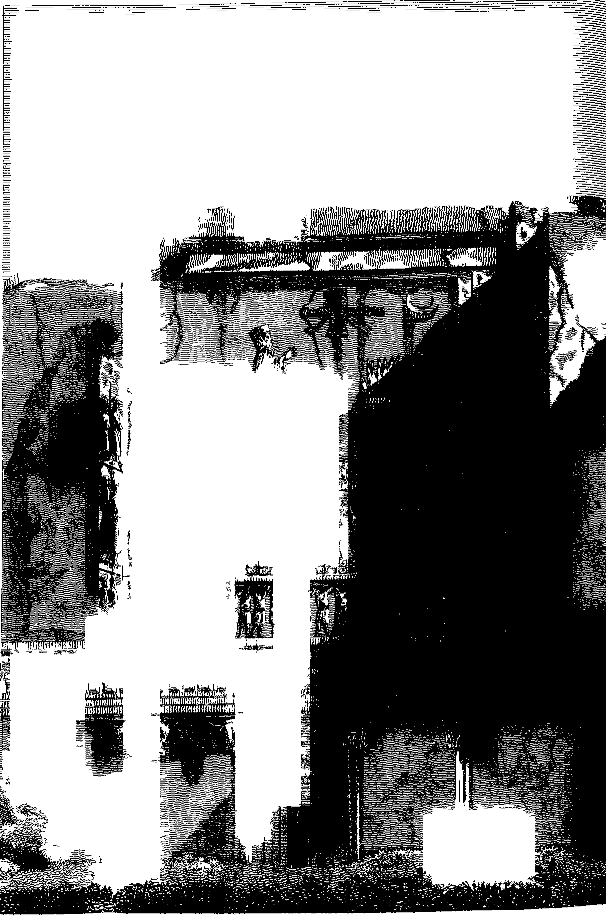
Pl. V. Temple of Mithras Petræus in the Mountains of Persia. From Le Bruyn
The Greeks, whenever they met with this term, even in regions the most remote, always gave it an interpretation according to their own preconceptions; and explained θεοι Πατρῳοι, the oracular Deities, by Dii Patrii, or the Gods of the country. Thus, in the Palmyrene inscription, two Syrian Deities are characterized by this title.
Εισετι νηπιαχοιο χορους ἱδρυσατο Βακχου.
The Patrica were not only rites of Mithras, but also of Osiris, who was in reality the same Deity.