Chapter III · ARRIVAL AT MORZOUK.
Reading edition
Mode of travelling across the Desert — Interview with the Sultan — Description of Morzouk — Population — Castle of the Sultan — Illness and severe Distress of the Author and his Companions — Arrival of a Kafflé of Tuarick — Fast of Rhamadan — Departure of an Expedition to obtain Slaves from the Country of Borgoo — Diseases of the Inhabitants, and the Native Methods of Cure — Feast of Aidel Shraya — Observations on the Tuarick — Their Religion, Dress, Customs, and Language — Ghraat — Its Government, Laws, and Trade — Market there — Arrival of a Kafflé from Bornou with Slaves — Information respecting Bornou and the surrounding Countries, as collected from the Traders — Of Kashna and Soudan, in general — Account of Hornemann and his Death — Tembuctoo — General Remarks on the Geography of the Interior, and probable Course of the Niger — Vocabulary of the Fellātta Language — Conjectures on the Fate of Park.
On our entry into the town, the soldiers raced up a very broad street, firing and shouting, whilst the women uttered their shrill cry; and the scene was altogether highly interesting. On passing a large open space, before we reached the castle and walls surrounding it, we were saluted from two six-pounders. We did not enter the castle itself, but were conducted to a large house within its outward boundary, which had been prepared for our reception. An old Mamluke, Hadje Mahmoud حاج محمود took charge of us, and having passed our threshold “in the name of God,” brought us a hot mess and a large mat. We waited until the afternoon, and were then conducted to pay our respects to the Sultan, and to be introduced to his son, a boy of about thirteen years of age, born of a slave of Soudan. We, in our turn, were visited by a great number of people; who had, in the space of a few hours, informed themselves, very sagaciously, that we were great men, and had brought 30,000 dollars with us; when, in truth, we had only 300 (which were in Mukni’s hands), and knew not where to procure more. Our horses, which were much fatigued and very thin, were fed from the castle.
We had been thirty-nine days in coming from Tripoli; the road, with the exception of the immediate vicinity of the towns, was a dreary desert, having but few wells, and those of salt water. Nothing could have been more fortunate than our travelling with the Sultan; our difficulties must otherwise have been very great. Mukni, to do him justice, showed us every attention; and we always partook of his meals when in the towns. I was his constant companion, and being of a less sedate disposition than Mr. Ritchie, he always invited me to ride by him, generally treating me with some cakes or dainties, which he carried with him. In return, I allowed him a draught from my water-skin. He spoke a little Italian, and amused himself much by asking questions about my country, of the wealth and grandeur of which he had formed very exalted ideas; particularly respecting the funds, or banco, as he called it. He certainly evinced a great desire to lodge some of his property, in this manner, in England, provided he could arrange it privately; it being against the Mahommedan religion to receive interest.
When I told him that English women were allowed to have money in their own power, and that some of them had immense fortunes, he seemed scarcely to credit me. He was much astonished at being told, that young men often did not marry until they had arrived at 25 or 30 years of age: this he considered as highly improper; but in some degree reconciled it to his way of thinking, by supposing that they must, in that case, have a great number of concubines, and that they only married those who brought them children. He did not find fault with our customs in that respect, as he had, himself, only one wife; but he had 50 Negresses, which was considered a very moderate allowance for a Sultan of Fezzan. He frequently asked me how natural children were disposed of, when it was requisite to conceal their birth from the parents of the offending parties. His pointed manner of questioning me on this subject led me to some suspicion of his motives for the inquiry; and I afterwards discovered, from several of his people, that he invariably caused to be strangled all babes born of his Negresses by other men, and that it was the general custom at Tripoli, to poison illegitimate infants in the womb. The mother of little Yussuf, his son, had a child about a year since, perfectly black. Mukni being satisfied it could not be his, sent for the suspected father, and made him strangle the infant: the mother was allowed to return to her own country, which was considered a great piece of lenity, death being usually the punishment for such an offence.
Our travelling pace was a walk of the horses, which generally got considerably in advance of the camels. At noon, or about that time, if we could find a tree, we stopped under it; if not, we sat under the shadow of our horses. The Sultan was grand victualler, and generally produced a bag of bread or dates, or the remains of his dinner of the day before. Each one then had a portion, not sufficient to be called a dinner, but to break his fast; and after eating, and drinking a few mouthfuls of water, stretched himself out, and slept until the camels came up: the party then mounted and rode on. These rests were very refreshing to the men and horses; but the loaded camels never made any stop, neither did the poor Negroes, who, with their wives and even little children, plodded on the whole day, over a burning soil, sometimes for twenty, and often for sixteen hours, whenever want of water made a forced march necessary. Several of the smallest of the black children, though probably not more than four or five years of age, walked for many hours with great strength in the early part of the day, having but a few rags to cover them, and when unable to proceed further, were put on the camels for the remainder of the day. One of our party, a poor old man, totally blind, arrived safe at Morzouk from Tripoli. He had walked all the way over the rocks and plains, led by his wife, and was kept alive by the hope of once more hearing the voices of his countrymen.
When we stopped for the night, it was generally so contrived that we should lie in some spot where bushes might be found for the camels to browse upon; but even though there might be no wood or herbage, a wadey was always preferred, as more sheltered. Our tents were pitched, if the ground was sufficiently soft to admit the pegs, and our bales and chests so placed, as to form a shelter for those who had no tents; affording a bulwark against the wind and sand. The little resistance offered by any intervening objects to the winds of the desert, renders them very powerful, and the stillness of the night, in blowing weather, is particularly awful. The tents are no sooner pitched, than the camels are turned out to feed on the thin and scattered bushes, and parties go to collect wood; the horses are hobbled, watered from the skins, and then fed. Should there be no wood, camels’ dung is an excellent substitute, as it burns like peat, and forms a very glowing fire. A hole is dug in the ground, and three stones so placed, as to support the little copper pot. Cusscussou or Bazeen is then prepared. The Sultanesses are no contemptible cooks, and they made every evening an excellent supper for their master. When no fire is to be had, Zumeeta is prepared with water and oil, and so eaten. We usually managed, in an evening, to make a little coffee, of which Mukni always came and partook; and as soon as he left the tent, his slaves and people generally succeeded him, wishing also to taste some. If we had time, we occasionally drank a cup of it in the morning fasting, which we found, in the most sultry weather, prevented thirst. I observed, that we never required water if we abstained from eating in the early part of the day, and I thus account for the Arabs drinking so little: on the contrary, if any quantity of water is taken on an empty stomach, the person who indulges in it suffers great thirst for the remainder of the day. When hot, it is much better to drink from the palm of the hand, which prevents the possibility of taking too great a draught at once. It is very refreshing after a long day’s journey, to be well oiled all over; and a wet cloth applied to the back of the neck relieves the fulness of the head, after being many hours exposed to the sun.—Horses should not be brought near the wells until it is their turn to drink; if they are kept in sight of the water, without being able to reach it, they frequently become furious, and many of them greedily devour the mud.
The water is generally carried on camels set apart for that purpose, and having no other loads. The usual quantity is six gerbas, or water-skins, three on each side, one slung above the other. Each of these skins is about fifty pounds in weight when full. Should the Kafflé expect to be four or six days without finding water, every camel which carries goods, has, in addition to its load, a skin on each side. In fact, horses generally occasion more trouble to a caravan than any thing else. The immense quantity of water necessary to be taken for them is always averaged at one camel for each horse, not including other loads of corn or dates for their food.
Nothing can be more overpowering than the south wind, El Gibli قبلي, or the east, El Shirghi الشرقي; each of which is equally to be dreaded. In addition to the excessive heat and dryness of these winds, they are so impregnated with sand, that the air is darkened by it, the sky appears of a dusky yellow, and the sun is barely perceptible. The eyes become red, swelled, and inflamed; the lips and skin parched and chopped; while severe pain in the chest is very generally felt, in consequence of the quantities of sand unavoidably inhaled. Nothing, indeed, is able to resist the unwholesome effects of this wind. On opening our boxes, we found that many little articles, and some of our instruments, which had been carefully packed, were entirely split and destroyed. Gales of the kind here described generally continue ten or twelve hours, yet when a change takes place, the air seems so fresh and delightful, that the miseries of the sand-wind are soon forgotten. We sometimes met people on our road, who invariably at parting recited the Fatha, each one religiously stroking his beard as soon as he had concluded this prayer.
Being now settled for a time in Morzouk, we went about, in order to become better acquainted with the people. Mr. Ritchie made magnificent presents to the Sultan and his sons, and every thing seemed to promise well, except that we had but little money, and were obliged to live in a most economical manner on corn, and seldom able to afford meat; having not only ourselves but our black servant and four horses to feed.
We had now acquired some little knowledge of the language, when, on the first Friday after our arrival, Mukni sent to tell us that he intended going to the Mosque at the Asr عسر, or afternoon prayers, and that he expected to see us there. As this was to be Mr. Ritchie’s first appearance in a Mosque, we had no sooner dressed ourselves in our best clothes than we practised the necessary prostrations, until we heard the crier call to prayers, when our old Mamluke came to conduct us to the church. We found a large assembly sitting in rows on mats, our places being in front. The Sultan soon after entered with his guards, and the Mosque was instantly filled with a strong smell of attar of roses, which his Majesty used in large quantities. Mr. Ritchie and myself got through our part very well, and after the service was over, waited at the door to see the Sultan mount and return to the Castle.
His horse, richly caparisoned, was led to an earthen seat, from which he mounted, three led horses preceding him. He was surrounded by his armed slaves, and fanned by men with ostrich feathers; and thus proceeded, slowly, and amidst an immense crowd, to the Castle, a distance of about five hundred yards. When arrived there, he remained for a few minutes in the court-yard, seated in his state chair, and receiving the homage of his subjects, leaning on two of his principal people; he then ascended into the Castle, where we followed him, and were allowed to sit on the same carpet as himself. He here paid to Mr. Ritchie the three hundred dollars which he owed him, and at the same time made most flattering promises about assisting us at any future period in money matters. We implicitly believed his professions, and left the Castle much delighted at possessing such a friend in one, who, had he been ill-disposed, had so much power to injure us.
At our return home, on examining our stock of eatables, we found that we had been robbed of a large sack of rice, another of flour, and a great quantity of cusscussou. From our hardware we missed one pistol, both locks of a double-barrelled gun, and several bags of shot. We made instant complaint to Mukni, who promised that every inquiry should be made for the stolen articles, and that they should, if found, be faithfully returned to us. We laid in a stock of dates for our horses, and commenced keeping house on our own account.
Our habitation was a very good one, and as all the large houses are built on nearly the same plan, I may, by describing this, give an idea of all the rest. A large door, sufficiently high to admit a camel, opened into a broad passage, or Skeefa سكيفه; on one side of which was a tolerable stable for five horses; and close to it a small room for the slaves, whose duty it might be to attend the house. A door opposite to that of the stable opened into the Kowdi كودي, or large square room, the roof of which, at the height of eighteen feet, was supported by four palm-trees as pillars. In the centre of the roofing was a large open space, about twelve feet by nine; from this the house and rooms receive light (not to mention dust), and excessive heat in the afternoon. At the end of the room, facing the door, a large seat of mud was raised, about eighteen inches high, and twelve feet in length. Heaps of this description, though higher, are found at the doors of most houses, and are covered with loungers in the cool of the morning and evening. Our large room was fifty feet by thirty-nine. From the sides, doors opened into smaller ones, which might be used as sleeping or store-rooms, but were generally preferred for their coolness. Their only light was received from the door. Ascending a few steps, there was a kind of gallery over the side rooms, and in it were two small apartments, but so very hot as to be almost useless. From the large room was a passage leading to a yard, having also small houses attached to it in the same manner, and a well of comparatively good water. The floors were of sand, and the walls of mud roughly plastered, and showing every where the marks of the only trowel used in the country—the fingers of the right hand. There are no windows to any of the houses; but some rooms have a small hole in the ceiling, or high up in the wall.
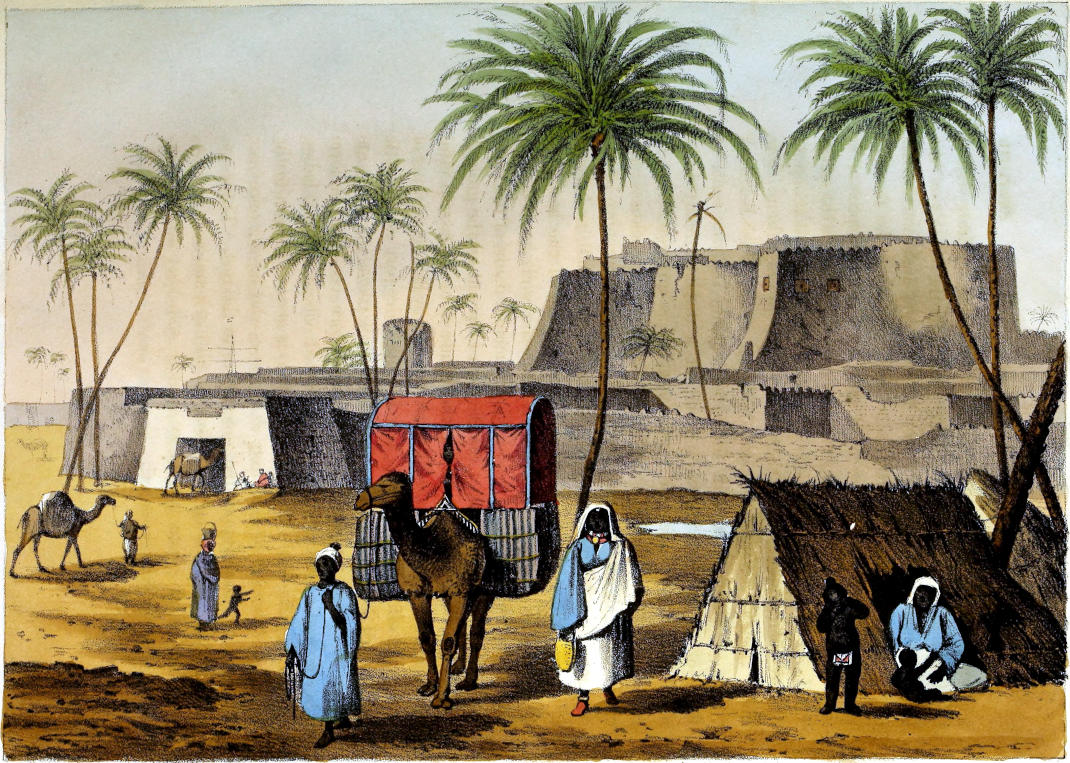
Morzouk is a walled town, containing about 2500 inhabitants, who are blacks, and who do not, like the Arabs, change their residence. The walls are of mud, having round buttresses, with loopholes for musketry, rudely built, but sufficiently strong to guard against attack: they are about fifteen feet in height, and at the bottom eight feet in thickness, tapering, as all walls in this country do, towards the top. The town has seven gates, four of which are built up in order to prevent the people escaping when they are required to pay their duties. A man is appointed by the Sultan to attend each of these gates, day and night, lest any slaves or merchandize should be smuggled into the town. The people, in building the walls and houses, fabricate a good substitute for stones, (which are not to be found in these parts), by forming clay into balls, which they dry in the sun, and use with mud as mortar: the walls are thus made very strong; and, as rain is unknown, durable also. The houses, with very few exceptions, are of one story, and those of the poorer sort receive all their light from the doors: these are so low, as to require stooping nearly double to enter them; but the large houses have a capacious outer door; which is sufficiently well contrived, considering the bad quality of the wood that composes them. Thick palm planks, of four or five inches in breadth, (for the size and manner of cutting a tree will not afford more) have a square hole punched through them at the top and bottom, by which they are firmly wedged together, with thick palm sticks; wet thongs of camels’ hide are then tied tightly over them, which, on drying, draw the planks more strongly and securely together. There are no hinges to the doors; but they turn on a pivot, formed on the last plank near the wall, which is always the largest on that account. The locks and keys are very large and heavy, and of curious construction. The houses are generally built in little narrow streets; but there are many open spaces, entirely void of buildings, and covered with sand, on which the camels of the traders remain. Many palms grow in the town, and some houses have small square enclosures, in which are cultivated a few red peppers and onions. The street of entrance is a broad space of at least a hundred yards, leading to the wall that surrounds the castle, and is extremely pretty: here the horsemen have full scope to display their abilities when they skirmish before the Sultan. The castle itself is an immense mud building, rising to the height of eighty or ninety feet, with little battlements on the walls (a fancy of the present Sultan’s); and at a distance really looks warlike. Like all the other buildings, it has no pretensions to regularity: the lower walls are fifty or sixty feet in thickness; the upper taper off to about four or five feet. In consequence of the immense mass of wall, the apartments are very small, and few in number. The rooms occupied by the Sultan are of the best quality, (that is to say, comparatively), for the walls are tolerably smooth, and white-washed, and have ornamental daubs of red paint in blotches, by way of effect. His couch is spread on the ground, and his visitors squat down on the sandy floor at a respectful distance; we, however, were always honoured by having a corner of the carpet offered to us. The best and most airy part of the castle is occupied by the women, who have small rooms round a large court, in which they take exercise, grind corn, cook, and perform other domestic offices. The number called Kibere, or great ladies, seldom exceeds six. This dignified title is generally given to the mothers of the Sultan’s children, or to those, who, having once been great favourites, are appointed governesses to the rest. There are, on the whole, about fifty young women, all black and very comely; and from what stolen glances we could obtain, they appeared extremely well dressed. They are guarded by five eunuchs, who keep up their authority by occasionally beating them. The Sultan has three sons and two daughters, who live with him in this cage, the doors of which are locked at night, and the keys brought to him, so that he remains free from any fear of attack. The castle is entered by a long winding passage in the wall, quite dark and very steep. At the door is a large shed, looking on a square space, capable of containing three or four hundred men closely huddled together. Under this shed is a great chair of state (once finely gilt and ornamented), with a patchwork quilt thrown over it; and behind it are the remains of two large looking-glasses. In this chair the Sultan receives homage every Friday, before he ascends the castle, after returning from the Mosque. This place is the Mejlees, مبولبس, and was the scene of all the cruelties practised by Mukni when he first took possession of the country.
Drawn from Nature by G. F. Lyon. On Stone by D. Dighton. The Castle of Morzouk. London. Published by J. Murray Albemarle St. Feb.1.1821. C. Hullmandel’s Lithography.
There are several pools of stagnant salt water in the town, which, I conceive, in a great measure, promote the advance of the summer fevers and agues. The burying-places are outside the walls, and are of considerable extent. In lieu of stones, small mud embankments are formed round the graves, which are ornamented with shreds of cloth tied to small sticks, with broken pots, and sometimes ostrich eggs. One of the burying-places is for slaves, who are laid very little below the surface; and in some parts the sand has been so carried away by the wind, as to expose their skeletons to view. Owing to the want of wood, no coffins are used; the bodies are merely wrapped in a mat, or linen cloth, and covered with palm branches, over which the earth is thrown. When the branches decay, the earth falls in; and the graves are easily known by being concave instead of convex. The place where the former Sultans are buried is a plain near the town; their graves are only distinguished from those of other people by having a larger proportion of broken pots scattered about them. It is a custom for the relations of the deceased to visit, and occasionally to recite a prayer over the grave, or to repeat a verse of the Koran. Children never pass within sight of the tombs of their parents without stopping to pay this grateful tribute of respect to their memory. Animals are never buried, but thrown on mounds outside the walls, and there left. The excessive heat soon dries up all their moisture, and prevents their becoming offensive; and the hair remains on them, so that they appear like preserved skins.
May 15th.—I was attacked with severe dysentery, which confined me to my bed during twenty-two days, and reduced me to the last extremity. Our little party was at this time miserably poor, for we had only money sufficient for the purchase of corn to keep us alive, and never tasted meat, unless fortunate enough to kill a pigeon in the gardens. My illness was the first break up in our little community, and from that time it rarely happened that one or two of us were not confined to our beds. The extreme saltness of the water, the poor quality of our food, together with the excessive heat and dryness of the climate, long retarded my recovery; and when it did take place, it was looked on as a miracle by those who had seen me in my worst state, and who thought it impossible for me to survive. I was no sooner convalescent, than Mr. Ritchie fell ill, and was confined to his bed with an attack of bilious fever, accompanied with delirium, and great pain in his back and kidneys, for which he required repeated cupping. When a little recovered, he got up for two days, but his disorder soon returned with redoubled and alarming violence. He rejected every thing but water; and, excepting about three hours in the afternoon, remained either constantly asleep, or in a delirious state. Even had he been capable of taking food, we had not the power of purchasing any which could nourish or refresh him. Our money was now all expended, and the Sultan’s treacherous plans to distress us, which daily became too apparent, were so well arranged, that we could not find any one to buy our goods. For six entire weeks we were without animal food, subsisting on a very scanty portion of corn and dates. Our horses were mere skeletons, added to which, Belford became totally deaf, and so emaciated as to be unable to walk.
My situation was now such as to create the most gloomy apprehensions; for I reflected that, if my two companions were to die, which there was every reason to apprehend, I had no money with which to bury them, or to support myself; and must in that case have actually perished from want, in a land of comparative plenty. My naturally sanguine mind, however, and above all, my firm reliance in that Power which had so mercifully protected me on so many trying occasions, prevented my giving way to despondency; and, Belford beginning soon to rally a little, we united, and took turns in nursing and attending on our poor companion. At this time, having no servant, we performed for Mr. Ritchie and for ourselves the most menial offices, Mr. Ritchie being wholly unable to assist himself.
Two young men, brothers, whom we had treated with great kindness, and whom we had engaged to attend on us, so far from commiserating our forlorn situation, forsook us in our distress, and even carried off our little store of rice and cusscussou, laughing at our complaints, and well knowing that our poverty prevented the redress which we should otherwise have sought and obtained.
During the period of Mr. Ritchie’s illness, a Kafflé of Tuarick arrived, on their way to Mecca; they had with them a Marāboot of most extraordinary talent and sagacity, about fifteen years old. This young saint was said never to look up, but to have his eyes either fixed on the Koran, or on the ground. I managed to ride out to visit this exalted personage, and found him a fat silly boy with sore eyes, very dirty and ragged, and surrounded by Hadge Mahmoud and a few others, with about the same share of intellect as himself, who were listening with great admiration to his remarks.
The Sultan, on the arrival of this Kafflé, rode out in state to see them, and supplied them with provisions during their stay. They were about one hundred and fifty in number, and with the exception of two tents of canvas, all the rest were of leather, supported by sticks and the people’s baggage.
I shall speak at a future period of the Tuarick, their dress, language, &c.
Rhamadan (the month in which Mohammed is said to have had his first communication with the angel Gabriel) was announced on the 23d of June, when the new moon appeared. The strictest fast was immediately commenced before day, about three o’clock, until sunset at seven P.M., sixteen hours; during this time no one drinks or eats, smokes or chews tobacco, and even smelling perfume is considered as wicked, as is swallowing the saliva.
The excessive heat which raged at this period (see Meteorological register at the end of the volume) was the occasion of many very serious illnesses amongst our friends and neighbours. Mr. Ritchie being very unwell and in bed, was, in a manner, privileged to take food or drink; but as Belford and myself were now much recovered, we were obliged to be very cautious, only eating by stealth, and when no one was likely to interrupt us. We had at this time a servant, who was a very inquisitive fellow; and our artifices to get him out of the way on these occasions would, by any but a blockhead like himself, have been soon discovered: however, we not only got safely through, but were fortunate enough to obtain credit for keeping the fast with great strictness, and without exciting the slightest suspicions of our stolen meals.
Hadje Mahmoud, a most religious old man, became very troublesome to me, and was continually begging that I would call in some Marāboot to pray over, and write prayers on Mr. Ritchie’s head and hands: his delirium he attributed to the devil, and foretold that it would not cease until we had put a sword, or some implement of iron, under his head, Iblis being much alarmed at that metal. All these plans I resisted as well as I could; but found much difficulty in overcoming a strong desire he had to bring a plate with the names of God written on it, which were to be washed off, and the inky water given to the invalid to drink. Our poor patient, meanwhile, regardless of what was passing, longed and asked only for a little milk, which unhappily we were not able to procure; the Sultan, although he had fifty goats, made so many excuses and difficulties about affording us any, that we were obliged to give up all hopes of gratifying him.
Great preparations were now making all over the kingdom, to forward an expedition which the Sultan intended to send against the tribe of the Tibboo Borgo, a country about a month S.E. Bodies of Arabs arrived from Sockna, and the towns in that direction; a party of horse also came from Benioleed, and Morzouk was all confusion. Sidi Aleiwa, the Sultan’s eldest son, was to take the command. All the men assembled to accompany him were quartered on the town’s-people, who were obliged to feed them and their cattle twice a day.
I shall here mention the names of certain persons who came to see us, and were really friendly towards us, in order to distinguish them from numberless other visitors, who, at first, were very regular in their attendance, but who vanished as soon as our sugar and coffee were expended. Mohammed El Lizari حمداليزهاري and Yussuf his brother were our two principal and real friends, and were the sons of a Mamluke long since dead.
On Mukni’s coming to this country, he reduced them from a state of affluence to complete poverty, leaving them their palms, the only possessions of which he could not deprive them. The friendship which these good men evinced for us was perfectly disinterested; and when we were poor and nearly starving, they most humanely and considerately conferred on us many acts of real kindness. Mohammed, the elder brother, was obliged to prepare himself to go on the slave hunt, much against his inclination, and was appointed to take charge of the young Aleiwa.
Old Hadje Mahmoud, whom I have before mentioned, was another of our friends, but rather less disinterested than the two former: he was credulous, superstitious, and rather time-serving; but being our neighbour, did us now and then a good office. His kindness, however, certainly slackened after our poverty became but too apparent.
Mohammed ben Abd Alla was, for a length of time, our most constant visitor. He was a Mamluke, born at Naples, and apostatised when about ten years old. He remained some time at Tripoli; and, when about eighteen years of age, was sent by the Bashaw as a present to the former Sultan. He recollected but little of his native language; was shrewd and lively, and was certainly employed by the Sultan as a spy upon our actions. Having fully ascertained this circumstance, we employed many tricks to deceive him, in which we completely succeeded. One of his great points was, to discover for what reason we came so far into the country, and whether we really were very great men, as we were reported to be.
A report had been circulated that Mr. Ritchie was married to the King of England’s daughter, and that I recently had married his Majesty’s niece. As Mohammed affected to be acquainted with all our affairs, we always denied our high connexions in such a manner as to confirm, rather than to contradict, the reports. Our wealth he imagined to be very considerable, until he found we ceased to eat meat, and then his suspicions of our real situation were awakened. As he became excessively importunate in his questions, I at last undertook to frighten him, and after one or two preparatory conversations, got him out on the sand one night when there was no moon. I began talking of King Solomon and his seal, and related to him as many horrible stories of ghosts as I could conjure up. I told him that Mr. Ritchie and myself were Freemasons, and that we understood the writing which was on our Lord Solomon’s seal. On this subject I also invented tales, to convince him that Freemasons were acquainted with every thing. I took him home with me, and (Mr. Ritchie being on that evening pretty well) desired him to mention some words to me, which I would, with his hand over my mouth, convey across the room. I accordingly spelt the words with my fingers, and Mr. Ritchie, to Mohammed’s great astonishment, repeated them aloud. A few repetitions of this plan made a sensible alteration in our inquisitive friend, who, from that time, gradually ceased to intrude on us. Mohammed was particularly proud of his high blood (being a Mamluke), boasting that his father (though an unbeliever) was a very great man, and much in the confidence of the King of Naples, whose revenues he collected, and had a large army under his orders. He also recollected his having fine laced clothes, and riding a horse. We were often much puzzled to guess who this great personage could be, when one evening, by way of surprising and delighting us, he, with great gravity, informed us that his father was a caporale, or, in plain English, a corporal!
On the 12th of July, the army all being in readiness, amounting to about 300 horse and 800 foot, with nearly 2000 camels, set out for Gutrone, from whence they were to make their final departure. Mukni accompanied them; and the town was left in a state of quiet we had never before observed. The charge of the castle was committed to old Hadge Mahmoud, who locked the females up every evening at sunset. Mukni, who was not considered to be a very religious person, was much blamed for setting out during the fast of Rhamadan; and some, who knew we should not betray their opinions, said, that his only reason for choosing such a time was, that he might have an excuse for eating, which is allowed by the Koran to travellers and sick persons; provided they make amends when they are able, by fasting in some other month.
Many people came to us to beg for medicines; and Mr. Ritchie being unable to attend to their wants, I became their physician, having a medical book constantly at hand to refer to in difficult cases. My medicines sometimes succeeded, and I must say, that where I could not afford relief, I never attempted any experiments which could injure my patients. I shall here state the most prevalent disorders, with the method of cure employed by the inhabitants:
Diseases. Method of Cure.
Liver complaint, frequently fatal Burning with a hot iron.
Enlargement of the spleen, ditto Ditto.
Asthma, ditto Ditto.
Consumption, ditto Ditto.
Blindness Burning the temples, and putting pieces of onion between the eyelids.
Rupture Burning.
Fever and ague, called Hemma Charms drank in water.
Venereal Purges of colocynth, and washes of soda. Effectual.
Strictures Burning.
Ghonorrhæa Purges and burning.
Palsy Charms.
I saw one instance of elephantiasis. The man afflicted with it was a native of Morzouk. His right leg was very much swoln, and he said it had been in that state for more than a year, and was still increasing in size. He said it gave him no pain, but much incommoded him in working. His complexion appeared sallow and shrivelled; but his leg was red, and the skin shining.
I was now considered as a doctor, and my character, in consequence, became established; although my knowledge was certainly confined within a very narrow compass, and extended no farther than bleeding, blistering, and preparing a simple dose of physic.
On the 22nd of July Mukni returned, having seen his son safe on his way. Rhamadan’s sun was now set; and on the 23rd instant, early in the morning, the moon was visible. It would be impossible to describe the joy which this sight occasioned, after thirty days’ fasting. Every body was in motion, screaming, dancing, firing guns, eating and drinking.
Mr. Ritchie was now beginning to recover, and was able to sit up a little, after having been confined fifty-eight days to his bed. At noon, having ornamented myself and my poor lean horse as well as I could, I joined the procession which was to ride round the town. The Sultan and his two youngest sons, covered with rich clothes, rode first, with flags, led horses, and music. All the people, who remained behind from the army, were dressed in their finest habits; and we thus proceeded to a small building near the tombs of the former Sultans. On arriving there we dismounted, and I entered with the Sultan and one or two more. The Kadi stood in a niche, from which he could be seen by all the people on the plain, and recited the usual prayers; after which he read many passages from the Koran, expressly relating to Rhamadan. All the prayers being finished, every one embraced his neighbour, and congratulated him on the happy termination of the fast. Such kissing I never before witnessed. All who were capable of crowding into this house kissed the hand of Mukni, and welcomed him with the word of joy, Mabrook el Aïd! “Welcome the feast!” I was allowed to salute his shoulder, perhaps because he knew I would not pay that compliment to his hand. We then remounted, and rode round the town in great state, leaving the Kadi to kill a fat sheep as a sacrifice. I was much amused at sight of the little boys, all dressed in their fathers’ clothes, which trailed along the ground as they walked, and had a most ludicrous appearance. Some had only a rich jacket on, which hung on them like a great coat; and all wore turbans over their usual red caps. Every donkey was in requisition, and those which had the longest backs bore the greatest quantity of elegant riders. The joy depicted on every countenance, the fineness of the weather, and the novelty of the scene, was really very striking. Clothes were worn on this day which had never been used but on similar occasions; and many a Kaftan revisited the light, which had belonged to the great grandfather of the wearer. This feast is the Bairam of the Turks, and lasts three days; during which, the people, in their finest garments, receive and pay visits of ceremony. Every afternoon the Sultan rides out in state. Even the most needy manage on this grand occasion to get a little camels’ flesh, and sometimes mutton.
The great people (as commanded by their religion) give food to the poor, who take care to come in immense crowds to demand it. We were obliged to expend two of our remaining dollars, and to distribute camels’ flesh. However, it really was appropriated to those who most wanted it; as I sent for the negroes who accompanied our Kafflé from Tripoli, and who were without friends or money, and divided it amongst them. One necessary attendant on charity is, that the person who bestows it should go and boast of his good deeds to all the world. I was found much fault with by our neighbour for not sitting outside the door to distribute the flesh, (Mr. Ritchie being too weak to attend for that purpose), so that every one should see me—a piece of ostentation which our neighbour did not omit; and in only giving pieces about the size of a walnut to each applicant, of whom there were great numbers, he certainly extended his charity farther than we did.
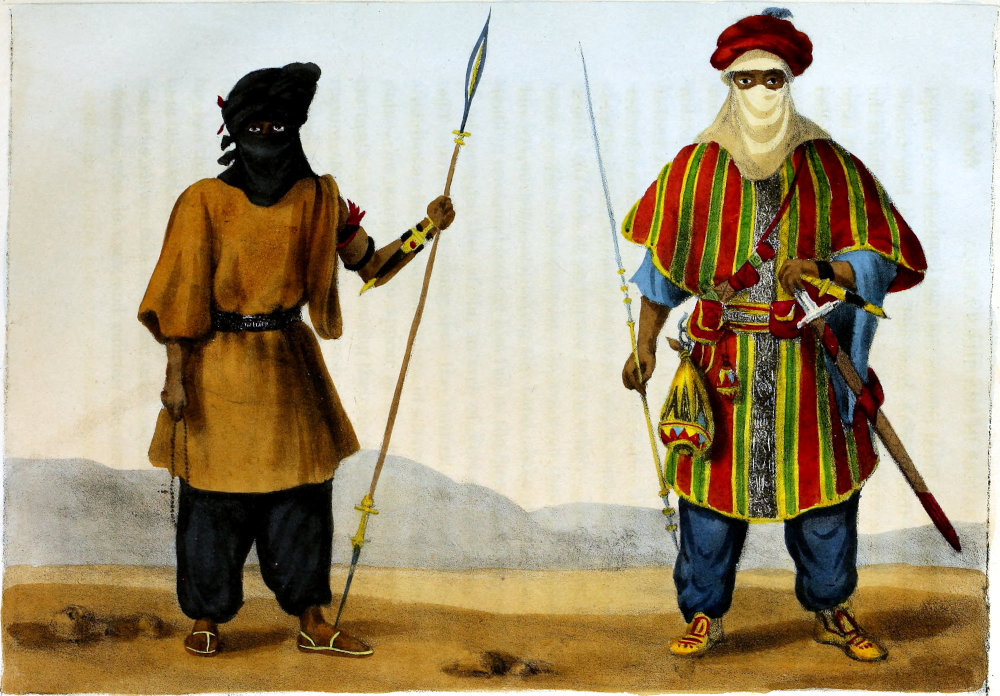
Many parties of Tuarick came with their slaves and goods, during the last month, (July), from Kashna, Aghades, and Ghraat. They are the finest race of men I ever saw; tall, straight, and handsome, with a certain air of independence and pride, which is very imposing. They are generally white, that is to say, comparatively so; the dark brown of their complexions only being occasioned by the heat of the climate. Their arms or bodies, (where constantly covered), are as white as those of many Europeans. Their costume is very remarkable, and they cover their faces as high as the eyes, in the manner of women on the sea-coast. Their original motive for so doing is now forgotten; but they say it must be right, as it was the fashion of their forefathers. This covering extends as high as half way up the bridge of the nose, from whence it hangs down below the chin on the breast, much in the same way (but longer) as crape or lace is hung to a lady’s half mask. This cloth is generally of blue glazed cotton; but yellow, red, white, and many other colours are worn according to taste, or the ability of the wearer to purchase them. The beard is kept close clipped, so as not to interfere with the covering which is tied behind; their red caps are generally very high, but some wear yellow or green ones, fitted close to the head: others have no caps at all, but leave their hair to grow, and plait it in long tresses. All wear turbans, which are never of any fixed colour: blue is the most common and cheap; but gaudy hues are preferred. A large loose shirt (having the sleeves the same size as the body), called Tobe, is the common dress; it is of cotton, generally blue, or blue and white, and is of their own manufacture, although some wear those of Soudan, which are considered the best that are made. The merchants generally dress very gaudily while in the towns, wearing kaftans of bright red cloth, or very gay silk and cotton striped, which they procure from the Tripoline traders. A leather kaftan is also much worn, of their own manufacture, as are leather shirts of the skins of antelopes, very neatly sewed, and well prepared. Their trowsers are not made so full as those of the Moors, as they would in that case be much encumbered in riding their maherries: they rather resemble those called Cossack trowsers, and are made of cotton stuff, dark blue being the most common. Their sandals are the most elegant part of their dress, being made of black leather, with scarlet thongs to brace them to the feet. The ornamental needle-work on the inside of the sole is really admirable. They all wear a whip, hanging from a belt passed over the left shoulder by the right side. Their swords are straight and of great length, and they wield them with much ease and dexterity. From the left wrist is suspended a dagger, with the hilt towards the hand; it has a broad leather ring attached to the scabbard, and through this the hand is passed. No Tuarick is ever seen without this appendage, and a light elegant spear, sometimes entirely of iron, inlaid with brass; others are of wood, but are also highly ornamented. These weapons are about six feet in length, and are thrown to a great distance. In making war, they have three longer and heavier spears, and a strong lance, which are fastened behind the saddle. A long gun is also generally carried; and these people are considered sure marksmen. They are, if possible, more superstitious than the natives of Fezzan; some of them being literally covered with charms against disorders and accidents, which they wear round their arms, legs, necks, across the breast, and in fact wherever they can find a place for them. Their spears and guns have also their due allowance, and in the folds of the turbans are always hidden a number of holy writings. Some wear large silver cases tied round the head, containing charms against the devil. Their language is the Breber, or original African tongue, still spoken in the mountains behind Tunis, in some parts of Morocco, and at Sockna, where it is called Ertana. On a future occasion I shall give a small vocabulary of it. They are very proud of the antiquity of their language, which some have told me was spoken by Noah, in preference to any other. They never kiss the hand as other Mohammedans do, not even that of the Sultan himself, but advance, and, taking the hand, shake it, and then retire, standing erect, and looking him full in the face—a striking contrast of manners to that of the natives of Fezzan. No people have more aversion to washing than the Tuarick generally have; some, after having equipped themselves in a new suit of blue, become so stained for a time as to appear of the same complexion as their garments. Even in performing their necessary purifications, which require that a man should wash in a particular way before his prayers, they avoid water, and make use of sand. Many attempts were made by us to discover the reason why they kept themselves in such a dirty state; but to all our inquiries we obtained nearly the same answers: “God never intended that man should injure his health, if he could avoid it: water having been given to man to drink, and cook with, it does not agree with the skin of a Tuarick, who always falls sick after much washing.” There are some, however, who do wash, and ridicule the dirty ones; but these are comparatively few. They are Moslem, and their prayers are in Arabic, of which language many do not understand a syllable; those who do pray (and there are many who do not) only repeat their belief, viz. “There is no God but God, and Mohammed is his prophet,” and know very little besides of their religion. They inhabit that immense tract of country, known in maps under the name of Sahara, or the Great Desert, and are of numerous tribes, some of whom have no settled habitations, but wander like the Arabs, and subsist by plunder. They are not cruel on these occasions, provided they meet with no resistance; but should the party attacked attempt to defend themselves, their death is certain.
Drawn from Nature by G. F. Lyon. On Stone by M. Gauci. Tuarick in a shirt of Leather. Tuarick of Aghades. London. Published by J. Murray Albemarle St. 1821. C. Hullmandel’s Lithography.
The Tuarick, or more properly tribes of them, are always at war with the Soudan states, and carry off from them incalculable numbers of slaves. They are so completely masters of their weapons, and so very courageous, that they are much dreaded, which enables them to traverse unmolested, and in very small bodies, countries full of armed people. Each tribe has some peculiarity in its dress, or manner of riding and making war. The nearest Tuarick to Fezzan are at Ghraat, which is ten days from Morzouk, and from Oubari, the most western village in the Wadey Shiati. Near Sebha (see map) it is seven days west by south.
Ghraat, غرعت is a walled town, having houses in streets, and built of stone and mud, in the same manner as Morzouk. It is twenty days from Tuat, طوات and five days from Ganat, which place is not, as has been generally supposed, a town, but merely a country producing dates, and having a few scattered huts and gardens, the wells of which are salt.
Ghadams, غدامس is twenty days north-west of Ghraat. At about the distance of five or six miles from the latter, is a town called El Berkaat, البركعت famous for the quantity and fineness of the grapes produced there. It is also a walled town, but rather smaller than its neighbour, which may be about the size of Sockna.
Drawn from Nature by G. F. Lyon. On Stone by M. Gauci. Tuaricks of Ghraat. London. Published by J. Murray Albemarle St. 1821. C. Hullmandel’s Lithography.
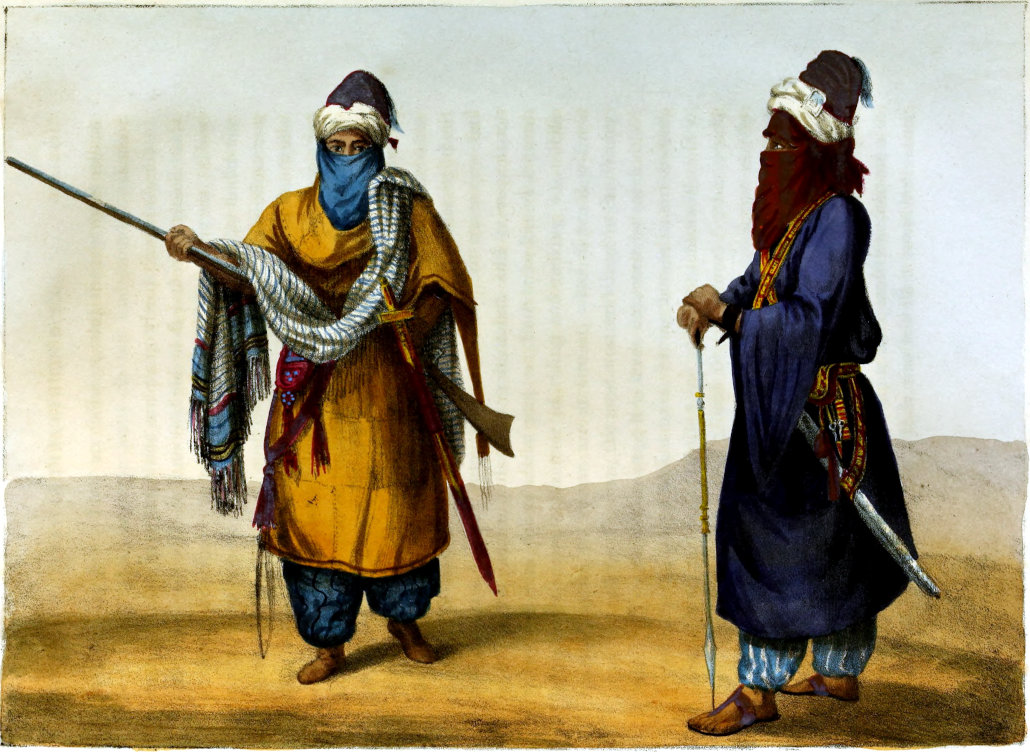
Ghraat is built partly on a plain, and partly on a steep hill side. It is closely surrounded by high mountains, which are perfectly barren: the plains are not sandy, but gravel. The Sheikh is there called Sultan, and his name is Bel Gassem. He receives but a precarious revenue, and that only from the settled inhabitants, who are called Ghratïa. The Tuarick show no respect to him, and pay no duties. They are generally wanderers, leaving only a few of each tribe in the country; but they never settle any where else. They are of the tribes Heggār, حقار, Booghrasāten, بوغراساتن, Menghrāata, منغرعت, and Haïoon, حيون; which last people are famed for sanctity, and there are but few of them who have not performed the pilgrimage to the Holy House. They are settled in the country, and seldom go to the negro kingdoms to trade. The Sultan has not the power of life and death; cannot alter or make laws; and is directed by an assembly of the elders of the people, who always try offences of a criminal nature, and then submit their sentence to him for his approval. He cannot even resolve on any measure of importance without first obtaining the permission of those elders. Neither in his dress, mode of living, or habitation, is he distinguished from the common people; and he walks about and trades by himself without attracting any notice. The Sultanship is hereditary, and not being a very desirable office, occasions no wars for the succession.
The Ghrātïa allow strangers to sit and converse with their wives and daughters, who seldom are known to abuse the liberty allowed them. They are said to be fine looking women, and inclined to corpulency. These people are reputed to be rich, from their constant trade with Soudan, and from having no one to deprive them of their gains. Provisions of all kinds are exorbitantly dear. The dates are not plentiful, and of a very inferior quality. They grow but little corn, and procure more from Morzouk in exchange for slaves, gold, or other merchandize.
The Tuarick of the tribes frequenting Ghraat are insatiable and unwearied beggars, generally securing possession, and then begging the thing taken as a present.
There is annually in the spring a great market, to which dealers from all the neighbouring countries resort in great numbers. The Ghadamsines bring swords, guns, powder, flints, lead and iron ware, also a few articles of clothing. The Soudan traders bring slaves, cotton cloths, skins, gold, civet, shears, daggers, water skins, Goroo nuts, &c.: the Fezzan merchants a mixed cargo of such goods as they procure from Tripoli or Egypt. Slaves and camels, dates and corn, are always the principal articles of commerce, and in great abundance. All traders have a tribute exacted from them by the Tuarick of the country. Clothing, some powder, or any small article, franks a Kafflé; and if a single trader goes, the same is expected from him: friends only being allowed to pass free. This tribute is called “safety money,” and once paid, the merchants are exempt from farther demand. The Mamlukes of Morzouk, or people sent by them, do not pay any thing, it being the interest of the Tuarick, who constantly come to the capital, to keep on terms with them.
The manner of riding amongst these people is very singular. They have swift, tall camels, called Maherry (the Herie of travellers), with which they perform extraordinary journeys. The saddle is placed on the withers, and confined by a band under the belly. It is very small, and difficult to sit, which is done by balancing with the feet against the neck of the animal, and holding a tight rein to steady the head. They manage these creatures with great dexterity, fighting when mounted on them, and firing at marks while at full speed, which is a long trot, in which, the maherry can continue at about nine miles an hour for many hours together. They do not much esteem horses, and never buy them but for the purpose of exchanging them for slaves in Soudan.
We had many visits from these extraordinary people, who came to see us as curiosities, and minutely examined every thing we would allow them to handle. The report which they had heard of our great knowledge, and of our being able to look steadfastly at the sun, or in other words, to take celestial observations, brought large parties to our habitation, on whom we not unfrequently played a few tricks. Phosphorus astonished them beyond all measure; kaleidoscopes, and the camera obscura, also excited great amazement; but the compass was quite beyond their comprehension, so much so, that they generally were afraid to touch it. Our arms were more suited to their taste, and they took much pleasure in handling them. The pistols with stop locks were looked upon with great reverence, and a sword which I had, with a pistol in the handle, was considered so valuable, that I might have purchased with it a couple of Negresses. Our having a stock of medicines was a sufficient inducement for all our visitors to find themselves very ill, and to imagine not one, but every disorder of the country. One man had bad eyes; if he succeeded in getting something to relieve them, the whole party all began immediately to blink, and affect to be half blind, hoping also to get some medicine. Another had a liver complaint; the rest then were all so ill as to be unable to walk or to speak without a great many ejaculatory oh’s; and so on, until they had exhausted the whole chapter of ailments. We at first gave them medicine, but soon discovered it was a preconcerted plan to impose on us, and that when one set had obtained what they wanted, another brought forward a friend or two, who were exactly in the same miserable and suffering state as themselves, and equally disposed to deceive us. One begged a little physic to keep in store, another some sugar just to taste, a small piece for their wives as a curiosity, and a few lumps into the bargain for their children: a little writing paper for charms, a handful of tobacco, one of our nice knives, or a pair of scissars, or a little powder to show when they got home, with many other et cæteras, until our patience being completely exhausted, we were obliged, very unceremoniously, and much to their astonishment, to push the whole party out of the house. Many amusing incidents occurred on the score of medical knowledge, which showed the implicit confidence reposed in us.
During Mr. Ritchie’s illness, an old man, aged eighty, came to consult us about his back, which was very much bent, and had been so for many years: he had seen us give a liniment to a person who had sprained his ankle, which got well in a few days; and his request was, that some of the same medicine might be given him to strengthen his back, which, he said, was becoming very inconvenient to him. One of the Tuarick, who had taken a very strong dose of salts, brought a friend to interpret for him, as he understood but little Arabic, and begged to be told what he was to do to stop the effects of the dose, lest, not rightly understanding me, he might be in danger of dying on the road. A Negress of the Sultan’s chief man being sick, sent her armlet to Mr. Ritchie, by which he was to discover her disorder, and to send her the requisite medicine. The Sultan’s own women were continually sending little bottles for something to cause them to bear children, and their emissaries sometimes whispered whether it was a boy or girl that was desired. Mr. Ritchie prescribed for the whole of the Sultan’s establishment, which, with the males and females, might amount to at least a hundred. Numbers came or sent daily with such an air of authority, as led us to suppose that Mukni had spread a report of his paying liberally for Mr. Ritchie’s attentions, which was not the case; on the contrary, we were all day weighing out doses for the slaves, who never even thanked us for our trouble; and when we were poor and destitute of every comfort, Mukni never gave us the slightest assistance: if, however, any of his family required charms for their disorders, the writers were liberally rewarded, and the effect of the medicines always attributed to those charms. When I commanded at the laboratory, I took good care to give such doses as were not easily forgotten, and, in consequence, none of his household ever after sent for medicine, unless really ill. Many of the women required a great deal of explanation, as to how any thing taken into the stomach could relieve a head-ache. Purgatives were always despised in comparison with emetics. The allowance which would suffice for a strong European took no effect with them; but when a double dose was given, it pleased so much, that many requests were made for “Just such another dose as was given to such a one, which made him so sick that he almost died.” The prevalent disorder when a man wanted medicine for novelty’s sake was, being “ill all over.”
By the 20th August, Mr. Ritchie had tolerably recovered. Mukni had several times, during his illness, talked publicly of his great friendship for us, declaring, that if we were in want even of a thousand dollars, he would immediately lend them: but his conduct was in direct contradiction to his professions; for although he visited Mr. Ritchie during his illness, he never offered him the least assistance, or even bestowed such trifling articles of nourishment as I requested. Once, and once only, when rice was not to be bought, he, with great parade, sent a quart, on which the poor invalid dined for eight days.
It became indeed but too apparent that he expected and wished us all to die, in which case he would have seized on, and appropriated all our effects and merchandise to his own use: of the latter, we had a great quantity, which Mr. Ritchie would not allow me to dispose of, lest it should lower us in the eyes of the natives; but I thought it could be of little consequence when compared with our lives, which were so perpetually endangered by want and privation. We had in vain tried to dispose of our horses; they were so lean, (and we had no money with which to buy any provision to fatten them) that no one would even look at them.
I had managed to keep my own in rather better case than the others, by giving him our travelling baskets, and occasionally stealing a little food for him, but still he was not sale-worthy. In this situation were our affairs, when in one of our visits to the Sultan, Mr. Ritchie ventured to ask from him the loan of some money: his answer, though a negative, was couched in very plausible and friendly terms; and he assured us, by the name of God, that we were welcome to all he had in the world, but that the Bashaw had lately exacted so much from him, that he had not a single dollar remaining. It happened, however, that on the preceding day, he had, to our certain knowledge, received 4000, which were deposited in the very chest against which he leant, whilst he uttered these falsehoods. Finding that nothing was to be gained at this visit, we retired in utter disappointment, not knowing where else to apply.
Belford, at this time, was attacked with giddiness and deafness, and fell into a very weak state. Our situation was daily becoming more deplorable in all respects; our rate of living was reduced to one saa, or quart of corn per diem, with occasionally a few dates, amongst four of us. Mukni’s spy, about this time, came and made some very mean offers, (but which Mr. Ritchie thought proper to reject) about purchasing our cloth and gunpowder, and we plainly perceived he was negotiating for the Sultan. We had endeavoured, indeed, to sell some of our merchandise, by offering it somewhat cheaper than the people of the country; but no one would actually buy, or even propose for it, and we then became convinced, that Mukni was the cause of all our distresses; he, however, still continued to call on us, proffering kindness which he never intended to fulfil.
Being now reduced to the last extremity, and Mr. Ritchie not thinking it right to draw for money on the Treasury, I drew a bill on my own private account, for £20, with which we proceeded immediately to the Sultan, hoping it would have the desired effect: Mr. Ritchie having at the former interview explained to them, that if he accommodated us with 80 dollars, and sent the draft to his (the Sultan’s) wife, who was then resident in Tripoli, she would instantly receive the amount from the British consul. He still, however, refused to assist us; when on a sudden, artfully pretending to mistake 8 for 80, he exclaimed, “Well! I did not think it necessary to draw a written agreement for so small a sum; I will, however, advance you the eight dollars you require, and you may return them when convenient.” Farther explanation to a man determined not to understand was wholly useless, and our poverty not allowing us to refuse the sum, however small, we accepted it; and immediately employed part of our newly acquired riches in treating ourselves with a little meat.
Though we knew not where to procure farther pecuniary aid, we were, for the moment, happy, and soon after had reason to be more so. We had, on coming to Morzouk, lent to our neighbour, Hadje Mahmoud, 20 dollars, of which he paid us 10; and now, in the moment of need, brought us the remainder. At this critical period, it acquired tenfold value, and was of course received with thankfulness and delight.
In this unexpected improvement of our circumstances, we determined to fatten our horses for sale, and to purchase some fowls and a milch ewe, as a resource against future illness. We frequently rode out to the gardens near the town, and Mr. Ritchie became again tolerably well, though I observed, with much regret, that his late and frequent disorders appeared to have very materially depressed his spirits, insomuch, that he almost constantly remained secluded in his own apartment, silent, unoccupied, and averse to every kind of society.
At the end of this month, a large Kafflé of Arabs, Tripolines, and Tibboo, arrived from Bornou, bringing with them 1400 slaves of both sexes and of all ages, the greater part being females. Several smaller parties had preceded them, many of whom also brought slaves. We rode out to meet the great kafflé, and to see them enter the town—it was indeed a piteous spectacle! These poor oppressed beings were, many of them, so exhausted as to be scarcely able to walk; their legs and feet were much swelled, and by their enormous size, formed a striking contrast with their emaciated bodies. They were all borne down with loads of fire-wood; and even poor little children, worn to skeletons by fatigue and hardships, were obliged to bear their burthen, while many of their inhuman masters rode on camels, with the dreaded whip suspended from their wrists, with which they, from time to time, enforced obedience from these wretched captives. Care was taken, however, that the hair of the females should be arranged in nice order, and that their bodies should be well oiled, whilst the males were closely shaven, to give them a good appearance on entering the town. Their dresses were simply the usual cotton wrappers, and even these, in many instances, were so torn, as scarcely to cover them. We observed one girl (of what country I know not) who had her back and shoulders burned in little sprigs, in a very curious manner, so as to resemble figured silk; it had a very pretty appearance, and must have been done when she was quite an infant. Some of the women carried little children on their backs, some of whom were so small, that they must have been born on the road.
The Tibboo, who bring the slaves from Bornou, are of the tribes on the road; and some are from Fezzan. They never trade to Soudan, on account of the distance; but prefer exchanging their slaves for horses, which they sell to great advantage in the interior: for though there are horses in Bornou, they are not much esteemed; but those of Tripoli are greatly valued. The Tibboo ride on saddles, resembling in some respects our English ones; but they are smaller, and have a high peak in front: their stirrups resemble ours, but they do not put the whole foot in them, only the four small toes, the great one remaining out; their shoes are all contrived for this purpose, by having a separate division for a great toe, and are made in the same manner as childrens’ mittens. Their bridles are also in our style, being much lighter than those of the Arabs. They are more careful of their horses than of their families, sparing no expense to fatten them; this is done by cramming them with large balls of meal or dough, which are considered highly nourishing. A fine horse will, in the Negro country, sell for 10 or 15 Negresses; each of which, at the Barbary ports, is worth from 80 to 150 dollars.
All the traders speak of slaves as farmers do of cattle. Those recently brought from the interior were fattening, in order that they might be able to go on to Tripoli, Benghazi, or Egypt: thus a distance of 1600 or 1800 miles is to be traversed, from the time these poor creatures are taken from their homes, before they can be settled; whilst in the Interior they may, perhaps, be doomed to pass through the hands of eight or ten masters, who treat them well or ill, according to their pleasure. These devoted victims fondly hoping that each new purchaser may be the last, find perhaps that they have again to commence a journey equally long and dreary with the one they have just finished, under a burning sun, with new companions, but with the same miseries.
The females are always considered as bearing fatigue much better than the males; perhaps because their small allowance of food and water more easily suffices them. I have always observed that the men were more miserable in their appearance, and walked with more difficulty than the women.
Having been enabled to collect a great deal of information from Bornou traders, respecting that country, I shall here detail it; but I have to request my readers to bear in mind, that I only report what I have heard, and refrain from giving any opinion as to the Course of the Niger, having so often found how little the accounts concerning it are to be credited. I certainly have formed my own conjectures; but may be mistaken, as better theorists than myself have been, on that most interesting subject.
COUNTRY OF BORNOU, AS COLLECTED FROM TRADERS.
Bornou Language.
One Teelo
Two Andee
Three Yaskoo
Four Daigoo
Five Oogoo
Six Araskoo
Seven Tuller
Eight Oskoo
Nine Lekār
Ten Maigoo
Twenty Maigoo lata Maigoo
Hundred Jarroo
Man Kooa
Woman Mata
Father Abbah
Mother Yany
Head Kela
Eyes Shim
Nose Kensha
Hair Kondoly
Teeth Timmi
Belly Soro
Hand Moskoo
Foot Shie
Blood Boo
Day Koo
Night Booné
Sleep Koonem
Dead Nowy
White Bull
Black Tsellm
Sun Koo
Moon Kengāl
Stars Shilluga
Stone Kow
Good Unglla
Fire Kanno
Water Ankee
Earth Shiddi
Bird Ongoodo
Egg Engoôbble
Fish Boney
Camel Kalgāmoo
Cow Faï
God Allah الله
Bornou is a large tract of country, 40 days’ journey, or about 700 miles, south of Fezzan. It is bounded on the east by Baghermi, on the west by Kano كنّو, and to the northward by Kanem. Few traders ever go due south of Bornou, and are therefore unable to speak of the countries in that direction. There are many contradictions respecting the principal town, called Birnie برني; or more properly, Birnie Jedeed or new Birnie, to distinguish it from another town, called Gedeem or old.
These towns are five days east and west of each other, and the River Tsād runs near them both. The old town is the most to the westward, and is now nearly forsaken. In consequence of its vicinity to the Fellāta, who were masters of Soudan, it was constantly exposed to Ghrazzies, or incursions for the purpose of carrying off the natives; and even single inhabitants were often seized and dragged from their labour by small marauding parties, who lay in ambush for them. It was therefore determined about eight years since, to build a new town more in the centre of their country, and to forsake what had been their capital from the earliest times in which they were known.
Thus it is that the accounts received are often materially different: those who have visited the old town, giving their distances from it, whilst more recent traders speak only of the new one. All the distances I have laid down are from the last.
From Birnie to Baghermi is ten days to the borders, S.E. Looggan, a town of Bornou, is half way, or five days; and the Tsād runs past it, across the road, in such a way, that those going to Baghermi must necessarily pass it. This river runs from S.W. to N.E. is of great breadth, and is crossed by heavy goods being carried on rafts, floated on large gourds, which are impelled forward by swimmers, who hold or push with one hand whilst they strike with the other. Smaller rafts are used to carry four or five men, or some light goods; these, according to my informants, are formed with cross spars and gourds. The men sit astride on this machine, having their legs in the water, and so propel themselves forward with their hands and feet. A lighter vehicle is used for one man, and is merely a spar on two flat gourds, carried on by paddling with the feet and a small oar.
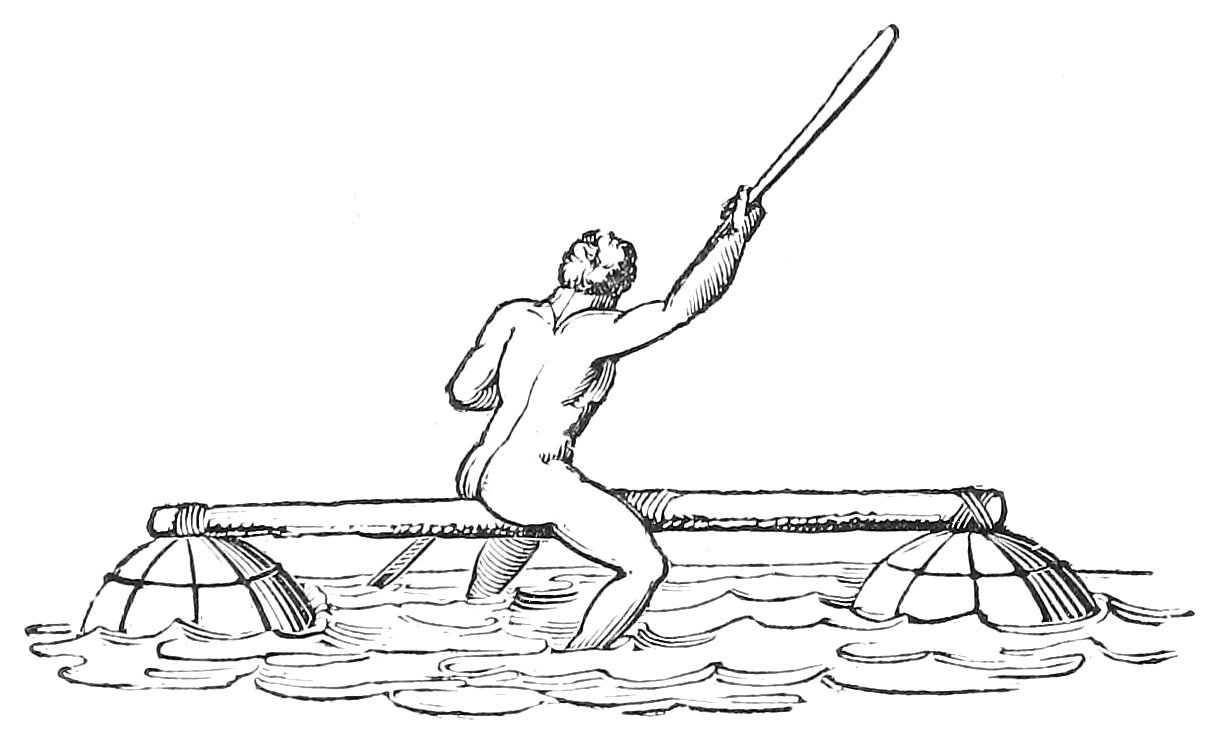
I learnt with astonishment, that though the river has many crocodiles, they never attack the legs of people passing in this manner. Whether the raft or the bright yellow of the gourds intimidates them I cannot tell, but so it is.
The river, according to the natives, is said to run past Foor— (Dar fur of Brown), and thence to Egypt. Horses are swam over, being buoyed up with inflated water-skins slung round them; and camels are conducted by men who hold them by their long upper lips, and keep their heads above water: the forepart of that animal being the heaviest, another man sits behind the hump, in order to raise the fore and depress the hinder parts, whilst crossing.
Almost every account we received of the Tsād was so materially different, that it long remained a puzzle to us, how to account for such palpable errors as some of our informers must have fallen into. Some declared it to be so large a Lake, that the opposite side of it could not be seen from Birnie; others termed it an inconsiderable river: at last, the nephew of the Kadi, who had just arrived, furnished us with the following clear statement. “The Tsād is not a river, but an immense Lake, into which many streams discharge themselves after the summer rains. It is then, for some months, of such extent, that the opposite shores cannot be seen, and the people catch many fish, and go about on it in boats. In the early part of the spring, when the great heats come on, it soon changes its appearance, and dries up, with the exception of a small rill. This streamlet, which runs through the centre of its bed, is called by the same name, and comes from the westward, taking an easterly direction; but to what place he knows not.”
All the inhabitants of the villages on the borders of the Lake go out and sow corn and esculent vegetables, which come to maturity, and are gathered in before the rainy season, as in Egypt, after the flowing of the Nile, which he has seen. He had himself observed the people getting in their harvest on the same ground which he had, only a few months before, known to be covered with water.
The rivers which, he says, flow into the lake after the rains, appear to be torrents from the mountains, as he never observed more than the small stream I have mentioned in the dry season.
The Tsād is also called the Gambarro after it quits Birnie, and even there it is as frequently called the Nil. Until a few years ago, when the country became much improved under the mild government of a very religious Moslem, it was the custom to throw into the stream at the time of its rise a virgin richly dressed, and of superior beauty. The greatest people of the country considered themselves honoured if the preference was given to one of their daughters, and the learned men augured a good or bad year from the ease or difficulty with which their victim was drowned.
There are several tribes of wandering Tibboo to the northward of Bornou, the principal of which are the Wandela, Gunda, and Traïta. These people are principally Kaffirs: they do not trade, but live by their flocks, and not unfrequently by pillage.
To the eastward of Bornou, near Baghermi, is a country called Mandra, which is tributary to Bornou, but does not escape the incursions for slaves, which are frequently made by its nominal protectors. The language of this country is a corrupt dialect of the Bornou. The people are finely formed, and the females have lively intelligent countenances: they are all Kaffirs, and live in huts of grass, woven like mats, and sewed together, called Booshīa.
I shall have occasion, when speaking of the country of the Tibboo, to mention three rivers of note which I am able to trace to some distance at ten days to the north of Wadāy.
I now return to the accounts of the bearings of several places of note from Bornou.
Birnie Jedeed to
Baghermi, ten long days, east-south-east.
Maoo, principal town of Kanem, fifteen days, north-north-east.
Kanno, ten days, west.
Kooka, fifteen days, east by south.
Kattagum, four days, west-south-west.
Ringhem, nine days, west-south-west.
Shaikoo, two days, west.
Kawar, ten days, north-eastward.
Bilma, fifteen days, north-eastward.
Makaree, eight days, east-south-east.
Ongornoo, fourteen days, east by south.
Zegzeg, fifteen days, south-west.
Zakari, eight days, westerly.
Waday, sixteen days, easterly.
Bahr el Ghazal (south part), ten days, east-north-east.
Kashna, sixteen days, west.
Morzouk, forty days, north.
At Kattagum, a river called Nil by the natives flows across the road from Bornou to Kashna to the north-east. It is of great magnitude, and is passed on rafts; the water is sweet, and full of fish. It rises periodically, and sometimes overflows the country.
Ongornoo is situated within a day of Kooka, and is much frequented by traders in the spring, when a large market is held there, principally for slaves, who are brought from all the surrounding countries in security; a general armistice prevailing during the annual sale. It is subject to Bornou: the people are Mohammedans. A river flows past it to the eastward.
Bahr el Ghazal, the south part of which is about ten days east-north-east of Birnie, runs nearly north-east and south-west for a great distance. It is inhabited by Negro tribes, of whom the greater part are Kaffirs, or, at all events, not Moslems. The nearest part of it to Bornou is about ten days east-north-east. It is an immense wadey, or valley full of trees, and having many inhabitants, who are wanderers. Elephants, rhinoceroses, lions, buffaloes, and the camelopard, or giraffe, called Jimel Allah جمل الله, or God’s camel, by the Arabs, are in great numbers. The natives generally use a kind of corrupt Arabic, though one or two languages peculiar to the country are also spoken.
These people are a fine race, well made, and very active. They wear their hair, which is not woolly, long and plaited. The general dress is leather, but some go entirely naked. The cattle are in such numbers, that parts of the country appear literally covered with them. Great quantities of elephants’ teeth are procured in the woods.
All the accounts of this country agree in one material point, namely, that though called Bahr, there is no river; but that there has been one of great magnitude. Immense bones of unknown animals and fish are frequently found here in a state of petrifaction. The Arabs account for this, by saying, “They went to take them up as bones, but by a deception of Iblis they proved to be stones.” Handsome shells, Beit el Khoot, بيت الخوت or “fishes’ houses,” are often found imbedded in the earth, and retaining a fine polish. Some are so large, that the Negroes make trumpets of them. By their description of the bones and vertebræ, some of the fish must have been ten or twelve feet in length.
Battalïa, which is often called Bahr, appears by some accounts to be near Bahr el Ghazal, while others assert that it is part of it. The same accounts of its having once been a river, and of petrified bones being found in it, are generally believed.
Bornou is governed by a Sultan, who is considered very powerful; but of late years he has allowed the Sheikh of Kanem (which country is dependant) to encroach upon his authority. The Sheikh, who is a great Marāboot, never uses gold or silver in his apparel, and confines himself to four wives; but has several female slaves, who have borne him a multitude of children. He is constantly making war, under the plea of religion, against the neighbouring Kaffirs, and has enriched himself by the immense number of slaves and horses which he has taken. He lives at Kanem, in the chief town Maoo, which is fifteen days north-north-east of Birnie: his name is El Hadge el Ameen. All the traders from Fezzan carry him presents, and consider him as a far greater man than his master, who now lives in a very retired manner.
In Kanem, within one day of Maoo (the capital), is a very large river, which comes from the south-west, and runs to the north-east. It is deep, broad, and full of fish, which the natives dry in the sun, and keep in store for the rainy season; it is called by the people of the country Yaoo, but by the Moorish traders, Nil.
On Mukni’s last excursion in that direction, he made an attack on the defenceless people of Kanem, Moslem as well as Kaffir: and having first burnt their town, pursued them to the banks of the river; many were drowned in attempting to cross it; others were taken out of the water; and the women and children who had not the power of escaping, were caught on the banks; the number of captives made on that day amounting to 1800. The route of Mukni’s army on its return, was over a wide sandy desert, without water for three days. During their journey a tremendous wind arose, which blew the sand about in all directions, and continued to rage in so furious a manner during two entire days, that Mukni and his people were totally at a loss in what direction to proceed. On the second evening, however, it was resolved that a number of the captives should be sent on under a small guard; but many of these poor creatures expired by the way: the remaining few succeeded in finding a watering place. Mukni himself remained until the third morning; when the sand wind still continuing, and his impatience increasing in proportion to the delay, he gave an order that all the remaining slaves should be put to death. This cruel mandate was immediately executed in cold blood on three hundred defenceless beings, whose country he had first entered under the mask of friendship, pretending that he came only to wage war against some states which had injured them. This aggravated cruelty and treachery was therefore the more odious; and his very name, in consequence, is never mentioned by the people of that country without curses on himself and ancestors, which even little children are taught to utter as soon as they can speak. This war on Kanem set the wild tribes in motion, and a ferment arose, which, even three years after, was not appeased. The Sheikh of Kanem, whom I have already mentioned, was fortunate enough, on this dreadful occasion, to escape to Birnie, many of his family having fallen sacrifices to Mukni’s barbarity.
In Bornou there is current a small copper coin of little value, which is struck in the country. Gold is also used, but more generally as an ornament, than as an object of exchange. The people are called Believers, but a great part of them are Kaffirs. Their dresses, in the most civilized parts, are of cotton. Their arms are lances, bows, and arrows: the Sheikh and a few of the Sultan’s guards have muskets; but they are unable to make good powder. It is reported, that in Birnie are 60,000 horsemen, who have armour for themselves and horses, which are small but hardy, and are said not to run as other horses do, but to spring forward by repeated bounds: large ones are in great request, and are chiefly purchased from the Fezzan traders. Wedda, ودّه or cowrie shells, are not used as money, but as ornaments, and bands for the head. The country is very fertile, producing corn and fruits; amongst others the Tamarind, طمر الهندي, or fruit of the Indies. The woods are numerous, and the trees very large and shady: from these the boards are brought on which prayers are written, and children taught to read.
From Tegerry to Kanem is 20 days south by east; Kanem to Bornou is 15 south by west. Many of the Kafflés pass over the countries of the Tibboo, and through the desert of Bilma, from whence they enter on the borders of Bornou. As I intend speaking of these places on a future occasion, the routes I shall there mention may be taken as the nearest.
of kashna and soudan in general.—from morzouk to kashna.
South-west by south.
Morzouk to Akraf 14 days.
Akraf to Felezlis 4
Felezlis to Tadent 4
Tadent to Assieu 6
Assieu to Trajeet 4
Trajeet to Seloofia 2
Seloofia to Āghades 2
Āghades to Begzam 3
Begzam to Ghrulghīwa 3
Ghrulghiwa to Tagama 7
Tagama to Kashna 7
56 days, of 20 miles per diem.
Āghades is a large district, having a town of the same name; it is 36 days from Morzouk in summer, and in winter is sometimes 45. It is 15 or 20 days from Kashna; 20 from Bornou; 6 from Asouda; 3 or 4 from Begzam; 30 in summer, and 35 or 40 in winter, from Ghraat; and 40 from Tuat. The inhabitants are Tuarick of the tribe of Kellewi. It is a larger town than Morzouk; the houses are of mud, and are built in the same style, and of the same size, as in Fezzan: some have a kind of second story. It is surrounded by a wall of mud and stone, of sufficient strength to protect it. There is a very high Mouadden or Minaret to the principal mosque, which the Tuarick affect to consider higher than any in Egypt. The country is independent, and is governed by a Sheikh, who is a Mulatto, and of middle age, named Yusuffah. He is considered as great a man as the Sultan of Fezzan. Dome dates are in great plenty: the common ones are scarce, and never arrive at any degree of perfection. The soil of the country is earth, not sand, and is quite covered with grass. There are large trees, chiefly the Talhh. Corn and vegetables are in plenty, and animal food is very cheap. The people are rigid Moslems.
Kashna is 20 days from Noofy. I here give an account of the road, as we received it from a friend of Horneman’s, who is well acquainted with Soudan.
West ⎧ ⎪ ⎪ ⎪ ⎪ ⎪ ⎨ ⎪ ⎪ ⎪ ⎪ ⎪ ⎩ Kashna to Yandekka.
Yandekka to Doogroomakee.
Doogroomakee to Zurmee, a very large town.
Zurmee to Faoushee, or Zanfara.
Faoushee to Doofa Mafora.
Doofa Mafora to Thalata noma.
Thalata noma to Bacoora.
Bacoora to Gandee.
Gandee to Burnee dengāda.
Burnee dengāda to Sakkatoo, a large Fellata town.
Sakkatoo to Mifferadaati; from whence several small
towns are passed until Noofy, which is a country on the borders of the Nil. Its chief town is Bakkanee; and it was there that Horneman died, in the house of a man called Ali el Felatni. Our informant gave the following account of his having accompanied Horneman from Morzouk to that place. They first became acquainted in Fezzan, from whence they went together with a large Kafflé to Bornou, when they separated. After Horneman had resided three or four months there, they again met in a Kafflé going to Kashna, and associated much together. The people became greatly attached to Horneman, on account of his amiable deportment and skill in medicine; and he was generally considered as a Marāboot. After a short time they proceeded with another party of merchants to Noofy, living together in the house of a man named Ali, of the tribe Fellata. It was Horneman’s custom while on his journeys after quitting Fezzan, to note down the bearings of every tree, mountain, or village, he saw; by which means he might be more easily enabled to know his road again without a guide. His intention was to go on through Dagomba to Ashantee, which is forty days’ journey to the southward. When our merchant left Noofy, he was in good health and spirits, and had not experienced any difficulties; but this man, on arriving in Kashna, heard that Horneman had died of dysentery, a few days after their separation.
The clearest account I have yet heard of the rivers which flow near Kashna is from a person named Mustapha, a son of the old Mamluke who, with his two other sons, was strangled by Mukni. This man fled, and spent some years in Soudan. He has himself passed three rivers, all running from east to west, as he thinks; but will not be positive. One alone is very considerable; fish, alligators, and hippopotami, being found in it. It is very deep, and is passed in boats, and by rafts. He mentions the rivers in the following order:
Kashna to the river Ringhem is seven days east. This river is the smallest; it is deep, but narrow; water quite fresh. A town, called Sankara, is distant one day east.
From Kashna to the river Doodroo is six days nearly south. On this river are canoes, which are hollowed out of a single tree: they have sharp bottoms, not rounded. They are numerous, and serve equally well for fishing, and for ferry-boats from shore to shore.
From Kashna to Kattagum (which again appears east-north-east on the road to Bornou) south-east is ten days. This river is at all times large; but after the rains it overflows the country. During the inundation the natives use rafts floated on gourds, which grow to an extraordinary size. A quantity of these are scooped out, and lashed together; a deck is then formed of brushwood, or bundles of rushes.
The only palpable inaccuracy in his account (and which, indeed, is a great one) is that relating to the course of these rivers: he was by no means certain whether they flowed to or from the east, and always concluded by saying, that he never had thought it worth while to remember the circumstance.
From Kashna to Sakkatoo is nine days and a half west. This place is the residence of Bello, son of the celebrated Fellata chief Hatman Danfodio. It is a walled town of much consideration, three days east of Gooberr, which is also a Fellata town, and one day east of Kebbi (the Cabi of our maps.) The natives are now a settled people, but were once wanderers of the warlike tribe of Fellata, who, some years since, came from the west, and succeeded in overcoming the whole of Soudan, carrying their conquests as far as old Birnie, and causing the Sultan and his people to remove five days farther to the eastward. These conquests have, in the end, occasioned their ruin; for not having it in their power to continue a force in each subjugated country, they became scattered, and were easily driven back by the different tribes who had been subject to them. They now are not found (except in small parties) farther east than Kashna. Their complexion being of a much lighter hue than that of the other tribes, they call themselves white; their colour resembles that of our gipsies in England.
Many female slaves are brought to Morzouk from their nation, and are very handsome women. The men I have never seen, and I understand that in the late wars all the male prisoners were put to death. They walk very erect, and have rather a haughty expression of countenance. These people have been of late chiefly at war with the Tuarick, who are powerful enemies, and harass them continually.
Kashna is still in a great measure dependant on Bello, who appoints its Kaid or Governor. This man is named Mellona Amarroo Delagie, and assumes the title of Sultan in his master’s absence. He makes constant incursions on the countries round him, and is much dreaded; though he sometimes suffers severely from retaliations. His family consists of two hundred Negresses, and the same number of children, which they have borne him. I conceive from a vocabulary, which I subjoin, that the Fellata will be found to be the Foulah of Park: they call themselves Fellan.
From a young woman, who arrived direct from Sakkatoo, I obtained some trifling information. The account she gave of herself was, that as she was leading her cows out to feed, a party of Gooberr people (also Fellata, and subject to the same King), seized and brought her away; but meeting on their progress with some Tuarick, she was sold to them. Her complexion was fair, and she had an intelligent countenance; her legs were much swelled, and her form emaciated. She was called into her master’s presence to give me some words of her language, when I began by asking her how she named a man in her country: thinking I wished to know that of her husband, she looked up, and with tears in her eyes, answered, “Mohammed; but he is alone now;” and then added, “I had a little boy, too, called Mohammed; when I was stolen he had no teeth, and I know not who will suckle him.”
I here subjoin the words she taught me.
Man Efillo.
Woman Debbo.
Boy Pipullo.
Girl Bitadeppo.
Small Toccochu.
Heavy Teddoodoo.
Light Oodumhaïneddi.
I understand Andal.
Hand Jungo.
Head Hora.
Sun Naanga.
Moon Laighroo.
Stars Caudie.
Meat Niri.
Flesh Taïoo.
Horse Pootchio.
Cow Nagga.
Ass Babba.
Camel Gailopa.
Goat Baïa.
Sheep Baloo.
Dog Kootooroo.
Walk Jiadoo.
Sleep Fokadaan.
Come Warr.
Go Beadillo.
Good Oodonwodi.
Bad Kalloodoo.
Large Maoodoo.
River Lana.
Eat Aniami.
Drink Ghiarki.
Sweet Oodomwaili.
Sour Oodomlammi.
Heaven Samaachi.
Father Babama.
Mother Imāma.
Elder brother Maoona.
Younger brother Minia.
Sister Bānda.
Grandfather Mamama.
Wife Tirajumma.
Friend Haigomo.
Foot Koinka.
Leg Korla.
I do not Mianda.
Milk Koossum.
Mat Dago.
Carpet Baïtookki.
Pillow Ting ada.
I Mahan.
You Maan.
He Damaitoo.
Shirt Toggora.
Trowsers Serla.
Gold Laamdi.
Iron Yamgoo.
Corn Elcamarani.
Maize Baïra.
Gussub Gaouri.
Tree Barkihi.
Wood Leddi.
Water Ghium.
Fire Eeta.
God Allah.
House Oora.
Town Gerri.
Bowl Laa.
A well Oondoo.
Water Ghium.
Rope Bogool.
Bucket Kianga.
Book Deftera.
To-day Ilanda nundi.
To-morrow Tiango.
Yesterday Fadijiango.
Not yet Towli.
I am ill Tyawdoo.
I am well Hairama.
Beads Kaadeh.
Petticoat Oodarra.
Aba Godori.
Thigh Asanga.
Arm Kiauwall ghisingo.
Belly Kraigoo.
Back Baoo.
Breast Barendi.
Neck Daandi.
Nipples Endoo.
Fingers Honedoo.
Cap Hoffanaïra.
Cat Mussouroo.
Shoes Paddi.
Beard Wari.
Eye Gitta.
Nose Hinari.
Mouth Kondookkoo.
Forehead Teeda.
Ear Leppi.
Turban Maitello.
Blood Eia.
Bones Kial.
Burn Awli.
Roast Awoodi.
Hot Odunwooli.
Cold Dumfai.
Hungry Ïam.
I am full Mihāri.
Thirsty Nanadumka.
This Doondo.
Give Okon.
Take Gabboo.
Fat Paidoo.
Thin Fautdo.
Dirty Toondi.
Clean Loomram mitell.
Tired Ensoomi.
Language Bolli.
Sword Kansakali.
Stone Booddi.
Sand Jearidi.
Earth Laidi.
Red Bodaijo.
White Daraijiu.
Black Balaijiu.
Green Koraijiuna.
Yellow Jianajiu.
Get up and go Ummadillo.
Grass Koodoo.
Hard Uddumyori.
Soft Oodum haihaitirri.
How are you Mia Loodoo.
Well Noobāndoo.
Whence come Kai ooaidi.
Where going Tingailta.
Is he within Uden wodi.
He is not Unwalla.
Garden Engassa.
Run Endogga.
Quick Ommandillo.
Enough Doodoo.
A little Sedda.
To weave Sansanbi.
Flour Kiandi.
Pepper Syasi.
Poor Kolakomi.
Rich Waidande.
Honey Jumeri.
Bird Soodoo.
Fowl Gertooka.
Pigeon Umfoodi sondo.
Set down Jiaura.
Night Ghem.
Morning Dun waidi.
Day Hansi.
Lion Jagerri.
Arrow Lebbo.
Glass Karroo.
Spoon Gerbal.
Pot Footira.
Knife Lab.
Spear Ghembirri.
Dagger Labijungo.
Gun Bendiga.
Rain Ghium ghiwondi.
Brass Yamgo daikoo.
Tiger Melaho.
Antelope Lelwa.
Happy Well well ti.
I am sad Berna metti.
Sing Ghimmoo.
Dance Fidio.
Fear Dooba.
Teeth Nïa.
I thank you Allah imoghni.
Bello, son, as I have said, of the celebrated Fellata Chief, is famed for many very noble actions, and is a man generally beloved. He is a great warrior, and the people about him are very well armed and appointed. He does not, like the other chiefs, seek out the gaudy dresses and toys brought by the Kafflés, but buys up arms of all descriptions. Reverence for his religion, and for those who are eminent in it, are amongst his virtues. I was acquainted with a man who passed himself off as a Shreef, which he was not, and who had been plundered by the Tuarick. Bello actually presented to this impostor one hundred Negresses, thinking that he only offered a slight testimony of respect to the memory of the Prophet in the person of his pretended descendant.