Chapter I
Reading edition
The Author’s Departure from Malta — Arrival at Tripoli — Character of Mohammed el Mukni, Bey of Fezzan — Equipment of Mr. Ritchie and the Author — Costume of the Natives of Tripoli — Character of the Marāboots, and Celebration of their annual Festival — The Natives of Tripoli — Their Habits, Customs, &c. — Public Baths — Punishments — Costumes of the Women — Tripoline Marriages and Funerals — Funeral of the Bashaw’s Grand-daughter — Resignation of M. Dupont — Journey to the Gharian Mountains and Benioleed, in Company with Mr. Ritchie — General Appearance of the Country — Arrival at the Gharian Mountains — Visit to the Sheikh — Short Account of the Passes — Roman Tomb — Castle of Gharian — Distressed State of Usadena — Account of the People of Gharian — Set out for Benioleed, through the gravelly Desert — Arrival at Benioleed — Character of the Inhabitants — Its Population — Description of the Arabs — Their Religion, Manners, Habits, &c.
IN the month of September, 1818, Mr. Ritchie, a gentleman of great science and ability, employed by the British government on a mission to the interior of Africa, arrived at Malta from Marseilles, attended by M. Dupont, a Frenchman in his pay, whom he had engaged for the purpose of collecting and preparing objects of natural history. It was understood that Captain Marryat, of the Royal Navy, was also to have accompanied Mr. Ritchie; but that circumstances had occurred which induced that gentleman to relinquish his intention of joining the mission. Soon after Mr. Ritchie’s arrival in Malta, I was fortunate enough to become acquainted with him, and hearing him express his disappointment at having failed to obtain Captain Marryat as his companion on the proposed expedition, I ventured to offer my best endeavours to supply his place, and although conscious that I had but little talent to boast, I yet hoped that the zeal by which I was actuated would in some degree make amends for my deficiencies in other respects. Mr. Ritchie, without hesitation, accepted my proposal, and in consequence lost no time in applying to Admiral Sir C. V. Penrose, Commander-in-Chief in the Mediterranean, to solicit the necessary leave for my quitting the Albion. Sir C. Penrose, in the kindest and most flattering manner, acceded to the request, and immediately wrote in my favour to the Lords of the Admiralty, to obtain permission for me to belong to the mission. Mr. Ritchie in the meantime occupied himself in making preparations for his departure; and, as an addition to his small party, engaged a ship-wright from the dockyard, Malta, named John Belford (who, as well as myself, was a volunteer), to accompany him. His arrangements thus made, Mr. Ritchie, on the 10th October, sailed for Tripoli in the Admiral’s schooner, leaving me behind, anxiously awaiting an answer from England to the application made for me. I employed this period of suspense in acquiring the Arabic alphabet, and in otherwise preparing myself for the object in view. On 19th November the wished for permission arrived, and on November 21st I sailed from Malta in the tender for Tripoli, at which place I arrived on the 25th of November, 1818. I found Mr. Ritchie still there, and likely to remain sometime longer. He was residing in the house of the British consul, Colonel Warrington, who received me most hospitably, and invited me to take up my quarters under his roof. Mr. Ritchie’s intention being to proceed to Mourzouk, مرزوك the capital of Fezzan فزّان with the Sultan of that country, his motions were to be regulated by the departure of this person, who, as we learned, was about to take with him a large body of men, for the purpose of waging war on the inhabitants of Waday, واداي (the Borgoo of Brown) which is to the southward and eastward of Fezzan; but as the people of Tripoli were by no means alert in coming forward, and as the Bashaw did not appear much inclined to compel them, no just idea could be formed as to the probable time of our setting off.
Mohammed el Mukni محمد المكني who at Tripoli is called the Bey of Fezzan, (but who takes the title of sultan on entering his own territories), is a man of about fifty years of age, of a fine martial appearance, and of great personal strength; but withal of an insatiable ambition and excessive avarice. He was one of the chief supporters and friends of the Bashaw during the reign of his father, and was afterwards of considerable assistance to him in quelling the disturbances which took place on his usurping the throne. Mukni was at this time in great favour, and considered as a person of much consequence. After his father’s death he became Bey el Noba, or collector of the Bashaw’s tribute from the Sultan of Fezzan, and went thither annually to receive it. Though the tribute was trifling, the office of Bey el Noba was held of great importance. It was while acting in this capacity that Horneman accompanied him to Fezzan. Mukni’s frequent visits to that country gave him opportunities of ascertaining that the sum paid as the tribute was but a very small part of the immense gains of the reigning Sultan; and having once determined on getting the kingdom into his own hands, he soon found means to influence the Bashaw to permit his removing the reigning family, under pretence that such a change would be for the Bashaw’s sole emolument. In 1811, therefore, he took a body of men by the Gharian mountains, and succeeded in reaching Mourzouk undiscovered. The detail of his proceedings would be wholly uninteresting; suffice it to say, that his ambitious views were fully accomplished. He caused the Sultan and his brother to be strangled, as well as the principal Mamluke and his two eldest sons; and pretending that it was unsafe to leave Mourzouk immediately after these acts of cruelty and injustice, he had the address to persuade the Bashaw to appoint him his viceroy, promising to increase the tribute to 15,000 dollars annually, whereas that of the former Sultan did not exceed 5000. Having thus established himself, he waged war on all his defenceless neighbours, and annually carried off 4000 or 5000 slaves. From one of these slave-hunts into Kanem he had just returned to Tripoli, with a numerous body of captives and many camels, and was, in consequence, in the highest favour with the Bashaw.
I learnt on my arrival that Mr. Ritchie had several times had interviews with the Bashaw, to whom he made many valuable presents; and that His Highness was fully informed of his proposed journey and plans respecting the interior. Though Mr. Ritchie himself never communicated with me on this subject, or made known what occurred at these interviews, I have every reason to conclude they were favourable to the object he had in view, and that the protection of the Bashaw, as far as his power extended, was fully ensured to the mission. The Sultan of Fezzan also on his side made the most flattering promises of protection; declaring that he only awaited the opportunity of showing his good will, and that, when arrived in his own dominions, he would act towards Mr. Ritchie as a brother, and assist him in all things to the utmost of his power. After my own introduction to Mukni, I frequently heard him repeat these expressions of regard towards Mr. Ritchie, and they extended also to myself, whom he promised equally to protect and assist.
With so powerful and friendly an ally as we had every reason to consider Mukni, we of course felt perfect security and confidence in the future, and we remained in the firm hope and assurance that all these flattering professions would be fully realised on our arrival in the kingdom of Fezzan. In a few days after I reached Tripoli I was introduced by the British Consul to the Bashaw; but as it was a private audience only, I had no opportunity of witnessing the splendour of his court. As neither Mr. Ritchie nor myself were yet equipped in our Moorish costume, which we were particularly advised by the Bashaw to adopt, we did not appear much in public; but having procured the Consul’s permission to reside in a house once belonging to the Portuguese consulate, we removed there in order to prepare ourselves for our outfit. I furnished myself with a horse and the greater part of my equipments, Mr. Ritchie not possessing sufficient funds for that purpose.
When presented to the Bashaw, it was thought absolutely necessary, by way of adding consequence and respectability to the mission, that I should be styled captain. I was therefore introduced as a Rais, or commander of a ship of war. Had I been supposed to have held an inferior rank, my reception by the great man would not have been so flattering, there being no intermediate gradation known in that country.
On the 5th of December, 1818, having accepted an invitation to pass the evening at the house of the Sheikh el Bled, or Governor of the town, we sent for an old barber to shave our heads; and our beards (which we had suffered to grow, and which now made a respectable appearance), were put in order for the occasion.
Our costume was that of the better class of Tripolines, who have two kinds of dresses; the one long, and worn chiefly by elderly men and persons of great consequence; the other short, and worn generally. For the information of future travellers, I shall enumerate the different articles of clothing.
Short Dress.
Sidrea.—A waistcoat fitting tight to the body, without any opening in front, having only holes for the neck and arms. It is pulled on in the same manner as the Guernsey frock used by seamen.
Farmela is a second waistcoat, open in front, and having broad gold lace and buttons, but no button-holes. It hangs over the sidrea.
Zibboon.—A jacket, the sleeves of which are embroidered. These first three dresses are confined round the waist by the band of the trowsers, which come outside them. A broad belt of silk or gold is then passed round the body. Over the jacket is an embroidered waistcoat without sleeves, called
Bidrïah.—All these dresses may be of different colours, the most brilliant and gaudy being chiefly in request. On walking out, a hooded cloak of very finely spun white wool is thrown over all, and on great occasions a cloth one of the same form, bordered with rich gold lace, is used. This cloak is called Bornouse. The trowsers are immense, and of silk or cloth, according to the pleasure of the wearer.
The Long Dress
Consists of the two under waistcoats: over them is worn a caftan, which is a long gown or robe, embroidered in front and at the sleeves. Over this is worn a
Beneish, which resembles a caftan in shape, but differs in the disposition of the ornaments.
Jerba is a caftan with short sleeves, and is often worn in lieu of the Beneish.
Drawn from Nature by G. F. Lyon. On Stone by M. Gauci. Costume of Tripoli. London. Published by J. Murray Albemarle St. Feb.1.1821. C. Hullmandel’s Lithography.
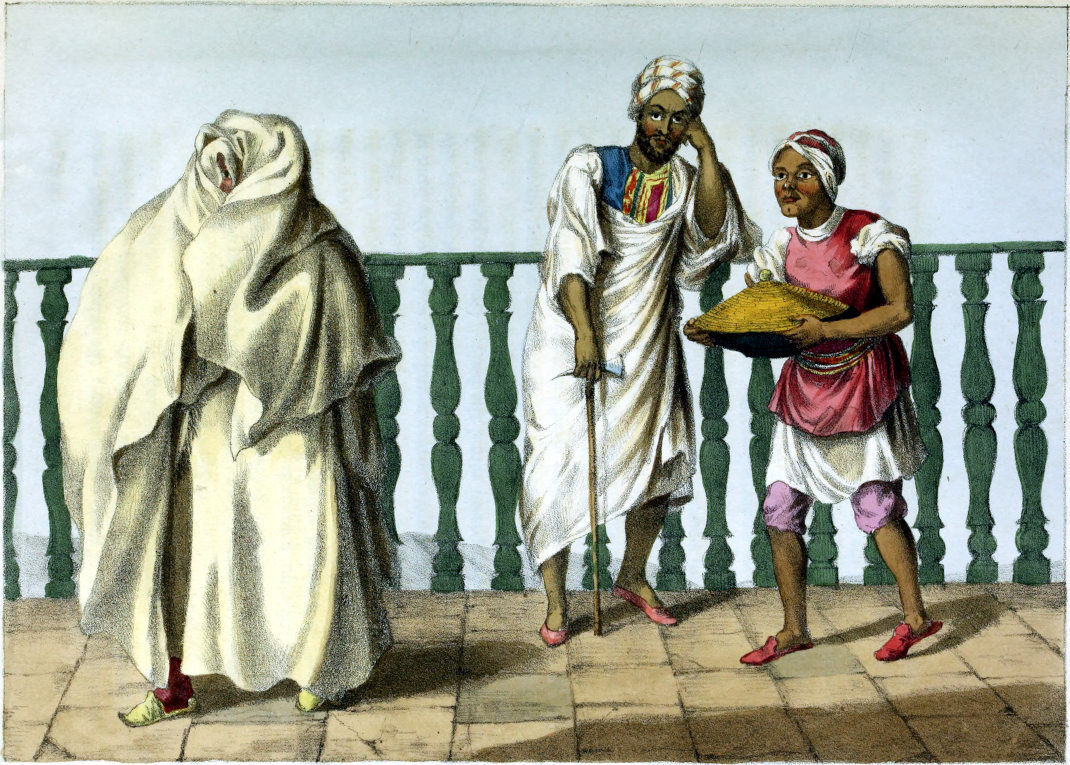
Over these dresses woollen and cloth Bornouses are worn. The turbans are various, according to fancy: shawls of Cashmere, or imitations of those of Europe, are considered as the most splendid. Green turbans, it is well known, can be worn by none who are not shreefs, or descendants of the prophet. Blue, being the colour confined to the Jews, is of course not used in the turbans of the Mohammedans.
In riding out, boots of red, and sometimes yellow Morocco leather are worn, a pad being closely tied round each ankle before putting them on, in order to prevent the large stirrups from hurting the leg. When not riding, yellow slippers, with soles of the same kind as the upper leathers, are used, and are slipped into large solid ones of the same colour with thick soles when walking out. These last are always left at the door on entering a room. Red shoes are also worn by the middle class. The Jews are restricted to black. The trappings of the horse are gaudy, and as cumbrous as those of its rider. The saddles are high before and behind, much the same as those used in Spain. Under them, on the back of the horse, are five or six cloths of different colours, which are so arranged that the edges of each are shown. The saddles are frequently covered with highly embroidered velvet, or richly embossed gilt cases. Over the seat is thrown a saddle-cloth, bordered with gilt lace and embroidery. The stirrups are from a foot to twenty inches in length, and are generally gilt.
Having thus given a sketch of the costume of the Tripoli men, I conceive it necessary to mention that we fully adopted the dress and appearance of Moslems, using all our endeavours to become acquainted with their manners. Mr. Ritchie assumed the name of Yussuf el Ritchie, يوسف الريتشي Belford was called Ali, Dupont Mourad, and I was styled Said ben abd Allah سعيدبن عبدالله. We found no difficulty in procuring a fighi (or clerk) of one of the mosques to visit us at stated periods to instruct us in reading. He also, at my particular request, gave me all the requisite information respecting the ceremonies used in prayer; and when I became perfect in them, I taught them to Mr. Ritchie.
Every thing now seemed to promise well, as far as our residence in Tripoli was concerned; but Mr. Ritchie felt much anxiety respecting a further allowance from government, as we had scarcely more than money sufficient to pay the hire of our camels to Mourzouk, and beyond that place we were uncertain how we could procure a fresh supply for the use of the mission. Mr. Ritchie had brought with him a good deal of merchandize; but, from what he learnt at Tripoli, it was likely to be of little service to us, as it consisted of few or none of the articles of trade most commonly used in the interior.
Sidi Mohammed d’Gheïs, formerly minister to the Bashaw, but who had retired some years since on account of total blindness, showed us every attention, and by his kind assistance afforded us most useful information. He had travelled much in Europe, and was well acquainted with our customs, so that he was perfectly qualified to caution us on many points which, had we remained in ignorance of them, would inevitably have betrayed us to be Christians to the people in the interior.
It would be useless to attempt giving any description of the city of Tripoli, as it has already been done by far more able pens than mine; but of any particular occurrences which attracted my attention during my residence there, I conceive I may be allowed to make mention. The most extraordinary characters are the Marāboots, مرابوت a set of people much spoken of in all Moslem countries; but it strikes me that the requisites necessary to constitute one of these saints are not every where the same. In the interior they consist in keeping up the outward show of sanctity, in abstaining from proscribed liquors, in avoiding improper or profane expressions, in being faithful to the limited number of wives (namely four), and in not intriguing with the wives of other men; whilst in Tripoli such forbearance is by no means considered necessary. The Marāboots there, are of two classes: idiots, who are allowed to say and do whatever they please; and men possessed of all their senses, who, by juggling and performing many bold and disgusting tricks, establish to themselves the exclusive right of being the greatest rogues and nuisances to be met with. There are mosques in which these people assemble every Friday afternoon, and where they eat snakes, scorpions, &c. affecting to be inspired, and committing the greatest extravagancies.
On the 9th of January, 1819, their annual festival began, and continued for three days, with all its barbarous ceremonies. On, or rather before this day, the great Marāboot is supposed to inspire those who are to appear in the processions, and who, according to their abilities, are more or less mad and furious. The natural fools are always ready for the exhibition; and it is amusing to observe their looks of astonishment at being on that day, more than any other, brought into notice. During the time the Marāboots (who are guarded and attended by a great number of people) are allowed to parade the streets, no Christians or Jews can with any safety make their appearance, as they would, if once in the power of these wretches, be instantly torn to pieces; indeed, wherever they show themselves on their terraces or from windows, they are sure of a plentiful shower of stones from the boys who are in attendance.
As I was in the dress of the country, and very anxious to witness the whole of the ceremonies, I ventured to go out with our Dragoman, and to make my way to the mosque from which the procession was to set out. I certainly felt that my situation was a very dangerous one; but being resolved on the attempt, and telling the man to follow me closely, I dashed in with the crowd, and succeeded in getting near the Saints, who, with dishevelled hair, were rapidly turning round, and working themselves into a most alarming state of frenzy. A band of barbarous music was playing to them, while several men were constantly employed in sprinkling them with rose-water. Had I been discovered, my life would have been in very great jeopardy; but fortunately I was able to keep my countenance, and to pass unnoticed; and when the performers were sufficiently inspired, sallied out with them, and followed through the streets. One had a large nail run through his face from one cheek to the other; and all had bitten their tongues in so violent a manner as to cause blood and saliva to flow copiously. They were half naked, at intervals uttering short groans and howls; and as they proceeded (sometimes three or four abreast leaning on each other,) they threw their heads backwards and forwards with a quick motion, which caused the blood to rise in their faces, and their eyes to project from the sockets to a frightful degree. Their long black hair, which grew from the crown of the head (the other parts being closely shaven), was continually waving to and fro, owing to the motion of the head. One or two, who were the most furious, and who continually attempted to run at the crowd, were held by a man on each side, by means of a rope, or a handkerchief tied round the middle. As we passed through one of the streets, a party of Maltese and other Christians were discovered on a terrace, and were instantly assailed by showers of stones. I observed that whenever the Marāboots passed the house of a Christian, they affected to be ungovernable, and endeavoured to get near it, pretending they made the discovery by smelling out Unbelievers. After following for an hour or two, during which I witnessed the most horrible and revolting scenes, I returned home, when, to my great amusement, I learnt that a rumour prevailed of my having been attacked and very ill treated; and that I had, in defending myself, stabbed a Marāboot, and ran away, no one knew whither. I was happy to be enabled in person to contradict these reports, and to prove that I had escaped not only unhurt, but unobserved. There were two parties who traversed the town; but from their being of opposite sects, and at war with each other, it was so arranged that they should take different routes.
That which I did not see was the superior one, and took its departure from under the walls of the castle. It was headed by a man named Mohammed, who had been much at our house, going on errands, and attending our horses. I did not, until afterwards, know he was so celebrated a character. Before the time of the procession he was confined in a dungeon, in consequence of his becoming very furious. When all was in readiness for the ceremony, the Bashaw took his station in the balcony overlooking the Arsenal, and this man was set at liberty, when he rushed on an ass, and with one thrust pushed his hand into the animal’s side, from which he tore its bowels, and began to devour them. Many eat dogs, and other animals; and on that day a little Jew boy was killed in the street, either by the Marāboots or their followers.
As the power of taking up serpents and scorpions is supposed to constitute a Marāboot, I determined on acquiring that honorable title. Mr. Ritchie bought some snakes, which we all learnt to handle, and I soon found out an effectual way of taking up the largest scorpions without the slightest chance of being stung. However, in order to observe the ceremonies practised by these pretended saints, I sent a servant in search of one of the most celebrated, under pretence of wishing myself to become a Marāboot. This fellow went through numberless prayers and ceremonies, spitting in my hands, taking rose-water in his mouth, and sprinkling my face with it, reciting occasional prayers, and then washing his own mouth and hands in rose-water. After bottling up this sacred fluid, he told me to drink it on a particular day, which he named, and I then should be as highly gifted as himself; thus concluding his instructions, which, of course, I did not think myself bound to observe.
There are two grand markets held weekly, one on the sands behind the town every Tuesday, and the other on Fridays, about four miles distance, amongst the gardens of the Meshea مشيه which form a stripe of about three or four miles in breadth, between the beach and the desert.
In the town are Bazaars, which are open every day. These are streets, covered in overhead. The shops of merchants are ranged on each side, and are very small. Slaves and goods are carried about before the traders by auctioneers, who keep up a continual din, each calling the price last bidden. The Jews have a quarter of the town expressly to themselves, where they have their shops, and in which they are shut up every evening at sunset. This place is called Zanga t’el Yahood زنقامتا اليحود. These people are much persecuted, yet they contrive to engross all the trade and places of profit. They are forbidden, as I before observed, to wear gaudy clothes, and are only allowed turbans of blue.
Several houses set apart for the reception of merchants and their goods are called Fondook, فندوك and answer to the description given of the Caravanseras of the East. There are a few schools at which reading and writing, though to no great extent, are taught in a very noisy manner. A knowledge of letters, however, is by no means necessary to constitute a great man, or to advance him to any post of trust: of this there exists an example in the present minister, Sidi Hamet (who was formerly Rais el Marsa, or Captain of the port), and who can neither read nor write. We had often heard this circumstance, and one day put into his hands the Koran, with the wrong side uppermost, begging him to repeat to us a few lines of it. He evaded our request by pretending to read to himself for a short time, with the book still turned the wrong way; when assuming a very sagacious look, he returned it to us, observing, that “it was very well written,” and thus convincing us we had not been misinformed respecting his ignorance. The Sheikh el Bled, or Governor of the town, is considered a very good scholar, and ready accountant, though he was once a boatman in the harbour. The contrast between the rigidity of some Moslems, and the indifference of others respecting association with Christians, is curiously exemplified in this man. He had sent his son to learn Italian under a Roman Catholic priest, without at all disguising the circumstance.
Drunkenness is more common in Tripoli than even in most towns in England. There are public wine-houses, at the doors of which the Moors sit and drink without any scruple; and the Saldanah, or place of the guard, is seldom without a few drunkards. The greater part of the better sort of people also drink very hard; but their favourite beverage is Rosolia, an Italian cordial, and it is not uncommon for visitors, when making calls, to give unequivocal hints that a little rum would be well received. Prostitutes are in large numbers, and are obliged (if known to be such) to live in a particular part of the town (called Zanga t’el Ghaab زنقامت الغعب or quarter of the prostitutes), under a Chowse, or superintendent, appointed expressly for that purpose. These women are obliged daily to supply food for the Bashaw’s dogs which guard the Arsenal.
A kind of bad Italian is generally spoken by the Inhabitants of the town; so that Christians have not much difficulty in transacting business.
I observed a singular custom to be prevalent amongst all Moors and Arabs, from the Bashaw down to the poorest camel-driver, which is that of eructation, and which they perform as often and as loudly as possible. Great men go through this ceremony with a solemnity and dignity altogether imposing; stroking their beards, and thanking God for the great relief they have obtained. Mukni was quite a professor in this way; and his little son Yussuf (a boy of about eight years of age,) promised fair to be equally accomplished. Both of the last mentioned personages had also a peculiar way of blowing their noses in the ends of their turbans.
Mamlukes (who are either renegades, or purchased slaves from Georgia or Circassia), enjoy the highest offices; and the Bashaw’s daughters are not permitted to marry any others. The Admiral of the fleet is a Mamluke, a Scotchman by birth, and now named Mourad Rais. He was in banishment during our stay at Tripoli; but we learnt from the Consul and chief people that he bore an excellent character.
The public Baths are of the same kind as those said to be used in Turkey and Egypt; although not so magnificent in point of ornament or size. The bather, on stripping, is girded round the middle with a linen cloth, and one also is thrown over the shoulders, which is taken off on entering the vapour chamber. This is a large circular room, having a dome, through which the light is admitted by many small holes well stopped with glass, and by which means the air is entirely excluded. The light is much obscured by the vapour, which constantly rises; lamps are therefore kept burning, those who first enter being for a time unable to see their way. Round the sides of the chamber are raised broad stone benches, and a large square place of the same description is in the centre; under these are the fires which heat the bath, and it is necessary to lie down on them in order to become ready for the operations of the men whose business it is to rub and clean the bathers. Water is then thrown over the body, so as to induce a quicker perspiration. The heat is excessive, and we had no Thermometer highly enough graduated to ascertain the temperature. When a sufficient time has elapsed to produce languor and strong perspiration, an assistant approaches and rubs the skin with a glove of hair, in such a way as to cause the cuticle to peel off in large dark rolls, however clean and white the skin may have appeared previously to this operation. He then proceeds to shampooing (called Temerse تمرس). The operations having thus finished, some soap is brought to the bather, and he remains sitting under a spout of warm water as long as he pleases. Dry cloths are then brought to him, and being well wrapped up, he is conducted to an outer room, where pipes and coffee are placed before him, with incense to perfume the beard, after which he dresses and sallies out. The price for the bath alone, without soap, is about five pence; though it was always more expensive to us than to the natives. The men come in the morning, and the women in the afternoon.
When the Bashaw rides to the Messhia, or gardens behind the town, he is accompanied by his sons, and a large troop of horsemen, consisting of Mamlukes and the principal people of his court, well mounted and splendidly attired. They ride in a confused body round his person, and have no idea of regularity in their motions. A few occasionally leave the main troop at full speed, screaming and making flourishes with their muskets, which they discharge, and then return to their ranks. On re-entering the town, the whole party charge in groups of ten or twelve, each firing while the horses are in full speed, which has an exceeding pretty effect. The horses (who are trained to the practice), as soon as they hear the explosion, turn suddenly round on their haunches, and canter back to the place from which they started. The beach being of hard sand, is admirably adapted for these manœuvres.
More than half of the guards are black, and as they are all dressed differently, their appearance is very curious. No uniformity is observed either in the shape or colour of their horses, whose bits are so severe, that they are seldom without raw and bleeding mouths. The stirrups (which act as spurs) are used so roughly as frequently to leave large gashes in the poor animal’s flanks. It is considered highly ornamental to brand the thighs of horses with lines and stars.
The mode of punishment at Tripoli (and, I believe, all other Mohammedan towns), is totally different from any of those practised by Europeans. Some crimes are considered capital by law; but many are rendered so by the whim of the Bashaw, in which case, hanging, decapitating, and strangling are used. The Moors are never employed as hangmen; but the first Jew who happens to be at hand has that office conferred upon him, and is obliged to accompany the culprit to the ramparts over the town gate, attended by the guards and mob, when he puts on the rope well or ill according to his ability, attaching it to a bolt fixed in the wall for that purpose. The unfortunate victim is then forced through an embrazure, and suspended by the side of the gateway, so as to be seen by all who enter or leave the town. When decapitation is the punishment, the head alone is exposed to public view.
Torture is not unfrequently made use of; but as all punishments of that kind are confined to the dungeons of the castle, no one can or dares give any description of the nature of it. Theft (as presented by the Koran) is punished by cutting off a hand, and, if to a very great extent, a foot also; but repeated offences of this kind extend sometimes to an amputation of the other hand or foot, and I once saw a man, who, for a capital crime, had been mutilated in this manner. The operation is performed with a razor. The limb is first tied tight above the joint with a piece of cord, and the hand or foot is taken out of the socket of the wrist or ankle joint. The stump is then dipped into hot pitch, and the sufferer is permitted to go away with his friends; and it is astonishing how soon he recovers without any other dressing than the one which I have mentioned. Beating with a stick on the posteriors or soles of the feet is the general punishment for minor offences; although in some cases it is so severe as to occasion death. Four or five hundred lashes are frequently given; but fifty is about the general allowance. Some culprits, who, by bribery, or other means, are able to influence the persons employed to see the sentence executed, contrive to stuff their trowsers so as to escape without much suffering. This punishment is inflicted equally on all ranks, at the pleasure of the Bashaw; and should even his own sons, his Minister, or the Sheikh of the town, displease him, they would be obliged to submit to it, as well as the lowest of his subjects; nor would they consider themselves at all degraded, or their dignity in any degree lessened by it.
Drawn from Life by G. F. Lyon. On Stone by M. Gauci. Tripoli Costume. London. Published by J. Murray Albemarle St. Feb.1.1821. C. Hullmandel’s Lithography.
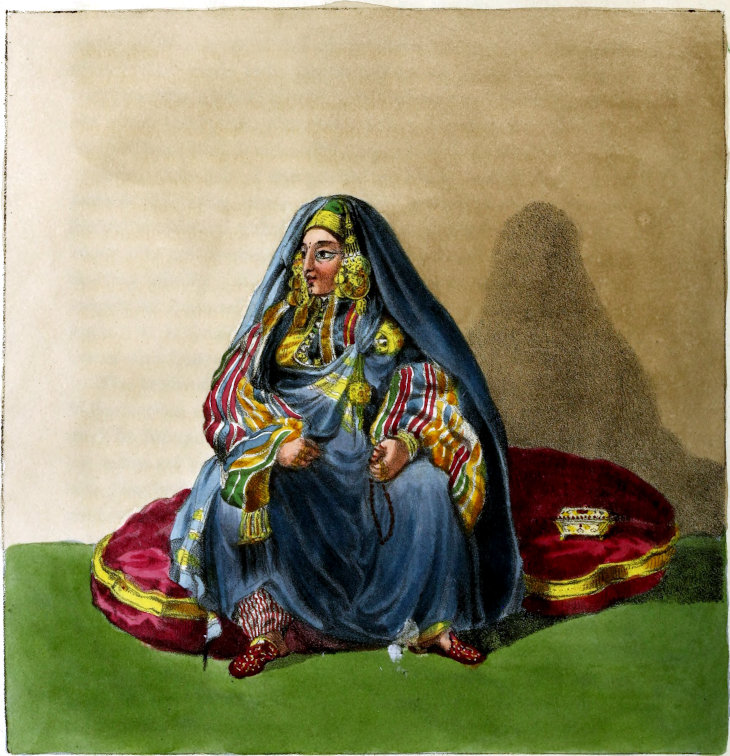
We had resided some time in Tripoli before I had an opportunity of seeing any other costume of the women than their walking dress. This consists of a Barracan (or wrapper, like that which the Arabs wear, and which I shall describe when speaking of the costume of those people), so arranged as to envelope the body and head, and merely to show one eye; they also wear red boots, and yellow or red slippers when in their houses. The dress of the women of the better class is magnificent; consisting of a silk shirt of many colours in stripes, a highly embroidered waistcoat, silk trowsers, and a Barracan also of silk or fine cotton of the most gaudy colours, which is so put on as to form a species of petticoat, as well as to hang gracefully over the head and shoulders. A cap of cloth of gold is worn with many rich ornaments on the head. The eyelids are stained with Antimony, which gives an enlarged appearance to the eye, and increases its brilliancy. The brows are plucked so as to be quite straight, and squared off at each end. Much rouge is used; and gold and silver ornaments of great weight are worn in the ears, and suspended from the head, as well as large bracelets and anklets of the same metals. The garb of the Jewish women varies but little from that of the Moslems; their full dress is exactly the same, but their walking dress, instead of showing one eye, exhibits both. They can wear only black or yellow slippers, and boots are prohibited.
The coin, which is now and has for some years been current in Tripoli, has only fourteen per cent. of silver in it, and is daily decreasing in value.
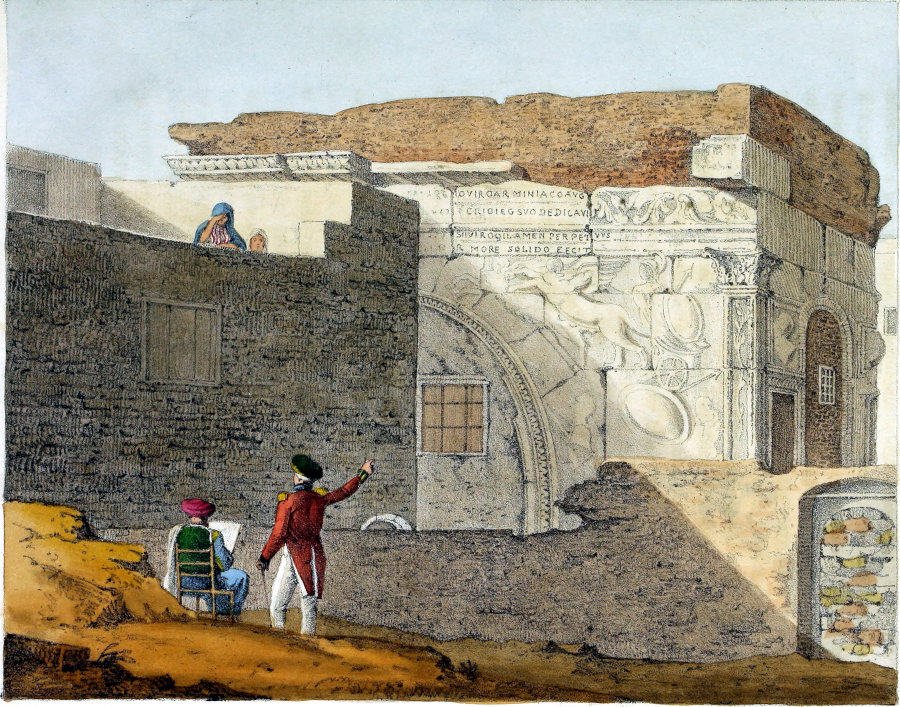
Near the sea gate are the remains of a fine square Roman building, which now has its arches filled up, and is used as a store-house[1].
The Tripoline Marriages are, I understand, (for no man is allowed to see them,) conducted with great splendour; the night is the time chosen for the bride to be conveyed to the house of her husband, when she is attended by a large troop of women, who carry torches, and utter loud and repeated cries of joy.
Drawn from Nature by G. F. Lyon. On Stone by G. Harley. Triumphal Arch, Tripoli. London. Published by J. Murray Albemarle St. Feb.1.1821. C. Hullmandel’s Lithography.
Their Burials have nothing remarkable; the body being merely put into a shell, which is covered with a cloth, having sentences of the Koran worked round the edges. The friends of the deceased follow in a hurried manner, singing verses and religious sentences. The grave of a man is as usual distinguished by a pillar of stone, having a turban carved on it, placed at the head. The funerals of women are in some cases far more interesting, and are conducted with a considerable degree of pomp and ceremony. One instance of this, I witnessed myself. It was the daughter of the Minister, and grand-daughter of the Bashaw, whom I saw carried to the grave. Her coffin was covered with a rich purple cloth, embroidered with gold, and having large golden characters from the Koran sewed on it. At the head was placed a large nosegay of the choicest and most beautiful flowers; the clothes and many costly ornaments of the deceased were laid on the coffin; and the accumulation of rich waistcoats, shirts, caps, &c. had a most splendid effect. The mourners carried bunches of flowers in their hands, and, in contrast to the shining decorations of the bier, were dressed in soiled and old clothes, without antimony on their eyelids, and, in fact, studiously avoiding the use of any ornaments. The Minister himself headed the procession, and although not in general considered a man of very acute feelings, appeared in this instance much affected. It is the custom at all funerals to liberate one or more slaves, who may at the time belong to the family of the departed; and it is equally a rule to distribute food amongst the poor, who, on these occasions, never fail to attend in great numbers. These offerings are of course regulated by the comparative wealth or poverty of the donors; but those persons are considered as most meritorious who incur the greatest expense in honour of their deceased relative. There are women whose sole employment it is to attend the house of mourning, where they howl, lament, and tear their hair and faces in a barbarous manner. Their cries continue with very little intermission during three days, and the additional din occasioned by their repeatedly beating wooden boxes or pots is truly horrible. The customs and ceremonies used on these occasions, with many other interesting subjects relating to Tripoli, are so faithfully and pleasingly described in Tully’s narrative[2], that they render any further observations on my part unnecessary.
Mr. Ritchie, finding that Mukni still delayed his departure, and that some weeks might yet elapse before he commenced his journey, determined on employing the intermediate time in visiting Benioleed and the Gharian mountains. For this purpose he procured a Chowse, a person employed by the Bashaw to collect the revenues, and hired two camels to carry our provisions and baggage.
At this time M. Dupont thought fit to resign the office which he had pledged himself to fulfil, and abruptly left Mr. Ritchie, influenced, as we had reason to think, by the advice and suggestions of some of his supposed friends. Not wishing to revive a subject so little creditable to those who influenced the conduct of M. Dupont, I shall only observe, that the petty intrigues which were carried on in order to detract from the merits of the mission, and eventually to obstruct its progress, were most disgraceful.
journey to the gharian mountains and benioleed.
Sunday, February 7th, 1819.—Leaving Belford in charge of our house, we quitted Tripoli at 10.5. A.M. and after passing through the gardens of the Meshea مشيه at eleven arrived on the desert to the southward of them, near the tomb of the Marāboot Seyd سعيد who is spoken of in the “Letters from Tripoli.” The sand here rises in irregular hills, and is totally barren, not the slightest traces of vegetation being perceptible. We continued travelling over this until five o’clock, when we came to small spots of grass and shrubs, on which flocks were feeding, and where a few Bedouins had pitched their tents. We waited here for our camels, having directed our course south south-west about fifteen miles, and on their coming up, pitched our tents near a well on the plain. The Chowse ordered us a supper, from the Sheikh of the Arabs, and we soon had a smoking bowl of Bazeen and lamb. All the young girls came to stare at us and our tents, as something quite new to them.
Monday, 8th February.—At eight we started, and travelled south-west by south over a country nearly desert, until ten, when we passed a few corn-fields, and a pretty plain covered with tents and flocks. Here we stopped to examine the ruins of the Castle of Mejnine مجنين. This was once used as a frontier post for the troops of the Bashaw, who kept the rebel Arab tribes in check; but having been built of mud and small stones, the rains have now washed it nearly away: part of the walls only and a gate are still standing. From this place we had a fine view of the Gharian mountains, and observed that several hills in the range were in a conical form. On leaving it, we proceeded until 1.30. P.M. when we stopped at a tent by the invitation of an Arab, who had ridden the preceding day in our company. He gave us a hearty welcome, and set before us a large wooden bowl of dates, mashed up with hot oil, which we found very good; its appearance was not unlike soft soap. The women sat behind a carpet, and peeped at us through a small hole in it. After quitting our kind host, we crossed the broad bed of a water-course, when our road lay between two mountains, the right hand one being called Smeeran سميران and that on the left Batus بتس distant from each other about one mile and a half. Here the ground began to rise a little, and greater quantities of herbage appeared. We travelled on in hopes of finding a well until 4.30., but without success; we therefore pitched our tents on a little rising ground, near some Arabs, and after much trouble, succeeded in purchasing a skin or two of water for our horses. The Sheikh provided an excellent supper of Bazeen and stewed lamb for us; and we had a full tent of Arabs squatted on their heels, who came to look at us whilst we were eating. After our dinner we made a little coffee, which, as well as our European cups, excited much astonishment. We offered some to the Sheikh, who not knowing what it was, suspected some treachery, and at first refused to take it; however, by a little persuasion, we overcame his prejudice, and seeing that we ourselves drank some, he at length swallowed it with confidence. One of the party, on tasting some, spat it out in horror, calling loudly on the Prophet, “Ya Rassoul Illa يارسول الله Oh, Prophet of God!” A third was so much pleased with it, and became so great a connoisseur, that he absolutely refused a second cup, because it was too cold. A Kaleidoscope was handed round to the visitors, and excited general admiration and amazement; like children, they quarrelled for their turns to look through it, and if I might judge from the repeated laughter and exclamations made use of, many extraordinary observations were made on the subject. The old Sheikh in particular would scarcely bear to have it taken out of his hand.
Jackals and hyænas are very numerous here; but the quantity of noisy dogs which attend the flocks keep them in awe, whilst they also kept us half the night awake.
Tuesday, 9th February.—At 7, A.M. we struck our tents, and went on for Gharian. The country here had quite changed its appearance. The paths, which in many places were covered with broken basalt, were uneven and difficult; and the ground became steep and irregular as we approached the foot of the mountains. At three we rode a little to the left of the track, and fastening our horses, climbed a small conical mountain of basalt, having very little earth at the top of it, and called El Kelb Assoud اكلب اسود or “the Black Dog.” Near this were two or three smaller hillocks, also entirely of basalt. Our road was through a barren, but beautiful and romantic valley, at the foot of the mountains. At ten we arrived at the foot of the Gharian Pass. This spot is encompassed on three sides by lofty mountains, and opens to the north-east. There are some scattered palms here, and a clear stream winds among them. Here a small Kafflé passed us, consisting of ten or twelve camels, and amongst them one or two Maherries, laden with Trona, or soda, الطرون from Fezzan. Their owners were brown, wild looking men, and appeared of a different cast from the Arabs of Tripoli. In this little valley, about ten years since, the Hasnadar, or Treasurer of the Bashaw, was murdered. He was on his way to collect tribute from the mountaineers (which, in those days, was rarely obtained but by force); and, as the Bashaw had newly made peace with them, he was but poorly attended. Whilst performing his ablutions and shaving his head, he was fired at and killed by some men stationed on the rocky pass, who again ascended their mountain. His party returned to Tripoli, and war was immediately declared. The Bashaw caused a numerous army to be fitted out to quell the insurgents, who, being joined by other discontented tribes, prepared for a vigorous resistance. Owing to the bravery of these people, and the natural strength of their passes and fastnesses, the Bashaw’s army were some weeks before they could ascend the mountains, and during that period many of them were killed. When at last they succeeded in taking possession, they exercised on the poor wretches every species of cruelty, suffocating them in their subterraneous habitations, by throwing into them heaps of wood and straw, and then setting fire to them. Twelve camels, laden with heads to the amount of two thousand, were sent into Tripoli as a token of triumph. These mountaineers have since conducted themselves peaceably; though before their defeat they were so much dreaded, that all communication through their country to the interior was cut off, and few people would venture amongst them. We were an hour in ascending the pass, which was the most difficult and dangerous I ever saw. The rocks were worn so smooth as to render it necessary for us to bestow constant attention on our horses, which we were obliged to lead; one false step would otherwise, in some places, have precipitated them down the side of the mountain. The camels, however, with their persevering pace, arrived at the top as soon as we did. Near the place where we stopped was a Tower, with loopholes for musketry. This, with many others of the same description, was erected by the Bashaw on the conquest of the mountain, that his troops might be enabled to overawe the natives; but as he never stations any forces there, his purposes will only operate against himself, and enable the Arabs to defend their mountains with greater obstinacy, should they ever so far recover from their defeat as again to resist his unjust demands. We stopped at a nest, I cannot call it village, where all the habitations are under-ground. The Sheikh, on hearing we were under the protection of the Bashaw, came to welcome us, and gave us the only hut the place afforded, in which we placed our people and camel loads. As for ourselves, we preferred clearing part of the farm yard, and pitching our tent in it, surrounded by our horses and camels. This place is called Beni abbās بني ابّعس. As the natives live, as I have observed, under-ground, a person unacquainted with the circumstance might cross the mountain without once suspecting that it was inhabited. All the dwelling-places being formed in the same manner, a description of the Sheikh’s may suffice for the rest. The upper soil is sandy earth, of about four feet in depth; under this sand, and in some places limestone, a large hole is dug, to the depth of twenty-five or thirty feet, and its breadth in every direction is about the same, being as nearly as can be made, a perfect square. The rock is then smoothed so as to form perpendicular sides to this space, in which doors are cut through, and arched chambers excavated, so as to receive their light from the doors. These rooms are sometimes three or four of a side, in others a whole side composes one; the arrangements depending on the number of the inhabitants. In the open court is generally a well, water being found at about ten or twelve feet below the base of the square. The entrance to the house is at about thirty-six yards from the pit, and opens above ground. It is arched overhead; is generally cut in a winding direction, and is perfectly dark. Some of these passages are sufficiently large to admit a loaded camel. The entrance has a strong wall built over it, something resembling an ice-house. This is covered overhead, and has a very strong heavy door, which is shut at night, or in cases of danger. At about ten yards from the bottom is another door, equally strong, so that it is almost impossible to enter these houses, should the inhabitants determine to resist. Few Arab attacks last long enough to end in a siege. All their sheep and poultry being confined in the house at night, the Bashaw’s army, when here, had recourse to suffocating the inmates, being unable to starve them out.
The mountain top spreads from this village on to a fine plain, of a mile or two in length, which is in the highest state of cultivation. Corn and saffron fields covered with venerable olive trees yield a delightful and novel prospect, to which the wildness of the surrounding mountains contributes its share. The elevated situation of these mountains prevents the cultivation of palms. Apple and almond trees were planted in such little ledges of the rocks as were too narrow for grain, and were at this time covered with blossoms. From a crag above the pass we had a most extensive view of the country over which we had travelled in coming from Tripoli. The Kelb Assoud, or Black Dog, lay north-east of us, about six miles on the plain below. All the remarkable places which we had traversed were quite distinguishable, and even a part of the sandy desert behind Tripoli; but the sea, which the natives said was often discernible, was hidden from us by the vapour arising from the sands.
The young men of the Douar, or village, took great delight in doing the honours of their beautiful country, jumping from rock to rock like goats, and appearing a most active, hardy set of people. My very limited knowledge of the language was a source of continual regret to me; and I believe the trip to these mountains caused me afterwards to apply with more assiduity to improve myself in it.
We returned with a keen appetite to our dinner, which consisted of bazeen, hard eggs, and mutton, and at which the Sheikh waited on us. The Chowse and our servant impudently volunteered their company, and became our messmates for the rest of the journey. The mutton and eggs being despatched, the broth, seasoned with plenty of red pepper, was poured scalding over the bazeen, and every one fell to work with extraordinary activity.
It is a point of great politeness with the Arabs to tear the meat for a stranger, as well as to squeeze up the bazeen with the sauce for him; and as this is sometimes done with rather unsavoury fingers, hunger becomes an absolute requisite to induce a novice to touch an Arab meal.
Our tent was in the evening filled by visitors, who squatted down, and were much delighted with what few wonders we had to exhibit to them. The principal of these was a loadstone, which drew a penknife out of its case, and which was consequently a subject of much speculation and whispering.
The Sheikh, who really appeared a superior kind of man, was all attention and kindness; but whether from fear of the Bashaw’s Chowse, or a real wish to be of service to us, I know not. I rather suspect the former motive, since dread of their masters, and love of presents, operate equally on the mind of Arabs. We had for our supper a kind of paste called Hatria, which resembles macaroni, and is considered a dish of honour.
In the evening we were joined by a fine, bold, soldier-looking man, who was on a visit, and who was Sheikh of Battus, (a mountain, mentioned in a former page), inhabited during a few months in the year by shepherds, and those who go there to gather in their harvest. This person and myself became great friends, and from our conversation being chiefly in pantomime, we afforded no little amusement to the rest of the party. He invited us to go and hunt on his mountain, promising me a truly Arab present, viz. a young wolf and fox. He told us that a thousand years ago the Christians established themselves on his mountain, but were unable to remain there more than forty days; an evident proof of their inferiority to his tribe, which was commanded by one of his ancestors, and which then lived on Battus, though they have since become wanderers. My new acquaintance was elegantly armed, having an embroidered belt, silver scabbarded sword, and well mounted pistols. He had received a wound in his arm in the mountain wars (when his tribe resisted the Bashaw), and imagined this to be the cause of a cough which at times troubled him. He was not well pleased with our laughing at his way of accounting for his complaint.
All the dogs here being white, the liver-coloured pointers which had followed us from the Consulate caused the women and children to fly on their approach, from the idea that they were wolves.
There are many Jews living in these mountains, whose dwellings are much cleaner and better excavated than those of the Arabs, and are also neatly whitewashed. These people, as in Tripoli, are the only handicraftsmen, and seem here to be rather better treated than elsewhere.
It rained very hard this night, and was very cold; but under shelter of our tent we kept ourselves warm and dry. From the village we had observed a mountain called Tekoot طكوت, to bear south 23° west.
Wednesday, February 10th.—At 7.10. A.M. we left Beni abbās, and went on for the Castle of Gharian, or Gusser Turk قسرطيرك. After having proceeded over the plain, and reached the mountains that rise from it, we climbed a steep peak, and making our way along a sharp ledge on its top, again ascended to the mountain of Tekoot, the principal of the range. From this point we took the bearings of the following remarkable objects: Beni abbās, north 33° east. Gusser Turk, south 35° west. A mountain called Meroobi, south 55° east, and another mountain, west 5° south, distant about twenty-five miles, inhabited at this time by a rebel tribe under a chief called Kalēefa. Owing to the height of the spot on which we stood, we found it difficult to distinguish many objects, which from the plain had appeared very conspicuous. Unfortunately, before we ascended this mountain we had broken our Barometer, and were thence unable to ascertain its precise elevation. Here is the tomb of a Marāboot, whose sanctity is the subject of many extraordinary stories.
It was from hence that the Arabs, when they declared war against the Bashaw (which formerly happened very frequently), announced their rising to their allies and neighbouring tribes, by signals of a fire at night, and a smoke by day. Three poor Arabs followed us up the mountain, pointing out to us the most remarkable surrounding objects: they gathered for us some small black berries from a low thorny tree, with yellow flowers, which they called Dummagh ظمّاح or “brains,” and which had an astringent taste, somewhat resembling that of a ripe sloe, but the fruit was much smaller. They told us that the Arabs of Gharian always spoke with gratitude of the English Consul, who had once persuaded the Bashaw not to increase their tribute, as he intended.
At noon we arrived at a cluster of nests called El Guasem القاسو about six miles from Beni abbās: all the habitations of this place are of the same kind as those already described; we, however, found a small uninhabited shed above ground, situated at the foot of a little turret, where we deposited our goods, and determined on passing the night. From the inscriptions which we found in this building, it must be about 150 years old. The present Bashaw, his father, grand and great grandfather, had all slept in the smoky corner, of which we now took possession. The turret itself is constructed in a mode common to many others in these mountains. At about half way down one of the subterranean passages, a hole is cut upwards in an awkward way through the rock into the first floor of the turret, which is even with the ground, and perfectly dark, except where here and there a small stone is pushed out to make way for the muzzle of a musket. From this floor is an ascent to one, two, or three stories, by means of pieces of stick placed in the walls. Each floor consists of branches of trees, most alarmingly elastic, and the door of entrance from one to the other is a small hole, through which a person has to force himself upwards. All these military buildings manifest a noble contempt of architectural skill, or neatness. On the side of a small hill near the village are caves of some magnitude, from which good millstones are procured. At this place we fared as we did the evening before, though the Chowse had a most vociferous conversation with the Sheikh before he could get any barley for the horses. We were well sheltered, and sufficiently warm, for we had a good fire in the centre of the hut, and slept at one end of it, while our people and the Chowse’s mare occupied the other. It rained very hard all night.
Thursday, February 11th.—At 7 A.M. we started, after making the Sheikh a present, and wound along amongst the mountains in the direction of the castle. Tekoot, bearing north three miles, we discovered a Roman building in the form of a tomb, or perhaps a very large altar; it was about twelve feet square, standing on two or three broad steps, which seem to have had a neat cornice. From the present appearance of the ruins, the original building must have been ten or twelve feet in height. We could discern no inscription. Our road hence was once more over very difficult passes, from which we expected to have had a delightful view, but the mountains, to our great regret, became obscured by a thick mist.
These mountains separated into a deep romantic valley, which appeared to run immediately down to the desert. The tops were in a very superior state of cultivation; figs, olives, and vines flourishing on every spot which had sufficient earth to nourish them. We observed many of the trees ornamented with the skulls of horses, camels, or sheep, to protect the tree and its fruit from being blasted by the “Evil Eye.” At two we came to the castle, an immense ill-constructed building of rough stones, having a turret at each corner, an open court, and stalls for horses, embrasures for cannon (closed up with mud), and here and there a loophole for musketry. There are five or six six-pounders upset, and honeycombed, to make a show; but I conceive the Bashaw would find no one daring enough to fire them. The key of the castle (which is never used but by the Kaid when he comes to collect tribute for the Bey, to whom Gharian belongs), is kept by a neighbouring Sheikh. Our Chowse was here of great importance, for being in the service of the Bey, all the Arabs came to kiss his hands, and bring him presents, and he consequently assumed a very dignified and solemn demeanour. At night one of our camel boys, who had the office of porter assigned to him, brought the key of the gate to the Chowse, and reported all right. We were informed very seriously, that the room in which we slept was haunted by a Ghole, and several devils, in consequence of some prisoners having had their throats cut there a short time before.
Friday, February 12th.—Our porter had been so very careful over night, that we were half an hour unlocking, unbarring, and unbolting, before we could get out. Mr. Ritchie and myself then sallied forth, he to botanize, and I with my gun in search of animals called Gundy قندي. After lying down flat in the rain for three or four hours, I was fortunate enough to shoot three, which I prepared, in order that they might be sent to the British Museum, and I believe they will be the first of the species known in Europe. These animals resemble very much a Guinea pig in form, but are of a light-brown mouse colour. The fur is longer than that of a rat, and is very silky; the eyes are black, large, and prominent; the orifices of the ears (which are quite flat against the side of the head) are also black, and free from hair; the tail, or rather a little stump resembling one, is just perceptible to the touch, and from it grows a bunch or tuft of long black hair. The body is very round and fat, and particularly broad at the shoulders. These animals burrow amongst the rocks. They are eaten with great relish by the Arabs, and no doubt are very good, as the flesh is exceedingly white and fat, and resembles that of a rabbit.
At about half a mile from the castle is a place called Tghrasat تغراسات at which a Bazaar is held weekly, and whither all the mountaineers resort. At two we passed this place, and went about four miles south to a village called Tegerinna طجرنّه, where the inhabitants live above as well as under ground. We pitched our tents in a saffron field, and had our horses shod by a Jew blacksmith. He afterwards prepared in his house a fine lamb, and very white bread, for our dinners, of which the Chowse pocketed all we did not eat. We made the poor man a present, to his great astonishment; for no one, if he can avoid it, performs any act of kindness to these persecuted people. In the evening we had many visitors, amongst others the Sheikh, who was all curiosity, and ready for as many presents as we chose to make him.
From this place, three other above-ground villages bore south by west two miles. They were called Usadena. The inhabitants, male and female, had all been murdered on the Bashaw’s conquering the country, and the buildings were entirely ruined.
Gharian is famed for the excellence of its oil, the richness of its saffron, which is produced in great quantities, and the goodness of its corn. The people are fine, well made men, and have an air of freedom, which their change of circumstances has not been able to conquer. In collecting the tribute for the Bey, each man pays in kind a certain portion of his harvest. The Jews are employed to weigh and prepare the Bey’s share, and are well paid by the Arabs, in order that they may give short measure; for although using false weights is by the law of Mohammed a heinous crime, yet they fancy the sin is not incurred if the Jews defraud for them.
Of the dress, food, &c. of the Arabs, I shall treat more fully in a future page.
Saturday, 13th February.—At seven A.M. we left this delightful spot for Benioleed. Our road was through very difficult passes in the mountains, where we found some rain water, with which we filled our gerbas, or water-skins, with a sufficient supply for three days.
Our road the latter part of this day lay over a barren, stony plain; and having proceeded south 40° east twenty-five miles, we encamped at sunset in a small valley amongst some bushes. Our fellow travellers, after prefacing their stories by boasting of their own courage and expertness in fighting, gave us most frightful accounts of the banditti who were said to frequent this track; but how these rogues, or any one else, could manage to exist at all in such a place, was a riddle which our friends could not explain. Muskets and pistols were laid at the Chowse’s head, and two bottles of wine were drank to fortify his stomach, so that he slept undisturbed through the night.
Sunday, 14th.—The country onward presented one unvaried scene of desolation: not a living creature appeared during the day; but at night the jackals kept up a continual howling. At noon, we passed a deep ravine, for about eight miles, of basalt, which appeared as if it had been rent open by some convulsion of nature. At five, we crossed a dry water-course, and stopped on its bank for the night amongst some stunted bushes. We made this day, south 40° east, thirty miles.
Monday, 15th February.—At four A.M. made on for Benioleed. We passed occasionally over mountains and gravelly plains, generally coming again to the side of a large Wadey, or ravine, in which there was some appearance of verdure. Many coveys of red-legged partridges flew by us. After winding along a Wadey for an hour or two, we arrived at Benioleed بنيوليد, at two P.M., ourselves and animals much fatigued: we had made, south 50° east, twenty-five miles. We took up our quarters in the house, or rather in the stable of the house, of the Sheikh. Here we paid our guide, who came with us from Gharian, and who was a feeble man in appearance, but a most persevering walker. He never would sleep in our tent, but preferred lying in the open air, though the Thermometer was generally at the freezing point, with no other covering than his Barracan, not even a shirt.
Tuesday, 16th February.—We walked out to see the houses, which are built on each side of the Wadey of rough stones: none are above eight feet in height; they have no windows, but receive their light through the doors; and all look like heaps of ruins. The inhabitants are Arabs of the tribe Orfilly الفلّي, and are a fine handsome race of people. The young girls are really beautiful.
These poor Arabs are dreadfully oppressed by the Bashaw, who has reduced them all to a most miserable state of poverty. Those who remain in the country are in rags; the others who let their camels out to hire, and accompany traders to the interior, are somewhat better off. They were once a brave daring set of men, who defied the government of Tripoli; and, during the youth of the present Bashaw, fully protected him from his father’s troops. Their services to him have, however, been but ill requited; for he persecutes them more than any others of his subjects. They have (and I believe not without deserving it) the character of being the greatest robbers and rogues in the neighbourhood of Tripoli.
The Wadey produces but little corn, as the crops are all sown in the desert to the eastward; and in harvest time the owners go in bodies to bring in the grain. Much oil is made here, and the palms and olive-trees are very flourishing. We observed that of the latter there were no young trees, and learnt that the Bashaw taxed them, wherever found, as large ones,—a system, which, if pursued, will in a few years more destroy all the olive groves in his dominions.
The water here is excellent; the wells are of great depth, many being 100 feet, and others above 200 feet: in fact, the labour requisite in drawing water, makes it a scarce article. This is the most southerly town in the Bashaw’s dominions on the road to Fezzan, to which it is nearer than the other routes.
I took a drawing of the valley, which very much amazed the Arabs, and collected round me an immense crowd. We here discovered that our living amongst these people had not contributed much to our cleanliness, and that one of Pharaoh’s curses was but too evidently upon us.
Wednesday, 17th.—We removed from our stable to a building dignified by the name of a castle, in which the Kaid resides during his too frequent visits to these parts. We had a dozen negroes turned out to make way for us, the only good room being occupied by a Chowse, who in the Kaid’s name was collecting money. He was all day surrounded by poor wretches, entreating that his master would spare them, and that something might be left to assist in supporting their families. It was really melancholy to witness the misery which prevailed amongst them; for they were called upon to answer the exactions of three masters, none of whom would leave them even a sheep, if their extortions were not complied with. Thus it is: the Bashaw demands a certain sum of money, and sends a Kaid to collect it. This man doubles the requisition, in order to enrich himself; and it not unfrequently happens that he goes away, and leaves a Chowse to act for him, who in his turn drains them still more and more; and thus their victims are reduced to utter ruin. There were in the castle slaves, camels, sheep, goats, and grain in quantities, which had all been lately extorted from these unhappy people. Eight poor prisoners were confined under-ground, and had not been fed during the time we were there; and finally, the Chowse had an order to cut their throats, which we understood was executed the day after we left the castle. A market is held here weekly, to which the necessaries of life are brought with fear and trembling, lest any one should appear too rich.
Thursday, 18th February.—This being market day, a few sheep and goats were brought on the plain before the gate. There were also dates, corn, and gunpowder, but in small quantities. We bought a sheep and some dates. It rained the whole of this day; but at night it cleared up. The Sheikh came to see us, and brought us a bowl of Bazeen, in return for which we gave him some powder. The Population amounts to about 2000, as near as I could judge; but the habitations are so scattered along the sides of the Wadey, that no very just estimate can be given.
Mr. Ritchie was requested to obtain the pardon of the prisoners in the castle, who had been guilty of resisting an attempt to drive off their flocks for the service of the Bashaw, and he promised to intercede for them; but we were overtaken, when on our return to Tripoli, by a man, who informed us that they had all been killed.
Mr. Ritchie, by two observations, made the latitude of Benioleed, 31°. 45′ north.
Friday, 19th February.—Having somewhat refreshed ourselves and cattle, we left this place at eight A.M.; and, ascending the side of the Wadey, proceeded during the whole day over a rocky flat, perfectly barren, until six P.M., when we stopped, having made, north 20° west, thirty miles. We saw this day two large vultures, but scarcely within shot of us.
Saturday, 20th February.—Our road this day improved, and we went through several fertile Wadeys, and over plains of fine grass. We passed also several herds of female camels, with their young, and many flocks of sheep. At three, our road began to rise, and we saw many tents of the Arabs of Terhoona ترحونه, who were attending their flocks: some of them were changing their quarters, and we were much amused by different parties, who were travelling on the same road as ourselves. Women and children were riding the camels, which were also laden with their tents and furniture. At seven, we came amongst the mountains, and arrived at the wells of Melghrā ملغرا, which have excellent water. There are several little streams from the sides of the hills, which run through the valley; and there is much game here, principally partridges and snipes.
Sunday, 21st February.—At eight A.M., we left the wells, and passed through winding defiles at the foot of the mountains until noon, when we cleared them, and opened on a sandy plain, covered in some places with verdure, and having great quantities of the Khandal حندل or Colycynth. On passing some Arab tents, the children brought us small roots, of the shape of young potatoes; but resembling mushrooms in taste, smell, and tenderness. They grow in the sand, and the Arabs call them Terfaas ترفاس. We here drank some camel’s milk for the first time. It is much less rich than that of a cow, and saltish to the taste. We also procured a skin full of sour butter-milk, which is much esteemed by the Arabs, who call it Libban لبّان. It is never drank in a sweet state; but is allowed, after the butter is made, to stand until it tastes and smells very sour.
In the afternoon, the country over which we passed had many bushes; and at five, we came to a well, near a Marāboot’s tomb, having made, north 43° west, twenty-four miles. The well, near which we were, was 288 feet in depth, and the water brackish. In the evening a man came to request Mr. Ritchie to take an Arab under his protection to Tripoli, and endeavour to procure for him the Bashaw’s pardon, he being the only one remaining of a rebel tribe, which had been destroyed. The offender was in the Marāboots’ tombs, which was considered a sanctuary; but, on our mounting our horses in the morning, he was to follow us at full speed, and claim the protection of the British flag.
Monday, 22d.—We waited some time for this man, and at last were obliged to proceed to Tripoli without him. Our road was over very steep and irregular sand hills. At three P.M. we arrived, having made, north-west, twenty miles. As I now had many opportunities of seeing the Arabs amongst their own tribes, and had greatly familiarised myself with them, I obtained some knowledge of their manners and customs, which I will endeavour to describe in giving an account of this extraordinary race of people.
OF THE ARABS.
The Arabs are, generally speaking, tall, straight, and well formed, and inclined, from their manner of living, to be thin and muscular. Their countenances are expressive and handsome, their form of face oval, and their noses aquiline. Although naturally white, their complexion becomes dark from continual exposure to the sun, and from not being very particular in their ablutions. They are active; capable of undergoing great fatigue and abstinence from food; lively in their manners; daring, and possessed of much cunning: though generous, they are great beggars; revengeful and unforgiving. The general costume of the men is a large loose shirt and trowsers of cotton, sandals, or tight half boots of red leather, which lace in front, fit close round the ankle, and rise as high as the calf of the leg. On their heads they wear a red cap, which is long enough to hang a little down on one side; from the top of it falls a tassel of blue silk. A wrapper of woollen (from about twenty to twenty-five feet in length, and five or six in breadth), woven rather more compactly than flannel, is thrown round the body in folds, part being placed over the head in the manner of a hood, while the end is thrown over the left shoulder, and hangs down behind the back. This article of dress has several names, according to its texture. The most coarse and heavy is called Aba. That between this and the finest (called Jereed) is named Kholi; but in Tripoli, all three are known under the appellation of Barracan. A large cloak, having a hood, and no sleeves, and composed of closely and well-woven wool without a seam, is used in rainy or cold weather over the Barracan, and is called Bornouse. The dress of the females differs but little from that of the men in materials, but they put it on in a different manner. The poorest class wear only the Barracan, which is passed over the head and fastened at the waist; others have a shirt in addition to this. Young women wear their hair in tresses, to which they attach beads, pieces of coral, silver, or any other gaudy thing which they can procure; and they have one or two large silver ornaments in the form of crescents, fastened on the right side of the head, on which they also frequently wear a large woollen turban of blue, wrapped carelessly round. From their ears are suspended a multitude of silver rings, and round their necks they hang rows of beads of various colours. The old women frizzle their hair over the forehead, so as to make it project to some distance; and they dye it of a dull red, with the leaves of a plant called Henna, which gives it the appearance of red wool. All the females have a practice of tattooing their chins, the tips of their noses, and between the eyebrows. Their necks and arms are also frequently marked. The favourite figure is that of a hand, which is intended to avert the “Evil Eye.” They wear red lacing boots, in the same manner as the men. When young (that is to say, fifteen or sixteen), they have fine figures, and are exceedingly handsome; but they soon lose their good looks and pleasing form, and become as ugly as they were before beautiful. Their eyes are black and large; their noses straight and well proportioned; they have small lips, and their teeth are exquisitely white. Nothing, in fact, can exceed in prettiness an Arab girl; but the old women are, without exception, the most disgusting and hideous creatures I ever beheld. Both sexes blacken their eyelids with Kohol, or lead ore powdered, which adds much to the brilliancy of the eye, and makes it appear larger than it really is. They all wear an immense quantity of Agebs عجب, or Charms, against disorders and misfortunes.
The arms of the Arabs are the same as those of the natives of Tripoli, viz. guns, pistols, swords, and daggers. They are good shots, when able to rest their guns; but otherwise cannot easily manage them. The gun is slung over the shoulders, and the pistols are worn in a belt, which is hung round the body, and which contains the ammunition. They are constantly armed with both these weapons; but the sword is seldom carried, unless when they ride on horseback; it is then suspended by the side of the saddle, in such a way as to remain under the left leg, with the hilt near the pommel. They generally procure their powder and lead from Tripoli, though some possess the art of making a kind of inferior powder amongst themselves.
In the Tripoline dominions, and in Fezzan also, there are two kinds of Arabs, one wanderers, the other fixed residents in towns; those in towns (as Benioleed for example) travel much about the country, but always return to what they consider as their home. The wanderers have no permanent place of abode, but remove their tents as pasturage or circumstances require. These tents are made of woollen, coarsely woven in long pieces and sewn together. They spread to a great breadth, but are not high; the entrance being about six feet, and the top sloping gradually down till it is fastened to the ground. They are so divided by means of mats or carpets, that the women have a separate place from the men, and can be hidden from the gaze of strangers: they, however, so manage it, as to see without being themselves observed. These dwellings of the Arabs are called by their inhabitants, Beit el Shar, بيت الشار, or “hair houses,” and Nejja also. By means of bushes, almost every tent has an inclosure adjoining it, for securing sheep or goats at night; and stakes are driven in the ground, to which the horses are fastened, though sometimes these animals are allowed a portion of the tents of their masters. The Arabs are generous to their own kinsmen; and should a stranger come amongst them, they never deny him the rights of hospitality, provided they are themselves eating; but should that not be the case, they make no attempt to prepare food expressly for him: an acquaintance, however, is always sure of a good reception.
The Bedouins of Barbary are not to be compared with those of Egypt, either for enterprise, ingenuity, or good qualities; since whatever they may have been, they are now, by the tyranny of their masters, fallen from their once high character, and are not in any respect better than slaves. One or two tribes are yet independent, but are likely soon to fall. Each tribe, or even set of tents, is governed by a Sheikh, who, being an old man, or one appointed by the Bashaw, is looked up to as a superior; though his business is chiefly to collect the requisite sums of money from his people. Some years back, these Sheikhs commanded their tribes in the wars of plunder, or in defence of their liberties, and were then chosen by the voice of the people, for their courage and military skill; but all offensive or defensive wars being now at an end, in consequence of their repeated and bloody overthrows by the Bashaw, the name of Sheikh has no honour attached to it. In some cases, indeed, individuals refuse to undertake the office, lest the Bashaw should make them responsible for any faults committed by their followers.
In their Religion, the Arabs are great bigots, very superstitious, and easily alarmed about the enchantments and wiles of Iblis (or the devil), to whom they attribute many of their misfortunes and illnesses. To the prayers enjoined by the Koran they are very attentive, and, unless in travelling, never omit repeating them at the appointed periods. Of the name and attributes of God they never speak without reverence; and they have a profound respect for Idiots, whom they consider as people beloved of Heaven, and totally unable to think of the things of this world.
Marriages are contracted in most instances without either party having seen the other, the agreement being entirely on the part of the parents of the bride, and the bridegroom, the consent of the females never being asked. There are certain marriage presents which are always given by the husband to the relations of his wife, so that he may be said to purchase her of them. Though four wives are allowed to all Mohammedans, the Arabs very rarely possess so many, few having more than two, and some only one. It is not their custom to have Negresses living with them, which may be accounted for by their dislike to being considered as the fathers of children of colour. The settled Arabs are not so scrupulous; but are, notwithstanding, more so than the Moors. The ceremony observed in conducting a bride to her husband is very singular; and having myself been an eye-witness of it, I made a drawing representing the camel used on such occasions, with its gay trappings.
A frame being fixed on the back of the animal, the bride is placed in it, and, while thus sitting, is housed over with carpets, shawls, and ostrich feathers. In travelling from place to place, or in searching for pasture ground, the people make use of these frames; but they are in such cases generally uncovered, and have baskets, or other frame-work, attached to their sides, in which the young children are placed. An Arab family on its march presents a very extraordinary appearance, the camels being laden with tents, cooking utensils, women, and children. The men walk, driving their flocks before them, or ride their horses, frequently without bridle or saddle. Should the journey exceed one day, a temporary tent is erected at night; and at the dawn of morning, all is again placed on the camels. The operation of erecting or taking down one of their hair houses does not occupy much time, as the women always assist the men on these occasions. The dogs guard the flocks during the night, and are very fierce. In colour they are white, resembling wolves in form, and having long bushy tails. They howl rather than bark, and with great apparent courage attack every stranger who approaches them, though when threatened with a stick or stone, they run yelping away. It frequently happens, that the spot fixed on as a temporary residence is far distant from any well, sometimes even three days of the ordinary march of flocks; yet this does not dishearten the persevering Arab, who, notwithstanding, drives his sheep once a week to drink. They feed as they go and come, and therefore do not suffer much on their long journey. The wants of the people are easily supplied; a few skins of water being brought at stated times by a camel, and economised with great care. I have remarked, that not only the Arabs and their camels, but all animals in this country have the power of remaining a great length of time without water. Sheep, (provided they have tolerable herbage), will pass even a month without drinking. Antelopes and buffaloes, I should conceive, in some cases never taste water, none being found on the surface of the desert, and they are unable to obtain that which is in the wells. On the other hand, wolves, hyænas, foxes, and jackals, are less capable of enduring thirst. They descend such wells (or more properly pits) as are not deep; and the vicinity of one of these places is frequently ascertained from observing the tracks of animals, which, during the night, go there to drink.
The Bedouins sow their scanty stock of corn, after turning up the earth with a rude plough, or more generally with a hoe. These cultivated spots are respected by other wanderers, and the corn is rarely stolen; should the Bashaw, indeed, be at war with the Arabs, he never fails to destroy their crops. When a sufficient time has elapsed to allow of the grain being in a state of maturity, those to whom it belongs come and gather in their harvest (sometimes before it is perfectly ripe), lest the Bashaw should be informed of the circumstance, and deprive them of a larger portion than they can afford; emissaries, indeed, are never wanting, who make it their business to ascertain the exact time when the corn is to be cut, and then pounce on the poor Arabs for the Bashaw’s share of it. To avoid such taxes, therefore, they sometimes gather it so prematurely, that it will not serve as seed for the ensuing year. When the date season commences, many families come and pitch their tents in the Meshea of Tripoli, in order to purchase dates for their future subsistence; these they deprive of the stones, and when kneaded together, keep them in skins, so as to preserve them from insects or wet: these form their chief support, assisted by the milk of their sheep and camels. That of the camel, as I have before noticed, is thin, of a bluish colour (resembling cow’s milk mixed with water), and rather salt to the taste; it throws up no cream, but soon coagulates like new curds. The ewe milk is excellent, but is never drank fresh, the Arabs preferring it sour, or, more properly, as butter-milk. The flocks are milked morning and night into large bowls, and when a sufficient quantity is thus collected, it is poured into skins, without much attention being paid to its cleanliness, when by shaking and rolling it about, butter is procured, and generally attaches itself to the side of the skin; the milk being then strained from it into other vessels, is allowed to grow sour, and a quantity of butter being produced, it is boiled with a little salt until it becomes like oil, and is then poured into goat-skins, and is fit for use or market.
Cheese is procured by turning the milk with a certain herb (the name of which I have forgotten), and the curds, being salted, are spread out to dry in the sun, when they resemble little crums, and are very pleasant to the taste. I did not see any other kind of cheese than the one I have mentioned, and this is rather scarce, and used as a luxury in many of their little messes. Sometimes it is toasted, and has a very agreeable flavour. It is called Jibn, جبن.
A great article of commerce is the fat which the shepherds procure from the sheep they kill. They cut it from every part of the body, salt it, and lay it by until a large quantity is collected, when, whether putrid or not, they boil it, until it bear some resemblance to the grease used by tallow-chandlers; it is then poured into skins, and is fit for use. In the interior it sells at about a shilling a pound; but at Tripoli it is much cheaper. It is put into almost every article of food by the Arabs, and though not very savoury, we soon became accustomed to its taste. It is called Shahm شحامر.
From the wool of their sheep, the women make strong barracans, carpets, shirts, turbans, and many ornaments. Their tents too are made of wool and goats’ hair, as are also sacks, which are used to carry corn and merchandize on the camels. Mats and ornaments of palm leaves or grass are neatly made. Their dyes are generally brilliant; black, blue, red, and orange; in fact, every colour excepting green, which they find much difficulty in producing; though at Tripoli the dyers succeed very well in it. The looms of the Arab women are on the ground; they have no shuttles, but with much trouble pass the threads through with their fingers, generally lightening their labour with songs. The men seldom work while in their tents, and their time seems to hang much heavier on their hands than that of the women, who with cooking and other domestic employments are generally pretty well occupied. No woman eats in the presence of a man, and wives always wait on their husbands.
The domestic animals consist of poultry, sheep, goats, camels, horses, and dogs: they all live under the same canopy as their masters, and are on good terms amongst themselves. The horses are perfectly quiet, being brought up with the children of the family. They would be a fine race, but that the want of good food prevents their acquiring a handsome appearance; add to which, the ambition of possessing well fed and comely animals does not now exist; for should any of the Bashaw’s people wish to appropriate a fine horse, the owner dares not refuse to sell him, at whatever low price may be offered. Still, however, many of the Arabs breed them expressly for the market, bringing them while foals for sale. I have seen some of them brought in this way, which, when taken care of, became remarkably handsome, and unlike the generality belonging to the Bedouins. In the bazaars at Tripoli I have sometimes observed very fine ones, which were brought from the Desert, and sold for forty or fifty dollars (about eleven or twelve pounds sterling) a piece. All have long tails, and are entire; a great defect is, however, almost general amongst them, in consequence of their being mounted when too young; which is, that their backs are very hollow, and their hind quarters appear higher than their fore. Colts of twelve months are frequently seen, staggering beneath the weight of a heavy man, his arms, water skin, and food. The Arabs consider a large belly as very handsome; and some horses, from the nature of their food, acquire such rotundity in this respect, that they appear like mares in foal.
Drawn from Life by G. F. Lyon. On Stone by D. Dighton. Arabs exercising. London. Published by J. Murray Albemarle St. 1821. C. Hullmandel’s Lithography.
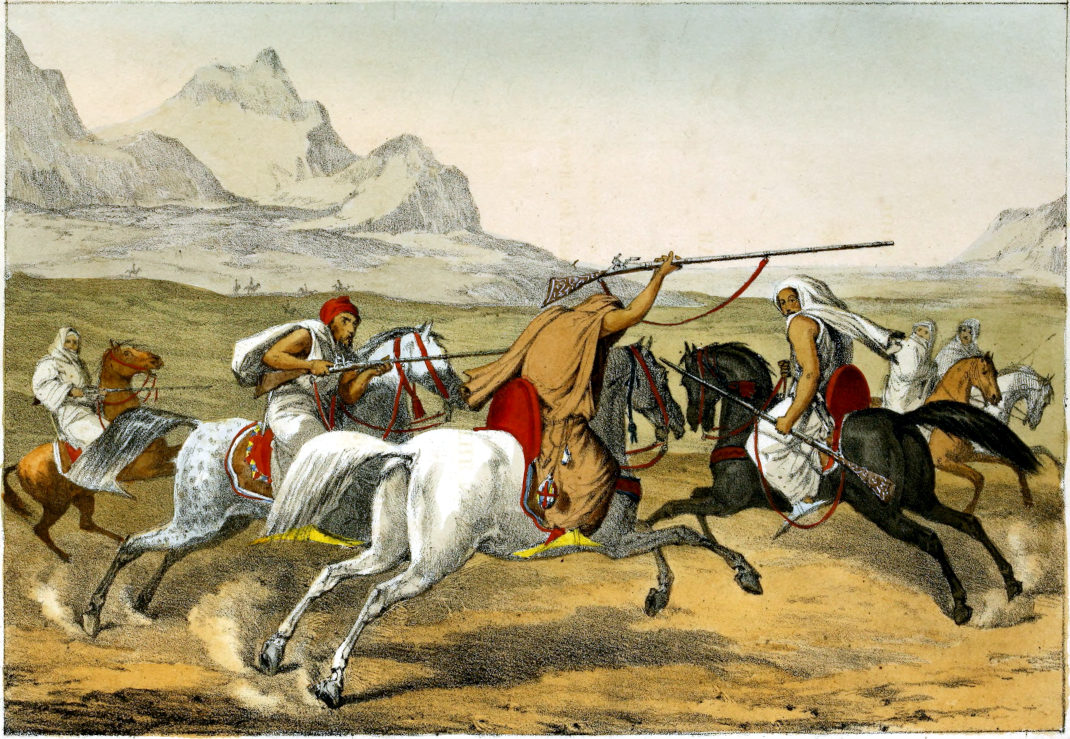
A light mane and tail on a chesnut horse is considered unlucky; the colour, though common, is not much admired, and the feet of such animals are accounted soft and tender. Bay is the favourite colour next to light grey, which is much in request, the Bashaw generally riding horses of this description.
Much importance is attached to the manner in which the legs are coloured, stockinged horses being in the extremes of good or bad luck, according to the disposition of the white. If both forelegs are marked, it is good; if one hind and one fore leg are marked on the same side, it is very unlucky; or if one alone is white, it is equally unfortunate; but if opposite legs (off fore and near hind) are light, nothing can be more admired. Ridiculous as these fancies may appear, they nevertheless influence the price of horses, sometimes to even a sixth of their value.
In sandy parts of the desert shoeing is never used; but where the animals are to pass over mountains, it is absolutely necessary. The Arab shoes are thus formed, turning up behind; and are, in general, so badly put on, that there are few horses to be found which have not been injured in their feet. The Arab’s forge is simple, and almost every man is his own blacksmith. A small mud or clay wall is built to the height of a foot or eighteen inches; a hole is then made even with the ground, and an iron pipe introduced. To this are attached two skins, which open at the upper end by means of two sticks, having a small leather handle on each: the thumb is passed through one of these, and the fingers through the other; so that the hand easily opens and shuts the skin. The mouth being closed, the skin is pressed down, and throws a strong blast through the pipe. It is again opened and lifted up, when it is once more ready. Thus, alternately with each hand, the current of air is kept up to the fire which lies over the pipe. Camel’s dung is used when charcoal cannot be procured, and gives a very strong heat. The anvil is a small square-ended piece of iron, which is sunk in a log of wood, and partly buried in the sand. An ordinary hammer, and a pair or two of pincers, complete the apparatus.
The mill is equally simple, being composed of two circular stones, one of which lies flat on the other, and is turned by a small handle placed on it; this is fixed by a pivot from the lower one, and has a hole in the centre, through which it is supplied with grain.
The messes made with flour are few, and may be thus enumerated: Cusscussou, Bazeen, Dweeda, Atila, Mogatta, Zūmeita, Bread, Fetaat. Cusscussou being a dish very generally mentioned in all books of travels, I shall attempt to describe the manner in which it is made; and I trust I may be allowed, however trifling the subject, to mention in the same manner the other articles of food, as I believe they are at present only known by name.