{145} CHAP. VI.
Reading edition
Transactions at the Copper-mine River, and till we joined all the women to the South of Cogead Lake.
Some Copper Indians join us—Indians send three spies down the river—Begin my survey—Spies return, and give an account of five tents of Esquimaux—Indians consult the best method to steal on them in the night, and kill them while asleep—Cross the river—Proceedings of the Indians as they advance towards the Esquimaux tents—The Indians begin the massacre while the poor Esquimaux are asleep, and slay them all—Much affected at the sight of one young woman killed close to my feet—The behaviour of the Indians on this occasion—Their brutish treatment of the dead bodies—Seven more tents seen on the opposite side of the river—The Indians harass them, till they fly to a shoal in the river for safety—Behaviour of the Indians after killing those Esquimaux—Cross the river, and proceed to the tents on that side—Plunder their tents, and destroy their utensils—Continue my survey to the river's mouth—Remarks there—Set out on my return—Arrive at one of the Coppermines—Remarks on it—Many attempts made to induce the Copper Indians to carry their own goods to market—Obstacles to it—Villany and cruelty of Keelshies to some of those poor Indians—Leave the Copper-mine, and walk at an amazing rate till we join the women, by the side of Cogead Whoie—Much foot-foundered—The appearance very alarming, but soon changes for the better—Proceed to the Southward, and join the remainder of the women and children—Many other Indians arrive with them.
1771. July. 14th
We had scarcely arrived at the Copper-mine River when four Copper Indians joined us, and brought with them two canoes. They had seen all the Indians who were sent from us at various times, except Matonabbee's {146} brother, and three others that were first dispatched from Congecathawhachaga.
1771. July.
On my arrival here I was not a little surprised to find the river differ so much from the description which the Indians had given of it at the Factory; for, instead of being so large as to be navigable for shipping, as it had been represented by them, it was at that part scarcely navigable for an Indian canoe, being no more than one hundred and eighty yards wide, every where full of shoals, and no less than three falls were in sight at first view.
Near the water's edge there is some wood; but not one tree grows on or near the top of the hills between which the river runs. There appears to have been formerly a much greater quantity than there is at present; but the trees seem to have been set on fire some years ago, and, in consequence, there is at present ten sticks lying on the ground, for one green one which is growing beside them. The whole timber appears to have been, even in its greatest prosperity, of so crooked and dwarfish a growth as to render it of little use for any purpose but fire-wood.
Soon after our arrival at the river-side, three Indians were sent off as spies, in order to see if any Esquimaux were inhabiting the river-side between us and the sea. After walking about three-quarters of a mile by the side of the river, we put up, when most of the Indians went a {147} hunting, and killed several musk-oxen and some deer. They were employed all the remainder of the day and night in splitting and drying the meat by the fire. As we were not then in want of provisions, and as deer and other animals were so plentiful, that each day's journey might have provided for itself, I was at a loss to account for this unusual œconomy of my companions; but was soon informed, that those preparations were made with a view to have victuals enough ready-cooked to serve us to the river's mouth, without being obliged to kill any in our way, as the report of the guns, and the smoke of the fires, would be liable to alarm the natives, if any should be near at hand, and give them an opportunity of escaping.
1771. July. 15th.
Early in the morning of the fifteenth, we set out, when I immediately began my survey, which I continued about ten miles down the river, till heavy rain coming on we were obliged to put up; and the place where we lay that night was the end, or edge of the woods, the whole space between it and the sea being entirely barren hills and wide open marshes. In the course of this day's survey, I found the river as full of shoals as the part which I had seen before; and in many places it was so greatly diminished in its width, that in our way we passed by two more capital falls.
16th.
Early in the morning of the sixteenth, the weather being fine and pleasant, I again proceeded with my survey, and continued it for ten miles farther down the river; {148} but still found it the same as before, being every where full of falls and shoals. At this time (it being about noon) the three men who had been sent as spies met us on their return, and informed my companions that five tents of Esquimaux were on the west side of the river. The situation, they said, was very convenient for surprising them; and, according to their account, I judged it to be about twelve miles from the place we met the spies. When the Indians received this intelligence, no farther attendance or attention was paid to my survey, but their whole thoughts were immediately engaged in planning the best method of attack, and how they might steal on the poor Esquimaux the ensuing night, and kill them all while asleep. To accomplish this bloody design more effectually, the Indians thought it necessary to cross the river as soon as possible; and, by the account of the spies, it appeared that no part was more convenient for the purpose than that where we had met them, it being there very smooth, and at a considerable distance from any fall. Accordingly, after the Indians had put all their guns, spears, targets, &c. in good order, we crossed the river, which took up some time.
1771. July.
When we arrived on the West side of the river, each painted the front of his target or shield; some with the figure of the Sun, others with that of the Moon, several with different kinds of birds and beasts of prey, and many with the images of imaginary beings, which, {149} according to their silly notions, are the inhabitants of the different elements, Earth, Sea, Air, &c.
On enquiring the reason of their doing so, I learned that each man painted his shield with the image of that being on which he relied most for success in the intended engagement. Some were contented with a single representation; while others, doubtful, as I suppose, of the quality and power of any single being, had their shields covered to the very margin with a group of hieroglyphics, quite unintelligible to every one except the painter. Indeed, from the hurry in which this business was necessarily done, the want of every colour but red and black, and the deficiency of skill in the artist, most of those paintings had more the appearance of a number of accidental blotches, than "of any thing that is on the earth, or in the water under the earth"; and though some few of them conveyed a tolerable idea of the thing intended, yet even these were many degrees worse than our country sign-paintings in England.
1771. July.
When this piece of superstition was completed, we began to advance toward the Esquimaux tents; but were very careful to avoid crossing any hills, or talking loud, for fear of being seen or overheard by the inhabitants; by which means the distance was not only much greater than it otherwise would have been, but, for the sake of keeping in the lowest grounds, we were obliged to walk through {150} entire swamps of stiff marly clay, sometimes up to the knees. Our course, however, on this occasion, though very serpentine, was not altogether so remote from the river as entirely to exclude me from a view of it the whole way: on the contrary, several times (according to the situation of the ground) we advanced so near it, as to give me an opportunity of convincing myself that it was as unnavigable as it was in those parts which I had surveyed before, and which entirely corresponded with the accounts given of it by the spies.
It is perhaps worth remarking, that my crew, though an undisciplined rabble, and by no means accustomed to war or command, seemingly acted on this horrid occasion with the utmost uniformity of sentiment. There was not among them the least altercation or separate opinion; all were united in the general cause, and as ready to follow where Matonabbee led, as he appeared to be ready to lead, according to the advice of an old Copper Indian, who had joined us on our first arrival at the river where this bloody business was first proposed.
Never was reciprocity of interest more generally regarded among a number of people, than it was on the present occasion by my crew, for not one was a moment in want of any thing that another could spare; and if ever the spirit of disinterested friendship expanded the heart of a Northern Indian, it was here exhibited in the most {151} extensive meaning of the word. Property of every kind that could be of general use now ceased to be private, and every one who had any thing which came under that description, seemed proud of an opportunity of giving it, or lending it to those who had none, or were most in want of it.
The number of my crew was so much greater than that which five tents could contain, and the warlike manner in which they were equipped so greatly superior to what could be expected of the poor Esquimaux, that no less than a total massacre of every one of them was likely to be the case, unless Providence should work a miracle for their deliverance.
1771. July.
The land was so situated that we walked under cover of the rocks and hills till we were within two hundred yards of the tents. There we lay in ambush for some time, watching the motions of the Esquimaux; and here the Indians would have advised me to stay till the fight was over, but to this I could by no means consent; for I considered that when the Esquimaux came to be surprised, they would try every way to escape, and if they found me alone, not knowing me from an enemy, they would probably proceed to violence against me when no person was near to assist. For this reason I determined to accompany them, telling them at the same time, that I would not have any hand in the murder they were about to commit, {152} unless I found it necessary for my own safety. The Indians were not displeased at this proposal; one of them immediately fixed me a spear, and another lent me a broad bayonet for my protection, but at that time I could not be provided with a target; nor did I want to be encumbered with such an unnecessary piece of lumber.
While we lay in ambush, the Indians performed the last ceremonies which were thought necessary before the engagement. These chiefly consisted in painting their faces; some all black, some all red, and others with a mixture of the two; and to prevent their hair from blowing into their eyes, it was either tied before and behind, and on both sides, or else cut short all round. The next thing they considered was to make themselves as light as possible for running; which they did, by pulling off their stockings, and either cutting off the sleeves of their jackets, or rolling them up close to their armpits; and though the muskettoes at that time were so numerous as to surpass all credibility, yet some of the Indians actually pulled off their jackets and entered the lists quite naked, except their breech-cloths and shoes. Fearing I might have occasion to run with the rest, I thought it also advisable to pull off my stockings and cap, and to tie my hair as close up as possible.
17th.
By the time the Indians had made themselves thus completely frightful, it was near one o'clock in the {153} morning of the seventeenth; when finding all the Esquimaux quiet in their tents, they rushed forth from their ambuscade, and fell on the poor unsuspecting creatures, unperceived till close at the very eves of their tents, when they soon began the bloody massacre, while I stood neuter in the rear.
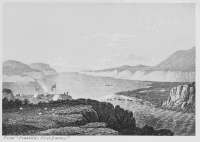
From "Franklin's First Journey." BLOODY FALLS, COPPERMINE RIVER
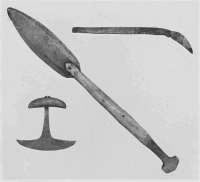
COPPER IMPLEMENTS FROM COPPERMINE RIVER
1771. July.
In a few seconds the horrible scene commenced; it was shocking beyond description; the poor unhappy victims were surprised in the midst of their sleep, and had neither time nor power to make any resistance; men, women, and children, in all upward of twenty, ran out of their tents stark naked, and endeavoured to make their escape; but the Indians having possession of all the land-side, to no place could they fly for shelter. One alternative only remained, that of jumping into the river; but, as none of them attempted it, they all fell a sacrifice to Indian barbarity!
1771. July.
The shrieks and groans of the poor expiring wretches were truly dreadful; and my horror was much increased at seeing a young girl, seemingly about eighteen years of age, killed so near me, that when the first spear was stuck into her side she fell down at my feet, and twisted round my legs, so that it was with difficulty that I could disengage myself from her dying grasps. As two Indian men pursued this unfortunate victim, I solicited very hard for her life; but the murderers made no reply till they had {154} stuck both their spears through her body, and transfixed her to the ground. They then looked me sternly in the face, and began to ridicule me, by asking if I wanted an Esquimaux wife; and paid not the smallest regard to the shrieks and agony of the poor wretch, who was twining round their spears like an eel! Indeed, after receiving much abusive language from them on the occasion, I was at length obliged to desire that they would be more expeditious in dispatching their victim out of her misery, otherwise I should be obliged, out of pity, to assist in the friendly office of putting an end to the existence of a fellow-creature who was so cruelly wounded. On this request being made, one of the Indians hastily drew his spear from the place where it was first lodged, and pierced it through her breast near the heart. The love of life, however, even in this most miserable state, was so predominant, that though this might justly be called the most merciful act that could be done for the poor creature, it seemed to be unwelcome, for though much exhausted by pain and loss of blood, she made several efforts to ward off the friendly blow. My situation and the terror of my mind at beholding this butchery, cannot easily be conceived, much less described; though I summed up all the fortitude I was master of on the occasion, it was with difficulty that I could refrain from tears; and I am confident that my features must have feelingly expressed how sincerely I was affected at the barbarous scene I then {155} witnessed; even at this hour I cannot reflect on the transactions of that horrid day without shedding tears.
The brutish manner in which these savages used the bodies they had so cruelly bereaved of life was so shocking, that it would be indecent to describe it; particularly their curiosity in examining, and the remarks they made, on the formation of the women; which, they pretended to say, differed materially from that of their own. For my own part I must acknowledge, that however favourable the opportunity for determining that point might have been, yet my thoughts at the time were too much agitated to admit of any such remarks; and I firmly believe, that had there actually been as much difference between them as there is said to be between the Hottentots and those of Europe, it would not have been in my power to have marked the distinction. I have reason to think, however, that there is no ground for the assertion; and really believe that the declaration of the Indians on this occasion, was utterly void of truth, and proceeded only from the implacable hatred they bore to the whole tribe of people of whom I am speaking.
1771. July.
When the Indians had completed the murder of the poor Esquimaux, seven other tents on the East side of the river immediately engaged their attention: very luckily, however, our canoes and baggage had been left at a little distance up the river, so that they had no way of {156} crossing to get at them. The river at this part being little more than eighty yards wide, they began firing at them from the West side. The poor Esquimaux on the opposite shore, though all up in arms, did not attempt to abandon their tents; and they were so unacquainted with the nature of fire-arms, that when the bullets struck the ground, they ran in crowds to see what was sent them, and seemed anxious to examine all the pieces of lead which they found flattened against the rocks. At length one of the Esquimaux men was shot in the calf of his leg, which put them in great confusion. They all immediately embarked in their little canoes, and paddled to a shoal in the middle of the river, which being somewhat more than a gun-shot from any part of the shore, put them out of the reach of our barbarians.
1771. July.
When the savages discovered that the surviving Esquimaux had gained the shore above mentioned, the Northern Indians began to plunder the tents of the deceased of all the copper utensils they could find; such as hatchets, bayonets, knives, &c. after which they assembled on the top of an adjacent high hill, and standing all in a cluster, so as to form a solid circle, with their spears erect in the air, gave many shouts of victory, constantly clashing their spears against each other, and frequently calling out tima! tima![AM] by way of derision to the poor surviving {157} Esquimaux, who were standing on the shoal almost knee-deep in water. After parading the hill for some time, it was agreed to return up the river to the place where we had left our canoes and baggage, which was about half a mile distant, and then to cross the river again and plunder the seven tents on the East side. This resolution was immediately put in force; and as ferrying across with only three or four canoes[AN] took a considerable time, and as we were, from the crookedness of the river and the form of the land, entirely under cover, several of the poor surviving Esquimaux, thinking probably that we were gone about our business, and meant to trouble them no more, had returned from the shoal to their habitations. When we approached their tents, which we did under cover of the rocks, we found them busily employed tying up bundles. These the Indians seized with their usual ferocity; on which, the Esquimaux having their canoes lying ready in the water, immediately embarked, and all of them got safe to the former shoal, except an old man, who was so intent on collecting his things, that the Indians coming upon him before he could reach his canoe, he fell a sacrifice to their fury: I verily believe not less than twenty had a hand in his death, as his whole body was like a cullender. It is here necessary to observe that the spies {158} when on the look-out, could not see these seven tents, though close under them, as the bank, on which they stood, stretched over them.
1771. July.
1771. July.
17th.
It ought to have been mentioned in its proper place, that in making our retreat up the river, after killing the Esquimaux on the West side, we saw an old woman sitting by the side of the water, killing salmon,[71] which lay at the foot of the fall as thick as a shoal of herrings. Whether from the noise of the fall, or a natural defect in the old woman's hearing, it is hard to determine, but certain it is, she had no knowledge of the tragical scene which had been so lately transacted at the tents, though she was not more than two hundred yards from the place. When we first perceived her, she seemed perfectly at ease, and was entirely surrounded with the produce of her labour. From her manner of behaviour, and the appearance of her eyes, which were as red as blood, it is more than probable that her sight was not very good; for she scarcely discerned that the Indians were enemies, till they were within twice the length of their spears of her. It was in vain that she attempted to fly, for the wretches of my crew transfixed her to the ground in a few seconds, and butchered her in the most savage manner. There was scarcely a man among them who had not a thrust at her with his spear; and many in doing this, aimed at torture, rather than immediate death, as they not only poked out her eyes, {159} but stabbed her in many parts very remote from those which are vital.
1771. July.
It may appear strange, that a person supposed to be almost blind should be employed in the business of fishing, and particularly with any degree of success; but when the multitude of fish is taken into the account, the wonder will cease. Indeed they were so numerous at the foot of the fall, that when a light pole, armed with a few spikes, which was the instrument the old woman used, was put under water, and hauled up with a jerk, it was scarcely possible to miss them. Some of my Indians tried the method, for curiosity, with the old woman's staff, and seldom got less than two at a jerk, sometimes three or four. Those fish, though very fine, and beautifully red, are but small, seldom weighing more (as near as I could judge) than six or seven pounds, and in general much less. Their numbers at this place were almost incredible, perhaps equal to any thing that is related of the salmon in Kamschatka, or any other part of the world. It does not appear that the Esquimaux have any other method of catching the fish, unless it be by spears and darts; for no appearance of nets was discovered either at their tents, or on any part of the shore. This is the case with all the Esquimaux on the West side of Hudson's Bay; spearing in Summer, and angling in Winter, are the only methods they have yet devised to catch fish, though at {160} times their whole dependence for support is on that article.[AO]
1771. July.
{161} When the Indians had plundered the seven tents of all the copper utensils, which seemed the only thing worth {162} their notice, they threw all the tents and tent-poles into the river, destroyed a vast quantity of dried salmon, musk-oxen flesh, and other provisions; broke all the stone kettles; and, in fact, did all the mischief they possibly could to distress the poor creatures they could not murder, and who were standing on the shoal before mentioned, obliged to be woeful spectators of their great, or perhaps irreparable loss.
After the Indians had completed this piece of wantonness we sat down, and made a good meal of fresh salmon, which were as numerous at the place where we now rested, as they were on the West side of the river. When we had finished our meal, which was the first we had enjoyed for many hours, the Indians told me that they were again ready to assist me in making an end of my survey. It was then about five o'clock in the morning of the seventeenth, the sea being in sight from the North West by West to the North East, about eight miles distant. I therefore set instantly about commencing my survey, and pursued it to the mouth of the river, which I found all the way so full of shoals and falls that it was not navigable even for a boat, and that it emptied itself into the sea over a ridge or bar. {163} The tide was then out; but I judged from the marks which I saw on the edge of the ice, that it flowed about twelve or fourteen feet, which will only reach a little way within the river's mouth. The tide being out, the water in the river was perfectly fresh; but I am certain of its being the sea, or some branch of it, by the quantity of whalebone and seal-skins which the Esquimaux had at their tents, and also by the number of seals[72] which I saw on the ice. At the mouth of the river, the sea is full of islands and shoals, as far as I could see with the assistance of a good pocket telescope. The ice was not then broke up, but was melted away for about three quarters of a mile from the main shore, and to a little distance round the islands and shoals.
18th.
By the time I had completed this survey, it was about one in the morning of the eighteenth; but in those high latitudes, and at this season of the year, the Sun is always at a good height above the horizon, so that we had not only day light, but sunshine the whole night: a thick fog and drizzling rain then came on, and finding that neither the river nor sea were likely to be of any use, I did not think it worth while to wait for fair weather to determine the latitude exactly by an observation; but by the extraordinary care I took in observing the courses and distances when I walked from Congecathawhachaga, where I had two good observations, the latitude may be depended upon within twenty miles at the utmost. For the sake of form, {164} however, after having had some consultation with the Indians, I erected a mark, and took possession of the coast, on behalf of the Hudson's Bay Company.[73]
1771. July.
Having finished this business, we set out on our return, and walked about twelve miles to the South by East, when we stopped and took a little sleep, which was the first time that any of us had closed our eyes from the fifteenth instant, and it was now six o'clock in the morning of the eighteenth. Here the Indians killed a musk-ox, but the moss being very wet, we could not make a fire, so that we were obliged to eat the meat raw, which was intolerable, as it happened to be an old beast.
1771. July.
Before I proceed farther on my return, it may not be improper to give some account of the river, and the country adjacent; its productions, and the animals which constantly inhabit those dreary regions, as well as those that only migrate thither in Summer, in order to breed and rear their young, unmolested by man. That I may do this to better purpose, it will be necessary to go back to the place where I first came to the river, which was about forty miles from its mouth.
Beside the stunted pines already mentioned, there are some tufts of dwarf willows; plenty of Wishacumpuckey,[74] (as the English call it, and which they use as tea); some {165} jackasheypuck, which the natives use as tobacco; and a few cranberry and heathberry bushes; but not the least appearance of any fruit.
The woods grow gradually thinner and smaller as you approach the sea; and the last little tuft of pines that I saw is about thirty miles from the mouth of the river, so that we meet with nothing between that spot and the sea-side but barren hills and marshes.
1771. July.
The general course of the river is about North by East; but in some places it is very crooked, and its breadth varies from twenty yards to four or five hundred. The banks are in general a solid rock, both sides of which correspond so exactly with each other, as to leave no doubt that the channel of the river has been caused by some terrible convulsion of nature; and the stream is supplied by a variety of little rivulets, that rush down the sides of the hills, occasioned chiefly by the melting of the snow. Some of the Indians say, that this river takes its rise from the North West side of Large White Stone Lake, which is at the distance of near three hundred miles on a straight line; but I can scarcely think that is the case, unless there be many intervening lakes, which are supplied by the vast quantity of water that is collected in so great an extent of hilly and mountainous country: for were it otherwise, I should imagine that the multitude of small rivers, which must empty themselves into the main stream in the course of so {166} great a distance, would have formed a much deeper and stronger current than I discovered, and occasioned an annual deluge at the breaking up of the ice in the Spring, of which there was not the least appearance, except at Bloody Fall, where the river was contracted to the breadth of about twenty yards. It was at the foot of this fall that my Indians killed the Esquimaux; which was the reason why I distinguished it by that appellation. From this fall, which is about eight miles from the sea-side, there are very few hills, and those not high. The land between them is a stiff loam and clay, which, in some parts, produces patches of pretty good grass, and in others tallish dwarf willows: at the foot of the hills also there is plenty of fine scurvy-grass.
The Esquimaux at this river are but low in stature, none exceeding the middle size, and though broad set, are neither well-made nor strong bodied. Their complexion is of a dirty copper colour; some of the women, however, are more fair and ruddy. Their dress much resembles that of the Greenlanders in Davis's Straits, except the women's boots, which are not stiffened out with whalebone, and the tails of their jackets are not more than a foot long.
Their arms and fishing-tackle are bows and arrows, spears, lances, darts, &c. which exactly resemble those made use of by the Esquimaux in Hudson's Straits, and {167} which have been well described by Crantz[AP]; but, for want of good edge-tools, are far inferior to them in workmanship. Their arrows are either shod with a triangular piece of black stone, like slate, or a piece of copper; but most commonly the former.
1771. July.
The body of their canoes is on the same construction as that of the other Esquimaux, and there is no unnecessary prow-projection beyond the body of the vessel; these, like their arms and other utensils, are, for the want of better tools, by no means so neat as those I have seen in Hudson's Bay and Straits. The double-bladed paddle is in universal use among all the tribes of this people.
Their tents are made of parchment deer-skins in the hair, and are pitched in a circular form, the same as those of the Esquimaux in Hudson's Bay. These tents are undoubtedly no more than their Summer habitations, for I saw the remains of two miserable hovels, which, from the situation, the structure, and the vast quantity of bones, old shoes, scraps of skins, and other rubbish lying near them, had certainly been some of their Winter retreats. These houses were situated on the South side of a hill; one half of them were under-ground, and the upper parts closely set round with poles, meeting at the top in a conical form, like their Summer-houses or tents. These tents, {168} when inhabited, had undoubtedly been covered with skins; and in Winter entirely overspread with the snow-drift, which must have greatly contributed to their warmth. They were so small, that they did not contain more than six or eight persons each; and even that number of any other people would have found them but miserable habitations.
Their household furniture chiefly consists of stone kettles, and wooden troughs of various sizes; also dishes, scoops, and spoons, made of the buffalo or musk-ox horns. Their kettles are formed of a pepper and salt coloured stone; and though the texture appears to be very coarse, and as porous as a dripstone, yet they are perfectly tight, and will sound as clear as a china bowl. Some of those kettles are so large as to be capable of containing five or six gallons; and though it is impossible these poor people can perform this arduous work with any other tools than harder stones, yet they are by far superior to any that I had ever seen in Hudson's Bay; every one of them being ornamented with neat mouldings round the rim, and some of the large ones with a kind of flute-work at each corner. In shape they were a long square, something wider at the top than bottom, like a knife-tray, and strong handles of the solid stone were left at each end to lift them up.
1771. July.
Their hatchets are made of a thick lump of copper, about five or six inches long, and from one and a half to two inches square; they are bevelled away at one end like a {169} mortice-chissel. This is lashed into the end of a piece of wood about twelve or fourteen inches long, in such a manner as to act like an adze: in general they are applied to the wood like a chissel, and driven in with a heavy club, instead of a mallet. Neither the weight of the tool nor the sharpness of the metal will admit of their being handled either as adze or axe, with any degree of success.
The men's bayonets and women's knives are also made of copper; the former are in shape like the ace of spades, with the handle of deers horn a foot long, and the latter exactly resemble those described by Crantz. Samples of both these implements I formerly sent home to James Fitzgerald, Esq. then one of the Hudson's Bay Committee.
Among all the spoils of the twelve tents which my companions plundered, only two small pieces of iron were found; one of which was about an inch and a half long, and three eighths of an inch broad, made into a woman's knife; the other was barely an inch long, and a quarter of an inch wide. This last was rivetted into a piece of ivory, so as to form a man's knife, known in Hudson's Bay by the name of Mokeatoggan, and is the only instrument used by them in shaping all their wood-work.
Those people had a fine and numerous breed of dogs, with sharp erect ears, sharp noses, bushy tails, &c. {170} exactly like those seen among the Esquimaux in Hudson's Bay and Straits. They were all tethered to stones, to prevent them, as I suppose, from eating the fish that were spread all over the rocks to dry. I do not recollect that my companions killed or hurt one of those animals; but after we had left the tents, they often wished they had taken some of those fine dogs with them.
1771. July.
Though the dress, canoes, utensils, and many other articles belonging to these people, are very similar to those of Hudson's Bay, yet there is one custom that prevails among them—namely, that of the men having all the hair of their heads pulled out by the roots—which pronounces them to be of a different tribe from any hitherto seen either on the coast of Labradore, Hudson's Bay, or Davis's Straits. The women wore their hair at full length, and exactly in the same stile as all the other Esquimaux women do whom I have seen.
When at the sea-side, (at the mouth of the Copper River,) besides seeing many seals on the ice, I also observed several flocks of sea-fowl flying about the shores; such as, gulls, black-heads, loons, old wives, ha-ha-wie's, dunter geese, arctic gulls, and willicks. In the adjacent ponds also were some swans and geese in a moulting state, and in the marshes some curlews and plover; plenty of hawks-eyes, (i.e. the green plover,) and some yellow-legs;[75] also several other small birds, that visit those Northern parts in the {171} Spring to breed and moult, and which doubtless return Southward as the fall advances. My reason for this conjecture is founded on a certain knowledge that all those birds migrate in Hudson's Bay; and it is but reasonable to think that they are less capable of withstanding the rigour of such a long and cold Winter as they must necessarily experience in a country which is so many degrees within the Arctic Circle, as that is where I now saw them.
1771. July.
That the musk-oxen, deer, bears, wolves, wolvarines, foxes, Alpine hares,[76] white owls, ravens, partridges, ground-squirrels, common squirrels, ermins, mice, &c. are the constant inhabitants of those parts, is not to be doubted. In many places, by the sides of the hills, where the snow lay to a great depth, the dung of the musk-oxen and deer was lying in such long and continued heaps, as clearly to point out that those places had been their much-frequented paths during the preceding Winter. There were also many other similar appearances on the hills, and other parts, where the snow was entirely thawed away, without any print of a foot being visible in the moss; which is a certain proof that these long ridges of dung must have been dropped in the snow as the beasts were passing and repassing over it in the Winter. There are likewise similar proofs that the Alpine hare[77] and the partridge[78] do not migrate, but remain there the whole year: the latter we found in considerable flocks among the tufts of willows which grow near the sea.
{172} It is perhaps not generally known, even to the curious, therefore may not be unworthy of observation, that the dung of the musk-ox, though so large an animal, is not larger, and at the same time so near the shape and colour of that of the Alpine hare, that the difference is not easily distinguished but by the natives, though in general the quantity may lead to a discovery of the animal to which it belongs.
1771. July.
I did not see any birds peculiar to those parts, except what the Copper Indians call the "Alarm Bird," or "Bird of Warning."[79] In size and colour it resembles a Cobadekoock, and is of the owl genus. The name is said to be well adapted to its qualities; for when it perceives any people, or beast, it directs its way towards them immediately, and after hovering over them some time, flies round them in circles, or goes a-head in the same direction in which they walk. They repeat their visits frequently; and if they see any other moving objects, fly alternately from one party to the other, hover over them for some time, and make a loud screaming noise, like the crying of a child. In this manner they are said sometimes to follow passengers a whole day. The Copper Indians put great confidence in those birds, and say they are frequently apprized by them of the approach of strangers, and conducted by them to herds of deer and musk-oxen; which, without their assistance, in all probability, they never could have found.
{173} The Esquimaux seem not to have imbibed the same opinion of those birds; for if they had, they must have been apprized of our approach toward their tents, because all the time the Indians lay in ambush, (before they began the massacre,) a large flock of those birds were continually flying about, and hovering alternately over them and the tents, making a noise sufficient to awaken any man out of the soundest sleep.
After a sleep of five or six hours we once more set out, and walked eighteen or nineteen miles to the South South East, when we arrived at one of the copper mines, which lies, from the river's mouth about South South East, distant about twenty-nine or thirty miles.
This mine, if it deserve that appellation, is no more than an entire jumble of rocks and gravel, which has been rent many ways by an earthquake. Through these ruins there runs a small river; but no part of it, at the time I was there, was more than knee-deep.[80]
1771. July.
1771. July.
1771. July.
The Indians who were the occasion of my undertaking this journey, represented this mine to be so rich and valuable, that if a factory were built at the river, a ship might be ballasted with the ore, instead of stone; and that with the same ease and dispatch as is done with stones at Churchill River. By their account the hills were entirely composed of that metal, all in handy lumps, like {174} a heap of pebbles. But their account differed so much from the truth, that I and almost all my companions expended near four hours in search of some of this metal, with such poor success, that among us all, only one piece of any size could be found. This, however, was remarkably good, and weighed above four pounds.[AQ] I believe the copper has formerly been in much greater plenty; for in many places, both on the surface and in the cavities and crevices of the rocks, the stones are much tinged with verdigrise.
It may not be unworthy the notice of the curious, or undeserving a place in my Journal, to remark, that the Indians imagine that every bit of copper they find resembles some object in nature; but by what I saw of the large piece, and some smaller ones which were found by my companions, it requires a great share of invention to make this out. I found that different people had different ideas on the subject, for the large piece of copper above mentioned had not been found long before it had twenty different names. One saying that it resembled this animal, and another that it represented a particular part of another; at last it was generally allowed to resemble an Alpine hare couchant: for my part, I must confess that I could not see it had the least resemblance to any thing to which they compared it. It would be endless to {175} enumerate the different parts of a deer, and other animals, which the Indians say the best pieces of copper resemble: it may therefore be sufficient to say, that the largest pieces, with the fewest branches and the least dross, are the best for their use; as by the help of fire, and two stones, they can beat it out to any shape they wish.
1771. July.
Before Churchill River was settled by the Hudson's Bay Company, which was not more than fifty years previous to this journey being undertaken, the Northern Indians had no other metal but copper among them, except a small quantity of iron-work, which a party of them who visited York Fort about the year one thousand seven hundred and thirteen, or one thousand seven hundred and fourteen, purchased; and a few pieces of old iron found at Churchill River, which had undoubtedly been left there by Captain Monk. This being the case, numbers of them from all quarters used every Summer to resort to these hills in search of copper; of which they made hatchets, ice-chissels, bayonets, knives, awls, arrow-heads, &c.[AR] The many {176} paths that had been beaten by the Indians on these occasions, and which are yet, in many places, very perfect, especially on the dry ridges and hills, is surprising; in the vallies and marshy grounds, however, they are mostly grown over with herbage, so as not to be discerned.
1771. July.
The Copper Indians set a great value on their native metal even to this day; and prefer it to iron, for almost every use except that of a hatchet, a knife, and an awl: for these three necessary implements, copper makes but a very poor substitute. When they exchange copper for iron-work with our trading Northern Indians, which is but seldom, the standard is an ice-chissel of copper for an ice-chissel of iron, or an ice-chissel and a few arrow-heads of copper, for a half-worn hatchet; but when they barter furrs with our Indians, the established rule is to give ten times the price for every thing they purchase that is given for them at the Company's Factory. Thus, a hatchet that is bought at the Factory for one beaver-skin, or one cat-skin, or three ordinary martins' skins, is sold to {177} those people at the advanced price of one thousand per cent.; they also pay in proportion, for knives, and every other smaller piece of iron-work. For a small brass kettle of two pounds, or two pounds and a half weight, they pay sixty martins, or twenty beaver in other kinds of furrs.[AS] If the kettles are not bruised, or ill-used in any other respect, the Northern traders have the conscience at times to exact something more. It is at this extravagant price that all the Copper and Dog-ribbed Indians, who traffic with our yearly traders, supply themselves with iron-work, &c.
1771. July.
From those two tribes our Northern Indians used formerly to purchase most of the furrs they brought to the Company's Factory; for their own country produced very few of those articles, and being, at that time, at war with the Southern Indians, they were prevented from penetrating far enough backwards to meet with many animals of the furr kind; so that deer-skins, and {178} such furrs as they could extort from the Copper and Dog-ribbed Indians, composed the whole of their trade; which, on an average of many years, and indeed till very lately, seldom or ever exceeded six thousand Made Beaver per annum.
1771. July.
At present happy it is for them, and greatly to the advantage of the Company, that they are in perfect peace, and live in friendship with their Southern neighbours. The good effect of this harmony is already so visible, that within a few years the trade from that quarter has increased many thousands of Made Beaver annually; some years even to the amount of eleven thousand skins.[AT] Besides {179} the advantage arising to the Company from this increase, the poor Northern Indians reap innumerable benefits from a fine and plentiful country, with the produce of which they annually load themselves for trade, without giving the least offence to the proper inhabitants.
1771. July.
Several attempts have been made to induce the Copper and Dog-ribbed Indians to visit the Company's Fort at Churchill River, and for that purpose many presents have been sent, but they never were attended with any success. And though several of the Copper Indians have visited Churchill, in the capacity of servants to the Northern Indians, and were generally sent back loaded with presents for their countrymen, yet the Northern Indians always plundered them of the whole soon after they left the Fort. This kind of treatment, added to the many inconveniences that attend so long a journey, are great obstacles in their way; otherwise it would be as possible for them to bring their own goods to market, as for the Northern Indians to go so far to purchase them on their own account, {180} and have the same distance to bring them as the first proprietors would have had. But it is a political scheme of our Northern traders to prevent such an intercourse, as it would greatly lessen their consequence and emolument. Superstition, indeed, will, in all probability, be a lasting barrier against those people ever having a settled communication with our Factory; as few of them chuse to travel in countries so remote from their own, under a pretence that the change of air and provisions (though exactly the same to which they are accustomed) are highly prejudicial to their health; and that not one out of three of those who have undertaken the journey, have ever lived to return. The first of these reasons is evidently no more than gross superstition; and though the latter is but too true, it has always been owing to the treachery and cruelty of the Northern Indians, who took them under their protection.
It is but a few years since, that Captain Keelshies, who is frequently mentioned in this Journal, took twelve of these people under his charge, all heavy laden with the most valuable furrs; and long before they arrived at the Fort, he and the rest of his crew had got all the furrs from them, in payment for provisions for their support, and obliged them to carry the furrs on their account.
On their arrival at Prince of Wales's Fort, Keelshies laid claim to great merit for having brought those strangers, {181} so richly laden, to the Factory, and assured the Governor that he might, in future, expect a great increase in trade from that quarter, through his interest and assiduity. One of the strangers was dubbed with the name of Captain, and treated accordingly, while at the Fort; that is, he was dressed out in the best manner; and at his departure, both himself and all his countrymen were loaded with presents, in hopes that they would not only repeat the visit themselves, but by displaying so much generosity, many of their countrymen would be induced to accompany them.
1771. July.
There seems to be great propriety in the conduct of the Governor[AU] on this occasion; but however well-intended, it had quite the contrary effect, for Keelshies and the rest of his execrable gang, not content with sharing all the furrs those poor people had carried to the Fort, determined to get also all the European goods that had been given to them by the Governor. As neither Keelshies nor any of his gang had the courage to kill the Copper Indians, they concerted a deep-laid scheme for their destruction; which was to leave them on an island. With this view, when they got to the proposed spot, the Northern Indians took care to have all the baggage belonging to the Copper Indians ferried across to the main, and having stripped them of such parts of their clothing as they {182} thought worthy their notice, went off with all the canoes, leaving them all behind on the island, where they perished for want. When I was on my journey to the Fort in June one thousand seven hundred and seventy two, I saw the bones of those poor people, and had the foregoing account from my guide Matonabbee; but it was not made known to the Governor for some years afterward, for fear of prejudicing him against Keelshies.
A similar circumstance had nearly happened to a Copper Indian who accompanied me to the Fort in one thousand seven hundred and seventy-two: after we were all ferried across Seal River, and the poor man's bundle of furrs on the South-side, he was left alone on the opposite shore; and no one except Matonabbee would go over for him. The wind at that time blew so hard, that Matonabbee stripped himself quite naked, to be ready for swimming in case the canoe should overset; but he soon brought the Copper Indian safe over, to the no small mortification of the wretch who had the charge of him, and who would gladly have possessed the bundle of furrs at the expence of the poor man's life.
When the Northern Indians returned from the Factory that year, the above Copper Indian put himself under the protection of Matonabbee, who accompanied him as far North, as the latitude 64°, where they saw some Copper Indians, among whom was the young man's father, into {183} whose hands Matonabbee delivered him in good health, with all his goods safe, and in good order.
1771. July.
Soon after we had left the Coppermine, there came on a thick fog with rain, and at intervals heavy showers of snow. This kind of weather continued for some days; and at times it was so thick, that we were obliged to stop for several hours together, as we were unable to see our way, and the road was remarkably rocky and intricate.
22d.
At three o'clock in the morning of the twenty-second, Matonabbee's brother and one of the Copper Indians, who had been first dispatched a-head from Congecathawhachaga, overtook us. During their absence they had not discovered any Indians who could have been serviceable to my expedition. They had, however, been at the Copper River, and seeing some marks set up there to direct them to return, they had made the best of their way, and had not slept from the time they left the river till they joined us, though the distance was not less than a hundred miles. When they arrived we were asleep, but we soon awakened, and began to proceed on our journey. That day we walked forty-two miles; and in our way passed Buffalo Lake: at night, we put up about the middle of the Stony Mountains. The weather was excessively hot and sultry.
23d.
{184} On the twenty-third, the weather continued much the same as on the preceding day. Early in the morning we set out, and walked forty-five miles the first day, during which the Indians killed several fine fat buck deer.
24th.
1771. July.
About one o'clock in the morning of the twenty-fourth, we stopped and took a little refreshment, as we had also done about noon the preceding day; but the Indians had been so long from their wives and families, that they promised not to sleep till they saw them, especially as we were then in sight of the hills of Congecathawhachaga,[83] where we had left the last of them. After resting about an hour, we proceeded on our way, and at six in the morning arrived at Congecathawhachaga; when, to our great disappointment, we found that all our women had got set across the river before the Copper Indians left that part; so that when we arrived, not an Indian was to be found, except an old man and his family, who had arrived in our absence, and was waiting at the crossing-place with some furrs for Matonabbee, who was so nearly related to the old man as to be his son-in-law, having one of his daughters for a wife. The old man had another with him, who was also offered to the great man, but not accepted.
Our stay at this place may be said to have been of very short duration; for on seeing a large smoke to the Southward, we immediately crossed the river, and walked towards it, {185} when we found that the women had indeed been there some days before, but were gone; and at their departure had set the moss on fire, which was then burning, and occasioned the smoke we had seen. By this time the afternoon was far advanced; we pursued, however, our course in the direction which the women took, for their track we could easily discover in the moss. We had not gone far, before we saw another smoke at a great distance, for which we shaped our course; and, notwithstanding we redoubled our pace, it was eleven o'clock at night before we reached it; when, to our great mortification, we found it to be the place where the women had slept the night before; having in the morning, at their departure, set fire to the moss which was then burning.
25th.
The Indians, finding that their wives were so near as to be within one of their ordinary day's walk, which seldom exceeded ten or twelve miles, determined not to rest till they had joined them. Accordingly we pursued our course, and about two o'clock in the morning of the twenty-fifth, came up with some of the women, who had then pitched their tents by the side of Cogead Lake.[84]
1771. July.
From our leaving the Copper-mine River to this time we had travelled so hard, and taken so little rest by the way, that my feet and legs had swelled considerably, and I had become quite stiff at the ankles. In this situation I had {186} so little power to direct my feet when walking, that I frequently knocked them against the stones with such force, as not only to jar and disorder them, but my legs also; and the nails of my toes were bruised to such a degree, that several of them festered and dropped off. To add to this mishap, the skin was entirely chafed off from the tops of both my feet, and between every toe; so that the sand and gravel, which I could by no means exclude, irritated the raw parts so much, that for a whole day before we arrived at the women's tents, I left the print of my feet in blood almost at every step I took. Several of the Indians began to complain that their feet also were sore; but, on examination, not one of them was the twentieth part in so bad a state as mine.
This being the first time I had been in such a situation, or seen anybody foot-foundered, I was much alarmed, and under great apprehensions for the consequences. Though I was but little fatigued in body, yet the excruciating pain I suffered when walking, had such an effect on my spirits, that if the Indians had continued to travel two or three days longer at that unmerciful rate, I must unavoidably have been left behind; for my feet were in many places quite honey-combed, by the dirt and gravel eating into the raw flesh.
1771. July.
As soon as we arrived at the women's tents, the first thing I did, was to wash and clean my feet in {187} warm water; then I bathed the swelled parts with spirits of wine, and dressed those that were raw with Turner's cerate; soon after which I betook myself to rest. As we did not move on the following day, I perceived that the swelling abated, and the raw parts of my feet were not quite so much inflamed. This change for the better gave me the strongest assurance that rest was the principal thing wanted to effect a speedy and complete cure of my painful, though in reality very simple disorder, (foot-foundering,) which I had before considered to be an affair of the greatest consequence.
27th.
Rest, however, though essential to my speedy recovery, could not at this time be procured; for as the Indians were desirous of joining the remainder of their wives and families as soon as possible, they would not stop even a single day; so that on the twenty-seventh we again began to move; and though they moved at the rate of eight or nine miles a day, it was with the utmost difficulty that I could follow them. Indeed the weather proved remarkably fine and pleasant, and the ground was in general pretty dry, and free from stones; which contributed greatly to my ease in walking, and enabled me to keep up with the natives.
31st.
August. 1st.
5th.
1771. July.
On the thirty-first of July, we arrived at the place[85] where the wives and families of my companions had been ordered to wait our return from the Copper-mine River. Here we found several tents of Indians; but those {188} belonging to Matonabbee, and some others of my crew, had not arrived. We saw, however, a large smoke to the Eastward, which we supposed had been made by them, as no other Indians were expected from that quarter. Accordingly, the next morning, Matonabbee sent some of his young men in quest of them, and on the fifth, they all joined us; when, contrary to expectation, a great number of other Indians were with them; in all, to the amount of more than forty tents. Among those Indians, was the man who Matonabbee stabbed when we were at Clowey. With the greatest submission he led his wife to Matonabbee's tent, set her down by his side, and retired, without saying a word. Matonabbee took no notice of her, though she was bathed in tears; and by degrees, after reclining herself on her elbow for some time, she lay down, and, sobbing, said, see'd dinne, see'd dinne! which is, My husband, my husband! On which Matonabbee told her, that if she had respected him as such, she would not have run away from him; and that she was at liberty to go where she pleased. On which she got up, with seeming reluctance, though most assuredly with a light heart, and returned to her former husband's tent.