JOURNAL OF LADY SALE. (continued 3)
Reading edition
Some say that Mahommed Akbar Khan is now King, and Zeman Shah Khan his Wuzeer: others state that the latter refuses to give up his lately acquired power.
Ishmatoolah (the Akhoonzada or old moollah from Kandahar, who was to have gone with Sir William to Bombay), has taken himself off, leaving a message for the Envoy to say that he was gone to the city. A messenger was sent to his son, Khojeh Meer, in Behmaru; who stated that two respectable persons came to fetch the moollah, reporting that they did so by order of Mahomed Akbar Khan, who required his immediate attendance, as Lawrence and Trevor were both with him, and the Envoy coming. Whether the father and son are in league or not, remains to be proved; but this man's secession (who was much in Sir William's confidence) has caused us all to be on the alert, expecting an attack, or mischief of some kind.
There was an absurd report to-day, that the enemy had sent us back the gun they captured on the 23d, with the horses; and the gullibility of John Bull was proved by many persons leaving an auction of some of the deceased officers' property, to go to the Kohistan gate, and find it was all nonsense.
28th.—Shelled the village of Behmaru, whence the enemy annoyed us by firing on our yaboos sent out to endeavour to procure grain.
This day we had both rain and snow. Mahommed Shah Khan Ghilzye is come into Cabul, and therefore we think there must have been a fight below, in which he has had the worst.
A Hindu merchant has offered to bring grain, and lay it at the gate of Mahommed Shureef's fort in the night. We are not to speak to his people; and are eventually to pay him at the rate of one Cabul seer for the rupee, and we are bound to take 200 kurwars. Also on every hundred maunds being delivered, we are to lay down a bag of 1500 rupees as a present. He says many would assist us, but are afraid; that as he is the first in the market, he expects to make his fortune.
29th.—The enemy are not showing any cavalry to-day; and there is a rumour that they have gone to meet the corps coming in from Ghuznee—there was only infantry on the hillside; however, some alarmists fancied that they were coming down, which they never do without horsemen: the bugles sounded, there was a great bustle, and all ended in nothing.
We shelled Behmaru and the hill above it; and also the two shops close to the village, one on either side of the road, where there is a little bridge, and the trees form an archway.
Ammunition was sent to the Bala Hissar.
The horses are hard up for grain: those for the artillery have not been much looked after since Lieut. Waller was wounded; and one of them is averred to have eaten his comrade's tail! That he bit it off there is no doubt.
30th.—Abdoolah Khan's death has, it is said, created some confusion in the city. Whilst still living a report was spread of his decease; and, like Alexander, he mounted his horse, and showed himself to his followers; but the exertion was too great for him, and he shortly after expired.
Amongst other political barometers, the manner in which persons are spoken of indicates whether affairs are going on well or ill: just now, things are looking up again. A few days ago people spoke of "The Macnaghtens;" then they became again "Sir William and my Lady;" and to-day they have left their refuge in a tent in cantonments, and are gone into the great house again, which they think will have a good effect, and tend to quiet people's minds.
The politicals are again very mysterious, and deny that any negotiations are going on, &c .; but letters come in constantly; and we know they are treating with the Ghilzyes.
A new arrangement is made with Khojeh Meer regarding grain: formerly he received fifty rupees daily as bukshees, whether grain was procured or not; now he is to have 500 rupees given him on delivery of every hundred khurwars.
Sturt proposes to hut the men on the ramparts, and give them plenty of firewood. As yet they are not allowed any fires, except for cooking their food. He also wishes to have the city shelled, both from the Bala Hissar and the cantonments, particularly to annoy the quarter where the gunpowder-makers reside.
Early this morning a party of horsemen left the city in the direction of Bhoodkhak, and another towards the Kohistan.
Treaty is certainly going on; and we think that the confederacy may be breaking up. Humza Khan of Tezeen is said to be sending his women away from Cabul, and many have been seen mounted on yaboos going away on the road leading to Bhoodkhak.
1st December.—Mohun Lull writes that the enemy will show in force to-day, and attack us to-morrow. The firing we heard in the night was an attack on the patrol, who got in safe.
A cossid reported yesterday that he had been with his letter to Kelat-i-Ghilzye, but he brought no letter back. He said that the force had left the place; and as he could not give any account of, or letters from Ghuznee, we suspect that he never went at all.
A report to-day that the Hindu merchant had commenced his supplies of grain is contradicted: but a small quantity was got in to-day.
We sent to get some barley for our horses; but the enemy were hovering about the villages, and prevented us.
It is reported that the garrison at Ghuznee have blown up the bastions, and joined General Nott's force.
More treaty going on. Firing at night, said to be an attempt to blow up the Bala Hissar gate, which was repulsed. A good deal of firing during the night, and also shelling into the town.
2nd.—Last night's firing was an unsuccessful attempt of the enemy on the Bourj above the Bala Hissar.
I counted this morning 49 horsemen on the Siah Sung Hill, who were reported to the General at 300! We did not fire at them, as they were seen to come from Mahmood Khan's Fort, where the Ghilzyes reside who are now treating with us.
Mohun Lull's information was incorrect; the enemy did not show in force yesterday, neither have they to-day made their intended attack on the captured fort and that of the magazine. The person who succeeds in taking the latter is promised 40,000 rupees, and the rents of the adjacent lands.
The enemy's confederacy is said to be breaking up: they are now quarrelling regarding the partition of power which as yet they have not. One says he will be chief of Cabul, another of Jellalabad, &c . The plan proposed for the capture of cantonments by the enemy is, to send 200 bildars in front to cut down the ramparts; next come the infantry, and then the horse. I suppose we are to stand still and look on.
Mahommed Akbar Khan is said to be very ill.
There is a report that a man has come in from Gen. Nott's camp at Urghundee, eighteen miles off; that the enemy had attacked him, placing two guns in position, both of which we are said to have captured. We fear this news is too good to be true. These reports are disseminated by the enemy; and the only motive to which I can attribute them is a wish to lull us into security by reports of aid coming to us, until starvation prompts acquiescence in their demands, be they what they may.
A man of the Ghoorka corps has come in. He says the men are wandering up and down the country, and that some have taken refuge in forts; that poor Rose, in a fit of despair, put an end to his existence by shooting himself; and that Dr. Grant, when he last saw him, was wounded in the leg.
Ishmatoolah is said to be imprisoned in the city.
The Parsee merchant is also in prison until he pays a ransom of 10,000 rupees: his property has all been taken away.
The people of the city are said to be discontented. They have no firewood; the people who used to bring it in are afraid to do so lest they should be plundered.
3rd.—The attack intended for yesterday has been postponed to to-day, we hear; but there seems to be little likelihood of one.
Khojeh Meer says that he has no more grain: we only got 50 maunds in to-day. He also says that the moollahs have been to all the villages, and laid the people under ban not to assist the English, and that consequently the Mussulman population are as one man against us. He says he expects himself to have to run for his life to Peshawer whenever we go away. Khojeh Meer has a difficult part, to play: his pecuniary gain in siding with us is great; but being the father-in-law of Meer Musjudee, who married the Khojeh's daughter, he of course lets the enemy occupy the village whenever they please. As far as we are individually concerned, Khojeh Meer has been very civil to us: he sells us grain whenever we can manage to send an Affghan servant on a yaboo to purchase it. Sturt has been kind to the man; and he evinces his gratitude by writing to say that he will get us what supplies he can. Much more grain might have been procured, had we not foolishly tried to drive hard bargains with Khojeh Meer. It has been intimated to the Envoy that the enemy's troops, who lately got one rupee daily for each horseman, and eight anas for each foot soldier, have not had any pay for four days, and that they are grumbling at it.
We saw a party leaving Cabul towards Bhoodkhak with two women on one horse riding with them.
A cossid came in from Jellalabad; no letter for me. He had been detained five days in the city, and his intelligence only reached to the 21st. Khojeh Meer says that the villages to our rear (from whence the grain was brought to Behmaru) are occupied; and that the only place which could have given us grain, and where we might have obtained six months' supply, was Khojeh Rewash, which is at present occupied by Sekundu Khan with 500 men.
In the evening about seven o'clock there was firing on the southern face, and towards the Magazine fort, which continued until past ten o'clock. The enemy appear to be trying to mine that fort, and Sturt saw about ten men close up under the walls of it.
The enemy seem to be on the alert; however there was no firing at night of any consequence: we shelled the city from the Bala Hissar as usual.
Orders were this day issued, that the arms and accoutrements, discipline, &c . of the various corps, should be attended to! Consequent on this order the 5th have been very busy cleaning their musket barrels,—a most unusual exertion. The arms used to be placed against the rampart, and of course the barrels were rusty and the powder damp.
A committee is ordered to assemble to-morrow to value all useless horses in the Bazaar, which are to be destroyed; so there will be plenty of cheap meat, as tattoos and camels have for some time past been eaten: even some of the gentlemen ate camel's flesh, particularly the heart, which was esteemed equal to that of the bullock. I never was tempted by these choice viands; so cannot offer an opinion regarding them.
Brig. Shelton sent to tell Sturt that one of the bastions of the captured fort was on fire, and to request he would send bildars to dig the place and lay on fresh earth. He went accordingly to see what was the matter, and came back very angry, as the guard had been burning the defences he had put up.
4th.—Two chiefs have been treating with the King: they propose that he throws off the Feringhees, on which they will render their allegiance to him. His Majesty, however, thinks it unsafe to break with us. Gen. Nott's brigade is now supposed to be at Shekoabad, about six marches from Cabul. The enemy assembled in numbers on the heights, and planted two guns in the gorge; from which they discharged 144 shot at us (said to have been scored on the wall of the Mission Compound). They had three other guns out, which were placed on the road behind a trench they had dug, and a kind of breastwork they had thrown up across the road, near the Shah Bagh.
In front of this they had another for their men to fire from behind it. Another party took post in the Nullah, near the bridge going to Siah Sung. A man mounted on a grey horse came down apparently to see if they were properly posted: he had a foot man with him. A shot was taken at the latter, who, being beyond its range, ran a few yards backwards and forwards, dancing, jumping, and cutting capers in derision.
Just as it was getting dark the fight commenced in earnest: the enemy made a rush at the captured fort. They had placed a bag of powder at the wicket, and must have been greatly astonished at finding it produced no effect in consequence of Sturt having filled the place up.
They were received with a sharp fire, which was kept up for a long time, both of musketry and guns. Lieut. Cumberland, of the 44th, was on duty there with 100 men. He sent for a reinforcement, and Sturt took fifty men to him under a very heavy fire. (Observe the wisdom of unnecessarily risking the life of our only engineer officer.)
Notwithstanding that the enemy opened five guns on us, our loss was very trifling: as yet I have heard only of one man, an artilleryman, killed; and a sergeant of Sturt's (Williams) was wounded whilst digging with the sappers. A few horses and camels were killed, as also one or two camp followers in the Mission Compound.
Some of the cannon shot went clean over the cantonments (those fired from the gorge): one fell between the legs of Mr. Mein's mule in Sturt's compound, near the rear gate, without doing any damage.
To-day Sturt came home with his clothes singed, having been nearly blown up by an explosion of powder in one of the batteries, when a man got his pouch ignited by the port-fire; he was much hurt: at 10 o'clock the shots were dropping quickly.
I can scarcely believe that this is the grand attempt at capturing cantonments; and therefore am expecting another, and wish it may occur by daylight.
The enemy's idea of blowing open a gate is excellent. They filled the bag with powder, applied and lighted a slow match, and then threw it at the gate! so that, when it exploded, of course it did no harm.
5th.—The enemy assembled in small parties on the Siah Sung Hill; also, but not in great force, on the other hills.
In the morning they attacked a foraging party sent by the cavalry, and surrounded them in a fort. At length they took an oath on the Koran not to hurt them; and a trooper, notwithstanding the remonstrances of the rest, came out: he talked with them, shook hands with them, and they seemed very friendly. They then desired the camp followers to come out; but they distrusted them, and called to the trooper to return to them: as he was doing so they shot him. The grasscutters had amongst them one old musket, with which they shot two of the enemy: further operations were suspended by the arrival of a reinforcement, when the enemy disappeared instanter.
Some ottah has been said to have been dropped at the Musjed; but this has been contradicted, and I believe no grain has been brought in to-day.
The chief of Khojeh Rewash says that we must send a force, to make it appear that we force it from him; and then he will sell us grain.
The proprietor of Kella Bolund offers 1000 kurwars of grain if we will send for it, and has given the Envoy an order for its delivery; but the difficulty lies in getting at it.
Major Kershaw has sent to announce that the enemy are coming out of the city gate with their guns.
There has been firing all day, but I believe only a bheestee of Mr. Eyre's killed, just behind our compound.
In the evening, about five o'clock, there was very quick firing about the Bazar village.
The enemy have burnt the bridge, and commenced mining one of the bastions of the captured fort.
A strong reinforcement has been sent there; and Sturt is gone down again, at nine at night, to look to its defences.
Sturt has again to-day narrowly escaped being shot. The enemy seem to know and to lie in wait for him, and he never shows his head above the rampart without a ball whistling close to it. The Affghans are good shots when they fire from their rests; and as the ammunition is the property of each individual, they do not throw it away as we do ours. Their gunners appear to be inferior, as they fired at the captured fort at a distance of 300 yards, yet did not hit it.
6th.—Sturt was out till one o'clock this morning. Between twelve and one he crept round the fort and got into the enemy's mine: they had worked in about eight feet. He blew up the mine, which fell in and destroyed the covered way they had made, and shook down part of the garden wall.
News from the Bala Hissar that the enemy are evidently thinning their numbers; and a Ghilzye chief who has been wounded is gone home.
A cossid, who was sent by the King to Ghuznee, has returned. He says he was stopped half way and put in kyde; that during the time he was a prisoner another cossid arrived, sent to Amenoollah Khan from the Kelat-i-Ghilzye chiefs with a letter. This man told him that he was the bearer of a request for troops and guns, without which they could not prevent the Feringhee King reaching Cabul; and that four regiments of infantry, 100 horse, and five guns were already at Karabagh, two marches from Ghuznee: that this occurred five days since (about the 1st). The cossid took his oath on the Koran, before four moollahs, to the truth of his statement; desired he might be put in prison (in which he was accommodated); and further begged if the force did not arrive they would put him to death! So after all this asseveration he was, of course, implicitly believed.
At daybreak not a vestige remained of the bridge; which, however, the General is still very anxious to rebuild, and has sent to inquire if Sturt can do so. Without materials or workmen, and the enemy on the spot, it is as impossible as useless to attempt it.
The General refused to have a party stationed in the small fort to defend this same bridge, and now it is gone. He seems more bewildered than ever, and says if the force arrives there will only be more mouths to eat up our provisions; and we have only eight days', this inclusive; but we have not a man to send out to forage.
The enemy were out to-day, but not in great force. They have got a Russian seventeen-pounder of brass, which they have brought in from the Kohistan, and have planted it in the road, near and on this side of Mahmood Khan's fort. From this they have been firing at us all day, and the balls fall many of them in the gardens of Messrs. Eyre and Sturt's house. We have picked up three cannon balls close to the door of the verandah.
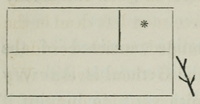
Lieut. Hawtrey of the 37th N. I. was on duty at the captured fort to-day with 100 men—forty of these were of the 44th, the rest from the 37th. Suppose this to be the fort: * no outlet, the window being blocked up with mud. In this room were six of the 44th. The Affghans planted their crooked sticks, which served them for scaling ladders; got up one by one; pulled out the mud, and got in. A child with a stick might have repulsed them. The Europeans had their belts and accoutrements off, and the Sipahees the same. They all ran away as fast as they could! The 44th say that the 37th ran first, and as they were too weak they went too. Hawtrey says there was not a pin to choose,—all cowards alike. After he was deserted by the men, he himself threw six hand grenades before he followed them. One man of the 44th was an exception, and he was shot whilst assisting Hawtrey in throwing these missiles.
Lieut. Gray, 44th, was wounded in the arm earlier in the day, by a man who climbed up and fired through a loophole at him: he thoughtlessly left his post to return to cantonments and get his wound dressed; and the men endeavoured to excuse themselves by saying their own officer was not there to direct them. It was the most shameful of all the runaways that has occurred. The men (all agree) were not dressed when the enemy entered. The 37th had three men left dead in the breach, and two were wounded, which certainly looks as if they had defended themselves. We lost 6000 rounds of ammunition in this fort.
Brig. Shelton wished that the garrison who had evacuated the fort should retake it. For this purpose he got the men under arms as soon as they could be collected together, and kept them, regardless of the inclemency of the weather, with snow lying on the ground, until three or four o'clock in the morning; when they were eventually dismissed, nothing being attempted.
The least thing seems to-day to create alarm. The following note, accompanied by a six-pound shot, was sent by order of Brig. Shelton to Sturt:
"Dear Hogg—The enemy have planted a gun in a bastion of one of their forts, near the road leading to the Kohistan gate of the city, and have been firing it at the Magazine fort since one o'clock. Two or three shots struck the rear face. I send you one that fell in the room above the gateway, after passing through the wall.
"Yours, W. Grant."
Gen. Elphinstone wrote again to the Envoy to-day, urging him to treat for terms with the enemy.
At near 9 A.M. Sturt left us with an intention of blowing up the captured fort, which the men seem to have taken a dislike to, and to be determined not to defend it. He had not been gone more than a few minutes when quick firing commenced: the enemy had come down evidently in force along the south-eastern face of cantonments. There was a blaze of light from Mahmood Khan's fort to our rear gate: it did not last long, but it was a very anxious time; for our north-eastern portion of rampart is occupied by the 5th, and I distinctly heard Bygrave using no gentle language whilst he kicked the men up and out of their tents. Lieut. Mein (13th) was also active in assisting to do the same, but with very little success; though the drums beating to arms, and the hallooing and shouting for the General and the Brigadier, were noise enough to have aroused the dead. Lieut. Deas was on the rear gate guard; and had a rush been made at it by the enemy, there did not seem to be any one to oppose them.
Yesterday when Sturt was talking to the General and the Brigadier about the captured fort, he mentioned that Capt. Layton commanded there that day, and that he wished he should remain and retain it as a permanent command, it being a place for which an officer should be selected, and he considered him as well fitted for the command. Shelton, with a sneer, asked if Layton would like to stay there? To which Sturt replied, "I do not know what he would like, but I know that I should wish him to do so." Capt. Layton's courage and steadiness were too unimpeachable for the sneer to affect his character as a soldier. The Brigadier's dislike to him arose from his not being a man of polished manners, and rather ungrammatical in his language.
After all had gone wrong, the Brigadier told Sturt that he had told him to order Capt. Layton to remain, and appealed to the General whether he did not; to which Elphinstone hesitatingly replied, yes. On Sturt saying that he never understood such an order, and that their recollections of the conversation were different from his; that he would not give up his own reminiscence of the business; that he (Sturt) was wide awake at the time; the Brigadier lying on the floor rolled up in his bedding, and either really or affectedly half asleep. On this the General hedged off evasively by saying, he did not think what was said amounted to an order!
Now when Sturt mentioned the circumstance to me yesterday, I asked him whether he thought they would select an officer as a permanent commandant, and his reply was, "God knows." Besides if it was to be, it would have been notified in Orders, being a decided innovation on the daily relief of the fort.
"One example is as good as a million:" these circumstances show how affairs are carried on. The General, unsettled in his purposes, delegates his power to the Brigadier, and the Brigadier tries to throw off all responsibility on the General's or any body's shoulders except his own: and the General is, as in the present instance, too gentlemanlike to tell him that he deviates a little from the exact line, and thus takes on himself the evasion.
Sturt came home quite disgusted; vowing that if those dear to him were not in cantonments, they might blow them up for what he cared.
I heard a piece of private intelligence to-day,—that three of the Envoy's Chuprassies and a Duffodar of the 4th Ressallah, with two other persons whose names have not transpired, are in connection with the enemy; and this treasonable correspondence has been discovered by some intercepted letters. The men had been disposing of their property two days previous to the discovery. The three Chuprassies are in confinement, and the Envoy talks of asking the General for a court-martial on them. The chances are they will escape punishment: whereas were they hanged as traitors at once, it might be an useful lesson to others. We have a Fakir and some Affghans in confinement also, who are suspected of being spies.
The General peremptorily forbade the camp followers trying to take away the piles of the bridge that remained; so the enemy, who are hard up for wood, came down in great numbers, and did it for us. To-day we have seven days' provisions left.
7th.—Sturt was anxious to take the recaptured fort; and as it appears that the men are determined not to keep it, he proposed to blow it up, and to call for volunteers for that purpose.
The 44th say they wish to wipe out the stain on their name, as do the 37th. Hawtrey's company volunteer to go with him, and take it without the assistance of any other troops.
In sending the Sipahees to that fort, the sixty men were taken six from each company, so that very few could have had their own officer, European or native, havildars, jemadars, or even their own comrades. It was certainly a particularly bad arrangement.
The General wished to know from Sturt whether the fort was practicable and tenable; at least this was the message brought by Capt. Bellew: to which Sturt said but one reply could be made—"Practicable if the men will fight: tenable if they do not run away!"—but that he considered that the great object was to destroy it; as he more than doubted the willingness of the troops to garrison it, although daily relieved.
Objections were raised as to any other measures being taken than firing at it to batter it down, which was accordingly done all day. The enemy showed again; but their numbers are thinning: they fired at us all day; and the balls from the brass seventeen-pounder just opposite came whizzing over and about Sturt's house and garden.
Our chiefs are very anxious regarding three galleries that the enemy are said to be running from various points to the Bazar bastion. They are said to have mined 100 yards towards it from the captured fort. Hadjee Mahommed, the famous miner from the Kohistan, has twenty men with him; and the enemy have great confidence in his skill, and have given him 12,000 rupees.
I wonder if they paid the conquering hero of the captured fort their promised reward of 4000 rupees?
The report is, that the Affghans have sworn on the Koran to take the Bazar fort and the Magazine fort: for the latter they are to receive 10,000 rupees.
The Envoy is in hopes to get in five days' provisions from the Bala Hissar.
Mahommed Akbar Khan sent in, offering us terms to go out, bag and baggage: but this was before the fort was taken, and he will now probably rise in his demands, which have not transpired. No reply has yet been given, as hopes are entertained of the arrival of Gen. Nott's force before we are quite starved: besides, as Zeman Shah Khan has not given up the power to Mahommed Akbar Khan, he may not be able to guarantee our safety.
8th.—The first news of the day was, that the ammunition destined for the Bala Hissar during last night set out, eighty yaboos, escorted by some of Skinner's horse, under Capt. Hay: when they got to the camel sheds they found themselves between two fires, of which, however, but one shot hit a trooper. On the first shot being fired, many of the saces threw off their loads, and galloped as hard as they could. Only forty-four laden yaboos arrived: five were lost altogether, with many yaboos and loads of private baggage; for there was (now, when the enemy's suspicions were raised) an idea of trying to throw ammunition into the Bala Hissar, and of eventually endeavouring to force our way there: and a good deal of private property was attempted to be sent in with it. We did not send any thing, expecting that our goods would never reach their destination.
Had Sturt's wish been complied with, long ago we should have been safe in the Bala Hissar, with plenty of provisions, and might have set all Affghanistan at defiance until an army could arrive from the provinces.
The orders given to the reserve last night were, to go to the rescue if the convoy was attacked on its return; but as there was no order to defend the animals laden with ammunition when going, they waited until Brig. Shelton should arrive, and when of course it was too late, and all was over.
Conolly and Jan Fishan Khan have come in, I believe to press the subject of our all going to the Bala Hissar.
The General now says that it was Sturt who objected to the attempt on the Captured fort:—rather an odd assertion, as he was not likely to object to his own proposition!
There is a report that the Wallee of Khoolloom is coming to our assistance. To-day there has been much firing in the city; and Dr. Duff says he saw with a glass the people in the Kuzzilbash quarter fighting from the tops of the houses.
Yesterday the servants of Mr. Steer and of some other officers asserted that they heard distant firing of artillery across the gorge behind Cabul, but no one gave much credit to it. This morning both Sturt and Warburton heard the booming of very distant artillery, and several other persons did the same. Ghuznee is only about eighty miles from us: so that the firing might be from thence: but it is confidently asserted that the Kandahar force must be near; and three days are given as the period for their arrival.
Great anxiety, occasioned by a new mine reported to be commenced at the mill, which Kershaw has examined, as also Sturt and his sergeants, and there does not happen to be any such thing!
Two days since we saw a funeral procession, with about fifty followers, going away by the road leading towards the ground lately occupied by the Shah's camp.
To-day we saw a number of laden camels and yaboos, and sheep, and people, all going away: they were escorted off in safety by horsemen, who returned as soon as they were out of sight of cantonments. A number also went off towards the Kohistan; and we think the confederacy must be breaking up, as we see very few of the enemy now, either horse or foot; and the information from the Bala Hissar now rates their numbers at 2500 fighting men.
A letter was sent by the General to the Envoy, finding fault with the site of cantonments, adverting to our want of provisions, &c .; and also urgently pointing out the necessity of the Envoy's negotiating with the enemy for the best terms he could get from them. This letter was signed by the four members of the council of war,—Major-Gen. Elphinstone, Brig. Shelton, Brig. Anquetil, and Col. Chambers. Anquetil appended to his signature, "I concur in this opinion in a military point of view."
9th.—Another letter, much of the same tenor, from the General to the Envoy.
Letters received from Jellalabad, but not by me. I wrote to Sale by the return cossid, from the 18th inclusive. Mackeson had thrown provisions into Alimusjid; and 400 Usutzyes were raising for its defence. The Afreedees' allegiance was doubtful, and they were likely on any reverse to become our open enemies.
Sale had written to the Commander-in-chief to say that reinforcements for this country must be much greater than those now on their way; that there must be a strong siege train, engineer officers, with all materiel—light infantry, British infantry, and dragoons; and had stated that the whole country was in insurrection, and up against us. In a postscript he mentions that on the day he wrote the first, they had sallied and entirely defeated the enemy.
Treating is still going on. We have only three days' provisions! The Ben-i-shehr is rich in grain. Conolly at the Bala Hissar offers to take it with the escort, but is not permitted; and to send a force from cantonments it would require a much larger one than we can afford; the same misfortune attaches to Killa Bolund and Khojeh Rewash.
The King wrote to say that John Conolly and Jan Fishan Khan, who came into cantonments, must not return to the Bala Hissar last night, as there were Juzailchees out for the purpose of cutting them off. They therefore went in at five this morning. They got in safe, though their escort was fired upon.
We had Sturt's yaboo paraded this morning, who did not seem to feel the smallest inconvenience, notwithstanding that he had been knocked down by a nine-pounder shot yesterday. The ball struck the rampart and rebounded on to his neck, which was protected by such a mane as would not be believed on description, being of the very shaggiest of those in this country.
At one this morning Sturt was roused up to examine a wall that Brig. Shelton wished to have pulled down, and was kept out, with Capt. Hawtrey and fifty men, for an hour. It proved to be a mare's nest, and the party were sent on a harassing duty for no purpose!
The 44th have asked for a court of inquiry, and it is to sit to-morrow: but there is but too much evidence to prove that the Europeans were the first to run away from the Captured fort. The artillerymen in the bastions all assert that they were so, and also the first into cantonments; and the rest of the regiment have cut that company; and men are generally good judges of their comrades' conduct.
Capt. Trevor was sent by Sir William to meet several Ghilzye chiefs who had volunteered to enter into terms with him, on payment of two lakhs of rupees, which sum was taken by Trevor that night, but only one person met him, who said that the others had seceded from the engagement, and they would not receive the money. They had declared that, although connected by marriage with Mahommed Akbar Khan, they had no regard for him, and would, if Sir William wished it, bring his head; but he replied, assassination was not our custom.
The alarm was sounded, and at the same time there was a signal flying from the Bala Hissar, of the enemy being in force in the Shah's garden. They were making a place to fire behind; from which we drove them. We had the usual firing all day, and dismounted one of their guns.
Early this morning I was awakened by firing, proceeding from a party under a Duffodar, in charge of twenty yaboos, with 100 sacks to be filled with grain at the Bala Hissar. They were fired on by the enemy; and came scampering back without their bags, and having lost six ponies.
Capt. Hay was this day sent with a message of consequence to the King, attended by an escort of fifty horse. He went out of cantonments at a brisk trot, and forded the river. The enemy kept an excellent look-out; they were immediately in pursuit, but our party got safe into the Bala Hissar. It was a beautiful sight to see Hay with his cap pulled down on his brows, his teeth set, neither looking right nor left, but leading his men with the air of a man ready and expecting to encounter the worst, and fully determined to do his devoir. We were all very anxious about him, and were delighted to hear that he had got back safe, for they were fired on in returning, and ten horses without riders were the heralds of their return. One man only is missing, and we hope he may yet find his way in, as it is very dark, and the enemy may miss him.
To avoid the enemy, they had to make a détour out of the road some miles, and the men got dismounted by their horses stumbling and falling into ditches, &c . There was much anxiety relative to the purport of the message. It was supposed to be an urgent entreaty from the Envoy to the King, that the latter would come into cantonments for the purpose of retreating with the army to India: whatever it was, it produced an order for the immediate evacuation of the Bala Hissar by our troops.
The enemy have been busy to-day making a platform (said to be 12 feet by 4) behind the commissariat fort.
It is surmised that this is a contrivance to cross the ditch with; but, as that is 20 feet wide, it is not likely to succeed. They are said to have appeared to be trying its strength by walking over it.
This day orders have been issued to deprive all camp followers that are not mustered of their grain rations; but those who will take meat are permitted to have it in lieu. We have commenced giving our servants two sheep a day. Between Sturt's servants, mine, and Mr. Mein's (who is staying with us), we muster forty.
Sturt was told yesterday that two of his sappers were going to desert, and he had the circumstance reported; but the General and Capt. Bellew would not put them into confinement, because their plan being overheard was not considered as a sufficient proof of their intentions: so they ordered them to be watched; and the end of the story is, that to-day they are not to be found. A second case of most excellent surveillance.
11th.—Early this morning, a convoy went to and returned from the Bala Hissar, having conveyed bags there to be filled with grain.
An armistice; and chiefs came to treat with the Envoy: they met on the plain; and whilst the negotiations (which were lengthy) were carrying on, the enemy were busy throwing up works and placing guns in position.
A letter was received last night from Ghuznee: that place was invested; and Col. MacLaren was marching up with troops, who were somewhere between Candahar and that place.
As we have only two days' provisions, terms have been accepted. As far as I can learn, four political hostages are to be given—Pottinger, Trevor, MacGregor, and Conolly—to insure the return of the Dost.
Mahommed Akbar Khan is to go down with us. They say they will give us carriage, and we are to be off on Tuesday. The 54th from the Bala Hissar are to come in to-morrow morning.
12th.—The troops from the Bala Hissar have not come in, at the desire of the chiefs; who have now decided that they wish the Shah to remain, and only require us to go. They wish the King to strengthen their allegiance by giving his daughters in marriage to the chiefs, and receiving theirs in return.
They were anxious to have our ladies as hostages, but it was refused.
The Kuzzilbashes have every thing to lose, should the Dost return, and the Barukzye power come in.
13th.—Another letter from Gen. Elphinstone, urging the Envoy to treat with the chiefs.
A report prevalent that it is wished the force should remain; which is, however, discredited.
The Kohistanees are in great numbers in Behmaru, the Shahbagh, &c .; and unless the chiefs take possession of the forts near, and probably have a party in cantonments, they will certainly get in, and loot immediately on our going out.
A curious scene occurred to-day. The men are to leave their old muskets, and take fresh ones out of the magazine. Without any order or arrangement the Europeans, Sipahees, and camp followers all got into the midst of the stores, and helped themselves to whatever came in their way; it was a regular scene of plunder.
14th.—The troops left the Bala Hissar last night, but it was considered unsafe for them to come on here on account of the lateness of the hour. Immediately on their getting outside the gate, a rush was made by Mahommed Akbar Khan's men, that chief wishing to seize on the Bala Hissar, and the person of the King. His majesty had the gates shut, and in so doing shut in the quarter guard, with some prisoners of the 54th. Finding that the force could not come on, Conolly returned to the gate to ask to be re-admitted, at which time he was saluted with a discharge of grape, had one horse shot under him, and another wounded. This was afterwards explained away as having been intended for the King's and our mutual foes: if so, they were not very particular as to which party they fired at. Our troops remained out all night; and this morning had to fight their way in, against a mixed rabble of Ghilzyes, Logurees, and Cabulees.
The bullock drivers ran away from the nine-pounder gun; of which the enemy took possession. They carried off the bullocks; but being near cantonments, fresh animals were sent out (it was on this side of the Siah Sung Hill), the gun was soon recaptured; but not till an unfortunate artilleryman, who being sick rode on it, had been cut to pieces.
Osman Khan sent to say that if one of the three lakhs promised to him was sent this evening, he would send in provisions, of which we are in great need, having only sufficient for to-day and to-morrow's consumption. In the evening three and a half lakhs were sent.
15th.—There is a very evident change in politics. "The good King," as Sir William used to call him, is now thrown over by us, as he refused to deviate from his accustomed hauteur towards his nobles, or to admit of his daughters marrying the chiefs as they proposed.
Shah Shoojah has also set his seal to a proclamation calling on all true Mussalmans to fight against the Feringhees.
A small quantity of ottah was brought in to-day.
Negotiations are still going on.
The chiefs are very anxious to have all the married men and their families as hostages for the Dost's safe return.
Two days since the King was to have come into cantonments, in rather light marching order, to accompany us to the provinces. At that time it was decided that Osman Khan (head of the Barukzyes now in the country, and at present Vizier) should remain at Cabul: and it being expected that the expulsion of our force would be a scene of bloodshed and disaster, a running fight all the way down, Sturt said, that if he could see Osman Khan himself, and make his own terms with him for our safety and protection in his own house, he would not object to being one of the hostages, and keeping his wife and mother with him: he authorized Capt. Lawrence to say as much to the Envoy. To his great astonishment he heard that his name had been proposed to the chiefs without any further communication with him, and with a state of politics wholly different from those under which he would have acquiesced in the proposition. In the first place, Shah Shoojah is not going with our army; but is doing all he can to raise a party against us, and sits at a window of his palace in the Bala Hissar, whence he distributes shawls, khelluts, and bhoodkhees to the Ghazeeas. In the second place, Osman Khan is one of the chiefs who it is now decided are to go down with the Envoy.
Sturt's having talked imprudently to a friend, and its being taken advantage of, prevents his interfering in the affair; but I am not so tied, and have represented (through friends) to the General in a military point of view that he ought to object to Sturt's being taken as a hostage, on the plea that should there be any thing to do on the way down, through the Khyber or in the Punjab, he is the only engineer officer we have;—a circumstance which the General acknowledges escaped his recollection, but he quickly remedied the ill by writing to the Envoy on the subject; and time must show the result.
Determined not to put his wife and myself in the enemy's power, he wrote to the Envoy as follows:—
"My dear Sir William,
"Within the last hour a report has reached me, that myself, Lady Sale, and Mrs. Sturt, had been proposed to the Cabul chiefs as hostages, in exchange for Capt. Trevor.
"I have a very distinct recollection of having told Lawrence to mention to you, that I had no objection to such an arrangement under certain terms; but not having been made acquainted with the fact of such a proposition having been made, or further consulted on the subject, I write in much anxiety to inquire if there is any foundation for the report, and if there is, to be made acquainted with the arrangements proposed, under which I can be expected to acquiesce in them as far as regards Lady Sale and Mrs. Sturt; for myself I am ready for any circumstances likely to benefit or aid in bringing negotiations to a satisfactory conclusion. I trust you will ease my mind upon this point, for reports have reached me from several quarters, all of which are more vague than satisfactory.
"Very truly yours, "J. L. D. Sturt.
"15th December, 1841."
This elicited a reply from Sir William stating that he was much hurried by business, and did not recollect whether Sturt's name had been mentioned to the chiefs or not; but it was of no consequence, as no ladies were to be sent as hostages, &c . The letter was evasive and diplomatic; and did not inform us whether Sturt was to be sent from us or not. It was, I believe, unfortunately thrown amongst a heap of papers which Sturt was destroying, for I could not find it afterwards.
16th.—The impudence of these Affghans is very great! Yesterday some men who were looting our people close to the gates were warned off, and they replied, that we might keep within our walls; all without belonged to them.
To-day a well-dressed man, one of Mahommed Akbar Khan's personal attendants, was attacked by them close to the walls, and stripped of his garments.
Mr. Baness, the merchant, was standing talking to some of the Affghans by the gate; a man snatched his watch from him, ran up to a suwar, knocked him off his horse, mounted it, and galloped off.
This day Sturt was fortunate in purchasing a bag of otta sent in to him by Taj Mahommed; whose man brought another which our servants were purchasing.
In a moment there was a cry of otta! and the garden was filled with camp followers and Sipahees. I never saw such a scene: the joy of those who got a handful for a rupee, the sorrow evinced by those who were unsuccessful, and the struggles of all to get close to the man! The gentlemen had to stand with thick sticks to keep the people off. There was no weighing; at first the man gave two handsful for a rupee, but the quantity soon diminished in consequence of the great demand for it.
To prove our good faith and belief in that of the chiefs, we are to-day placed entirely in their power.
They know that we are starving; that our horses and cattle have neither grain, bhoosa, nor grass. They have pretty well eaten up the bark of the trees and the tender branches; the horses gnaw the tent pegs. I was gravely told that the artillery horses had eaten the trunnion of a gun! This is difficult of belief; but I have seen my own riding-horse gnaw voraciously at a cart-wheel. Nothing is satisfied with food except the Pariah dogs, who are gorged with eating dead camels and horses.
This evening the Rikabashees fort, Zulfa Khan's fort, and the Magazine fort, were given up to the chiefs.
Misseer Aollah Khan, brother of Nawaub Zeman Shah Khan, came in as a hostage.
In the Magazine fort our allies are said to have placed 4,000 men. The chiefs promised, as soon as they were in possession of our forts, to give us grain; and about half an hour after our garrisons were withdrawn 155 maunds of otta and a small quantity of bhoosa was brought in.
They have also promised to procure us 2,000 camels and 400 yaboos.
To show how strangely military matters are conducted at present; we were taking our evening walk on the ramparts, when a Sipahee quite out of breath came up, and asked for the Brigade Major, saying that he was sent from the Rikabashees fort to ask for the order to give it up, as the men were waiting outside the gate ready to march off, and the Affghans were also waiting to march in; as we plainly saw, when we stood near Bygrave's bastion. I do not attach any blame to the General in this; but to those whose duty it was to issue the orders and see them executed.
At eleven P.M. heard some firing, and began to think there was going to be some treachery.
Our allies, as they are now called, will be very magnanimous if they let us escape, now that they have fairly got us in their net. It is said the Bala Hissar will be attacked to-morrow by those who are neither the King's nor our friends; though they are now termed allies instead of enemies.
17th.—There has been news from Jellalabad to-day up to the 7th. I hear that Sale and all are well there; but it came out by accident. The Sikhs have refused to assist us, which is breaking their treaty, and portends military movements in the Punjab;—an additional reason why our only engineer should not remain in Cabul.
Accounts from Candahar and Khelat-i-Gilzie. All is right again, they say, at the former place; that prompt measures were taken; a chief seized and blown from a gun, which terrified the rest into subjection. No further news from Ghuznee; which, by the last accounts, was invested.
Both otta and bhoosa brought in to-day; but not more than for the day's consumption, and only for the commissariat. Camels were brought in, and some sold to the commissariat for 140 and 150 rupees each. We offered 1000 rupees for eight camels; but for so few they insisted on receiving 200 for each. The plunderers were, as usual, outside attacking all who passed, friend or foe, and were fired on from the magazine fort: the garrison there were also firing.
Sturt was standing at the rear gate, when a man inquired if he was an officer; and, on his asking why he wished to know, and what he wanted with him, said, half drawing his sword, "to fight."
It is said that our departure depends on the King's reply, which was expected to be given to-day. He is either to go with us to Loodianah, to remain here, or to go on a pilgrimage to Mecca.
In the city Zeman Shah Khan now reigns.
The people say that, as soon as we go, there will be dreadful fighting; not such as they have had with us, but chupaos on each other's houses, sword in hand, and cutting each other's throats: that we shall be attacked all the way to Khoord Cabul, but not after that, as that part of the country belongs to Ameenoollah Khan, whose son goes with us.
Nothing decided regarding Sturt, but it is said he will have to remain.
18th.—When we rose this morning the ground was covered with snow; which continued falling all day.
A very strange circumstance occurred last night. Some persons were endeavouring to remove the barricade at the gate of the mission compound: on being discovered, two Europeans galloped away, who were not recognised. The third, ——, a writer in Capt. Johnson's office, was taken prisoner: he refuses to name his companions, and says they were going to Mahommed Akbar Khan to obtain provisions for the army. —— is a man of bad character; he has lately got himself into bad repute by writing letters in the newspapers under the signature of "Sharp." He was also connected with a man of the name of O'Grady Gorman in a correspondence with the Russians; which was proved by letters found amongst the papers of the latter after he was murdered at Candahar.
Two men of the 54th have made their escape out of the Bala Hissar; they passed a rope through one of the loopholes and let themselves down. They say the King has been tampering with them, offering to give them 15 rupees a month, and to promote all the non-commissioned officers; but that not one has accepted his offers.
This day we bought camels at 150 rupees each.
19th.—More strange things have occurred. Brig. Shelton wrote privately to Mahommed Akbar Khan for forage for his own use, and obtained ten loads of bhoosa. He made the man who brought it a present (writing to Sir William that he wished to have a pair of pistols or a chogah of small value from the Tosha Khana to present to a respectable native), and the present was sent with a bill attached to it for 30 rupees. On its arrival, Shelton left the room to receive it, and during his absence the Affghan appropriated to himself a sword which had been a gift to the Brigadier from Shah Shoojah. On this he applied to the Envoy for its restoration, which brought the whole story to light; and occasioned the Brigadier to receive an admonition for having, unknown to the Envoy, entered into correspondence with one of the chiefs. The General, having heard the former part of the above story, wrote to the Envoy to ascertain if he also could not obtain forage from Akbar direct; but Sir William was extremely indignant at any attempt at correspondence being entered into with any of the chiefs by individuals, and peremptorily forbade it; having the courtesy to add, that he was in expectation of obtaining some for himself, of which he would permit Gen. Elphinstone to have a part.
The chiefs are evidently fearful that we are getting in supplies to a greater extent than they wish.
We had been fortunate enough to purchase some otta and barley for our servants and cattle. A servant of Mahommed Akbar Khan's came into our verandah and wanted to take it away by force; but I saw what was going on, and called Sturt, who took him by the collar, and expedited his departure by a kick; to the great astonishment of sundry Affghans at such indignity being offered to the servant of a sirdar.
Snow again fell to-day.
In a letter from Gen. Elphinstone to the Envoy to-day, he observes, "that the force is not in a state to act in any way necessity might require; but he hoped that it would be better disposed to-morrow!"
20th.—Taj Mahommed Khan came again to see Sturt; and through his servants we got some new cheese. He told us that Shamsuddeen's brother died last night.
Taj Mahommed assures us of the intended treachery of Akbar; and says the force will be annihilated, and is most anxious that we should accept such protection as he is willing to afford us somewhere in the hills until the return of the English;—for that a strong force will be sent to retake Cabul, and avenge the meditated destruction of our army, is a general opinion amongst the thinking Affghans, several of whom, as well as Taj Mahommed Khan, obtained written testimonials of their friendship towards the English, that they may hereafter produce them for their advantage. We can only thank him for his good intentions. It is difficult to make these people understand our ideas on military subjects; and how a proceeding, which was only intended to save a man's life, conjointly with that of his wife and mother, can in any way affect his honour. Certain it is that we have very little hope of saving our lives.
The Envoy seems to fear treachery on the part of the chiefs; and evidently wishes to break the treaty. If he does so, it must be by a simultaneous attack on the three forts we have given up to our "allies," and also on Mahommed Khan's fort. It would, if successful, give us a decided advantage, and perhaps alarm many into siding with us; but the plan is too late a one. Sturt was applied to for a sketch of operations, which he gave, for the attack on Mahommed Khan's fort, but was of opinion we were too weak, and our men too dispirited, to attempt it. On this subject he received a letter from the General, of which the following is a copy:—
"My dear Sturt,
"I do not know whether Thain has written to you the substance of a conversation I had this day with the Envoy. He thinks it possible we may be driven to hostilities, and asked, with the view to the recapture of the magazine (fort omitted), whether we had ladders, or the means of making them. I hope they will not drive us to this, although things look very ill and very like treachery.
"Yours, "W. K. E."
"20th Dec."
The Envoy had a meeting with the allies this evening: he says they have not broken their treaty, but are fearful we shall break ours. The chiefs rise daily in their demands; and to-day required that we should send the guns and ammunition that were to be left at once into Mahmood Khan's fort.
They now will not give up Trevor; because, as the Envoy wishes to get him back, they take it for granted he is a person of consequence. The affair of the sword has made the same impression regarding Brig. Shelton, whom the chiefs have demanded, with Captains Grant and Conolly. Trevor is with them, and Drummond and Skinner are still detained in the city.
Chiefs, or their deputies, daily come in to negotiate; but we have only Moussa Khan with us as an "honoured guest."
Sturt has proposed to the General that we break off all treaty, and openly retreat to Jellalabad; directing Sale to remain there, and the whole force to await the arrival of troops either at Jellalabad or Peshawer; not to leave our sick, as was intended, with Zeman Shah Khan, but to take all officers' and other private baggage for them, and the ammunition, allowing a small portion for women and children. The staff and sick officers to be allowed a riding horse, the others to march with their men. This is a public-spirited proposition of his; for we had succeeded, at great expense, in obtaining carriage for his most valuable property, which, by this arrangement, must be abandoned, and for which it was possible he would not receive any recompence.
We hear that the inhabitants of the fortress of Ghuznee communicated with the enemy without; and by a coalition have driven our troops from all other parts than the citadel and the Cabul gateway. Now, had we retreated to the citadel in the Bala Hissar, as Sturt recommended before the Rikabashees' fort was taken, and often afterwards, we should not now be in the humiliating situation that we are.
The troops sent to the relief of Ghuznee only got two marches beyond Khelat-i-Ghilzie: their further progress is said to have been prevented, not only by the overpowering numbers of the enemy, but also by the snow, which rendered the passes impracticable; they fell back upon Candahar, leaving reinforcements in Khelat-i-Ghilzie.
Orders were despatched yesterday to Ghuznee, for the surrender of that place. The troops will have to march through the Zoormut country, and go down by Dera Ismael Khan.
Thursday is at present said to be the day for our departure.
21st.—The hostages are decided on,—Airey, Pottinger, Warburton, and Conolly, who are to start immediately for the city.
The Envoy met Osman Khan and Mahommed Akbar Khan in conference.
22d.—The waggons, ammunition, &c ., given up to our "allies."
Lady Macnaghten's carriage and horses given to Mahommed Akbar Khan.
The troops were kept under arms for two hours about nothing. Some cavalry horses were sent out to be shot: the Affghans wished to take them away, but the guard (37th) bayoneted one man, and shot another; on which they dispersed.
The Affghans say, that if, when we retook the gun on the hill, on the 23d of last month, we had pursued to the gates of Cabul, they would never have made head against us again. They say they cannot understand Shelton's conduct on the hill on that day; and that, if our generals can do no more, the Affghans have nothing to fear from them. This is nearly verbatim what has been remarked before, but I am not attempting to shine in rounded periods; but give every thing that occurs as it comes to my knowledge: and this was the saying of an Affghan gentleman, and also of several of the lower classes, who came both to-day and often, to see Sturt, to give him warnings, which, alas! were by those in authority slighted.
A general opinion prevails amongst the Affghans that a force will be sent up against them; and many persons are getting letters to prove who are our friends.
Macgregor writes that for reasons of the utmost consequence, it is impossible for Sale's brigade to leave Jellalabad. Yesterday there was a grand discussion in the chiefs' durbar. One party objected to the departure of the English, urging that, coute qui coute, they should be killed: the Nawaub Zeman Shah Khan said, "If that is your opinion, I shall go into cantonments; after that, do as you will: for me, I will never lend myself to any act that is contrary to good faith." Our friends in the city seem to think that this chief's character is not understood by our chiefs in cantonments. Zeman Shah Khan does not wish our departure; but he fears his followers, and dares not openly say what he thinks.
The Envoy, in taking the part of Mahommed Akbar Khan, and in giving him money, has given him the means of doing much harm. Before he received money from us he had no power, and was not a person of any consequence; now he is in force, with the disadvantage of possessing a very bad disposition; and until the Nawaub said, "if you put difficulties in their route to Jellalabad I shall go into cantonments," he did every thing in his power to embarrass the council. At present, all appears couleur de rose.
It is said that yesterday Mahommed Akbar Khan went to Osman Khan's house, and swore on the Koran that he would do whatever the Nawaub desired. This act they say decided every thing; and it was settled that the troops should march on Tuesday the 4th, Osman Khan to go with the army; he appears to be a good and an intelligent person. The son of the Nawaub also goes, but he is not considered a shining character, though a good person. It is believed that Shah Shoojah will have a strong party after the English depart; but the Nawaub's faction treat this opinion with ridicule.
23d.—Humza Khan is a Ghilzye chief, now in Mahmood Khan's fort. He was the governor of the Ghilzye country; and, when the insurrection broke out in the end of September at Bhoodkhak, he was sent by the King to suppress it: instead of which he organised the rebel force.
On the return of this chief to Cabul he was put in irons in prison, and was to have been sent to the fortress of Ghuznee; he obtained his release when the insurrection of the 2d of November took place. This said Humza Khan has proffered to the Envoy, for a large consideration, provisions, if we will hold out; but his reputed bad character for faith renders him perhaps unsafe to deal with: besides, it may be a mere ruse to ascertain whether we are sincere or not in regard to the treaty we have made. There are said to be 2000 men in Mahmood Khan's fort at present.
Our sick men were placed in doolies to-day, preparatory to their removal to Zeman Shah Khan's house in the city; but their departure was delayed.
Some of our ammunition waggons were taken away by the allies; as also shrapnell and eight-inch shells.
Capt. Skinner came in at eleven last night with two Affghans; one, I believe, was a half brother of Mahommed Akbar's, by name Sultan Khan. At one this morning they returned to the city on important business. Moussa Khan was also sent into the city early this morning on some affair connected with negotiations.
The 54th, Shah's 6th, and some guns are ordered for a secret service; which the staff officer who gave the order said was to attack Mahmood Khan's fort, and from thence to bring away Amenoollah Khan, dead or alive. This force was ordered on an especial requisition of the Envoy's: I was present at mid-day, when Capt. Lawrence told Capt. Boyd that he was to purchase any quantity of grain and provision in his power, even to the extent of fifty days' supplies; and if it was not required, the loss would fall on the Government, should we go away and leave it behind. This conversation took place just previous to the Envoy going out to meet Akbar Khan, on the plain between the cantonments and the Siah Sung Hill.
I remarked that Lawrence styled the chiefs rebels instead of allies; which, coupled with the order to the commissariat officer to lay in provisions, looked very suspicious.
About two o'clock we suddenly heard firing, and all went to the rear gate to see what the matter was; when I met Mr. Waller, who informed me that the Envoy had been taken away by the chiefs.
The clearest account we have yet obtained was from Le Geyt, who accompanied the Envoy. It seems, when he arrived at the burnt bridge, the Envoy sent back all his escort except ten men.
Brig. Shelton having expressed a wish to be present at the conference, and not having joined the party, Le Geyt was sent back to hasten his arrival. The Brigadier said he was occupied, and could not go; and when Le Geyt returned it was too late, and he met the escort, who said that Lawrence and Mackenzie had ordered them back.
Many shots were fired, and some of them came into cantonments. Le Geyt's saces, who had been desired to remain when his master returned to cantonments, now came up; and reported that on the Envoy's arrival he found the chiefs seated on a loonghee on the ground; that he sat there with them and discoursed, whilst Trevor, Mackenzie, and Lawrence remained on their horses; that after a time two sirdars came, and stood behind the Envoy, who rose, as did Akbar Khan; that the Ghazeeas came and cut in between them and the cantonments, and firing commenced; that one of them drew Lawrence's sword from his side; that Akbar Khan took the Envoy by the hand, and led him, and all the gentlemen dismounted, towards the Yaghi fort; but it is generally believed that they are all safe, but taken into the city; however, great anxiety prevails regarding their fate, and that of Skinner, Conolly, and Airey, who are in the city as hostages.
The regiments were got under arms, the walls manned, &c .; but nothing was done. Grant declared that it was impossible to say whether it was a piece of treachery on the part of the chiefs, or friendship to save the party from an attack by the Ghazeeas. The only certain thing is, that our chiefs are at a non-plus.
The Affghans are greatly alarmed at a letter they have intercepted from Major Leech, political agent: this letter was of an old date, in which he tells the Envoy to hold out, that reinforcements are coming from Candahar, and that by hook or by crook he will obtain other aid from Hindostan.
There is also a native report, that four regiments are between this and Jellalabad. A cossid has come in from Macgregor; where he has been detained we know not; but the letters he brought were of the 16th of November. There is a general opinion in cantonments that faith has been broken on both sides, and that the Affghans have made the cleverest chupao.
Boyd has seven days' provisions; and says the bazaar can furnish seven more.
The bridge is taken up at the rear gate, and the camels that came in with grain have not been allowed to go out again. Neither is egress permitted to any respectable-looking Affghan who is in cantonments. The Meerakhor (one of the hostages, and the general go-between in our negotiations) has promised to get a letter conveyed to Sir William in the morning and to obtain a reply: he says there are too many Ghazeeas about to attempt it to-night.
The plain was at one time covered with people; but the horsemen seemed wending up and down trying to quiet them, and they gradually dispersed.
There was a great crowd about a body, which the Affghans were seen to strip: it was evidently that of an European; but, strange to say, no endeavour was made to recover it, which might easily have been done by sending out cavalry.
A red flag, said to be Amenoollah Khan's, went with about thirty men to reinforce the Rikabashees fort; and subsequently a greater number.
The Magazine fort was crowded with men.
24th.—I received a note from Lawrence, enclosing one from Conolly (Sir William's nephew) to Lady Macnaghten, and had the sad office imposed on me of informing both her and Mrs. Trevor of their husbands' assassination: over such scenes I draw a veil. It was a most painful meeting to us all.
Numerous reports are current. That of to-day is, that Sir William was taken to the city, and arraigned before a tribunal there for want of faith; and that Trevor suffered from the assiduity with which he executed the Envoy's orders. All reports agree, that both the Envoy's and Trevor's bodies are hanging in the public chouk: the Envoy's decapitated and a mere trunk; the limbs having been carried in triumph about the city.
A fallen man meets but little justice; and reports are rife that the Envoy was guilty of double-dealing, treating with Akbar Khan and Amenoollah Khan at the same time. In justice to a dead man, it should be remembered that the only person supposed to know the object of the Envoy's going out on the 23d was Skinner; who is now in the city. Sultan Khan was, I believe, the name of the person who came in with him, with a letter from Akbar Khan, on the night of the 22d. In that letter, which was read by a friend of mine, Akbar proposed that he should be made wuzeer to Shah Shoojah; he was to receive thirty lakhs of rupees, down, and four lakhs per annum: our troops to remain eight months; and then only to go if the King wished them to do so. He urgently requested the Envoy to come and talk it over with him.
We must hold in mind that, although we had performed all promises made on our part, given up our waggons, ammunition, forts, &c ., the treaty had never been signed by the chiefs; nor had they fulfilled a single condition which had been specified verbally, beyond giving us grain in small quantities. The sequitur is, that the Envoy was perfectly justified, as far as keeping good faith went, in entering into any arrangement by which the condition of the troops could be ameliorated and the honour of our country be insured. He only erred in supposing it possible that Akbar Khan, proverbially the most treacherous of all his countrymen, could be sincere.
It was a part of Akbar Khan's plan to have Amenoollah Khan seized and brought to cantonments as a hostage.
It was a most decided piece of treachery on the part of Akbar. They were seated on a bank together: Lawrence, a very spunky active man, felt as if something was wrong; and when urged to sit, only knelt on one knee, that he might start up on occasion: but his pistol and sword were seized and his arms secured instantaneously, which rendered him powerless, and he was hurried away behind a chief on horseback; as was Mackenzie.
At that time Mahommed Akbar Khan had seized the Envoy by his left wrist, and Sultan Jan held him by the right; they dragged him down the bank, he exclaiming, "Az burai Kodar!" (For the love of God!) At the moment he was laid hands on, Mackenzie, Trevor, and Lawrence were disarmed, and forced away en croup behind different chiefs. They saw no more of the Envoy alive. Sultan Jan uttering an opprobrious epithet, calling him a dog, cut poor Trevor down, as did also Moollah Momind. Mackenzie would have shared the same fate had not Mahommed Shah Khan, behind whom he rode, received the cut on his own arm, which went through his postheen. Lawrence's life was saved by hard galloping: but he received some blows. This account I had from the surviving principals in the tragedy; so it may be depended on as the true account. The body we saw from the rear gate was that of the Envoy.
A letter has this day been received, signed by several Kohistanees, of no great consequence, setting forth that they do not care for either party; that they can muster 400 men, and are ready for a handsome consideration to escort us down safe to Jellalabad. No notice was taken of this letter, but the idea was laughed to scorn.
The original treaty between Sir William and the chiefs has been sent in again; with three additional clauses:—
To leave all our treasure:
To leave all our guns excepting six:
To exchange the present hostages for all the married men and their families; and General Sale's name particularly mentioned. No doubt he was not forgotten by Mahommed Shah Khan the Ghilzye, whom he defeated at Jellalabad, and 500 of whose followers were killed.
General Elphinstone said he might give the officers as hostages; but that their wives and families were not public property: and, unless the husbands consented, he could not send them.
Major Thain was accordingly sent round to ask all the married officers if they would consent to their wives staying; offering those who did so a salary of 2000 rupees a month. Lieut. Eyre said if it was to be productive of great good he would stay with his wife and child. The others all refused to risk the safety of their families. Capt. Anderson said he would rather put a pistol to his wife's head and shoot her; and Sturt, that his wife and mother should only be taken at the point of the bayonet: for himself, he was ready to perform any duty imposed on him.
There certainly appears to have been a fatality about the events of yesterday. I have mentioned that Sir William applied to Gen. Elphinstone for two regiments and two guns for a secret service, which were in readiness, but never went out of cantonments: had they done so, it is more than probable that the surprise never would have occurred. Added to this, with his usual vacillation, Gen. E. wrote a note to the Envoy, which never reached him, as it arrived at his house after his departure, and was not even opened at the time. In this note he stated that we were too weak to send two regiments out of cantonments; particularly as the magazine fort was now garrisoned by 400 men instead of 40, the number the allies had stipulated should be thrown into it: and that if two regiments and two guns were to go out, the safety of the cantonments would be endangered. The Envoy had only ordered ten of his escort to attend him. Lawrence had taken sixteen; but a part of these returned of their own accord, feigning orders from Lawrence and Mackenzie. They probably had some knowledge of what was in contemplation; for there can be no doubt that the Envoy was surrounded by spies and traitors. Persian notes, that have arrived, have on different occasions been offered for perusal by his chuprassies—who were unable to read themselves, and anxious to know the contents—to Capt. Trevor's elder boys, who could read the characters; but they, imagining it was pure curiosity, and having no turn of a diplomatic description, refused to read them; and the notes were probably taken to others who did so, and made bad use of what intelligence they contained.
As it appears extremely uncertain whether we shall get on with the treaty or not, we are busy making up hammocks to carry the sick. They are making up in Sturt's compound; so light that two men can carry a heavy man in one easily.
Reports are assiduously spread that the Envoy's and Trevor's deaths were the act of the Ghazeeas; and that Mahommed Akbar Khan greatly regrets all that has passed.
25th.—A dismal Christmas-day, and our situation far from cheering. A letter brought in from Conolly to say, that the Nawaub Zeman Khan had interested himself greatly in the cause; and had procured the two bodies to be stolen, and that they hoped to be able to send them in at night. Trevor's had not been mutilated. It appears probable that the Envoy's death was not contemplated. Akbar wished to seize him, in hopes, by making him a hostage, to obtain better terms: but he is a man of violent passions; and, being thwarted, the natural ferocity of his disposition was evinced.
At night there was some firing, and the bugles sounded: all went to their respective posts, but the party of about 200 Affghans went away.
There was evidently great commotion in the city at the same time.
A cossid came in from Jellalabad; but no news later than the 7th.
26th.—The bodies were not sent in. The city is in great excitement; the Affghans fearing we shall not make the treaty good and force our way down.
It seems that the original treaty insured to the chiefs thirteen lakhs of rupees; and they insist on having it paid; not, as was stipulated, on our safe arrival at Peshawer, but to be given now in bills on Government, which there are people here who will cash for them on the spot. We are to be allowed to keep six yaboo loads of treasure; and all the rest is to be given to them before we go; or else the chiefs fear they will not get it, as their people would loot it all.
However, we are informed that the chiefs do not mean to keep faith; and that it is their intention to get all our women into their possession; and to kill every man except one, who is to have his hands and legs cut off, and is to be placed with a letter in terrorem at the entrance of the Khyber passes, to deter all Feringhees from entering the country again. A Persian note, without signature or address, was brought by a common-looking man to the officer on duty at the rear gate; giving information that the cantonments are to be attacked to-night. We have also information that the road to Jellalabad is clear; as the Ghilzyes are all come into Cabul to exterminate us and loot the cantonments.
The chiefs wish to force us to go down by another route, where our people say we are sure to be opposed.
Letters received from Capt. Mackeson, P. A. at Peshawer, state that the advance with ammunition had reached Peshawer, and the 16th Lancers, the 9th, and 31st, were close behind: it is, however, impossible that they can arrive here in time to save us from either a disgraceful treaty, or a disastrous retreat.
27th.—The Council—Elphinstone, Shelton, Anquetil, and Chambers, with Major Pottinger—have ratified the treaty. No one but themselves exactly knows what this same treaty is; further than that it is most disgraceful! 14½ lakhs to be given for our safe conduct to Peshawer; all our guns to be given up save six; and six hostages to be given on our part; and when they are sent Lawrence and Mackenzie are to return.
28th.—Lawrence has come in, looking haggard and ten years older from anxiety. It appears that the Envoy, when Mahommed Akbar Khan took hold of him, grappled with him and threw him on the ground. Akbar fired his pistol at him, and wounded him; and afterwards he was cut to pieces.
There has been great excitement in the city. Khan Shereen Khan refused to attend the Durbar; and Akbar's conduct has been generally condemned by the chiefs.
Naïb Shureef paid for the interment of Sir A. Burnes's body; but it was never buried; and part of it, cut into many pieces, is still hanging on the trees in his garden.
The Envoy's head is kept in a bhoossa bag in the chouk: and Akbar says he will send it to Bokhara; to show to the king there how he has seized the Feringhees here, and what he means to do to them.
Our guns are brought down to the gate, to be ready for the Affghans to carry off to-morrow.
Conolly, Airy, and Skinner are in the city; and Warburton, Walsh, and Webb have been sent as the other three hostages, to make up the number, although the treaty is not yet signed by the chiefs. There is much doubt whether Mackenzie will be given up to us.
It was reported that the Meer Wallee of Khoolloom was expected with reinforcements to Akbar to-day; but we have not heard whether he has arrived or not.
Many routes have been named for our downward march this morning. We were to go by Zoormut; but I believe we still go by Jellalabad.
Amenoollah Khan is now represented as our best friend amongst the chiefs.
Whether we go by treaty or not, I fear but few of us will live to reach the provinces.
Although there is plenty of carriage for the sick, it is to-day decided that they are to be left behind; and the medical men drew lots who were to stay: they fell upon Primrose of the 44th, and Campbell of the Company's service: the former exchanged with Dr. Berwick, the late Envoy's medical staff, who, with Mr. Campbell of the 54th, are to go to the city with the sick men.
Snow all day.
29th.—Mackenzie and Skinner came in, in handsome dresses presented to them by Mahommed Akbar Khan, who professed to them he had no hand in the Envoy's death; and, to prove his sincerity, wept for two hours.
Brig. Shelton has again had recourse to Mahommed Akbar; and has obtained carriage from him.
It is said it was the Envoy's intention to have superseded Gen. Elphinstone, had Gen. Nott arrived: but no such measure would have been requisite, as the General had summoned Nott to take the command, and had, in fact, given it over to him from the 1st of November: so that it is a point to speculate upon as to who is our military chief; and whether, under existing circumstances, Gen. Elphinstone is empowered to treat with the chiefs regarding the troops.
To give an instance of the strange way in which matters are conducted here: Serg. Deane came and reported to Sturt that he had received orders to slope the banks of the canal, &c ., without any reference to Sturt; who, of course, ordered his sergeants not to undertake any work without his orders. Sloping these banks would facilitate the passage of the enemy; who otherwise must cross the canal at the usual spots, either the ford or bridge.
Our sick sent to the city.
Snow all day.
30th.—500 Ghazeeas made a rush at the rear gate; and only desisted on finding the port-fire ready, which would have sent grape in amongst them. In revenge, they tore up the small bridge over the canal.
More of our guns were sent to the chiefs, who now dictate to us, delaying our departure, which is to be postponed according to their pleasure.
More sick men sent to the city to-day. As the camels and doolies that conveyed them there returned, they were attacked and plundered; the men were stripped, and had to run for their lives without any clothing, their black bodies conspicuous as they ran over the snow. The doolies and camels were all carried off. One of the hostages has written to me, dated midnight of the 29th, and tells me that they are all well in the city, and that, from the appearance of affairs, we shall most likely go down unmolested: that the Nawaub Zeman Khan is very kind; and he or one of his sons is with them nearly all day: the room they inhabit is eighteen feet by ten, and all the hostages are together: it is very uncomfortable, being thus confined; this, however, must be the case for some time: even the courtyard below is not free from vagabonds. The night the Envoy was killed the Ghazeeas rushed even up to the door, determined on Conolly's and Airy's death; and it was difficult to get rid of them. The poor Envoy's hand was held up to the window, to show it to Conolly! Ameenoollah Khan seems to be well pleased. The King went to them the night the letter was written, and took his musicians with him, who played and sang till eleven o'clock: he is represented as a most fatherly old gentleman. This alludes to Zeman Shah Khan, and not to Shah Shoojah.
The Nawaub's second son, Soojah ool Dowlah, is to go down with us: he is represented as a very nice fellow, about twenty-two years old. A postscript, added this morning, informs me that the chiefs are very well pleased; and do not wish us to go till all our arrangements are comfortably made, for their suspicions are now at an end.
Sturt received instructions from Capt. Bellew to scarp the banks of the canal, by way of rendering them easier for the camels to get over. "To slope, I suppose you mean?" said Sturt. "You may suppose what you please," replied Bellew; "but the General's orders sent by me are, to scarp the banks;—and now do as you like: and you are also to cut the rampart down, to make a free passage for the troops; as, there being but one gateway on the face, it would take a long time for the troops and baggage to pass out."
When Sturt was first desired by the General to cut an opening, he proposed making two of twelve feet each, with twenty feet between: this was objected to, as being too small; and he then said he would throw down the rampart between, which would make an opening of forty-four feet: but of course such a breach (for the rampart was to be thrown in to fill the ditch, twenty feet wide) was a work only to be undertaken at the last hour; unless the General could give guns and additional troops to defend it.
In consequence of these messages, Sturt wrote to Grant to say, that unless we were to start instanter after the breach was made, or the General had the necessary means for its defence, it would risk the safety of the cantonments; particularly after what had occurred this morning. Grant, by the General's desire, wrote to know what did occur; and then Sturt wrote an account of the attack of the Ghazeeas at the rear gate, our cattle having been carried off and the bearers plundered, &c .: upon this Grant, by the General's desire, wrote to say they did not know any of the circumstances; and begged nothing might be done to injure our defences.
Snow all day.
Dec. 31st.—The chiefs say they have no control over the Ghazeeas; that when they offend we may fire on them; that they will have the camels, taken from us yesterday, restored.
Now did they give us even camel for camel, it would be another matter: but, instead of that, fifteen of the worst of our own were brought back out of thirty-six; and a present of 100 rupees was made to them for the trouble they had taken.
This morning a number of camels laden with grain, &c . were plundered close to the rear gate. Verbal orders were sent by Brig. Shelton to fire on these people if absolutely requisite: but no written order to that effect has been given, and no one will take the responsibility upon his own shoulders. No orders of any import are transmitted in writing. Some one, any one, is sent, with a verbal message to the officer it concerns; and, if any thing goes wrong, what has he to show as his authority for acting as he has done? Amongst other orders, there is one not actually to fire, but to make believe they are going to do so; which has occasioned some ridiculous and harmless flourishes of port-fires.
There is still negotiation going on; and there seems to be some hints regarding Shah Shoojah's abdication. The Affghans do not wish to put him to death, but only to deprive him of sight.
The chiefs are, we hear, to come into Mahmood Khan's fort with a large force to-morrow, to be ready to protect cantonments, and we are to march out the next day.
Thus ends the year. The bodies of the Envoy and Trevor have not been brought in; and we hope that the Nawaub Zeman Khan may be able to get them privately interred in his own garden.
Sergeant Williams, who died in consequence of his wound, was placed in the coffin and buried in the grave prepared for the Envoy behind the barracks.
Snow has lain on the ground since the 18th of December.
Jan. 1st, 1842.—The Naïb Meer came in: negotiations are still going on.
The Nawaub Zeman Shall Khan and Osman Khan appear to be honourable men; as also Mahommed Shah Khan Ghilzye: the former, or his son, sits with the hostages day and night to insure their protection. The latter is the person who received the sword-cut on his arm intended for Mackenzie, and thereby saved his life, on the 23d of last month.
A party of fifty Affghan workmen, magnified by the General into 500, have been sent to work on the banks of the canal: they soon said they were cold and tired, and would finish the rest to-morrow.
Two men came in to-day with a Koran to Sergeant Deane (who, from having an Affghan wife, has many acquaintances and friends amongst the people of Cabul): they report that Mahommed Akbar Khan is false; that 10,000 Kohistanees are to attack us at Tézeen, and all the Ghilzyes at Soorkhab.
Offers have been made of provisions; but it is suspected that it is only to try our faith, and see if we will lay in provisions on the sly.
2d.—Before breakfast Sturt received the following note from Gen. Elphinstone:—
"Dear Sturt,
"Are we to have the Affghan Bhildars again to-day? If so, they had better be employed on the other side of the river. Pottinger proposes our taking on the planks to cross the streams in the Khoord Cabul pass. He says 250 planks would do. He will explain this to you after breakfast. Let me hear what was done yesterday. We shall march on Tuesday, I think: that is the present arrangement. You must settle with Boyd about the bullocks for the bridge, which we must take on to the Loghur.
"Yours, "W. R. E."
There have been so many clever propositions during the siege, that, if I succeed in saving my papers, many of the original letters will require to be appended, to prove that I do not use the traveller's privilege! To-day's is this. We make a bridge to cross the Cabul river; and carry on planks to the Loghur, in case that bridge should have been destroyed. Major Pottinger proposes that we carry 250 planks, to be laid down in the Khoord Cabul, for crossing the streams, which occur on an average every 100 yards. Could we afford transport for these planks, the delay occasioned would render the journey through that pass one of about three days, as the stream is crossed about thirty times. One word regarding the carriage of these said planks. A camel would only carry two; thus, 125 animals would be required; and we are unable to take the requisite quantity of ammunition, for want of carriage. Besides, why is this stream not to be frozen, as it is but a few inches deep any where?