Chapter V · The Filipino People Before the Arrival of the Spaniards.
Reading edition
Position of Tribes.—On the arrival of the Spaniards, the population of the Philippines seems to have been distributed by tribes in much the same manner as at present. Then, as now, the Bisaya occupied the central islands of the archipelago and some of the northern coast of Mindanao. The Bicol, Tagálog, and Pampango were in the same parts of Luzon as we find them to-day. The Ilocano occupied the coastal plain facing the China Sea, but since the arrival of the Spaniards they have expanded considerably and their settlements are now numerous in Pangasinan, Nueva Vizcaya, and the valley of the Cagayan.
The Number of People.—These tribes which to-day number nearly 7,000,000 souls, at the time of Magellan’s discovery were, probably, not more than 500,000. The first enumeration of the population made by the Spaniards in 1591, and which included practically all of these tribes, gives a population of less than 700,000. (See Chapter VIII., The Philippines Three Hundred Years Ago.)
There are other facts too that show us how sparse the population must have been. The Spanish expeditions found many coasts and islands in the Bisayan group without inhabitants. Occasionally a sail or a canoe would be seen, and then these would disappear in some small “estero” or mangrove swamp and the land seem as unpopulated as before. At certain points, like Limasaua, Butúan, and Bohol, the natives were more numerous, and Cebu was a large and thriving community; but the Spaniards had nearly everywhere to search for settled places and cultivated lands.
The sparsity of population is also well indicated by the great scarcity of food. The Spaniards had much difficulty in securing sufficient provisions. A small amount of rice, a pig and a few chickens, were obtainable here and there, but the Filipinos had no large supplies. After the settlement of Manila was made, a large part of the food of the city was drawn from China. The very ease with which the Spaniards marched where they willed and reduced the Filipinos to obedience shows that the latter were weak in numbers. Laguna and the Camarines seem to have been the most populous portions of the archipelago. All of these things and others show that the Filipinos were but a small fraction of their present number.
On the other hand, the Negritos seem to have been more numerous, or at least more in evidence. They were immediately noticed on the island of Negros, where at the present they are few and confined to the interior; and in the vicinity of Manila and in Batangas, where they are no longer found, they were mingling with the Tagálog population.
Conditions of Culture.—The culture of the various tribes, which is now quite the same throughout the archipelago, presented some differences. In the southern Bisayas, where the Spaniards first entered the archipelago, there seem to have been two kinds of natives: the hill dwellers, who lived in the interior of the islands in small numbers, who wore garments of tree bark and who sometimes built their houses in the trees; and the sea dwellers, who were very much like the present day Moro tribes south of Mindanao, who are known as the Sámal, and who built their villages over the sea or on the shore and lived much in boats. These were probably later arrivals than the forest people. From both of these elements the Bisaya Filipinos are descended, but while the coast people have been entirely absorbed, some of the hill-folk are still pagan and uncivilized, and must be very much as they were when the Spaniards first came.
The highest grade of culture was in the settlements where there was regular trade with Borneo, Siam, and China, and especially about Manila, where many Mohammedan Malays had colonies.
The Tagálog Language.—It should be a matter of great interest to Filipinos that the great scientist, Baron William von Humboldt, considered the Tagálog to be the richest and most perfect of all the languages of the Malayo-Polynesian family, and perhaps the type of them all. “It possesses,” he said, “all the forms collectively of which particular ones are found singly in other dialects; and it has preserved them all with very trifling exceptions unbroken, and in entire harmony and symmetry.” The Spanish friars, on their arrival in the Philippines, devoted themselves at once to learning the native dialects and to the preparation of prayers and catechisms in these native tongues. They were very successful in their studies. Father Chirino tells us of one Jesuit who learned sufficient Tagálog in seventy days to preach and hear confession. In this way the Bisayan, the Tagálog, and the Ilocano were soon mastered.
An Early Connection with the Hindus.—The Malayan languages contain also a considerable proportion of words borrowed from the Sanskrit, and in this the Tagálog, Bisayan, and Ilocano are included. Whether these words were passed along from one Malayan group to another, or whether they were introduced by the actual presence and power of the Hindu in this archipelago, may be fair ground for debate; but the case for the latter position has been so well and brilliantly put by Dr. Pardo de Tavera that his conclusions are here given in his own words. “The words which Tagálog borrowed,” he says, “are those which signify intellectual acts, moral conceptions, emotions, superstitions, names of deities, of planets, of numerals of high number, of botany, of war and its results and consequences, and finally of titles and dignities, some animals, instruments of industry, and the names of money.”
From the evidence of these works, Dr. Pardo argues for a period in the early history of the Filipinos, not merely of commercial intercourse, like that of the Chinese, but of Hindu political and social domination. “I do not believe,” he says, “and I base my opinion on the same words that I have brought together in this vocabulary, that the Hindus were here simply as merchants, but that they dominated different parts of the archipelago, where to-day are spoken the most cultured languages,—the Tagálo, the Visayan, the Pampanga, and the Ilocano; and that the higher culture of these languages comes precisely from the influence of the Hindu race over the Filipino.”
Systems of Writing among the Filipinos.—When the Spaniards arrived in the Philippines, the Filipinos were using systems of writing borrowed from Hindu or Javanese sources. This matter is so interesting that one can not do better than to quote in full Padre Chirino’s account, as he is the first of the Spanish writers to mention it and as his notice is quite complete.
“So given are these islanders to reading and writing that there is hardly a man, and much less a woman, that does not read and write in letters peculiar to the island of Manila, very different from those of China, Japan, and of India, as will be seen from the following alphabet.
“The vowels are three; but they serve for five, and are,



ᜀ ᜁ ᜂ
a e, i o, u
The consonants are no more than twelve, and they serve to write both consonant and vowel, in this form. The letter alone, without any point either above or below, sounds with a.



ᜊ ᜃ ᜇ ᜄ ᜑ ᜎ
Ba ca da ga ha la


ᜋ ᜈ ᜉ ᜐ ᜎ ᜌ
ma na pa sa ta ya
Placing the point above, each one sounds with e or with i.



ᜊᜒ ᜃᜒ ᜇᜒ ᜄᜒ ᜑᜒ ᜎᜒ
Bi qui di gui hi li
be que de gue he le


ᜋᜒ ᜈᜒ ᜉᜒ ᜐᜒ ᜎᜒ ᜌᜒ
mi ni pi si ti yi
me ne pe se te ye
Placing the point below, it sounds with o or with u.


ᜊᜓ ᜃᜓ ᜇᜓ ᜄᜓ ᜑᜓ ᜎᜓ
bo co do go ho lo
bu cu du gu hu lu


ᜋᜓ ᜈᜓ ᜉᜓ ᜐᜓ ᜎᜓ ᜌᜓ
mo no po so to yo
mu nu pu su tu yu
For instance, in order to say ‘cama,’ the two letters alone suffice.
ᜃ ᜋ
ca ma
If to the ᜃ there is placed a point above, it will say
ᜃᜒ ᜋ
que ma
If it is given to both below, it will say
ᜃᜓ ᜋᜓ
co mo
The final consonants are supplied or understood in all cases, and so to say ‘cantar,’ they write
ᜃ ᜆ
ca ta
barba,
ᜊ ᜊ
ba ba
But with all, and that without many evasions, they make themselves understood, and they themselves understand marvellously. And the reader supplies, with much skill and ease, the consonants that are lacking. They have learned from us to write running the lines from the left hand to the right, but formerly they only wrote from above downwards, placing the first line (if I remember rightly) at the left hand, and continuing with the others to the right, the opposite of the Chinese and Japanese.... They write upon canes or on leaves of a palm, using for a pen a point of iron. Nowadays in writing not only their own but also our letters, they use a feather very well cut, and paper like ourselves.
Sanskrit Source of the Filipino Alphabet.—Besides the Tagálog, the Bisaya, Pampango, Pangasinan, and Ilocano had alphabets, or more properly syllabaries similar to this one. Dr. Pardo de Tavera has gathered many data concerning them, and shows that they were undoubtedly received by the Filipinos from a Sanskrit source.
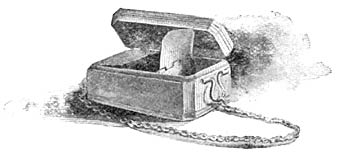
Moro Brass Betel Box.
“When the merchant (Chinese) ships arrive at this port they anchor in front of an open place ... which serves as a market, where they trade in the produce of the country. When a ship enters this port, the captain makes presents of white umbrellas (to the mandarins). The merchants are obliged to pay this tribute in order to obtain the good will of these lords.” The products of the country are stated to be yellow wax, cotton, pearls, shells, betel nuts, and yuta cloth, which was perhaps one of the several cloths still woven of abacá, or piña. The articles imported by the Chinese were “porcelain, trade gold, objects of lead, glass beads of all colors, iron cooking-pans, and iron needles.”
The Negritos.—Very curious is the accurate mention in this Chinese writing, of the Negritos, the first of all accounts to be made of the little blacks. “In the interior of the valleys lives a race called Hai-tan (Acta). They are, of low stature, have round eyes of a yellow color, curly hair, and their teeth are easily seen between their lips. (That is, probably, not darkened by betel-chewing or artificial stains.) They build their nests in the treetops and in each nest lives a family, which only consists of from three to five persons. They travel about in the densest thickets of the forests, and, without being seen themselves, shoot their arrows at the passers-by; for this reason they are much feared. If the trader (Chinese) throws them a small porcelain bowl, they will stoop down to catch it and then run away with it, shouting joyfully.”
Increase in Chinese Trade.—These junks also visited the more central islands, but here traffic was conducted on the ships, the Chinese on arrival announcing themselves by beating gongs and the Filipinos coming out to them in their light boats. Among other things here offered by the natives for trade are mentioned “strange cloth,” perhaps cinamay or jusi, and fine mats.
This Chinese trade continued probably quite steadily until the arrival of the Spaniards. Then it received an enormous increase through the demand for Chinese food-products and wares made by the Spaniards, and because of the value of the Mexican silver which the Spaniards offered in exchange.
Trade with the Moro Malays of the South.—The spread of Mohammedanism and especially the foundation of the colony of Borneo brought the Philippines into important commercial relations with the Malays of the south. Previous to the arrival of the Spaniards these relations seem to have been friendly and peaceful. The Mohammedan Malays sent their praos northward for purposes of trade, and they were also settling in the north Philippines as they had in Mindanao.
Butúan, on the north coast of Mindanao, seems to have been quite a trading-place resorted to by vessels from all quarters. This country, like many other parts of the Philippines, has produced from time immemorial small quantities of gold, and all the early voyagers speak of the gold earrings and ornaments of the natives. Butúan also produced sugarcane and was a trading-port for slaves. This unfortunate traffic in human life seems to have been not unusual, and was doubtless stimulated by the commerce with Borneo. Junks from Siam trading with Cebu were also encountered by the Spaniards.
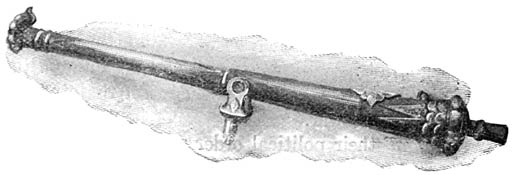
Moro Brass Cannon, or “Lantaka.”
Early Political and Social Life.—The Barangay.—The weakest side of the culture of the early Filipinos was their political and social organization, and they were weak here in precisely the same way that the now uncivilized peoples of northern Luzon are still weak. Their state did not embrace the whole tribe or nation; it included simply the community. Outside of the settlers in one immediate vicinity, all others were enemies or at most foreigners. There were in the Philippines no large states, nor even great rajas and sultans such as were found in the Malay Archipelago, but instead on every island were a multitude of small communities, each independent of the other and frequently waging war.
The unit of their political order was a little cluster of houses from thirty to one hundred families, called a “barangay,” and which still exists in the Philippines as the “barrio.” At the head of each barangay was a chief known as the “dato,” a word no longer used in the northern Philippines, though it persists among the Moros of Mindanao. The powers of these datos within their small areas appear to have been great, and they were treated with utmost respect by the people.
The barangays were grouped together in tiny federations including about as much territory as the present towns, whose affairs were conducted by the chiefs or datos, although sometimes they seem to have all been in obedience to a single chief, known in some places as the “hari,” at other times by the Hindu word “raja,” or the Mohammedan term “sultan.” Sometimes the power of one of these rajas seems to have extended over the whole of a small island, but usually their “kingdoms” embraced only a few miles.
Changes Made by the Spaniards.—The Spaniards, in enforcing their authority through the islands, took away the real power from the datos, grouping the barangays into towns, or “pueblos,” but making the datos “cabezas de barrio,” or “gobernadorcillos.” Something of the old distinction between the dato, or “principal,” and the common man may be still represented in the “gente illustrada,” or the more wealthy, educated, and influential class found in each town, and the “gente baja,” or the poor and uneducated.
Then there was a very large class, who appear to have been freedmen or liberated slaves, who had acquired their own homes and lived with their families, but who owed to dato or maharlica heavy debts of service; to sow and harvest in his ricefields, to tend his fish-traps, to row his canoe, to build his house, to attend him when he had guests, and to perform any other duties that the chief might command. These semi-free were called “aliping namamahay,” and their condition of bondage descended to their children.
Beneath these existed a class of slaves. These were the “siguiguiliris,” and they were numerous. Their slavery arose in several ways. Some were those who as children had been captured in war and their lives spared. Some became slaves by selling their freedom in times of hunger. But most of them became slaves through debt, which descended from father to son. The sum of five or six pesos was enough in some cases to deprive a man of his freedom.
These slaves were absolutely owned by their lord, who could theoretically sell them like cattle; but, in spite of its bad possibilities, this Filipino slavery was ordinarily not of a cruel or distressing nature. The slaves frequently associated on kindly relations with their masters and were not overworked. This form of slavery still persists in the Philippines among the Moros of Mindanao and Jolo. Children of slaves inherited their parents’ slavery. If one parent was free and the other slave, the first, third, and fifth children were free and the second, fourth, and sixth slaves. This whole matter of inheritance of slavery was curiously worked out in minute details.
Material Progress of the Filipinos.—The material surroundings of the Filipino before the arrival of the Spaniards were in nearly every way quite as they are to-day. The “center of population” of each town to-day, with its great church, tribunal, stores and houses of stone and wood, is certainly in marked contrast; but the appearance of a barrio a little distance from the center is to-day probably much as it was then. Then, as now, the bulk of the people lived in humble houses of bamboo and nipa raised on piles above the dampness of the soil; then, as now, the food was largely rice and the excellent fish which abound in river and sea. There were on the water the same familiar bancas and fish corrals, and on land the rice fields and cocoanut groves. The Filipinos had then most of the present domesticated animals,—dogs, cats, goats, chickens, and pigs,—and perhaps in Luzon the domesticated buffalo, although this animal was widely introduced into the Philippines from China after the Spanish conquest. Horses came with the Spaniards and their numbers were increased by the bringing in of Chinese mares, whose importation is frequently mentioned.
The Spaniards introduced also the cultivation of tobacco, coffee, and cacao, and perhaps also the native corn of America, the maize, although Pigafetta says they found it already growing in the Bisayas.
The Filipino has been affected by these centuries of Spanish sovereignty far less on his material side than he has on his spiritual, and it is mainly in the deepening and elevating of his emotional and mental life and not in the bettering of his material condition that advance has been made.