Front matter
Reading edition
[☞ SECOND EDITION.—GREATLY ENLARGED.]

[Entered at Stationers’ Hall. ☞All Rights Reserved.]
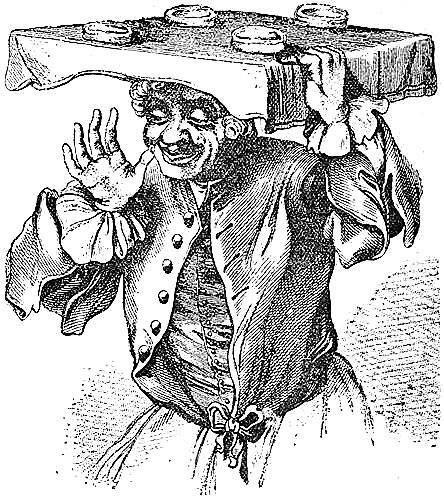
Hogarth’s Pieman.
“We frequently meet with the pieman in old prints; and, in Hogarth’s ‘March to Finchley,’ there he stands in the very centre of the crowd, grinning with delight at the adroitness of one robbery, while he is himself the victim of another. We learn from this admirable figure by the greatest painter of English life, that the pieman of the last century perambulated the streets in professional costume; and we gather further, from the burly dimensions of his wares, that he kept his trade alive by the laudable practice of giving ‘a good pennyworth for a penny.’ Justice compels us to observe that his successors of a later generation have not been very conscientious observers of this maxim.”
A HISTORY OF THE CRIES OF LONDON.
Ancient and Modern.
“Let none despise the merry, merry Cries Of famous London Town.”
SECOND EDITION. GREATLY ENLARGED AND CAREFULLY REVISED
BY CHARLES HINDLEY, Esq.,
Editor of “The Old Book Collector’s Miscellany; or, a Collection of Readable Reprints of Literary Rarities,” “Works of John Taylor—the Water Poet,” “The Roxburghe Ballads,” “The Catnach Press,” “The Curiosities of Street Literature,” “The Book of Ready Made Speeches,” “Life and Times of James Catnach, late of the Seven Dials, Ballad Monger,” “Tavern Anecdotes and Sayings,” etc.
London: CHARLES HINDLEY [The Younger,] BOOKSELLERS’ ROW, ST. CLEMENT DANES, STRAND, W. C.
London:— E. A. BECKETT, PRINTER, 111 & 113 KINGSLAND ROAD.
TO HORATIO NOBLE PYM, Esq., OF HARLEY STREET, CAVENDISH SQUARE, AS A TESTIMONIAL OF ESTEEM For His Private Worth, AND AS A PATRON OF LITERATURE: A HISTORY OF THE CRIES OF LONDON, Ancient and Modern, Is Respectfully Dedicated by

Rectory Road, Stoke Newington, London, N.
Oh, dearly do I love “Old Cries,” Your “Lilies all a’blowing!” Your blossoms blue, still wet with dew, “Sweet Violets all a’growing!” Eliza Cook.
The idea of printing and publishing “A History of the Cries of London—Ancient and Modern,” somewhat in the manner and style here presented to the public, was first suggested to me by the late Rev:—
Author of “The Bewick Collector,” 1866. The Supplement to same, 1868, and “Bewick’s Woodcuts,” 1870, etc., and at the time, Rector of West Hackney Church, Stoke Newington, London, N., in the year 1876.
While actively engaged in preparing for publication “The Life and Times of

late of Seven Dials: Ballad Monger,”—to which the present work may be considered a sequel, and the completion of the series on the subject of the—
“CURIOSITIES OF STREET LITERATURE,”
I had frequently to consult the pages of “The Bewick Collector,” and other works of a kindred character for information respecting the elder Catnach, who, by himself, and afterwards in conjunction with his partner, and subsequently his successor, William Davison, employed Thomas Bewick, the famous English artist who imparted the first impulse to the art of wood engraving, for several of their Alnwick publications. This led to my communicating with the Rev. Thomas Hugo, wherein I informed him of my plans, and of the object I had in view with regard to the publication I was then preparing for the press: at the same time soliciting his co-operation, especially in reference to the loan of some of the Bewick wood-cuts, formerly possessed by the elder Catnach, while he was in business as a printer, in Narrowgate Street, Alnwick, an ancient borough and market-town in Northumberland.
In answer to my application, I received the letters that follow:—
The Rectory, WEST HACKNEY, STOKE NEWINGTON, LONDON, N.
21st August, 1876.
Dear Sir,
I shall be glad to aid you in any way. I must ask you to see me on some morning, between nine and eleven o’clock, and to make a previous appointment, as I am a working man, with plenty to do.
Yours sincerely,
Charles Hindley, Esq., 76, Rose Hill Terrace, Brighton.
West Hackney Rectory, Amhurst Road, West, Stoke Newington, N.
Tuesday Night. [13th September, 1876.]
Dear Sir,
I have been expecting you for the last ten days. In a few hours I am leaving town for my holiday; I shall not return till far on in October.
As Brighton is but a short way off, I shall hope to see you on my return. You shall be welcome to the loan of some Blocks. You had better examine my folio volume, called “Bewick’s Woodcuts,” in the British Museum, and give me the numbers of the cuts, when I will see what I can do for you.
Yours sincerely,
Mr. C. Hindley, Senr., (of Brighton,) 8, Booksellers’ Row, Strand, W.C.
West Hackney Rectory, Amhurst Road, West, Stoke Newington, N.
8th Nov., 1876.
Dear Sir,
I can see you between 9.30 and 10.30 on Friday Morning.
Be so good as to advise me beforehand what you wish to see.
Yours sincerely,
Mr. C. Hindley, Esq., (of Brighton,) 8, Booksellers’ Row, Strand, W.C.
The proposed interview took place at the Rectory-house, on the 10th of November, and was of a very delightful and intellectual character. The reverend gentleman found me an apt scholar in all matters with respect to his favourite “Hobby-horse,” viz:—the Brothers Bewick and their Works. All the rich and rare Bewickian gems were placed before me for inspection, and all the desired assistance I needed at his hands was freely offered and ultimately carried out. During our conversation the learned Rector said:—
“I look upon it as a curious fact that you should have been of late occupying your leisure in working out your own ideas of Catnach and his Times, because, while I was in the office at Monmouth-court, where I went several times to look out all the examples of Bewick I could find, and which I afterwards purchased of Mr. Fortey—the person who has succeeded to the business of the late James Catnach, I one day caught nearly the same notion, but it was more in reference to Old London Cries: as I possess a fairly large collection of nicely engraved wood-blocks on the subject, that I met with in ‘Canny Newcassel,’—in some of which it is asserted, and can hardly be denied, that Thomas Bewick had a hand. I have since used the set in my ‘Bewick’s Woodcuts.’ But, alas!—Tempus fugit, and all thoughts on the subject got—by reason of my having so much to do and think of—crowded out of my memory. Now, sir, as you seem to have much more leisure time than myself, I shall be happy to turn the subject-matter over to you and to assist in every way in my power.”
I thanked the rev. gentleman, at the same time promising to bear the suggestion in mind for a future day.
West Hackney Rectory, Amhurst Road, West, Stoke Newington, N., 14th Nov., 1876.
Dear Sir,
Accept my best thanks for your letter, books, and promises of future gifts, all of which I cordially accept.
To-morrow, if all be well, I shall have time to look out the Blocks, and they shall be with you soon afterwards.
Very truly yours,
C. Hindley, Esq., Rose Hill Terrace, Brighton.
W. H. R. 29th Nov. [1876.]
Dear Sir,
Herewith the Block. I have made a few corrections (of fact) in your proof.
Yours sincerely, T. H.
C. Hindley, Esq., 76, Rose Hill Terrace, Brighton.
The somewhat sudden and unexpected death of the Rev. Thomas Hugo on the last day of the year 1876 is now a matter of history.
In Memoriam. The Rev. T. HUGO, M.A. Rector of West Hackney Church. Departed this life, Sunday, December 31st, 1876.

On Christmas Day, before the altar kneeling, Taking that Food by which our souls are fed; Around us all a solemn silence stealing, And broken only by the priests’ slow tread. Yes, he was there, our good and earnest Rector, And firmly strove his weakness to withstand, Giving the cup, he, the pure Faith’s protector— That cup of blessing with a trembling hand. His church, for which he felt such admiration, Was deck’d with flow’rs and evergreens that morn, In praise to Christ, who died for our salvation, And deign’d as a weak infant to be born. Ah! little did we think that happy morning— So truly, bravely kept he at his post— When next a Sabbath came, to us his warning And kind, yet noble, presence would be lost. That solemn sound, which tells of souls departed, Took the glad place of that which calls to prayer, And his loved people, shocked and broken-hearted, Could hardly enter, for he was not there. But when they heard it was his last desire That they should meet at midnight as was said, They met by thousands, mov’d with holy fire, And spoke in whispers of their shepherd—dead. No, no, not dead, but calm in Jesus sleeping; Free from all sorrow, all reproach, all pain: And though he leaves a congregration weeping Their earthly loss is his eternal gain. He loved the weak, and all the mute creation, In generous deeds he ever took his part; At Death, the thrice-repeated word Salvation Showed the firm trust of that true, tender heart. ······ Again we meet: they come his coffin bringing Midst solemn chant, and deck’d with purest flowers, And feel, whilst we his own sweet hymn are singing, The joy is his, the sad rememberance ours. Mrs. HILDRETH.
At the sale of the Hugo Collection, I purchased among many others:—
Lot 405. London Cries, also used in Newcastle and York Cries, two very pretty series of early Cries, some with back-grounds, from Hodgson’s office, and R. Robinson, Newcastle—[51 blocks],
To carry out the suggestion before-mentioned, and to utilize the very pretty series of fifty-one woodcuts as above, and other Bewick, Bewickiana, and ultra anti-Bewickian woodcut blocks I possess, formed and accumulated by reason of my published works: “The Catnach Press,” 1868. “Curiosities of Street Literature,” 1871. And “Life and Times of James Catnach,” 1878.
In collecting information on the subject of “The Cries of London—Ancient and Modern,” I have availed myself of all existing authorities within reach, and therefore, to prevent the necessity of continual reference, here state that I have drawn largely from Charles Knight’s “London.” Mayhew’s “London Labour and the London Poor.” Hone’s “Every-Day Book.” An article on Old London Cries, in “Fraser’s Magazine.” “Cuthbert Bede.” Mr. Edwin Goadby’s “The England of Shakespeare,”—an excellent Text Book, forming one of Cassell’s Popular Shilling Library. “Our Milk Supply,” from the columns of The Daily Telegraph. Charles Manby Smith’s “Curiosities of London Life,” and his “Little World of London.” And what from various other sources was suitable for my purpose.
To the one lady, and many gentlemen friends who have responded to my enquiries for advice, material, and assistance, and by which they have so greatly enriched the contents of this volume, I beg to express my best thanks. I must in a more particular manner mention the names of—the one lady first—Mrs. Rose Hildreth; then Mr. John Furbor Dexter, Mr. William Mansell; next Messrs. W. H. & L. Collingridge, the Proprietors of The City Press, Aldersgate-street, London, for the use of the following woodcuts that have appeared in the pages of their ever-entertaining work, “Ye Old City,” by Aleph.: 1.—Shakespeare’s London; 2.—Aldersgate; 3.—Cheapside Cross; 4.—Old Stage Waggon; 5.—Baynard’s Castle; 6.—Old London Shop; 7.—St. Pauls Cathedral. I have also to express my cordial thanks to Messrs. Longman, Green & Co., who kindly allowed the use of 1.—Colebrook Cottage; 2.—The Old Queen’s Head; and 3.—Canonbury Tower. From Howitt’s “Northern Heights of London.” Messrs. Chatto & Windus, Piccadilly: 1.—Charles Lamb’s House, Enfield; 2.—House at Edmonton, where Charles Lamb died; 3.—Edmonton Church. Messrs. Marks and Sons, Publishers of all kinds of Fancy Stationery, Toy-books, Valentines, &c., 72, Houndsditch, for the eight blocks used in their “Cries of London,” at pages 351 to 358. Messrs. Goode, Toy-book Manufacturers, Clerkenwell Green. Mr. John W. Jarvis, Mr. William Briggs, Mr. G. Skelly, Alnwick, and Dr. David Morgan, Brighton.
SECOND EDITION.
The rapid sale of the whole of the First Edition of this work—about one half of which went Due-North, that is to say, in and round about “Canny Newcassel” (the home-land of the Brothers Bewick), America taking the remainder,—will sufficiently explain the re-appearance of “A History of the Cries of London” in its new, and, the Author ventures to think, improved form.
Rectory Road, Stoke Newington, London, N. Lady-Day., 1884.
CATALOGUE OF THE CHOICE AND VALUABLE COLLECTION OF BOOKS, WOOD ENGRAVINGS, AND ENGRAVED WOODCUT BLOCKS, Manuscripts, Autograph Letters & Proof Impressions, BY OR RELATING TO THOMAS AND JOHN BEWICK, AND THEIR PUPILS, GLEANED FROM EVERY AVAILABLE SOURCE BY THE LATE
WHICH WILL BE SOLD BY AUCTION, BY MESSRS. SOTHEBY, WILKINSON & HODGE,
Auctioneers of Literary Property & Works illustrative of the Fine Arts, At their House, No. 13, Wellington Street, Strand, W. On WEDNESDAY, 8th of AUGUST, 1877, and following Day, At One O’clock precisely. May be Viewed Two Days prior, and Catalogues had.
Dryden Press: J. Davy and Sons. 137, Long Acre.
Goldsmith and Parnell Poems: Published by William Bulmer, Shakespeare Printing Office, London, 1795. Embellished with thirteen designs on wood. Most of the cuts were drawn by Robert Johnson and John Bewick, and all were engraved by Thomas Bewick, except the vignettes on the title-pages, and the large cut of “The Sad Historian,” and the tail-piece at the end of the volume, which was done by John Bewick.
The most magnificent result of the efforts of the wood-engraver, type-founder, paper-maker, and printer, “that ever was produced in any age, or in any country.” Bulmer realized, after paying all expenses, a profit of £1,500 on the work these exquisite blocks adorned.
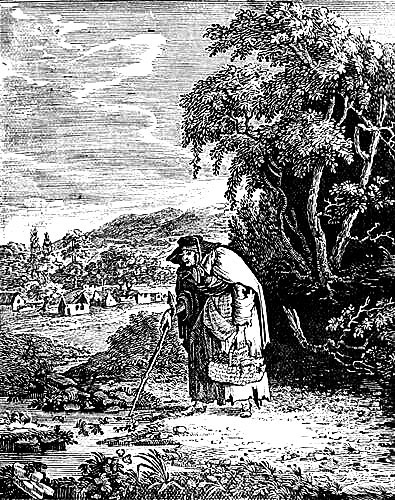
[John Bewick, del. et Sculp.] THE SAD HISTORIAN. Published January 1, 1795, by William Bulmer, at the Shakespeare Printing Office, Cleveland Row.

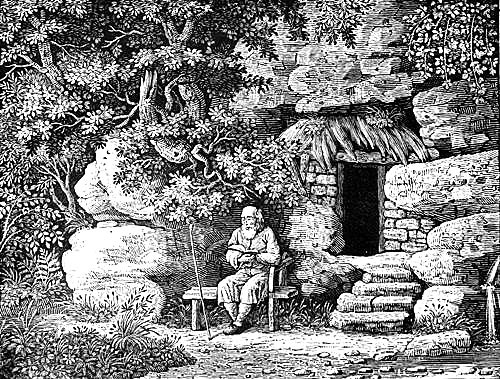
John Johnson, del.] [T. Bewick, Sculp. THE HERMIT AT HIS MORNING DEVOTIONS. Published January 1, 1795, by William Bulmer, at the Shakespeare Printing Office, Cleveland Row.
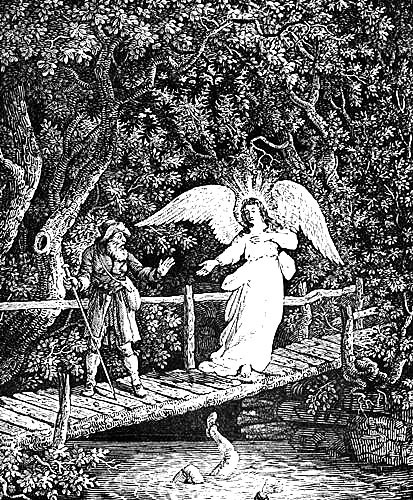
R Johnson, del.] [T. Bewick, Sculp. THE HERMIT, ANGEL, AND GUIDE. Published January 1, 1795, by William Bulmer, at the Shakespeare Printing Office, Cleveland Row.
John Bewick, del.] [T. Bewick, sculp.
THE CHASE. A POEM BY William Somervile, Esq.
LONDON: Printed by W. Bulmer & Co., Shakespeare Printing Office, Cleveland Row. 1796.
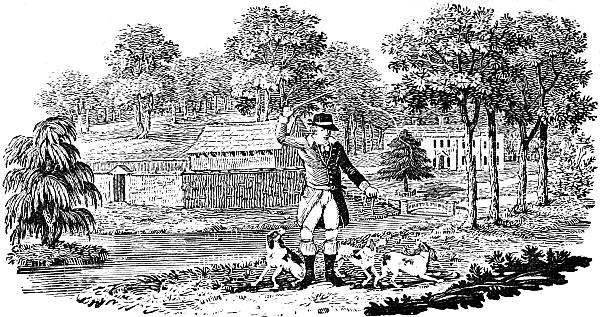
John Bewick, del.] [T. Bewick, sculp.
SOMERVILE’S CHASE.
This work contains the best specimens of John Bewick’s abilities as a designer; all the cuts were drawn by him except one, but none of them were engraved by him. Shortly after he had finished the drawings on the blocks, he left London and returned to the North in consequence of ill-health. They were engraved by Thomas Bewick, with the exception of the tail-piece at the end of the volume, which was engraved by Charles Nesbit, one of his pupils.
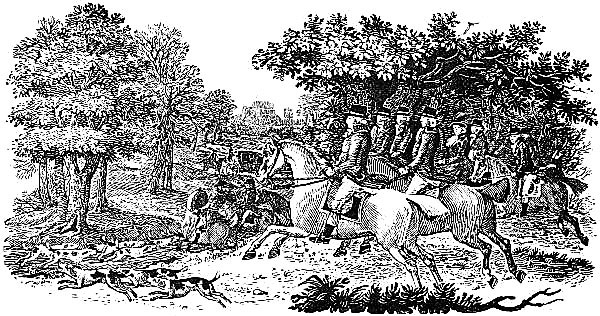
John Bewick, del.] [T. Bewick, sculp.
SOMERVILE’S CHASE.
The cuts in the Chase, on the whole, are superior in point of execution to those in the Poems of Goldsmith and Parnell. Many conceive it impossible that such delicate effects could be produced from blocks of wood, and his late Majesty (George III.) ordered his bookseller, Mr. George Nicolls, to procure the blocks for his inspection, that he might convince himself of the fact.
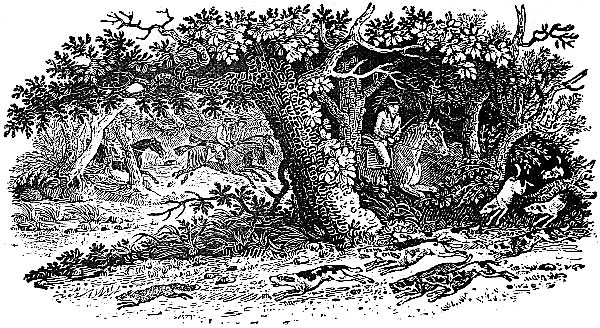
John Bewick, del.] [T. Bewick, sculp.
SOMERVILE’S CHASE.
Speaking of the death of John Bewick, which took place at Ovingham on the 5th of December, 1795,—aged 35, a writer in the Gentleman’s Magazine says, “The works of this young artist will be held in estimation, and the engravings to ‘Somervile’s Chase’ will be a monument of fame of more celebrity than marble can bestow.”
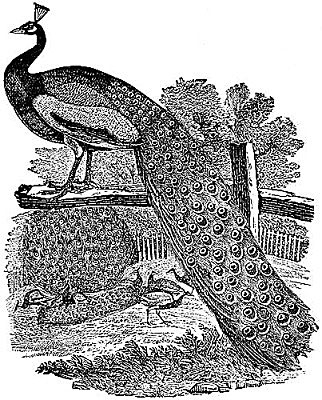
The Peacock. (Pavo cristatus, Linn.——Le Paon, Buff.) (From Bewick’s Land Birds.)
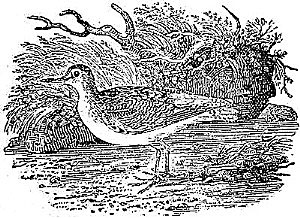
The Common Sandpiper. (Bewick’s Water Birds).
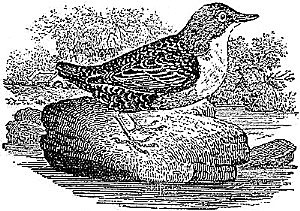
The Water Ouzel. (Bewick’s Water Birds.)
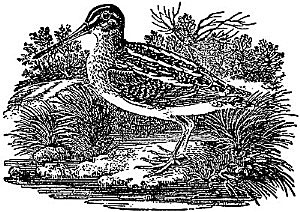
The Snipe. (Bewick’s Water Birds.)
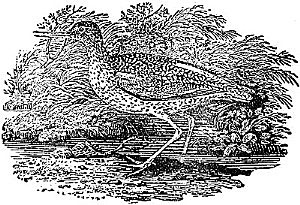
The Redstart. (Bewick’s Water Birds.)
FIRST STATE!
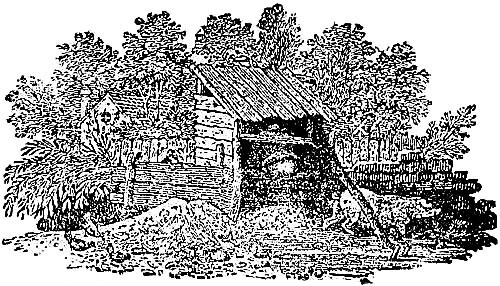
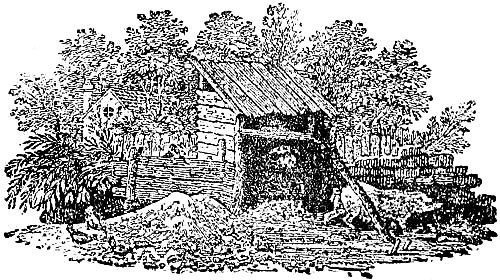
“The Little House” and Pig, &c.
“Snug in an English garden’s shadiest spot A structure stands, and welcomes many a breeze; Lonely and simple as a ploughman’s cot! Where monarchs may unbend who wish for ease.” Colman’s—Broad Grins.
SECOND STATE!!
Among the very many and all much admired Tail-pieces drawn and engraved by Bewick himself, the above, which, in its—First state! is at page 285 of vol. i. of ‘A History of British Birds,’ 1797, has obtained by far the greatest notoriety. It appears that soon after publication, it was pointed out to Bewick that the nakedness of a prominent part of his subject required to be a little more covered—draped! So one of his apprentices was employed to blacken over with ink all the copies then remaining unsold. But by the time Bewick received the ‘gentle hint,’ a goodly number had been delivered to local subscribers and the London agents—Messrs. G. G. and J. Robinson. It is these ‘not inked!’ copies that are now so readily sought after by all “Bewick Collectors.”
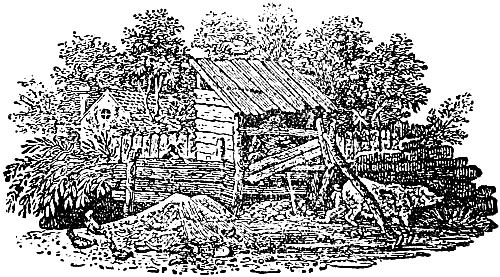
THIRD STATE!!!
For the next, and all subsequent editions a plug was inserted in the block, and the representation of two bars of wood engraved upon it, to hide the part! However, it seems that before the block was thus altered and amended, many impressions on various papers were taken of the—First state! The late Rev. Hugo possessed several of such, one of which—Proof on paper—he gave me on the 10th of November, 1876.—C. H.
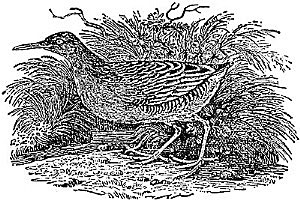
The Water Rail. (Bewick’s Water Birds.)
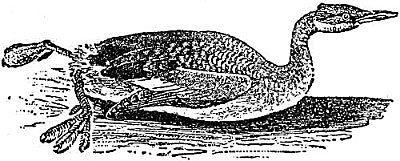
The Red-necked Grebe. (Bewick’s Water Birds.)
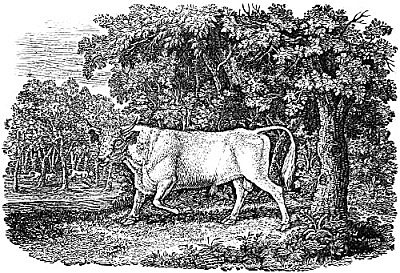
The Chillingham Wild Bull. Used in Richardson’s Table Book, Vol. vi p. 15. ⁂ Attributed to T. Bewick.
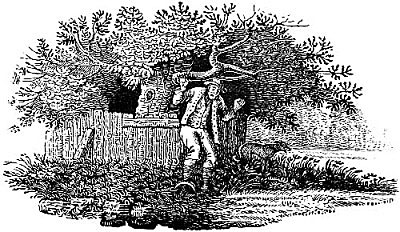
T. Bewick. Gin and Bitters. The Sportsman’s Cabinet, 1803.
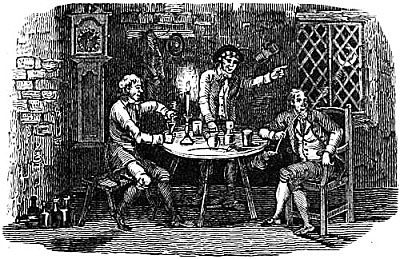
“Willie Brew’d a Peck o’Maut.”
The Poetical Works of Robert Burns. Engravings on Wood by Bewick, from designs by Thurston. Alnwick: Printed by Catnach and Davison, 1808. And London: Printed for T. Cadell and Davis, Strand, 1814. With cuts previously used in Davison’s publications.
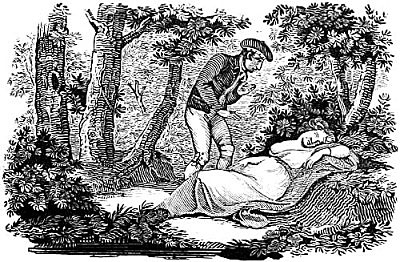
“Many of the engravings produced for Burns’ Poems, are of a very superior class, and cannot be too highly commended.”—Hugo.
“And for whole days would wander in those places where she had been used to walk with Henry.”
The History of Crazy Jane. By Sarah Wilkinson. With a Frontispiece by Bewick. Alnwick: Printed by W. Davison, 1813.
Jackson’s: A Treatise on Wood Engraving. See Hugo’s “Bewick Collector.”—The Supplement.
The Repository of Select Literature. Adorned with beautiful Engravings by Bewick. Alnwick: Printed by W. Davison, 1808.
Arms of Newcastle. (Signed Bewick, Sculpt.)
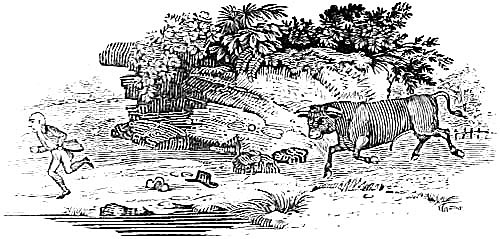
Bull Pursuing a Man. The Poetical Works of Robert Ferguson, with his Life. Engravings on Wood by Bewick.
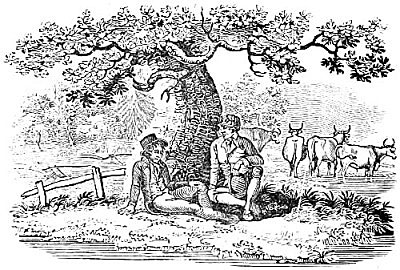
“Sandie and Willie.” The Poetical Works of Robert Ferguson. Alnwick: Printed by W. Davison.—1814.
Scottish Ballads and Songs. Printed and Sold by G. Nicholson, Poughnill, Near Ludlow.
G. Nicholson, Printer, Poughnill, near Ludlow.
G. Nicholson, Printer, Poughnill, near Ludlow.
G. Nicholson, Printer.
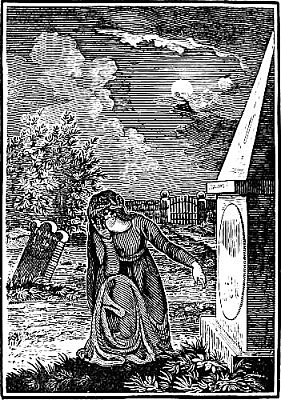
“Not to return, how painful the remembrance Of joys departed,”
Blair’s Grave. Alnwick: Printed by Catnach and Davison,—1808.
From Newcastle. Hugo’s Bewick’s Woodcuts, No. 1333.
View of Strawberry Hill. With Shield of Arms of the Hon. Horace Walpole.
Mr. Bigge’s cut of the Figure of Liberty.
Tyne-side Scene, With Shield of Arms.
A Churchyard Memorial Cut.
The Sportsman’s Calender. 1818. Hugo’s “Bewick’s Woodcuts,” No. 1309.
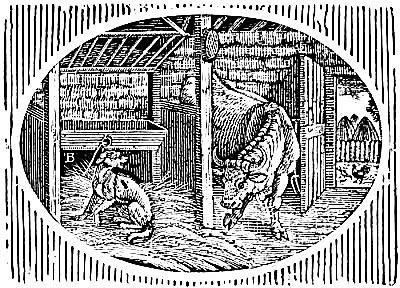
The Dog in the Manger.
Hastie’s Reading Easy. From Angus’s Office, where the book was printed.
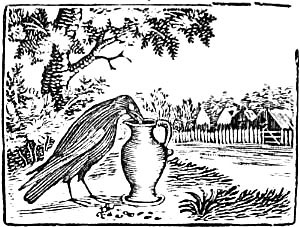
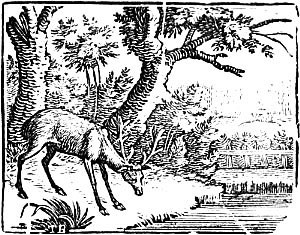
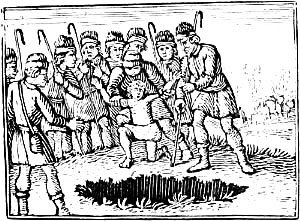
“Bewick cut for Mrs. Angus, twenty-four figures for the Alphabet:—The Fox and Grapes, the Crow and Pitcher, the Foolish Stag, Joseph and his Brethren, etc. All of them excellent cuts. The fortieth edition was printed in 1814, and the seventy-third in 1839, so that they must have been done in his early days.”
MS. Note of the late Mr. John Bell, of Newcastle. See Hugo’s Bewick’s Woodcuts. No. 240-276.
Fox and the Grapes. The Crow and Pitcher.
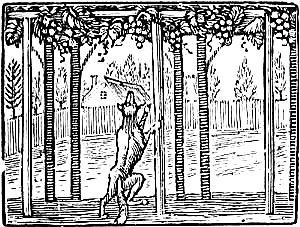
The Foolish Stag.
Joseph and his Brethren.





T. Bewick.—Sculpt.




T. Bewick.—Sculpt.
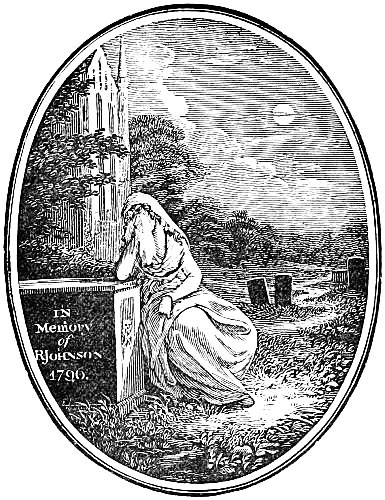
[R. Johnson, del. Charlton Nesbit, sculpt.]
Cut to the memory of Robert Johnson. Bewick’s favourite Pupil.
On the South side of Ovingham Church there is this tablet—
In Memory of ROBERT JOHNSON, Painter and Engraver. A NATIVE OF THIS PARISH. Who died at Kenmore in Perthshire, The 29th, of October, 1796. IN THE 26th, YEAR OF HIS AGE.
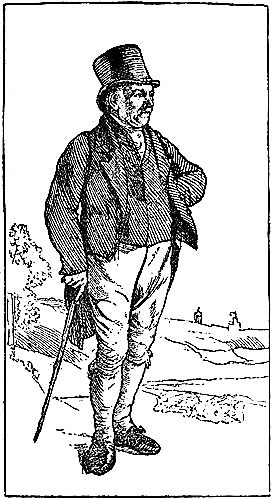
Thomas Bewick.
Thomas Bewick died at his house on the Windmill-Hills, Gateshead, November the 8th, 1828, in the seventy-sixth year of his age, and on the 13th he was buried in the family burial-place at Ovingham, where his parents, wife, and brother were interred.
“O death, where is thy sting? O grave, where is thy victory?”
A HISTORY
OF THE
CRIES OF LONDON.
HISTORY
OF THE
CRIES OF LONDON.
———
“Let none despise the merry, merry cries Of famous London Town”:—Rex. Ballad.
———
The cries of London have ever been very popular, whether as broadsides, books, ballads, or engravings. Artists of all countries and times have delighted to represent those peculiarities of costume and character which belong to the history of street-cries, and the criers thereof. Annibale Carracci—1560-1609—has immortalized the cries of Bologna; and from the time of Elizabeth to that of Queen Victoria, authors, artists and printers combined, have presented the Cries and Itinerant Trades of London, in almost numberless forms, and in various degrees of quality, from the roughest and rudest wood-cut-blocks to the finest of copper and steel plate engravings, or skilfully wrought etchings. While many of the early English dramatists often introduced the subject, eminent composers were wont to “set to music” as catch, glee, or roundelaye, all the London Cries then most in vogue,—“They were, I ween, ryght merrye songs, and the musick well engraved.”
The earliest mention of London trade-cries is by Dan John Lydgate (1370-1450), a Monk of the Benedictine Abbey of Bury St. Edmund’s, the friend and immediate follower of Geoffrey Chaucer, and one of the most prolific writers of his age this country has produced. To enumerate Lydgate’s pieces would be to write out the catalogue of a small library. No poet seems to have possessed a greater versatility of talents. He moves with equal ease in every mode of composition; and among his minor pieces he has left us a very curious poem entitled “London Lyckpeny,” i.e., London Lackpenny: this has been frequently printed; by Strutt, Pugh, Nicolas, and partly by John Stow in “A Survey of London,” 1598. There are two copies in the British Museum, Harl. MSS., 367 and 542. We somewhat modernize the text of the former and best of these copies, which differ considerably from each other.
“O Mayster Lydgate! the most dulcet sprynge Of famous rethoryke, with balade ryall The chefe orygynal.” “The Pastyme of Plasure,” by Stephen Hawes, 1509.
In “London Lackpenny” we have a most interesting and graphic picture of the hero coming to Westminster, in term time, to obtain legal redress for the wrong he had sustained, and explain to a man of law his case—“How my goods were defrauded me by falsehood,” but being without the means to pay even the preliminary fee, he was sent—“from pillar to post,” that is from one Law-court to another, but although he “crouched, kneeled, prayed for God’s sake, and Mary’s love, he could not get from one the—mum of his mouth.” So leaving the City of Westminster—minus his hood, he walked on to the City of London, which he tells us was crowded with peripatetic traders, but tempting as all their goods and offers were, his lack-of-money prevented him from indulging in any of them—But, however, let Lackpenny, through the ballad, speak for himself:—
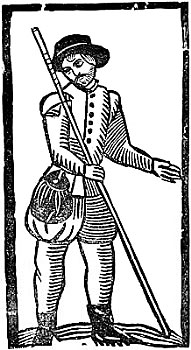
London Lackpenny.
To London once my steps I bent, Where truth in no wise should be faint, To Westminster-ward I forthwith went, To a man of law to make complaint, I said, “for Mary’s love, that Holy saint! Pity the poor that would proceed,” But, for lack of money, I could not speed. And as I thrust the prese among, [crowd] By froward chance my hood was gone, Yet for all that I stayed not long, Till to the King’s Bench I was come, Before the Judge I kneeled anon, And prayed him for God’s sake to take heed; But, for lack of money, I might not speed. Beneath them sat Clerks a great rout, Which fast did write by one assent, There stood up one and cryed about, Richard, Robert, and John of Kent. I wist not well what this man meant, He cried so thick there indeed, But he that lacked money, might not speed. Unto the Common-place I yode thoo, [I went then] Where sat one with a silken hood; I did him reverence, for I ought to do so, And told him my case as well as I could, How my goods were defrauded me by falsehood. I gat not a mum of his mouth for my meed, And, for lack of money, I might not speed. Unto the Rolls I gat me from thence, Before the clerks of the Chancery, Where many I found earning of pence, But none at all once regarded me, I gave them my plaint upon my knee; They liked it well, when they had it read: But, lacking money, I could not speed. In Westminster Hall I found out one, Which went in a long gown of ray; [velvet] I crouched and kneeled before him anon, For Mary’s love, of help I him pray. “I wot not what thou meanest” gan he say: To get me thence he did me bede, For lack of money, I could not speed. Within this Hall, neither rich nor yet poor Would do for me ought, although I should die: Which seeing, I gat me out of the door, Where Flemings began on me for to cry: “Master, what will you copen or buy? [chap or exchange] Fine felt hats, or spectacles to read? Lay down your silver, and here you may speed.”
Spectacles to read before printing was invented must have had a rather limited market; but we must bear in mind where they were sold. In Westminster Hall there were lawyers and rich suitors congregated,—worshipful men, who had a written law to study and expound, and learned treatises diligently to peruse, and titles to hunt after through the labyrinths of fine and recovery. The dealer in spectacles was a dealer in hats, as we see; and the articles were no doubt both of foreign manufacture. But lawyers and suitors had also to feed, as well as to read with spectacles; and on the Thames side, instead of the coffee-houses of modern date, were tables in the open air, where men every day ate of “bread, ribs of beef, both fat and full fine,” and drank jollily of “ale and wine,” as they do now at a horse-race:—
Then to Westminster Gate I presently went, When the sun was at high prime: Cooks to me, they took good intent, And proffered me bread, with ale and wine, Ribs of beef, both fat and full fine; A fair cloth they gan for to spread, But, wanting money, I might not there speed.
Passing from the City of Westminster, through the village of Charing and along Strand-side, to the City of London, the cries of food and feeding were first especially addressed to those who preferred a vegetable diet, with dessert and “spice, pepper, and saffron” to follow. “Hot peascod one began to cry,” Peascod being the shell of peas; the cod what we now call the pod:—
“Were women as little as they are good, A peascod would make them a gown and hood.”
“Strawberry ripe, and cherries in the rise.” Rise—branch, twig, either a natural branch, or tied on sticks as we still see them.
Then unto London I did me hie, Of all the land it beareth the prize; Hot peascods! one began to cry; Strawberry ripe, and Cherries in the rise! One bade me come near and buy some spice; Pepper and saffron they gan me bede; [offer to me] But, for lack of money, I might not speed.
In Chepe (Cheapside) he saw “much people” standing, who proclaimed the merits of their “velvets, silk, lawn, and Paris thread.” These, however, were shopkeepers; but their shops were not after the modern fashion of plate-glass windows, and carpeted floors, and lustres blazing at night with a splendour that would put to shame the glories of an eastern palace. They were rude booths, the owners of which bawled as loudly as the itinerants; and they went on bawling for several centuries, like butchers in a market, so that, in 1628, Alexander Gell, a bachelor of divinity, was sentenced to lose his ears and to be degraded from the ministry, for giving his opinion of Charles I., that he was fitter to stand in a Cheapside shop with an apron before him, and say “What do ye lack, what do ye lack? What lack ye?” than to govern a kingdom.
Then to the Chepe I began me drawn, Where much people I saw for to stand; One offered me velvet, silk, and lawn; Another he taketh me by the hand, “Here is Paris thread, the finest in the land.” I never was used to such things indeed; And, wanting money, I might not speed. Then went I forth by London Stone, Throughout all Canwyke Street: Drapers much cloth me offered anon; Then comes in one crying “Hot sheep’s feet;” One cried mackerel, rushes green, another gan greet; One bade me buy a hood to cover my head; But, for want of money, I might not speed.
The London Stone, the lapis milliaris (mile stone) of the Romans, has never failed to arrest the attention of the “Countryman in Lunnun.” The Canwyke Street of the days of John Lydgate, is the Cannon Street of the present. “Hot sheep’s feet,” which were cried in the streets in the time of Henry V., are now sold cold as “sheep’s trotters,” and vended at the doors of the lower-priced theatres, music-halls, and public-houses. Henry Mayhew in his “London Labour and the London Poor,” estimates that there are sold weekly 20,000 sets, or 80,000 feet. The wholesale price at the “trotter yard” is five a penny, which gives an outlay by the street sellers of £3,033 6s. 8d. yearly. The cry which is still heard and tolerated by law, that of Mackerel rang through every street. The cry of Rushes-green tells us of by-gone customs. In ages long before the luxury of carpets was known in England, the floors of houses were covered with rushes. The strewing of rushes in the way where processions were to pass is attributed by our poets to all times and countries. Thus at the coronation of Henry V., when the procession is coming, the grooms cry—
“More rushes, more rushes.”
Not worth a rush became a common comparison for anything worthless; the rush being of so little value as to be trodden under foot. Rush-lights, or candles with rush wicks, are of the greatest antiquity.
Then I hied me into East-chepe, One cries ribs of beef, and many a pie; Pewter pots they clattered on a heap; There was harp, pipe, and minstrelsy; “Yea by Cock! Nay by Cock!” some began cry; Some sung of Jenkin and Julian for their meed; But, for lack of money, I might not speed.
Eastcheap, this ancient thoroughfare, originally extended from Tower-street westward to the south end of Clement’s-lane, where Cannon-street begins. It was the Eastern Cheap or Market, as distinguished from Westcheap, now Cheapside. The site of the Boar’s Head Tavern, first mentioned temp. Richard II., the scene of the revels of Falstaff and Henry V., when Prince of Wales, is very nearly that of the statue of King William IV. Lackpenny had presented to him several of the real Signs of the Times and of Life in London with “ribs of beef—many a pie—pewter pots—music and singing”—strange oaths, “Yea by Cock” being a vulgar corruption for a profane oath. Our own taverns still supply us with ballad-singers—“Buskers”—who will sing of “Jenkin and Julian”—Ben Block; or, She Wore a Wreath of Roses, “for their meed.”
Then into Cornhill anon I yode, [went] Where was much stolen gear among; I saw where hung mine own hood That I had lost among the throng; To buy my own hood I thought it wrong; I knew it well, as I did my creed; But, for lack of money, I could not speed.
The manners and customs of the dwellers in Cornhill in the time of John Lydgate, when a stranger could have his hood stolen at one end of the town and see it exposed for sale at the other, forcibly reminds us of Field-lane and the Jew Fagin, so faithfully sketched in pen and ink by Charles Dickens of our day. Where “a young man from the country” would run the risk of meeting with an Artful Dodger, to pick his pocket of his silk handkerchief at the entrance of the Lane, and it would be offered him for sale by a Jew fence at the end, not only “Once a Week” but “All the Year Round.” However, when Charles Dickens and Oliver Twist came in, Field-lane and Fagin went out.
At length the Kentish man being wearied, falls a prey to the invitation of a taverner, who with a cringing bow, and taking him by the sleeve:—“Sir,” saith he, “will you our wine assay?” Whereupon Lackpenny, coming to the safe conclusion that “a penny can do no more than it may,” enters the tempting and hospitable house of entertainment, and there spends his only penny, for which he is supplied with a pint of wine:—
The taverner took me by the sleeve, “Sir,” saith he, “will you our wine assay?” I answered “That cannot be much grieve, A penny can do no more than it may;” I drank a pint, and for it did pay; Yet, sore a-hungered from hence I yode, [went] And, wanting money, I could not speed.
Worthy old John Stow supposes this interesting incident to have happened at the Pope’s Head, in Cornhill, and bids us enjoy the knowledge of the fact, that:—“Wine one pint for a pennie, and bread to drink it was given free in every taverne.” Yet Lydgate’s hero went away “Sore a-hungered,” for there was no eating at taverns at this time beyond a crust to relish the wine, and he who wished to dine before he drank had to go to the cook’s.
Wanting money, Lackpenny has now no choice but to return to the country, and applies to the watermen at Billingsgate:—
Then hied I me to Billingsgate, And one cried “Hoo! go we hence!” I prayed a bargeman, for God’s sake, That he would spare me my expense, “Thou scap’st not here, quod he, under two-pence, I list not yet bestow any almes deed.” Thus, lacking money, I could not speed.
We have a corroboration of the accuracy of this picture in Lambarde’s “Perambulation of Kent.” The old topographer informs us that in the time of Richard II. the inhabitants of Milton and Gravesend agreed to carry in their boats, from London to Gravesend, a passenger with his truss or fardel [burden] for twopence.
Then I conveyed me into Kent; For of the law would I meddle no more; Because no man to me took entent, I dyght [prepared] me to do as I did before. Now Jesus, that in Bethlem was bore, Save London, and send true lawyers their meed! For whoso wants money, with them shall not speed.
The poor Kentish suitor, without two-pence in his pocket to pay the Gravesend bargemen, whispers a mild anathema against London lawyers, then takes his solitary way on foot homeward—a sadder and a wiser man.
With unpaved streets, and no noise of coaches to drown any particular sound, we may readily imagine the din of the great London thoroughfares of four centuries ago, produced by all the vociferous demand for custom. The chief body of London retailers were then itinerant,—literally pedlars; and those who had attained some higher station were simply stall-keepers. The streets of trade must have borne a wonderful resemblance to a modern fair. Competition was then a very rude thing, and the loudest voice did something perhaps to carry the customer.
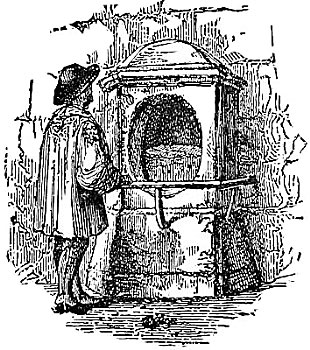
The London Stone.
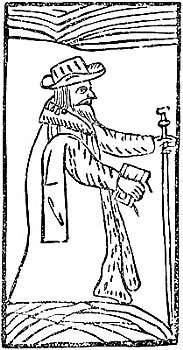
In the old play entitled:—“A ryght excellent and famous Comedy called the Three Ladies of London, wherein is Notable declared and set fourth, how by the meanes of Lucar, Love and Conscience is so corrupted, that the one is married to Dissimulation, the other fraught with all abhomination. A Perfect Patterne of All Estates to looke into, and a worke ryght worthie to be marked. Written by R. W.; as it hath been publiquely played. At London, Printed by Roger Warde, dwelling neere Holburne Conduit at the sign of the Talbot, 1584,” is the following poetical description of some London cries:—
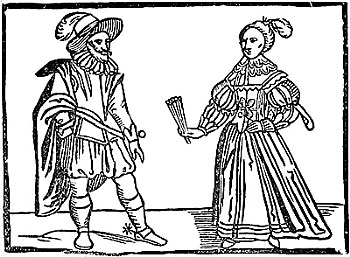
Enter Conscience, with brooms, singing as followeth:—
New broomes, green broomes, will you buy any? Come maydens, come quickly, let me take a penny. My brooms are not steeped, But very well bound: My broomes be not crooked, But smooth cut and round. I wish it would please you, To buy of my broome: Then would it well ease me, If market were done. Have you any olde bootes, Or any old shoone: Powch-ringes, or buskins, To cope for new broome? If so you have, maydens, I pray you bring hither; That you and I, friendly, May bargin together. New broomes, green broomes, will you buy any? Come maydens, come quickly, let me take a penny.
Conscience speaketh.
Thus am I driven to make a virtue of necessity; And seeing God Almighty will have it so, I embrace it thankfully, Desiring God to mollify and lesson Usury’s hard heart, That the poor people feel not the like penury and smart. But Usury is made tolerable amongst Christians as a necessary thing, So that, going beyond the limits of our law, they extort, and to many misery bring. But if we should follow God’s law we should not receive above what we lend; For if we lend for reward, how can we say we are our neighbour’s friend? O, how blessed shall that man be, that lends without abuse, But thrice accursed shall he be, that greatly covets use; For he that covets over-much, insatiate is his mind: So that to perjury and cruelty he wholly is inclined: Wherewith they sore oppress the poor by divers sundry ways, Which makes them cry unto the Lord to shorten cut-throats’ days. Paul calleth them thieves that doth not give the needy of their store, And thrice accurs’d are they that take one penny from the poor. But while I stand reasoning thus, I forget my market clean; And sith God hath ordained this way, I am to use the mean.
Sings again.
Have ye any old shoes, or have ye any boots? have ye any buskins, or will ye buy any broome? Who bargins or chops with Conscience? What will no customer come?
Enter Usury.
Usury.
Who is that cries brooms? What, Conscience, selling brooms about the street?
Conscience.
What, Usury, it is a great pity thou art unhanged yet.
Usury.
Believe me, Conscience, it grieves me thou art brought so low.
Conscience.
Believe me, Usury, it grieves me thou wast not hanged long ago, For if thou hadst been hanged, before thou slewest Hospitality, Thou hadst not made me and thousands more to feel like Poverty.
By another old comedy by the same author as the preceding one, which he entitles:—“The pleasant and Stately Morall of the Three Lords and Three Ladies of London. With the great Joye and Pompe, Solemnized at their Marriages: Commically interlaced with much honest Mirth, for pleasure and recreation, among many Morall observations, and other important matters of due regard. By R. W., London. Printed by R. Ihones, at the Rose and Crowne, neere Holburne Bridge, 1590,” it appears that woodmen went about with their beetles and wedges on their backs, crying “Have you any wood to cleave?” It must be borne in mind that in consequence of the many complaints against coal as a public nuisance, it was not in common use in London until the reign of Charles I., 1625.
There is a character in the play named Simplicity, a poor Freeman of London, who for a purpose turns ballad-monger, and in answer to the question of “What dainty fine ballad have you now to be sold?” replies:—“I have ‘Chipping-Norton,’ ‘A mile from Chapel o’ th’ Heath’—‘A lamentable ballad of burning of the Pope’s dog;’ ‘The sweet ballad of the Lincolnshire bagpipes;’ and ‘Peggy and Willy: But now he is dead and gone; Mine own sweet Willy is laid in his grave.’”
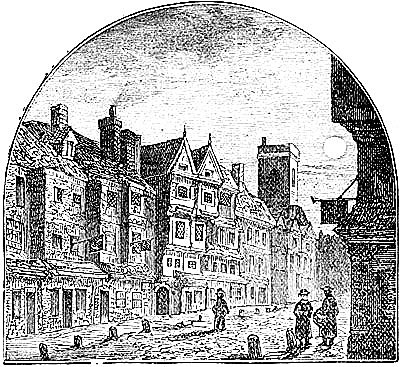
SHAKESPEARE’S LONDON.
“City of ancient memories! Thy spires Rise o’er the dust of worthy sons; thy walls, Within their narrow compass, hold as much Of Freedom as the whole wide world beside.”
The London of Shakespeare, Ben Jonson and Co.,—Limited as it was within its great wall, occupied very much the same space as that now covered by the City proper; its streets were narrow and winding, yet there were still left many open spaces; it was covered with people; its river was full of shipping; it was rich, prosperous, and possessed of a considerable amount of liberty. The great wall of London, broad and strong, with towers at intervals, was more than two miles long, from end to end, beginning at the Tower of London on the east, and ending at the Fleet River and the Thames on the west.
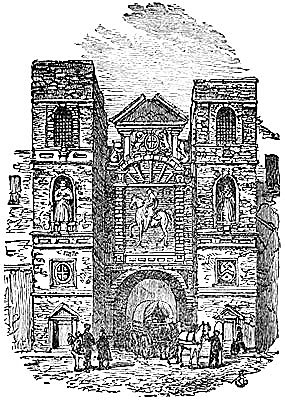
ALDERSGATE.
As regards the gates, there were anciently only four—namely, Aldersgate, Aldgate, Ludgate, and Bridgegate—that is to say, one for each of the cardinal points. Then other gates and posterns were added for the convenience of the citizens: Bishopsgate, for those who had business in the direction of Norfolk, Suffolk, or Cambridgeshire; Moorgate, for those who would practice archery, or take their recreation in Moor Fields; Cripplegate, more ancient than the two preceding, had a prison for debtors attached to it; and there was also a postern for the Convent of Grey Friars, now Christ’s Hospital. At Newgate was a small, incommodious, and fever-haunted prison for criminals; and at Ludgate was another prison, appropriated to debtors, trespassers, and those who committed contempt of Court. Along the river-side were several water-gates, the chief of which were Blackfriars, Greenhithe, Dowgate and Billingsgate.
Within the narrow space of the City Walls there rose a forest of towers and spires. The piety of Merchants had erected no fewer than a hundred and three churches, which successive citizens were continually rebuilding, beautifying, or enlarging. They were filled with the effigies and splendid tombs, the painted and gilded arms, of their founders and benefactors, for whose souls masses were continually said.
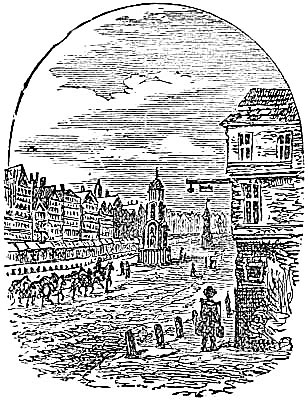
CHEAPSIDE CROSS.
“London was divided into Wards, and was perhaps as catholic in its commercial and industrial pursuits then as now. Every kind of trade was carried on within its walls, just as every kind of merchandise was sold. The combination of fellows of the same craft began in very early times, guilds were formed for the protection of trade and its followers; the guild-brothers met once a month to consider the interests of the craft, regulating prices, recovering debts and so forth. But the London of the period was not so gay as Paris, nor so bustling and prosperous as Antwerp, nor so full of splendour and intellectual life as Venice.[1] Yet to the Englishman of the day it was an ever-lasting wonder. Its towers and palaces, its episcopal residences and gentlemen’s inns, the bustle of its commerce, the number of its foreigners, the wealth of its Companies, and the bravery of its pageants, invested it with more poetry than can be claimed for it at the present time, unless Wealth be our deity, Hurry our companion, and Progress our muse. The rich were leaving their pleasant country mansions to plunge into its delights. At the law terms there was a regular influx of visitors, who seemed to think more of taking tobacco than of winning a lawsuit. Ambitious courtiers, hopeful ecclesiastics, pushing merchants, and poetic dreamers, were all caught by the fascinations of London. Site, antiquity, life, and, above all, abundance of the good things that make up half its charm, in the shape of early delicacies, costly meats, and choice wines, combined to make it a miraculous city in the eyes of the Elizabethan.”
“The external appearance of the City was certainly picturesque. Old grey walls threw round it the arm of military protection. Their gates were conspicuous objects, and the white uniforms of the train-bands on guard, with their red crosses on the back, fully represented the valour which wraps itself in the British flag and dies in its defence. To the north were the various fields whose names survive, diversified by an occasional house, and Dutch-looking windmills, creaking in the breeze. Finsbury was a fenny tract, where the City archers practised; Spitalfields, an open, grassy place, with grounds for artillery exercise and a market cross; and Smithfield, or Smoothfield, was an unenclosed plain, where tournaments were held, horses were sold, and martyrs had been burnt. To the east was the Tower of London, black with age, armed with cannon and culverin, and representing the munificence which entertained royalty as well as the power which punished traitors. Beyond it was Wapping, the Port of London, with its narrow streets, its rope-walks and biscuit shops. Black fronted taverns, with low doorways and leaden framed windows, their rooms reeking with smoke and noisy with the chatter of ear-ringed sailors, were to be found in nearly every street. Here the merchant adventurer came to hire his seamen, and here the pamphleteer or the ballad-maker could any night gather materials for many a long-winded yarn about Drake and the Spanish main, negroes, pearls, and palm-groves.
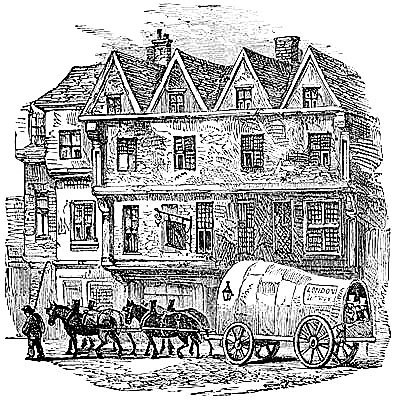
OLD STAGE WAGGON.
“To the west, the scene was broken with hamlets, trees, and country roads. Marylebone and Hyde Park were a royal hunting-ground, with a manor house, where the Earls of Oxford lived in later times. Piccadilly was ‘the road to Reading,’ with foxgloves growing in its ditches, gathered by the simple dealers of Bucklersbury, to make anodynes for the weary-hearted. Chelsea was a village; Pimlico a country hamlet, where pudding-pies were eaten by strolling Londoners on a Sunday. Westminster was a city standing by itself, with its Royal Palace, its Great Hall for banquets and the trial of traitors, its sanctuary, its beautiful Abbey, and its famous Almonry. St. James’s Park was walled with red brick, and contained the palace Henry VIII. had built for Anne Boleyn. Whitehall Palace was in its glory. The Strand, along which gay ladies drove in their ‘crab-shell coaches,’ had been recently paved, and its streams of water diverted. A few houses had made their appearance on the north side of the Strand, between the timber house and its narrow gateway, which then formed Temple Bar, the boundary between London and Westminster, and the church of St. Mary-le-Strand. The southern side was adorned with noble episcopal residences, and with handsome turreted mansions, extending to the river, rich with trees and gardens, and relieved by flashes of sparkling water.
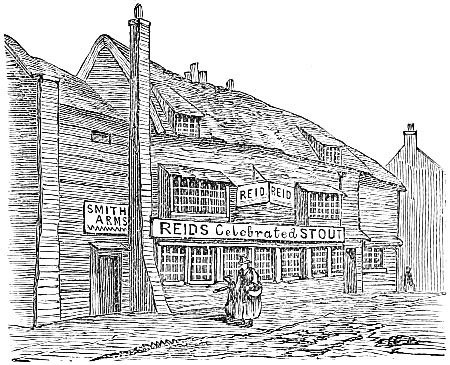
SMITH’S ARMS, BANKSIDE.[2]
“To the south, Lambeth, with its palace and church, and Faux Hall, were conspicuous objects. Here were pretty gardens and rustic cottages. The village of Southwark, with its prisons, its public theatres, its palace, and its old Tabard Inn, had many charms. It was the abode of Shakespeare himself, as he resided in a good house in the Liberty of the Clink, and was assessed in the weekly payment of 6d., no one but Henslowe, Alleyn, Collins, and Barrett, being so highly rated. That part of the Borough of Southwark known as Bankside was not only famous in Shakespeare’s time for its Theatres, but also as the acknowledged retreat of the warmest of the demi-monde!
“‘And here, as in a tavern, or a stew, He and his wild associates spend their hours.’” —Ben Jonson.
“We fear our best zeal for the drama will not authorise us to deny that Covent-garden and Drury-lane have succeeded to the Bank-side in every species of fame!
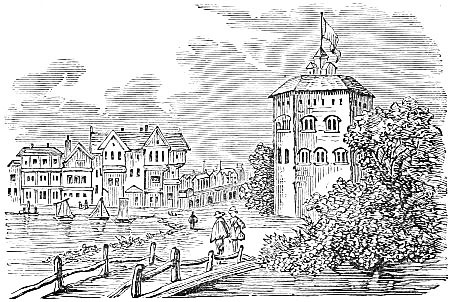
The Globe Theatre.
“We must not forget the river Thames. It was one of the sights of the time. Its waters were pure and bright, full of delicate salmon, and flecked by snowy swans, ‘white as Lemster wool.’ Wherries plied freely on its surface. Tall masts clustered by its banks. Silken-covered tiltboats, freighted with ruffed and feathered ladies and gentlemen, swept by, the watermen every now and then breaking the plash of the waves against their boats by singing out, in their bass voices, ‘Heave and how, rumbelow.’ At night, the scene reminded the travelled man of Venice. All the mansions by the water-side had river-terraces and steps, and each one its own tiltboat, barge, and watermen. Down these steps, lighted by torches and lanterns, stepped dainty ladies, in their coloured shoes, with masks on their faces, and gay gallants, in laced cloaks, by their side, bound for Richmond or Westminster, to mask and revel. Noisy parties of wits and Paul’s men crossed to Bankside to see Romeo and Juliet, or Hamlet the Dane, or else ‘The most excellent historie of the Merchant of Venice, with the extreme crueltie of Shylocke, the Jewe, towards the sayd merchant, in cutting a just pound of his flesh, and obtaining of Portia by the choyse of three caskets, as it hath diverse times been acted by the Lord Chamberlain, his servants. Written by William Shakespeare.’
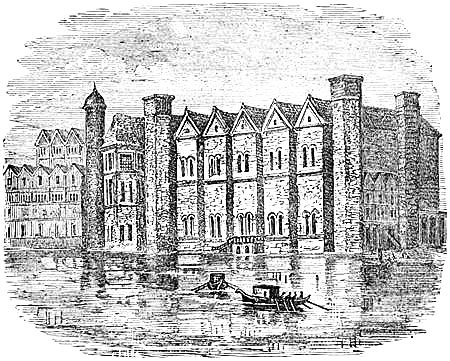
BAYNARD’S CASTLE.
“From Westminster to London Bridge was a favourite trip. There was plenty to see. The fine Strand-side houses were always pointed out—Northumberland House, York House, Baynard’s Castle, the scene of the secret interview between the Duke of York and the Earls of Salisbury and Warwick, was singled out, between Paul’s Wharf and Puddle Dock. Next to the Temple, and between it and Whitefriars, was the region known as Alsatia. Here safe from every document but the writ of the Lord Chief Justice and the Lords of the Privy Council, in dark dwellings, with subterranean passages, narrow streets, and trap-doors that led to the Thames, dwelt all the rascaldom of the time—men who had been ‘horned’ or outlawed, bankrupts, coiners, thieves, cheaters at dice and cards, duellists, homicides, and foreign bravoes, ready to do any desperate deed. At night the contents of this kingdom of villany were sprayed out over London, to the bewilderment of good-natured Dogberries, and country gentlemen, making their first visit to town.
“Still further down the river was the famous London Bridge. It consisted of twenty arches; its roadway was sixty feet from the river; and the length of the bridge from end to end was 926 feet.
“It was one of the wonders that strangers never ceased to admire. Its many shops were occupied by pin nacres, just beginning to feel the competition with the Netherland pin-makers, and the tower at its Southwark end was adorned with three hundred heads, stuck on poles, like gigantic pins, memorials of treachery and heresy.
“The roar of the river through the arches was almost deafening. ‘The noise at London Bridge is nothing near her,’ says one of the characters in Beaumont and Fletcher’s Woman’s Prize. Shakespeare, Ben Jonson & Co., must have crossed the bridge many a time on their visits to the City, to ‘gather humours of men daily,’ as Aubrey quaintly expresses it.”
The name of Ben Jonson reminds us that in The Silent Woman,—one of the most popular of his Comedies,—we have presented to us a more vivid picture than can elsewhere be found of the characteristic noises, and street-cries of London more than two centuries ago. It is easy to form to ourselves a general idea of the hum and buzz of the bees and drones of this mighty hive, under a state of manners essentially different from our own; but it is not so easy to attain a lively conception of the particular sounds that once went to make up this great discord, and so to compare them in their resemblances and their differences with the roar which the great Babel now “sends through all her gates.” We propose, therefore, to put before our readers this passage of Jonson’s comedy; and then, classifying what he describes, illustrate our fine old dramatic painter of manners by references to other writers, and by the results of our own observation.
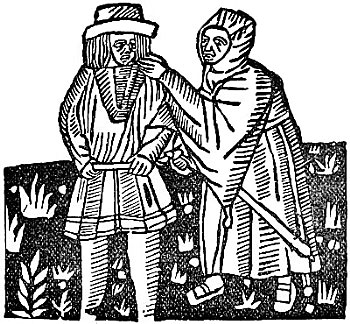
The principal character of Jonson’s Silent Woman is founded upon a sketch by a Greek writer of the fourth century, Libanius. Jonson designates this character by the name of “Morose;” and his peculiarity is that he can bear no kind of noise, not even that of ordinary talk. The plot turns upon this affectation; for having been entrapped into a marriage with the “Silent Woman,” she and her friends assail him with tongues the most obstreperous, and clamours the most uproarious, until, to be relieved of this nuisance, he comes to terms with his nephew for a portion of his fortune and is relieved of the “Silent Woman,” who is in reality a boy in disguise. We extract the dialogue of the whole scene; the speakers being “Truewitt,” “Clerimont,” and a “Page”:—
“True. I met that stiff piece of formality, Master Morose, his uncle, yesterday, with a huge turban of night-caps on his head, buckled over his ears.
“Cler. O! that’s his custom when he walks abroad. He can endure no noise, man.
“True. So I have heard. But is the disease so ridiculous in him as it is made? They say he has been upon divers treaties with the fish-wives and orange-women; and articles propounded between them: marry, the chimney-sweepes will not be drawn in.
“Cler. No, nor the broom-men: they stand out stiffly. He cannot endure a costard-monger; he swoons if he hear one.
“True. Methinks a smith should be ominous.
“Cler. Or any hammer-man. A brasier is not suffer’d to dwell in the parish, nor an armourer. He would have hang’d a pewterer’s ’prentice once upon a Shrove-Tuesday’s riot, for being of that trade, when the rest were quit.
“True. A trumpet should fright him terribly, or the hautboys.
“Cler. Out of his senses. The waits of the City have a pension of him not to come near that ward. This youth practised on him one night like the bellman, and never left till he had brought him down to the door with a long sword; and there left him flourishing with the air.
“Page. Why, sir, he hath chosen a street to lie in, so narrow at both ends that it will receive no coaches, nor carts, nor any of these common noises; and therefore we that love him devise to bring him in such as we may now and then, for his exercise, to breathe him. He would grow resty else in his cage; his virtue would rust without action. I entreated a bearward, one day, to come down with the dogs of some four parishes that way, and I thank him he did; and cried his games under Master Morose’s window; till he was sent crying away, with his head made a most bleeding spectacle to the multitude. And, another time, a fencer marching to his prize had his drum most tragically run through, for taking that street in his way at my request.
“True. A good wag! How does he for the bells?
“Cler. O! In the queen’s time he was wont to go out of town every Saturday at ten o’clock, or on holiday eves. But now, by reason of the sickness, the perpetuity of ringing has made him devise a room with double walls and treble ceilings; the windows close shut and caulk’d; and there he lives by candlelight.”
The first class of noises, then, against which “Morose” protected his ears by “a huge turban of night-caps,” is that of the ancient and far-famed London Cries. We have here the very loudest of them—fish-wives, orange-women, chimney-sweepers, broom-men, costard-mongers. But we might almost say that there were hundreds of other cries; and therefore, reserving to ourselves some opportunity for a special enumeration of a few of the more remarkable of these cries, we shall now slightly group them, as they present themselves to our notice during successive generations.
We shall not readily associate any very agreeable sounds with the voices of the “fish-wives.” The one who cried “Mackerel” in Lydgate’s day had probably no such explanatory cry as the “Mackerel alive, alive ho!” of modern times. In the seventeenth century the cry was “New Mackerel.” And in the same way there was:—
New Wall-Fleet Oysters. New Flounders.
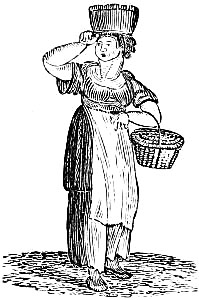
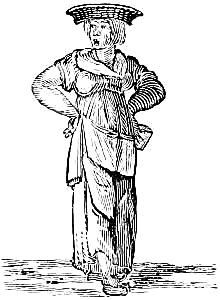
New Whiting. New Salmon.
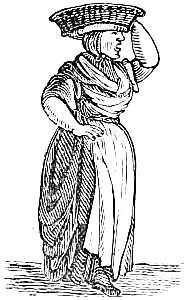
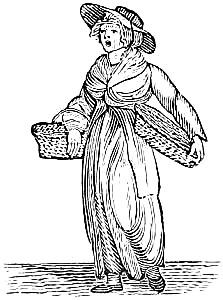
The freshness of fish must have been a considerable recommendation in those days of tardy intercourse. But quantity was also to be taken into the account, and so we find the cries of “Buy my dish of Great Smelts;” “Great Plaice;” “Great Mussels.” Such are the fish-cries enumerated in Lauron’s and various other collections of “London Cries.”
Buy Great Smelts. Buy Great Plaice.
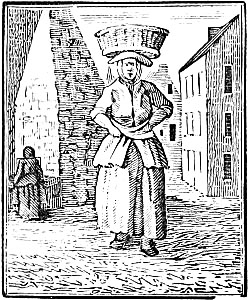
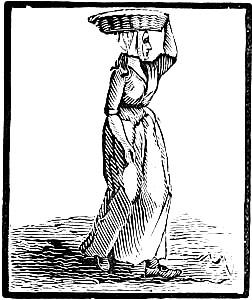
Buy Great Mussels. Buy Great Eels.
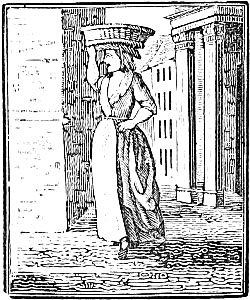
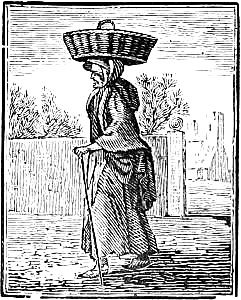
But, we are forgetting “Morose,” and his “turban of night-caps.” Was Hogarth familiar with the old noise-hater when he conceived his own:—
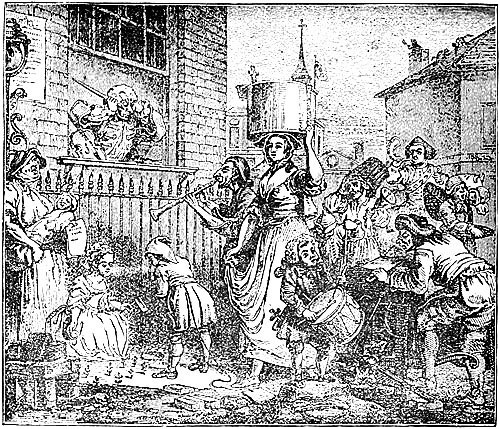
Enraged Musician.
In this extraordinary gathering together of the producers of the most discordant sounds, we have a representation which may fairly match the dramatist’s description of street noises. Here we have the milk-maid’s scream, the mackerel seller’s shout, the sweep upon the house top,—to match the fish-wives and orange-women, the broom-men and costard-mongers. The smith, who was “ominous,” had no longer his forge in the busy streets of Hogarth’s time; the armourer was obsolete: but Hogarth can rival their noises with the pavior’s hammer, the sow-gelder’s horn, and the knife-grinder’s wheel. The waits of the city had a pension not to come near “Morose’s” ward; but it was out of the power of the “Enraged Musician” to avert the terrible discord of the blind hautboy-player. The bellman who frightened the sleepers at midnight, was extinct; but modern London had acquired the dustman’s bell. The bear-ward no longer came down the street with the dogs of four parishes, nor did the fencer march with a drum to his prize; but there was the ballad-singer, with her squalling child, roaring worse than bear or dog; and the drum of the little boy playing at soldiers was a more abiding nuisance than the fencer. “Morose” and the “Enraged Musician” had each the church bells to fill up the measure of discord.
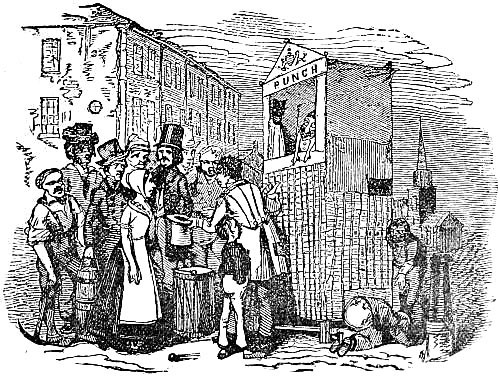
The fish-wives are no longer seen in our great city of London thoroughfares. In Tottenham Court-road, Hoxton, Shoreditch, Kingsland, Whitechapel, Hackney-road, and many other suburban districts, which still retain the character of a street-market, they stand in long rows as the evening draws in, with paper-lanterns stuck in their baskets on dark nights; and there they vociferate as loudly as in the olden time.
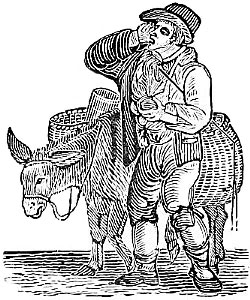
The “costard-monger” whom Morose dreaded, still lives amongst us, and is still noisy. He bawls so loud even to this day, that he puts his hand behind his ear to mitigate the sensation which he inflicts upon his own tympanum. He was originally an apple-seller, whence his name; and, from the mention of him in the old dramatists, he appears to have been frequently an Irishman. In Jonson’s “Bartholomew Fair,” he cries “pears.” Ford makes him cry “pippins.” He is a quarrelsome fellow, according to Beaumont and Fletcher:—
“And then he’ll rail like a rude costermonger, That schoolboys had cozened of his apple, As loud and senseless.”
The costermonger is now a travelling shopkeeper. We encounter him not in Cornhill, or Holborn, or the Strand: in the neighbourhood of the great markets and well-stored shops he travels not. But his voice is heard in some silent streets stretching into the suburbs; and there, with his donkey and hampers stands at the door, as the servant-maid cheapens a bundle of cauliflowers. He has monopolized all the trades that were anciently represented by such cries as “Buy my artichokes, mistress;” “Ripe cowcumbers;” “White onions, white St. Thomas’ onions;” “White radish;” “Ripe young beans;” “Any baking pears;” “Ripe sparrowgrass.” He would be indignant to encounter such petty chapmen interfering with his wholesale operations. He would rail against them as the city shopkeepers of the sixteenth and seventeenth centuries railed against itinerant traders of every denomination. In the days of Elizabeth, they declare by act of common council, that in ancient times the open streets and lanes of the city have been used, and ought to be used, as the common highway only, and not for hucksters, pedlars, and hagglers, to stand or sit to sell their wares in, and to pass from street to street hawking and offering their wares. In the seventh year of Charles I. the same authorities denounce the oyster-wives, herb-wives, tripe-wives, and the like, as “unruly people;” and they charge them somewhat unjustly, as it must appear, with “framing to themselves a way whereby to live a more easy life than by labour.”
“How busy is the man the world calls idle!”
The evil, as the citizens term it, seems to have increased; for in 1694 the common council threatened the pedlars and petty chapmen with the terrors of the laws against rogues and sturdy beggars, the least penalty being whipping, whether for male or female. The reason for this terrible denunciation is very candidly put: the citizens and shopkeepers are greatly hindered and prejudiced in their trades by the hawkers and pedlars. Such denunciations as these had little share in putting down the itinerant traders. They continued to flourish, because society required them; and they vanished from our view when society required them no longer. In the middle of the last century they were fairly established as rivals to the shopkeepers. Dr. Johnson, than whom no man knew London better, thus writes in the “Adventurer:”—“The attention of a new-comer is generally first struck by the multiplicity of cries that stun him in the streets, and the variety of merchandise and manufactures which the shopkeepers expose on every hand.” The shopkeepers have now ruined the itinerants—not by putting them down by fiery penalties, but by the competition amongst themselves to have every article at hand for every man’s use, which shall be better and cheaper than the wares of the itinerant. Whose ear is now ever deafened by the cries of the broom-man? He was a sturdy fellow in the days of old “Morose,” carrying on a barter which in itself speaks of the infancy of civilization. His cry was “Old Shoes for some Brooms.” Those proclamations for barter no doubt furnished a peculiar characteristic of the old London Cries. The itinerant buyers were as loud, though not so numerous, as the sellers.
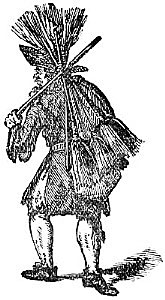
New Brooms for Old Shoes!
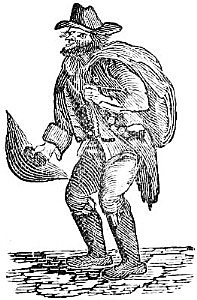
Old Clowze, any old Clo’, Clo’.
The familiar voice of “Old Clowze, any old Clo’ Clo,” has lasted through some generations; but the glories of Monmouth-street were unknown when a lady in a peaked bonnet and a laced stomacher went about proclaiming “Old Satin, old Taffety, or Velvet.” And a singular looking party of the Hebrew persuasion, with a cocked hat on his head, and a bundle of rapiers and sword-sticks under his arm, which he was ready to barter for:—
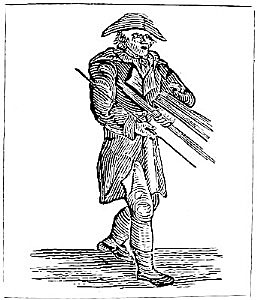
Old Cloaks, Suits, or Coats.
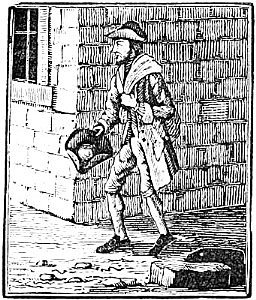
Hats or Caps—Buy, Sell, or Exchange.
While another of the tribe proclaimed aloud from east to west—and back again, “From morn to noon, from noon to dewy eve,” his willingness to “Buy, sell, or exchange Hats or Caps.” Why should the Hebrew race appear to possess a monopoly in the purchase and sale of dilapidated costumes? Why should their voices, and theirs alone, be employed in the constant iteration of the talismanic monosyllables “Old Clo’?” Is it because Judas carried the bag that all the children of Israel are to trudge through London streets to the end of their days with sack on shoulder? Artists generally represent the old clothesman with three, and sometimes four, hats, superposed one above the other. Now, although we have seen him with many hats in his hands or elsewhere, we never yet saw him with more than one hat on his head. The three-hatted clothesman, if ever he existed, is obsolete. According to Ingoldsby, however, when “Portia” pronounced the law adverse to “Shylock”:
“Off went his three hats, and he look’d as the cats Do, whenever a mouse has escaped from their claw.”
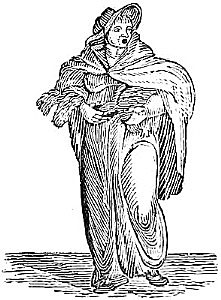
Any Kitchen-Stuff have you Maids?
There was trading then going forward from house to house, which careful housewifery and a more vigilant police have banished from the daylight, if they have not extirpated it altogether. Before the shops are open and the chimneys send forth their smoke, there may be now, sometimes, seen creeping up an area a sly-looking beldam, who treads as stealthily as a cat. Under her cloak she has a pan, whose unctuous contents will some day assist in the enlightenment or purification of the world, in the form of candles or soap. But the good lady of the house, who is a late riser, knows not of the transformation that is going forward. In the old days she would have heard the cry of a maiden, with tub on head and pence in hand, of “Any Kitchen-stuff have you Maids?” and she probably would have dealt with her herself, or have forbidden her maids to deal.
So it is with the old cry of “Any Old Iron take Money for?” The fellow who then went openly about with sack on back was a thief, and an encourager of thieves; he now keeps a marine-store.
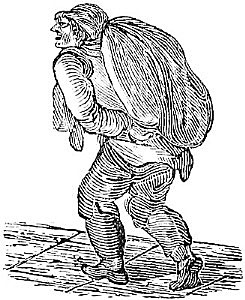
Any Old Iron take Money for?
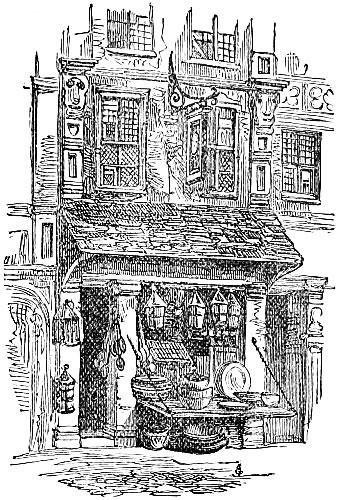
Old London Shop.
Sir Walter Scott, in his Fortunes of Nigel, has left us a capital description of the shop of a London tradesman during the reign of King James in England, the shop in question being that of David Ramsay, maker of watches and horologes, within Temple-bar—a few yards eastward of St. Dunstan’s church, Fleet-street, and where his apprentice, Jenkin Vincent—abbreviated to Jin Vin, when not engaged in ’prentices-riots—is crying to every likely passer-by:—
“What d’ye lack?—What d’ye lack?—Clocks—watches—barnacles?—What d’ye lack?—Watches—clocks—barnacles?—What d’ye lack, sir? What d’ye lack, madam?—Barnacles—watches—clocks? What d’ye lack, noble sir?—What d’ye lack, beauteous madam?—God bless your reverence, the Greek and Hebrew have harmed your reverence’s eyes. Buy a pair of David Ramsay’s barnacles. The king, God bless his sacred Majesty! never reads Hebrew or Greek without them. What d’ye lack? Mirrors for your toilets, my pretty madam; your head-gear is something awry—pity, since it so well fancied. What d’ye lack? a watch, Master Sargeant?—a watch that will go as long as a lawsuit, as steady and true as your own eloquence? a watch that shall not lose thirteen minutes in a thirteen years’ lawsuit—a watch with four wheels and a bar-movement—a watch that shall tell you, Master Poet, how long the patience of the audience will endure your next piece at the Black Bull.”
The verbal proclaimers of the excellence of their commodities, had this advantage over those who, in the present day, use the public papers for the same purpose, that they could in many cases adapt their address to the peculiar appearance and apparent taste of the passengers. This direct and personal mode of invitation to customers became, however, a dangerous temptation to the young wags who were employed in the task of solicitation during the absence of the principal person interested in the traffic; and, confiding in their numbers and civic union, the ’prentices of London were often seduced into taking liberties with the passengers, and exercising their wit at the expense of those whom they had no hopes of converting into customers by their eloquence. If this were resented by any act of violence, the inmates of each shop were ready to pour forth in succour; and in the words of an old song which Dr. Johnson was used to hum,—
“Up then rose the ’prentices all, Living in London, both proper and tall.”
Desperate riots often arose on such occasions, especially when the Templars, or other youths connected with the aristocracy, were insulted, or conceived themselves so to be. Upon such occasions, bare steel was frequently opposed to the clubs of the citizens, and death sometimes ensued on both sides. The tardy and inefficient police of the time had no other resource than by the Alderman of the ward calling out the householders, and putting a stop to the strife by overpowering numbers, as the Capulets and Montagues are separated upon the stage.
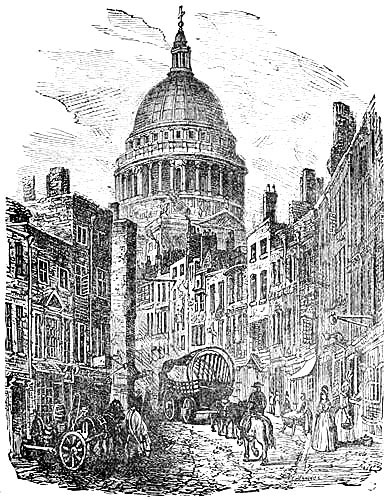
St. Paul’s Cathedral.
It must not be imagined that these ’prentices of the City of London were of mean and humble origin. The sons of freemen of the City, or country boys of good and honourable families, alone were admitted to the seven years’ apprenticeship. The common people—the ascripti glebæ—the poor rustics who were bound to the soil, had little or no share in the fortunes of the City of London. Many of the burgesses were as proud of their descent as of their liberties.
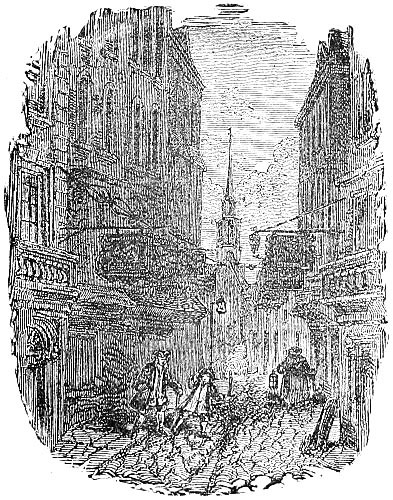
A Street at Night—Shakespeare’s London.
Once apprenticed, and having in a few weeks imbibed the spirit of the place, the lad became a Londoner. It is one of the characteristics of London, that he who comes up to the City from the country speedily becomes penetrated with the magic of the golden pavement, and falls in love with the great City. And he who has once felt that love of London can never again be happy beyond the sound of Bow Bells, which could formerly be heard for ten miles and more. The greatness of the City, its history, its associations, its ambitions, its pride, its hurrying crowds—all these things affect the imagination and fill the heart. There is no place in the world, and never has been, which so stirs the heart of her children with love and pride as the City of London.
A year or two later on, the boy would learn, with his fellow-’prentices that he must betake himself to the practice of bow and arrow, “pellet and bolt,” with a view to what might happen. Moorfields was convenient for the volunteers of the time. There was, however, never any lack of excitement and novelty in the City of London. But this is a digression.
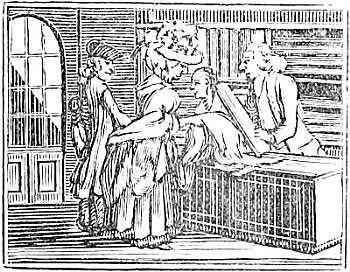
Amongst the earliest of the Cries of London we must class the “cry” of the City watchman; although it essentially differed from the “cries” of the shopkeepers and the hawkers; for they, as a rule, had something to exchange or sell—copen or buy? as Lydgate puts it—then the watchmen were wont to commence their “cry” at, or about, the hour of night when all others had finished for the day. After that it was the business of the watchman to make his first call, or cry after the manner inscribed over the figure here given.
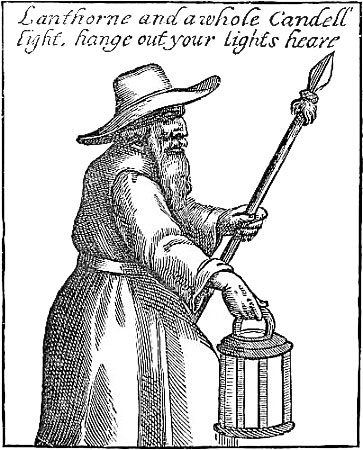
He had to deal with deaf listeners, and he therefore proclaimed with a voice of command, “Lanthorn!” but a lanthorn alone was a body without a soul; and he therefore demanded “a whole candle.” To render the mandate less individually oppressive, he went on to cry, “Hang out your Lights!” And, that even the sleepers might sleep no more, he ended with “Heare!” It will be seen that he carries his staff and lanthorn with the air of honest old Dogberry about him,—“A good man and true,” and “the most desartless man to be constable.”
The making of lanthorns was a great trade in the early times. We clung to King Alfred’s invention for the preservation of light with as reverend a love, during many centuries, as we bestowed upon his civil institutions. The horn of the favoured utensil was a very dense medium for illumination, but science had substituted nothing better; and, even when progressing people carried about a neat glass instrument with a brilliant reflector, the watchman held to his ponderous and murky relic of the past, making “night hideous” with his voice, to give news of the weather, such as: “Past eleven, and a starlight night;” or “Past one o’clock, and a windy morning;” in fact, disturbed your rest to tell you “what’s o’clock.”
We are told by the chroniclers that, as early as 1416, the mayor, Sir Henry Barton, ordered lanthorns and lights to be hanged out on the winter evenings, betwixt Allhallows and Candlemass. For three centuries this practice subsisted, constantly evaded, no doubt through the avarice or poverty of individuals, sometimes probably disused altogether, but still the custom of London up to the time of Queen Anne. The cry of the watchman, “Hang out your Lights,” was an exhortation to the negligent, which probably they answered only by snores, equally indifferent to their own safety and the public preservation. A worthy mayor in the time of Queen Mary provided the watchman with a bell, with which instrument he accompanied the music of his voice down to the days of the Commonwealth. The “Statutes of the Streets,” in the time of Elizabeth, were careful enough for the preservation of silence in some things. They prescribed that, “no man shall blow any horn in the night, or whistle after the hour of nine o’clock in the night, under pain of imprisonment;” and, what was a harder thing to keep, they also forbade a man to make any “sudden outcry in the still of the night, as making any affray, or beating his wife.” Yet a privileged man was to go about knocking at doors and ringing his alarum—an intolerable nuisance if he did what he was ordered to do.
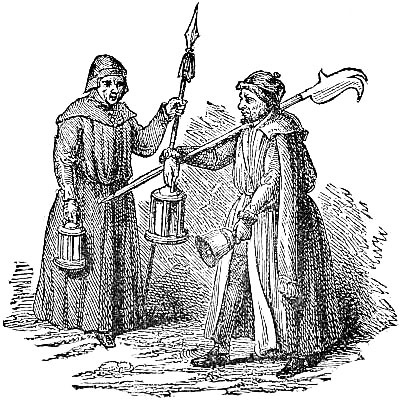
The Watch—Shakespeare’s London.
But the watchmen were, no doubt, wise in their generation. With honest Dogberry, they could not “see how sleeping should offend;” and after the watch was set, they probably agreed to “go sit upon the church bench till two, and then all to bed.”
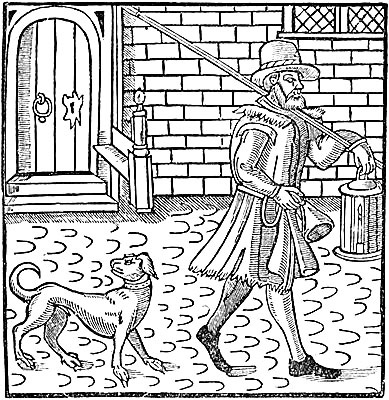
The Bellman—from Dekker, 1608.
We have observed in our old statutes, and in the pages of authors of various kinds, that separate mention is made of the Watchman and the Bellman. No doubt there were several degrees of office in the ancient Watch and Ward system, and that part of the office of the old Watch, or Bellman, was to bless the sleepers, whose door he passed, which blessing was often sung or said in verse—hence Bellman’s verse. These verses were in many cases, the relics of the old incantations to keep off elves and hobgoblins. There is a curious work by Thomas Dekker—otherwise Decker,—entitled: “The Bellman of London. Bringing to light the most notorious Villanies that are now practised in the Kingdom, Profitable for Gentlemen, Lawyers, Merchants, Citizens, Farmers, Masters of Households and all sortes of servants to Marke, and delightful for all men to Reade, Lege, Perlege, Relege.” Printed at London for Nathaniel Butter, 1608. Where he describes the Bellman as a person of some activity—“the child of darkness; a common nightwalker; a man that had no man to wait upon him, but only a dog; one that was a disordered person, and at midnight would beat at men’s doors, bidding them (in mere mockery) to look to their candles, when they themselves were in their dead sleeps.” Stow says that in Queen Mary’s day one of each ward “began to go all night with a bell, and at every lane’s end, and at the ward’s end, gave warning of fire and candle, and to help the poor and pray for the dead.” Milton, in his “Il Penseroso,” has:—
“Far from the resort of mirth, Save the cricket on the hearth, Or the bellman’s drowsy charm, To bless the doors from nightly harm.”
In “A Bellman’s Song” of the same date, we have:—
“Maidens to bed, and cover coal, Let the mouse out of her hole, Crickets in the chimney sing, Whilst the little bell doth ring; If fast asleep, who can tell When the clapper hits the bell?”
Herrick, also, has given us a verse of Bellman’s poetry in one of the charming morsels of his “Hesperides:”—
“From noise of scare-fires rest ye free, From murders Benedicite; From all mischances that may fright Your pleasing slumbers in the night, Mercy secure ye all, and keep The goblin from ye while ye sleep. Past one o’clock, and almost two, My masters all, ‘Good day to you!’”
But, with or without a bell, the real prosaic watchman continued to make the same demand as his predecessors for lights through a long series of years; and his demand tells us plainly that London was a city without lamps. But though he was a prosaic person, he had his own verses. He addressed himself to the “maids.” He exhorted them to make their lanthorns “bright and clear.” He told them how long their candles were expected to burn. And, finally, like a considerate lawgiver, he gave reason for his edict:—
“That honest men that walk along, May see to pass safe without wrong.”
Formerly it was the duty of the bellman of St. Sepulchre’s parish, near Newgate, to rouse the unfortunates condemned to death in that prison, the night before their execution, and solemnly exhort them to repentance with good words in bad rhyme, ending with
“When St. Sepulchre’s bell to-morrow tolls, The Lord above have mercy on your souls.”
It was customary for the bellman to present at Christmas time to each householder in his district “A Copy of Verses,” and he expected from each in return some small gratuity. The execrable character of his poetry is indicated by the contempt with which the wits speak of “Bellman’s verses” and the comparison they bear to “Cutler’s poetry upon a knife,” whose poesy was—“Love me, and leave me not.” On this subject there is a work entitled—“The British Bellman. Printed in the year of Saint’s Fear, Anno Domini 1648, and reprinted in the Harleian Miscellany.” “The Merry Bellman’s Out-Cryes, or the Cities O Yes! being a mad merry Ditty, both Pleasant and Witty, to be cry’d in Prick-Song[3] Prose, through Country and City. Printed in the year of Bartledum Fair, 1655.” Also—“The Bell-man’s Treasury, containing above a Hundred several Verses fitted for all Humours and Fancies, and suited to all Times and Seasons. London, 1707.” It was from the riches of this “treasury” that the predecessors of the present parish Bellman mostly took their own (!) “Copy of Verses.”
In the Luttrell Collection of Broadsides (Brit. Mus.) is one dated 1683-4, entitled, “A Copy of Verses presented by Isaac Ragg, Bellman, to the Masters and Mistresses of Holbourn Division, in the Parish of St. Giles’s-in-the-Fields.” It is headed by a woodcut representing Isaac in his professional accoutrements, a pointed pole in his left hand, and in the right a bell, while his lanthorn hangs from his jacket in front; below is a series of verses, the only specimen worth giving here being the expression of Mr. Ragg’s official duty; it is as follows:—
“Time Masters, calls your bellman to his task, To see your doors and windows are all fast, And that no villany or foul crime be done To you or yours in absence of the sun. If any base lurker I do meet, In private alley or in open street, You shall have warning by my timely call, And so God bless you and give rest to all.”
In a similar, but unadorned broadside, dated 1666, Thomas Law, Bellman, greets his Masters of “St. Giles, Cripplegate, within the Freedom,” in twenty-three dull stanzas, of which the last may be subjoined:—
“No sooner hath St. Andrew crowned November, But Boreas from the North brings cold December, And I have often heard a many say He brings the winter month Newcastle way; For comfort here of poor distressed souls, Would he had with him brought a fleet of coals.”
We have in our possession a “copy of verses,” coming down to our own time. It is a folio broadside, and contains in addition to a portrait of the Bellman of the Parish and his dog on their rounds, fifteen smaller cuts, mostly Scriptural. It is entitled:—
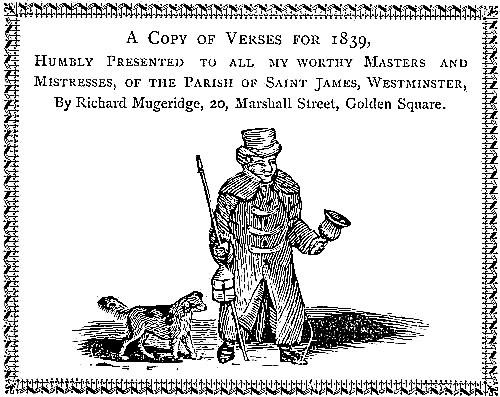
The “Verses” all contain allusions to the prominent events of the past year, and have various headings—first we have the:—
Prologue.
My Masters and Mistresses, pray lend an ear, While your Bellman recounts some events of the year; For altho’ its commencement was rather distressing, We’ve had reason to thank it for more than one blessing, ’Tis true that Canadian proceedings were strange, And a very sad fire was the Royal Exchange; Yet the first, let us hope, is no serious matter, And we’ll soon have a new one in lieu of the latter. Our rulers have grappled with one of our crosses, While for beauty and fitness the other no loss is. And still more to make up for these drawbacks vexatious, Dame Fortune has been on the whole, pretty gracious. We’ve had peace to get wealth, which of war is the sinews. Grant us wit to make hay while the sunshine continues. Then, the Bear of the North, that insatiate beast, Has been check’d in his wily attempts on the East; And his further insidious advances forbidden By the broadsword of Auckland, which warns him from Eden. While our rulers, in earnest, apply to the work, And a treaty concludes with the Austrian and Turk, Which, when next the fell Monster is tempted to roam, May provide him some pleasant employment at home.
To the Queen.
Whilst the high and the noble in gallant array, Assemble around her, their homage to pay; While the proud Peers of Britain with rapture, I ween, Place her crown on the brow of their peerless young Queen; While by prince and by peasant her sceptre is blest; Why may not the Bellman chime in with the rest? Tho’ alas! my poor muse would long labour in vain, To express our delight in Victoria’s reign, Long may we exult in her merciful sway, May her moments speed blithely and sweetly as May, And her days be prolonged till her glories efface The last maiden lady’s, who sate in her place.
The Great Western.
Well, despite of some thousand objections pedantic, The “Great Western” has cross’d and re-cross’d the Atlantic, Nor is this the first time—to the foe’s consternation— That the deeds of our tars have defied calculation. Though few of our learned professors did dream That our seamen in steamers would reach the gulf stream, Yet a fortnight’s vibration, from Bristol or Cork, Will now set us down with our friends at New York; And a closer acquaintance bind firmer than ever, A friendship which nothing on earth ought to sever. ****** ******
Epilogue.
Now having conducted his well-meant effusion Thus far on its way to a happy conclusion, Your Bellman, tho’ not quite so fresh as at starting, Would still have a word with his patrons at parting, Just by way of a cordial and kindly farewell, For his heart, altho’ softer, is sound as his bell, And he cannot say more for himself or his strains, Than, whatever his success, he has not spared pains; And that blest in their kindness, and countenance steady, His song and his services always are ready; So he bids them adieu till next season appears— May their wealth and their virtues increase with their years; May they always have more than they ever can spend, With the soul to help on a less fortunate friend; And their Bellman continue to cudgel his brain, For their yearly amusement, again and again.
Cheap and Expeditious Printing by Steam Machinery, executed by C. Reynell, 16, Little Pulteney Street, Golden Square.—First printed in 1735.
There is a very rare sheet of woodcuts in the Print-room of the British Museum, containing twelve cries, with figures of the “Criers” and the cries themselves beneath. The cuts are singularly characteristic, and may be assigned with safety, on the authority of Mr. John Thomas Smith, the late keeper of the prints and drawings, as of the same date as Ben Jonson’s “fish-wives,” “costard-mongers,” and “orange women.”
No. 1 on the sheet, is the “Watch;” he has no name, but carries a staff and a lanthorn, is well secured in a good frieze gabardine, leathern-girdle, and wears a serviceable hat to guard against the weather. The worthy here depicted has a most venerable face and beard, showing how ancient was the habit of parish officers to select the poor and feeble for the office of watchman, in order to keep them out of the poor-house. The “cry” of the “watch” is as follows:—
“A light here, maids, hang out your light, And see your horns be clear and bright, That so your candle clear may shine, Continuing from six till nine; That honest men that walk along, May see to pass safe without wrong.”
No. 2 is the “Bellman”—Dekker’s “Bellman of London and Dog.” (as at page 49.) He carries a halberd lanthorn, and bell, and his “cry” is curious:—
“Maids in your smocks, look to your locks, Your fire and candle-light; For well ’tis known much mischief’s done By both in dead of night; Your locks and fire do not neglect, And so you may good rest expect.”
No. 3 is the “Orange Woman,” a sort of full-grown Nell Gwynne, if we can only fancy Nelly, the favourite mistress of King Charles the Second, grown up in her humble occupation. She carries a basket of oranges and lemons under her arm, and seeks to sell them by the following “cry”:—
“Fine Sevil oranges, fine lemmons, fine; Round, sound, and tender, inside and rine, One pin’s prick their vertue show: They’ve liquor by their weight, you may know.”
No. 4 is the “Hair-line Man,” with a bundle of lines under his arm, and a line in his hand. Clothes-pegs was, perhaps, a separate “cry.” Here is his:—
“Buy a hair-line, or a line for Jacke, If you any hair or hemp-cord lack, Mistris, here’s good as you need use; Bid fair for handsel, I’ll not refuse.”
No. 5 is the “Radish and Lettuce Woman.”—Your fine “goss” lettuce is a modern cry:—
“White raddish, white young lettis, White young lettis white; You hear me cry, come mistris, buy, To make my burden light.”
No. 6 is the man who sells “Marking Stones,” now, unless we except slate-pencils, completely out of use:—
“Buy marking-stones, marking-stones buy, Much profit in their use doth lie: I’ve marking-stones of colour red, Passing good, or else black lead.”
No. 7 is the “Sausage Woman,” holding a pound of sausages in her hand:—
“Who buys my sausages, sausages fine? I ha’ fine sausages of the best; As good they are as ere was eat; If they be finely drest. Come, mistris, buy this daintie pound, About a capon roast them round.”
No. 8 is a man with “Toasting-forks and Spice-graters”:—
“Buy a fine toasting-fork for toast, Or fine spice-grater—tools for an hoast; If these in winter be lacking, I say, Your guests will pack, your trade decay.”
No. 9 is the “Broom Man,” and here we have a “cry” different from the one we have already given. He carries a pair of old boots in his hand:—
“Come buy some brooms, come buy of me: Birch, Heath, and green,—none better be; The staves are straight, and all bound sure; Come, maids, my brooms will still endure. Old boots or shoes I’ll take for brooms, Come buy to make clean all your rooms!”
No. 10 is a woman with a box of “Wash balls”:—
“Buy fine washing-balls, buy a ball, Cheaper and dearer, greater and small; For scouring none do them excel, Their odour scenteth passing well; Come buy rare balls, and trial make, Spots out of clothes they quickly take.”
No. 11 sells Ink and Pens.—He carries an ink-bottle hung by a stick behind him, and has a bunch of pens in his hand:—
“Buy pens, pens, pens of the best, Excellent pens and seconds the least; Come buy good ink as black as jet, A varnish like gloss on writing ’twill set.”
The twelfth and last is a woman with a basket of Venice Glasses, such as a modern collector would give a great deal to get hold of:—
“Come glasses, glasses, fine glasses buy; Fine glasses o’ the best I call and cry. Fine Venice-glasses,—no chrystal more clear, Of all forms and fashions buy glasses here, Black pots for good ale I also do cry; Come therefore quickly before I pass by.”
In the same collection, is a series of three plates, “Part of the Cries in London,” evidently belonging to the same set, though only one has got a title. Each plate contains thirty-six criers, with the addition of a principal “Crier” in the centre. These were evidently executed abroad, as late, perhaps, as the reign of Charles II. No. 1 (with the title page) is ornamented in the centre with the “Rat-Catcher,” carrying an emblazoned banner of rats, and attended by a boy. The leather investment of the rat-catcher of the present day is a pleasant memorial of the banner of the past. Beneath the rat-catcher, the following lines occur:—
“Hee that wil have neither Ratt nor Mowssee Lett him pluck of the tillies And set fire of his hows.”
Proving, evidently that the rat-catcher courted more to his banner than his poetry. Then follow the thirty-six cries, some of which, it will be seen, are extremely curious. The names are given beneath the cuts, but without any verse or peculiarity of cry.
Cooper Alminake Olde Iron
Ende of Golde Coonie skine Aqua vitæ
Olde Dublets Mussels Pens and Ink
Blackinge man Cabeches Olde Bellows
Tinker Kitchen stuff Herrings
Pippins Glasses Buy any Milke
Bui a Matte Cockels Piepin Pys
Cooles Hartti chaks Osters
Chimnie swepes Mackrill Shades
Bui Brumes Oranges, Lemens Turneps
Camphires Lettice Rosmarie Baie
Cherry ripe Place Onions.
“Haie ye any work for John Cooper?” is the title of one of the Martin Marprelate pamphlets. “Haie ye ani gold ends to sell?” is mentioned as a “cry,” in “Pappe with a Hatchet” (cir. 1589). “Camphires,” means Samphires. The “Alminake” man has completely gone, and “Old Dublets” has degenerated into “Ogh Clo,” a “cry” which teased Coleridge for a time, and occasioned a ludicrous incident, which we had reserved for a place somewhat later in our history, had not “Old Dublets” brought it, not inopportunely, to mind. “The other day,” said Coleridge, “I was what you would call floored by a Jew. He passed me several times crying out for old clothes, in the most nasal and extraordinary tone I ever heard. At last I was so provoked, that I said to him, ‘Pray, why can’t you say ‘old clothes’ in a plain way, as I do?’ The Jew stopped, and looking very gravely at me, said in a clear and even accent, ‘Sir, I can say ‘old clothes’ as well as you can; but if you had to say so ten times a minute, for an hour together, you would say Ogh Clo as I do now;’ and so he marched off.” Coleridge was so confounded with the justice of the retort that he followed and gave him a shilling—the only one he had.
The principal figure on the second plate is the “Bellman,” with dog, bell, halberd, and lanthorns. His “cry” is curious, though we have had it almost in the same form before, at page 56:—
“Mayds in your Smocks, Looke Wel to your lock—your fire And your light, and God Give you good night. At One a Clock.”
The cries around him deserve transcription:—
Buy any Shrimps Buy a Purs Buy any Marking Stones
Buy some Figs Buy a dish a Flounders The Bear bayting
Buy a Tosting Iron Buy a Footestoole Buy any blew Starch
Lantorne candellyht Buy a fine Bowpot Buy any Points
Buy any Maydes Buy a pair a Shoes New Hadog
The Water bearer Buy any Garters Yards and Ells
Buy a whyt Pot Featherbeds to dryue Buy a fyne Brush
Bread and Meate Buy any Bottens Hote Mutton Poys
Buy a Candelsticke Buy any Whiting maps New Sprats new
Buy any Prunes Buy any Tape New Cod new
Buy a Washing ball Worcestershyr Salt Buy any Reasons
Good Sasages Ripe Damsons P. and Glasses to mend
On the third plate, the principal figure is the “Crier,” with his staff and keys:—
“O yis, any man or woman that Can tell any tydings of a little Mayden Childe of the age of 24 Yeares. Bring worde to the cryer, And you shal be pleased for Your labor And God’s blessinge.”
The figures surrounding the Common Crier are in the same style of art, and their cries characteristic of bygone times:—
Buy any Wheat Buy a Hair Lyne Hats or Caps to dress
Buy al my Smelts Buy any Pompeons Wood to cleave
Quick Periwinckels Whyt Scalions Pins of the maker
Rype Chesnuts Rype Walnuts Any sciruy Grass
Payres fyn Fyn Potatos fyn Any Cornes to pick
White Redish whyt Hote Eele Pyes Buy any Parsnips
Buy any Whyting Fresh Cheese and Creame Hot Codlinges hot
Buy any Bone lays Buy any Garlick Buy all my Soales
I ha’ rype Straberies Buy a longe Brush Good Marroquin
Buy a Case for a Hat Whyt Carots whyt Buy any Cocumber
Birds and Hens Fyne Pomgranats New Thornebacke
Hote Podding Pyes Buy any Russes Fyne Oate Cakes.
The only crier in the series who has a horse and cart to attend him is the Worcestershire salt-man. Salt is still sold from carts in poor and crowded neighbourhoods.
We have been somewhat surprised in not finding a single Thames waterman among the criers of London; but the series was, perhaps, confined to the streets of London, and the watermen were thought to belong altogether to the stairs leading to their silent highway. Three of their cries have given titles to three good old English comedies, “Northward, ho!” “Eastward, ho!” and “Westward, ho!” But our series of cries is still extremely incomplete. Every thing in early times was carried and cried, and we have seen two rare prints of old London Cries not to be found in the lists already enumerated. One is called “Clove Water, Stomock Water,” and the other “Buy an new Booke.” Others may still exist. In the Duke of Devonshire’s collection of drawings, by Inigo Jones, are several cries, drawn in pen-and-ink, for the masques at court in the reigns of James I. and Charles I.
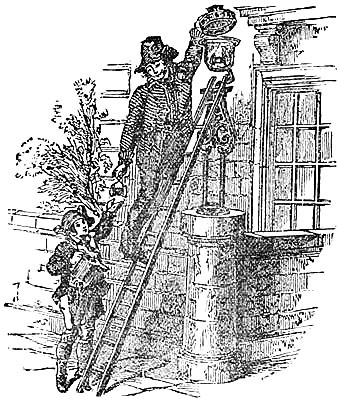
The Light of Other Days.
In Thomas Heywood’s, “The Rape of Lucrece, a True Roman Tragedy, acted by Her Majestie’s Servants at the Red-Bull, 1609,” is the following long list of London Cries, but called for the sake of the dramatic action of the scene, “Cries of Rome,” which was the common practice with the old dramatists, Rome being the canting name of London. Robert Greene, in his “Perimedes the Blacksmith, 1588,” when he wished to criticise the London Theatre at Shoreditch, talks of the Theatre in Rome; also in his “Never too Late, 1590,” when he talks of the London actors, he pretends only to speak of Roscius and the actors of Rome. In the pedlar’s French of the day Rome-vyle—or ville—was London, and Rome-mort the Queen [Elizabeth]. There is some humour in the classification, and if the cries were well imitated by the singer, the ballad—or as it would then be called “jig”—is likely to have been extremely popular in its day.