Front matter (continued 3)
Reading edition
“Ti-tid-ty, ti-tid-ty. Ti-tid-ty—tiddy-loll. Ti-tid-ty, ti-tid-ty. Ti-tid-ty—tiddy-doll.”
Hence arose his nickname “Tiddy-Doll.” In Hogarth’s print of the “Idle ’Prentice Executed at Tyburn,” Tiddy-Doll is seen holding up a gingerbread cake with his left hand, his right hand within his coat, to imply that he is speaking the truth from his heart, while describing the superiority of his wares over those of any other vendor in the fair! while he still anxiously inquires:—
“Mary, Mary, where are you now, Mary?”
His proper name was Ford, and so well known was he that, on his once being missed for a week from his usual stand in the Haymarket, on the occasion of a visit which he paid to a country fair, a “Catch penny” account of his alleged murder was printed, and sold in the streets by thousands.
Allusions to Tiddy-Doll, and sayings derived from him, have reached to our own time, thus, we still say to an over-dressed person—“You are as tawdry as Diddy-doll,” “You are quite Tiddy-doll, you look as fine as Tiddy-doll,” he or she is said to be “All Tiddy-doll,” &c.
The class of men formerly well known to the citizens of London as News-criers, or Hornmen, must now be spoken of in the past sense, as the further use of the horn was prohibited long ago by the magistracy, subject to a penalty of ten shillings for the first offence, and twenty shillings on the conviction of repeating so heinous a crime.
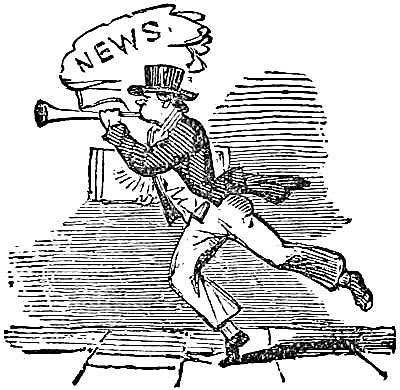
“Great News, Bloody Battle, Great Victory! Extraordinary Gazette! Second Edition!”
were the usual loud bellowing of fellows with stentorian lungs, accompanied by a loud blast of a long tin-horn, which announced to the delighted populace of London the martial achievements of a Marlborough, Howe, Hood, Nelson, or Wellington. A copy of the “Gazette” or newspaper they “cried” was usually affixed under the hatband, in front, and their demand was generally one shilling.
At least one of these news criers has been immortalized. In a volume of “Miscellaneous Poems,” edited by Elijah Fenton, and printed by Bernard Lintot, without date, but anterior to 1720, there are the lines that follow, to one old Bennet, who seems to have made a great noise in the world of London during the early part of last century:—
“On the Death of Old Bennet, the News Cryer
“One evening, when the sun was just gone down, And I was walking thro’ the noisy town, A sudden silence through each street was spread, As if the soul of London had been fled. Much I enquired the cause, but could not hear, Till fame, so frightened, that she did not dare To raise her voice, thus whisper’d in my ear:— Bennet, the prince of hawkers, is no more, Bennet, my Herald on the British shore, Bennet, by whom, I own myself outdone, Tho’ I a hundred mouths, he had but one, He, when the list’ning town he would amuse, Made Echo tremble with his ‘Bloody news!’ No more shall Echo, now his voice return, Echo for ever must in silence mourn,— Lament, ye heroes, who frequent the wars, The great proclaimer of your dreadful scars. Thus wept the conqueror who the world o’ercame, Homer was waiting to enlarge his fame, Homer, the first of hawkers that is known, Great News from Troy, cried up and down the town, None like him has there been for ages past, Till our stentorian Bennet came at last, Homer and Bennet were in this agreed, Homer was blind, and Bennet could not read!”
In our own days there has been legislation for the benefit of tender ears; and there are now penalties, with police constables to enforce them, against “All persons blowing any horn or using any other noisy instrument, for the purpose of calling persons together, or of announcing any show or entertainment, or for the purpose of hawking, selling, distributing, or collecting any article, or of obtaining money or alms.” These are the words of the Police Act of 1839; and they are stringent enough to have nearly banished from our streets all those uncommon noises which did something to relieve the monotony of the one endless roar of the tread of feet and the rush of wheels.
Mr. Henry Mayhew, in his admirable work of “London Labour and London Poor,” writing in 1851, under the head “Of the Sellers of Second Editions,” says:—
“I believe that there is not now in existence—unless it be in a workhouse and unknown to his fellows, or engaged in some other avocation, and lost sight of by them—any one who sold ‘Second Editions’ of the Courier evening paper at the time of the Duke of York’s Walcheren expedition, at the period of the battle of the Nile, during the continuance of the Peninsular war, or even at the battle of Waterloo. There were a few old men—some of whom had been soldiers or sailors, and others who have simulated it—surviving within these five or six years and some later, who ‘worked Waterloo,’ but they were swept off, I was told, by the cholera.”
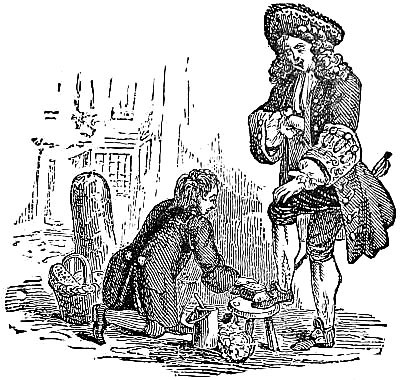
Clean Your Honour’s Shoes.
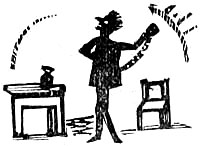
“Temper the foot within this vase of oil, And let the little tripod aid thy toil; On this methinks I see the walking crew, At thy request, support the miry shoe; The foot grows black that was with dirt embrown’d, And in thy pocket jingling halfpence sound.” Gay’s “Trivia.”
“About thirty years before the cry of ‘Clean your boots, sir!’ became familiar to the ears of the present generation of Londoners,” Mr. Charles Knight informs us that:—“In one of the many courts on the north side of Fleet-street, might be seen, somewhere about the year 1820, ‘The last of the London shoe-blacks.’ One would think that he deemed himself dedicated to his profession by Nature, for he was a Negro. At the earliest dawn he crept forth from his neighbouring lodging, and planted his tripod on the quiet pavement, where he patiently stood till noon was past. He was a short, large-headed son of Africa, subject, as it would appear, to considerable variations of spirits, alternating between depression and excitement, as the gains of the day presented to him the chance of having a few pence to recreate himself beyond what he should carry home to his wife and children. For he had a wife and children, this last representative of a falling trade; and two or three little woolly-headed décrotteurs nestled around him when he was idle, or assisted in taking off the roughest of the dirt when he had more than one client. He watched, with a melancholy eye, the gradual improvement of the streets; for during some twenty or thirty years he had beheld all the world combining to ruin him. He saw the foot pavements widening; the large flag-stones carefully laid down; the loose and broken piece, which discharged a slushy shower on the unwary foot, and known to him and London chairmen as a ‘Beau-trap’[11] instantly removed: he saw the kennels diligently cleansed, and the drains widened: he saw experiment upon experiment made in the repair of the carriage-way, and the holes, which were to him as the ‘old familiar faces’ which he loved, filled up with a haste that appeared quite unnecessary, if not insulting. One solitary country shopkeeper, who had come to London once a year during a long life, clung to our sable friend; for he was the only one of the fraternity that he could find remaining, in his walk from Charing-cross to Cheapside.”
Hone, in “The Table Book,” 1827, under an article on the Old London cries has:—“A Shoeblack; A boy, with a small basket beside him, brushes a shoe on a stone, and addresses himself to a wigged beau, who carries his cocked hat under his left arm, with a crooked-headed walking stick in his left hand, as was the fashion among the dandies of old times. I recollect shoeblacks formerly at the corner of almost every street, especially in great thoroughfares. There were several every morning on the steps of St. Andrew’s church, Holborn, till late in the forenoon. But the greatest exhibition of these artists was on the site of Finsbury-square, when it was an open field, and a depository for the stones used in paving and street-masonry. There, a whole army of shoeblacks intercepted the citizens and their clerks on their way from Islington and Hoxton to the counting-houses and shops in the city, with ‘Shoeblack, your honour! Black your shoes, sir!’”
Each of them had a large, old tin-kettle, containing his apparatus, viz:—a capacious pipkin, or other large earthen-pot, containing the blacking, which was made of ivory-black, the coarsest moist sugar, and pure water with a little vinegar—a knife, two or three brushes, and an old wig. The old wig was an indispensable requisite to a shoeblack; it whisked away the dust, or thoroughly wiped off the wet dirt, which his knife and brushes could not entirely detach; a rag tied to the end of a stick smeared his viscid blacking on the shoe, and if the blacking was “real japan,” it shone. The old experienced shoe-wearers preferred an oleaginous, lustreless blacking. A more liquid blacking, which took a polish from the brush, was of later use and invention. Nobody at that time wore boots except on horseback; and everybody wore breeches and stockings: pantaloons, or trousers, were unheard of. The old shoeblacks operated on the shoes while they were on the feet, and so dexterously as not to soil the fine white cotton stocking, which was at that time the extreme of fashion, or to smear the buckles, which were universally worn. Latterly, you were accommodated with an old pair of shoes to stand in, and the yesterday’s paper to read, while your shoes were cleaning and polishing, and your buckles were whitened and brushed. When shoestrings first came into vogue, the Prince of Wales (Geo. IV.) appeared with them in his shoes, when immediately a deputation from the buckle-makers of Birmingham presented a petition to his Royal Highness to resume the wearing of buckles, which was good-naturedly complied with. Yet, in a short time, shoestrings entirely superseded buckles. The first incursion on the shoeblacks was by the makers of “Patent Cake Blacking” on sticks formed with a handle, like a small battledoor; they suffered a more fearful invasion from the makers of liquid blacking in bottles. Soon afterwards, when “Day and Martin” manufactured the ne plus ultra of blacking, private shoeblacking became general, public shoeblacks rapidly disappeared, and in [1827] they became extinct. The last shoeblack that I remember in London sat under the covered entrance of Red Lion-court, Fleet-street within the last six years. This unfortunate, “The Last of the London Shoeblacks”—was probably the “short, large headed son of Africa” alluded to by Charles Knight, under the heading of “Clean your honour’s shoes,” in his “History of London.”
In 1851, some gentlemen connected with the Ragged Schools determined to revive the brotherhood of boot cleaners for the convenience of the foreign visitors to the Exhibition, and commenced the experiment by sending out five boys in the now well-known red uniform. The scheme succeeded beyond expection; the boys were patronized by natives as well as aliens, and the Shoeblack Society and its brigade were regularly organized. During the exhibition season, about twenty-five boys were constantly employed, and cleaned no less than 100,000 pairs of boots. The receipts of the brigade during its first year amounted to £656. Since that time, thanks to the combination of discipline and liberality, the Shoeblack Society has gone on and prospered, and proved the Parent of other Societies. Every district in London now has its corps of shoeblacks, in every variety of uniform, and while the number of boys has increased from tens to hundreds, their earnings have increased from hundreds to thousands. Numbers of London waifs and strays have been rescued from idleness and crime. The Ragged School Union, and Shoeblack Brigades, therefore hold a prominent place among the indirectly preventive agencies for the suppression of crime: for since ignorance is generally the parent of vice, any means of securing the benefits of education to those who are hopelessly deprived of it, must operate in favour of the well-being of society.
“’Tis education forms the common mind; Just as the twig is bent, the tree’s inclined.”
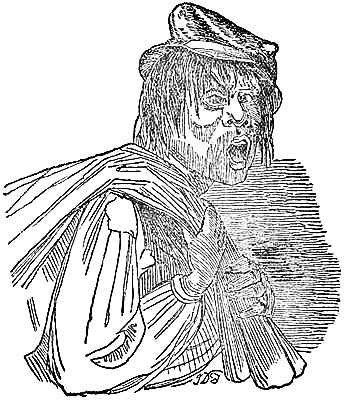
The Hearth-Stone Merchant.
“Hearth-stones! Do you want any hearth-stones? Now, my maids, here’s your right sort—reg’lar good’uns, and no mistake—vorth two o’your shop harticles, and at half the price. Now my pretty von, lay out a tanner, and charge your missus a bob—and no cheating neither! the cook has always a right to make her market penny and to assist a poor cove like me in the bargain.
“They’re good uns, you vill find— Choose any, marm, as you prefer. You look so handsome and so kind, I’m sure you’ll be a customer. Three halfpence, marm, for this here pair— I only vish as you vould try ’em; I’m sure you’ll say the price is fair— Come marm, a penny if you’ll buy ’em.”
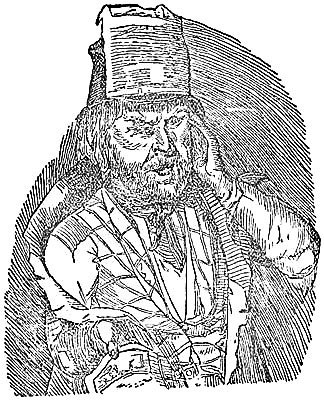
The Flying Stationer, otherwise Patterer.
“Here’s tidings sad, for owld and young, Of von who liv’d for years by macing; And vos this werry morning hung, The Debtor’s Door at Newgate facing. “Here’s his confession upon hoath, The vords he spoke ven he vos dying, His birth and eddycation both— The whole pertic’lers—vell vorth the buying. “Here’s an account of robberies sad. In vich he alus vos a hactor; You must to read the life be glad— Of such a famous malefactor! “How to the mob he spinn’d a yarn, And varn’d them from a course unproper, You may, vith all his history, larn— For the small valley of a copper!”
“Now my kind-hearted, haffectionated and wery ready-money Christian-hearted, pious and hinfidel customers, here you have the last speech and dying vords, life, character, and behaviour of the hunfortunate malefactor that vas hexecuted this morning hopposit the Debtor’s door in the Hold Bailey! together with a full confession of the hoffence vherevith he vos found guilty before a hupright Judge and a wery himpartial Jury! Here you have likewise a copy of a most affecting letter, written by the criminal in the condemned cell the night afore hexecution to his hinnocent vife and hunoffending babbies, vith a copy of werses consarning the same—all for the small charge of von halfpenny. Yes, my friends, von halfpenny buys the werses as follows—von arter the ’tother:—
“Come, all you blessed Christians dear, That’s a-tender, kind, and free, While I a story do relate Of a dreadful tragedy, Which happened in London town, As you shall all be told; But when you hear the horrid deed ’Twill make your blood run cold.— For the small charge of a ha’penny! “’Twas in the merry month of May, When my true love I did meet; She look’d all like an angel bright, So beautiful and sweet. I told her I loved her much, And she could not say nay; ’Twas then I stung her tender heart, And led her all astray.— Only a ha’penny!”
JAMES—or as he was popularly called, “Jemmy,” or, “Old Jemmy” Catnach, (Kat-nak,) late of the Seven Dials, London, printer and publisher of ballads, battledores, lotteries, primers, &c., and whose name is ever associated with the literature of the streets, was the son of John Catnach, a printer, of Alnwick, an ancient borough, market town, and parish of Northumberland, where he was born on August 18th, 1792.
At the time Jemmy Catnach commenced business in Seven Dials it took all the prudence and tact which he could command to maintain his position, as at that time “Johnny” Pitts,[12] of the Toy and Marble Warehouse, No. 6, Great St. Andrew-street, was the acknowledged and established printer of street literature for the “Dials” district; therefore, as may be easily imagined, a powerful rivalry and vindictive jealousy soon arose between these “two of a trade”—most especially on the part of “Old Mother” Pitts, who is described as being a coarse and vulgar-minded personage, and as having originally followed the trade of a bumboat woman at Portsmouth: she “wowed wengeance” against the young fellow in the court for daring to set up in their business, and also spoke of him as a young “Catsnatch,” “Catblock,” “Cut-throat;” many other opprobrious terms being also freely given to the new comer. Pitts’ staff of “bards” were duly cautioned of the consequences which would inevitably follow should they dare to write a line for Catnach—the new cove in the court. The injunction was for a time obeyed, but the “Seven Bards of the Seven Dials” soon found it not only convenient, but also more profitable to sell copies of their effusions to both sides at the same time, and by keeping their council they avoided detection, as each printer accused the other of buying an early sold copy, and then reprinting it off with the utmost speed, and which was in reality often the case, as “Both Houses” had emissaries on the constant look-out for any new production suitable for street-sale. Now, although this style of “double dealing” and competition tended much to lessen the cost price to the “middle-man,” or vendor, the public in this case did not get any of the reduction, as a penny broadside was still a penny, and a quarter-sheet still a halfpenny to them, the “street-patterer” obtaining the whole of the reduction as extra profit.
The feud existing between these rival publishers, who have been somewhat aptly designated as the Colburn and Bentley of the “paper” trade, never abated, but, on the contrary, increased in acrimony of temper until at last not being content to vilify each other by words alone, they resorted to printing off virulent lampoons, in which Catnach never failed to let the world know that “Old Mother Pitts” had been formerly a bumboat woman, while the Pitts’ party announced that—
“All the boys and girls around, Who go out prigging rags and phials, Know Jemmy Catsnatch!!! well, Who lives in a back slum in the Dials. He hangs out in Monmouth Court, And wears a pair of blue-black breeches, Where all the ‘Polly Cox’s crew’ do resort To chop their swag for badly printed Dying Speeches.”
A mournful and affecting COPY OF VERSES on the death of Who was barbarously and cruelly murdered by her sweetheart, W. JONES, near Wirksworth, in Derbyshire, July, 1823.

William Jones, a young man aged 20, has been fully committed to Derby gaol for the murder of his sweetheart, under circumstances of unheard of barbarity. The poor victim was a servant girl, whom under pretense of marriage he seduced. On her proving with child the villain formed the horrid design of murdering her, and carried his diabolical plan into execution on Monday evening last. The following verses are written upon the occasion, giving a complete detail of this shocking affair:—
Come all false hearted young men And listen to my song, ’Tis of a cruel murder, That lately has been done On the body of a maiden fair The truth I will unfold, The bare relation of this deed Will make your blood run cold. Near Wirksworth town in Derbyshire, Ann Williams she did dwell, In service she long time had lived, Till this to her befel. Her cheeks were like the blushing rose All in the month of May, Which made this wicked young man Thus unto her did say: Nancy, my charming creature, You have my heart ensnared, My love is such I am resolved To wed you I declare. Thus by his false deluding tongue Poor Nancy was beguil’d, And soon to her misfortune, By him she proved with child. Some days ago this damsel fair Did write to him with speed. Such tenderness she did express Would make a heart to bleed. She said, my dearest William, I am with child by thee; Therefore, my dear, pray let me know When you will marry me. The following day at evening, This young man did repair, Unto the town of Wirksworth, To meet his Nancy there. Saying, Nancy dear, come let us walk, Among the flowery fields, And then the secrets of my heart To you I will reveal. O then this wicked young man A knife he did provide, And all unknown to his true love Concealed it by his side. When to the fatal spot they came, These words to her did say: All on this very night I will Your precious life betray. On bended knee she then did fall, In sorrow and despair, Aloud for mercy she did call, Her cries did rend the air; With clasped hands and uplift eyes She cried, Oh spare my life, I never more will ask you To make me your wedded wife. O then this wicked young man said, No mercy will I show; He took the knife all from his side, And pierced her body through. But still she smiling said to him, While trembling with fear, Aä! William, William, spare my life, Think on your baby dear. Twice more then with the bloody knife He ran her body through, Her throat was cut from ear to ear, Most dreadful for to view; Her hands and arms and beauteous face He cut and mangled sore, While down upon her milk white breast The crimson blood did pour. He took the shawl from off her neck, And round her body tied, With pebble stones he did it fill, Thinking the crime to hide. O then into the silver stream He plunged her straightway, But with her precious blood was stained, Which soon did him betray. O then this young man taken was, And into prison sent, In ratling chains he is confin’d His crime for to lament, Until the Asizes do come on When trembling he must stand, Reflecting on the deed he’s done; Waiting the dread command. Now all you thoughtless young men A timely warning take; Likewise ye fair young maidens, For this poor damsel’s sake. And Oh beware of flattering tongues, For they’ll your ruin prove; So may you crown your future day, In comfort, joy, and love.
Printed at J. Pitts, Wholesale Toy and Marble Warehouse, 6, Great St. Andrew Street, Seven Dials.
There can be little doubt that Catnach, the great publisher of the Seven Dials, next to children’s books, had his mind mostly centred upon the chronicling of doubtful scandals, fabulous duels between ladies of fashion, “cooked” assassinations, and sudden deaths of eminent individuals, apochryphal elopements, real or catch-penny accounts of murders, impossible robberies, delusive suicides, dark deeds and public executions, to which was usually attached the all-important and necessary “Sorrowful Lamentations,” or “Copy of Affectionate Verses,” which, according to the established custom, the criminal composed in the condemned cell the night before his execution, after this manner:—
“All you that have got feeling hearts, I pray you now attend To these few lines so sad and true, a solemn silence lend; It is of a cruel murder, to you I will unfold—— The bare recital of the tale must make your blood run cold.”
Or take another and stereotyped example, which from time to time has served equally well for the verses written by the culprit—Brown, Jones, Robinson, or Smith:
“Those deeds I mournfully repent, But now it is too late, The day is past, the die is cast, And fixed is my fate.
Occasionally the Last Sorrowful Lamentations contained a “Love Letter”—the criminal being unable, in some instances, to read or write, being no obstacle to the composition—written according to the street patterer’s statement: “from the depths of the condemned cell, with the condemned pen, ink, and paper.” This mode of procedure in “gallows” literature, and this style of composition having prevailed for from sixty to seventy years.
Then they would say: “Here you have also an exact likeness of the murderer, taken at the bar of the Old Bailey by an eminent artist!” when all the time it was an old woodcut that had been used for every criminal for many years.
“There’s nothing beats a stunning good murder after all,” said a “running patterer” to Mr. Henry Mayhew, the author of “London Labour and London Poor.” It is only fair to assume that Mr. James Catnach shared in the sentiment, for it is said that he made over £500 by the publication of:—
“The Full, True and Particular Account of the Murder of Mr. Weare by John Thurtell and his Companions, which took place on the 24th of October, 1823, in Gill’s Hill-lane, near Elstree, in Hertfordshire:—Only One Penny.” There were eight formes set up, for old Jemmy had no notion of stereotyping in those days, and pressmen had to re-cover their own sheep-skins. But by working night and day for a week they managed to get off about 250,000 copies with the four presses, each working two formes at a time.
As the trial progressed, and the case became more fully developed, the public mind became almost insatiable. Every night and morning large bundles were despatched to the principal towns in the three kingdoms.
One of the many street-ballads on the subject informed the British public that:—
“Thurtell, Hunt, and Probert, too, for trial must now prepare, For that horrid murder of Mr. William Weare.”
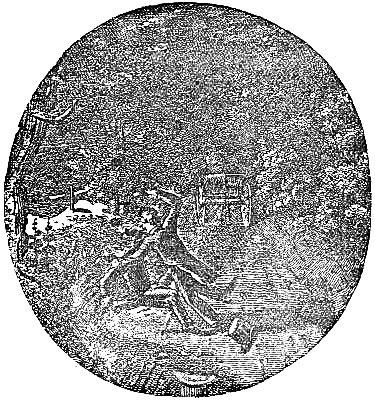
Thurtell Murdering Mr. Weare.
In connection with the murder of Mr. Weare by Thurtell and Co., Sir Walter Scott, collected the printed trials with great assiduity, and took care always to have to hand the contemporary ballads and prints bound up with them. He admired particularly this verse of Theodore Hook’s[13] broadside:—
“They cut his throat from ear to ear, His brains they battered in; His name was Mr. William Weare, He dwelt in Lyon’s Inn.”
THE CONFESSION AND EXECUTION OF JOHN THURTELL On Friday, the 9th of January, 1824.

THE EXECUTION.
Hertford, half-past twelve o’clock.
This morning, at ten minutes before twelve, a bustle among the javelin-men stationed within the boarded enclosure on which the drop was erected, announced to the multitude without that the preparations for the execution were nearly concluded. The javelin-men proceeded to arrange themselves in the order usually observed upon these melancholy but necessary occurrences. They had scarcely finished their arrangements, when the opening of the gate of the prison gave an additional impulse to public anxiety.
When the clock was on the stroke of twelve, Mr Nicholson, the Under-Sheriff, and the executioner ascended the platform, followed on to it by Thurtell, who mounted the stairs with a slow but steady step. The principal turnkey of the gaol came next, and was followed by Mr Wilson and two officers. On the approach of the prisoner being intimated by those persons who, being in an elevated situation, obtained the first view of him, all the immense multitude present took off their hats.
Thurtell immediately placed himself under the fatal beam, and at that moment the chimes of a neighbouring clock began to strike twelve. The executioner then came forward with the rope, which he threw across it. Thurtell first lifted his eyes up to the drop, gazed at it for a few moments, and then took a calm but hurried survey of the multitude around him. He next fixed his eyes on a young gentleman in the crowd, whom he had frequently seen as a spectator at the commencement of the proceedings against him. Seeing that the individual was affected by the circumstance, he removed them to another quarter, and in so doing recognised an individual well known in the sporting circles, to whom he made a slight bow.
The prisoner was attired in a dark brown great coat, with a black velvet collar, white corduroy breeches, drab gaiters and shoes. His hands were confined with handcuffs, instead of being tied with cord, as is usually the case on such occasions, and, at his own request, his arms were not pinioned. He wore a pair of black kid gloves, and the wrists of his shirt were visible below the cuffs of his coat. As on the last day of his trial, he wore a white cravat. The irons, which were very heavy, and consisted of a succession of chain links, were still on his legs, and were held up in the middle by a Belcher handkerchief tied round his waist.
The executioner commenced his mournful duties by taking from the unhappy prisoner his cravat and collar. To obviate all difficulty in this stage of the proceedings, Thurtell flung back his head and neck, and so gave the executioner an opportunity of immediately divesting him of that part of his dress. After tying the rope round Thurtell’s neck, the executioner drew a white cotton cap over his countenance, which did not, however, conceal the contour of his face, or deprive him entirely of the view of surrounding objects.
At that moment the clock sounded the last stroke of twelve. During the whole of this appalling ceremony, there was not the slightest symptom of emotion discernible in his features; his demeanour was perfectly calm and tranquil, and he behaved like a man acquainted with the dreadful ordeal he was about to pass, but not unprepared to meet it. Though his fortitude was thus conspicuous, it was evident from his appearance that in the interval between his conviction and his execution he must have suffered much. He looked careworn; his countenance had assumed a cadaverous hue, and there was a haggardness and lankness about his cheeks and mouth, which could not fail to attract the notice of every spectator.
The executioner next proceeded to adjust the noose by which Thurtell was to be attached to the scaffold. After he had fastened it in such a manner as to satisfy his own mind, Thurtell looked up at it, and examined it with great attention. He then desired the executioner to let him have fall enough. The rope at this moment seemed as if it would only give a fall of two or three feet. The executioner assured him that the fall was quite sufficient. The principal turnkey then went up to Thurtell, shook hands with him, and turned away in tears. Mr Wilson, the governor of the gaol, next approached him. Thurtell said to him, “Do you think, Mr Wilson, I have got enough fall?” Mr Wilson replied, “I think you have, Sir. Yes, quite enough.” Mr Wilson then took hold of his hand, shook it, and said, “Good bye, Mr Thurtell, may God Almighty bless you.” Thurtell instantly replied, “God bless you, Mr Wilson, God bless you.” Mr Wilson next asked him whether he considered that the laws of his country had been dealt to him justly and fairly, upon which he said, “I admit that justice has been done me—I am perfectly satisfied.”
A few seconds then elapsed, during which every person seemed to be engaged in examining narrowly Thurtell’s deportment. His features, as well as they could be discerned, appeared to remain unmoved, and his hands, which were extremely prominent, continued perfectly steady, and were not affected by the slightest tremulous motion.
Exactly at two minutes past twelve the Under-Sheriff, with his wand, gave the dreadful signal—the drop suddenly and silently fell—and
John Thurtell was Launched into Eternity.
Printed at J. Pitts, Wholesale Toy and Marble Warehouse, 6, Great St. Andrew Street, Seven Dials.
ATROCIOUS MURDER OF A YOUNG WOMAN IN SUFFOLK. SINGULAR DISCOVERY OF THE BODY FROM A DREAM.
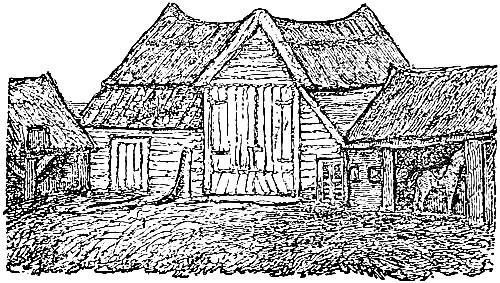
The Red Barn.
THE SCENE OF THE MURDER, AND WHERE THE BODY OF MARIA MARTEN WAS FOUND CONCEALED.
Four years after the Thurtell and Weare affair, namely, in the month of April, 1828, another “sensational” murder was discovered—that of Maria Marten, by William Corder, in the Red Barn, at Polstead, in the county of Suffolk. The circumstances that led to the discovery of this most atrocious murder were of an extraordinary and romantic nature, and manifest an almost special interposition of Providence in marking out the offender. As the mother of the girl had on three several nights dreamt that her daughter was murdered and buried in Corder’s Red Barn, and as this proved to be the case, an additional “charm” was given to the circumstance. Hence the “Catnach Press” was again set working both day and night to meet the great demand for the “Full Particulars.” In due course came the gratifying announcement of the apprehension of the murderer! and the sale continued unabatingly, in both town and country, every “Flying Stationer” making great profits by the sale.
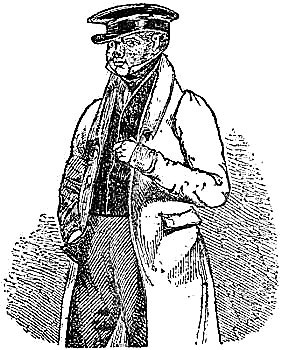
Likeness of William Corder.
The trial of Corder took place at Bury St. Edmonds, on the 7th of August, 1828, before the Lord Chief Baron (Anderson). The prisoner pleaded “Not Guilty,” and the trial proceeded. On being called on for his defence, Corder read a manuscript paper. He declared that he deeply deplored the death of the unfortunate deceased, and he urged the jury to dismiss from their minds all that prejudice which must necessarily have been excited against him by the public press, &c. Having concluded his address, the Lord Chief Baron summed up, and a verdict of “Guilty” was returned. The Last Dying Speech and confession had an enormous sale—estimated at 1,166,000, a fac-simile copy of which, with the “Lamentable Verses,” said to have been written by Old Jemmy Catnach, will be found on the opposite page.
CONFESSION AND EXECUTION OF THE MURDERER OF MARIA MARTEN.

Since the tragical affair between Thurtell and Weare, no event has occurred connected with the criminal annals of our country which has excited so much interest as the trial of Corder, who was justly convicted of the murder of Maria Marten on Friday last.
THE CONFESSION.
“Bury Gaol, August 10th, 1828.—Condemned cell. “Sunday evening, half-past Eleven.
“I acknowledge being guilty of the death of poor Maria Marten, by shooting her with a pistol. The particulars are as follows:—When we left her father’s house, we began quarrelling about the burial of the child: she apprehended the place wherein it was deposited would be found out. The quarrel continued about three quarters of an hour upon this sad and about other subjects. A scuffle ensued, and during the scuffle, and at the time I think that she had hold of me, I took the pistol from the side pocket of my velveteen jacket and fired. She fell, and died in an instant. I never saw her even struggle. I was overwhelmed with agitation and dismay:—the body fell near the front doors on the floor of the barn. A vast quantity of blood issued from the wound, and ran on to the floor and through the crevices. Having determined to bury the body in the barn (about two hours after she was dead). I went and borrowed a spade of Mrs Stow, but before I went there I dragged the body from the barn into the chaff-house, and locked the barn. I returned again to the barn, and began to dig a hole, but the spade being a bad one, and the earth firm and hard, I was obliged to go home for a pickaxe and a better spade, with which I dug the hole, and then buried the body. I think I dragged the body by the handkerchief that was tied round her neck. It was dark when I finished covering up the body. I went the next day, and washed the blood from off the barn-floor. I declare to Almighty God I had no sharp instrument about me, and no other wound but the one made by the pistol was inflicted by me. I have been guilty of great idleness, and at times led a dissolute life, but I hope through the mercy of God to be forgiven. William Corder.”
Witness to the signing by the said William Corder,
John Orridge.
Condemned cell, Eleven o’clock, Monday morning, August 11th, 1828.
The above confession was read over carefully to the prisoner in our presence, who stated most solemnly it was true, and that he had nothing to add to or retract from it.—W. Stocking, chaplain; Timothy R. Holmes, Under-Sheriff.
THE EXECUTION.
At ten minutes before twelve o’clock the prisoner was brought from his cell and pinioned by the hangman, who was brought from London for the purpose. He appeared resigned, but was so weak as to be unable to stand without support; when his cravat was removed he groaned heavily, and appeared to be labouring under great mental agony. When his wrists and arms were made fast, he was led round twards the scaffold, and as he paused the different yards in which the prisoners were confined, he shook hands with them, and speaking to two of them by name, he said, “Good bye, God bless you.” They appeared considerably affected by the wretched appearance which he made, and “God bless you!” “May God receive your soul!” were frequently uttered as he passed along. The chaplain walked before the prisoner, reading the usual Burial Service, and the Governor and Officers walking immediately after him. The prisoner was supported to the steps which led to the scaffold; he looked somewhat wildly around, and a constable was obliged to support him while the hangman was adjusting the fatal cord. There was a barrier to keep off the crowd, amounting to upwards of 7,000 persons, who at the time had stationed themselves in the adjoining fields, on the hedges, the tops of houses, and at every point from which a view of the execution could be best obtained. The prisoner, a few moments before the drop fell, groaned heavily, and would have fallen, had not a second constable caught hold of him. Everything having been made ready, the signal was given, the fatal drop fell, and the unfortunate man was launched into eternity. Just before he was turned off, he said in a feeble tone, “I am justly sentenced, and may God forgive me.”
The Murder of Maria Marten.
BY W. CORDER
Come all you thoughtless young men, a warning take by me, And think upon my unhappy fate to be hanged upon a tree; My name is William Corder, to you I do declare, I courted Maria Marten, most beautiful and fair. I promised I would marry her upon a certain day. Instead of that, I was resolved to take her life away. I went into her father’s house the 18th day of May, Saying, my dear Maria, we will fix the wedding day. If you will meet me at the Red-barn, as sure as I have life, I will take you to Ipswich town, and there make you my wife; I then went home and fetched my gun, my pickaxe and my spade, I went into the Red-barn, and there I dug her grave. With heart so light, she thought no harm, to meet him she did go He murdered her all in the barn, and laid her body low; After the horrible deed was done, she lay weltering in her gore, Her bleeding mangled body he buried beneath the Red-barn floor. Now all things being silent, her spirit could not rest, She appeared unto her mother, who suckled her at her breast, For many a long month or more, her mind being sore oppress’d, Neither night or day she could not take any rest. Her mother’s mind being so disturbed, she dreamt three nights o’er, Her daughter she lay murdered beneath the Red-barn floor; She sent the father to the barn, when he the ground did thrust, And there he found his daughter mingling with the dust. My trial is hard, I could not stand, most woeful was the sight, When her jaw-bone was brought to prove, which pierced my heart quite; Her aged father standing by, likewise his loving wife, And in her grief her hair she tore, she scarcely could keep life. Adieu, adieu, my loving friends, my glass is almost run, On Monday next will be my last, when I am to be hang’d, So you, young men, who do pass by, with pity look on me, For murdering Maria Marten, I was hang’d upon the tree.
Printed by J. Catnach, 2 and 3, Monmouth Court.—Cards, &c., Printed Cheap.
LIFE, TRIAL, CONFESSION, & EXECUTION OF FOR THE EDGEWARE ROAD MURDER.

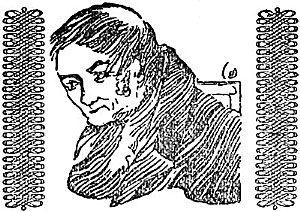
On the 22nd of April, James Greenacre was found guilty of the wilful murder of Hannah Brown, and Sarah Gale with being accessary after the fact. A long and connected chain of evidence was produced, which showed, that the sack in which the body was found was the property of Mr. Ward; that is was usually deposited in a part of the premises which led to the workshop, and could without observation have been carried away by him; that the said sack contained several fragments of shavings of mahogany, such as were made in the course of business by Ward; and that it contained some pieces of linen cloth, which had been patched with nankeen; that this linen cloth matched exactly with a frock which was found on Greenacre’s premises, and which belonged to the female prisoner. Feltham, a police-officer, deposed, that on the 26th of March he apprehended the prisoners at the lodgings of Greenacre; that on searching the trowsers pockets of that person, he took therefrom a pawnbroker’s duplicate for two silk gowns, and from the fingers of the female prisoner two rings, and also a similar duplicate for two veils, and an old-fashioned silver watch, which she was endeavouring to conceal; and it was further proved that these articles were pledged by the prisoners, and that they had been the property of the deceased woman.—Two surgeons were examined, whose evidence was most important, and whose depositions were of the greatest consequence in throwing a clear light on the manner in which the female, Hannah Brown, met with her death. Mr. Birtwhistle deposed, that he had carefully examined the head; that the right eye had been knocked out by a blow inflicted while the person was living; there was also a cut on the cheek, and the jaw was fractured, these two last wounds were, in his opinion, produced after death; there was also a bruise on the head, which had occurred after death; the head had been separated by cutting, and the bone sawed nearly through, and then broken off; there were the marks of a saw, which fitted with a saw which was found in Greenacre’s box. Mr. Girdwood, a surgeon, very minutely and skilfully described the appearances presented on the head, and showed incontestibly, that the head had been severed from the body while the person was yet alive; that this was proved by the retraction, or drawing back, of the muscles at the parts where they were separated by the knife, and further, by the blood-vessels being empty, the body was drained of blood. This part of the evidence produced a thrill of horror throughout the court, but Greenacre remained quite unmoved.
After a most impressive and impartial summing up by the learned Judge, the jury retired, and, after the absence of a quarter of an hour, returned into court, and pronounced a verdict of “Guilty” against both the prisoners.
The prisoners heard the verdict without evincing the least emotion, or the slightest change of countenance. After an awful silence of a few minutes, the Lord Chief Justice said they might retire, as they would be remanded until the end of the session.
They were then conducted from the bar, and on going down the steps, the unfortunate female prisoner kissed Greenacre with every mark of tenderness and affection.
The crowd outside the court on this day was even greater than on either of the preceding; and when the result of the trial was made known in the street, a sudden and general shout succeeded, and continued huzzas were heard for several minutes.
THE EXECUTION.
At half past seven the sheriff arrived in his carriage, and in a short time the press-yard was thronged with gentlemen who had been admitted by tickets. The unhappy convict was now led from his cell. When he arrived in the press-yard, his whole appearance pourtrayed the utmost misery and spirit-broken dejection; his countenance haggard, and his whole frame agitated; all that self-possession and fortitude which he displayed in the early part of his imprisonment, had utterly forsaken him, and had left him a victim of hopelessness and despair. He requested the executioner to give him as little pain as possible in the process of pinioning his arms and wrists; he uttered not a word in allusion to his crime; neither did he make any dying request, except that his spectacles might be given to Sarah Gale; he exhibited no sign of hope; he showed no symptom of reconciliation with his offended God! When the venerable ordinary preceded him in the solemn procession through the vaulted passage to the fatal drop, he was so overcome and unmanned, that he could not support himself without the aid of the assistant executioner. At the moment he ascended the faithless floor, from which he was to be launched into eternity, the most terrific yells, groans, and cheers were vociferated by the immense multitude surrounding the place of execution. Greenacre bowed to the sheriff, and begged he might not be allowed to remain long in the concourse; and almost immediately the fatal bolt was withdrawn, and, without a struggle, he became a lifeless corse.—Thus ended the days of Greenacre, a man endowed with more than ordinary talents, respectably connected, and desirably placed in society; but a want of probity, an absolute dearth of principle, led him on from one crime to another, until at length he perpetrated the sanguinary deed which brought his career to an awful and disgraceful period, and which has enrolled his name among the most notorious of those who have expiated their crime on the gallows.
On hearing the death-bell toll, Gale became dreadfully agitated; and when she heard the brutal shouts of the crowd of spectators, she fainted, and remained in a state of alternate mental agony and insensibility throughout the whole day.
After having been suspended the usual time, his body was cut down, and buried in a hole dug in one of the passages of the prison, near the spot where Thistlewood and his associates were deposited.
J. Catnach, Printer, 2 and 3, Monmouth Court.
The following is a fac-simile of the “Execution Paper,” from the press of Paul and Co.,—successors of Catnach.
TRIAL, SENTENCE, CONFESSION, & EXECUTION OF FOR THE Murder of Lord Wm. Russell.

THE VERDICT.
Old Bailey, Saturday Evening, June 20th, 1840.
After the jury had been absent for an hour and twenty minutes, they returned into court, and the prisoner was again placed at the bar.
The names of the jury were then called over, and the clerk of the court said—“How say you, gentlemen, have you agreed on your verdict? Do you find the prisoner Guilty or Not Guilty of the felony of murder with which he stands charged?”
The foreman of the jury, in a low voice, said—“We find him GUILTY!”
The Clerk of the Court then said: François Benjamin Courvoisier, you have been found Guilty of the wilful murder of William Russell, Esq., commonly called Lord William Russell; what have you to say why the court should not give you sentence to die according to law?
The prisoner made no reply. The usual proclamation for silence was then made.
SENTENCE.
The Lord Chief Justice Tindal, having put on the black cap, said: François Benjamin Courvoisier, you have been found guilty by an intelligent, patient, and impartial jury of the crime of wilful murder. That crime has been established against you, not indeed by the testimony of eye-witnesses as to the fact, but by a chain of circumstances no less unerring, which have left no doubt of your guilt in the minds of the jury, and all those who heard the trial. It is ordained by divine authority that the murderer shall not escape justice, and this ordination has been exemplified in your case, in the course of this trial, by the disclosure of evidence which has brought the facts to bear against you in a conclusive manner. The murder, although committed in the dark and silent hour of night, has nevertheless been brought clearly to light by Divine interposition. The precise motive which induced you to commit this guilty act can only be known to your own conscience; but it now only remains for me to recommend you most earnestly to employ the short time you have to live in prayer and repentance, and in endeavouring to make your peace with that Almighty Being whose law you have broken, and before whom you must shortly appear. The Learned Judge then passed sentence on the prisoner in the usual form.
The court was very much crowded to the last.
THE CONFESSION OF THE CONVICT.
After the Learned Judge had passed sentence on the convict, he was removed from the bar, and immediately made a full confession of his guilt.
THE EXECUTION.
At eight o’clock this morning, Courvoisier ascended the steps leading to the gallows, and advanced, without looking round him, to the centre of the platform, followed by the executioner and the ordinary of the prison, the Rev. Mr Carver. On his appearance a few yells of execration escaped from a portion of the crowd, but the general body of the people, great as must have been their abhorrence of his atrocious crime, remained silent spectators of the scene which was passing before their eyes. The prisoner’s manner was marked by an extraordinary appearance of firmness. His step was steady and collected, and his movements free from the slightest agitation or indecision. His countenance indeed was pale, and bore the trace of much dejection, but it was at the same time calm and unmoved. While the executioner was placing him on the drop he slightly moved his hands (which were tied in front of him, and strongly clasped one within the other) up and down two or three times, and this was the only visible symptom of any emotion or mental anguish which the wretched man endured. His face was then covered with the cap, fitting so closely as not to conceal the outlines of his countenance, the noose was then adjusted. During this operation he lifted up his head and raised his hands to his breast, as if in the action of fervent prayer. In a moment the fatal bolt was withdrawn, the drop fell, and in this attitude the murderer perished. He died without any violent struggle. In two minutes after he had fallen his legs were twice slightly convulsed, but no further motion was observable, excepting that his raised arms, gradually losing their vitality, sank down from their own lifeless weight.
After hanging one hour, the body was cut down and removed within the prison.
AFFECTING COPY OF VERSES.
Attention give, both old and young, Of high and low degree, Think while this mournful tale is sung, Of my sad misery. I’ve slain a master good and kind, To me has been a friend, For which I must my life resign, My time is near an end. Oh hark! what means that dreadful sound? It sinks deep in my soul; It is the bell that sounds my knell, How solemn is the toll. See thousands are assembled Around the fatal place, To gaze on my approaching, And witness my disgrace. There many sympathising hearts, Who feel another’s woe, Even now appears in sorrow, For my sad overthrow. Think of the aged man I slew, Then pity’s at an end, I robb’d him of property and life, And the poor man of a friend. Let pilfering passions not intrude, For to lead you astray, From step to step it will delude, And bring you to dismay. Think of the wretched Courvoisier, Who thus dies on a tree, A death of shame, I’ve nought to blame, But my own dishonesty. Mercy on earth I’ll not implore, To crave it would be vain, My hands are dyed with human gore, None can wash off the stain. But the merits of a Saviour, Whose mercy alone I crave; Good Christians pray, as thus I die, I may his pardon have.
Paul & Co., Printers, 2, 3, Monmouth Court, Seven Dials.
But the gallows was not always a fruit-bearing tree, and a “stunning good murder” did not happen every day. Nevertheless the street patterer must live, and lest the increase of public virtue should condemn him to starvation, the “Seven Dials Press,” stepped forward to his aid, and considerately supplied him with a species of street-literature well known to the trade as “Cocks,” and which are defined in “Hotton’s Slang Dictionary” thus:—
Cocks, fictitious narratives, in verse or prose, of murders, fires and terrible accidents, sold in the streets as true accounts. The man who hawks them, a patterer, often changes the scene of the awful event to suit the taste of the neighbourhood he is trying to delude. Possibly a corruption of cook—a cooked statement, or may be “the story of a cock and bull” may have had something to do with the term. Improvements in newspapers, especially in those published in the evening, and increased scepticism on the part of the public have destroyed this branch of a once-flourishing business.
The late Mr. Albert Smith, the humourist and novelist, has very happily hit off this style of thing in “The Man in the Moon,” one of the many rivals to “Punch,” and edited by that very promising son of genius, the late Angus B. Reach, 1832-56. It is entitled—
A COPY OF VERSES
Found among the Papers of Mr. Catnach, the spirited Publisher of Seven Dials; originally intended to have been “printed and published at the Toy and Marble Warehouse, 2 and 3, Monmouth Court, Seven Dials.”
DEDICATED TO THE AUTHOR OF “LUCRETIA.”
I.
The Hero claims the attention of virtuous persons, and leads them to anticipate a painful disclosure.
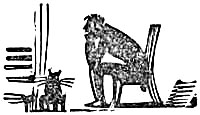
Draw hither now good people all And let my story warn, For I will tell to you a tale, What will wrend them breasts of yourn.
II.
He names the place and hour of the disgraceful penalty he is about to undergo.
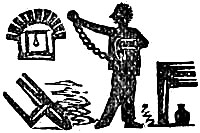
I am condemn’d all for to die A death of scorn and horror; In front of Horsemonger-lane Gaol, At eight o’clock to-morrer.
III.
He hints at his atrocity; and the ebullition produced by the mere recollection of it.
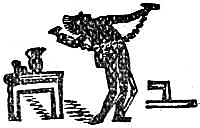
The crime of which I was found guilty, Oh! it was shocking vile; The very thoughts of the cruel deed Now makes my blood to bile.
IV.
He speaks of the happy hours of Childhood, never more to return.
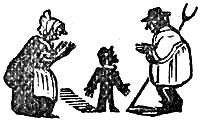
In Somersetshire I was born’d, And my little sister dear Didn’t think then that my sad end Would be like unto this here.
V.
The revelation of his name and profession; and subsequent avowal of his guilt.
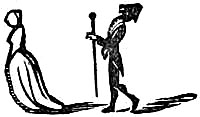
James Guffin is my hated name, And a footman I’m by trade; And I do confess that I did slay My poor fellow-servant maid.
VI.
He acknowledges the justice of his sentence.
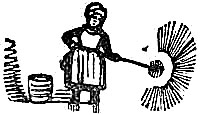
And well I do deserve, I own, My fate which is so bitter: For ’twas most wicked for to kill So innicent a critter.
VII.
And pictures what might have taken place but for the interference of Destiny.
Her maiden name was Sarey Leigh, And was to have been Guffin; For we was to have been marri-ed, But Fate brought that to nuffin.
VIII.
He is particular as to the date of the occurrence.
All on a Wednesday afternoon, On the ninth of Janivary, Eighteen hundred and forty-four, Oh! I did kill my Sarey.
IX.
And narrates the means employed, and the circumstances which led him to destroy his betrothed.
With arsenic her I did destroy, How could I be so vicious! But of my young master I was jealous, And so was my old Missus.
X.
He is led away by bad passions.
I thought Sarey Leigh warn’t true to me, So all pity then despising, Sure I was tempted by the Devil To give to her some p’ison.
XI.
His bosom is torn by conflicting resolutions; but he is at last decided.
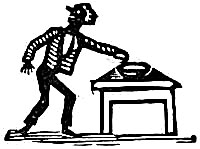
Long—long I brooded on the deed, ’Til one morning of a sudden, I did determine for to put It in a beef-steak puddin.
XII.
The victim falls into the snare.
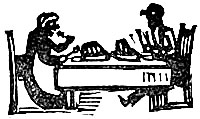
Of the fatal pudding she did partake, Most fearful for to see, And an hour arter was to it a martyr, Launch’d into eternity.
XIII.
He feels that his perception comes too late.
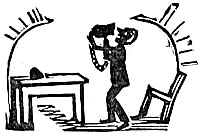
Ah! had I then but viewed things in The light that I now does ’em, I never should have know’d the grief As burns in this here buzum.
XIV.
He commits his secret to the earth.
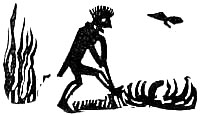
So when I seed what I had done, In hopes of justice retarding, I took and buried poor Sarey Leigh Out in the kitching garding.
XV.
But the earth refuses to keep it.
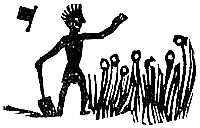
But it did haunt me, so I felt As of a load deliver’d, When three weeks after the fatal deed, The body was diskiver’d.
XVI.
Remorse and self examination.
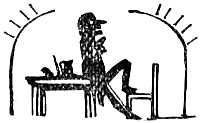
O! why did I form of Sarey Leigh Such cruel unjust opinions, When my young master did her find Beneath the bed of inions.
XVII.
His countrymen form a just estimate of his delinquency.
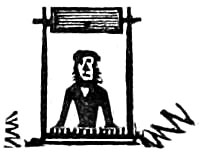
Afore twelve jurymen I was tried, And condemned the perpetrator Of this here awful Tragedy, As shocks one’s human natur.
XVIII.
He conjures up a painful image.
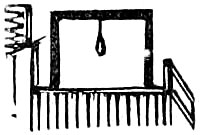
But the bell is tolling for my end; How shocking for to see A footman gay, in the prime of life, Die on the fatal tree.
XIX.
His last words convey a moral lesson.
The Moral!!!
Take warning, then, all ye as would Not die like malefactors; Never the company for to keep Of them with bad characters.
Little Boys and Girls will find At Catnach’s something to their mind; From great variety may choose, What will instruct them and amuse. The prettiest plates that you can find, To please at once the eye and mind.

One class of literature which the late Jemmy Catnach made almost his own, was children’s farthing and halfpenny books. Among the great many that he published we select, from our own private collection, the following as a fair sample:—“The Tragical Death of an Apple Pie,” “The House that Jack Built,” “Jumping Joan,” “The Butterflies Ball and Grasshoppers’ Feast,” “Jerry Diddle and his Fiddle,” “Nurse Love-Child’s Gift,” “The Death and Burial of Cock Robin,” “The Cries of London,” “Simple Simon,” “Jacky Jingle and Suky Shingle,” and—“Here you have just prin—ted and pub—lish—ed, and a—dor—ned with eight beau—ti—ful and ele—gantly engraved embellish—ments, and for the low charge of one farden—Yes! one farden buys.”
NURSERY RHYMES.
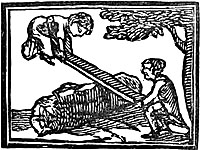
See-saw, sacradown, Which is the way to London town? One foot up, and the other down, And that is the way to London town.
———
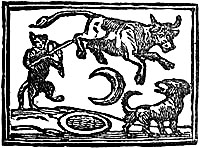
Hey diddle, the cat and the fiddle, The cow jumped over the moon, The little dog laughed to see the sport, And the dish ran away with the spoon.
———
Ding, dong bell! Pussy’s in the well. Who put her in? Little Johnny Green. Who pulled her out? Little Johnny Snout. What a naughty boy was that, To drown poor pussy cat, Who never did him any harm, And kill’d the mice in his father’s barn.
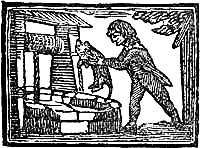
———
Jack and Jill went up the hill, To get a pail of water; Jack fell down and broke his crown, And Jill came tumbling after.
———
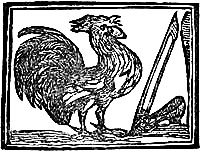
Cock a doodle do, The dame has lost her shoe, And master’s lost his fiddle stick And don’t know what to do.
———
I had a little husband, No bigger than my thumb. I put him in a quart pot, And there I bid him drum.
———
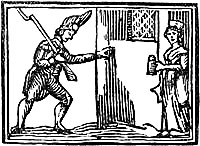
Who’s there? A Grenadier! What do you want? A pot of beer. Where’s your money? Oh, I forgot, Then get you gone, you drunken sot.
———
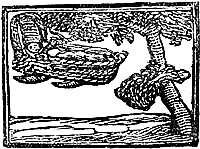
Hush-a-bye, baby, on the tree top, When the wind blows the cradle will rock, When the bough breaks the cradle will fall, Down comes the baby, cradle and all.
———
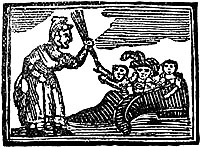
There was an old woman that lived in a shoe, She had so many children she knew not what to do; She gave them some broth without any bread, Then she beat them all well, and sent them to bed.
———
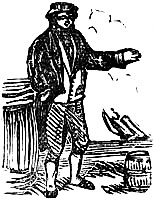
My mother and your mother Went over the way; Said my mother to your mother, It’s chop-a-nose day!
J. Catnach, Printer, 2, Monmouth Court, 7 Dials.
THE CRIES OF LONDON.
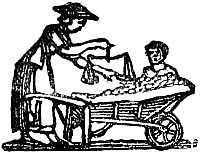
Cherries.
Here’s round and sound, Black and white heart cherries, Two-pence a pound.
———
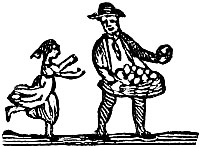
Oranges.
Here’s oranges nice, At a very small price, I sell them all two for a penny. Ripe, juicy, and sweet, Just fit for to eat, So customers buy a good many.
———
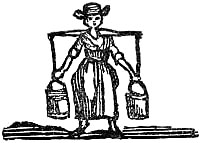
Milk below.
Rain, frost, or snow, or hot or cold, I travel up and down, The cream and milk you buy of me Is best in all the town. For custards, puddings, or for tea, There’s none like those you buy of me.
———
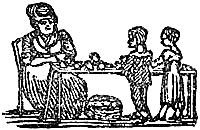
Crumpling Codlings.
Come buy my Crumpling Codlings, Buy all my Crumplings. Some of them you may eat raw, Of the rest make dumplings, Or pies, or puddings, which you please.
———
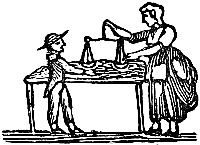
Filberts.
Come buy my filberts ripe and brown, They are the best in all the town, I sell them for a groat a pound, And warrant them all good and sound, You’re welcome for to crack and try, They are so good, I’m sure you’ll buy.
———
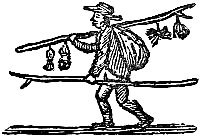
Clothes Pegs, Props, or Lines.
Come, maids, and buy my pegs and props, Or lines to dry your clothes, And when they are dry they’ll smell as sweet As any damask rose. Come buy and save your clothes from dirt, They’ll save you washing many a shirt.
———
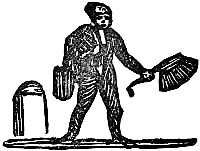
Sweep.
Sweep, chimney sweep, Is the common cry I keep, If you rightly understand me; With my brush, broom, and my rake, Such cleanly work I make, There’s few can go beyond me.
———
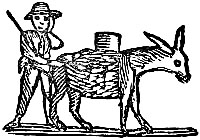
Peas and Beans.
Four pence a peck, green Hastings! And fine garden beans. They are all morning gathered, Come hither, my queens. Come buy my Windsor beans and peas, You’ll see no more this year like these.
———
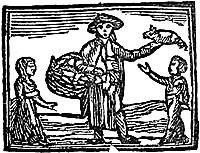
Young Lambs to Sell.
Get ready your money and come to me, I sell a young lamb for a penny. Young lambs to sell! young lambs to sell! If I’d as much money as I could tell, I never would cry young lambs to sell.
———
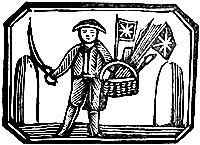
Here’s your toys for girls and boys, Only a penny, or a dirty phial or bottle.
———
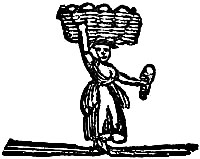
Strawberries.
Rare ripe strawberries and Hautboys, sixpence a pottle. Full to the bottom, hautboys. Strawberries and Cream are charming and sweet, Mix them and try how delightful they eat.
———
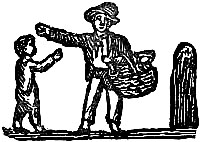
When Good Friday comes, The old woman runs With Hot Cross Buns, One a penny, Buns, Two a penny, Buns, All Hot Buns.
———
London: Printed by J. Catnach, 2, Monmouth Court, 7 Dials.
“Songs! Songs! Songs! Beautiful songs! Love songs; Newest songs! Old songs! Popular songs! Songs, Three Yards a Penny!” was a “standing dish” at the “Catnach Press,” and Catnach was the Leo X. of street publishers. And it is said that he at one time kept a fiddler on the premises, and that he used to sit receiving ballad writers and singers, and judging of the merits of any production which was brought to him, by having it sung then and there to some popular air played by his own fiddler, and so that the ballad-singer should be enabled to start at once, not only with the new song, but also the tune to which it was adapted. His broad-sheets contain all sorts of songs and ballads, for he had a most catholic taste, and introduced the custom of taking from any writer, living or dead, whatever he fancied, and printing it side by side with the productions of his own clients.
Catnach, towards the latter part of his time and in his threefold capacity of publisher, compositor, and poet, was in the habit of taking things very easy, and always appeared to the best advantage when in his printing office, or stationed behind the ricketty counter which for a number of years had done good service in the shop in Monmouth-court. In this uncongenial atmosphere, where the rays of the sun are seldom or never seen, Jemmy was as happy as a prince. “A poor man’s home is his castle,” so says an old proverb, and no one could have been prouder than he was when despatching to almost every town in the kingdom some specialty in the printing department. He naturally had a bit of a taste for old ballads, music, and song writing; and in this respect he was far in advance of many of his contemporaries. To bring within the reach of all, the standard and popular works of the day, had been the ambition of the elder Catnach; whilst the son was, nolens volens, incessant in his endeavours in trying to promulgate and advance, not the beauty, elegance, and harmony which pervades many of our national airs and ballad poety, but very often the worst and vilest of each and every description—in other words, those most suitable for street sale. His stock of songs was very like his customers, diversified. There were all kinds, to suit all classes. Love, sentimental, and comic songs were so interwoven as to form a trio of no ordinary amount of novelty. At ordinary times, when the Awfuls and Sensationals were flat, Jemmy did a large stroke of business in this line.
It is said that when the “Songs—Three-yards-a-penny”—first came out and had all the attractions of novelty, some men sold twelve or fourteen dozen on fine days during three or four of the summer months, so clearing between 6s. and 7s. a day, but on the average about 25s. per week profit. The “long songs,” however, have been quite superseded by the “Monster” and “Giant Penny Song Books.” Still there are a vast number of halfpenny ballad-sheets worked off, and in proportion to their size, far more than the “Monsters” or “Giants.” One song book, entitled the “Little Warbler,” was published in parts, and had an enormous sale.
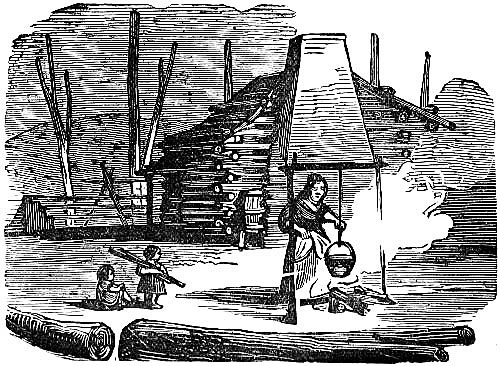
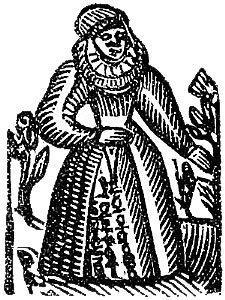
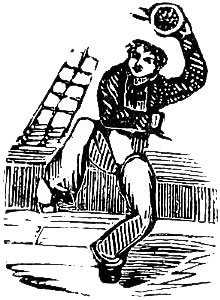
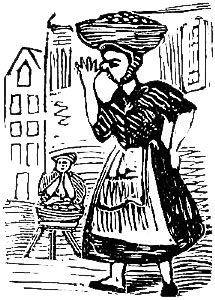
There are invariably but two songs printed on the half-penny ballad-sheets—generally a new and popular song with another older ditty, or a comic and sentimental, and “adorned” with two woodcuts. These are selected without any regard to their fitness to the subject, and in most cases have not the slightest reference to the ballad of which they form the headpiece. For instance:—“The Heart that can feel for another” is illustrated by a gaunt and savage-looking lion; “When I was first Breeched,” by an engraving of a Highlander sans culotte; “The Poacher” comes under the cut of a youth with a large watering-pot, tending flowers; “Ben Block” is heralded by the rising sun; “The London Oyster Girl,” by Sir Walter Raleigh; “The Sailors Grave,” by the figure of Justice; “Alice Grey” comes under the very dilapidated figure of a sailor, or “Jolly Young Waterman;” “Bright Hours are in store for us yet” is headed with a tail-piece of an urn, on which is inscribed Finis. (?) “Watercresses,” with the portrait of a Silly Billy; “The Wild Boar Hunt,” by two wolves chasing a deer; “The Dying Child to its Mother,” by an Angel appearing to an old man; “Crazy Jane,” by the Royal Arms of England; “Autumn Leaves lie strew’d around,” by a ship in full sail; “Cherry Ripe,” by Death’s Head and Cross Bones; “Jack at the Windlass,” falls under a Roadside Inn; while “William Tell” is presented to the British public in form and style of an old woman nursing an infant of a squally nature. Here are a few examples:—
The Smuggler King. Let me like a Soldier fall.
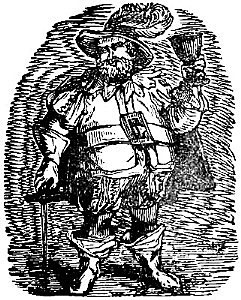
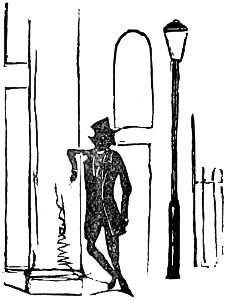
Fair Phœbe and her Dark-Eyed Sailor. My Pretty Jane.
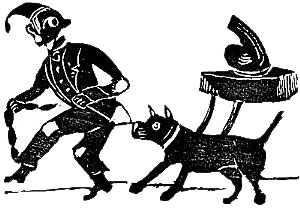
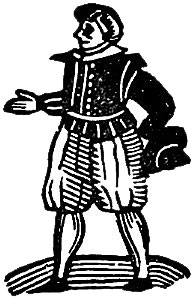
The Thorn. The Saucy Arethusa.
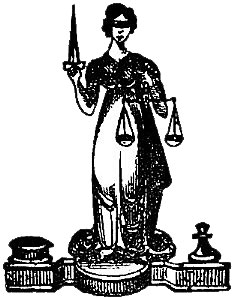
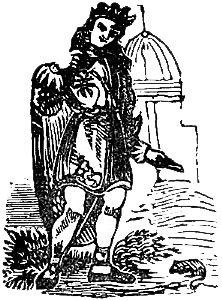
The Gipsy King. Hearts of Oak.
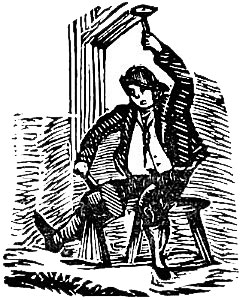
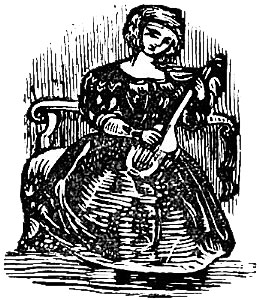
Harry Bluff. Death of Nelson.
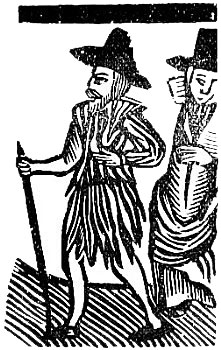
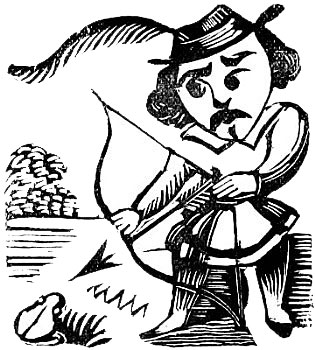
John Anderson, my Jo.
Old English Gentleman. The Bleeding Heart.
Wapping Old Stairs. Poor Bessy was a Sailor’s Bride.
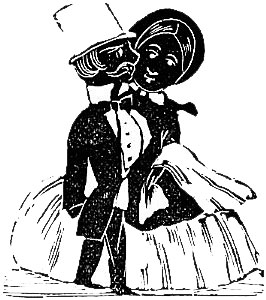
Poor Mary Anne. The Muleteer.
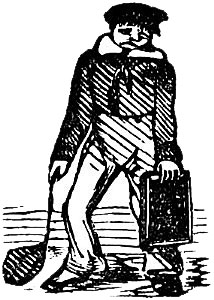
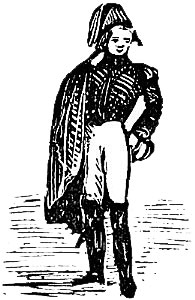
Tom Bowling. Ye Banks an’ Braes.
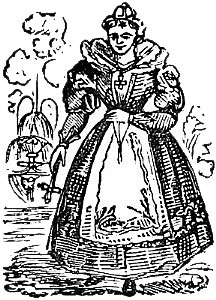
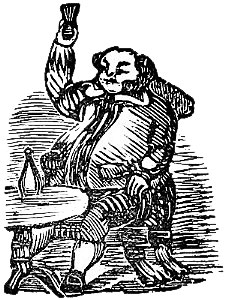
The Mistletoe Bough.
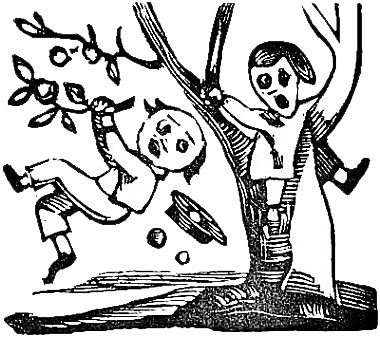
The Woodpecker. The Soldier’s Tear.
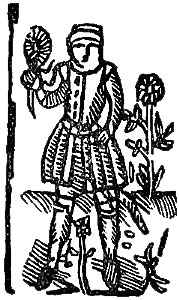
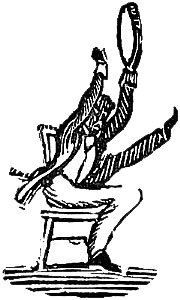
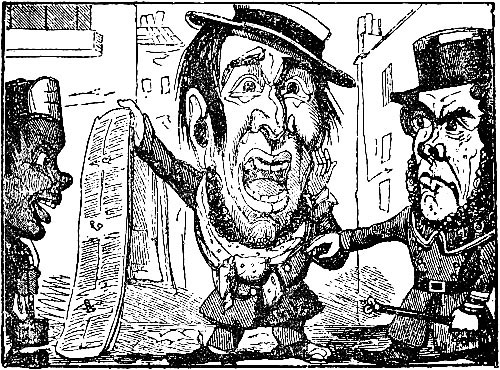
Long-song Seller.
Besides the chanters, who sing the songs through the streets of every city, town, village, and hamlet in the kingdom—the long-song seller, who shouts their titles on the kerb-stone, and the countless small shop-keepers, who, in swag-shops, toy-shops, sweetstuff-shops, tobacco-shops, and general shops, keep them as part of their stock for the supply of the street boys and the servant girls—there is another important functionary engaged in their distribution, and who is well known to the inhabitants of large towns, this is the pinner-up, who takes his stand against a dead wall or a long range of iron railings, and first festooning it liberally with twine, pins up one or two hundred ballads for public perusal and selection. Time was when this was a thriving trade: and we are old enough to remember the day when a good half-mile of wall fluttered with the minstrelsy of war and love, under the guardianship of a scattered file of pinners-up, along the south side of Oxford-street alone. Thirty years ago the dead walls gave place to shop fronts, and the pinners-up departed to their long homes. As they died out very few succeeded to their honours and emoluments. There is one pinner-up, seemingly the last of his race, who makes his display on the dead wall of the underground railway in Farringdon road.
Catnach, to the day of his retirement from business in 1838, when he purchased the freehold of a disused public-house, which had been known as the Lion Inn, together with the grounds attached at Dancer’s-hill, South Mimms, near Barnet, in the county of Middlesex, worked and toiled in the office of the “Seven Dials Press,” in which he had moved as the pivot, or directing mind, for upwards of a quarter of a century. He lived and died a bachelor. His only idea of all earthly happiness and mental enjoyment was now to get away in retirement to a convenient distance from his old place of business, so to give him an opportunity occasionally to go up to town and have a chat and a friendly glass with one or two old paper-workers and ballad-writers, and a few others connected with his peculiar trade who had shown any disposition to work when work was to be done. To them he was always willing to give or advance a few pence or shillings, in money or stock, and a glass.
Catnach left the whole of the business to Mrs. Anne Ryle, his sister, charged, nevertheless, to the amount of £1,000, payable at his death to the estate of his niece, Marion Martha Ryle. In the meanwhile Mr. James Paul acted as managing man for Mrs. Ryle. This Mr. Paul—of whom Jemmy was very fond, and rumour saith, had no great dislike to the mother—had grown from a boy to a man in the office of the “Catnach Press.” He was, therefore, well acquainted with the customers, by whom he was much respected; and it was by his tact and judgment that the business was kept so well together. At Catnach’s death he entered into partnership with Mrs. Ryle, and the business was carried on under the title and style of Paul & Co. In 1845 the partnership was dissolved, Mr. Paul receiving £800 in settlement. He then entered into the public line, taking the Spencer’s Arms, at the corner of Monmouth-court. A son that was born to him in 1847, he had christened James Catnach Paul. About this date “The Catnach Press” had a formidable rival in “The Nassau Steam Press,” which was originally started in Nassau Street, Soho, and afterwards removed to No. 60, St. Martin’s Lane. Mr. Paul was especially engaged to manage the song department at this office. He died in the year 1870, just six weeks after Mrs. Ryle, and lies buried in the next grave but one to Catnach and his sister, in Highgate Cemetery.
After Mr. Paul had left the business it was carried on as A. Ryle & Co., and ultimately became the property of Mr. W. S. Fortey, who still carries on the old business in the same premises. A copy of whose trade announcement runs thus:—
“The Catnach Press.” (Established 1813.)
“William S. Fortey, (late A. Ryle, successor to the late J. Catnach,) Printer, Publisher, and Wholesale Stationer, 2 and 3, Monmouth-court, Seven Dials, London, W.C.”
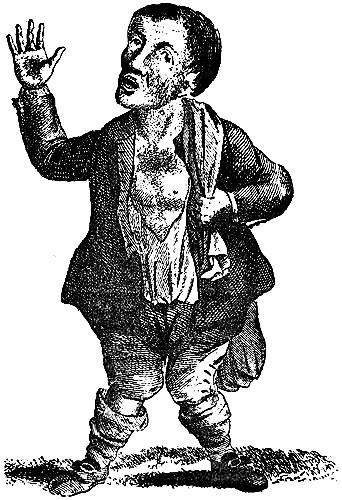
Sir Jeffery Dunstan, Late Mayor of Garratt, and Itinerant Dealer in Wigs.
Sir Jeffery Dunstan—thrice Mayor of Garratt! was the most popular candidate that ever appeared on the Hustings at that very Free and Independent Borough! His occupation was that of buying old wigs, once an article of trade like that of old clothes. Sir Jeffery usually carried his wig bag over his shoulder, and to avoid the charge of vagrancy, vociferated, as he passed along the street, “Old Wigs,” but having a person like Æsop, and a countenance and manner marked by irresistible humour, he never appeared without a train of boys and curious persons, whom he entertained by his sallies of wit, shrewd sayings, and smart repartees; and from whom, without begging, he collected sufficient to help to maintain his dignity of Mayor and Knight.
From the earliest period of Sir Jeffery’s life, he was a friend to “good measures,” especially those for “spirituous liquors,” and he never saw the inside of a pot without going to the bottom of it. This determination of character created difficulties to him; for his freedom was not always regulated by the doctrines of meum et tuum, or, of the great Blackstone, “on the rights of persons,” and consequences ensued that were occasionally injurious to Sir Jeffery’s eyes, face, and nose. The same enlightened Judge’s views of “the rights of property,” were not comprehended by Sir Jeffery, he had long made free with the porter of manifold pots, and at length he made free with a few of the pots—which the publicans in London seemed to show in the streets as much as to say “Come and steal me.” For this he was “questioned” in the high Commission Court of oyer and terminer, and suffered an imprisonment, which, according to his manner of life, and his notions of the liberty of the subject, was “frivolous and vexatious.” On his liberation, he returned to an occupation he had long followed, the dealing in “Old Wigs.” Some other circumstances, developed in course of the preceding inquiry, seem to favour a supposition that the bag he carried had enabled him to conceal his previous “free trade” in pewter pots. But, be that as it might, it is certain that in his armorial bearings of four wigs, he added a quart pot for a crest.
Sir Jeffery was remarkably dirty in his person, and always had his shirt thrown open, which exposed his breast to public view. This was in him a sort of pride; for he would frequently in an exulting manner say to inferiors “I’ve got a collar to my shirt, sir.” He had a filthy habit, when he saw a number of girls around him, of spitting in their faces, saying, “There, go about your business.”
Sir Jeffery, in the days of his prosperity, took his “Hodges’ best,” at the “Blind Beggar of Bethnal-green,” or the “Horse and Leaping Bar,” High-street, Whitechapel, at one or other of these favourite retreats, he got in a regular manner “regularly drunk.” Then it was that he sung in his best style various popular “London Cries,” mimicking others in their crying, especially one who vended “Lily, lily, lily, lily white—sand oh! oh!! oh!!!” this afforded sport to a merry company. Afterwards, should Sir Jeffery receive sufficient metalic support from his friends, he was placed in an arm chair on the table, when he recited to the students of the London Hospital and the Bucks of the East, his mock-election speeches. He was no respecter of persons, and was so severe in his jokes on the corruptions and compromises of power, that he was prosecuted for using what were then called seditious expressions. In consequence of this affair, and some few charges of dishonesty, he lost his popularity, and, at the next general election was ousted by Sir Harry Dimsdale, muffin-seller, a man as much deformed as himself. Sir Jeffery could not long survive his fall, but, in death as in life, he proved a satire on the vices of the proud, for he died, like Alexander the Great, the sailor in Lord Byron’s “Don Juan,” and many other heroes renowned in history—of suffocation from excessive drinking!.
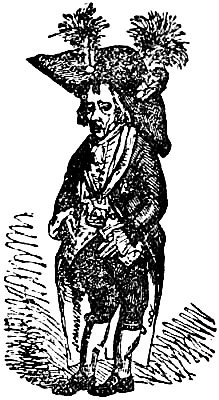
Sir Harry Dimsdale, M.P., for Garratt, Cosmopolite and Muffin-Seller.
“Those evening bells! those evening bells! How many a tale their music tells! Of youth, and home, and that sweet time When last I heard their soothing chime.”
“Muffins, oh! Crumpets, oh,” rank among the old cries of London, and at least one of the calling has been made famous, namely, Harry Dimsdale, sometime Mayor of Garratt, who, from the moment he stood as candidate, received mock knighthood, and was ever after known under the appellation of “Sir Harry.” This half-witted character was a dealer in tin-ware—together with threads, tapes and bootlaces, during the morning, and a muffin-seller in the afternoon, when he had a little bell, which he held to his ear, and smiling ironically at its tinkling he would cry:—“Muffins! muffins! ladies come buy me! pretty, handsome, blooming, smiling maids!”
Mr. J. T. Smith, in his ever-charming work of “A Book for a Rainy Day; or, Recollections of the Events of the Years 1766-1833,” writing under date 1787, gives the following graphic sketch of the sayings and doings—taken from life, of “Sir Harry.”
“One of the curious scenes I witnessed on a nocturnal visit to the watch house of St. Anne, Soho, afforded me no small amusement. Sir Harry Dinsdale, usually called Dimsdale, a short, feeble little man, was brought in, charged by two colossal guardians of the night with conduct most unruly. ‘What have you, Sir Harry, to say to all this?’ asked the Dogberry of St. Anne. The knight, who had been roughly handled, commenced like a true orator, in a low tone of voice. ‘May it please ye, my magistrate, I am not drunk; it is languor. A parcel of the Bloods of the Garden have treated me cruelly, because I would not treat them. This day, sir, I was sent for by Mr. Sheridan, to make a speech upon the table at the Shakespeare Tavern, in Common Garden; he wrote the speech for me, and always gives half a guinea; he sends for me to the tavern. You see I didn’t go in my Royal robes, I only put ’um on when I stand to be a member.’ The constable—‘Well, but Sir Harry, why are you brought here?’ One of the watchmen then observed, ‘That though Sir Harry was but a little shambling fellow, he was so upstroppolus, and kicked him about at such a rate, that it was as much as he and his comrade could do to bring him along.’ As there was no one to support the charge, Sir Harry was advised to go home, which, however, he swore he would not do at midnight without an escort. ‘Do you know,’ said he, ‘there’s a parcel of raps now on the outside waiting for me.’
“The constable of the night gave orders for him to be protected to the public-house opposite the west end of St. Giles’s Church, where he then lodged. Sir Harry, hearing a noise in the street, muttered, ‘I shall catch it; I know I shall.’ (Cries without,) ‘See the conquering hero comes.’ ‘Ay, they always use that tune when I gain my election at Garratt.’
“There are several portraits of this singular little object, by some called ‘Honey-juice.’ Flaxman, the sculptor, and Mrs. Mathews, of blue-stocking memory, equipped him as a hardware man, and as such I made two etchings of him.”
The Muffin Man. (T. Dibden.)
While you opera-squallers fine verses are singing, Of heroes, and poets, and such like humguffins; While the world’s running round, like a mill in a sail, I’ll ne’er bother my head with what other folks ail, But careless and frisky, my bell I keep ringing, And walk about merrily crying my muffins.
Chorus.
Lily-white muffins, O, rare crumpets smoking, Hot Yorkshire cakes, hot loaves and charming cakes, One-a-penny, two-a-penny, Yorkshire cakes. What matters to me if great folks run a gadding, For politics, fashions, or such botheration; Let them drink as they brew, while I merrily bake; For though I sell muffins, I’m not such a cake— To let other fools’ fancies e’er set me a gadding, Or burthen my thoughts with the cares of the nation.
Spoken.—What have I to do with politicians? And for your Parliament cakes. Why! everybody knows they are bought and sold, and often done brown, and made crusty all over the nation. No, no, its enough for me to cry—
Lily-white muffins, &c.
Let soldiers and sailors, contending for glory, Delight in the rattle of drums and of trumpets; Undertakers get living by other folks dying, While actors make money by laughing or crying; Let lawyers with quizzels and quiddities bore ye, It’s nothing to me, while I’m crying my crumpets.
Spoken.—What do I care for lawyers? A’nt I a baker, and consequently, Master of the Rolls:—Droll enough, too, for a Master of the Rolls to be crying—
Lily-white muffins, &c.
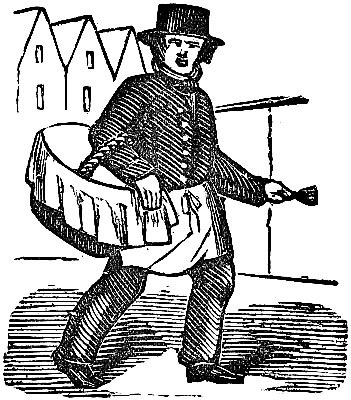
The Muffin Man.
“Muffins, oh! crumpets, oh! Come buy, come buy of me. Muffins and crumpets, muffins, For breakfast or for tea.”
The ringing of the muffin-man’s bell—attached to which the pleasant associations are not a few—is prohibited by a ponderous Act of Parliament, but the prohibition has been all but inoperative, for the muffin bell still tinkles along the streets, and is rung vigorously in the suburbs, and just at the time when City gents, at winter’s eve, are comfortably enveloped in fancy-patterned dressing gowns, prettily-worked smoking-caps, and easy-going and highly-coloured slippers, and saying within themselves or aloud:—
“Now stir the fire, and close the shutters fast, Let fall the curtains, wheel the sofa round, And while the bubbling and loud hissing urn Throws up a steamy column, and the cups, That cheer but not inebriate, wait on each, So let us welcome peaceful evening in.”
“Hot Cross Buns!” Perhaps no “cry”—though it is only for one day in the year, is more familiar to the ears of a Londoner, than that of “One-a-penny, two-a-penny, hot cross-buns.” We lie awake early upon Good Friday morning and listen to the London bells:—
“Oranges and lemons, say the bells of St. Clement’s Pancakes and fritters, say the bells of St. Peter’s, Two sticks and an apple, say the bells of Whitechapel. Kettles and pans, say the bells of St. Ann’s. Pokers and tongs, say the bells of St. John’s Brickbats and tiles, say the bells of St. Giles’ Halfpence and farthings, say the bells of St. Martin’s. Bull’s eyes and targets, say the bells of St. Marg’rets.”
And all the other London bells having rung—or, rather toll’d out their own tale of joy or trouble: then comes—rattling over the stones—W. H. Smith’s well-known red Express-carts laden with the early printed newspapers of the coming day, while all night long the carts and waggons come rumbling in from the country to Covent-garden, and not the least pleasant sound—pleasant for its old recollections—is the time-honoured old cry of “Hot Cross-Buns.” Century after century passes by, and those who busily drove their carts day after day from Isleworth, Romford, Enfield, Battersea, Blackheath, or Richmond, one hundred years ago, are as still and silent as if they had never been; yet still, Passion week after Passion week, comes that old cry, nobody knows how old, “Hot Cross Buns, Hot Cross Buns.” And as we lie in a half dreamy state we hear and think of the chimes of St. Clement Danes, which may still be heard, as Fallstaff describes, having heard them with Justice Shallow; also, how Pope, as he lay in Holywell-street—now Bookseller’s-row; and Addison and Johnson; and, before their time, Waller, at the house of his old friend the merchant of St. Giles’s; and the goodly company of poets that lived at the cost of the king, near Whitehall; then of the quaint old gossiping diarist, Samuel Pepys, Secretary of the Admiralty; John Taylor, the Water-Poet; even Shakespeare himself, having each in their turn been awakened on the Good Friday morning by the same sound ringing in their ears. For this is a custom which can hardly be traced to a beginning: and all we know about it is, that as far as we can go back, the Good Friday was ushered in by the old Good Friday bun; and that the baker in the towns, and the old good wife in the country, would have thought the day but badly kept, and augured badly for the coming summer’s luck, without it.
But between the cakes of Cecrops and the modern Hot Cross Bun there is a wide gulf of 3,400 years; and yet the one may be traced up to the other. There are some, indeed, who would wish to give to the Good Friday Hot Cross Bun a still longer pedigree, and to take it back to the time of the Patriarchs and their consecrated bread; and there are others who would go yet further, and trace it to the earliest age of the world, in a portion of Cain’s sacrifice. We may, however, content ourselves with stopping short at the era of the Egyptian Cecrops, founder of Athens, who made his sweet cakes of flour and honey. Such cakes as these, as we learn from the prophet Jeremiah, were offered by the idolatrous Hebrew women to “the Queen of Heaven,”
“Ashtoreth, whom the Phœnicians called Astarte, Queen of Heaven, with cresent horns.”
Some can even discern Astarte in our “Easter.” The Jews of old had the shew-bread and the wafer of unleavened bread; and the Egyptians, under the Pharaohs, had also their cakes, round, oval, and triangular. The Persians had their sacred cakes of flour and honey; and Herodotus speaks of similar cakes being offered by the Athenians to a sacred serpent in the temple of their citadel. And, not to mention other nations, the circumstance that accompanied the outbreak of the Indian Mutiny, 1857, will make memorable the “chupatties” or sacred cakes of Khrishna.
The cakes that were offered to Luna by the Greeks and Romans were either crescent-shaped, or were marked with the crescent moon; and this stamp must have been very similar to that impressed on the cakes offered by the Hebrew women to the Queen of Heaven. This mark also resembles that representing the horns of the sacred ox which was stamped on the Grecian cakes; and the ox was bous, and, in one of its oblique cases, boun, so we derive from that word boun our familiar “bun.” There were not only horn-marked cakes, but horn-marked pieces of money; so that it is very difficult to ascertain the true meaning of that passage in the opening of the “Agamemnon” of Æschylus, where the watchman says that a great bous has come, or set foot, upon his tongue. Although it might mean that something as weighty as an ox’s hoof had weighed down his tongue, yet it more probably signifies either that he was bribed to silence with a piece of money marked with the ox’s horns, or that the partaking of a sacred horn-marked cake had initiated him into a certain secret. Curiously enough, in the argot of thieves, at the present day, a crown piece is termed “a bull;” and it may also be noted that pecunia, “money,” is derived from pecus, “cattle;” and “bull” is derived from bous, and also “cow” from the same word, through the Sanscrit gou, the b and g being convertible.
Thus, originally, the boun or bun was the cake marked with the horns of the sacred ox. The cross mark was first adopted by the Greeks and Romans to facilitate the division of the cake into four equal parts; and two such cross-marked cakes were found in the ruins of Herculaneum. These cakes were adopted by the early Christians in a spirit of symbolism; but, although the cross was marked on the cake in token of the badge of their faith, yet it was also used by the priest for the breaking of the cake, or Eucharistic wafer, into four pieces; and this was so ordered in the Liturgy of St. Chrysostom. The cross-marked buns are now, for popular use, reserved for Good Friday, and, as Lenten cakes, are peculiar to this country. Among the Syrian Christians of Travancore and Cochin, who trace their descent from those who were converted by St. Thomas on his (supposed) visit to India, a peculiar cake is made for “Sorrowful Friday”—as they term Good Friday. The cake is stuffed with sweetmeats in the form of an eye, to represent the evil eye of Judas, coveting the thirty pieces of silver; and the cake is flung at with sticks by the members of the family until the eye is quite put out; they then share the remains of the cake among them.
In the days before the Reformation, eulogiæ, or cross-marked consecrated cakes, were made from the dough of the mass-bread, and distributed by the priests to be eaten at home by those who had been prevented by sickness or infirmity from attending the mass. After the Reformation, Protestants would readily retain the custom of eating in their houses a cross marked cake, although no longer connecting it with a sacred rite, but restricting its use to that one day of the year known as “Holy Friday,” or “Long Friday”—from the length of the service on that day—but which gradually came to be called, by the Anglican Church, “Good Friday,” in remembrance of the good things secured to mankind on that day. The presence upon the breakfast-table of the cross marked bun, flavoured with allspice, in token of the spices that were prepared by the pious women of Galilee, was, therefore, regarded in the light of a remembrancer of the solemnities of the day. The buns were made on the previous evening, Maundy Thursday so called, either from the “maunds,” or baskets, in which Easter gifts were distributed, or, more probably, because it was the Dies mandati, the day of the command, “That thou doest, do quickly!” as also, “Do this in remembrance of Me!” and that the disciples should love one another and should show humility in the washing of feet.
As Chelsea was long famous for its buns—which are mentioned by Swift to Stella, in 1712—it was not to be wondered at that it should be celebrated for its production of hot cross buns on Good Friday. Early in the present century there were two bun-houses at Chelsea, both claiming to be “Royal” as well as “Original,” until, at last, one of the two proclaimed itself to be “The Real Old Original Bun House.” These two houses did a roaring trade during the whole of Good Friday, their piazzas being crowded, from six in the morning to six in the evening, by crowds of purchasers, loungers, and gossipers. Good King George the Third would come there with his children; and, of course, the nobility and gentry followed his example. These two bun-houses were swallowed up, in the march of improvement, some forty years ago; but on Good Friday, 1830, 240,000 hot cross buns were sold there.
The cross bun is not without its folk-lore. Country folks attach much virtue to the Good Friday buns; and many are kept for “luck’s sake” in cottages from one Good Friday to another. They are not only considered to be preservatives from sickness and disease, but also as safeguards from fire and lightning. They are supposed never to get mouldy, as was noted by “Poor Robin,” in his Almanack for 1733, under the head of March:—
“Good Friday comes this month: the old woman runs With one a penny, two a penny hot cross-buns; Whose virtue is, if you’ll believe what’s said, They’ll not grow mouldy like the common bread.”
Furthermore, be it known, then, in the interests of suffering humanity, that if a piece of a Good Friday bun is grated and eaten, it will cure as many diseases as were ever cured by a patent pill; moreover, the animal world is not shut out from sharing in its benefits, for it will cure a calf from “scouring,” and mixed in a warm mash, it is the very best remedy for your cow. Thus the bun is good for the boun; in fact, it is good both for man and beast.
The sellers of the Good Friday buns are composed of old men and young men, old women and young women, big children and little children, but principally boys, and they are of mixed classes, as, costers’ boys, boys habitually and boys occasionally street-sellers, and boys—“some cry now who never cried before,” and for that occasion only. One great inducement to embark in the trade is the hope of raising a little money for the Easter holidays following.
The “cry” of the Hot Cross Bun vendor varies at times and in places—as thus:—
“One-a-penny, two-a-penny, hot cross-buns! One-a-penny, two for tup’ence, hot cross buns!”
While some of a humorous turn of mind like to introduce a little bit of their own, or the borrowed wit of those who have gone before them, and effect the one step which is said to exist from the sublime to the ridiculous, and cry—
“One-a-penny, poker; two-a-penny, tongs! One-a-penny; two-a-penny, hot cross buns. One-a-penny, two-a-penny, hot cross-buns! If your daughters will not eat them, give them to your sons. But if you haven’t any of those pretty little elves, You cannot then do better than eat them up yourselves; One-a-penny, two-a-penny, hot cross buns: All, hot, hot, hot, all hot. One-a-penny, two-a-penny, hot cross buns! Burning hot! smoking hot, r-r-r-roking hot— One-a-penny, two-a-penny, hot cross buns.”
But the street hot-cross-bun trade is languishing—and languishing, will ultimately die a natural death, as the master bakers and pastrycooks have entered into it more freely, and now send round to their regular customers for orders some few days before each succeeding Good Friday.
A capital writer of Notes, Comment and Gossip, who contributes every week to the City Press, under the nom de plume of “Dogberry,” gave—inter alia—a few “Good Words,” the result of his “Leisure Hours” in that journal, on the subject of “Good Friday Customs.” March 24, 1883, thus:—
“That the buns themselves are as popular as ever they were when the Real Original Bun Houses existed in Chelsea, was manifest on Thursday evening, though the scene is now changed from the west to the east. Bishopsgate-street was indeed all alive with people of high and low degree crowding in and out of Messrs. Hill & Sons, who, I am told, turned no less than 47 sacks of flour, representing over 13,000 lbs., into the favourite Good Friday cakes. This mass was sweetened by 2,800 lbs. of sugar, moistened with 1,500 quarts of milk, and ‘lightened’ with 2,200 lbs. of butter. Something like 25,000 paper bags were used in packing the buns, and upwards of 150 pairs of hands were engaged in the making and distribution of the tasty morsels at Bishopsgate and at the West-end branch of Messrs. Hill, at Victoria. The customary business of the firm must have been interrupted considerably by Good Friday, and the forty-seven sacks of flour made into buns represented, I presume, a considerable deduction from the hundred and ninety to two hundred which the firm work up in one form or another every week. But then you can’t eat your (Good Friday) cake and have it. There were other bakers and confectioners in the City, too, who appeared to do a thriving trade in buns—notably Messrs. Robertson & Co., in Aldersgate-street. Long live the Good Friday bun!”