Front matter (continued 4)
Reading edition
Dogberry.
Hot Cross Buns.
By Miss Eliza Cook.
“The clear spring dawn is breaking, and there cometh with the ray, The stripling boy with ‘shining face,’ and dame in ‘hodden grey:’ Rude melody is breathed by all—young—old—the strong, and weak; From manhood with its burly tone, and age with treble squeak. Forth come the little busy ‘Jacks’ and forth come little ‘Jills,’ As thick and quick as working ants about their summer hills; With baskets of all shapes and makes, of every size and sort; Away they trudge with eager step, through alley, street, and court. A spicy freight they bear along, and earnest is their care, To guard it like a tender thing from morning’s nipping air; And though our rest be broken by their voices shrill and clear, There’s something in the well-known ‘cry’ we dearly love to hear. ’Tis old, familiar music, when ‘the old woman runs’ With ‘One-a-penny, two-a-penny, Hot Cross Buns!’ Full many a cake of dainty make has gained a great renown, We all have lauded ‘Gingerbread’ and ‘Parliament’ done brown; But when did luscious ‘Banburies,’ or dainty ‘Sally Lunns,’ E’er yield such merry chorus theme as ‘One-a-penny buns!’ The pomp of palate that may be like old Vitellius fed, Can never feast as mine did on the sweet and fragrant bread; When quick impatience could not wait to share the early meal, But eyed the pile of ‘Hot Cross Buns,’ and dared to snatch and steal. Oh, the soul must be uncouth as a Vandal’s Goth’s, or Hun’s, That loveth not the melody of ‘One-a-penny Buns!’”
And so, awaking in the early morning, we hear the streets ringing with the cry, “Hot Cross Buns.” And perhaps when all that we have wrought shall be forgotten, when our name shall be as though it had been written on water, and many institutions great and noble shall have perished, this little bun will live on unharmed. Others, as well as ourselves, will, it may be, lie awake upon their beds, and listen to the murmurs going to and fro within the great heart of London, and, thinking on the half-forgotten days of the nineteenth century, wonder perhaps whether, in these olden times, we too heard the sound of “Hot Cross Buns.”

The street Pieman with his “cry,” of “Pies all hot! hot!! hot!!!—Penny pies, all hot! hot!!—fruit, eel, beef, veal or kidney pies! pies, all hot-hot-hot,” is one of the most ancient of street callings, and to London boys of every degree, “Familiar in their mouths as household words.” Nor is the itinerant trade in pies—“Eel, beef, veal, kidney or fruit,” confined to the great metropolis. All large provincial towns have, from a time going back much farther than even the proverbial “oldest inhabitant” can recollect, had their old and favourite “Penny Pieman,” or, “Old-all-Hot!” as folks were ever wont to call him. He was generally a merry dog, and mostly to be found where merriment was going on, he scrupled not to force his way through the thickest of the crowd, knowing that the very centre of action was the best market for his wares.
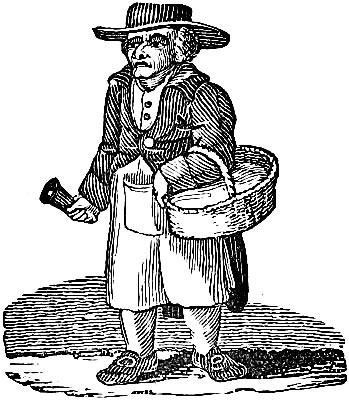
The Pieman; OR, O LORD! WHAT A PLACE IS A CAMP.
“O Lord! what a place is a camp, What wonderful doings are there; The people are all on the tramp, To me it looks devilish queer: Here’s ladies a swigging of gin, A crop of macaronies likewise: And I, with my ‘Who’ll up and win? Come, here is your hot mutton pies.’ Here’s gallopping this way and that, With, ‘Madam, stand out of the way;’ Here’s, ‘O fie! sir, what would you be at?— Come, none of your impudence pray:’ Here’s ‘Halt—to the right-about-face,’ Here’s laughing, and screaming, and cries: Here’s milliners’-men out of place, And I with my hot mutton pies. Here’s the heath all round like a fair, Here’s butlers, and sutlers, and cooks; Here’s popping away in the air, And captains with terrible looks: Here’s ‘How do you do?’—‘Pretty well; The dust has got into my eyes,’ There’s—‘Fellow what have you to sell?’ ‘Why, only some hot mutton pies.’”
History informs us, through the medium of the halfpenny plain and penny coloured chap book, editions issued by the “Catnach Press,” that, one:—
“Simple Simon met a Pieman, Going to the fair; Says simple Simon to the Pieman, ‘Let me taste your ware.’ Says the Pieman unto Simon, ‘First give me a penny;’ Says Simple Simon to the Pieman, ‘I have not got any.’”
But history is silent as to the birth, parentage, or, even place and date of the death of the said Simple Simon, or of this very particular pieman. Halliwell informs us, through one of the “Nursery Rhymes of England,” that on one occasion:—
“Punch and Judy Fought for a pie; Punch gave Judy A sad blow on the eye.”
James Lackington—1746-1816—one of the most celebrated of our early cheap booksellers, lived at the “Temple of Muses,” Finsbury-place—the shop, into which a coach and six could be driven. This curious mixture of cobbler’s wax, piety, vanity, and love of business, has left us in his autobiography, which he published under the title of his “Memoirs and Confessions,” his experience as a pie-boy! or seller of pies, thus:—
“At ten years old I cried apple pies in the street. I had noticed a famous pieman, and thought I could do it better myself. My mode of crying pies soon made me a street favourite, and the old pie merchant left off trade. You see, friend, I soon began to make a noise in the world. But one day I threw my master’s child out of a wheelbarrow, so I went home again, and was set by my father to learn his trade, continuing with him for several years. My fame as a pieman led to my selling almanacks on the market days at Christmas. This was to my mind, and I sorely vexed the [regular] vendors of ‘Moore,’ ‘Wing,’ and ‘Poor Robin.’ My next move was to be bound apprentice for seven years.”
We frequently meet with the pieman in old prints; and in Hogarth’s “March to Finchley,” there he stands in the very centre of the crowd, grinning with delight at the adroitness of one robbery, while he is himself the victim of another. We learn from this admirable figure by the greatest painter of English life, that the pieman of the last century perambulated the streets in professional costume; and we gather further, from the burly dimensions of his wares that he kept his trade alive by the laudable practice of giving “a good pennyworth for a penny.” Justice compels us to observe that his successors of a later generation have not been very conscientious observers of this maxim.
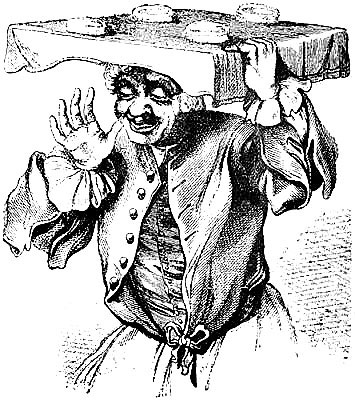
Hogarth’s Pieman.
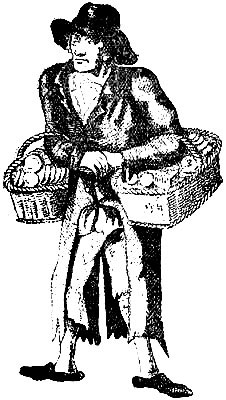
Nice New! Nice New! All hot! All Hot Hot! All Hot! Here they are, two sizes bigger than last week.
At this date there was James Sharpe England, a noted flying pieman, who attended all the metropolitan festive gatherings; he walked about hatless, to sell his savoury wares, with his hair powdered and tied en queue, his dress neat, apron spotless, jesting wherever he went, with a mighty voice in recommendation of the puddings and pies, which, for the sake of greater oddity he sometimes carried on a wooden platter.
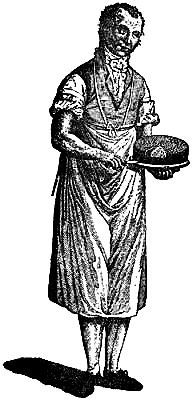
James Sharpe England, The Flying Pieman.
The London pieman, as he takes his walks abroad, makes a practice of “looking in” at all the taverns on his way. Here his customers are found principally in the tap-room. “Here they are, all ’ot!” the pieman cries, as he walks in; “toss or buy! up and win ’em!” For be it known to all whom it may concern, the pieman is a gambler, both from inclination and principle, and will toss with his customers, either by the dallying shilly-shally process of “best five in nine,” or “best two in three,” or the desperate dash of “sudden death!” in which latter case the first toss decides the matter, viz:—a pie for a penny, or your penny gone for nothing, but he invariably declines the mysterious process of “odd man,” not being altogether free from suspicion on the subject of collusion between a couple of hungry, and not over honestly inclined customers.
Of the “stuff” which pie-dealers usually make their wares, much has been sung and said, and in some neighbourhoods the sight of an approaching pieman seems to get about an immediate desire for imitating the harmless cat and its “Mee-yow,” or the “Bow-wow-wow!” of the dog. And opprobrious epithets are hurled at the piemen as they parade the streets and alleys, and even kidnapping has been slyly hinted at, for the mother of Tom Cladpole, finding her son so determined to make a “Jurney to Lunnun”—least he should die a fool, tries to frighten the boy out of his fixed intention by informing him in pure Sussex dialect that:—
“Besides, dey kidnap people dere, Ah! ketch um by supprize, An send um off where nub’dy knows, Or baak um up in pies.”
It was ever a safe piece of comic business with Old Joey Grimaldi and his favourite pupil and successor, Tom Matthews, together with all other stage clowns following them, that a penny pieman and the bright shining block-tin can should be introduced into every Christmas pantomime. The pataloon is made to be tossing the safe game of—“heads I win, tails you lose” with the stage pieman, while the roguish clown is adroitly managing to swallow the whole of the stock of pies from the can, and which are made by the stage property-man for the occasion out of tissue-paper painted in water-colours. Then follows the wry faces and spasmodic stomach-pinchings of the clown, accompanied with the echoing cries of “Mee, mee, mow, woo!” while the pantaloon takes from the pieman’s can some seven or eight fine young kittens and the old tabby-cat—also the handy-work of the stage property-man. The whole scene usually finishes by the pantaloon pointedly sympathizing with the now woebegone clown to the tune of “Serve ye right—Greedy! greedy!! greedy!!!” when enter six supernumeraries dressed as large and motherly-looking tabbies with aprons and bibs, and bedizened with white linen night caps of the pattern known in private life to middle-aged married men only. The clown and pantaloon then work together in hunting down, and then handing over the poor pieman to the tender mercies and talons of the stage-cats, who finish up the “business” of the scene by popping the pieman into what looks like a copper of boiling water.
Mr. Samuel Weller,—otherwise, Veller, that great modern authority on Ye Manners and Ye Customs, of Ye English in general, and of London Life wery Particular:—for “Mr. Weller’s knowldge of London was extensive and peculiar”—has left us his own ideas of the baked “mysteries” of the pieman’s ware:—
“Weal pie,” said Mr. Weller, soliloquising, as he arranged the eatables on the grass. “Werry good thing is a weal pie, when you know the lady as made it, and is quite sure it an’t kittens; and arter all, though, where’s the odds, when they’re so like weal that the wery piemen themselves don’t know the difference?”
“Don’t they, Sam?” said Mr. Pickwick.
“Not they, sir,” replied Mr. Weller, touching his hat. “I lodged in the same house vith a pieman once, sir, and a wery nice man he was—reg’lar clever chap too—made pies out o’ anything, he could. ‘What a number o’ cats you keep, Mr. Brooks,’ says I, when I’d got intimate with him. ‘Ah,’ says he, ‘I do—a good many,’ says he. ‘You must be wery fond o’ cats,’ says I. ‘Other people is,’ says he, a winkin’ at me; ‘they an’t in season till the winter though,’ says he. ‘Not in season!’ says I. ‘No,’ says he, ‘fruits is in, cats is out.’ ‘Why, what do you mean?’ says I. ‘Mean?’ says he. ‘That I’ll never be a party to the combination o’ the butchers, to keep up the prices o’ meat,’ says he. ‘Mr. Weller,’ says he, a squeezing my hand wery hard, and vispering in my ear—‘don’t mention this here agin—but it’s the seasonin’ that does it. They’re all made o’ them noble animals,’ says he, a pointin’ to a wery nice little tabby kitten, ‘and I seasons ’em for beef-steaks, weal, or kidney, ’cordin to demand. And more than that,’ says he, ‘I can make a weal a beef-steak, or a beef-steak a kidney, or any one on ’em a mutton, at a minute’s notice, just as the market changes, and appetites wary!”
“He must have been a very ingenious young man, that, Sam,” said Mr. Pickwick, with a slight shudder.
“Just was, sir,” replied Mr. Weller, continuing his occupation of emptying the basket, “and the pies was beautiful.”
The “gravy” given with the meat-pies is poured out of an oil-can and consists of a little salt and water browned. A hole is made with the little finger in the top of the pie and the “gravy” poured in until the crust rises sufficiently to satisfy the young critical gourmand’s taste.
“The London piemen,” says Mr. Henry Mayhew, “May be numbered at about forty in winter, and twice that number in summer.” Calculating that there are only fifty plying their trade the year through, and their average earnings at 8s. a week, we find a street expenditure exceeding £1,040, and a street consumption of pies amounting to nearly three quarters of a million yearly.
Young Lambs to Sell.
Young lambs to sell! young lambs to sell. If I’d as much money as I could tell, I’d not come here with young lambs to sell! Dolly and Molly, Richard and Nell, Buy my young lambs, and I’ll use you well!
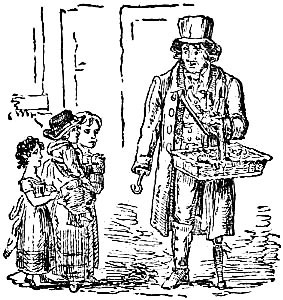
The engraving represents an old “London Crier,” one William Liston, from a drawing for which he purposely stood in 1826.
This “public character” was born in the City of Glasgow. He became a soldier in the waggon-train commanded by Colonel Hamilton, and served under the Duke of York in Holland, where, on the 6th of October, 1799, he lost his right arm and left leg, and his place in the army. His misfortunes thrust distinction upon him. From having been a private in the ranks, where he would have remained undistinguished, he became one of the popular street-characters of his day.
In Miss Eliza Cook’s Poem “Old Cries” she sings in no feeble strain the praises of the old man of her youthful days, who cried—“Merry and free as a marriage bell”:—
Young Lambs to Sell.
There was a man in olden time, And a troubador was he; Whose passing chant and lilting rhyme Had mighty charms for me. My eyes grew big with a sparkling stare, And my heart began to swell, When I heard his loud song filling the air About “Young lambs to sell!” His flocks were white as the falling snow, With collars of shining gold; And I chose from the pretty ones “all of a row,” With a joy that was untold. Oh, why did the gold become less bright, Why did the soft fleece lose its white, And why did the child grow old? ’Twas a blithe, bold song the old man sung; The words came fast, and the echoes rung, Merry and free as “a marriage bell;” And a right, good troubadour was he, For the hive never swarmed to the chinking key, As the wee things did when they gathered in glee To his musical cry—“Young lambs to sell!” Ah, well-a-day! it hath passed away, With my holiday pence and my holiday play— I wonder if I could listen again, As I listened then, to that old man’s strain— All of a row—“Young lambs to sell.”
The London Barrow-Woman.
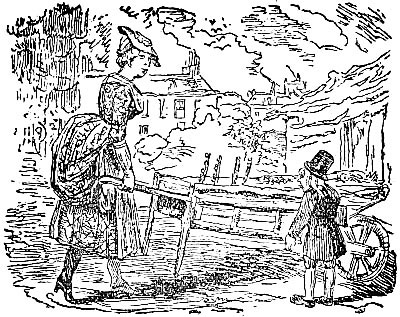
Round and sound, Two-pence a pound. Cherries, rare ripe cherries! Cherries a ha’penny a stick Come and pick! come and pick! Cherries big as plums! who comes, who comes.
The late George Cruikshank, whose pencil was ever distinguished by power of decision in every character he sketched, and whose close observation of passing men and manners was unrivalled by any artist of his day, contributed the “London Barrow-woman” to the pages of Hone’s Every-Day Book in 1826 from his own recollection of her.
Buy a Broom.
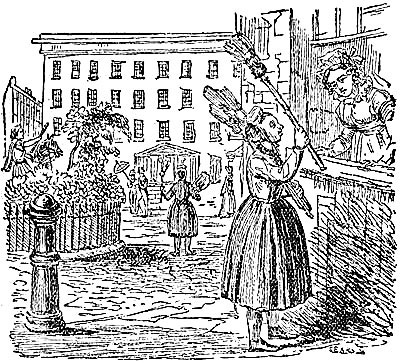
These poor “Buy-a-Broom girls” exactly dress now, As Hollar etch’d such girls two cent’ries ago; All formal and stiff, with legs, only at ease— Yet, pray, judge for yourself; and don’t if you please, ****** But ask for the print, at old print shops—they’ll show it, And look at it, “with your own eyes,” and you’ll know it.
Buy a Broom? was formerly a very popular London-cry, when it was usually rendered thus:—“Puy a Proom, puy a prooms? a leetle von for ze papy, and a pig vons for ze lady: Puy a Proom.” Fifty years ago Madame Vestris charmed the town by her singing and displaying her legs as a Buy-a-Broom Girl.
Buy a broom, buy a broom, Large broom, small broom, No lady should e’er be without one, &c.
But time and fashion has swept both the brooms and the girls from our shores.—Madame Vestris lies head-to-head with Charles Mathews in Kensal Green Cemetery. Tempus omnia revelat.
The Lady as Cries Cats’ Meat.
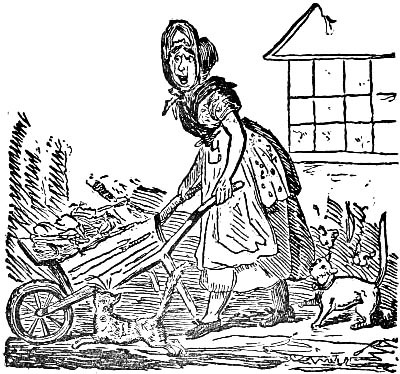
Old Maids, your custom I invites, Fork out, and don’t be shabby, And don’t begrudge a bit of lights Or liver for your Tabby. Hark! how the Pusses make a rout— To buy you can’t refuse; So may you never be without The music of their mews. Here’s famous meat—all lean, no fat— No better in Great Britain; Come, buy a penn’orth for your Cat— A happ’orth for your Kitten. Come all my barrow for a bob! Some charity diskivir; For faith, it ar’n’t an easy job To live by selling liver. Who’ll buy? who’ll buy of Catsmeat-Nan! I’ve bawl’d till I am sick; But ready money is my plan; I never gives no tick. I’ve got no customers as yet— In wain is my appeal— And not to buy a single bit Is werry ungenteel!
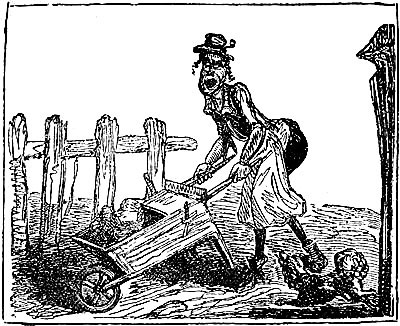
Our Dandy Cats’ and Dogs’ Meat Man.
Every morning as true as the clock—the quiet of “Our Village Green” is broken by a peculiar and suggestive cry. We do not hear it yet ourselves, but Pincher, our black and tan terrier dog, and Smut, our black and white cat, have both caught the well-known accents, and each with natural characteristic—the one wagging his tail, the other with a stiff perpendicular [dorsel appendage] sidles towards the door, demanding as plainly as possible, to be let out. Yes, it is “Our Dandy Cats’ and Dogs’ Meat Man,” with his “Ca’ me-e-et—dogs’ me yet—Ca’ or do-args-me-a-yet, me a-t—me-yett!!!” that fills the morning air, and arouses exactly seven dogs of various kinds, and exactly thirty-one responsive feline voices—there is a cat to every house on “Our Village Green”—and causes thirty-one aspiring cat’s-tails to point to the zenith. We do not know how it is, but the Cat’s-meat man is the most unerring and punctual of all those peripatetic functionaries who undertake to cater for the public. The baker, the butcher, the grocer, the butterman, the fishmonger, and the coster, occasionally forget your necessities, or omit to call for your orders—the cat’s-meat man never!
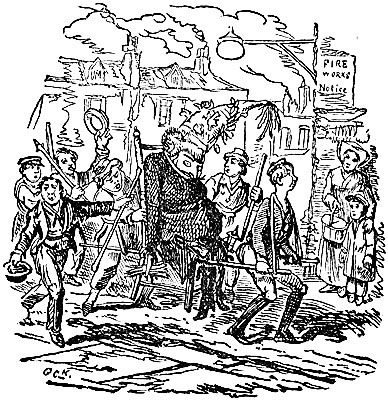
Guy Fawkes—Guy.
There cannot be a better representation of “Guy Fawkes,” as he was borne about the metropolis in effigy in the days “When George the Third was King,” than the above sketch by George Cruikshank.
Please to remember the fifth of November, Gunpowder treason and plot; We know no reason, why gunpowder treason, Should ever be forgot! Holla boys! holla boys! huzza-a-a! A stick and a stake, for King George’s sake, A stick and a stump, for Guy Fawkes’ rump! Holla boys! holla boys! huzza-a-a!
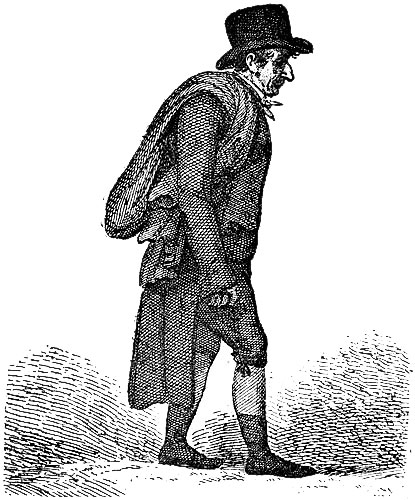
Henry Lemoine, The Literary and Pedestrian Bookseller and Author, A well known Eccentric Character of the City of London.
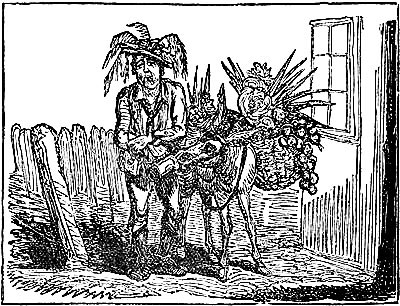
All Round my Hat I Vears a Green Villow.
All round my hat I vears a green villow, All round my hat, for a twelvemonth and a day; If any body axes me the reason vy I vears it, I tells ’em that my own true love is far far away. ’Twas a going of my rounds, in the streets I first did meet her, Oh, I thought she vos a hangel just come down from the sky;
Spoken.—She’s a nice wegitable countenance; turnup nose, redish cheeks, and carroty hair.
And I never knew a voice more louder or more sweeter, Vhen she cried, buy my primroses, my primroses come buy.
Spoken.—Here’s your fine colliflowers.
All round, &c. O, my love she was fair, my love she was kind, too, And cruel vos the cruel judge vot had my love to try:
Spoken.—Here’s your precious turnups.
For thieving vos a thing she never vos inclined to: But he sent my love across the seas, far far away.
Spoken.—Here’s your hard-hearted cabbages.
All round, &c. For seven long years my love and I is parted, For seven long years my love is bound to stay.
Spoken.—It’s a precious long time ’fore I does any trade to-day.
Bad luck to that chap vot’d ever be false-hearted, Oh, I’ll love my love for ever, tho’ she’s far far away.
Spoken.—Here’s your nice heads of salary!
All round, &c. There is some young men so preciously deceitful, A coaxing of the young gals they vish to lead astray.
Spoken.—Here’s your Valnuts; crack’em and try’em, a shilling a hundred!
As soon as they deceives’em, so cruelly they leaves ’em, And they never sighs nor sorrows ven they’re far far away!—
Spoken.—Do you vant any hingons to-day, marm?
All round, &c. Oh, I bought my love a ring on the werry day she started, Vich I gave her as a token all to remember me:
Spoken.—Bless her h-eyes,
And vhen she does come back, oh, ve’ll never more be parted But ve’ll marry and be happy—oh, for ever and a day.
Spoken.—Here’s your fine spring redishes.
All round, &c.
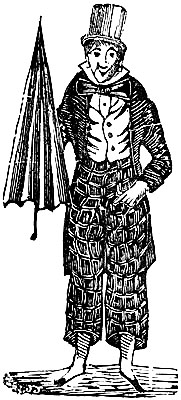
The New London Cries.
Tune—“The Night Coach.”
Dear me! what a squalling and a bawling, What noise, and what bustle in London pervades; People of all sorts shouting and calling, London’s a mart, sure, for men of all trades. The chummy so black, sir, with bag on his back, sir, Commences the noise with the cry of “sweep, sweep!” Then Dusty and Crusty with voices so lusty, Fish-men and green-men, their nuisances keep. Dear me, &c. Fine water cresses, two bunches a penny, Fine new milk, two-pence ha’p’ny a quart! Come buy my fine matches—as long as I’ve any, Carrots and turnips, the finest e’er bought. Dainty fresh salmon! without any gammon, Hare skins or rabbit skins! hare skins, cook I buy! ’Taters all sound, sir, two-pence six pounds, sir, Coals ten-pence a bushel, buy them and try. Dear me, &c. Here’s songs three yards for a penny! Comic songs, love songs, and funny songs, too; Billy Barlow,—Little Mike,—Paddy Denny! The Bailiffs are coming—The Hero of Waterloo. Eels four-pence a pound—pen knives here ground, Scissors ground sharp, a penny a pair! Tin kettles to mend, sir, your fenders here send, sir, For six-pence a piece, I will paint ’em with care. Dear me, &c. Come buy my old man, a penny a root, The whole true account of the murder last night! Fine Seville oranges, ne’er was such fruit, Just printed and published, the last famous fight. Arrived here this morning—strange news from Greece, A victory gain’d o’er the great Turkish fleet; Chairs to mend—hair brooms, a shilling a piece! Cap box, bonnet box—cats’ and dogs’ meat. Dear me, &c. Here’s inguns a penny a rope, Pots and pans—old clothes, clo’ for sale! A dread storm near the Cape of Good Hope. Greens two-pence a bunch—twenty-pence a new pail. Sprats, a penny a plateful—I should feel werry grateful, Kind friends for a ha’p’ny for my babe’s sakes; Shrimps, penny a pot—baked ’taters all hot! Muffins and crumpets, or fine Yorkshire cakes. Dear me, &c.
“Had I a Garden, a Field and a Gate, I would not care for the Duke of Bedford’s estate; That is, I would not care for the Duke of Bedford’s estate, If I had Covent Garden, Smithfield, and Billingsgate.”
Billingsgate has from time immemorial had much to do with “The Cries of London,” and although a rough and unromantic place at the present day, has an ancient legend of its own, that associates it with royal names and venerable folk. Geoffrey of Monmouth deposeth that about 400 years before Christ’s nativity, Belin, a king of the Britons, built this gate and gave it its name, and that when he was dead the royal body was burnt, and the ashes set over the gate in a vessel of brass, upon a high pinnacle of stone. The London historian, John Stow, more prosaic, on the other hand, is quite satisfied that one Biling once owned the wharf, and troubles himself no further.
Byllngsgate Dock is mentioned as an important quay in “Brompton’s Chronicle” (Edward III.), under the date 976, when King Ethelred, being then at Wantage, in Berkshire, made laws for regulating the customs on ships at Byllngsgate, then the only wharf in London. 1. Small vessels were to pay one halfpenny. 2. Larger ones, with sails, one penny. 3. Keeles, or hulks, still larger, fourpence. 4. Ships laden with wood, one log shall be given for toll. 5. Boats with fish, according to size, a halfpenny. 6. Men of Rouen, who came with wine or peas, and men of Flanders and Liege, were to pay toll before they began to sell, but the Emperor’s men (Germans of the Steel Yard) paid an annual toll. 7. Bread was tolled three times a week, cattle were paid for in kind, and butter and cheese were paid more for before Christmas than after.
Hence we gather that at a very early period Billingsgate was not merely a fish-market, but for the sale of general commodities. Paying toll in kind is a curious fiscal regulation; though, doubtless, when barter was the ordinary mode of transacting business, taxes must have been collected in the form of an instalment of the goods brought to market.
Our ancestors four hundred years ago had, in proportion to the population of London, much more abundant and much cheaper fish than we have now. According to the “Noble Boke off Cookry,” a reprint of which, from the rare manuscript in the Holkham Collection, has just been edited by Mrs. Alexander Napier, Londoners in the reign of Henry VII. could regale on “baked porpois,” “turbert,” “pik in braissille,” “mortins of ffishe,” “eles in bruet,” “fresh lamprey bak,” “breme,” in “sauce” and in “brasse,” “soal in brasse,” “sturgion boiled,” “haddock in cevy,” “codling haddock,” “congur,” “halobut,” “gurnard or rocket boiled,” “plaice or flounders boiled,” “whelks boiled,” “perche boiled,” “freeke makrell,” “bace molet,” “musculles,” in “shelles” and in “brothe,” “tench in cevy,” and “lossenge for ffishe daies.” For the rich there were “potages of oysters,” “blang mang” and “rape” of “ffishe,” to say nothing of “lampry in galantyn” and “lampry bak.” Our forefathers ate more varieties of fish, cooked it better, and paid much less for it than we do, with all our railways and steamboats, our Fisheries’ Inspectors, our Fisheries Exhibion and new Fish Markets with their liberal rules and regulations. To be sure, those same forefathers of ours not only enacted certain very stringent laws against “forestalling” and “regrating,” but were likewise accustomed to enforce them, and to make short work upon occasion of the forestalled and regraters of fish, as of other commodities.
In Donald Lupton’s “London and the Covntrey Carbonadoed and Quartred into seuerall Characters. London, Printed by Nicholas Okes, 1632,” the nymphs of the locality are thus described:—
Fisherwomen:—These crying, wandering, and travelling creatures carry their shops on their heads, and their storehouse is ordinarily Byllyngsgate, or Ye Brydge-foot; and their habitation Turnagain Lane. They set up every morning their trade afresh. They are easily furnished; get something and spend it jovially and merrily. Five shillings, a basket, and a good cry, are a large stock for them. They are the merriest when all their ware is gone. In the morning they delight to have their shop full; at evening they desire to have it empty. Their shop is but little, some two yards compass, yet it holds all sort of fish, or herbs, or roots, and such like ware. Nay, it is not destitute often of nuts, oranges, and lemons. They are free in all places, and pay nothing for rent, but only find repairs to it. If they drink their whole stock, it is but pawning a petticoate in Long Lane, or themselves in Turnbull Street, to set up again. They change daily; for she that was for fish this day, may be to-morrow for fruit, next day for herbs, another for roots; so that you must hear them cry before you know what they are furnished withal. When they have done their Fair, they meet in mirth, singing, dancing, and end not till either their money, or wit, or credit be clean spent out. Well, when on any evening they are not merry in a drinking house, it is thought they have had bad return, or else have paid some old score, or else they are bankrupt: they are creatures soon up and soon down.
The above quaint account of the ancient Billingsgate ladies answers exactly to the costermonger’s wives of the present day, who are just as careless and improvident; they are merry over their rope of onions, and laugh over a basketful of stale sprats. In their dealings and disputes they are as noisy as ever, and rather apt to put decency and good manners to the blush. Billingsgate eloquence has long been proverbial for coarse language, so that low abuse is often termed, “That’s talking Billingsgate!” or, that, “You are no better than a Billingsgate fish-fag”—i.e., You are as rude and ill-mannered as the women of Billingsgate fish-market (Saxon, bellan, “to bawl,” and gate, “quay,” meaning the noisy quay). The French say “Maubert,” instead of Billingsgate, as “Your compliments are like those of the Place Maubert”—i.e., No compliments at all, but vulgar dirt-flinging. The “Place Maubert,” has long been noted for its market.
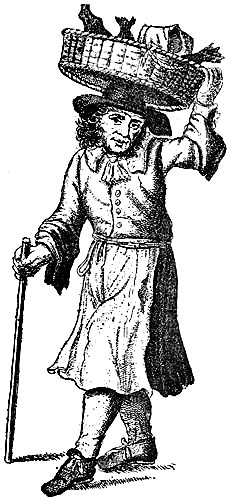
The Crier of Poor John.
“It is well thou art not a fish, for then thou would’st have been Poor John”—Romeo and Juliet.
The introduction of steamboats has much altered the aspect of Billingsgate. Formerly, passengers embarked here for Gravesend and other places down the river, and a great many sailors mingled with the salesmen and fishermen. The boats sailed only when the tide served, and the necessity of being ready at the strangest hours rendered many taverns necessary for the accommodation of travellers. The market formerly opened two hours earlier than at present, and the result was demoralising and exhausting. Drink led to ribald language and fighting, but the refreshment now taken is chiefly tea or coffee, and the general language and behaviour has improved. The fish-fags of Ned Ward’s time have disappeared, and the business is done smarter and quicker. As late as 1842 coaches would sometimes arrive at Billingsgate from Dover or Brighton, and so affect the market. The old circle from which dealers in their carts attended the market, included Windsor, St. Alban’s, Hertford, Romford, and other places within twenty-five miles. Railways have now enlarged the area of purchasers to an indefinite degree.
To see this market in its busiest time, says Mr. Mayhew, “the visitor should be there about seven o’clock on a Friday morning.” The market opens at four, but for the first two or three hours it is attended solely by the regular fishmongers and “bummarees,” who have the pick of the best there. As soon as these are gone the costermonger’s sale begins. Many of the costers that usually deal in vegetables buy a little fish on the Friday. It is the fast day of the Irish, and the mechanics’ wives run short of money at the end of the week, and so make up their dinners with fish: for this reason the attendance of costers’ barrows at Billingsgate on a Friday morning is always very great. As soon as you reach the Monument you see a line of them, with one or two tall fishmongers’ carts breaking the uniformity, and the din of the cries and commotion of the distant market begin to break on the ear like the buzzing of a hornet’s nest. The whole neighbourhood is covered with hand-barrows, some laden with baskets, others with sacks. The air is filled with a kind of sea-weedy odour, reminding one of the sea-shore; and on entering the market, the smell of whelks, red herrings, sprats, and a hundred other sorts of fish, is almost overpowering. The wooden barn looking square[14] where the fish is sold is, soon after six o’clock, crowded with shiny cord jackets and greasy caps. Everybody comes to Billingsgate in his worst clothes; and no one knows the length of time a coat can be worn until they have been to a fish sale. Through the bright opening at the end are seen the tangled rigging of the oyster boats, and the red-worsted caps of the sailors. Over the hum of voices is heard the shouts of the salesmen, who, with their white aprons, peering above the heads of the mob, stand on their tables roaring out their prices. All are bawling together—salesmen and hucksters of provisions, capes, hardware, and newspapers—till the place is a perfect Babel of competition.
“Ha-a-andsome cod! best in the market! All alive! alive! alive, oh!”—“Ye-o-o! ye-o-o! Here’s your fine Yarmouth bloaters! Who’s the buyer?”—“Here you are, governor; splendid whiting! some of the right sort!”—“Turbot! turbot! All alive, turbot.”—“Glass of nice peppermint, this cold morning? Halfpenny a glass!”—“Here you are, at your own price! Fine soles, oh!”—“Oy! oy! oy! Now’s your time! Fine grizzling sprats! all large, and no small!”—“Hullo! hullo, here! Beautiful lobsters! good and cheap. Fine cock crabs, all alive, oh!”—“Five brill and one turbot—have that lot for a pound! Come and look at ’em, governor; you won’t see a better lot in the market!”—“Here! this way; this way, for splendid skate! Skate, oh! skate, oh!”—“Had-had-had-had-haddock! All fresh and good!”—“Currant and meat puddings! a ha’penny each!”—“Now, you mussel-buyers, come along! come along! come along! Now’s your time for fine fat mussels!”—“Here’s food for the belly, and clothes for the back; but I sell food for the mind!” shouts the newsvendor.—“Here’s smelt, oh!”—“Here ye are, fine Finney haddick!”—“Hot soup! nice pea-soup! a-all hot! hot!”—“Ahoy! ahoy, here! Live plaice! all alive, oh!”—“Now or never! Whelk! whelk! whelk!” “Who’ll buy brill, oh! brill, oh?”—“Capes! waterproof capes! Sure to keep the wet out! A shilling apiece!”—“Eels, oh! eels, oh! Alive, oh! alive oh!”—“Fine flounders, a shilling a lot! Who’ll have this prime lot of flounders?”—“Shrimps! shrimps! fine shrimps!”—“Wink! wink! wink!”—“Hi! hi-i! here you are; just eight eels left—only eight!”—“O ho! O ho! this way—this way—this way! Fish alive! alive! alive, oh.”
Billingsgate; or, the School of Rhetoric.
Near London Bridge once stood a gate, Belinus gave it name, Whence the green Nereids oysters bring, A place of public fame. Here eloquence has fixed her seat, The nymphs here learn by heart In mode and figure still to speak, By modern rules of art. To each fair oratress this school Its rhetoric strong affords; They double and redouble tropes, With finger, fish, and words. Both nerve and strength and flow of speech, With beauties ever new, Adorn the language of these nymphs, Who give it all their due. O, happy seat of happy nymphs! For many ages known, To thee each rostrum’s forc’d to yield— Each forum in the town. Let other academies boast What titles else they please; Thou shalt be call’d “the gate of tongues,” Of tongues that never cease.
The sale of hot green peas in the streets of London is of great antiquity, that is to say, if the cry of “Hot peascods! one began to cry,” recorded by Lydgate in his London Lackpenny, may be taken as having intimated the sale of the same article under the modern cry of “Hot green peas! all hot, all hot! Here’s your peas, hot, hot, hot!” In many parts of the country it is, or was, customary to have a “scalding of peas,” as a sort of rustic festivity, at which green peas scalded or slightly boiled with their pods on are the main dish. Being set on the table in the midst of the party, each person dips his peapod in a common cup of melted butter, seasoned with salt and pepper, and extracts the peas by the agency of his teeth. At times one bean, shell and all is put into the steaming mass, whoever gets this bean is to be first married.
The sellers of green peas “hot, all hot!” have no stands but carry them in a tin pot or pan which is wrapped round with a thick cloth, to retain the heat. The peas are served out with a ladle, and eaten by the customers out of basins provided with spoons by the vendor. Salt and pepper are supplied at discretion, but the fresh! butter to grease ’em (avec votre permission.)
The hot green peas are sold out in halfpennyworths and pennyworths, some vendors, in addition to the usual seasoning supplied, add a suck of bacon. The “suck of bacon” is obtained by the street Arabs from a piece of that article, securely fastened by a string, to obtain a “relish” for the peas, or as is usually said “to flavour ’em;” sometimes these young gamins manage to bite the string and then bolt not only the bacon, but away from the vendors. The popular saying “a plate of veal cut with a hammy knife” is but a refined rendering of the pea and suck-’o-bacon, street luxury trick.
Pea soup is also sold in the streets of London, but not to the extent it was twenty years ago, when the chilled labourer and others having only a halfpenny to spend would indulge in a basin of—“All hot!”
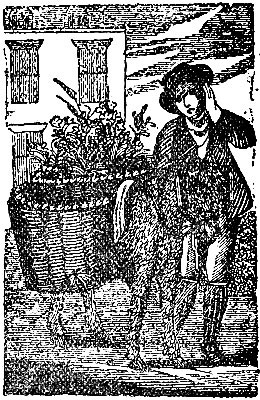
The Flower-Pot Man.
Here comes the old mail with his flowers to sell, Along the streets merrily going; Full many a year I’ve remember’d him well, With, “Flowers, a-growing, a-blowing.” Geraniums in dresses of scarlet and green; Thick aloes, that blossom so rarely; The long creeping cereus with prickles so keen, Or primroses modest and early. The myrtle dark green, and the jessamine pale, Sweet scented and gracefully flowing, This flower-man carries and offers for sale, “All flourishing, growing, and blowing.”
With the coming in of spring there is a large sale of Palm; on the Saturday preceding and on Palm Sunday; also of May, the fragrant flower of the hawthorn, and lilac in flower. But perhaps the pleasantest of all cries in early spring is that of “Flowers—All a-growing—all a-blowing,” heard for the first time in the season. Their beauty and fragrance gladden the senses; and the first and unexpected sight of them may prompt hopes of the coming year, such as seem proper to the spring.
“Come, gentle spring! ethereal mildness! come.”
The sale of English and Foreign nuts in London is enormous, the annual export from Tarragona alone is estimated at 10,000 tons. Of the various kinds, we may mention the “Spanish,” the “Barcelona,” the “Brazil,” the “Coker-nut,” the “Chesnut,” and “Though last, not least, in love”—The “Walnut!”
“As jealous as Ford, that search’d a hollow wall-nut for his wife’s lemon.”—Merry Wives of Windsor.
The walnut-tree has long existed in England, and it is estimated that upwards of 50,000 bushels of walnuts are disposed of in the wholesale markets of the London district annually. Who is not pleased to hear every Autumn the familiar cry of:—
“Crack ’em and try ’em, before you buy ’em, Eight a-penny—All new walnuts Crack ’em and try ’em, before you buy ’em, A shilling a-hundred—All new-walnuts.
The history of the happy and social walnut involves some curious misconceptions. Take its name to begin with. Why walnut? What has this splendid, wide-spreading tree to do with walls, except such as are used as stepping-stones for the boys to climb up into the branches and steal the fruit? Nothing whatever! for, if we are to believe the learned in such matters, this fine old English tree, as it is sometimes called, is not an English tree at all, but a distinct and emphatic foreigner, and hence the derivation. The walnut is a native of Persia, and has been so named to distinguish the naturalised European from its companions, the hazel, the filbert, and the chesnut. In “the authorities” we are told that “gual” or “wall” means “strange” or “exotic,” the same root being found in Welsh and kindred tongues; hence walnut. It is true, at any rate, that in France they retain the distinctive name “Noix Persique.” There is another mistaken theory connected with the tree which bears a fruit so dear to society at large, for someone has been hazardous enough to assert that:—
“A woman, a spaniel, and a walnut tree, The more you beat them the better they be.”
And this ribald rhyme—which is of Latin origin, is now an established English proverb, or proverbial phrase, but variously construed. See Nash’s “Have with you to Saffron-Walden; or, Gabriel Harvey’s Hunt is up,” 1596.—Reprinted by J. P. Collier, 1870. Moor, in his “Suffolk Words,” pp. 465, furnishes another version, which is rather an epigram than a proverb:—
“Three things by beating better prove; A Nut, an Ass, a Woman; The cudgel from their back remove, And they’ll be good for no man.” “Nux, asinus, mulier simili sunt lege ligata. Hæc tria nil recté faciunt si verbera cessant. Adducitur a cognato, est temen novum.”—Martial.
“Sam.... Why he’s married, beates his wife, and has two or three children by her: for you must note, that any woman beares the more when she is beaten.”—A Yorkshire Tragedy: “Not so New, as Lamentable and true—1608,” edition 1619.—Signature, A. Verso.
“Flamineo.—Why do you kick her, say? Do you think that she’s like a walnut tree? Must she be cudgell’d ere she bear good fruit?”
—Webster’s “White Devil,” 1612. iv. 4. (Works, edited by W. C. Hazlitt, II. 105.)
Now all these statements are at once unkind and erroneous all round. We know what is declared of the “man who, save in the way of kindness, lays his hand upon a woman,” to say nothing of the punishment awaiting him at the adjacent police court.[15] As to dogs, those who respect the calves of their legs had best beware of the danger of applying this recipe to any but low-spirited animals. In the case of the walnut-tree, the recommendation is again distinctly false, and the results mis-described. Possibly there are walnut-trees, as there are women, dogs, and horses, who seem none the worse for the stick; but, as a general rule, kindly treatment, for vegetable and animal alike, is the best, and, in the long run, the wisest.
In “The Miller’s Daughter,” one of the most homely and charming poems ever penned by the Poet Laureate, occurs a quatrain, spoken by an old gentleman addressing his faithful spouse:—
“So sweet it seems with thee to talk, And once again to woo thee mine; ’Tis like an after-dinner talk Across the walnuts and the wine.”
The Christmas Holly.
“The Holly! the Holly! oh, twine it with bay— Come give the Holly a song; For it helps to drive stern Winter away, With his garments so sombre and long. It peeps through the trees with its berries so red, And its leaves of burnished green, When the flowers and fruits have long been dead, And not even the daisy is seen. Then sing to the Holly, the Christmas Holly, That hangs over the peasant and king: While we laugh and carouse ’neath its glittering boughs, To the Christmas Holly we’ll sing.” Eliza Cook.
In London a large sale is carried on in “Christmasing,” or in the sale of holly, ivy, laurel, evergreens, bay, and mistletoe, for Christmas sports and decorations, by the family greengrocer and the costermongers. The latter of whom make the streets ring with their stentorian cry of:—
Holly! Holly!! Holly, oh!!! Christmas Holly, oh!
Old Cries.
By Miss Eliza Cook.
Oh! dearly do I love “Old Cries” That touch my heart and bid me look On “Bough-pots” plucked ’neath summer skies, And “Watercresses” from the brook. It may be vain, it may be weak, To list when common voices speak; But rivers with their broad, deep course, Pour from a mean and unmarked source: And so my warmest tide of soul From strange, unheeded spring will roll. “Old Cries,” “Old Cries”—there is not one But hath a mystic tissue spun Around it, flinging on the ear A magic mantle rich and dear, From “Hautboys,” pottled in the sun, To the loud wish that cometh when The tune of midnight waits is done With “A merry Christmas, gentlemen, And a Happy New Year—Past one- O’clock, and a frosty morning!” And there was a “cry” in the days gone by, That ever came when my pillow was nigh; When, tired and spent I was passively led By a mother’s hand, to my own sweet bed— My lids grew heavy, and my glance was dim, As I yawned in the midst of a cradle hymn— When the watchman’s echo lulled me quite, With “Past ten o’clock, and a starlight night!” Well I remember the hideous dream, When I struggled in terror, and strove to scream, As I took a wild leap o’er the precipice steep, And convulsively flung off the incubus sleep. How I loved to behold the moonshine cold Illume each well-known curtain-fold; And how I was soothed by the watchman’s warning, Of “Past three o’clock, and a moonlight morning!” Oh, there was music in this “old cry,” Whose deep, rough tones will never die: No rare serenade will put to flight The chant that proclaimed a “stormy night.” The “watchmen of the city” are gone, The church-bell speaketh, but speaketh alone; We hear no voice at the wintry dawning, With “Past five o’clock, and a cloudy morning!” Ah, well-a-day! it hath passed away, But I sadly miss the cry That told in the night when the stars were bright, Or the rain-cloud veiled the sky. Watchmen, Watchmen, ye are among The bygone things that will haunt me long. “Three bunches a penny, Primroses!” Oh, dear is the greeting of Spring; When she offers her dew-spangled posies; The fairest Creation can bring. “Three bunches a penny, Primroses!” The echo resounds in the mart; And the simple “cry” often uncloses The worldly bars grating man’s heart. We reflect, we contrive, and we reckon How best we can gather up wealth; We go where bright finger-posts beckon, Till we wander from Nature and Health. But the “old cry,” shall burst on our scheming, The song of “Primroses” shall flow, And “Three bunches a penny” set dreaming Of all that we loved long ago. It brings visions of meadow and mountain, Of valley, and streamlet, and hill, When Life’s ocean but played in a fountain— Ah, would that it sparkled so still! It conjures back shadowless hours, When we threaded the dark, forest ways; When our own hand went seeking the flowers, And our own lips were shouting their praise. The perfume and tint of the blossom; Are as fresh in vale, dingle, and glen; But say, is the pulse of our bosom As warm and as bounding as then? “Three bunches a penny,—Primroses!” “Three bunches a penny,—come, buy!” A blessing on all the sweet posies, And good-will to the poor ones who cry. “Lavender, sweet Lavender!” With “Cherry Ripe!” is coming; While the droning beetles whirr, And merry bees are humming. “Lavender, sweet Lavender!” Oh, pleasant is the crying; While the rose-leaves scarcely stir, And downy moths are flying, Oh, dearly do I love “Old Cries,” Your “Lilies all a-blowing!” Your blossoms blue, still wet with dew, “Sweet Violets all a-growing!” Oh, happy were the days, methinks, In truth the best of any; When “Periwinkles, winkle, winks!” Allured my last, lone penny. Oh, what had I to do with cares That bring the frown and furrow, When “Walnuts” and “Fine mellow Pears” Beat Catalani thorough. Full dearly do I love “Old Cries,” And always turn to hear them; And though they cause me some few sighs, Those sighs do but endear them. My heart is like the fair sea-shell, There’s music ever in it; Though bleak the shore where it may dwell, Some power still lives to win it. When music fills the shell no more, ’Twill be all crushed and scattered; And when this heart’s deep tone is o’er, ’Twill be all cold and shattered. Oh, vain will be the hope to break Its last and dreamless slumbers; When “Old Cries” come, and fail to wake Its deep and fairy numbers!
Dust, O!—Dust, O!—Bring it out to day, Bring it out to-day, I sha’n’t be here to-mor-row!
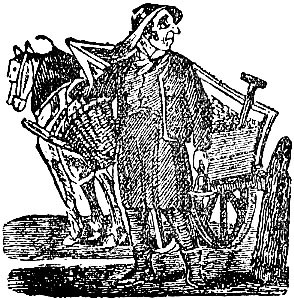
Dust, O!—Dust, O!
His noisy bell the dustman rings, Her dust the housemaid gladly brings: Ringing he goes from door to door, Until his cart will hold no more.
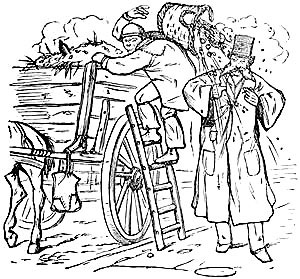
The Dustman.
Bring out your dust, the dustman cries, Whilst ringing of his bell: If the wind blows, pray guard your eyes, To keep them clear and well. I am very glad ’tis not my luck To get my bread by carting muck; I am sure I never could be made To work at such a dirty trade. Hold, my fine spark, not so fast, Some proud folks get a fall at last; And you, young gentleman, I say, May be a Dustman, one fine day. All working folks, who seldom play, Yet get their bread in a honest way, Though not to wealth or honours born, Deserve respect instead of scorn. Such rude contempt they merit less Than those who live in idleness; Who are less useful, I’m afraid, Than I, the Dustman, am by trade.
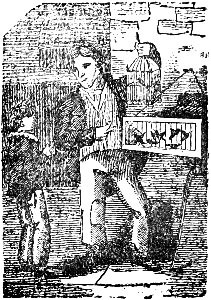
The Birdman.
Have pity, have pity on poor little birds, Who only make music, and cannot sing words; And think, when you listen, we mean by our strain, O! let us fly home to our woodlands again. Our dear woody coverts, and thickets so green, Too close for the school-boy to rustle between; No foot to alarm us, no sorrow, no rain, O! let us fly home to our woodlands again. There perched on the branches that wave to the wind, No more in this pitiless prison confined, How gaily we’ll tune up our merriest strain, If once we get home to our woodlands again.
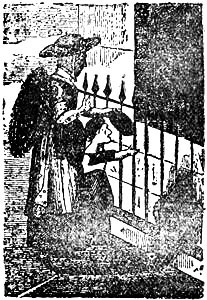
Buy a Door-Mat or a Table-Mat.
Stooping o’er the ragged heath, Thick with thorns and briers keen, Or the weedy bank beneath, Have I cut my rushes green; While the broom and spiked thorn Pearly drops of dew adorn. Sometimes across the heath I wind, Where scarce a human face is seen, Wandering marshy spots to find, Where to cut my rushes green; Here and there, with weary tread, Working for a piece of bread. Then my little child and I Plat and weave them, as you see; Pray my lady, pray do buy, You can’t have better than of me; For never, surely were there seen Prettier mats of rushes green.
I sweep your Chimnies clean, O, Sweep your Chimney clean, O!
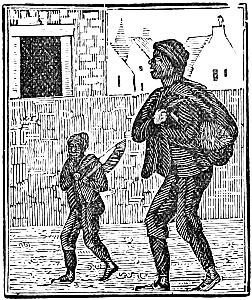
The Chimney Sweeper.
With drawling tone, brush under arm, And bag slung o’er his shoulder: Behold the sweep the streets alarm, With Stentor’s voice, and louder.
Buy my Diddle Dumplings, hot! hot! Diddle, diddle, diddle, Dumplings hot!
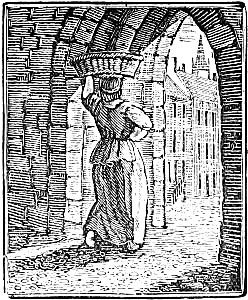
The Dumpling Woman.
This woman’s in industry wise, She lives near Butcher-row; Each night round Temple-bar she plies, With Diddle Dumplings, ho!
Yorkshire Cakes, Who’ll buy Yorkshire Cakes, All piping hot—smoking hot! hot!!
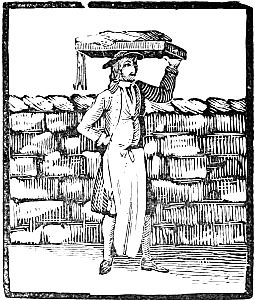
The Yorkshire Cake Man.
Fine Yorkshire Cakes; Who’ll buy Yorkshire cakes? They are all piping hot, and nicely made; His daily walk this fellow takes, And seems to drive a pretty trade.
Buy my Flowers, sweet Flowers, new-cut Flowers, New Flowers, sweet Flowers, fresh Flowers, O!
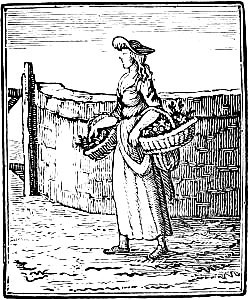
Flowers, Cut Flowers.
New-cut Flowers this pretty maid doth cry, In Spring, Summer and Autumn, gaily; Which shows how fast the Seasons fly— As we pass to our final home, daily.
Buy green and large Cucumbers, Cucumbers, Green and large Cucumbers, twelve a penny.
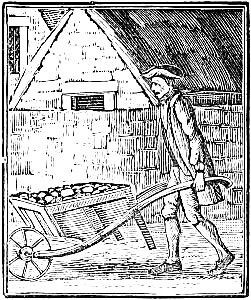
Cucumbers.
A penny a dozen, Cucumbers! Tailors, hallo! hallo! Now from the shop-board each man runs, For Cucumbers below.
Buy Rosemary! Buy Sweetbriar! Rosemary and Sweetbriar, O!
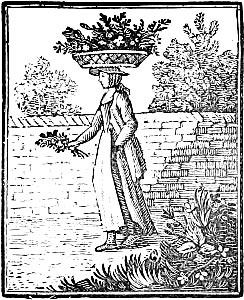
Rosemary and Sweetbriar.
Rosemary and briar sweet, This maiden now doth cry, Through every square and street, Come buy it sweet, come buy it dry.
Newcastle Salmon! Dainty fine Salmon! Dainty fine Salmon! Newcastle Salmon!
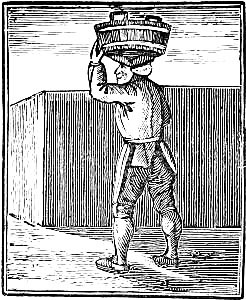
Newcastle Salmon.
Newcastle salmon, very good, Is just come in for summer food; No one hath better fish than I, So if you’ve money come and buy.
Buy my Cranberries! Fine Cranberries! Buy my Cranberries! Fine Cranberries!
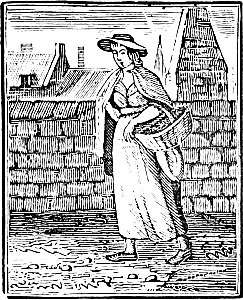
Cranberries.
Buy Cranberries, to line your crust, In Lincolnshire they’re grown; Come buy, come buy, for sell I must Three quarts for half-a-crown.
Come buy my Walking-Sticks or Canes! I’ve got them for the young or old.
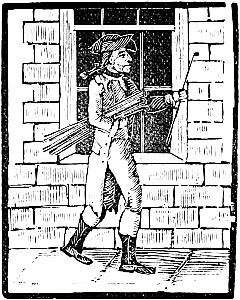
Sticks and Canes.
How sloven like the school-boy looks, Who daubs his books at play; Give him a new one? No, adzooks! Give him a Cane, I say.
Buy my fine Gooseberries! Fine Gooseberries! Three-pence a quart! Ripe Gooseberries!
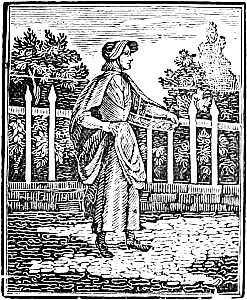
Gooseberries.
Ripe gooseberries in town you’ll buy As cheap as cheap can be; Of many sorts you hear the cry; Pray purchase, sir, of me!
Pears for pies! Come feast your eyes! Ripe Pears, of every size, who’ll buy?
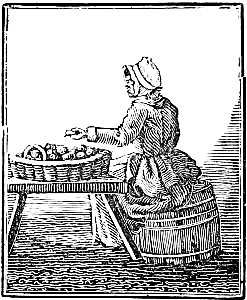
Ripe Pears.
Pears ripe, pears sound, This woman cries all day; Pears for pies, long or round, Come buy them while you may.
One a penny, two a penny, hot Cross Buns! One a penny, two a penny, hot Cross Buns!
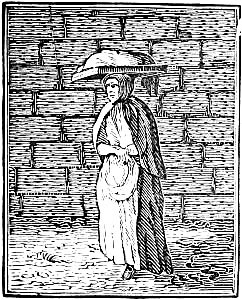
Hot Cross Buns.
Think on this sacred festival; Think why Cross Buns were given; Then think of Him who dy’d for all, To give you right to Heaven.
Maids, I mend old Pans or Kettles, Mend old Pans or Kettles, O!
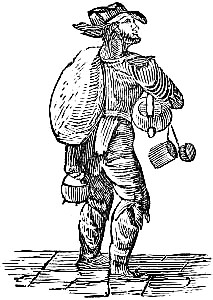
The Tinker.
Hark, who is this? the Tinker bold, To mend or spoil your kettle, Whose wife I’m certain is a scold, Made of basest metal.
Buy my Capers! Buy my nice Capers! Buy my Anchovies! Buy my nice Anchovies!
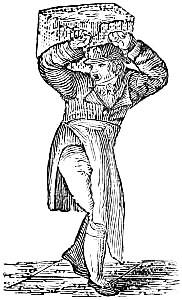
Capers, Anchovies.
How melodious the voice of this man, The Capers he says are the best; His Anchovies too, beat ’em who can, Are constantly found in request.
Mulberries, all ripe and fresh to day! Only a groat a pottle—full to the bottom!
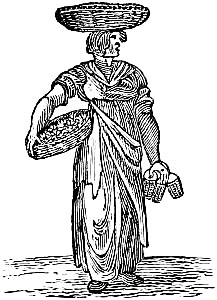
Mulberries.
Mulberries, ripe and fresh to-day, They warm and purify the blood; Have them a groat a pottle you may. They are all fresh! they are all good!
Buy my Cockles! Fine new Cockles! Cockles fine, and Cockles new!
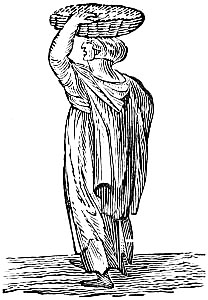
New Cockles.
Cockles fine; and cockles new, They are as fine as any. Cockles! New cockles, O! I sell a good lot for a penny, O!
Buy fine Flounders! Fine Dabs! All alive, O! Fine Dabs! Fine live Flounders, O!
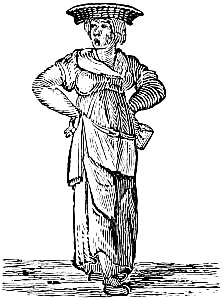
Buy Fine Flounders! Fine Dabs!
There goes a tall fish-woman sounding her cry, “Who’ll buy my fine flounders, and dabs, who’ll buy?” Poor flounder, he heaves up his fin with a sigh, And thinks that he has most occasion to cry; “Ah, neighbour,” says dab, “indeed, so do I.”
Buy my nice and new Banbury Cakes! Buy my nice new Banbury Cakes, O!
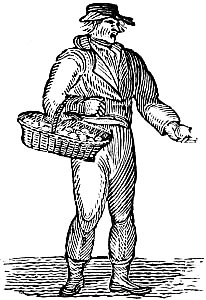
Banbury Cakes.
Buy Banbury Cakes! By fortune’s frown, You see this needy man, Along the street, and up and down, Is selling all he can.
Buy my Lavender! Sweet blooming Lavender! Sweet blooming Lavender! Blooming Lavender!
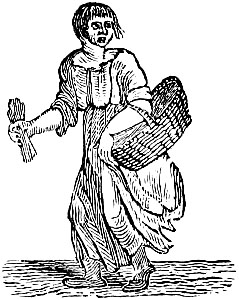
Lavender.
Lavender! Sweet blooming lavender, Six bunches for a penny to-day! Lavender! sweet blooming lavender! Ladies, buy it while you may.
Live Mackerel! Three a-shilling, O! Le’ping alive, O! Three a-shilling O!
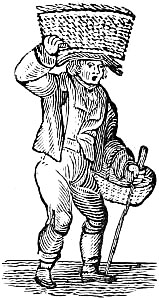
Mackerel.
Live Mackerel, oh! fresh as the day! At three for a shilling, is giving away; Full row’d, like bright silver they shine; Two persons on one can sup or dine.
Buy my Shirt Buttons! Shirt Buttons! Buy Shirt Hand Buttons! Buttons!
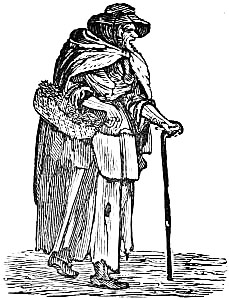
Shirt Buttons.
At a penny a dozen, a dozen, My Buttons for shirts I sell, Come aunt, uncle, sister, and cousin, I’ll warrant I’ll use you well.
Buy my Rabbits! Rabbits, who’ll buy? Rabbit! Rabbit! who will buy?
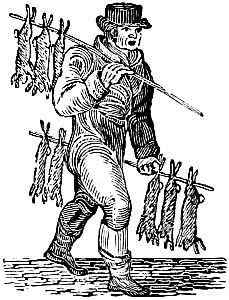
The Rabbit Man.
“Rabbit! Rabbit! who will buy?” Is all you hear from him; The Rabbit you may roast or fry, The fur your cloak will trim.
Buy Rue! Buy Sage! Buy Mint! Buy Rue, Sage and Mint, a farthing a bunch!
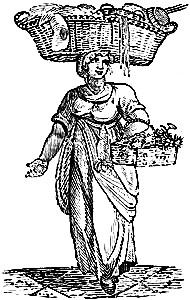
The Herb-Wife.
As thro’ the fields she bends her way, Pure nature’s work discerning; So you should practice every day, To trace the fields of learning.
Apple Tarts! All sweet and good, to-day! Hot, nice, sweet and good, to-day!
Apple Tarts. Apple Tarts.
Apple Tarts! Apple Tarts! Tarts, I cry! They are all of my own making, My Apple Tarts! My Apple Tarts, come buy! For, a honest penny I would be taking.
Ripe Strawberries! a groat a pottle, to-day, Only a groat a pottle, is what I say!
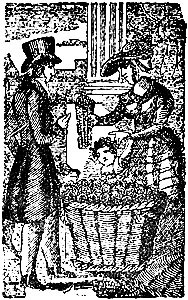
Ripe and Fresh Strawberries.
Ripe strawberries, a full pottle for a groat! They are all ripe and fresh gathered, as you see, No finer for money I believe can be bought; So I pray you come and deal fairly with me.
Any Knives, or Scissors to grind, to-day? Big Knives, or little Knives, or Scissors to grind, O!
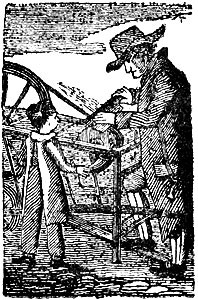
Any Knives or Scissors to Grind.
Any Knives or Scissors to grind, to-day? I’ll do them well and there’s little to pay; Any Knives or Scissors to grind, to-day? If you’ve nothing for me, I’ll go away.
Door-Mat! Door-Mat, Buy a Door-Mat, Rope-mat! Rope-Mat! Buy a Rope-Mat.
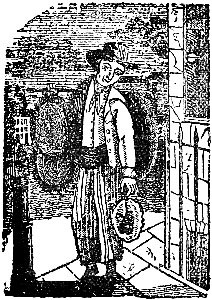
Rope Mat. Door Mat.
Rope Mat! Door Mat! you really must Buy one to save the mud and dust; Think of the dirt brought from the street For the want of a Mat to wipe your feet.
Clothes Props! Clothes Props! I say, good wives Clothes Props, all long and very strong, to-day.
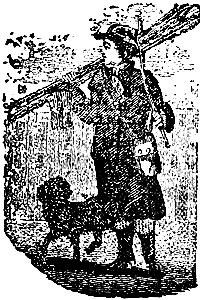
Clothes Props, Clothes Props.
Buy Clothes Props, Buy Clothes Props! Pretty maids, or pretty wives, I say, I sell them half the price of the shops; So you’ll buy of the old man, I pray.
Come take a Peep, boys, take a Peep? Girls, I’ve the wonder of the world.
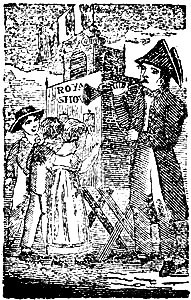
The Raree-Show.
Come take a Peep, each lady and gent, My Show is the best, I assure you; You’ll not have the least cause to repent, For I’ll strive all I can to allure you.
Water Cresses! Fine Spring Water Cresses! Three bunches a penny, young Water Cresses!
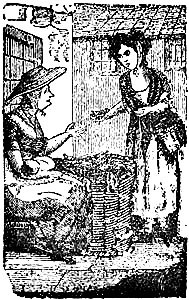
Water Cresses. Fresh and Fine.
Young Cresses, fresh, at breakfast taken A relish will give to eggs and bacon! My profit’s small, for I put many In bunches sold at three a penny
Mutton Pies! Mutton Pies! Mutton Pies, Come feast your eyes with my Mutton Pies.
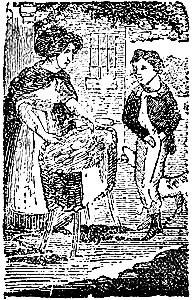
Who’ll Buy my Mutton Pies?
Through London’s long and busy streets, This honest woman cries, To every little boy she meets, Who’ll buy my Mutton Pies?
Please to Pity the Poor Old Fiddler! Pity the Poor Old Blind Fiddler!
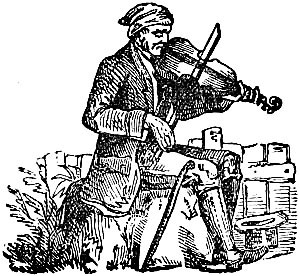
The Poor Old Fiddler.
The poor old Fiddler goes his rounds, Along with old Dog Tray; The East of London mostly bounds His journeys for the day.
Muffins, O! Crumpets! Muffins, to-day! Crumpets, O! Muffins, O! fresh, to-day!
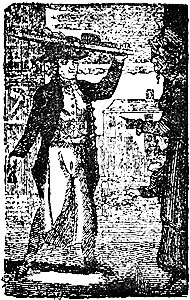
The Muffin Man.
The Muffin Man! hark, I hear His small bell tinkle shrill and clear; Muffins and Crumpets nice he brings, While on the fire the kettle sings.
Oysters, fresh and alive, three a penny, O! When they are all sold I sha’n’t have any, O!
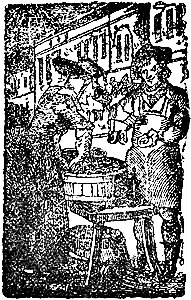
Oysters. Fine New Oysters.
They’re all alive and very fine, So if you like them, come and dine; I’ll find you bread and butter, too, Or you may have them opened for a stew.
Buy fine Kidney Potatoes! New Potatoes! Fine Kidney Potatoes! Potatoes, O!
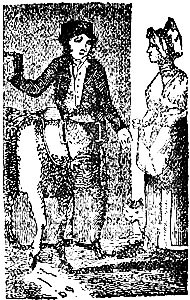
Potatoes, Kidney Potatoes.
Potatoes, oh! of kidney kind, Come buy, and boil, and eat, The core, and eke also, the rind, They are indeed so sweet.
Buy Images! Good and cheap! Images, very good—very cheap!
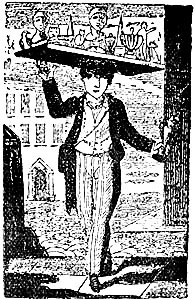
Buy my Images, Images.
Come buy my image earthenware, Your mantel pieces to bedeck, Examine them with greatest care, You will not find a single speck.
Buy ’em by the stick, or buy’em by the pound, Cherries ripe, all round and sound!
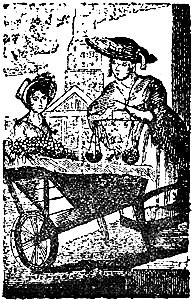
All round and sound, my Ripe Kentish Cherries.
Who such Cherries would see, And not tempted be To wish he possessed a small share? But observe, I say small, For those who want all Deserve not to taste of such fare.
Buy a Mop! Buy a Broom! Good to-day! Buy a Broom! Buy a Mop, I say!
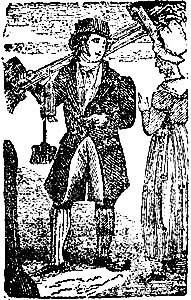
Buy a Mop or a Broom.
Ye cleanly housewives come to me, And buy a Mop or Broom, To sweep your chambers, scour your stairs, Or wash your sitting room.
Golden Pippins, all of the right sort, girls! Golden Pippins, all of the right sort, boys!
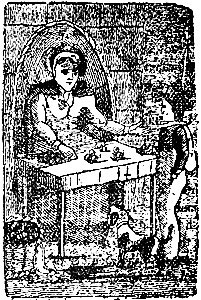
Golden Pippins, Who’ll Buy?
Here are fine Golden Pippins; Who’ll buy them, who’ll buy? Nobody in London sells better than I! Who’ll buy them, who’ll buy?
Wash Ball, a Trinket, or a Watch, buy? Buy ’em, all cheap and all good!
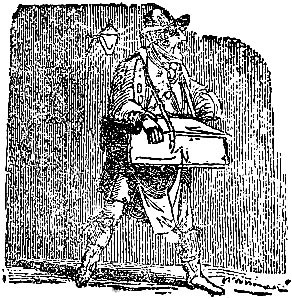
Wash Ball, Trinket, or Watch.
Do ye want any Wash Ball or Patch.— Dear ladies, pray, buy of me;— Or Trinkets to hang at your Watch, Or Garters to tie at your knee?
Past twelve o’clock, and a cloudy morning! Past twelve o’clock; and mind, I give you warning!
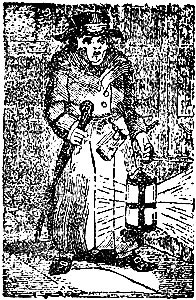
The City Watchman.
Past twelve o’clock, and a moonlight night! Past twelve o’clock, and the stars shine bright! Past twelve o’clock, your doors are all fast like you! Past twelve o’clock, and I’ll soon be fast, too!
Young Lambs to sell! Young Lambs to sell! Young Lambs to sell! Young Lambs to sell!
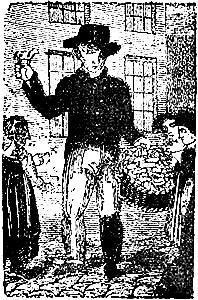
Young Lambs to Sell.
Young Lambs to sell! Young Lambs to sell! Two a penny, Young Lambs to sell; If I’d as much money as I could tell, I wouldn’t cry young Lambs to sell.
Buy my sweet and rare Lilies of the Valley? Buy of your Sally—Sally of our Alley?
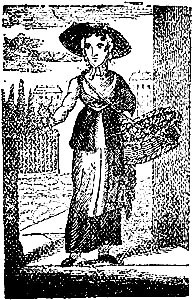
Lilies of the Valley.
In London street, I ne’er could find, A girl like lively Sally, Who picks and culls, and cries aloud, Sweet Lilies of the Valley.
Buy my young chickens! Buy’em alive, O! Buy of the Fowlman, and have ’em alive, O!
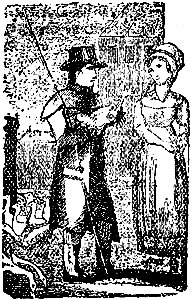
Buy Chickens, Young Chickens.
Buy my young Chickens, or a Fowl, well-fed, And we’ll not quarrel about the price; ’Tis thus I get my daily bread: As all the year round my Fowls are very nice.
Green Peas, I say! Green Peas, I say, here, Hav’em at your own price—here! here!
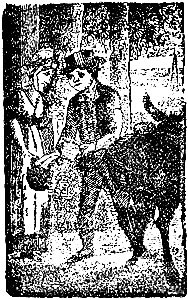
Green Peas! Buy my Green Peas?
Sixpence a peck, these Peas are sold, Fresh and green, and far from old; Green Marrows, it is quite clear, And as times go, cannot be dear.
Hat Box! Cap Box! Boxes, all sizes; All good, and at very low prices.
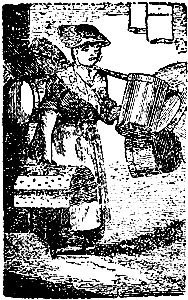
Hat-Box; Cap Box.
Hat or Cap Box! for ribbons or lace, When in a Box, keep in their place; And in a Box, your favourite bonnet Is safe from getting things thrown on it.
Eels, fine Silver Eels! Dutch Eels! They are all alive—Silver Eels!
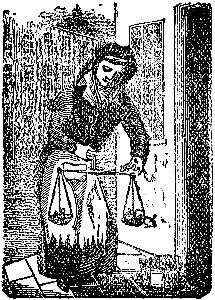
Eels; fine Dutch Eels.
Eels, alive! fine Dutch eels, I cry, Mistress, to use you well I’m willing, Come step forth and buy— Take four pounds for one shilling.
Plumbs, ripe Plumbs! Big as your thumbs! Plumbs! Plumbs! Big as your thumbs!
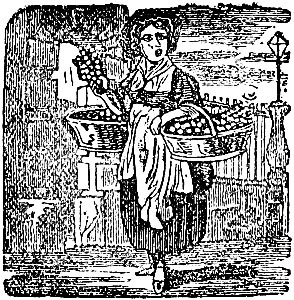
Plumbs; ripe Plumbs.
Plumbs, for puddings or pies, This noisy woman bawls; Plumbs, for puddings or pies, In every street she calls.
Buy a Purse; a long and a strong Purse! A good leather or a strong mole-skin Purse!
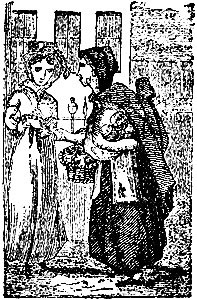
Buy a Purse.
Buy a Purse; a long and strong Purse, They’ll suit the young—they suit the old! To lose good money, what is worse? Yet it’s daily done for the want of a purse.
Kettles to mend! any Pots to mend? Daily I say as my way I wend.
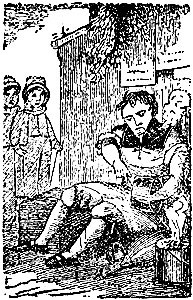
Kettles or Pots to Mend!
Kettles to mend! any pots to mend! You cannot do better to me than send; Think of the mess when the saucepans run, The fire put out, and the dinner not done.
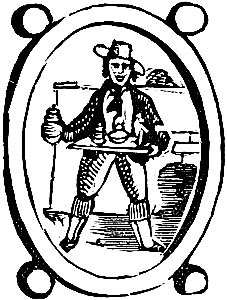
The Jolly Tinker.
My daddy was a tinker’s son, And I’m his boy, ’tis ten to one, Here’s pots to mend! was still his cry, Here’s pots to mend! aloud bawl I. Have ye any tin pots, kettles or cans, Coppers to solder, or brass pans? Of wives my dad had near a score, And I have twice as many more: My daddy was the lord—I don’t know who— With his:— Tan ran tan, tan ran tan tan, For pot or can, oh! I’m your man. Once I in my budget snug had got A barn-door capon, and what not, Here’s pots to mend! I cried along— Here’s pots to mend! was my song. At village wake—oh! curse his throat, The cock crowed so loud a note, The folks in clusters flocked around, They seized my budget, in it found The cock, a gammon, peas and beans, Besides a jolly tinker. Yes, a jolly tinker— With his— Tan ran tan, tan ran tan tan, For pot or can, oh! I’m your man. Like dad, when I to quarters come, For want of cash the folks I hum, Here’s kettles to mend: Bring me some beer! The landlord cries, “You’ll get none here! You tink’ring dog, pay what you owe, Or out of doors you’ll instant go,” In rage I squeezed him ’gainst the door, And with his back rubb’d off the score. At his expense we drown all strife For which I praise the landlord’s wife— With my Tan ran tan, tan ran tan tan, For pot or can, oh! I’m your man.
Fine China Oranges, sweet as sugar! They are very fine, and cheap, too, to-day.
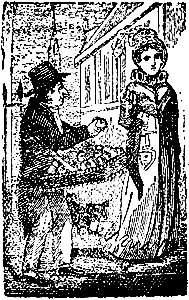
Fine China Oranges.
If friends permit, and money suits, The tempting purchase make; But, first, examine well the fruit, And then the change you take.
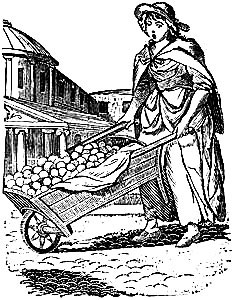
Fine ripe Oranges
Here are Oranges, fine ripe Oranges, Of golden colour to the eye, And fragrant perfume they’re dispensing, Sweeter than roses; come then and buy. Flowers cannot give forth the fragrance That scents the air from my golden store, Fairest lady, none can excel them, Buy then my Oranges; buy, I implore. Here are Oranges, fine ripe Oranges, Golden globes of nectar fine, Luscious juice the gods might envy, Richer far than the finest wine. Flowers cannot give forth the fragrance That scents the air from my golden store, Fairest lady, none can excel them, Buy then my Oranges; buy, I implore.
Round for Four Voices.
Sir. J. Stevenson.
Come buy my cherries, beauteous lasses; Fresh from the garden pluck’d by me; All on a summer’s day, so gay, You hear the London Cries—“Knives ground here by me.” Fine apples and choice pears, Eat, boys, forget your cares; All on a summer’s day, so gay, You hear the London Cries—“Sweep, sweep, sweep.” Fruit in abundance sold by me, Fruit in abundance here you see; All on a summer’s day, so gay, You hear the London Cries—“Parsnips, carrots, and choice beans.” Whey, fine sweet whey, Come taste my whey; All on a summer’s day, so gay, You hear the London Cries—“Fine radish, fine lettuce, sold by me.”
Primroses.
Come who’ll buy my roses, Primroses, who’ll buy? They are sweet to the sense, they are fair to the eye; They are covered all o’er with diamond dew, Which Aurora’s bright handmaids unsparingly threw On their beautiful heads: and I ask but of you— To buy, buy, buy, buy. The sun kiss’d the flowers as he rose from the sea bright, And their golden eyes opened with beauty and glee bright, Their sweets are untasted by hornet or bee— They are fresh as the morning and lovely to see— So reject not the blossoms now offered by me— But buy, buy, buy, buy. Nay, never refuse me, nor cry my buds down, They are nature’s production, and sweet ones, you’ll own; And tho’ torn from the earth, they will smile in your hall, They will bloom in a cottage, be it ever so small— And still look the lovliest flowers of all! So buy, buy, buy, buy.



THE LONDON CRIES IN LONDON STREETS.

Embellished with Pretty Cuts, For the use of Good little Boys and Girls, and a Copy of Verses.
Printed by T. BIRT,30,Great St. Andrew Street,
Wholesale & Retail,Seven Dials, London.
Country Orders punctually attended to. Every description of Printing done Cheap. ☞ Travellers and Shopkeepers supplied with Sheet Hymns, Patters, and Slip Songs, as Cheap and Good as any Shop in London.




T. BIRT. To the Good Little Masters and Mistresses in Town and Country.
Here! look at the Cries of London town, For you need not travel there; But view you those of most renown, Whilst sitting in your chair. At Home—a hundred miles away, ’Tis easy now to look At the Cries of London gay, In this our little book. Yes; there in quiet you may be, Beside the winter’s fire, And read as well as see, All those that you desire. Or underneath the oak so grey, That grows beside the briar; May pass the summer’s eve away, And view each City Crier.

Buy a Gazette? Great News!
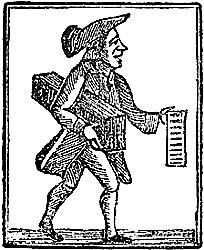
In the Gazette great news, to-day: The enemy is beat, they say, And all are eager to be told— The news, the new events unfold.
Come Buy my Fine Roses.
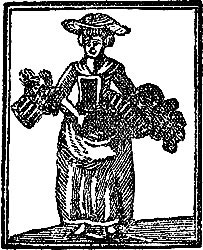
Come buy my fine roses, My myrtles and stocks; My sweet smelling balsams And close growing box.
Buy an Almanack: New Almanacks.
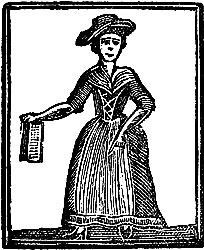
My Almanacks aim at no learning at all, But only to show when the holidays fall: And tell, as by study we easily may, How many eclipses the year will display.
Buy a Mop? Buy a Mop?
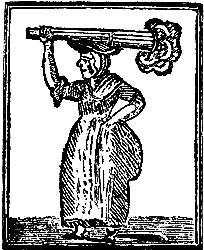
My Mop is so big, It might serve as a wig For a judge, had he no objection; And as to my brooms, They will sweep dirty rooms, And make the dust fly, to perfection.
Lobsters and Crabs.
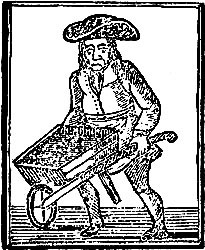
Here’s lobsters and crabs, Alive, O! and good, So buy if you please; This delicate food.
Milk from the Cow.
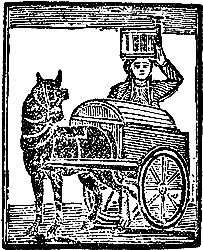
Rich Milk from the Cow, Both sweet and fine; The doctors declare; It is better than wine.
Buy a Basket, Large or Small?
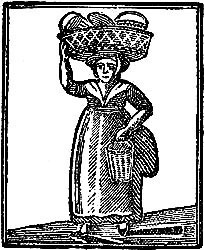
Buy a basket? large or small? For all sorts I’ve got by me, So come ye forth, one and all, If you buy once, another time you’ll try me.
Buy a Cane for Naughty Boys.
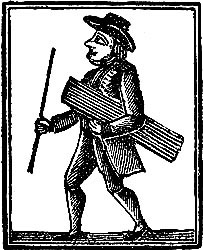
I’ve Sticks and Canes for old and young, To either they are handy, In driving off a barking cur, Or chastising a dandy.
Hot Rice-Milk.
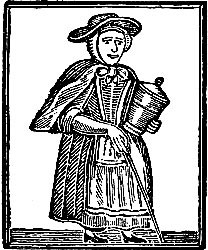
Hot Rice-Milk this woman calls— Behold her bright can, As up and down the streets she bawls Hot Rice-Milk to warm the inner man.
Peaches and Nectarines.
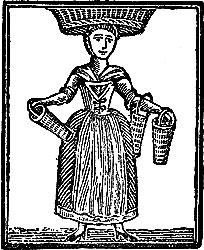
Nice Peaches and Nectarines Just fresh from the tree; All you who have money, Come buy them of me.
Hot Spice-Gingerbread.
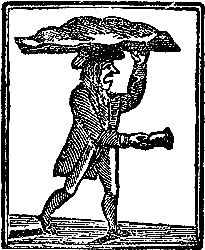
Hot Spice-Gingerbread, hot! hot! all hot! This noisy fellow loudly bawls, Hot! hot! hot! smoking hot! red hot! In every street or public place he calls.
Come, Buy my Spice-Gingerbread, Smoking Hot! Hot! Hot!
Come, boys and girls, men and maids, widows and wives, The best penny laid out you e’er spent in your lives; Here’s my whirl-a-gig lottery, a penny a spell, No blanks, but all prizes, and that’s pretty well. Don’t stand humming and ha-aring, with ifs and with buts, Try your luck for my round and sound gingerbread-nuts; And there’s my glorious spice-gingerbread, too, Hot enough e’en to thaw the heart of a Jew. Hot spice-gingerbread, hot! hot! all hot! Come, buy my spice-gingerbread, smoking hot! I’m a gingerbread-merchant, but what of that, then? All the world, take my word, deal in gingerbread ware; Your fine beaus and your belles and your rattlepate rakes— One half are game-nuts, the rest gingerbread cakes; Then in gingerbread coaches we’ve gingerbread lords, And gingerbread soldiers with gingerbread swords. And what are you patriots, ’tis easy to tell— By their constantly crying they’ve something to sell. And what harm is there in selling—hem!— Hot spice-gingerbread, &c. My gingerbread-lottery is just like the world, For its index of chances for ever is twirled; But some difference between’em exist, without doubt, The world’s lottery has blanks, while mine’s wholly without, There’s no matter how often you shuffle and cut, If but once in ten games you can get a game-nut. So I laugh at the world, like an impudent elf, And just like my betters, take care of myself, and my— Hot spice-gingerbread, &c.
T. Birt, Printer, 30, Great St. Andrews Street, Seven Dials.
Marks Edition.
THE NEW LONDON CRIES
OR A
VISIT TO TOWN.
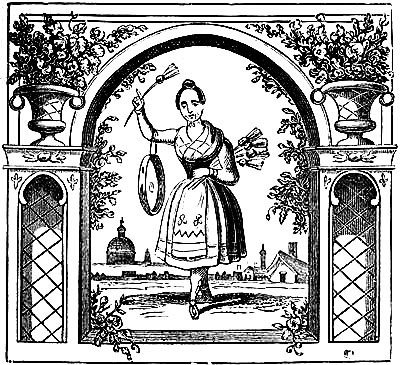
Buy a Broom.
From morn till eve I rove along, And joys my eyes illume, If you but listen to my song, And kindly buy a broom.
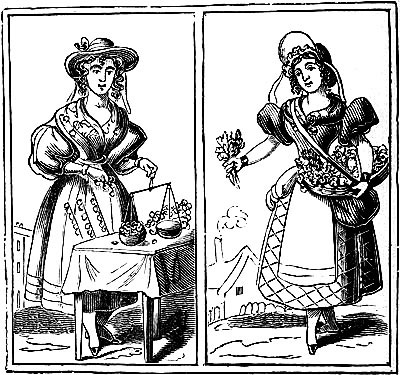
Ripe Cherries.
Cherries ripe four-pence a pound, Come buy of me they’re good and sound.
Water Cresses.
O you whom peace and plenty blesses, Buy my fine spring water cresses.
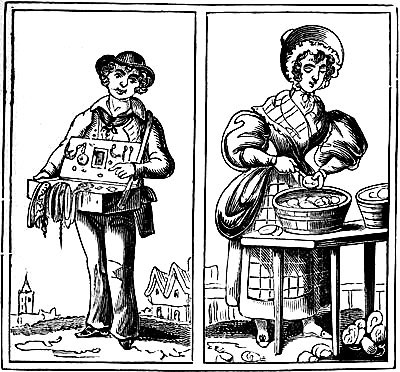
Young Pedlar.
Threads laces bodkins here I cry, Of a wandering orphan buy.
Oysters Sir.
My native oysters here I cry, Gents and ladies come and buy.
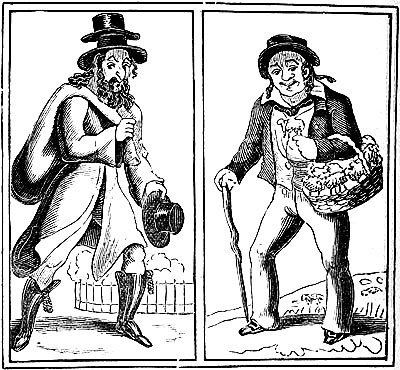
Old Clothes.
Daily streets and squares I range Calling clothes to sell or change.
Young Lambs.
In London streets I’m known full well, Two for a penny young lambs to sell.
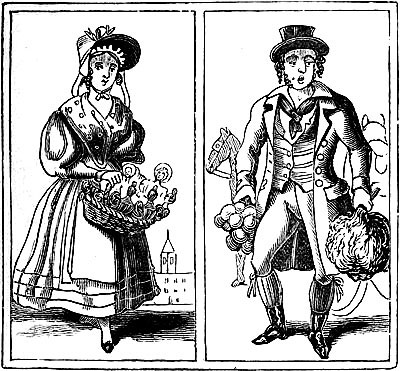
Dolls To Sell.
Come buy a doll my little miss, You’ll find no time as good as this.
Greens Cabbages Ho.
London daily hears my cry, Carrots Turnips who will buy.
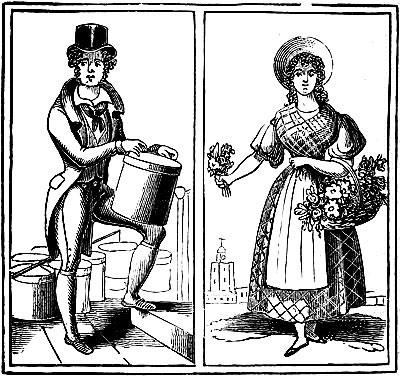
Bonnet Box.
Buy a Box for hat and cap, ’Twill keep them safe from all mishap.
Flower Girl.
My basket daily I supply, Come buy my nosegays buy who’ll buy.
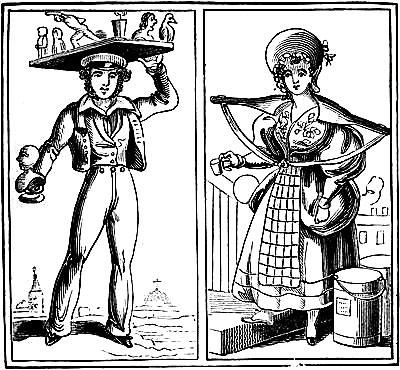
Images.
My casts are form’d to get my bread, And humble shelter for my head.
Milk Below.
At rise of morn my rounds I go, And daily cry my milk below.
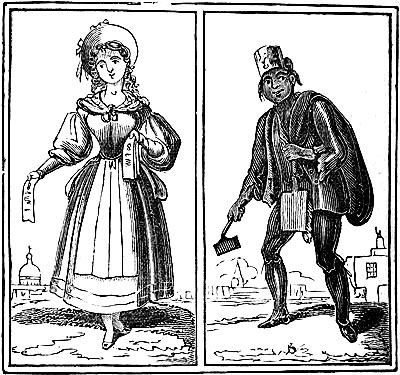
Ballad Singer.
Listen to my tunes so gay, And buy a ballad of me pray.
Sweep Soot Ho.
Comfort from my toil you reap, Then pray employ a little sweep.
London: Printed and Published by S. Marks & Sons, 72, Houndsditch.
THE CRIES OF LONDON.
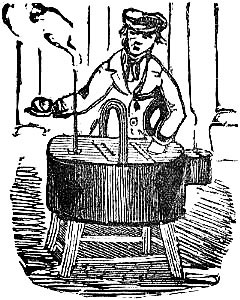
Flowery Ware—All Hot!
Here’s taters hot, my little chaps, Now just lay out a copper, I’m known up and down the Strand, You’ll not find any hotter.
———
LONDON: GOODE, BROS., Wholesale Stationers and Toy Book Manufacturers, CLERKENWELL GREEN.
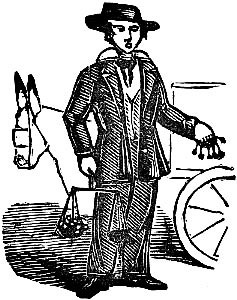
Cherries, my Pretty Maids.
Here’s cherries, oh! my pretty maids, My cherries round and sound; Whitehearts, Kentish, or Blackhearts And only twopence a pound.
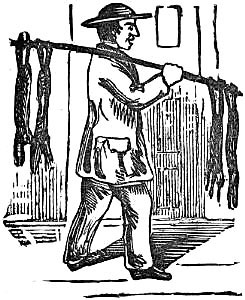
Fine Hampshire Rabbits.
Here I am with my rabbits Hanging on my pole, The finest Hampshire rabbits That e’er crept from a hole.
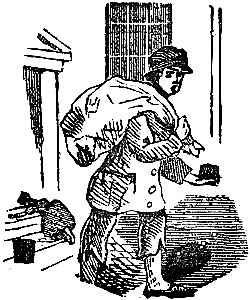
Hearthstone! Hearthstone.
Hearthstones my pretty maids, I sell them four a penny, Hearthstones, come buy of me, As long as I have any.
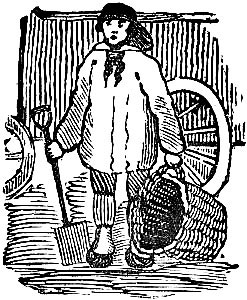
Dust oh! Dust oh!
Dust or ash this chap calls out, With all his might and main, He’s got a mighty cinder heap Somewhere near Gray’s Inn Lane.
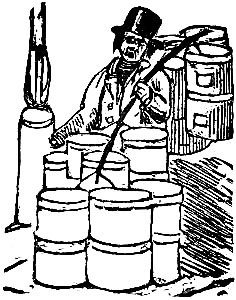
Buy a Bonnet Box or Cap Box
Bonnet boxes and cap boxes, The best that e’er was seen, They are so very nicely made, They’ll keep your things so clean.
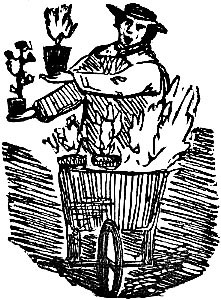
All a Growing And a Blowing.
Now ladies here’s roots for your gardens, Come buy some of me if you please, There’s tulips, heart’s-ease, and roses, Sweet Williams, and sweet peas.
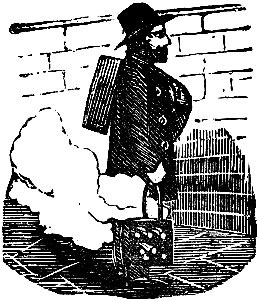
Any Old Pots or Kettles to Mend?
Any old pots or kettles, Or any old brass to mend Come my pretty maids all, To me your aid must lend.
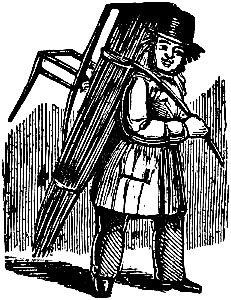
Any Old Chairs to Mend?
Any old chairs to mend? Any old chairs to seat? I’ll make them quite as good as new, And make them look so neat.
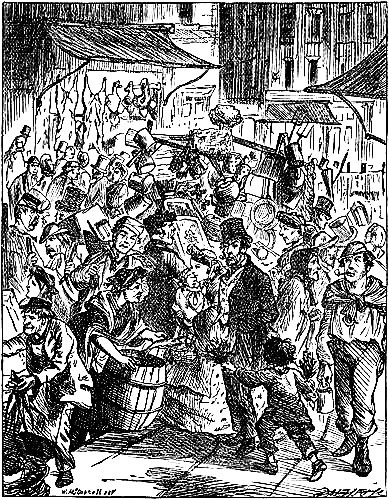
The London Street-Markets on a Saturday Night.
Mr. Henry Mayhew has painted a minute yet vivid picture of the London street markets, street sellers and purchasers which are to be seen in the greatest number on a Saturday night:—
“Here, and in the streets immediately adjoining, the working classes generally purchase their Sunday’s dinner; and after pay-time on Saturday night, or early on Sunday morning, the crowd in the New-cut, and the Brill in particular, is almost impassable. Indeed, the scene in these parts has more the character of a fair than a market. There are hundreds of stalls, and every stall has its one or two lights; either it is illuminated by the intense white light of the new self-generating gas-lamp, or else it is brightened up by the red smoky flame of the old-fashioned grease-lamp. One man shows off his yellow haddock with a candle stuck in a bundle of firewood; his neighbour makes a candlestick of a huge turnip, and the tallow gutters over its sides; whilst the boy shouting “Eight a penny, stunning pears!” has rolled his dip in a thick coat of brown paper, that flares away with the candle. Some stalls are crimson with the fire shining through the holes beneath the baked chesnut stove; others have handsome octohedral lamps, while a few have a candle shining through a sieve; these, with the sparkling ground-glass globes of the tea-dealers’ shops, and the butchers’ gaslights streaming and fluttering in the wind, like flags of flame, pour forth such a flood of light, that at a distance the atmosphere immediately above the spot is as lurid as if the street were on fire.
A Street-Market On Saturday Night.
The pavement and the road are crowded with purchasers and street-sellers. The housewife in her thick shawl, with the market-basket on her arm, walks slowly on, stopping now to look at the stall of caps, and now to cheapen a bunch of greens. Little boys, holding three or four onions in their hands, creep between the people, wriggling their way through every interstice, and asking for custom in whining tones, as if seeking charity. Then the tumult of the thousand different cries of the eager dealers, all shouting at the top of their voices, at one and the same time, is almost bewildering. “So-old again,” roars one. “Chesnuts, all’ot, a penny a score,” bawls another. “An ’aypenny a skin, blacking,” squeaks a boy. “Buy, buy, buy, buy,—bu-u-uy!” cries the butcher. “Half-quire of paper for a penny,” bellows the street-stationer. “An ’apenny a lot ing-uns.” “Twopence a pound, grapes.” “Three a penny! Yarmouth bloaters.” “Who’ll buy a bonnet for fourpence?” “Pick ’em out cheap here! three pair for a-halfpenny, bootlaces.” “Now’s your time! beautiful whelks, a penny a lot.” “Here’s ha’p’orths,” shouts the perambulating confectioner. “Come and look at’em! here’s toasters!” bellows one with a Yarmouth bloater stuck on a toasting fork. “Penny a lot, fine russets,” calls the apple woman: and so the Babel goes on.
One man stands with his red-edge mats hanging over his back and chest, like a herald’s coat; and the girl with her basket of walnuts lifts her brown-stained fingers to her mouth, as she screams, “Fine warnuts! sixteen a penny, fine war-r-nuts.” A bootmaker, to “ensure custom,” has illuminated his front-shop with a line of gas, and in its full glare stands a blind beggar, his eyes turned up so as to show only “the whites,” and mumbling some begging rhymes, that are drowned in the shrill notes of the bamboo-flute-player next to him. The boy’s sharp cry, the woman’s cracked voice, the gruff, hoarse shout of the man, are all mingled together. Sometimes an Irishman is heard with his “fine ating apples,” or else the jingling music of an unseen organ breaks out, as the trio of street singers rest between the verses.
Then the sights, as you elbow your way through the crowd are equally multifarious. Here is a stall glittering with new tin saucepans; there another, bright with its blue and yellow crockery, and sparkling with white glass. Now you come to a row of old shoes arranged along the pavement; now to a stand of gaudy tea-trays; then to a shop with red handkerchiefs and blue checked shirts, fluttering backwards and forwards, and a counter built up outside on the kerb, behind which are boys beseeching custom. At the door of a tea-shop, with its hundred white globes of light, stands a man delivering bills, thanking the public for past favours, and “defying competition.” Here, along side the road, are some half-dozen headless tailors’ dummies, dressed in Chesterfields and fustian jackets, each labelled:—“Look at the prices,” or “Observe the quality.” After this a butcher’s shop, crimson and white with meat piled up to the first-floor, in front of all the butcher himself, in his blue coat, walks up and down, sharpening his knife on the steel that hangs to his waist. A little further on stands the clean family, begging; the father with his head down as if in shame, and a box of lucifers held forth in his hand—the boys in newly-washed pinafores, and the tidyly got up mother with a child at her breast. This stall is green and white with bunches of turnips—that red with apples, the next yellow with onions, and another purple with pickling cabbages. One minute you pass a man with an umbrella turned inside up and full of prints; the next, you hear one with a peepshow of Mazeppa, and Paul Jones the pirate, describing the pictures to the boys looking in at the little round windows. Then is heard the sharp snap of the purcussion-cap from the crowd of lads firing at the target for nuts; and the moment afterwards, you see either a black man half-clad in white, and shivering in the cold with tracts in his hand, or else you hear the sounds of music from “Frazier’s Circus,” on the other side of the road, and the man outside the door of the penny concert, beseeching you to “Be in time—be in time!” as Mr. Somebody is just about to sing his favourite song of the “Knife Grinder.” Such, indeed, is the riot, the struggle, and the scramble for a living, that the confusion and the uproar of the New-cut on Saturday night have a bewildering and sad effect upon the thoughtful mind.
Each salesman tries his utmost to sell his wares, tempting the passers-by with his bargains. The boy with his stock of herbs offers “a double ’andful of fine parsley for a penny;” the man with the donkey-cart filled with turnips has three lads to shout for him to their utmost, with their “Ho! ho! hi-i-i! What do you think of us here? A penny a bunch—hurrah for free trade! Here’s your turnips!” Until it is seen and heard, we have no sense of the scramble that is going on throughout London for a living. The same scene takes place at the Brill—the same in Leather-lane—the same in Tottenham-court-road—the same in Whitecross-street; go to whatever corner of the metropolis you please, either on a Saturday night or a Sunday morning, and there is the same shouting and the same struggling to get the penny profit out of the poor man’s Sunday’s dinner.
Since the above description was written, the New Cut has lost much of its noisy and brilliant glory. In consequence of a New Police regulation, “stands” or “pitches” have been forbidden, and each coster, on a market night, is now obliged, under pain of the lock-up house, to carry his tray, or keep moving with his barrow. The gay stalls have been replaced by deal boards, some sodden with wet fish, others stained purple with blackberries, or brown with walnut peel; and the bright lamps are almost totally superseded by the dim, guttering candle. Even if the pole under the tray or “shallow” is seen resting on the ground, the policeman on duty is obliged to interfere.
The mob of purchasers has diminished one-half; and instead of the road being filled with customers and trucks, the pavement and kerbstones are scarcely crowded.
The Sunday Morning Markets.
Nearly every poor man’s market does its Sunday trade. For a few hours on the Sabbath morning, the noise, bustle, and scramble of the Saturday night are repeated, and but for this opportunity many a poor family would pass a dinnerless Sunday. The system of paying the mechanic late on the Saturday night—and more particularly of paying a man his wages in a public-house—when he is tired with his day’s work, lures him to the tavern, and there the hours fly quickly enough beside the warm tap-room fire, so that by the time the wife comes for her husband’s wages, she finds a large portion of them gone in drink and the streets half cleared, thus the Sunday market is the only chance of getting the Sunday’s dinner.
Of all these Sunday morning markets, the Brill, perhaps, furnishes the busiest scene; so that it may be taken as a type of the whole.
The streets in the neighbourhood are quiet and empty. The shops are closed with their different coloured shutters, and the people round about are dressed in the shiny cloth of the holiday suit. There are no “cabs,” and but few omnibuses to disturb the rest, and men walk in the road as safely as on the footpath.
As you enter the Brill the market sounds are scarcely heard. But at each step the low hum grows gradually into the noisy shouting, until at last the different cries become distinct, and the hubbub, din, and confusion of a thousand voices bellowing at once, again fill the air. The road and footpath are crowded, as on the over-night; the men are standing in groups, smoking and talking; whilst the women run to and fro, some with the white round turnips showing out of their filled aprons, others with cabbages under their arms, and a piece of red meat dangling from their hands. Only a few of the shops are closed; but the butcher’s and the coal shed are filled with customers, and from the door of the shut-up baker’s, the women come streaming forth with bags of flour in their hands, while men sally from the halfpenny barber’s, smoothing their clean-shaved chins. Walnuts, blacking, apples, onions, braces, combs, turnips, herrings, pens, and corn-plasters, are all bellowed out at the same time. Labourers and mechanics, still unshorn and undressed, hang about with their hands in their pockets, some with their pet terriers under their arms. The pavement is green with the refuse leaves of vegetables, and round a cabbage-barrow the women stand turning over the bunches, as the man shouts “Where you like, only a penny.” Boys are running home with the breakfast herring held in a piece of paper, and the side-pocket of an apple man’s stuff coat hangs down with the weight of halfpence stored within it. Presently the tolling of the neighbouring church bells break forth. Then the bustle doubles itself, the cries grow louder, the confusion greater. Women run about and push their way through the throng, scolding the saunterers, for in half-an-hour the market will close. In a little time the butcher puts up his shutters, and leaves the door still open; the policemen in their clean gloves come round and drive the street-sellers before them, and as the clock strikes eleven the market finishes, and the Sunday’s rest begins.”

As it was in the beginning of our book and in the days of Queen Elizabeth:—
“When the City shopkeepers railed against itinerant traders of every denomination, and the Common Council declared that in ancient times the open streets and lanes had been used, and ought to be used only, as the common highway, and not for the hucksters, pedlars, and hagglers, to stand and sell their wares in”—
so it is now, in the Victorian age, and ever will be a very vexed question, and thinking representative men of varied social positions materially differ in opinion; some contending that the question is not of class interest but that of the interest of the public at large; some argue in an effective but perfectly legal and orderly manner for the removal of what they term a greivous nuisance; others ask that an industrious and useful class of men and women should be allowed their honest calling. They protest against the enforcement of an almost obsolete statute which conduces to the waste of fruit, fish, and vegetables, in London and large towns, which practically maintains a trade monopoly, and discourages an abundant supply. They claim for the public a right to buy in the cheapest market, and plead for a liberty which is enjoyed unmolested in many parts of the kingdom, and protest against a remnant of protectionist restriction being put into force against street-hawking.
By the side of this temperate reasoning, let us place the principal arguments which are so often reiterated by aldermen, deputies, councillors, vestrymen, and others, when “drest in a little brief authority,” and come at once to the gravamen of the charge against the hawkers, which we find to consist in the nuisance of the street cries.
London, as a commercial city, has numbers of visitors and residents to whom quiet is of vital importance. The street cries, it is alleged, constitute a nuisance to the public, particularly to numbers of day-time-alone occupants, to whom time and thought is money. It is the same thing repeated with many of the suburban residents, in what is generally known as quiet neighbourhoods. Discounting duly the rhetorical exaggeration, it is to be feared the charge must be admitted. Therefore, the shopkeepers argue, let us put down the hawking of everything and everybody. But this does not follow at all. Not only so, but the proposed remedy is ridiculously inadequate to the occasion. Admit the principle, however, for the sake of argument and let us see whither it will lead us. At early morn how often are our matutinal slumbers disturbed by a prolonged shriek, as of some unfortunate cat in mortal agony, but which simply signifies that Mr. Skyblue, the milkman, is on his rounds. The milkman, it is evident, must be abolished. People can easily get their breakfast milk at any respectable dairyman’s shop, and get it, too, with less danger of an aqueous dilution. After breakfast—to say nothing of German bands and itinerant organ grinders—a gentleman with a barrow wakens the echoes by the announcement of fresh mackerel, salmon, cod, whiting, soles or plaice, with various additional epithets, descriptive of their recent arrival from the sea. The voice is more loud than melodious, the repetition is frequent, and the effect is the reverse of pleasing to the public ear. Accordingly we must abolish fish hawking: any respectable fishmonger will supply us with better fish without making so much noise over it; and if he charges a higher price it is only the indubitable right of a respectable tradesman and a ratepayer. Then comes on the scene, and determined to have a voice—and a loud one, too, in the morning’s hullabaloo, the costermonger—Bill Smith, he declares with stentorian lungs that his cherries, plums, apples, pears, turnips, carrots, cabbages, cowcumbers, sparrow-grass, colly-flow-ers, inguns, ru-bub, and taters, is, and allus vos rounder, sounder, longer, stronger, heavier, fresher, and ever-so-much cheaper than any shopkeeping greengrocer as ever vos: Why? “Vy? cos he don’t keep not no slap-up shop vith all plate-glass vinders and a ’andsom sixty-five guinea ’oss and trap to take the missus and the kids out on-a-arternoon, nor yet send his sons and darters to a boarding school to larn French, German, Greek, nor playing on the pianoforte.” All this may be very true; but Bill Smith, the costermonger, is a noisy vulgar fellow; therefore must be put down. Mrs. Curate, Mrs. Lawyer, Mrs. Chemist, and Miss Seventy-four must be taught to go to the greengrocer of the district, Mr. Manners, a highly respectable man, a Vestryman and a Churchwarden, who keeps:—
Plate, Waiters, and Linen for Hire. N.B.—Evening Parties Attended.
As the morning wears on we have:—“I say!—I say!! Old hats I buy,” “Rags or bones,” “Hearthstones,” “Scissors to grind—pots, pans, kettles or old umbrellas to mend,” “Old clo! clo,” “Cat or dog’s meat,” “Old china I mend,” “Clothes props,” “Any old chairs to mend?” “Any ornaments for your fire stove,” “Ripe strawberries,” “Any hare skins,”—“rabbit skins,” “Pots or pans—jugs or mugs,” “I say, Bow! wow! and they are all a-growing and a-blowing—three pots for sixpence,” and other regular acquaintances, with the occasional accompaniment of the dustman’s bell, conclude the morning’s performance, which, altogether is reminiscent of the “Market Chorus” in the opera of Masaniello; and if the public quiet is to be protected, our sapient Town Councillors would abolish one and all of these, dustman included. One of the latest innovations upon the peace and happiness of an invalid, an author, or a quiet-loving resident, is the street vendor of coals. “Tyne Main,” or “Blow-me-Tight’s,” Coals! “C-o-a-l-s, one and tuppence a underd—see’em weighed.” This is the New Cry. Small waggons, attended by a man and a boy, go to our modern railway sidings to be filled or replenished with sacks containing 56 lbs. or 112 lbs. of coals, and then proceed to the different suburban quiet neighbourhoods, where the man and boy commence a kind of one done the other go on duet to the above words, which is enough to drive the strongest trained one crazy. All the great coal merchants seem to have adopted this method of retailing coals, and have thus caused the almost total abolition of coal sheds, and the greengrocer and general dealer to abandon the latter part of his calling. Our afternoon hours, after the passing of the muffin bell, are made harmonious by public references to shrimps, fine Yarmouth bloaters, haddocks, periwinkles, boiled whelks, and watercreases, which are too familiar to need description; and our local governors in their wisdom would bid us no longer be luxurious at our tea, or else go to respectable shops and buy our “little creature comforts.” Professing an anxiety to put down street cries, our police persecute one class out of a multitude, and leave all the rest untouched. It is not only an inadequate remedy, but the remedy is sought in the wrong direction. The fact is, that the street noises are an undoubted evil, and in the interests of the public, action should be taken not to put them down, but to regulate them by local bye-laws, leaving the course of trade otherwise free. It is a plan adopted in most of the greater towns which have in any way dealt with the subject.

THE DEMONS OF PIMLICO.
[From Punch.]
Edwin is a Young Bard, who has taken a lodging in a Quiet Street in Belgravia, that he may write his Oxford Prize Poem. The interlocutors are Demons of both Sexes.
Edwin (composing). Where the sparkling fountain never ceases—
Female Demon. “Wa-ter-creece-ses!”
Edwin. And liquid music on the marble floor tinkles—
Male Demon. “Buy my perriwinkles!”
Edwin. Where the sad Oread oft retires to weep—
Black Demon. “Sweep! Sweep!! Sweep!!!”
Edwin. And tears that comfort not must ever flow—
Demon from Palestine. “Clo! Clo!! Old Clo!!!”
Edwin. There let me linger beneath the trees—
Italian Demon. “Buy, Im-magees!”
Edwin. And weave long grasses into lovers’ knots—
Demon in white apron. “Pots! Pots!! Pots!!!”
Edwin. Oh! what vagrant dreams the fancy hatches—
Ragged Old Demon. “Matches! Buy Matches!”
Edwin. She opes her treasure-cells, like Portia’s caskets—
Demon with Cart. “Baskets, any Baskets!”
Edwin. Spangles the air with thousand-coloured silks—
Old Demon. “Buy my Wilks! Wilks!! Wilks!!!”
Edwin. Garments which the fairies might make habits—
Lame Demon. “Rabbits, Hampshire Rabbits!”
Edwin. Visions like those the Interpreter of Bunyan’s—