ELIZABETH 1558-1603
Reading edition
The Naval Policy of Elizabeth.
Her subjects were occupied, during the greater portion of Elizabeth’s reign, in teaching their Queen the use of a navy, instruction that she was the first English sovereign to put into practice on strategic principles. Yet study of the forty-five years of glorious naval history on which her renown is mainly based, leaves the impression that more might and should have been done with the Navy. That she preferred diplomacy to force would have been a merit had the choice been founded on an ethical detestation of the cruelty of war, instead of an ingenuous belief in her own skill and the obtuseness of her antagonists. Under conditions more favourable to ascendancy at sea than have ever existed for England, before or since, the successes of the Navy itself, as distinguished from the expansion of the commercial marine, were, although relatively great, limited by the hesitation with which the naval arm was employed, the way in which the service was pecuniarily starved, and the settled doctrine underlying her maritime essays that an expedition should be of a character to return a profit on the outlay. And perhaps the severest comment on her government lies in the fact that she was more liberal in her treatment of the Navy, than of any other department of the State. In February 1559 she possessed twenty-two effective ships of 100 tons and upwards, in March 1603, twenty-nine; practically, therefore, she did little more than replace those worn out by efflux of time, for only two were lost in warfare. If Henry VIII created a navy under the stimulus of a possible necessity it requires little imagination to conceive his course when the time had come, as it never came for him, to put forth every effort in using it for the preservation of England.
When Elizabeth succeeded to the throne, the possession of a fleet and an organised administration, the French royal navy, only a few years before an apparently serious competitor, had ceased to exist; the rivalry of Holland had not yet begun, and it is hardly an exaggeration to say that a Spanish royal navy had never existed, in the sense of an ocean going service organised on a basis enabling it to act vigorously and effectively in any direction.[499] The opportunity had come therefore to a power with maritime ambition, the only one possessing an efficient fleet and naval control, and incited by religious differences and commercial emulation. The altered situation brought to the front a band of men who, in the preceding century, would have been military adventurers in France, but who now, half traders, half pirates, handled their ships with the same strategic and tactical skill their ancestors exercised on land, and who, if they had been allowed a free hand, would have brought Spain down in ruin instead of merely reducing her to a condition of baffled impotence. They were not allowed a free hand. When acting for themselves they had the knowledge that if it suited the royal policy of the moment repudiation of their deeds might mean, if not loss of life, at least loss of property and reputation. When in command of royal fleets they were kept in touch with the government, hampered by voluminous and contradictory instructions, and, above all, their efforts and successes rendered nugatory by the parsimony which kept the depots always on the brink of exhaustion.
In naval, as in other matters, Elizabeth tried to make her subjects do the work of the crown and therefore she frequently confined her action to taking a share with several ships in a privateering expedition, prepared by private individuals for their own profit. Such expeditions swell the list of ships employed at sea, and privateering as a source of injury to an enemy has its value, but such enterprises when forming the whole effort of the State for a particular year show an insufficient acquaintance with the character of the operations required. Privateers were equipped not with large objects but to secure profits for owners and crews. It sometimes happened that this purpose was at issue with the wider views of the admiral in command, and the voyage became ineffective where a similar number of men-of-war subject to discipline might have done important service. The enormous increase in the merchant marine which, it will be shown, characterised the reign, was in one way disadvantageous since it induced the government to rely more on a guerre de course than on the sustained and systematised action of the Royal Navy. Even when a great fleet was sent out the light in which Elizabeth regarded it is instructively shown in a letter to Nottingham, after the Cadiz voyage of 1596, when he had asked for money to pay the men’s wages:
‘though we have already written you divers letters to prevent the inconvenience which we suspected would follow this journey that it would be rather an action of honour and virtue against the enemy and particular profit by spoil to the army than any way profitable to ourself yet now we do plainly see by the return of our whole fleet that the actions of hope are fully finished without as much as surety of defraying the charge past or that which is to come.[500]
The blow to Spanish power and prestige, or an ‘action of honour and virtue,’ counted for nothing if a fleet did not pay its expenses and make some profit over and above.
It may be asked then in what respect was Elizabeth personally deserving of praise? The answer is that it fell to her to use for the first time an untried weapon—untried in the sense that never before had England relied on it as the right arm of attack or defence. For centuries the defence of the country had depended on the mail-clad horseman and the yeoman archer; from the first days of her accession she recognised that the enemies of England were to be fought at sea, a doctrine which is a commonplace now, but was then being only slowly evolved in minds even yet dazzled by memories of invasions of France. She accepted and proved the truth of the theory on which the policy of Henry VIII was grounded, and, if she failed to carry it out fully, it was perhaps more from ignorance of the might of the weapon in her hand than from want of statesmanship. Notwithstanding her niggardliness, which nearly ruined England in 1588, she expended money—for her lavishly—on the Navy, while the military and other services were remorselessly starved. Sooner or later the naval authorities obtained at least part of their requirements, in striking contrast to the fortune of other officials who thought, and whose contemporaries probably thought, their needs of equal or more importance. If she did not use the fleet as some of the great seamen who served her would have had her use it, she at anyrate extended its field of action in a manner hitherto unknown, and sealed the direction of future English policy.
The following abstract, compiled from the pay and victualling lists and the State Papers, will show the number of vessels of the Royal Navy in commission each year, that it was used continuously as never before, but also that it was seldom used up to its possible capacity. In every case there were hired merchantmen as well if a fleet was engaged in an over-sea expedition, but unless there was a prospect of plunder the brunt of the work always fell on the men-of-war. As an arbitrary division, for the purpose of the table, first-rates are taken as those above 600 tons; second-rates from 400 to 600 tons; third-rates from 200 to 400 tons; fourth-rates from 100 to 200 tons; fifth-rates from 50 to 100 tons; and sixth-rates under 50 tons. Owing to technical difficulties connected with the lists used it is probably not exactly correct but is sufficiently so to give a just impression:—
1st 2nd 3rd 4th 5th 6th Galleys.
1559 2 4
1560[501]
1561 1 1 2 1
1562 2 4 1 5
1563 2 1 9 1 7 4 3
1564 1 2 3
1565 2
1566 1 2
1567 1 1 1
1568 2 1 1
1569 3 4 2 2
1570 3 3 3 2
1571 2 1
1572 2 2
1573 1 1 3 1
1574 2 1
1575 2 1
1576 1 3 2 2
1577 1 2 2
1578 2 3 1
1579 1 3 3 1
1580 1 6 2 1
1581 2 5 1
1582 1 2 1
1583 2 1 1
1584 2 1 1
1585 1 2 4
1586 3 1 4 1 7 1
1587 3 3 5 3 6
1588[502] 5 10 5 3 7 3 1
1589 4 2 4 2 4
1590 8 4 6 2 5
1591 8 4 2 2 4
1592 2 4 2 2 3
1593 1 3 2 2 2
1594 1 3 1 1 4
1595 4 4 1 2 3
1596 4 9 5 3 2 1
1597 6 11 6 1 2 2
1598 5 5 2 2 4
1599 6 10 6 2 2 7 1
1600 2 2 5 1 1 5
1601 2 11 3 1 2 3
1602 3 9 5 1 1
From this it is evident that vessels of from 400 to 600 tons were the favourites; they were handier, better seaboats, and represented the latest improvements in shipbuilding. Of the eleven first-rates on the navy list in 1603, two were Spanish prizes of 1596, four dated from the beginning of the reign, while the remaining five were of 1587 and later years; it was these latter that were used from 1596 onwards. The four earlier ones, built before Hawkyns came into office, were of an old type and seem never to have been commissioned unless the services of the whole Navy were required. The Victory, for instance was only at sea in 1563, 1588, and 1589, although she is not entered in the foregoing table under 1589, because lent to the Earl of Cumberland for a private venture. The stress of the work fell therefore on the smaller vessels. The Bonaventure, for instance, was at sea every year from 1585 to 1590 inclusive. During the greater part of 1591 she was in dock at Woolwich for repairs, but at Portsmouth in October, and then sent to sea. Again in 1592, 5, 6, 7, and 1599. The Dreadnought, launched in 1573, was commissioned during each of the six years 1575-80, and in 1585, 7, 8, and 1590. She was then, for nearly a year, in dry dock, recommencing service in 1594, continuing it in 1595, 6, 7, 9, 1601, 2, and 1603. It must also be noted that many of these years included more than one commission. Excluding the fourth-, fifth-, and sixth-rates, which were serviceable for privateering purpose, but could not take a place in any form of attack requiring ships of force, it will be seen by how very few vessels the naval warfare was really carried on, and that a succession of serious descents on the Spanish coasts and transatlantic settlements, such as were urged on Elizabeth, would have necessitated very large additions to the Royal Navy.
Shortly after the Queen’s accession she possessed, according to one account thirty-five,[503] and according to another thirty-two[504] vessels of all classes and in good and bad condition. Some ships had been under repair before Mary’s death,[505] but the dockyards were working with redoubled vigour since Elizabeth’s succession. At Deptford, in March, 228 men were at work on five ships; at Woolwich 175 men on eight others, and at Portsmouth 154 men on nine more.[506] Some of these were rebuildings, others could have been but trifling repairs, but the list shows with what energy Elizabeth and her Council applied themselves to the maintenance of the fleet. From that time the yards, with the exception of a few years, were kept fully occupied, and the following is a list of the new ships built at them or otherwise added to the Navy. The dates are New Style:—
Built At By Rebuilt Bought Prize
Elizabeth Jonas[507] 1559 Woolwich 1597-8
Hope[508] 1559 1602-3
Victory[509] 1560
Primrose[510] 1560
Minion[511] 1560
Galley Speedwell[512] 1559
Galley Tryright[513] 1559
Triumph[514] 1561 1595-6
Aid[515] 1562
Galley Ellynor[516] 1563
Post[517] 1563
Guide[517] 1563
Makeshift[517] 1563
Search[517] 1563
White Bear[518] 1564 1598-9
Elizabeth Bonaventure[519] 1581 1567
Foresight[520] 1570
Bull[521] 1570
Tiger[522] 1570
Swiftsure[523] 1573 Deptford Peter Pett 1592
Dreadnought[524] 1573 do. Math. Baker 1592
Achates[525] 1573 do. Peter Pett
Handmaid[526] 1573 do. Math. Baker
Revenge[527] 1577 do.
Scout[528] 1577 do.
Merlin[529] 1579
Antelope[530] 1581
Golden Lion[531] 1582
Brigantine[532] 1583
Nonpareil[533] Deptford 1584
Galley Bonavolia[534] 1584
Greyhound[535] 1585 Wm. Pett
Talbot[536] 1585 R. Chapman
Cygnet[537] 1585 Tho. Bowman
Makeshift[538] 1586 Limehouse Wm. Pett
Spy[539] 1586 do. do.
Advice[540] 1586 Woolwich M. Baker
Trust[541] 1586
Sun[542] 1586 Chatham M. Baker
Seven Stars[543] 1586
Tremontana[544] 1586 Deptford R. Chapman
Moon[545] 1586 do. Peter Pett
Charles[546] 1586 Woolwich M. Baker
Vanguard[547] 1586 do. do. 1599
Rainbow[548] 1586 Deptford Peter Pett 1602
Ark Royal[549] 1587 do. R. Chapman
Popinjay[550] 1587
Nuestra Señora del Rosario[551] 1588
Mary Rose[552] 1589
Merhonour[553] 1590 M. Baker
Garland[554] 1590 R. Chapman
Defiance[555] 1590 P. & Jos. Pett
Answer[556] 1590 M. Baker
Quittance[557] 1590 do.
Crane[558] 1590 R. Chapman
Advantage[559] 1590 P. & Jos. Pett
Lion’s Whelp[560] 1590
Primrose Hoy[561] 1590
Black Dog[562] 1590
French Frigott[563] 1591
Flighte[564] 1592
Mercury[565] 1592 Deptford M. Baker
Eagle[566] 1592
Adventure[567] 1594 Deptford M. Baker
Mynikin[568] 1595
Warspite[569] 1596 Deptford E. Stevens
Due Repulse[570] 1596
St Mathew[571] 1596
St Andrew[571] 1596
Lion’s Whelp[572] 1601
Superlativa[573] 1601 Deptford
Advantagia[573] 1601 Woolwich
George Hoy[574] 1601 Adye
Gallarita[575] 1602 Limehouse
Volatillia[575] 1602 Deptford
In number this is an imposing array but exclusive of galleys, prizes, six pre-existing vessels rebuilt, and the numerous small vessels, only twenty-nine men-of-war of 100 tons and upwards were added to the establishment between 1558 and 1603, notwithstanding the amount of work thrown upon the Navy. It has been noticed that the term rebuilding, as used in the official papers, is extremely vague and it is only when the cost per ton can be ascertained that it can be known with certainty whether a ship was renewed or repaired; it is quite possible that, with the exception of the Philip and Mary, the rebuilt vessels were in reality only subjected to more or less complete repair. Again, of these twenty-nine only twenty-one were of 300 tons and upwards and suited for distant expeditions; of the twenty-one the Elizabeth, Hope, Victory, Triumph, and White Bear, were not liked—too big, too expensive, or too unhandy—and were never used unless a fleet of great strength was required. The names of a few ships recur, therefore, year after year as forming the main strength of the squadrons, made up with armed merchantmen, sent out for various purposes. Had Spain been able to offer any real resistance at sea the destructive results of even victorious action would have soon compelled the replacement of these ships and a large increase in the navy list.
Various Ships.
The Elizabeth Jonas varies as to tonnage between 855 and 1000 tons in different papers. The Victory oscillates between 694 and 800 tons, the Triumph between 955 and 1200, and a smaller vessel, the Foresight, is given in three lists, within six years, as of 300, 350, then of 260 tons, and in a fourth list of 1592 as of 450 tons. Before 1582 measurement must have been usually a matter of opinion and comparison; after that year when Baker’s rule had come into use there is more uniformity. But such variations entirely vitiate dogmatic comparisons of the strength of opposing ships or squadrons. The Elizabeth was, ‘in new making’ at Woolwich in December 1558,[576] and was therefore commenced before Mary’s death. There is a singular story told of the origin of the name.
‘The shipp called the Elizabeth Jonas was so named by her Grace in remembrance of her owne deliverance from the furye of her enemyes from which in one respect she was no lesse myraculously preserved than was the prophet Jonas from the belly of the whale.’[577]
This occurs in a commonplace book kept by Robert Commaundre, Rector of Tarporley, Chester, who died in 1613, and among some other naval information wholly incorrect. It is a fact that Elizabeth christened the ship herself but Commaundre’s version is probably country gossip made to explain the name. If, however, it should be true it throws a more vivid light on Elizabeth’s real feeling towards her unhappy sister than is shed by many volumes of State Papers.
The first occurrence of the famous name of the Victory in an English navy list is of great interest but unfortunately cannot be dated with certainty. The earliest mention known is of the victualling accounts of the quarter ending with September 1562.[578] On 14th March 1560, the Great Christopher, of 800 tons, was bought of Ant. Hickman and Ed. Castlyn, two London merchants. The tonnage corresponds with that assigned to the Victory in early papers, and the year corresponds with that assigned to the Victory in the State Paper quoted in the table. The name Great Christopher is only found down to 1562, when it is immediately succeeded by that of Victory; in fact the Christopher is named in October and then ceases, to be replaced by the Victory in November.[579] Unless we suppose that a new 800-ton ship, one of the two largest in the Navy, disappeared without leaving a trace of the cause it must be assumed that the name was changed, a not unusual occurrence, and if so, the Victory is its only possible representative. The name was quite new among English men-of-war; it may have been taken from that of Magellan’s celebrated ship.
The Primrose and the Minion had for some years previously been employed among the hired London merchantmen; from 1560 they appear on the navy lists, which points to their purchase. The Minion, in which Hawkyns escaped from San Juan de Ulloa in 1568, was condemned in 1570; the Primrose was sold in 1575, again rejoining the merchant service, to which she still belonged in 1583.[580] The galleys Tryright and Speedwell disappear after 1579; and the Bonavolia from 1599; of the four later galleys the Gallarita and Volatillia were presented by the city of London. The Mercury, another vessel of the galley type was however furnished with masts and sails, and afterwards converted into a pinnace.
Returning to the large ships, the Aid was condemned in 1599, the Elizabeth Bonaventure, purchased from Walter Jobson for £2230, the Bull was broken up in 1594, and the Revenge captured by a Spanish fleet in 1591. The Tiger, Scout, and Achates, were cut down into lighters and, in 1603, were supporting Upnor chain. The Ark Royal, or Ark Ralegh, seems to have been built originally for Sir Walter Ralegh,[581] although constructed in a royal yard and by a government shipwright, who, later, received a pension for this among other services. Some £1200 was spent in 1598 on the repairs of the St Mathew and St Andrew; they only served under the English flag, however, in the Islands voyage of 1597. Some of the small pinnaces disappear from the lists during these years without assigned cause, but the only two vessels known to have been lost by stress of weather during the reign were the earlier Greyhound of Henry VIII, wrecked off Rye in 1562, and the Lion’s Whelp in 1591.
Table of General Details.
The following table of 1602 furnishes many curious details:—[582]
Length of keel Beam Depth of hold Rate forward Rate aft Burden Ton and Tonnage Weight of masts and yards Weight of rigging tackle Canvas for sails in bolts, ¾ths of a yd. broad and 28 yds. long Anchors Cables Weight of Ordnance Men in harbour Men at sea Mariners Gunners Soldiers Cost per month at sea: wages and victualling
feet feet feet feet feet tons tons ton. cwt. lbs. No. lbs. No. lbs. tons £ s d
Elizabeth 100 38 18 36 6 684 855 22.8 17000 85 7 15000 7 31000 61 30 500 340 40 120 758 6 8
Triumph 100 40 19 37 6 760 955 24.17 18000 95 7 15000 7 32500 68 30 500 340 40 120 758 6 8
White Bear 110 37 18 36 6.6 732 915 24 17000 88 7 15300 7 30000 63 30 500 340 40 120 758 6 8
Merhonour 110 37 17 37 6.6 691 865 22.13 17000 87 7 15000 7 30000 63 30 400 268 32 100 606 13 4
Ark Royal 100 37 15 33.6 6 555 692 18.4 15300 84 7 13500 7 24000 50 17 400 268 32 100 606 13 4
Victory 95 35 17 32 5.10 555 694 18.4 16200 78 7 13000 7 24000 50 17 400 268 32 100 606 13 4
Repulse 105 37 16 622 777 20.7 17000 78 7 14400 7 26300 54 16 350 230 30 90 530 16 8
Garland 95 33 17 32 5.8 532 666 17.7 14600 66 7 12700 7 22800 47 16 300 190 30 80 455 0 0
Warspite 90 36 16 518 648 17 14400 62 7 13000 7 22800 40 12 300 190 30 80 455 0 0
Mary Rose 85 33 17 30.6 5 476 596 15.12 13000 62 7 13000 7 20000 43 12 250 150 30 70 379 3 4
Hope 94 33 13 31.6 5.7 416 520 13.14 11500 66 6 9200 6 17800 37 12 250 150 30 70 379 3 4
Bonaventure 80 35 16 28 4.10 448 560 14.14 12300 70 6 9600 6 19000 40 12 250 150 30 70 379 3 4
Lion 100 32 14 31.6 5.10½ 448 560 14.14 12300 70 6 9600 6 19000 40 12 250 150 30 70 379 3 4
Nonpareil 85 28 15 29 5 357 446 11.7 9800 56 6 9600 6 15000 32 12 250 150 30 70 379 3 4
Defiance 92 32 15 31 5.6 441 552 14.9 12300 60 7 12200 7 19000 41 12 250 150 30 70 379 3 4
Vanguard 108 32 13 32 5.8 449 561 14.14 12300 70 6 9600 6 19100 40 12 250 150 30 70 379 3 4
Rainbow 100 32 12 33.6 6 384 480 12.11 10500 67 6 9000 6 16600 35 12 250 150 30 70 379 3 4
Dreadnought 80 30 15 31 5.4 360 450 11.16 9800 52 6 8200 6 15400 32 10 200 130 20 50 303 6 8
Swiftsure 74 30 15 26 4.6 333 416 9.18 9600 47 5 7100 5 14100 29 10 200 130 20 50 303 6 8
Antelope 87 28 14 29.6 5.3 341 426 11.3 9500 50 5 7300 5 14000 30 10 160 114 16 30 242 13 4
Foresight 78 27 14 27 4.8 294 306 9.12 8300 47 5 7300 5 12600 26 10 160 114 16 30 242 13 4
Adventure 88 26 12 274 343 8.7 7300 44 4 6000 4 11000 24 10 120 88 12 20 182 0 0
Crane 60 26 13 23 3.10 202 253 6.12 5400 40 4 4500 4 8500 18 7 100 76 12 12 151 13 4
Quittance 64 26 13 24 4 219 274 7.5 5800 42 4 4500 4 9400 19 7 100 76 12 12 151 13 4
Answer 65 26 13 24 4 219 274 7.5 5800 42 4 4500 4 9400 19 7 100 76 12 12 151 13 4
Advantage 60 24 12 22 3.10 172 216 5.13 4600 36 4 3700 4 7400 15 7 100 76 12 12 151 13 4
Tremontana 60 22 10 132 165 4.6 3500 31 4 3200 4 5600 11 6 70 52 8 10 106 3 4
Charles 63 16 7 15 3 70 80 2.4 2000 20 4 1800 4 3000 7 5 45 32 6 7 68 5 0
Moon 50 17 7 15 2.8 59 74 1.17 1600 19 3 1800 3 2600 5 5 40 30 5 5 60 13 4
Advice 50 14 6 12 2.6 42 52 1.4 1100 15 3 1600 3 2000 3½ 5 40 30 5 5 60 13 4
Spy 50 14 6 12 2.6 42 52 1.4 1100 15 3 1600 3 2000 3½ 5 40 30 5 5 60 13 4
Sonne 50 13 6 11 2.2 39 48 1.2 1100 13 3 1500 3 1700 3¼ 5 30 24 4 2 45 10 0
In consequence of the existence of a formula, to be presently noticed, for calculating tonnage, we have in the preceding table for the first time an attempt at exactness instead of the former round numbers. The keel and other measurements given can only be taken as approximate seeing that they differ in nearly every paper. And some of the other particulars, such as the number of anchors and cables, represent only a theoretical equipment; the inventories show that vessels frequently carried more than the seven anchors and seven cables assigned to the large ones here. On the other hand the strength of the crews rarely reached the proportions in the list, it may safely be said never, if a large fleet was prepared.
The great Portuguese carrack, the Madre de Dios, captured in 1592 and regarded as the largest ship afloat, had a keel length of 100 feet, an extreme breath of 46 feet 10 inches, and an extreme length of 165 feet.[583] The keel length of the Rainbow being 100 feet, her extreme length was 139 feet 6 inches and she had only 32 feet of beam. Moreover the carrack would be hampered by tiers of cabins built up on her poop and forecastle; a comparison of these proportions will help to explain the better weatherly and sailing qualities of the English ships. If for further illustration we compare the Elizabeth Jonas carrying 55 heavy guns,[584] with a 52 gun ship of 1832 we find that the ordnance of the latter weighed 125 tons 4 cwt.; cables (iron and hempen), 56 tons 1 cwt.; anchors 12 tons 10 cwt. 2 qrs.; masts and yards 74 tons 5 cwt.; and fixed and running rigging 51 tons 9 cwt.[585]
This table also explains why galleys, never much in favour, were rapidly falling out of use. In 1588 the Bonavolia served for two months as a guardship in the river at a total cost of £1028,[586] that is to say £514 a month. In 1589 there is an estimate, in the handwriting of Hawkyns, for the same galley but 150 ‘slaves’ are now allowed for, and ‘there may be for every bank[587] a soldier with his piece if the service require it.’ He adds ‘there is no dyett spoken of for the slaves for that we are not yett in the experyence.’[588] We cannot now tell whether Hawkyns had his early merchandise of negroes in his mind or whether ‘slaves’ was the pleasant Elizabethan way of describing criminals and vagrants.[589] The reference however, to ignorance in the matter of diet seems rather to imply that negroes were in question. Doubtless the cost of free oarsmen had been found to be too great. It will be observed that a large cruiser like the Dreadnought could be kept at sea throughout the year at a charge of £303 a month while the almost useless galley, only doubtfully available in summer, cost very much more. The galley service was only possible among the Mediterranean states, and then only when, like Venice, they bought surplus human stock by the thousand from the Emperor. The four galleys of 1601-2 were never once engaged in active service, and were probably only used for purposes for which steam tugs are now employed; perhaps also in pageants, men from the royal ships or ordinary watermen being put in them for the particular service.
Types of Ships.
The lines of ships had begun to vary according to the purpose for which they were designed. There had formerly been no difference between merchantmen and men-of-war except that the latter were perhaps more strongly built. But a paper by William Borough, Comptroller of the Navy, now describes three orders:—[590]
1. The shortest, broadest, and deepest order. To have the length by the keel double the breadth amidships and the depth in hold half that breadth.
This order is used in some merchant ships for most profit.
2. The mean and best proportion for shipping for merchandise, likewise very serviceable for all purposes. Length of keel two or two and a quarter that of beam. Depth of hold eleven-twentyfourths that of beam.
3. The largest order for galleons or ships for the wars made for the most advantage of sailing. Length of keel three times the beam. Depth of hold two-fifths of beam.
If the figures in the preceding table are trustworthy it will be seen that the keel length is very seldom three times the breadth although the later ships show a drift towards that proportion. The short keel, not sufficiently supported in a head sea must have made the vessel pitch tremendously, and one object of the beakhead and great forward rake was to shatter the seas and prevent them breaking on board. Probably these ships were but little worse sailers than the ordinary merchantmen of the beginning of this century, at least before the wind. They could not sail on the wind within at least eight points; fore and aft sails were not yet known, and the top-hamper of lofty sides and built up poop and forecastle levered the vessel off to leeward.
Improvements and Inventions.
Many improvements however were introduced. A method of striking topmasts, ‘a wonderful ease to great ships,’ and a system of sheathing by double planks, having a layer of tar and hair between them, were two of the most important. Both were due to Hawkyns, and the sheathing process remained in use for more than a century after his death. The finest Elizabethan men-of-war, the fastest sailers and best seaboats then afloat were built from his plans; and from the time of his appointment as Treasurer of the Navy dates the change to the relatively low and long type that made the English ships so much more handy than their Spanish antagonists. On Ralegh’s testimony the chain pump, the use of the capstan for weighing the anchor, bonnets and drablers, sprit, studding, top, and top-gallant sails were all new.[591] Ralegh is usually accepted as an authority, but some of these statements are surprisingly inaccurate, considering that he was a shipowner, and had himself been to sea. The bonnet, which laced on to the foot of the ordinary sail, was in use at least as early as the fourteenth century: the drabler laced on to the bonnet, and if the name was new the thing itself was doubtless old. Top, top-gallant, and sprit sails, can be traced back to the close of the preceding century, and there is no reference to studding sails in the inventories. In view also of the ‘main,’ ‘forecastle,’ and ‘lift’ capstans found on a ship like the Sovereign in 1496 it seems incredible that they should not have been earlier applied to weighing the anchor.
The chain pump was brought into use by Hawkyns; a patent log was invented by Humphrey Cole but it does not appear to have superseded the ordinary log line. The lower ports were now some four feet above the water line, and there was a tendency to decrease the deck superstructures. Ralegh is emphatic in his disapproval of deck cabins: ‘they are but sluttish dens that breed sickness in peace, serving to cover stealths, and in fight are dangerous to tear men with their splinters.’ Nevertheless others thought differently, and in view of the large crew of a man-of-war and crowded narrow quarters some deck accommodation was perhaps absolutely essential. Both poop and forecastle were barricaded and the bulkheads pierced for arrow and musketry fire. In ships ‘built loftie’ there was a second, and perhaps even a third tier over the poop and forecastle of similarly defended cabins. The waist was partly open on the upper deck, while on the lower deck were again loop-holed bulkheads running transversely, so that if a ship were boarded her assailants found themselves exposed to a galling cross-fire from the defenders.
Gravel ballast only was used and for such crank vessels a large quantity was necessary. It was seldom changed and becoming soaked with bilgewater, drainings from beer casks, and the general waste of a ship, was a source of injury to the vessel and of danger to the health of the men. The ‘cook-room,’ a solid structure of bricks and mortar, was built in the hold on this ballast, and in that position, besides making the ship hot and spoiling the stores, was a frequent cause of fire. Moreover ballast and cook-room being practically immovable nothing could be known of the condition of the timber and ironwork below. Sir William Wynter advocated, in 1578, the use of stone ballast and the removal of the cooking galley to the forecastle, but neither proposal was generally adopted.[592] In the squadron commanded by Hawkyns and Frobisher in 1590 the Mary Rose, however, Hawkyns’ flagship, had her cook-room especially removed from the hold to the forecastle, ‘as well for the better stowinge of her victualles as also for better preserving her whole companie in health during that voyadge beinge bounde to the southwardes.’ We may therefore take it that the opinion of Hawkyns coincided with that of Wynter on this point. But the alteration in the Mary Rose was an isolated occurrence, and even as late as the beginning of the eighteenth century the galley was still sometimes in the hold. The large amount of space occupied by the ballast, cables, ammunition, and other necessaries left but little room for other things, and a ship had only provisions on board for three or four weeks, although theoretically she was expected to carry more. The presence of a fleet of transports was therefore necessary with all naval expeditions.
The attention given to maritime matters bore fruit in other inventions, many of them far in advance of their time. Centre board boats, paddlewheels, a diving dress, and fireships, were all recommended and perhaps used.[593] Gawen Smith proposed to erect a beacon and refuge, capable of holding twenty or thirty persons, on the Goodwin sands such as was actually tried, unsuccessfully, in the first half of this century.[594]
Cost and Construction of Ships.
There is no detailed statement of the whole cost of a ship complete. Most were built by contract, and payment to the master shipwright responsible appears to be only for the hull, masts and spars. For an early vessel, probably the Triumph, there is a fuller account[595] and here the total is £3788, of which the timber cost £1200, spars and ironwork £700, and wages £1888; this does not include sails, fittings, etc. Building by contract seems to have commenced with the accession to office of Hawkyns in 1578. The Lion was rebuilt in this manner in 1582 for £1440, the Nonpareil for £1600, the Hope ‘brought into the fourme of a galease’ £250,[596] and the Cygnet, and Greyhound built for £93, 18s 1d and £66, 13s 4d each.[597] The Victory was ‘altered into the forme of a galleon’ for £500, and the Vanguard and Rainbow built for £2600, apiece.[598] The Merhonour, Garland, and Defiance, cost £5, 2s, £5, 19s 5d, and £6, 7s 4d a ton,[599] and the price was based on the net tonnage. These rates do not however correspond with the amounts in the naval accounts which are £3600 for the Merhonour, £3200 for the Garland, and £3000 for the Defiance.
The earliest details we have of construction are in connection with these three vessels. A committee consisting of Howard, Drake, Hawkyns, Wynter, Borough, Ed. Fenton, Rich. Chapman, and Mathew and Christopher Baker, settled the plans.[600] The three were very similar, and it was decided that the one to be built by Peter Pett (the Defiance) should have a keel length of 92 feet, a beam of 32 feet, and be 15 feet deep ‘under the beame of the maine overloppe.’ Eight feet above the keel ten beams were to be placed on which ‘to lay a false overloppe so far as neede shall require,’ and under the ten beams ten riders were to be set; the riders at the footwales were to have two ‘sleepers on every side fore and afte,’ and pillars to be sufficiently bolted to them. The pillars supporting the lower deck had been newly adopted,[601] and as riders were put into the White Bear twenty years after she was built they also were possibly a recent improvement. The main, or lower deck, of the Defiance was to have twelve beams, with side knees and standards, every knee having four bolts and the deck itself was of three-inch plank. The upper deck was of two-and-a-half inch plank, but three inches in the waist; on this deck were the poop and forecastle. From the keel to the second wale four-inch plank was to be used, thence to the ‘quickside or waist,’ three-inch, and above that two-inch ‘rabbated to the railles to be inbowed to goe to the shippes side,’ On the orlop deck there were to be cabins for the boatswain, surgeon, gunner, and carpenter; the ship’s company were berthed on the main deck.
The Merhonour, and Garland, differed only in details, therefore these vessels, one of which was the third largest in the Royal Navy, were not even two-deckers in the modern sense. Three-deckers were unknown in the English service and, beyond the existence of a print, diagrammatic in character, in the British Museum, which is said, on insufficient authority, to represent the Ark Royal, there is no ground for supposing that two-deckers were in use. The Warspite, of 648 tons, had possibly only one ordnance deck but certainly not more than one-and-a-half; ‘having an overloppe and deck before and after, and a half deck abaft the main mast.’[602] She was ‘planked between the two lower walles and from the lower walle down to the keele with four-inch plank, and from the second walle upwards to the cheyne walle with three-inch plank, and from the cheyne walles to the railes upwards on the waste with two-inch plank.’ The Warspite was one of the few shipbuilding failures of the reign. In 1598, although a nearly new ship, she cost £712 for repairs and further sums were spent on her in the succeeding years.
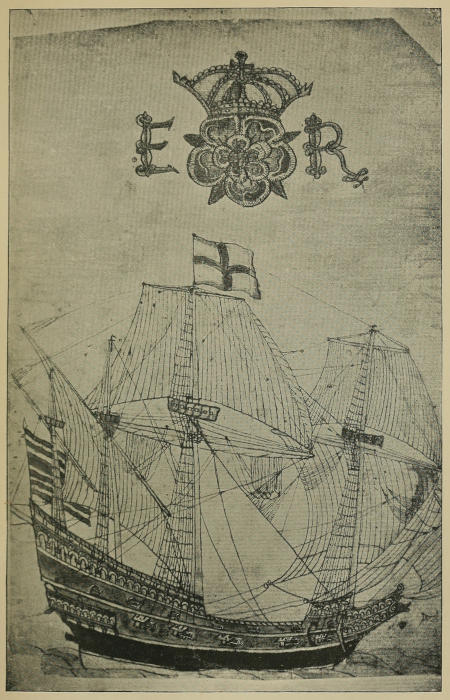
The illustration of an Elizabethan man-of-war, reproduced from a drawing in a Bodleian MS., shows some marked differences from the Tiger of Henry VIII. She is probably a vessel of the earlier portion of the reign; perhaps the Bull or Tiger of 1570. So far as the hull is concerned, there is distinct retrogression in that the keel is relatively shorter to the extreme length, and that the poop is built up to a disproportionate and unseaworthy extent. This last may be explained by the fact that the earlier Tiger was not expected to be called upon to serve outside the four seas, while the later ship had a wider cruising scope. The extended field of service called for larger crews, and as the orlop deck was not introduced till late in the reign, the increased accommodation necessary was obtained by the provision of more deck structures. In the matter of heavier masts and spars, possibly finer under water lines, larger sail area, and the multiplication of appliances for more rapid handling, there was an undoubted advance on the earlier ship.
Decoration of Ships.
Philip’s ambassador told him in 1569 that ‘they expect to be able to repel any attack by means of their fleet,’ and this confidence found natural expression in an inclination to decorate and adorn the weapons on which they relied. At any rate we now find specific payments for these purposes made with a frequency new in naval history. The ‘carving of personages in timber,’ and painting and colouring of ships in 1563 cost £121, 13s 8d and ‘painting and colouring red the great new ship called the White Bear‘[603] £20. Three ‘great personages in wood for the garnishing and setting forth’ of the same vessel were £1, 15s each. The upper works of the Bonaventure were painted black and white,[604] and the Lion in ‘timber colour;’ as the White Bear was red, and the Revenge and Scout, green and white there was evidently no regulation colour. The Bonaventure had a dragon on her beakhead, the royal arms on her stern, and two lions and two dragons in gilt and paint on her galleries. The Foresight carried the Queen’s arms, a rose and a fleur de lis, on her stern, and in 1579 £2, 13s 4d was paid for carving a Saturn and a Salamander for the Swallow. Figure heads were usual. The Nonpareil, Adventure, Dreadnought and Hope, had a dragon; the Charles, Defiance, Rainbow, Repulse and Garland a lion; the Mary Rose, a unicorn, and the Swiftsure a tiger. When the White Bear was rebuilt the carvings included,
‘an image of Jupiter sitting uppon an eagle with the cloudes, before the heade of the shippe xiˡⁱ; twoe sidebordes for the heade with compartments and badges and fruitages xˡⁱ; the traynebord[605] with compartments and badges of both sides viiˡⁱ; xvi brackets going round about the heade at xiiˢ the pece; xxxviii peces of spoyle or artillarie round about the shippe at xivˢ the pece; the greate pece of Neptune and the Nymphes about him for the uprighte of the Sterne viˡⁱ xˢ.’[606]
The whole cost of carving was here £172, and of painting and gilding £205, 10s, but these appear to have been exceptional amounts. Painting the Bonaventure cost £23, 6s 8d, the Dreadnought £20, the Vanguard £30, and the Merhonour £40, and these sums more nearly represented the ordinary expenditure. On the Elizabeth however £180 was spent in 1598 for
‘newe payntinge and guildinge with fine gold her beake heade on both sides with Her Maiesties whole armes and supporters, for payntinge the forecastle, the cubbridge heades[607] on the wast, the outsides from stemme to sterne, for like payntinge and newe guildinge of both the galleries with Her Maiesties armes and supporters on both sides, the sterne newe paynted with divers devices and beastes guilte with fine gold; for newe payntinge the captens cabbon, the somer decke[608] as well overhead as on the sides, the barbycan, the dyninge roome and the studdie.’[609]
The Rainbow’s lion figure head was gilt and on her sides were ‘planets, rainbows, and clouds’ with the royal arms on the upper, middle, and lower counter, but the whole charge was only £58, 6s. Cabins were painted and upholstered in the favourite Tudor colour of green and ‘Her Maiesties badge’ was painted in green and red. The White Bear and the Elizabeth are the only two instances in which comparatively large sums are found to be spent in ornament, and it does not appear that there was as yet more than a bent towards general embellishment. The smaller vessels are never mentioned in this connexion. The opinion of a contemporary was that, both for work and appearance,
‘our navy is such as wanteth neither goodly, great, nor beautiful ships who of mould are so clean made beneath, of proportion so fine above, of sail so swift, the ports, fights, coines, in them so well devised, with the ordnance so well placed, that none of any other region may seem comparable unto them.’[610]
Tonnage Measurement.
The new method of building by contract, and the large number of merchantmen upon which the bounty was now paid, necessitated a more exact measurement of tonnage than had hitherto obtained. In 1582 a rule was devised which remained in use for nearly half a century and was said to have been due to Mathew Baker, son of the James Baker shipwright to Henry VIII, and himself one of the principal government shipwrights. The writer says:[611]
‘By the proportion of breadth, depth, and length of any ship to judge what burden she may be of in merchant’s goods and how much of dead weight of ton and tonnage. The Ascension of London being in breadth 24 feet, depth 12 feet from that breadth to the hold, and by the keel 54 feet in length doth carry in burden of merchant’s goods (in pipes of oil or Bordeaux wine) 160 tons, but to accompt her in dead weight, or her ton and tonnage may be added one third part of the same burden which maketh her tonnage 213⅓. After the same rate these proportions follow:
Breadth at midship beam Depth from her breadth Keel Burden in cask of oil or wine Dead weight tonnage
A Ship of 20 ft. 10 ft. 42 ft. 86½ 115
A Ship of 21 ” 10½ ” 45 ” 102⅒ 136⅛
Prudence of London 24 ” 12 ” 51½ ” 150½ 202⅔
Golden Lion 32 ” 12 or 14 ” 102 ” 403 or 461 537 or 614⅔
Elizabeth Jonas[612] 40 ” 18 ” 100 ” 740 986⅔
To find the burden of any ship proportionately to the Ascension before specified multiply the breadth of her by her depth, and the product by her length at the keel, the amounting sum you shall use as your divisor. If 15,552, the solid cubical number for the Ascension do give 160 tons, her just burthen, what shall 8400, the solid number of a ship 20 feet broad, 10 feet deep, and 42 feet keel. Work and you shall find 86³⁴⁄₈₁ tons of burden while if you add one-third you shall find your tonnage 114 almost.’
This formula made theory square with fact since the result corresponded with the tuns of Bordeaux wine experience had shown a ship to be able to carry. But strictly, ‘burden’ and ‘ton and tonnage,’ as used here do not correspond with our net and gross tonnage, since burden is used in connexion with lighter material occupying more space than a heavy cargo, such as coal, that would be represented by ton and tonnage. The Spanish system of measurement in 1590 was to multiply half the breadth by depth of hold and the result by the length over all.[613] From this 5% was deducted for the entry and run, and the remainder divided by eight, gave the net tonnage; 20% was added to obtain the gross tonnage.[614]
The Seamen.
As early as 1561 the Venetian Resident considered England superior to its neighbours in naval strength,[615] but he may not have included Spain among the neighbours. The Spaniards officially in England kept Philip fully acquainted with the character and equipment of the fleet. He was always apprised of any preparations, and in such detail that we find him told on one occasion that twelve or fourteen ships were of from 400 to 700 tons ‘with little top-hamper and very light, which is a great advantage for close quarters, and with much artillery, the heavy pieces being close to the water.’[616] Eight years earlier his ambassador, De Silva, recommended him to have ships built in England instead of continuing the chartering system in vogue in Spain as ‘certainly the ships built here are very sound and good.’[617] These intimations probably did not stand alone, but neither then nor later did they lead to any change in the type affected in the Peninsula. English seamen did not favourably impress the Spaniards. One of Philip’s correspondents, in writing to him that four men-of-war had been prepared for sea, added, ‘the men in them are poor creatures.’[618] Six months later he was informed that although Elizabeth possessed twenty-two large ships she had only been able to fit eleven for sea, and would find it impossible to equip more, and that ‘the men on the fleet although they appear bellicose are really pampered and effeminate different from what they used to be.’[619] The estimate appears the more extraordinary because English seamen were at this time giving daily proof, at the expense of Spanish and other commerce, of the wild energy animating them. As late as 1586, Mendoza wrote that four ships were in commission and others in preparation, but of these latter, only four were seaworthy, ‘all the rest being old and rotten.’[620] If Philip was continuously misinformed as to the number of ships available, the difficulties in furnishing them, and the fighting value of the men, it may help to explain the confidence he showed later.
As a matter of fact, there are very few complaints throughout the reign about embarrassments due to want of crews. The semi-piratical expeditions preferred by the government were better liked than would have been a more regular warfare that would have meant harder fighting and fewer chances of plunder. Hatred of Spain and Popery, conjoined with the hoped for pillage of Spanish galleons, formed an inducement that never failed to bring a sufficient number of men together, notwithstanding that, as privateering speculations, most of the voyages were, pecuniarily, failures, although they served their purpose in destroying Spanish commerce and credit. The proportion of men on board a man-of-war was three to every five tons, of gross tonnage; one-third being soldiers, one-seventh of the remainder, gunners; and the rest seamen. In merchantmen the ratio was one man to every five tons of net tonnage, one-twelfth being gunners and the rest seamen.[621] But in practice the strength of a crew depended on the number of men required and the success of the impress authorities.
The Seamen:—Pay and Rewards.
Until 1585 the wages remained at 6s 8d a month, to which it had been raised in 1546 or very shortly afterwards. In 1585, the sailor’s pay was raised to ten shillings a month, through the action of Hawkyns. There must have been some dissatisfaction with the quality of the men hitherto serving, and the breach with Spain doubtless made an improvement necessary. Hawkyns coated the pill for Elizabeth by assuring her that fewer men would be required, of the standard to be attracted by the higher rate, and, ‘by this meane her Maiesties shippes wolde be ffurnyshed with able men suche as can make shyfte for themselves, kepe themselves clene withoute vermyne and noysomeness which bredeth sycknes and mortalletye.’[622] Moreover, ships could then carry more stores and continue longer at sea. Hawkyns was one of the few commanders of his age who recognised a claim to consideration in his inferiors, and made some attempt to secure their health and comfort. In 1589 he took care to have his stores ‘of an extraordinary price and goodnes to keep men in health’; in 1595 he took out clothes for his men and a new kind of ‘lading victuells, a kind of victuells for sea service devised by Mr Hughe Platte.’[623] Hammocks were introduced in 1597, when a warrant authorises payment for 300 bolts of canvas ‘to make hanging cabones or beddes ... for the better preservation of their health.’[624] In 1590, a suggestion, which did not, however, take practical shape till long afterwards, was made for the benefit of the merchant sailor. John Allington, a draper of London, proposed the creation of a special office for the registration of contracts between merchants, owners, and masters of ships. This would have led to something equivalent to the present ‘signing on’ enforced by the Board of Trade, and would have regulated the position of the seamen and simplified the enforcements of his rights, too often sacrificed to an unscrupulous use of legal forms.[625] Allington, like most of the projectors and schemers of his day, was no philanthropist. He offered to pay £40 a year for permission to establish such an office, and apparently expected to obtain five shillings apiece from 500 or 600 ships a year.
No especial provision was made on board men-of-war for the sick or wounded sailor; if the ship went into action he was placed in the cable tier or laid upon the ballast as being the safest places. If he survived the medical science of his time, and was landed disabled, he was supposed to be passed to his own parish. Sometimes he was permitted to beg. A printed licence from Howard, as Lord Admiral, under date 1590, still exists empowering William Browne, maimed in 1588, to beg for a year in all churches.[626] By 35 c. 4 and 39 c. 21 of Elizabeth relief was afforded to hurt men; these were both repealed by 43 c. 3 which enacted that parishes were to be charged with a weekly sum of not less than twopence or more than tenpence to provide help, the pension however in no case to exceed ten pounds for a sailor or twenty pounds for an officer. Gratuities were sometimes given. In 1593 Hawkyns was ordered to pay two shillings a week, for twenty weeks, to 29 injured men, and William Storey, having lost a leg, received £1, 13s 4d, apparently in settlement of all claims.[627]
Such gifts, in view of the number we can still trace, were probably more frequent than would be expected from the character of Elizabeth. In 1587 a month’s extra pay was awarded to the crews of three pinnaces for their good service in capturing Spanish prizes. For 1588 £5, was divided among 100 men who manned the fireships sent into Calais Roads, £80, among the wounded of the fleet generally, and £7 to sick men in the Elizabeth.[628] In 1591 six months’ pay was given to the widows of the men killed in the Revenge, and in 1594 there is a gift of £61, 19s 6d to Helen Armourer, widow of John Armourer of Newcastle, ‘in consideration of his good and faithful services,’ although the name is quite strange in naval affairs.[629] Merchant seamen were also remembered in these benefactions. On one occasion forty marks were paid to five men ‘having been lately lamentably afflicted in Naples by pryson and other punyshments by thinquisition of Spayne as we are informed and by secret escape savid their lyves.’[630] On another ‘in consideration of the valiantnes done in Turkey by our welbeloved subiecte John Ffoxe of Woodbridge in our county of Suffolk, gunner by whose meanes 266 Christians were released out of miserable captivity,’ an assuredly nobly earned pension of one shilling a day was conferred upon him.[631] When it cost the Queen nothing directly she was sometimes still more liberal. To Robert Miller, a master mariner, £200, was allowed out of forfeited goods in consideration of his services and losses at sea; George Harrison received £800, in the same way and for the same reasons. Sometimes seamen’s wives, whose husbands were prisoners in Spain, petitioned the Council for help. In one instance the merchants owning the ships were ordered to assist the women; in another their landlords were directed not to press them for rent.
We can know little of the internal economy of a merchantman in those days. The vessels were relatively as crowded, and probably as unhealthy, as men-of-war; the victualling was of the same, and at times even worse quality, seeing that the owners of merchant vessels were expected to buy government provisions if the victualling department found itself overstocked. In 1596 there is a letter directing the Lord Mayor to forbid the city butchers to sell meat to ships until the government stores of salt beef were sold out. This is followed by an order from the Council to the Serjeant of the Admiralty not to allow any outward bound trader to pass down the river unless a certificate of such purchase was produced.[632]
Mortality on Shipboard.
We have no means of estimating the mortality from disease on board merchant ships, but we know that in men-of-war it was very great. ‘In the late Queen’s time many thousands did miscarry by the corruption as well of drink as of meat,’ says a seventeenth century writer;[633] and Sir Richard Hawkyns thought that, in twenty years, 10,000 men died from scorbutic affections. The length of the voyages now undertaken rendered larger crews necessary; the accommodation was narrow and ill-ventilated, the requirements of sanitation unknown, and the food was usually scanty and bad, so that the sailor was placed under conditions that made him fall an easy victim to disease. In Drake’s voyage of 1585-6 out of 2300 men nearly 600 died from disease. In the expedition of 1589, out of 12,000 men employed, nearly one-half perished, mainly from sickness and want of food, and every enterprise, small or great, suffered more or less largely in the same way. Usually the hope of plunder sustained the men through all such trials, and there is only one serious case of the mutiny of a crew because of ‘the weakness and feebleness they were fallen into through the spare and bad diet.’ But in this instance sympathy with their captain may have had much to do with their action.[634]
The pages of Hakluyt relate much of the suffering endured by our seamen abroad from disease and privation, but there is one historic illustration at home of the miseries borne by the men and the callousness or scanty resources of the authorities. On 10th August 1588 Howard wrote to Burghley:
‘Sicknes and mortallitie begin wonderfullie to growe amongste us ... the Elizabeth, which hath don as well as eaver anie ship did in anie service, hath had a great infectione in her from the beginning soe as of the 500 men which she carried out, by the time she had bin in Plymouth three weeks or a month there were ded of them 200 and above, soe as I was driven to set all the rest of her men ashore, to take out the ballast and to make fires in her of wet broom 3 or 4 daies together, and so hoped therebie to have cleansed her of her infectione, and thereuppon got newe men, verie tall and hable as eaver I saw and put them into her; nowe the infectione is broken out in greater extremitie than eaver it did before, and they die and sicken faster than ever they did, soe as I am driven of force to send her to Chatham ... Sir Roger Townsend of all the men he brought out with him hath but one left alive ... it is like enough that the like infectione will growe throughout the most part of the fleet, for they have bin soe long at sea and have so little shift of apparell ... and no money wherewith to buy it.’
On the 22nd August he writes to the Queen that the infection is bad, that men sicken one day and die the next but, in courtly phrase, that ‘I doubt not that with good care and God’s goodnes which doth ever bles your Maiestie it wyll quenche againe.’ But on the same day he tells the Council more plainly, ‘the most part of the fleet is grievouslie infected and die dailie ... and the ships themselves be so infectious and so corrupted as it is thought to be a verie plague ... manie of the ships have hardly men enough to waie their anchors.’[635] And as illustrating the infection and its probable cause comes a complaint from him to Walsingham that, although the beer in the fleet has been condemned as unfit for use, it is still served out to the men, and ‘nothing doth displease the seamen more than sour beer.’
This sickness is usually said to have been the plague or typhus. But Howard and his captains, who had lived to middle age in a country where the plague was endemic and who must have known its symptoms well, obviously thought ‘the infectione’ something different. In the passage quoted above he compares it to the plague and in another letter he writes, ‘The mariners who have a conceit (and I think it true and so do all the captains here) that sour drink hath been a great cause of this infection amongst us.’[636] The plague was familiar to them all but this was something they could not easily name. The same arguments apply, although perhaps not so closely, against typhus which in its general form and symptoms was familiar under various names to sixteenth century observers. But 1588 was not a particularly unhealthy year on land and there is no record of any sudden outbreak of epidemic disease either before or after that occurring on the fleet. Moreover though typhus occasionally kills within a few hours it has never been known to kill numbers in the rapid fashion suggested by Howard. It is probable that the complaint was an acute enteritis, caused by the beer, acting on frames enfeebled by bad and insufficient food, and still further weakened by the scorbutic taint to which all classes, but especially seamen, were subject in the middle ages.
On the whole the position of the sailor was now steadily deteriorating. In the fourteenth and fifteenth centuries his pay had been relatively very high, and as he was only called upon to serve round the coasts, or, at furthest, to Bordeaux or the Baltic, his health was not affected by conditions to which he was only exposed for a short time. But towards the end of the sixteenth century the wages, in consequence of the general rise in prices, were relatively less than they had been, and less than those of the artisan classes on shore. In an epoch when the increase in the number of distant voyages set his services in commercial demand he was required to serve in the royal fleets for longer periods than had been before known. He was exposed to a merciless system of impressment, cheap for the State because he had to indirectly bear the cost. And the length of the cruises, their extension into tropical climates, and the character of the provisions, unsuited to the new conditions, made themselves felt in outbreaks of disease to which his ancestors, assembled chiefly for Channel work, had been strangers. Morally the general tone among the men cannot have been high if we may judge them from a phrase used by the officials sent down to examine into the plunder of the Madre de Dios in 1592, ‘we hold it loste labor and offence to God to minister oathes unto the generallitie of them.’[637]
Seamen’s Clothing.
It will have been noticed that in his letter of 10th August Howard says that the men have no money wherewith to buy clothes; in another he suggests that a thousand marks’ worth of apparel should be sent down. But the custom of providing crews with coats or jackets at the expense of the crown had quite ceased, and even if necessaries were supplied to the men they had to pay for them. The supply was usually a private speculation on the part of some Admiralty official. In 1586 Roger Langford, afterwards paymaster of the Navy furnished men with canvas caps, shirts, shoes, etc., a piece of business by which he lost £140. In 1580 the government sent over clothes for the men on the Irish station, the cost of which was to be deducted from their wages. The articles included, ‘canvas for breches and dublettes’—‘coutten for lyninges, and petticoates,’ stockings, caps, shoes, and shirts.[638] Hawkyns with the forethought always characterising his action as an admiral, took out with him in 1595 ‘calico for 200 suits of apparel,’ 400 shirts, woollen and worsted hose, linen breeches and Monmouth caps.[639] There is a sketch in a contemporary treatise on navigation of a seaman, apparently an officer. He wears a Monmouth, or small Tam o’ Shanter, cap, a small ruff round the neck, a close-fitting vest, and long bell-mouthed trousers.[640] In 1602 there is a payment in the Navy accounts of £54, 19s 8d for clothing for Spanish prisoners. Canvas shirts, cotton waistcoats, caps, hose, and ‘rugge’ for gowns were provided and the articles were doubtless of the same kind and quality as those worn by the men.
Royal Ships Lent.
During the earlier years of her reign the Queen, like her predecessors, frequently allowed her ships to be hired for trading voyages. In 1561 the Minion, Primrose, Brigandine and Fleur de Lys, were delivered to Sir William Chester and others for a voyage to Africa. In this case Elizabeth shared the risk. For her ships, and for provisions to the value of £500, she was to receive one-third of the profits. The hirers undertook to ship at least £5000 of goods, pay wages and all other expenses, and each enter into a bond of 1000 marks to carry out the conditions.[641] In 1563 the Jesus of Lubeck was lent to Dudley and others, to trade to Guinea and the West Indies, for which they paid £500.[642] She was then, after having been in the Royal Navy nearly twenty years, valued at £2000 for which amounts the hirers had to give their bonds. She returned in 1565, was at Padstow in October, and ‘cannot be brought to Gillingham till spring of next year.’ The adventurers could not have procured a 600 ton vessel, for two years, for £500 from any owner but the State. And as she had to remain at Padstow during the whole winter it may be inferred that she returned in a very unseaworthy condition, for Elizabethan seamanship was certainly equal to taking a ship up Channel during the winter months. She was hired by Hawkyns in 1568 and was then the first of the only two men-of-war lost to Spain during the entire reign. When a convoy was furnished a full charge was levied for the protection; £558 was received in 1569 from the Merchant Adventurers’ Company for men-of-war serving on this duty, and again £586 in 1570.[643] As private owners built more and bigger ships the demand for men-of-war for trading voyages grew less, but the Queen often lent them for privateering ventures in which she was pecuniarily interested, assessing their estimated value as a portion of the money advanced by her and on which she would receive a dividend. Under these circumstances her representatives did not err on the side of moderation when valuing the ships thus temporarily lent. When Drake took the Bonaventure and the Aid in 1585 they were appraised at £10,000, an obviously extravagant estimate. Nominally Elizabeth advanced £20,000, of which these two ships stood for half; she got her ships back, £2000 for the use of them, and the same dividend on £20,000 as the other persons who had taken shares. Those others lost five shillings in the pound; she must have made a profit.
The Victualling Department.
In consequence of the greater activity of the Royal Navy the victualling department experienced a corresponding enlargement. In 1560 the buildings at Tower Hill, formerly the Abbey of Grace, and granted in 1542 to Sir Arthur Darcy, were purchased from him for £1200, and £700 expended in repairing them.[644] Other storehouses were hired at Ratcliff and St Katherines, the latter from Anthony Anthony, Surveyor of the Ordnance, who seems to have taken great interest in naval matters, and to whom we are indebted for the coloured drawings of ships previously referred to. For his storehouse he was paid £16 a year; another at Rochester cost £5, 6s 8d a year. By a patent of 24th December 1560, William Holstock was joined with Baeshe as Surveyor of the Victuals; this was surrendered and replaced by another of 30th October, 1563 in which John Elliott took Holstock’s place. Neither Holstock nor Elliott had any actual position, the new patents only giving them the chance of succeeding Baeshe. An agreement with him of 13th April 1565, but which did not cancel the title and fees granted to him by his Letters Patent, instituted a considerable reform inasmuch as it did away with purveyance, or forced purchase, at rates fixed by the officers of the crown. Henceforth Baeshe was to be paid fourpence halfpenny a day for each man in harbour and fivepence a day at sea. For this he was to provide, per head, on Sundays, Mondays, Tuesdays and Thursdays, 1 lb of biscuit and 1 gallon of beer, and 2 lbs of salt beef, and on the other three days, besides the biscuit and beer, a quarter of a stockfish,[645] one-eighth of a pound of butter, and one quarter of a pound of cheese. Fourpence a man per month at sea, and eightpence in harbour he was to allow for purser’s necessaries, such as wood, candles, etc., and he was to pay the rent of all hired storehouses and the wages of his clerks. He undertook not to use the right of purveyance unless ordered to victual more than 2000 men suddenly, and agreed to always keep in hand one months provisions for 1000 men. The agreement could be terminated by six months’ notice on either side, and until it ceased the crown advanced him £500 without interest to be repaid within six months of the cessation of his contract. He was given the use of all the crown buildings belonging to his department, subject to his keeping them in repair, and was permitted to export 1000 hides in peace time and as many as he should slaughter oxen during war.[646] The weight of purveyance was felt chiefly in the home counties, and Elizabeth may have felt it good policy to do away with a ceaseless source of popular irritation which was really of very little advantage to the crown. From this date payments were made to Baeshe direct from the Exchequer and no longer through the Navy Treasurer. Isolated payments relating to storehouses, of no general interest, recur in the accounts, but the growing importance of Chatham is shown by the removal, in 1570, of buildings at Dover, and their re-erection at Rochester, at a cost of £300.
In 1569 an additional £1000 was advanced to Baeshe without interest, and in 1573, the harbour rate was raised to fivepence halfpenny per man, and the sea rate to sixpence. All this assistance, for probably further sums were lent to him without interest, does not seem to have enabled him to carry on his work without loss. In 1576 he petitioned the Queen to be forgiven the first £500 advanced to him and to be permitted to pay off the balance at £1000 a year. He based his claim to consideration on the fact that he had saved her 1000 marks a year by his contract and had acted without recourse to purveyance, ‘no small benefit to the hole realme.’ He had lost £500 a year, for four years, by the embargo on trade with the Low Countries, which prevented his exportation of hides, and £ 240 by the fire at Portsmouth. And:—
‘finally what my service hath bin from tyme to tyme as well to her most noble ffather, brother, and sister, as to her Maiestie I do referre the same to the report of my Lord Tresorer and my Lord Admirall and yet hitherto I never receyved from her Maiestie any reward for service but only her Maiesties gracious good countenance to my comfort.’[647]
The petition does not appear to have obtained anything beyond a continuance of these unsubstantial favours, but Baeshe struggled on till 6th May 1586 when he gave six months’ notice to determine his contract. He then anticipated a loss of £534 on victualling eight or ten ships, ‘which I am not able to beare.’[648] He must have been a very old man and anxiety perhaps hastened his death, which occurred in April 1587. In the interval, however, the rate had been raised, from 1st November 1586 to 31st March 1587 to sixpence a day per man in harbour, and sixpence halfpenny at sea, and from 1st April 1587 to 31st October to sixpence halfpenny in harbour and sevenpence at sea, ‘on account of the great dearth.’ The Armada was already expected, but on 30th June 1587, when the stores were handed over to Baeshe’s successor there were only 6020 pieces[649] of beef, and 2300 stockfish in hand.
By Letters Patent of 27th November 1582 James Quarles ‘one of the officers of our household’[650] had been granted survivorship to Baeshe, and he now took his place from 1st July 1587, at the same fees and allowances as had been originally given by the patent of 18th June 1550. The rate was maintained at sixpence halfpenny and sevenpence ‘untill it shall please Almightie God to send such plentie as the heigh prises and rates of victuall shalbe diminished’. The quantity and quality of the food provided for the men in 1588 has long been a source of disgrace to Elizabeth and her ministers. An apology for them has been attempted on the ground that the mechanism at work was new and not capable of dealing with large numbers of men, and that the failure was mainly due to the suddenness of the demand. So far as the first statement is concerned it is sufficient to answer that the victualling branch had been organised for nearly forty years, and found no difficulty in arranging for 13,000 men in 1596, and 9200 men in 1597 after timely notice. The last reason may excuse the victualling department but will not relieve the statesman in responsible direction. The government had had long notice of the coming of the Armada, but even as late as March Burghley was occupied with niggling attempts at making 26 days’ victuals last for 28 days.[651] In 1565 Baeshe had undertaken to keep always one month’s victuals for 1000 men in store, but in June 1587 there was not even so much. The point therefore is that if the ministry had thus early recognised the necessity for a reserve, and that two or three months were requisite for the collection and preparation of provisions for a large force, and if with the knowledge that such provisions were certain to be required, and in spite of the warnings of those best able to judge, they neglected the preparations and continued a supply which was merely from hand to mouth, they must be held guilty of the sufferings inflicted on the men by their miserable policy. When the moment of trial came Quarles and his superiors did their best, but the accusation against the latter is that had they exercised the foresight supposed to be one of the qualifications for their dignified posts no such sudden and almost ineffective efforts would have been necessary. The spirit in which they or the Queen dealt with the matter is shown by the necessity Howard was under of paying out of his own pocket for the extra comforts obtained for the dying seamen at Plymouth.[652]
How far Elizabeth was herself answerable is a moot point. There is no direct evidence that the delay in obtaining provisions was due to her orders. On the other hand we know that the postponements in equipping the ships, and the hesitating action and inconsistent directions and suggestions that characterised the early months of 1588, were due to her, and there is a strong probability that much of the shame should rest with her rather than with ministers who perhaps had to carry out commands to which they had objected in Council. Moreover very few things, especially those involving expense, were done without the knowledge and approval of Elizabeth. It was a personal government and there is no reason to suppose that this particular branch was beyond her cognisance. With the fatality that has usually dogged English militant endeavour the fleet did not even obtain the benefit, at the right time, of the stores provided. Frequently victuallers were blundering about for weeks looking for it, while the admirals were sending up despairing entreaties for supplies. In April, Drake wrote to the Queen ‘I have not in my lifetime known better men and possessed with gallanter minds than your Majesty’s people are for the most part.’ Whether the cause was incompetence or a criminal parsimony their fate, after having saved their country, was to perish in misery, unheeded and unhelped except by the officers who had fought with them. In the conceit of Elizabeth and her like they were only ‘the common sort.’
During the forty years that Baeshe had served the crown he had never been charged with dishonesty and he died poor. Quarles however had at once serious malpractices imputed to him as having occurred within his first year of office.[653] His accuser, a subordinate, as usual offered to do his work for 1000 marks a year less, and on examination of the charges it seems likely that some were untrue and that other defaults occurred in consequence of the orders given to him.
From 1589 the rate again fell to fivepence-halfpenny and sixpence, in harbour and at sea; but for 1590 and 1591 Quarles was allowed £2355, on account of the dearth still existing. He had petitioned that he had suffered a loss of £3172, between April 1590 and April 1591, being the difference between the rates paid to him and the cost per head of the victuals.[654] He died in 1595 and was succeeded by Marmaduke Darell, his coadjutor, ‘clerk of our averie.’[655] Till 1600 the rate remained the same although heavy extra allowances were made each year to Darell; then it was raised to sixpence halfpenny and sevenpence. In this year £738 was spent on repairs to Tower Hill where there were separate houses for beef, bacon, ling, etc., ‘the great mansion being the officers lodgings.’ The storehouses and brewhouses at Portsmouth, built by Henry VIII, still existed under the names originally given them and were repaired at a cost of £234.
One ton and a half of gross tonnage, or one of stowage, was allowed on board ship, for one month’s provisions for four men, of which the beer occupied half, wood and water a quarter, and solid food the remainder of a ton.[656] There is no reason to suppose that either Baeshe, Quarles, or Darell were either dishonest or incompetent. The terrible outbreaks of disease that occurred during nearly every long voyage were not confined to the English service and were the natural result of salt meat and fish, and beer that could not be prevented from turning sour. They could only do their best with the materials at command but which were not suitable to the larger field in which the services of English sailors were now required.
The Administration.
Benjamin Gonson was Treasurer of the Navy when Elizabeth came to the throne and held the post until his death in 1577. The number of vessels added to the Navy during his term of office shows that he was not inactive, and he was certainly a competent public servant. John Hawkyns[657] was his son-in-law, and the relationship doubtless inspired Hawkyns with the hope of succeeding him, and perhaps enabled him to infuse some of his own spirit into the management of the Navy, while Gonson was still its official head. But mere relationship, although it had its influence would not alone have sufficed, had not Hawkyns already made his name as a seaman and as an able commander. In 1567 he received a grant of the reversion to the office of Clerk of the Ships, a post he could only have looked upon as a stepping-stone, and which he never took up. In 1577, when Gonson was ill, Hawkyns petitioned the Queen, probably, although it is not specifically mentioned, for the reversion to his post, and drew up a long catalogue of unrecompensed services.[658] Gonson died in the course of a year, a landed proprietor in Essex, and a successful man, but he had told his son-in-law, when the latter was trying to obtain the reversion, that, ‘I shall pluck a thorn out of my foot and put it into yours.’ Hawkyns lived to realise the truth of the kindly warning. He commenced his duties from 1st January 1577-8, acting under Letters Patent of 18th November 1577, by which he was granted the survivorship to Gonson. For seventeen years, during the most critical period of English history, he was, in real fact, solely responsible for the efficiency of the Navy, and he, more than any other man may be said to have ‘organised victory’ for the English fleets. His duties included not only the superintendence of the work at the dockyards, but that of building, equipping, and repairing the ships, of keeping them safely moored and in good order, of the supply of good and sufficient stores, and apparently of every administrative detail except those connected with the ordnance, and of victualling and pressing the men. The technical improvements he himself invented or introduced have already been noticed. In the administration he made others, which may or may not have been advantageous, but which touched the interests of subordinates, and which resulted in his having to stand alone and carry on his work impeded by the sullen enmity of his colleagues and his inferiors.
Hawkyns owed his knighthood to Howard rather than the Queen; his reward after 1588 was to be allowed a year wherein to unravel his intricate accounts. In fact few of Elizabeth’s officials escaped her left-handed graces. Baeshe died in poverty after forty years of honest service, and Hawkyns was continually struggling to clear himself from suspicions that were kept hanging over him, but from which he was given no proper opportunity to free himself. Elizabeth’s favours and bounties were reserved for court gallants of smoother fibre than were these men. In 1594, shortly before his last unhappy voyage, Hawkyns founded a hospital at Chatham for ten poor mariners and shipwrights. He, with Drake, established the ‘Chatham Chest,’ for disabled seamen, and it should be remembered to his honour that, in an age when little care was bestowed on inferiors if they had ceased to be of any utility, he never relaxed his efforts until his craft had rescued from Spanish prisons the survivors of those under his command in 1568 whom he had been compelled to leave ashore after escaping from San Juan de Ulloa.
Charges of peculation against persons connected with maritime affairs were rife on all sides. The shipwrights quarrelled among themselves and with Hawkyns, and two of the former, Chapman and Pett, were moreover accused by outsiders of gross overcharges.[659] Captains were said to dismiss pressed men for bribes, to retain wages, and keep back arms;[660] pursers to steal provisions, to make false entries by which they obtained payments for money never advanced to the men, and to remain ashore while their ships were at sea.[661] Pursers, cooks, and boatswains, bought their places: the cooks had the victuals in their care and recouped themselves at the expense of the seamen; boatswains stripped a ship of movable fittings, on her return home, and stole rigging and cordage.[662] According to the evidence of a witness, in the inquiry of 1608, these abuses, if they did not commence, took fresh and vigorous life after the death of Hawkyns. In 1587 he recognised the theft going on and his inability to completely suppress it; ‘I thincke it wolde be mete their weare a provost marshyall attendante upon ye Lord Admirall and Offycers of the Navye to doe suche present execucyon aboorde the shippes uppon the offenders as shulde be apoynted.’[663] Accusations were not wanting during Gonson’s lifetime but the increased activity of the Navy after his death gave a wider scope both to suspicion and to actual peculation. Hawkyns was not the only one of the Principal Officers whose conduct was impeached, but in virtue of his position the brunt of attack fell upon him. There was hardly one of his duties which at some time or another did not give occasion for a charge of dishonesty.[664]
Hawkyns, if we may judge by the letters remaining in the Record Office, was more frequently in communication with Burghley, explaining his intentions and desires, than with his official chief the Lord Admiral. Either therefore Burghley was satisfied with his conduct—and there is one letter that directly supports this view—or the Lord Treasurer allowed a man whose honesty he doubted to remain in a responsible office without removing him, or adopting any new measure of supervision. The quality of the cordage had been a common cause of complaint and, in 1579, Hawkyns wrote that he had taken measures, of which he doubted not the success, to remedy this and other evils, and that he had a memorandum ready proposing a course to be followed, ‘wherebye the offyce wolld not onelye flourysshe but within a few yers be bountyfullye provyded of all maner of provycion without extra charge to her Maiestie.’[665] Subsequent events show that the suggestions he was here about to make were accepted and, as a consequence of his new methods, the clamour raised against him grew so loud that in January 1583-4 a commission sat to inquire into the condition of the ships and the conduct of the office. Nothing is known of their report but it was evidently not of a character fatal to his reputation. In another letter to Burghley shortly afterwards he attributes his success in carrying out reforms to the aid he had received from the minister’s skill,
‘in the passinge of theis greate thinges thadversaries of the worke have contynewallye opposyd themselves against me ... and their slawnders hathe gone verye farr ... onlye to be avenged of me and this servis which doth discover the corruption and ignoraunce of the tyme past.’[666]
By 1587 he had begun to share Gonson’s weary disgust of his surroundings, and intimated that the work was too much for any one man and should be done by a commission. Howard’s high opinion of him was expressed freely in his letters during 1588, and shown practically by the knighthood he conferred. Notwithstanding his services, so fully tested in that year, he does not appear to have won the shy confidence of Elizabeth, but that he had succeeded in convincing Burghley is I think clearly proved by the following letter:—[667]
‘My bownden dewtie in humble manner rememberyd unto your good lordshipe; I do perseve hir Maiestie ys not well sattysfied concernyng the imploymentes of the great somes of mony that have byne reseaved into thoffice of the navye although your Honour dyd very honourably bothe take payne and care to se the strycte and orderly course that ys used in thoffice and thereupon delyver your mynd playnely to her Maiestie as your lordship found yt for which I shall ever acknowlege myself dewtyfully bownd to honour and serve your lordshipp to the uttermost of my abillytie: and whereas her Highnes pleasure ys to be farther sattysfied in myne accomptes ther hathe nothyng byne more desyred nor cold be more wellcome or acceptible to me and when yt shalbe hir Maiesties pleasure to nomynate the persons that I shall attend upon I wyll brieffly shew the state of every yeres accompt suffycyently avouched by boockes to the last day of Desember 1588 which is XI yeres.... If any worlldly thynge that I possesse cold free me of this mystrust and importyble care and toyle I wold most wyllyngley depart with yt for as the case stondeth I thynke ther ys no man lyvinge that hathe so carefull so myserable so unfortunate and so dangerous a lyfe; onlye I se your lordship with care and trewthe dothe serche into the trew order the sufficiency and valyditye of the course that ys caryed in the office whiche otherwyse I wold even playnely gyve over my place and submyt myselfe to her Maiesties mercye thogh I lyvid in pryson all the dayes of my lyffe; the matters in thoffice growe infenyte and chargeable beyond all measure and soche as hardly any man can gyve a reason of the innumerable busynesses that dayly grow; yet the mystrust ys more trobelsome and grievous then all the rest for with the answerynge of thone and towle of thother there ys hardly any tyme left to serve God or to sattysfie man. The greater sort that serve in this office be growen so proud obstinate and insolent nothynge can sattysfie them[668] and the commen sort very dysobedyent so as a man that must answere the immoderate desyre of all these were better to chuse to dye than so lyve. The paynfull place that your lordship dothe holde and the imoderate demaunds that comes before you havyng with the favour of her Maiestie the hellp of an absolute power to bynd and lose may eselye demonstrate the borden that so meane a man as I am dothe here (which must passe every thynge by petycon and mystrust), to sattysfie the multytude of demaundes that are in this office and although they be many and as well satysfied as in any office in all Ingland yet few are contentyd but go away with grudging and mormoure. It were a great vanytie for me to comend myne owne service neyther do I go abowt to acumyllatte to myself any comendacon for that I thought I performyd my dewtie suffycyentlie but yf the estate of thoffice be consyderyd what yt was when I came into yt and what yt ys now ther wilbe found greate oddes wherein I have traveyled as carefully as I cold and as my creddytt cold obtayne meane to reduce the state of thoffice shipes and there furnyture into good and perfitt ordre; in recompense whereof my onely desyre ys that yt may please hir Maiestie some course may be taken wherein hir Maiestie may be sattysfied that a playne and honest course hathe byne taken and caryed in thoffice and then to dyspose of my place to whome yt shall please hir Highnes and I shalbe reddy to serve hir Maiestie any other way that I shalbe appoynted wherein my skyll or abyllytie will extend and so I humbly take my leve from Deptford the 16th April 1590.’
The writer of this letter was either a master hypocrite so skilful in roguery that he feared neither the investigations of his superiors nor the denunciations of envious and hostile subordinates, or an honest man who had nothing to dread from inquiry. He had convinced Howard and Burghley, of whom the first was a seaman who had proved his work by the tests of war and storm, and the second no guileless innocent, but a politician grown grey among surroundings of fraud and intrigue. Only the penetrating Elizabeth refused to be deceived.
In 1592 and 1594 he again expressed his wish to resign, but the government had apparently no desire to lose his services.[669] On Clynton’s decease Charles, Lord Howard of Effingham became Lord Admiral,[670] and held the office till 1618. His name is indissolubly connected with the maritime glories his support of Hawkyns and his clear judgment as a commander helped to bring about. Howard was the first Lord Admiral who transferred some of the privileges of his office. In 1594 he gave over to the Trinity House the management of buoys and beacons along the coasts and the rights of ballasting in the Thames.[671] This marks the first practical connection the Corporation had with maritime affairs. Hawkyns died at sea on 12th November 1595, and the Treasurership was not immediately filled up. Roger Langford, long an office assistant, and his deputy during his absence, was made ‘General Paymaster of the Marine Causes,’ but simply worked at the accounts without authority in administrative business.[672] In 1598 Fulke Grevill, afterwards Lord Brooke, was appointed Treasurer with full powers.[673] Grevill is said, by a modern writer, to have possessed ‘a dignified indolence of temper,’ and ‘a refinement in morality which rendered him unfit for the common pursuits of mankind.’ These were not qualifications peculiarly fitting him for the rough surroundings of naval affairs in 1598 and the real control passed into the hands of his colleagues.
Till his death in 1589 Sir Wm. Wynter, from 1557 Surveyor of the Ships and Master of the Ordnance of the Navy, was, after Hawkyns, the most influential officer. He was succeeded by Sir H. Palmer,[674] who held the post until he became Comptroller in 1598,[675] when he was replaced as Surveyor by John Trevor.[676] After Wynter’s death there was no longer a separate ordnance department for the Navy. Richard Howlet, the former Clerk of the Ships, died in 1560, and George Wynter, a brother of Sir William Wynter was appointed.[677] In 1580 George Wynter was succeeded by William Borough,[678] who, in 1588 was followed by Benjamin Gonson, son of the former Treasurer,[679] who, in turn, was succeeded by Peter Buck in 1600. William Holstock became Comptroller from 12th December 1561, in succession to Brooke, and in 1589 William Borough succeeded him until 1598. Nearly all these men commanded ships or squadrons at sea at various times, in addition to their duties as members of the naval board. There is a draft document existing[680] which shows that in January 1564 it was intended to add another officer as ‘Chief Pilot of England,’ on the model of the ‘Pilot Major’ of Spain. Stephen Borough was the person chosen, and in consequence of the losses of shipping through the ignorance of pilots and masters no one was to act in such a capacity in vessels of forty tons and upwards, without a certificate of competence from him, under a penalty of two pounds. Masters’ mates, boatswains, and quartermasters were to be similarly examined and certified. This plan, however, was not carried into execution.
Dockyards.
Concerning the dockyards the most noteworthy feature is: the rise into importance of the Chatham yard. For 1563 the expenses of Deptford were £19,700, while those of Gillingham, chiefly for the wages and victuals of shipkeepers, were £3700. In 1567 it is first called Chatham, a house rented for the use of the Board, and the cost of Chatham and Gillingham £6300. Next year the ground on which Upnor Castle was to be built was bought for £25,[681] and in 1574 a fort was ordered for Sheerness which replaced the bulwark built in the reign of Edward VI. In 1571 more ground was rented at Chatham, and in 1574 the fairway through St Mary’s Creek, by which the anchorage could be taken in flank, was blocked by piles.[682] Deptford, however, was still in considerable use, especially for building and repairs of ships, and in the same year the dock was reconstructed. In 1578 a new pair of gates for the Deptford dock cost £150, and in the following year most, if not all, of the dockyards were fenced round with hedges.[683] Small additions in the shape of wharves and storehouses, were being continually made to Chatham; one of the former, built in 1580, was 378 feet Long, 40 feet broad, and cost five shillings a foot. Various other improvements of the same kind were carried out in connection with Woolwich and Deptford, and as no drydock was constructed at Chatham during this reign, all the building and repairs of the big ships was done at the former places. Portsmouth was hardly used at all. In 1586 a new wharf was made, and sundry small expenses were at various times incurred for keeping the dock in order, but sometimes for years in succession the only expenses relating to it are the salaries of the officers in charge. The yard was nearly destroyed by a fire on 4th August 1576, and was probably not fully restored. It was, moreover, contemned by the chief officers, who considered it expensive and defenceless.[684] For a few years, from 1601, the Hansa steelyard was handed over to the Admiralty and used for storage purposes.