ELIZABETH 1558-1603 (continued 2)
Reading edition
In early times the Bridport district had supplied most of the cordage used in the English service; in the fifteenth and sixteenth centuries it had mostly come from abroad. In 1573 there was an attempt to secure independence in this respect, and £800 which he was to repay by £100 a year, was advanced to Thomas Allen to build ropehouses at Woolwich.[685] Allen was ‘Queen’s merchant,’ i.e., crown purchaser, for Dantzic cordage. The experiment was probably a failure, since there is no other reference to it, and was not renewed until the next reign.
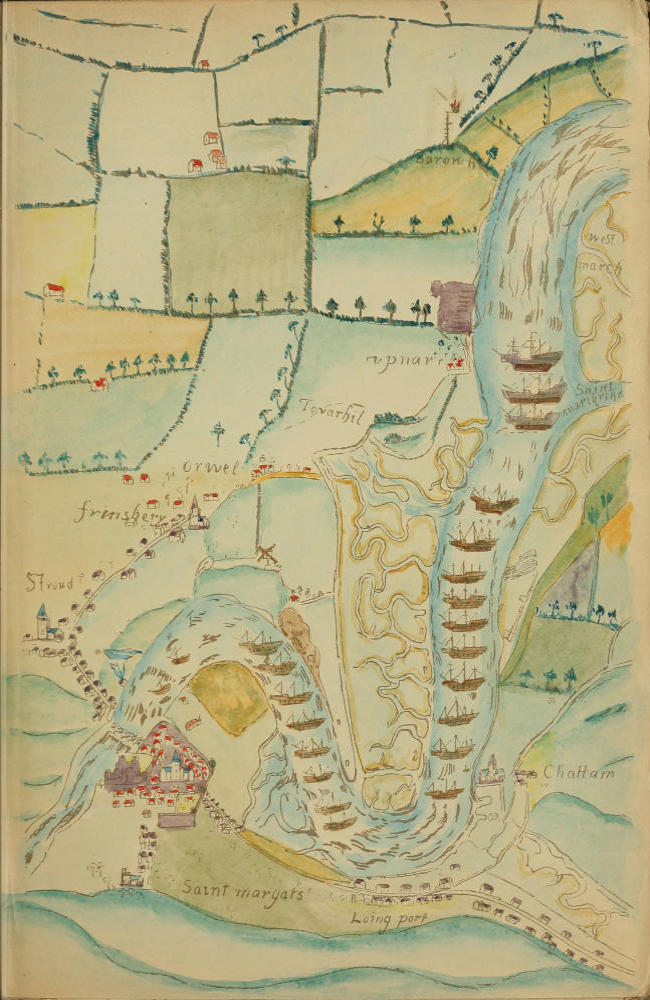
In addition to the forts at Upnor and Sheerness the ships lying in the Medway required some further protection, as relations with Spain became more critical and rumours of plots to fire the vessels frequent. This was given by means of a chain, an old and well known form of defence. In a letter to Burghley, of March 1585, Hawkyns suggested the chain with two or four pinnaces stationed by it, and the Scout and Achates at Sheerness to search everything passing.[686] In October the work was nearly completed; it had been ‘tedyous and cumbersome but now stretched over the river in good order yt dothe requyre many lyghters for the bearynge of it which are in hand.’[687] One end was fixed to piles, the other worked round ‘two great wheels to draw it up;’ it was supported by five lighters, and pinnaces were stationed at each shore end. The Council ordered, as well, that whereas Her Majesty was ‘advertysed that some practyce and devyce ys taken in hande to bourne and destroye the navye,’ the principal officers were to sleep on board at the anchorage in turn, for a month at the time, and see that the shipkeepers did their duty.
The Elizabethan drawing of the Medway and surrounding district, partly reproduced in this volume, does not show the chain at Upnor and is probably therefore of a date between 1568-85. It is seen that the ships are moored athwart stream in three groups, from Upnor towards Rochester, the larger ones being at Upnor. They must have been moored across stream from considerations of space; and the accuracy of the placing is corroborated by a much later drawing of 1702 which shows vessels in the same position, and by the fact that we know from other sources that the first-rates were nearest Upnor. These latter carried lights at night[688] and the whole were in the especial charge of the principal masters of the Navy of whom, after 1588, there were six and who were allowed three shillings a week for their victualling. The first sign of the dockyard is possibly shown between Chatham Church and St Mary’s creek. The vessels are shown dismantled as would have been actually the case.
Shipwrights.
In 1559 shipwrights’ wages were from eightpence to a shilling, and in 1588 from a shilling to seventeenpence a day; they were also provided with free lodging, or lodging money at the rate of a shilling a week, with three meals a day and as much beer ‘as shall suffice them,’ and, between 25th March and 8th September, an afternoon snack of bread, cheese, and beer.[689] From 1st November to 2nd February, they worked from daylight till dark; for the rest of the year from five o’clock, in the morning till 7 at night, and, on Saturdays till 6 o’clock. They were allowed one hour at noon, and work was started and stopped by bell; anyone ringing it except by order of the master shipwright was fined a day’s pay and put into the stocks.[690] The three principal constructors, or master shipwrights were Peter Pett, Mathew Baker, and Richard Chapman. Pett died in 1589 and was succeeded by his son Joseph, and then, in 1600, by his better known younger son Phineas, who had been sent to Cambridge but who did not think it unbecoming his university standing to start in life as a carpenter’s mate on a Levant trader. Although Pett has the greater reputation, at least one officer of the Admiralty well qualified to judge—William Borough—considered Baker his superior. John Davis, the explorer, also specially speaks of him as, ‘Mr Baker for his skill and surpassing grounded knowledge in the building of ships advantageable to all purpose hath not in any nation his equal.’[691] Baker became master shipwright by Letters Patent of 29th August 1572, and by virtue of the patent, received a fee of one shilling a day for life from the Exchequer. Peter Pett already held a similar patent, Richard Chapman obtained one in 1587 and Joseph Pett in 1590. Little is known of Chapman beyond the fact that from the ships he built his reputation must have been equal to that of the others, and practically all the important building of the reign was done by these three men.
Ships’ Officers and Pay.
There are but few notices of the ships’ officers of this period. In all ranks the majority seem to have been disposed to add to their pay by irregular methods. Some of the accusations made against them have been noticed, and on service, whether the prize was a captured town or a small merchantman, discipline was at an end until all, from captains downwards had taken their fill of pillage. At sea captains obeyed or disobeyed, deserted or remained with their admiral, without usually being afterwards called to account for their conduct. In only one case was a captain, William Borough, tried for insubordination in 1587, and as this is the first instance of a court martial the proceedings are here printed in full.[692] If Drake intended to disgrace Borough he failed, for no result followed, and the delinquent, two years later, became Comptroller of the Navy. Until 1582 the old system of paying the officers the wages of a ‘common man’ per month, and adding to this by a graduated proportion representing the dead shares and rewards, still continued. However when wages were raised in that year the dead shares and rewards were abolished, except as a form of expression, and each officer had a fixed sum per month, according to the rate of his ship.[693] But sometimes the scale of pay depended not upon the rate, but was ‘according to the greatness of his charge,’ i.e., on the nature of the work for which the vessel was commissioned.[694] Wages were again raised about 1602,[695] and the two scales of payment are thrown together in the following table:—
First-rates Second-rates Third-rates Fourth-rates Fifth-rates Sixth-rates Seventh-rates
1582 1602 1582 1602 1582 1602 1582 1602 1582 1602 1582 1602 1602
£ s. d. £ s. d. £ s. d. £ s. d. £ s. d. £ s. d. £ s. d. £ s. d. £ s. d. £ s. d. £ s. d. £ s. d. £ s. d.
Master 2 1 8 3 2 6 2 0 0 3 0 0 1 16 8 2 10 0 1 11 8 2 5 0 1 6 8 2 0 0 1 1 8 1 7 0 1 0 0
Master’s Mate 1 1 8 1 10 0 0 16 8 1 5 0 0 16 8 1 5 0 0 11 8 1 0 0 0 11 8 1 0 0 0 11 8
Boatswain 1 1 8 1 10 0 0 16 8 1 5 0 0 11 8 0 17 6 0 11 8 0 17 6 0 11 8 0 17 6 0 11 8 0 17 6 0 13 9
Boatswain’s Mate 0 11 8 0 17 6 0 11 8 0 17 6 0 9 2 0 13 9 0 9 2 0 13 9 0 9 2 0 13 9
Quartermaster 0 16 8 1 5 0 0 11 8 0 17 6 0 11 8 0 17 6 0 11 8 0 17 6 0 11 8 0 17 6 0 11 8 0 17 6
Do. Mate 0 11 8 0 17 6 0 9 2 0 13 9 0 9 2 0 13 9 0 9 2 0 13 9
Purser 0 16 8 1 0 0 0 11 8 0 16 8 0 11 8 0 13 4 0 11 8 0 13 4 0 11 8 0 13 4 0 9 2 0 13 4
Master Carpenter 0 16 8 1 5 0 0 16 8 1 5 0 0 11 8 0 17 6 0 11 8 0 17 6 0 11 8 0 17 6 0 11 8 0 17 6
Carpenter’s Mate 0 11 8 0 17 6 0 11 8 0 17 6 0 9 2 0 13 9 0 9 2 0 13 9 0 9 2 0 13 9
Master Gunner 0 10 0 0 15 0 0 10 0 0 15 0 0 10 0 0 15 0 0 10 0 0 15 0 0 10 0 0 15 0 0 10 0 0 15 0 0 13 4
Gunner’s Mates 0 7 6 0 11 3 0 7 6 0 11 3 0 7 6 0 11 3 0 7 6 0 11 3 0 7 6 0 11 3 0 7 6 0 11 3
Surgeon 0 15 0 1 0 0 0 15 0 1 0 0 0 15 0 1 0 0 0 15 0 1 0 0 0 15 0 1 0 0 1 0 0
Pilot 1 0 0 1 10 0 1 0 0 1 5 0 0 16 8 1 5 0 0 16 8 1 0 0 0 15 0 1 0 0
Cook 0 11 8 0 17 6 0 11 8 0 17 6 0 11 8 0 17 6 0 11 8 0 17 6 0 11 8 0 17 6 0 9 2 0 17 6 0 13 9
Yeomen of the Tacks and Jeers 0 11 8 0 17 6 0 11 8 0 14 0 0 14 0
Cockswain 0 11 8 0 17 6 0 11 8 0 17 6 0 9 2 0 17 6
Trumpeter 0 15 0 1 0 0 0 15 0 1 0 0 0 15 0 1 0 0 0 15 0 1 0 0 0 15 0 1 0 0 0 15 0 1 0 0
Steward 0 11 8 0 17 6 0 11 8 0 17 6 0 11 8 0 17 6 0 11 8 0 17 6 0 11 8 0 17 6 0 9 2 0 17 6 0 13 9
Harbour pay was from 40% to 50% below these rates. There is nothing known of the reasons moving the government to the relatively enormous increase of the end of the reign, marked by a liberality contrary to the traditions of nearly half a century. The relative pays would now, in some cases, be considered extraordinary; surgeons and trumpeters are put on the same footing, and sixth-rates of 1602 are given the option between them but are not allowed both. A captain’s pay varied between 2s 6d and 6s 8d a day, and he was allowed two servants for every fifty men of his crew, and if he were a knight four men. This really meant that he was licensed to draw pay and rations, or the value in money of rations, for the permitted number of servants whether or no they were actually on board. In 1588 lieutenants at £3, and corporals at 17s 6d a month were carried in some of the ships.
Although in 1564 it had been intended to nominate a pilot major to insure a knowledge of seamanship and navigation in those responsible for the safety of ships, further experience may have brought more efficient men to the front and rendered it unnecessary. There are very few signs that such a step could have been requisite, judging from the accounts of the voyages of these years. Men seem to have handled their ships skilfully in all conditions and under all difficulties, and in navigation landfalls were made with accuracy, landmarks known and recorded, and the Channel soundings as minutely mapped out and acted upon as now. The case was very different with Spanish seamen. From 1508 there had been a great school of cosmography and navigation at Seville, under the superintendence of the Pilot Major of Spain, but it does not appear to have succeeded in turning out competent officers. The records of the Spanish voyages show how frequently gross errors in navigation occurred, and travellers communicated their impressions to the same effect. One of these, writing in 1573, says,
‘How can a wise and omnipotent God have placed such a difficult and important art as navigation into such coarse and lubberly hands as those of these pilots. You should see them ask one another, “How many degrees have you got?” One says, “Sixteen,” another “About twenty,” and another “Thirteen and a half.” Then they will say, “What distance do you make it to the land?” One answers, “I make it 40 leagues from land,” another “I a hundred and fifty,” a third, “I reckoned it this morning to be ninety-two leagues;” and whether it be three or three hundred no one of them agrees with the other or with the actual fact.’[696]
Ordnance and Ship Armament.
In 1558 there were ordnance wharves and storehouses, connected with the Navy at Woolwich, Portsmouth, and Porchester; Gillingham was shortly after added to these. In her youth Elizabeth appears to have been fond of fireworks as the ordnance accounts bear £130, 4s 2d expended, between 1558-64, to amuse her in that way. The report drawn up in 1559[697] tells us that there were 264 brass and 48 iron guns, of all calibres down to falconets, on board the ships, and 48 brass and 8 iron in store. To these could be added upwards of 1000 small pieces, whole, demi, and quarter slings, fowlers, bases, portpieces, and harquebuses.[698] Eleven thousand rounds of cannon shot, 10,600 of lead, 1500 of stone and 692 cross bar shot, supplied the guns; other weapons were 3000 bows, 6300 sheaves of arrows, 3100 morrispikes, and 3700 bills. The heaviest piece used on shipboard was the culverin of 4500 lbs., throwing a 17⅓ lbs. ball with an extreme range of 2500 paces;[699] the next the demi cannon weighing 4000 lbs., with a 30⅓ lbs. ball and range of 1700 paces; then the demi culverin of 3400 lbs., a 9⅓ lb. ball and 2500 paces, and the cannon petroe, or perier, of 3000 lbs. 24¼ lb. ball and 1600 paces.[700] There were also sakers, minions, and falconets, but culverins and demi culverins were the most useful and became the favourite ship guns. The weights given differ in nearly every list found and were purely academic. A contemporary wrote, ‘the founders never cast them so exactly but that they differ two or three cwt. in a piece,’ and in a paper of 1564 the average weights of culverins, demi culverins, and cannon periers are respectively 3300 lbs., 2500 lbs., and 2000 lbs.
The equipment of a first-rate like the Triumph (450 seamen, 50 gunners, and 200 soldiers) in small arms, was 250 harquebuses, 50 bows, 100 sheaves of arrows, 200 pikes, 200 bills, 100 corselets, and 200 morions.[701] There were 750 lbs. of corn, and 4470 of serpentine, powder on board. The Victory had 200 harquebuses, 40 bows, 80 sheaves of arrows, 100 pikes, 180 bills, 80 corselets, and 160 minions; she carried 600 lbs. of corn powder, and 4347 of serpentine. Twenty-four was the number of ships usually taken as the standard to be prepared in the numerous estimates of the equipment necessary for fleets; in 1574 there were 45 demi cannon, 37 cannon periers, 89 culverins, 142 demi culverins, 183 sakers, 56 minions, and 66 falcons on board 24 vessels in June of that year.[702] The first list giving the armament of the ships individually is of 1585 and is as follows:[703]
Demi Cannon Cannon Periers Culverins Demi Culverins Sakers Minions Fawcons Fawconets Portpieces Fowlers Bases
Elizabeth 9 4 14 7 6 2 8 4 10 12
Triumph 9 4 14 7 6 2 4 10 12
White Bear 11 6 17 10 10 4 4 4 10 12
Victory 6 4 14 8 2 4 6 10 12
Hope 4 2 6 10 4 2 1 4 6 12
Mary Rose 4 2 8 6 8 2 6 4
Nonpareil 4 2 4 6 12 1 1 4 6 12
Lion 4 4 6 8 6 2 4 6 12
Revenge 2 4 10 6 10 2 2 4 6
Bonaventure 4 2 6 8 6 2 2 4 6 12
Dreadnought 2 4 10 6 2 2 8 8
Swiftsure 2 4 8 8 4 2 6 8
Antelope 2 2 6 6 2 2 4 4 10
Swallow 2 4 8 2 6 4 4 10
Foresight 4 8 8 4 2 2 8
Aid 2 8 2 6 1 4 8 8
Bull 6 8 2 1 4 4
Tiger 6 10 2 2 4 4
Scout 8 2 6 2 2 6
Achates 2 4 10 2 4
Merlin 6 2 2 2
This appears to have been the existing or intended provision, ‘according to Sir William Wynters proporcion of 1569,’ The system of heavily arming ships, introduced by Henry VIII, had grown in favour with the lapse of time. From a chance allusion we know that the Victory’s waist was ordinarily 20 feet above the water line; she only had a lower gun-deck, therefore, the lower tier must have been more than the four feet above the water allowed by Ralegh.
In only one paper have we any information as to the distribution of the guns; from a schedule of October 1595, of iron ordnance to be provided for the ‘lesser ship now building’ (probably the Warspite) we are able to note their arrangement and the tendency to limit the varieties in use.[704] But it differs considerably from the armament of the Warspite as given in the next table.
For the sides on the lower overloppe, 12 Culverins
For the stern and prow on the lower overloppe, 4 do.
For the capstan deck on the sides, 8 Demi Culverins
For the stem and prow on the sides, 4 do.
For the waist fore and aft, 6 Sakers
For the half deck 2 do.
The next list drawn up two months after Elizabeth’s death, gives the armament of the whole Navy.[705] Upnor Castle possessed, in brass, 1 demi cannon, 3 culverins, 1 minion, 3 fawcons and 4 fowlers; in iron, 4 culverins, 5 demi culverins and 1 saker. The ships:
Demi Cannon Cannon Periers Culverins Demi Culverins Sakers Minions Fawcons Fowlers[706] Portpieces[707]
Brass Brass Brs Irn Brs Irn Brs Irn Brs Irn Brs Irn Brs Brs
Elizabeth 2 3 18 13 19 1 2
Triumph 3 4 19 16 13 4
White Bear 6 2 21 16 12
Merhonour 4 15 16 4 2
Ark Royal 4 4 12 12 6 2 4
Garland 16 12 2 2 2 2 2
Due Repulse 3 2 13 14 6 2 2
Warspite 2 2 14 10 4 4 2
Defiance 14 14 2 2
Mary Rose 4 10 1 7 3 4 4
Bonaventure 2 2 11 14 4 2 2 2
Nonpareil 3 2 7 8 12 4 4
Lion 4 8 12 2 9 1 8
Victory[708] 7
Rainbow 6 10 7 1 4
Hope 4 2 9 12 4 2 4
Vanguard 4 14 16 4 2 2
St Mathew 4 4 16 10 6 2 2 3 1 2
St Andrew[709] 2 4 2 7 14 4 4 1 1 4
Antelope 4 5 8 4 4 1 2 2
Adventure 4 11 7 2
Advantage 6 8 2 4
Crane 2 4 2 5 6 2
Tremontana 12 7 2
Quittance 2 4 2 4 3 4 2 2
Answer 2 3 2 4 2 4 2 2
Moon 5 6 2
Charles 4 2 2
Advice 4 2 3
Superlativa[710] 1 2 2 2
Mercury 1 2 2
Merlin 2 6
Lion’s Whelp 2 7 2
Comparing this with the preceding list of 1585 it is noticed that there is a large decrease in cannon and a corresponding increase in culverins, demi culverins and sakers, which strained a ship less, were served more quickly and by fewer men, and permitted a heavier broadside in the same deck space. They were mounted on four-wheeled carriages and may have been fitted with elevating screws, the latter probably recently introduced as they are mentioned among Bourne’s Inventions. The length of a cannon carriage was 5½ ft., and of a demi cannon carriage 5 ft., costing respectively £1, 3s 4d and 19s 9d.[711] A ship’s anchors and guns had her name painted on them.[712]
William Thomas, master gunner of the Victory, drew attention in 1584 to the lack of trained gunners he thought he perceived, nor was he the only person who detected the same deficiency. The Spaniards who were, under the circumstances, perhaps better judges thought differently, and one of their Armada captains relates that the English fired their heavy guns as quickly as the Spaniards did their muskets.[713] The grant of the artillery ground by Henry VIII as a place of practice has already been mentioned, and, in 1575, it is again brought into notice by an order that sufficient powder and shot should be allowed to train ‘scollers’ there.[714] Until Wynter’s death in 1589 the supply of ordnance stores for the Navy remained under his control, and the absence of remark shows that the business progressed smoothly. It then became a part of the ordinary work of the Ordnance Office, and that department did not belie the unsavoury reputation it has always held. By 1591 outcry against it ran high, and in 1598 and 1600 its corrupt and lax administration called forth various projects of reform. The superior departmental officers gave themselves allowances and, through brokers, sold to themselves as representing the crown; the inferior clerks were in league with the gunners in embezzlement.[715] With such encouragement it is not surprising to find that
‘the master gunners who do usually indent for the provision of ships and fortified places do commonly return unreasonable waste of all things committed to their charge, which waste grows not by any of Her Majesty’s service but by the gunners themselves in selling Her Majesty’s powder and shot and other provisions, sometimes before they go to sea and most usually upon their return from the sea.’
Usually the captain shared the proceeds with the gunner and the clerks of the Ordnance department, and the transaction leaves no mark. Occasionally a captain refused and then we have the incident put on record as in the case of the master gunner of the Defiance, who, when she returned from sea in 1596 offered his commander £100 for permission to steal half the powder remaining on board.[716] The patentee for iron shot was a prisoner for debt and forced to sublet his contract; sometimes he bought shot sold by the gunners, ‘so that Her Majesty buyeth her own goods and payeth double for the same.’ When the pursuit of the flying Armada ceased want of ammunition was as much a reason as want of provisions. But if the deposition of John Charlton, who lived in a house adjoining to that of Hamon, a master gunner of the Ark Royal, is to be credited, that ship, at any rate, did not lack powder. Charlton informed Howard that he had daily seen much powder taken into Hamon’s dwelling. Hamon confessed, but according to Charlton, very incompletely, for, ‘where it was set downe but iiii barrels I will aprove that after the fight there came to his house fortie barrels which was to her Maiestie in that fighte greate hinderance.’ It is significant that a labourer in the employ of the Ordnance Office acknowledged that he had been hired to pick a quarrel with Charlton and maim or kill him.[717]
The cost of cast iron ordnance was, between 1565 and 1570, from £10 to £12 a ton; in 1600 it had fallen to £8 and £9 a ton. Brass ordnance was from £40 to £60 a ton. The reputation of our founders stood so high that the Spaniards were prepared to pay £22 a ton for iron guns and to give a pension to the man who could smuggle them over.[718] The exportation of ordnance was strictly prohibited, but an extensive underhand trade went on notwithstanding the efforts of the government. In February 1574 all gunfounders were called upon to give bonds to £2000 apiece not to cast ordnance without licence and not to sell it to foreigners. The seat of the industry was Kent and Sussex and the requirements of the kingdom exclusive of the Royal Navy and of the royal forts, were then estimated at 600 tons a year.[719] There seem to have been only some six or seven founders in the business, and in the following June, the Council ordered that no one should enter into it without permission; that all guns should be sent to the Tower wharf, there to be sold to English subjects who were to give sureties not to sell abroad out of their ships; and that all founders were to send in a yearly return to the Master of the Ordnance of the number of guns sold, and to whom.[720] These orders were repeated in 1588 and 1601, but a founder estimated that 2500 tons of ordnance were cast a year, being three times as much as could be used in England, and it was supposed that, previous to 1592, out of 2000 tons yearly made 1600 were secretly sent abroad.
Although the saltpetre had been obtained from the continent powder had long been made in England as well as bought abroad. In 1562 three persons who had erected powder mills, tendered to supply it on a large scale—200 lasts a year—at £3, 5s a cwt. (of 100 lbs.) for corn powder, and £2, 16s 8d for serpentine powder.[721] This offer does not seem to have been accepted although in 1560 the crown was paying £3, 5s 2d, the cwt. (of 112 lbs.) for serpentine powder, and in 1570, still higher prices. In November 1588 there was ‘a reasonable store’ of round shot in hand and 55 lasts of powder; 100 tons of shot and 100 lasts of powder were required to make good deficiencies, but in view of the amount remaining in stock only the fatal blundering which has always characterised the departments can explain the constant prayer for supplies that came, vainly, from the fleet.[722] Wynter, whose province it was to attend to naval requirements in these matters, was himself on service from 22nd December 1587 until 15th September 1588, in command of the Vanguard and the Ark Royal. How the business of his office was carried on in his absence we do not know with certainty, but from some entries in the Privy Council Register for 1588, it would appear to have been handed over to the Ordnance Office. The cost of the powder was here estimated at £100 a last, but in 1589 a tender from George Evelyn, John Evelyn, and Richard Hills, to deliver 80 lasts a year for eleven years at £80 was accepted. In 1603 they, with some other partners, were still acting and furnishing 100 lasts a year. Round shot, from cannon down to fawcon, was obtained at an average of £8 a ton; ‘jointed shot,’ and cross-bar shot were dear, from 2s 6d to 8s apiece, according to the size of the gun. Stone shot were still used and cost from sixpence to two shillings each conformable to size.[723]
Naval Expenditure.
The naval expenses, especially during the last fifteen years of her reign, must have seemed appalling to Elizabeth and would have excused her parsimony had she not been so lavish to herself. From the Audit Office Accounts we are enabled to give on the next page the amounts for which the Treasurer of the Navy was answerable, but these by no means included all the expenditure of the crown in various expeditions. The total cost of the Cadiz and Islands voyages, for instance, of 1596 and 1597 is given as £172,260 and this is only partly represented below.[724] If the Queen took a share in an adventure the money she advanced was paid from the Exchequer and is not borne on the Navy accounts.
The £12,000 a year allotted to Gonson, under Mary, for the working of the naval establishments during peace was reduced from 1st January 1564 to £6000 a year, of which he was to pay Baeshe £165, 2s a month for harbour victualling.[725] Of course war, or preparation for war, upset all calculations of economy, but the attempt was steadily made to keep the normal, everyday, expenses of the department separate from the exceptional ones, and to reduce the former to as low a sum as practicable. Gonson must have found the £6000 a year impossible, for in 1567 it was raised to £7695, 6s 2d. The economy could have been only nominal, for on the same date as this new order[726] there is a warrant to Gonson for £10,200 extra for stores and ship repairs which would have formerly been included in the £12,000 a year. By a statement of 1585 the average for these years was £10,946 yearly, when building, repairs, and stores purchased were included.[740] From 1571 commences the division into ordinary and extraordinary, which doubtless had a further saving for its object, although how the process was to work, except as tending towards clearer bookkeeping, is not now manifest.
Total received Victualling[727] Dockyards Sea Charges[728] Total Spent Stores[729] Ordinary[730] Extraordinary
Chatham Deptford Woolwich Portsmouth
£ £ £ £ £ £ £ £ £ £ £
1559 } 106000 43300 5157 26800 1400 2726 23380
1560 }
1561 19757 3200 2164 19528 866 265 27485
1562[731]
1563[732] 53790 19208 3701 19707 944 2529 16021 63290
1564 18000 4492 2038 2912 14 268 1497 21471
1565 5318 2149 4350 445 32 294 7844[733]
1566 5178 1843 3612 247 10 77 6244
1567 13129 1999 6257 484 12 66 19000
1568 12062 2718 5843 1854 21 100 743 15115
1569 17015 7484 2653 343 12 50 2820 17800 6354
1570 15138 7162 3133 985 12 266 2332 17527 3834
1571 8580 2403 8598 5752 2846[734]
1572 12300 2765 8559 5646 2913
1573 8934 2686 10686 5940 4746
1574 14157 2964 12877 6143 3776
1575 6802 2969 6893
1576 9957 4449 10660 5631 5029
1577 12977 3871 12899
1578 14276 5032 14956 5712 8727
1579 8400 4918 1351 8100 3849 1481
1580 5829 11932 4110 14602 3833 6172
1581 9532 3356 11902
1582 8388 3230 8663 4015 4624
1583 6694 2274 7486
1584 8020 2615 3680 8515 3934 4581
1585 12934 5786 11602
1586 25691 8636 8905 29391
1587 46300 29563 7355 44000
1588 80666 59221 5387 90813 2283 88530
1589 52317 15949 3864 12650 47836 4756 43057
1590 61168 20379 2257 16109 60370 3248
1591 35626 13198 7046 4141 31000 6172 24868
1592 29937 11657 7442 6789 28585 5554 23031
1593 26000 9872 5400 22269 4974 17224
1594 49000 16241 49300
1595[735] 59700 14665 12328 5631 15293 59000 10425 48588
1597 64705 28630 40680[739] 76513 14906 60702
1598 69000 22100 9229 53300 18000 14203 39000
1599 67116 32426 15749 66665 7137 59504
1600 37780 21355 14039 35200 8600 8170 19028
1601 56500 28866 14166 22910 7047 45326
1602 62457 40945 26270 60832 20104 6976 53840
In October 1579 ‘bargains’ were made between the Queen and Hawkyns, and with Pett and Baker.[741] Twenty-five vessels of all classes were named in the agreement and Hawkyns undertook to provide their moorings, to keep spare cables and hawsers on board, and to furnish other cordage necessary for ordinary harbour and sea use, for £1200 a year, the contract being terminable at six months’ notice. He was not to be called upon to account for the £1200 and therefore evidently expected, and was at liberty, to make a profit. The agreement with Pett and Baker was to the effect that they should ground and grave the ships at least every first, second, or third year, according to size; that they should repair or replace all faulty masts and yards that became defective in harbour, except the lower masts and yards of the sixteen largest vessels; that they were to pay wages, victualling and lodging of the men they employed and provide all materials and tools; they were to supply carpenters’ stores to vessels in commission, and pay all carriage and hire of storehouses. For this they were to have £1000 a year. It was these two contracts that brought such a storm of obloquy on Hawkyns. On the one hand, the other officers found the greater part of their occupation gone, and their interference in some of the most important transactions an unwarrantable intermeddling with agreements approved by the government. On the other Hawkyns and the shipwrights expected to make a profit, and circumstances seem to suggest that the way in which Hawkyns insisted on the work being done did not leave Pett and Baker that margin they anticipated. These two men subsequently became his bitter enemies, and in 1588 sent in a report on his management, to which events at that time were daily giving the lie. The effect of the new arrangement was to make Hawkyns supreme in all the branches of administration, and therefore every contractor or middleman, with whose arrangements he interfered, swelled the outcry. The result of the commission of inquiry of January 1584 was not to displace him, but apparently it did abrogate these contracts, and in 1585 a new one was entered into with Hawkyns alone. For £4000 a year he defrayed the repair of ships in harbour, found moorings, paid shipkeepers and the garrison of Upnor, repaired wharves and storehouses, finding in all cases materials, victuals, and lodgings for the workmen.[742] The object of this and the preceding agreement was to get the ordinary done for £4000 a year, devoting the money saved to the purchase of cordage, masts, etc., which had formerly been extra. Hawkyns maintained that he had performed it successfully; his opponents denied it. It was the last contract, from which they were excluded, that Pett and Baker reported upon. He gave notice to terminate it at Christmas 1587 in consequence of the great increase in naval operations, and no third bargain was engaged in. From 1st January 1589 the amount allowed for the ordinary was raised to £7268[743] which then only restored it to the standard of 1567; in January 1599 it was increased to £11,000 a year.[744]
The year to which the reader will turn with most interest is 1588, and the figures here given, representing the payments of Hawkyns only, deal with the expenditure through him and probably do not represent the whole, even of the naval expenses. A document printed by Murdin[745] makes the naval disbursements, between the beginning of November 1587 and the end of September 1588, exclusive of victualling and the charges borne by London and other ports, reach the much larger sum of £112,000. Powder and shot were used to the value of £10,000, while £20,000 was required to replace stores and put the fleet in seaworthy condition again. Another estimate puts the expenses of the year at £92,370.[746] It gives the cost by fleets: the Lord Admiral’s £31,980; Seymour’s £12,180; coasters and volunteers £15,970; Frobisher’s £840; Drake’s £21,890, etc. Finally we have the items stated in a different way[747]: wages £52,557; conduct and discharge money £2272; tonnage (hire of) £6225; other expenses £15,003; extraordinary allowances and rewards £854. The compensation paid for the eight vessels converted into fireships and sent among the Spaniards during the anxious night of 28-29th July was £5111, 10s, perhaps the cheapest national investment that this country has ever made.[748] Two of them were of 200 tons apiece, in all they measured 1230 tons.
Preparation and Cost of Fleets.
There were in pay during the struggle in the Channel 34 Queen’s ships and 163 merchantmen, but all through the year merchantmen had been taken up or discharged, and men-of-war put in and out of commission as the need seemed more or less urgent. There were 8 admirals, 3 vice-admirals, 126 captains, 136 masters, 26 lieutenants, 24 corporals, 2 ensign bearers, 2 secretaries, 13 preachers, and 11,618 soldiers, sailors, and gunners.[749] Other authorities give a larger number of men, in one instance 15,925; and only 95 merchantmen appear in the Audit Office Accounts as paid by the Treasurer. In this case the in and out working must have puzzled the authorities considerably, but ordinarily experience had enabled them to calculate with fair accuracy the probable cost of sending a fleet to sea. In October 1580—Drake had returned in September and Mendoza was vapouring—such an estimate was prepared for twenty men-of-war, to be manned by 4030 seamen and gunners, and 1690 soldiers. The press and conduct money of the seamen amounts to £1410, 10s, that of the soldiers and their coat money to £676; sea stores of ships £800, and wages of officers and crews for one month £2669, 6s 8d. The discharge money for both soldiers and sailors is £1462, and one month’s provisions £4004. In all the charges make a total of £11,449 for the first month. As there would be no cost of preparation, nor press, conduct, coat, or discharge money to be reckoned in the following months, the cost for the second and succeeding months would be £6773 each. For another £12,000 twenty-two armed merchantmen, of 5200 tons and 2790 men, could be joined with the men-of-war for three months. The last years in which foreign ships appear to have been ‘stayed’ by the authority of the crown for service with its fleets were 1560, 1561, and 1569. There is a payment of £300 in 1560 for ‘putting the Venetian’s hulk and ship that be staied for our service in warre in like order and sorte.’[750] In 1569 another £300 was paid by Gonson to two Ragusan masters whose ships were stayed but do not appear to have been used.[751] Some other foreign vessels are also referred to but their names do not occur in any naval paper.
The expenses of the semi-private, semi-royal, expeditions of various years are not borne on the navy accounts and the references to them in the State Papers are frequently incomplete and contradictory. That of Frobisher, in 1589, cost upwards of £11,000, of Frobisher and Hawkyns in 1590, £17,000,[752] and of Lord Thomas Howard in 1591, £24,000.[753] The outlay attendant on Essex’s fleet in 1596 was £78,000,[754] and that of the Drake-Hawkyns venture in 1595, £42,000.[755] Here the Queen provided six men-of-war and, according to one statement,[756] was to have had one-third of the booty, but it is difficult to disentangle the actual facts from the several discrepant versions. The voyage was a disastrous failure financially, treasure to £4907 only being brought home; worse still it cost the lives of Drake and Hawkyns. The lower ranks, however, did not fare so badly; it was said that £1000 was embezzled from the sale of powder alone, and some of the men, being drunk, ‘showed a great store of gold’ on their return.
Division of Prize Money.
In the seventeenth century Monson noticed that, notwithstanding the destruction they brought on Spanish commerce nationally, the majority of the Elizabethan adventurers not only made no fortunes but ruined themselves by their enterprises. So far as pecuniary receipts were concerned there were only two really great captures during the Queen’s reign. Her share of the St Philip, taken by Drake in 1587, was £46,672; Drake’s own, £18,235; the Lord Admiral’s, £4338; and private adventurers, £44,787.[757] A still richer haul was made in the Madre de Dios, taken in 1592, which, by the account of her purser, carried 8500 quintals of pepper, 900 of cloves, 700 of cinnamon, 500 of cochineal, and 450 of other merchandise, besides amber, musk, and precious stones to the value of 400,000 crusados, and some especially fine diamonds.[758] In this case there was only one Queen’s ship among the ten entitled to share, and the services rendered by that one were questioned, but Her Majesty demanded the lion’s share of the proceeds. If the men were not paid wages the usual arrangement for the division of prize money was that if ships were cruising, and ‘thirds’ were agreed upon, the spoil was to be divided into three parts, viz., tonnage (i.e., owners), one part, the victuallers the second part, and the men the remaining third. But if ships joined in ‘consortship,’ their takings were to be first divided ton for ton, and man for man, then each vessel’s proportion was to be joined and divided into shares as before.[759] By the second mode ships belonging to the squadron, but absent from a particular capture, would still share the pillage. The captain took ten shares, the master seven or eight, and most of the remaining officers three to five each; if the cruiser was a privateer the Lord Admiral received a tenth from each of the thirds. For the twelve years 1587-98 Nottingham’s tenths amounted to upwards of £18,000.[760] The following computation shows the proportions due on this system of division assuming the value of the carrack’s cargo to have been £140,000.[761]
Foresight (Queen’s Ship) Tonnage 450, £8092 9 8½ } £23103 10 4½
Men 170, 7505 10 4 }
Victualling as for men, 7505 10 4 }
Roebuck (Sir W. Ralegh) Tonnage 350, 6294 3 1½ } 20422 3 10½
Men 160, 7064 0 4½ }
Victualling as for men, 7064 0 4½ }
Dainty (Sir J. Hawkyns) Tonnage 300, 5394 19 9½ } 14225 0 2½
Men 100, 4415 0 2½ }
Victualling as for men, 4415 0 2½ }
Five Ships (Earl of Cumberland) Tonnage 1235, 22209 7 6½ } 66359 9 9½
Men 500, 22075 1 1½ }
Victualling as for men, 22075 1 1½ }
Two Ships of London Tonnage 260, 4675 13 2 } 15889 15 9
Men 127, 5607 1 3½ }
Victualling as for men, 5607 1 3½ }
There was thus a total of 2595 tons. One third of £140,000 is £46,666, 13s 4d and this, divided by 2595, gives a unit of £17, 19s 6d a ton. For the Foresight 450 times £17, 19s 6d yields roughly the £8092, 9s 8½d to which her tonnage entitles her; the same formula gives the shares of the other ships, and of the men, substituting in the latter case 1057 for 2595. The Earl of Cumberland, one of the most persistent and one of the most unlucky of the private adventurers of his day got only £36,000, and in the end, after much bickering, Elizabeth took nearly £80,000 of the plunder. There is no doubt that the fleet was in ‘consortship,’[762] but it did not suit her interests to allow that form of division. The official belief, and one apparently well founded, was that enormous theft went on, both among officers and men, before the prize was brought into port. Robert Cecil, who had been sent into Devonshire to make inquiries, wrote to his father that, approaching Exeter, he ‘cold well smell them almost such has been the spoils of amber and musk among them ... there never was such spoil.’ Officers and men pillaged first, the captains took what they could from them, and when the admiral, Sir John Burroughs, came up, he plundered the captains. Among other items the Commissioners found that an emerald cross three inches long, 62 diamonds, and 1400 ‘very great’ pearls had been stolen. It is not known what became of the Madre de Dios, but possibly an offer from the mayor and burgesses of Dartmouth to pay £200 and build a hospital for the poor in return ‘for yᵉ carrick’ may refer to it.[763]
Merchant Shipping and Trade.
In 1584 Hawkyns wrote to Burghley ‘I ame perswydyd that the substance of this reallme ys treblyd in vallew syns her Maiesties raygne.’ So far as the carrying trade, as exemplified in the increase of merchant ships, was concerned, the statement was more than justified. The legislation that had long been directed in a more or less perfunctory manner to the encouragement of English merchant shipping by protective enactments was enforced more stringently. Such enactments were varied or renewed by the 1st, 5th, 13th, 23rd, 27th and 39th of Elizabeth. The coast fisheries were assisted by permission being granted to export fish in English bottoms, free of custom, subsidy, or poundage,[764] while the internal consumption was increased by the more rigid exaction of the observance of fish days. The coasting trade was confined to English owned ships, and the earlier statutes bearing on exportation or importation in foreign vessels were put into active operation. These measures were not fruitless. For 1576 is a list of fifty-one ships built in the preceding five years and attributed, rightly or wrongly, to the statute ordering abstinence from flesh on Wednesdays.[765] In 1581 the authorities of the Trinity Corporation sent in a certificate showing a large increase in the number of fishing boats, there being in a short time, an addition of 114 on the east and south-east coasts alone between Newcastle and Portsmouth.[766]
The bounty of five shillings a ton, for vessels of 100 tons and upwards, only paid occasionally during preceding reigns is now of common occurrence. The Exchequer warrants name 162 ships on which it was given during the reign, and the series is probably far from complete. Certain names frequently recur in these entries; the Hawkyns family of Plymouth; Olyff Burre, a coppersmith of Southwark, who obtained the bounty on 790 tons of shipping in two years; the Fenners of Chichester; Philip and Francis Drake; and William Borough. Sometimes seamen were both owners and masters but more frequently the owners are described as merchants. Towards the later years of the century, when the volume of ocean trade had greatly increased, the bounty payments become almost continuous, and then owners had to give surety not to sell their ships to foreigners. Between 1581 and 1594 there had been built—or rather had received the premium—46 such vessels of which 25 belonged to London, 7 to Bristol, 2 to Southampton, 3 to Dartmouth, and 1 each to Hull and Liverpool.[767] The Galleon Ughtred of Southampton, built by John Ughtred of Netley, was of 500 tons, and when she was sent to sea under Fenton was valued at £6035, fitted, victualled, and munitioned.[768]
It is perhaps indicative of the results of the years 1587-8-9 that while only 46 such vessels had been built in thirteen years, there were, between 1592 and 1595, 48 large ships of 10,622 tons receiving a sum of £2683, 5s. In one year—1593—London owners were paid on 16 ships of 3248 tons; Dartmouth, as in the preceding century, is ahead of the other southern ports with seven vessels of 1460 tons.[769] From September 1596 to September 1597 the bounty was paid on 57 ships of 11,160 tons; two were of 400 tons, four of 320, two of 310, thirty-two of between 200 and 300 tons, and the general increase in the tonnage of individual ships is another noticeable fact in the growth of the shipping industry.[770]
But probably the bounty was not always paid. At the foot of a list of merchantmen for the years 1572-9, the owners of which had given bond that they should not be sold to the subjects of a foreign power, the clerk writes: ‘whether all these or how many of them have had any allowance of Her Majesty I cannot tell for that there is no record of the allowance in this court.’[771] The total is 70 ships of 12,630 tons; the largest are, one of Bristol of 600 tons, one of London of 450, and one of Dartmouth of 400 tons. One entry, on 9th July, 1577, is that Francis Drake of Plymouth gives bond for the Pelican of 150 tons.[772] Very often the five shillings a ton was not paid but allowed on the customs, as in 1595, when 636 crowns were granted to three London merchants ‘to be allowed on the customs of merchandise brought by the said ships.’ It was of course to the interest of the owner to have his vessel rated at the highest possible tonnage, both for the bounty and for service with the royal fleets. For the latter the hire remained at one shilling a ton till about 1580 when it was raised to two shillings and even then the measuring officers, we are told, usually allowed the Queen to be charged for a third more than the real tonnage.[773]
Besides the stimulus of general trade and the requirements of the crown for ships to serve with the fleets, there was a further encouragement to building in the action of the great chartered associations then in possession of so much of the over sea trade. The Russia Company, chartered in 1555, traded to Russia, Persia, and the Caspian, and, late in the century, commenced the whale fishery; the Turkey, or Levant Company, founded in 1581, to the dominions of the Sultan, the Greek Archipelago, and, indirectly, to the East Indies; the Eastland Company trading through the Sound to Norway, Finland, Sweden, and Denmark; the Guinea Company to the west coast of Africa, and the Merchant Adventurers along the northern coast of continental Europe. Many of the largest ocean-going ships either belonged to, or were hired by, these corporations, and owners who had entered into the prevalent spirit of shipbuilding felt that they had a right to have their vessels hired by the companies. Olyff Burre, the speculative owner before mentioned, petitioned the Council in 1579 to the effect that he had obtained a living for forty years ‘cheefely by the maynteyninge of shippinge and the navygacon,’ that he now had a number of vessels unemployed, and that he trusted they would order the Spanish Company to hire his ships.[774] In 1581 the Levant Company possessed fourteen ships varying in size from 200 to 350 tons; they complain, in a petition, that the new import duties levied by the Venetians are destroying their trade, and that their ships are too big to be employed in any other work.[775] In the five years 1583-7 this company employed nineteen vessels and 787 men in twenty-seven voyages, and paid £11,359 in customs. In 1600 they owned thirteen of 2610 tons and hired seventeen of 2650 tons. Their agent at Constantinople cost £1000 a year, besides presents to the Turks, and in 1591 they calculated that, first and last, they had been compelled to spend £40,000 in maintaining agents, consuls, etc.[776] The profits made by these companies were sometimes enormous and their risks were fewer than those of individual owners, for their large, well-armed and manned ships were less exposed to the dangers of navigation and piracy, the latter a factor to be always reckoned with.
Notwithstanding piracy, warfare, and the risks of navigation in little known seas, the returns show a steady increase in the size and number of English vessels. The necessities of distant trading explain the increase in size both in view of a relatively smaller cost of working and a larger number of partners interested in the cargo, and the results of successful maritime war were shown in a carrying trade which it may almost be held to have founded. But an extension of commerce was sometimes thrust unwillingly on the English merchants. Some of them petitioned in 1571 that the trade with Portugal was of more value than that with the East Indies, and that an agreement should be come to with the King of Portugal by which Englishmen would undertake not to trade with the East if a free opening were given by that monarch in his European dominions. They said that the traffic to the East Indies ‘often attempted hath taken small effect,’ that in fifteen years no merchants had made any profit, ‘except such as being spoiled there have made great gain by the recompense here.’[777] They did not foresee the future subjects of spoliation, but although trade was progressing it moved onwards tentatively and with hesitation; and but for the cessation of trade with Portugal the formation of the East India Company might have been long deferred.
If a merchantman escaped the ordinary risks of the sea as they were understood in the sixteenth century, risks that included much more than is comprised in the expression to-day, the owner’s troubles were by no means over. Commerce with the East could only be carried on by constant bribery; if he traded to Spain he had to reckon with the suspicious bigotry of Church and State, and when returned to England he had to deal with the more selfish dishonesty of custom-house officials, and sometimes of persons of higher rank. Three victims of Spanish procedure petition Burghley:—
‘In this moste wofull manner sheweth unto your Honour your suppliantes John Tyndall and Robert Frampton of Bristowe and William Ellize of Alperton ... late marchants and the Quenes Maiesties naturall subjectes late in case right good to live and nowe in state most miserable. That where your said suppliantes did trade into Spayne in the way of marchandise—soe it is Right Honourable that besydes longe and miserable imprisonment besydes the intollerable torment of the Strappadoe there susteyned by the authoritie of the Inquisition of Spayne your said suppliantes are there spoyled of all their goodes to the vallew of ˡⁱ2228 10ˢ 6ᵈ, to their utter undoing.’[778]
Their ship was seized and they were tortured because a Cato in English was found on board—Spain and England being at peace. They go on to ask that they may have restitution out of Spanish goods in England. In 1588, of the crew of a Scotch ship just arrived at St Lucar, ‘accused to be protestantes and fleshe eaters on dayes prohibite,’ three were burnt and the rest sent to the galleys, upon accusation, without any trial.[779] As the knowledge of these and other stories spread, one does not wonder at the massacres of Smerwick and Connaught; it is only a matter for surprise that any Spanish prisoner received quarter.
It was a usual clause in a charter-party that a merchantman should carry ordnance and small arms. In the peaceful Bordeaux fleet of 1593, the three largest vessels carried from 17 to 21 guns, and all the others have from 3 to 16 pieces of various sizes. Owners whose vessels had escaped the perils of the voyage had to be prepared for trickery at home. Accusations of dishonesty were general against the officers of the customs; ‘they alter their books leaving out and putting in what pleases them’; the wages of the waiters were £12, 16s a year, but some of them kept large establishments, the officers were said to attend about two-and-a-half hours daily, and the chief ones seldom came at all. These latter, says the writer, appointed clerks who grew rich the same way, and these again took under clerks who made a living out of the merchants; the chief posts were sold at high prices, while, in the country, the Queen was defrauded of half the customs.’[780] Another person, writing to Robert Cecil in 1594, says ‘there has been transported out of Rye within twelve months not less than £10,000 of prohibited wares. The customs officers not only connive but help.’[781] Other examples might be cited to show that there had not been much improvement in these years, although the service had been reorganised in 1586 when the Customer, Sir Thos. Smith, who farmed some of the imposts, had been compelled to disgorge a portion of his profits. The revenue from the customs was £24,000 in 1586, in 1590 £50,000, and £127,000 in 1603. If the merchant escaped the extortions of the custom house he might find that persons of the highest rank did not disdain to avail themselves of the organised chicane of the law. In 1586 Leicester sent a cargo to Barbary, and in the return lading, the factor thought it safer, on account of pirates and other enemies, to mark all his employers’ goods with Leicester’s mark. On the arrival of the ship Elizabeth’s favourite claimed the whole cargo and, the law being on his side, the owners were compelled to compound with him for their own property.[782]
Returns of Merchant Ships and Seamen.
There are more detailed lists of merchant ships for the period under review than for any other reign. By these lists, equivalent to a return of vessels now built to Admiralty requirements, the government knew, from time to time, how many ships could be relied on as fighting auxiliaries and how many could be used as tenders and transports. They also enabled the Council to judge whether the measures taken for the protection and encouragement of native shipping were successful. The first of these returns is for March 1560 and is incomplete since there is no entry for such a port as Bristol, and Somerset and the Welsh counties are also omitted:—[783]
Tons 100 Tons 120 Tons 140 Tons 160 Tons 180 Tons 200 Tons 260 Tons 300
London 1 2 6 4 3 2 1 2
Saltash 1
Fowey 1
Northam 1 1 1
Plymouth 2 1 1
Salcombe 1
Dartmouth 1 3 1
Cockington 1
Kingswear 2 1 1
Southampton 1
Christchurch 1
Sandwich 1
Brightlingsea 1 1
Walderswick 2
Southwold 1 1
Cley 1 1
Wells 2
Grimsby 1
Scarborough 1
Hull 4 1 1
Newcastle 12 1
Chester 1 1
Here there are seventy-six ships and although some towns, such as Southampton, may not have their full complement given, there was probably no other port, with the exception of Bristol, possessing vessels of 100 tons or upwards. During the early years of the reign the country was impoverished and the people little inclined to effort. Mary left the crown deeply indebted and, concurrently with an increase of national expenditure, there was, for the moment, a general decline of commerce, and a shifting of the centres of commercial distribution, especially felt by some of the older seaports. Yarmouth petitioned in 1559 for relief from payment of the tenths and fifteenths on account of loss of trade; their harbour had cost them £1000 a year and was not yet finished, the town walls £100 a year, and the relief of their poor yet another hundred.[784] In 1565 Yarmouth had 553 householders; 7 seagoing ships, of which the largest was 140 tons; 25 smaller ones, and 81 fishing boats together with 400 seamen.[785] Doubtless the burgesses did not minimise their calamities but similar complaints came in from all quarters. Hythe had, from 80 vessels and fishing boats sunk to 8; Winchilsea, ‘there is at this present none, and the town greatly decayed.’[786] Between 1558 and 1565 Dartmouth owners had lost four and sold eleven ships, and seemingly had no intention of replacing fifteen others worn out by service. The complaints of Chester are chronic in the same sense; its merchants had lost £22,000 in seven years from piracies and shipwrecks; and Hull in a shorter period had lost £23,000 from the same causes.
The next list, of 1568,[787] gives seventy-three vessels of 100 tons or more but from this many important places, such as London, Bristol, Hull, and others are wanting so that it may be assumed that a marked improvement had already commenced. There are many isolated certificates of ships belonging to various ports scattered through the State Papers, and from one of them we find that ‘Hawkyns of Plymouth’ possessed, in 1570, thirteen of 2040 tons; one of them was of 500 and another of 350 tons. There is a certificate of vessels trading between September 1571 and September 1572,[788] which gives eighty-six of 100 tons and upwards, including forty-nine of 6870 tons belonging to London, but this is not a complete list of ships owned in the various ports, but only of those that had been engaged in trade. For February 1577 there is a full return which yields the following results:—[789]
Ton 100 Ton 110 Ton 120 Ton 130 Ton 140 Ton 150 Ton 160 Ton 180 Ton 200 Ton 220 Ton 240 Ton 260 Ton 300 Ton 350 Ton 500
London 10 6 7 4 4 1 3 4 2 1 1 1
Bristol 1 1 2 1 1 1 1
Chester 1
Newport 2
Chepstow 1
Barnstaple 1
Fowey 1 1 1
Looe 1
Plymouth 2 1 1 1 1
Dartmouth 1 1 1 1
Exmouth 3 1
Weymouth 1
Poole 2
Southampton & Portsmouth 1 1 1
Dover 1
Harwich and Ipswich 7 2 1 1
Woodbridge 1
Orford and Aldborough 3 1 5
Walderswick 1
Yarmouth 4 1
Lynn 2
Hull 3 1 3 2 1
Newcastle 6 1 3 2 1 1
The total is 135 and the report says that there are 656 more between 40 and 100 tons besides ‘an infinite number’ of small barks. Yet this return can hardly be complete as it does not correspond, in many instances, with the tonnage measurements of a list of March 1576 which is a schedule of such vessels built since 1571.[790] This list is of value as showing the rapid progress now being made in the construction of comparatively large vessels, a progress which could only be the result of a demand caused by increasing trade:—
Tons 100 Tons 120 Tons 130 Tons 140 Tons 150 Tons 160 Tons 170 Tons 180 Tons 200 Tons 240 Tons 260
London 3 3 3 1 1 1 2
Lee 2 1
Exmouth 1 1
Kingsbridge 1
Bristol 1 1 1
Plymouth 1 1 1
Hull 1 1 2
Newcastle 2 1
Southwold 1
Cley 2
Yarmouth 2 1
Orwell 1
Chester 1
Ipswich 2 1
Looe 1
Fowey 1
Aldborough 2
Harwich 1
Wells 1 1
In the year ending with Easter 1581 there were 413 English ships, of 20 tons and upwards ‘coming from ports beyond seas’ and discharging in London, but no doubt many of the smaller of these, making short voyages, were reckoned more than once.[791]
The authorities encouraged merchants and shipowners not only by legislation but with that personal interest to which the human heart responds more promptly than to legal enactments however profitable the latter may promise to be. When the Levant Company was founded its promoters were called before the Council, thanked and praised for building ships of suitable tonnage for the trade, and urged to go forward ‘for the kingdom’s sake.’ The Levant Company returned at first 300% profit to its shareholders but in the sixteenth century ‘the kingdom’s sake’ was a factor, always more or less present, in the action of the merchant class, nor was the commendation of the lords of the Council considered a matter of small importance. In a national as well as in a private sense it was fortunate that most of these chartered Companies were originally successful. The next certificate is of 1582 and gives:—
Ton 100 Ton 110 Ton 120 Ton 130 Ton 140 Ton 150 Ton 160 Ton 180 Ton 200 Ton 220 Ton 240 Ton 250 Ton 300 Ton 500 Between 80 and 100
London 10 5 11 7 14 1 6 3 2 3 23
Harwich 6 1 1
Lee 2 2
Cley 2 1
Wiveton 4 2
Blakeney 1 2
Lynn 1 1 1
Yarmouth 3 1 2
Wells 2 1 3
Aldborough 4 3 1 1 3 1 2 4
Ipswich 8 6
Southampton 3 1 1 1 1 1 2
Bristol 2 2 1 1 1 1 1 2
Hull 2 2 1 2 2 1 1 7
Newcastle 1 2 6 3 1 2 1 1 8
Poole 2 2 1 1 1
Topsham 1
Southwold 1 1 2
Orford 1
Fowey 3
Exmouth 1
Kenton 1 1
Cockington 2 1
Northam 1
Weymouth 1 1 1
The number of vessels of 100 tons and upwards is therefore 177, a very respectable increase from 1577, allowing for wrecks and other sources of loss. Besides the 70 vessels between 80 and 100 tons there are 1383 measuring from 20 to 80 tons. Another return, a year later, is made out on the same system as regards division of tonnage, but by counties; it will be observed that the results do not altogether coincide:—[792]
100 tons and upwards Between 80 and 100 tons Between 60 and 80 tons 100 tons and upwards Between 80 and 100 tons Between 20 and 80 tons
London 62 25 44 Dorsetshire 9 12 51
Essex 9 40 145 Bristol 9 12 327
Norfolk 16 80 145 Isle of Wight 29
Suffolk 27 14 60 Southampton 8 7 47
Cornwall 3 2 65 Kent 95
Yorkshire 11 8 36 Cinque Ports 220
North Parts 17 1 121 Cumberland 12
Lincolnshire 5 20 Gloucestershire 29
Sussex 65 Lancaster and Chester 72
Devonshire 7 3 109
There is a certificate, said to be of 1588,[793] but it bears too close a resemblance to the Harleian MS. to be considered trustworthy. The 1582 list and the Harleian MS. differ somewhat but they are sufficiently alike in classification and totals to show that they belong to nearly the same period; the Cottonian MS. is the same in form and almost exactly the same in results, and must be wrongly dated. There is no other list of ships belonging to this reign, but there are occasional references which show that the subject was not neglected. For February 1589 there is a note of large merchantmen at sea during that month; thirteen of 2940 tons are ‘in the Straights,’ five in ‘Barbaria’ and three bound there, five for Bordeaux, eleven for Middleburgh, and six at sea ‘adventuring.’[794] The total tonnage is 7220. Evidently the government was kept well informed of the position of the trading vessels it might possibly require for transport or warfare. Notwithstanding the various encouragements to native owners the foreign carrying trade was by no means destroyed for, in the year ending September 1596, no fewer than 646 ‘strangers’ ships’ came to London.[795] In Jan. 1597 there were 197 vessels entered inwards at London; two were from Stade, two from Tripoli, one from Venice, six from Spain, twenty-six from Bordeaux, ten from Dantzic, three from Hamburg, one from Scotland, and most of the others from the Low Countries.[796]
With the certificates of ships there was sometimes a return of the men available to man them. It has been noticed that there was seldom much difficulty in obtaining crews, and the table below points to a growth of the maritime population commensurate with the increase of shipping:—
Cornwall 1703 1064 1918
Devon 1268 1264[801] 2165
Dorset 255 347 318 645
Hampshire 296 167 342 470
Sussex 400 321 513
Cinque Ports 396 1024 952
Essex 565 1549 385 693
Suffolk 415 1161 1156 1282
Norfolk 178 975 1112 1670
Lincolnshire 229 234 449
Kent 243
Yorkshire 542 505 878
Cheshire[802] 135 324
Gloucestershire 203 220
Pembrokeshire 392
Northumberland 37 851
Somerset 63 512
London and River of Thames 2286[803]
Cumberland 212
The certificate from which the last column is taken shows that in 1582 there were 1488 masters, 11,515 seamen, 2299 fishermen, and 957 London watermen available for service. A fleet of 24 Queen’s ships required about 3700 seamen; an auxiliary fleet of 24 armed merchantmen about 3000, so that except when exposed to the strain of a year like 1588 the resources of the country in men were fully equal to any demand likely to be made upon them.
Piracy and Privateering.
During the reign of Elizabeth piracy appears to have almost attained the dignity of a recognised profession, and some notice of its extent is necessary to enable us to recognise the difficulties amid which commerce was extending. In 1563 there were some 400 known pirates in the four seas; and men of good family, who subsequently acquired official rank in the royal service—Champernounes, Killigrews, Careys, Horseys, and Oglanders—had made their earliest bids for fortune as Channel rovers. Occasionally, when an important personage was inconvenienced, a spasmodic effort was made and dire punishment followed. In 1573, the Earl of Worcester, while travelling to France as the bearer of a christening present from Elizabeth to the infant daughter of Charles IX, was attacked between Dover and Boulogne and, although he saved the gold salver he was entrusted with, eleven or twelve of his attendants were killed and wounded and property stolen to the value of £500. This led to steps that resulted in the capture of some hundreds of pirates, but only three were hanged. On the whole, Elizabeth made fewer efforts to deal with the evil than either her sister or brother did; sometimes ships were sent to sea for the purpose but there were no continuous endeavours such as they made. And although pirates were frequently taken few were executed, and their aiders and abettors on shore, a class that included merchants, country squires, and government officials, were always let off with a fine. In truth the English rover was more than half patriot; if he injured English commerce he did infinitely more hurt to that of France and Spain, and he only differed in degree from the semi-trading, semi-marauding expeditions on a large scale, in which the Queen herself took a share, and for which she lent her ships.
At first Elizabeth sent out even fewer ships than her predecessors had commissioned to clear the Channel; she tried, as usual, to make those principally interested do the work of the crown. Commissions were granted to merchants to equip vessels to catch pirates, their reward taking the form of a permission to recoup themselves out of captured cargo. But even if pirate plunder was recaptured the owners were little better off as the men were commonly serving ‘for the spoyle onely without any wagies allowed them by hir Hignes,’ and the spoil seldom covered their wages. In 1574 both Hull and Bristol were authorised to equip ships at their own expense to deal with the scourge, and as late as 1600 petitioners were cynically informed that Royal ships could not be spared for convoy duty and that the merchants interested should get together ten or twelve vessels ‘by voluntary contributions from subjects.’[804] Proclamation followed proclamation without effect and it was not until 1577 that a really serious attempt was made to crush the freebooters; Palmer and Holstock were sent to sea with a squadron, and searching inquiries were instituted to ascertain the persons who dealt with them ashore and helped them. Southampton was a flourishing centre; not only did the mayor release captured men, but there were brokers in the town who made a business of negotiation between owners and pirates for the return of ships and merchandise taken by the latter.[805] Among the persons fined for dealing with pirates we find the mayor of Dartmouth, the lieutenant of Portsmouth, the deputy searcher of the customs there; the deputy of the Vice-Admiral of Bristol trading with them and taking bills from them,[806] the sheriff of Glamorganshire, and Wm. Wynter, a relative of the Surveyor of the Navy. Wm. Hawkyns, brother of the Navy Treasurer, and Rich. Grenville, the famous captain of the Revenge, were both up before the Council for piracy.[807] A well-known pirate, Atkinson, escaped from Exeter gaol, it was supposed with the connivance of the mayor; the mayor accused the sergeant of the Admiralty, and the evidence seems to show that they were both involved. Sometimes a pirate cargo must have been very valuable; one was made up of 434 ‘elephants’ teeth,’ cochineal, wine, and ‘Spanish aquavitæ.’ If in need of supplies the pirate captain could always reckon on sympathy and assistance ashore, and Cardiff was a recognised headquarters where necessaries could be obtained. If caught by weather and in distress he could usually rely on local help. One vessel, being driven ashore, was deserted by her crew, a proceeding which, if due to fear, was unnecessarily hasty. A local magnate, Sir Rich. Rogers, got assistance, refloated the vessel, and restored her to the captain, accepting a tun of wine and a chest of sugar in acknowledgment.[808] Yet the government dealt tenderly with these men. Of the many names of pirate captains continually recurring in the Elizabethan papers there is not one known to have been executed although some were captured.
In 1584 it was said that ‘wee and the French are most infamous for our outrageous, common, and daily piracies,’ and naturally the State Papers are full of petitions for redress and compensation, and with commissions of inquiry issued to the various local authorities. Claim and counterclaim from Englishman, Scotchman, Frenchman, Dane, and Hamburger, follow in endless confusion. In 1586 a correspondent wrote to Burghley ...
‘being at St Malo last month he heard that sixteen of their ships had been rifled or taken by Englishmen ... and that their hatred of the English was such that our merchants dared not walk about in public ... men in authority to recover their unthriftiness sell their lands, buy ships, and command the captain and company not to return without assurance of a very great sum.’[809]
On the other hand, Bristol, in 1574, had formally complained of St Malo in that ‘by common consent’ they had set forth seven vessels to prey upon Bristol commerce. The court of Admiralty had granted Bristol merchants permission to seize St Malo ships and goods, which perhaps explains the letter to Burghley just quoted.[810] In 1584 the French ambassador stated that in the preceding two years English pirates had plundered Frenchmen of merchandise to the value of 200,000 crowns; the only answer given was the general statement that Englishmen had lost more by French pirates. There is a list, 47 pages long, of piracies committed by the English on Portuguese subjects alone.
Between 1564 and 1586 Englishmen had spoiled the Scotch—who were said to ‘take it unkindly’—of goods valued at £20,717, and restitution had been made to the amount of £3483. But between 1581-5, the Scotch had plundered the English to the sum of £9268, and had restored only £140; from this proportion it may be concluded that the Scot was more successful than the Frenchman in adapting himself to the fashionable pursuit of the time.[811] Nor were the injured persons exposed only to the loss of their property. A Bayonne ship was captured by a Bristol privateer in 1591 and the owners came to England to obtain redress, but after vainly expending 500 crowns they were, ‘fain to leave off their suit and return to France and save their lives.’ But the Englishman did not fare better in France. In 1572 the Pelican of London, belonging to alderman Wm. Bond and others, was seized by French pirates, the master and crew, twenty-three in number, murdered, and goods valued at £4000 taken with her. The thieves and the receivers were both well known and the owners commenced a suit in the parliament of Brittany; but after fruitlessly expending £1000 prefer to ‘leave all in the hands of God rather than prosecute any more suits in France.’[812] Frequently there was little disguise about ownership. In 1580 three Hamburg merchants petition that their ships were despoiled by ‘one called the Henry Seckforde whereof is owner, Henry Seckforde, Esq., one of the gentlemen of your Majesty’s privy chamber.’[813] If business at sea was languishing, the pirate did not disdain to vary his methods; some Dunkirkers planned, and nearly succeeded in carrying out, the abduction of Sir John Spencer, known as ‘rich Spencer’ on his way to his country house at Islington.
Occasionally, but very rarely, the pirate changed his allegiance. Nicholas Franklin deposes:—[814]
‘A year ago was with Captain Elliott when they took a flyboat of which captain Elliot made a man-of-war: they went to Helford in Cornwall and brought in a Dieppe prize.... John Killigrew, captain of the castle there, warned them to be off as he was expecting the Crane one of the Queen’s ships; thereupon Elliott gave him nine bolts of Holland cloth and a chest and they sailed to Cork ... thence back to the Channel and took four Scotch and Irish ships, thence to the Isles of Bayonne.’[815]
Here they met some Spaniards, and his crew wanted to fight, but Elliot and his officers drew their swords and forced the men to surrender. Elliot was given the command of a Spanish galleon and, from another paper, it appears that he was afterwards the cause of some Englishmen being racked.
If letters of marque were given they only faintly veiled the real character of the proceedings. In 1586 letters of reprisal were granted to Diggory Piper in the Sweepstakes of London, an appropriate name for a privateer. He was authorised to attack Spanish and Portuguese ships; he commenced with some Flemings, continued with two French traders, and finished with a Dane having goods worth £3000 on board.[816] In view of the fact that at various times letters of reprisal to the amount of £140,000 were issued to only a few places,[817] the amount of unlicensed robbery done under cover of such letters can be imperfectly imagined. Sometimes the proceedings were straightforward enough and, as an illustration of their manner of dealing with Spanish ships and the privateersman’s contempt for odds, a relation of one of these encounters is given subsequently.[818]
Stores.
In 1579 the stores, such as canvas, cordage, masts, anchors, etc., at Deptford and on board the ships were valued at £8000, and it was only considered necessary to replenish the stock up to £14,000.[819] For some time whatever was used in any given year was replaced the following year; thus stores to £1662, 11s 8d and £831, 11s 1d were used in 1580 and 1581, and were ordered to be made good in 1581 and 1582. The heavy expenses caused by the war upset this arrangement, and in 1589 we find a payment of £8921, 8s 8d for the balance, still owing, of stores bought in 1587. In 1602 there were at Deptford, 551 cables and hawsers, 26 bolts of canvas, 45 masts and 660 spars, 31,220 ft. of timber, 36 barrels of pitch and tar, besides compasses, flags, etc. Chatham had only 10 cables but 54 bolts of canvas, 124 masts and 1076 spars; Woolwich had timber only.[820] Masts were obtained from the Baltic and varied in length from twelve to thirty-four yards, the latter size being twenty-eight hands in circumference at the partners, and eighteen and two-thirds at the top end. Anything under six hands at the partners was accounted a spar.[821] In 1588 masts of twenty-nine and thirty yards were £26, and £31. In the year of Elizabeth’s accession Dantzic cordage cost £13, 6s 8d a ton. Subsequently cables were chiefly purchased from the Russia Company and went up in price until in 1597 Russian cordage ‘of perfect good stuff’ was costing £23, 10s a ton.[822] For the heaviest anchors the rule was to give a half inch in the circumference of the cable for every foot of beam; a ship with thirty-eight feet of beam would therefore have some cables nineteen inches in circumference. The length was 100 fathoms, and the weight of one fourteen inches round was 34 cwt. 3 qrs. 14 lbs. in white, and 43 cwt. 35 lbs. tarred. A large number of cables, cablettes and hawsers were carried. Although in the preceding table on p. 124 the Merhonour, like the other big ships, is allowed seven cables, there were ordered for her in 1589, two of 18 inches circumference weighing five tons; four of 17 inches weighing nine tons; two of 16 inches weighing four tons; and one of 12 inches weighing one ton and a quarter.[823]
Until about 1585 the custom of the principal Officers themselves to sell the Queen minor stores, such as canvas, tar, etc., if it excited comment or suspicion, does not seem to have been stopped; from Burghley’s notes on the subject it appears from that time to have been no longer allowed.[824] Nevertheless in 1589 Hawkyns and Borough were accused of still selling to the crown through third persons, but the force of the charge is vitiated by the usual proposal of the informer, that he should act as an inspector of canvas, of course with a salary.[825] The heaviest anchor made was of 30 cwt., but they were usually much smaller; the Merhonour had one of 25 cwt., four of 22 cwt., three of 20 cwt., and one of 12 cwt.[826] The price of these was £1 10s per cwt. as against £1 2s in the beginning of the reign. The following is an abstract of the prices of other stores but there were many different qualities in each article which explains large variations in the price:—
Canvas { Polldavy (1558) 40s a bolt
{ English Midrenex (1569) 28s a bolt
{ British[827] do. (1569) 33s 4d a bolt
{ British do. (1581) 28s a bolt
{ English do. (1581) 30s a bolt
{ Ipswich canvas (1590) 29s a bolt
Timber { Compass and straight } (1567) 8s and 9s a ton
{ Oak and elm}
{ Oak (1587) 18s a load
{ Elm (1594) 18s a load
{ Oak knee (1594) 20s a load
{ do. (1598) 22s to 27s a load
Spanish Iron (1567) £13 a ton
English do. do. £10 a ton
Spanish do. (1572) £14 a ton
Rosin (1567) £8 a ton
do. (1590) £8 a ton
Tar (1567) £4 and £5 a last[828]
do. (1592) £6 a last
do. (1598) £8 a last
Train oil (1567) £11, 10s & £14 a ton
do. (1587) £20 a ton
do. (1590) £17 a ton
Tree-nails { 12 inch (1571) 1s per 100
{ 36 inch (1571) 3s per 100
{ 36 inch (1590) 4s 6d per 100
Flags, etc.
Men on deck were sheltered by waistcloths of canvas above the bulwarks which were painted in oil colours; the Merhonour required 542 yards. Sometimes the waistcloths were used for the forecastle and poop while the waist itself was protected by nettings.[829] Men-of-war alone seem to have been entitled to wear a flag at the main, ‘the earl’s ship after the taking of the carrack very undutifully bore his flag in the main top which no subject’s ship ought to presume to do.’ The St George’s cross was generally used; the flag shown on the ensign staff of the Elizabethan man-of-war is of green and white, the Tudor colours, and is one that was in common use during the sixteenth century. In 1592 the Levant Company was permitted to use ‘the armes of Englande with the redd crosse in white over the same as heretofore they used.’[830] Representations of saints on flags had ceased but other emblems were still in use; falcons, lions, the royal arms, and ‘her Maiesties badges in silver and gold,’ are mentioned. We have ‘sarcenets of divers colours’ for ensigns, red and blue say for banners, red say for streamers, and red and white cloth for flags.[831] The Cadiz fleet of 1596 had four large flags, one white, one orange tawney, one blue, and one crimson, ‘which were appointed to be so made for the distinguishing of the four squadrons of the flete.’[832] This appears to have been the earliest distinction of squadrons by flags, afterwards shown by the red, white, and blue. The salute to the flag was upheld under circumstances where it might have been more diplomatic to escape the necessity of claiming it. When Anne of Austria was expected to travel by sea to Spain to marry Philip, De Guaras wrote, ‘although it is quite incredible it is generally affirmed that when our fleet passes, the English fleet will force it to salute. This absurdity sounds like a joke but it is asserted by persons of weight who assure us that the admiral bears orders to do all manner of wonderful things if our fleet does not salute.’ It is said, however, that they had to salute.
It speaks sufficiently for the courage of the Elizabethan sailor that during the whole of the reign only two English men-of-war were captured by Spain, and then only after desperate fighting against overwhelming superiority of force.[833] It speaks equally well for his seamanship afloat and the skill and good workmanship of shipwrights ashore that, with the exception of the small Lion’s Whelp, no dockyard built ship was lost by stress of weather, by fire, or by running aground. During the same years, and sometimes during the same gales, that the English ships weathered successfully, whole Spanish fleets foundered at sea.