Chapter VIII · HISTORY OF THE PERISSODACTYLA (continued 2)
Reading edition
Of the three rhinoceros groups, whatever rank be assigned them, family or subfamily, much the most prolific in divergent forms was that of the true rhinoceroses (Rhinocerotidæ) of which seven or more phyla have been distinguished, three of them surviving to the present time. Only in this series were horns frequently present, the brief experiment, as it might be called, of the Bridger genus †Colonoceras, being the only known instances of horns among the †hyracodonts, and the †amynodonts were all hornless. In making the comparison as to degree of ramification among the three series, it should be borne in mind that the true rhinoceroses were the only long-lived group, the other two dying out before or at the end of the White River stage. Within the series or family of the true rhinoceroses, there was no great divergence of type, and all the members were much alike, heavy and slow animals, but with very great variety in the details of structure. Take, for instance, the matter of horns; we find both hornless and horned genera, the former preceding the latter in time, but, so far as North America is concerned, continuing in association with them till the end. Among the horned genera, the horn may be single, double in a transverse pair (†Diceratherium) or arranged one behind the other in the median line of the head (Dicerorhinus, Opsiceros, etc.). The single horn may be on the nose or the forehead; if on the nose, it may be on the upper side of the nasal bones (Rhinoceros) or on the extreme tip and pointing obliquely forward (†Teleoceras). The single frontal horn was much less common, but in the extraordinary †Elasmotherium, of the European and Siberian Pleistocene, the horn was of gigantic size and the surface for its attachment an enormous, dome-like boss on the forehead.
All three of the series had their most ancient known representatives in North America, and it seems probable, though by no means certain, that they all originated here by divergence from a common stock, which was represented more or less closely by the genus †Hyrachyus of the Bridger and Wind River stages of the Eocene. However that may be, true rhinoceroses flourished exceedingly in the Old World from the upper Oligocene to the Pleistocene, the events of the latter epoch restricting them to their present range. The significance of the American genera for the ancestry of the modern types can be found only in the most ancient forms, †Trigonias and †Cænopus; the subsequent development which led up to the existing species of Asia and Africa went on entirely in the eastern hemisphere. The †hyracodont subfamily had no known representatives outside of North America, but the †amynodonts sent out emigrants, which appeared for a brief time in the Oligocene of Europe.
In the varied history of the rhinoceroses, the principles of evolutionary change which may be deduced from the recorded development of the horses, tapirs and †titanotheres are found to be applicable.
(1) There was the same gradual increase in size from the earlier to the later geological stages. Not that all the phyla kept equal pace in this respect, and even within the same phylum it was the rule rather than the exception to find larger and smaller contemporary species.
(2) In all of the early forms, up to the middle Miocene, the teeth were low-crowned; after that time there was a decided increase in the height of the teeth, though only in †Elasmotherium was the fully hypsodont, cement-covered crown attained. In the existing African Broad-Lipped Rhinoceros (Opsiceros simus), which is a grazing animal, the high, cement-covered teeth may also fairly be called hypsodont.
(3) In all of the lines, as in the other perissodactyl families, the premolars gradually took on the pattern of the molars; only in the †amynodonts were the premolars notably reduced in number and size.
(4) The three different modes of development of the anterior teeth, exemplified by the true rhinoceroses, the †hyracodonts and †amynodonts respectively, need not be recapitulated here. It is sufficient to call attention to the fact that the three kinds of modification diverged from a common starting-point such as may be seen in the middle Eocene perissodactyls generally, and that in each series the transformation was gradual.
(5) The modification of the skull followed several different courses, as designated by the major and minor subdivisions of families, subfamilies and phyla. The development of horns, whether single or double, in transverse or longitudinal pairs, was the most important single influence in transforming the skull, as determined by the mechanical adjustment necessary to make these weapons effective, but even in the hornless forms changes went on, and in all the phyla the skull departed more and more widely from the primitive Eocene type in each succeeding geological stage. The most aberrant form of skull was that of the hornless and presumably aquatic †Metamynodon, in which the greatly shortened face, high sagittal crest and extremely wide zygomatic arches were altogether exceptional.
(6) When the history of any horned phylum is at all complete, the development of the horns may be followed step by step from the marks which they left upon the skull. As a rule, the story was one of gradual enlargement, but, in one case at least, an incipient horn apparently failed to enlarge and was eventually lost.
(7) In the light, slender and cursorial †hyracodonts the mode of development resembled that of the horses, as appears in the elongation of the neck, limbs and feet, in the enlargement of the median toe and concomitant reduction of the lateral digits. Also, as in the horses, the elongation of the limbs began to be noteworthy while the body-weight was small and was consequently accompanied by great slenderness; as the body-weight increased, the limbs became stouter, to yield the necessary support.
(8) In the phyla composed of massive animals the principle of change agreed with that exemplified by the †titanotheres, increasing body-weight being the determining factor in both cases. When this increase began to be decided, the reduction of digits ceased at the point which had already been reached in any particular series, three in both manus and pes in the true rhinoceroses, four in the manus and three in the pes in the †amynodonts. Very heavy animals require broad, columnar feet to support them, and hence the similarity of appearance in such widely separated groups as elephants, rhinoceroses and hippopotamuses, not to mention several extinct orders and families. Among the larger and heavier rhinoceroses, as in those of the present time, there was great variety in the proportionate lengths of the limbs, body and feet.
In brief, the great complexity of the history of the rhinoceroses is due to the many divergent and parallel phyla into which these animals may be grouped. Broadly speaking, they may be subdivided into the slender, cursorial types and the heavy, slow-moving types, the former developing in a manner similar to that shown by the horses, while the latter were modified after the fashion of the †titanotheres. Obviously the load to be supported by the legs and feet was a very important factor in determining the character of evolutionary change.
II. †Ancylopoda. †Clawed Perissodactyls
The very extraordinary and aberrant animals which are referable to this suborder have been understood only since the year 1888, for, as was shown in an earlier chapter (p. 41) their scattered parts had been assigned to two different mammalian orders, the skull to the perissodactyls and the feet to the pangolins, or scaly anteaters (Pholidota) of the Old World, since it occurred to no one that the same animal could have such a skull and teeth in combination with such feet.
The history of the Ancylopoda is still very incomplete, only four genera, of the lower Pliocene, middle and lower Miocene, and the middle Eocene respectively, being at all adequately known, but even in this imperfect form the story is worth telling. The suborder was probably of American origin and its most ancient known member existed in the middle Eocene. Both in Europe and North America the group persisted into the lower Pliocene and it is believed, though not clearly demonstrated, that in eastern Asia it continued even into the Pleistocene. All the genera of the suborder may be included in a single family.
7. †Chalicotheriidæ. †Chalicotheres
The specimens which so far have been found in the American middle and upper Miocene and lower Pliocene are very fragmentary, consisting of little more than teeth, and give no information other than to demonstrate the presence of the family in North America during that period of time. On the other hand, the European genera of the middle Miocene and lower Pliocene are well known and may or may not have been closely similar to their American contemporaries, though they were undoubtedly larger. In these most peculiar and grotesque animals (†Macrotherium and †Chalicotherium) the head was relatively small, the teeth were very low-crowned and adapted only to a diet of soft vegetable substances and the mode of feeding must have been that of browsing upon leaves and shoots of trees and bushes; the premolars had not acquired the molar-pattern, which was very exceptional for perissodactyls of so late a time, such a difference between the two classes of teeth being characteristic of the Eocene members of the order; the incisors and canines were reduced, but the formula is not definitely known.
The neck was of moderate length, the body very long, and the limbs were also elongate, especially the anterior pair, in consequence of which the back sloped downward from the shoulders to the rump; the two fore-arm bones were fused together, and these, with the thigh-bones, were the longest segments of the limbs. The special peculiarity of these animals was in the character of the feet, which had three toes, each armed with a huge claw, instead of terminating in a hoof, as it does in all normal perissodactyls. The external digit, which, in the absence of the fifth, was the fourth, was the largest of the series and apparently bore the most of the weight, a notable departure from the normal perissodactyl symmetry, in which the third or median toe is the largest. The hind feet were considerably smaller than the fore, but had similar claws.
Many suggestions have been offered as to the manner in which these great claws were employed. The teeth demonstrate that these animals could not have had predaceous habits, but must have been inoffensive plant-feeders. As no such herbivorous creatures are living now, it is impossible to reach a definitive solution of the problem, which is further complicated by the fact that in two other orders of hoofed mammals, Artiodactyla and †Toxodontia, a more or less similar transformation of hoofs into claws took place, and among the edentates the large, herbivorous †ground-sloths (†Gravigrada) had enormous claws. It is inadmissible to suppose that these great †chalicotheres could have been burrowers, or tree-climbers, or that they pursued and slaughtered prey of any kind, for, aside from the character of the teeth, such heavy and slow-moving beasts would have been utterly inefficient at work of that sort. No doubt, the claws were used, to some extent, as weapons of defence, as the existing South American Ant-Bear (Myrmecophaga jubata) uses his formidable claws; probably also some, if not all, of these clawed ungulates would employ the fore feet in digging for roots and tubers, as is done by the bears generally. Many years ago, the late Sir Richard Owen suggested with reference to the †ground-sloths that the principal use of the fore feet, other than that of locomotion, was to draw down within reach of the long tongue and prehensile upper lip the branches upon which they browsed. This explanation may perhaps be applicable to all of these aberrant and exceptional groups of hoofed animals.
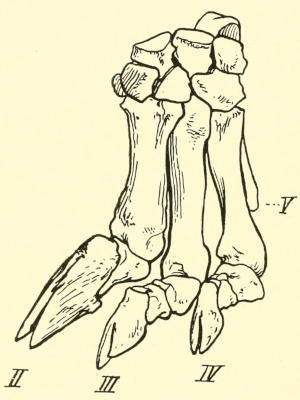
Fig. 185.—Left manus of lower Miocene †chalicothere (†Moropus). (After Peterson.)
In the lower Miocene (Arikaree stage) of North America well-nigh complete skeletons of a large †chalicothere (†Moropus, Fig. 130, p. 240) have been obtained, an animal which considerably exceeded a large horse in bulk and stature. In structure this genus had departed less widely from the normal perissodactyl type than the genera of the European Miocene and Pliocene above described and was in many respects more primitive. It could not, however, have been directly ancestral to the European forms, though indicating in a general sort of way what the ancestral type must have been. †Moropus had a relatively small, slender and pointed head, a long neck, much longer than in the European genera, and long fore legs; the shorter hind legs gave the back a steep inclination from the shoulders to the rump. The proportions of the head, neck and limbs suggest those of a giraffe, in less exaggerated form, but the likeness is more marked in the skeleton than in the restoration and is at best a distant one. The feet were armed with the great claws characteristic of the suborder, but the fore foot, in addition to the three functional toes, had a long splint, representing the rudimentary fifth digit; of the first, or pollex, no trace remained. The perissodactyl plan of symmetry had not yet been lost, the third or median digit being the longest of the series. In the hind foot, which had only three toes, the departure from the perissodactyl arrangement had already begun, and the third and fourth digits (i.e. of the original five) were of nearly equal size, both in length and thickness, while the second was smaller.
The family is represented in the John Day, or upper Oligocene, by specimens which are sufficiently characteristic to prove that they are properly referable to this group. They have been assigned to the same genus as that of the lower Miocene, but whether the identification is justified remains to be determined.
In the lower White River beds of Canada is found a much smaller animal of this family, but the material is too fragmentary for generic identification. Something more is known of a genus (†Schizotherium) from the European Oligocene, likewise much smaller than the Miocene and Pliocene forms, which had four, or possibly even five, functional digits, in the manus, but it has not been ascertained whether the transformation of hoofs into claws had already taken place.
It is not yet practicable to determine the relationships of the European and American †chalicotheres to one another, because of the imperfect nature of most of the material.
The molar teeth of the †chalicotheres were suggestively like those of the †titanotheres, and, were the teeth alone to be taken into account, no one could hesitate to regard the two families as closely related.
The most ancient known member of the family is the genus †Eomoropus, from the Bridger Eocene, which will be described by Professor Osborn in a paper soon to appear. †Eomoropus was much nearer to the normal perissodactyls than were the genera from the Oligocene and Miocene above described.