Chapter XIX
Reading edition
Tomkins’s picture lottery—The lottery abolished—Handbills.
There was a private lottery drawn July 24, 1821.
“TOMKINS’S PICTURE LOTTERY
of the British Gallery of Pictures, comprising 16,550 Prizes, Valued at £152,225!
This Lottery consists of highly finished Paintings from the most valuable pictures of the old Masters, in the Collections of Noblemen and Gentlemen; a Set of Paintings faithfully representing the Marquis of Stafford’s Splendid Gallery; Fifteen exquisite Oil Paintings by Hamilton, illustrative of Thomson’s Seasons; Beautiful Water Colour Paintings from the old Masters; several thousand Impressions of the Selections from the old Masters, exquisitely coloured; the same in black, Prints and Proofs; the Lease of the Premises, 54, New Bond Street, where the above Pictures are now exhibiting Gratis, &c., &c. The whole forming a complete Chef d’Œuvre of the Arts.
Tickets, Price £3 3s. Each, are now on Sale at No. 54, NEW BOND STREET, Where the Prizes are exhibiting gratis.—And also at all Lottery Offices, Printsellers’, and Booksellers’.
A Perfectly Novel Scheme.
“One half of the Tickets are printed in Black, and the other half in Red Ink; and the drawing is so arranged, that if the last drawn Ticket in the State Lottery, (which is to decide this) be an even number, then the Red Tickets will be all Prizes; but if an odd number, then the Black Tickets will be all Prizes; so that one Colour must be all Prizes, and the other Colour all Blanks, by which arrangement
The Purchaser of a Red Ticket and a Black Ticket is SURE to gain a Prize.
Among many other POINTS OF ATTRACTION Which this Lottery presents to the Public, are the following:—
“1. The Price of Tickets is considerably below their Estimated Value.
“2. The certainty (as above stated) of gaining a Prize, by purchasing two Tickets of different Colours.
“3. The great beauty and interest of all the Prizes, even the smallest, to every individual possessing a taste for the fine Arts.
“4. The original Pictures from which the above are taken, are acknowledged to be the finest in the world, and are executed by the following admired Masters:—Raphael, Claude, Rubens, Correggio, Titian, Poussin, Gerard Douw, Paul Potter, Cuyp, Rembrandt, &c., each picture valued at from £1000 to £10,000.
“5. The exquisitely finished Copies of these masterly productions are unique, and permission to copy them could only be obtained for the above Grand National Work.
“6. The Copper-Plates will be destroyed, by Act of Parliament, which will, of course, add to the value and scarcity of the Pictures.
“7. The encouragement afforded to the fine Arts.
“8. Trustees are appointed by Act of Parliament, for the faithful performance of the Conditions of the Act.
“9. Testimonials in approbation of these beautiful imitations of original Paintings have been received from the first and most distinguished Artists in the world.
SCHEDULE OF THE PRIZES.
1 First Grand Prize, consisting of 291 Pictures,
in elegant Frames, representing the Marquis of
Stafford’s magnificent Gallery of Pictures; also
the Lease of the Premises, where the same are
exhibited; also a set of coloured Impressions of
the Marquis of Stafford’s Gallery, making Four
Grand Folio Volumes, superbly bound in Russia;
likewise Proofs and Etchings of the above
Works in Black; also a large Painting in Oil
Colours by Hamilton, R.A., value £7,500 0 0
1 Second Grand Prize, consisting
of Fifty Two highly finished Paintings,
in elegant Frames, of a Selection from
the most valuable Paintings of the Old
Masters, in the Collections of Noblemen,
Gentlemen, and eminent Collectors in the
United Kingdoms; together with a set of
highly finished Coloured Impressions,
bound in Russia: likewise a set of the
Marquis of Stafford’s Gallery, finely
coloured; likewise Proof Impressions
and Etchings of both Works in Black, £ s. d.
value 3,750 0 0
1 Third Grand Prize, comprising
Ten Pictures, in elegant Frames,
exquisitely painted in Water Colours,
from the Old Masters; together with
a set of the Marquis of Stafford’s
Gallery, finely coloured; with Proofs
of both Works in Black, value 939 10 0
☛ The other Prizes consist of sets of the Work, in Colours,
Proofs, or Prints, value as under:
40 Capital Prizes, each comprising a
set of Prints of the Marquis of
Stafford’s Gallery, finely coloured;
value of each Prize £171 14 0 6,868 0 0
150 Ditto, Proof Impressions of
ditto, each £71 8 0 10,710 10 0
1000 Ditto, Print Impressions of
ditto, each £35 14 0 35,700 0 0
40 Ditto, each comprising
a Set of the Selections
from the Old Masters,
exquisitely coloured,
each value 151 4 0 6,048 0 0
100 Ditto, Proof Impression
of ditto, each value 25 4 0 2,520 0 0
399 Ditto, Print Impressions
of ditto, each value 12 12 0 5,027 8 0
350 Ditto, each being a set
of 21 Engravings,
illustrative of Thomson’s
Seasons. Print
Impressions, value 8 8 0 2,940 0 0
1000 Prizes, being miscellaneous
subjects from the above
Works, exquisitely
coloured value 6 6 0 6,300 0 0
4000 Ditto, finely coloured,
each value 5 5 0 21,000 0 0
9466 Ditto, Proof and Print
Impressions, each
value 4 4 0 39,757 4 0
1 Grand Capital Prize, being Four
highly finished Paintings in
elegant Frames, with sets of both
Works in Black, value 165 0 0
1 Last Grand Capital Prize, being
15 Pictures handsomely framed,
finely painted in Oil, by the late
W. Hamilton, R.A., purposely to
embellish Thomson’s Seasons; together
with a copy of Thomson’s
Seasons, Imperial Folio, elegantly
bound in Russia, embellished with
21 Engravings by F. Bartolozzi,
R.A., and P. W. Tomkins, value 3,000 0 0
16,550 Prizes Grand Total £152,225 12 0
Letters commendatory of the Pictures and Scheme were received from Benjamin West, P.R.A., Sir Thos. Lawrence, R.A., Sir Wm. Beechy, R.A., J. Ward, R.A., M. A. Shee, R.A., R. Smirke, R.A., T. Stothard, R.A., J. Flaxman, R.A., J. Nollekens, R.A., and others.
The Lottery Act for 1822 (3 Geo. IV. c. 101) was passed on July 21. It distributed £593,411 17s. 6d. in prizes, and made a profit to the Government of £183,056 9s. 3d.
The end of the Lottery had now virtually come, for, in the Lottery Act of 1823 (4 Geo. IV. c. 60), passed July 9, provision was made for its discontinuance after the drawing of the lottery sanctioned by that Act, the Treasury being empowered to retain the services of the Lottery Commissioners and their officers for three years longer, to enable them to wind up all outstanding business. This lottery was for a much larger sum than heretofore, prizes being given to the amount of £1,453,875; but the net profit thereon was less than that of the previous year, which was for a far smaller amount—in fact, less than half.
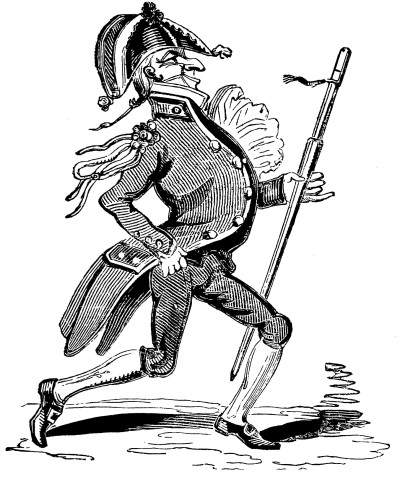
“Run, Neighbours, run, the Lottery’s expiring, When Fortune’s merry wheel it will never turn more; She now supplies all Numbers you’re desiring, All Prizes, No Blanks, and Twenty Thousands Four. Haste, Neighbours, haste, the Chance will never come again, When, without pain, for little Cash, you’ll all be rich; Prizes a plenty of, and such a certain source of gain, That young and old, and all the world, it must bewitch.”
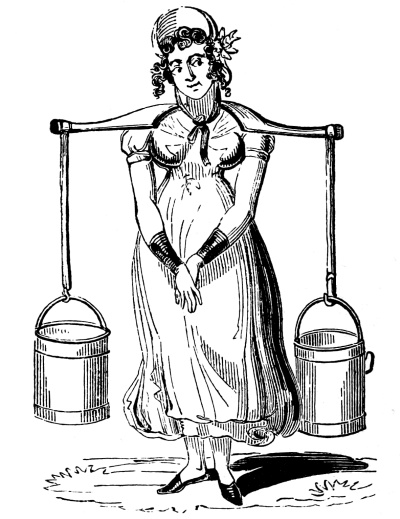
“Though the Lotteries soon will be over, I’m told That now is the time to get pailsful of Gold; And if there is any real truth in a dream, I, myself, shall come in for a Share of the Cream. We hail, ere the Sun, the first breath of the morn, And ’tis said, 'Early birds get the best of the Corn,’ Of the Four Twenty Thousands, perhaps Fortune may Have in store One for me, as they’re drawn in One Day.”
Here are four of Bish’s handbills, the woodcuts of which are better executed than usual.
RAPTURE.
A Member rehearsing his Speech]
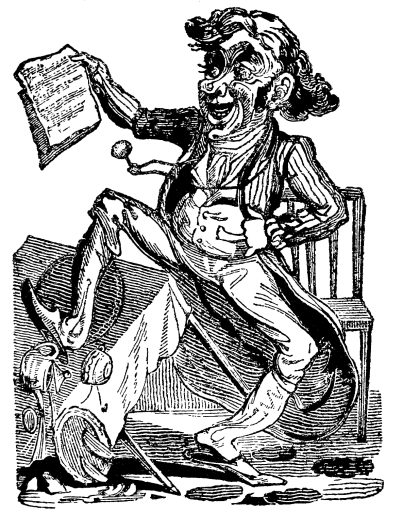
SIR WILLIAM COURTEOUS. Hear him! hear him! Order! Order! All the Court is in disorder! I echo, Sir, the Public voice— What I hold here’s the People’s choice A num’rous host stood forth of late And BISH was chosen candidate The loans of Fortune to supply From the rich New Year’s Lottery, In Sterling Money—(Hear him, hear him!) The Ayes have got it. (Chair him, chair him!)
Lottery begins 21ₛₜ This Month (Jan.)—2 of 20,000 Guineas, and 40 other Capitals—all Sterling Money (no Stock Prizes.)]
CURIOSITY.
Jerry Sneak peeping at his Wife and the Major in the Summer House.
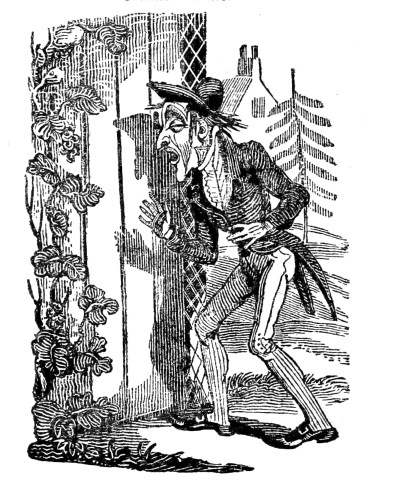
JERRY SNEAK Vile Curiosity goes creeping, Into his neighbours secrets peeping: So Jerry, peeping, all on thorns, Thought on the Devil, and descried his horns Go peep at Bish’s, and I’ll wager Of Prizes he will share the major.
Lottery begins 21ₛₜ This Month (Jan.)—2 of 20,000 Guineas & 40 other Capitals—all Sterling Money (no Stock Prizes)
MEANNESS.
Endeavouring to read the Contents of a Letter
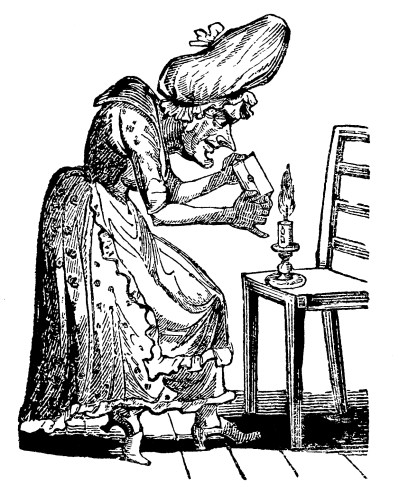
MRS. PRY “What the eye never sees, we can never repent— ”What the heart never feels, we can never resent.” Change the scene, paltry wretch—you would think it unkind Were your secrets expos’d, for concealment design’d If you’d peep to advantage, to Bish’s then hie, For a Prize in the rich New Year’s Lottery, Pry
Lottery begins 21ₛₜ This Month (Jan.)—2 of 20,000 Guineas, & 40 other Capitals—all Sterling Money (no Stock Prizes.)
INDIFFERENCE.
A Husband indifferent to his Wife’s Importunities.
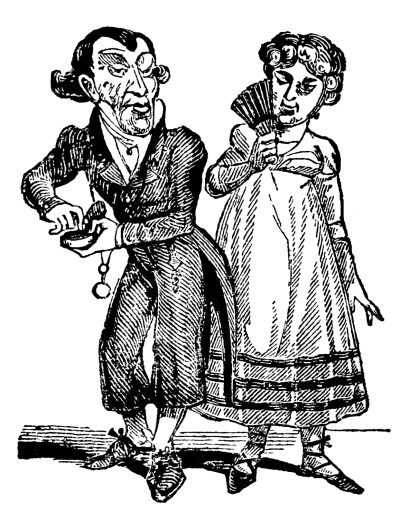
SIR SIMON SLENDERWIT O turn, my love, I pray now do! I never turn my back on you I’ll fan the flame—O let it burn! “How sweet’s the love that meets return.” But if insensate to my wishes I’ll get whate’er I want at Bish’s
Lottery begins 21ₛₜ This Month (Jan)—2 of 20,000 Guineas & 40 other Capitals—all Sterling Money (no Stock Prizes)]