Chapter X
Reading edition
The Boydell Lottery—Bowyer’s “Historic” Lottery.
1803 had its usual annual lottery (43 Geo. III. c. 91), in which £710,000 was given in prizes, and the Government netted £204,354 4s. 9d. Another in 1804 (44 Geo. III. c. 93) has £800,000 in prizes, and the net profit was £266,924 5s. 11d.
This year is famous for the Shakespeare, or Boydell, Lottery. John Boydell was an engraver in the city of London, of which he was elected Alderman in 1782, Sheriff in 1785, and Lord Mayor in 1790. He died, on December 12, 1804, aged 86. He was very ambitious, and brought himself to financial grief over a magnificently illustrated edition of Shakespeare, on which he employed all the best artists of the day. Let him tell his own story, as contained in a letter from him to Sir John William Anderson, and read by the latter in the House of Commons, when applying for leave to dispose of the Shakespeare paintings, etc., by lottery.
“You will excuse, my dear sir, some warmth in an old man on this subject, when I inform you that this unhappy Revolution has cut up, by the roots, that revenue from the Continent, which enabled me to undertake such considerable works in this country.... Had I but laid up ten pounds out of every hundred my plates produced, I should not now have had occasion to trouble my friends, or appeal to the Public; but, on the contrary, I flew with impatience to employ some new artist, with the whole gains of my former undertakings. I now see my error, for I have thereby decreased my ready money, and increased my stock of Copper plates to such a size, that all the printsellers in Europe could not purchase it, especially at these times, which are so unfavourable.” The letter concludes with the suggestion that Parliamentary sanction should be given to a lottery. “The objects of it are my pictures, galleries, drawings, etc., etc., which, unconnected with my copper plates and trade, are much more than sufficient to pay, if properly disposed of, all I owe in the world.”
The following is the scheme of the
“SHAKESPEARE LOTTERY,
To be drawn pursuant to an Act of Parliament passed in the 44th year of His Majesty’s reign, entitled 'An Act to enable John Boydell, Esq., one of the Aldermen of the City of London, and Josiah Boydell, his Nephew and Partner, to dispose of their Collection of Paintings, Drawings, and Engravings, together with the Leasehold Premises in Pall Mall, called the Shakespeare Gallery, by way of Chance.’
“The number of Tickets to be 22,000, at the price of Three Guineas a Ticket.
“The Capital Prizes are 62, which are to be decided by the sixty-two Tickets first drawn. The holders of each and every of the 21,938 undrawn Tickets, are to receive a Print or Prints aggregately of the estimated value of One Guinea, from the Collection of the said John and Josiah Boydell, consisting of 4432 Copper-plates, according to their Alphabetical Catalogue, lodged at the Shakespeare Gallery, in Pall Mall, pursuant to the said Act.
“The Capital Prizes and Prints to be obtained by the holders of the 22,000 Tickets, amount to upwards of £69,800, according to the prime cost proved before both Houses of Parliament; where evidence was also given that the Copper-plates engraved from the pictures and drawings that constitute the following prizes, had cost Messrs. Boydell upwards of £300,000.
“The whole may be viewed at the Shakespeare Gallery—Admittance One Shilling each person—such exhibition being reserved to Messrs. Boydell by the Act.
“The Catalogue of the Shakespeare Pictures to be had as above, at one shilling and sixpence each; and the Alphabetical Catalogue at the same price. Both Catalogues may be seen and inspected at the Gallery, and at No. 90, Cheapside.”
The first twenty-six prizes were framed paintings, by Poussin, Titian, Teniers, Rubens, Caracci, Vernet, Hogarth, Copley, Northcote, Rigaud, Peters, Stodhart, Angelica Kauffman, and other artists.
The next eighteen prizes were framed drawings, by Guido, Rubens, Rembrandt, Vanderwerff, Both, Smirke, Westall, West, Angelica Kauffman, Wright of Derby, Gainsborough, etc.
Prize No. 45 was thirty-seven drawings (unframed) by Linck.
The fourteen succeeding prizes were prints, and books with prints.
The sixty-first prize was twenty-eight large framed drawings by Richard Westall, R.A., in colours, for the poetical works of Milton.
But the plum was the sixty-second and last prize, which consisted of “the whole of the large pictures, from Shakespeare, now exhibiting, and from which the large plates have been taken. Also the whole of the small pictures, from which the plates have been engraved, for the Embellishment of the Great National Edition of Shakespeare in Nine Volumes, Folio. Also Seven Pictures of the Ages, by Smirke, R.A. Together with all the Estate, Right and Interest of Messrs. John and Josiah Boydell, in these Premises, which were erected by them, and in which they hold an unexpired Term of sixty-four years, at a Ground Rent of £125 per Annum.
“The Pictures are all framed, and are fully described in the Shakespeare Gallery Catalogue, and amount, in the Whole, to 167; besides which there are Three Supernumerary Pictures, not in the Catalogue, and which have not been engraved.
“This Prize will also include the Alto Relievo in Front of the Gallery, by T. Banks, R.A., and two Basso Relievos by the Hon. Anne Damer.
“What is given in this last Prize, for the Sixty Second Drawn Ticket, has cost the Proprietors upwards of £30,000.”
This prize was won on June 28, 1805, by Mr. Tassie, a sculptor, who lived in Leicester Square, and he, not wanting such a white elephant, sent the pictures to Christie’s, where they were sold on May 17, 18, and 20, 1805, realizing 10,237½ guineas.
On June 27, 1805, was passed another State lottery (45 Geo. III. c. 74), which gave £750,000 in prizes, and yielded a net profit of £363,070 9s. 11d. £250,000 of this lottery was drawn on September 30, 1805. On May 31 was drawn the last portion of the 1804 lottery.
Probably encouraged by the success of Boydell’s lottery, another engraver followed his example, and had a lottery to get rid of his unsaleable stock. It was drawn before September 30, 1805.
“Mr. Bowyer presumes he need not inform the Friends of Literature and the Arts, that the Works which he has received the Sanction of Parliament to dispose of by way of Lottery, are deemed the most splendid Publications in Europe; he can, however, at all events, assure them that these Works have cost him above a Hundred Thousand Pounds; and that, after the Lottery is over, a single Copy of either cannot be had on any terms whatever.
HISTORIC LOTTERY.
Without a Possibility of the least Loss.
Tickets, Three Guineas each.
Contains One Thousand Four Hundred and Fifty-One Capital Prizes.
“Every Ticket not drawn one of the Capital Prizes will, never the less, be entitled to and the Holder will fairly and Honourably receive the Full Amount of the Original Cost of the Ticket in Beautiful Engravings, most of them new Subjects never yet published; and that Purchasers may be SATISFIED of receiving no other Engravings for the Blanks but those of the Very First Class; Specimens of the Whole are now exhibiting at the Historic Gallery, Pall Mall, and No. 73, Cornhill.
And of these they are warranted to receive fine Impressions.
“List of the Prizes.
For the First drawn Ticket, Value Ten Thousand Pounds.
£ s. d.
No. of All the Pictures composing the
prizes. Historic Gallery in Pall Mall,
1 painted by Members of the
Royal Academy, and have cost
the Proprietor, as proved before
the Committees in both
Houses of Parliament 8,433 4 0
Four sets of the History of
England, at £73 10/- each 294 0 0
Four sets of do., the Plates on
India Paper, at £147 588 0 0
Four sets of the Engravings, at
£50 each Copy 200 0 0
Four sets of the Historical
Engravings, £24 10/- each Set 98 0 0
Four sets of the Etchings of the
above Work, at 30 Guis. each 126 0 0
Four complete Sets of Views in
Egypt, etc., etc., at £55 4/- 100 16 0
One large Picture of the Battle
of the Nile, by R. Smirke, jun.,
from a design by Anderson 160 0 0
£10,000 0 0
For the Second to the Three Hundred and First drawn Tickets, both inclusive.
£ s. d.
300 Three Hundred Prizes. Each
Prize to consist of a complete
Set of the History of England,
in Seventy Numbers, at one
Guinea each Number. This
work contains nearly 200 Engra-
vings, has cost upwards of
£68,000, and is deemed the
most magnificent Work in
Europe. Three Hundred
Prizes, therefore, at £73 10/-
each, the price to Subscribers,
is 22,050 0 0
For the three Hundred and Second to the Eight Hundred and First drawn Tickets, both inclusive.
500 Five Hundred Prizes. Each
Prize to consist of a Complete
Set of Engravings, being near
Two Hundred in Number,
and which form the entire
Embellishments to the Splendid
Work of the History of
England, at the price to
Subscribers, being £50 per set 25,000 0 0
For the Eight Hundred and Second to the Nine Hundred and Fifty First drawn Tickets, both inclusive.
150 One Hundred and Fifty Prizes.
Each of these Prizes to
consist of a Complete Set of
the Historical Engravings to
the above Work, at £24 10/-
each Set 3,675 0 0
For the Nine Hundred and Fifty Second to the Twelve Hundred and Fifty First drawn Tickets, both inclusive.
300 Three Hundred Prizes. Each
of these Prizes to consist of a
Series of Four Engravings, 29
Inches high by 17 Inches wide,
to commemorate the four great
Naval Victories of the late
War, and containing near One
Hundred Portraits of the
Admirals and Captains who
were engaged in those National
Achievements. The Work is
done up in Boards, with a
History of each Action, printed
by Bensley, at the Subscription
price of Nine Guineas, is 2,835 0 0
For the Twelve Hundred and Fifty Second to the Fourteen Hundred and Fifty First drawn Tickets, both inclusive.
200 Two Hundred Prizes. Each of
these Prizes to consist of a
Complete Copy of a magnificent
and interesting Work, just
finished, of Views in Egypt,
Palestine, and other parts of
the Ottoman Empire, from the
celebrated Collection of Drawings
in the possession of Sir
Robert Ainslie, Bart., in 2 Vols.
Folio, containing Ninety-six
Views, beautifully coloured to
imitate the original Drawings;
with a History of those Countries,
at the Subscription Price,
per Copy, of Twenty-four
Guineas, is 5,040 0 0
1,451 Capital Prizes. £68,600 0 0
20,549 Tickets, which, if not drawn either of the
22,000 Tickets. Capital Prizes above mentioned,
will, nevertheless, be entitled to new
and beautiful Engravings, of the
Estimated Value of 3 Guineas, being
the Price of each Ticket.
The whole of the Collection is, by the Act, vested in Trustees for the Holders of the Tickets.”
The scheme then goes on to say that, if any one, taking more than one share, should have duplicate engravings allotted to them, they will be exchanged for others. The following were some of the subjects, and had never before been published:—
“Matrimony; These four Engravings are executed
Confirmation; by Meadow, from four of the
Christening; most beautiful Drawings ever
and the Lord’s made by Mr. Westall. Size of
Supper. Plates, 24 in. by 18.
From the two celebrated Pictures
The Tired by Opie, which were exhibited
Soldier, and its two years ago at the Royal
Companion. Academy. Size of Plates, 24 in. by 19.
The Young From two exquisite Pictures by
Cottager, and Gainsborough. Size of Plates,
Companion. 28 in. by 20.
Rural Innocence; From two very fine Pictures by
Cottage Cares. Sir Francis Bourgeois. Size,
28 in. by 20.
The Blind From an interesting Picture by
Hermit. Stothard. Size, 28 in. by 20.
Winter and
Cottagers; From beautiful Pictures by Morland.
Summer and Size, 24 in. by 19.
Fishing.
Wood Cutter, All from Drawings by Morland.
and Six other Size, 22 in. by 18.
Engravings.
Fishermen From two Pictures by Bigg. Size,
going out; 24 in. by 19.”
Ditto returning.
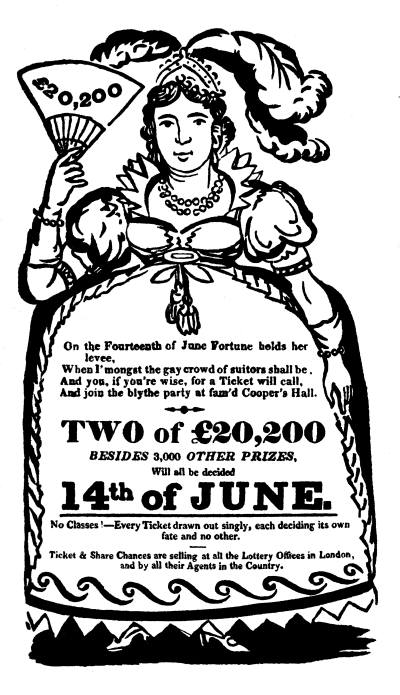
This lottery rather hung fire, and, before its drawing, an additional stimulus was given by the promise that every purchaser, at the time of buying a ticket, should be presented with an engraved portrait of Nelson or Collingwood, at their option.
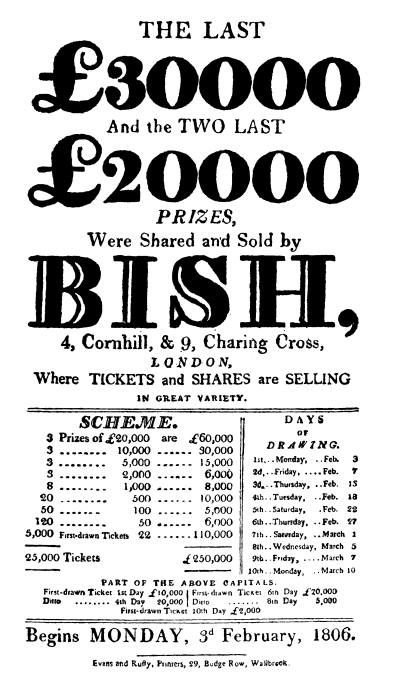
In 1806 a State lottery was granted (46 Geo. III. c. 148), July 22, in which £900,000 was the amount of prizes, and net profit £378,039 16s. 2d.
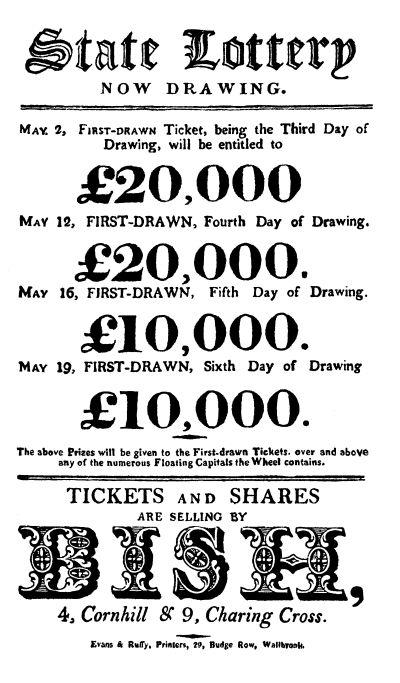
Bish issued a handbill relative to the lottery began to be drawn on February 3 this year.
“FIRST 5000 TICKETS.
T. Bish, Contractor for the approaching grand Lottery, solicits the Public to notice that the first 5000 Tickets drawn are sure to be
ALL PRIZES,
From £22 to £20,000, and the First drawn Ticket, Monday, February 3rd, cannot be less than
£10,022,
And may be more: The advantage in buying before the Drawing begins, is, therefore, obvious, as those whose Tickets are drawn early will be
SURE TO GAIN,
And, if their tickets are not drawn Capital Prizes in the first instance, they will have the advantage of Changing them (without any additional expence) for
Undrawn Tickets
Or Shares, by which means they have a DOUBLE CHANCE for the numerous Prizes with which the Scheme abounds, from
£50 to £20,000;
Or, if they should wish to part with them, there is not a doubt but they may easily find Purchasers (at a profit), as Tickets at that time[21] will be scarce, especially as the first drawn Ticket on the fourth Day is entitled to
£20,000.