Chapter XI · THE VICTORIAN AGE
Reading edition
TIME-CHART OF THE CHIEF AUTHORS
The thick line represents the period of important literary work.
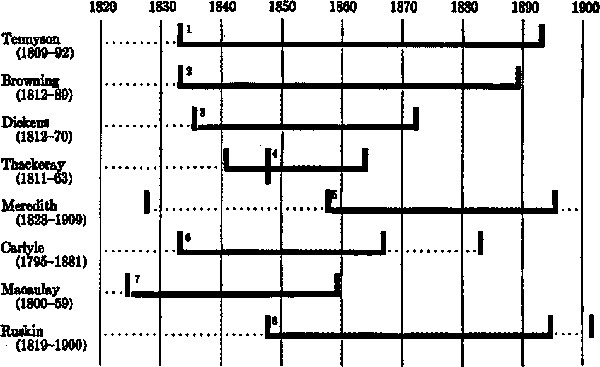
1820 1830 1840 1850 1860 1870 1880 1890 1900 | | | | | | | | | | | ║[215] | | | | | | ║ | Tennyson |........|.║======================================================║ | (1809–1892) | | | | | | | | | | | ║[216] | | | | | ║ | | Browning |........|.║=================================================║ | | (1812–89) | | | | | | | | | | | ║[217] | | | | ║ | | | Dickens |........|..║==================================║ | | | (1812–70) | | | | | | | | | | | |║ ║[218] | | ║ | | | | Thackeray |........|........|║=║=================║ | | | | (1811–63) | | | ║ | | | | | | | ║ | | | ║[219] | | | | ║ | Meredith | ║..|........|........|...║===================================║....| (1828–1909) | | | | | | | | | | | ║[220] | | | ║ | | ║ | | Carlyle |........|.║============================║....|........|..║ | | (1795–1881) | | | | | | | | | | ║[221] | | | ║ | | | | | Macaulay |..║==============================║ | | | | | (1800–59) | | | | | | | | | | | | ║[222] | | | | | ║ |║ Ruskin |........|........|...║===========================================║.....|║ (1819–1900) | | | | | | | | |
THE HISTORICAL BACKGROUND
1. An Era of Peace. The few colonial wars that broke out during the Victorian epoch did not seriously disturb the national life. There was one Continental war that directly affected Britain—the Crimean War—and one that affected her indirectly though strongly—the Franco-German struggle; yet neither of these caused any profound changes. In America the great civil struggle left scars that were soon to be obliterated by the wise statesmanship of her rulers. The whole age may be not unfairly described as one of peaceful activity. In the earlier stages the lessening surges of the French Revolution were still left; but by the middle of the century they had almost completely died down, and other hopes and ideals, largely pacific, were gradually taking their place.
2. Material Developments. It was an age alive with new activities. There was a revolution in commercial enterprise, due to the great increase of available markets, and, as a result of this, an immense advance in the use of mechanical devices. The new commercial energy was reflected in the Great Exhibition of 1851, which was greeted as the inauguration of a new era of prosperity.
3. Intellectual Developments. There can be little doubt that in many cases material wealth produced a hardness of temper and an impatience of projects and ideas that brought no return in hard cash; yet it is to the credit of this age that intellectual activities were so numerous. There was quite a revolution in scientific thought following upon the works of Darwin and his school, and an immense outburst of social and political theorizing which was represented in England by the writings of men like Herbert Spencer and John Stuart Mill. In addition, popular education became a practical thing. This in its turn produced a new hunger for intellectual food, and resulted in a great increase in the productions of the Press and of other more durable species of literature.
LITERARY FEATURES OF THE AGE
The sixty years (1830–90) commonly included under the name of the Victorian age present many dissimilar features; yet in several respects we can safely generalize.
1. Its Morality. Nearly all observers of the Victorian age are struck by its extreme deference to the conventions. To a later age these seem ludicrous. It was thought indecorous for a man to smoke in public and (much later in the century) for a lady to ride a bicycle. To a great extent the new morality was a natural revolt against the grossness of the earlier Regency, and the influence of the Victorian Court was all in its favor. In literature it is amply reflected. Tennyson is the most conspicuous example in poetry, creating the priggishly complacent Sir Galahad and King Arthur. Dickens, perhaps the most representative of the Victorian novelists, took for his model the old picaresque novel; but it is almost laughable to observe his anxiety to be “moral.” This type of writing is quite blameless, but it produced the kind of public that denounced the innocuous Jane Eyre as wicked because it dealt with the harmless affection of a girl for a married man.
2. The Revolt. Many writers protested against the deadening effects of the conventions. Carlyle and Matthew Arnold, in their different accents, were loud in their denunciations; Thackeray never tired of satirizing the snobbishness of the age; and Browning’s cobbly mannerisms were an indirect challenge to the velvety diction and the smooth self-satisfaction of the Tennysonian school. As the age proceeded the reaction strengthened. In poetry the Pre-Raphaelites, led by Swinburne and William Morris, proclaimed no morality but that of the artist’s regard for his art. By the vigor of his methods Swinburne horrified the timorous, and made himself rather ridiculous in the eyes of sensible people. It remained for Mr. Hardy (whom we reserve for the next chapter) to pull aside the Victorian veils and shutters and with the large tolerance of the master to regard men’s actions with open gaze. To the present day, sometimes wisely, often unwisely, poet and novelist have carried on the process; and the end is not yet.
3. Intellectual Developments. The literary product was inevitably affected by the new ideas in science, religion, and politics. The Origin of Species (1859) of Darwin shook to its foundations scientific thought. We can perceive the influence of such a work in Tennyson’s In Memoriam, in Matthew Arnold’s meditative poetry, and in the works of Carlyle. In religious and ethical thought the “Oxford Movement,” as it was called, was the most noteworthy advance. This movement had its source among the young and eager thinkers of the old university, and was headed by the great Newman, who ultimately (1845) joined the Church of Rome. As a religious portent it marked the widespread discontent with the existing beliefs of the Church of England; as a literary influence it affected many writers of note, including Newman himself, Froude, Maurice, Kingsley, and Gladstone.
4. The New Education. The Education Acts, making a certain measure of education compulsory, rapidly produced an enormous reading public. The cheapening of printing and paper increased the demand for books, so that the production was multiplied. The most popular form of literature was the novel, and the novelists responded with a will. Much of their work was of a high standard, so much so that it has been asserted by competent critics that the middle years of the nineteenth century were the richest in the whole history of the novel.
5. International Influences. During the nineteenth century the interaction among American and European writers was remarkably fresh and strong. In Britain the influence of the great German writers was continuous, and it was championed by Carlyle and Matthew Arnold. Subject nations, in particular the Italians, were a sympathetic theme for prose and verse. The Brownings, Swinburne, Morris, and Meredith were deeply absorbed in the long struggle of the followers of Garibaldi and Cavour; and when Italian freedom was gained the rejoicings were genuine.
6. The Achievement of the Age. With all its immense production, the age produced no supreme writer. It revealed no Shakespeare, no Shelley, nor (in the international sense) a Byron or a Scott. The general literary level was, however, very high; and it was an age, moreover, of spacious intellectual horizons, noble endeavor, and bright aspirations.
ALFRED, LORD TENNYSON (1809–92)
1. His Life. Alfred Tennyson, the son of a clergyman, was born at his father’s living at Somersby in Lincolnshire. After some schooling at Louth, which was not agreeable to him, he proceeded to Cambridge (1828). At the university he was a wholly conventional person, and the only mark he made was to win the Chancellor’s Prize for a poem on Timbuctoo. He left Cambridge without taking a degree; but before doing so he published a small volume of mediocre verse. During the next twenty years he passed a tranquil existence, living chiefly with his parents, and writing much poetry. Pleasant jaunts—to the Lake District, to Stratford-on-Avon, and other places—varied his peaceful life, and all the while his fame as a poet was making headway. In 1844 he lost most of his small means in an unlucky speculation, but in the nick of time (1845) he received a Government pension. He was appointed Poet Laureate (1850) in succession to Wordsworth, married, and removed to Freshwater, in the Isle of Wight, which was his home for the next twenty years. In his later years recognition and applause came increasingly upon him, and he was regarded as the greatest poet of his day. In 1884 he was created a baron, sat in the House of Lords, and for a time took himself rather seriously as a politician, falling out with Gladstone over the Irish question. He died at Aldworth, near Haslemere, in Surrey, and was buried in Westminster Abbey.
2. His Poetry. When he was seventeen years old Tennyson collaborated with his elder brother Charles in Poems by Two Brothers (1826). The volume is a slight one, but in the light of his later work we can already discern a little of the Tennysonian metrical aptitude and descriptive power. His prize poem of Timbuctoo (1829) is not much better than the usual prize poem. His Poems, Chiefly Lyrical (1830), published while he was an undergraduate, are yet immature, but in pieces like Isabel and Madeleine the pictorial effect and the sumptuous imagery of his maturer style are already conspicuous.
His volume of Poems (1832) is of a different quality, and marks a decided advance. In this book, which contains Mariana in the South and The Palace of Art, we see the Tennysonian features approaching perfection. Poems (1833), with such notable items as Œnone and The Lotos-Eaters, advances still further in technique. Then in 1842 he produced two volumes of poetry that set him once and for all among the greater poets of his day. The first volume contains revised forms of some of the numbers published previously, the second is entirely new. It opens with Morte d’Arthur, and contains Ulysses, Locksley Hall, and several other poems that stand at the summit of his achievement.
The later stages of his career are marked chiefly by much longer poems. The Princess (1847) is a serio-comic attempt to handle the theme that was then known as “the new woman.” For the sake of his story Tennyson imagines a ladies’ academy with a mutinously intellectual princess at the head of it. For a space a tragedy seems imminent, but in the end all is well, for the Princess is married to the blameless hero. The poem is in blank verse, but interspersed are several singularly beautiful lyrics. The humor is heavy, but many of the descriptions are as rich and wonderful as any Tennyson ever attempted.
In Memoriam (1850) caused a great stir when it first appeared. It is a very long series of meditations upon the death of Arthur Henry Hallam, Tennyson’s college friend, who died at Vienna in 1833. Tennyson brooded over the subject for years; and upon this elegiac theme he imposed numerous meditations on life and death, showing how these subjects were affected by the new theories of the day. To a later generation his ideas appear pallid enough; but at the time they marked a great advance upon the notions of the past. The poem is adorned with many beautiful sketches of English scenery; and the meter—now called the In Memoriam meter—which is quite rare, is deftly managed.
Maud and Other Poems (1855) was received with amazement by the public. The chief poem is called a “monodrama”; it consists of a series of lyrics which reflect the love and hatred, the hope and despair, of a lover who slays his mistress’s brother, and then flies broken to France. The whole tone of the work is forced and fevered, and it ends in a glorification of war and bloodshed. It does not add to Tennyson’s fame.
Beginning in 1859, Tennyson issued a series of Idylls of the King, which had considered and attempted a great theme that Milton abandoned—that of King Arthur and the Round Table. Many doting admirers saw in the Idylls an allegory of the soul of man; but in effect Tennyson drew largely upon the simple tales of Malory, stripping them of their “bold bawdry” to please his public, and covering them with a thick coating of his delicate and detailed ornamentation. It is doubtful if this unnatural compound of Malory-Tennyson is quite a happy one, but we do obtain much blank verse of noble and sustained power.
The only other poem of any length is Enoch Arden (1864), which became the most popular of all, and found its way in translation into foreign languages. The plot is cheap enough, dealing with a seaman, supposedly drowned, who returns and, finding his wife happily married to another man, regretfully retires without making himself known. The tale, as ever, is rich with Tennysonian adornment. In particular, there is a description of the tropical island where Enoch is wrecked that is among the highest flights of the poet:
The mountain wooded to the peak, the lawns And winding glades high up like ways to Heaven, The slender coco’s drooping crown of plumes, The lightning flash of insect and of bird, The lustre of the long convolvuluses That coiled around the stately stems, and ran Even to the limit of the land, the glows And glories of the broad belt of the world, All these he saw; but what he fain had seen He could not see, the kindly human face, Nor ever hear a kindly voice, but heard The myriad shriek of wheeling ocean-fowl, The league-long roller thundering on the reef.
His last poems contain a harsher note, as if old age had brought disillusion and a peevish discontent with the pleasant artifices that had graced his prime. Even the later instalments of the Idylls of the King contain jarring notes, and are often fretful and unhappy in tone. Among the shorter poems, Locksley Hall Sixty Years after (1885) and The Death of Œnone (1892) are sad echoes of the sumptuous imaginings of the years preceding 1842.
3. His Plays. Tennyson’s dramas occupied his later years. He wrote three historical plays—Queen Mary (1875), Harold (1877), and Becket (1884). The last, owing chiefly to the exertions of Sir Henry Irving, the actor-manager, was quite a stage success. None, however, ranks high as a real dramatic effort, though all show much care and skill. The Falcon (1879) is a comedy based on a story from Boccaccio; The Cup (1880) is based on a story from Plutarch, and scored a success, also through the skill of Irving. The Foresters (1892), dealing with the familiar Robin Hood theme, was produced in America.
4. His Poetical Characteristics. (a) His Craftsmanship. No one can deny the great care and skill shown in Tennyson’s work. His method of producing poetry was slowly to evolve the lines in his mind, commit them to paper, and to revise them till they were as near perfection as he could make them. Consequently we have a high level of poetical artistry. No one excels Tennyson in the deft application of sound to sense and in the subtle and pervading employment of alliteration and vowel-music. Such passages as this abound in his work:
Myriads of rivulets hurrying thro’ the lawn, The moan of doves in immemorial elms, And murmuring of innumerable bees. The Princess
This is perhaps not the highest poetry, but shows only a kind of manual, or rather aural, dexterity; yet as Tennyson employs it, it is effective to a degree.
His excellent craftsmanship is also apparent in his handling of English meters, in which he is a tireless experimenter. In blank verse he is not so varied and powerful as Shakespeare, nor so majestical as Milton, but in the skill of his workmanship and in his wealth of diction he falls but little short of these great masters.
(b) His Pictorial Quality. In this respect Tennyson follows the example of Keats. Nearly all of his poems, even the simplest, abound in ornate description of natural and other scenes. His method is to seize upon appropriate details, dress them in expressive and musical phrases, and thus throw a glistening image before the reader’s eye:
The silk star-broider’d coverlid Unto her limbs itself doth mould Languidly ever; and, amid Her full black ringlets downward rolled, Glows forth each softly-shadowed arm With bracelets of the diamond bright: Her constant beauty doth inform Stillness with love, and day with light. The Sleeping Beauty
Till now the doubtful dusk reveal’d The knolls once more where, couched at ease, The white kine glimmered, and the trees Laid their dark arms about the field: And sucked from out the distant gloom A breeze began to tremble o’er The large leaves of the sycamore, And fluctuate all the still perfume. In Memoriam
Such passages as these reveal Tennyson at his best; but once again the doubt arises as to whether they represent the highest poetry. They show care of observation and a studious loveliness of epithet; but they lack the intense insight, the ringing and romantic note, of the best efforts of Keats.
(c) Tennyson’s lyrical quality is somewhat uneven. The slightest of his pieces, like Blow, bugle, blow, are musical and attractive; but on the whole his nature was too self-conscious, and perhaps his life too regular and prosperous, to provide a background for the true lyrical intensity of emotion. Once or twice, as in the wonderful Break, break, break and Crossing the Bar, he touches real greatness:
Break, break, break, On thy cold gray stones, O Sea! And I would that my tongue could utter The thoughts that arise in me. O well for the fisherman’s boy, That he shouts with his sister at play! O well for the sailor lad, That he sings in his boat on the bay! And the stately ships go on To their haven under the hill; But O for the touch of a vanished hand, And the sound of a voice that is still! Break, break, break, At the foot of thy crags, O Sea! But the tender grace of a day that is dead Will never come back to me.
This lyric has a brevity, unity, and simple earnestness of emotion that make it truly great.
(d) The extracts already given have sufficiently revealed the qualities of his style. It can be quite simple, as in The Brook and Will Waterproof’s Lyrical Monologue; but his typical style shows a slow and somewhat sententious progress, heavy with imagery and all the other devices of the poetical artist. In particular, he is an adept at coining phrases—“jewels five words long,” as he himself aptly expressed it; and he is almost invariably happy in his choice of epithet.
(e) His reputation has already declined from the idolatry in which he was held when he was alive. He himself foresaw “the clamour and the cry” that was bound to arise after his death. To his contemporaries he was a demigod; but younger men strongly assailed his patent literary mannerisms, his complacent acceptance of the evils of his time, his flattery of the great, and his somewhat arrogant assumption of the airs of immortality. Consequently for twenty years after his death his reputation suffered considerably. Once more reaction has set in, and his detractors have modified their attitude. He is not a supreme poet; and whether he will maintain the primacy among the singers of his own generation, as he undoubtedly did during his lifetime, remains to be seen; but, after all deductions are made, his high place in the Temple of Fame is assured.
ROBERT BROWNING (1812–89)
1. His Life. Browning was born at Camberwell, his father being connected with the Bank of England. The future poet was educated semi-privately, and from an early age he was free to follow his inclination toward studying unusual subjects. As a child he was precocious, and began to write poetry at the age of twelve. Of his predecessors Shelley in particular influenced his mind, which was unformed and turbulent at this time with the growing power within. After a brief course at London University, Browning for a short period traveled in Russia (1833); then he lived in London, where he became acquainted with some of the leaders of the literary and theatrical worlds. In 1834 he paid his first visit to Italy, a country which was for him a fitful kind of home. In 1845 he visited Elizabeth Barrett, the poetess, whose works had strongly attracted him. A mutual liking ensued, and then, after a private marriage, a sort of elopement followed, to escape the anger of the wife’s stern parent. The remainder of Browning’s life was occupied with journeys between England and France and Italy, and with much poetical activity. His wife died at Florence in 1861, leaving one son. Browning thereupon left the city for good and returned to England, though in 1878 he went back once more to Italy. His works, after suffering much neglect, were now being appreciated, and in 1867 Oxford conferred upon him the degree of D.C.L. He died in Italy, and was buried in Westminster Abbey.
2. His Poems and Plays. His first work of any importance is Pauline (1833). The poem is a wild imitation of the more extravagant outbursts of Shelley, whom it praises effusively. The work is crude and feverish, and at the time it attracted little notice. Paracelsus (1835) reveals Browning’s affection for unusual subjects. The poem, a very long one, is composed largely of monologues of the medieval charlatan whose name forms the title. The work gave the public its first taste of Browning’s famous “obscurity.” The style is often harsh and rugged, but the blank verse contains many isolated passages of great tenderness and beauty. There are in addition one or two charming lyrics that are as limpid as well-water:
Thus the Mayne glideth Where my love abideth. Sleep’s no softer: it proceeds On through lawns, on through meads, On and on, whate’er befall, Meandering and musical, Though the niggard pasturage Bears not on its shaven ledge Aught but weeds and waving grasses To view the river as it passes, Save here and there a scanty patch Of primrose too faint to catch A weary bee.
His next effort was the play Strafford (1837), which was written at the suggestion of the actor Macready, and was fairly successful. Sordello (1840) established Browning’s reputation for obscurity. The poem professes to tell the life-story of a Mantuan troubadour, but most of it is occupied with long irrelevant speeches and with Browning’s commentary thereon. Pippa Passes (1841) is in form a drama. In plot it is highly improbable, as it is based on several coincidences that all happen in one day. The work is rather more terse than its predecessors, and the purple patches are more numerous. Pippa’s songs, moreover, are often of great beauty. In Dramatic Lyrics (1842) there are many examples of clear and forcible work, including his Cavalier lyrics and such well-known pieces as Home Thoughts from Abroad. Other works of this period include The Return of the Druses (1843), a play; Dramatic Romances (1846), which shows the Browning obscurity and virility at their best and worst; Luria (1846), perhaps the weakest of his tragedies, resembling Othello in some respects; Men and Women (1855), consisting of dramatic monologues, some of great power and penetration; Dramatis Personæ (1864), containing more monologues; Balaustion’s Adventure (1871), a transcript from Euripides; and the longest of all his works, The Ring and the Book (1868–69), with which the period closes.
The Ring and the Book is (the word is so apt as to be inevitable) a literary “stunt.” It is the story of the murder of a young wife, Pompilia, by her worthless husband, in the year 1698, and the same story is told by nine different people, and continues for twelve books. The result is a monument of masterly discursiveness.
In the later stages of his career Browning’s mannerisms are accentuated in the dreary wildernesses of Prince Hohenstiel-Schwangau (1871), Red Cotton Night-Cap Country (1873), The Inn Album (1875), and La Saisiaz (1878). It is difficult to understand the use of such poems, except to give employment to the Browning Societies that were springing up to explain them. But his better qualities are shown in Fifine at the Fair (1872), which is still too long; Dramatic Idylls (1879–80); Jocoseria (1883); Ferishtah’s Fancies (1884); and Parleyings with Certain People (1887). His long life’s work has a powerful close in Asolando (1889), which, along with much of the tired disillusion of the old man, has in places the firmness and enthusiasm of his prime. The last verses he ever wrote describe himself in the character he most loved to adopt:
One who never turned his back but marched breast forward, Never doubted clouds would break, Never dreamed, though right were worsted, wrong would triumph, Held we fall to rise, are baffled to fight better, Sleep to wake. No, at noonday in the bustle of man’s worktime Greet the unseen with a cheer! Bid him forward, breast and back as either should be, “Strive and thrive!” cry, “Speed,—fight on, fare ever There as here!”
3. Features of his Work. (a) His Style. Browning’s style has been the subject of endless discussion, for it presents a fascinating problem. Within itself it reveals the widest range. Its famous “obscurity” was so pronounced that it led to the production of “Browning dictionaries” and other apparatus to disclose the deep meanings of the master. This feature of his work is partly due to his fondness for recondite subjects, to his compression and also to his diffuseness of thought and language, and to his juggling with words and meters. It often leads to such passages as the following, which is nothing less than jockeying with the English language:
Now, your rater and debater Is baulked by a mere spectator Who simply stares and listens Tongue tied, while eye nor glistens Nor brow grows hot and twitchy, Nor mouth, for a combat itchy, Quivers with some convincing Reply—that sets him wincing? Nay, rather, reply that furnishes Your debater with what burnishes The crest of him, all one triumph, As you see him rise, hear him cry “Humph! Convinced am I? This confutes me. Receive the rejoinder that suits me! Confutation of vassal for prince meet— Wherein all the powers that convince meet, And mash my opponent to mincemeat!” Pacchiarotto
In contrast with this huddle of words, Browning can write clearly and with perfect cohesion and directness, as may easily be seen in such well-known poems as How They Brought the Good News from Ghent to Aix, Time’s Revenges, and The Glove. His middle style, common in his blank verse and his lyrics, is somewhat like that of Byron in its fine prosaic aptness:
This flower she stopped at, finger on lip, Stooped over, in doubt, as settling its claim; Till she gave me, with pride to make no slip, Its soft meandering Spanish name: What a name! Was it love or praise? Speech half-asleep or song half-awake? I must learn Spanish, one of these days, Only for that slow sweet name’s sake. Garden Fancies
(b) His Descriptive Power. In this respect Browning differs widely from Tennyson, who slowly creates a lovely image by careful massing of detail. Browning, however, makes one or two dashing strokes, and, by his complete mastery of phrase, the picture is revealed:
Yon otter, sleek-wet, black, lithe as a leech; Yon auk, one fire-eye in a ball of foam, That floats and feeds; a certain badger brown He hath watched hunt with that slant white-wedge eye By moonlight; and the pie with the long tongue That pricks deep into oakworts for a worm, And says a plain word when she finds her prize. Caliban upon Setebos
This love for the picturesque leads him into many crooked byways of life, manners, and history, often with results that dismay his warmest admirers. Frequently, however, the stubborn thistle of his style blossoms into glossy purples. For example, in The Ring and the Book, we often light upon a tender passage like the following, which refreshes the whole arid page around it:
So, when the she-dove breeds, strange yearnings come For the unknown shelter by undreamed-of shores, And there is born a blood-pulse in her heart To fight if needs be, though with flap of wing, For the wool-flock or the fur-tuft, though a hawk Contest the prize.
(c) His Teaching. Much play has been made with this side of his writings. But, after analysis, his teaching can with fairness be summed up in the simple exhortation to strive, hope, and fear not. A fair proportion of his poems are inspired with the facile optimism that led him to cry,
God’s in his heaven, All’s right with the world,
but his sager mind let him perceive that much of the world was wrong. He had generous enthusiasms, such as that for the cause of Italian liberty; several strong prejudices, such as that against spiritualism; but on the whole his is a fair reflex of the average mind of his day, with the addition of much reading and observation and the priceless boon of genuine poetical genius.
(d) His Reputation. Recognition was slow in coming, but like Wordsworth he lived to see his name established high among his fellows. He wrote too freely, and often too carelessly and perversely, and much of his work will pass into oblivion; but the residue will be of quality high enough to make his fame secure.
OTHER POETS
1. Elizabeth Barrett Browning (1806–61), whose maiden name was Elizabeth Barrett, was the daughter of a West India planter, and was born at Durham. She began to write poems at the age of eight; her first published work worth mentioning was An Essay on Mind (1826), which is of slight importance. When she was about thirty years old delicate health prostrated her, and for the rest of her life she was almost an invalid. In 1846, when she was forty, she and Robert Browning were married, and stole off to Italy, where they made Florence their headquarters. She was a woman of acute sensibilities, and was fervid in the support of many good causes, one of which was the attainment of Italian independence. On the death of Wordsworth in 1850 it was suggested that the Laureateship should be conferred upon her, but the project fell through. After a very happy married life she died at Florence.
Only the chief of her numerous poetical works can be mentioned here. After her first work noted above there was a pause of nine years; then appeared Prometheus Bound (1835). Other works are The Seraphim (1838), Sonnets from the Portuguese (1846), Casa Guidi Windows (1851), Aurora Leigh (1857), an immense poem in blank verse, and Last Poems (1861). She wrote many of her shorter pieces for magazines, the most important contributions being The Cry of the Children (1841) for Blackwood’s and The Great God Pan (1860) for the Cornhill. As a narrative poet Mrs. Browning is a comparative failure, for in method she is discursive and confused, but she has command of a sweet, clear, and often passionate style. She has many slips of taste, and her desire for elevation sometimes leads her into what Rossetti called “falsetto masculinity,” a kind of hysterical bravado.
2. Matthew Arnold (1822–88) was a writer of many activities, but it is chiefly as a poet that he now holds his place in literature. He was the son of the famous headmaster of Rugby, and was educated at Winchester, Rugby, and at Balliol College, Oxford, where he gained the Newdigate Prize for poetry. Subsequently he became a Fellow of Oriel College (1845). In 1851 he was appointed an inspector of schools, and proved to be a capable official. His life was busily uneventful, and in 1886 he resigned, receiving a pension from the Government. Less than two years afterward he died suddenly of heart disease.
His poetical works are not very bulky. The Strayed Reveller (1848) appeared under the nom de plume of “A”; then followed Empedocles on Etna (1853), Poems (1854), and New Poems (1868). None of these volumes is of large size, though much of the content is of a high quality. For subject Arnold is fond of classical themes, to which he gives a meditative and even melancholy cast common in modern compositions. In some of the poems—as, for example, in the nobly pessimistic Scholar-Gipsy—he excels in the description of typical English scenery. In style he has much of the classical stateliness and more formal type of beauty, but he can be graceful and charming, with sometimes the note of real passion. His meditative poetry, like Dover Beach and A Summer Night, resembles that of Gray in its subdued melancholy resignation, but all his work is careful, scholarly, and workmanlike.
His prose works are large in bulk and wide in range. Of them all his critical essays are probably of the highest value. Essays in Criticism (1865) contains the best of his critical work, which is marked by wide reading and careful thought. His judgment, usually admirably sane and measured, is sometimes distorted a little by his views on life and politics. Arnold also wrote freely upon theological and political themes, but these were largely topics of the day, and his works on such subjects have no great permanent value. His best books of this class are Culture and Anarchy (1869) and Literature and Dogma (1873).
3. Edward Fitzgerald (1809–83), like Thomas Gray, lives in general literature by one poem. This, after long neglect, came to be regarded as one of the great things in English literature. He was a man of original views and retiring habits, and spent most of his life in his native Suffolk. In 1859 he issued the Rubáiyát of the early Persian poet Omar Khayyám. His version is a very free translation, cast into curious four-lined stanzas, which have an extraordinary cadence, rugged yet melodious, strong yet sweet. The feeling expressed in the verses, with much energy and picturesque effect, is stoical resignation. Fitzgerald also wrote a prose dialogue of much beauty called Euphranor (1851); and his surviving letters testify to his quiet and caustic humor.
4. Arthur Hugh Clough (1819–61) was born at Liverpool, and educated at Rugby, where Dr. Arnold made a deep impression upon his mind. He proceeded to Oxford, where, like his friend Matthew Arnold, he later became a Fellow of Oriel College. He traveled much, and then became Warden of University Hall, London. This post he soon resigned, and some public appointments followed. He died at Florence, after a long pilgrimage to restore his failing health. His death was bewailed by Arnold in his beautiful elegy Thyrsis.
Clough’s first long poem was The Bothie of Tober-na-Vuolich (1848), which is written in rough classical hexameters and contains some fine descriptions of the Scottish Highlands. He wrote little else of much value. His Amours de Voyage (1849) is also in hexameters; Dipsychus (1850) is a meditative poem. His poetry is charged with much of the deep-seated unrest and despondency that mark the work of Arnold. His lyrical gift is not great, but once at least, in the powerful Say not the Struggle Naught Availeth, he soared into greatness.
5. Dante Gabriel Rossetti (1828–82) was the eldest of the Pre-Raphaelite school of artists and poets. He himself was both artist and poet. He was the son of an Italian refugee, and early became an artist. In art, as in poetry, he broke away from convention when he saw fit. His poetical works are small in bulk, consisting of two slight volumes, Poems (1870) and Ballads and Sonnets (1881).
Of the high quality of these poems there can be little question. With a little more breadth of view, and with perhaps more of the humane element in him, he might have found a place among the very highest. For he had real genius, and in The Blessed Damozel his gifts are fully displayed: a gift for description of almost uncanny splendor, a brooding and passionate introspection, often of a religious nature, and a verbal beauty as studied and melodious as that of Tennyson—less certain and decisive perhaps, but surpassing that of the older poet in unearthly suggestiveness. In his ballads, like Rose Mary and Troy Town, the same powers are apparent, though in a lesser degree; these have in addition a power of narrative that is only a very little short of the greatest. An extract appears on p. 515.
6. Christina Georgina Rossetti (1830–94) was a younger sister of the poet last named, and survived him by some years. Her life was uneventful, like her brother’s, and was passed chiefly in London.
Her bent was almost entirely lyrical, and was shown in Goblin Market (1862), The Prince’s Progress (1866), A Pageant (1881), and Verses (1892). Another volume, called New Poems (1896), was published after her death, and contains much excellent early work. Her poetry, perhaps less impressive than that of her brother in its descriptive passages, has a purer lyrical note of deep and sustained passion, with a somewhat larger command of humor, and a gift of poetical expression as noble and comprehensive as his own. They resemble each other in a curious still undertone of passionate religious meditation joined to a fine simplicity of diction.
7. William Morris (1834–96) produced a great amount of poetry, and was one of the most conspicuous figures in mid-Victorian literature. He was born near London, the son of a wealthy merchant, and was educated at Marlborough and Oxford. His wealth, freeing him from the drudgery of a profession, permitted him to take a lively and practical interest in the questions of his day. Upon art, education, politics, and social problems his great energy and powerful mind led him to take very decided views, sometimes of an original nature. Here we are concerned only with his achievement in literature.
At an early period he was drawn into the Pre-Raphaelite movement, for he was keenly alive to its studied beauty and rather extreme medievalism. The Defence of Guenevere (1858), written in this manner, was received with neglect. The poems are laboriously fantastic, but they show great beauty and a sense of restrained passion. The Life and Death of Jason (1866) is a long narrative poem on a familiar theme, written in the heroic couplet in a manner suggestive of Chaucer, but easy and melodious to an extent that makes the tale almost monotonous. The Earthly Paradise (1868–70) develops this narrative method still further, and is a collection of twenty-four tales on various subjects of classical and medieval origin. In meter the poems vary, but the couplet is prominent. In range and vivacity the work is extraordinary, and the framework into which the tales are set is both ingenious and beautiful. Poems by the Way (1891) contains some fine miscellaneous pieces. A brief extract from his poems will be found on p. 514.
Morris also busied himself with the composition of long prose tales, produced in great quantity during the later years of his life. The tales are written in a curious headlong, semi-rhythmical, semi-archaic style. Much reading of it tends to give the reader mental indigestion, but the vigor and skill of the prose are very considerable. Some of the tales are The House of the Wolfings (1889), The Roots of the Mountains (1890), The Story of the Glittering Plain (1891), and The Sundering Flood (1898).
8. Algernon Charles Swinburne (1837–1909) had a long life and his poetical work was in proportion to it. Of aristocratic lineage, he was educated at Eton and Oxford. He left Oxford (1860) without taking a degree, and for the rest of his life wrote voluminously, if not always judiciously. He was a man of quick attachments and violent antagonisms, and these features of his character did much to vitiate his prose criticisms, of which he wrote a large number. In his later years, from 1879 onward, he lived with his friend Theodore Watts-Dunton at Putney Hill, where he died.
Atalanta in Calydon (1865), an attempt at an English version of an ancient Greek tragedy, was his first considerable effort in poetic form, and it attracted notice at once. At a bound the young poet had attained to a style of his own: tuneful and impetuous movement, a cunning metrical craftsmanship, and a mastery of melodious diction. The excess of these virtues was also its bane, leading to diffuseness, breathlessness, and incoherence. Poems and Ballads (1866), a second extraordinary book, was, owing to its choice of unconventional subjects, criticized as being wicked. In it the Swinburnian features already mentioned are revealed in a stronger fashion. Only a few of his later poetical works can be mentioned here: Songs before Sunrise (1871), a collection of poems chiefly in praise of Italian liberty, some of them of great beauty, but marred by his reckless defiance of the common view; Erectheus (1876), a further and less successful effort at Greek tragedy; and Tristram of Lyonesse (1882), a narrative of much passion and force, composed in the heroic couplet. Some of his shorter poems were reproduced in two further series of Poems and Ballads in 1878 and 1889, but they are inferior to those of his prime.
Swinburne wrote a large number of plays, of which the most noteworthy are The Queen Mother and Rosamond (1860), with which he began his career as an author; three plays on the subject of Mary Queen of Scots, called Chastelard (1865), Bothwell (1874), and Mary Stuart (1881); Locrine (1887); and The Sisters (1892). The gifts of Swinburne are lyrical rather than dramatic, and his tragedies, like those of most of his contemporaries, are only of literary importance. His blank verse is strongly phrased, and in drama his diffuseness—that desire for mere sound and speed which was his greatest weakness—has little scope.
9. Arthur Edward O’Shaughnessy (1844–81) was born in London, of Irish descent. In 1861 he joined the staff of the British Museum Library, where a promising career was cut short by his early death. He wrote little, and his books came close upon each other: The Epic of Women (1870), Lays of France (1872), Music and Moonlight (1874), and Songs of a Worker (1881), the last appearing after his death. His longer poems have a certain haziness and incoherence, but the shorter pieces have a musical and attractive style and a certain half-mystical wistfulness. His ode beginning “We are the music-makers” is often quoted, and other poems quite as good are A Neglected Heart and Exile.
CHARLES DICKENS (1812–70)
1. His Life. Dickens was born near Portsea, where his father was a clerk in the Navy Pay Office. Charles, the second of eight children, was a delicate child, and much of his boyhood was spent at home, where he read the novels of Smollett, Fielding, and Le Sage. The works of these writers were to influence his own novels very deeply. At an early age also he became very fond of the theater, a fondness that remained with him all his life, and affected his novels to a great extent. In 1823 the Dickens family removed to London, where the father, an improvident man of the Micawber type, soon drew them into money difficulties. The schooling of Charles, which had all along been desultory enough, was temporarily suspended. The boy for a time worked in a blacking factory while his father was an inmate of the debtors’ prison of the Marshalsea. After a year or so financial matters improved; the education of Charles was resumed; then in 1827 he entered the office of an attorney, and in time became an expert shorthand-writer. This proficiency led (1835) to an appointment as reporter on the Morning Chronicle. In this capacity he did much traveling by stage-coach, during which a keen eye and a retentive memory stored material to exploit a greatness yet undreamed of. Previously, in 1833, some articles which he called Sketches by Boz had appeared in The Monthly Magazine. They were brightly written, and attracted some notice.
In 1836 Messrs. Chapman and Hall, a firm of publishers, had agreed to produce in periodical form a series of sketches by Seymour, a popular black-and-white artist. The subjects were of a sporting and convivial kind, and to give them more general interest some story was needed to accompany them. Dickens was requested to supply the “book,” and thus originated The Pickwick Papers (1836). Before the issue of the second number of the prints Seymour committed suicide, and Hablot K. Browne, who adopted the name of “Phiz,” carried on the work. His illustrations are still commonly adopted for Dickens’s books.
The Pickwick Papers was a great success; Dickens’s fame was secure, and the rest of his life was that of a busy and successful novelist. He lived to enjoy a reputation that was unexampled, surpassing even that of Scott; for the appeal of Dickens was wider and more searching than that of the Scottish novelist. He varied his work with much traveling—among other places to America (1842), to Italy (1844), to Switzerland (1846), and again to America (1867). His popularity was exploited in journalism, for he edited The Daily News (1846), and founded Household Words (1849) and All the Year Round (1859). In 1858 Dickens commenced his famous series of public readings. These were actings rather than readings, for he chose some of the most violent or affecting scenes from his novels and presented them with full-blown histrionic effect. The readings brought him much money, but they wore him down physically. They were also given in America, with the greatest success. He died in his favorite house, Gad’s Hill Place, near Rochester, and was buried in Westminster Abbey.
2. His Novels. Sketches by Boz (1833), a series dealing with London life in the manner of Leigh Hunt, is interesting, but trifling when compared with The Pickwick Papers (1836), its successor. The plot of the latter book is rudimentary. In order to provide an occasion for Seymour’s sketches Dickens hit upon the idea of a sporting club, to be called the Pickwick Club. As the book proceeds this idea is soon dropped, and the story becomes a kind of large and genial picaresque novel. The incidents are loosely connected and the chronology will not bear close inspection, but in abundance of detail of a high quality, in vivacity of humor, in acute and accurate observation, the book is of the first rank. It is doubtful if Dickens ever improved upon it. Then, before Pickwick was finished, Oliver Twist (1837) appeared piecemeal in Bentley’s Miscellany; and Nicholas Nickleby (1838) was begun before the second novel had ceased to appear. The demand for Dickens’s novels was now enormous, and he was assiduous in catering for his public. For his next novels he constructed a somewhat elaborate framework, calling the work Master Humphrey’s Clock; but he sensibly abandoned the notion, and the books appeared separately as The Old Curiosity Shop (1840), which was an immense success, and Barnaby Rudge (1841), a historical novel. In 1842 he sailed to America, where his experiences bore fruit in American Notes (1843) and Martin Chuzzlewit (1843). These works were not complimentary to the Americans, and they brought him much unpopularity in the United States. A Christmas Carol (1843) and Dombey and Son (1848) appeared next, the latter being written partly at Lausanne. Then in 1849 he started David Copperfield, which contains many of his personal experiences and is often considered to be his masterpiece, though for many critics The Pickwick Papers retains its primacy.
From this point onward a certain decline is manifest. His stories drag; his mannerisms become more apparent, and his splendid buoyancy is less visible. Bleak House (1852) and Hard Times (1854) were written for his Household Words; Little Dorrit (1856) appeared in monthly parts; A Tale of Two Cities (1859) and Great Expectations (1860) were for All the Year Round. After producing Our Mutual Friend (1864) he paid his second visit to America, and was received very cordially. He returned to England, but did not live to finish The Mystery of Edwin Drood, which was appearing in monthly parts when he died.
3. Features of his Novels. (a) Their Popularity. At the age of twenty-six Dickens was a popular author. This was a happy state of affairs for him, and to his books it served as an ardent stimulus. But there were attendant disadvantages. The demand for his novels was so enormous that it often led to hasty and ill-considered work: to crudity of plot, to unreality of characters, and to looseness of style. It led also to the pernicious habit of issuing the stories in parts. This in turn resulted in much padding and in lopsidedness of construction. The marvelous thing is that with so strong a temptation to slop-work he created books that were so rich and enduring.
(b) His Imagination. No English novelist excels Dickens in the multiplicity of his characters and situations. Pickwick Papers, the first of the novels, teems with characters, some of them finely portrayed, and in mere numbers the supply is maintained to the very end of his life. He creates for us a whole world of people. In this world he is most at home with persons of the lower and middle ranks of life, especially those who frequent the neighborhood of London.
(c) His Humor and Pathos. It is very likely that the reputation of Dickens will be maintained chiefly as a humorist. His humor is broad, humane, and creative. It gives us such real immortals as Mr. Pickwick, Mrs. Gamp, Mr. Micawber, and Sam Weller—typical inhabitants of the Dickensian sphere, and worthy of a place in any literary brotherhood. Dickens’s humor is not very subtle, but it goes deep, and in expression it is free and vivacious. His satire is apt to develop into mere burlesque, as it does when he deals with Mr. Stiggins and Bumble. As for his pathos, in its day it had an appeal that appears amazing to a later generation, whom it strikes as cheap and maudlin. His devices are often third-rate, as when they depend upon such themes as the deaths of little children, which he describes in detail. His genius had little tragic force. He could describe the horrible, as in the death of Bill Sikes; he could be painfully melodramatic, as in characters like Rosa Dartle and Madame Defarge; but he seems to have been unable to command the simplicity of real tragic greatness.
(d) His mannerisms are many, and they do not make for good in his novels. It has often been pointed out that his characters are created not “in the round,” but “in the flat.” Each represents one mood, one turn of phrase. Uriah Heep is “’umble,” Barkis is “willin’.” In this fashion his characters become associated with catch-phrases, like the personages in inferior drama. Dickens’s partiality for the drama is also seen in the staginess of his scenes and plots.
(e) In time his style became mannered also. At its best it is not polished nor scholarly, but it is clear, rapid, and workmanlike, the style of the working journalist. In the early books it is sometimes trivial with puns, Cockneyisms, and tiresome circumlocutions. This heavy-handedness of phrase remained with him all his life. In his more aspiring flights, in particular in his deeply pathetic passages, he adopted a lyrical style, a kind of verse-in-prose, that is blank verse slightly disguised. We add a passage of this last type. It can be scanned in places like pure blank verse:
For she was dead. There, upon her little bed, she lay at rest. The solemn stillness was no marvel now.
She was dead. No sleep so beautiful and calm, so free from trace of pain, so fair to look upon. She seemed a creature fresh from the hand of God, and waiting for the breath of life; not one who had lived and suffered death.
Her couch was dressed with here and there some winter berries and green leaves, gathered in a spot she had been used to favour. “When I die, put near me something that has loved the light, and had the sky above it always.” Those were her words.
The Old Curiosity Shop
We give also a specimen of the typical Dickensian style. The reader should observe in it the qualities of ease, perspicuity, and humor:
The particular picture on which Sam Weller’s eyes were fixed, as he said this, was a highly coloured representation of a couple of human hearts skewered together with an arrow, cooking before a cheerful fire, while a male and female cannibal in modern attire: the gentleman being clad in a blue coat and white trousers, and the lady in a deep red pelisse with a parasol of the same: were approaching the meal with hungry eyes, up a serpentine gravel path leading thereunto. A decidedly indelicate young gentleman, in a pair of wings and nothing else, was depicted as superintending the cooking; a representation of the spire of the church in Langham Place, London, appeared in the distance; and the whole formed a “valentine,” of which, as a written inscription in the window testified, there was a large assortment within, which the shopkeeper pledged himself to dispose of, to his countrymen generally, at the reduced rate of one and sixpence each.
The Pickwick Papers
WILLIAM MAKEPEACE THACKERAY (1811–63)
1. His Life. Thackeray was born at Calcutta, and was descended from an ancient Yorkshire family. His father having died in 1816, the boy was sent to England for his education; and on the voyage home he had a glimpse of Napoleon, then a prisoner on St. Helena. His school was the Charterhouse, and his college was Trinity College, Cambridge, which he entered in 1829. Both at school and college he struck his contemporaries as an idle and rather cynical youth, whose main diversions were sketching and lampooning his friends and enemies. For a time Thackeray had some intention of becoming an artist, and studied art in Paris. Then the loss of his entire fortune drove him into journalism for a living. He contributed both prose and light verse to several periodicals, including Punch and Fraser’s Magazine, winning his way slowly and with much difficulty, for his were gifts that do not gain ready recognition. It was not till nearly the middle of the century that Vanity Fair (1847) brought him some credit, though at first the book was grudgingly received. Thenceforward he wrote steadily and with increasing favor until his death, which occurred with great suddenness. Before his death he had enjoined his executors not to publish any biography, so that of all the major Victorian writers we have of him the scantiest biographical materials.
2. His Novels. For a considerable number of years Thackeray was groping for a means of expression, and wavered between verse, prose, and sketching. His earliest literary work consisted of light and popular contributions to periodicals. The most considerable of these are The Yellowplush Papers (1837), contributed to Fraser’s Magazine and dealing with the philosophy and experiences of Jeames, an imaginary footman, and The Book of Snobs (1846), which originally appeared in Punch as The Snob Papers. Snobs, who continued to be Thackeray’s pet abhorrence, are defined by him as those “who meanly admire mean things,” and in this early book their widespread activities are closely pursued and harried. The History of Samuel Titmarsh (1841), The Great Hoggarty Diamond (1841), and The Fitzboodle Papers (1842) appeared first in Fraser’s Magazine. They are deeply marked with his biting humor and merciless observation of human weaknesses, but they found little acceptance. The Memoirs of Barry Lyndon (1842) is a distinct advance. It is a species of picaresque novel, telling of the adventures of a gambling rascal, an amiable scapegrace who prowls over Europe. In range the book is wider, and the grasp of incident and character is more sure. In Vanity Fair (1847) the genius of Thackeray reaches high-water mark. In theme it is concerned chiefly with the fortunes of Becky Sharp, an adventuress. In dexterity of treatment, in an imaginative power that both reveals and transforms, and in a clear and mournful vision of the vanities of mankind the novel is among the greatest in the language. Pendennis (1848) continues the method of Vanity Fair. Partly autobiographical, it portrays life as it appears to the author. Thackeray refuses to bow to convention and precedent, except when these conform to his ideals of literature. In this book Thackeray openly avows his debt to Fielding, the master whom he equals and in places excels. Henry Esmond (1852) is a historical novel of great length and complexity, showing the previous excellences of Thackeray in almost undiminished force, as well as immense care and forethought, a minute and accurate knowledge of the times of Queen Anne, and an extraordinary faculty for reproducing both the style and the atmosphere of the period. By some judges this book is considered to be his best. His novel The Newcomes (1854) is supposed to be edited by Pendennis. In tone it is more genial than its predecessors, but it ends tragically with the death of the aged Colonel Newcome. With The Virginians (1857) the list of the great novels is closed. This book, a sequel to Henry Esmond, is a record of the experiences of two lads called Warrington, the grandsons of Henry Esmond himself. In the story, a pale shadow of her former self, appears Beatrix Esmond, the fickle heroine of the earlier book.
In 1860 Thackeray was appointed first editor of The Cornhill Magazine, and for this he wrote Lovel the Widower (1860), The Adventures of Philip (1861), and a series of essays, charming and witty trifles, which were reissued as The Roundabout Papers (1862). Both in size and in merit these last novels are inferior to their predecessors. At his death he left an unfinished novel, Denis Duval.
Like Dickens, Thackeray had much success as a lecturer on both sides of the Atlantic, though in his methods he did not follow his fellow-novelist. Two courses of lectures were published as The English Humourists (1852) and The Four Georges (1857). All his life he delighted in writing burlesques, the best of which are Rebecca and Rowena (1850), a comic continuation of Ivanhoe, and The Legend of the Rhine (1851), a burlesque tale of medieval chivalry.
3. His Poetry. On the surface Thackeray’s verse appears to be frivolous stuff, but behind the frivolity there is always sense, often a barb of reproof, and sometimes a note of sorrow. The Ballads of Policeman X is an early work contributed in numbers to Punch. Others, such as The White Squall and The Ballad of Bouillabaisse, have more claim to rank as poetry, for they show much metrical dexterity and in places a touch of real pathos.
4. Features of his Works. (a) Their Reputation. While Dickens was in the full tide of his success Thackeray was struggling through neglect and contempt to recognition. Thackeray’s genius blossomed slowly, just as Fielding’s did; for that reason the fruit is more mellow and matured, and perhaps on that account it will last the longer. Once he had gained the favor of the public he held it, and among outstanding English novelists there is none whose claim is so little subject to challenge.
(b) His Method. “Since the writer of Tom Jones was buried,” says Thackeray in his preface to Pendennis, “no writer of fiction among us has been permitted to depict to the best of his power a MAN. We must shape him and give him a certain conventional temper.” Thackeray’s novels are a protest against this convention. He returns to the Fielding method: to view his characters steadily and fearlessly, and to set on record their failings as well as their merits and capacities. In his hands the results are not flattering to human nature, for most of his clever people are rogues and most of his virtuous folk are fools. But whether they are rogues, or fools, or merely blundering incompetents, his creations are rounded, entire, and quite alive and convincing.
(c) His Humor and Pathos. Much has been made of the sneering cynicism of Thackeray’s humor, and a good deal of the criticism is true. It was his desire to reveal the truth, and satire is one of his most potent methods of revelation. His sarcasm, a deadly species, is husbanded for deserving objects, such as Lord Steyne and (to a lesser degree) Barnes Newcome. In the case of people who are only stupid, like Rawdon Crawley, mercy tempers justice; and when Thackeray chooses to do so he can handle a character with loving tenderness, as can be seen in the case of Lady Castlewood and of Colonel Newcome. In pathos he is seldom sentimental, being usually quiet and effective. But at the thought of the vain, the arrogant, and the mean people of the world Thackeray barbs his pen, with destructive results.
(d) His style is very near to the ideal for a novelist. It is effortless, and is therefore unobtrusive, detracting in no wise from the interest in the story. It is also flexible to an extraordinary degree. We have seen how in Esmond he recaptured the Addisonian style; this is only one aspect of his mimetic faculty, which in his burlesques finds ample scope. We add a typical specimen of his style:
As they came up to the house at Walcote, the windows from within were lighted up with friendly welcome; the supper-table was spread in the oak-parlour; it seemed as if forgiveness and love were awaiting the returning prodigal. Two or three familiar faces of domestics were on the look-out at the porch—the old housekeeper was there, and young Lockwood from Castlewood in my lord’s livery of tawny and blue. His dear mistress pressed his arm as they passed into the hall. Her eyes beamed out on him with affection indescribable. “Welcome,” was all she said: as she looked up, putting back her fair curls and black hood. A sweet rosy smile blushed on her face: Harry thought he had never seen her look so charming. Her face was lighted with a joy that was brighter than beauty—she took a hand of her son who was in the hall waiting his mother—she did not quit Esmond’s arm.
Henry Esmond
GEORGE MEREDITH (1828–1909)
Of the later Victorian novelists Meredith takes rank as the most noteworthy.
1. His Life. The known details of Meredith’s earlier life are still rather scanty, and he himself gives us little enlightenment. He was born at Portsmouth, and until he was sixteen he was educated in Germany. At first he studied law, but, rebelling against his legal studies, took to literature as a profession, contributing to magazines and newspapers. Like so many of the eager spirits of his day, he was deeply interested in the struggles of Italy and Germany to be free. For some considerable time he was reader to a London publishing house; then, as his own books slowly won their way, he was enabled to give more time to their composition. In 1867 he was appointed editor of The Fortnightly Review. He died at his home at Boxhill, Surrey.
2. His Poetry. During all his career as a novelist Meredith published much verse. Chillianwallah (1849), his first published work, contains much spirited verse; other works are Modern Love (1862), Ballads and Poems (1887), and Poems (1892). Like his novels, much of Meredith’s poetry is almost willfully obscure, as it undoubtedly is in Modern Love; but in the case of such poems as The Nuptials of Attila he is clear and vigorous. He loved nature and the open air, and in poems like the beautiful Love in the Valley such affection is brightly visible. Like Swinburne, he was always eager to champion the cause of the oppressed.
3. His Novels. Meredith’s first novel of importance is The Ordeal of Richard Feverel (1859). Almost at one stride he attains to his full strength, for this novel is typical of much of his later work. In plot it is rather weak, and almost incredible toward the end. It deals with a young aristocrat educated on a system laboriously virtuous; but youthful nature breaks the bonds, and complications follow. Most of the characters are of the higher ranks of society, and they are subtly analyzed and elaborately featured. They move languidly across the story, speaking in a language as extraordinary, in its chiseled epigrammatic precision, as that of the creatures of Congreve or Oscar Wilde. The general style of the language is mannered in the extreme; it is a kind of elaborate literary confectionery—it almost seems a pity on the part of the hasty novel-reader to swallow it in rude mouthfuls. Nevertheless, behind this appearance of artificiality there ranges a mind both subtle and sure, an elfish, satiric spirit, and a passionate ideal of artistic perfection. Such a novel could hardly hope for a ready recognition; but its ultimate fame was assured.
The next novel was Evan Harrington (1860), which contains some details of Meredith’s own family life; then followed Emilia in England (1864), the name of which was afterward altered to Sandra Belloni, in which the scene is laid partly in Italy. In Rhoda Fleming (1865) Meredith tried to deal with plebeian folks, but with indifferent success. The heroines of his later novels—Meredith was always careful to make his female characters at least as important as his male ones—are aristocratic in rank and inclinations. Vittoria (1867) is a sequel to Sandra Belloni, and contains much spirited handling of the Italian insurrectionary movement. Then came The Adventures of Harry Richmond (1870), in which the scene is laid in England, and Beauchamp’s Career (1874), in which Meredith’s style is seen in its most exaggerated form. In The Egoist (1879), his next novel, Meredith may be said to reach the climax of his art. The style is fully matured, with much less surface glitter and more depth and solidity; the treatment of the characters is close, accurate, and amazingly detailed; and the Egoist himself, Sir Willoughby Patterne—Meredith hunted the egoist as remorselessly as Thackeray pursued the snob—is a triumph of comic artistry. The later novels are of less merit. The Tragic Comedians (1880) is chaotic in plot and over-developed in style; and the same faults may be urged against Diana of the Crossways (1885), though it contains many beautiful passages; One of our Conquerors (1890) is nearly impossible in plot and style, and The Amazing Marriage (1895) is not much better.
We add a short typical specimen of Meredith’s style. Observe the studied precision of phrase and epithet, the elaboration of detail, and the imaginative power.
She had the mouth that smiles in repose. The lips met full on the centre of the bow and thinned along to a lifting dimple; the eyelids also lifted slightly at the outer corners and seemed, like the lip into the limpid cheek, quickening up the temples, as with a run of light, or the ascension indicated off a shoot of colour. Her features were playfellows of one another, none of them pretending to rigid correctness, nor the nose to the ordinary dignity of governess among merry girls, despite which the nose was of fair design, not acutely interrogative or inviting to gambols. Aspens imaged in water, waiting for the breeze, would offer a susceptible lover some suggestion of her face; a pure smooth-white face, tenderly flushed in the cheeks, where the gentle dints were faintly intermelting even during quietness. Her eyes were brown, set well between mild lids, often shadowed, not unwakeful. Her hair of lighter brown, swelling above her temples on the sweep to the knot, imposed the triangle of the fabulous wild woodland visage from brow to mouth and chin, evidently in agreement with her taste; and the triangle suited her; but her face was not significant of a tameless wildness or of weakness; her equable shut mouth threw its long curve to guard the small round chin from that effect; her eyes wavered only in humour, they were steady when thoughtfulness was awakened; and at such seasons the build of her winter-beechwood hair lost the touch of nymph-like and whimsical, and strangely, by mere outline, added to her appearance of studious concentration. Observe the hawk on stretched wings over the prey he spies, for an idea of this change in the look of a young lady whom Vernon Whitford could liken to the Mountain Echo, and Mrs Mountstuart Jenkinson pronounced to be “a dainty rogue in porcelain.”
The Egoist
OTHER NOVELISTS
1. Charlotte Brontë (1816–55) is the most important of three sisters, the other two being Emily Brontë (1818–48) and Anne Brontë (1820–49). They were the daughters of an Irish clergyman who held a living in Yorkshire. Financial difficulties compelled Charlotte to become a schoolteacher and then (1832) a governess. Along with Emily she visited Brussels in 1842, and then returned home, where family cares kept her closely tied. Later her books had much success, and so she was released from many of her financial worries. She was married in 1854, but died in the next year. Her two younger sisters, brilliant but erratic creatures, had predeceased her.
The three sisters began their career jointly with a volume of verse, in which they respectively adopted the names of Currer, Ellis, and Acton Bell. The poems, which appeared in 1846, are unusually fine in parts, especially the pieces ascribed to Emily. Charlotte’s first novel, The Professor, which was written before the poems were published, had no success, and was not published till after her death. Jane Eyre (1847), which was given to the world after The Professor had failed to find a publisher, created a stir by its unusual candor, passion, and power. It was based on the work of Thackeray, whom Miss Brontë, in the second edition of the book, acknowledged as her Master in the art of fiction. Her other novels were Shirley (1849) and Villette (1853).
The truth and intensity of Charlotte’s work are unquestioned: she can see and judge with the eye of a genius. But these merits have their disadvantages. In the plots of her novels she is largely restricted to her own experiences; her high seriousness is unrelieved by any humor; and her passion is at times overcharged to the point of frenzy. But to the novel she brought an energy and passion that gave to commonplace people and actions the wonder and beauty of the romantic world.
Emily wrote a novel, Wuthering Heights (1847), a wild effort, hit or miss, at the tragical romance. Where she is successful she attains to a tragical emphasis that is almost sublime; but as a whole the book is too unequal to rank as very great.
The third sister, Anne, in her short life wrote two novels, Agnes Grey (1847) and The Tenant of Wildfell Hall (1847). They are much inferior to the novels of her sisters, for she lacks nearly all their power and intensity.
2. Charles Reade (1814–84) was born in Oxfordshire, being the youngest son of a squire. He was educated at Iffley and Oxford, and then, entering Lincoln’s Inn, was called to the Bar. He was only slightly interested in the legal profession, but very fond of the theater and traveling. After 1852 he settled down to the career of the successful man of letters. He died at Shepherd’s Bush.
He began authorship with the writing of plays. As a playwright he had a fair amount of success, his most fortunate production being Masks and Faces (1852), written in collaboration with Tom Taylor. Peg Woffington (1853) was his first novel, and was followed by Christie Johnstone (1853), which deals with Scottish fisherfolk. It’s Never too Late to Mend (1856), sometimes considered to be his masterpiece, treats of prisons and of life in the colonies. The Cloister and the Hearth (1861), one of his best novels, is a story of the later Middle Ages, and shows the author’s immense care and knowledge; Hard Cash (1863) is an attack upon private lunatic asylums; and Griffith Gaunt (1866), Foul Play (1869), and some other inferior books are in the nature of propaganda against abuses of the time.
When he is at his best Reade tells a fine tale, for he can move with speed and describe with considerable power. But he tends to overload his narrative with historical and topical detail, of which he collected great masses. His style, too, is frequently marred by annoying tricks of manner, such as over-emphasis and mechanical repetition. Since his own day his reputation has declined.
3. Anthony Trollope (1815–82) is another Victorian novelist who just missed greatness. The son of a barrister, he was born in London, educated at Harrow and Winchester, and obtained an appointment in the Post Office. After an unpromising start he rapidly improved, and rose high in the service.
In all Trollope wrote over fifty novels, the best of which are The Warden (1855), Barchester Towers (1857), Doctor Thorne (1858), Framley Parsonage (1861), and The Last Chronicle of Barset (1867). He is at his best when he deals with the lives of the clergymen of the town that he calls Barchester, which has been identified with Salisbury. His novels, owing to the rapidity of their output, tend to become mechanical and ill constructed; but he has a genial humor, a lively narrative method, and much shrewd observation. Barchester Towers contains several characters not unworthy of Dickens.
4. Wilkie Collins (1824–89) is considered to be the most successful of the followers of Dickens. At one time, about 1860, his vogue was nearly as great as that of Dickens himself. Collins was born in London, and was a son of a famous painter. After a few years spent in business he took to the study of the law, but very soon abandoned that for literature. He was a versatile man, dabbling much in journalism and play-writing.
Collins specialized in the mystery novel, to which he sometimes added a spice of the supernatural. In many of his books the story, which is often ingeniously complicated, is unfolded by letters or the narratives of persons actually engaged in the events. To a certain extent this method is cumbrous, but it allowed Collins to draw his characters with much wealth of detail. His characters are often described in the Dickensian manner of emphasizing some humor or peculiarity. He wrote more than twenty-five novels, the most popular being The Dead Secret (1857), The Woman in White (1860)—the most successful of them all—No Name (1862), and The Moonstone (1868). The Moonstone is one of the earliest and the best of the great multitude of detective stories that now crowd the popular press. Collins was in addition one of the first authors to devote himself to the short magazine story; After Dark is a little masterpiece.
5. George Eliot—the pen name of Mary Ann Evans (1819–80)—was during her lifetime reckoned to be among the greatest authors, but time has dealt rather unkindly with her reputation. Even yet, however, she ranks among the greatest of women novelists. The daughter of a Warwickshire land-agent, she was born near Nuneaton, and after being educated at Nuneaton and Coventry lived much at home. Her mind was well above the ordinary in its bent for religious and philosophical speculation. In 1846 she translated Strauss’s Life of Jesus, and on the death of her father in 1849 she took entirely to literary work. She was appointed assistant editor of the Westminster Review (1851), and became the center of a literary circle. In later life she traveled extensively, and married (1880) Mr. J. W. Cross. She died at Chelsea in the same year.
Her first fiction consisted of three short stories published in Blackwood’s Magazine and reissued under the title of Scenes from Clerical Life (1857). Adam Bede (1859), her second book, was brilliantly successful. It is a story of country life, subtly yet powerfully told. To this succeeded The Mill on the Floss (1860), partly autobiographical. This book is longer and heavier than its predecessor, but it has much tragic force and acute observation, and a placidly caustic humor. Silas Marner (1861) is shorter, crisper, and exceedingly effective, but Romola (1863), a laborious story of medieval Florence, is overweighted with learning and philosophizing. After this point the decline is rapid in Felix Holt (1866), Middlemarch (1872), Daniel Deronda (1876), and The Impressions of Theophrastus Such (1879).
In some respects George Eliot is first rate: in humorous observation of country folk, in keen analysis of motive, and in a curious kind of grim subdued passion. But she lacks fire and rapidity, and is deficient in the warmer kind of humanity. The consequence is that, especially in the later books, when the heart became subordinated to the head, her people are icily unreal. In these last books, moreover, she allowed her religious, racial, and political theories to run away with her, and thus to ruin her work as artistic fiction.
6. Charles Kingsley (1819–75) was a Devonshire man, being born at Holne and brought up at Clovelly. He completed his education at Oxford (1842), where he was very successful as a student, and took orders. During his early manhood he was a strenuous Christian Socialist, and for the first few years of his curacy he devoted himself to the cause of the poor. All his life was spent, first as curate and then as rector, at Eversley, in Hampshire. In the course of time his books brought him honors, including the professorship of history at Oxford and a chaplaincy to the Queen.
His first novels, Alton Locke (1849) and Yeast (1849), deal in a robust fashion with the social questions of his day. They are crude in their methods, but they were effective both as fiction and social propaganda. Hypatia (1853) has for its theme the struggle between early Christianity and intellectual paganism; in workmanship it is less immature, but the cruelly tragic conclusion made it less popular than the others. Westward Ho! (1855), a tale of the good old days of Queen Elizabeth, marks the climax of his career as a novelist. At first the book strikes the reader as being wordy and diffuse, and all through it is marred with much tedious abuse of Roman Catholics; but once the tale roams abroad into exciting scenes it moves with a buoyant zest, and reflects with romantic exuberance the spirit of the early sea-rovers. Two Years Ago (1857) and Hereward the Wake (1866) did not recapture the note of their great predecessor.
Kingsley excels as the manly and straightforward story-teller. His characters, though they are clearly stamped and visualized, lack delicacy of finish, yet they suit his purpose excellently. In treatment he revels in a kind of florid description which is not always successful.
As a poet Kingsley achieved some remarkable results, especially in his short poems. Of these a few, including the familiar Sands of Dee, The Three Fishers, and Airly Beacon, are of the truly lyrical cast: short, profoundly passionate, and perfectly phrased. His longer poems, such as The Saint’s Tragedy (1848), are not nearly so good. Kingsley could write also a rhythmic semi-poetical prose, as is seen in his book of stories from the Greek myths called The Heroes (1856) and to a less degree in his delightful fantasy The Water Babies (1863).
7. Walter Besant (1836–1901) is a good example of the class of light novelist that flourished in the later Victorian epoch. He was born at Portsmouth, educated at London and Cambridge, held a professorship in Mauritius, and then, returning to England (1868), settled down to the life of a novelist. Along with James Rice (1844–82) he wrote many novels, including Ready-Money Mortiboy (1872) and The Golden Butterfly (1876). These books do not aspire to be great literature, but they are healthy and amusing productions.
8. George Borrow (1803–81) had a curious career which did not lose its interest from his method of telling its story. He was born in Norfolk, and was the son of a soldier. From his earliest manhood he led a wandering life, and consorted with queer people, of whose languages and customs he was a quick observer. At one stage of his career he was a colporteur for the Bible Society, visiting Spain and Morocco (1835–39). Then he married a lady with a considerable income, and died a landed proprietor in comfortable circumstances.
His principal books were The Bible in Spain (1843), telling of his adventures as an agent of the Bible Society; Lavengro (1851) and The Romany Rye (1857), dealing with his life among the gypsies; and Wild Wales (1862). His books are remarkable in that they seriously pretend to tell the actual facts of the author’s life, but how much is fact and how much is fiction will never be accurately known, so great is his power of imagination. Taken as mere fiction, the books exert a strong and strange fascination on many readers. They have a naïve simplicity resembling that of Goldsmith, a wry humor, and a quick and natural shrewdness. As a blend of fact and fiction, of hard detail and misty imagination, of sly humor and stockish solemnity, the books stand apart in our literature.
9. Richard D. Blackmore (1825–1900) was born in Berkshire, and educated at Tiverton and Oxford. He was called to the Bar, but forsook the law for the occupation of a farmer, which suited him much better. He died at Teddington-on-Thames.
He began authorship by writing verse of little value; then turned to writing novels, which are much worthier as literature. The best of these are Lorna Doone (1869), an excellent historical romance of Exmoor, The Maid of Sker (1872), and Cripps the Carrier (1876). Blackmore had little skill in contriving plots, and many of his characters, especially his wicked characters, carry little conviction. Yet he has a rare capacity for tale-telling, a real enthusiasm for nature, and a romantic eloquence of style that falls little short of greatness. Lorna Doone stands high among historical novels.
10. Robert Louis Stevenson (1850–94) was born at Edinburgh, and was called to the Scottish Bar. He had little taste for the legal profession, and a constitutional tendency to consumption made an outdoor life necessary. He traveled much in an erratic manner, and wrote for periodicals. Then, when his malady became acute, he migrated to Samoa (1888), where the mildness of the climate only delayed a death which came all too prematurely. He lies buried in Samoa.
His first published works were of the essay nature, and included An Inland Voyage (1879), Travels with a Donkey (1879), and Virginibus Puerisque (1881). His next step was into romance, in which he began with The New Arabian Nights (1882), and then had real success with Treasure Island (1883), a stirring yarn of pirates and perilous seas. Then came Dr. Jekyll and Mr. Hyde (1886), a fine example of the terror-mystery novel, and several historical novels: Kidnapped (1887), The Black Arrow (1888), The Master of Ballantrae (1889), and Catriona (1893), which was a sequel to Kidnapped. With the exception of The Black Arrow, the historical novels deal with Scotland in the eighteenth century. At his death he left a powerful fragment, Weir of Hermiston.
In the novel Stevenson carries on the tradition of George Meredith. He applies to the novel a cultivated style and a laborious craftsmanship. These features would in themselves have made his novels unattractive, but to them he added a pawky sense of humor, a swift and brilliant descriptive faculty, and a wide knowledge of and a deep regard for the lore of his native land. Compared with Scott he seems cramped and finicking in his methods, and his outlook is sometimes crude and juvenile, but his finer qualities more than atone for his shortcomings.
Stevenson’s poetry is charming and dexterous, excelling in its treatment of child-nature. His best volumes are A Child’s Garden of Verses (1885), Underwoods (1887), and Ballads (1889).
11. Samuel Butler (1835–1902) was born in Nottinghamshire, and educated at Shrewsbury and Cambridge. In 1860 he emigrated to New Zealand, where a few years’ successful sheep-farming allowed him to return to England and live a modest literary life. Butler was a man who harbored unusual ideas on music, art, education, and social conditions in general. His mind was at once cultured and credulous; and his gift of pungent language gave him much influence among the more ardent and advanced minds of his day.
His first work, Erewhon (1872), appeared originally in a newspaper in New Zealand. It is a combination of Gulliver’s Travels and Utopia adapted to modern life, and full of Butler’s odd prejudices and sardonic wit. Its acute thinking and solid narrative gifts are also very apparent. His great novel The Way of All Flesh was published posthumously in 1903. It is modern enough in its keen satire upon conventional education and parental methods of control and in its candid personal disclosures. As time goes on the work will probably take its place as one of the outstanding novels of the period.
THOMAS CARLYLE (1795–1881)
1. His Life. Carlyle, who was born at Ecclefechan, in Dumfriesshire, was the son of a stonemason. He was educated at Annan and at Edinburgh University, and, giving up his intention of entering the Church, became for a time a schoolteacher in Kirkcaldy. After a few years’ teaching, during which he saved a little money, he abandoned the profession and removed to Edinburgh, where he did literary hack-work for a living. At this time (1818) he was poor in means and wretched in health, and his spiritual and bodily torments are revealed in Sartor Resartus. In 1828 he married Jane Welsh, an able woman who possessed a little property of her own; and after a brief spell of married life in Edinburgh they removed to Craigenputtock, a small estate in the wilds of Dumfriesshire owned by Mrs. Carlyle. Here they lived unhappily enough, but here Carlyle wrote some of his best-known books. In 1834 they removed to London, and settled permanently in Chelsea. Carlyle’s poverty was still acute, and as a means of alleviating it he took to lecturing. He was moderately successful in the effort. Then his books, at first received with complete indifference or positive amazement and disgust, began to find favor, and for the last twenty years of his life he was prominent among the intellectual leaders of the time. His wife died in 1866, and in his latter years he was much afflicted with illness and by his deep concern for the state of public affairs. He died at Chelsea, and was buried among his own people at Ecclefechan.
2. His Works. Carlyle’s earliest work consisted of translations, essays, and biographies. Of these the best are his translation of Goethe’s Wilhelm Meister (1824), his Life of Schiller (1825), and his essays on Burns and Scott. Then Sartor Resartus (1833) appeared piecemeal in Fraser’s Magazine. It is an extraordinary book, pretending to contain the opinions of a German professor; but under a thin veil of fiction Carlyle discloses his own spiritual struggles during his early troubled years. The style is violent and exclamatory, and the meaning is frequently obscured in a torrent of words, but it has an energy and a rapturous ecstasy of revolt that quite take the breath away. Carlyle then turned to historical writing, which he handled in his own unconventional fashion. His major historical works are The French Revolution (1837), a series of vivid word-pictures rather than sober history, but full of audacity and color; Oliver Cromwell’s Letters and Speeches (1845), a huge effort relieved from tedium only by Carlyle’s volcanic methods; The Life of John Sterling (1851), a slight work, but more genial and humane than his writing usually is; and The Life of Frederick II (1865), enormous in scale and heavy with detail. His works dealing with contemporary events are numerous, and include Chartism (1839), Past and Present (1843), and Latter-day Pamphlets (1850). The series of lectures he delivered in 1837 was published as Heroes and Hero-worship (1840).
3. Features of his Works. (a) His Teaching. It is now a little difficult to understand why Carlyle was valued so highly as a sage in moral and political affairs. Throughout his works there is much froth and thunder, but little of anything that (to a later age) is solid and capable of analysis. Carlyle, however, was a man of sterling honesty, of sagacious and powerful mind, which he applied without hesitation to the troubles of his time. His influence, therefore, was rather personal, like that of Dr. Johnson, and cannot be accurately gauged from his written works. His opinions were widely discussed and widely accepted, and his books had the force of ex cathedra pronouncements. In them he sometimes contradicted himself, but he did great service in his denunciation of shams and tyrannies, and in his tempestuous advocacy of hard work and clear thinking.
(b) His Historical Method. Carlyle’s method was essentially biographical—he sought out the “hero,” the superman who could benevolently dominate his fellows, and compel them to do better. Such were his Cromwell and his Frederick. His other aim was to make history alive. He denounced the “Dryasdust” who killed the living force in history. To achieve his purpose he sought out and recorded infinite detail of life and opinion, and by means of his own masculine imagination and pithy style he brought the subject vividly before his reader’s eye.
(c) His style is entirely his own. At the first glance a typical passage seems rude and uncouth: with many capital letters in the German fashion, with broken phrases and ejaculations, he proceeds amid a torrent of whirling words. Yet he is flexible to a wonderful degree: he can command a beauty of expression that wrings the very heart: a sweet and piercing melody, with a suggestion, always present, yet always remote, of infinite regret and longing. In such divine moments his style has the lyrical note that requires only the lyrical meter to become great poetry.[223]
The following are two specimens of his style. The first, based on German models, is in his cruder early manner; the second is more matured and restrained. Note in this the quizzical humor.
(1) “Es leuchtet mir ein, I see a glimpse of it!” cries he elsewhere: “there is in man a Higher than Love of Happiness: he can do without Happiness, and instead thereof find Blessedness! Was it not to preach-forth this same Higher that sages and martyrs, the Poet and the Priest, in all times, have spoken and suffered; bearing testimony, through life and through death, of the Godlike that is in Man, and how in the Godlike only has he Strength and Freedom? Which God-inspired Doctrine art thou also honoured to be taught; O Heavens! and broken with manifold merciful Afflictions, even till thou become contrite, and learn it! O, thank thy Destiny for these; thankfully bear what yet remain: thou hadst need of them; the Self in thee needed to be annihilated. By benignant fever-paroxysms is Life rooting out the deep-seated chronic Disease, and triumphs over Death. On the roaring billows of Time, thou art not engulfed, but borne aloft into the azure of Eternity. Love not Pleasure; love God. This is the Everlasting Yea, wherein all contradiction is solved: wherein whoso walks and works, it is well with him.”
Sartor Resartus
(2) The good man,[224] he was now getting old, towards sixty perhaps; and gave you the idea of a life that had been full of sufferings; a life heavy-laden, half-vanquished, still swimming painfully in seas of manifold physical and other bewilderment. Brow and head were round, and of massive weight, but the face was flabby and irresolute. The deep eyes, of a light hazel, were as full of sorrow as of inspiration; confused pain looked mildly from them, as in a kind of mild astonishment. The whole figure and air, good and amiable otherwise, might be called flabby and irresolute; expressive of weakness under possibility of strength. He hung loosely on his limbs, with knees bent, and stooping attitude; in walking, he rather shuffled than decisively stept; and a lady once remarked, he never could fix which side of the garden walk would suit him best, but continually shifted, in cork-screw fashion, and kept trying both. A heavy-laden, high-aspiring, and surely much-suffering man. His voice, naturally soft and good, had contracted itself into a plaintive snuffle and sing-song; he spoke as if preaching,—you would have said, preaching earnestly and also hopelessly the weightiest things. I still recollect his “object” and “subject,” terms of continual recurrence in the Kantean province, and how he sang and snuffled them into “om-m-mject,” “sum-m-mject,” with a kind of solemn shake or quaver, as he rolled along. No talk, in his century or in any other, could be more surprising.
The Life of John Sterling
THOMAS BABINGTON MACAULAY (1800–59)
1. His Life. Macaulay was born in Leicestershire, his father being Zachary Macaulay, the earnest upholder of negro emancipation. Macaulay was educated privately, and then at Cambridge. From his infancy he was remarkable for his precocity and his prodigious memory. At Cambridge he twice won the Chancellor’s Medal for English verse; and after taking high honors he was called to the Bar. By this time his father’s business had collapsed, and Macaulay had to depend partly upon his pen for a living. At first he contributed to Knight’s Quarterly, but later he began writing his famous essays for The Edinburgh Review. Having entered Parliament as a Whig (1830), a very promising political career seemed to be opening before him when he accepted a lucrative legal post in India. He was in India for four years; then, returning to England, he re-entered political life, and became in turn Secretary of State for War and Paymaster of the Forces. In 1857 he was raised to the peerage, and died when he was still busy with his History.
2. His poetry was nearly all written early in his career, and most of it is included in his Lays of Ancient Rome (1842). In style the poems resemble the narrative poems of Scott, and in subject they are based upon the legends of early Rome, the best-known dealing with the story of Horatius. His verse is virile stuff, moving with vigor and assurance, and is full of action and color. Like his prose, however, it is hard and brassy, and quite lacking in the softer qualities of melody and sweetness and in the rich suggestiveness of the early ballad. It is not great poetry, but it will always be popular with those who like plenty of action and little contemplation.
3. His Prose Works. Before he left for India Macaulay had written twenty-two essays for The Edinburgh Review; he added three during his stay in India, and finished eleven others after he returned to England. With the five biographies that he contributed to The Encyclopedia Britannica, these include all his shorter prose works. The essays are of two kinds—those dealing with literary subjects, such as those on Milton, Byron, and Southey, and the historical studies, including the famous compositions on Warren Hastings and Lord Clive. His method of essay-writing was as follows: he brought under review a set of volumes that had already been published on the subject, then, after a survey, long or short as the case might be, of these volumes, gave his own views at great length. His opinions were often one-sided, and his great parade of knowledge was often flawed with actual error or distorted by his craving for antithesis and epigram; but the essays are clearly and ably written, and they disclose an eye for picturesque effect that in places is almost barbaric.