Chapter X · THE RETURN TO NATURE
Reading edition
TIME-CHART OF THE CHIEF AUTHORS
The thick line shows the period of important literary work.
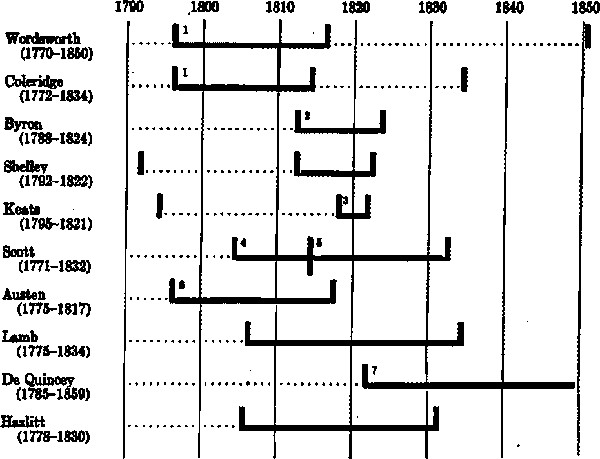
1790 1800 1810 1820 1830 1840 1850 | ║[191] ] | ║ | | | |║ Wordsworth |...║==================║...|........|........|........|║ (1770–1850) | | | | | | | | ║[191] | | ║ | | ║ | | Coleridge |...║================║.....|........|...║ | | (1772–1834) | | | | | | | | | | ║[192] | ║ | | | Byron |........|........|.║==========║ | | | (1788–1824) | | | | | | | | ║ | | ║ | ║ | | | Shelley | ║......|........|.║=========║ | | | (1792–1822) | | | | | | | | ║ | | ║[193] ║ | | | Keats | ║.....|........|...║======║ | | | (1795–1821) | | | | | | | | | ║[194] | ║[195] | | ║ | | Scott |........|..║========║=================║ | | (1771–1832) | | | ║ | | | | | ║[196] | ║ | | | | Austen |...║==================║ | | | | (1775–1817) | | | | | | | | | ║ | | | ║ | | Lamb |........|....║=========================║ | | (1775–1834) | | | | | | | | | | | ║[197] | | | De Quincey |........|........|........|.║========================+ (1785–1859) | | | | | | | | | ║ | | | ║ | | Hazlitt |........|...║========================║ | | (1778–1830) | | | | | | |
THE HISTORICAL BACKGROUND (1790–1830)
To an overwhelming extent the history of the time is the record of the effects of the French Revolution.
1. The European War. The close of the eighteenth century saw England and France engaged in open warfare (1793). Many causes contributed to set the war in motion, and many more kept it intractably in operation. Hostilities dragged on till 1815, in the end bringing about the extinction of the French Republic, the birth of which was greeted so joyfully by the English Liberals, the rise and destruction of the power of Napoleon, and the restoration of the Bourbon dynasty. These events had their effects in every corner of Europe, and in none more strongly than in England.
2. The Reaction. It has been well said: “At the beginning of every revolution men hope, for they think of all that mankind may gain in a new world; in its next phase they fear, for they think of what mankind may lose.” This was the case with the French Revolution. The elder writers of the period, with Wordsworth and Coleridge as conspicuous examples, hailed the new era with joy. Then, as the Revolution proceeded to unexpected developments, there came in turn disappointment, disillusion, dejection, and despair, and, notably in the case of Wordsworth, the rejection of youthful ideas and the soured adoption of the older reactionary faith. The younger writers, such as Leigh Hunt, Shelley, and Keats, still adhered to the Revolutionary doctrines, but the warmth of the early days had already passed away.
3. Social Conditions. The conclusion of the long war brought inevitable misery; low wages, unemployment, and heavy taxation gave rise to fiery resentment and fierce demands on the part of the people. Men like Shelley and Ebenezer Elliott called aloud for social justice; in gentler mood Mrs. Hemans and Tom Hood bewailed the social misery. We have the massacre of Peterloo and the wild rioting over the Reform Bill and the Corn Laws.
The Reform Bill (1832) was a grudging concession to the general discontent. To conservative minds, like those of Scott and the maturer Wordsworth, the Bill seemed to pronounce the dissolution of every social tie. But the Bill brought only disappointment to its friends. In the next chapter we shall see how the demand for social amelioration deepened and broadened, and colored the literature of the time.
The interest in social conditions became intensified toward the end of the nineteenth century, until it has grown to be one of the chief features of modern literature.
THE RETURN TO NATURE
In the last chapter we noted the beginnings and development of the new feeling for nature. This chapter sees the full effects of the movement, and the subsequent reaction that followed.
1. Abundant Output. Even the lavishness of the Elizabethans cannot excel that of this age. The development of new ideas brings fresh inspiration for poetry, and the poetical sky is bright with luminaries of the first magnitude. In prose we may note especially the fruitful yield of the novel, the rejuvenation of the essay, and the unprecedented activity of critical and miscellaneous writers. This is the most fertile period of our literature.
2. Great Range of Subject. The new and buoyant race of writers, especially the poets, lays the knowledge and experience of all ages under a heavy toll. The classical writers are explored anew, and are drawn upon by the genius of Keats and Shelley; the Middle Ages inspire the novels of Scott and the poems of Coleridge, Southey, and many more; modern times are analyzed and dissected in the work of the novelists, the satires of Byron, and the productions of the miscellaneous writers. This is indeed the return to nature, for all nature is scrutinized and summed up afresh.
3. Treatment of Nature. If for the moment we take the restricted meaning of the word, and understand by “nature” the common phenomena of earth, air, and sea, we find the poetical attitude to nature altering profoundly. In the work of Cowper, Crabbe, and Gray the treatment is principally the simple chronicle and sympathetic observation of natural features. In the new race of poets the observation becomes more matured and intimate. Notably in the case of Wordsworth, the feeling for nature rises to a passionate veneration that is love and religion too. To Wordsworth nature is not only a procession of seasons and seasonal fruition: it is the eye of all things, natural and supernatural, into which the observant soul can peer and behold the spirit that inhabits all things. Nature is thus amplified and glorified; it is to be sought, not only in the flowers and the fields, but also in
the light of setting suns, And the round ocean and the living air, And the blue sky, and in the mind of man.
4. Political and Periodical Writing. The age did not produce a pamphleteer of the first class like Swift or Burke, but the turbulence of the period was clearly marked in the immense productivity of its political writers. The number of periodicals was greatly augmented, and we notice the first of the great daily journals that are still a strong element in literature and politics. The Morning Chronicle (1769) and The Morning Post (1772) were started by Henry Bate, The Times (1785) by John Walter. Of a more irresponsible type were the Radical Political Register (1802) of Cobbett and The Examiner (1808) of Leigh Hunt. A race of powerful literary magazines sprang to life: The Edinburgh Review (1802), The Quarterly Review (1809), The London Magazine (1817), Blackwood’s Magazine (1817), and The Westminster Review (1827). Such excellent publications reacted strongly upon authorship, and were responsible for much of the best work of Hazlitt, Lamb, Southey, and a host of other miscellaneous writers.
5. The Influence of Germany. The increasing bitterness of the long war with France almost extinguished the literary influence of the French language, which, as was indicated in the last chapter, had been affecting English literature deeply. In the place of French, the study of German literature and learning came rapidly into favor. The first poetical work of Scott is based on the German, and the effects of the new influence can be further observed in the works of Coleridge, Shelley, Byron, and many more. In the course of time German increased its hold upon English, until by the middle of the nineteenth century it was perhaps the dominating foreign tongue.
WILLIAM WORDSWORTH (1770–1850)
1. His Life. Wordsworth was born at Cockermouth, a town which is actually outside the Lake District, but well within hail of it. His father, who was a lawyer, died when William was thirteen years old. The elder Wordsworth left a modest sum of money, which was not available at the time of his death, so that William had to depend on the generosity of two uncles, who paid for his schooling at Hawkshead, near Lake Windermere. Subsequently Wordsworth went to Cambridge, entering St. John’s College in 1787. His work at the university was quite undistinguished, and having graduated in 1791 he left with no fixed career in view. After spending a few months in London he crossed over to France (1791), and stayed at Orléans and Blois for nearly a year. An enthusiasm for the Revolution was aroused in him; he himself has chronicled the mood in one of his happiest passages:
Bliss was it in that dawn to be alive, But to be young was very heaven.
He returned to Paris in 1792 just after the September massacres, and the sights and stories that greeted him there shook his faith in the dominant political doctrine. Even yet, however, he thought of becoming a Girondin, or moderate Republican, but his allowance from home was stopped, and he returned to England. With his sister Dorothy (henceforward his lifelong companion) he settled in a little cottage in Dorset; then, having met Coleridge, they moved to Alfoxden, a house in Somersetshire, in order to live near him. It was there that the two poets took the series of walks the fruit of which was to be the Lyrical Ballads.
After a visit to Germany in 1798 the Wordsworths settled in the Lake District, which was to be their home for the future. In turn they occupied Dove Cottage, at Town-End, Grasmere (1802), Allan Bank (1808), Grasmere Parsonage (1811), and lastly the well-known residence of Rydal Mount, which was Wordsworth’s home from 1813 till his death. Shortly after he had moved to Rydal Mount he received the sinecure of Distributor of Stamps for Westmorland, and was put out of reach of poverty.
The remainder of his life was a model of domesticity. He was carefully tended by his wife and sister, who, with a zeal that was noteworthy, though it was injudicious, treasured every scrap of his poetry that they could lay their hands on. His great passion was for traveling. He explored most of the accessible parts of the Continent, and visited Scotland several times. On the last occasion (1831) he and his daughter renewed their acquaintance with Scott at Abbotsford, and saw the great novelist when he was fast crumbling into mental ruin. Wordsworth’s poetry, which at first had been received with derision or indifference, was now winning its way, and recognition was general. In 1839 Oxford conferred upon him the degree of D.C.L.; in 1842 the Crown awarded him a pension of £300 a year; and on the death of Southey in 1843 he became Poet Laureate.
Long before this time he had discarded his early ideals and become the upholder of conservatism. Perhaps he is not “the lost leader” whose recantation Browning bewails with rather theatrical woe; but he lived to deplore the Reform Bill and to oppose the causes to which his early genius had been dedicated. Throughout his life, however, he never wavered in his faith in himself and his immortality as a poet. He lived to see his own belief in his powers triumphantly justified. It is seldom indeed that such gigantic egoism is so amply and so justly repaid.
2. His Poetry. He records that his earliest verses were written at school, and that they were “a tame imitation of Pope’s versification.” This is an interesting admission of the still surviving domination of the earlier poet. At the university he composed some poetry, which appeared as The Evening Walk (1793) and Descriptive Sketches (1793). In style these poems have little originality, but they already show the Wordsworthian eye for nature. The firstfruits of his genius were seen in the Lyrical Ballads (1798), a joint production by Coleridge and himself, which was published at Bristol.
Regarding the inception of this remarkable book both Wordsworth and Coleridge have left accounts, which vary to some extent, though not materially. Coleridge’s may be taken as the more plausible. He says in his Biographia Literaria:
It was agreed that my endeavours should be directed to persons and characters supernatural, or at least romantic, yet so as to transfer from our inward nature a human interest and a semblance of truth sufficient to procure for these shadows of the imagination that willing suspension of disbelief for the moment which constitutes poetic faith. Mr Wordsworth was to give the charm of novelty to things of everyday life by awakening the mind’s attention to the loveliness and wonders of the world before us.
This volume is epoch-making, for it is the prelude to the Romantic movement proper. Wordsworth had the larger share in the book. Some of his poems in it, such as The Thorn and The Idiot Boy, are condemned as being trivial and childish in style; a few, such as Simon Lee and Expostulation and Reply, are more adequate in their expression; and the concluding piece, Tintern Abbey, is one of the triumphs of his genius.
During his visit to Germany in 1798–99 Wordsworth composed such typical poems as Lucy Gray, Ruth, and Nutting, which along with a large number of the same kind were issued in two volumes in 1807. This work, which comprises the flower of his poetry, was sharply assailed by the critics; but on the whole it amended the puerilities of the earlier volume, and set in motion the steady undercurrent of appreciation that was finally to overwhelm his detractors. While he was in Germany he planned The Prelude, which was not concluded till 1805, and remained unpublished during his lifetime. The Prelude, which dealt with his education and early ideals, was meant to be the introduction to an enormous blank-verse poem, chiefly on himself. The entire work was to be called The Recluse, and The Excursion (1814) was the second and only other completed part of it. It is on the whole fortunate that the entire poem was never finished. The Excursion is in itself a huge poem of nine books, and long stretches of it are dull and prosaic. It is inferior to The Prelude, which, though it is unequal in style, has some of the very best Wordsworthian blank verse; and it is only reasonable to imagine that further instalments of The Recluse would mark an increasing decline in poetic merit.
After the publication of The Excursion Wordsworth’s poetical power was clearly on the wane, but his productivity was unimpaired. His later volumes include The White Doe of Rylstone (1815), The Waggoner (1819), Peter Bell (1819), Yarrow Revisited (1835), and The Borderers (1842), a drama. The progress of the works marks the decline in an increasing degree. There are flashes of the old spirit, such as we see in his lines upon the death of “the Ettrick Shepherd”; but the fire and stately intonation become rarer, and mere garrulity becomes more and more apparent.
3. His Theory of Poetry. In the preface to the second edition of the Lyrical Ballads Wordsworth set out his theory of poetry, and to this theory he continued to do lip-service, while in practice he constantly violated it. The Wordsworthian dogma can be divided into two portions, concerning (a) the subject and (b) the style of poetry.
(a) Regarding subject, Wordsworth declares his preference for “incidents and situations from common life”; to obtain such situations “humble and rustic life is generally chosen, because in that condition the essential passions of the heart find a better soil.” In this respect Wordsworth was staunch to his declared opinions, because the majority of his poems deal with humble and rustic. life, including his own.
(b) With regard to style, Wordsworth declares that the language of poetry ought to be “the language really used by men,” especially by rustics, because the latter “speak a plainer and more emphatic language.” A little reflection will show that this contention is at best only half true, and Wordsworth laid himself open to deadly criticism. It was this part of his theory, moreover, that he himself constantly violated. Coleridge, who was Wordsworth’s great friend, but who held his critical faith higher than personal predilection, had but to quote Wordsworth’s own poems to condemn him. No doubt Wordsworth in such pieces as Lucy Gray and We are Seven does use the language of ordinary men; but in his greatest poems he prefers a language of a certain stiff ornateness, fired and fused by the passion of his imaginative insight. As Coleridge pointed out, it is not likely that a rustic would say
The sounding cataract Haunted me like a passion.
Yet this expression is typical of Wordsworth’s style at its best.
4. Features of his Poetry. (a) Its Inequality and its Limitations. All the critics of Wordsworth are at pains to point out the mass of inferior work that came from his pen. Matthew Arnold, one of the acutest of the poet’s admirers, closes the record of Wordsworth’s best work with the year 1808, even before the composition of The Excursion. This poem is long, meditative, and often prosaic, and these tendencies become more marked as the years pass. Before the year 1808 he had produced poems as intensely and artistically beautiful as any in the language. It was hard, however, for Wordsworth to appreciate his limitations, which were many and serious. He had little sense of humor, a scanty dramatic power, and only a meager narrative gift, but he strove to exploit all these qualities in his work. His one drama, The Borderers, was only a partial success, and his narrative poems, like Ruth and The White Doe of Rylstone, are not among the best of his work.
(b) Its Egoism. In a person of lesser caliber such a degree of self-esteem as Wordsworth’s would have been ridiculous; in his case, with the undoubted genius that was in the man, it was something almost heroic. Domestic circumstances—the adoration of a couple of women and the cloistral seclusion of the life he led—confirmed him in the habit of taking himself too seriously. The best of his shorter poems deal with his own experiences; and his longest works, The Prelude and The Excursion, describe his career, both inward and outward, with a fullness, closeness, and laborious anxiety that are unique in our literature.
(c) In spite of this self-obsession he is curiously deficient in the purely lyrical gift. He cannot bare his bosom, as Burns does; he cannot leap into the ether like Shelley. Yet he excels, especially in the face of nature, in the expression of a reflective and analytic mood which is both personal and general. The following lyric illustrates this mood to perfection:
My heart leaps up when I behold A rainbow in the sky: So was it when my life began; So is it now I am a man; So be it when I shall grow old, Or let me die! The Child is father of the Man; And I could wish my days to be Bound each to each by natural piety.
Sometimes he does touch on intimate emotions, but then he tends to be diffident and decorous, hinting at rather than proclaiming the passions that he feels. The series of Lucy poems are typical of their kind:
She dwelt among the untrodden ways Beside the springs of Dove, A Maid whom there were none to praise, And very few to love. ***** She lived unknown, and few could know When Lucy ceased to be; But she is in her grave, and, oh, The difference to me!
Such a lyrical gift, reflective rather than passionate, finds a congenial mode of expression in the sonnet, the most complicated and expository of the lyrical forms. In his sonnets his lyrical mood burns clear and strong, and as a result they rank among the best in English poetry.
(d) His Treatment of Nature. His dealings with nature are his chief glory as a poet.
(1) His treatment is accurate and first-hand. As he explained, he wrote with his eye “steadily fixed on the object.” Even the slightest of his poems have evidence of close observation:
The cattle are grazing, Their heads never raising; There are forty feeding like one.
The most polished of his poems have the same stamp, as can be seen in Resolution and Independence. “The image of the hare,” he says with reference to this poem, quoted below, “I then observed on the ridge of the Fell.”
There was a roaring in the wind all night; The rain came heavily and fell in floods; But now the sun is rising calm and bright; The birds are singing in the distant woods; Over his own sweet voice the Stock-dove broods; The Jay makes answer as the Magpie chatters; And all the air is filled with pleasant noise of waters. All things that love the sun are out of doors; The sky rejoices in the morning’s birth; The grass is bright with rain-drops;—on the moors The hare is running races in her mirth; And with her feet she from the plashy earth Raises a mist, that, glittering in the sun, Runs with her all the way, wherever she doth run.
(2) This personal dealing with Nature in all her moods produces a joy, a plenteousness of delight, that to most readers is Wordsworth’s most appealing charm. Before the beauty of nature he is never paltry; he is nearly always adequate; and that is perhaps the highest achievement that he ever desired. The extracts just quoted are outstanding examples of this aspect of his poetry.
(3) In his treatment of nature, however, he is not content merely to rejoice: he tries to see more deeply and to find the secret springs of this joy and thanksgiving. He says:
To me the meanest flower that blows can give Thoughts that do often lie too deep for tears.
He strives to capture and embody in words such deep-seated emotions, but, almost of necessity, from the very nature of the case, with little success. He gropes in the shadows, and comes away with empty hands. He cannot solve the riddle of
those obstinate questionings Of sense and outward things, Fallings from us, vanishings.
Yet, with a remarkable fusion of sustained thought and of poetic imagination, he does convey the idea of “the Being that is in the clouds and air,” the soul that penetrates all things, the spirit, the mystical essence, the divine knowledge that, as far as he was concerned, lies behind all nature. Lastly, in one of the most exalted poetical efforts in any language, he puts into words the idea of the continuity of life that runs through all existence:
Our birth is but a sleep and a forgetting: The Soul that rises with us, our life’s Star, Hath had elsewhere its setting, And cometh from afar; Not in entire forgetfulness, And not in utter nakedness, But trailing clouds of glory do we come From God, who is our home. Ode: Intimations of Immortality
(e) In style Wordsworth presents a remarkable contrast, for he ranges from the sublime (as in the extract last quoted) to the ridiculous:
In the sweet shire of Cardigan, Not far from pleasant Ivor-hall, An old Man dwells, a little man,— ’Tis said he once was tall. Full five-and-thirty years he lived A running huntsman merry; And still the centre of his cheek Is red as a ripe cherry. Simon Lee
This verse illustrates the lower ranges of his style, when he is hag-ridden with his theories of poetic diction. The first two lines are mediocre; the second pair are absurd; and the rest of the verse is middling. This is simplicity overdone; yet it is always to be remembered that at his best Wordsworth can unite simplicity with sublimity, as he does in the lyrics we have already quoted. He has a kind of middle style; at its best it has grace and dignity, a heart-searching simplicity, and a certain magical enlightenment of phrase that is all his own. Not Shakespeare himself can better Wordsworth when the latter is in a mood that produces a poem like the following:
“She shall be sportive as the fawn That wild with glee across the lawn, Or up the mountain springs; And hers shall be the breathing balm, And hers the silence and the calm, Of mute insensate things. “The floating clouds their state shall lend To her; for her the willow bend; Nor shall she fail to see Even in the motions of the Storm Grace that shall mould the Maiden’s form By silent sympathy. “The stars of midnight shall be dear To her; and she shall lean her ear In many a secret place Where rivulets dance their wayward round, And beauty born of murmuring sound Shall pass into her face.” The Education of Nature
SAMUEL TAYLOR COLERIDGE (1772–1834)
1. His Life. Coleridge was born in Devonshire, and was the youngest of the thirteen children of the vicar of Ottery St. Mary. As a child he was unusually precocious: “I never thought as a child,” he says, “never had the language of a child.” When he was nine years old his father died, and then at the age of ten he obtained a place in Christ’s Hospital, where he astonished his schoolmates, one of whom was Charles Lamb, with his queer tastes in reading and speculation. He went to Cambridge (1791), where he was fired with the revolutionary doctrines. He abandoned the university and enlisted in the Light Dragoons, but a few months as a soldier ended his military career. In 1794 he returned to Cambridge, and later in the year became acquainted at Oxford with Southey, with whom he planned the founding of an ideal republic in America. With Southey he lived for a space at Bristol, and there he met Southey’s wife’s sister, whom he eventually married. At Bristol Coleridge lectured, wrote poetry, and issued a newspaper called The Watchman, all with the idea of converting humanity; yet in spite of it all humanity remained unperturbed in its original sin. At this time (1797) he met Wordsworth, and, as has already been noticed, planned their joint production of the Lyrical Ballads, which was published at Bristol.
After a brief spell as a Unitarian minister, Coleridge, who was now dependent on a small annuity from two rich friends, studied German philosophy on the Continent; returned to England (1799), and for a time lived in the Lake District; tried journalism and lecturing; and in general pursued a restless and unhappy existence. As a writer and lecturer he was already failing, and failing fast. His work languished, and his ability and energy were relaxed. The cause of this early decline lay in his habit of opium-taking, which was now apparently past mending. He parted from his wife and children, leaving them to the charity of his friends. Till 1816 he drifted about in London, a moral and physical wreck, his rare genius revealing itself only in fitful gleams. In 1816, after repeated efforts to rid himself of the foul fiend that would not let him be, he entered the house of a Mr. Gillman, in Highgate. This provided for him a kind of refined and sympathetic inebriates’ home. Here he gradually shook himself free from opium-taking, and he spent the last years of his life in an atmosphere of subdued content, visited by his friends, and conversing interminably in that manner of wandering but luminous intelligence that marked his later years. From the house in Highgate he issued a few books that, with all their faults, are among the best of their class.
2. His Poetry. The real blossoming of Coleridge’s poetical genius was brief indeed, but the fruit of it was rich and wonderful. With the exception of a very few pieces, the best of his poems were composed within two years, 1797–98.
His first book was Poems on Various Subjects (1797), issued at Bristol. The miscellaneous poems that the volume contains have only a very moderate merit. Then, in collaboration with Wordsworth, he produced the Lyrical Ballads. This remarkable volume contains nineteen poems by Wordsworth and four by Coleridge; and of these four by far the most noteworthy is The Rime of the Ancient Mariner.
Wordsworth has set on record the origin of the Ancient Mariner. He and Coleridge discussed the poem during their walks on the Quantock Hills. The main idea of the voyage, founded on a dream of his own, was Coleridge’s; Wordsworth suggested details, and they thought of working on it together. Very soon, however, Coleridge’s imagination was fired with the story, and his friend very sensibly left him to write it all. Hence we have that marvelous series of dissolving pictures, so curiously distinct and yet so strangely fused into one: the voyage through the polar ice; the death of the albatross; the amazing scenes during the calm and the storm; and the return home. In style, in swift stealthiness of narrative speed, and in its weird and compelling strength of imagination the poem is without a parallel.
In 1797 Coleridge also wrote Christabel and Kubla Khan. Both of these poems remained unfinished, and lay unpublished till 1816. Christabel is the tale of a kind of vampire which, by taking the shape of a lovely lady, wins the confidence of the heroine Christabel. The tale is barely begun when it collapses. Already Coleridge’s fatal indecision is declaring itself. The poem is long enough, however, to show us Coleridge’s superlative power as a poet. There are passages of wonderful beauty and of charming natural description, though they scarcely reach the heights of the Ancient Mariner. The meter, now known as the Christabel meter, is a loose but exceedingly melodious form of the octosyllabic couplet. It became exceedingly popular, and its influence is still unimpaired. We give a brief extract to show the meter, and also to give a slight idea of the poet’s descriptive power:
There is not wind enough to twirl The one red leaf, the last of its clan, That dances as often as dance it can, Hanging so light, and hanging so high, On the topmost twig that looks up at the sky.
Kubla Khan is the echo of a dream—the shadow of a shadow. Coleridge avers that he dreamt the lines, awoke in a fever of inspiration, threw the words on paper, but before the fit was over was distracted from the composition, so that the glory of the dream never returned and Kubla Khan remained unfinished. The poem, beginning with a description of the stately pleasure-dome built by Kubla Khan in Xanadu, soon becomes a dreamlike series of dissolving views, grows wilder and wilder into a dervish-dance of the imagination, and collapses in mid-career.
In the same year Coleridge composed several other poems, including the fine Frost at Midnight, Love, and the Ode to France. In 1802 he wrote the great ode Dejection, in which he already bewails the suspension of his “shaping spirit of Imagination.” Save for a few fragments, such as the beautiful epitaph The Knight’s Tomb, the remainder of his poems are of poorer quality and slight in bulk. His play Remorse was, on the recommendation of Byron, accepted by the management of the Drury Lane Theatre and produced in 1813. It succeeded on the stage, but as literature it is of little importance.
3. Features of his Poetry. Within its peculiar limits his poetical work, slight though it is, is of the highest.
(a) The most conspicuous feature of the poems is their intense imaginative power. Sometimes this riots into excess. It exploits the weird, the supernatural, and the obscure. Yet, such is the power of true imagination, it can produce what Coleridge calls “that willing suspension of disbelief,” and for the moment he can compel us to believe it all. He sees nature with a penetrating and revealing glance, drawing from it inspiration for the stuff of his poetry. He is particularly fine in his descriptions of the sky and the sea and the wider and more remote aspects of things.
(b) No poet has ever excelled Coleridge in witchery of language. His is the song the sirens sang. The Ancient Mariner has more than one passage like the following:
And now ’twas like all instruments, Now like a lonely flute; And now it is an angel’s song, That makes the heavens be mute. It ceased; yet still the sails made on A pleasant noise till noon, A noise like of a hidden brook In the leafy month of June, That to the sleeping woods all night Singeth a quiet tune.
The epitaph we have mentioned is another fine example:
Where is the grave of Sir Arthur O’Kellyn? Where may the grave of that good man be? By the side of a spring, on the breast of Helvellyn, Under the twigs of a young birch tree. The oak that in summer was sweet to hear, And rustled its leaves in the fall of the year, And whistled and roared in the winter alone, Is gone,—and the birch in its stead is grown.— The knight’s bones are dust, And his good sword rust:— His soul is with the saints, I trust.
The reader of such passages can discover something of the secret of their charm by observing the dexterous handling of the meter, the vowel-music, and other technical features, but in the last analysis their beauty defies explanation: it is there that genius lies.
(c) Along with his explosive fervor Coleridge preserves a fine simplicity of diction. He appeals directly to the reader’s imagination by writing with great clearness. In this respect he often closely resembles Wordsworth. His meditative poem Frost at Midnight strongly shows this resemblance:
Therefore all seasons shall be sweet to thee, Whether the summer clothe the general earth With greenness, or the redbreast sit and sing Betwixt the tufts of snow on the bare branch Of mossy apple-tree, while the nigh thatch Smokes in the sun-thaw; whether the eave-drops fall Heard only in the trances of the blast, Or if the secret ministry of frost Shall hang them up in silent icicles, Quietly shining to the quiet moon.
4. His Prose. The same blight that afflicted Coleridge’s poetry lies upon his prose. It is scrappy, chaotic, and tentative. In bulk it is large and sprawling; in manner it is diffuse and involved; but in its happier moments it possesses a breadth, a depth, and a searching wisdom that are as rare as they are admirable.
Most of his prose was of journalistic origin. In theme it is chiefly philosophical or literary. In 1796 he started The Watchman, a periodical, ambitious in scope, which ran to ten numbers only. To this journal Coleridge contributed some typical essays, which, among much that is both obscure and formless, show considerable weight and acuteness of thought. He followed with much more miscellaneous prose, some of it being written for The Morning Post, to which he was for a time a contributor. In 1808 he began a series of lectures on poetry and allied subjects, but already the curse of opium was upon him, and the lectures were failures. While he resided in the Lake District he started The Friend (1809), which was published at Penrith, but like The Watchman it had a brief career. Then in 1817, when he had shaken himself free from opium, he published Biographia Literaria and Sibylline Leaves.
Biographia Literaria is his most valuable prose work. It pretends to record his literary upbringing, but as a consecutive narrative it is quite worthless. After sixteen chapters of philosophizing, almost entirely irrelevant, he discusses the poetical theory of his friend Wordsworth, and then in the last seven chapters of the book he gives a remarkable demonstration of his critical powers. He analyzes the Wordsworthian theory in masterly fashion, and, separating the good from the bad, upon the sounder elements bases a critical dogma of great and permanent value. These last chapters of the book, which are the most enduring exposition of the Romantic theory as it exists in English, place Coleridge in the first flight of critics.
In addition, he gave another series of lectures (1818), and wrote (1825) Aids to Reflection. But he seemed to be incapable of writing a work of any size. After his death his Table Talk was published, giving fleeting glimpses of a brilliant and erratic mind.
We give a short extract from his prose. This shows not only his sincere and temperate admiration for the poems of Wordsworth, but also the nature of his prose style. As a style it is not wholly commendable. It is too involved, and clogged with qualifications and digressions; but, though he develops his ideas in a curious indirect fashion, he makes rapid progress.
Had Mr Wordsworth’s poems been the silly, the childish things, which they were for a long time described as being; had they been really distinguished from the compositions of other poets merely by meanness of language and inanity of thought; had they indeed contained nothing more than what is found in the parodies and pretended imitations of them; they must have sunk at once, a dead weight, into the slough of oblivion, and have dragged the preface along with them. But year after year increased the number of Mr Wordsworth’s admirers. They were found, too, not in the lower classes of the reading public, but chiefly among young men of strong sensibility and meditative minds; and their admiration (inflamed perhaps in some degree by opposition) was distinguished by its intensity, I might almost say, by its religious fervour. These facts, and the intellectual energy of the author, which was more or less consciously felt, where it was outwardly and even boisterously denied, meeting with sentiments of aversion to his opinions, and of alarm at their consequences, produced an eddy of criticism, which would of itself have borne up the poems by the violence with which it whirled them round and round. With many parts of this preface, in the sense attributed to them, and which the words undoubtedly seem to authorise, I never concurred; but on the contrary objected to them as erroneous in principle, and as contradictory (in appearance at least) both to other parts of the same preface, and to the author’s own practice in the greater number of the poems themselves. Mr Wordsworth in his recent collection has, I find, degraded this prefatory disquisition to the end of his second volume, to be read or not at the reader’s choice. But he has not, as far as I can discover, announced any change in his poetic creed.
Biographia Literaria
LORD BYRON (1788–1824)
1. His Life. George Gordon Byron, sixth Lord Byron, was as proud of his ancestry as he was of his poetry, and his ancestors were as extraordinary as was his poetry. They stretched back to the Norman Conquest, and included among them a notorious admiral, Byron’s grandfather. The poet’s father was a rake and a scoundrel. He married a Scottish heiress, Miss Gordon of Gight, whose money he was not long in squandering. Though the poet was born in London, his early years were passed in Aberdeen, his mother’s native place. At the age of ten he succeeded his grand-uncle in the title and in the possession of the ruinous Abbey of Newstead, and Scotland was left behind for ever. He was educated at Harrow and Cambridge, where he showed himself to be heir to the ancestral nature, dark and passionate, but relieved by humor and affection. All his life through Byron cultivated the somber and theatrical side of his disposition, which latterly became a byword; but there can be little doubt that his “Byronic” temperament was not entirely affected. His mother, a foolish, unbalanced woman, warped the boy’s temper still more by her frequent follies and frenzies. The recollection of the tortures he underwent in the fruitless effort to cure him of a malformity of his foot remained with him till his death.
Leaving the university (1807), he remained for a while at Newstead, where with a few congenial youths he plunged into orgies of puerile dissipation. In the fashion of the time, he gloried in the reputation he was acquiring for being a dare-devil, but he lived to pay for it. Wearying of loose delights, he traveled for a couple of years upon the Continent. He had previously taken his seat in the House of Lords, but made no mark in political affairs.
Then with a sudden bound he leaped into the limelight. His poem on his travels became all the rage. He found himself the darling of society, in which his youth, his title, his physical beauty, his wit, and his picturesque and romantic melancholy made him a marvel and a delight. He married a great heiress (1814), but after a year his wife left him, for reasons that were not publicly divulged. Regarding his conduct dark rumors grew apace; his popularity waned, and in the face of a storm of abuse he left England for good (1816). For the last eight years of his life he wandered about the Continent, visiting Italy, and there meeting Shelley. Finally the cause of Greek independence caught his fancy. He devoted his money, which was inconsiderable, and the weight of his name, which was gigantic, to the Greeks, who proved to be very ungrateful allies. He died of fever at Missolonghi, and his body was given a grand funeral in the England that had cast him out.
2. His Poetry. Byron’s first volume was a juvenile effort, Hours of Idleness (1807), which was little more than the elegant trifling of a lord who condescends to be a minor poet. This frail production was roughly handled by The Edinburgh Review, and Byron, who never lacked spirit, retorted with some effect. He composed a satire in the style of Pope, calling it English Bards and Scotch Reviewers (1809). The poem is immature, being often crudely expressed, and it throws abuse recklessly upon good writers and bad; but in the handling of the couplet it already shows some of the Byronic force and pungency. The poem is also of interest in that it lets us see how much he is influenced by the preceding age.
Next view in state, proud prancing on his roan, The golden-crested haughty Marmion, Now forging scrolls, now foremost in the fight, Not quite a felon, yet but half a knight, The gibbet or the field prepared to grace; A mighty mixture of the great and base. And think’st thou, Scott! by vain conceit perchance, On public taste to foist thy stale romance, Though Murray with his Miller may combine To yield thy muse just half-a-crown per line?
Then followed the two years of travel, which had their fruit in the first two cantos of Childe Harold’s Pilgrimage (1812). The hero of the poem is a romantic youth, and is very clearly Byron himself. He is very grand and terrible, and sinister with the stain of a dark and awful past. He visits some of the popular beauty-spots of the Continent, which he describes in Spenserian stanzas of moderate skill and attractiveness. The poem is diffuse, but sometimes it can be terse and energetic; the style is halfheartedly old-fashioned, in deference to the stanza. Byron is to do much better things, but already he shows a real appreciation of nature, and considerable dexterity in the handling of his meter.
On, on the vessel flies, the land is gone, And winds are rude in Biscay’s sleepless bay. Four days are sped, but with the fifth, anon, New shores descried make every bosom gay; And Cintra’s mountain greets them on their way, And Tagus dashing onward to the deep, His fabled golden tribute bent to pay; And soon on board the Lusian pilots leap. And steer ’twixt fertile shores where yet few rustics reap.
Childe Harold brought its author a dower of fame, which in the next few years he was to squander to the uttermost. In the intervals of society functions he produced poetic tales in astonishing profusion: The Giaour and The Bride of Abydos in 1813, The Corsair and Lara in 1814, The Siege of Corinth and Parisina in 1815. These tales deal with the romantic scenes of the East; they almost uniformly reproduce the young Byronic hero of Childe Harold; and to a great extent they are mannered and stagy. Written in the couplet form, the verse is founded on that of the metrical tales of Scott, whom Byron was not long in supplanting in popular favor, although the masculine fervor of Scott’s poems is lacking from his work. In sentiment his lines are often sickly enough, yet they sometimes have a vehemence that might be mistaken for passion, and a tawdriness that imitates real beauty.
In 1816 Byron was hounded out of England, and his wanderings are chronicled in the third (1816) and fourth (1817) cantos of Childe Harold’s Pilgrimage. In meter and general scheme the poem is unaltered, but in spirit and style the new parts are very different from the first two cantos. The descriptions are firmer and terser, and are often graced with a fine simplicity; the old-fashioned mannerisms are entirely discarded; and the tone all through is deeper and more sincere. There is apparent an undercurrent of bitter pessimism that is only natural under the circumstances, though he dwells too lengthily upon his misfortunes. The following stanza is a fair specimen of this later and simpler style:
They keep his dust in Arqua, where he died; The mountain village where his latter days Went down the vale of years, and ’tis their pride— An honest pride—and let it be their praise, To offer to the passing stranger’s gaze His mansion and his sepulchre; both plain And venerably simple, such as raise A feeling more accordant with his strain Than if a pyramid formed his monumental fane.
During these years on the Continent he was not idle. Some of his longer poems are The Prisoner of Chillon (1816) and Mazeppa (1819), the last of his metrical tales. He also composed a large number of lyrics, most of them only mediocre in quality; and he added several great satirical poems, the most notable of which are Beppo (1818), The Vision of Judgment (1822), directed mainly against Southey, and, the longest of all, Don Juan.
In range, in vigor, and in effectiveness Don Juan ranks as one of the greatest of satirical poems. It was issued in portions during the years 1819–24, just as Byron composed it. It is a kind of picaresque novel cast into verse. The hero, like that of the picaresque novel, has many wanderings and adventures, the narration of which might go on interminably. At the time of its publication it was denounced by a shocked world as vile and immoral, and to a great extent it deserves the censure. In it Byron expresses the wrath that consumes him, and all the human race comes under the lash. The strength and flexibility of the satire are beyond question, and are freely revealed in bitter mockery, in caustic comment, and in burning rage. The stanzas, written in ottava rima, are as keen and supple as a tempered steel blade. The style is a kind of sublimated, half-colloquial prose, showing a disdainful abrogation of the finer poetical trappings; but in places it rises into passages of rare and lovely tenderness. When affliction came upon him, in the words of Lear he had vowed a vow:
No, I’ll not weep; I have full cause of weeping, but this heart Will break into a hundred thousand flaws Or ere I’ll weep.
But sometimes the poet prevails over the satirist, and the mocking laughter is stifled with the sound of bitter weeping.
The first extract given below shows Byron in his bitter and cynical mood; the tone of the second and third is far removed from such asperity:
(1) Ovid’s a rake, as half his verses show him, Anacreon’s morals are a still worse sample, Catullus scarcely has a decent poem, I don’t think Sappho’s Ode a good example, Although Longinus tells us there is no hymn Where the sublime soars forth on wings more ample; But Virgil’s songs are pure, except that horrid one Beginning with “Formosum Pastor Corydon.” Lucretius’ irreligion is too strong For early stomachs to prove wholesome food; I can’t help thinking Juvenal was wrong, Although no doubt his real intent was good, For speaking out so plainly in his song, So much indeed as to be downright rude; And then what proper person can be partial To all those nauseous epigrams of Martial?
(2) Round her she made an atmosphere of life; The very air seemed lighter from her eyes, They were so soft and beautiful, and rife With all we can imagine of the skies, As pure as Psyche ere she grew a wife— Too pure even for the purest human ties; Her overpowering presence made you feel It would not be idolatry to kneel. Her eyelashes, though dark as night, were tinged— It is the country’s custom—but in vain; For those large black eyes were so blackly fringed, The glossy rebels mocked the jetty stain, And in her native beauty stood avenged: Her nails were touched with henna; but again The power of art was turned to nothing, for They could not look more rosy than before.
(3) Thus lived—thus died she; never more on her Shall sorrow light or shame. She was not made Through years or moons the inner weight to bear, Which colder hearts endure till they are laid By age in earth: her days and pleasures were Brief, but delightful—such as had not stayed Long with her destiny; but she sleeps well By the sea-shore whereon she loved to dwell. That isle is now all desolate and bare, Its dwelling down, its tenants passed away; None but her own and father’s grave is there And nothing outward tells of human clay; Ye could not know where lies a thing so fair; No one is there to show, no tongue to say What was; no dirge except the hollow seas Mourns o’er the beauty of the Cyclades.
3. His Drama. Byron’s dramas are all blank-verse tragedies that were composed during the later stages of his career, when he was in Italy. The chief are Manfred (1817), Marino Faliero (1820), The Two Foscari and Cain (1821), and The Deformed Transformed (1824). In nearly all we have a hero of the Byronic type. In Cain, for example, we have the outcast who defies the censure of the world; in The Deformed Transformed there are thinly screened references to Byron’s own deformity. In this fashion he showed that he had little of the real dramatic faculty, for he could portray no character with any zeal unless it resembled himself. The blank verse has power and dignity, but it lacks the higher poetic inspiration.
4. Features of his Poetry. (a) For a man of his egotistical temper Byron’s lyrical gift is disappointingly meager. He wrote many tuneful and readable lyrics, such as She walks in Beauty and To Thyrza. His favorite theme draws on variations of the following mood:
Do thou, amid the fair white walls, If Cadiz still be free, At times, from out her latticed halls, Look o’er the dark blue sea; Then think upon Calypso’s isles, Endeared by days gone by; To others give a thousand smiles, To me a single sigh.
In such lyrics he is merely sentimental, and the reader cannot avoid thinking that he is posturing before the world. When he attempts more elevated themes, as he does in The Isles of Greece, he is little better than a poetical tub-thumper. Of the genuine passionate lyric there is little trace in his poems.
(b) His satirical power is gigantic. In the expression of his scorn, a kind of sublime and reckless arrogance, he has the touch of the master. Yet in spite of his genius he has several defects. In the first place, his motive is to a very large extent personal, and so his scorn becomes one-sided. It is, however, a sign of the essential bigness of his mind that he hardly ever becomes mean and spiteful. Secondly, he lacks the deep vision of the supreme satirist, like Cervantes, who behind the shadows of the crimes and follies of men can see the pity of it all. In the third place, he is often deliberately outrageous. When he found how easily and deeply he could shock a certain class of people he went out of his way to shock them, and succeeded only too well. No doubt this satisfied Byron’s injured feelings, but it is a rather cheap and juvenile proceeding, and detracts from the solid value of his work.
(c) He treats nature in a rather lordly fashion, more as a humble helper in his poems than as a light and inspiration. In his later poems he agreeably modified this attitude; and his passion for the sea never paled.
(d) His style has been sufficiently revealed in the extracts we have given. He could modulate it with great skill to the purpose in hand. Dignified in his dramas, melodious in his songs, vigorous in his narratives, and stinging in his satires, he is hardly ever dull, seldom obscure, and always the master of his medium.
(e) A word is necessary regarding the fluctuations of his reputation. In his earlier manhood he was reckoned among the great poets; he lived to hear himself denounced, and his poetry belittled. After his death Victorian morality held up hands in horror over his iniquity, and his real merits were steadily decried. Since those days his reputation has been climbing back to take a stable position high above the second-rate poets. In some European countries he still ranks second to none among English poets. He broke down the labored insularity of the English, and he gave to non-English readers a clear and forcible example of what the English language can accomplish.
PERCY BYSSHE SHELLEY (1792–1822)
1. His Life. Shelley was born in Sussex, the heir to a baronetcy and a great fortune. He was educated at Eton and Oxford, but from a very early age showed great eccentricity of character. He frequented graveyards, studied alchemy, and read books of dreadful import. While he was at the university he wrote several extraordinary pamphlets, one of which, The Necessity of Atheism, caused him to be expelled from Oxford. He had already developed extreme notions on religion, politics, and morality generally, a violence that was entirely theoretical, for by nature he was among the most unselfish and amiable of mankind. His opinions, as well as an early and unhappy marriage which he contracted, brought about a painful quarrel with his relatives. This was finally composed by the poet’s father, Sir Timothy Shelley, who settled an annuity upon his son. The poet immediately took to the life that suited him best, ardently devoting himself to his writing, and wandering where the spirit led him. In 1816 his first wife committed suicide; and Shelley, having married the daughter of William Godwin, settled in Italy, the land he loved the best. The intoxication of Rome’s blue sky and the delicious unrestraint of his Italian existence set his genius blossoming into the rarest beauty. In the full flower of it he was drowned, when he was only thirty years old, in a sudden squall that overtook his yacht in the Gulf of Spezzia. His body—a fit consummation—was burned on the beach where it was found, and his ashes were laid beside those of Keats in the Roman cemetery that he had nobly hymned. It is impossible to estimate the loss to literature that was caused by his early extinction. The crudeness of his earlier opinions was passing away, his vision was gaining immeasurably in clearness and intensity, and his singing-robes seemed to be developing almost into seraph’s wings. In his case the grave can indeed claim a victory.
2. His Poetry. His earliest effort of any note is Queen Mab (1813). The poem is clearly immature; it is lengthy, and contains much of Shelley’s cruder atheism. It is written in the irregular unrhymed meter that was made popular by Southey. The beginning is worth quoting, for already it reveals a touch of the airy music that was to distinguish his later work:
How wonderful is Death, Death and his brother Sleep! One, pale as yonder waning moon With lips of lurid blue; The other, rosy as the morn When throned on ocean’s wave It blushes o’er the world: Yet both so passing wonderful!
Alastor, or The Spirit of Solitude (1816) followed. It is a kind of spiritual autobiography. The chief character is a wild youth who retires into the wilderness and stays there under highly romantic circumstances. The poem is too long and formless, and in places the expression becomes so wild as to be only a foamy gabble of words. It is written in blank verse that shows Shelley’s growing skill as a poet. After this came Laon and Cynthia (1817), afterward called The Revolt of Islam. It has the fault of its immediate predecessor—lack of grip and coherence; but it is richer in descriptive passages, and has many outbursts of rapturous energy.
Then Shelley left for Italy. The first fruits of his new life were apparent in Prometheus Unbound (1819). This wonderful production is a combination of the lyric and the drama. The story is that of Prometheus, who defied the gods and suffered for his presumption. There is a small proportion of narrative in blank verse, but the chief feature of the poem is the series of lyrics that both sustain and embellish the action. As a whole the poem has a sweep, a soar, and an unearthly vitality that sometimes staggers the imagination. It is peopled with spirits and demigods, and its scenes are cast in the inaccessible spaces of sky, mountain, and sea.
In The Cenci (1819) Shelley started to write formal drama. In this play he seems deliberately to have set upon himself the restraints that he defied in Prometheus Unbound. The plot is not of the sky and the sea; it is a grim and sordid family affair; in style it is neither fervent nor ornate, but bleak and austere. Yet behind this reticence of manner there is a deep and smoldering intensity of passion and enormous adequacy of tragic purpose. Many of the poet’s admirers look upon it as his masterpiece; and there can be little doubt that, with the exception possibly of the Venice Preserved of Otway, it is the most powerful tragedy since the days of Shakespeare. The last words of the play, when the heroine goes to her doom, are almost heart-breaking in their simplicity:
Beatrice. Give yourself no unnecessary pain, My dear Lord Cardinal. Here, mother, tie My girdle for me, and bind up this hair In any simple knot; ay, that does well. And yours I see is coming down. How often Have we done this for one another! Now We shall not do it any more. My lord, We are quite ready. Well, ’tis very well.
The poems of this period are extraordinary in their number and quality. Among the longer ones are Julian and Maddalo (1818) and The Masque of Anarchy (1819). The latter, inspired by the news of the massacre of Peterloo, expresses Shelley’s revolutionary political views, and is very severe on Lord Castlereagh. The beginning of the poem is startling enough:
I met Murder on the way, He had a mask like Castlereagh; Very smooth he looked, yet grim, Seven bloodhounds followed him.
In The Witch of Atlas (1820) and Epipsychidion (1821) Shelley rises further and further into the ether of poetical imagination, until he becomes almost impossible of comprehension. Adonais (1821) is a lament for the death of Keats. In plan the poem is crazily constructed, but it glows with some of the most splendid of Shelley’s conceptions:
He has outsoared the shadow of our night. Envy and calumny and hate and pain, And that unrest which men miscall delight, Can touch him not and torture not again. From the contagion of the world’s slow stain He is secure; and now can never mourn A heart grown cold, a head grown grey, in vain— Nor, when the spirit’s self has ceased to burn, With sparkless ashes load an unlamented urn. He lives, he wakes—’tis Death is dead, not he; Mourn not for Adonais.—Thou, young Dawn, Turn all thy dew to splendour, for from thee The spirit thou lamentest is not gone! Ye caverns and ye forests, cease to moan! Cease, ye faint flowers and fountains; and, thou Air, Which like a mourning veil thy scarf hadst thrown O’er the abandoned Earth, now leave it bare Even to the joyous stars which smile on its despair!
With the longer poems went a brilliant cascade of shorter lyrical pieces. To name them is to mention some of the sweetest English lyrics. The constantly quoted Skylark and Cloud are among them; so are some exquisite songs, such as Lines to an Indian Air, Music, when soft voices die, On a Faded Violet, To Night, and the longer occasional pieces—for example, Lines written among the Euganean Hills, and the Letter to Maria Gisborne. Of his many beautiful odes, the most remarkable is To the West Wind. The stanzas have the elemental rush of the wind itself, and the conclusion, where Shelley sees a parallel to himself, is the most remarkable of all:
Make me thy lyre, ev’n as the forest is: What if my leaves are falling like its own! The tumult of thy mighty harmonies Will take from both a deep autumnal tone, Sweet though in sadness. Be thou, Spirit fierce, My spirit! be thou me, impetuous one! Drive my dead thoughts over the universe, Like wither’d leaves, to quicken a new birth; And, by the incantation of this verse, Scatter, as from an unextinguish’d hearth Ashes and sparks, my words among mankind! Be through my lips to unawaken’d earth The trumpet of a prophecy! O Wind, If Winter comes, can Spring be far behind?
3. His Prose. Shelley began his literary career with two boyish romances, Zastrozzi and St. Irvyne. These books were written when he was still at school, and are almost laughably bad in style and story. The only other prose work that is worth mention is his short essay The Defence of Poetry. The work is soundly written, and is a strong exposition of the Romantic point of view. His published letters show him to have been a man of considerable common sense, and not merely the crazy theorist of popular imagination. His prose style is somewhat heavy, but always clear and readable.
4. Features of his Poetry. (a) His lyrical power is equal to the highest to be found in any language. It is now recognized to be one of the supreme gifts in literature, like the dramatic genius of Shakespeare. This gift is shown at its best when it expresses the highest emotional ecstasy, as in the lyrics of Prometheus Unbound. It is a sign of his great genius that, in spite of the passion that pervades his lyrics, he is seldom shrill and tuneless. He can also express a mood of blessed cheerfulness, a sane and delectable joy. To the Spirit of Delight he says:
I love Love, though he has wings, And like light can flee, But above all other things, Spirit, I love thee. Thou art love and life! O come, Make once more my heart thy home.
He can also express the keenest note of depression and despair, as in the lyric O World! O Life! O Time!
(b) In his choice of subject he differs from such a poet as Burns, who is almost the only other poet who challenges him as master of the lyric. Shelley lacks the homely appeal of Burns; he loves to roam through space and infinity. In his own words he
Feeds upon the aerial kisses Of shapes that haunt thought’s wildernesses.
He rejoices in nature, but nature of a spiritual kind, which he peoples with phantoms and airy beings:
I love all that thou lovest, Spirit of Delight! The fresh Earth in new leaves drest, And the starry night; Autumn evening, and the morn When the golden mists are born. I love snow, and all the forms Of the radiant frost: I love waves, and winds, and storms, Everything almost Which is nature’s, and may be Untainted by man’s misery.
(c) His descriptive power at once strikes the imagination. The effect is instantaneous. His fancy played among wild and elemental things, but it gave them form and substance, as well as a radiant loveliness. His favorite device for this purpose is personification, of which the following is an excellent example:
For Winter came; the wind was his whip; One choppy finger was on his lip; He had torn the cataracts from the hills, And they clanked at his girdle like manacles. The Sensitive Plant
We add another extract to show his almost unearthly skill in visualizing the wilder aspects of nature. Note the extreme simplicity and ease of the style:
We paused among the pines that stood The giants of the waste, Tortured by storms to shapes as rude As serpents interlaced. The Pine Forest
(d) His style is perfectly attuned to his purpose. Like all the finest lyrical styles, it is simple, flexible, and passionate. Sometimes, as in The Cenci, it rises to a commanding simplicity. The extracts already given sufficiently show this.
(e) Shelley’s limitations are almost as plain as his great abilities. His continual rhapsodizings tend to become tedious and baffling; in his narrative he is diffuse and argumentative; he lacks humor; and his political poetry is often violent and unreasonable.
(f) His Reputation. During his lifetime Shelley’s opinions obscured his powers as a poet. Even to Scott, who with all his Tory prejudices was liberal enough in his views on literature, he was simply “that atheist Shelley.” After his death his reputation rose rapidly, and by the middle of the nineteenth century his position was assured. By the curious alternation that seems to affect popular taste, his fame since that time has paled a little; but no fluctuations in taste can ever remove him from his place among the great.
JOHN KEATS (1795–1821)
1. His Life. Keats was born in London, the son of the well-to-do keeper of a livery stable. He was educated at a private school at Enfield, and at the age of fifteen was apprenticed to a surgeon. In 1814 he transferred his residence to London, and followed part of the regular course of instruction prescribed for medical students. Already, however, his poetical bent was becoming apparent. Surgery lost its slight attraction, and the career of a poet became a bright possibility when he made the acquaintance of Leigh Hunt (1815), the famous Radical journalist and poet, whose collisions with the Government had caused much commotion and his own imprisonment. Keats was soon intimate with the Radical brotherhood that surrounded Leigh Hunt, and thus he became known to Shelley and others. In 1817 he published his first volume of verse, but it attracted little notice, in spite of the championship of Hunt. By this time the family tendency to consumption became painfully manifest in him, and he spent his time in searching for places, including the Isle of Wight and the suburbs of London, where his affliction might be remedied. While he was staying in London he became acquainted with Fanny Brawne, and afterward was engaged to her for a time. His malady, however, became worse, and the mental and physical distress caused by his complaint, added to despair regarding the success of his love-affair, produced a frantic state of mind painfully reflected in his letters to the young lady. These letters were foolishly printed (1879), long after the poet’s death.
His second volume of verse, published in 1818, was brutally assailed by The Quarterly Review and (to a lesser degree) by Blackwood’s Magazine. These Tory journals probably struck at him because of his friendship with the radical Leigh Hunt. Keats bore the attack with apparent serenity, and always protested that he minded it little; but there can be little doubt that it affected his health to some degree. In 1820 he was compelled to seek warmer skies, and died in Rome early in the next year, at the age of twenty-five.
2. His Poetry. When he was about seventeen years old Keats became acquainted with the works of Spenser, and this proved to be the turning-point in his life. The mannerisms of the Elizabethan immediately captivated him, and he resolved to imitate him. His earliest attempt at verse is his Imitation of Spenser (1813), written when he was eighteen. This and some other short pieces were published together in his Poems (1817), his first volume of verse. This book contains little of any outstanding merit. The different poems, which include the pieces On Death, To Hope, and Sleep and Poetry, follow the methods of Shenstone, Gray, and Byron. Of a different quality was his next volume, which bore the title of Endymion (1818). Probably based partly on Drayton’s Man in the Moon and Fletcher’s Faithful Shepherdess, this remarkable poem of Endymion professes to tell the story of the lovely youth who was kissed by the moon-goddess on the summit of Mount Latmos. Keats develops this simple myth into an intricate and flowery tale of over four thousand lines. The work is clearly immature, and flawed with many weaknesses both of taste and of construction, but many of the passages are most beautiful, and the poem shows the tender budding of the Keatsian style—a rich and suggestive beauty obtained by a richly ornamented diction. The first line is often quoted, and it contains the theory that Keats followed in a subconscious fashion during most of his poetical career:
A thing of beauty is a joy for ever.
The crudeness of the work laid it temptingly open to attack, and, as we have noticed, the hostile reviews found it an easy prey.
Keats’s health was already failing, but the amount of poetry he wrote is marvelous both in magnitude and in quality. His third and last volume, published just before he left England, contains a collection of poems of the first rank, which were written approximately in the order that follows.
Isabella, or The Pot of Basil (1818), is a version of a tale from Boccaccio, and deals with the murder of a lady’s lover by her two wicked brothers. The poem, which is written in ottava rima, marks a decided advance in Keats’s work. The slips of taste are fewer; the style is richer and deeper in tone; and the conclusion, though it is sentimentally treated, is not wanting in pathos.
The Eve of St. Agnes (1818) has for a plot the merest incident dealing with the elopement of two lovers. The tale is so sumptuously adorned with the silks and jewels of poetical imagination that it is almost lost in the decoration. This is sometimes considered his masterpiece; it is certainly the most typical of his poems. The richness of fancy and pictorial effect mark the summit of the poet’s art. It is somewhat hectic and overloaded, but its faults are quite venial. We add one of its exquisite Spenserian stanzas:
Full on this casement shone the wintry moon, And threw warm gules on Madeleine’s fair breast, As down she knelt for heaven’s grace and boon; Rose-bloom fell on her hands, together prest, And on her silver cross soft amethyst, And on her hair a glory, like a saint: She seemed a splendid angel, newly drest, Save wings, for heaven:—Porphyro grew faint: She knelt, so pure a thing, so free from mortal taint.
Hyperion (1818) is of a different type. For this poem Keats adopts blank verse, and for theme he goes to the primeval warfare between early deities, such as Saturn and Thea, and younger divinities, such as Apollo and Minerva. The poem remains unfinished, owing, it is stated, to the poet’s discouragement over the reception of Endymion. It is doubtful if Keats could ever have finished it. The scale of the story is so gigantic, and the style is pitched at such an altitude of sublimity that Keats appears to have been lacking in mere physical fitness to carry it to a conclusion. In the fragment that we have an observant reader can see that the poet’s grip is loosening, and his breath failing, before the effort ceases entirely. Keats, with his usual insight, appropriately writes the poem in a style of bleak and almost terrible simplicity. The opening lines are among the best:
Deep in the shady sadness of a vale, Far sunken from the healthy breath of morn, Far from the fiery noon, and eve’s one star, Sat gray-haired Saturn, quiet as a stone, Still as the silence round about his lair; Forest on forest hung about his head Like cloud on cloud. No stir of air was there, Not so much life as on a summer’s day Robs not one light seed from the feathered grass, But where the dead leaf fell, there did it rest. A stream went voiceless by, still deadened more By reason of his fallen divinity Spreading a shade: the Naiad ’mid her reeds Pressed her cold finger closer to her lips.
Next was written The Eve of St. Mark (1819), which also remains unfinished. The tale shows how far even Keats can improve upon himself. It is adorned with brilliant descriptive passages, and the strokes are more dashing than usual. The earlier languor and sentimentality are almost eliminated:
The bells had ceased, the prayers begun, And Bertha had not yet half done A curious volume, patched and torn, That all day long, from earliest morn, Had taken captive her two eyes, Among its golden broideries; Perplexed her with a thousand things, The stars of heaven, and angels’ wings, Martyrs in a fiery blaze, Azure saints and silver rays, Moses’ breastplate, and the seven Candlesticks John saw in heaven, The winged Lion of St Mark, And the Covenantal Ark, With its many mysteries, Cherubim and golden mice.
The story of Lamia (1819) is taken from Burton’s Anatomy of Melancholy, and tells of a beautiful enchantress. It is the weakest of all the longer poems, and the lapses are more numerous. The language becomes mannered and overdone:
He answered, bending to her open eyes, Where he was mirrored small in paradise,— “My silver planet, both of eve and morn! Why will you plead yourself so sad forlorn, While I am striving how to fill my heart With deeper crimson, and a double smart? How to entangle, trammel up and snare Your soul in mine, and labyrinth you there, Like the hid scent in an unbudded rose?”
In this passage we observe the strength of Keats running to seed. Phrases like “plead yourself” and “labyrinth you” go beyond the limits of poetical license; and the whole passage in conception resembles the conceits of the Caroline poets rather than the finer and stronger flights of imagination of which Keats was so thoroughly capable.
Together with the longer poems are many shorter pieces of supreme beauty. The great odes—To a Nightingale, On a Grecian Urn, To Autumn—were nearly all written in 1819. Among the other shorter poems La Belle Dame sans Merci, a kind of lyrical ballad, is considered to be one of the choicest in the language.
In 1819 Keats collaborated in a drama, Otho the Great, and began another, King Stephen, which he did not complete. Neither effort is of much consequence. The Cap and Bells, a longish fairy-tale which also is unfinished, is much below the level of his usual work.
3. Features of his Poetry. (a) His style should be considered first, for Keats is above all a stylist. The typical Keatsian poetry is, one imagines, the ideal of what is popularly considered to be “poetry”: it is gorgeously attractive, with its melodic beauty and sensuous passion; soft and caressing, like velvet; and richly colored and odorous. At its very best the spell of it works like a divine enchantment; but at even a little less than the best it becomes unctuous, sickly, and stuffily uncomfortable. There can be little doubt that Keats’s physical malady shows itself in his writings. With all their genius, they are the work of an unhealthy brain. His heroes are languid and neurotic creatures, and his style is attuned to their swoons and faintings. A stanza from Isabella will illustrate what has already been exemplified in the verse we have quoted from The Eve of St. Agnes:
So once more had he waked and anguished A dreary night of love and misery, If Isabel’s quick eye had not been wed To every symbol on his forehead high; She saw it waxing very pale and dead, And straight all flushed; so, lisped tenderly, “Lorenzo!”—here she ceased her timid quest, But in her tone and look he read the rest.
(b) His descriptive and romantic quality is of the highest. He modeled his work upon that of Spenser, but before he had finished he almost bettered his model. In beauty and splendor he is nearly unrivaled. He ranges among classical and medieval subjects, and distills from them the essence of their beauty. For example, he knew no Greek, but he could reproduce the full charm of the Greek seaboard:
Who are these coming to the sacrifice? To what green altar, O mysterious priest, Lead’st thou that heifer lowing at the skies, And all her silken flanks with garlands drest? What little town by river or sea-shore, Or mountain-built with peaceful citadel, Is emptied of its folk, this pious morn? And, little town, thy streets for evermore Will silent be; and not a soul to tell Why thou art desolate, can e’er return. Ode on a Grecian Urn
(c) Keats’s lyrical faculty is limited. When brooding over his woes he can utter a complaint on the true lyrical note. Hence we obtain such results as his wonderful last sonnet and La Belle Dame sans Merci, which is a lyric thinly disguised as a ballad. He was perhaps physically unable to experience the healthier joys of Burns, and so was incapable of expressing them.
(d) His Influence. A single glance at the table at the head of this chapter will show how piteously short was his poetical career; but, short as it was, his labor created a larger school than that of any of his contemporaries. His tradition was carried on by Tennyson and the Pre-Raphaelites, and to this day his influence is strong in English poetry.
OTHER POETS
1. Robert Southey (1774–1843). Southey was born at Bristol, educated at Westminster School and at Oxford, and settled down to lead the laborious life of a man of letters. He produced a great mass of work, much of which is of considerable merit, and he ranked as one of the leading writers of his age. Most of his work was written at Greta Hall, near Keswick, where he lived most of his life. He was made Poet Laureate in 1813. His reputation, especially as a poet, has not been maintained.
His poems, which are of great bulk, include Joan of Arc (1798), Thalaba the Destroyer (1801), The Curse of Kehama (1810), and Roderick the Goth (1814); they are pretentious in style and subject, but are now almost forgotten. Some shorter pieces, such as The Holly-tree, The Battle of Blenheim, and The Inchcape Rock, are still in favor, and deservedly so.
His numerous prose works include The History of Brazil (1810–19) and The Peninsular War (1822–33). The slightest of them all, The Life of Nelson (1813), is the only one now freely read. It shows Southey’s easy yet scholarly style at its best.
2. Walter Savage Landor (1775–1864). Landor had a long life, for he was born five years after Wordsworth, and lived to see the full yield of the Victorian era. Of an ancient family, he was born in Warwickshire, and was educated at Rugby and Oxford. Later he was fired with republican ideas, abandoned his projected career in the British Army, and supported the revolutionaries in Spain. In temper he was impulsive to the point of mania; and his life is marked by a succession of violent quarrels with his friends and enemies. The middle years of his life were passed in Italy. He returned to England in 1838, and lived in Bath until 1858. In this year his pugnacity involved him in an action for damages, in which as defendant he cut a lamentable figure. Poor and dishonored, he forsook England, and settled again in Florence, where he died.
His Gebir (1798) is a kind of epic poem written in blank verse. It is “classical” in its stiff and formal style; but it has a stately beauty and much powerful natural description. Count Julian (1812), a tragedy, has much the same qualities, good and bad, as Gebir. His shorter pieces, especially the eight-line lyric Rose Aylmer, have more ease and passion, and are gracefully expressed.
His bulkiest prose work is his Imaginary Conversations, which was published at intervals from 1824 to 1846. The volumes record imaginary dialogues between all kinds of people on a great variety of subjects. They have Landor’s chief defect, a stony lifelessness; but in style they are stately, strong, and scholarly, with frequent passages of noble description. All his life he continued to issue essays and pamphlets. A collection of them, called Dry Sticks (1858), as has been noticed, brought upon his head the weight of the law. Landor professed to despise popularity; he was moody, crotchety, and often deliberately perverse. Posterity has repaid him by consigning him to an oblivion that only the devotion of a small but eminent band of admirers keeps from being absolute.
3. Thomas Moore (1779–1852). Moore was born in Dublin, took his degree at Trinity College, and studied law in the same city. He too was imbued with revolutionary notions, and attempted to apply them to Ireland, but with no success. He obtained a valuable appointment in the Bermudas, the duties of which were discharged by a deputy, who in this case proved faithless and caused Moore financial loss. Moore was a friend of Byron and a prominent literary figure of the time. Most of his life was passed as a successful man of letters.
His poems were highly successful during his lifetime, but after his death there was a reaction against them. His Irish Melodies are set to the traditional musical airs of Ireland. They are graceful, and adapt themselves admirably to the tunes. Moore, however, lacked the depth and far-ranging strength of Burns, and so he failed to do for Ireland what the Ayrshire poet did for Scotland: he did not raise the national sentiment of Ireland into one of the precious things of literature. His Lalla Rookh (1817) is an Oriental romance, written in the Scott-Byron manner then so popular. The poem had an immense success, which has now almost totally faded. It contains an abundance of florid description, but as poetry it is hardly second-rate. Moore’s political satires, such as The Twopenny Postbag (1813), The Fudge Family in Paris (1818), and Fables for the Holy Alliance (1823), are keen and lively, and show his Irish wit at its very best.
His prose works include his Life of Byron (1830), which has taken its place as the standard biography of that poet. It is an able and scholarly piece of work, and is written with much knowledge and sympathy.
4. Thomas Campbell (1777–1844). Campbell was born in Glasgow, of a poor but ancient family. After studying at Glasgow University he became tutor to a private family; but his Pleasures of Hope (1799) brought him fame, and he adopted the career of a poet. He visited the Continent, and saw much of the turmoil that there reigned. Returning, he settled in London, where he was editor of The New Monthly Magazine from 1820 to 1830.
His longer poems are quite numerous, and begin with the Pleasures of Hope, which consists of a series of descriptions of nature in heroic couplets, written in a style that suggests Goldsmith. Other longer poems include Gertrude of Wyoming (1809), a longish tale of Pennsylvania, written in Spenserian stanzas, and The Pilgrim of Glencoe (1842). Campbell, however, is chiefly remembered for his stirring songs, some of which were written during his early Continental tour and were published in newspapers. His most successful are Ye Mariners of England and The Battle of the Baltic, which are spirited without containing the bluster and boasting that so often disfigure the patriotic song.
5. Samuel Rogers (1763–1855). Rogers was born in London, the son of a rich banker. He soon became a partner in his father’s firm, and for the rest of his life his financial success was assured. His chief interest lay in art and poetry, which he cultivated in an earnest fashion. He was a generous patron of the man of letters, and was acquainted with most of the literary people of the time. His breakfasts were famous.
His Pleasures of Memory (1792) is a reversion to the typical eighteenth-century manner, and as such is interesting. He could compose polished verses, but he was little of the poet. Other works are Columbus (1812), Jacqueline (1814), a tale in the Byronic manner, and Italy (1822).
Rogers was a careful and fastidious writer, but his excellence does not go much further. His name is a prominent one in the literary annals of the time, but his wealth rather than his merit accounts for this.
6. Leigh Hunt (1784–1859), unlike Rogers, was not a wealthy amateur who could trifle for years with mediocre production; he was of the arena, taking and giving hard knocks in both political and literary scuffles. He was born in Middlesex, educated at Christ’s Hospital, and while still in his teens became a journalist, and remained a journalist all his life. His Radical journal The Examiner (1808) was strongly critical of the Government, and Hunt’s aptitude for abuse landed him in prison for two years. His captivity, as he gleefully records, made a hero of him; and most of the literary men who prided themselves upon their Liberalism—among them being Wordsworth, Byron, Moore, Keats, and Shelley—sought his friendship. Hunt had a powerful influence on Keats, and published some of the latter’s shorter poems in The Examiner. He tried various other journalistic ventures, but none of them had the success of The Examiner; his attempted collaboration in journalism with Byron was a lamentable failure. He died, like Wordsworth and others, a respectable pensioner of the Government he had once so strongly condemned.
He much fancied himself as a poet, and popular taste confirmed him in his delusion. The best of his longer poems is Rimini (1811), an Italian tale in verse. The poem is of interest because its flowing couplets were the model for Keats’s Endymion. Hunt’s shorter pieces—for example, Abou Ben Adhem—are often graceful, but their poetical value is not very high.
His prose includes an enormous amount of journalistic matter, which was occasionally collected and issued in book form. Such was his Men, Women, and Books (1847). His Autobiography (1850) contains much interesting biographical and literary gossip. He is an agreeable essayist, fluent and easygoing; his critical opinions are solid and sensible, though often half-informed. He wrote a novel, Sir Ralph Esher (1832), and a very readable book on London called The Town (1848). Hunt is not a genius, but he is a useful and amiable second-rate writer.
7. James Hogg (1770–1835). Hogg became known to the world as “the Ettrick Shepherd,” for he was born of a shepherd’s family in the valley of the Ettrick, in Selkirkshire. He was a man of much natural ability, and from his infancy was an eager listener to the songs and ballads of his district. He was introduced to Walter Scott (1802) while the latter was collecting the Border minstrelsy, and by Scott he was supported both as a literary man and as a farmer. Many of his admirers assisted him in the acquisition of a sheep-farm, but Hogg proved to be a poor farmer. He was known to most of the members of the Scottish literary circle, but his shiftless and unmanageable disposition alienated most of his friends. He died in his native district.
Hogg had little education and very little sense of discrimination, so that much of his poetry is very poor indeed. Sometimes, however, his native talent prevails, and he writes such poems as Kilmeny and When the Kye comes Hame. The latter is a lyric resembling those of Burns in its humor and simple appeal. In Kilmeny (in The Queen’s Wake) he achieves what is commonly held to be the true Celtic note: the eerie description of elves and the gloaming, and murmuring and musical echoes of things half seen and half understood. Some of his books are The Forest Minstrel (1801), The Queen’s Wake (1813), and The Brownie of Bodsbeck (1818), the last being a prose tale.
8. Ebenezer Elliott (1781–1849). Elliott was born at Masborough, in Yorkshire, and worked as an iron-founder. The struggles of the poor, oppressed by the Corn Laws, were early borne in upon him, and his poetical gift was used in a fierce challenge to the existing system. Like Crabbe, he devoted himself to the cause of the poor; and it is a tribute to his merit as a poet that, in spite of his bristling assertiveness, he produced some work of real value. He became known as the “Corn Law Rhymer,” and he lived to see the abolition of the laws that he had always attacked.
His best book is Corn Law Rhymes (1830), which includes the powerful and somber Battle-song. This poem is a kind of anthem for the poor, and breathes a spirit of fierce unrest.
9. Felicia Hemans (1793–1835). Mrs. Hemans’s maiden name was Browne, and she was born at Liverpool. Later she removed to Wales, where a large part of her life was spent. At the age of fifteen she began to write poetry, and persisted in the habit all her life. She married somewhat unhappily, but she lived to be a highly popular poetess, and produced a large amount of work. She died in Dublin.
Nobody can call Mrs. Hemans a great poetess, but her verses are facile and fairly melodious, and she can give simple themes a simple setting. One can respect the genuine quality of her emotions, and the zeal with which she expressed them. Some of her better lyrics—for example, The Stately Homes of England, The Graves of a Household, and The Pilgrim Fathers—are in their limited fashion well done.
10. Thomas Hood (1799–1845). Hood was a native of London, and became a partner in a book-selling firm. He took to a literary career, and contributed to many periodicals, including The London Magazine. For a time he edited The New Monthly Magazine, but he was much troubled by illness, and died prematurely.
Hood first gained notoriety with some humorous poems, published under the title of Whims and Oddities (1826). To modern taste the humor is rather cheap, for it consists largely of verbal quibblings, such as the free use of the pun. It seemed to be acceptable to the public of the time, for the book had much success. Other volumes in the same vein were The Comic Annual, Up the Rhine (1839), and Whimsicalities (1843). Hood, in spite of his smartness, could not keep free of vulgarity, and his wit often jars. As a kind of tragic relief Hood sometimes produced poems of a tearful intensity, such as The Death-bed and The Bridge of Sighs. One could believe that his grief was genuine if he did not dwell so much upon it. His Song of the Shirt, first published in Punch in 1845, is rather a versified political pamphlet than a real poem, but it is powerful verse, and one can forgive much on account of the motive, which was to help the sweated sempstress. His Dream of Eugene Aram (1829) was an attempt at the horrible, and was long a bravura piece for aspiring elocutionists. It is a middling specimen of poetical rhetoric.
11. John Clare (1793–1864) was a true peasant poet, and in his day he had a great popularity. After his death his works fell into neglect, but recently (1920) a reissue of his poems, some of them new to the public, has recalled attention to the considerable value of much that he wrote. He was born near Peterborough, his father being a cripple and a pauper. At the age of thirteen he saved sufficient money to buy a copy of The Seasons, which fired his poetic ability. His Collection of Original Trifles (1817) attracted notice, and his Poems (1820) was much praised. The patronage of rich admirers put him above poverty, but a tendency to insanity developed, and, like Christopher Smart, he died in a madhouse.
Clare’s poems are seen at their best when they deal with simple rustic themes, and then they are quite charming. He rejoices in the ways of animals and insects. He is not a great poet, but there are many poets with flaunting credentials who have less claims to consideration than he.
12. James Smith (1775–1837) and Horace Smith (1779–1849), two brothers, collaborated in the production of a work that was one of the “hits” of the period. This book was Rejected Addresses (1812). When the Drury Lane Theatre was burned down and rebuilt the management offered a prize for the best poem to be recited on the opening night. The Smiths hit on the idea of making parodies of the notable poets of the time and pretending that they were the rejected poems of the writers mentioned. The result is the classical collection of parodies in English. Scott, Wordsworth, and other well-known authors are imitated, usually with much cleverness. The Wordsworth poem is recited by Nancy Lake, a girl of eight, who is drawn upon the stage in a perambulator:
My brother Jack was nine in May, And I was eight on New Year’s Day; So in Kate Williams’ shop Papa (he’s my papa and Jack’s) Bought me, last week, a doll of wax, And brother Jack a top.
WALTER SCOTT (1771–1832)
1. His Life. Scott was born in Edinburgh, of an ancient stock of Border freebooters. At the age of eighteen months he was crippled for life by a childish ailment; and though he grew up to be a man of great physical robustness he never lost his lameness. He was educated at the High School of Edinburgh and at the university; and there he developed that powerful memory which, though it rejected things of no interest to it, held in tenacious grasp a great store of miscellaneous knowledge. His father was a lawyer, and Scott himself was called to the Scottish Bar (1792). As a pleader he had little success, for he was much more interested in the lore and antiquities of the country. He was glad, therefore, to accept a small legal appointment as Sheriff of Selkirkshire (1799). Just before this, after an unsuccessful love-affair with a Perthshire lady, he had married the daughter of a French exile. In 1806 he obtained the valuable post of Clerk of Session, but for six years he received no salary, as the post was still held by an invalid nominally in charge.