Chapter I · (continued 3)
Walter Armstrong translation
Fig. 25.—Fragment of a bas-relief in alabaster. Louvre. Height 23 inches. Drawn by Saint-Elme Gautier.
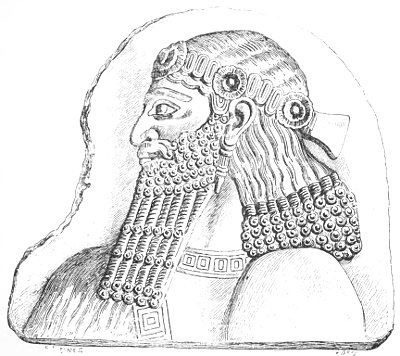
Now the sculpture upon the alabaster slabs with which the palace walls of Shalmaneser and Sargon, of Sennacherib and Assurbanipal, were covered, confines itself mainly to marches, combats, and sieves, it is more realistic than the sculpture of Chaldæa, a country that had done less, especially upon fields of battle, but had invented more and done more thinking than its bellicose rival. We owe no small debt of gratitude to the swordsmen of Assyria, in spite of the blood they shed and the horrible cruelties they committed and delighted in seeing commemorated in the figured histories of their reigns. The works entrusted to their artists have left us precious documents and the elements for a restoration of a vanished world. Philologists may take their time over the decipherment of the texts inscribed on the reliefs, but the great people of prey who, for at least four centuries, pillaged all Asia without themselves becoming softened by the possession of so much accumulated wealth, live, henceforward, in the long series of pictures recovered for the world by Layard and Botta. The stern conquerors reappear, armed, helmeted, and cuirassed, as they passed before the trembling nations thirty centuries ago. They are short of stature, but vigorous and sturdy, with an exceptional muscular development. They were, no doubt, prepared for their military duties from infancy by some system of gymnastic exercises, such as have been practised by other nations of soldiers. Their noses are high and hooked, their eyes large, their features as a whole strongly Semitic (see Fig. 25).
Fig. 26.—Bas-relief of Tiglath Pileser II.; from Nimroud. British Museum. Height 44 inches. Drawn by Saint-Elme Gautier.
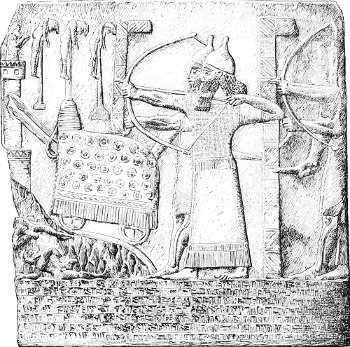
Fig. 27.—Feast of Assurbanipal; from Kouyundjik. British Museum. Height 20¾ inches. No. 1, The servants of the feast.
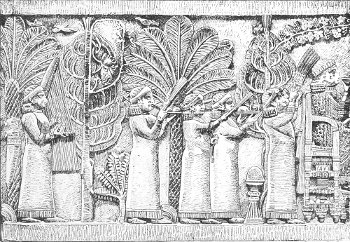
Fig. 28.—Feast of Assurbanipal, continued. No. 2, The king and queen at table. Drawn by Saint-Elme Gautier.
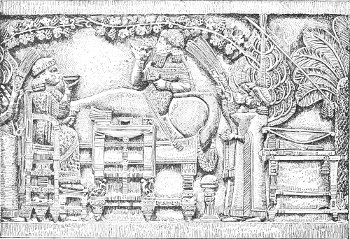
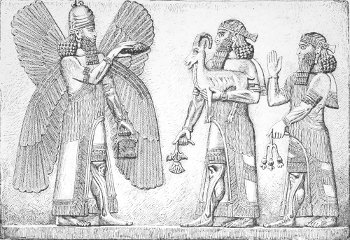
The moral character of the people is shown with no less clearness. The ferocity they preserved amid all the luxurious appliances of their civilization is commemorated. Atrocities of every kind find a place in the reliefs. Among the prisoners of war the most fortunate are those led by a cord passed through their lips. Others are mutilated, crucified, flayed alive. Tiglath Pileser II. is shown to us besieging a city, before whose walls he has impaled three prisoners taken from the defenders (see Fig. 26). Elsewhere we find scribes counting over heaps of heads before paying the price for them.[125] When these had come from the shoulders of important enemies they were carried in procession and treasured as honourable trophies. In one relief we find Assurbanipal, after his return to Nineveh from the subjugation of the southern rebels, lying upon a luxurious couch in the garden of his harem and sharing a sumptuous meal with a favoured wife. Birds are singing in the trees, an attendant touches the harp, flowers and palms fill the background, while a head, the head of the Elamite king, whom Assurbanipal conquered and captured in his last campaign, hangs from a tree near the right[126] of the scene (see Figs. 27 and 28). The princes who took pleasure in these horrors were scrupulous in their piety. We find numberless representations of them in attitudes of profound respect before their gods, and sometimes they bring victims and libations in their hands (see Fig. 29). Thus, without any help from the inscriptions, we may divine from the sculptures alone what strange contrasts were presented by the Assyrian character—a character at once sanguinary and voluptuous, brutal and refined, mystical and truculent.
Fig. 29.—Offerings to a god; Alabaster relief. Louvre. Height 10 feet. Drawn by Saint-Elme Gautier.
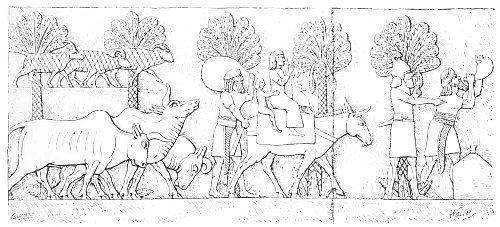
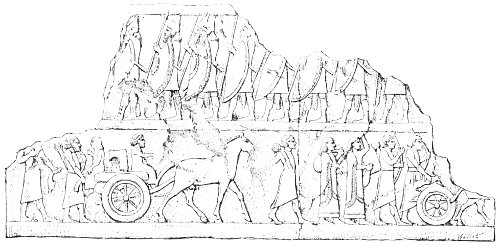
It is not only by what it says, it is by what it leaves untold, by what it forgets to tell, that art has left us such a sincere account of this singular nation. The king and his lieutenants, his ministers and household officers, the veterans who formed the strength of his legions and the young men from whom their numbers were recruited, did not constitute the whole of the Assyrian nation. There were also the tillers of the soil, the followers of those countless trades implied by a civilized society—the peasants, artisans, and merchants of every kind, who fed, clothed, and equipped the armies; the men who carried on the useful but modest work without which the fighting machine must soon have come to a standstill. And yet they are entirely absent from the sculptures in which the artist seems to have included everything that to him seemed worthy of interest. We meet them here and there, but only by accident. They may be descried now and then in the background of some scene of war, acting as labourers or in some other humble capacity. Otherwise the sculptor ignored their existence. They were not soldiers, which was much as to say they were nothing. Can any other instance be cited of an art so well endowed entirely suppressing what we should call the civil element of life? Neither do we find women in the bas-reliefs: that in which the queen of Assurbanipal occurs is quite unique in its way. Except in scenes representing the capture of a town and the carrying off of its inhabitants as prisoners of war, females are almost entirely wanting. On those occasions we sometimes find them carried on mules or in chariots (see Figs. 30 and 31). In certain bas-reliefs of Assurbanipal, treating of his campaign against Susa, women are playing the tambourine and singing the king's praises. But all these are exceptions. Woman, whose grace and beauty were so keenly felt by the Egyptians, is almost completely absent from the sculpture of Assyria.
Fig. 30.—Convoy of prisoners. Kouyundjik. From Layard.
By thus limiting its scope, sculpture condemned itself to much repetition and to a uniformity not far removed from sameness; but its very silences are eloquent upon the inhuman originality of a system to which Assyria owed both the splendour of her military successes and the finality of her fall. The great entrenched camp, of which Nineveh was the centre, once forced; the veteran ranks, in which constant war, and war without quarter, had made such wide gaps, once broken, nothing remained of the true Assyria but the ignorant masses of a second-class state to whom a change of masters had little meaning, and a few vast buildings doomed soon to disappear under their own ruins.
Fig. 31.—Convoy of prisoners. Kouyundjik. From Layard.
When we have completed our examination of Assyrian sculpture, so rich in some respects, so poor in others, we shall understand the rapidity with which silence and oblivion overtook so much glory and power; we shall understand how some two centuries after the victory of Nabopolassar and the final triumph of Babylon and her allies, Xenophon and his Greeks could mount the Tigris and gaze upon the still formidable walls of the deserted cities of Mespila and Larissa without even hearing the name of Nineveh pronounced. Eager for knowledge as they were, they passed over the ground without suspecting that the dust thrown up by their feet had once been a city famous and feared over all Asia, and that the capital of an empire hardly less great than that of the Artaxerxes whom they had faced at Cunaxa, had once covered the ground where they stood.
NOTES