A GIRL’S LIFE EIGHTY YEARS AGO (continued 4)
Reading edition
Adieu; remember me to any of my friends who enquire, and believe me
Your affectionate sister, Eliza S. Bowne.
Miranda Southgate.
Rockaway, August 24, 1804.
Dear Girls:
I enclose you a piece of Mr. Blovell’s poetry on the Miss Broomes’ country seat at Bloomingdale; as you both know him, I think it will amuse you. I expect Eliza and Jane Watts down here in a few days and should be delighted if you could be here at the same time. I wrote to you, Octavia, on Monday last a long letter,—answer it soon and tell me how far you mean to comply with my proposals. I spent several days at Flushing last week; they all enquired very affectionately for you; but I don’t know but Miranda is your rival—she is a monstrous favorite among some of them. I believe Mary Murray is engaged and all matters settled. I met the Murrays and Mrs. Ogden at Miss Curtis’s; they came up from New York the same day we did from Rockaway,—very fortunate meeting them, for it rendered my visit doubly pleasant. ’Twas the season for peaches, we feasted finely. I shall attend to your memorandums as soon as possible. Give my best love to Horatio and Nabby, if I may be allowed to connect the names, and tell him my plan. Mr. Bowne says I must write another letter to urge it more strongly; it must be so.
Yours ever,
E. S. Bowne.
[New York, November 9th, 1804 (?).]
I have been in daily expectation of a letter from you ever since my return and none has yet come. I have not heard a word from Isabella, tho’ I have been very anxious. The trunks arrived yesterday with an old letter for me enclosed by Horatio in a blank cover, not a word to say how all the family did, particularly Isabella. We are still at our Mother’s, and shall probably remain a fortnight longer; the house would be ready in a few days, but we think it is too damp at present. Every body expected you back, for the Murrays had told most of our acquaintance you were to return with me. John and Hannah Murray came to see me the day after I arrived. John rattles as usual, talks much of getting married—his old tune, you know: he has completed his thirtieth year now since we have been gone; he says, “I begin to feel the approach of old age.” Mr. Newbold called to enquire particularly after your ladyship, and Mr. Rhinelander[68] spent last evening with us; I think he improves fast; he told me a deal of news. Miss Farquar and Mr. Jepson[69] were married last night, Miss Blackwell and Mr. Forbes, and one or two others. Rhinelander says half the girls in town are to be married before Spring. Maria Denning for one; and the world says Amelia and James Gillispie will certainly make a match,—that I was surprised at. Miss Bunner[70] and John Duer are married; Sally Duer is soon to be; and Fanny is positively engaged to Mr. Smith, whom you saw several times last winter, of Princeton. So you see all the girls are silly enough to give up their fine dancing days and become old matrons like myself. Mrs. Kane is in town; looks older, paler, and thinner. She has got a charming little girl,[71] fat and good-natured as possible. Mrs. Ogden stays out of town all winter. We are engaged at Mrs. Bogert’s this afternoon, but it storms so violently I believe I shan’t go. She regrets very much your not coming, and Lucia [Wadsworth] she would be delighted to have. Our things arrived yesterday, but are not out of the vessel yet. At present there is no gaiety, quite dull; there will be a revival soon, I suppose. Mr. Poinsett has been to see me several mornings; he goes on Monday to Carolina. Miss de Neufville spends the winter in New York with her Aunt Stowton. I meant to call on her this morning, but it was stormy. The few days I was in Boston I was constantly engaged. We dined at Sheriff Allen’s with a very large party,—Lady Temple,[72] Mrs. Winthrop and daughters, Mrs. Bowdoin, Mrs. G. Green, Mrs. Stouton and daughter, and many others,—about 30; and we were at Mrs. G. Blake’s at a tea-party, she enquired particularly after you; she is a very fine woman I think. Our journey on was tolerably pleasant. We arrived before Uncle and Aunt. Eliza Watts told me she had a letter from you after I left home. Adieu; write me soon and tell me all the news. Give my best love to Father, Mother, and all the family. I am very well and grow fat; everybody says I am wonderfully improved. Write me soon.
Yours ever,
Eliza S. Bowne.
195
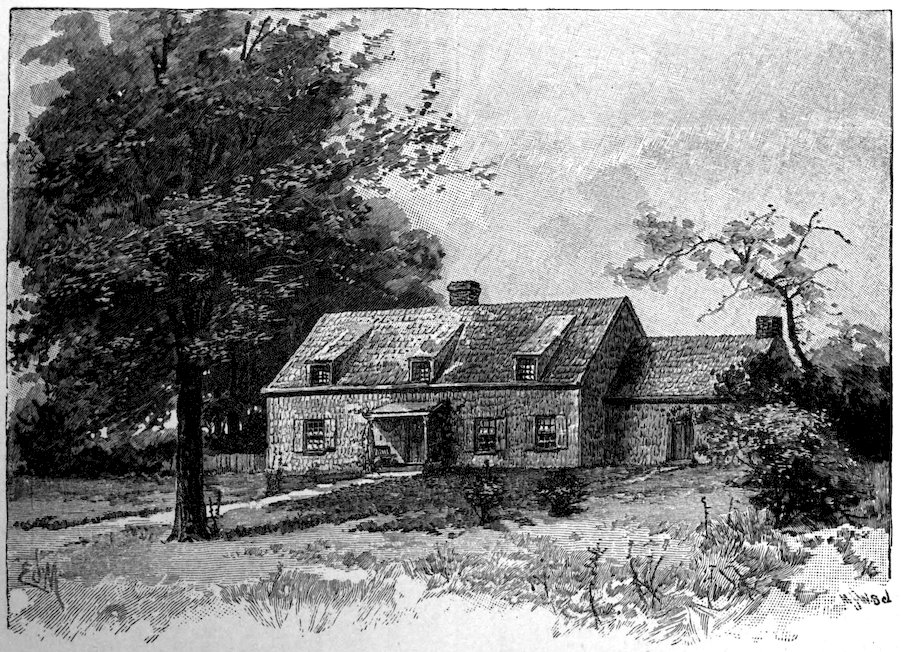
THE BOWNE HOUSE—FLUSHING Erected 1661
New York, July 30, 1804.
I received your letter, my Dearest Mother, three days since, and every moment of my time and attention since has been taken up with our dear Eliza. I am grieved that you are so low-spirited about her, tho’ as you predicted her trouble has again ended, I yet feel confident if we once get her home, that she will gain strength and do well. Her Physician has been in great hopes that she would get through this time without any difficulty, indeed the first week we were in the country she was so finely, that we all felt encouraged about her. She had been as prudent as possible, and she can’t with any reason reflect upon herself. The last week we were there she began to droop again, and Mr. Bowne brought her into town with an intention of carrying her to Flushing; now we shall set off for home as soon as she is strong enough to travel. I am astonished at her spirits, they are as good again as mine, and yet to-day she is so much better. I feel finely myself.
She has had no pain, but only suffers from weakness. We shall go in three or four days to Flushing, which is a fine, bracing air, and stay there a few days till Eliza is smart enough to travel 10 miles a day. I place full confidence in this journey; I am sure that the change of air and scene, and more than all, the prospect of home, will render it truly beneficial. We are at Mr. Bowne’s mother’s, for we have shut our house up. She is a fine old lady, and Caroline is perfectly amiable and as attentive as possible. I am very glad we are here and in the neighborhood of Mrs. Bogert, for she is all goodness. I grow more and more anxious every hour to get home. The city is quite deserted, though it never was more healthy. There are as few deaths as there were in the winter. There has been two weeks of very cool weather. I go wandering about and see scarcely a face I know. I used to complain last winter of our large acquaintance, and having the house full of company, but now I exclaim out half a dozen times a day that “I wished I could see some one I knew.” There are gentlemen enough, but no ladies. Uncle and Aunt, I suppose, have nearly set out for Scarborough. I wish we were to be there whilst they are with you. You can have no idea how very anxious I am to return. Was I not so much occupied I should be positively homesick, but I have no time to think but upon one subject. Kiss the dear children for us all, for we are equally anxious to see you. Remember me very affectionately to Sister Boyd and to the children. Before I leave here I shall be in need of a little money. I won’t seal my letter to-night, but will write you how she is to-morrow.
July 31.
I did not finish my letter this morning because Eliza did not feel as well as usual, but this afternoon she is better. She is in charming spirits and so very well that we are delighted. She gives her best love to you; says she don’t feel at all obliged to you for your wishes, and is determined not to join with you. The old lady desires to be remembered, and says,—“If thee was here, thee could do no more for thy child than we have.” Indeed she is the most tender, affectionate of women. My best love to my Father. We are in the full of seeing you soon. I shall not make it long before I write again.
Yours affectionately,
O. Southgate.
June 3, 1805.
Dear Octavia:
Mamma arrived safe and well on Wednesday morning to our great joy, after having a pleasant passage from Newport, staying two days in Boston, two in Newport, and one in Providence. We are going to Uncle’s to dine to-day, and I can’t persuade Miranda to write a line to let you know Mamma had come,—company coming in every minute, and can but just steal a moment to write. Louise is with you,—I am more than half vexed that I am to be disappointed of the charming winter I had promised myself, with you and Louise to spend it with me, so you need not be surprised if I am rather ill-natured at times. The secret is out, and all your friends, beaux I mean, walk the other side of the street when I meet them. Mary Murray called this morning; seemed rather disappointed at not having a letter. Eliza Watts thanks you for the wedding-cake as well as myself. Give my best love to Louise as well as all my other friends. We go over into Jersey to-morrow,—E. Watts and Susan go with us,—John Wadsworth. I wish you could have been here while Mamma was. Adieu; write me soon, and expect a longer letter as soon as I can command a little more time.
Your affectionate
E. S. Bowne.
P. S. Remember I don’t call this a letter, so no lectures on that head.
Jamaica, October 6, 1805.
I am delighted, my Dear Octavia, to hear you are so finely, and the more so as I hear it from yourself. I did not so soon expect such fine effects from the new system of living; I am sure all will be well now. A wedding I suppose next, for I conclude from the melancholy pathos with which you say, you shall “neither have the independence of a married woman, nor of a single,” that you don’t mean to try the half-way being. However, let the man teaze if he will; do not think of being married until your health is perfectly confirmed,—I would not for the world. ’Tis so late in the season, ’tis not possible I can come to see you this fall, even tho’ there should be two weddings in November. And so you talk of spending the winter with me,—how you love to tantalize!—and wish me to give you the pleasure of refusing me. You know I should be delighted to have you, but you know you never mean to visit New York as Miss Southgate again. Somebody would put on a graver face than he did last fall on a like occasion, and as he had as much influence then as to counteract my wishes, I won’t subject myself to the mortification of another defeat now I know his power to be much greater. However I won’t ask, tho’ I shall be very happy to have you with me. As for news, you give me more than I can you. We have left Rockaway more than a week ago, still exiled from our home by this dreadful calamity. We are at lodgings in Jamaica, where we shall probably remain until ’tis safe removing to the City. Uncle and Aunt,—Mr. and Mrs. Bogert,[73] have gone about 30 miles down the Island, sporting for Grouse, and return to Jamaica until we can all go in town. Mr. and Mrs. Rogers (Cruger that was) have taken a house in Jamaica during the fever; the next door to this I lodge in. Mr. and Mrs. Hayward[74] are with them, but leave here for Charleston this week. I am in there half of my time. We make a snug little party at Brag in the evening frequently, and work together mornings. Mr. Bowne goes to Greenwich, where all the business is transacted, on Mondays and Thursdays, but returns the same night, so I am but little alone. As to news—Miss Charlotte Manden Heard was married last week to a gentleman from Demarara, whom nobody knew she was engaged to until he came a few weeks since and they were married. John Murray, I believe, is at last really in love, tho’ ’tis not yet determined whether the lady smiles or not. A Miss Rogers from Baltimore, whom he met at the Springs,—a sweet interesting girl, ’tis said. Wolsey Rogers[75] and Harriet Clarke[76] were talked of as a match at the Springs. Mrs. Kane[77] staid at the Springs till she was so late she could not venture to ride to Providence with her Mother, and the fever kept her from New York, so was obliged to stop at Mrs. Gilbert Livingstone’s[78]—Mr. Kane’s sister—at Red Hook, until able to resume her journey home, which will probably be in November. Mrs. Fish[79] has a daughter; great joy on the occasion. Give my love to Cousin Pauline,[80] and tell her I congratulate her on the birth of her son. What do Mary[81] and Paulina call their boys—Nathaniel and Enoch? I hope not, never keep up such ugly names. Mr. B. says you must spend the winter with us,—he will come under bonds to somebody to return you safe. Give my best love to Sister Boyd, Horatio, and all the family at home. Has any progress been made in the new house? I am sorry to say I fear not—’tis pity,—I had almost said ’tis wrong. I am half mortified when I hear of any of my acquaintance visiting Portland,—’tis true, I declare,—tho’ Husband would scold me for saying so. Pappa is an affectionate Father, yet therein he acts not up to his character. I must check my pen—I am too much interested in this subject. Adieu; make my compliments to all acquaintances and write me again soon. Love to Miranda—tell her Mrs. Bogert talks much of her, and remind her from me of Aunt’s sleeves; are they finished?—if they are, I hope she will send them by Mrs. McKersen. I am working me a beautiful dress,—it will be when ’tis done. By-the-by, any purchases for the coming occasion will be executed with pleasure. Give my best love to (sister I had almost said) Nabby,[82] and tell her I shall feel myself flattered by any commission she will give me either in clothes or furniture; do away her modesty in this thing, if you think I can be of any service in that way, for I assure you ’twill gratify me. Tell Horatio[82] I am impatient to thank him for giving so pleasant an acquisition to our family, but I could do it more heartily in person in New York, if so I might be indulged. Since you won’t be honest and tell the truth, I won’t tell you what I’ll say to you. Do ask Papa if he could send us 6 or 8 barrels of potatoes, there is like to be a great scarcity in New York; put them in the hold of the vessel or anywhere. Col. Barclay has sent to Nova Scotia for a vessel load,—a housekeeper—
What a romantic conclusion.
Yours, E. B.
New York, Nov. 10, 1805.
Horatio is really married then; and we not married; and I suppose the next account your ladyship will be added to the list. How swimmingly you all go on! What a tremendous marrying place Portland is. New Yorkers don’t marry—sad sett of them. I am half angry to think you are marrying in such an out-of-the-way season, that ’tis impossible any one can come to see you. However, I hope to come early in the summer, if nothing happens to prevent, and spend 3 or 4 months. I shall have so many new relations that ’twill be necessary to come often to keep an account. Robert Murray[83] came home quite delighted with his eastern visit, but disappointed at seeing so little of Miranda. What has been the matter with her, any thing more than a heavy cold? I wish she was here with all my heart. I am quite alone and require a companion more than ever, but I suppose Mamma could not hear of that. I wish Arixene and Mary could have found a good opportunity to come this fall, and we could take them home in the summer,—but I suppose I must be content. We have been in town since the 31st of October, the day your letter was dated; it has been a long time in coming. I got it only last evening. Mr. Bowne had found out Capt. Libby, and we were preparing to send the sheeting and diaper by him; he sails the last of the week; the other things you wish we will send as many as can be procured before the vessel sails, but ’twill be impossible to get any plate made to send for several weeks,—we will order it immediately, and as it will not be bulky, there will probably be no difficulty in finding a conveyance. We made a sketch of the articles you wished and of the pieces, which cannot be very incorrect, as I took them all from our own furniture book, and we calculated that the whole of Mamma’s plate and another suit of curtains for Nabby included would come at about 400 dollars. Mr. B. has 340 in his hands of Pappa’s, about the sum that would buy all the things but Mamma’s plate and Nabby’s curtains; however, that makes not the least difference to Mr. Bowne, as he desires me to say he shall execute the commissions with great pleasure, and ’twill be no inconvenience to him to purchase the other articles, and I merely mentioned it as I did not know that you knew the real sum in Mr. Bowne’s hands. ’Tis very lucky there is so direct an opportunity to Scarborough; we shall endeavor to send as many things as possible. Shopping at present is a prohibited pleasure to me, but as all the things can be better procured at wholesale stores, and my husband has both a great deal of taste and judgment in those things, and makes better bargains than I do, you will be no sufferer by the loss of my services in that,—and I can have anything sent to me to look at, and therefore ’tis quite as well as if I went for them. I don’t mean you shall understand because I don’t go shopping that I am confined to the house. On the contrary, I am much better than could be expected and hope with care to do very well. I shall go out very little until the middle or last of the winter, when I hope, if I continue well, to be most as smart as other people. My husband does not allow me to go into a shop. I laugh at him and tell him I don’t believe but the health of his purse is one-half his concern—a fine excuse. Mrs. Bogert is in expectation of seeing Lucia Wadsworth when the General comes on. I have been confined to the house with a severe cold since Thursday,—Friday and Saturday was quite sick, and to-day feel unfit for anything almost but my bed. Adieu; my best love to all the family. You mentioned nothing of the Cypher on the Plate: O. S. or B.—or your crest, or William’s crest, if you can find them out,—I suppose we could here,—or what? Mamma’s I suppose will be S. only. I have a great mind to tell you what a saucy thing my husband said on your anxiety—that the bowls and edges of the spoons should not be sharp; but I leave you to guess, or if you can’t, perhaps William may help you to an explanation.
Adieu. Yours ever,
E. S. Bowne.
Miss Octavia Southgate.
November 14, 1805.
Capt. Libby sails to-morrow; we have got as many things as possible. There is not a piece of embossed Buff in New York, nor of plain either, there is not more than 2 pair alike, therefore I have done nothing about the trimmings. I fancy Boston is a better place for those things than New York. The most fashionable beds have draperies the same as my dimity window curtains. However, if you think best I will look farther, and perhaps there will be something new open in a week or two. There is but one barrel urn in the city. Mr. B. was two days in pursuit of one; he purchased this and sent it back: ’twas brown, and no plate on it except the nose. I can get you one like mine for $25. Let me know immediately respecting these things. Yesterday the Silversmith came for instructions respecting the plate, and bro’t patterns for me to look at. I ordered a set of tea-things for Mamma the same as mine; I think them handsomer than any I see. The man is to send me some patterns to look at which he thinks are similar to your description. On the next page I will make a list of the goods and pieces copied from the bills.
1 piece Irish sheeting, 48 yards, at 5 $30.00
1 piece Irish sheeting, 55 yards, at 6/6 44.69
6 yards Fine Linen, at 7/6 5.62
12 Damask Napkins, at 8 12.00
1 piece fine Diaper 27 yards, at 5/6 18.56
2 Breakfast Cloths, at 14 3.50
1 plated Castor best kind, 12.00
1 plated Cake Basket silver rims, 18.00
2 Pearl tea-pots, 2.25; 1 Trunk, 2.50 4.75
$149.12
The sheeting is quite as cheap as mine, the fine I like very much and think it quite a bargain. The Diaper is not quite so cheap as mine, but it has risen; the tablecloths are cheap, the linen is high I think. The Cake Basket is very cheap, $2 cheaper than mine, and rather handsomer I think. I could get no crimson marking, but send you a few skeins of cotton which I procured with much difficulty. The napkins are not the kind I wished, but there was none of those excepting at 2 places, and they were 18/–22/ a piece. I thought these pretty and would answer your purpose. I enclose the marking cotton and the key of the trunk. Adieu.
Yours ever, E. S. Bowne.
P. S. The bills are in Miranda’s book in the trunk.
206
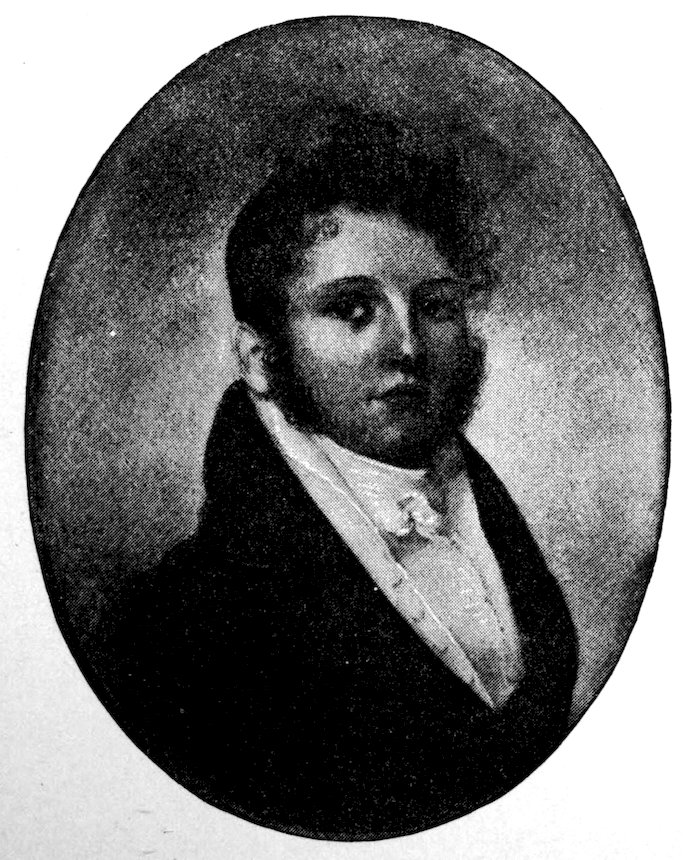
JAMES GORE KING From a miniature in the possession of A. Gracie King, Esq.
Jan. 14, 1806.
My dear Miranda:
Mr. Abbot is here from Brunswick and will take a letter for me to any of my friends. I should not have been surprised any more to have seen the cupola of the college itself walk into the room than I was to see Mr. Abbot, I could hardly believe my eyes; but I could not but know him, as I know nobody like him: he always seems like a frightened bird—so hurried in his manner and conversation. How much he looked like some of Timothy Dexter’s wooden men—at commencement last year; it came across my mind while he was sitting by me yesterday,—’twas well I was alone, or I should have certainly laughed. Frederic,[84] I suppose, is at home, tho’ Mr. A. could not tell me. John[85] and Charles King have some thought of going to Portland. I have told them they had better go some other time, as they will find Portland so dull and none of you in quite so good spirits. James is here and they return with him. You ask about Jane Watts—nobody sees her, she is entirely confined to her room. Doctor Burchea attends her now; her cough they think a little better, but she is not able to sleep at all without laudanum. I have no expectation she will recover, the family seem to have.
As to news—New York is not so gay as last Winter, few balls but a great many tea-parties. I believe I told you Mrs. Gillespie[86] has a daughter, and still more news. You never wrote me anything about the muslin for Arixene to work her a frock, ’tis so good an opportunity to send it that I have a great mind to get it notwithstanding. If you can, send the things I left to Louisa Davis in Boston. John and Charles would bring them on to me. Walter[87] will want the shirts as soon as the weather becomes warm. You say I have said nothing of Walter in any of my letters; he is so hearty and well I hardly thought of him when I wrote; he has not had a day’s sickness since I returned. I send him out walking frequently when ’tis so cold it quite makes the tears come; he trudges along with leading very well in the street, he never takes cold. He goes to bed at 6 o’clock, away in the room in the third story you used to sleep in, without fire or candle, and there he sleeps till Phœbe goes to bed to him. You know I am a great enemy to letting children sleep with a fire in the room; ’tis the universal practice here, and as long as I can avoid it I never mean to practice it; it subjects them to constant colds. They think I am very severe to suffer such a child to be put in the third story to sleep without a fire. I presume Aunt King and family are all well; they are going to have a fine waffle party on Tuesday. I wish you were here to go, for the boys want to have a fine frolic. Kitty Bayard[88] is to be married in April to Duncan Campbell; all engaged since Wolsey and Susan were married. Mary Watts[89] is engaged to the big Doctor Romaine,—that is quite a surprise to every one: this is rumor. And now I have written all the trifling, I come to what is nearer my heart. You are not half particular enough about Octavia. Does Isabella live in the same house she did when we were there? Has Octavia nobody with her to take care of her child? I am very glad to hear they are so cheerful. Pappa you say has been sick but is quite recovered. How is Mamma this winter, quite recovered her health?
Adieu. E. S. B.
Feb. 15.
And so I must hear of all the important events of the family from anybody who casually may have it in their power to communicate them. Horatio has a fine son, I hear, of which I am very glad; congratulate them for me—do they mean to call him the same name as their other little boy? I suppose you have heard from John and Charles King[90] since they have been in Boston. If you would send the little bundle for them to bring on I should be very glad, and I wish you to get me 3 pr. of Mr. Smith’s little white worsted socks, such as I bo’t for Walter, only two or three sizes larger, big enough for him next winter,—don’t neglect it, for I wish for them very much. Let them be full large for a child 3 years old. How are all the family? Octavia, I don’t hear from anybody; you ought to write once a fortnight certainly. Poor Jane Watts is very low, confined to her bed,—I fear she will never go out again. Adieu; love to all. This is my second letter since I heard from you. I write more particularly that you may send those things by the boys.
Yours ever, E. S. B.
To Mrs. Octavia Browne.
New York, March 30, 1806.
My Dear Mother:
I am most impatiently looking for Miranda and hoping, tho’ I dare not place too much dependence on seeing my Father. I am better than when I wrote you before, tho’ still subject to these faint turns. I have become more used to them and they don’t alarm me. I ride frequently and take the air every fine day in some way or other. I have been free from a return of the nervous headache for a fortnight, till the night before last I had a return of the numbness and pain, tho’ not so severe as the last. I have a very good appetite and look very fat and rosy, but really am very weak and languid. I don’t know why I look so much better than I feel. Mary Murray is to be married a week from next Wednesday; she is very desirous that Miranda should get here; I really hope she may. Perhaps I may get courage enough to go myself if she comes in time, otherwise I don’t believe I shall venture; however, ’twill depend upon my feelings at the time. I shall look out the last of the week for Pappa and Miranda very seriously. I hope they are on their way now. Uncle’s oldest son, John Alsop, arrived here about a week since; he seems a very fine young man, rather taller than his Father,—he will be a second Uncle William, for he does not appear to have half got his height. Charles King has gone to Holland.
E. S. B.
Mrs. Mary Southgate.
210
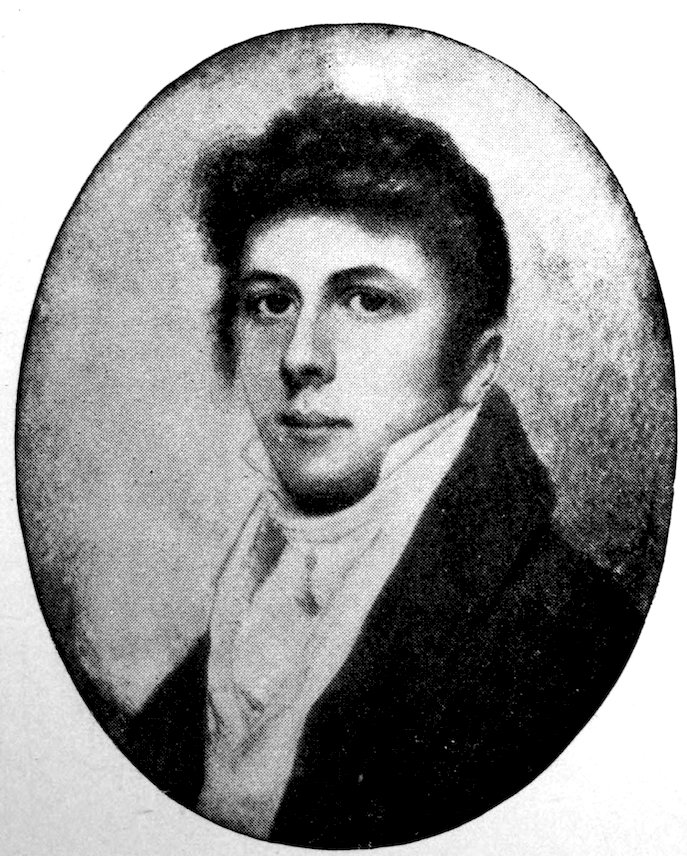
CHARLES KING From a miniature in the possession of his daughter, Mrs. Martin
New York, April 27, 1806.
My Dear Mother:
Before you receive this my Father will be with you. He says I need not fear any thing, that I am in a very fair way of doing well; he will tell you all the particulars better than I could write. He got quite homesick, we could not prevail on him to lengthen his visit or go to the Springs and return here. I promised to let you hear from me once a week how I got along. For the last 3 days I have been finely, for me; the fore part of the day I am often very faint—all the forenoon, but generally better towards evening. ’Tis a great comfort to me to have Miranda with me, as I am a great part of the time unfit for anything. My head has been much more clear and comfortable for the last few days than for some time past. Tell Father there was a meeting called last evening of the Federalists in the city, to make some further remonstrances on the defenceless state of the Port of New York, occasioned by an accident that has set the whole City in an uproar. There are 3 British Frigates at the Hook, a few miles from the City, that fire upon all the vessels that come in or go out, and search them. They have sent several on to Halifax, and yesterday they fired in a most wanton manner upon a little coaster that was entering the harbor with only three men on board, and before they had time to come to as they were preparing to do, they fired again, and killed one of the men dead upon the spot,—he was brought up and the body exposed to view on one of the wharves, where several thousand people were collected to see it,—it put the City in great confusion, and this meeting was called in consequence—where Uncle made a very elegant speech. I am very sorry Father had not been here, it would have gratified him. ’Tis the first time he has spoken in public since his return to this Country. The British Consul had sent several boats of provisions down to the frigates—which as soon as ’twas known the Pilot-boats went after and brought them all back,—they were loaded upon carts and carried in procession thro’ the streets to the poor house, attended by a prodigious mob—huzzaing, and the English and American colors fixed on the carts; they demanded the Commander of the frigate to be given up as a murderer by the British Consul,—he replied he had no power over him. It has made a prodigious noise in the City, as you may imagine. So much for Father;—I shall expect to hear to-morrow when he got to Providence. Adieu, my dear Mother.
Ever your affectionate E. S. Bowne.
May 18.
By way of punishment, if it is any, I have denied myself the pleasure of answering your letter till I thought you would begin really to wish for a letter. However, I quite want to hear again, and as there is little hope of that until I answer yours, I’ll e’en set about it at once. William Weeks told me he saw you in Portland the day before he left there. I wonder he did not tell you he was coming to New York. Mr. Isaac McLellan is here too from Portland. You did not write to me half particulars; you said nothing about Arixene.
Sunday, May 25, 1806.
After a week has elapsed I resume my pen to finish my letter. I was expecting Mr. Isaac McLellan to call and let me know when he should return, as I intended writing by him, but he has left town without my knowing it. Now for news, which I suppose you are very anxious to hear. In the first place—Miss Laurelia Dashaway is married to Mr. Hawkes. On Saturday morning, 8 o’clock, Trinity Church was opened on purpose for the occasion; something singular, as it would not be like Miss Laurelia. But what do you think—Mr. Grellet has taken French leave of New York—sailed for France about a fortnight ago, without anybody’s knowing their intention till they were gone. There are many conjectures upon the occasion not very favorable to the state of their finances. ’Tis said his friends were very averse to her going with him. If she had not, I suspect she must have sympathized with Madame Jerome Buonoparte and many other poor Madames that have founded their hopes on the fidelity of a Frenchman. Poor Mrs. Ogden has another little petticoated little John Murray—4 daughters!—I am sorry it was not a boy. What should you think to see me come home without Mr. Bowne? I strongly fear he won’t have it in his power to leave the office more than once in the Season; if so, I would much prefer him to come for me in the Autumn. However, we have made no arrangements yet. Walter grows such a playful little rogue, he is always in mischief; I am just leaving off his caps; I want his hair to grow before his Grandmamma sees him; he won’t look so pretty without his caps. He creeps so much I find it impossible to keep him so nice as I used to. Poor Harriet Beam I think is going rapidly in a decline, she has been confined to her room 5 or 6 weeks. I have not seen the Wattses this some time; they are gone to Passaic Falls with a little party,—Maria Laight, Mr. Delort, Robert Harney, etc. My love to all; write me soon particularly. I hope soon to be with you. How is Sister Boyd’s infant?
Yours ever, E. S. Bowne.
Miss Miranda Southgate.
New York, Nov. 8, 1806.
My Dear Octavia:
I am quite anxious to hear good news from you. Miranda has been in Jamaica this fortnight; she has taken a frock and cap along with her to work for you; I hope she will have it finished when she returns. Maria Denning is married, and William Duer has returned to New Orleans; left her with her friends for the winter. Amelia was married to Mr. Gillespie in the spring; lives at home yet.
Miss Pell was married last week to Robert MacComb; they are making a prodigious dash. I went to pay the bride’s visit on Friday; they had an elegant ball and supper in the evening, as it was the last day of seeing Company; 7 brides-maids and 7 Bride-men, most superb dresses; the bride’s pearls cost 1,500 dollars; they spend the winter in Charleston. Adieu! Love to all friends, and tell your husband to write me immediately after this great event. I am looking forward to a happy summer spent among you. Best love to Isabella and family, Horatio and family. How is Robert Southgate junr.? That is as it ought to be. Pappa is pleased I dare say.
Yours ever,
Eliza S. Bowne.
My Dear Mother:
I find it quite in vain to wait for a letter from Miranda, and she has left me to chance and uncertainty to know whether she has ever arrived at Providence, but luckily, from constant enquiries, I have learnt she did arrive safe, and from some other accidental information, that she was to leave Boston last Thursday for home, with Judge Thatcher. I presume by this she is with you. As the Spring opens I begin to look forward to my Eastern visit. Octavia’s boy is as beautiful as a cherub, I hear.
Saturday, 18th.
Miranda:
Mrs. Derby has returned from Philadelphia, and intends leaving here for Boston on Tuesday. She spent a long sociable day with me yesterday and I found it quite a treat; I have seen so little of her but in mix’t parties that it hardly seems like a visit. She is almost worn out with dissipation, and I greatly fear her constitution has suffered an injury from this kind of life it will never recover. She has absolutely refused all invitations since her return, and means to rest for a few days while she remains here; she takes one of our belles on to Boston with her,—Miss Fairlie;[91] Miranda knows her. Martha had a letter from Mrs. Sumner yesterday, where she mentions Miranda leaving there for home the Sunday before with Mr. and Mrs. Kinsman; I am really hurt at her unaccountable silence. I promised to tell her all the news and account of all the parties after she left me, but I was quite provoked at her not writing. Tell her, however, that there seems no end to the gaiety this Spring; it does not abate as yet at all. The day after she left me I paid the bride’s visit to young Mrs. Murray; there was a prodigious crowd, a hundred and fifty at least, and many never sat down at all. Madame Moreau[92] wore a long black velvet dress with Pearl ornaments, looking elegantly. The next day I dined at Uncle Rufus King’s with company; on Tuesday following, went to a ball at Mrs. Stevens’;[93] next day, a ball at Miss Murray’s, very pleasant; they very much regretted her not being here; she was intended to be one of the Bridesmaids; and the day after the last Assembly, as you may suppose, was completely tired dancing three nights in succession. Last Friday I was at a ball at the Watts’s, and the week before at Miss Lyde’s[94] to a ball, and Mrs. Turnbull’s to a monstrous tea-party. Yesterday at Mrs. Morris’. On Monday next Aunt King has a very large party. On Tuesday I go to Mrs. Stoughton’s, on Thursday to Mrs. Hopkins’, and on Friday dine at Mrs. Bogert’s, and this evening to Mrs. Henderson’s to a ball. I think it will be one of the most elegant we have had this winter. I wish Miranda was here,—so much for Miranda. Adieu! I have promised to go shopping with Mrs. Derby this morning and ’tis growing late. I look forward with delight to the approaching summer spent amidst all my family.
Give my affectionate regard to all.
Ever yours, E. S. Bowne.
New York, Dec. 1, 1807.
You won’t write a line I find without a punctual answer, letter for letter. Could not you make any allowance for domestic engagements, etc., etc., and write me at present two for one, or were you afraid of the precedent; I might claim as a right hereafter what I owed merely to your indulgence. I have anxiously wished to hear again from little William Brown, for, notwithstanding your flattering accounts of his returning health, I felt so fully persuaded he would never recover that I could not but think he would relapse again. How happy I shall be to hear that my fears are groundless! If you have not written again before this reaches you, lose no time but write at once. I do not write to Octavia till I know whether she is in Boston or Portland. You must make it a rule, Miranda, to write me once a fortnight whether I answer or not. Charles King will tell you all the news of the fashionable world. I have been in no parties yet. The Theatre is quite the rage. I have been several times,—you have no idea how much it is improved, entirely altered,—looks light and gay,—a perfect contrast to its former appearance. Cooper draws crowded houses every night—I have been much delighted. Mr. Wolsey Rogers’ approaching nuptials seem anticipated as the opening of the winter campaign; of course the event is much talked of, not a mantua-maker in the city but will tell you some particulars of the bride’s wardrobe,—length of her train, etc., etc.;—a fine lady here, as Mustapha says, is estimated by the length of her tail. If it was not for using a most homely proverb, I would say “Every dog has his day.” Here was our friend John Murray and his bride last winter, making all ring; this winter quietly settled in Nassau St., just what I call comfortable, (you have not seen this new play about comfortable.) Poor Sterlitz, who has no way to discover his taste or judgment but by finding fault with everything, seems quite in a fuze (is there such a word?) that Mr. Murray prefers his own comfort to dashing in high style. I suppose, Mrs. B. begins to feel all the palpitations and trepidations of a doating anxious mother in introducing her favorite daughter to the world. The next winter is the all-important era for the exhibition. Miss A., in my opinion, will make a little coquette—the bud seems expanding even now,—that extreme simplicity, which her mother encouraged by always talking of it before her, as if she was too young to understand, is now changing for an affectation of simplicity. I hope she will correct it; time will convince her that simplicity is only charming in inexperienced youth, or rather the kind of simplicity which she possesses. There is a simplicity which gives a softness, a tone (as a painter would say) to the whole character, but it springs uncontaminated from the guileless purity of the mind; all affectation of this serves but as a tattered veil thro’ which you constantly penetrate to the original deformity—Where have I rambled? Poor Mrs. Greene is dangerously ill, her friends have little hope of her recovery. On Saturday she was not expected to live the day,—bled several quarts at the lungs; she is a favorite with all who know her, a most valuable woman. On business:—Mamma told me something about getting muslin for Arixene—a frock to work, but I have forgotten whether she afterwards told me to get it or not. I can get very pretty for 2 dollars or 2 1–2; let me know. Tell Octavia I received the little hat which Mr. Browne bo’t for me in Boston, and shall send the little tub and the rest of the money, as soon as I know she is in Boston. Fashions:—Ladies wear fawn-colored coats and bonnets of the same trimmed with velvet trimming, same color with lappets, cape and inner waistcoat. If I could find an opportunity I should send you a bonnet and Mamma a cap. Adieu,—tell Arixene to write to me. James King writes to Charles King he liked Arixene best of all the Cousins.
To Miss Miranda Southgate.
New York, Dec. 13, 1807.
I have been waiting some time to hear you were in Boston, but as I have not heard from any of the family for some weeks I shall write you and direct to Portland. I am rejoiced to hear that little William continues to recover fast, for Mrs. Derby writes me still later than Miranda that he is almost recovered. How happy you must feel! None but those who have suffered the anxiety can conceive the happiness of such a change. I don’t hear half often enough from you. Miranda writes but seldom. Charles King told me last evening, in his last letter from her she says she is going to spend part of the winter in Boston with you,—from that I conclude you intend going to housekeeping before Spring. I have been making a plan for you to make me a visit next Spring. I think there can be no objection to it; your husband can make arrangements to leave Boston for a month or a few weeks, I am sure. The accommodations in the stage to Providence are so good, you can go in half a day—take passage in a Packet and be in New York in three days with ease. You can either bring William with you, which I should wish you to, or leave him if you prefer it. Indeed I can see no objection to the plan. Your friends in New York have made particular enquiries respecting you. Mary Murray says you have quite given her up, that she has not received a line from you for some time—I don’t remember how long. I believe I told you Mrs. Ogden had lost her youngest child, about 5 months old. Harriet Beam, whom I believe you knew, died last week,—melancholy, so young. Mrs. Derby writes me her Father is still far from strong and firm, tho’ much better; very probable his constitution will never entirely recover this shock. I am much obliged to Mr. Browne for purchasing the little hat for Walter. It was not the kind I meant, however,—those here are worn only by girls, square crowns altogether for boys. Give my best love to Horatio and Nabby, Isabella and husband, Arixene—I want to send her a pattern to work a frock in; I have a very pretty one, with but little work on. Adieu; write me very particularly about William.
E. S. Bowne.
To Mrs. Wm. Browne (Octavia Southgate).
New York, Jan. 13, 1808.
I have been in daily expectation of hearing farther from you, my dear Miranda. I received a letter from Octavia by the same mail that brought me yours, informing me of the melancholy change in their prospects, which I answered immediately and used every argument I thought could console her at such a time. Her firmness and resolution in relating the particulars, her reasoning on the subject, displayed the real superiority of her mind. She has had severe trials; the danger of her child, and now this stroke; I tremble when I think with how much less firmness I should probably have acted in the same trials. I am extremely anxious to hear all the particulars of their failure, how Mr. Browne bears it, where they will spend their winter. I wish with all my heart Octavia and her child would come and stay with me until Mr. Browne could arrange his affairs a little. But I suppose ’twould be in vain to urge her to leave her husband at this time. You mention that you were in hopes Papa would secure Octavia’s furniture for her. I wish you would write me particularly if he did. Octavia writes me he attached all the personal property he knew of at the time. Pappa too I fear will be quite a sufferer by their failure. I hear Webster is gone,—he, I think, had money of my Father’s. Mr. Bowne has always thought he played rather a hazardous game in letting out money in that way. I hope he is not materially injured,—he will, at any rate, have the consolation to know that the education of his children is principally accomplished; he will always have enough to live with comfort and ease, and as to leaving a great deal, I think ’tis very immaterial. I am glad to find his stock here has produced a very good dividend this month. I hope this won’t depress his spirits any,—old people feel the loss of property much more than younger ones. However, Papa’s is nothing to mention at these times, as he is not in debt, has a good farm, and will always have all the comforts of life; indeed, I think ’twill have a good effect. He has always been determined on leaving such a sum untouched, and from that darling object has deprived himself of the comfort of a comfortable house for many years past. Accident has interfered with the fulfilment of his plan; he will now enjoy what he has left without thinking of leaving just so much; his children are, or soon will be grown up, and he ought to have no other care but to enjoy what he has dearly earned, now in his old age. I am sure all his children most heartily wish it, if he should not leave a farthing for them. Old Mr. Codwise has failed, a dreadful thing for so old a man. Mr. Macomb [Ann and Robert’s father] is gone too; all the Franklins too, and a great many others I do not now recollect. Adieu; write me immediately and tell me every particular. My love to Arixene; is she at Miss Martin’s, for I have never heard?
E. S. Bowne.
Miss Miranda Southgate.
Boston, December 21, 1808.
My best Friends:
In consequence of a letter from Mr. Bowne, received this day, I have to inform you that instead of proceeding to Scarborough, my next journey is to New York. He writes me that by the advice of Mr. King they have concluded it will be best for Eliza to go to Charleston, South Carolina, in order to avoid the severity of our winter; that he is under the necessity of remaining in New York till February himself, and that he wishes me to return and go on with Eliza and Octavia as soon as I can. As I have nothing of consequence to prevent me, I shall leave this in a day or two for New York, and shall be fully satisfied if I can render them the least service by my attentions. With sentiments of the highest esteem and regard,
I am your obedient servant W. Browne.
To Mr. and Mrs. Southgate.
New York, Dec. 27, 1808.
You are anxious, my Dear Mother, to hear from my own hand how I am. Octavia has told you all my complaints: my cough is extremely obstinate, I have occasionally a little fever, tho’ quite irregular and sometimes a week without any. I have a new Physician to attend me; he is a Frenchman of great celebrity, particularly in Pulmonary complaints, and has been wonderfully successful in the cure of coughs; he keeps me on a milk diet, but allows me to eat eggs and oysters. He does not give any opiates; Paregoric and Laudanum he entirely disapproves of; he gives no medicine but a decoction of Roots and Flowers;—the Iceland Moss or Lichen made in a tea he gives a great deal of, and for cough I take a white Pectoral lotion he calls it, made principally of White Almonds, Gum Arabic, Gum Tragacanth (or something like it), the Syrup of Muskmelon seeds. He thinks I am much better already. I have no pain at all, and have not had any. My cough seems to be all my disorder. He thinks he can cure that; indeed he speaks with perfect confidence, and says he has no doubt as soon as I get to warmer weather, my cough will soon leave me. Mr. Browne got here last night, and we shall probably sail by Sunday at farthest. Octavia will write particularly. You will hear from me, my Dear Mother, often,—at present my mind seems so occupied; leaving my children, preparing to go, and making arrangements to shut up my house. ’Tis quite a trial to leave my little ones; I leave them at their Grandmother’s. My little Mary[95] has a wet-nurse; she is a fine, lively child, and thrives fast. Adieu, my Dear Mother; I did not think I could have written half as much; love to all my friends.
Eliza S. Bowne.
Charleston, South Carolina, Jan. 1, 1809.
Our most esteemed Friends:
We have now been in the City a week. We find that Eliza has gained a little strength since she arrived, and that her cough is not quite so distressing as before we left New York. She complains of no pain, but her fever and night sweats continue to trouble her every other day and night, as was the case before. She can walk about her room with ease; and she rides when the weather is fine, which she is much pleased with, and no doubt it is of great service to her. The streets are entirely of sand, as smooth as possible, no pavements, not a stone to be seen, which renders it very easy riding for her. It is as warm as our first of May, (if not the middle,) and when the weather is fair, the air is clear, very mild and refreshing. The change is so great between this and New York that I cannot help thinking it must have a great and good effect on Eliza. I find as to myself that my cough is done away entirely, and I had a little of it most all the time at home in winter. Octavia has certainly grown fat, and our little Frederic is very well indeed. Eliza eats hominy, rice and milk, eggs and oysters cooked in various ways, vegetables too, which we find in great perfection here; fruit is plenty of almost every description. The oranges raised here are not sweet but are very large. Their olives, grapes, and figs are excellent. Their meats and fish are not so good as ours. Their Poultry is fine; a great plenty of Venison, wild ducks, and small sea-fowl; green peas we shall have in about a month; so that, beside the change of climate, we have many of the luxuries of a Northern summer. Uncle King gave us letters to Gen. C. C. Pinckney and his brother Major Thomas Pinckney,—both of them being out of town at their plantation; their sister, Mrs. Hovey, received the letters and has been very attentive and kind to us all. She is a widow, about 55 I should judge, of the first respectability, and appears a very pleasant, amiable and cheerful old lady. She sends some nice things to Eliza almost every day. Her daughters, Mrs. Rutledge, two Miss Pinckneys (daughters of the General), Mrs. Gilchrist and daughter, Mr. and Mrs. Mannigault, Mrs. Middleton, Mr. and Mrs. Izard,[96] Mr. and Mrs. Dessault and Mr. Heyward make an extensive acquaintance for us. They all seem very kind and hospitable to us, plain and open in their manners, and yet the most genteel and easy. Eliza has seen only Mrs. Hovey, Mrs. Rutledge, and the two Miss Pinckneys, but she thinks in a few days to be able to receive short visits from a few of her friends, and even thinks it may be of consequence to enliven her. She rides whenever the weather is fine, and is very much pleased with the appearance of everything growing in the gardens here so like our June. We have had one visit from a Physician only; he thinks taking a little blood from her would be of service, but she has not yet consented. He approved of her diet and of the Iceland Moss tea which was recommended at New York, and which is said here to have had a great effect in removing complaints of the cough. Mrs. Mannigault told us yesterday she found immediate relief from it after she had been sick a long time. We expect Mr. Bowne in the course of a fortnight, and then I expect to return toward Scarborough immediately. We hope to hear from you in a few days; not a word have we yet from New York since we arrived. Our darling boy we think we see every day playing about us, without thinking who admires him at the distance of 1100 miles.
Our best wishes attend you always.
Affectionately, W. Browne.
To Mr. and Mrs. Southgate.
Charleston, Jan. 28, 1809.
Dear Caroline, I send by Capt. Crowel a little pair of shoes for Mary, a little Cuckoo toy for Walter, and a tumbler of Orange Marmalade for Mother. I have had only one letter from New York since I have been here, and that from Mary Perkins, not one line from my husband. I can tell you nothing flattering of my health: I am very miserable; at present I have a kind of intermittent Fever; this afternoon I shall take an emetic, and hope a good effect. How are my dear little ones?—I hope not too troublesome. Octavia is in fine health and grows quite fat for her. Frederic has been unusually troublesome. My dear little Walter!—I hardly trust myself to think of them,—precious children—how they bind me to life! Adieu. I have a bad headache and low-spirited to-day.
Eliza.
Caroline Bowne (with 2 small parcels),
No. 288 Pearl Street,
Blazing Star. New York.
This appears to be the last letter written by Mrs. Bowne. (M. K. L.)
From Mrs. William Browne to Mrs. King.
Charleston, February 2, 1809.
I have been waiting day after day, my Dear Aunt, in the hope of having something pleasant to communicate to you, but I do very much fear I shall now have nothing, if ever, to say about our Dear Eliza but will give you pain. I sat down to write to you without knowing what to say. I have been so in the habit of dissembling lately that I can hardly throw it off, for when I write my Father and Mother everything is so glossed over, ’tis impossible to come at the truth. You know not how I am affected, my Dear Aunt. I fear I am doing wrong in deceiving them, for it is my firm opinion she never will be well. Do advise me, tell me what I ought to do. I think to you I may say the truth—I think she has been growing sicker every hour since she left New York. Her voyage had a singular effect upon her: she suffered but little from seasickness, but every bad symptom she had before seemed increased; she coughed a great deal and very hard, her fever and night sweats were excessive. You may imagine she was much weakened; but I hoped this was a temporary thing, and a few days of quiet and of rest would restore her; but instead of that, directly after our arrival a sort of intermittent fever took place, she had a regular chill and fever every day, she lost her strength very much, no appetite at all. This last four or five days her disorder wears another appearance. ’Tis now Thursday. On Sunday Dr. Irvine ordered her to take Quashy in order to prevent a chill; she took it according to his direction—it brought on her fever at 1 o’clock in the morning, and it never left her till 12 o’clock at night, it absolutely raged all day. Since then she has had no night sweats, no chill, but her cough and fever very much increased. Her nerves are extremely disordered; such a tremor that to-day she cannot feed herself at all. She is so weak and exhausted that she cannot walk alone. ’Tis now 11 o’clock—I am sitting by her side, and she is still coughing and in such a hot fever she can bear nothing to touch her. I have not asked her Physician’s opinion concerning her; ’tis unnecessary I feel, I know what it must be. Yet is it not strange she keeps up her spirits? She is looking forward with the greatest anxiety to warm weather. God grant it may not be too late! Dr. Irvine was the Physician Mrs. Hovey recommended; he is indisposed and has left his patients in the care of Dr. Barrow. The exchange has pleased us very much, for Dr. Barrow is considered quite as skilful, and is extremely kind and fatherly in his manners, indeed he reminds us so strongly of our Dear Father that we already love him very much.
February 3.
Poor Eliza had a most distressing night last night. She coughed so long that she was entirely exhausted; her fever was very high, and she has scarcely spoken a loud word to-day. Her nerves are in a dreadful state. I inquired of Dr. Barrow what he thought of her situation; he says he can say nothing encouraging. He said the disorder had taken great hold upon her, and had shattered her nerves in a terrible manner. He very much fears a nervous fever,—that her pulse was very bad, as nearly as he could count up to 150. Is it not very evident from his being so candid, my Dear Aunt, that he has but little or no hope of her recovery? And yet so strongly do I sympathize in every feeling of hers, that seeing her easier and more comfortable this evening has renewed my hopes and put me quite in spirits. She has been much better this afternoon and evening, less fever, less tremor upon her nerves, and since she has been in bed has had no bad coughing spell. The mail went to the Northward to-day. I have so little time to write that I have missed it. I will let you know to-morrow how she is, and the next day is post-day again. I know what a kind interest you and my uncle take in our dear Eliza, and I know I cannot be too minute. Our friends here are kinder than I can express to you. It seems sometimes as though we were among our own relations. They think of every little thing for Eliza’s comfort and convenience that I could myself.
Monday, February 6.
This morning Eliza was better, my Dear Aunt, than she has been for a week past. Her voice has returned and she appears stronger in every respect. Yesterday and last night she had a little fever, this morning is delightful and she is going to ride. You shall hear again from us before long. I know Mrs. Bogert will need no apology, I am sure, for my not writing. The repetition of such symptoms are distressing to me beyond expression.
Your affectionate niece O. S. Browne.
To Mrs. Bowne.
New York, Feb’y 4, 1809.
Your letter, my love, of the 13th and 14th has comforted me. You must keep up your spirits; you will do well, Dr. Bergere says; attacks similar to yours are not of the dangerous kind that some think; he approves of your taking the Lychen again. I have sent a bundle from Mr. King by Capt. Slocum, who sails to-morrow. I am distressed I cannot go with him, but so it is. It is next to impossible I should leave here till about the 25th of this month. Mr. Jenkins, my assistant, is absent, and I cannot leave the office until he returns without relinquishing it altogether, and I have most of my houses to let this month, those I have lately built included, and which are not finished, but I am determined to leave here in all this month. I hope you have a comfortable place now; what abominable lodgings the first were! Don’t mind the expense: get everything and do everything you like, we can afford it. I wish my presence in this place could as well be dispensed with, but so it is. I think it right you should have a Physician. I will bring the things you mention; our children are well.
Ever, Walter Bowne.
The Ship—General Eaton—has not yet arrived, I will write to Mr. Brown by this vessel if I have time; if not, by mail on Monday or Tuesday.
(With a bundle of Lychen for E. S. B.)
The following letter from Mr. Rufus King to his nephew Horatio Southgate, will show how much alarm was felt about Mrs. Bowne’s health.
New York, February 9, 1809.
Dear Sir:
I have to beg your excuse that I have so long delayed my answer to your letter written I believe in November. The Plants were a long time on their way, and did not arrive till Christmas, when we had a few days of mild weather, which enabled us to put them in the ground. Mr. Mars is entitled to credit for the manner and care with which the Plants were packed, and altho’ they were much longer out of the ground than they shd have been, I am in hopes that many of them were saved. Inclosed I send you a Post-note (payable to your order) on the Boston Branch Bank for 47 dollars, being the amount of Mars’s account, and I beg you to accept my acknowledgments for the trouble you have given yourself in this Business. Should there be an opportunity direct from Portland to N. York in the Spring, any time in Apl or May would do (for that is the true season, even on to the middle of June, to remove evergreens), I wish Mars to send me a few more spruces, one moderate sized Box, together with some of the small Evergreen shrubs found in the woods and pastures, and which I remember abounded in the Pasture of Knight’s Farm, and which we called laurel, or sheep poison. Any other small plants may be added to fill up the Box.
We yesterday heard from Mrs. Bowne, who had recovered from the fatigue of her voyage, and thought herself something better. I am in hopes that the soft weather of an early spring will do more for her than medicine could have effected in the rude weather of our winter and spring. I ought not to conceal from you, tho’ I think you shd not unnecessarily increase the anxiety of your mother, that I am not free from apprehensions regarding your Sister’s complaint; it is so flattering and insidious, that I do not place the same Reliance upon favorable Reports wh in any other case I shd be inclined to do. I by no means think that she has no chance of recovery. On the contrary, I have the satisfaction to believe and expect that she will regain her accustomed good health. Mrs. Browne’s being with her is a very important circumstance in a case in which good nursing and careful attention is of so much consequence.
With sincere Regards, I remain, Dr Sir,
Yr obliged serv’t, Rufus King.
Horatio Southgate, Esqr., Portland, Maine.
Charleston, February 21, 1809.
I will permit no one but myself to transmit to you the dreadful intelligence this letter will convey to you, my dear Parents. A good and merciful God will not forsake you at this awful moment. Our dear Eliza is freed from her earthly sufferings and I humbly trust is now a blessed spirit in Heaven! I offer you no consolation; I commit you into the hands of a Good God, who has supported me when my strength failed me. She had her senses at intervals for the few days last of her illness. She spoke of her approaching change with great composure, said she had thought much of it, that she trusted in God for future happiness with great satisfaction and confidence; wished her time might come speedily that she might be relieved from the pain of seeing her distressed friends. She suffered with wonderful patience; never murmured. At the very last she looked the satisfaction she had not the power to speak. At 2 o’clock yesterday afternoon was this most afflicting scene. Octavia had great fortitude to sit by her when she could speak only with her eyes. She knew us, and listened with apparent satisfaction to a prayer I read only an hour before the sad moment. It was a day of trial with us most severe.
With much affection and regard to all,
W. Browne.
Poor Mr. Bowne has not arrived.
To Mr. & Mrs. Southgate.
Charleston, March 12, 1809.
I hope, my dear Miranda, this will be the last letter you will receive from me at Charleston. Poor Mr. Bowne arrived here on Thursday. Not a word had he heard, and owing to his having left New York he had not received a single very alarming letter. He was entirely unprepared for the shock which awaited him; never did I pity any one so. He is indeed borne down with the weight of his grief. But the violence I dreaded I see nothing of. There is no judging from the effect little troubles have upon people, how they will bear great ones. I know it by myself—I see it in him. He is more composed to-day, and we are making arrangements to get away. He is much gratified that we waited here for him, which we had some doubt about on account of the great expense in these houses. The Minerva, a very fine Packet, arrived from New York yesterday. We shall return in her. She will go in the course of a week or ten days. What a melancholy voyage! But yet I will not think so. I am going to my dear father and mother, my kind sisters,—indeed, ’tis a delightful thought.
Your sister,
O. Browne.
Among the letters which were so carefully preserved by her daughter, Mrs. Lawrence, was found the following extract from a daily paper:—
Died at Charleston, S. C., on the 19th ult., Mrs. Walter Bowne, consort of Walter Bowne, Esq., of New York, and daughter of the Hon. Robert Southgate, of Scarborough, Maine, aged 25 years. The Bereaved Husband and infant children, the afflicted parents, Brethren and sisters, and the numerous respectable friends and acquaintances by whom she was so justly respected and beloved for her talents and virtues, will deeply mourn this early signal triumph of the King of Terrors. But they will not “sorrow as those without hope.” Her immortal spirit, liberated from the body, is, we trust, already admitted to a clear and perfect, an immediate and positive, a soul-transforming and eternal vision of God and the Redeemer. Why the most endearing ties of nature should be dissolved almost as soon as formed, why the dreadful law of mortality should be executed on the most worthy and dearest objects of conjugal, parental, and social love, in the moment of sanguine expectation of reciprocal enjoyment, is among the dark and mysterious questions in the book of Providence. The ways of God are inscrutable to man, “clouds and darkness are round about him, yet righteousness and judgment are the habitation of his throne.” All afflictive events are readily resolved into the wisdom of God. To his sovereign will, reason and religion, duty and interest require us to bow with reverence. What a dark and gloomy veil is spread by the early death of our friends over our earthly enjoyments! How tenderly are we hereby admonished not to expect satisfaction in this empty, fluctuating, and transitory state! How strongly urged to place our affections on things above, to secure an immediate interest in those sublime and durable pleasures which flow from the service and favor of God and the prospect of complete and endless felicity in His presence.
Inscription on the monument in Archdale Churchyard, in Archdale Street, Charleston, S. C.:—
SACRED
TO THE MEMORY OF
ELIZA S. BOWNE
Wife of Walter Bowne of New York,
Daughter of Robert Southgate Esqr.,
of Scarborough, District of Maine,
who departed this life on the 19th
day of February, 1809, aged 25 years.
TRANSCRIBER’S NOTES
Non-standard spelling and dialect retained.
Used numbers for footnotes, placing them all at the end of the last chapter.