A GIRL’S LIFE EIGHTY YEARS AGO (continued 2)
Reading edition
You have a fine imagination and have pictured a chain of delightful events which probably will exist there alone, yet I should have no objection to your being a true prophet. We all can plan delightful schemes, but they rarely ever become realities; but no matter, we enjoy them in imagination. I expect from you a particular account of yourself when you return. You will have many amusing anecdotes to tell me, if you will take the trouble. I have just read your last and picture something in it that at first I did not pay much attention to. You say all you have said on the subject of education was merely the thought of the moment, “written not to be received but laughed at.” What shall I think?—That you think me too contemptible to know your real sentiments? I should be very unwilling to admit such a suspicion, yet what can you mean?—with the greatest apparent seriousness, you speak of the sincerity with which you conduct this correspondence. Was that likewise meant to be laughed at? I had flattered myself, when I commenced this correspondence, to reap both instruction and amusement from an undisguised communication of sentiments. I had likewise hoped you would not think it too great a condescension to speak to me with that openness you would to a male friend. However, I shall begin to think it is contrary to the nature of things that a gentleman should speak his real sentiments to a lady, yet in our correspondence I wished and expected to step aside from the world, speak to each other in the plain language of sincerity. I have much to say on this subject, but unfortunately my ideas never begin to flow until I have filled up my paper. Do not imagine from what I have said that the most disagreeable truths will offend me. I promise not to feel hurt at any thing you write, if ’tis your real sentiment. But, Cousin, don’t trifle with me. Do not make me think so contemptibly of myself as you will by not allowing me your confidence; promise to speak as you think and I will never scold you again.
Eliza.
Cousin, I wish you would write a list of your mother’s children, names and ages, those that have died together with the others. We are going to send them out to Uncle Rufus, as he requested it some time since. By Martha it will be a fine opportunity,—as soon as convenient send them over.
Mr. Moses Porter,
Biddeford.
Scarborough, August 6, 1801.
Hon. Rufus King.
Pardon, my dear Sir, the liberty I take in addressing you, and let my motives shield me from the imputation of presumption. Some time since, you requested a list of my Aunt Porter’s and our family. It has never been sent, and as we have now a very favorable opportunity, my father has requested me to make it out and enclose it to you. I tremble while I write, lest I should appear disrespectful in my manner of addressing you. Unused as I am to writing to any one so much superior in years, I cannot but feel embarrassed. A degree of confidence in ourselves is necessary in every undertaking to ensure success; as I feel at this moment destitute of that confidence, I likewise despair of succeeding in my wishes, yet I entreat you to attribute whatever may appear assuming rather to an incapacity of expressing myself as I wish than to a want of respect. When I consider you as a public character esteemed and respected by your country, I would willingly shrink from observation, lest my intruding myself on your attention should be thought impertinence. But when I think how nearly I am allied, I flatter myself I shall obtain that indulgence which I now earnestly solicit. Mr. and Mrs. Derby, by whom I shall send this, intend taking the tour of Europe after having taken that of the United States. Mrs. Derby is my particular friend, and as she is intimately acquainted in our family, can give you whatever information you wish respecting us. I say nothing to remind her, for I have too high an opinion of your discernment to suppose any recommendation necessary. My mother joins me in desiring you would make our respects acceptable to Mrs. King, and all the family unite in earnest wishes for the complete restoration of her health. Our family are all in good health.... My mother really looks young! My Aunt Porter [Pauline] is not wholly restored to her former health, but is much better than she has been for many years past.
68
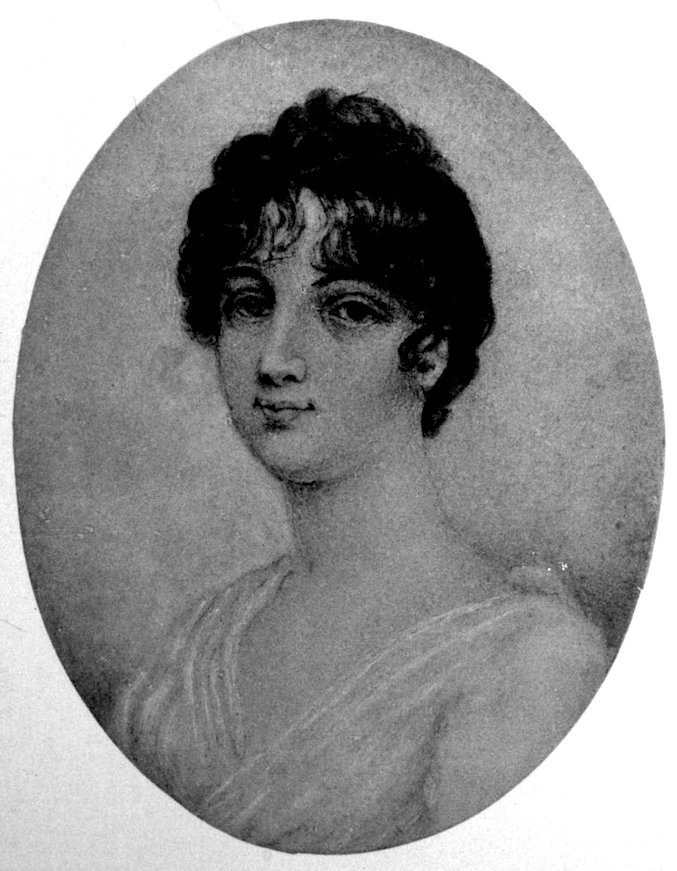
Mrs. RUFUS KING. After a portrait by Trumbull. ARTOTYPE. E. BIERSTADT, N. Y.
I cannot conclude this without earnestly intreating you to receive it with the candor of an Uncle rather than the severity of a critic. I feel I do not write as I ought to, yet I entreat you not to think me deficient in that respect and esteem with which I shall ever remain.
Your niece Eliza Southgate.
Scarborough, August 4, 1801.
Dr. Southgate to Rufus King in London.
You will receive this by Mr. Richard Derby, youngest son of the late H. Derby of Salem. His lady who accompanies him is the daughter of Dr. N. Coffin of Portland. The Doctor’s family and mine have ever been on terms of intimacy and friendship. Mrs. Derby in particular has ever been a favorite of my daughters Octavia and Eliza. They can give you all particulars about friends at home.
Bath, Sunday, Sept. 13.
There are some kinds of indisposition that instead of weakening the faculties of the mind, serve only to render them more vigorous and sprightly, and in proportion as the body is debilitated, the mind is strengthened. I have every reason to believe that the imagination never soars to such lofty heights as it sometimes does in sickness. But where am I! What about—Well may you ask the question. Believe me, Cousin, I have attempted to finish this letter 4 times this day. I cannot account for my inability to write. It used to be the joy of my life, nothing delighted me so much as to steal into the chamber by myself and scribble an hour, but since I received your last I have often attempted to answer it, but in vain. I have a stubborn brain; it must be coaxed, not driven. I find there is nothing so tedious as to write when we are not in the mood for it. You may easily see that I am not in one at present. Now for Heaven’s sake see what I have written—find the chain that connects. When I began I meant to say I had been quite unwell ever since I left Portland, that some disorders only served to give vigor to the mind, &c., &c., but I meant also to say mine was altogether of a different nature. But as I left that out, so I had better have done the other. Oh—’tis too, too bad! I’ll not write another till I think I can understand it after it is written. I am low-spirited, stupid and everything else.
Wednesday.
Now I shall really think I have no soul if I find myself as destitute of ideas as I was on Sunday. I have just been viewing the most delightful prospect I have seen this long time, and if it has left no more impression on my mind than objects passing before a mirror, I shall think myself devoid of every quality that constitutes us rational beings. I think nature has done everything to render Bath pleasant: the window at which I now sit commands a most delightful water prospect; the river is about a mile in breadth at this place, the opposite banks are neither sublime nor beautiful. What if I for a moment should take a poet’s license, and by the force of imagination project steep and rugged rocks! bid them stoop with awful majesty to reflect their gloomy horrors in the wave! See you not that enormous precipice whose awful summit was ne’er profaned by human footsteps? Does not your blood freeze as it creeps along your veins? Behold again that barren waste, the axe nor the plough have never clothed it with a borrowed charm, or robbed it of those nature bestowed upon it; it still boasts its independence of the labor of man. But to leave fiction for reality, the surface of the water is a perfect mirror. I never saw it so perfectly smooth; at this moment there is a boat passing, rowed by two men—the reflection in the water is so distinct, so very clear, it looks like two boats. I admire to see a boat rowed; it seems to look like arms or wings, moving with graceful majesty, while the boat cuts the liquid bosom of the water, leaving as it recedes a widening track. There is always to me something very charming in the rowing of a boat. There is music in the motion; and what can be more graceful and majestic than the motion of a ship under sail? Yesterday there was a brig passed by here—’twas within hearing—very near. I never was more forcibly struck than at the moment; I longed to prostrate myself in humble admiration—as she approached with a slow, commanding, celestial air;—at the moment I am sure it gave me a better idea of the awful grandeur of a deity than anything I had ever seen. I saw Juno’s dignified gracefulness such as I had read of but could not conceive.
I have often in reading been disagreeably struck by the epithets used for the motions of the gods. Sometimes they make them glide thro’ the air, sometimes approach with a solemn step, and many other words I do not recollect; nor do I at present think of any words that would answer better—yet to glide seems stealing along—to move rapidly and imperceptibly;—a bird glides thro’ the air, yet there is nothing celestial in the flight of a bird. It seems to me properly applied to fairies; something light and airy should glide,—that a fairy should glide along seems right,—just as I have an idea of them. And then for a god to step—that seems too grovelling, too like us mortals,—yet that in my opinion is better than the other.
The place on which this house stands seems to project in a small degree toward the water. I believe there is not a window in the house that does not command a view of the water. In front there is a kind of cove the water makes in several rods; the river is broad and straight, the land rises gradually from it a half mile;—but I think it is to be regretted that the inhabitants have built under the hill, or rather that they did not prefer climbing a little higher; however, I think it must have a fine appearance from the water. Last year I recollect sailing along in front of the settlement and remarked how much more compact it looked than it really is, the houses rising one above the other in such a manner that every one was seen distinctly. I think nothing can be more beautiful than a town built on a sloping ground ascending from so fine a river as this branch of the Kennebec. All the navigation belonging to the different ports on this river above Bath, passes directly by here, and several times I have seen 12 or 14 at a time. To one who has been brought up amidst salt marsh and flats, this large fine river affords much novelty and amusement, and I cannot confess but the sensations I feel in viewing it are more pleasing than those produced by a stagnant water in a Scarborough salt pond. I have almost filled my sheet without saying a word of your letter, indeed I have forgotten what was in it—at the time you gave it me I know I received it with much pleasure, as it robbed me of some painful moments. After Horatio’s recovery I sat down one evening to write you, but I had only written the day of the month, when a most violent clap of thunder (the same that struck Mrs. Horper’s house) shook the pen from my hand and my desk from my lap. I do not imagine even by this omen that I offend the strictest laws of virtue and propriety by continuing to write you, therefore should something equally powerful wrest the pen from my hand, depend upon it I will seize it with renewed vigor and dare assure you of my esteem, &c., &c.
Eliza.
I shall go to Wiscassett on Monday; expect to hear from me after I return to Bath; while there I shall have no time. I expect to have important communications to forward—a certain pair of sparkling eyes, which are far more eloquent than her tongue! Now I have half a mind to be affronted. I know at this time, as soon as you have read this you are tumbling it into your pocket as waste paper to ponder on the brilliancy of said eyes. Is it true? Well, I shall see them soon and shall be tempted to ask some atonement for the damages I may suffer. Write me often while I am here, it is your duty.
Mr. Moses Porter, Biddeford.
By Mrs. King.
To Mr. Moses Porter at Biddeford.
I want to write, yet I don’t want to write to you, my ceremonious Cousin, but at this time I can think of nobody else and am compelled to address you. My last was dated from Bath, so is this; since then I have made a visit to Wiscassett. Oh I believe—yes I did write a few lines from there by Uncle Thatcher—I had forgotten that I wrote any more than the letter I finished before I left Bath. I wish I could give you an account of my spending my fortnight at Wiscasset, which would amuse you as much as the reality did me, but that is impossible. I have seen so many new faces—(I was going to say new characters, but they were generally such as we see every day), so many handsome ladies, so many fine men, indeed I have seen a little of everything. Mr. Wild and Mr. Davis (of Portland) kept at Mrs. Lee’s. Mr. Wild is a most charming man, and sensible and genteel, apparently has one of the mildest and most amiable dispositions in the world. Mr. Davis you know. There was a Miss P—— spent 2 or 3 days at Mrs. Lee’s. She was—was—I can’t tell you what; you may have heard of her, celebrated for her wit, lost a lover by exercising it rather too severely; poor soul! it was a sad affair; she has at length become sensible of the impropriety of her conduct, and now hopes to atone for it by flattering every gentleman she sees—time will show whether this plan will succeed. She talks incessantly, laughs always at what she says herself. At table, when the judges, lawyers, and a dozen gentlemen and ladies were seated, Miss P—— engrossed all the conversation. I defy any person to be in the room with her and not be compelled to converse with her, not by the irresistible force of her charms, they are rather in the wane. If you look at her she asks what you were going to say—“I know you were going to speak by your looks.” Of course my gentleman walks up, how can he help it? In this manner she draws a whole swarm around her; the poor souls rattle out their outrageous compliments, trembling with fear, for the moment their ardor to please appears to abate, she rouses them to a sense of their duty by a lash of her tongue.
Sunday.—Now I can’t bear to be hurried, and I must submit to be or not send this by Mamma King. Last night when I began this, I felt quite disposed to throw away an hour (for my letters to you are thrown away as you won’t take the trouble to answer them) without consulting anything but my feelings. I began, and soon found, to my mortification, that I ought to have consulted my candle, for as if piqued at my neglect, it took French leave to doze. I broke off my description of Miss P—— in the most striking part. I do not resume the subject, ’twould be a profanation of this day to scandalize a frail sister; my mind is full of charity and Christian love. I hope I shall not stumble against some unlucky thought that may derange its present peaceful state. Now, Cousin, don’t you think it unpardonable, don’t you think it a violation of all the laws of politeness, that you should neglect writing me merely because I owed a letter? I should not be surprised if you counted the words in yours and my letters and settled the account by some rule in Arithmetic. But let me entreat you not to estimate mine by the weight, but the number; in that case I am equal to anybody; but if, unhappily for me, you should weigh them with critical exactness, ’twill take many of them to repay you for one of yours. I feel assured you must have adopted this method, and sincerely ask your pardon for doubting a moment that this was the true cause. What prevented your coming to Wiscassett? I tho’t you had determined upon it. Rebecca and I used to expect you every day; believe me I was asked a dozen times if you were not absolutely engaged to Miss Rice. How such things will get about. I told every body that asked me that I was your confidant, of course must keep your attachment a secret, for which I am prepared to receive your thanks.
Mr. Kinsman has been down to Wiscassett. He attended the courts, as he says, to acquire a better knowledge of the law; but I should imagine he mistook the ladies for the law, as he makes them his constant study. But I leave so dangerous a subject, lest my feelings should deprive me of the power to finish this sheet. I shall probably return home the beginning of next month. If I have a letter due from you, according to your new arrangement, I beg you to forward it as soon as possible; however, I have not the vanity to suppose there is more than a dozen lines as yet; perhaps when I have written half a dozen more letters I may be richly rewarded with one from you. Where is Maria? How does she do? Rebecca wrote her while I was in Wiscassett, and told her undoubtedly she is expected to spend the winter there. I must finish: Uncle calls.
Eliza.
I believe it is about the 10th day of October.
E.
Ellen Coffin is going to be married to a widower and 3 children, think of that, sir!!! I had a letter from her last week. She is not coming home till she leaves Portland as Mrs. Derby.
Topsham, Oct. 29, 1801.
Why, you unaccountable wretch! you obstinate fellow! you malicious, you vain, you—Oh, I am run out, I will e’en call in the assistance of Sir John Fallstaff to help me exclaim against you—provoking creature! With one scratch of your pen to banish such delightful thoughts! I was applauding myself for my condescension in writing so often without answers. I exulted in the thought of your shame and confusion at the proofs of my superiority,—so much above the little forms that narrowed your own heart. How did I see you hanging your head with penitence and sorrow, while your face glowed with conscious shame! Oh, ’twas delicious! Every day I reflected on it with renewed pleasure. I felt assured nothing prevented your writing but an aversion to acknowledging how humble, how little you felt,—yet the letter at length arrived, my heart trembled with delight, a glow of triumph flushed my face. I saw the humiliation so grateful to my vanity, (I was at the Lieu table)—I hurried the letter into my pocket, I had no wish to read it—I knew (I tho’t I did) what it must contain. I could scarcely breathe; vanity, exultation, revenge (sweet sensation) gave me unusual spirits. I stood and called 5— I was sure of a Palm-flush! ’twas impossible anything could go wrong,—’twas a frail hope—I got nothing, was lieued; never mind it, thought I, the letter is enough. I played wrong, discarded the wrong card, knocked over the candlestick, spilt my wine; positively, if it had been a love-letter, a first declaration, it would not put me in a worse flustration; but ah! ’twas so different,—I did not blush, look down, tremble, fear to raise my eyes; my heart did not dissolve away in melting tenderness—hey-day! I had no notion of telling you what I did not do—but what I did. Well then—I sat so upright, I was a foot taller, I looked at every body for applause. I wondered I did not hear them exclaim: Oh, generous, excellent girl! I demanded it with my eyes—’twas all in vain, I heard nothing but—“Eliza, you must follow suit. Why do you play that card? You will certainly be lieued!” I was vexed; I thought of the letter, all was sunshine again. I am called—dinner; oh, this eating seems to clog all my faculties, I never write with half so much ease as when I’m half starved. I believe it is true that poets ought not to live well.
But begging your pardon for leaving you so in the lurch, I had forgotten that the letter was as yet unopened in my pocket. Well then, we did not break up till late; after I retired to bed out came the letter. I was sleepy and had a great mind not to open it till morning; however I thought I would, to have the satisfaction of the confirmation of my hopes, not once thinking of the stroke that should annihilate them. It came. How shall I tell you my consternation!—“description falters at the threshold;” yet I did not rave, I did not tear my hair with a frenzy of passion. I did not stand in mute despair,—no; I collected all my dignity and stood fixed and immovable. I was convinced ’twas obstinacy alone, ’twas envy, ’twas a something that prevented you from giving me what you knew I deserved. I am called again.
Portland, Nov. 10, 1801.
I had almost determined to light the fire with this scrawl!—but upon second thoughts I withdrew my hand from the devouring flames and saved it from the fate it so justly merits. Yet we have such a partiality for our own offspring we rarely ever treat them with the severity they deserve. But I ought to tell you where I am,—but this letter has nothing like method in it—but never mind—I began it immediately after I received your last. I wrote while the first impressions it made were on me; unluckily I was called from the pleasing task while in the midst of it, and as I never feel the same two hours together, I was unable to continue as I began: ’twould have been cold and studied; so I left it. I threw it into my trunk, determining not to have anything more to do with it. I had grown amazingly wise; I wondered how I could suffer myself to write such nonsense. To-day I have received an invitation to the second wedding of Capt. Stephenson. I shall go. I thought I would write you a line to let you know I was still in existence and on my way home. I could not find any paper and was compelled to tumble over my trunk to find this. I have a world of news to tell you, but I don’t know that you would care a farthing about any of it. Mary has been at Boston. Capt. Stephenson told me all about it. Tell her I hear she has a heap of fine things, at which, together with her ladyship, I hope to have a peep. I have something of vast importance to say to her likewise, a thing on which depends the life and happiness of a fellow-creature. “Oh, Mary! who would have thought cruelty one of the failings of your heart.” But I shall out with this secret to you before I am aware of it. Now I have a great mind to turn this into a letter to Mary. I have as much again to say to her as I have to you, but she would not know what to make of some of it. I expect to be at home on Saturday next; bring Mary on Sunday,—mind, and don’t disobey. Horatio will be with me. I am in a monstrous hurry. I must send more blank paper than I ever did before, for which you will thank me, as I think you once told me that the blank paper in my letters always afforded you the most pleasure,—not exactly so—but something like it. Adieu.
Eliza.
Mr. Moses Porter.
Scarborough, Dec. 4th, 1801.
“I give you thanks,” as Parson Fletcher says, for your dissertation upon apologies and old sayings. You have stored up enough to fill a volume, if I should take your last as a specimen of the quantity. However, they are things I trouble myself but little about, and I should rather be inclined to join in railing against them than in enumerating their good effects. I perceive that you were much more inclined to be their advocate after supper than you were before. You had just laid down your pen after venting all your spleen and ill-nature (occasioned by your impatience for roast-beef) upon these poor harmless old sayings. You return, with an entire new set of sentiments on the subject. You commence their advocate with more vehemence than is usual with you, and conclude by making them the very foundation of every virtue. Now I have endeavored to find some natural cause for this sudden change, but cannot. Was it that you heard one trickle from the lips of some favorite fair with eloquence too powerful to be resisted? Or was it a bumper of wine which proved so warm a friend to them? Or was it the good-natured effects of the roast-beef, which exhilarating your spirits, made you look with an eye of pity and compassion on these poor neglected things, and endeavor by rubbing off the rust and polishing them anew, to compensate for your malicious endeavors to lessen their merit? But after all I must confess myself a great enemy to them, in conversation particularly. I never knew a person who made frequent use of them, but I pitied them for the scanty portion of ideas which must have driven them to such a paltry theft; and moreover, if I must steal the idea, I would clothe it myself, lest its garment should betray me. I dislike them because they are in every body’s mouth, the greatest fool on earth has sense enough to use them with as much propriety as any other, and you will find every old beggar has his wallet stuffed full of them, ready to launch out on every occasion. I don’t know, however, but you are perfectly right in what you say in their defence. I am inclined to believe what you say is just, but I have so often seen instances of their meaning being perverted to answer some vicious purpose that I am compelled to believe the balance is against them. “So much for old sayings.”—But now as to apologies, I must with due reverence beg leave to differ from you in my opinion of them. I am by no means inclined to think they are never used but when we know ourselves in fault, and that we ought always to suspect the sincerity of any one who makes them. You certainly must have known instances when they were essentially necessary, and not to have made them would have proved an obstinacy of disposition quite as disagreeable as insincerity. I hate this parade and nonsense about independence, which every gentleman of ton puts on; it always proves that the reality is small, when such a fuss is made for the appearance. I know some gentlemen who boast of never having made an apology, yet at the same time would say and do a thousand things much more derogatory to their dear independence than fifty apologies, such as any man of sense might make. I should be glad to see our fine gentlemen more careful in avoiding anything that would require an apology, and not like cowards skulk behind their flimsy shield of independence for defence or security. I have as great an aversion to cringing apologies, made on every occasion, as you possibly can have, and should always suspect the sincerity of them.—If this class are the greater part of them,—still I can conceive, nay I have known instances when an apology has heightened my opinion of a person instead of lessening it. If we are in fault, ought we not to confess it? If we are not in fault, ought we not to exculpate ourselves? I should think a person valued my approbation very little, if he knew I had any reason to censure him and yet would not by a single word convince me I had been deceived. However, I did not mean to dip so far into this weighty subject, ’twould have been better to have just touched the edges and away. Now really, Moses, I write in pain if I am not good-natured; you must attribute it all to the cold which makes my fingers tingle; I can’t write below, there is such a gabbling. ’Tis a cold, comfortless night; the rain patters against the window and the wind whistles round the house, it sounds like December,—oh! that was an unlucky word! I feel gloomy at the sight of it. The storm has driven all my thoughts back to myself for shelter. I am at this moment so selfish and cross that I would not walk ten steps to do good to any one. Our old windows here clatter so that I can hear nothing else. I shall begin to think the candle burns blue, and that I hear the groans of distress between the blasts of wind, which sound hollow and dreary; even now the shadow of my pen on the wall looked like a man’s arm, and as true as I live, here is a winding-sheet in the candle. Oh these hobgoblin stories! we never get rid of them. I sometimes, when sitting alone, after all are asleep in the house, get my imagination so roused, that I look in fearful expectation that the tall martial ghost of Hamlet will stalk before my eyes, or that some less dignified one will step through the keyhole, or pop down chimney.—Ghosts, what a looking word that is!!—nonsense!—what was I going to say, something about ghosts and all not warming my fingers. I declare this shall be the last letter I will write from the fire,—December, and writing in the chamber without fire. Oh—monstrous! But here am I at the end without saying several things I meant to. I never, when I sit down to write, say any thing I wished or intended to when I began. You found my letter, you say—’twas not worth the finding, as it was too late to answer the purpose I wish. Write me often. I have been entertained with Johnson’s life. We are alone, so write me often.
E. S.
A man of your gallantry, cousin, surely might make a small exertion to confer an obligation on two of the fair. Octavia and myself are very anxious that Miss Tappan should make us a visit. My father will bring Miranda home; but our chaise is broken so much that ’tis impossible to use it in its present state; none to be hired or borrowed. Why can’t you take a chaise and bring over Pauline and Betsey Tappan? Besides gratifying me with their company, I would be very glad to see you—no coaxing Eliza! But I am in earnest; come and see. Do come and bring them if possible. I will show you some of Martha’s letters from London, Bath. I will tell you everything I can think of and perhaps invent something if all this won’t do. Lord bless me! I should not have to urge every one so hard to come and see me. I am sure I should be discouraged; but seriously, I wish you to come very much, but if you think it impossible, or rather very bad—don’t mind what I say; however, I expect you.
Eliza.
To Mr. Moses Porter.
Portland, Jan. 24, 1802.
Now at this moment imagine your friend Eliza half-double with the cold, two children teazing and playing round the table, sister and nurse talking all the time, and you will then be prepared to receive a letter abounding with sound reasoning, profound argument, elegant language, and a profusion of sublime ideas; but do not stare if I intersperse, by way of relieving your mind, a few little Jackey Horner stories which I am obliged to gabble out by wholesale to stop the children’s mouths. If I had not had a most retentive memory, I should have forgotten we were correspondents. I can put up with such a tardy, indifferent, reluctant correspondent when I myself set the example—but we ladies are so accustomed to attention from gentlemen that I can hardly bring myself to put up with your neglect. I have a thousand times determined to wait just as long before I answer your letters as you do before mine are noticed, and you have nothing to prevent—but, pshaw! I am only spending time to give you something to laugh at. I must honestly acknowledge, however, that your last letter was very acceptable, though I was piqued at your neglecting me so long. I wish I felt adequate to giving an opinion on your perfect character, but as I have told you before, I cannot think when all is noise and confusion around me. But I have endeavored in vain to find fault with it. I am really sorry that your sentiments so perfectly coincide with my own, for you have said all I think on the subject and much more than I could have expressed, therefore I am compelled to assent to all you have said. I am very glad we do not agree on every subject, for our letters would (mine I mean) be very unentertaining, indeed they have no merit to part with. I do not mean to send your perfect character away without a more intimate acquaintance. When I feel in a proper mood for it I will take it up and examine every quality separately. I have the outlines impressed on my mind, but I cannot refer to your letter for ’tis up in my trunk and I feel no disposition to leave the fire; with your permission I will lay it by till another time. In the meantime let us descend from these important discussions to the trifling occurrences of the day. With great satisfaction we at length behold the ground covered with snow, for we are almost freezing here; it has been impossible almost to obtain wood to keep us warm, and I declare I have thought a log-house and clay chimney—The bell rings—I must stop!—
Monday, Feb. 1, 1802, Portland.
The sudden ringing of the bell last Monday stopt me in the midst of a very homely catalogue of blessings—’tis not worth finishing, and if it was I could not take up a broken sentence and finish it a week after it was begun. I have in vain attempted to finish this sheet, but I find I am entirely unfit to write. I hold my pen firm in my hand, look this side and that side, yet still cannot think. Scarborough—desolate, dreary Scarborough is the only place from whence I can write with ease,—nothing present engages my attentions, and I then have leisure to turn over the rubbish which I have collected from home—ponder on things past and anticipate those to come: ’tis something like dreaming,—we are insensible to everything around us,—the imagination is unchecked by the operation of our senses, and soars beyond the boundaries of reality. Pray read over this last half-page and see if you cannot tell how I feel, look, and act at this moment. If your penetration does not discover a something unlike my letters in general,—cold and studied—I will not—I cannot write, another post must pass and no letter, yet ’tis labor, ’tis pain to write thus.
Sunday, Feb. 8.
To see the dates of this sheet one would immediately conclude that my ideas flowed periodically and that I had stated periods to “unpack the heart,” but ’tis because I cannot take my pen and write at the moment I feel an inclination,—not to defer it till a more convenient time when I most probably should feel indifferent about it. Now I am aware what you are about to infer from such a dull studied letter as this is,—The “seven days twice run” has put something into your head that ought not to be there, and you are laughing in your sleeve at the discovery. Now, I am not after the manner of our sex going to protest it is false—that there is no foundation for such a report, and counterfeit anger that I don’t feel, for these things always are viewed as a modest confirmation of the truth, and frequently are considered the greatest proof that can be brought. It is folly to give importance to such stories by appearing to feel interested, and the only way to destroy them is to hear and let them pass with perfect indifference; time will certainly show what is true and what is not, and the only method is to let them take their course, they will sink to oblivion if not fed by our own folly. I own ’tis unpleasant to hear such things, but every girl must prepare herself for such vexations. It has one good effect—that of making us more circumspect in our conduct. I do not say I am not in love; if your penetration has not discovered that I am, neither will what I say convince you. How such a report came to you I do not know. I had hoped it would wither and die in the hotbed of scandal from whence it sprang. If you lived here you would not be surprised at any thing of the kind. I declare to you I don’t know the girl in town of whom the same is not said. The prevailing propensity this winter is match-making, and at the assemblies there is no other conversation,—such and such a one will make a match because they dance together,—another one is positively engaged because she does not dance with him. If a lady does not attend the assembly constantly—’tis because her favorite swain is not a member,—if she does—’tis to meet him there: if she is silent, she is certainly in love; if she is gay and talks much, there must be a lover in the way. If a gentleman looks at you at meeting you are suspected, if he dances with you at the assembly it must be true, and if he rides with you—’tis “confirmation strong as proof of holy writ.” I am vext to have spent so much time on this subject, but I care nothing about it. ’Tis well I have found something to fill my sheet, and had it not been for that lucky seven days twice over, I should not have finished it this month, and finishing now has been a week’s work.
Eliza.
To Mr. Moses Porter.
Sunday, Feb’y 14.
Only think, Moses, I was from home when you passed thro’ town! I did not expect you so soon, altho’ you said you should return on Friday. I thought something might detain you in Wiscassett longer than you expected; but you are one of those odd fellows which nothing can turn aside, no, not even the most sparkling pair of black eyes in the world could detain you a moment longer than you first intended,—what a philosopher in this age of gallantry to remain untainted! It will come at last, Moses. Belamy says there is as much a time for love as for death, and every one as surely one time or other will feel it. I expect to see you throw off the Philosopher and assume the man; one more trial and I will pronounce you invulnerable. For Miss T——, this one is reserved. I long to see how you will look when (to use a religious phrase) you are struck down. Pray write me as soon as you receive this and tell me about your journey; don’t wait as long as you commonly do.
Adieu.
Eliza.
Portland, March 1, 1802.
Such a frolic! Such a chain of adventures I never before met with, nay, the page of romance never presented its equal. ’Tis now Monday,—but a little more method, that I may be understood. I have just ended my Assembly’s adventure, never got home till this morning. Thursday it snowed violently, indeed for two days before it had been storming so much that the snow drifts were very large; however, as it was the last Assembly I could not resist the temptation of going, as I knew all the world would be there. About 7 I went down-stairs and found young Charles Coffin, the minister, in the parlor. After the usual enquiries were over he stared awhile at my feathers and flowers, asked if I was going out,—I told him I was going to the Assembly. “Think, Miss Southgate,” said he, after a long pause, “think you would go out to meeting in such a storm as this?” Then assuming a tone of reproof, he entreated me to examine well my feelings on such an occasion. I heard in silence, unwilling to begin an argument that I was unable to support. The stopping of the carriage roused me; I immediately slipt on my socks and coat, and met Horatio and Mr. Motley in the entry. The snow was deep, but Mr. Motley took me up in his arms and sat me in the carriage without difficulty. I found a full assembly, many married ladies, and every one disposed to end the winter in good spirits. At one we left dancing and went to the cardroom to wait for a coach. It stormed dreadfully. The hacks were all employed as soon as they returned, and we could not get one till 3 o’clock, for about two they left the house, determined not to return again for the night. It was the most violent storm I ever knew. There were now 20 in waiting, the gentlemen scolding and fretting, the ladies murmuring and complaining. One hack returned; all flocked to the stairs to engage a seat. So many crowded down that ’twas impossible to get past; luckily I was one of the first. I stept in, found a young lady, almost a stranger in town, who keeps at Mrs. Jordan’s, sitting in the back-seat. She immediately caught hold of me and beg’d if I possibly could accommodate her to take her home with me, as she had attempted to go to Mrs. Jordan’s, but the drifts were so high, the horses could not get through; that they were compelled to return to the hall, where she had not a single acquaintance with whom she could go home. I was distres’t, for I could not ask her home with me, for sister had so much company that I was obliged to go home with Sally Weeks and give my chamber to Parson Coffin. I told her this, and likewise that she should be provided for if my endeavors could be of any service. None but ladies were permitted to get into the carriage; it presently was stowed in so full that the horses could not move; the door was burst open, for such a clamor as the closing of it occasioned I never before heard. The universal cry was—“a gentleman in the coach, let him come out!” We all protested there was none, as it was too dark to distinguish; but the little man soon raised his voice and bid the coachman proceed; a dozen voices gave contrary orders. ’Twas a proper riot, I was really alarmed. My gentleman, with avast deal of fashionable independence, swore no power on earth should make him quit his seat; but a gentleman at the door jump’t into the carriage, caught hold of him, and would have dragged him out if we had not all entreated them to desist. He squeezed again into his seat, inwardly exulting to think he should get safe home from such rough creatures as the men, should pass for a lady, be secure under their protection, for none would insult him before them, mean creature!! The carriage at length started full of ladies, and not one gentleman to protect us, except our lady man who had crept to us for shelter. When we found ourselves in the street, the first thing was to find out who was in the carriage and where we were all going, who first must be left. Luckily two gentlemen had followed by the side of the carriage, and when it stopt took out the ladies as they got to their houses. Our sweet little, trembling, delicate, unprotected fellow sat immovable whilst the two gentlemen that were obliged to walk thro’ all the snow and storm carried all the ladies from the carriage. What could be the motive of the little wretch for creeping in with us I know not: I should have thought ’twas his great wish to serve the ladies, if he had moved from the seat, but ’twas the most singular thing I ever heard of. We at length arrived at the place of our destination. Miss Weeks asked Miss Coffin (for that was the unlucky girl’s name) to go home with her, which she readily did. The gentlemen then proceeded to take us out. My beau, unused to carrying such a weight of sin and folly, sank under its pressure, and I was obliged to carry my mighty self through the snow which almost buried me. Such a time, I never shall forget it! My great-grandmother never told any of her youthful adventures to equal it. The storm continued till Monday, and I was obliged to stay; but Monday I insisted if there was any possibility of getting to Sister’s to set out. The horse and sleigh were soon at the door, and again I sallied forth to brave the tempestuous weather (for it still snowed) and surmount the many obstacles I had to meet with. We rode on a few rods, when coming directly upon a large drift, we stuck fast. We could neither get forward nor turn round. After waiting till I was most frozen we got out, and with the help of a truckman the sleigh was lifted up and turned towards a cross street that led to Federal Street. We again went on; at the corner we found it impossible to turn up or turn, but must go down and begin where we first started, and take a new course; but suddenly turning the corner we came full upon a pair of trucks, heavily laden; the drift on one side was so large that it left a very narrow passage between that and the corner house, indeed we were obliged to go so near that the post grazed my bonnet. What was to be done? Our horses’ heads touched before we saw them. I jump’t out, the sleigh was unfastened and lifted round, and we again measured back our old steps. At length we arrived at Sister Boyd’s door, and the drift before it was the greatest we had met with; the horse was so exhausted that he sunk down, and we really thought him dead. ’Twas some distance from the gate and no path. The gentleman took me up in his arms and carried me till my weight pressed him so far into the snow that he had no power to move his feet. I rolled out of his arms and wallowed till I reached the gate; then rising to shake off the snow, I turned and beheld my beau fixed and immoveable; he could not get his feet out to take another step. At length, making a great exertion to spring his whole length forward, he made out to reach the poor horse, who lay in a worse condition than his master. By this time all the family had gathered to the window, indeed they saw the whole frolic; but ’twas not yet ended, for, unluckily, in pulling off Miss Weeks’ bonnet to send to the sleigh to be carried back, I pulled off my wig and left my head bare. I was perfectly convulsed with laughter. Think what a ludicrous figure I must have been, still standing at the gate, my bonnet halfway to the sleigh and my wig in my hand. However, I hurried it on, for they were all laughing at the window, and made the best of my way into the house. The horse was unhitched and again set out, and left me to ponder on the incidents of the morning. I have since heard of several events that took place that Assembly night much more amusing than mine,—nay, Don Quixote’s most ludicrous adventures compared with some of them will appear like the common events of the day.
March 12, 1802.
William Weeks is going to Philipsburg[24] and thinks of returning by the way of Scarborough; if so, will leave this at our house, otherwise can return it to me. I have not yet seen Miss Jewett, but I hear she has returned. Did your Saco party come as you expected? Give my love to Miss Tappan, and tell her nothing but the fame of her beauty would carry this young man so many miles out of his way. I found he was very desirous of calling at our house, therefore wrote by him. Tell her she must answer for the mischief done by leading young men astray from their path. I will estimate the loss it will be to William:—he will ride 6 or 8 miles further than necessary,—fatigue his horse,—wear out his sleigh runners, and certainly be detained 3 hours. Now, as we know a gentleman’s time is much more valuable than a lady’s, it must be a real loss to him. 3 dollars a day for posting books any common accountant would have; and allowing him but just so much, his loss would certainly amount to 4–6 on that score. I speak merely of the loss on the score of interest;—how deeply it may affect him otherwise may better be imagined from the ravages she has committed in Mr. Orr’s heart than from anything I can say. This short visit may derange all his reasoning faculties, and give a different hue to all his future prospects,—it may give him a disrelish for all amusements, and make him sigh for the calm serenity of domestic life,—to sum up all together—it may make him in love,—but I shall have no time to say anything else, if I run on with this any further. To-morrow I expect to go to Gorham,—return the same evening or Sunday morning. I am still at Mrs. Coffin’s, but shall return to Sister when I come from Gorham. We have had a number of pleasant parties this week,—Tuesday Mrs. Robert Boyd had a charming one. Wednesday had a large one here, and to-day all going to Capt. Robinson’s, where we expect to dance. To-morrow I go to Gorham. I wrote to Mamma requesting money to buy a lace shade,—I called to look at them again and the shopkeeper told me he was mistaken in the price, for it was 21 per yard instead of the whole pattern, which makes a vast difference. I, of course, think no more of lace shades, but I still think of some money, I have but 4 cents in the world, not enough to pay the postage of a letter, pray send me a little immediately. I shall send you a description of the Assembly—which I believe you may read to my Mother if you wish, ’twill amuse her I know. I wish you would look in the old desk among my papers and get a little Drawing book,—directions for drawing printed in a pamphlet, and give to William to bring over. I hope the snow will last till Mamma comes over and I return home, ’tis delightful weather. How do the daisies and jelly flowers? Mrs. Parker is going to give me some flower seeds. I hear frequent enquiries for you—when are you coming in town? Tell Miss Tappan I had the honor of dancing a voluntary dance with Mr. Orr at the last assembly,—he attracted much attention by his irregular expression—“The floor was very unyielding,” &c., &c. I did not tell you any one’s adventures but my own on that eventful night. Poor Mr. Orr, impatient to get home, plunged into the snow without waiting for a carriage, and unfortunately turning up street instead of down, got most to Mr. Vaughn’s before he discovered his mistake, and was obliged to turn round and worry his way back again, he was half dead when he got to his lodgings. Eunice Deering was tumbled over and when Mr. Little took her from the carriage[25].
Portland, May 23, 1802.
I receive your apology and am satisfied—’tis not the manner of making apologies I think most of, but that long dissertation on the subject continually obtrudes itself on your mind whenever you feel conscious an apology is necessary, but while I am convinced nothing but the fear of appearing inconsistent prevents your making these said apologies, I will not complain—let them come “edgeways” or any other way—so long as I am convinced you feel their necessity. But I have been pondering on your new plan of life, yet I confess it does not appear to me so delightful as to you, it sounds well,—tickles the fancy,—cuts a pretty figure on paper and would form a delightful chapter for a novel. Our novelists have worn the pleasures of rural life threadbare, every lovesick swain imagines that with the mistress of his heart he could leave the noisy tumultuous scenes of life and in the shades of rural retirement feel all the delightful serenity and peace ascribed to the golden age. The Philosopher and the Poet fly to this imaginary heaven with as much enthusiasm as the lover. Here, say they, we can contemplate the beauty and sublimity of nature free from interruption; here the reflecting mind can find endless subjects for contemplation! here all is peace and love! no discord can find a place among these innocent and happy beings,—they live but to promote the happiness of each other and their every action teems with benevolence and love. Yet let us judge for ourselves,—we all have seen what the pleasures of rural life are, and whatever Poets may have ascribed to it, we must know there is as much depravity and consequently as much discontent in the inhabitants of a country village as in the most populous city. They are generally ignorant, illiterate, without knowledge to discover the real blessings they enjoy by comparing them with others, continually looking to those above them with envy and discontent and imagine their share of happiness is proportioned to their rank and power. I am convinced that a country life is more calculated to produce that security and happiness we are all in pursuit of than any other, but those who have ever been accustomed to it have no relish for its pleasures, and those who quit the busy scenes of life, disgusted by the duplicity or ingratitude of the world, or oppressed by the weight of accumulated misfortune—carry with them feelings and sentiments which cannot be reciprocated. Solitary happiness I have no idea of, ’tis only in the delightful sympathies of friendship, similarity of sentiments, that genuine happiness can be enjoyed. Your mind is cultivated and enlarged, your sentiments delicate and refined, you could not expect to find many with whom you could converse on a perfect equality,—or rather many whose sentiments could assimilate with yours. Were I a man, I should think it cowardly to bury myself in solitude,—nay, I should be unwilling to confess I felt myself unable to preserve my virtue where there were temptations to destroy it, there is no merit in being virtuous when there is no struggle to preserve that virtue. ’Tis in the midst of temptations and allurements that the active and generous virtues must be exerted in their full force. One virtuous action where there were temptations and delusions to surmount would give more delight to my own heart, more real satisfaction than a whole life spent in more negative goodness, he must be base indeed who can voluntarily act wrong when no allurement draws him from the path of virtue. You say you never dip’t much into the pleasures of high life and therefore should have but little to regret on that score. In the choice of life one ought to consult their own dispositions and inclinations, their own powers and talents. We all have a preference to some particular mode of life, and we surely ought to endeavor to arrive at that which will more probably ensure us most happiness. I have often thought what profession I should choose were I a man. I might then think very differently from what I do now, yet I have always thought if I felt conscious of possessing brilliant talents, the law would be my choice. Then I might hope to arrive at an eminence which would be gratifying to my feelings. I should then hope to be a public character, respected and admired,—but unless I was convinced I possessed the talents which would distinguish me as a speaker I would be anything rather than a lawyer;—from the dry sameness of such employments as the business of an office all my feelings would revolt, but to be an eloquent speaker would be the delight of my heart. I thank Heaven I was born a woman. I have now only patiently to wait till some clever fellow shall take a fancy to me and place me in a situation, I am determined to make the best of it, let it be what it will. We ladies, you know, possess that “sweet pliability of temper” that disposes us to enjoy any situation, and we must have no choice in these things till we find what is to be our destiny, then we must consider it the best in the world. But remember, I desire to be thankful I am not a man. I should not be content with moderate abilities—nay, I should not be content with mediocrity in any thing, but as a woman I am equal to the generality of my sex, and I do not feel that great desire of fame I think I should if I was a man. Should you hereafter become an inhabitant of Boyford I make no doubt you will be very happy, because you will weigh all the advantages and disadvantages. Yet I do not think you qualified for the laborious life farmers generally lead, and it requires a little fortune to live an independent farmer without labor. Rebecca would do charmingly, I know you are imagining her the partner of all your joys and cares,—of all your harmony and content, when you charm yourself with your description of rural happiness. With her you imagined you could quit the world and almost live happy in a desert. So may it be,—I know none but a lover could paint the sweets of retirement with such enthusiasm. ’Tis my turn now to rail a little,—the world also has linked you to a certain person, as firmly—nay, more so than it ever did me; however I will not press so closely on this subject. I shall not expect that candid confession I made you,—as your feelings and mine are, I believe, entirely different on the two subjects. I want to ask you a question which you may possibly think improper, but if so, do not answer it.—Is Mary[26] really engaged to Mr. Coffin? I hear so from so many persons and in so decided a manner I cannot doubt. I would ask her, but in these things there is so much deception, there is no finding out,—but however, I think I should never deny such a thing when I once was engaged,—however, enough of this. I am now in Portland, shall return to-morrow to Scarborough where I shall be very happy to see you and Mary, so I depend on your bringing her over very soon. Adieu—dinner is ready and I have nothing to say worth losing it for, write me often—I shall be at home alone these two months to come,—remember you have it in your power to amuse and gratify.
Eliza.
I hardly know what to say to you, Cousin, you have attacked my system with a kind of fury that has entirely obscured your judgment, and instead of being convinced of its impracticability, you appear to fear its justness. You tell me of some excellent effects of my system, but pardon me for thinking they are dictated by prejudice rather than reason. I feel fully convinced in my own mind that no such effects could be produced. You ask if this plan of education will render one a more dutiful child, a more affectionate wife, &c, &c., surely it will,—those virtues which now are merely practised from the momentary impulse of the heart, will then be adhered to from principle, a sense of duty, and a mind sufficiently strengthened not to yield implicitly to every impulse, will give a degree of uniformity, of stability to the female character, which it evidently at present does not possess. From having no fixed guide for our conduct we have acquired a reputation for caprice, which we justly deserve. I can hardly believe you serious when you say that “the enlargement of the mind will inevitably produce superciliousness and a desire of ascendancy,”—I should much sooner expect it from an ignorant, uncultivated mind. We cannot enlarge and improve our minds without perceiving our weakness, and wisdom is always modest and unassuming,—on the contrary a mind that has never been exerted knows not its deficiencies and presumes much more on its powers than it otherwise would. You beg me to drop this crazy scheme and say no more about enlarging the mind, as it is disagreeable, and you are too much prejudiced ever to listen with composure to me when I write on the subject. I quit it forever, nor will I again shock your ear with a plan which you think has nothing for its foundation either just or durable, which a girlish imagination gave birth to, and a presumptuous folly cherished. I fear I have rather injured the cause than otherwise, and what I have said may have more firmly established those sentiments in you which I wished to destroy. Be it as it may, I believe it is a cause that has been more injured by its friends than its enemies. I am sorry that I have said so much, yet I said no more than I really thought, and still think, just and true. I beg you to say no more to me on the subject as I shall know ’twill be only a form of politeness which I will dispense with. You undoubtedly think I am acting out of my sphere in attempting to discuss this subject, and my presumption probably gave rise to that idea, which you expressed in your last, that however unqualified a woman might be she was always equipt for the discussion of any subject and overwhelmed her hearers with her “clack.” On what subjects shall I write you? I shall either fatigue and disgust you with female trifles, or shock you by stepping beyond the limits you have prescribed. As I cannot pursue a medium I fear I shall be obliged to relinquish the hope of pleasing—of course of writing. Good night, I am sleepy and stupid. Morning. O, how I hate this warm weather, it deprives me of the power of using any exertion, it clogs my ideas, and I ask no greater felicity than the pleasure of doing nothing. I intended to amuse you with some of the trifles of the day, but I shall scarcely do them justice this morning. Friday night we had a ball,—the hall was decorated with much taste. ’Twas filled up for the masons. At the head of the room there was a most romantic little bower, four large pillars formed of green and interspersed with flowers, supported a kind of canopy which was arched in front, with this inscription—“Here Peace and Silence reign,” filled with a parcel of girls whining sentiment, and silly fellows spouting love, it produced a most laughable scene. The deities to whom it was dedicated withdrew from the sacred retreat, which was so profaned, and noise and folly reigned supreme,—so sweet a place,—so fine an opportunity for making speeches—’twas irresistible, even you would have caught a spark of inspiration from the surrounding glories,—and felt a degree of emulation at the flashes of genius that blazed from every quarter. Invention was on the rack, the stores of memory were exhausted and folly blushed to be so outdone. Mr. Symmes sat down to overwhelm me with a torrent of eloquence, yet his compassionate heart often prompted him to hesitate that I might recover myself. Such stores of learning did he display, such mines of wisdom did he open to my view, that I gazed with astonishment and awe and scarce believed “That one small head could carry all he knew.” Mr. Kinsman with a countenance that beamed with benevolence and compassion gazed on all around, while a benign smile played round his mouth and dimpled his polished cheek, the laughing loves peeped from his eyes and aimed their never-failing darts—rash girl—too, too near hast thou approached this divinity—the poisoned dart still rankles in thy heart,—“The lingering pang of hopeless love unpitied I endure,” and feel a wound within my heart which death alone can cure. Monday night—You will easily perceive that I am obliged to write when and where I can, I have not quite so much leisure as when at Scarborough, and though in the very place to hear news, I have no faculty of relating what I hear in a manner that could interest you. Last evening I spent in talking scandal (for which God forgive me) but was too tempting an occasion to be resisted. I wish you were acquainted with some of the Portland ladies, I would then tell you many things that might amuse. But I dare not introduce you to them, lest I should entirely mistake their character, and that when personally acquainted with them you would be confirmed in your opinion of my wanting penetration in studying characters. Yesterday I spent with Martha, I wish you were acquainted with her, she is truly an original. I never saw one that bore any resemblance to her. She despises flattery and is even above praise, beautiful without vanity, possessing a refined understanding without pedantry, the most exquisite sensibility connected with all the great and noble qualities of the mind. She knows that no woman in America ever was more admired, she has received every attention which could be paid and yet is exactly as before she left Portland. The same condescension, the same elegance and unaffected simplicity of manners, the same independent and noble sentiments. Perhaps I am blinded to her faults, yet I think she deserves all I say of her, nay more, for she “outstrips all praise and makes it halt behind her.” They have determined to go to England, in two months at farthest they will leave America, not to return for 2 years,—two years! how many, many events will have taken place. Perhaps ere that I shall rest in the tomb of my fathers forgotten and unknown!! Perhaps oppressed with care and borne down with misfortune, I shall have lost all relish for life—all hopes of pleasure may have ceased to exist and the grave of time closed over them forever. I grow gloomy, I wish I could write anything, but I have never felt a relish for writing since I have been in Portland,—at home it supplies the place of society, but here I need no such substitute.
Eliza.
Write by the post if you have no other opportunity, the players will commence acting next Wednesday.
I believe it is the 28th.
Mr. Moses Porter, Biddeford.
This letter is the last one written by Miss Southgate to her cousin Moses Porter. The following one from Dr. Southgate to his brother-in-law, Rufus King, who was then living in England, tells of the untimely death of his nephew, and its sad cause, July 26th, 1802.
Our brother and sister Porter of Biddeford have lost their eldest son Moses. He dyed (sic) about fifteen days since of the yellow fever. He had a ship arrived from the West Indies. On her passage the cook boy dyed suddenly—the rest of the crew were none of them sick, but of those persons who went on board, five or six were taken with the yellow fever in about four days—none of whom lived more than four or five days. Moses is much lamented by his family and acquaintance—this month would have completed his law education. His talents, generous and amiable disposition formed a pleasing prospect etc. etc. Mrs. Porter’s health is better, better than I ever expected she would have enjoyed tho’ she is now only a feeble woman.
R. Southgate.
110
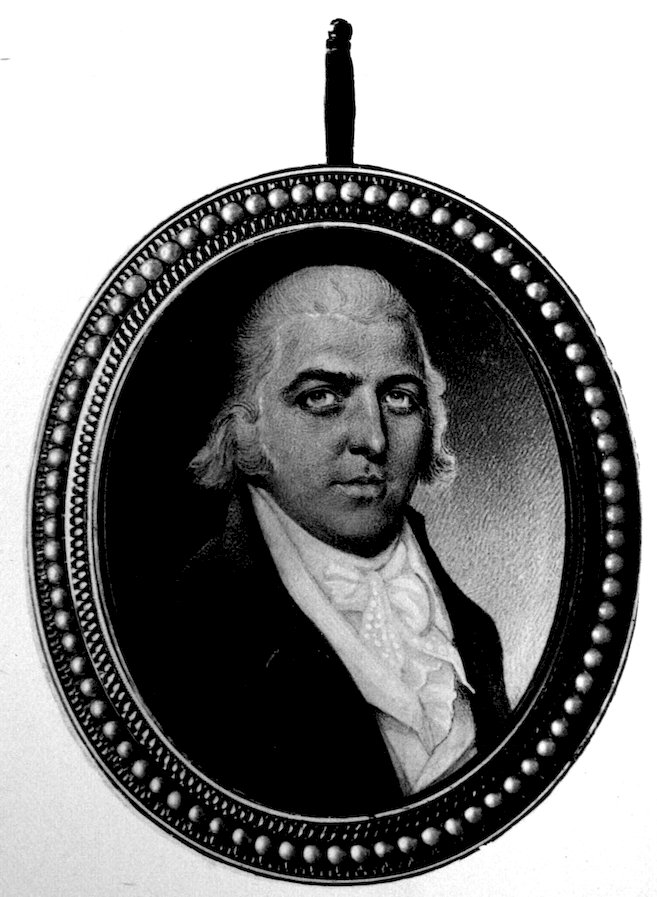
Mr. E. HASKET DERBY of Salem Æt 28, 1794 From a miniature in possession of Dr. Hasket Derby of Boston. ARTOTYPE, E BIERSTADT, N. Y.
Journal.
Tuesday, July 6th, 1802.
Arrived in Salem, met Mrs. Derby at the door who received us joyfully. At tea-time saw the children, fine boys, very fond of Ellen and are managed by their Father with great judgment. How few understand the true art of managing children, and how often is the important task of forming young minds left to the discretion of servants who caress or reprove as the impulse of the moment compels them. Here are we convinced of the great necessity that Mothers, or all ladies should have cultivated minds, as the first rudiments of education are always received from them, and at that early period of life when the mind is open to every new impression and ready to receive the seeds which must form the future principles of the character. At that time how important is it to be judicious in your conduct towards them! In the evening Mr. Hasket Derby came in on his return from New York; he is a fine, majestic-looking man, tho’ he strikes you rather heavy and unwieldy on his first appearance; he says little, yet does not appear absent,—has travelled much, and in his manners has an easy unassuming politeness that is not the acquirement of a day.—Wednesday morning had an agreeable tete-a-tete with Ellen, talked over all our affairs: in the afternoon rode out to Hersey Derby’s[27] farm, about 3 miles from Salem; a most delightful place! The gardens superior to any I have ever seen of the kind; cherries in perfection! We really feasted! There are 3 divisions in the gardens, and you pass from the lower one to the upper thro’ several arches rising one above the other. From the lower gate you have a fine perspective view of the whole range, rising gradually until the sight is terminated by a hermitage. The summer house in the center has an arch thro’ it with 3 doors on each side which open into little apartments, and one of them opens to a staircase by which you ascend into a square room the whole size of the building; it has a fine airy appearance and commands a view of the whole garden; two large chestnut trees on each side almost shade it from the view when seen from the sides; the air from the windows is always pure and cool, and the eye wanders with delight and admiration over the extensive landscape below, so beautifully variegated with the charms of nature. Imagination luxuriates with delight, and as it plays o’er the beauties of an opening flower, imperceptibly wanders to the first principles of nature, its wonderful and surprising operation; its harmony and beauty. The room is ornamented with some Chinese figures and seems calculated for serenity and peace. ’Tis like the pavilion of Caroline, and I almost looked around me for the music of the Guitar and books; but I heard not the tramplings of Lindorf’s horse, nor did I sing to hear the echo of his voice,—“Listen to love, and thou shalt know indifference or bless the foe;” certain it is, however, I thought of Caroline the moment I entered. We descended, and passing thro’ the arch, proceeded to the hermitage, which terminated the garden. It was scarcely perceptible at a distance. A large weeping-willow swept the roof with its branches and bespoke the melancholy inhabitant. We caught a view of the little hut as we advanced thro’ the opening of the trees; it was covered with bark,—a small low door, slightly latched, immediately opened at our touch. A venerable old man was seated in the centre with a prayer-book in one hand, while the other supported his cheek, and rested on an old table, which, like the hermit, seemed moulding to decay; a broken pitcher, a plate and tea-pot sat before him, and his tea-kettle sat by the chimney; a tattered coverlit was spread over a bed of straw, which tho’ hard might be softened by resignation and content. I left him impressed with veneration and fear which the mystery of his situation seemed to create. We returned to the house, which was neat and handsome, and from thence visited the Greenhouse, where we saw oranges and lemons in perfection,—in one orange tree there were green ones, ripe ones and blossoms. Every plant and shrub which was beautiful and rare was collected here, and I looked around with astonishment and delight; at the upper end of the garden there was a beautiful arbour formed of a mound of turf, which we ascended by several steps formed likewise of turf, and ’twas surrounded by a thick row of poplar trees which branched out quite to the bottom and so close together that you could not see through,—’twas a most charming place, and I know not how long we should have remained to admire if they had not summoned us to tea. We returned home, and Mr. Hasket Derby asked if we should not like to walk over to his house and see the garden,—we readily consented, as I had heard much of the house. The evening was calm and delightful, the moon shone in its greatest splendor. We entered the house, and the door opened into a spacious entry; on each side were large white marble images. We passed on by doors on each side opening into the drawing-room, dining-room, parlor, etc., etc., and at the farther part of the entry a door opened into a large, magnificent oval room; and another door opposite the one we entered was thrown open and gave us a full view of the garden below. The moon shone with uncommon splendor. The large marble vases, the images, the mirrors to correspond with the windows, gave it so uniform and finished an appearance, that I could not think it possible I viewed objects that were real, every thing appeared like enchantment,—the stillness of the hour, the imperfect light of the moon, the novelty of the scene, filled my mind with sensations I never felt before. I could not realize every thing and expected every moment that the wand of the fairy would sweep all from before my eyes and leave me to stare and wonder what it meant. You can scarcely conceive any thing more superb. We descended into the garden, which is laid out with exquisite taste, an airy irregularity seems to characterize the whole. At the foot of the garden there was a summer house, and a row of tall poplar trees which hid every thing beyond from the sight, and formed a kind of walk. I arrived there and to my astonishment found thro’ the opening of the trees that there was a beautiful terrace the whole width of the garden; ’twas twenty feet from the street, and gravelled on the top, with a white balustrade round; ’twas almost level, and the poplar trees so close that we could only occasionally catch a glimpse of the house. The moon shone full upon it, and I really think this side is the most beautiful, tho’ ’tis the back one. A large dome swells quite to the chamber-windows and is railed round on top and forms a delightful walk,—the magnificent pillars which support it fill the mind with pleasure. We returned into the house; and on passing the mirrors I involuntarily started back at seeing so much company in the other room. We entered the drawing-room which is superb, furnished with blue and wood color. There was the Grand Piano, the most charming Instrument I ever heard. Mr. and Mrs. Derby, Mr. Hasket D., Frank Coffin and myself were the party, and I was requested to play, and took my seat at the Instrument, and had just begun playing, when a slight noise in the entry made me turn my head. A gentleman entered and was introduced as Mr. Grey; made a most graceful bow, took his seat, and I resumed my playing. We rose to depart, and Mr. G. accompanied us home. I was delighted with his conversation, which was sensible, unassuming, and agreeable. I scarcely saw his face, as there was no light.
Thursday at home all day. In the evening walked in the garden. The evening was uncommonly fine. The moon shines brighter in Salem than anywhere else; here too is an elegant garden, full of fruit trees, the walks kept as nice as possible, and shaded on each side by plum trees; very handsome summer house where we sat an hour or two. Rambled in the garden all the evening, which was the finest I ever saw, so very light, that, as Shakespeare says, “’twas but the daylight sick, only a little paler.” There is something in a fine moonlight evening exquisitely soothing to the soul. I have felt as if I could melt away with the exquisite enthusiasm of my sensations. We were called into the house and found Mrs. West, a sister of Mrs. Derby’s; but more of her by-and-bye. Friday Dr. Coffin arrived, and Dr. Lathrop and Hasket Derby dined with us and set out for Boston.
The following letter, written by Martha Coffin, Eliza’s most intimate friend, and descriptive of a visit that she paid to Salem, will be found of interest.
June 29, 1800.
My dear Ellen:
I have never told you all about my visit to Salem. I passed my time as you may imagine very charmingly, and had I your pen or your talent at description I would endeavor to give you some ideas of the house, the gardens, and the farm; but it is Impossible.
The Hermitage more than answered my expectations. It is everything which we see described in novels, and which I thought was not to be found in reality.
The garden beyond description beautiful, does indeed exceed anything of the kind I ever saw. Ten thousand different kinds of flowers from all quarters of the globe. Fruit of every kind in abundance. A delightful Summer house in the middle of the garden, furnished quite in the rural style; and from the chamber where they sometimes drink tea is the most beautiful prospect you can imagine.
M. Coffin.
116
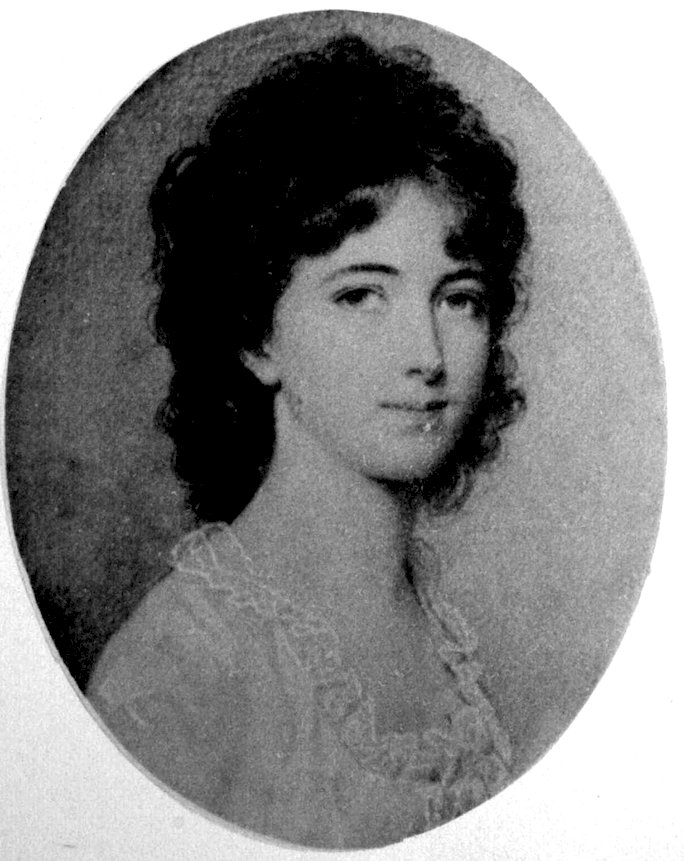
Mrs. RICHARD DERBY. (Martha Coffin) From a miniature by Malbone, in possession of Mrs. Peabody of Boston ARTOTYPE, E. BIERSTADT, N. Y.
Salem, July 14, 1802.
Dear Mother:
I have just received my trunk with the letter and key. I perceive you have not received my letter by Mr. Jewett. Fear not, my dear Mother, tho’ gay and volatile in my disposition, I feel that I shall return home with the same sentiments with which I left it. True, I was in the midst of gaiety and splendor such as I never before witnessed, yet a something within whispers true happiness resides not here,—in this family all is calm contentment and peaceful pleasure. Mr. Derby is everything his best friends can wish him, and the whole family consider him as every thing good and benevolent; he truly is so, and appears one of the finest men I ever knew. How is Uncle Porter’s family? I cannot even now reconcile myself to the idea of leaving them so unexpectedly and so immediately, yet I know not how it could be avoided. I am in the midst of amusements and pleasure, they drive all melancholy reflection from my mind, but when alone, my feelings warmly pay a tribute to the merit of our departed Moses; yet I cannot,—do not realize, every thing contributes to make me think it a delusion, a mere dream; how is it possible I can realize it? Yet sometimes I feel it is, it must be true. How soon do we reconcile ourselves to the loss of the dearest friends; what would most distract us in anticipation we meet with calmness when it approaches; strange, unaccountable. I surely loved Moses with sincerity. I knew of no person so distantly connected whom I felt so interested in,—yet he is dead,—he is gone, and I can speak of it without emotion, and I am called. Adieu, I will write soon.
Eliza.
Journal.
Saturday, July 11, 1802.
We rode out, Ellen and myself, with the three boys, in a hack. Went to Danners—Parson Wadsworth’s, to see Mrs. Rickman’s children; took them in to ride; came down by the mills and went across to Hasket Derby’s farm,—all the cherries gone,—rambled about the gardens an hour and returned home,—charming ride; the country round Salem is delightful, altho’ ’tis situated rather in a plain, ’tis surrounded with beautiful hills, handsome trees, ponds, brooks, etc. We got home at dusk and found Mr. Coffin just returned from Boston. Mrs. Hasket Derby sent a great basket of cherries and her compliments, she would come over in the morning. I wished very much to see her, she had been gone 5 weeks to the Springs. I had heard Martha say much of her and wished much that to-morrow could come.
Next morning—Sunday—went to Meeting. Mr. Dana of Marblehead preached; very devout, unaffected young man; saw not a soul I had ever seen before, excepting Mr. Grey; thought I should not have known him as I scarcely saw his face before. Found Mrs. Hasket Derby on my return, was disappointed in her personal appearance; instead of finding the elegant, majestic, beautiful creature my imagination had pictured, I beheld a little, short, plump woman dressed in black, a coarse complexion and anxious eyes, yet I had not been in her company an hour without confessing to myself she was the most agreeable, fascinating woman I ever saw. She continually pleases and delights you; she appears to live for others, nor ever bestows a thought upon herself, yet so perfectly unconscious of it, that it seems inherent in her disposition, and to flow without any effort. She planned parties of amusement as I was a stranger, and we fixed upon Friday for a fishing party to Nahant; sent to Boston for some to meet us. Monday a small party at Mrs. Derby’s came to tea. I rode in the chaise with Mr. Grey. Mrs. Grey and a Mr. White, an Englishman, in her carriage. Mr. Coffin and Miss Grey in another chaise,—Mr. and Mrs. Hasket Derby. We walked on a hill near the house, where we had the most extensive prospect I ever saw—the whole world seemed spread before us covered with the richly variegated carpet of nature. We returned home in the evening with a fine moon, and all went to Mr. Grey’s to spend the evening. Most charming time; treated with great attention by Mrs. Grey, who is, in my opinion, a fine woman, domestic, fond of her children, and never so happy as in contributing to their amusement, and possesses fine sense, animated, unceremonious, and agreeable.—Tuesday, Doct. and Mrs. Coffin and Mrs. Sumner came down from Boston; dined together, and all went to Hasket Derby’s farm in the afternoon. Mrs. Grey and Miss Bishop of the party; glad to see Miss Bishop—one of my old school-mates. Had a most charming ride; went in the carriage with Mrs. Grey. All returned to Mr. John Derby’s and spent the evening. William Grey and his father came in the evening; walked in the garden.—Wednesday, large party of gentlemen to dine with Doct. Coffin. In the afternoon all went to Mrs. Grey’s; danced in the evening. Miss Bishop plays and sings charmingly. Thursday, Doct. and Mrs. Coffin went home, and in the afternoon went to Mrs. Hasket Derby’s with a party; every thing elegant and pleasant. Friday to Nahant, fishing—Mr. and Mrs. Hasket Derby, Mr. and Mrs. John Derby, Mr. and Mrs. Hersey Derby, Miss Bishop, Mr. Grey, Mr. Coffin, and myself, Miss Heller, Mr. Prince, who looks very much like Horatio, and several others. Met there some smart Boston beaux,—Mr. Amory Parkman, Turner, etc., etc. Spent a most charming day; caught but few fish, and very warm, yet pleasant notwithstanding—set out for home just as the sun was setting. I returned in the chaise with William Grey, Frank with Miss Bishop,—rode 2 miles on the beach, the tide down, sun just setting; ’twas charming and delightful. Saturday went out to Hersey Derby’s farm to tea, went to the bathing house, summer house—and saw the Rumford[28] kitchen—elegant place, beautiful children,—rainy afternoon, we could not enjoy the pleasures of the country so well. Sunday—went to meeting and to tea with Mrs. Hasket Derby; met company from Boston,—two beaux, Mr. Lee and Mr. Davis. Monday—a party of young ladies at Mrs. Grey’s; danced in the evening, went home at eleven, spent half an hour at Hasket Derby’s on my way; Ellen was there. Tuesday—rode out with Mrs. Grey after dinner, returned and drank tea with Mrs. Lambert, found company at Ellen’s on my return—Mr. and Mrs. Hasket Derby, Hersey Derby and wife, Mr. Prince and wife,—Patty Derby that was—looks like old Madame Milliken[29] very much. Mr. and Mrs. Hasket Derby wish me to go to the Springs with them; know not what to do. Ellen says go by all means, never will have such another opportunity; she thinks my Father and Mother would not object if I had time to write them, which would be impossible, they go to-morrow—what shall I do? I must go over after breakfast, I will consult Mrs. J. Derby. I would not go for the world if I thought my Father or Mother would not be pleased. Mr. and Mrs. Derby go alone in their carriage. I must think of it.
Wednesday, Salem, July, 1802.
What will you say, my Dear Mother, when you find I am gone with Mr. and Mrs. Hasket Derby to the Saratoga Springs? But I hasten to explain all. Mr. and Mrs. Derby were going in their carriage alone. Mrs. Derby says she never travelled without some lady, and urged my accompanying her. I thought ’twas only a compliment and treated it as such, but when I found she seriously wished it and her husband joined his influence, I began to think how it would do. I consulted Ellen and Mr. Derby, and they both thought I ought not to refuse an opportunity of seeing the country which perhaps may never again occur—a better one surely can never occur. To go with Mr. and Mrs. Derby is surely an advantage I can never hope to meet with again. Believe me, nothing would have induced me to think of going with them unless they had been very urgent. Ellen and Mr. Derby both say they doubt not you would approve the plan if you were here to consult. If I did not think so myself nothing would induce me to go—still I regret not having it in my power to wait an answer from you, but to-morrow afternoon we must set out. Ellen has lent me everything necessary for my journey,—indeed I can never repay her. She is the most generous being I ever saw. She has nothing in the house but is at my service,—all her handsome dresses she wishes me to carry, indeed everything that I can possibly want she has supplied me with. I am glad that I shall not be compelled to purchase anything that would be unnecessary after my return. I think I shall borrow some money of her, as it is impossible I can receive any from home, and if I do not need it, I need not spend it. You may assure yourself I shall remember to economise as much as possible. It seems as if Ellen and Mrs. Derby tried which should most oblige me. As I never determined to go till this morning, Mrs. Derby said ’twas impossible to make any new clothes, nay unnecessary, and insisted I should take any thing of hers I should want, but Ellen would not admit of that. I know not the route we shall take, but Mrs. Derby says we shall probably go or return thro’ Leicester.[30] I shall be gratified very much at an opportunity of seeing our relations there. Ellen promises to write. I never was treated with more attention in my life. Ellen heaps me with favors, and now I have thought of this journey, she thinks she can’t do enough. I intend keeping a particular journal while I am gone, which you shall all peruse on my return. We shall probably be gone four or five weeks, as it is two or three hundred miles from here. When you write me direct your letters to Salem and Mr. Derby will forward them as he will know where we are. Has Octavia returned? tell her I shall leave my Salem journal to be sent to her the first opportunity. If I go thro’ Newport I shall endeavor to find out Miss Crary and Miss Clarke, and wish I had a letter from her.
And now, my dear Mother, assure me you approve of my going and I shall have nothing to trouble me. My Father, I think, would not object to it if I could know his opinion. Mr. Grey (Wm. Grey) says he is sure he would not disapprove of it, if he knew in what good protection I was. By-the-bye, I have received every attention from Mr. Grey’s family, and Mrs. Grey is a remarkably fine woman. I rode out with her yesterday afternoon, and she sent for me to go to Wexham pond with her this afternoon; called to excuse myself and tell her of my projected journey; she regretted it as I was to have gone to Medford with her the next week, and she had planned several parties for me which would be frustrated; but she acknowledged I was perfectly right to go, and if ’twas her daughter she should be much gratified at the opportunity. Mr. and Mrs. Derby say I must tell you they will take good care of me and they shall take the full protection of me. Write me soon, or request my Father or Octavia; but pray if you disapprove, do not tell me till I return, ’twill be too late to alter or retract, and I should be wretched if I thought you disapproved my going,—do write, or ask my Father, I shall feel uneasy. My love to all friends, and believe me, with great affection, Your
Eliza.
Francestown (New Hampshire),
July 26, 1802.
My dear Father:
My letter in which I informed you of my intended journey, my motives for it, etc., you will receive before this, I therefore think it unnecessary to say any more, but rest with full confidence on the indulgent heart of an affectionate Father, who I trust knows my heart too well to think me capable of acting in opposition to what I know to be his wishes. We left Salem on Thursday evening and slept at Ten hills in Charleston, breakfasted in Webrion,[31] and dined in Betavia.[32] We had a fine view of the celebrated Middlesex canal, which in future ages must do honor to our country,—such monuments of industry and perseverance raise our opinion of our countrymen; it will be 25 miles in length when completed, running from Deckel[33] to Medford river,—the river of Concord supplies it with water, boats pass every day, and parties of pleasure are always sailing on it. In my journal I have been more particular, here I say but little as we are in a miserable tavern and the horses almost ready. I cannot tell you the route we are going,—Mr. Derby’s motive is to see the most pleasant part of the country that he has not seen before. From Bilusia we came through Chelmsford, Inigsborough where old Irving lived and Miss Pitts, now Mrs. Brimby, the heiress of his fortune has a most elegant tasty country house on the banks of the Merrimack—which forms a most beautiful scene in front of the house and gives a full view of the river in each direction,—more of this in my journal. We are on a new turnpike road, from Amherst to Dartmouth. We shall go up to Dartmouth College as ’tis wholly a jaunt of pleasure, and Mr. Derby is determined to be in no haste, to enquire everything worth seeing and not to mind 6 or 7 miles from a direct road,—they are very attentive to me and have gone a mile from the direct road to show me something they had seen before. Mr. Derby has been such a traveller that he is now one of the most useful travelling companions in the world; his wife is the most engaging, unaffected, family woman in the world, and instead of feeling myself a burden to them, they make me feel of the utmost consequence. We passed thro’ several pretty villages on coming here—tho’ it is almost a new country, scarcely cleared up,—excepting a small village every 6 or 7 miles; the most hilly, mountainous, woody country I ever was in,—here as I look round me I see nothing but enormous high hills, covered with trees and almost mingling with the clouds. One of them in particular—Francestown[34] is about 12 miles from Amherst, a number of pleasant houses and a very elegant meeting-house,—how different from our part of the country!—here, if there is but one handsome house in town there will be a meeting house. I have passed but one on my journey, in these new back places, but what was painted and a steeple! From Dartmouth we go down to Northampton and then to Lebanon Springs, then to Ballstown and Saratoga, and return by the way of New Haven, Hartford, etc. I shall have a fine opportunity of seeing the country on Connecticut River. Mr. Derby does not know the route he shall go, but shall depend on what he hears; we shall go thro’ a part of the States of Vermont, Connecticut, and New York, so that in our tour we shall be in 5 different States. I shall write very often, and wish you, my Dear Father, to write me by the return of the mail, and direct to Pittsfield in Massachusetts,—or to Mr. John Derby in Salem. If we go thro’ Leicester I shall find out our relations. Tell Octavia and Horatio I shall write them soon, but as I keep a particular journal which they shall all see, ’tis not so material. I hear the carriage—love to all.