A GENTLEMAN-AT-ARMS (continued 5)
Reading edition
We arrayed four of the stoutest of them in the garments we had taken from the soldiers, covering their shaven heads with the morions that hung on pegs to the wall. Then with these four and four others, Raoul remaining in the hall, we ran swiftly down the passage to the guard-room, burst open the door, and by the vehemency of our onset overthrew the soldiers there in marvellous brief time. Stubbs and myself we set to a-trussing the fellows, but the slaves contemned such delicate work, and gave quietus to their whilom oppressors with such weapons as came first to hand.
While we were in the midst of this hurly-burly, on a sudden lifting of my eyes I saw Captain Badillo standing in the door betwixt the guard-room and his own apartment, and gazing at us in the manner of one bereft of his wits. I left trussing my fellow and sprang towards the captain, whom I caught by the scruff of his neck, and, showing him my dagger, bade him hold his peace on peril of his life. At that same conjuncture some one cried that the cookmen were crossing the outer court, bearing hugeous baskets of biscuit and great two-handed caldrons of meagre broth, as they were wont to do at this time. Extremity, I must believe, sharpens a man's wits, for in the twinkling of an eye I thrust the captain into the passage and towards the outer door, straitly charging him to bid the men carry their burdens to the Captain-General's galley, since he had taken a sudden purpose to go a cruise. I had Spanish enough, to be sure, to give the command myself, but I knew it would come with authority from Captain Badillo, whereas from me, a stranger, it might be slighted. My naked dagger was sufficient enforcement of my bidding, and in a trice I saw with satisfaction the cookmen change their course and stagger with their loads to the quayside. By this means I obtained for the slaves a modest dole of food, whereof I doubted not they stood in need.
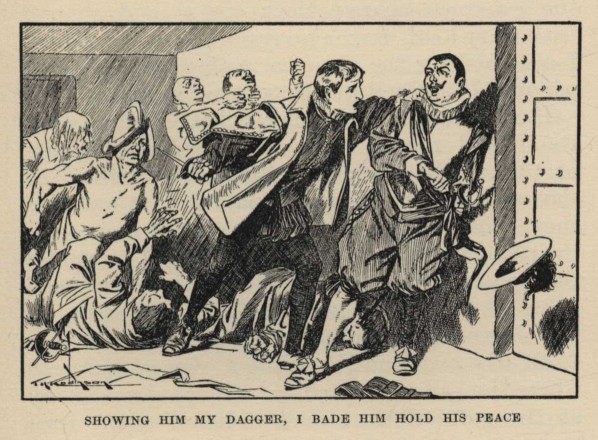
SHOWING HIM MY DAGGER, I BADE HIM HOLD HIS PEACE
Hasting back to the slaves' hall, I found that Raoul had ranged them all in readiness for departure. I had bidden Stubbs see to it that the slaves in the guard-room should don as much as they could of the soldiers' garments and cover their bald pates with their morions, and bring also the weapons from his bundles, and then, myself going at the head, holding Captain Badillo by the sleeve, we marched out and made our way as swiftly as we might without sign of hurry to where the galley awaited us. There was a sentry at the gate of the munition-house some two-score paces distant, but the dusk in some sort enshrouded us, and certain it is we came to the galley without molestation or so much as a cry.
But there a peril that I had not foreseen lay in wait for us. The cookmen, having bestowed their burdens aboard, stood carelessly on the quay to witness our embarkation. A dozen of the slaves had shipped themselves before these men were aware of aught amiss; but then one spied the villainous countenance of a notorious desperado beneath a soldier's morion, and communicating his discovery to his fellows, they with one consent took to their heels and fled towards their quarters with hue and cry. Sundry of them were felled by the slaves whom they encountered, but the rest got themselves clear away, and it was plain that ere long the alarm would be sounded in every part of the town. I cast Captain Badillo into the galley, and urged the rest of the men to quicken their speed, and they came helter-skelter, falling one over another in their haste.
Now it seemed that all were aboard, but I had not observed Stubbs among them, and began to fear lest he had been intercepted. But I then perceived him, and three of the galley-slaves, staggering towards me with a heavy burden which as they drew near I discerned to be none other than the mountainous bulk of Don Ygnacio de Acosta. I cried to them to hasten their steps, the which they did, and arriving at the quayside they let their load fall with no more tenderness than if it had been a bale of merchandise, and the Captain-General fell with a monstrous thwack upon the galley's deck.
At Raoul's bidding the men had already gotten out the sweeps. But at this the eleventh hour I observed a pile of sails lying over against the sea-wall, and I commanded Stubbs and those with him to bring them to the galley. The men who were aboard, in their haste to depart, had slipped the moorings, and could hardly be restrained from pushing off without us. I heard Raoul upbraid them with great vehemency, and ask them how they supposed they could escape with oars alone, whereupon they left their striving and gave us time to tumble the sails in among them. Then the rest of us leapt aboard, I last of all, and the slaves, thrusting their oars with desperate violence against the quay-wall, drove the rocking vessel out into the basin.
It was high time, for already there was stir and hubbub not a great way from the quay, and at the very moment when we sheered off a shot was fired, I doubt not by the sentry at the munition-house. Through the gathering dusk I saw a concourse of folk swarm upon the sea-wall and the quay, there being not a few soldiers among them. But all things had been done so suddenly as that none but the sentry had had time to kindle his match, and the galley was come forth out of the dock ere they arrived at the quay. Shouting and cursing they ran hither and thither, in a perfect medley and confusion, there being as yet none to direct them what they should do. I could not forbear making them a most courteous salutation with my hat, though I fear the darkness and their fury forbade them to mark the exceeding grace of it.
Turning to observe how things were ordered, I perceived that Raoul, whose knowledge of the harbour was the fruit of long and bitter travail, had established himself at the helm. I descended to the lower deck, where Stubbs had put himself over the oarsmen, who were set in their due ranks, and tugged at the sweeps with a vigour wherewith they had never laboured before, I warrant you. In sooth, Stubbs was constrained to bid them moderate their ardour, inasmuch as there lay a reef of rocks on the starboard side, and it would go hard with us if we by any ill-hap ran upon them. But the resolute and assured look upon their faces, villainous and forbidding as the most part were, confirmed me in my belief that, barring any untoward accident, we should in no long time be beyond reach of pursuers.
The harbour of Cadiz, you are to understand, hath a northward trend to the mouth of the river Guadaloto, whence the coast of the mainland runs north-westerly until we come to the mouth of the Guadalquivir. Four galleys, as I have said, were at anchor nigh the munition-house, and at the bulwark of Saint Philip at the north-east extremity of the island lay other sixteen. The first four we had already passed, but we must run the gauntlet of the sixteen, the which when we should have done we had nought to fear save perchance from the ordnance established on the coast of the bay of Caleta. I knew right well that notwithstanding the clamour that filled the town, where alarm bells were dinning amain, some time must needs be consumed before the occasion of the pother was thoroughly known, and the galleys could be put in fair trim to pursue us. So indeed the event answered to my expectation, for we came pretty near to the mouth of the harbour without anything whatsoever happening to mar our security.
It was now dark, yet not so black but that we could see our course, and besides there were the lights of the town to serve our helmsman as guide posts. That the town was mightily astir was demonstrated by a shot that was belched out upon us by one of the great pieces mounted on the bulwark of Saint Philip. But it did us no harm, unless some slight defacement of our figurehead that I observed next day was the work of this shot. Taking warning, Raoul steered the vessel hard over against the mainland, though I deplored the loss of time we suffered thereby. Indeed, but for this circuit which we made, and which, being a prudent measure, I could not gainsay, verily I believe we should have run out into the open sea without any let or hindrance whatsoever. But it happed that as we again bore westward, I perceived the black shape of a galley move from its anchorage in our wake, and presently after other of the same sort. This gave me no manner of apprehension, for we were fully manned, and our men, rowing for their very lives, were not like to be outdone by the hapless slaves in our pursuers, even though they were urged by the whip.
We were in another case when, as we came abreast of the point at the northern extremity of the bay of Caleta, a galley shot forth by the skirts of the rocks and made great speed to sea, not directly towards us, but taking a slantwise course with intent to head us off, as seamen say. It was a hard matter in the darkness to make a nice reckoning, yet I thought we should outstrip even this the most threatening of our pursuers. Being ware of a steady fair breeze off the land, I deemed it mere foolishness to neglect it; accordingly I bade Stubbs choose some few men among the oarsmen that were mariners, and send them on deck to bend the sails. This proceeding caused us to lose way somewhat, the sails having been cast aboard without any care, and so needing time to order them rightly. And when I saw that the captain of the galley in chase of us had foregone me, and being now come into the wind had already gotten his sails ahoist, I was not a little dismayed. Bethinking me of Don Ygnacio and Captain Badillo, hitherto mere idle passengers and burdensome, I resolved to put them to the oars, not without a secret relish in the thought that they would now taste of the toil they had heretofore inflicted upon the slaves. With my own hands therefore I cast Don Ygnacio loose, and bundled both him and the lesser captain to the lower part of the vessel, giving them into the charge of my good Stubbs, with a strait injunction that he should urge them to a decent industry. I did not see with my own eyes how they accommodated themselves to their task, because I returned to the deck to look to the sails and also to keep a watch on the enemy. But Stubbs told me afterwards that he plied the whip right merrily on the backs of those two proud Spaniards, and so wrought them to a just activity, to the great delectation of the galley-slaves, who themselves rowed with the more cheerfulness, beholding their tormentors dealt with after the manner they delighted in.
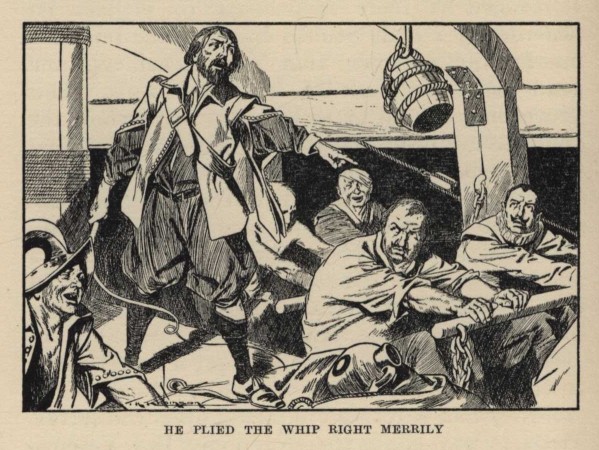
HE PLIED THE WHIP RIGHT MERRILY
When our sails took the wind, the speed of the galley sensibly increased, but it was not long before I was troubled to see that our pursuer was gaining on us. She had far outstripped her consorts, the which indeed were no longer visible, and might be left out of the reckoning. The darkness was waxing deeper, and I could scarce have seen our resolute pursuer had we not come opposite to the extreme westward point of the island, where, before the friary of Saint Sebastian, a great fire had been kindled, without doubt of set purpose to enfurther the chase. It was the customary place where beacon fires were made, to give warning of danger on the side of the sea. The ruddy glare, shining forth over the water, showed me that the galley was no more than two furlongs astern. We made all the speed we might, but I could not but perceive that the pursuer crept ever nearer, and I began to be exceeding apprehensive. Her oarsmen, having rowed not above a quarter of the distance we had come, must needs be fresh by comparison with my own men, who had been straining at the oar without remission for close upon an hour. Furthermore, she would certainly have soldiers aboard her, maybe to the number of fifty or more, and we had no sufficiency of arms wherewith to oppose them.
We had come beyond the cast of the beacon fire, into a vast impenetrable blackness. Pacing the deck in sore travail of spirit, and setting my wits on the rack if haply I might devise some stratagem that should profit us, on a sudden I spied by the fore hatch a large vessel of iron shaped like a round bucket, and pierced with holes, which I knew was designed to hold fire, whether for cooking or for illumination. I stood for a while chewing upon a device which the sight of this vessel had set a-working in my mind, and then hied me to Raoul to make him partner of the merry conceit I had fashioned. He heard it joyfully, and I went without delay to put it in practice.
I gathered together some shreds of canvas and rope ends and stuffed them lightly into the vessel, mixing them plentifully with grease that was employed about the rowlocks, and liquid tar out of pots left in the galley by the men that had been caulking her. Then I thrust two short pikes through the topmost holes of the vessel opposite one to the other, as it were at the cardinal points of the circumference, and stopped the others as well as I could. This done I strewed upon the top a handful of gunpowder, and set in the midst a length of slow match that might be two or three minutes in burning. Having kindled the match at its utmost end, I let down the vessel over the stern into the water, and with great satisfaction watched it float in our wake until nought was visible in the darkness save the red glow of the match. Then I ran below and bade Stubbs put the rowers to a very frenzy of labour, so that we might draw as far as we could from the pursuer while that their strength endured.
Returning to the deck I beheld my beacon burst into a bright flare; and the pursuer coming upon it, I saw the galley with great clearness, and sparkling reflections from the morions and harness of the soldiers that were aboard. I knew that so long as the light endured our own galley must be wholly hid from their eyes, and besides, they would be perplexed to know the meaning of the light, and might even suppose it to betoken a floating mine whereof they must be ware. Without doubt it would delay them somewhat, and give me the few minutes I needed for the full accomplishment of my design.
As soon as I saw the galley come within the circle of light I gave the word to Raoul, who put up the helm, so that our vessel swung round in a wide circuit until she was a cable length of her former course. I had already commanded the slaves to cease from rowing, lest the sound of their oars should acquaint the enemy with our movement. As we came round I saw the galley draw out from the radiance, and heard the voices of the men upon her. She sped directly forward, following the course her captain supposed us to have taken.
When she was almost abreast of us, and scarce three fathom length away, I bade the rowers pull with all their might, and Raoul steered straight for the galley. The rattle of the oars must have apprised the enemy that we were nearer than they supposed, but they were not thoroughly aware of us until we were upon them. Then, as they spied our vessel looming big out of the darkness, there was a great outcry among them, and it appeared that divers commands were given, for one moment she seemed to be swinging round to oppose the imminent shock, the next she held on her course as if endeavouring to evade us. By her greater speed she might without difficulty have drawn clear, but in bearing up she lost way, and so enabled us to diminish the gap between her and our galley.
Under the sturdy strokes of our oarsmen the galley in a manner leapt towards her. We were greeted with a pretty hot salvo from her musketeers, but there were no more than two or three of us upon the deck, and we were flat on our faces, all save Raoul, so that what with the sway and toss of the vessels and the flurried aim they took, we suffered no hurt. While the smoke still hung in the air there was a mighty crash: the bow of our galley had cut the other a little abaft of the mainmast. Being fashioned for this very device of ramming, our beak had, I doubted not, stove a hole in her side, whereas I could not suppose that we had been endamaged, though the vessel quivered from stem to stern.
Immediately after we struck I commanded the oarsmen to back water, by which means, and the cunning handling of the helm, we withdrew a space. From the enemy's galley came loud shouts of fear and consternation, and I heard some say that she was sinking. It troubled me that, to save our own skins, we had perforce imperilled the lives of three-score hapless slaves that had done us no wrong, but were indeed in a like case with our own men; but the breeze brought with it the rattle of the oars of the galleys that had first set off to pursue us, and I could very well leave the men of the foundering vessel to be rescued by their fellows. Our need was to draw clear away as swiftly as we might. Accordingly I commanded our men again to ply their oars, and this they did the more willingly, despite their fatigue, because they exulted in the crippling of their adversaries.
We were now come into the open sea. Our men pulled with measured strokes for a full half-hour before I deemed it prudent to suffer any intermission. Then I bade them lie upon their oars while I hearkened for sounds of our pursuers. There was not so much as a whisper. I could not but believe that the commanders of the galleys had given over the attempt to come up with us. Yet, as I took counsel with Raoul, I durst not rest thoroughly assured that all danger was past, nor all need for labour and watchfulness vanished. The galleons in the harbour would surely make sail as soon as they could be put in trim, and scour the sea for leagues around. Furthermore, we might fall in with some vessel homeward bound, or perchance outward bound from Lisbon to the Americas. It behoved us then to be very wary, and, as our proverb says, not to holla until we were out of the wood.
Our men, having fasted since the morning and toiled very hard, were in dire need of food, and I hazarded to rest for so long as they might take their fill of the broth and biscuit which the cookmen had brought aboard, bidding them spare enough for another meal. We should not be utterly safe until we made a French port, Bordeaux being the most likely, and we were distant thence, at the very least reckoning, upwards of three hundred leagues. Within a single day we must needs be in dire straits for food, but I had conceived a plan for supplying ourselves so soon as we were free from the immediate fear of pursuit.
When we had all eaten and drunk very heartily, though in good sooth the fare was of the poorest, we sped on again, the men taking turns to row, and so continued all that night. We directed our course at a venture, but at break of day we saw with thankfulness that we were not a great way from the shore. There was no safety for us but in boldness; accordingly Raoul steered directly for the land, that was very barren hereabout, and we put into a small bay, and ran the vessel abeach, purposing to lie up there and take our rest. I parted the whole company into watches, and we slept by turns, the men of each watch being straitly charged not to stray from the low beach to higher ground. While we stayed in that place I saw several galleys and one great galleon cruising in the offing, which I guessed to be hunting for us; but we were very well hid, and I thought it would scarce come into the heads of the Spaniards that we had adventured ourselves ashore.
During one of the watches I talked long with Raoul concerning the occasion of my venturing upon this course for his behoof. He was in perfect ignorance of the complicity of the Count de Sarney in his kidnapping, and was loath to believe that his uncle could have descended to such a depth of villainy. I was at no pains to bring him to my own persuasion, being content to leave the unravelling of the plot until we should come safely to his home. He drew from me the full tale of my adventures, breaking into a great gust of laughter when I related the manner of my dealing with Don Ygnacio. I assured him that he owed all to my honest mariner William Stubbs, on whom he bestowed thanks without stint, promising me in secret that, if we got safe to Torcy, he would reward him with much more than barren words.
We lay in that spot for near six hours, and then, having consumed all our food, saw ourselves faced by the prospect of famine. Certain of the galley-slaves, who were for the most part desperate and abandoned ruffians that richly deserved their fate, began to murmur, and not without reason, for it is no profit to a man to leap out of the frying-pan into the fire. In this strait I bethought me of the use whereto I had imagined putting our noble prisoners, Don Ygnacio and Captain Badillo. We launched our galley when the tide was full, and mounting into her, coasted along for a league or two until we descried a village of fishers nestling in a hollow between the cliffs. We then ran ashore, and made Don Ygnacio write on his tables a formal requisition for meat and wine, signing it with his full name and titles. And I went up the land with Stubbs and Captain Badillo, together with a dozen of the galley-slaves bearing baskets and buckets; and giving the captain to know that I would certainly use my dagger upon him if he by word, deed, or even with wink of eye betrayed us, we marched boldly to the village, where he presented his mandate to the people, and received from them enough to supply our instant needs. When I saw how grudgingly they furnished us, I pitied the poor folk, and wished with all my heart that I could pay them, suspecting that the minions of the Spanish king were not over scrupulous in honouring this sort of debt; but my purse was well-nigh empty, and I could only trust that Providence would in due season repay them a hundredfold.
The story we gave out was that the Captain-General of the King's galleys was making a voyage to inspect the coast, and we found this served us to a miracle among the ignorant fisher folk, both at this place and at the many other villages on the coast of Portugal where we made like perquisitions on the days succeeding. We pursued our way every night, and rested every day, choosing only small paltry places whereat to obtain food, and such as we might adventure into without raising a wind of suspicion. Nowhere did we come within an ace of danger save at one village, whose parish priest, a canon of Salamanca, would not be stayed from paying a visit of ceremony to the illustrious and worshipful Captain-General. It was a marvellous whimsical thing to behold their meeting, the priest offering gracious incense of flattery to the royal officer, who received his compliments and felicitations, I being at his elbow, in a mood betwixt dudgeon and impotent rage. I caught a look of puzzlement on the worthy canon's face as he made his adieu, and I fear me he carried to his humble parsonage a blighted estimate of the courtliness of princes' servants. As for me, I thanked my stars that the peril of discovery had as it were but lightly brushed us.
Our plan of hugging the coast, yet not so close as to risk our bottom on rocks or shoals, kept us far away from the track of sea-going vessels, and the weather being exceedingly fair, we accomplished fifteen or twenty leagues a day without danger from the elements or man. The voyage was tedious beyond telling, but I did not grudge it, for joy at beholding the amelioration it wrought in the health of my dear friend. I laughed often to think how the transfusion I had proposed in trickery to Don Ygnacio was in process of accomplishment by the agency of nature. He became leaner in proportion as Raoul indued flesh, and my scrupulous care that he should not have the means to overeat, but should perform a fitting share of labour at the oar, did not only reduce his bulk, but also brought his body to a healthful condition whereto he had been strange for many a year. He showed me no gratitude, and paid me no fees, though I declare without boasting that I did more for him than any physician or chirurgeon that ever mixed a powder or wielded a scalpel.
I used my endeavour to wrest from him a full confession of his villainies, but he would never admit further than what we knew: that he had received moneys from his cousin the Count de Sarney. As for the kidnapping, he avouched most solemnly that he was as ignorant as innocent in respect of it; but inasmuch as Raoul had acquainted him of his name and condition, and besought him with many promises to set him free, I concluded that he had found his best interest in playing the horse-leech upon his cousin.
We came in due time to Bordeaux, where our story, when it leaked out, became a nine-days' wonder. I am very sure it would have mightily pleased the Sieur Michel de Montaigne, had he been yet alive; of whose Essays I purchased a very pretty copy before I departed. We sold the galley at a price much above its value, to a rich noble of Perigord, who declared his intention of keeping it for his private pleasure, and for a perpetual memorial of the gullibility of Spaniards. Every galley-slave received his freedom and his proper share of the purchase money, though I confess I was uneasy in my mind when I thought of such rapscallions being loosed among honest people. We delivered Don Ygnacio and Captain Badillo to the mayor, who threw them into prison until he should advise himself concerning their future. Then one fair day I took ship with Raoul and worthy Stubbs in a vessel bound for Calais, being somewhat in pocket by my adventure.
V
In the interim between our departure from Cadiz and our arrival at Calais, Raoul's hairs grew again both on his face and on his head, albeit I observed with sorrow a many flecks of grey among them. Besides those and sundry scars and callosities, there was no other enduring mark upon him of his long torture in the galleys when he came ashore with me. We stayed in Calais only so long as that he might provide himself with decent apparel, and then we rode on hired horses, Stubbs following, to Dieppe. There we betook ourselves to Jean Prévost, to learn what had happened during the two months of my absence. He welcomed Raoul with boisterous demonstrations of delight, and having heard our story, cried out in a fury that he would drive his sword through the carcass of the Count de Sarney, and so rid the world of a villain. But I prevailed upon him to leave us to our own courses with the Count, whereupon he told us that the Count had but lately sold his own little domain, the which we took to be an evident sign of his perfect security.
Next day we rode all four to Torcy, and never did I see pleasure so admirably pictured on a man's countenance as it was when the old faithful servitor opened to us and beheld his true master. He lifted up his old cracked voice and called to his fellows, and they came pell-mell from the kitchen and offices, and leapt and laughed in the right Gallic manner, which we sober Englishmen are apt to find ridiculous. Their clamour drew the Count from his cabinet, and he stood at the head of the stairs as still as a stone, his countenance taking the colour of wax when he beheld Raoul at my side, and Stubbs capering (sore against his will) in the arms of a buxom buttery maid. The miserable wretch wreathed his lips to a smile, and said, mumbling in dreadful sort—
"Welcome, my dear nephew; I had given you up for dead."
"You have kept my house warm for me, monsieur," said Raoul, with a fine self-mastery; but Jean Prévost sprang up the stairs, and taking the Count by the collar, bundled him down and out at the door without ceremony. Raoul dispatched a man after him with his hat and cloak, and he went away and sought shelter, as we afterward learnt, in the house of one of his old retainers.
We made diligent search in the cabinet for evidence of his villainy, finding nought save a book of accounts wherein were set down the sums he had paid to Don Ygnacio de Acosta, the addition of which mounted to a monstrous figure. Raoul bade his servants gather up all the Count's chattels ready to be conveyed to him, and having put all things in order for his own occupancy he returned with us to Dieppe, where we spent a merry night at Jean Prévost's house.
We did not delay to seek the king's commissary, before whom we laid the whole matter. He took down our depositions, and examined the account-book, and delivered his opinion at great length, the which was, in brief, that we had nothing to convict the Count of the felony of kidnapping, though we might reasonably presume it; but that Raoul might bring a suit against him in the king's court for restitution of the moneys he had disbursed. This he did, and I had word, many months after, that the slow-footed law upheld his claim, and that the Count, being unable to acquit himself of so heavy a debt, was reduced to beggary and thrown into prison, there to remain at the king's pleasure. With great magnanimity Raoul relented towards him for the sake of his son Armand, whom he sought out in Paris, and, being perfectly assured of his innocency, endowed him with a pension sufficient to keep his father in a decent penury.
As for me, long ere this was accomplished I had returned with Stubbs (rejoicing in Raoul's liberal largess, and bound to my service for ever) to my own land. I was not wholly at ease in my mind, for I had absented myself from my duty in the Queen's Guard without her august leave, and had no expectation but that she would visit my fault upon me somewhat grievously. I betook me to the Palace on the day after my return, and learnt from my comrades that the Queen had been highly incensed against me, and had sworn to show me bitter marks of her anger.
I took up my post in the corridor at the proper hour, and had been there but a brief while, when her Highness herself issued from her cabinet unattended. She halted at sight of me, and, frowning heavily, cried in shrill and shrewish accents (and it went to my heart that she was now most apparently an old woman)—
"How now, sirrah? Dost dare show thy ugly face to me?"
"As for my ugliness, madam," said I, "that is as God pleases."
"It does not please me that thou hast hog's bristles on thy countenance" (my beard and mustachio, in truth, were as yet somewhat like a field of stubble). "Where hast thou been, monkey?"
I told her Grace that I had come from working some mischief among the galleys of her brother of Spain, whereupon she let forth a round oath, exceeding disparaging to the said brother, and bid me go with her into her chamber and inform her more particularly on that matter. I related the incidents in their due order, and when I came to that part where I had made the Captain-General swallow my vile admixture, she burst forth in a fit of laughter so immoderate that I feared lest, tight-laced as she was, she should do herself a hurt.
"Well, well, I pardon thee, my sweet Chris," she said, when I had made an end; "but I must e'en have my moiety of the spoils."
And 'tis sober truth that her Grace made me tell over into her royal palm a half of the French crowns that I had brought back with me. I confess 'twas not an exact reckoning, for knowing her Grace's propensity, I had been careful to make a subtraction from the full sum before I named it, a fault which I trust will be held to be venial, and not laid against me by honest men.
Her Grace's anger being thus mollified, I made bold to proffer a petition whereon I set much store, to wit, that she would suffer me to join myself to Sir Walter Raleigh for his voyage, the ships being at that time, as I had already learnt, on the point of sailing from Plymouth.
"Ods my bodikins!" cried the Queen; "hast thou lost thy silly heart to some Spanish slut, that thou art burning to return among the garlic-eaters?"
"I assure your Highness' Grace," said I, "that in all my wanderings I have never beheld a damsel whose eyes could lure me from devotion to my Queen."
At this her Grace showed as much pleasure as she were a girl of sixteen, and I looked for her to consent to my petition; but in this I was deceived.
"Well, well," she said, "thou'rt a proper bold rascal, but I can't have all my lovers running about the wicked world, in danger of falling into divers snares and temptations. No; ods my life, thou shan't go," she cried in a passion, "and if I see any mumping and glooming, to the Tower with thee!"
I smiled as amiably as I could, and vowed that I had no pleasure save her Highness' will; but I own that I nourish to this day a remnant grudge against my old mistress, for that she hindered me from serving with Sir Walter in that world-renowned enterprise.
tailpiece to Fourth Part
Interim
That feat of Sir Walter Raleigh was a wondrous achievement that any man might envy without blame. The English fleet came to anchor off Cadiz on June 20, 1596. Sir Walter's voice had great weight with the generals, and it was by his counsel and ordering that the enterprise was ruled. His device was to attack the galleons lying there in the haven and after assail the town, and so was it performed. Himself led the van ward in the Warspright, and ran through a fierce cannonade from the fort of Puntal and the galleys, esteeming them but as wasps in respect of the powerfulness of the others, and making no answer save by blare of trumpet to each discharge. And he dropped anchor close over against the St. Philip and the St. Andrew, the greatest of all the galleons, and the same which had overpowered in the Azores the little Revenge wherein Sir Richard Grenville died gloriously, winning deathless fame. Three hours the Warspright fought those great ships, and was near sinking; nevertheless Raleigh would not yield precedence to my Lord Essex or the Lord Admiral, but thrust himself athwart the channel, so as he was sure none should out-start him again for that day.
And so he set on to grapple the St. Philip, and the Spaniards fell into a panic, and that galleon with three others tried to run aground, tumbling into the sea soldiers in heaps, so thick as if coals had been poured out of a sack. Straightway two were taken or ever their captains were able to turn them; but the St. Philip was blown up by her captain, and a multitude of men were drowned or scorched with the flames. And Raleigh received in the leg from a spent shot a grievous wound, interlaced and deformed with splinters.
Thereupon my Lord Essex hasted to land, and put to rout eight hundred horse that stood against him, and by eight of the clock the English were masters of the market-place, the forts, and the whole town save only the castle, which held out till break of day. And the citizens were constrained to pay a hundred and twenty thousand crowns for their ransom, and moreover all the rich merchandise of the town fell to the English as spoils of war. And Sir Walter's valiant deeds purchased again the favour of the Queen, and she willed he should come to the Palace, and received him graciously, holding much private talk and riding abroad with him.
My grandfather, who was of a goodly presence, had taken the eye of the Queen, and she lifted him out of the Guard and made him one of her fifty gentlemen pensioners, albeit he was full young for such a place. These gentlemen were appointed to attend the Queen on all ceremonious occasions, bearing a gilt axe upon a staff, and to serve about the Palace, the which offices were little to his liking. And his father dying about this time, he went down into Hampshire to take up his inheritance, and was much busied about his estates, and exercising as justice of the peace that little law he had learned in the Inner Temple. But he was again lodging in London when my Lord Essex, having botched up his work in Ireland, and taking reproof like a spoilt child, gave rein to his ill-temper, and hatched treason against his long-suffering Mistress. My grandfather often spoke to me sorrowfully of that headstrong young lord, and related sundry of his foolhardy doings—how he locked into an inner chamber the Chancellor, the Chief Justice, and other grave men who had resorted to his house to inquire the cause of the assemblage of armed men there; how he rode boisterously through the streets, brandishing his sword, and calling upon the populace to follow him; and how finally he lost his head on the block.
A short while thereafter, my grandfather sailed to Ireland, where befell him the last great adventure, and, as he was wont to say, the most fortunate, of his life. The O'Neill, called Earl of Tyrone, had been long time a thorn in the side of Queen Elizabeth, taking gold from the King of Spain to sustain his treasons, and in the year 1597 making open war upon the English governor. He did great despite upon the people of the Plantation, and lurking in the forests, long defied the English soldiery. My Lord Mountjoy, whom the Queen had sent to Ireland as her deputy in the room of Essex, being resolved to make an end of the rebellion, ravaged and wasted the country, driving off the cattle, starving the people, and fortifying all the passes through the woods. And you shall read now how my grandfather once more, and for the last time, drew his sword, and the strange fashion whereby he was led to put it up again, for ever.
THE FIFTH PART
CHRISTOPHER RUDD'S ADVENTURE IN IRELAND, AND THE MANNER OF HIS WINNING A WIFE
headpiece to Fifth Part
I
I hold it ill that a man should be under no constraint to labour for his bread. To have a competency is indeed a comfortable thing; but being so possessed, a man lacks a spur to high emprise, and his faculties are like to wither and decay.
It was my fortune to receive from my father a property sufficient to supply the needs of the body; and the gear I added thereto in divers enterprises and adventures gave me the wherewithal to maintain a decent port before the world, and even at the Court of the Queen's Majesty, where a man had need be of some substance. But my ambition did not soar a high pitch: I was content to play a modest part on the world's stage; and when I fell out of humour, as sometimes I did, with the fevered life at Court, I withdrew myself to my little estate in the country, and there lived rustically among the boors and the pigs.
Nevertheless, from having seen many men and cities in my time, I was not long of finding this rustical employment stale upon me. After some few months I would begin to yearn again for the stir and bustle of London, where I might at the least whet my wits that had grown dull and rusty among my simple country fellows. One such time, in the late autumn of the year 1601, my years then numbering thirty, I rode out of Hampshire to London, and took up my lodging in King Street, in Westminster, rejoicing to meet my old friends again, to hear the clash of wits, and feed my mind on the marvellous inventions of Will Shakespeare and Ben Jonson and other ornaments and luminaries of that glorious age.
I found that two great matters were in men's mouths, whereof the one was the exceeding melancholy whereinto the Queen had sunk since the beheading of my Lord Essex; the other, the rising of the O'Neill (otherwise the Earl of Tyrone) in Ireland, and the descent of some thousands of Spaniards upon the harbour of Kinsale to enfurther that base ungrateful traitor. King Philip having failed in his endeavour to get a grip upon the throat of England, was seeking to annoy her extremities, like as a blister upon the heel or a corn upon the toe. I acknowledge that this news of his impudency made me itch and sweat to flesh my sword again on those enemies of my country; but I dallied somewhat, supposing that my Lord Mountjoy, who was now Lord Deputy in my Lord Essex his room, would speedily make his account with the Irish rebels and their Spanish consorts. Furthermore, Ireland had always shown me a forbidding aspect: I had heard much of its wildness, its thick woods and filthy bogs, its savage and uncouth people, from men that had served the Queen there and got thereby small thanks and less renown; and I had read of these matters also in the book of Master Spenser, whereof a written copy (for it was not put in print until many years after) had come into my hands. For these reasons, therefore, I was no ways in the mind to adventure myself across the Irish Sea.
But that winter, a day or two before Christmas, Sir Oliver St. John arrived in London out of that distressful country, bearing letters from the Lord Deputy and his council wherein they set down the exceeding hard straits in which they rested for want of provisions and men. They related how they had annoyed all parts of the town of Kinsale with the battery of their ordnance, so as the breach was almost assaultable, insomuch that they were not without hope of the enemy yielding, or of their being able to enter the town by force. But a thousand more Spaniards had lately sailed into Castlehaven with great store of munition and artillery; and moreover the Spanish commander had besought the O'Neill to haste to relieve him, who had accordingly come and encamped not far from the town with eight thousand men or more. The Lord Deputy therefore earnestly entreated the Lords of the Council in England to despatch to him without delay four thousand good footmen at the least, with victuals, munition, and money.
These urgent messages occasioned a notable stir among the Lords of the Council, and being laid before the Queen by master secretary Cecil, kindled her to an extremity of rage. Her Majesty had already been at great charges to sustain the Lord Deputy in his dealings with the rebels and their Spanish aids, and being ever loth to untie her purse-strings, she bemoaned exceedingly the ruinous expense which this demand of the Lord Mountjoy would cast upon her. Yet had she a proud spirit that ill brooked the thought of Spain planting a foot in any part whatsoever of her dominions, and she was torn betwixt her parsimony and her care for the common weal.
It chanced that, having gone to Greenwich, where the Queen then was, to bear my part in the revels that were performed at Christmas-time, I came in the eye of Her Majesty one day as she passed through the hall. She stayed her walk (alas! how tottering!), and as I rose up from bending my knee, my heart smote me to see how thin and frail her body was, albeit her eye still flashed and glittered with the fire of her unquenchable spirit.
"So, sirrah," quoth she, "you are come again out of your pigsty to refresh your snout with more delectable odours."
Her Majesty was ever hard of tongue, and she bore me a grudge for that I had demitted the humble office I had one time held at her Court.
"Madam," I said, "I have come like Eurydice, out of Tartarus into the bounteous light of the sun."
"Ods fish! dost think to win me by thy flattery?" she said; nevertheless methought she was not ill-pleased. But she went on, in a pitiful shrill voice: "What does a proper man here in idlesse, conning soft speeches and inditing silly verses to silly wenches, when my kingdom of Ireland lieth in peril for lack of swords! Go to, rascal; an thou wouldst pleasure me, show thyself a man, and vex me not with lip service and the antics of an ape."
Then, wellnigh breaking in two with her churchyard cough, she passed on, leaving me a sorry spectacle of confusion.
Methought that now I could do no other thing than take up the challenge which my wrathful Mistress had flung at me. In two breaths she had called me swine and ape, and I grudged that in this her feeble old age she should hold me in low esteem. 'Twas too plain that she was not long for this world, and the desire to please her, together with my old longing for a bout with the Spaniards, prevailed upon me to join myself to those voluntaries that were proffering their service in Ireland. Accordingly I wrote a brief epistle to her Majesty, acquainting her of my design, and received for answer two lines in a quivering hand.
"Chris, thou'rt a good lad. God bless thee with perseverance. Thy loving sovereign, E.R."
II
In such manner it came to pass that, one day about the middle of January, I found myself sailing into Kinsale harbour, my ship having aboard her many gentlemen that were voluntaries like myself, and some portion of the new levies for which the Lord Deputy had made petition. I stretched my ears for the sound of guns and the blast of war trumpets, but there was a great stillness and peace that smote me with dread of ill news. However, on coming to land, I discovered as much with disappointment as with joy that the Spaniards had yielded themselves by articles of capitulation a few days before, that the O'Neill had been beaten back from the English camp with sore discomfiture, and his men scattered to the four winds. Though I rejoiced in the good success of the Lord Deputy's arms, I was vexed that I had come too late to deal a blow against the Spaniard, more especially as I foresaw a weary campaign against the native rebels.
It fell out according to my expectation. The Lord Deputy, furnished with new supplies of men and munition, marched through the land, burning, wasting, harrowing without ruth, and hanging such chief rebels as fell into his hands. As it ever is in war, they that suffered most were the poor peasantry of the country: and seeing daily their lamentable estate, finding everywhere men dead of famine, insomuch that in one day's journey we saw upwards of a thousand men lying unburied, my heart sickened of this work, and I thought to return home. Could I but have looked into the future, I should have seen divers sorry experiences through which it was my destiny to pass; but that which is to come is mercifully hid from us. I foresaw neither what I was to suffer, nor that great blessing which Providence bestowed on me, whereby I have ever regarded my going to Ireland as the most fortunate and happy event of all that ever befell me.
That island is covered in every part with thick forest and vast swamps and bogs, from which arise exhalations exceeding noisome as well to the native people as to our English. From camping oft on the borders of such oozy fens I took an Irish ague, suffering sharp pains in all my limbs, with shivering and vomiting, my teeth chattering, my head oppressed with ringing noises intolerable. So sore was I beset by this most malignant distemper as that all my strength departed from me; I could neither sit my horse nor march afoot, and was afflicted with so desperate a languor and exhaustion that I believed myself nigh unto death. Being in so dreadful a case, I must needs be left behind in a small fort, that had lately been constructed to command a ford on the border of O'Neill's country; and I am sure that when my companions shook my hand and bade me farewell, none expected ever to see me in life again. But by the mercy of God and the devotion of my servant (there was no physician in that place) I recovered of my fever; and within ten days or so I felt myself ready to make a push towards the army that had gone before.
We had learnt by scourers that our people were then distant some thirty miles across the hills, intending to advance further towards the north. By this it was plain that I must needs hasten if I would come up with them, and there was the more reason for this in that the hills were known to be the haunt and covert of rebels. But I had good hope that, being furnished with a noble horse, and accompanied with my stout and mettlesome servant, and three tall natives of the country, of proven loyalty, I might compass the journey of thirty miles in security. I acknowledge that, having been occupied of late in hunting a broken rabble, I held the enemy in lighter esteem than I ought; and when I look back upon the matter, I feel some scorn of my recklessness, and deem that in what befell me I had no more than my desert.
We set forth at daybreak one morning, one of the Irishmen leading us, and took our way into the hills. I knew somewhat of the trials and hardships of travel in Ireland, but they were as nought by comparison with that which I encountered that day. The country was covered with close and almost impassable woods, intersected with watercourses of depth sufficient to render hazardous their crossing; and we pierced the woods but to find ourselves in swamp or morass. I was by this time aware of the treacherous nature of these quaggy places; but in spite of all our heedfulness, and notwithstanding that three of us were natives well skilled in their country's discommodities, we had ofttimes much ado to hold our course. Ever and anon we saw ourselves forced to go round about; and although our guide ordered our going with as diligent carefulness as he might, many times we had need to quit our saddles and lend aid to our horses, to draw them from the deceitful mire of the swamps, in such sort that we made but poor going, and by the middle part of the day had accomplished a mere trifle of our journey.
As we were picking our steps thus gingerly over an expanse of spongy ground, overhung by a low beetling cliff, there befell an accident upon which I cannot look back without a mortifying pang, seeing that I was, for all my thirty years, a veteran in war. In all our journey up to that moment we had seen neither man nor any living thing save only the small animals of the woods, and some few wild cattle that smelt us afar off, and vanished from our sight more quickly than eye could follow. On a sudden, before we were aware, there descended upon us from the midst of the bushes on the rock aforesaid a thick shower of spears and stones. A fragment of rock smote upon my headpiece with such violence as wellnigh to stun me; and my horse, made frantic by the sudden onset and the fierce cries of the men in ambush, swerved from the narrow track whereon we were riding, and carried me into the swamp. Dizzy with the shock, I lost my manage of the beast, which, plunging to regain his footing, cast me headlong from my saddle.
When I came to myself, I saw my horse in the hands of two kernes, as they are named in that country—rude and ragged fellows, barefoot, half-naked, and armed with light darts and a long and deadly knife which they call a skene. These two were hauling upon my horse's bridle, to bring the scrambling beast upon the dry ground. One of my Irishmen lay like a senseless log, with a dart in his body; another and my servant were overthrown, and the kernes were standing over them; the third Irishman, as I saw, had wheeled his horse, and was spurring along the track, I supposed to bring help. I made no doubt but that the rascals, when they had finished their work upon my followers, would deal likewise with me, whom they had left hitherto, seeing me dazed and bewildered by my fall.
But I perceived, after a brief space, that these ragged and unkempt creatures took no step towards me, but stood at gaze, their fierce eyes glittering with I knew not what excitation of mind. I was still in my wonderment, bracing myself to withstand the assault which I supposed they intended against me, when I came to a sudden knowledge of my true situation. I lay upon a thin crust of earth overlying the yielding bog, and already I felt it sinking under my weight. I had not been so short a time in the country but I knew in what extremity of peril I lay, and this knowledge serving as a goad to my numbness, I strove to lift myself from the clammy embrace of the bog that was beginning to suck me down.
And now my mind was smitten with the fear of death, and I take no shame from the terror that beset me. A man may face his foes, and not quail, with a weapon in his hand; but to lie helpless in the clutch of an enemy against which neither weapon nor courage is of any avail is a condition to turn the stoutest heart to water. I cried aloud to those kernes that stood upon the bank, choosing rather to die swiftly by their knives than to choke and smother in that slow torment. They did but mock me with jeers and horrid execrations, uttered in their barbarous tongue,[#] and their delight became doubly manifest when with every motion of my ineffectual limbs I did but assist the bog. The more desperately I strove to free myself, the more closely did the pitiless morass cling about me and clog me, like to that loathly creature of which mariners tell, that winds innumerable tentacles about its living prey and digests it to a jelly. Presently I could no more move my limbs, and when I sought to purchase succour from those that stood by, offering great rewards whereby every one of those paupers might have become a petty Croesus among his kind, they sat them down like spectators at a play, to feast their eyes upon my agony, even as in ancient days the Romans saw without compassion the holy martyrs yield up their lives beneath the claws of Nubian lions. And when I saw that neither promises nor entreaties would prevail with them, by reason mayhap that they knew not what I said, I wrapped myself in despair and silence, endeavouring, as a Christian ought, to contemplate the inevitable end with quiet mind.
[#] It must be remembered that Englishmen of Christopher Rudd's time were ignorant of the Irish civilization and literature which their ancestors had destroyed, and were even more apt than their descendants to decry what they did not understand.—H.S.
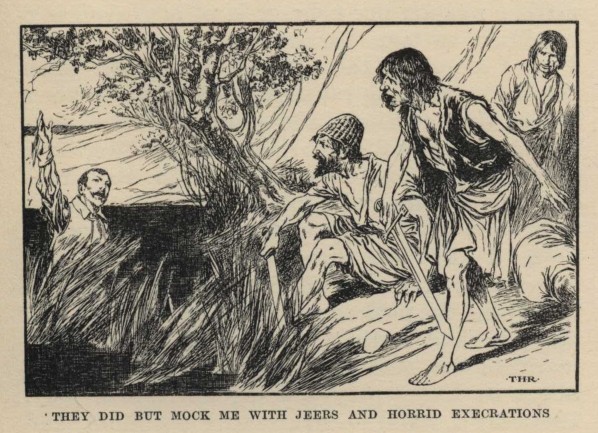
THEY DID BUT MOCK ME WITH JEERS AND HORRID EXECRATIONS
I had sunk wellnigh to my shoulder-blades, and as it were a mist was hovering before my eyes, when the sound of a horse galloping awoke my slumbering senses, and I looked up, thinking to see my Irishman returning. The kernes had risen to their feet, and turned their backs upon me, and their vociferous clamour fell to a great silence. And gazing beyond them, I saw, not my Irishman, but a young maiden, upon a hobby of the country, riding with loose rein at the very brink of the cliff above. Distraught and speechless, I gazed in amaze and wonderment, as this radiant creature brought her hobby to a stand on the height over against me. She cast one glance at me, and I heard a voice like a silver bell rung sharply, and at her words the kernes were set in motion as they were puppets moved by invisible strings, and with one consent, yet sullenly, they hasted to obey her behests. Having loosed the bridles of my servant's horse and of the maiden's hobby, they knit them together, and one of the men cast this rope of leather upon the bog towards me. Mustering my remnant strength I caught it, and passed it over my head and beneath my armpits, whereupon some few of the kernes laid hold of it at the end, and with mighty hauling heaved me from my slimy bed. So strong was the embrace wherein I had been clasped that I came to the bank in my stocking feet, having left my boots in that ravenous maw.
In this sorry plight my aspect was as filthy and foul as Odysseus when he showed himself to the maiden Nausicaa. My Nausicaa smiled upon viewing me, and when I could find no words wherewith to utter the gratitude of my swelling spirit, her lips parted, and that silvery voice uttered words in my own tongue, which fell the more sweetly upon my ear by reason of their quaintness of accent.
"I am troubled, sir," said she, "at this your incommodity, but no herald announced your coming, whereby we might furnish guides. Haply your messenger went astray?"
I perceived that she mocked me, but being too far spent to answer her in kind, I was content to relate briefly what had befallen me. She smiled again, and said lightly—
"My kernes did what seemed good to them, at no man's bidding. I pray you accept our hospitality, so that we can repair in some measure the coldness of your welcome in this our country."
Then she turned upon the kernes that stood glooming by, and spake a few words to them in their own tongue; and after she had assured me that they would do me no harm, and bid me accompany them, she sped back towards the quarter whence she had come, riding without bridle, a marvel to behold.
III
I would fain have had further speech with the damsel, to know more fully what was intended towards me; 'twas plain that she was of much consideration with these ragged ruffians, with whom her lightest word was law; and in truth I wondered not at their tame submission, for though her age was, as I guessed, not above twenty years, she had a most commanding and imperial mien, and a manner of speech that enforced obedience.
Having set me upon my horse, and likewise upon his my Irishman that was wounded, my servant and the other Irishman being compelled to remain afoot, the kernes led us along the path over the hillside, one of them bearing my pistol, another my sword, which he had taken from my belt. Thus as we marched, my mind was busy with these late accidents, and with my fair saviour, whose hair methought was of the hue of red gold, and her eyes of an incomparable blue. From such meditation I shook myself, to take note, as beseemed one in my case, of the nature of the country we were traversing. I perceived that the track, very rugged and narrow, wound steeply up the hillside, giving but few glimpses of any prospect. But on a sudden, coming to the summit, I beheld a very fair and delightful landscape, that put me in mind of the country in Devon. Betwixt the hill whereon I stood, and another like to it, above a mile distant, there lay a pleasant valley of emerald green, and in the midst thereof a lake or mere, and a silvery stream feeding it from the high ground above. But that which held the eye more especially in this delectable prospect was a castle in the midst of the lake—a fortress of stone built in the Norman style, of no great magnitude, but having a keep, a courtyard, and divers appurtenances. 'Twas a goodly spectacle, this hoary shape engoldened by the sunlight, girt about with blue water, and all encompassed by the living green.
At the end of the lake nearest to us, I perceived the semblance of a jetty framed of wood, whereto a vessel like unto our Thames wherries was moored; and both on the vessel and the jetty I saw sundry folk, and likewise a few assembled in the courtyard. In the castle wall was a water-gate, which now lay open, bounded above by the teeth of a portcullis.
We stayed not our march, but descended the hillside towards the lake. And as I drew nearer, I perceived that the castle was in ill repair, the stonework weatherworn and crumbling, and the iron of the portcullis exceeding rusty, so that I misdoubted whether it were possible to be raised. Methought the place was of very ancient date, perchance of the time when, for our woe, Strongbow set his foot upon this country—destined to be a continual nursery of trouble to her English governors.
When we were come to the waterside, a man met me from the jetty, and speaking in the English of a five-years' bairn, invited me to enter the wherry. This I did, with my own men and some of those that were with us, and we were ferried over the lake, and into the castle by the water-gate, through a covered way that led from the lake into the courtyard.
Alighting from the wherry and ascending some few ragged stone steps, I found myself in the courtyard amid a strange medley of beasts and men. There were cattle, swine, and poultry enclosed in tumbledown pens, and set against the walls were rude cabins of wood overlaid with turfs, which I supposed to be the dwellings of serving men and retainers. Of mankind there were in the courtyard about a score, men, women and children, the men being for the greater part well stricken in years. All these folk gazed upon me as you see peasants gaze at quaint outlandish monsters in a country fair. My men were taken, by command already given, into one of the cabins aforesaid; but I myself was ushered through a postern into the keep, and up a winding stair to a chamber barely furnished with a stool and a truckle bed, whereon was laid in a heap a suit of woollen garments. These I donned with much contentment in exchange for my own sodden and miry raiment, a man standing at the door with his back to me all the time, a courtesy I little expected in such savages. When I was dry clad he conducted me down the stairs into a lofty and spacious hall, where food of the English sort was spread upon a table. With this I was mightily refreshed and strengthened, for hard fortune had not bereft me of appetite, though I acknowledge my satisfaction was tempered by the recollection that I who had fought in campaigns with the greatest captains of the age had fallen an inglorious victim to a handful of wild Irish kernes.
Some while after the remains of my repast had been removed, and I was drumming my heels alone and in idleness, the door opened, and the maiden entered, and with her an old and withered dame of forbidding aspect and mien. A smile flickered upon the maiden's countenance as she beheld me, clad in coarse and ill-fitting garments, making my bow as courtly as to a queen.
"Our fare is poorer than I could wish," she said, "but 'tis our necessity at fault, not our good will."
"I thank you, mistress," said I, "and would fain beg that the same fare may be provided for my men, one of whom, I fear, was somewhat incommoded in the late misadventure."
"Their wants are supplied, sir," quoth she coldly; "and as for you, I desire that you will rest in such comfort as our poor means and the straitness of our dwelling may afford."
"In troth, mistress," said I, "I have known worse quarters and leaner fare; but desiring that you be at no more pains or charges in my behoof, I purpose with your leave to get me hence with all commendable speed as soon as my garments are dried, not forgetting that I owe my life to you."
At this she smiled again.
"Of what value your life may be to you or to your countrymen I know not," she said, "but at this present time it is of some worth to me."
"I am honoured, madam," said I in some puzzlement.
And then, seeing my wonder writ on my face, she laughed outright.
"I fear me, good sir, we are scarcely of one mind," she said. "Loth as I am to enforce you with any restraint, yet needs must I tell you that for a time you shall rest content to remain my guest."
"Shall, madam?" said I, with a lift of the eyes.
"Shall, sir," she repeated. "You shall be a hostage, a pledge for the fair treatment of my father."
"What have I to do with your father?" I asked, in my bewilderment.
"This: that your general has sworn to hang my father so soon as he lays hands on him, wherefore I have despatched a letter to your general to let him know that I have you in ward, and will surely execute upon you any violence or indignity that my father may suffer."
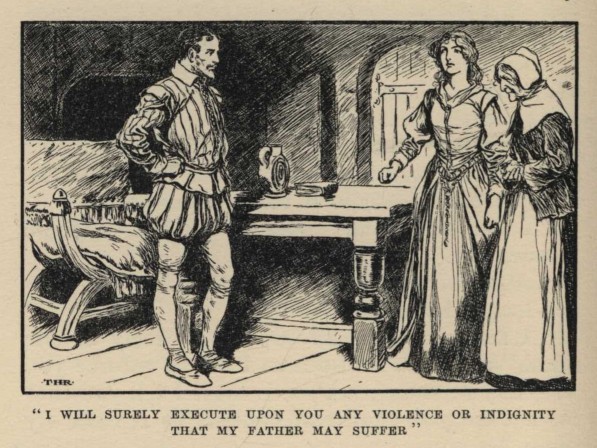
"I WILL SURELY EXECUTE UPON YOU ANY VIOLENCE OR INDIGNITY THAT MY FATHER MAY SUFFER"
This she said with a firm voice, smiting the table with her little hand; and I knew in my heart that what she said, that the fair termagant would surely do.
"And may I presume to ask, madam," said I, "the name of the gentleman upon whose safety my own salvation hangs?"
"His name, sir, is Kedagh O'Hagan: and yours?"
"A name of much less mark: Christopher Rudd, at your service."
"A knight?"
"Nay, madam, a plain gentleman."
She smiled a little at this, and continued—
"Well, Master Christopher Rudd, give me the word of a plain gentleman that you will use no endeavour to flee away, and I give you the freedom of this castle, such as it is."
"I thank you, madam, for your good will," said I, "but I have a larger notion of freedom. With your leave I will put no fetters on my discretion."
"Nor I on your limbs, and yet you shall be confined," said she; and after the exchange of sundry civil nothings between us, she departed with the ancient dame, who had stood by the while with arms folded upon her hips, and lips pressed together grimly.
The door was closed upon them, and by the voices that came to me through the timber I knew that two men had been set to guard me.
I had much to speculate upon in my solitude. This Kedagh O'Hagan, the damsel's father, was a notorious rebel, and a doughty lieutenant of the O'Neill. I knew that my general, Sir Arthur Chichester, had vowed to hang him, as she had said; but seeing that the fellow was slippery as an eel and had escaped us not a few times, I saw myself doomed in all likelihood to a long imprisonment unless peradventure I could make my escape. Moreover, if by any foul chance he should lose his life, the gallows was my certain destination, an ignominious end which I could not contemplate with any comfort or serenity.
From meditating on this I came to think of my fair hostess. I had seen full many a glorious beauty at the Queen's Court, and in France when I served King Henry, but none that so bewitched and teased me as this Irish maiden, with her red-gold hair, and her eyes of unsoundable blue, and her coral lips that curled the one above the other when she smiled. And the dulcet fluting of her voice, breathing out pure English with a faint smack of something outlandish and yet most pleasing, remained singing in my ears. Moreover her bold and mettlesome spirit, yet not a whit unmaidenly, liked me well, and I considered within myself that I could be well content to enjoy her society during the few days which I needed for the perfect recovery of my strength. Her converse, methought, would sweeten my confinement until I should make my escape, whereto I was resolved.
I remained in that chamber while daylight endured, now ruminating, now reading in the one or two books that my fair jailer had set there for me—some poems of Master Spenser, Tottel's Miscellany, and sundry other volumes which I marvelled to find in that barbarous land; and it chancing that my supper was brought to me by that man that had some smattering of English, I fell on talk with him, to learn somewhat, if I might, of his fair mistress. Her name was Sheila, he told me—quaint and pretty to my ears; she was her father's sole child, and the apple of his eye. She had dwelt some time in England, her father having been carried there a hostage, but loved Ireland, said the man. He told me also that she was vehemently besought in marriage by a young chieftain of that neighbourhood, one Rory Mac Shane, betwixt whose family and her own there was an ancient feud. 'Twas Mac Shane's purpose to end the feud by this alliance, but he was looked upon with loathing both by the maiden and by her father, not only because of the inveterate enmity between the two houses, but also because they misliked the man himself, a robustious unlettered fellow, a foul liver, and one that constantly besotted himself with usquebagh, a vile drink of the country. Mac Shane had sworn, so it was told me, to wed the maiden, will she, nill she, for which reason had her father conveyed her to this castle in the lake, as being more easily defended than his greater seat a few miles distant. I had ofttimes heard of the raids made one upon another by these petty Irish chiefs, and my informant did not question but that some time, when occasion served, Mac Shane would seek to attain his end by violence. In this case I could not but marvel that O'Hagan had left his daughter, and withdrawn the main part of his people to assist O'Neill; but reflected that he must know his own business best, and so dismissed the matter.
IV
At fall of night I was led upstairs again to the small chamber wherein I had made my change of clothes. The door was locked and barred upon me, and by divers faint noises that I heard I knew that sentinels were set without to guard me. Being wondrous fatigued I slept very soundly, and was awakened only when a sunbeam falling athwart my bed struck upon my eyes. I rose up, and all being silent, made a more thorough survey of my room than I had done afore. 'Twas by measurement of my paces not above ten feet square, and had a single window, not closed with glass, looking upon the lake forty or fifty feet beneath. The wall was thick, and the window was splayed inwards, being upwards of an ell in breadth on the inner side, but no more than three spans on the outer; and here 'twas divided in twain from top to bottom by a bar of iron, set in the stonework.
This bar I perceived to be deeply rusted, like the iron of the portcullis above the water-gate, and methought I could with a vehement wrench or two force it from its sockets, and so leave a clear space and a way of escape. But when I leant upon the sill and contemplated the water beneath, of whose depth I was ignorant, I was somewhat mistrustful of my success if I should attempt so great a dive. My further meditation of this matter was hindered by the noise of unlocking and unbarring, and I was seated upon my bed when a man entered, to bid me descend to break my fast in the chamber below.
The second day of my imprisonment was like unto the first, save that my fair chatelaine did not deign to visit me, but sent me greetings by her servitor. At this, without any reason, I was somewhat vexed, having counted on seeing her comeliness and hearing the music of her speech. I took no pleasure in reading of Colin Clout or Astrophel, laying down my book, and striding about the room in dudgeon. But as I went I pondered that matter of escaping by the window, which, though narrow, would let me through, my body having been marvellously thinned by my late sickness. My splash into the water, if 'twere heard by one of my guards, would bring a boat in chase of me ere I could win to the bank, swam I never so strongly. And if by good luck I were neither heard nor seen, yet I misdoubted of my safety, for I was in poor health, unarmed, ignorant of the country, and in no case to adventure myself in a guideless journey over those rugged hills, the haunt and lair of maybe thousands of the wild Irish, ay, and with a hue and cry ringing behind me. What with these my doubts and fears, and the neglect (as I called it) of the mistress of the castle, the day lingered out very discomfortably, and I went to my bed at odds with myself and all men.
On the next day, after breakfast, my servant Stubbs was admitted to me. He told me that he and my Irishmen were treated very handsomely, the lady of the castle herself visiting them twice a day and inquiring of their welfare.
"She's a beauty, sir," said the man heartily.
"And my neck is in a noose," said I, feeling a twinge of jealousy in that Stubbs had been favoured above me, and I told him of my being a hostage for the life of the maid's father.
"Why, then, the general will have a care that he comes to no harm," said Stubbs, "seeing that an English gentleman is of more value than many mere Irish."
"In his own conceit," said that sweet and tunable voice, and the lady came into the room, attended as before by her ancient dame of the sour visage. "Good morrow, Master Rudd."
"Good morrow, Mistress Sheila," said I, shooting a look at her as I made my bow.
A flush mantled her cheek at this hearing of her name.
"I brook no plots nor complots between you two," said she. "I bade your servant attend you as a grace, Master Rudd."
"For which you have my hearty thanks, madam," said I. "The conversation of your servitor is a child's babble, and the reading of your books breeds only discontent."
"You have but to give your word, and you are free to range this castle, sir," said she.
"'Twould be but to beat my wings against the bars of my cage," said I.
"A bird, quotha!" said she, laughing. "His feathers are ruffled, and he stints his song."
"He has no mate, madam," said I; and after more bandying of words, she departed again.
So passed some few days, the while I nursed my strength for the attempt whereon I was resolved. The lady paid me fitful visits, and I looked for them ever more wistfully. Once, when I had not seen her for thirty hours or more, I dared to read aloud at her entrance, from the book of Master Spenser's sonnets upon my knees, the concluding verses—
"Dark is my day, whiles her fair light I miss,
And dead my life that wants such lively bliss;"
whereupon she took the book from my hand, averring that such woebegone stuff would but addle my wits. She spoke as one chiding a froward child, and I acknowledged to myself that she had dealt tenderly with my presumption. One day when she came to me I perceived that all was not well with her. Her bright hue was faded, her eye was sad, and whereas she was wont to be merry with quips, answering me right saucily, her spirit was now leaden. She heard me in silence, and heaved many a sigh. I guessed that she had received ill news, and by little and little I got from her what it was that so much troubled her. She told me that the O'Neill had been signally worsted, and was withdrawing himself deeper into his mountain fastnesses. She feared for her father's safety, and then, with a flash of her old spirit, she struck my table and declared right vehemently—
"If my father is taken, and suffers what is threatened against him, I vow, Master Rudd, that you shall dangle from the castle wall, a feast for kites and crows."
And then she broke into a passion of weeping and fled out of the room.
This news came as a rude shock to the contentment into which I had let myself be lulled; and fearing lest in the heat of battle Kedagh O'Hagan should come to harm even against the commandment of my general, I saw that it behoved me, if I would put my neck beyond jeopardy, to slip the noose at once. I had no manner of doubt that the girl would do even as she had said, out of duty, though I believed that she held me in no disfavour in my proper person.
I determined therefore to put my plan in practice in the early part of that night, so that, if I should come safe to shore, I might have the hours of darkness to cover my flight. But my design was frustrated by much coming and going betwixt the shore and the castle. It was plain that some enterprise was afoot, and from my little window looking forth, I watched the daylight sink into night without any diminution of the busy movements below.
But when the small hours crept on, and all around was wrapt in an immense stillness, and a snoring in two several tones proclaimed that my guardians were asleep, I clambered up into the embrasure, and, employing one of the legs of my truckle bed as a lever, with as little noise as might be, I forced the rusty iron bar from its sockets; which done, I loosed part of my outer garments, and having made them into a bundle with my boots, I tore my coverlid into strips and knit them into a cord, and tied my bundle to one end of it. The other end I knotted about the bar, which I laid transversely across the window, and then let down the bundle into the depths towards the lake.
Upon hauling it up I discovered that it was dry, whereby I learnt that my rope was not of length sufficient to touch the water, though having used all my convenient bedding I knew that it could not fall far short. I deemed neither the rope nor the bar stout enough to bear my own weight, and saw that I must needs dive into the lake, and take my chance. Accordingly I turned myself sideways, and so contrived to squeeze my shoulders through the narrow opening, not without fear lest I should lose my balance, and topple down in a heap without the opportunity of poising for the clean dive that would best ensure my safety and cause the least noise.
Having let down my bundle again, I was now able to see (for the summer sky had some luminancy) that it came within a little of the water. As I crouched there upon the sill I was in no little tremor and dread, for if there should be a watchman upon the keep, as was most like, he would scarce but hear the splash I should make. I stretched my ears for sounds within and without, below and above, and when all was yet silent I gathered myself together, and without poising, for which there was no room, I lifted myself on a sudden, and extending my arms above me made the best shift I could for the dive.
'Twas as though I hurled myself upon stone, so mighty was the shock of my entering the water. Methought in my confusion of wits 'twas an age before I came to the surface, gasping for my breath. In a daze I trod water until my senses were some little restored; then, hearkening with all my ears, but hearing nought, I swam close beneath the wall, until I found my bundle dangling, and thereupon tugging upon the cord I snapped it, and set the bundle upon my head. There I held it with one hand, while with the other I struck out towards the shore; at which arriving I scrambled up the bank, and sped away as fleetly as I might to the shelter of a copse hard by. Here, all winded as I was with swift running after my dive and swim, I made short work of stripping off my wet clothes, and donning the dry raiment and the boots which I had brought in my bundle; which done, I wrung out my sodden things, tied them about my back with the cord, and making a cast as well as I could for the English fort I had lately left, I turned my back upon the lake and the castle, and issued forth from among the trees to plod over those unknown barren hills.
V
The sky, as I told you, rendered a pale light, it being high summer; and I was rather dismayed than pleasured when I saw the moon's pale sphere stretching a bow beyond the further hills. The more light, the less chance of shunning an enemy. Truly, I could have been thankful for a lanthorn upon my path, for I had need to go slowly and heedfully, lest I should find myself embogged, of which my one experience was more than enough. I laboured over the ground, making small headway, for where 'twas not marshy 'twas rugged and bestrewn with loose stones, and where 'twas none of these, I was annoyed with pestering thorns or entangled underwood. And the short summer darkness was already dissolving with the dawn.
I looked back over the way I had come, and saw the lake not above two miles off, below me, and the castle rose-tinted in the sun's ray. Even now, I thought, the nimble kernes, whose fleetness of foot exceeds that of a horse, might run me down, if my escape had become known. I considered whether to seek a hiding-place, in some bosky covert or some brier-clad hole in the hills; but bethought myself that I must then lie quiet all day without food, and maybe lose myself when I came forth in the night. It seemed to me best to keep right on, watching my steps, and shrouding myself with such brushwood and overhanging cliffs as I might encounter on my way.
Presently after I had thus resolved, I came unawares out of the trackless ground upon a beaten path, which methought led in the direction of my course. To follow this path stood me in some danger of meeting my foes; yet I should make speedier progress upon it, and have my eyes for scanning the country instead of for taking heed of bogs or pitfalls. Therefore I cast away all scruples of timidity and struck with assured gait into the path.
'Twas not long before I repented of my temerity. On a sudden I heard a patter of feet before me, and ere I could slip aside for hiding there came into my sight, round a bend in the path, a man of lofty stature, running as for a prize. At one and the same instant we halted upon our feet, the runner and I, being divided by no more than thirty paces. I had but just perceived by his garb that the man was an Irishman when he leapt from the path down a shelving grassy bank at his right hand, and bounded like a hunted stag towards a clump of woodland no great distance away.
Bethinking me in a flash that every Irishman hereabout was an enemy, and that this man, were he to escape, might fetch a horde of his wild fellows upon my track, I sprang after him, in my soul doubting whether with my utmost endeavour I could overtake him. For some little time the man outsped me, but coming to the skirts of the woodland he suddenly stumbled, sought desperately to recover his footing, and then sank upon the ground. Gathering my speed, in four leaps I was upon him, and closed with him, expecting that he would strive with me for the mastery; but he lay limp and lumpish in my hands, his eyes beseeching mercy. So stout of frame he was, I was no little amazed at my easy victory, until I saw by his laboured breathing, the quivering of his nostrils, and the pallor of his cheeks, that he was utterly spent. This put me in a quandary. I had a mind to leave him and go my way; but in a moment I saw that I might perchance make some profit of him. Taking a portion of the cord about my bundle, I bound his hands behind him, and when the heaving of his naked breast was somewhat stilled, I bade him arise and lead me to the English camp, fearing the while lest he should be of the wild barbarians that knew no tongue but their own. But at my words he looked me in the face, and told me that the English were many miles away, marching northward.
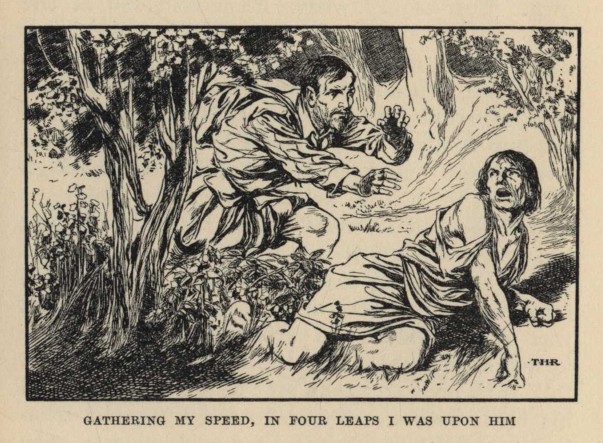
GATHERING MY SPEED, IN FOUR LEAPS I WAS UPON HIM
I asked him how he knew, whereupon he said that he had himself been among them. Questioning him further, by degrees I learnt that he was one of the band that had followed Kedagh O'Hagan into the field. Two days before a battle had been fought betwixt the rebels and the army of my general, and this man had been taken, but having escaped by night, he had fled for refuge to the cabin of his sister, whose husband was a henchman to Rory Mac Shane. The husband being absent, the man had learnt in talk with his sister that Mac Shane had gathered his men, with the intent to fall upon the lake-castle of O'Hagan while he was footing it with the rebels, and to carry away the maiden whom he had sworn to wed. At this news the man, in loyal service to his chief, brake from his sister, and ran all night over the hills to warn his mistress of the peril threatening her. Being not yet recovered of the fatigue of marching and the stress of battle; having, moreover, followed an indirect and winding course to avoid the raiders of Rory Mac Shane, who were already on foot; the man had overtaxed his strength in running, and so fallen helpless into my hands.
In my course through the world I had gained some skill in reading men, and was not easily deceived when those I had to do with were artless and simple, not versed in the tricks of courtiers, nor trained to mask their thoughts like the ambassadors of kings. The man's bearing was honest; his story fitted both with his present sorry case and with what I had heard before; briefly, I did not doubt him. And when I inquired of him where these raiders might be, and he told me that they were not above three miles from the place where we then stood, and full in my path, I could not but look upon this encounter as a fortunate accident for me.
And now I had perforce to choose what I must do. I could not proceed in safety until Mac Shane and his raiders were no longer between me and my goal, and I considered whether I should hide myself a while, and let the man continue his journey, and so warn his mistress of what was to come; or, making assurance doubly sure, I might hold him in hiding with me until the danger of interception was past, then leave him well tied up, and go my way: in which case the lady must remain unwarned. And as I thought thereon, and my mind's eye dwelt upon that piece of loveliness, forlorn in her ruinous castle, with few to help her, and remembered what I had been told of this Rory Mac Shane, a violent and besotted savage, on a sudden I felt the blood rush to my temples, and without more ado, scarce knowing what secret motive impelled me, I caught up my prisoner, unloosed his bonds, bade him pluck up heart, and, supporting his half-fainting form with my arm, set forth with hasty step towards the quarter whence I had come.
For all that I was cumbered with the poor wretch, I made better speed back than forth, because he knew the way, and avoided rough and quaggy places. The morning was yet young, wanting something of four o' the clock when we came to the lake-side, and I felt a passion of wrath spring within me at what had formerly served me well—namely, the culpable neglect of watch and ward upon the castle. There was no lookout man posted upon the keep; not a soul stirring on battlements or in courtyard: a heinous lack of precaution which could not but set on edge the nerves of any man with the least experience of war. God-a-mercy, thought I, is this the Irish manner of guarding fair ladies? No eye had spied us as we descended the hillside; and when, at the water's brink, we set up a loud halloo, we might have been wolves howling in a wilderness for all the stir we made.
Ofttimes as we came the Irishman had glanced back timorously along the path, and now he clutched me by the arm and stretching forth his hand, pointed to a regiment of dusky shapes moving against the sky behind us; which seeing, and being in no manner of doubt what they were, I made a trumpet of my hands and let forth a shout like to split my lungs. And then, above the broken parapet of the tower, a woman's form appeared, and stood there a brief space at gaze, then vanished from my sight. Still bellowing my loudest, I saw men moving in the courtyard, and presently from the water-gate the wherry shot forth under the strokes of two oarsmen. The Irishman by my side called to them in their own tongue, and they made great haste, and we waded into the lake to meet them, and leapt into the vessel, which swung about and conveyed us with all speed over the water and through the gate. I perceived the countenances of these oarsmen how they were blank with stark amazement, their eyes resting upon me as upon one risen from the dead; and the women in the courtyard crossed themselves and fell back from me as I passed among them, and 'twas told me afterward they held me for a wizard.
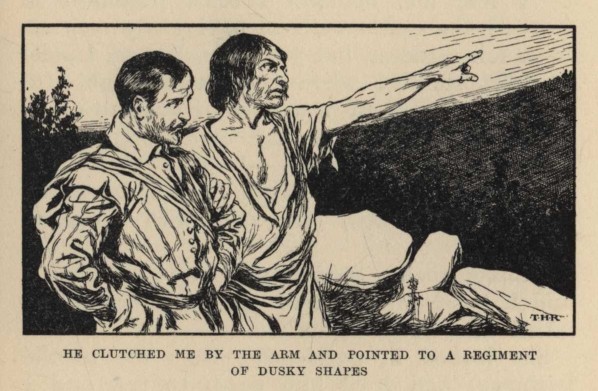
HE CLUTCHED ME BY THE ARM AND POINTED TO A REGIMENT OF DUSKY SHAPES