A GENTLEMAN-AT-ARMS (continued 2)
Reading edition
About twelve months thereafter, claiming the fulfilment of his father's promise, he joined himself to the company that his friend and captain Hilary Rawdon was raising for service under King Henry of Navarre, whose fortunes were at that time at a turning point. King Henry III, his cousin, had fallen to the assassin's knife, and Henry of Navarre should then have ascended the throne of France; but he was of the Huguenot party, and the Catholic League was bent upon crushing the Huguenots and excluding Henry from the enjoyment of his heritage. The army of the League, commanded by the Duke of Mayenne, held Paris; and Henry, desiring to put an end to the religious struggle that rent France asunder, and to make himself master of a united kingdom, saw himself constrained to fight for his crown. His army was choice and sound, but small, and in his extremity he sought the help of Queen Elizabeth, who sent him aid in money and men, and permitted gentlemen to enlist voluntarily under his flag. Many flocked to him, both as upholding his rightful cause, and from the love of adventure, and hatred of the Spaniards, with whom the Leaguers were in alliance. At that time my grandfather, his age being but eighteen, was moved rather by the latter considerations than by the former, though in after years the justice of a cause held ever the foremost place in his mind.
Henry of Navarre had broken up the siege of Paris and withdrawn with his army into Normandy, hoping thereby to tempt the Duke of Mayenne to follow him, and so enforce him to a decisive battle. Mayenne, on his side, issuing forth from the city, had sworn to drive the Bearnais into the sea, or to bring him back in chains. Such was the posture of affairs when that adventure befell my grandfather which I set down as he told it me, as now follows.
THE SECOND PART
CHRISTOPHER RUDD'S ADVENTURE IN FRANCE, AND HIS BORROWING OF THE WHITE PLUME OF HENRY OF NAVARRE
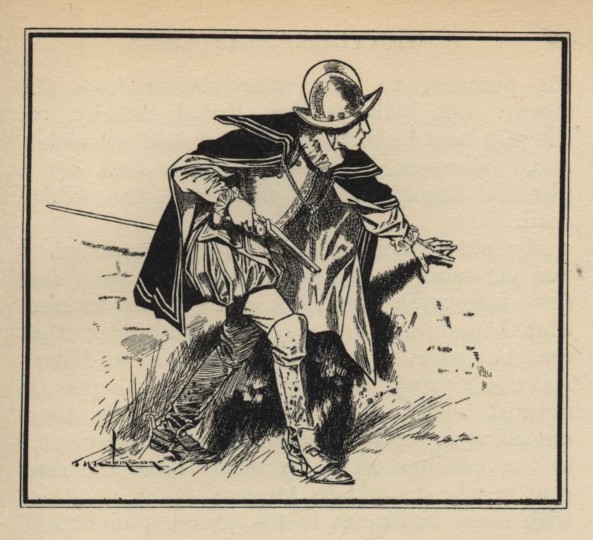
headpiece to Second Part
I
When I survey the backward of my life, and con over its accidents and adventures, my thoughts are drawn as by a magnet to one point of time—the moment when, through mirk and darkness, benighted in a strange place, I saw the glimmer of a light.
'Twas as foul a night as ever I saw: the sky black as Erebus; the wind howling like unnumbered poor lost souls; the rain, that smote me full in the face as I rode, stinging my flesh as each particular drop were a barb of fire. I pulled my cloak about me, and bent low over the pommel, to gain some shelter from the storm; but little comfort had I thereby, for the rain beat in betwixt my neck and the collar, and, moreover, my horse's hoofs cast up a plentiful bespattering of mud from the sodden road.
My outer man being thus discommoded, I was yet more ill at ease in my mind, for I had some little while suspected, and was now assured, that I had lost my way. I had ridden that road but once before, when I made one of Hilary Rawdon's troop that he took from Dieppe on outpost duty to St Jacques. By this time, according to my recollection, I should have come to the Bethune river, by whose bank the road runs nearly straight to Arques; but having met with some hindrance in my journey, night had overtaken me or ever I was aware, and with the darkness came the sudden bursting of the storm. What with the one and the other I could not doubt that I had strayed into one of the by-roads about Dampierre, and was now as helpless as a mariner without compass or glimpse of star.
I was musing how best to escape out of this pother when, on a sudden lifting of my head, I saw upon my left hand, level with my eyes, the blurred twinkle of the light. With a muttered benediction I turned my horse's head towards it, resolved, whether it shone from prince's mansion or shepherd's cot, to beg shelter there until the fury of the storm was abated. But I had not ridden above five yards before I found myself checked by a quickset hedge, the which made me to dismount and lead my horse up and down, seeking for some gate or gap whereby I might approach the light. Within a little my groping hand taught me that the hedge was neighbour to a low wall, and searching further, I knew that the wall was ruinous, the top being ragged and uneven where bricks or stones had fallen away. Then, touching a gatepost, and so learning that the gate was removed, I was on the point of leading my horse through the gap when my good genius whispered a hint of caution. Hilary Rawdon had dispatched me back on an errand of moment to the King; I should prove but a sorry messenger if, for my comfort's sake, I ran into any peril; 'twas meet that I should first find out what manner of house this was; for all I could tell, it might harbour an enemy. With this thought I led my horse across the lane ('twas no more), and coming after a few paces to a clump of trees, I hitched his bridle to a bough, took a pistol from the holster, and made my way afoot through the mire towards the beacon light.
The mud lay very thick, and there were besides many obstacles in the path, whereon I stumbled, being unable to see them for the darkness. Nevertheless, I picked my way among them as well as I could, holding my sword close lest it should clash upon a stone, and so came to the house, the which I perceived now to be of a good largeness. The ray shone through a chink in the shutter of a window some few feet above my head. The door was at my left hand, at the top of a flight of steps. Being resolved not to seek admittance until I had learnt somewhat of the inmates, I clambered upon the window-sill, the which being very wide gave me good foothold, and setting my eyes to the chink, I peered into the room.
My eyes were at first dazzled, from so long being in the dark; but within a little I saw two men seated at a table, between me and the light, the which came from two large candles set close together. Their backs were towards me, so that I could not tell with any certainty what manner of men they were; but from their shape I judged them not to be of the labouring kind; and indeed the room, so much of it as I could see, the chink in the shutter being but narrow, appeared to be an apartment of some splendour.
Now I had been sent by Hilary Rawdon to let King Henry know that the Duke of Mayenne was moving towards him from the eastward with a great army, without doubt intending to give him battle, word having been brought to St Jacques by a peasant that the duke was no more than forty miles away. The house whereto I had come could not be above four or five miles from the King's camp at Arques, wherefore it might be supposed that these men were friends of the King. Yet it crossed my mind that they might peradventure be Leaguers, and while I was in any uncertainty I durst not seek shelter with them, nor could I with any conscience proceed on my way. It behoved me, therefore, to make some further discovery, if that were possible, and having no satisfaction in what I had seen, I descended from my perch, and treading very warily, crept along the wall at my right hand, purposing to make the circuit of the house, in the hope to learn something more. By good hap the rain had now ceased, the sky was clearing, and, the month being August, the darkness was not so deep as heretofore; indeed, the stars were now visible, and there was a lightness that seemed to foretell the rising of the moon.
The house was all in darkness, save where I had seen the light. When I came to the corner I saw a smaller building some dozen rods apart, and there, as I passed it, I heard the sound of horses drawing their halters, whereby I guessed it to be the stables. And I perceived now many signs of disorder in the garden—statues overthrown and broken, fragments of wood and porcelain, and other things which led me to believe that the house had lately been put to the sack, and made me go with the more caution. Stealing through the garden to the back of the house, I found a door, which, when I pushed it, yielded an inch or two, but no more, by reason of some barricade behind. A little beyond it, however, I came to a window hanging loose upon its hinges; and after I had waited a moment to be sure that I was neither seen nor heard, I squeezed my body through, and entered a small room which, when my eyes became accustomed to the dimness, I perceived to be empty. There was a door at the left hand. Holding my sword under my arm, I drew my dagger, and crept across the room to the door, which, when I came to it, I found to be ajar. I pulled it towards me, desisting for a moment when it creaked, and listening, with a fear that the sound might have been heard. But there was nothing to alarm me, and having opened the door just so wide as that I might pass through, I came out into a long wide hall, which I could not doubt led to the chief entrance.
Here I paused, as well to recover breath—for my excitement had winded me—as to listen again. From my right came the low rumble of voices, and in an interval of silence I heard on my left hand, towards the main entrance, as I guessed, the sound of deep breathing as of a man asleep. Though the storm had ceased, there was still a slight moaning of the wind as its gusts took the eaves, and trusting to this to shroud my movements, I crept along the passage in the direction whence I had heard the voices, which came more clearly to my ear, yet muffled, as I advanced. Thus I arrived at a door on my left hand, and perceiving this to be open, I entered very stealthily, and saw that I was in a large and lofty chamber divided in two by a curtain.
I heard the voices yet more clearly now, but not distinctly, so that I could not catch the words. There were one or two shafts of light coming through the curtain, which when I ventured to draw near to it I found to be old and torn. Peeping through a rent that was just below the level of my head, I saw, not two men, but four, seated at the table, all masked, and wearing, as I perceived in the case of the two men whose faces were towards me, their cloaks being thrown back, the cuirasses of men of war. I listened very eagerly, to catch something of their discourse, but they were at a good distance from me, and spoke in low tones, so that I heard but a word here and there, and could not by any means piece them together. This irked me not a little, but I durst not part the curtain, for then I should have been in full view of the men on the further side of the table, whose backs I had seen when I peeped through the shutter; and I was troubled, also, by having, as it were, to strain one ear towards them and the other towards the man at the end of the hall, who might wake at any moment and, for all I knew, come to this very room. So in much impatience and fearfulness I listened, and went hot and cold when I caught the word "Bearnais," for that was the name by which the Leaguers called the King, and I had reason to suspect by this that these men were no friends of his. And by and by I heard other names, "Rosny" and "Biron," the King's friends, and then all again became confused, until one of the two that had their faces from me leant back in his chair, lifting his arms above his head as if to stretch himself, and said very clearly, and yet without raising his voice: "It were easy to snare the game, but the keepers are wary."
While I was still wondering what these words might mean, and vague surmise was making me uneasy, I heard very faintly the neighing of a horse, and a moment afterwards an answering whinny, but this much louder. The men had given over talking, and he that had last spoken still lay back in his chair, with his hands clasped behind his head, and so he remained while a man might count ten. Then of a sudden he straightened himself, flinging his hands apart, and leant across the table, and said: "The second horse is in the open." The men over against him looked at each other, their eyes glittering strangely through the masks, and I waited to see no more, for I could not doubt that the second horse was my own, and it was time for me to go. As quickly as I might, yet with great quietness, I stepped across the room towards the door, and had but just got myself out into the hall when I heard the grating sound of chairs pushed back as when men rise in a hurry, and saw a light flash through the doorway as the curtain was parted. With my heart in my mouth I fled on tiptoe along the hall and into the room I had first entered, and had not even time to close the door behind me when the men passed, their spurs ringing as they trod. I heard them come to the great door, and one of them kick the sleeping sentry, and then the door was thrown open with a mighty creaking, and I knew that they were betwixt me and my horse.
In a moment I skipped out by the window, delaying just so long as sufficed to replace it as it had first hung, and being now outside, stood to consider of my course. I saw with thankfulness that the sky had again become clouded, so that all was now near as dark as before. Men were calling to one another in the garden, and since they could hardly as yet have discovered the whereabouts of my horse, I thought I could do no better than make my way back as straightly as I could to the clump of trees where I had left him, trusting to luck and the darkness. I had gone but a few steps when I stumbled against a man, and believed myself undone; but he said: "Do you see anything?" and composing my voice I answered: "Nothing," and then left him and sped on, scarce believing in my good fortune. So with many a stumble and shrewd knock upon my shins, making all haste yet moving with such quietness as was possible, I came to the wall, and without waiting to seek the gateway I scrambled over, and fell upon my face in the mud. For this I cared nothing, only that in my fall my sword clashed against a stone, and a shout from the enclosure warned me that the alarm was given. I was on my feet in a trice, and sprang across the lane, in desperate fear lest my horse might whinny again and bring the enemy upon me ere I could loose him and mount. In my agitation of mind I could not remember whether the clump of trees was on my right hand or my left, but a break in the flying scud gave me so much light as to show me what I sought, and I had just reached it and was plunging through the undergrowth when I heard the clash of steel as the men scrambled over the wall like as I had done, and their voices calling one to another as they asked whether they saw any man.
So dark was it in the copse that I could not see my horse, and I doubt whether I should have found him in time if he, hearing my approach, had not whinnied and so led me in the right direction. I unloosed his bridle in haste, but had no sooner vaulted into the saddle than a man ran up behind me, and cried out to the others that he had me. I set spurs to my horse, but at the moment of his springing forward I felt a sharp pang in the calf of my left leg, and the man let forth a vehement oath when the horse carried me beyond his reach. Bending low in the saddle to shun the branches of the trees, the which swept my cheeks and dealt me many smarting wounds, I put my horse to the gallop, incommoded by finding that one of my stirrups was gone, and knowing never a whit whether I was riding towards Arques or from it. I came out of the copse into a road, and hearing no sounds of pursuit,—indeed scarce expecting any, since the men were not mounted—I gave the horse his head, and breasting an incline we came to a small hamlet, where I did not scruple to knock at one of the cottages until a window was opened, and a peasant sleepily demanded what I lacked. From him I learnt that I was but a stone's throw from the Bethune river, which gave me great comfort, and so I spurred on, and by and by came to the bridge by Archelles, and so on until I gained the marshy plain below Arques where the King was encamped, never stopping until I was challenged by the outposts.
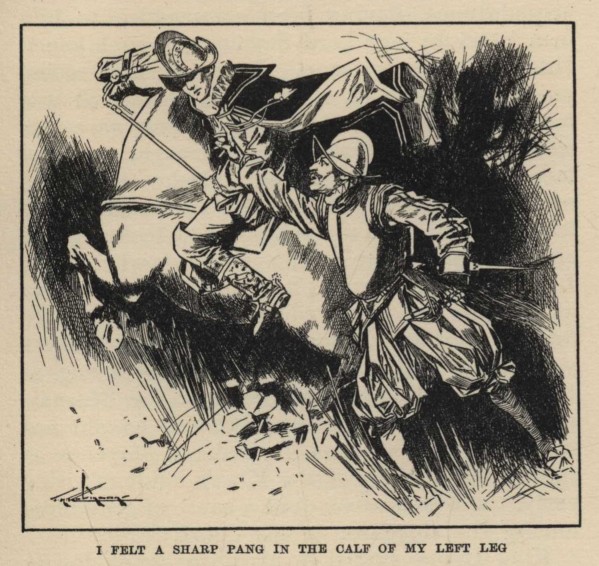
I FELT A SHARP PANG IN THE CALF OF MY LEFT LEG
The day was now breaking, and since my news was important—both that which I brought from Hilary Rawdon and that which I had discovered for myself—I demanded to be led instantly to Rosny, with whom I had some slight acquaintance, having been commended to him in a letter by my Lord Seymour when I joined Hilary Rawdon's troop. Rosny at first seeing me broke into a fit of laughter, the which was not to be wondered at, seeing that my garments were drenched through and through, and my face was muddy both from splashes and from my fall, and withal I walked somewhat stiffly from the wound in my leg. But he looked grave enough when I told him in brief what news I carried, and he would have me accompany him at once to the King, whom he doubted not to find already astir, though the morning was yet young. (I had not then heard the saying of Pope Sixtus V, who foretold that the Bearnais would come off conqueror because he did not remain so long abed as the Duke of Mayenne at table; but I knew of the King's habit of rising early, the which was indeed a cause of grumbling among the sluggards of his Court.)
King Henry smiled in his beard when Rosny presented me to him, but heard me soberly enough when I gave him Hilary Rawdon's message, to wit, that the Duke of Mayenne was drawing nigh with twenty-five thousand foot and eight thousand horse to give him battle.
"What shall we do against so great a host with our poor three thousand?" said the King to Marshal Biron that stood by. "Ventre-saint-gris! Is it not hard to be a king without a kingdom, a husband without a wife, and a warrior without money?"
Here Rosny said that I had more to tell, and the King, pursing his lips so that his long nose seemed to touch his chin, bade me say on. I told him of my seeing the light, and of all that followed thereafter, saving only the matter of my wound, and when I had done, he said sharply between his teeth—
"Well, what then?"
(His words in truth were "Mais encore?" but 'tis meet I turn French into English in telling my story now.)
"I know no more, Sire," I said in answer, "but I suspect the men I saw were Leaguers, and were plotting secretly to seize your person, or to do some other mischief, and 'twere well to send a party to take them, or if that be too late, to go not from the camp without a strong guard."
"What!" cries the King; "shall I cage myself like a song-bird, or tether myself like a drudging ass? Ventre-saint-gris! my dear friends have already counselled me that I seek refuge speedily in your country; but I tell you that while I continue at the head of even a handful of Frenchmen, such counsel 'tis impossible for me to follow. As for plots, a fig for them all! Did I not listen but yesterday to a tale of a plot, as shadowy as yours? There may be such plots afoot; let there be. The assassin of my late cousin will not lack of imitators. But shall we start at shadows, or flee like a cook-wench at sight of a mouse? The men you saw, as like as not, were bandits, discoursing on the spoils they expect to reap from the ambushing of some rich Churchman. Plots! I am aweary of the word."
This reception was so little like what I had looked for that I felt abashed and, I own, somewhat ruffled also. The King's courage was known of all men, but I hold that to neglect a warning is not courage, but mere foolhardiness. While I was meditating whether I should urge the matter, the King suddenly hailed a burly man that was riding slowly a few short paces from his tent.
"Hola, Lameray," he said, "send a dozen men to the château of St Aubyn-le-cauf—which is beyond doubt the place of your adventure, Master Rudd—and seize any man you find therein. Master Rudd will tell you more at large," and with that he turned away, jesting with Rosny.
The man whom the King had called Lameray dismounted from his horse, which I perceived to be much bespattered with mud, and coming towards me with a sort of roll in his gait, he said, in a full, harsh voice—
"Master Rudd will tell me more at large?"
There was certainly something of insolency in his tone, and being already ruffled with the King's manner of receiving my news, I did not feel very amiably disposed towards this stranger, who looked at me under his beaver with a glance of mockery.
"Master Rudd, if it please him, will tell me more at large," says the man again, while I was still considering of how I should deal with him.
"You heard the King's command, Master Lameray——"
"Pardon—De Lameray," says he, interrupting me.
"De Lameray," I said, making a bow. "The château of St Aubyn-le-cauf, your nobility may not be aware, lies something less than two miles along the road towards Dampierre, and if you hurry you may yet be in time to do the King's bidding."
"And perhaps Master Rudd would be pleased to accompany me?" he said, smiling upon me.
"No," I said shortly, and thinking that perhaps his mockery sprang of my dirty and dishevelled aspect, I left him there, and strode away, with a bare acknowledgment of his salutation, to the quarters I had formerly occupied in the camp. There, having bathed and got me into clean raiment, and bound up the wound in my leg, no great matter, and eaten pretty ravenously, I set off to find Raoul de Torcy, who was of my own age, and had been my particular friend ever since I came to France.
"What news of the camp?" I said, after I had greeted him, for having been absent for a fortnight I knew nothing of what had happened of late.
"The question I myself would ask," he said, "for I only returned from Paris last night."
"From Paris?" I said.
"Yes. I set off thither the very day after you left us, having friends there who are also very good friends of the King, and yet know all the counsels of the Leaguers. I rode thence the day before yesterday, bearing news of a plot to kill the King."
"Another?" I exclaimed.
"I know not what you mean by 'another,' my friend; but there is assuredly one afoot, and I rode apace with the news, and was chased well-nigh all the way from Paris by a fellow that had the very cut of a Leaguer. But I shook him off yesterday evening, just before the storm broke, and came safe into camp, and little enough I had for my pains."
"Why, did the King flout you too?" I asked.
"He laughed, and took it very lightly. 'Another?' says he, just as you did: 'I hear of plots as regularly as I eat my dinner.' And then he went off arm in arm with Rosny and paid no more heed to me."
Whereupon I told him of my own errand, and of what I had seen at the château, and how the King had received me.
"I love our Henry," said Raoul, with a shrug, when I had made an end; "but I sometimes question whether he be not too careless to make a good king for France. However, we have done our part; if any ill befalls him, it will not be for want of warning."
I asked him then who was this Monsieur de Lameray that the King had dispatched to the château, and he said he had never heard the man's name; but encountering Jean Prévost as we sauntered forth from his lodging, we put the question to him, and he told us that the Baron de Lameray had lately come into the camp and offered his sword to the King, with three score gentlemen well mounted and equipped. He had been a Leaguer, but it was no more uncommon then than now for warriors to shift their allegiance, and Henry, who dearly loved a good sword, had welcomed right heartily this notable accession to his party, and smiled upon him so graciously that certain of his well-tried servants were displeased thereat. Whereupon Raoul shrugged again, complaining of the fickleness of kings' favour.
II
On the night of that day, I rode with Raoul and a dozen more to the lodging of the Marquis de Contades in Dieppe, he having bidden us to supper and a game of tric-trac. The company was very merry, but I was aweary with having been up all the night before, and what with our host's good cheer and the heaviness of the air I could scarce keep my eyes open. Ever and anon I wandered to the window to cool myself, wishing with all my heart that the company would break up, whereof I had little hope, such jovial entertainments being commonly prolonged far towards morning. Looking forth one time into the silent and empty street, I saw a shadow move in a doorway on the further side, and felt a passing wonder as to who might be lurking there so late, concluding that 'twas some poor townsman on the lookout to earn a few doits by holding a stirrup or some such petty service. When I returned into the room the marquis rallied me on my air of weariness, and on my telling him that I had been long without sleep, he was pleased to admit my excuses, and bade me get away to my bed. I went down the stairs very gladly, to walk to the inn where I had left my horse and my servant, and had taken a pace or two before I remembered the shadow in the doorway. I looked up then to see whether the man was still there, and in that very moment a figure sprang at me out of the dark entry, and I saw in the starlight a long dagger uplifted against the sky. I had no time to draw my own weapon, but my lucky remembrance of the man having saved me from being taken wholly by surprise, I dropped suddenly to the ground, and my assailant stumbled over me in the vehemence of his onset. Before he could recover his footing I was upon him, but could do no more than grip his right arm, and we fell together. There we were, rolling over and over, and in the heat and fury of the struggle I heard the footsteps of other men on the cobbles, and a voice asking in a hoarse and breathless whisper which was the Englishman, and another answer: "'Tis no matter; the fool has botched it; strike anywhere!" and then the man I was gripping cried out with pain, for one of the newcomers had stooped and stabbed him, and as he loosened his hold upon me he screamed again, and I knew that in a moment one of these hacking swords must find me out.
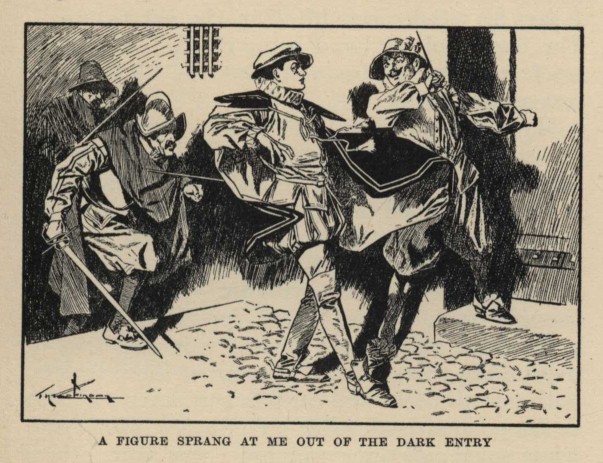
A FIGURE SPRANG AT ME OUT OF THE DARK ENTRY
But as I grappled the assassin to me to shield myself, there came to my ears a shouting and the clink and clatter of spurred boots upon the stones, and three of the four men above me took instantly to their heels. The fourth remained, still bending over us, and I heard his pants, and though I could not see his sword-arm, being partly underneath the body of my first assailant, I saw his other arm, lifted in the act to lunge. The fingers of his hand being distended, in that brief moment I observed that his little finger was amissing.
My companions, called forth by the cries and the sound of the scuffle, now came running up, and the man, with a growl of rage, straightened himself and sped away into the night. I rose, bruised and very scant of breath, and when I told them in a word what had happened, they were for pursuing the villains. But the time, though brief, was sufficient for them to make good their escape, and it was vain to think of overtaking them in the darkness of those streets, with many crooks and corners and narrow alleys; so they came back after going a few paces, and while some asked me whether I was hurt, others bent down to look at the fallen man, who was stark dead. A torch being brought from the marquis's lodging, they saw the device upon the man's coat, and some one cried that it was one of De Lameray's men. At this Raoul looked at me, and I at him, but we said nothing to our companions, having much food for thought. The party being thus broken up, those of the guests that belonged to the camp at Arques got their horses and rode back with me, and when we arrived at the camp Raoul accompanied me, late as it was, to the lodgings of Rosny, to whom we recounted, when we had roused him up, both what had befallen and what our suspicions were. He heard us gravely, and then bade us get to our beds, saying that the matter must be looked to in the morning.
I was glad enough to seek my couch, and fell asleep instantly; but all on a sudden I awaked and sat up with a start, a strange discovery having come upon me in the midst of my sleep. I was again peeping through the curtain at the château of St Aubyn-le-cauf; again I saw the man leaning back in his chair, and then unclasping his hands as he rose; and now my recollection acquainted me with something which had scarce made any impression at the moment of my actual beholding: the man's left hand had lacked a finger! I could not doubt that the man in the château and he of the late adventure in Dieppe were one and the same; and I had now some inkling of the reason why my life was attempted. Dead men tell no tales. My tale was already told, and the King had not hearkened; but I had somewhat new to add to it, and maybe he would not again turn me a deaf ear.
I had but just broken my fast when a lackey came to command my attendance on the King. I found His Majesty with Rosny in his tent, and the Baron de Lameray was there too, and as I entered and made my obeisance he said something under his breath that set the King a-laughing.
"Well, my friend," said Henry, "what is this I hear of tavern brawling in the streets of my good town of Dieppe?"
"I know not what you may have heard, Sire," I said, "nor can I answer for the doings of others; but an attempt was made upon my life last night," and then I told him the whole story as I have told it you.
"And who were these would-be assassins?" asked the King when I had done.
"The fellow that was killed, Sire, was said to wear the livery of my lord here," I replied, glancing towards Lameray; "and as for the others, I know no more than that I saw the hand of one of them, and it lacked a finger."
At this Lameray took a step forward, and glaring very darkly upon me demanded whether I hinted at him. Whereupon I smiled very pleasantly, and glancing at his hands, which were cased in gauntlets, as the manner of the camp was, I said—
"I have not the honour of knowing with what afflictions Providence has been pleased to visit Monsieur de Lameray."
The King laughed, and even Rosny's grave face relaxed a little; but Lameray frowned, and said with some heat: "I have already explained to His Majesty that at the time of this fracas I had not returned from the errand which he was pleased to entrust to me, and of that the gentlemen of my company can bear witness."
"And your château was empty, my good Rudd," said the King.
"I scarce expected otherwise, Sire," I said, "the men having had warning. And as to that matter, it is a slight thing, no doubt, but one of those I saw there had suffered the same misfortune as Monsieur de Lameray, if I take his words aright: he had but three fingers on his left hand."
The King cast a searching glance upon Lameray, who did not change countenance, but said with a sneer—
"It seems that Monsieur Rudd is beset with visions of conspirators lacking a finger. Maybe he is little practised in the use of the sword."
"I wield my sword with the right hand, Monsieur de Lameray," I said; and then the King, whose countenance had regained its wonted serenity, asked me why I had said nought of the three-fingered man when I told him of what I had seen in the château. This question put me in a confusion, for it was an ill matter to explain to the King that his manner of receiving my news had ruffled me, or that the remembrance had not come to me until the middle of the night, for that might very well seem to be a dream, or even an invention. I stammered in this quandary, and, I doubt not, looked as much embarrassed as I felt; and the King laughed somewhat impatiently, and turning to Rosny asked why he troubled him with these brawls and midnight robberies. Without waiting for an answer he bade us depart, vouchsafing to me no word save the bare command, but telling Monsieur de Lameray that he would do well in future to keep his lackeys more firmly in hand.
I returned to my quarters in high indignation, marvelling also at the King's strange simplicity, for I believed now with the utmost assurance that the man I had seen in the château and he I had seen in the street were Monsieur de Lameray and no other. And an hour or two after I found that I was not alone in this suspicion, for Rosny himself came to me and asked me to be wary, and to acquaint him immediately of anything I might see or hear further. "We must put things to the proof," he said in his brief way. When I told him that Hilary Rawdon had expected me to return to St Jacques after accomplishing my errand, Rosny replied that I must not do so, but remain at Arques. "And see that you do not stray from the camp alone, my friend," he said, "if you value your skin as I value mine." And so he left me.
III
It is ill work kicking one's heels in camp when no fighting is toward, and I was glad enough when a servant of Jean Prévost's came to me in the afternoon with a request from his master that I would join him and a few more in a gallop. I donned my doublet—the same which I had worn on the night of my ride—and chancing to put my hand into its inner pocket, I felt some small thing which, when I took it out, I found to be a thin roll of paper. For a brief space I looked at it in a kind of puzzlement, turning it over in my fingers, at a loss to know how I had gotten it. And then, in a flash, it came back to me. I told you that before I lost my way near the château of St Aubyn-le-cauf, I had already met with some hindrance in my journey, and I declare that the surprising events that had happened afterwards had clean driven it from my memory; but now I remembered it perfectly. About two miles out of St Jacques, just as the dusk was falling, and a drizzle of rain, I came to a cross-roads, and saw a man lying in a huddled heap by the roadside. I got off my horse to look more closely at him, and when I bent over him, I saw that he was stretched in a pool of blood, and there were great gashes in his doublet, not such clean cuts as a rapier makes, but jagged rents, the work of coarser instruments. I spoke to him, and he opened his eyes and groaned feebly, and then endeavoured to speak; but he was plainly very far gone, and I could make nothing of his mutterings. I looked around to see if there was any house whereto I might convey the man, who I supposed had been beset by footpads, but there was no dwelling at hand, and I was considering whether I should lift him on to my horse, when he lifted his hand painfully, and gave me a roll of paper. I asked him what it was, and what I should do with it, and he tried to tell me; but though his lips moved no articulate sound came from them, and even as I looked at him he heaved a great sigh, and his head fell back, and I knew that he was dead. What I might have done had not my errand been urgent I cannot tell; but since I could do nothing for him I delayed but to compose his huddled limbs, and mounted my horse again, thrusting the paper into my pocket, where it had since lain forgotten. Such things happened often in the lawless and distracted France of that time, so that it is no wonder it went out of my head when I had matters of greater moment to think of.
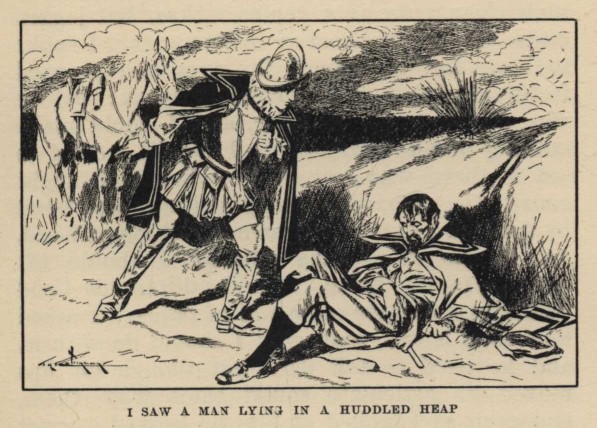
I SAW A MAN LYING IN A HUDDLED HEAP
Having found the paper, I unrolled it to see what it might be. It contained a few words plainly written, and yet I could not read them, for they were of no tongue that ever I heard of, and I was not long in concluding that they were writ in what is called a cipher. I rolled the paper again and put it back into my pocket, thinking to show it to Rosny by and by; but meeting Raoul de Torcy as I left my lodging, I spoke of it to him, telling him how I came by it. When I described the poor wretch who had been thus done to death, Raoul said 'twas like the horseman who had followed him from Paris, and begged me to leave the paper with him, for he had some skill in reading ciphers, and guessed that if the man had been a Leaguer, as he supposed, the writing might prove useful to the King.
I rode out with Jean Prévost's party, and after a hard gallop we were walking our horses when we were overtaken by the King himself, with Rosny and half-a-dozen more. The King looked over his shoulder as he rode by, and told me with a laugh that he was going to my château, as he called it, to look for the three-fingered gentleman, or at least to lay the ghost. I did not relish his mockery, nor the quizzing of my companions, who were importunate in asking what he meant, but I forbore to tell them, Rosny having charged me to say nothing of the matter. A little after we turned our horses and rode slowly back.
I had not been above five minutes in my quarters when Raoul burst into my apartment in a great heat, and cried to me that he had read the cipher.
"And what's more," said he, "it was intended for me myself! That poor fellow you found murdered was not a Leaguer after all, but had been dispatched from Paris hot upon my heels by my friends there."
"And what is the message he brought in such haste?" I asked.
"Why, hark to it," he said, thereupon reading from the paper: "'The mischief purposed against the King will be wrought by a feigning friend, who has lately joined himself to the royal forces. We do not yet know his name, but will acquaint you with that as soon as it is discovered.' Who should that be but Lameray?"
"Where is Lameray?" I cried instantly, remembering that the King had ridden out but sparely attended, so that if it was designed to seize him no better opportunity could present itself. When Raoul told me that he had not seen the baron all that day I sprang up in haste, saying that it were well we should make inquiry; and calling to my servant to saddle my best horse, I went out with Raoul to seek Charles de Martigny, who knew everything. From him we learnt that Lameray had ridden forth some while before with his troop to hunt in the forest of Arques across the river. Martigny remarked some excitement in our demeanour, and asked whether I had some new grudge against the baron; whereupon I told him what we had learnt, saying when I ended, "'Tis to be hoped he is hunting fair game."
"We must go and acquaint Rosny," said Martigny at once.
"Rosny has ridden out with the King—to lay the ghost of the three-fingered man," I said, with a kind of scorn.
"What!" cried he. "To St Aubyn-le-cauf? That is not far from the forest of Arques."
"True," said I coolly.
"And the King may be at this moment in the extremity of danger," he cried. "What you will do I know not, but as for me, I go straight to Biron and ask him to gather a troop and ride out instantly to defend the King."
"And be snubbed for your pains," said I, telling him then of the warnings I had already given. "We should be admirable laughing-stocks for the camp," I added, "did we discover a mare's nest again."
This had some weight with both of them, for a Frenchman of all men loves not to appear ridiculous. We concluded then to say nothing as yet to Biron, but to ride across the river, we three together, and see for ourselves the manner of Lameray's hunting. Within a few minutes we set forth, and as we descended the further side of the bridge of Archelles, we perceived far away a cloud of dust on the road that skirted the forest, and it moved in the direction of St Aubyn-le-cauf. It was plainly caused by a numerous body of horsemen, and the same thought flashed in the minds of all of us: Monsieur de Lameray's hunting expedition was a mere blind, and he was now riding to seize the King. That very instant I set spurs to my horse and galloped down the road that ran alongside the river, which would bring me to the château sooner than Lameray, I hoped, even though he had the start of me, he following a more winding road, and remoter from the camp. The King should at least be warned, and if this third time he slighted the warning, or it were proved needless—well, I could but swallow my chagrin, and resolve to mind my own business for the future. My two companions galloped after me, but I soon began to outstrip them, my steed being a noble beast of Arab strain, and, indeed, the envy of the camp. Seeing them left behind, so that they could not hope to be first with the news, I turned in my saddle and called to Martigny that he might now go to Biron, and let him bring out a company if he chose. Martigny, who was in some dudgeon, as I could see, because he could not overtake me, reined up and turned back towards the camp; but Raoul held on his course, and he being my particular friend, I allowed him to come up with me, and we galloped on together. I was glad of his company, for he knew of a short cut across the fields, and we sped on, leaping walls and ditches at some peril of our horses' knees, until we breasted a hillock, and saw the château lying amid its gardens half a mile away. And at that same moment, far to the left, we caught the glint of the setting sun upon a line of steel helmets, making at full speed towards the same goal as ourselves. Luckily we were nearer, and putting our horses to a fierce gallop down the slope, we came betimes to the château, where we expected to find the King.
But when we entered there was no man there, and we were thinking that we had had our ride for nought, when, looking from a window, we saw Henry's white plume nodding among his company as he approached leisurely from the direction of Dampierre. 'Twas plain he had no suspicion of danger, and I was in a ferment lest Lameray should fall upon him before he could gain what shelter the château afforded. I ran out immediately and leapt upon my horse's back, and flew like the wind to meet the King. As soon as I came to him I poured out my news in a breathless flood, and he laughed right heartily; but at this Rosny clutched at his bridle, and saying sternly, "Are you mad, Sire?" he made his own horse gallop, fairly lugging the King's along with him.
"Can we defend the garden?" Rosny whispered to me as I rode close beside him. I reminded him that the walls were ruinous and there was no gate, and he pressed his lips together and frowned with that fixed look he had when confronted by a difficulty. We said no more, and presently coming to the garden wall at the back, we found Raoul there, having opened a small wicket-gate for us, and he cried to us to haste, Lameray being not a quarter-mile up the lane. We passed through one by one, the gate being not wide enough for two—eleven of us in all—and then Henry, who, careless and pleasure-loving as he was, was yet quick in counsel and swift in action, asked whether the great door was open. When Raoul said it was, the King bade us all ride our horses after him up the steps into the great hall, the which we had but just done, Rosny being the last to enter, when Lameray and his men came pouring through the gateway from the lane. We slammed the door in great haste, and slid the bolts, the King with great readiness commanding some to bolt the shutters of the windows also, and to see what could be done to defend every part of the house. And having given this order he removed his hat and his purple cloak and set them on the table in the very room where I had seen the men, and catching sight of me as I slipped a bar into its place at the window, he swore his customary oath, and said, very pleasantly but with a touch of malice—
"I shall owe you something for making me sweat, my good Rudd, if this turns out to be another of your hallucinations."
Before I could frame my lips to any reply, there was a hammering at the great door and a voice demanding admittance.
"Ask him what brings him here," said the King to Rosny, who went accordingly to the porter's wicket beside the door, and opening the shutter demanded to know who knocked and what his errand was. Spying through a loophole of the shutter of my window I saw that the space in front of the château was thronged with horsemen, in number full sixty, all armed and accoutred.
"'Tis I, the Baron de Lameray," cried the full harsh voice.
"And your errand, Monsieur de Lameray?" said Rosny.
"That, with your leave, Monsieur de Rosny, is for the ears of my master the King alone."
"Tell him he may come in—alone," said the King, with a chuckle.
Rosny delivered the message, adding of his own motion that the door should not be opened until the baron had removed his men beyond the wall. At this, Lameray broke forth in indignation, demanding to know whether the King mistrusted him, and Rosny vouchsafing no answer, he stood for a space gnawing his lip, and then, casting a sharp and furious glance over the front of the house, the which was shuttered in all its lower part, he turned swiftly about and led his men out through the gateway. The King laughed, and bade us throw open the shutters, and when Rosny began to remonstrate with him he smote his thigh and cried, "Ventre-saint-gris! Dost think I will be mewed up here as though I were a craven?" Accordingly we opened the shutters, and the King began to march up and down the floor, expecting Monsieur de Lameray to return on foot. And within a minute we saw the baron coming alone through the gateway, and the King commanded that the door should be opened to him; but before this could be done, Raoul de Torcy ran down-stairs from an upper room whence he had been watching all that passed outside, and cried that the men, having tethered their horses in the copse beyond the lane (the same where I had left my horse on that night) were creeping round the wall towards the back of the house. And then Henry's face took on a wonderful sternness, and bidding Rosny still leave the door closed, he sent all of us but two to keep a watch upon the back until he should summon us. He called to me as I was going, and said, "I will borrow one of your pistols, my friend," being unarmed save for his sword.
We went to take up our posts, I directing myself with Raoul to the window through which I had made an entrance. 'Twas plain we could not defend it, for the shutters as well as the window itself hung loose upon their hinges. We therefore determined to quit that room and raise a barricade against its door that opened into the great hall. We were hauling tables and chairs to set against it when we heard Lameray again speaking through the porter's wicket, saying that his errand brooked no delay, and asking that the King would himself come to the door and speak with him.
"Open the door and let him in," cried the King, with a smile.
Rosny began to draw the bolts, but at the same instant there was a marvellous heavy thud upon the back door, whose timbers groaned and creaked, and as Raoul and I ran to it to see whether its fastenings would hold we heard a shot, and immediately afterwards the slamming of the shutter of the porter's wicket, and some one cried that Lameray had fired at Rosny, who, however, expecting something of the sort, had kept himself out of harm's way and was not touched. 'Twas plain that Lameray and his ruffians were resolved to put all to the hazard, and I doubt not that the Duke of Mayenne had promised them a very great reward if they should either kill the King or take him alive. And I own I quaked with fear lest they should accomplish their purpose, for we were but eleven, and they sixty or more, and the defences of the place were so paltry that it would be nothing short of a miracle if we kept them out.
By this time the shutters of the front windows had been closed and fastened again, so that the house was in darkness save for a little light that came from the upper floor. While some of our party were hasting to pile barricadoes against the doors leading into the hall, their work being greatly incommoded by the presence of the horses, I bethought me that we might do some damage among the enemy by firing at them out of an upper window. Accordingly I ran up the stairs by myself, and found that there was but one window opening on the back of the house, where the attack was being made, Lameray knowing very well that this side was not able to withstand a stout assault. I stood at the window for a little to comprehend what was proceeding beneath, and saw a crowd of men gathered about the door, and others entering the window into the room I had crossed on my way to the hall. Then, bending forward, I fired my pistol into the midst of the throng, which instantly fell apart, one man dropping to the ground, and Lameray shouting to the rest to save themselves and enter by the window. They did his bidding, but very soon I saw some issue forth and seize upon one of the broken statues that strewed the garden, and this they proceeded to carry through the window into the room, designing, as I guessed, to employ it as a battering ram against the inner door. I had charged my pistol again, and firing just as the last of the men entered, I was lucky enough to hit his right arm, which fell useless at his side.
Since I could now do no more above, I hastened back to the hall, and knew by the shouts and the blows upon the door that the enemy were making a very vigorous assault upon it. I knew that the timbers could not long endure so mighty a battering, and the barricado that we had raised against it would prove itself a very sorry defence. But the King, who was perfectly calm, and wore as serene a countenance as if he were playing a sett at tennis, stood in the midst of the hall, speaking brief words of cheer; and ever and anon our little party fired their pistols through the door, setting the muzzles close to the timber, not without effect, as we knew by the groans and cries from without. There came answering shots, the enemy desisting from their battering for this purpose, and first a horse near me screamed most pitifully, and then the Sieur de Langres gave one choking sigh, and fell at the King's feet with a bullet in his breast.
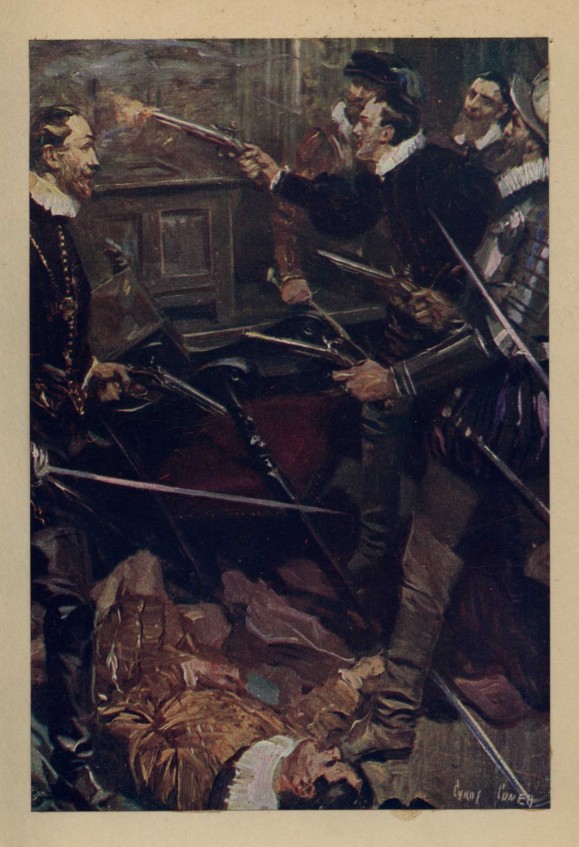
THE SIEUR DE LANGRES GAVE ONE CHOKING SIGH, AND FELL AT THE KING'S FEET
"Courage, my friends!" cried the King. "They have us in a trap, but they shall not get us until we have slain four for one."
"Navarre! Navarre!" we shouted in consort, the hall ringing with our cries, and from beyond the door we heard confused shouts of "Guise! Mayenne! Lameray!"
I observed that Rosny stood in front of the King, to protect him, which the King remarking, he plucked Rosny by the sleeve and said, in a gay and easy tone, "Nay, nay, mon cher, what says the Psalmist? 'The Lord is my shield and buckler.' Wouldst usurp the prerogative of the Almighty?" Rosny stepped aside at the King's urging, and I told him that Martigny had ridden back to warn the Marshal de Biron, and if we could only hold out for yet a little, I made no doubt the marshal would come with a troop sufficient to put our enemies to the rout. But at that moment, as if to mock my words, there was a loud crack, and we knew that the woodwork of the door was giving way. By good hap a heavy table stood at the place where the board was splintered, so that it was not driven in; and four of our party firing together through the door, we heard cries of pain mingled with the jubilant shouts which had hailed this breach in our defences.
But it was very plain that we could resist but little longer, and unless Biron should come within a few minutes, our case would be desperate indeed. In a fever of trouble I strove to think of some way whereby we might save the King, for I believed then, and I know now, that the loss of so great a man would have been a sore calamity for France and the world. And as I beat my wits on this matter, on a sudden I chanced to remember Henry's hat and cloak that lay on the table in the great salon, and a device rushed into my mind. I durst not tell the King, who would assuredly have forbid it; but I drew Rosny aside, and whispered it to him. A light beamed upon his troubled face, and he bade me go, but secretly, lest the King should observe me. Accordingly I sought my friend Raoul, and desired him to draw the bolts of the great door as silently as might be, and to be ready to throw it open at a word. And then I crept into the salon, and taking the plumed hat and cloak from the table I donned them, and returned into the hall. Meanwhile Rosny had informed the King that Biron had been warned, and had led him up the stairs to a window in the front of the house, whence they might overlook a great space of the country and peradventure spy the marshal coming. The way being thus cleared for me, I mounted my horse, there in the hall, and giving Raoul the word, he flung the door open, and I dashed out, my horse leaping the steps at one stride.
The enemy were all at the rear part of the house, so that there was none to see me as I galloped at a headlong pace towards the lane. But as I passed the stables they caught sight of me, as I designed they should, and then there was such a yell of consternation and rage as I had never heard before. A shot flew after me, but fell short, and in a trice I swept through the gateway, wheeled suddenly to the left, and set my horse to an easy canter, for it was not part of my plan to gallop clean away. I heard the shouts of the men as they swarmed after me, and turning in my saddle, yet keeping my face pretty well concealed, I saw them scurry into the copse where their horses were tethered, Lameray first among them. The dusk of evening and an autumn haze hung over the ground, so that I had good hope they would be deceived by the plume and the cloak, and not observe that the form thus clad was not that of Henry of Navarre, but of his humble servant Christopher Rudd.
I had ridden but a few hundred yards up the lane when they came dashing out of the copse after me, Lameray again the first. And now that I had drawn them into pursuit, as I had purposed, I gave my good horse his head, and galloped on at a round pace. Soon I left the lane, leaping the hedge into a field, not for easiness of going, but to entice the enemy after me, and thereby give the King the opportunity of riding forth with his party and reaching camp before me. The hunt followed my lead with excellent witlessness; taking a flying look at them I perceived that nearly every man of them was joining in the chase; and my blood tingles now, old man as I am, when I remember the joy that leapt in my veins as I rode, springing over hedges and ditches, the pack in full cry after me. Verily I believe that my horse was as merry as I myself, though he may have wondered where was the fox, not knowing that I myself was the quarry of that hunt.
My steed, as I have said, was the envy of the camp, and at the pace whereto I set him he soon outdistanced all the pursuers save only Lameray, who bestrode a fine roan but little less in value than my own horse. One by one the others dropt off, but he still kept within the same distance of me, and I wondered whether he would have the temerity to pursue me up to the very skirts of the camp and perchance into the arms of Biron. Glancing over my shoulder (yet careful to shield my face with my arm), I saw that a dyke I had just leapt had been too much for every one of my pursuers but him, and recollecting his insolency towards me, and the attempt on my life, and above all, his slur upon my swordsmanship, I resolved to try conclusions with him, and prove upon his body the foul traitor he was. Accordingly I put my horse at a low wall, barely clearing an unexpected ditch that lay beyond it, and reining up, wheeled about and awaited my enemy a dozen yards upon the further side. He came up at a wild and reckless pace, and, traitor though he was, I could not but admire the dexterity of his manage as he leapt the wall at the very place of my crossing. Seeing me biding for him, with no care now to shroud my countenance, he drew his sword at the moment of leaping, and came at me in a fury. But his horse lost a little speed in taking the ditch, and since I set spurs to mine as soon as Lameray's alighted, we met with a mighty shock, and my steed being lighter than his was forced back upon his haunches. In this manner I escaped the point of his sword outthrust towards me, and causing my horse to swerve, I heard Lameray's snarl of rage as he was carried a few paces beyond. In a twinkling he was about, and lifting his sword high above his head, he brought it down with a vehement stroke that, had it touched me, would assuredly have cleft my head in twain, or my arm from the shoulder. But my good steed answered perfectly to the pressure of my heel upon his flank, and swerving, saved me by a hair's breadth. And then, at the same moment that I heard a great shouting far away, I lunged swiftly, and by good hap my point entered his throat. With one dreadful sob he fell backwards over the crupper, and the traitor was no more.
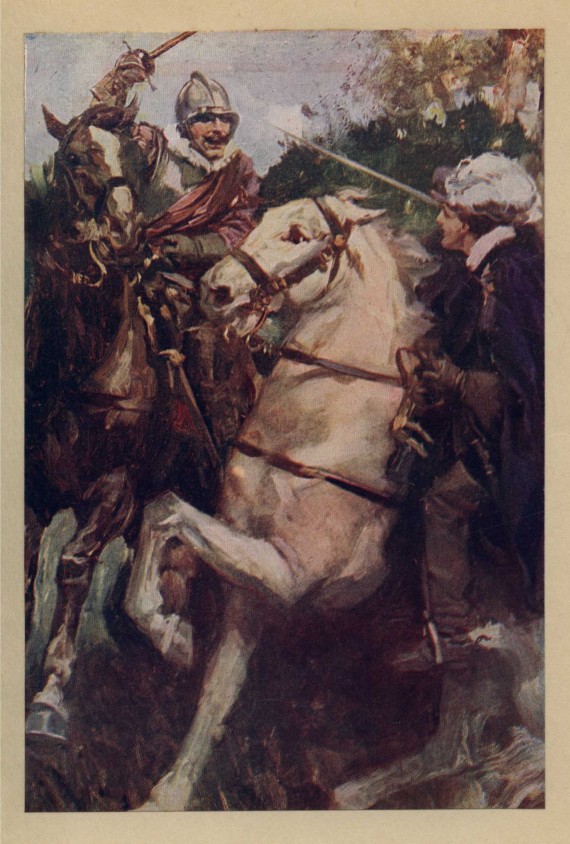
RAISING HIS SWORD HIGH ABOVE HIS HEAD, HE BROUGHT IT DOWN WITH A VEHEMENT STROKE
It needs not to tell how Biron, with three-score of his choicest cavaliers, rode out from camp with Martigny, having lost some little time in saddling, and came full upon a portion of Lameray's troop just as they returned to the lane. The King and his little band having sallied forth, and being on the further side of them, they were shut up as in a vice, and full two-score of them were slain. Nor does it become me to relate all that King Henry said to me when he sought me out, I having ridden straight into Arques when I had taken Lameray's sword as a trophy. I might, if I chose, write myself the Baron de St Aubyn in the peerage of France, since thus royally did the King see fit to reward me; but having been born an Englishman I have no great love for outlandish titles, though, maybe, if I enjoyed a marquis's rank I might not be so squeamish. Go to my cabinet yonder; there you will find, set together in one place, a white plume, a cloak, and a sword. These the King was pleased to give me. Peradventure in years to come, when your grandsons visit you, you will set these relics in state before them, and tell over again the story of the lonely château and the Baron de Lameray.
tailpiece to Second Part
Interim
A few days after this notable adventure, the Duke of Mayenne encamped over against Arques, and made sundry assaults upon King Henry's entrenchments, being baffled at all points. Then, hearing that new forces were drawing near from the east, and that five thousand good English soldiers were upon the sea, he withdrew himself into Picardy, the King marching close upon his heels up to the very walls of Paris, the suburbs whereof he took, and gave over to pillage. But winter coming on, he stayed not to open a siege, but withdrew to Tours, sallying forth thence when he heard that Mayenne was again afoot. Many strong places in Normandy yielded themselves up to him, and in the middle of March in the next year he gave battle to Mayenne at Ivry, where, when Fortune seemed to be turning against him, he called cheerfully upon his nobles and gentlemen, and they following him charged into the thick of the fray, his white plume waving in the midst. And among the thirty horsemen that came forth with him out of the mellay was my grandfather, who bore ever after on his neck the scar of a sword cut dealt him on that glorious day.
After this victory my grandfather accompanied the King in his march upon Paris, to which city Henry laid siege, straitly shutting it up all that summer, so that they lacked food, and devoured horses and asses, dogs and rats, and even little balls of clay and powdered bones. But the Duke of Parma coming out of the Low Countries with an army of Spaniards, the King was enforced to strike his camp and haste to meet this doughty foe. Nevertheless there was no battle betwixt them, for Henry was in no wise strong enough to match the Duke, nor indeed was he equal to him in the art of war, though none could be bolder or more daring in the field. Being therefore outdone, he drew back his forces, and the city was opened to the Spaniards, who threw into it a plenty of victuals and lifted the people out of their misery.
It were too long to tell of all the skirmishes, the marchings and countermarchings, the captures and surprises, wherein my grandfather bore his part for three years from that time. But in July 1593, the King professed himself of the Catholic faith, to the joy of the greater part of the nation, and the confusion of his enemies. City after city opened its gates to him; by the end of that year France had peace, and many of the English gentlemen that had fought for the King returned to their own country, my grandfather being among them. He told me that the main cause of his return was Queen Elizabeth's displeasure with Henry for that he had changed his religion, but it is known that the Queen nevertheless withdrew not her support from him, and methinks my grandfather himself no longer held him in the same degree of respect, for he abhorred a turncoat, and I know that he grieved because, as all men knew, the King forsook his faith without sincerity and for the mere bauble of a crown. My father was used to remind him how Naaman the Syrian bowed himself in the house of Rimmon, and is held of many to be blameless; and how King Henry did in truth by his conversion compose the French nation to peace and order; whereat my grandfather would cry, "How now! would you do ill that good may come?" and so put him to silence.
However, having returned to London, my grandfather obtained by the interest of a noble friend the promise of a place among the Queen's Guard. Yet it was some while ere he entered into this honourable office, for being sent by my Lord Burghley upon an errand to Flanders, he was led by chance, or more truly by the hand of Providence, to employ his sword in defence of the liberties of the commonweal there. The Provinces had been struggling for five and twenty years against the oppression of the Spanish King and his minions, of whom the Duke of Alva in especial left a name for iron sternness and cruelty. Like as in the case of King Henry of Navarre, Queen Elizabeth lent aid to the suffering folk; many of her chiefest men were captains in their army, and became governors of their towns, and did many right honest and praiseworthy deeds in their behoof. And among the stories that my grandfather told me, none pleased me better than this that now follows, wherein he relates a quaint and pleasant conceit that he devised for the undoing of a traitor.
THE THIRD PART
CHRISTOPHER RUDD'S ADVENTURE IN THE LOW COUNTRIES, AND HIS QUAINT DEVICE OF THE SILVER SHOT
headpiece to Third Part
I
I could wish that I had been born somewhat earlier into the world, for then I had had no cause, in these my latter years, to feel shame for my country, nor to look into the future with any disquietude. This our England stood upon a pinnacle of renown and majesty that year when the Spaniards' Armada was shattered by the winds of God and the shot of Sir Francis Drake. Queen Elizabeth went down to her grave in a blaze of glory; but in the reign of her successor the lustre of our name was dimmed. At this present the sky is black with clouds, and there is rumbling and muttering of thunder. Pray God our Ship of State may weather the imminent storm!
Chiefly I could wish to have been of an elder generation, because then I might have had a full share in that great struggle for liberty which our neighbours of the Low Countries long time maintained with stout heart against the Spaniard. I did, indeed, ply my sword in their behoof, among the voluntaries whom our queen suffered to engage in that service; but I came late to it, when a great part of the journey work was already done. Prince William, named the Silent, had fallen to the assassin's knife while I was yet at school; and by the hand of that pattern of all princely virtues the foundations of the Republic had been well and truly laid. Yet had he bequeathed a vast heritage of toil to his son, Prince Maurice, whom I must hold to be the peerless instructor of this age in the art of war. By his side I dealt many a dint for freedom, and it would need a month of talking so much as to tell over the sieges and stratagems, the ambuscades and sharp encounters, wherein I bore my part with that worthy prince. But at the very beginning of my service there befell me a noteworthy adventure which I look back upon with a certain joyous contentment; and that I will relate, craving your patience.
In the autumn of 1593 I was sent for one day to wait upon my Lord Burghley at Cecil House in the Strand. I found him exceeding sick in body, with a look of death upon his aged countenance; but his mind was sound and firm as ever, and he laid his commands upon me with all his wonted clearness and precision.
I had but lately quit the service of His Majesty of France. The Queen, my mistress, bore so ill King Henry's submission to the Roman Church as she could not endure the continuance of any of her servants in his employment. Thus I chanced to be for the nonce at large, and ready for the charge the Lord Treasurer committed to me.
Since the villainous treachery of Sir William Stanley and Sir Rowland Yorke in delivering the town of Deventer to the Spaniards, the Netherlanders had harboured a natural suspicion and distrust of the good faith of our English captains. Especially was there a present dread lest the town of Ostend should be betrayed by its English garrison. To clear our fame of this withering blight, the Queen had determined to admonish Sir Edward Norris, governor of that place, bidding him to keep a wary watch upon his captains and soldiers, to enforce them rigorously in their duty, and to hang up without remorse any that should be discovered in communication with the enemy. To this end she indited with her own hand a letter to Sir Edward, the which, together with his own formal despatch, the Lord Treasurer delivered to me for conveyance to Flanders.
This was a charge that jumped well with my inclination. I had no love for the soft air of courts or the mincing manners of a carpet knight, and having learnt from my Lord Burghley that, my errand being accomplished, the Queen would not stay me from serving Prince Maurice, I took passage very willingly in a hoy bound for Flushing, where I landed some time in the month of October.
It needs not to tell of my journey to Ostend and my meeting with Sir Edward Norris. Having delivered to him my letters, I departed as soon as with good manners I might, and, accompanied only by my servant, took my way to the camp of Sir Francis Vere, the principal general of our English levies since my Lord Leicester departed from the Low Countries. Sir Francis greeted me right boisterously, and put a troop of horse immediately at my command.
'Tis a matter well established that a man may have all the qualities of a captain and leader of men, and yet lack those higher parts that are requisite in a general. Sir Francis was in person the very image and model of a man of war. Of good stature, with a well-knit body and a princely countenance, his hair close-clipped and his brown beard spread spade-shaped upon his breast, he made a noble figure in his Milan corselet inlaid with gold and his ruff of point-lace. Bold and resolute in action, he was nevertheless heady, prone to anger, and full of whimsies, whereby in great affairs he was apt to be looked on with a certain mistrust, both in the council and in the field. I had not been long with him before I perceived that he entertained a most violent hatred and jealousy of Prince Maurice, and looked upon the Netherlanders with a sour contempt.
I learnt from him the posture of affairs in the Low Countries at that time. The Spaniards had of late taken sundry strong places of note, and were closely investing sundry others. Prince Maurice, being but ill provided, could do little towards the relief of those beleaguered towns, and while gathering strength thereto held himself mainly to the defensive. This loitering and idleness provoked Sir Francis to wrath, who would chafe and chide, and avouch that 'twould be profitable to the country if the whole breed of Nassaus were rid out of the way.
It chanced that one day I sallied forth with a handful of men towards a small city then besieged by the Spaniards, to discover if I might the strength and disposition of the enemy. For reasons that will presently appear I had liever not tell the true name of this place, but will call it Bargen.
We rode forth one misty afternoon, and picked our way not without trouble among the runnels and made watercourses wherewith that flat and marshy land abounds. Perceiving no sign of the enemy, I was tempted to approach more closely to their lines than consorted with prudence. As we rode by a narrow bridle path betwixt a patch of woodland and a field in stubble, on a sudden, from among the trees, cloaked in a measure by the mist, there sprang upon us a troop of corseleted horsemen. They had, I doubted not, got wind of my approach, and lain in wait under covert of the wood to cut me off.
Some of our fine gentlemen that showed their bravery at court were wont to boast that one Englishman was a match for five Spaniards; but such vainglorious brag is bemocked by those who, as I myself, have encountered those doughty warriors in the field. The Spaniard may be a paltry adversary on the seas, though even there I have met with some that were no mean fellows. Howbeit on land I found them valorous and redoubtable foemen, whom to despise would argue a pitiful ignorance and marvellous ill reckoning.
I had with me six or seven stout fellows, good swordsmen and well seasoned to war; but our enemy numbered a full score, who smote upon us like thunder and bore us down by sheer weight and fury. In my time I have been in many a sore strait and hazard, but never stood I in such jeopardy as when two of my men were cast headlong from their saddles and the Spaniards held the rest of us like rats in a trap. We had not time to wheel about and trust to the speed of our horses; the utmost that we could do was to back among the trees and play the man. There was a mighty clashing of steel upon armour as we gave stroke for stroke; but the enemy beset us vehemently, and had well-nigh encompassed us without hope of life, when, in the twinkling of an eye, there leapt from the depths of the wood a half-score of wild and unkempt figures, that flung themselves with exceeding heat and fury into the thick of the mellay, making marvellous quick play with their short knives, both upon the horses and the bodies of the Spaniards, at the joints of their harness.
This timely interposition put new heart into my stout fellows, who plied their swords with such manful resolution as made the Spaniards, already confused and baffled by the waspish newcomers, take thought for their safety and seek to draw out of danger. In short, within two minutes such of them as had not fallen betook themselves to flight, spurring their steeds every man in a contrary direction. My men in the fervency of victory made to pursue them; whereupon, being in no mind to be enticed further within the enemy's lines, I halloed to them loudly to refrain. They reined up and cantered back to me, save one headstrong and reckless fellow, John Temple by name, who pressed hard on the heels of the rearmost Spaniard, and was soon lost to sight beyond the confines of the wood.
Very well content with this happy issue from our troubles, I turned about to see more clearly what manner of men were those that had wrought our deliverance. Their aspect and garb bespoke them as boors of the country, for they wore rough smocks, round fur bonnets, and breeches of wondrous largeness and of a blue colour; yet they had not on their feet the wooden clogs of use and wont, but went barefoot for swiftness. I was minded to offer them some recompense for their service, and being as yet too new in the country to have gained anything of their speech, I bade one of my men, who had been long among Netherlandish folk, acquaint them with my purpose. Whereupon a young man who had hitherto held himself backward and aloof, stepped forth, and addressing me in execrable French, said—
"Sir, we covet no reward, having done that which we have done in the service of our country, and for behoof of those that serve her also."
Taking more particular note of this young man, I perceived that neither in favour nor in speech did he match the others of his company.
"Sir," said I, "we are beholden to you. I would fain know your name."
With some hesitancy he replied—
"Sir, call me Van der Kloof; 'twill serve as well as another."
I gave him a hard look, to ensure that I might know him again; but having made it a rule of conduct never to pry or meddle with matters that do not concern me, I forbore further question. Whereupon the young man told me of his own accord how that he had lain in the wood for a good while, keeping watch on the Spaniards, our late adversaries, who had come from the direction of Bargen, and were going, as he thought, towards the camp of Verdugo, the Spanish governor. I got from him sundry informations concerning matters in Bargen, though not so much as I should have liked.
The hour was now growing late, and John Temple had not yet returned. I had thought that, when he found himself without support from us, he would ride back without delay, and his continued absence made me fear for his safety. Though by his stupidity or obstinacy he deserved no better than to fall into the hands of the Spaniards, I was loth to lose any man of my charge; accordingly, we rode warily some short distance after him. But when we found him not, we turned about and made towards our own camp, only desiring Van der Kloof, if he should meet with Temple, to bid him follow hard after us.
We were within a bowshot of our camp when Temple overtook us. His horse was in a great heat and foam, and the man himself was in a sorry case, having a great gash in his cheek, his morion gone, his doublet slashed and bedabbled with blood.
"How now, sirrah!" I cried to him as he rode among us. "Art deaf, that thou didst not hear my command, or a mere addle-pate, to go alone into the midst of a host?" And I rated him very roundly, I do assure you. The man said not a whit in his proper defence, but pled that being at the very heels of a Spaniard who had dealt hardly with him in the fight, he could not endure to leave him without giving him a Roland for his Oliver. The chase was longer than his expectation; and the Spaniard, seeing him persistent, on a sudden wheeled about and met him face to face. They two fought it out, and after a long and laboursome bout, whereof Temple bore many eloquent and grievous tokens, he overcame his adversary and made his quietus.
And then he displayed before me the spoils of this engagement, to wit, a fine Toledo blade; a belt of good Cordovan leather, the pouch filled with Spanish dollars; and a jewelled ring of gold. And when I had told him that he might keep these for himself, he brought forth from under his belt a strip of paper, and put it into my hand.
"This I espied, sir," he said, "through a rent in the don's doublet, and seeing there was writing thereupon, being no scholar myself, I fished it out for your worship's perusal."
Thinking 'twas some love billet that the hapless Spaniard had worn against his heart, I was in a manner loth to take it. But I bethought myself directly after that in time of war it behoves a man to suspect all and trust none, and in this mind I spread open the paper and bent my eyes upon it. And then I was not a little discontented at the meagreness of what I read. 'Twas nothing but a table of stores, writ in the Spanish tongue: so many tubs of powder, so many chests of the same, so many spare pikes, so many double bullets for the calivers, so many bullets for the matchlocks, so many round shot for the sakers and culverins—in truth, I did not read every article, being persuaded that the fellow from whom the paper was taken was some pitiful storekeeper, a man of no account. Yet I stowed it within my doublet, from a mere habit of prudence, and rode on, telling the man Temple jestingly that my share of the booty was paltry by comparison with his.
II
It was dark when I came to my lodging, and learnt from my servant that Sir Francis Vere, some while before, had sent to seek me. I made haste to attend the general, whom I found alone at his supper.
"Ha, Rudd," he cried to me in his great voice, "I am glad to see thee, lad." (He was but ten years my elder, but let that pass.) "How hast fared?"
I rehearsed very shortly the particulars of my excursion, and those few matters I had learnt of the Dutchman; but held my peace as touching the paper Temple had given me, deeming that to be of no moment. Sir Francis made me compliments on my good hap in coming off with a whole skin, and then, bidding me share his meal, pushed a letter over the table towards me.
"Read that," said he, "and tell me your mind upon it."
The letter, I found, was from Prince Maurice himself, concerning Bargen, the place from before which I had even now returned. The Prince was troubled in mind about its safety. It had been some two months besieged by the Spaniards, and he was as yet unable to stir towards its relief, being himself menaced by a greater force, the which he believed to be looking for some movement on his part thitherward, with the intent to fall upon him as he marched. The city had hitherto made a good defence, but there had come to his ears rumours of a weak-kneed party in the council, and he feared lest, as the labour and hardship of the defence waxed greater, the tottering loyalty of these burghers should fail utterly, and they deliver up their city into the enemy's hands. In this strait he besought the aid of Sir Francis, requesting him to use all endeavours to save the place, chiefly by strengthening the hands of those burghers among the council that were still trusty and faithful.
"A murrain on him!" cried Sir Francis, as I set the letter down. "Why does he sit still, this Prince Do-Nothing? Did he strike a blow I would give him a mighty backing, but 'tis not in me to play the nurse, and cosset faint-hearts. He must seek another man for that job, one of his own slow Dutchmen, pardy!"
But it flashed upon me in a moment that the Prince had shown wisdom and discretion in seeking an Englishman for this part. I had learnt already that there was great jealousy between the several cities; each was in a manner a little republic; and the burghers of one city would be apt to look with ill-favour upon any man from another who should offer to teach them their duty. The like resentment would not be stirred up by an Englishman, more especially if he were commended to them as one expert in war and cunning in counsel. In this I thought Prince Maurice had done wisely, and so I told Sir Francis. He looked at me very sharply, fingering his beard, and then smote upon the table and cried with a great laugh:
"By the Lord Harry, thou art the man!"
I stared at him, at the first not understanding his intent. He laughed again, and said:
"Who so fit for this business as Master Christopher Rudd, expert in war, as witness his exploits with Henry of Navarre; cunning in counsel, as witness his lecture and admonition at this very table! You shall go into Bargen; you shall take in hand the instruction of the burghers; you shall strengthen the weak hands and confirm the feeble knees; a Daniel come to judgment!"
I did not relish his mockery, nor in any wise covet the office he would thrust upon me. But his laughter stung me to a great heat (though I showed it not), and, not counting the cost as an older man had done, I determined in my mind that I would do this thing, come of it what might. Whereupon, feigning to take him in merry mood, I smote upon the table likewise, declared 'twas a right royal jest, and vowed that on the morrow I would make my way privily through the enemy's lines into Bargen, and instal myself tutor among the mynheers. Sir Francis applauded me, still in sport, not supposing that I had spoken soberly and in earnest.
When I came to reflect upon it in my own chamber I questioned whether I were not clean witless, for the task I had taken upon myself was fitter for a man well acquainted with these burghers than for a man raw and untried. Nevertheless, having put the halter about my own neck, I could blame none but myself if I was hanged withal, and from sheer pride of soul I was steadfast to my purpose.
Accordingly, the next day, without any more speech of Sir Francis, I went about quietly to get myself a trusty Dutchman who should guide me into Bargen. By good fortune I lighted upon a man that not only knew English, but had himself gone in and out of the city by a secret way, in despite of the Spaniards. In the dusk we set forth from the camp, with my servant, and rode to a lonely mill some few miles from Bargen, half ruined and burnt in a foray the year before. There we left our horses, which the Dutchman engaged to lead back to the camp, and went down to the river hard by, where, in a clump of rushes, we found his raft cunningly concealed.
It being now dark, we got upon the raft, and oared ourselves warily and in silence down the stream, until we came to a spit or nose of land that was at this season partly submerged and in winter-time wholly. Here we stepped ashore, being within a short bowshot of the Spaniards' trenches. At this hour of the night none but the sentinels were stirring, and, as my guide well knew, the guard hereabout was negligent and unwary.
We crept softly as foxes toward the wall, and as we crawled up the glacis a voice challenged us, and I heard the click of a firelock. My guide made answer in a whisper, and immediately after two rope ladders were let down from the wall, upon which we nimbly mounted to the parapet. There we were confronted by a posse of the burgher guard, armed at all points, and my Dutchman presented me to their captain, saying, according to my instruction, that I was come on business of great moment from Prince Maurice.
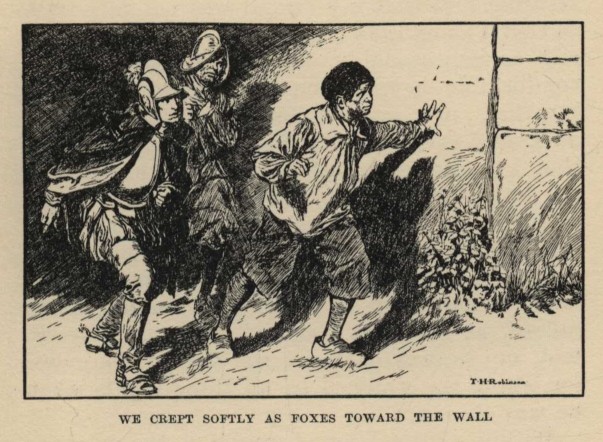
WE CREPT SOFTLY AS FOXES TOWARD THE WALL
The Captain would have led me instantly to the presence of the Burgomaster, but on my assuring him that my errand was not so urgent as that I should disturb that worthy gentleman's rest so unseasonably, he offered to find me a comfortable lodging for the night. We went together, my servant following, through the dark and silent streets, the Captain telling me that I should lodge in the house of the widow of the late Burgomaster, who had been slain in a skirmish the year before. When I said that I was loth to intrude upon the lady at so late an hour, the Captain declared that Meffrouw Verhoeff would deem it in no wise an intrusion; indeed, he said that I should find a table ready laid, my hostess having a son among the guard for whom she watched on all those nights when he was abroad.
Within a little I found myself at the entrance of a house wherein a lamp shone. At the Captain's knock the door was opened, and a voice asked, "Is it you, Jan?" the speaker not perceiving at the first who we were. The Captain presenting me as an envoy from Prince Maurice, and an Englishman, a soft hand caught mine, and drew me into the house, and I made my salutation to a little old lady, very comely and personable, with a widow's cap and snow-white ruff, who greeted me in English and bade me very heartily welcome. She would hear no excuses upon the lateness of the hour; but led me into her parlour, then left me while she bestowed my servant, and returning, entreated me to do honour to the viands with which her table was sparely spread.
Mistress Verhoeff entertained me as I ate with many particulars of the siege. I was not long of discovering that her small body was the seat of a very fiery and unquenchable spirit; and in truth, while she spoke of the brave deeds done in defence of the city, her cheeks glowed and her eyes sparkled so that she seemed young again. There had been much suffering, she told me; but her folk had learnt to suffer, and of a surety could endure even more grievous afflictions than had yet befallen them.