A GENTLEMAN-AT-ARMS (continued 4)
Reading edition
A matter of three months thereafter, my grandfather was with Sir Francis Vere when that valiant captain was sent by Prince Maurice to take the castle of Weerd. Upon Sir Francis demanding that the warden of the castle should yield it up, that doughty commander refused him with scorn, albeit he had no more than a score and six men at his back. But when Sir Francis opened upon the place with his artillery, these folk fell into a panic and laid open their gates. Their captain claimed the honours of war, but Sir Francis made answer that he should have no honours but halters for the stiff-necked simple men that had dared to defend their hovel against ordnance. Whereupon he made the six and twenty draw lots with black and white straws, and they that drew the white were immediately hanged, save only the thirteenth, to whom his life was given after that he had consented to do hangman's work upon his fellows. The noose was cast first about the neck of their captain, but the rope parting asunder, certain of Sir Francis' men held him under the water of the ditch until he was drowned. My grandfather fell out with Sir Francis upon this matter, deeming his truculency to be unworthy of a gentleman; and when the troops went into winter quarters, he took ship and returned to England, bearing a richly gilt sword, the gift of Prince Maurice.
He then took up his place in the Queen's Guard, but had accomplished scarce four months in the royal service when that adventure befell which follows next in order. It was known that King Philip was making ready a fleet of sixty sail to invade Ireland, and Sir Walter Raleigh was instant that the Queen's ministers should destroy that fleet in Spanish waters, saying that "expedition in a little is better than much too late." At that time the Spaniards were rejoicing in that Hawkins and Drake had come to grief in their enterprise against Panama, and were dead of a broken heart. Sir Walter's counsel was deemed good, and the Queen, enraged with the King of Spain for that he was abetting the Irish rebel Tyrone, fitted out ninety-six sail to convey 14,000 Englishmen to the harbour of Cadiz, setting over them Lord Admiral Howard and the Earl of Essex, and granting to Raleigh the command of twenty-two ships. Contrary winds delayed their setting forth, the which, as Sir Walter affirmed, caused him deeper grief than he ever felt for anything of this world. And Providence so fashioned it that my grandfather performed a hardy feat in Cadiz harbour a good month before Sir Walter set sail, as you shall now read.
THE FOURTH PART
CHRISTOPHER RUDD'S ADVENTURE IN SPAIN, AND THE FASHION IN WHICH HE PLAYED THE PART OF A PHYSICIAN
headpiece to Fourth Part
I
It has never been my lot to hold great place, whether in the employment of Queen Bess, or of her successor, King James; and when I think how sorely fortune hath buffeted some noble persons that served those monarchs, I count myself lucky in my obscurity.
Of all the noble men with whom I ever had to do, Sir Walter Raleigh was in my computation beyond compare the noblest. It frets me still, after forty years, that I was not of his company on that famous voyage to Cadiz when, as he writes in his History, "we stayed not to pick any lock, but brake open the doors, and, having rifled all, threw the key into the fire"; by the which figure he signifies the capture and destruction of that great town, with vast spoils both of merchandise and money. I was stayed but by accident, or, more truly, by the hand of God, who had other work for me, as you shall hear.
It chanced that one day, about Easter of the year 1596, I had been to visit Sir Walter in his house at Mile End, where he then lived to take the country air, and because, being out of favour with the Queen, his lodging in her great house by the Thames was not much to his liking. In name he was still Captain of the Guard and Warden of the Stannaries, but the former office was performed by one Master John Best, and the latter was, I think, in abeyance. He had but lately returned from his voyage to Guiana, and was even then occupied with the writing of the book wherein he relates his doings there, together with certain wonders that I must hold to be fables. It is clean against nature that men should have eyes in their shoulders and mouths in their breasts.
I had visited him, I say, and sat talking very late, finding him wrapt up in his project against Cadiz, where a Spanish fleet was fitting out with the intent to invade Ireland. It was understood, when I left him, that I should be one of his company in the Warspright, provided I could obtain leave from the Queen to quit my place in the royal Guard for a season. I rode back to Westminster, and, having stabled my horse, was proceeding on foot to my lodging, in a little mean street by the river, when it seemed to me on a sudden that I heard footsteps, as of one dogging me. It was very late, as I said; all honest folks (myself excepted) were abed; and having a modest love of myself, I halted and whipped out my sword, peering into the darkness, and stretching my ears for the sound that had brought me to a check. But all was silent as the grave, and I laughed a little when it came into my mind that peradventure 'twas no more than the echo of my own footsteps. Whereupon I put up my sword and went on, my thoughts being busy with the matters of Sir Walter's glowing discourse.
While I was thus rapt away, building, I doubt not, fantastical castles in Spain, on a sudden I was set upon by a hulking fellow that threw himself upon me out of a dark alley-way. The first warning I had of him was a sharp crack as the bludgeon he aimed at me struck a shop-sign that hung low over the street; but for this, without question I had suffered a broken skull. Even so I lacked time to draw sword or dagger, for the man flung aside his club and sprang upon me, grappling me to himself with a grip of iron. For a moment I yielded, out of policy, to his embrace, being careful, nathless, to maintain my footing; then, being very well practised in wrestling, and having good command of my breath, I dipt my arms about his middle and, with an ease that amazed me, gave him the backfall. Down he went upon the cobbles, and I stood over him while he lay and groaned.
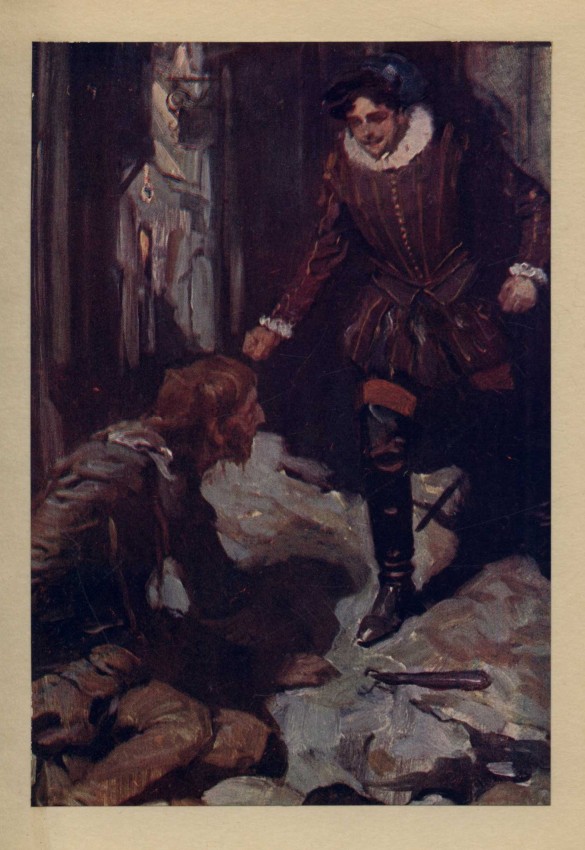
DOWN HE WENT UPON THE COBBLES, AND I STOOD OVER HIM WHILE HE LAY AND GROANED
At this hour of the night it were vain to look for any help from the watch, and I was in the mind to leave the fellow where he lay. Yet having a certain curiosity to see what manner of man he was, I felt in my fob for the steel and flint I was wont to carry, and when I found them not, only then remembered that I had left them on Sir Walter's table; he had borrowed them of me to light his pipe of tobacco, the which was a wondrous strange thing in those days. (That is Sir Walter's pipe, yonder in my cabinet; he gave it me for a keepsake a little while ere he died.) Having no light at command I resolved to bring the man to my own door, but a few steps distant; wherefore I stooped and hoisted him to his feet, and then took him by the collar with one hand, and with the other held my naked sword to his posteriors, and so marched him before me up the street. When we came to my door, and my servant opened to my knock, I thrust the man in front of me so that he stood within the light of the lamp.
He was a sorry knave, now that I beheld him clearly: a very ragged Robin, as foul in person as ever I saw. But I understood now the reason why I had so easily thrown him, for his countenance, so much of it as I could discern through a thick and tangled beard, was wan and sunken; his eyes shone with that glitter which bespeaks famine or fever; and his body, goodly in its proportions, was bent and shrunken together. In good sooth I had no cause to be vain of my prowess, and when the fellow turned his burning eyes upon me, regarding me sullenly, yet with no touch of fear, I was seized with compassion, and bade my servant go fetch meat and drink. He went about my bidding sluggishly, halting ever and anon to cast a backward glance, as though doubting the policy of playing good Samaritan to so uncouth and villainous an oaf. While he was absent I told the man that since he would surely be hanged for his attempt upon me, 'twere well he should eat and so fortify himself against his destiny. What I said in jest he took in earnest; but whether it be true or not, as I have heard tell, that with the hangman's noose dangling before him a criminal has no relish for food, certainly this man fell with very keen tooth upon my viands, and cleaned the platter with marvellous celerity.
Having dispatched my servant to bed, I sat me on the table and questioned the man, why he had waylaid me. He was loth to speak, but by little and little I drew from him his history, which he related not as one seeking to move pity, but by way of recompense, so it seemed to me, for the hospitality he had received. With his first words I own my heart warmed to him, for his speech smacked of my own country in the west, though intermixed with many quaint outlandish terms. His story I will relate in brief.
His name was William Stubbs, and he was born at Winterbourne Abbas, not a great way from my own birthplace. He had gone young to sea, and made several voyages with Master Cavendish, having indeed served as boatswain in the Desire with that worthy seaman and commander. He had roved the Spanish Main, and I proved his veracity in that particular by putting to him sundry questions begotten of my own knowledge. 'Twas plain that he had the common fault of seamen, spending his gains more quickly then he earned them, roistering it on shore while his money lasted, and when all was spent going to sea again in quest of more. But I perceived as he proceeded in his discourse that he was better than most in natural wit, and had made more profit of his adventures, in knowledge if not in pelf. He had a passable facility in both the French and the Spanish tongues, and his head was stuffed with a great quantity of curious information, which made me wonder that he had sunk so low as to become a common footpad.
The reason of that I learnt in order. Being on board the Revenge in that unlucky voyage of Sir Richard Grenville, he fell with many of his comrades into the hands of the Spaniards, who dealt with him very scurvily, as their custom is, and finally condemned him to the galleys. For three long years he was chained to an oar, and suffered all the miseries of unhappy prisoners in the like case. But it befell one day that the galley wherein he rowed fell foul of a Dutch vessel, which opened upon it with valorous broadsides, and after making havoc as well among the slaves as the crew, finally rammed it with great vehemency and stove a hole in its side. In the hottest of the fight, a round shot broke the chain that held Stubbs to his oar, and, seizing the moment when the Dutchman rammed and all was confusion, he leapt overboard and swam to that vessel, whose side he clambered up by the main chains. He came very near perishing at the hands of the crew, who at first supposed him to be a rascal; but when they learnt his true condition, they hauled him aboard with comfortable words, and brought him after many days to their own country. Thence he contrived to reach London, only to fall on evil hap, for his sufferings in captivity had sapped his strength, and, when he sought employment in his own trade he found no master mariner willing to accept him. Thus, reduced by sickness and famine, in his desperate strait he bethought him of conquering fortune on the highway, but was now ready to believe, seeing the unhappy issue of his first essay in that line of life, that he was at odds with Fate, and must needs, as he said, "kick the beam and ha' done with it."
When I heard this piteous story, and saw upon the man's neck and wrists the scars that were full proof, to all that knew the Spaniards, of his having rowed in their galleys, my anger against him was wholly quenched. I told him heartily that he should not hang for me, and then, perceiving that my good food had wrought upon his sickly frame, I bade him get himself into a closet wherein my servant kept my boots and sleep there for the night, promising to see him again in the morning, and perchance do somewhat to set him on his feet. The man was clean staggered by this kindness, as I could plainly see; but he did not thank me; and when he had crept into the closet and flung himself down heedless upon the floor, I turned the key in the lock for security's sake and went to my bed.
My servant was in a pretty fret and fume when he found the man there asleep in the morning, and eyed me with a disfavour that made me feel guilty towards him: a good servant hath in him something of the tyrant. When I bade him give my guest water for washing (whereof he was in great need), and meat and beer, his silence was a clear rebuke. But when he came again after doing my bidding he had somewhat to tell me.
"The rogue asked me your name, sir," quoth he, "and when I told him, he asked further whether you were akin to one Master Christopher Rudd of Shirley."
"And what said you?" I asked, knowing my servant.
"I said, sir, that he were best wash himself."
"A proper answer," said I, laughing. "When he has eaten, bring him to me."
And when the man came before me, cleaned of his foulness and with his beard trimmed, I saw that he was a goodly fellow, and felt the more sorry for him.
"You asked of one Master Christopher Rudd of Shirley," I said; "what have you to do with him?"
"Are you his kin, sir?" he asked doubtfully.
"We are of one family," I said, "and now you will answer my question."
And then he told me a story that filled me with as much trouble as amazement. Chained to him, on his galley, had been a young Frenchman, whom, even before their common misery had made them friends, he had surmised to be a man of rank. When they had learnt to trust each other, the Frenchman and he often talked together of the chances of escape, and each promised the other that, should fortune favour him, he would use his endeavours for behoof of him that was left. Stubbs said that, for his part, he feared he could do little, being an Englishman; whereupon the Frenchman told him that he had sundry good friends among the English, notably Christopher Rudd, of whom indeed he had been a close comrade in the service of King Henry of Navarre.
At this I pricked up my ears, and inquired eagerly for the Frenchman's name. Thereupon Stubbs rolled up his sleeves, and showed me, branded upon his arm, the letters "R. de T.," confessing that he had forgot the name, which indeed did not come easily to his tongue. I needed no more, but knew instantly that the luckless galley-slave could be none other than Raoul de Torcy, who had been my boon fellow when I was in France, and my companion that time when I had the good hap to win King Henry's favour. I bade Stubbs describe with circumstance the look and character of the Frenchman, and though he was unapt at such a task, his uncouth phrases gave me the assurance I sought, and I could have no manner of doubt that the man now swinking and sweating in one of the worst tortures ever devised by the wit of man was indeed my dear friend.
I taxed Stubbs narrowly, to discover by what mishap Raoul, a gentleman of France, had fallen to so pitiful an extremity, but on this point it appeared that Raoul himself was at a loss. He had been kidnapped one day in Calais, cast on board a vessel, and carried to Cadiz: who were his captors, and what moved them to it, were matters hidden from him.
Cadiz being the place of Raoul's exile, I instantly bethought me of my talk overnight with Sir Walter Raleigh, and saw in his projected enterprise a means of wresting my friend from his bondage. Accordingly I sent my servant for my horse, purposing to ride again to Mile End and acquaint Sir Walter with what I had heard. I gave money to Stubbs wherewith to buy new raiment, bidding him return to my house and await me, and above all to avoid any debate with my servant, the which might easily end in broken heads.
I found Sir Walter in his garden, smoking a pipe of tobacco, and setting potatoes, the new root that he had brought from the Indies, in the earth in the manner they call dibbling. He heard me attentively, and let out a round oath or two, and said that assuredly I might make the enlargement of my friend my personal charge in the adventure.
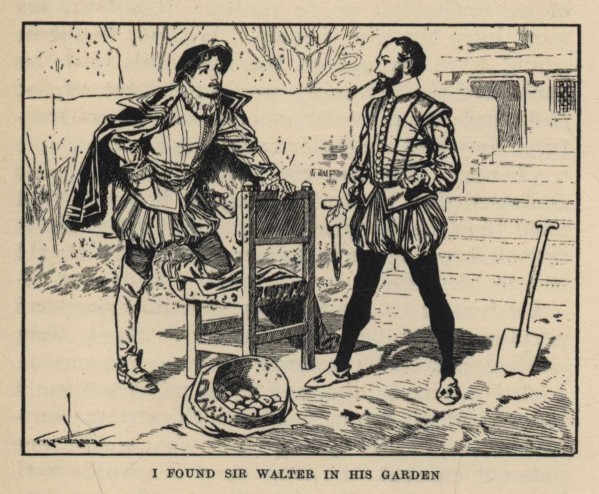
I FOUND SIR WALTER IN HIS GARDEN
"But you must know, Rudd," he said, "that the project is as yet a secret, and indeed there is no surety that the Queen will give consent thereto. Her Grace frowns on me most malevolently, and there are many hindrances to surmount ere I come by her august approval. Were it not better to ransom your friend? I doubt not he hath kinsmen that are ignorant of his plight, and would bestir themselves did they but know it."
I answered him that Raoul had spoken to me of an uncle, but as to ransom, Raoul himself must have thought thereon. Without doubt he would have acquainted the Spaniards with his rank, and their cupidity would not have refused to bargain for his enlargement, unless, peradventure, they had weightier reasons for holding him a prisoner. To this Sir Walter assented, and confessed that he saw nothing for it but to wait until the Queen's pleasure in the matter of the intended voyage was known, and with that I had to be content.
I returned to my lodging, sore downcast and perplexed. Stubbs was already there, new clothed in decent garments, and very personable. I fell a-talking to him, and in the midst a thought came suddenly to me. I knew the strange waywardness of the Queen, how she would one moment consent, the next deny her words with hearty swearing; it might be months, or even years, before Sir Walter had his way. It troubled me sorely to think that Raoul should endure his wretched lot while her Highness played see-saw, and I bethought me that I might at least voyage to France and see the kinsmen who were, I doubted not, mourning Raoul's disappearance, and might perchance devise with them some plan for his deliverance. And since the testimony of an eye-witness is ever more effectual than report at second-hand, I resolved to take my mariner with me, so as they might have from his own lips the tale he told me. I forbore to ask consent of the Queen to my absence, being resolved to hazard my place rather than my design.
We set off next day, riding to Dover, where we embarked upon a packet-boat, and so came, after much tossing and discomfort, to Calais. This being the port where Raoul had been kidnapped three years before, as Stubbs told me, I made discreet inquiry among the harbour people whether they knew aught of that villainy, being careful to name no names. But none had any knowledge of the matter, whereupon we rode on at once to Dieppe, both because that was the nearest port to Raoul's château, and because our common friend Jean Prévost dwelt there, whom I purposed to take into my confidence.
'Twas drawing towards evening when we came to the town and reined up at the door of the Belle Etoile, a hostelry that I knew very well. The host, honest Jacques Aicard, remembered me, though it was near seven years since he last saw me, and welcomed me very heartily. The goodman's face was rueful when he ushered me to a room.
"'Tis pity, monsieur," he said, "that I have no better chamber to offer, but my best room is bespoke. But if monsieur will be content with this for a night or two, be sure that he shall have the best when my other visitor departs."
I assured him that the room would do very well, since I did not purpose to make a long stay.
"Ah, monsieur," he said, "that is sad news. I would that I had more guests like monsieur," a piece of arrant flattery whereat I smiled. 'Tis true that honest Jacques loved an Englishman.
Having seen Stubbs also provided, I hastened forth, and by good luck found Jean Prévost at home. He likewise welcomed me with great heartiness, and, after our salutations, as he set wine before me, he opened upon the very matter which had brought me to him.
"Would that Raoul were with us!" he said. "How we three laughed! But I fear me we shall never see him more."
"He disappeared; that I know," said I. "Tell me how it befell."
"Why, three years ago he rode to Calais, with the intent to sail to the Low Countries, and use his sword against the Spaniards. We have never heard of him since. Whether he was wrecked, or fell in Flanders, we know not. He vanished utterly away."
"And what of his estate?" I asked.
"His uncle holds it, the Count de Sarney. You have heard Raoul speak of him. He was a Leaguer, and there was a coldness between them. Indeed, though their châteaux lie but five miles apart, they had no dealings one with the other for many years. But the breach was healed when Henry became king, and after that Raoul had disappeared none was so busy as the Count in seeking for him. He sent emissaries at his own charges to Flanders to inquire diligently in all likely quarters, and 'twas a full year before he entered upon his heritage. He lives at Torcy, much by himself, and we see little of him."
"Raoul lugs an oar in a galley at Cadiz," I said with a very quiet voice.
Jean leapt from his seat as though a wasp had stung him.
"A galley-slave! Impossible! Incredible!" he cried.
"Both credible and possible," I said, and then I told him all, as I have told you.
"Mon Dieu!" cried Jean, when I had made an end. "We must not wait while your Queen dallies. A ransom! I know a score of his friends who will give bonds for goodly sums——"
"Ay, truly," I said, interrupting him, "and the first of them should be his uncle and heir."
Jean stopped in his restless pacing of the floor, and looked at me very strangely.
"Why yes," he said, "his uncle, to be sure. But the Count is close-fisted; 'twas indeed a surprise to all the country-side when, after that he had entered into possession of Torcy—an estate of greater worth than his own—he showed himself a very niggard."
"Think you that he would refuse his mite in so good a cause?" I said.
Again Jean looked strangely at me, and for a while was silent. Then he said slowly—
"My friend, I ween we had best say nought to the Count de Sarney."
"Nevertheless, I go to him to-morrow," I replied. "Miser he may be, and 'tis clean against his interest, to be sure, to bring back the lawful owner of Torcy, and thereby dispossess himself. Yet if his duty be put to him, as I shall put it, I doubt not he will comply."
"I will go with you," said Jean.
"Nay, I am minded to go alone, or rather with none but my mariner. 'Twill be better so. Be assured I will acquaint you with the issue. And I beg you, Jean," I said earnestly, "that you speak no word of what I have told you, at least for this present time."
"I will be mute as a fish," said he, "but I shall think the more."
II
On the morrow, early in the morning, we saddled our horses, Stubbs and I, a thing we always performed ourselves, Stubbs somewhat fumblingly, I own, until practice gave him deftness and ease. 'Twas thirty miles to Torcy, that lay southerly from Dieppe, but we made such good speed that the sun was not yet in the zenith when we arrived at the château. The Count was within doors, said the lackey that opened the great gate of the park to us, and we rode up the avenue of chestnuts, just bourgeoning into leaf, and came after some three furlongs to the house.
The man that admitted me, an ancient retainer of Raoul's whom I knew very well, changed hue when he saw me, and asked me with trembling voice whether I had brought news of his master. I did not give him a direct answer, but bade him lead me at once to the Count, feeling not a little pleasure that the new lord still kept the old man in his service. He conducted me through the passages that I had last trod with Raoul himself, and brought me into the little chamber wherein I had passed many a merry evening with my friend. Stubbs meanwhile remained in the outer porch, ready to follow me at my summons.
I waited some while before the Count entered. He was a man of mean stature, very lean and dry, and with a grave cast of countenance wherein I discerned no likeness to the jolly favour of his nephew.
"I have not the honour," he began courteously as I bowed to him, and dealt me a shrewd look.
"Assuredly not, monsieur," I replied. "My name is Christopher Rudd, and I was once comrade to your nephew, whose fate has given such deep trouble to his friends."
"Ah yes, my poor nephew! Methinks I recall your name, monsieur, if you are the same that fought with Raoul in the late contention, now so happily concluded. Be seated, monsieur; I am charmed to meet one that was his friend. You will honour me by taking a cup of wine?"
He rang for a servant, and bade him bring wine and cakes, and also to request the company of Monsieur Armand. Before the man returned there entered into the room a solemn-visaged youth, clad in black with white ruffles at his wrists.
"My son, monsieur," said the Count. "He is but lately returned from Paris, where he has studied medicine and philosophy, not that I purpose that he should be either a physician or a philosopher, but because I deem it well that he, being my heir, but ill-fitted by reason of a delicate constitution for the pursuit of arms, should have some tincture of humane letters and of the beneficent art of healing. Situated as we are, somewhat remote from towns, it is fitting that one who will in due time be lord of many poor folks should be able to minister to them in their afflictions."
"A right worthy and commendable desire," I said, looking at the youth, whose solemnity of countenance somewhat tickled me.
The Count proceeded to expound the usefulness of philosophy, not interrupting his discourse when the servant returned with wine and delicacies which, being sharp-set after my ride, I devoured with relish. My host was so courteously bent on entertaining me that for a good while I found no opportunity of broaching the purpose of my visit, and more than once I thought of Stubbs waiting without, and certainly as hungry as myself. But perceiving at length in the Count's physiognomy a look that said clearly, despite his courtesy, that he thought it time my visit came to an end, I profited by a slight lull in his discourse to say—
"And my friend Raoul, monsieur—has nothing been heard of him?"
"Nothing, monsieur," he said with a sigh. "I fear we cannot hope to see him again, and the pain of his loss is embittered by our ignorance of his fate, whether he lies at the bottom of the sea, or perchance in some nameless grave."
"I rejoice, then," said I, "that I can assuage that bitterness, even though the knowledge has a bitterness of its own. Your nephew, monsieur, is at this moment, unless death has released him, suffering the tortures of a galley-slave in Spain."
A cry from the solemn youth caused me to look at him, and I own I was glad to see a spark of life in his dead face.
"What a monstrous thing!" he cried. "Was he taken prisoner in Flanders, monsieur?"
"Nay," I said, "he never fought in Flanders. He travelled no further than Calais. He was there kidnapped at the harbour, and thence conveyed to Cadiz. 'Twas the work of private enemies, beyond doubt."
"Will you tell us how you came by this amazing news, monsieur?" said the Count, in his thin cold voice.
Whereupon I related the whole story with circumstance, from the time when I was beset that night as I returned to my lodging. The Count listened to me with a courteous interest, but a look of compassion stole upon his face.
"It is incredible, monsieur," he said, when I ended my tale. "My poor nephew had no private enemies: none can know better than you how well beloved he was of all. Even in the height of our broils here he had no personal foes, and though he and I were for a time at variance, yet when the realm settled itself in peace and order we forgot our public differences, and Raoul and Armand became deeply attached the one to the other; is it not so, Armand?"
"It is indeed," said the youth eagerly. "Raoul and I were as brothers, and his loss has been my greatest sorrow."
I could not doubt he spoke truth: his eyes shone as he spoke. Nor could I wonder that his father was incredulous, for Raoul was indeed a man whom it were strange to hate.
"I have a man without who rowed in the self-same galley with Raoul," I said. "With your leave I will send for him, monsieur, and you may verify my story from his own lips."
The Count assented with the same smile of weary tolerance. Within a little Stubbs came to us, looking ill at ease, and twisting his bonnet between his hands as he stood waiting our pleasure. At my bidding he related the story as I have told it, and rolled back his sleeve to show the letters "R. de T." there branded. His French was uncouth and villainously inexact, yet not so base but that his meaning was clear. The Count questioned him searchingly, almost as an advocate seeks to shake the testimony of a witness; but the man held to his tale in its main parts, answering only "J'ne savons pas"—such was his barbarous form—when the matter in question was beyond his ken.
Having dismissed the man, I asked the Count whether he were not now perfectly convinced of his nephew's fate. He looked upon me with that same smile of pity, and gave me an answer that, I confess, enraged me.
"I felicitate you, monsieur," said he, "on your goodness of heart, but until this moment I was not aware that credulity could be laid to the charge of a man of your nation. I had rather looked upon Englishmen as sceptical, and not easily imposed upon. This man is certainly a liar: you yourself were witness of his confusion. He has played upon your benevolence, and, for myself, I regard it as monstrous that you should have been prevailed upon to make so long a journey for so bootless a reason. Nevertheless it has given me great pleasure to meet and converse with you; and now that you are here, I would beg you to do me the honour to remain my guest for a week at least."
"I thank you, monsieur," I said as civilly as I could, though in truth I was inly raging. "But so far from regarding the seaman as a liar, I do thoroughly believe his story."
"And I too," quoth Armand.
"But, my good friend," said the Count, "see the unlikelihood of it. Suppose that Raoul were indeed in the galleys, it were a simple matter for a man of his rank and condition to purchase his release, and be sure that by this time, and long before this, application would have been made to me for his ransom, the which I need not say would have been instantly dispatched. Is not that reasonable?"
I could not but own that it was, remembering that I had myself used the self-same argument with Sir Walter Raleigh.
"Furthermore," the Count proceeded, "say that I offered a large sum for his ransom, the Spaniards, if they have any reason for holding Raoul a prisoner, would certainly find some one to personate him, and release some knave that fully merits the punishment he suffers. And so you and I should look merely ridiculous."
There was so much reason in what the Count said that I was baffled. His unbelief, I thought, might be in some measure sprung from a reluctancy to relinquish the estate he now enjoyed, the which was not to be wondered at: and yet I deemed it unnatural that a kinsman should be more incredulous than a man bound to Raoul by no ties of blood. At a loss how to combat his arguments, I presently took my leave, excusing myself from accepting the invitation he pressed upon me.
I found that Stubbs had been fed by the ancient servitor, and set off with him towards Dieppe. Our horses proved themselves but indifferent steeds in respect of endurance, and we were slow upon the road, so that it was already dark when we reached our hostelry. Being wearied with the journey, as well as exceeding vexed in mind, I was in no mood for aught but a good supper and then bed, and I deferred to acquaint Jean Prévost with my barren errand until the morrow. Stubbs gave me a hard look when I bade him good-night, as though he would fain question me on the present posture of the affair; but I told him nothing, being resolved first to hear what Jean had to say.
I was mighty astonished next afternoon by Jean's manner of receiving my intelligence. Whereas he had been as sure as I myself that Raoul and the galley-slave were one and the same, he now wore a dubious look, and stroked his chin, and declared there was much reason in what the Count had said.
"Raoul is not the only name beginning with R," he said, "nor Torcy with T. Moreover this mariner of yours, you tell me, sought to enter into your good graces by cracking your skull, and is not thereby certified to be an honest man. The manifest friendliness of the Count's son, and the Count's own diligence in seeking his nephew, give no prop to the suspicion I own I entertained, that they were privy to the crime, for the sake of gaining Raoul's inheritance. I am fain to believe that there is dupery, or at least error."
I answered him somewhat hotly that I was no dupe, nor did I believe that Stubbs had erred, and asked whether we could not set on foot a proper inquiry. To this he replied that, France and Spain being at war, such a course must be beset with manifold difficulties.
"Yet," he said, "there is one way. Address yourself to some merchant in Antwerp that hath trading concerns in Cadiz. Such an one, if heedful and discreet, could put your mariner's story to the test, and I doubt not, knowing their love of lucre, there be many good men in Antwerp that would take this task upon them, for a fit recompense."
This counsel seeming good to me, I left him after a little, and instead of returning directly to my lodging, I wended to the harbour, and inquired what vessel sailed thence to Antwerp, and when. 'Twas told me that a trading vessel would leave the port on the morrow, whereupon I counted myself lucky, for none other would depart for a fortnight. I took passage in the vessel for myself and Stubbs, paying good English money, and bespeaking a sufficient quantity of food, more relishable than that which mariners are in general wont to eat.
By the time I came again to the Belle Etoile the sun was setting. I entered in, very well content with what I had done, and ran full against Stubbs, who was lurking within the doorway. He took me by the sleeve and drew me hastily to my room, where, having shut the door, he thrust into my hands some papers, and I perceived that the seals thereof had been broken.
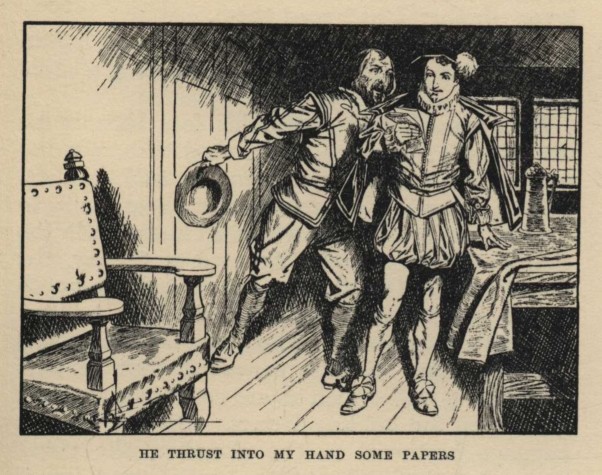
HE THRUST INTO MY HAND SOME PAPERS
"What is this?" I said in amazement, beholding signs of great trouble in the man's countenance.
"Read, sir, read, and quickly, for the love of God!" he said, and incontinently flung out of the room.
I took up one of the papers to examine it, and saw that it bore the superscription, "To Don Ygnacio de Acosta, at Cadiz." The others were addressed to grandees in Seville and elsewhere in the south of Spain. I was still holding them unopened, perplexed about my man's strange excitement, when he came back with the same haste into the room and asked me in a fever whether I had read them.
"Why, no," I said, "I may not read letters that are not addressed to me. What is all this to-do?"
He groaned, and cursed his fate because he was himself unable to read. And then, pouring out his words in a very torrent, he told me that, a little after my departure, there had come to the inn the young man whom he had seen in the château Torcy, namely, Armand de Sarney, the Count's son. Old Jacques conducted the youth to his bedchamber: 'twas plain that he was the expected guest for whom the best room had been bespoke. Stubbs perceived that he bore with him a wallet such as are commonly used by gentlemen for holding letters. Having seen his baggage bestowed in the chamber, the youth descended, but without the wallet, and issued forth into the street. Stubbs watched him until he was out of sight, then stole a tip-toe to the room, slit open the wallet, and withdrew its contents, the papers that he had laid in my hands.
"But why?" I asked, staggered by this act of criminal presumption, and thinking the man must be demented.
"Because thiccy count be a rare villain, sir," cried Stubbs hoarsely. "I bean't a fule; I kept my eyes upon him when you sat there a-crackin' with him, and if he don't know more'n he ought about thiccy young Frenchman, your friend, I'll go to the gallows happy. Read the names, sir, read 'un so that I can hear; quick, for he may be back along."
In a great wonderment I complied.
"Don Antonio de Herrera, Don Miguel de Leon y Buegas; Don Ygnacio de Acosta——"
"There! There!" he cried. "I knew it, be jowned! 'Tis the captain of the galleys, the Don Spaniard that has laid many a stripe on my bare back. Read the letter."
Again he left me in a great hurry, and I guessed now that he was gone to keep a watch against the return of Armand de Sarney.
I was in a quandary. Imprimis, 'twas a dastardly deed to break open the wallet and the seals, and not consonant with plain honesty. Yet I could but acknowledge that a letter writ by the Count de Sarney to the captain of the galleys was a grave cause of suspicion, more especially seeing that the Count had not told me he was acquainted with the Spaniard, as assuredly an innocent man would have done. And so, reflecting that the seal was broken beyond mending, and that my friend's welfare—nay, perchance, his very life—was at stake, I felt it behoved me to satisfy myself on the matter, and do as my Lord Burghley and Sir Francis Walsingham had done when they discovered those devilish plots against the Queen's highness.
Accordingly I spread open the letter addressed to Don Ygnacio de Acosta, and as I read it all compunction died within me, and I fumed with rage. After the customary salutations, this is what I read—
"The bearer of this letter is my only son, Armand de Sarney, whom I commit to your benevolence. Having gained some repute in Paris by his diligence in the study of philosophy and the sciences, above all in medicine, he is desirous of perfecting himself in this last, the which I hold to be both a science and an art, by inquiring into the Moorish system, for which purpose I deem it well, though I am loth to part with him, that he should voyage to Seville, the fame of whose schools has gone out into all the corners of the world. He bears with him letters from good friends in Paris to your most renowned doctors, and to your loving care do I especially commend him.
"I profit by his journey to send you a bill of exchange, drawn on our good friends at Antwerp, and beg that you will pardon my backwardness in that I have withheld it beyond the wonted time.
"The sickness whereof you wrote is now, I trust, wholly passed away, and with all felicitations I subscribe myself your loving cousin,
"HENRI DE SARNEY.
"Postscriptum.—I unseal this letter to add that since it was written I have been visited by an Englishman, who has learnt by the mouth of an escaped slave somewhat concerning a prisoner, who, he affirms, is chained to an oar in one of your galleys. The English are a stubborn and stiff-necked race, and this man has their vices in full measure, being the same that brought to nought the carefully-laid plans of the lamented Monsieur de Lameray. In heat and waywardness he may seek to pick locks and break fetters. Have a care therefore."
This letter, I say, put me in a fume. Some parts of it I comprehended not, and the whole was composed with great cunning; but I saw clearly enough that the Count de Sarney was well aware of his nephew's grievous plight, and, furthermore, I suspected that he had had a hand in bringing it about. For a brief space I was so mastered by my wrath as that I was in a manner bereft of my wits; but running my eyes again over the lines, I came on a sudden to a resolution, and none too soon, for Stubbs returned swiftly into the room and told me that the young man in black was at that moment making towards the inn. Thrusting the papers into my doublet, I hastened to the door, and there awaited his coming.
As he was in the act of going past, the passage being dark, I stepped forth and besought him to honour me with his company for a few minutes. His solemn face bore witness to his surprise at seeing me in his own inn, but I caught no trace either of alarm or embarrassment. He came into my room, and, having closed the door upon him, I said—
"It has come to my knowledge, monsieur, that you are about to voyage into Spain."
"It is true, monsieur, and I rejoice that I shall be able to inquire myself for my poor cousin, though my father scouts your story."
I read honesty in the lad's countenance, and grieved that it behoved me to play upon him.
"I have to tell you, monsieur," I said very gravely, "that you stand in imminent peril. Your country is at war with Spain. 'Tis believed that monsieur the Count is in treasonable correspondence with the Spanish court. 'Tis known that you are conveying a subsidy to an officer of their navy, and there are charges of even graver import, which in sum bring your father within danger of the extreme penalty."
The hue of the lad's face altered to an ashen colour, and he caught his breath.
"It is false, abominably false, monsieur," he gasped.
"Pray God it be so, monsieur!" said I, pitying him. "The unhappy fact is that papers of suspicious tenor have been discovered among your baggage, and 'tis only by good luck that I am able to warn you in time. Examine your papers. You will find that search has been made during your absence, and documents incriminating in character have been abstracted."
Trembling with fear the lad hastened to his own room, and came back in as great a panic as ever I saw.
"It is an error, monsieur," he cried; "my father is no traitor: he can explain. Mon Dieu! what can I do?"
"I will tell you, monsieur," I said. "Be assured that I acquit you of all guilty knowledge. The affair is known only to myself and one other whose silence I can command, and do you but follow my counsel you will be safe. Having fought in the army of Navarre, and being beholden to King Henry, I cannot suffer you to quit France; you will not voyage to Spain. But neither can I proceed over harshly against one so youthful. You were best hasten directly to Paris, and resume your studies there. You will pass me your word not to communicate with your father until I give you leave. He will be in no anxiety concerning you, believing you gone to Seville. But I warn you that if you, directly or indirectly, communicate with him, or with any one whatsoever in Spain, I will not answer for the sea of troubles whereinto both you and he will be plunged. I trust that things are not wholly what they seem, and be sure that none will more greatly rejoice than I if it be proved that the escutcheon of your house is without stain."
"I thank you, monsieur," said the lad brokenly. "I will do your behest in all points, sure, as I am, that time will bear me out."
"Stay," I said, as he made to quit the room; "are you known at the port, monsieur?"
"Nay, I have never travelled by sea," he replied, wondering.
"You are skilled in medicine," I proceeded, "and without doubt can name some authentic treatise wherein one ignorant of the art can gain some inkling of its mysteries."
"Assuredly, monsieur," said he, "there is none to be compared with the great work of Ambrose Parey, the renowned chirurgeon of King Henry III. I have it in the original Latin, and shall esteem myself honoured if you will accept it at my hand."
"Right willingly, monsieur," I said, "and though my Latin grows rusty with disuse, yet I doubt not I can make a shift to understand at least one phrase in two."
He departed to his room, returning ere long with a weighty tome with which, I could see, he was loth to part. Having bid each other adieu, he went from me, and since the hour was too late to permit of his riding forth that same night, he dismissed the man that had accompanied him from Torcy, and sought his bed. He rose betimes in the morning, and from my window I saw him ride eastward, leaving his baggage to be dispatched after him by the carrier.
When I had seen him well upon his way I skipped into my clothes, having as yet stood unclad at the window, and made haste to find old Toutain the tailor, whom I knew very well, and who had his shop on one of the quays abutting on what they call the avant port. He broke out into ecstasies of delight on seeing me, but I cut him short, and told him in one brief minute what I required of him, which was that within five hours he should rig me in the full apparel of a student of medicine. He protested with great volubility and play of hands that it could not be done, whereupon I told him brutally of our English saying, that "a tailor is but the ninth part of a man," and so stung him into a better mind. In a trice I had chosen the stuff, and Toutain took my measurements, the while he put me through a stiff interrogatory as to my new profession, where I purposed to study, and what not. I leave you to guess what a rack I put my invention upon to satisfy him. Within a bare quarter of an hour afterwards I was back at the Belle Etoile, breaking my fast upon a savoury omelet and other comestibles that suit with the French palate better than with ours.
Toutain himself brought me my new raiment half-an-hour before the term, by the which time I had made Stubbs shave off my infant beard and the mustachio that graced my lip. The stout little tailor preened himself like a cock robin when he beheld how becomingly his handiwork sat upon me, and departed gaily clinking the sound English nobles wherewith I paid him.
I had kept close all day, so as the metamorphosis the razor had wrought upon my lineaments should not excite an idle curiosity. At the proper time I sallied forth with Stubbs, he carrying my baggage and the great tome of Ambrose Parey, and made towards the harbour, composing my countenance to that grave solemnity which the disciples of Æsculapius commonly affect. I was taken aback for a moment when I saw Jean Prévost standing in wait at the quay, having come to bid me God-speed. I checked his cry of amazement, and bade him, as he loved me, say nought to a soul of my affairs, whereof I told him no more than that I was sailing to Antwerp, as he had himself advised. Then I went on board, announcing myself as Monsieur Armand de Sarney, and was taken with obsequious respect to the place allotted to me. Stubbs went forward among the crew, and I had no fear of any mischance through him, for a seaman amongst seamen, whatever their nation, is a bird of their own feather.
I observed after a little that the skipper was in a fret, continually pacing the deck and casting troubled glances at the tide. Presently I made bold to accost him, and asked why he tarried. His answer was an unwitting stab to the proper pride of an Englishman, but yet a comfortable testimony to the perfectness of my disguise.
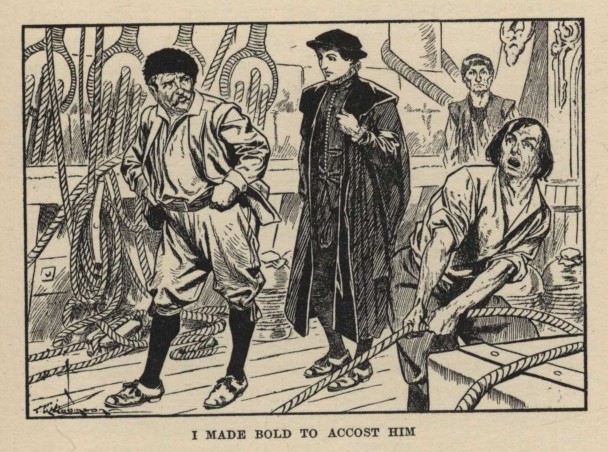
I MADE BOLD TO ACCOST HIM
"We wait for a pestilent Englishman, monsieur," he said raspingly, "a sluggard eater of beef, that will come up when the tide fails and expect us to sail against wind and weather to please his almightiness. And he must needs fill the boat with meat enough for a regiment: our provision is not good enough for him."
"I would delay for no Englishman alive," I said, "and as for his creature comforts, divide them among your mariners: I will see to it that you suffer nought."
Very soon thereafter he did indeed cast off. I responded with a grave salutation to Jean's wafture of his bonnet, and sat me down on a coil of rope to digest as well as I might Ambrose Parey his Latin.
We made good passage to Antwerp, where I did not delay to visit the goldsmith upon whom the Count de Sarney's bill of exchange was drawn. He held me in no suspicion, and was vastly serviceable in negotiating with the skipper of a vessel bound for Cadiz, as well as in conducting the other necessary parts of my business. I was some little troubled in my mind what course to pursue with my mariner. I proposed to him that, seeing the risks of my adventure, he should take ship for London, carrying a letter from me to Sir Walter Raleigh, who I made no doubt would find him employment. But he begged me so earnestly to permit him to accompany me that I yielded, though not without misgiving. I showed him that for a runagate slave to venture himself in Cadiz would be a mere running into the lion's jaws, to which he answered that, whereas on the galley his head and face were shaved, he was now as shaggy as a bear, and so would not easily be known of any man, slave or free. Furthermore I showed him how in Spain he could not hope to pass either for a Spaniard or a Frenchman, whereupon, with a readiness that raised him in my estimation, he said that he would pass very well for a Muscovite, and invented a fable of his having escaped fifteen years before from the clutches of Ivan the Terrible, and conveyed himself aboard a vessel of Sweden. To this he gave countenance by venting a torrent of outlandish phrases, assuring me 'twas a mingle-mangle of sea terms employed by the Muscovites and the Swedes; whereat I laughed very heartily, and declared that he at least would have been at no loss among the builders of Babel. The matter being thus settled to our mutual contentment, we tarried a few days in Antwerp until the time of our vessel's sailing, and then embarked together on an adventure whereof neither of us foresaw the end.
III
'Twas a fair bright day when we put into the harbour of Cadiz, and I set foot in that comely town. We took up our lodging in an inn (called venta in the Castilian tongue) built all of stone, as indeed are all the buildings, whether large or small. I spent a day in learning my way about the town, or, as Stubbs worded it, taking my bearings, and could not but admire its goodly cathedral and abbey, and its exceeding fine college of the Jesuits. The streets were for the most part so narrow, none being commonly broader than Watling Street in London, as but two men or three at the most together could in any reasonable sort march through them, and I was somewhat astonied to see that the town was altogether without glass, save only the churches. Yet the windows were fair and comely, having grates of iron to them, and large folding leaves of wainscot or the like.
Having attained a reasonable knowledge of the place, I made my way on the second day to the large flat-topped house (as are they all) which I had learnt to be the mansion of Don Ygnacio de Acosta. Before I left Antwerp I had taken pains to seal up the Count de Sarney's epistle (God pardon my duplicity!), and this I presented to a servant of exceeding magnificence at the door; the Spaniards call such majordomo: by whom I was after a tedious waiting conducted to the presence of the Captain of the Galleys. The Spaniards, as all the world knows, have the name for the nicest punctilio and courtliness, but I own that the Captain received me none too graciously. Indeed, his first words, after a briefer greeting than was seemly, were a complaint of the Count's delay in dispatching the draft, the which had occasioned Don Ygnacio to take a loan from a Jew of his town at a usurious rate of interest. I made humble excuses on my father's behalf: you are to remember that I personated Armand de Sarney: and it needed no wondrous shrewdness to discern, by the manner of the Spaniard's putting up the papers in his cabinet, that he was of a right avaricious nature. When he read the postscriptum wherein the Count de Sarney warned him against a meddlesome Englishman, he seemed to me to resemble a cock ruffling his feathers. He poured scorn upon the Count's fears and alarms, asking me whether Cadiz was Calais or even Cartagena that it lay open to any English adventurer. I might have reminded him how Sir Francis Drake burnt the King's galleys in this very harbour, but I forbore; nor would he have taken any profit of it, for the unquenchable pride and self-sufficiency of the Spaniards after so many buffets and calamities is one of the wonders of the age.
With great condescension Don Ygnacio offered me a lodging in his house until such time as I should pursue my way to Seville, and I guessed that his manner was nicely proportioned to the remote degree of his relationship to my supposed father. Moreover it bespoke no great relish for the company of a mere student. None the less I thanked him in terms whose warmth would have befitted one that had done me unimaginable honour, but declined his proffered hospitality, saying that even on my travels I diligently pursued my studies, so that I was in no wise suited to the thronging life of the world wherein so high a magnifico moved. His countenance confirmed the justness of my surmise. Then, summoning my gravest look, I said—
"I devote the greater part of my time, señor, to the investigation of the ills that affect the Ramus stomachichus, wherewith I have perceived, even in the so little time I have sojourned in your town, that many of its inhabitants are afflicted. My father bade me inquire very particularly after your health, the which by your last advice was not all that could be wished. I fear that the Ramus stomachichus is the seat of your disorder, and I trust that the treatment of your physician is meeting with the desired success."
I threw this out as a bait, and to my exceeding joy I saw that it was swallowed as greedily as a gudgeon snaps up a worm. Don Ygnacio was a mountainous man, as Stubbs had told me on the voyage, with the girth but not the hardness of an oak, his face like dough with two raisins for eyes, his whole frame betokening a consuming love of the flesh-pots and strong liquors. During my speech, delivered with a measured gravity, his face put on a look of great dolefulness, and broke out into a sweat.
"I cannot sleep," said he, in most dolorous accents.
"A certain sign," said I, nodding my head gravely.
"I dream of horrors," said he.
"Devils, and serpents, dark dens and caves, sepulchres, and dead corpses," said I, quoting the words of Ambrose Parey, which I had diligently conned on board ship, "all arising from the putrefaction and inflammation of the Ramus stomachichus, together with the afflux of noisome humours to the brain. The diaphragm hath a close community with that organ, by the nerves of the sixth conjugation which are carried in the stomach."
"I reel in the street," said he, with lamentable groans, "and when I lay my head on the pillow, I hear noises like the sound of many waters."
I shook my head solemnly, having at the moment no more of Ambrose Parey's sentences at my command. Taking him delicately by the wrist, I put my finger on his pulse, which in truth fluttered unsteadily.
"Show me your tongue," I said, and could barely avoid laughing at the grimace he made when he displayed that monstrous organ.
Then, presuming on his manifest discomposure, I dealt him a lusty buffet above the fifth rib, so that he catched at his breath, and at his outcry I inquired solicitously whether he felt any pain.
"The pains of Gehenna," he said, groaning.
I was mute, bending on him a mournful look, whereat his excitation of mind did but increase.
"I pray you, cousin, be open with me," he said. "I will steel my heart to bear it."
"Your case is not utterly hopeless," I replied with deliberation, having first hemmed and hawed in the style approved of the faculty, "but it demands careful treatment. Methinks from the symptoms that it has hitherto been treated somewhat negligently. I will return to my lodging and ponder upon it, consulting Fernelius, his Pathologia" (a work I had seen named in the pages of Ambrose Parey). "To-morrow, by your good leave, I will see you again. The true course is not to be lightly determined, but I trust that my art has resources wherewith to counter the worst symptoms of your distemper and perchance to work a cure."
"Do so, good cousin," he said. "Come early, I pray you, and by St. Iago, I shall know how to recompense you becomingly."
I took my leave, and when the door was between us, gave a loose to my merriment, hastily composing my features when the majordomo approached to conduct me to the street.
I returned to my inn, and buried my nose for some while in the folio; then betook myself to an apothecary's, where I purchased a quantity of barley creams, poppy seeds, and seeds of lettuce, purslain, and sorrel, commanding him to make a decoction of them and have it ready against I came on the morrow. This was a prescription of Ambrose Parey. I bade him also compound an admixture of the infusion of sundry simples, exceeding nauseous, yet like to do no great hurt, to wit, valerian, quassia, a trifling quantity of colocynthis (which grows very plentifully in Spain), and pix atra, by the which you shall understand common tar. This also, a bolus of my own devising, I commanded the man to have in readiness, and then found that I had a good relish for my dinner.
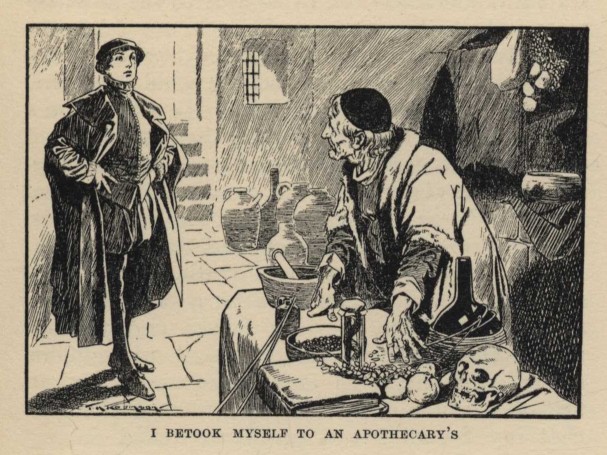
I BETOOK MYSELF TO AN APOTHECARY'S
Stubbs had already shown me where the king's galleys lay; 'twas off the east side of the town, betwixt the island and the mainland. They were four in number: these were the principal galleys, there being sixteen of an inferior sort that rode nigh to the bulwark of St. Philip, at the north-east extremity of the town. A strong fortification of stone-work ran from this bulwark towards the water-side, having its southern end beside the king's storehouse of provision and munition for his ships of war. Here, moreover, was the barrack in which certain of the galley-slaves were cabined at night, for when the galleys lay idle the greater number of the oarsmen was employed on shore in sundry laborious exercises—repairing the fortifications and the like. A little way southward of this barrack was a rampire of earth built close against the sea-wall, and furnished with three great pieces of ordnance. This kind of bulwark is called in military parlance a terrapleno. There was in the inner harbour also a fleet of near forty merchant vessels, making ready for the American voyage, and a goodly number of galleons and galliasses for the intended invasion of Ireland.
I marvelled greatly at the bravado of my companion as we passed through the marketplace, thronged with folk of all conditions—orange-sellers, horse-dealers, chapmen and hucksters innumerable—and came near to the barrack wherein he had spent many hours in anguish both of body and mind. He showed me the two portions of the building, and the window of the very room where he had lain. He showed me also a mighty fine galley lying in a manner of dock near to the king's storehouse, and on my asking a wayfarer what the vessel did there, he told me 'twas the galley of Don Ygnacio de Acosta being new furbished and fitted for sea. A great way off I saw some of the slaves, with shaven polls, and naked save for a strip of cloth about their loins, moving hither and thither about their labour, under guard of soldiers armed with halberds and arquebuses. A hot fire of wrath raged within me when I thought that my bosom friend perchance toiled among them, but I gave great heed so as that I should not approach them too nearly, lest he might spy me and by some gesture ruin the plan I had conceived for his salvation.
As we were returning to our inn from this inquisition, by way of the market-place, I observed that many curious glances were cast upon us, and being in some dubience how to account for this, I was at first ready to fear that some suspicion was entertained of me and my purposes, or else that some person had recognized my companion despite his shaggy locks and beard. But on a sudden the true explication smote upon my slumbering wits, and I took myself to task for my heedlessness. Stubbs was attired in the common garb of sailor men, and I perceived that it must indeed seem passing strange to the Spaniards, of all people the stiffest on decorum and punctilio, to see a grave student of medicine in familiar converse with a man so meanly habited. No sooner did this illumination flash upon my mind than I bid Stubbs leave me, giving him at the same time money wherewith to buy him a Spanish gaberdine, which would in some sort cloak his quality. I went on to my inn alone, pondering upon how prone men are, when devising machinations of great poise and moment, to omit some small trifling matter, which lacking, all their cunning is like to turn to futility.
Sallying forth of the inn about three of the clock, I went to my apothecary's, and took from him the vials containing the preparations he had compounded for me, together with a small Turkey sponge and a new medicine glass nicely graduated. These I gave into the hands of Stubbs, now clad in a capacious gaberdine that suited with his quality as my henchman, and bade him follow me at a reasonable interval. At the door of Don Ygnacio's house I received them from him again, and being admitted as before by the don's gentleman-usher, I found my grandee awaiting me in a quivering expectancy. His heavy countenance lightened at sight of me, and he told me with plentiful groaning that he had not shut an eye all the night through, but tossed wakeful and tormented upon his bed. I felt of his pulse and scanned his furred and sickly tongue, and then, mustering all my new-gotten lore, I discoursed very learnedly for the space of five minutes upon the distempers of the Ramus stomachichus, ending my allocution somewhat as follows—
"Having now full assurance, señor, as well by the observation of my senses as also by your own description, that this is in good sooth the distemper whereof you suffer, I must tell you in all sobriety that 'tis high time 'twere taken in hand ere it grow beyond remedy. My counsel is that you instantly command the attendance of a skilful surgeon."
"Ods my soul!" he cried (for so I render his words in our homely English), "I have employed surgeons without number, and they bleed me, both of blood and money. Do you undertake me, good cousin; but do not let my blood, I pray you, for I am not a whit better for all the gallons they have drawn from my exhausted veins."
I affected to shrink from the conduct of so serious a case, on the score of my youth and pupillary condition, and of the high nobility of his captainship; but the more backward I showed myself, so much the more instancy did he employ; in brief, he would take no denial. Whereupon I insisted that he must follow my directions without reck or hesitation, the which he avowed himself ready to do in all points. Accordingly I stripped the wrappings from my vials, and poured from the larger of them into the medicine glass, with the nicest measurement, a good dram of the villainous admixture, and called for water to allay it, and this I added with deliberate care, he keeping a wary watch on all my movements. I then bade him drink it at a draught, the which he did, afterwards spluttering and wrying his countenance to such a picture of abhorrence as came nigh to overset my studied gravity.
"Ay de mi! ay de mi!" he groaned; "'tis a very vile draught, cousin, a very villainous concoction. Must I discomfit my inwards with the whole bottle?"
"Thrice a day, señor, you must take your dose," I said.
"Permit me at least to qualify the savour of it: it is so exceeding nasty and rough upon the tongue," he said pleadingly.
"One sole glass of sherris," said I, with a great show of reluctancy; "no more, or the merits of this most potent medicine will be utterly quelled."
He drank the wine with great relish, eyeing the decanter very wistfully as I set it out of his reach. Then calling for a basin, I poured into it a little of the contents of my second vial, and dipping the sponge into the liquid, I delicately anointed his sweating brows, telling him 'twas a sure begetter of sleep tranquil as a child's.
"Your hand is rather that of a swordsman than of a physician, cousin," he said, thereby giving me a wrench in my soul, lest he began to suspect me. But he proceeded: "Yet it is delicate in its touch as a woman's; you give me great comfort, cousin."
I continued to bathe his temples until I had wrought him to a fair placidity; then admonishing him to be punctual in taking his doses of the former admixture, I left him, promising to visit him again on the morrow.
My next concern was to certify myself that Raoul was still among the galley-slaves, and whether he was of those that remained aboard or of those that were employed ashore. To this end I dispatched Stubbs to the sea-wall in the afternoon, a little before the time when, as he had told me, the day's work was wont to end, there to keep a watch. He returned soon after sunset, and told me that he had seen his whilom comrade among those that were marched into the barracks. I inquired eagerly how he looked, and my heart was very bitter when he replied that my friend was worn to a shadow, with lamentable sunken cheeks and haggard eyes. Nevertheless I rejoiced that he was yet alive, and comforted with this assurance I bent my mind to the working out of the plan I had devised for his deliverance.
On the morrow I went somewhat earlier to see my patient, whom I found wondrously gracious, for that he had slept a good four hours without waking. Indeed, he believed himself to be already cured, and I had much ado to persuade him to take his dose. I showed him that his distemper being of long standing, it was sheer madness to suppose that it could be wholly banished in so short a space of time, and proceeded to expound the necessity of continuing not only in the course he had begun, but also in a subsidiary treatment which I would forthwith explain.
Don Ygnacio, as I have said, was of enormous bulk, and the ills from which he suffered, when they were not merely figments of a disordered imagination, proceeded from too instant a devotion to meat and drink and an over-softness of living. In a word, his greatest need was temperance in these things, together with a more frequent use of his muscles. Accordingly I made him strip to his shirt and stand in his stocking feet in the middle of the room, and then put him through such simple exercises as the Dutch captains use with the common soldiers—extensions of the arms, bending of the trunk, and so forth. It was matter for merriment to see the great hulks, at my urging, make desperate endeavour to touch his toes, and come not within half a yard of accomplishing it. I kept him at these motions, paying no heed to his protestations, for a good half-hour, by the which time I had wrought him to a fine heat and perspiration, so that when finally I permitted him to sink back upon the cushions of his divan he was more wholesomely tired, I warrant, then he had been ever in his life before. While he sat and fanned himself, and quaffed slowly the cup of sherris I allowed for his refreshment, I made him a neat discourse for which I was beholden not to Master Ambrose Parey, but to my own wit. 'Twas sound sense as well as a furtherance of my device.
"You must know, señor," I said, "that this distemper of yours never assails men of spare frames and active bodies. The husbandman, the mariner, the poor scavenger of the street never suffer in this wise, nor is their Ramus stomachichus ever in peril of dissolution. In truth, their bodily exercise does but strengthen the nerves in all their conjugations, so that their inward parts perform their offices to perfection, and furthermore furnish to them in some sort an armour against the assaults of disease. For a speaking ensample you have the slaves of your galleys, those reprobates whom you have in your august charge. Did ever you know one of them to suffer from any derangement of the Ramus stomachichus?"
Since I conjectured Don Ygnacio's knowledge of the anatomy of man to be less than my own, and that was infinitely little, I got the answer that I expected, with the addition that if any galley-slave should have the impudency to suffer from a gentleman's complaint, he would certainly be cured by the bastinado.
"Now therefore," I continued, here drawing largely upon my invention, for a purpose, as you are to see—"now therefore, it is one of the miracles of our nature that a man beset by this dreadful distemper, being set in juxtaposition with a man of exceeding spareness, but otherwise sound in his members and organs, the infirmity of the one is in a manner fortified by the wholeness of the other, or as Spegelius hath it in his renowned tractate, the debility of the one is engraffed and mingled with the virtue of the other. The trial of this remedy is attended with sundry notable perils and incommodities, wherefore it is not to be lightly undertaken, and I leave it for this present until we have made a proper experimentum of the more vulgar means."
The captain heard this with great attention, and made me many compliments on the profundity of my learning, though he might have read Spegelius his tractate from cover to cover without finding the passage that I gave forth with so great unction. Leaving the precious seed to germinate, I betook myself away in high contentment, though not without a qualm and tremor at the lengths whereto my audacity was carrying me.
Having sought my faithful attendant, I dispatched him to make sundry purchases at the armourers of the town, a knife at one, a dagger at another, small weapons in goodly number, but not more than one weapon at any one shop, lest suspicion or curiosity should be excited. These weapons, when he brought them to the inn, I bade him enfold them in strips of cloth I held in readiness, and wrap them in two several parcels. While this was adoing, I took my way to the sea-wall, noting very particularly the positions of the four galleys, the extent of water betwixt them and the shore, the manner in which the shore curved to a point, and all other information that was necessary to the execution of my plan. As I walked hither and thither, I was observed by a captain of soldiers that chanced, as it seemed, to be taking the air by the sea-wall, and who accosted me, asking me with a kind of truculency what I did there.
"Noble excellency," I replied, "I am but a poor student of medicine of the French nation, making a brief sojourn in this your town."
"A Frenchman, and I warrant me a spy!" he cried, and hailing a soldier from the guard-house near by, he assured me that I should soon company with rats and beetles in the castle dungeon.
"Beseech you, señor," I said, "my illustrious cousin Don Ygnacio de Acosta, captain of the royal galleys, will have somewhat to say to that. Come with me straightway to his house, and we shall learn if such immodesty of language pleasures him."
My bold and assured mien daunted this strutting fellow, and he began incontinently to make excuse how that he wot not of my condition, and craved my pardon for the unmannerliness whereinto he had been betrayed. I took him very coldly, and set forth to return to my inn. This is a slight matter, unworthy of mention but for that which ensued.
That same evening, a little before the hour when the slaves were wont to be immured in their barrack, I came to the door of Don Ygnacio's house and inquired of the majordomo how the worshipful captain did.
"Desperately sick, señor," he replied. "He has but now commanded me to summon hither Don Diaz de Rotta, physician to the constable of the castle."
"Is the messenger gone forth?" I demanded, in no little perturbation, for the presence of a true physician was like not only to undo all my stratagems, but also to stand me in a pretty hobble. Hearing that the lackey was even then donning his outdoor livery (for among the Spaniards punctilio rules over high and low alike), I bade him stay the man until I should have seen his excellency.
When I entered to him I was amazed beyond measure to see his pitiful condition. He lay back on his divan, uttering most dismal groans, his countenance of a deathly pallor, and his eyes astare as with the very fear of death. He thrust out a feeble arm when he saw me, and cried in a faint voice—
"Out of my sight, rapscallion! You have killed me with your vile nostrums."
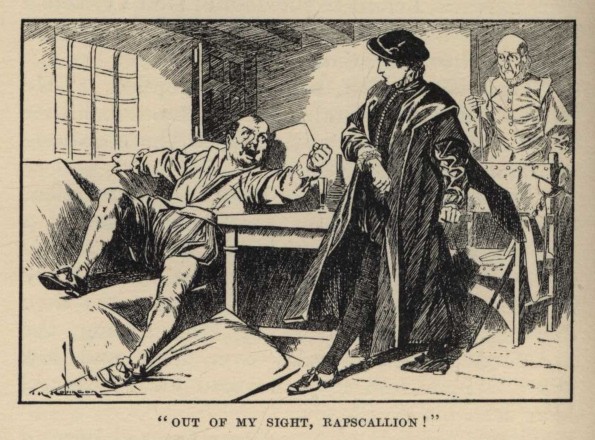
"OUT OF MY SIGHT, RAPSCALLION!"
My terror and amazement were little less than his own, for I knew my drugs to be harmless, albeit nauseous, and I could not come at any reasonable explanation of his distemperature.
I inquired of the majordomo, who had followed me into the room, the time when this alteration had manifested itself, and his answer removed all my apprehensions that Don Ygnacio was in imminent peril of dissolution. He had eaten a very hearty dinner soon after I left him, and fallen asleep, but was awakened by a violent commotion in his inward parts, and had been, to put it in plain English, as sick as a dog. It was told me afterwards by my good friend and physician Sir Miles Ruddall that my drugs themselves would not have wrought so mightily upon him but for the unwonted exercise whereto he had been enforced, and his monstrous gluttony thereafter. Having a shrewd suspicion that this was all that ailed him, I made him drink a cup of sherris mingled with cognac, and spoke soothingly to him, resolving with a stubborn hardness of heart to turn his incapacity to my own purposes. I upbraided him, mildly, yet with earnestness, for that his imprudence had well-nigh undone all my cure, and avouched that it was high time to attempt the experimentum I had formerly suggested.
"I am very sure," said I, "that there will be found among your galley-slaves a man of the right degree of leanness to accommodate your excellency, and I will instantly command your coach to attend you, so that we may go down to their place and make trial of this sovereign remedy without delay."
The strong liquors had already revived him, and his face was recovering its proper ruddiness. Likewise his spirit took on its natural hue, the proof whereof was his exceeding fierce outcry.
"Ods my valiancy!" he cried, "shall I join skins with a rascal, I, hidalgo of Spain? Never will I permit such scum to approach my person."
"Truly, señor," said I, "it is impossible to conceive a gentleman of your exalted rank coming within a span's-length of a mean rascal, but I opine that there are among the slaves some of reputable condition, perchance some English prisoners, or Flemings, only they are in general of a brawny lustiness that suiteth not with the experimentum."
"Why, so there is, now you put me in mind of it," he said with a brightened eye. "There is a Frenchman, a notorious reprobate, but that is nothing against his rank, which is but little less than my own. And for leanness a rake could hardly match him; his leanness is not far short of transparency."
"That is right good hap," said I, raging inwardly that he should speak thus of my friend, for I made no doubt it was he. After fortifying him with more wine, I linked my arm with his, and took him slowly to his coach, and when we had mounted into it, gave the word to the driver to convey us to the barrack. We halted for a brief space at the inn, and I brought out my henchman, carrying the two parcels which, as I told Don Ygnacio, held things needful for our trial. I bade Stubbs perch himself beside the driver, and we went on.
We had to pass on our way the small dock wherein the captain's galley lay, and here I let fall a word of admiration of the fine lines of the vessel, asking very innocently whether it were one of the royal galleys of his charge.
"It is my own vessel," he said with much complacency, and then nothing would content him but I must instantly go with him and see the vessel more closely. It was plain he held it in high esteem, and since I had a reason of my own for desiring a nearer acquaintance with it, I yielded to his wish in the manner of one humouring a sick person. He was by this time, in truth, so nearly returned to his wonted state that I began to fear lest he should declare the experiment of transfusion unnecessary. I accompanied him aboard the vessel, where he showed me the place for the crew, and those for the rowers and the soldiers, and his own place, very richly caparisoned; also the piles of arms and some barrels of gunpowder. Having admired the galley and all its appurtenances with great fluency of utterance, I entreated him to proceed to the barrack, advising him that the day was already far spent, and it were best to accomplish our purpose before the chill of night descended on us. And so we came to the barrack.
IV
Notwithstanding, or maybe by reason of, the marvellous good hap that had attended all my devices up to this present time, I was aware of a flutter of disquietude about my heart as I followed Don Ygnacio into the building. What I purposed doing must needs be done very quickly, and one untoward accident might very well prick the bladder of my imposture and wreathe a noose about my neck. I had laid my plans as warily as I might, and now all stood upon my composure, the degree of brazen-facedness I could muster, and the degree to which the Spaniard could be gulled.
We came first, having entered the passage, to the guard-room, where some dozen soldiers were assembled, casting the dice and taking their ease. The door of a room adjacent to it stood open, and there my eyes lit upon the captain that had accosted me by the sea-wall, who, when he beheld me, rose up from his seat with trepidation, believing without doubt that I had brought his general to punish him. I paid not the least heed to him, and he made haste at Don Ygnacio's bidding to go to the hall beyond, where the galley-slaves were confined, and bring forth the Frenchman.
When he was gone I asked Don Ygnacio whether there were not some private room where we might do our business, since it was not seemly that we should be at the gaze of so many goggling eyes while the experimentum was a-doing. He led me to a small ante-chamber some few steps along the passage towards the hall, Stubbs remaining with his parcels at the door of the guard-room, perfectly at ease, though he stood within arm's-length of the men that had formerly oppressed him. Presently I heard a clanking of chains, and the captain returned, bringing with him a lean and lanky scarecrow of a man, naked save for his loin-cloth, his poll and face being shaven clean. It smote me to the heart to see in his hollow eyes and sunken cheeks the altered lineaments of my dear friend, erstwhile comely and jocund as any you would see. He lifted his eyes as he came in, and regarded Don Ygnacio with a look of gall, not turning his gaze upon me.
"A sorry knave," said the Spaniard to me. "Think you, cousin, there is enough virtue in him for our business?"
"We can but try, excellency," I said, and at the words Raoul shivered and looked at me with such amazement that I feared lest an unlucky word should betray me. I dealt upon him a sudden and meaning frown, the which escaped the observation of the others, they having eyes for the slave alone. To my exceeding joy he had the wit to take me, and cast down his eyes in the manner of one that hath no more hold upon the world. Then I turned to Don Ygnacio and said:
"He hath a wild look, señor. It were meet that we have two soldiers here with us, so that we may make our trial in comfort and security."
"Certes," he replied, "we have already Captain Badillo; we will have a man from the guard-room."
"By your pardon, señor," I said, "the señor captain did me the honour to affront me a while ago, and his presence at this time will so trouble the conjugations of the nerves, the which needs must be in perfect tranquillity, as to imperil the good success of our undertaking."
"It was a lamentable error, excellency," stammered the captain. "I wot not that the worthy physician was akin to your excellency."
"Go, sirrah," said Don Ygnacio sternly. "Who affronts my kin affronts me. Send hither two men from the guard-room."
I was never better pleased in my life than when the captain departed, for the two common ignorant soldiers would be much less like to suspect me. Thereupon I called to Stubbs to bring in the parcels, and when he came, a little behind the soldiers, I shut the door, bade him undo one of his bundles, and said gravely that all would soon be ready for the experimentum.
Stubbs loosed the ropes and laid them, in the manner of a careful servant, beside the bundle. From this when it was unrolled he took first three strips of a dark cloth, about an ell long, which he laid over his arm. Then he brought forth a small roll of white canvas and gave it to me. I motioned him to withdraw to a little distance, as also the soldiers; then I made Raoul stand a few paces from Don Ygnacio, facing him. Posting myself betwixt the two, I drew from my pocket a small box of powder of chalk, and unrolled the canvas, yet so that the Spaniard might not see its inner side, and with solemn circumstance I dusted it with the powder. This done, I stretched it out between my arms, and making two strides towards Raoul I bade him look intently thereupon while I counted ten. I heard Don Ygnacio breathing hard behind me as I gravely told the numbers one by one, and when Raoul informed me with his eyes that he had read the words I had carefully imprinted on the canvas (they were: "Grip the Spaniard by the neck whenas I give the sign") I rolled up the canvas and stepped slowly backward, beckoning with the one hand Don Ygnacio, with the other Stubbs and the soldiers, to draw near.
You are now to observe that Raoul and Don Ygnacio were within a hand-breadth of each other, that one of the soldiers was close to me, and the second beside Stubbs. All was silent. On a sudden I let forth, very sharply but without raising my voice, the one word "Now!" Instantly Raoul was at Don Ygnacio's throat; I closed with my soldier and held him in a strangling embrace; and Stubbs, with the neatness of a skilled hand, dealt his man a blow that stretched him senseless on the floor. Quick as thought he handed to us two of the cloths that he had upon his arm, and we clapped them into the mouths of our prisoners, he doing the like with the third. So sudden were our motions that there had been not the least opportunity of resisting us, and though Don Ygnacio offered to cry out before the gag was comfortably settled between his teeth, Raoul bade him in a fierce whisper be silent or his life was forfeit. It was short work to truss them with the ropes, thanks to Stubbs his deftness, and I knew with infinite gladness of heart that the first part of my device was accomplished.
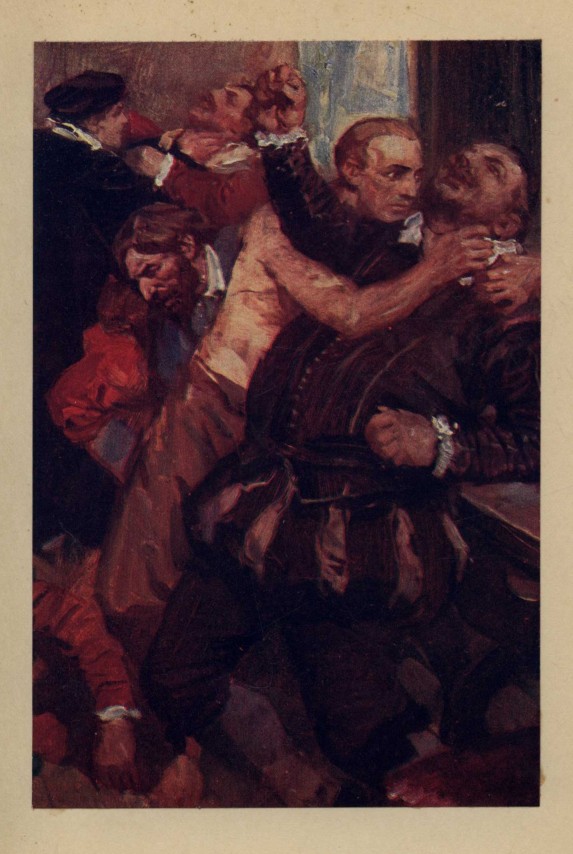
INSTANTLY RAOUL WAS AT DON YGNACIO'S THROAT
There was still much to do, and our peril was but beginning. In two words I acquainted Raoul with my plan. I asked him how many soldiers were on guard among the galley-slaves; he told me four, and every one had a key to the padlocks wherewith they were fettered to the wall. My design was to set free the slaves, seize upon the Captain-General's galley, the which he had so obligingly shown me, and put to sea. It was necessary to our success that the soldiers in the guard-room should be silenced, and also the Captain Badillo, if he was yet at hand; but since we could not hope, being but three, to overcome a dozen men, we must perforce first set free the slaves, by whose assistance the feat might be easily compassed. Moreover, there was great need for haste, Stubbs having told me that it was drawing near the time when the cookmen were wont to bring in the slaves' supper from the outhouses.
I opened the door stealthily, and peered along the passage to the guard-room. There was none in sight, but neither was there so much noise proceeding from the room as I should have liked. Nevertheless, since our case was desperate and would not abide long rumination, we durst not stay for the nice weighing of chances, but had to act at once. I had had the soldiers brought into the room for a purpose, namely, that we might dress ourselves in their garments and so gain some covert for our device. I bade Stubbs strip the two soldiers of their gaberdines, and these we donned, he and I, and then proceeded with all quietness along the passage to the slaves' hall, Raoul being carried betwixt us, so that the clanking of his chains might not draw the soldiers forth of the guard-room.
Coming to the door of the hall we set Raoul down, and thrust him before us into the room, entering close behind him. I saw in a quick glance the miserable slaves lying in a long row by the wall, and four soldiers conversing in a group about the middle of the room. The dusk of evening forbade them to perceive at once that the two supposed soldiers that had entered were not their comrades, and when at our approach they were certified thereof they had not the time to collect their wits, for Stubbs, by a little the foremost, smote one of them a dint that sent him headlong against the wall, and then immediately grappled with another. Meanwhile Raoul and I had not been idle, each dealing with his man, and in a few moments we had all four at our feet, begging for mercy.
This had not passed without some noise, but having been careful to shut the stout oaken door behind me I had a reasonable hope that the sound would not have penetrated to the guard-room. The clamour that might have been feared from the slaves did not arise, so great was their consternation. I asked Raoul to acquaint them with our design, whiles that with Stubbs' aid I stripped the soldiers of their outer garments and their arms, and trussed and gagged them as we had done afore with the others.
Raoul told the men that all who could muster their courage had a good chance of escape, but they must in all points obey me, a countryman of the great Dragon (so Sir Francis Drake was commonly known among them), who had come to their succour, and had already made a prisoner of Don Ygnacio. He promised them hard work, and maybe their fill of fighting, and adjured every man that had no stomach for it to remain in his fetters rather than irk the rest. Then we went swiftly from one to another, unlocking their chains with the keys we had taken from the soldiers. Never a man of them elected to remain, and though Raoul was for leaving certain of them that he knew to be poor-spirited, I deemed it best to release them all, lest those that were left should raise an uproar and so bring us into danger.