TEMPERATURE RELATIONSHIPS
Reading edition
Ant-eating frogs are active over a temperature range of at least 16° C. to 37.6° C. They tolerate high temperatures that would be lethal to many other kinds of amphibians, but are more sensitive to low temperatures than any of the other local species, and as a result their seasonal schedule resembles that of the larger lizards and snakes more than those of other local amphibians. The latter become active earlier in the spring.
Earliest recorded dates when the frogs were found active in the course of the present study from 1950 to 1955 were in April every year; the 20th, 25th, 24th, 2nd, 25th, and 21st. Latest dates when the frogs were found in the six years of the study were: October 22, 1949; October 13, 1950; October 7, 1951; August 24, 1952; August 18, 1953; and October 27, 1954 (excluding two late stragglers caught in a pitfall on December 5). Severe drought caused unseasonably early retirement in 1952 and 1953.
Body temperatures of the frogs were taken with a small mercury thermometer of the type described by Bogert (1949: 197); the bulb was used to force open the mouth and was thrust down the gullet into the stomach. To prevent conduction of heat from the hand, the frog was held down through several layers of cloth, at the spot where it was discovered, until the temperature reading could be made. This required approximately five seconds.
Fig. 1. Temperatures of ant-eating frogs grouped in one-degree intervals; upper figure is of frogs found active in the open, and lower is of those found under shelter. The frogs are active over a temperature range of more than 20 degrees, and show no clear cut preference within this range.
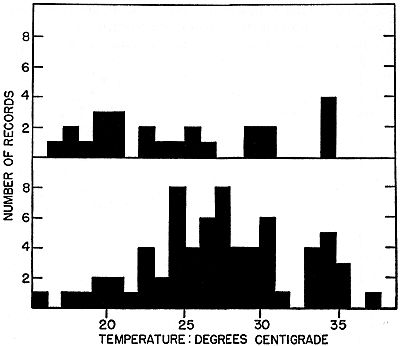
Most of the 79 frogs of which temperatures were measured, were found under shelter, chiefly beneath flat rocks. The rocks most utilized were in open situations, exposed to sunshine. Most of the frogs were in contact with the warmed undersurfaces of such rocks. Forty-three of the frogs, approximately 54.5 percent, were in the eight-degree range between 24° and 31° C. Probably the preferred temperatures lie within this range. The highest body temperature recorded, 37.6° C., was in a frog which "froze" and remained motionless in the sunshine for half a minute after the rock sheltering it was overturned. Probably its temperature was several degrees lower while it was sheltered by the rock. Other unusually high temperatures were recorded in newly metamorphosed frogs found hiding in piles of decaying vegetation near the edge of the pond, on hot afternoons of late August. Temperatures ranged from 17.0° to 30.7° in frogs that were found actually moving about. Several with relatively low temperatures, 22° to 17°, were juveniles travelling in rain or mist on cool days. These frogs, having relatively low temperature, were sluggish in their movements, as compared with individuals at the upper end of the temperature range.
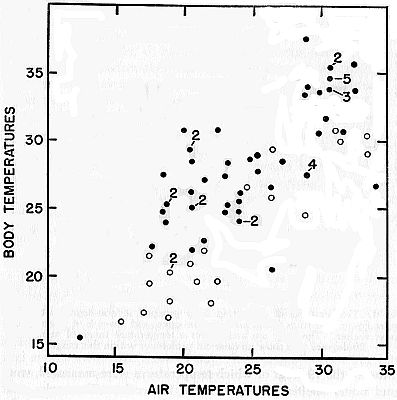
Fig. 2. Body temperatures and nearby air temperatures for frogs found under natural conditions. Dots represent frogs found under shelter; circles represent those found in the open.
After the first frost each year the frogs usually could not be found, either in the open or in their usual hiding places beneath rocks. They probably had retired to deep subterranean hibernation sites. The only exception was in 1954, when two immature frogs were found together in a pitfall on the morning of December 5 after a rain of .55 inches ending many weeks of drought. Air temperature had been little above 10° C. that night, but had often been below freezing in the preceding five weeks.
Reactions of these same two individuals to low temperatures were tested in the laboratory. At a body temperature of 11° C. they were extremely sluggish. They were capable of slow, waddling movements, but were reluctant to move and tended to crouch motionless. Even when they were prodded, they usually did not move away, but merely flinched slightly. At 6° C. they were even more sluggish, and seemed incapable of locomotion, as they could not be induced to hop or walk by prodding with a fine wire. When placed upside down on a flat surface, they could turn over, but did so slowly, sometimes only after a minute or more had elapsed. Respiratory throat movements numbered 46 and 60 per minute.